Electrochemical and Optical Properties of Boron Doped
Diamond Electrodes with Metallic Microdots
Chiuan-Yi Li1,*, Yonhua Tzeng1,2, Erhard Kohn3 , Michele Dipalo3 and Chih-Yi Liu4
1Institute of Nanotechnology and Microsystems Engineering, National Cheng Kung
University, Tainan, 701, Taiwan
2Institute of Microelectronics, National Cheng Kung University, Tainan, 701, Taiwan
3Institute of Electron Devices and Circuits, Ulm University, Ulm, Germany
4Department of Electro-Optical Engineering, National Cheng Kung University, Tainan,
701,Taiwan
*E-mail:q26984030@mail.ncku.edu.tw; Tel: +886-982-489-533
Abstract
Experimental and Results
Introduction
Conclusions
Acknowledgement
Boron doped diamond (BDD) electrodes possess excellent electrochemical characteristics, such as low and stable background current, wide working potential window,
and good physical and chemical stability. However, highly boron doped films are black and thus not transparent. For some applications, conductive, transparent and
chemically stable electrodes are needed. For this experiment a thin (1μm) boron doped cap layer (NA=1020 cm-3) has been grown on an undoped diamond (NCD) base
layer (of 1μm thickness) on Si using bias-enhanced nucleation (BEN) and hot-filament chemical vapor deposition (HFCVD). After removing the Si substrate (and the
disordered nucleation layer), a transparent and conductive diamond electrode is achieved. To improve the electrochemical sensitivity of the BDD electrode, diamond
surface has been deposited and patterned with metallic microdots which cover only a small fraction of the diamond surface and, therefore, have insignificant effect on the
transparency of the electrode. Platinum and titanium microdots were deposited on the BDD surface by sputtering and/or thermal evaporation. Because platinum doesn’t
form a stable bonding with carbon, titanium was used as an interfacial layer. Annealing at 900℃ was carried out to form a Ti carbide interface to facilitate a stable bonding
of the platinum overlayer to the BDD.
(A) Fabrication of diamond electrodes on silicon
Si
NCD
BDD 1 μm
1 μm
500μmSi
Transparent diamond film
cluster diameter: 2 µm
distance: 6 µm
surface coverage: 11%
Optical microscope photos
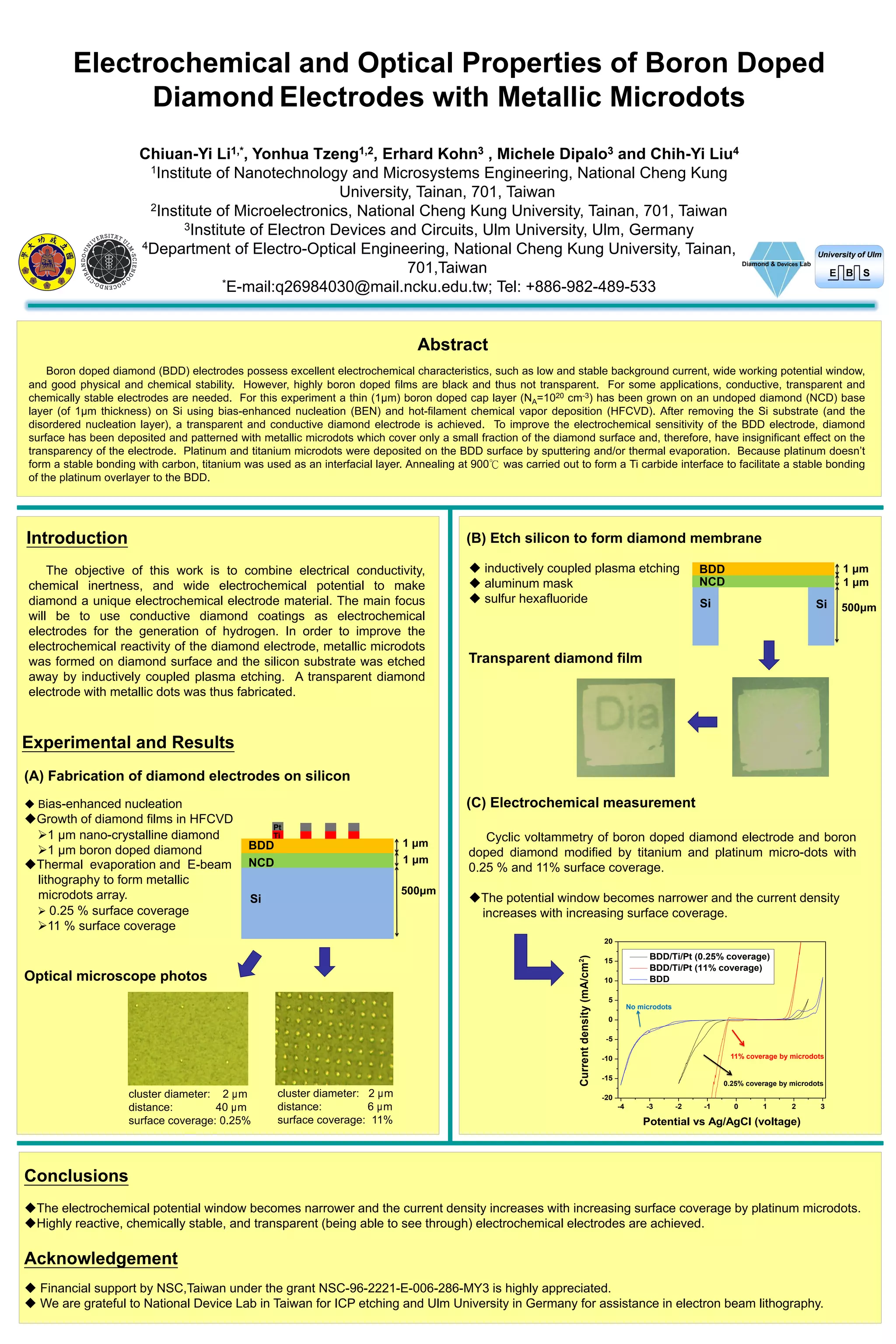
Cyclic voltammetry of boron doped diamond electrode and boron
doped diamond modified by titanium and platinum micro-dots with
0.25 % and 11% surface coverage.
The potential window becomes narrower and the current density
increases with increasing surface coverage.
(C) Electrochemical measurement
-4 -3 -2 -1 0 1 2 3
-20
-15
-10
-5
0
5
10
15
20
Currentdensity(mA/cm2
)
Potential vs Ag/AgCl (voltage)
BDD/Ti/Pt (0.25% coverage)
BDD/Ti/Pt (11% coverage)
BDD
No microdots
11% coverage by microdots
0.25% coverage by microdots
(B) Etch silicon to form diamond membrane
Si
NCD
1 μm
1 μm
500μm
BDD
Ti
Pt
 inductively coupled plasma etching
 aluminum mask
 sulfur hexafluoride
 Bias-enhanced nucleation
Growth of diamond films in HFCVD
Thermal evaporation and E-beam
lithography to form metallic
microdots array.
1 μm nano-crystalline diamond
1 μm boron doped diamond
 0.25 % surface coverage
11 % surface coverage
cluster diameter: 2 µm
distance: 40 µm
surface coverage: 0.25%
The electrochemical potential window becomes narrower and the current density increases with increasing surface coverage by platinum microdots.
Highly reactive, chemically stable, and transparent (being able to see through) electrochemical electrodes are achieved.
The objective of this work is to combine electrical conductivity,
chemical inertness, and wide electrochemical potential to make
diamond a unique electrochemical electrode material. The main focus
will be to use conductive diamond coatings as electrochemical
electrodes for the generation of hydrogen. In order to improve the
electrochemical reactivity of the diamond electrode, metallic microdots
was formed on diamond surface and the silicon substrate was etched
away by inductively coupled plasma etching. A transparent diamond
electrode with metallic dots was thus fabricated.
 Financial support by NSC,Taiwan under the grant NSC-96-2221-E-006-286-MY3 is highly appreciated.
 We are grateful to National Device Lab in Taiwan for ICP etching and Ulm University in Germany for assistance in electron beam lithography.
Diamond & Devices Lab

02

  • 1.
    Electrochemical and OpticalProperties of Boron Doped Diamond Electrodes with Metallic Microdots Chiuan-Yi Li1,*, Yonhua Tzeng1,2, Erhard Kohn3 , Michele Dipalo3 and Chih-Yi Liu4 1Institute of Nanotechnology and Microsystems Engineering, National Cheng Kung University, Tainan, 701, Taiwan 2Institute of Microelectronics, National Cheng Kung University, Tainan, 701, Taiwan 3Institute of Electron Devices and Circuits, Ulm University, Ulm, Germany 4Department of Electro-Optical Engineering, National Cheng Kung University, Tainan, 701,Taiwan *E-mail:q26984030@mail.ncku.edu.tw; Tel: +886-982-489-533 Abstract Experimental and Results Introduction Conclusions Acknowledgement Boron doped diamond (BDD) electrodes possess excellent electrochemical characteristics, such as low and stable background current, wide working potential window, and good physical and chemical stability. However, highly boron doped films are black and thus not transparent. For some applications, conductive, transparent and chemically stable electrodes are needed. For this experiment a thin (1μm) boron doped cap layer (NA=1020 cm-3) has been grown on an undoped diamond (NCD) base layer (of 1μm thickness) on Si using bias-enhanced nucleation (BEN) and hot-filament chemical vapor deposition (HFCVD). After removing the Si substrate (and the disordered nucleation layer), a transparent and conductive diamond electrode is achieved. To improve the electrochemical sensitivity of the BDD electrode, diamond surface has been deposited and patterned with metallic microdots which cover only a small fraction of the diamond surface and, therefore, have insignificant effect on the transparency of the electrode. Platinum and titanium microdots were deposited on the BDD surface by sputtering and/or thermal evaporation. Because platinum doesn’t form a stable bonding with carbon, titanium was used as an interfacial layer. Annealing at 900℃ was carried out to form a Ti carbide interface to facilitate a stable bonding of the platinum overlayer to the BDD. (A) Fabrication of diamond electrodes on silicon Si NCD BDD 1 μm 1 μm 500μmSi Transparent diamond film cluster diameter: 2 µm distance: 6 µm surface coverage: 11% Optical microscope photos Cyclic voltammetry of boron doped diamond electrode and boron doped diamond modified by titanium and platinum micro-dots with 0.25 % and 11% surface coverage. The potential window becomes narrower and the current density increases with increasing surface coverage. (C) Electrochemical measurement -4 -3 -2 -1 0 1 2 3 -20 -15 -10 -5 0 5 10 15 20 Currentdensity(mA/cm2 ) Potential vs Ag/AgCl (voltage) BDD/Ti/Pt (0.25% coverage) BDD/Ti/Pt (11% coverage) BDD No microdots 11% coverage by microdots 0.25% coverage by microdots (B) Etch silicon to form diamond membrane Si NCD 1 μm 1 μm 500μm BDD Ti Pt  inductively coupled plasma etching  aluminum mask  sulfur hexafluoride  Bias-enhanced nucleation Growth of diamond films in HFCVD Thermal evaporation and E-beam lithography to form metallic microdots array. 1 μm nano-crystalline diamond 1 μm boron doped diamond  0.25 % surface coverage 11 % surface coverage cluster diameter: 2 µm distance: 40 µm surface coverage: 0.25% The electrochemical potential window becomes narrower and the current density increases with increasing surface coverage by platinum microdots. Highly reactive, chemically stable, and transparent (being able to see through) electrochemical electrodes are achieved. The objective of this work is to combine electrical conductivity, chemical inertness, and wide electrochemical potential to make diamond a unique electrochemical electrode material. The main focus will be to use conductive diamond coatings as electrochemical electrodes for the generation of hydrogen. In order to improve the electrochemical reactivity of the diamond electrode, metallic microdots was formed on diamond surface and the silicon substrate was etched away by inductively coupled plasma etching. A transparent diamond electrode with metallic dots was thus fabricated.  Financial support by NSC,Taiwan under the grant NSC-96-2221-E-006-286-MY3 is highly appreciated.  We are grateful to National Device Lab in Taiwan for ICP etching and Ulm University in Germany for assistance in electron beam lithography. Diamond & Devices Lab