Introduction to
Java Programming, 4E
Y. Daniel Liang
2
Introduction
Course Objectives
Organization of the Book
3
Course Objectives
Upon completing the course, you will understand
– Create, compile, and run Java programs
– Primitive data types
– Java control flow
– Methods
– Arrays (for teaching Java in two semesters, this could be the end)
– Object-oriented programming
– Core Java classes (Swing, exception, internationalization,
multithreading, multimedia, I/O, networking, Java
Collections Framework)
4
Course Objectives, cont.
You will be able to
– Develop programs using Forte
– Write simple programs using primitive data
types, control statements, methods, and arrays.
– Create and use methods
– Develop a GUI interface and Java applets
– Write interesting projects
– Establish a firm foundation on Java concepts
5
Book Chapters
Part I: Fundamentals of Programming
– Chapter 1 Introduction to Java
– Chapter 2 Primitive Data Types and Operations
– Chapter 3 Control Statements
– Chapter 4 Methods
– Chapter 5 Arrays
6
Book Chapters, cont.
Part II: Object-Oriented Programming
– Chapter 6 Objects and Classes
– Chapter 7 Strings
– Chapter 8 Class Inheritance and Interfaces
– Chapter 9 Object-Oriented Software Development
7
Book Chapters, cont.
Part III: GUI Programming
– Chapter 10 Getting Started with GUI Programming
– Chapter 11 Creating User Interfaces
– Chapter 12 Applets and Advanced GUI
8
Book Chapters, cont.
Part IV: Developing Comprehensive Projects
– Chapter 13 Exception Handling
– Chapter 14 Internationalization
– Chapter 15 Multithreading
– Chapter 16 Multimedia
– Chapter 17 Input and Output
– Chapter 18 Networking
– Chapter 19 Java Data Structures
9
Chapter 1 Introduction to Java
and Forte
What Is Java?
Getting Started With Java Programming
– Create, Compile and Running a Java
Application
10
What Is Java?
History
Characteristics of Java
11
History
James Gosling and Sun Microsystems
Oak
Java, May 20, 1995, Sun World
HotJava
– The first Java-enabled Web browser
JDK Evolutions
J2SE, J2ME, and J2EE (not mentioned in the
book, but could discuss here optionally)
12
Characteristics of Java
Java is simple
Java is object-oriented
Java is distributed
Java is interpreted
Java is robust
Java is secure
Java is architecture-neutral
Java is portable
Java’s performance
Java is multithreaded
Java is dynamic
13
JDK Versions
JDK 1.02 (1995)
JDK 1.1 (1996)
Java 2 SDK v 1.2 (a.k.a JDK 1.2, 1998)
Java 2 SDK v 1.3 (a.k.a JDK 1.3, 2000)
Java 2 SDK v 1.4 (a.k.a JDK 1.4, 2002)
14
JDK Editions
Java Standard Edition (J2SE)
– J2SE can be used to develop client-side standalone
applications or applets.
Java Enterprise Edition (J2EE)
– J2EE can be used to develop server-side applications
such as Java servlets and Java ServerPages.
Java Micro Edition (J2ME).
– J2ME can be used to develop applications for mobile
devices such as cell phones.
This book uses J2SE to introduce Java
programming.
15
Java IDE Tools
Forte by Sun MicroSystems
Borland JBuilder
Microsoft Visual J++
WebGain Café
IBM Visual Age for Java
16
Getting Started with Java
Programming
A Simple Java Application
Compiling Programs
Executing Applications
17
A Simple Application
Example 1.1
//This application program prints Welcome
//to Java!
package chapter1;
public class Welcome {
public static void main(String[] args) {
System.out.println("Welcome to Java!");
}
}
RunRunSourceSource
NOTE: To run the program,
install slide files on hard
disk.
18
Creating and Compiling Programs
On command line
– javac file.java Source Code
Create/Modify Source Code
Compile Source Code
i.e. javac Welcome.java
Bytecode
Run Byteode
i.e. java Welcome
Result
If compilation errors
If runtime errors or incorrect result
19
Executing Applications
On command line
– java classname
Java
Interpreter
on Windows
Java
Interpreter
on Sun Solaris
Java
Interpreter
on Linux
Bytecode
...
20
Example
javac Welcome.java
java Welcome
output:...
21
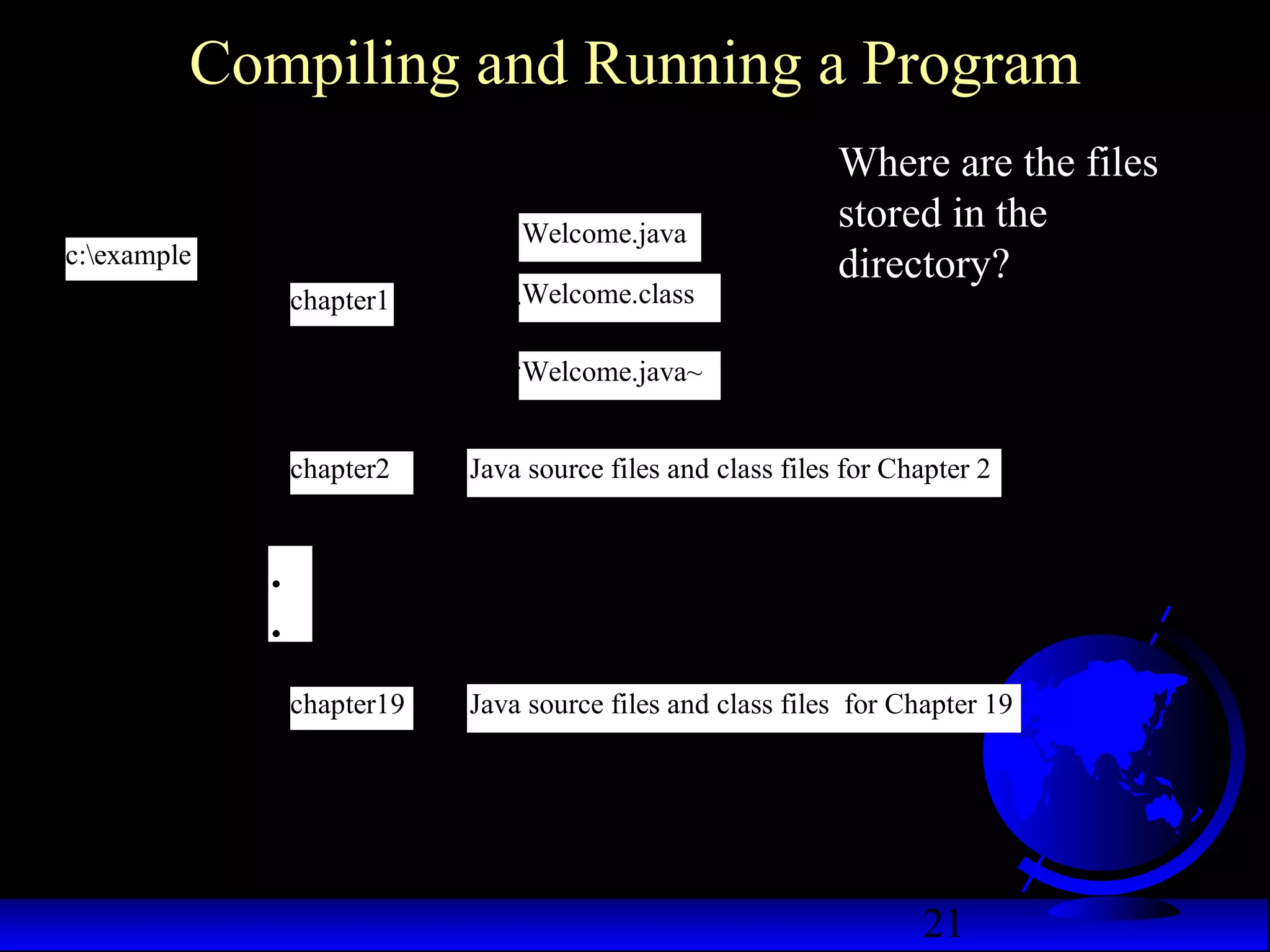
Compiling and Running a Program
Where are the files
stored in the
directory?c:example
chapter1 Welcome.class
Welcome.java
chapter2
.
.
.
Java source files and class files for Chapter 2
chapter19 Java source files and class files for Chapter 19
Welcome.java~
22
Anatomy of a Java Program
Comments
Package
Reserved words
Modifiers
Statements
Blocks
Classes
Methods
The main method
23
Comments
In Java, comments are
preceded by two slashes (//)
in a line, or enclosed
between /* and */ in one or
multiple lines. When the
compiler sees //, it ignores
all text after // in the
same line. When it sees /*,
24
Package
The second line in the program
(package chapter1;) specifies a package
name, chapter1, for the class Welcome.
Forte compiles the source code in
Welcome.java, generates
Welcome.class, and stores
Welcome.class in the chapter1 folder.
25
Reserved Words
Reserved words or keywords are
words that have a specific
meaning to the compiler and
cannot be used for other
purposes in the program. For
example, when the compiler sees
the word class, it understands
that the word after class is the
name for the class. Other
reserved words in Example 1.1
26
Modifiers
Java uses certain reserved words called
modifiers that specify the properties of the
data, methods, and classes and how they
can be used. Examples of modifiers are
public and static. Other modifiers are
private, final, abstract, and protected. A
public datum, method, or class can be
accessed by other programs. A private
datum or method cannot be accessed by
other programs. Modifiers are discussed in
Chapter 6, "Objects and Classes."
27
Statements
A statement represents an
action or a sequence of
actions. The statement
System.out.println("Welcome
to Java!") in the program in
Example 1.1 is a statement
to display the greeting
"Welcome to Java!" Every
statement in Java ends with
28
Blocks
A pair of braces in a program
forms a block that groups
components of a program.
public class Test {
public static void main(String[] args) {
System.out.println("Welcome to Java!");
}
}
Class block
Method block
29
Classes
The class is the essential Java
construct. A class is a template
or blueprint for objects. To
program in Java, you must
understand classes and be able
to write and use them. The
mystery of the class will
continue to be unveiled
throughout this book. For now,
though, understand that a
30
Methods
What is System.out.println? It is a method: a
collection of statements that performs a
sequence of operations to display a
message on the console. It can be used
even without fully understanding the
details of how it works. It is used by
invoking a statement with a string
argument. The string argument is enclosed
within parentheses. In this case, the
argument is "Welcome to Java!" You can
call the same println method with a
31
main Method
The main method provides the
control of program flow. The
Java interpreter executes the
application by invoking the main
method.
The main method looks like this:
public static void main(String[]
args) {
32
Displaying Text in a Message
Dialog Box
you can use the showMessageDialog
method in the JOptionPane class.
JOptionPane is one of the many
predefined classes in the Java system,
which can be reused rather than
“reinventing the wheel.”
RunRunSourceSource
33
The showMessageDialog Method
JOptionPane.showMessageDialog(null, "Welcome
to Java!",
"Example 1.2",
JOptionPane.INFORMATION_MESSAGE));
34
The exit Method
Use Exit to terminate the program and stop
all threads.
NOTE: When your program starts, a thread
is spawned to run the program. When the
showMessageDialog is invoked, a separate
thread is spawned to run this method. The
thread is not terminated even you close the
dialog box. To terminate the thread, you
have to invoke the exit method.

01slide (1)ffgfefge

  • 1.
  • 2.
  • 3.
    3 Course Objectives Upon completingthe course, you will understand – Create, compile, and run Java programs – Primitive data types – Java control flow – Methods – Arrays (for teaching Java in two semesters, this could be the end) – Object-oriented programming – Core Java classes (Swing, exception, internationalization, multithreading, multimedia, I/O, networking, Java Collections Framework)
  • 4.
    4 Course Objectives, cont. Youwill be able to – Develop programs using Forte – Write simple programs using primitive data types, control statements, methods, and arrays. – Create and use methods – Develop a GUI interface and Java applets – Write interesting projects – Establish a firm foundation on Java concepts
  • 5.
    5 Book Chapters Part I:Fundamentals of Programming – Chapter 1 Introduction to Java – Chapter 2 Primitive Data Types and Operations – Chapter 3 Control Statements – Chapter 4 Methods – Chapter 5 Arrays
  • 6.
    6 Book Chapters, cont. PartII: Object-Oriented Programming – Chapter 6 Objects and Classes – Chapter 7 Strings – Chapter 8 Class Inheritance and Interfaces – Chapter 9 Object-Oriented Software Development
  • 7.
    7 Book Chapters, cont. PartIII: GUI Programming – Chapter 10 Getting Started with GUI Programming – Chapter 11 Creating User Interfaces – Chapter 12 Applets and Advanced GUI
  • 8.
    8 Book Chapters, cont. PartIV: Developing Comprehensive Projects – Chapter 13 Exception Handling – Chapter 14 Internationalization – Chapter 15 Multithreading – Chapter 16 Multimedia – Chapter 17 Input and Output – Chapter 18 Networking – Chapter 19 Java Data Structures
  • 9.
    9 Chapter 1 Introductionto Java and Forte What Is Java? Getting Started With Java Programming – Create, Compile and Running a Java Application
  • 10.
  • 11.
    11 History James Gosling andSun Microsystems Oak Java, May 20, 1995, Sun World HotJava – The first Java-enabled Web browser JDK Evolutions J2SE, J2ME, and J2EE (not mentioned in the book, but could discuss here optionally)
  • 12.
    12 Characteristics of Java Javais simple Java is object-oriented Java is distributed Java is interpreted Java is robust Java is secure Java is architecture-neutral Java is portable Java’s performance Java is multithreaded Java is dynamic
  • 13.
    13 JDK Versions JDK 1.02(1995) JDK 1.1 (1996) Java 2 SDK v 1.2 (a.k.a JDK 1.2, 1998) Java 2 SDK v 1.3 (a.k.a JDK 1.3, 2000) Java 2 SDK v 1.4 (a.k.a JDK 1.4, 2002)
  • 14.
    14 JDK Editions Java StandardEdition (J2SE) – J2SE can be used to develop client-side standalone applications or applets. Java Enterprise Edition (J2EE) – J2EE can be used to develop server-side applications such as Java servlets and Java ServerPages. Java Micro Edition (J2ME). – J2ME can be used to develop applications for mobile devices such as cell phones. This book uses J2SE to introduce Java programming.
  • 15.
    15 Java IDE Tools Forteby Sun MicroSystems Borland JBuilder Microsoft Visual J++ WebGain Café IBM Visual Age for Java
  • 16.
    16 Getting Started withJava Programming A Simple Java Application Compiling Programs Executing Applications
  • 17.
    17 A Simple Application Example1.1 //This application program prints Welcome //to Java! package chapter1; public class Welcome { public static void main(String[] args) { System.out.println("Welcome to Java!"); } } RunRunSourceSource NOTE: To run the program, install slide files on hard disk.
  • 18.
    18 Creating and CompilingPrograms On command line – javac file.java Source Code Create/Modify Source Code Compile Source Code i.e. javac Welcome.java Bytecode Run Byteode i.e. java Welcome Result If compilation errors If runtime errors or incorrect result
  • 19.
    19 Executing Applications On commandline – java classname Java Interpreter on Windows Java Interpreter on Sun Solaris Java Interpreter on Linux Bytecode ...
  • 20.
  • 21.
    21 Compiling and Runninga Program Where are the files stored in the directory?c:example chapter1 Welcome.class Welcome.java chapter2 . . . Java source files and class files for Chapter 2 chapter19 Java source files and class files for Chapter 19 Welcome.java~
  • 22.
    22 Anatomy of aJava Program Comments Package Reserved words Modifiers Statements Blocks Classes Methods The main method
  • 23.
    23 Comments In Java, commentsare preceded by two slashes (//) in a line, or enclosed between /* and */ in one or multiple lines. When the compiler sees //, it ignores all text after // in the same line. When it sees /*,
  • 24.
    24 Package The second linein the program (package chapter1;) specifies a package name, chapter1, for the class Welcome. Forte compiles the source code in Welcome.java, generates Welcome.class, and stores Welcome.class in the chapter1 folder.
  • 25.
    25 Reserved Words Reserved wordsor keywords are words that have a specific meaning to the compiler and cannot be used for other purposes in the program. For example, when the compiler sees the word class, it understands that the word after class is the name for the class. Other reserved words in Example 1.1
  • 26.
    26 Modifiers Java uses certainreserved words called modifiers that specify the properties of the data, methods, and classes and how they can be used. Examples of modifiers are public and static. Other modifiers are private, final, abstract, and protected. A public datum, method, or class can be accessed by other programs. A private datum or method cannot be accessed by other programs. Modifiers are discussed in Chapter 6, "Objects and Classes."
  • 27.
    27 Statements A statement representsan action or a sequence of actions. The statement System.out.println("Welcome to Java!") in the program in Example 1.1 is a statement to display the greeting "Welcome to Java!" Every statement in Java ends with
  • 28.
    28 Blocks A pair ofbraces in a program forms a block that groups components of a program. public class Test { public static void main(String[] args) { System.out.println("Welcome to Java!"); } } Class block Method block
  • 29.
    29 Classes The class isthe essential Java construct. A class is a template or blueprint for objects. To program in Java, you must understand classes and be able to write and use them. The mystery of the class will continue to be unveiled throughout this book. For now, though, understand that a
  • 30.
    30 Methods What is System.out.println?It is a method: a collection of statements that performs a sequence of operations to display a message on the console. It can be used even without fully understanding the details of how it works. It is used by invoking a statement with a string argument. The string argument is enclosed within parentheses. In this case, the argument is "Welcome to Java!" You can call the same println method with a
  • 31.
    31 main Method The mainmethod provides the control of program flow. The Java interpreter executes the application by invoking the main method. The main method looks like this: public static void main(String[] args) {
  • 32.
    32 Displaying Text ina Message Dialog Box you can use the showMessageDialog method in the JOptionPane class. JOptionPane is one of the many predefined classes in the Java system, which can be reused rather than “reinventing the wheel.” RunRunSourceSource
  • 33.
    33 The showMessageDialog Method JOptionPane.showMessageDialog(null,"Welcome to Java!", "Example 1.2", JOptionPane.INFORMATION_MESSAGE));
  • 34.
    34 The exit Method UseExit to terminate the program and stop all threads. NOTE: When your program starts, a thread is spawned to run the program. When the showMessageDialog is invoked, a separate thread is spawned to run this method. The thread is not terminated even you close the dialog box. To terminate the thread, you have to invoke the exit method.

Editor's Notes

  • #2 First Class: Introduction, Prerequisites, Advices, Syllabus Lab 1: Create a Java Project, Compile, and Run. Show syntax errors Print program Capture screen shots, and save it in Word, and print it. Homework One: Check in the class randomly.