Introduction to Java
Programming Language
Java is a powerful, versatile, and widely-used programming
language. It is known for its portability, security, and strong object-
oriented programming features, making it a popular choice for
building a wide range of applications.
by Aditya Dhangar
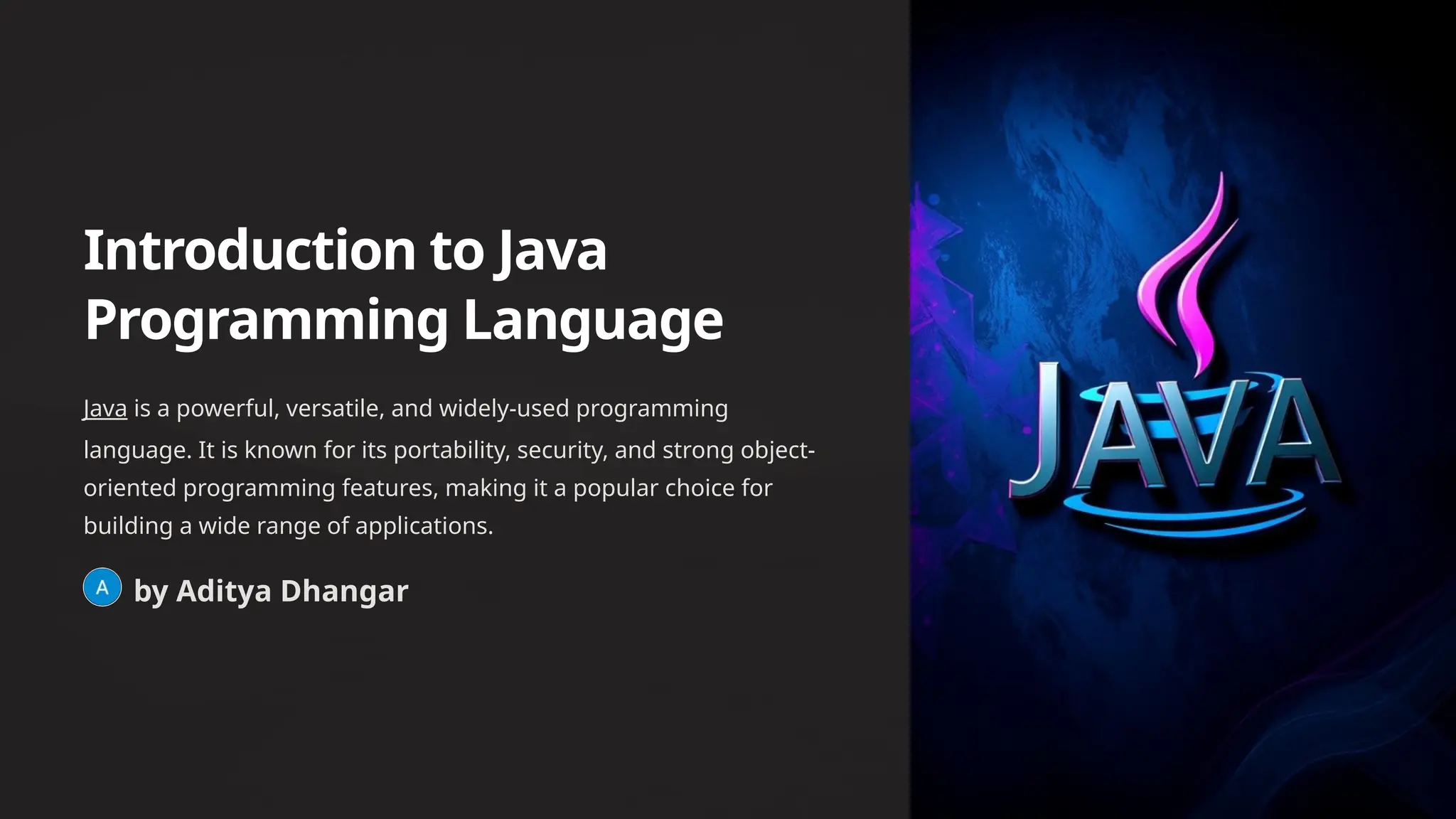
History and Evolution of Java
1
1995: Java's Inception
Java was created by a team at Sun Microsystems, led by James Gosling,
with the goal of developing a platform-independent language.
2
1996: Java 1.0 Release
The first public release of Java brought features like object-oriented
programming, garbage collection, and cross-platform portability.
3
2004: Java 1.5 (Java 5)
This major update introduced generics, enhanced for-each loops, and
other features that improved Java's expressiveness and type safety.
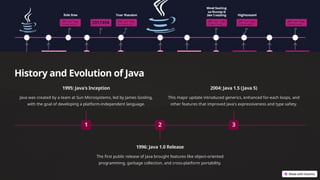
Java Syntax and Data Types
Syntax
Java has a C-like syntax, with curly
braces, semicolons, and strict rules
for variables, methods, and class
definitions.
Data Types
Java provides a range of primitive
data types, including integers,
floating-point numbers, booleans,
and characters, as well as more
complex object types.
Variables
Variables in Java must be declared
with a specific data type and can be
assigned different values
throughout the program's
execution.
Control Structures and
Conditional Statements
1 Conditional Statements
Java provides if-else
statements and switch-case
statements to control the
flow of execution based on
specific conditions.
2 Loops
Java supports various loop
structures, including for,
while, and do-while loops,
to repeatedly execute a
block of code.
3 Branching
The break and continue statements allow you to exit a loop or
skip an iteration, providing more control over the flow of
execution.
Object-Oriented Programming Concepts in Java
Classes and Objects
Java is an object-oriented
language, where classes define the
structure and behavior of objects,
and objects are instances of those
classes.
Inheritance
Java supports inheritance, allowing
classes to extend and inherit
properties and methods from
parent classes, promoting code
reuse.
Encapsulation and
Polymorphism
Java's encapsulation and
polymorphism features enable
data hiding and method
overriding, leading to more
modular and flexible code.
Java Packages and Libraries
Java Standard Library
The Java Standard Library
provides a vast collection of pre-
built classes and interfaces,
covering a wide range of
functionality, from I/O to
networking.
Third-Party Libraries
Java developers can leverage a
rich ecosystem of third-party
libraries and frameworks, such
as Spring, Hibernate, and Apache
Commons, to accelerate
development.
Package Management
Tools like Maven and Gradle help
manage Java project
dependencies and package
distributions, streamlining the
development and deployment
process.
Modular Design
Java's module system, introduced
in Java 9, allows for better
encapsulation and scalability by
organizing code into well-
defined, reusable modules.
Java Applications and Use Cases
Web Development
Java is a popular choice for
building robust and scalable
web applications, thanks to
frameworks like Spring and
Jakarta EE.
Mobile Development
With the introduction of Java
for Android, developers can
now create mobile apps
using the familiar Java
language.
Enterprise Applications
Java's reliability, security, and
scalability make it a preferred
language for building large-
scale enterprise systems and
distributed applications.
Scientific Computing
Java's strong mathematical
and analytical capabilities,
combined with libraries like
Apache Commons Math,
make it suitable for scientific
computing and data analysis.
Demonstration: Simple Java
Program
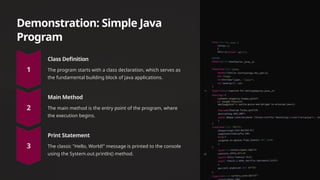
Class Definition
The program starts with a class declaration, which serves as
the fundamental building block of Java applications.
Main Method
The main method is the entry point of the program, where
the execution begins.
Print Statement
The classic "Hello, World!" message is printed to the console
using the System.out.println() method.
Best Practices for
Java Development
1 Code Formatting
Adhere to Java's code style
guidelines, using consistent
indentation, naming
conventions, and formatting
to improve code readability.
2 Exception Handling
Properly handle exceptions
to ensure your application
can gracefully recover from
unexpected situations and
provide helpful error
messages.
3 Modular Design
Organize your Java code into
logical modules or packages
to promote maintainability,
scalability, and reusability.
4 Unit Testing
Integrate automated unit
tests into your development
workflow to catch bugs early
and ensure the correctness
of your code.
Conclusion and Q&A
In this presentation, we've explored the fundamentals of Java programming, including its history, syntax, core
concepts, and a wide range of applications. We've also discussed best practices for Java development to help you
write clean, maintainable, and scalable code.
Now, let's open the floor to any questions you may have about Java programming. I'll do my best to provide clear and
informative answers.

Introduction-to-Java-Programming-Language (1).pptx

  • 1.
    Introduction to Java ProgrammingLanguage Java is a powerful, versatile, and widely-used programming language. It is known for its portability, security, and strong object- oriented programming features, making it a popular choice for building a wide range of applications. by Aditya Dhangar
  • 2.
    History and Evolutionof Java 1 1995: Java's Inception Java was created by a team at Sun Microsystems, led by James Gosling, with the goal of developing a platform-independent language. 2 1996: Java 1.0 Release The first public release of Java brought features like object-oriented programming, garbage collection, and cross-platform portability. 3 2004: Java 1.5 (Java 5) This major update introduced generics, enhanced for-each loops, and other features that improved Java's expressiveness and type safety.
  • 3.
    Java Syntax andData Types Syntax Java has a C-like syntax, with curly braces, semicolons, and strict rules for variables, methods, and class definitions. Data Types Java provides a range of primitive data types, including integers, floating-point numbers, booleans, and characters, as well as more complex object types. Variables Variables in Java must be declared with a specific data type and can be assigned different values throughout the program's execution.
  • 4.
    Control Structures and ConditionalStatements 1 Conditional Statements Java provides if-else statements and switch-case statements to control the flow of execution based on specific conditions. 2 Loops Java supports various loop structures, including for, while, and do-while loops, to repeatedly execute a block of code. 3 Branching The break and continue statements allow you to exit a loop or skip an iteration, providing more control over the flow of execution.
  • 5.
    Object-Oriented Programming Conceptsin Java Classes and Objects Java is an object-oriented language, where classes define the structure and behavior of objects, and objects are instances of those classes. Inheritance Java supports inheritance, allowing classes to extend and inherit properties and methods from parent classes, promoting code reuse. Encapsulation and Polymorphism Java's encapsulation and polymorphism features enable data hiding and method overriding, leading to more modular and flexible code.
  • 6.
    Java Packages andLibraries Java Standard Library The Java Standard Library provides a vast collection of pre- built classes and interfaces, covering a wide range of functionality, from I/O to networking. Third-Party Libraries Java developers can leverage a rich ecosystem of third-party libraries and frameworks, such as Spring, Hibernate, and Apache Commons, to accelerate development. Package Management Tools like Maven and Gradle help manage Java project dependencies and package distributions, streamlining the development and deployment process. Modular Design Java's module system, introduced in Java 9, allows for better encapsulation and scalability by organizing code into well- defined, reusable modules.
  • 7.
    Java Applications andUse Cases Web Development Java is a popular choice for building robust and scalable web applications, thanks to frameworks like Spring and Jakarta EE. Mobile Development With the introduction of Java for Android, developers can now create mobile apps using the familiar Java language. Enterprise Applications Java's reliability, security, and scalability make it a preferred language for building large- scale enterprise systems and distributed applications. Scientific Computing Java's strong mathematical and analytical capabilities, combined with libraries like Apache Commons Math, make it suitable for scientific computing and data analysis.
  • 8.
    Demonstration: Simple Java Program ClassDefinition The program starts with a class declaration, which serves as the fundamental building block of Java applications. Main Method The main method is the entry point of the program, where the execution begins. Print Statement The classic "Hello, World!" message is printed to the console using the System.out.println() method.
  • 9.
    Best Practices for JavaDevelopment 1 Code Formatting Adhere to Java's code style guidelines, using consistent indentation, naming conventions, and formatting to improve code readability. 2 Exception Handling Properly handle exceptions to ensure your application can gracefully recover from unexpected situations and provide helpful error messages. 3 Modular Design Organize your Java code into logical modules or packages to promote maintainability, scalability, and reusability. 4 Unit Testing Integrate automated unit tests into your development workflow to catch bugs early and ensure the correctness of your code.
  • 10.
    Conclusion and Q&A Inthis presentation, we've explored the fundamentals of Java programming, including its history, syntax, core concepts, and a wide range of applications. We've also discussed best practices for Java development to help you write clean, maintainable, and scalable code. Now, let's open the floor to any questions you may have about Java programming. I'll do my best to provide clear and informative answers.