• Sustainable water systems should provide adequate
water quantity and apprOpriate water quality for a
given need, without compromising the future ability to
provide this capacity and quality.
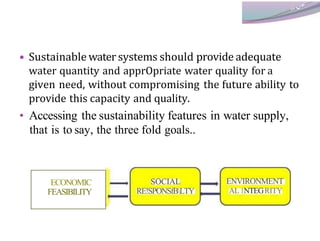
• Accessing the sustainability features in water supply,
that is to say, the three fold goals..
ECONOMIC
FEASIBILITY
SOCIAL
RE!SPONSfBLTY
ENVIRONMENT
AL INTEGRITY
• Water is used (i) for drinking as a survival necessity,
(2) in industrial operations (energy production,
manufacturing of goods, etc.), (3) domestic
applications (cooking, cleaning, bathing, sanitation),
and (4) agriculture.
• Sustainable water supply isa component of integrated
water resource management, the practice of bringing
together multiple stakeholders with various
viewpoints in order to determine how water should
best be managed.
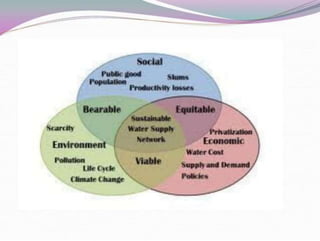
• In order to decide if a water system is sustainable,
vaiious economical, social and ecological
considerations must be considered.
The basics: Water Sources
’ace water
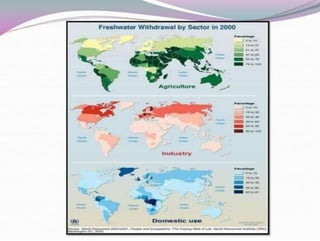
• Surface freshwater is unfortunately limited and
unequally distributed in the world.
• In addition, pollution from various activities leads to
surface water that is not drinking quality. Therefore,
treatment systems (either large scale or at the
household level) must be put in place.
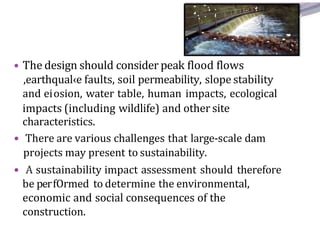
• Structures such as dams may be used to impound
water for consumption.
• Dams can be used for power generation, water supply,
irrigation, food prevention, water diversion,
navigation, etc. If properly designed and constructed,
dams can help provide a sustainable water supply.
• The design should consider peak flood flows
,earthqual‹e faults, soil permeability, slope stability
and eiosion, water table, human impacts, ecological
impacts (including wildlife) and other site
characteristics.
• There are various challenges that large-scale dam
projects may present to sustainability.
• A sustainability impact assessment should therefore
be perfOrmed to determine the environmental,
economic and social consequences of the
construction.
Ground water
• Groundwater accounts for greater than 5o% of global
freshwater; thus, it is critical for potable water.
• Groundwater can be a sustainable water supply source
if the total amount of water entering, leaving, and
being stored in the system is conserved.
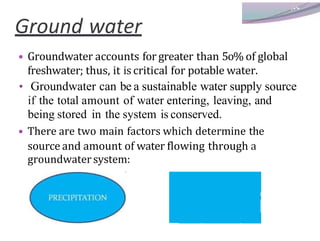
• There are two main factors which determine the
source and amount of water flowing through a
groundwatersystem:
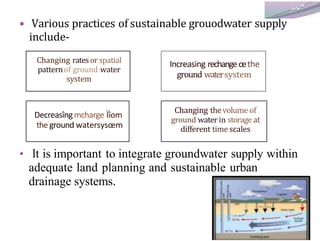
• Various practices of sustainable grouodwater supply
include-
Changing rates or spatial
patternof ground water
system
Decreasîngmcharge Ïîom
the ground watersysœm
Increasing rechangeœthe
ground watersystem
Changing thevolume of
ground water in storage at
different time scales
• lt is important to integrate groundwater supply within
adequate land planning and sustainable urban
drainage systems.
Rainwater Horvestin
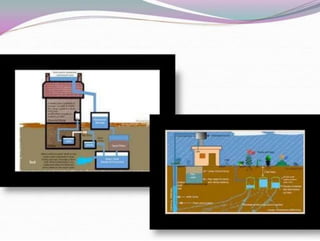
• Collecting water from precipitation is one of the most
sustainable sources of water supply.
• Reduces over-exploitation of groundwater and surface
water sources.
• Directly provides drinl‹ing water quality.
• Rainwater harvesting systems must be properly
designed and maintained in order to collect water
efficiently.
• Must be treated to prevent contaminati
Reclaimed water
• Reclaimed water, or water recycled from human use,
can also be a sustainable source of watersupply.
• It is an important solution to reduce stress on primary
water resources such as surface and groundwater.
• There are both centralized and decentralized systems
which include greywatei’ recycling systems and the use
of micro porous membranes.
• Reclaimed water must be treated to provide the
appropriate quality for a given applicatiOn (irrigation,
industry use, etc.)
• It is often most efficient to separate greywater from
blackwater, thei eby using the two water streams for
different uses.
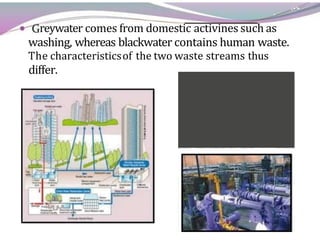
reywater comes from domestic activines such as
washing, whereas blackwater contains human waste.
The characteristicsof the two waste streams thus
differ.
Desalinization
• Desalinisation has the potential to provide an
adequate water quantity to those regions that are
freshwater poor, including small island states.
• A widely used procedure is involved in REVERSE
OSMOSIS for removing salt and adaption of this
technology isa challenge.
• If desalination can be prOvided with renewable
energies and efficient technologies, the sustainable
features of this supply source would increase.
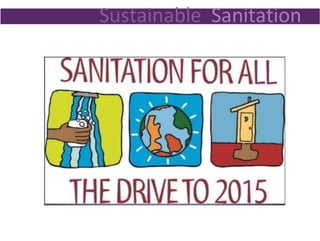
Sustainable Sanitation
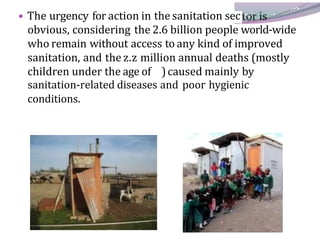
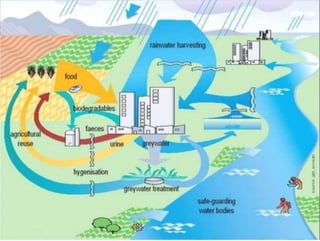
• The urgency for action in the sanitation sec
obvious, considering the 2.6 billion people world-wide
who remain without access to any kind of improved
sanitation, and the z.z million annual deaths (mostly
children under the age of )caused mainly by
sanitation-related diseases and poor hygienic
conditions.
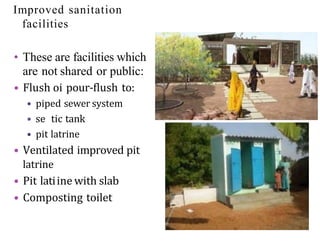
Improved sanitation
facilities
• These are facilities which
are not shared or public:
• Flush oi pour-flush to:
• piped sewer system
• se tic tank
• pit latrine
• Ventilated improved pit
latrine
• Pit latiine with slab
• Composting toilet
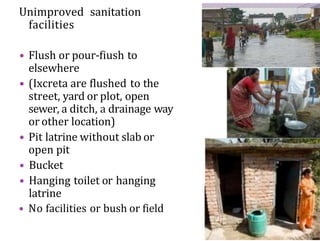
Unimproved sanitation
facilities
• Flush or pour-fiush to
elsewhere
• (Ixcreta are flushed to the
street, yard or plot, open
sewer, a ditch, a drainage way
or other location)
• Pit latrine without slab or
open pit
• Bucket
• Hanging toilet or hanging
latrine
• No facilities or bush or field
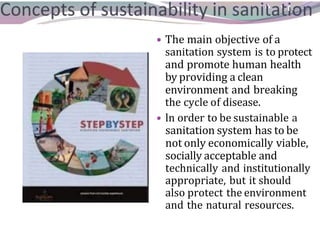
• The main objective of a
sanitation system is to protect
and promote human health
by providing a clean
environment and breaking
the cycle of disease.
• ln order to be sustainable a
sanitation system has to be
not only economically viable,
socially acceptable and
technically and institutionally
appropriate, but it should
also protect the environment
and the natural resources.
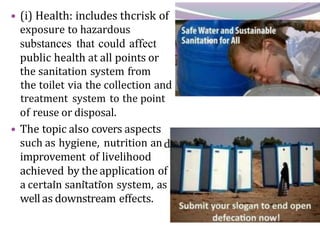
• (i) Health: includes thcrisk of
exposure to hazardous
substances that could affect
public health at all points or
the sanitation system from
the toilet via the collection and
treatment system to the point
of reuse or disposal.
• The topic also covers aspects
such as hygiene, nutrition an
improvement of livelihood
achieved by the application of
a certain sanitation system, as
well as downstream effects.
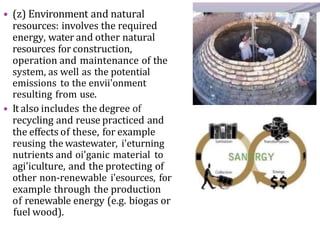
• (z) Environment and natural
resources: involves the required
energy, water and other natural
resources for construction,
operation and maintenance of the
system, as well as the potential
emissions to the envii'onment
resulting from use.
• It also includes the degree of
recycling and reuse practiced and
the effects of these, for example
reusing the wastewater, i'eturning
nutrients and oi'ganic material to
agi'iculture, and the protecting of
other non-renewable i'esources, for
example through the production
of renewable energy (e.g. biogas or
fuel wood).
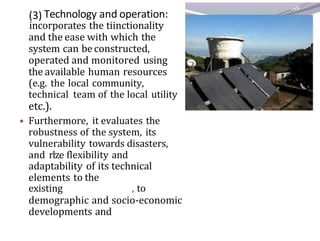
(3) Technology and operation:
incorporates the tiinctionality
and the ease with which the
system can be constructed,
operated and monitored using
the available human resources
(e.g. the local community,
technical team of the local utility
etc.).
• Furthermore, it evaluates the
robustness of the system, its
vulnerability towards disasters,
and rlze flexibility and
adaptability of its technical
elements to the
existing , to
demographic and socio-economic
developments and
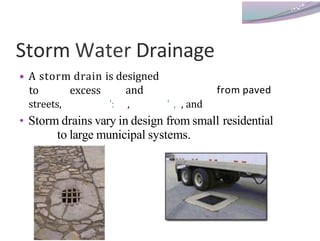
Storm Water Drainage
• A storm drain is designed
to excess
streets, ':
and from paved
, ' , , and
• Storm drains vary in design from small residential
to large municipal systems.
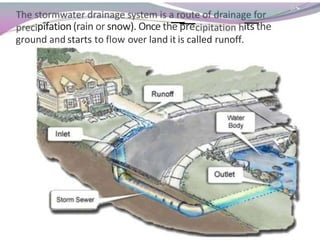
pîfation(rain or snow). Once the pre its the
ground and starts to flow over land it is called runoff.
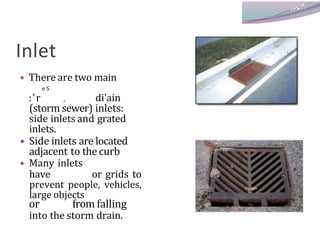
Inlet
• There are two main
e S
:’r , di'ain
(storm sewer) inlets:
side inlets and grated
inlets.
• Side inlets are located
adjacent to thecurb
• Many inlets
have or grids to
prevent people, vehicles,
large objects
or from falling
into the storm drain.
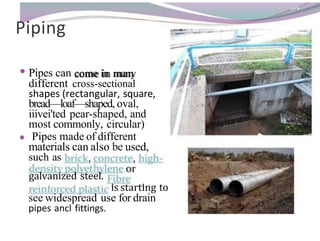
Piping
• Pipes can come in many
different cross-sectional
shapes (rectangular, square,
bread—loaf—shaped, oval,
iiivei'ted pear-shaped, and
most commonly, circular)
Pipes made of different
materials can also be used,
such as
galvanized steel.
is starting to
see widespread use for drain
pipes ancl fittings.
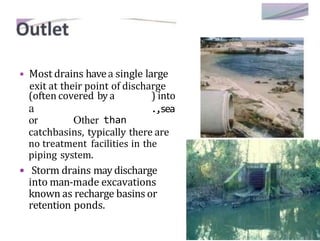
• Most drains havea single large
exit at their point of discharge
(often covered by a ) into
a .,sea
or Other than
catchbasins, typically there are
no treatment facilities in the
piping system.
• Storm drains may discharge
into man-made excavations
known as recharge basins or
retention ponds.
Reducing stormwater flows
• Runoff into storm sewei's can be
minimized by including
• To i'educe stormwater fi'om
rooftops, flows h'om eaves troughs
( and downspours) may
be into adjacent soil,
rather than discharged into the
storm sewer system.
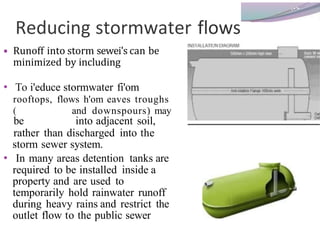
• In many areas detention tanks are
required to be installed inside a
property and are used to
temporarily hold rainwater runoff
during heavy rains and restrict the
outlet flow to the public sewer

suitable water system.pptx water treatment

  • 2.
    • Sustainable watersystems should provide adequate water quantity and apprOpriate water quality for a given need, without compromising the future ability to provide this capacity and quality. • Accessing the sustainability features in water supply, that is to say, the three fold goals.. ECONOMIC FEASIBILITY SOCIAL RE!SPONSfBLTY ENVIRONMENT AL INTEGRITY
  • 3.
    • Water isused (i) for drinking as a survival necessity, (2) in industrial operations (energy production, manufacturing of goods, etc.), (3) domestic applications (cooking, cleaning, bathing, sanitation), and (4) agriculture. • Sustainable water supply isa component of integrated water resource management, the practice of bringing together multiple stakeholders with various viewpoints in order to determine how water should best be managed. • In order to decide if a water system is sustainable, vaiious economical, social and ecological considerations must be considered.
  • 6.
  • 7.
    ’ace water • Surfacefreshwater is unfortunately limited and unequally distributed in the world. • In addition, pollution from various activities leads to surface water that is not drinking quality. Therefore, treatment systems (either large scale or at the household level) must be put in place. • Structures such as dams may be used to impound water for consumption. • Dams can be used for power generation, water supply, irrigation, food prevention, water diversion, navigation, etc. If properly designed and constructed, dams can help provide a sustainable water supply.
  • 8.
    • The designshould consider peak flood flows ,earthqual‹e faults, soil permeability, slope stability and eiosion, water table, human impacts, ecological impacts (including wildlife) and other site characteristics. • There are various challenges that large-scale dam projects may present to sustainability. • A sustainability impact assessment should therefore be perfOrmed to determine the environmental, economic and social consequences of the construction.
  • 9.
    Ground water • Groundwateraccounts for greater than 5o% of global freshwater; thus, it is critical for potable water. • Groundwater can be a sustainable water supply source if the total amount of water entering, leaving, and being stored in the system is conserved. • There are two main factors which determine the source and amount of water flowing through a groundwatersystem:
  • 10.
    • Various practicesof sustainable grouodwater supply include- Changing rates or spatial patternof ground water system Decreasîngmcharge Ïîom the ground watersysœm Increasing rechangeœthe ground watersystem Changing thevolume of ground water in storage at different time scales • lt is important to integrate groundwater supply within adequate land planning and sustainable urban drainage systems.
  • 11.
    Rainwater Horvestin • Collectingwater from precipitation is one of the most sustainable sources of water supply. • Reduces over-exploitation of groundwater and surface water sources. • Directly provides drinl‹ing water quality. • Rainwater harvesting systems must be properly designed and maintained in order to collect water efficiently. • Must be treated to prevent contaminati
  • 12.
    Reclaimed water • Reclaimedwater, or water recycled from human use, can also be a sustainable source of watersupply. • It is an important solution to reduce stress on primary water resources such as surface and groundwater. • There are both centralized and decentralized systems which include greywatei’ recycling systems and the use of micro porous membranes. • Reclaimed water must be treated to provide the appropriate quality for a given applicatiOn (irrigation, industry use, etc.) • It is often most efficient to separate greywater from blackwater, thei eby using the two water streams for different uses.
  • 13.
    reywater comes fromdomestic activines such as washing, whereas blackwater contains human waste. The characteristicsof the two waste streams thus differ.
  • 14.
    Desalinization • Desalinisation hasthe potential to provide an adequate water quantity to those regions that are freshwater poor, including small island states. • A widely used procedure is involved in REVERSE OSMOSIS for removing salt and adaption of this technology isa challenge. • If desalination can be prOvided with renewable energies and efficient technologies, the sustainable features of this supply source would increase.
  • 16.
  • 17.
    • The urgencyfor action in the sanitation sec obvious, considering the 2.6 billion people world-wide who remain without access to any kind of improved sanitation, and the z.z million annual deaths (mostly children under the age of )caused mainly by sanitation-related diseases and poor hygienic conditions.
  • 18.
    Improved sanitation facilities • Theseare facilities which are not shared or public: • Flush oi pour-flush to: • piped sewer system • se tic tank • pit latrine • Ventilated improved pit latrine • Pit latiine with slab • Composting toilet
  • 19.
    Unimproved sanitation facilities • Flushor pour-fiush to elsewhere • (Ixcreta are flushed to the street, yard or plot, open sewer, a ditch, a drainage way or other location) • Pit latrine without slab or open pit • Bucket • Hanging toilet or hanging latrine • No facilities or bush or field
  • 20.
    • The mainobjective of a sanitation system is to protect and promote human health by providing a clean environment and breaking the cycle of disease. • ln order to be sustainable a sanitation system has to be not only economically viable, socially acceptable and technically and institutionally appropriate, but it should also protect the environment and the natural resources.
  • 22.
    • (i) Health:includes thcrisk of exposure to hazardous substances that could affect public health at all points or the sanitation system from the toilet via the collection and treatment system to the point of reuse or disposal. • The topic also covers aspects such as hygiene, nutrition an improvement of livelihood achieved by the application of a certain sanitation system, as well as downstream effects.
  • 23.
    • (z) Environmentand natural resources: involves the required energy, water and other natural resources for construction, operation and maintenance of the system, as well as the potential emissions to the envii'onment resulting from use. • It also includes the degree of recycling and reuse practiced and the effects of these, for example reusing the wastewater, i'eturning nutrients and oi'ganic material to agi'iculture, and the protecting of other non-renewable i'esources, for example through the production of renewable energy (e.g. biogas or fuel wood).
  • 24.
    (3) Technology andoperation: incorporates the tiinctionality and the ease with which the system can be constructed, operated and monitored using the available human resources (e.g. the local community, technical team of the local utility etc.). • Furthermore, it evaluates the robustness of the system, its vulnerability towards disasters, and rlze flexibility and adaptability of its technical elements to the existing , to demographic and socio-economic developments and
  • 25.
    Storm Water Drainage •A storm drain is designed to excess streets, ': and from paved , ' , , and • Storm drains vary in design from small residential to large municipal systems.
  • 26.
    pîfation(rain or snow).Once the pre its the ground and starts to flow over land it is called runoff.
  • 27.
    Inlet • There aretwo main e S :’r , di'ain (storm sewer) inlets: side inlets and grated inlets. • Side inlets are located adjacent to thecurb • Many inlets have or grids to prevent people, vehicles, large objects or from falling into the storm drain.
  • 28.
    Piping • Pipes cancome in many different cross-sectional shapes (rectangular, square, bread—loaf—shaped, oval, iiivei'ted pear-shaped, and most commonly, circular) Pipes made of different materials can also be used, such as galvanized steel. is starting to see widespread use for drain pipes ancl fittings.
  • 29.
    • Most drainshavea single large exit at their point of discharge (often covered by a ) into a .,sea or Other than catchbasins, typically there are no treatment facilities in the piping system. • Storm drains may discharge into man-made excavations known as recharge basins or retention ponds.
  • 30.
    Reducing stormwater flows •Runoff into storm sewei's can be minimized by including • To i'educe stormwater fi'om rooftops, flows h'om eaves troughs ( and downspours) may be into adjacent soil, rather than discharged into the storm sewer system. • In many areas detention tanks are required to be installed inside a property and are used to temporarily hold rainwater runoff during heavy rains and restrict the outlet flow to the public sewer