Chapter 7: Courtroom Participants and the Trial
After completion of this chapter, students should be able to: Describe the basic legal philosophy of a criminal trial  Understand how court jurisdiction is determined Identify major pretrial proceedings Explain the Sixth Amendment requirement for a speedy trial Know the roles of the participants in a criminal trial
The concept that a trial is a ‘battle’ between the state and a legal ‘champion’ who represents the defendant  Trials are complex because many criminal justice agencies and personnel must interact in the pursuit of justice: police, prosecutors, judges, jurors, victims and offenders
Police and the prosecutor work together to bring charges This serves as a check and balance Police arrest does not guarantee the prosecutor will prosecute Thus the phrase ‘Prosecutorial Discretion’
Three other important decisions that are made before the trial are: 1. setting bail, 2. determining the competency of the defendant to stand trial 3. plea bargaining
Eighth Amendment of the Constitution recognizes the concept of bail: Bail may be set by a schedule Amount is typically based upon possible fine Can be denied if defendant is a flight risk Can be denied for reasons of community safety
Manhattan Bail Project Release on Recognizance (ROR) Conditional Release Property Bond Signature Bond
The controversy over bail has centered on: 1. What is excessive bail? 2. When can bail be denied? 3. Does the bail system discriminate against the poor?
Reduces time and cost associated with court case Keeps back-logged dockets moving Over 90% of defendants receive a plea bargain Plea can surround the charges or the range of sentencing
A criminal case must assure defendant the right to a speedy trial under the Sixth Amendment Federal prosecutor has 30 days to seek an indictment Federal prosecutor has 70 days to start trial
Motion for discovery Motion for suppression Motion for change of venue Motion for continuance  continued…
Motion for dismissal Motion for a bill of particulars Motions for severance of charges or defendants
Pearson Education, Inc. ©  2010  Prosecutor Defense Attorney Judge Jury continued….
Court reporter Clerk of the court Witness Bailiff
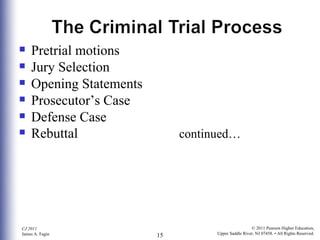
Pretrial motions Jury Selection Opening Statements Prosecutor’s Case Defense Case Rebuttal continued…
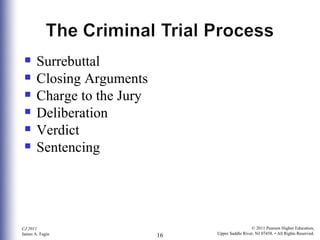
Surrebuttal Closing Arguments Charge to the Jury Deliberation Verdict Sentencing
Selecting fair citizen jurors has been a major challenge for courts ‘Jury of One’s Peers’ requires a broad base of citizens who represent the community Jury size of ‘12’ is a tradition, not a constitutional requirement

0131389033 ppt07

  • 1.
    Chapter 7: CourtroomParticipants and the Trial
  • 2.
    After completion ofthis chapter, students should be able to: Describe the basic legal philosophy of a criminal trial Understand how court jurisdiction is determined Identify major pretrial proceedings Explain the Sixth Amendment requirement for a speedy trial Know the roles of the participants in a criminal trial
  • 3.
    The concept thata trial is a ‘battle’ between the state and a legal ‘champion’ who represents the defendant Trials are complex because many criminal justice agencies and personnel must interact in the pursuit of justice: police, prosecutors, judges, jurors, victims and offenders
  • 4.
    Police and theprosecutor work together to bring charges This serves as a check and balance Police arrest does not guarantee the prosecutor will prosecute Thus the phrase ‘Prosecutorial Discretion’
  • 5.
    Three other importantdecisions that are made before the trial are: 1. setting bail, 2. determining the competency of the defendant to stand trial 3. plea bargaining
  • 6.
    Eighth Amendment ofthe Constitution recognizes the concept of bail: Bail may be set by a schedule Amount is typically based upon possible fine Can be denied if defendant is a flight risk Can be denied for reasons of community safety
  • 7.
    Manhattan Bail ProjectRelease on Recognizance (ROR) Conditional Release Property Bond Signature Bond
  • 8.
    The controversy overbail has centered on: 1. What is excessive bail? 2. When can bail be denied? 3. Does the bail system discriminate against the poor?
  • 9.
    Reduces time andcost associated with court case Keeps back-logged dockets moving Over 90% of defendants receive a plea bargain Plea can surround the charges or the range of sentencing
  • 10.
    A criminal casemust assure defendant the right to a speedy trial under the Sixth Amendment Federal prosecutor has 30 days to seek an indictment Federal prosecutor has 70 days to start trial
  • 11.
    Motion for discoveryMotion for suppression Motion for change of venue Motion for continuance continued…
  • 12.
    Motion for dismissalMotion for a bill of particulars Motions for severance of charges or defendants
  • 13.
    Pearson Education, Inc.© 2010 Prosecutor Defense Attorney Judge Jury continued….
  • 14.
    Court reporter Clerkof the court Witness Bailiff
  • 15.
    Pretrial motions JurySelection Opening Statements Prosecutor’s Case Defense Case Rebuttal continued…
  • 16.
    Surrebuttal Closing ArgumentsCharge to the Jury Deliberation Verdict Sentencing
  • 17.
    Selecting fair citizenjurors has been a major challenge for courts ‘Jury of One’s Peers’ requires a broad base of citizens who represent the community Jury size of ‘12’ is a tradition, not a constitutional requirement