BAIL-PRACTICE AND PROCEDURE
(S. 436-450)
Contents
• Interesting facts about Bail
• Bail-Meaning
• Bail: Concept and Principle
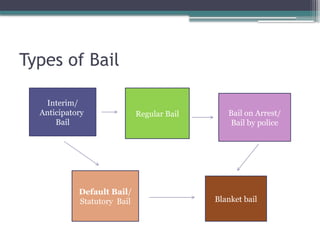
• Types of Bail
• Stages of granting bail
• In what cases bail can be taken
• Mandatory circumstances for granting bail
• Discretion of court for granting bail
• Various factors court consider for granting bail.
• Requirements for taking the bail from in-charge of police station
• Requirements for taking the bail from Magistrate/Session
Court/ High Court
• Requirements for taking the bail from Supreme Court
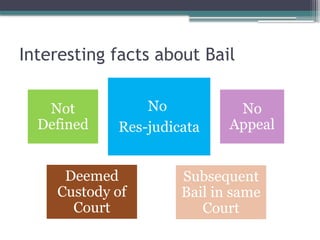
Interesting facts about Bail
Not
Defined
No
Res-judicata
No
Appeal
Deemed
Custody of
Court
Subsequent
Bail in same
Court
Bail-Meaning
• Bail, in law, means procurement of release from
prison of a person awaiting trial or an appeal, by
the deposit of security to ensure his submission
at the required time to legal authority.
• The monetary value of the security is called as bail
bond.
• Value is set by the court having jurisdiction over
the prisoner.
• The security may be cash, the papers giving title to
property (moveable or immoveable), or the bond of
private persons of means.
Bail: Concept and Principle
• The concept of bail can traced back to 399 BC, when
Plato tried to create a bond for the release of Socrates.
• Bail is rule Jail is an Exception.
• Article 21 of the Indian Constitution guaranteed
fundamental right to freedom to every citizen of India,
which specifically states:
▫ "No person shall be deprived of his life or personal liberty
except according to procedure established by law.”
Types of Bail
Interim/
Anticipatory
Bail
Regular Bail Bail on Arrest/
Bail by police
Default Bail/
Statutory Bail Blanket bail
Stages of granting bail
• There are 3 stages:
▫ Pre-trial (by police/ by court)
▫ Post – trial (by court)
▫ During trial (by court)
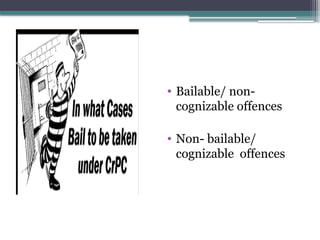
• Bailable/ non-
cognizable offences
• Non- bailable/
cognizable offences
Mandatory circumstances for granting bail
• Bailable offence (S. 436 (2))
• Investigation not completed within
prescribed time period ( s. 167 (2))
• No reasonable ground for believing
that accused is guilty of non-bailable
offence (S. 437 (2) (4))
• Where trial before magistrate not
concluded in 60 days (S. 437 (6))
• Where no reasonable ground exists
for believing the accused guilty after
conclusion of trial but before
judgement (S. 437 (7))
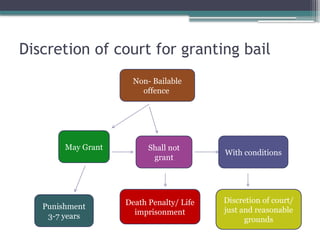
Discretion of court for granting bail
Non- Bailable
offence
With conditions
Shall not
grant
May Grant
Punishment
3-7 years
Death Penalty/ Life
imprisonment
Discretion of court/
just and reasonable
grounds
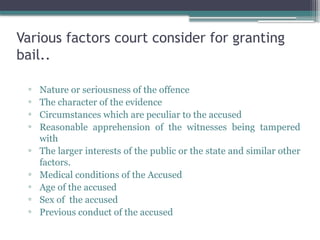
Various factors court consider for granting
bail..
▫ Nature or seriousness of the offence
▫ The character of the evidence
▫ Circumstances which are peculiar to the accused
▫ Reasonable apprehension of the witnesses being tampered
with
▫ The larger interests of the public or the state and similar other
factors.
▫ Medical conditions of the Accused
▫ Age of the accused
▫ Sex of the accused
▫ Previous conduct of the accused
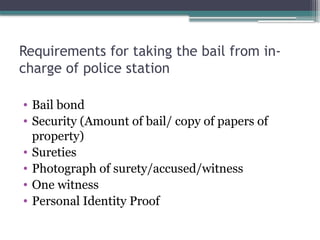
Requirements for taking the bail from in-
charge of police station
• Bail bond
• Security (Amount of bail/ copy of papers of
property)
• Sureties
• Photograph of surety/accused/witness
• One witness
• Personal Identity Proof
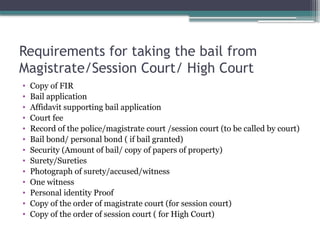
Requirements for taking the bail from
Magistrate/Session Court/ High Court
• Copy of FIR
• Bail application
• Affidavit supporting bail application
• Court fee
• Record of the police/magistrate court /session court (to be called by court)
• Bail bond/ personal bond ( if bail granted)
• Security (Amount of bail/ copy of papers of property)
• Surety/Sureties
• Photograph of surety/accused/witness
• One witness
• Personal identity Proof
• Copy of the order of magistrate court (for session court)
• Copy of the order of session court ( for High Court)
Requirements for taking the bail from
Supreme Court
• Bail Application
• Affidavit of the accused or pairokar
• Record of the High Court ( to be called by court)
• Copy of order of High Court
• Court fee
•Thanks

CONCEPT OF BAIL under Criminal Procedure Code.pptx

  • 1.
  • 2.
    Contents • Interesting factsabout Bail • Bail-Meaning • Bail: Concept and Principle • Types of Bail • Stages of granting bail • In what cases bail can be taken • Mandatory circumstances for granting bail • Discretion of court for granting bail • Various factors court consider for granting bail. • Requirements for taking the bail from in-charge of police station • Requirements for taking the bail from Magistrate/Session Court/ High Court • Requirements for taking the bail from Supreme Court
  • 3.
    Interesting facts aboutBail Not Defined No Res-judicata No Appeal Deemed Custody of Court Subsequent Bail in same Court
  • 4.
    Bail-Meaning • Bail, inlaw, means procurement of release from prison of a person awaiting trial or an appeal, by the deposit of security to ensure his submission at the required time to legal authority. • The monetary value of the security is called as bail bond. • Value is set by the court having jurisdiction over the prisoner. • The security may be cash, the papers giving title to property (moveable or immoveable), or the bond of private persons of means.
  • 5.
    Bail: Concept andPrinciple • The concept of bail can traced back to 399 BC, when Plato tried to create a bond for the release of Socrates. • Bail is rule Jail is an Exception. • Article 21 of the Indian Constitution guaranteed fundamental right to freedom to every citizen of India, which specifically states: ▫ "No person shall be deprived of his life or personal liberty except according to procedure established by law.”
  • 6.
    Types of Bail Interim/ Anticipatory Bail RegularBail Bail on Arrest/ Bail by police Default Bail/ Statutory Bail Blanket bail
  • 7.
    Stages of grantingbail • There are 3 stages: ▫ Pre-trial (by police/ by court) ▫ Post – trial (by court) ▫ During trial (by court)
  • 8.
    • Bailable/ non- cognizableoffences • Non- bailable/ cognizable offences
  • 9.
    Mandatory circumstances forgranting bail • Bailable offence (S. 436 (2)) • Investigation not completed within prescribed time period ( s. 167 (2)) • No reasonable ground for believing that accused is guilty of non-bailable offence (S. 437 (2) (4)) • Where trial before magistrate not concluded in 60 days (S. 437 (6)) • Where no reasonable ground exists for believing the accused guilty after conclusion of trial but before judgement (S. 437 (7))
  • 10.
    Discretion of courtfor granting bail Non- Bailable offence With conditions Shall not grant May Grant Punishment 3-7 years Death Penalty/ Life imprisonment Discretion of court/ just and reasonable grounds
  • 11.
    Various factors courtconsider for granting bail.. ▫ Nature or seriousness of the offence ▫ The character of the evidence ▫ Circumstances which are peculiar to the accused ▫ Reasonable apprehension of the witnesses being tampered with ▫ The larger interests of the public or the state and similar other factors. ▫ Medical conditions of the Accused ▫ Age of the accused ▫ Sex of the accused ▫ Previous conduct of the accused
  • 13.
    Requirements for takingthe bail from in- charge of police station • Bail bond • Security (Amount of bail/ copy of papers of property) • Sureties • Photograph of surety/accused/witness • One witness • Personal Identity Proof
  • 14.
    Requirements for takingthe bail from Magistrate/Session Court/ High Court • Copy of FIR • Bail application • Affidavit supporting bail application • Court fee • Record of the police/magistrate court /session court (to be called by court) • Bail bond/ personal bond ( if bail granted) • Security (Amount of bail/ copy of papers of property) • Surety/Sureties • Photograph of surety/accused/witness • One witness • Personal identity Proof • Copy of the order of magistrate court (for session court) • Copy of the order of session court ( for High Court)
  • 15.
    Requirements for takingthe bail from Supreme Court • Bail Application • Affidavit of the accused or pairokar • Record of the High Court ( to be called by court) • Copy of order of High Court • Court fee
  • 16.