
Science 
for Everyone
0.«1». maplllrHB 
3a~aqH no reOMeTpHH 
TIJIaHHMeTpHH 
HSJUlTeJlbCTBO tHayKa~, MOCKB8
I.F. Sharygin 
Problems in Plane Geometry 
Mir 
Publishers 
Moscow
Translated from Russian 
by Leonid Levant 
First published 1988 
Revised from the 1986 Russian edition 
m17020'0000-304 21-88 2 
056(01)-88 ' •• 
Ha ane..uucIWM Jl.awlCe 
Printed In the Union of Soviet Soetalis; Republic. 
@ HSAateJIbCTBO 4lHayxat 
I'nasaaa peAaxD;HJI t!»B8HKo-Ma­TeM8TB1fOOKOii 
JlHTepaTypw, t986 
@ English translation, 
Mir Publishers, 1988 
ISBN 5-03-000180-8
Contents 
Preface to the English Edition . 6 
Section t. Fundamental Geometrical Facts 
and Theorems. Computational 
Problems . . . 8 
Section 2. Selected Problems and Theo­rems 
of Plane Geometry 65. Car­not's 
Theorem 65. Ceva's and 
Menelaus' Theorems. Affine Prob­lems 
70. Loci of Points 82. 
Triangles. A Triangle and a 
Circle 89. Quadrilaterals t t 7. 
Circles aod Tangents. Feuer­bach's 
Theorem t29. Combina­tions 
of Figures. Displacements 
in the Plane. Polygons t37. Geo­metrical 
Inequalities. Problems 
on Extrema 147 
Answers, Hint!, Solutions too 
Section t too 
Section 2 . . . 214 
Appendix. Inversion 392
Preface to the English Edition 
This is a translation from the revised 
edition of the Russian book which was 
issued in 1982. It is- actually the first in 
a two-volume work on solving problems in 
geometry, the second volume "Problems in 
Solid Geometry" having been published in 
English first by Mir Publishers in ~986. 
Both volumes are designed for school­children 
and teachers. 
This volume contains over 600 problems 
in plane geometry and" consists of two 
parts. The first part contains rather simple 
problems to be solved in classes and at 
home. The second part also contains hints 
and detailed solutions. Over ~OO new prob­lems 
have been added to the 1982 edition, 
the simpler problems in the first addition 
having been eliminated, and a number of 
new sections- (circles and tangents, poly­gons, 
combinations of figures, etc.) having 
been introduced, The general structure of 
the book has been changed somewhat to 
accord with the new, more detailed, clas­sification 
of the problems. As a result, all 
the problems in this volume have been 
rearranged. 
Although the problems in this collection 
vary in "age" (some of them can be found 
in old books and journals, others were 
offered at mathematical olympiads or pub­lished 
in the journal "Quant" (Moscow», 
I still hope that some of the problems in
Preface 
this collection will be of interest to expe­rienced 
geometers. 
Almost every geometrical problem is non­standard 
(as compared with routine exer­cises 
on solving equations, inequalities, 
etc.): one has to think of what additional 
constructions must be made, or which for­mulas 
and theorems must be used. There­fore, 
this collection cannot be regarded as 
a problem-book in geometry; it is rather a 
collection of geometrical puzzles aimed at 
demonstrating the elegance of elementary 
geometrical techniques of proof and methods 
of computation (without using vector alge­bra 
and with a minimal use of the method 
of coordinates, geometrical transforms­tions, 
though a somewhat wider use of trig­onometry). 
In conclusion, I should like to thank 
A.Z. Bershtein who assisted me in prepar­ing 
the first section of the book for print. 
I am also grateful to A.A. Yagubiants who 
let me know several elegant geometrical 
facts. 
The Author
Section 1 
Fundamental Geometrical Facts 
and Theorems. 
Computational Problems 
t. Prove that the medians in a triangle 
intersect at one point (the median point) 
and are divided by this point in the ratio 
1 : 2. 
•2. Prove that the medians separate the 
triangle into six equivalent parts. 
3. Prove that the diameter of the circle 
circumscribed about a triangle is equal 
to the ratio of its side to the sine of the 
opposite angle. 
4. Let the vertex of an angle be located 
outside a circle, and let the sides of the 
angle intersect the circle. Prove that the 
angle is measured by the half-difference of 
the arcs inside the angle which are cut out 
by its sides on the circle. 
5. Let the vertex of an angle lie inside 
a circle. Prove that the angle is measured 
by the half-sum of the arcs one of which 
is enclosed between its sides and the other 
between their extensions. 
6. Let AB denote a chord of a circle, and 
l the tangent to the circle at the point A. 
Prove that either of the two angles between 
AB and l is measured by the half-arc of the
Sec. f. Fundamental Facts 9 
circle enclosed inside the angle under con­sideration. 
7. Through the point M located at a dis­tance 
a from the centre of a circle of radius R 
(a > R), a secant is drawn intersecting the 
circle at points A and B. Prove that the 
product IMA 1·1 MB J is constant for all 
the secants and equals a2 - R2 (which is 
the squared length of the tangent). 
8. A chord AB is drawn through the point 
M situated at a distance a from the centre 
of a circle of radius R (a < R). Prove that 
IAM I-I MB I is constant for all the chords 
and equals RI - a2• 
9. Let AM be an angle bisector in the 
triangle ABC. Prove that IBM I: I CMf = 
IAB I IAC I. The same is true for 
the bisector of the exterior angle of the 
triangle. (In this case the .point M lies on the 
extension of the side Be.) 
10. Prove that the sum of the squares of 
the lengths of the diagonals of a parallelo­gram 
is equal to the sum of the squares of 
the lengths of its sides. 
1t. Given the sides of a triangle (a, b, 
and e). Prove that the median mel drawn to 
the side a can be computed by the formula 
ma = ~ V2lJ2+ 2c2-a2 
• 
12. Given two triangles having one ver­tex 
A in common, the other vertices being 
situated on two straight lines passing
10 Problems in Plane Geometry 
through A. Prove that the ratio of the areas 
of these triangles is equal to the ratio of 
the products of the two sides of each triangle 
emanating from the vertex A. 
13. Prove that the area of the circum­scribed 
polygon is equal to rp, where r 
is the radius of the inscribed circle and p 
its half-perimeter (in particular, this for­mula 
holds true for a triangle). 
14. Prove that the area of a quadrilateral 
is equal to half the product of its diagonals' 
and the sine of the angle between them. '­15. 
Prove the validity of the following 
formulas for the area of a triangle: 
al sin B sin C 2... S = 2s.mA'S= 2R SID A SID B sm C, 
where A, B, C are its angles, a is the side 
lying opposite the angle A, and R is the 
radius of the circumscribed circle. 
16. Prove that the radius of the circle 
inscribed in a right triangle can be com-a+ 
b-c puted by the formula r = 2 ' 
where a and b are the legs and c is the 
hypotenuse. 
17. Prove that if a and b are two sides of 
a triangle, a the angle between them, and l 
the bisector of this angle, then 
(£ 
2abc08 T 
1= a+b
Sec. 1. Fundamental Facts it 
18. Prove that the distances from the 
vertex A of the triangle ABC to the points 
of tangency of the inscribed circle with the 
sides AB and AC are equal to p - a (each), 
where p is the half-perimeter of the triangle 
ABC, a = I BC I. 
19. Prove that if in a convex quadrilat­eral 
ABeD I AB I + I CD I = I AD I + 
I BC I, then there is a circle touching all 
of its sides. 
20. (a) Prove that the altitudes in a 
triangle 'are concurrent (that is intersect at 
one point). (b) Prove that the distance 
from any vertex of a triangle to the point 
of intersection of the altitudes is twice 
the distance from the centre of the cir­cumscribed 
circle to the opposite side. 
• • • 
21. Points A and B are taken on one side 
of a right angle with vertex 0 and lOA I = 
a, I OB I = b. Find the radius of the circle 
passing through the points A and Band 
touching the other side of the angle. 
22. The hypotenuse of a right triangle is 
.equal to c, one of the acute angles being 
30°. Find the radius of the circle with 
centre at the vertex of the angle of 30° 
which separates the triangle into two equi v­alent 
parts. 
23. The legs of a right triangle are a and 
b. Find the distance from the vertex of the
t2 Problems in Plane Geometry 
right angle to the nearest point of the 
inscribed circle. 
24. One of the medians of a right triangle 
is equal to m and divides the right angle 
in the ratio 1 : 2. Find the area of the 
triangle. 
25. Given in a triangle ABC are three 
sides: I Be I = a, I CA I = b, I AB I = c. 
Find the ratio in which the point of inter­section 
of the angle bisectors divides the 
bisector of the angle B. 
26. Prove that the sum of the distances 
from any point of the base of an isosceles 
triangle to its sides is equal to the altitude 
drawn to either of the sides. 
1:1. Prove that the sum of distances from 
any point inside an equilateral triangle 
to its sides is equal to the altitude of this 
triangle. 
28. In an isosceles triangle ABC, taken 
on the base AC is a point M such that 
IAM I = a, IMe I = b. Circles are in­scribed 
in the triangles ABM and CBM. 
Find the distance between the points at 
which these circles touch the side BM. 
29. Find the area of the quadrilateral 
bounded by the angle bisectors of a paral­lelogram 
with sides a and b and angle Ct. 
30. A circle is inscribed in a rhombus 
with altitude h and acute angle C%. Find 
the radius of the greatest of two possible 
circles each of which touches the given 
circle and two sides of the rhombus.
Sec. 1. Fundamental Facts 13 
3t . Determine the acute angle of the 
rhombus whose side is the geometric mean 
of its diagonals. 
32. The diagonals of a convex quadrilat­eral 
are equal to a and b, the line segments 
joining the midpoints of the opposite sides 
are congruent. Find the area of the quadri­lateral. 
33. The side AD of the rectangle ABCD 
is three times the side AB; points M and 
N divide AD into three equal parts. Find 
LAMB + LANB + LADB. 
34. Two circles intersect at points A 
and B. Chords A C and AD touching the 
given circles are drawn through the point 
A. Prove that lAC 12.1 BD I = IAD 2 
1 
• 
IBC I. 
35. Prove that the bisector of the right 
angle in a right triangle bisects the angle 
between the median and the altitude drawn 
to the hypotenuse. 
36. On a circle of radius r, three points 
are chosen 80 that the circle is divided 
into three arcs in the ratio 3 : 4 : 5. At the 
division points, tangents are drawn to the 
circle. Find the area of the triangle formed 
by the tangents. 
37. An equilateral trapezoid is circum­scribed 
about a circle, the lateral side of 
the trapezoid is I, one of its bases is equal 
to 4. Find the area of the trapezoid. 
38. Two straight lines parallel to the 
bases of a trapezoid divide each lateral
14 Problems in Plane Geometry 
side into three equal parts. The entire 
trapezoid is separated by the lines into 
three parts. Find the area of the middle 
part if the areas of the upper and lower 
parts are 81 and S2' respectively. 
39. In the trapezoid ABCD I AB I = a, 
IBC I = b (a =1= b). The bisector of the 
angle A intersects either the base BC or the 
lateral side CD. Find out which of them? 
40. Find the length of the line segment 
parallel to the bases of a trapezoid and 
passing through the point of intersection 
of its diagonals if the bases of the trapezoid 
are a and b. 
41. In an equilateral trapezoid circum­scribed 
about 8 circle, the ratio of the 
parallel sides is k. Find the angle at the 
base. 
42. In a trapezoid ABCD, the base AB 
is equal to a, and the base CD to b. .Find 
the area of the trapezoid if the diagonals 
of the trapezoid are known to be the bisec­tors 
of the angles DAB and ABC. 
43. In an equilateral trapezoid, the mid­line 
is equal to a, and the diagonals are 
mutually perpendicular. Find the area of 
the trapezoid. 
44. The area of an equilateral trapezoid 
circumscribed about a circle is equal to S, 
and the altitude of the trapezoid is half 
its lateral side. Determine the radius of 
the circle inscribed in the trapezoid. 
45. The areas of the triangles formed by
Sec. f. Fundamental Facts i5 
the segments of the diagonals of a trapezoid 
and its bases are equal to 81 and 8 1• Find 
the area of the trapezoid. 
46. In a triangle ABC, the angle ABC is 
tX. Find the angle AOe, where 0 is the 
centre of the inscribed circle. 
47. The bisector of the right angle is 
drawn in a right triangle. Find the distance 
between the points of intersection of the 
altitudes of the triangles thus obtained, 
if the legs of the given triangle are a and b. 
48. A straight line perpendicular to two 
sides of a parallelogram divides the latter 
into two trapezoids in each of which a 
circle can .be inscribed. Find the acute 
angle of the parallelogram if its sides are 
a and b (a < b). . 
49. Given a half-disc with diameter AB. 
Two straight lines are drawn through the 
midpoint of the semicircle which divide 
the half-disc into three equivalent areas. 
In what ratio is the diameter AB divided 
by these lines? 
50. A square ABCD with side a and two 
circles are constructed. The first circle is 
entirely inside the square touching the side 
AB at a point E and also the side Be and 
diagonal AC. The second circle with centre 
at A passes through the point E. Find 
the area of the common part of the two 
discs bounded by these circles. 
51. The vertices of a regular hexagon 
with side a are the centres of the circles
16 Problems in Plane Geometry 
with radius a/y'2. Find the area of the 
part of the hexagon not enclosed by these 
circles. 
52. A point A is taken outslde a circle 
of radius R. Two secants are drawn from 
this point: one passes through the centre, 
the other at a distance of R/2 from the 
centre. Find the area of the region enclosed 
between these secants. 
53. In a quadrilateral ABeD: LDAB = 
90°, LDBC = 90°. IDB I= a, and IDC 1= 
b. Find the distance between the centres 
of two circles one of which passes through 
the points D, A and B, the other through 
the points B, C, and D. 
54. On the sides AB and AD of the 
rhombus ABCD points M and N are taken 
such that the straight lines Me and NC 
separate the rhombus into three equivalent 
parts. Find IMN I if I BD I = d. 
55. Points M and N are taken on the 
side AB of a triangle ABC such that 
lAM I: IMN I: INB I = 1: 2 : 3.',Through 
the points M and N straight Iines are 
drawn parallel to tHe side AC. Find the 
area of the part of the triangle enclosed 
between these lines if the area of the triangle 
ABC is equal to S. 
56. Given a circle and a point A located 
outside of this circle, straight lines AB 
and AC are tangent to it (B and C points 
of tangency). Prove that the centre of the
Sec. t. Fundamental Facts i7 
circle inscribed in the triangle ABC lies 
on the given circle. 
57. A circle is circumscribed about an 
equilateral triangle ABC, and an arbitrary 
point M is taken on the arc BC. Prove that 
IAM I = I EM I + I CM I· 
58. Let H be the point of intersection of 
the altitudes in a triangle ABC. Find the 
interior angles of the triangle ABC if 
LBAH = a, LABH = ~. 
59. The area of a rhombus is equal to S, 
the sum of its diagonals is m, Find the side 
of the rhombus. 
60. A square with side a is inscribed in 
a circle. Find the side of the square in­scribed 
in one of the segments thus ob­tained. 
61. In a 1200 segment of a circle with 
altitude h a rectangle ABCD is inscribed 
so that I AB I : I BC I = 1 4 (BC lies 
on the chord). Find the area of the rect­angle. 
62. The area of an annulus is equal to S. 
The radius of the larger circle is equal to 
the circumference of the smaller. Find the 
radius of the smaller circle. 
63. Express the side of a regular decagon 
in terms of the radius R of the circumscribed 
circle. 
64. Tangents MA and MB are drawn 
from an exterior point M to a circle of 
radius R forming an angle a. Determine 
2-01557
18 Problems in Plane Geometry 
the area of the figure bounded by the tan­gents 
and the minor arc of the circle. 
65. Given a square ABCD with side a. 
Find the centre of the circle passing 
through the following points: the midpoint 
of the side AB, the centre of the square, 
and the vertex C. 
66. Given a rhombus with side a and acute 
angle Ct. Find the radius of the circle pass­ing 
through two neighbouring vertices of 
the rhombus and touching the opposite 
side of the rhombus or its extension. 
67. Given three pairwise tangent circles 
of radius r. Find the area of the triangle 
formed by three lines each of which touches 
two circles and does not intersect the third 
one. 
68. A circle of radius r touches a straight 
line at a point M. Two, points A and B 
are chosen on this line on opposite sides of 
M such that I MAl = 1MB I = a. Find 
the radius of the circle passing through A 
and B and touching the given circle. 
69. Given a square ABCD with side a. 
Taken on the side BC is a point M such that 
IBM I = 3 I MC I and on the side CD a 
point N such that 2 I CN I = I ND I. Find 
the radius of the circle inscribed in the 
triangle AMN. 
70. Given a square ABeD with side a. 
Determine the distance between the mid­point 
of the line segment AM, where M is
Sec. 1. Fundamental Facts 19 
the midpoint of Be, and a point N on the 
side CD such that I CN I I ND I = 3 1. 
71. A straight line emanating from the 
vertex A in a triangle ABC bisects the 
median BD (the point D lies on the side 
AC). What is the ratio in which this line 
divides the side BC? 
72. In a right triangle ABC the leg CA 
is equal to b, the leg eB is equal to a, CH 
is the altitude, and AM is the median. 
Find the area of the triangle BMH. 
73. Given an isosceles triangle ABC whose 
LA = a > 90° and I Be I = a. Find the 
distance between the point of intersection 
of the altitudes and the centre of the cir­cumscribed 
circle. 
74. A circle is circumscribed about a 
triangle ABC where I BC I = a, LB = a, 
LC = p. The bisector of the angle A meets 
the circle at a point K. Find IAK I. 
75. In a circle of radius R, a diameter is 
drawn with a point A taken at a distance 
a from the centre. Find the radius of another 
circle which is tangent to the diameter at 
the point A and touches internally the 
given circle. 
76. In a circle, three pairwise intersecting 
chords are drawn. Each chord is divided 
into three equal parts by the points of 
intersection. Find the radius of the circle 
if one of the chords is equal to a. 
77. One regular hexagon is inscribed in 
a circle, the other is circumscribed about 
2*
20 Problems in Plane Geometry 
it. Find the radius of the circle if the differ­ence 
between the perimeters of these hexa­gons 
is equal to a. 
78. In an equilateral triangle ABC whose 
side is equal to a, the altitude BK is drawn. 
A circle is inscribed in each of the triangles 
ABK and BCK, and a common external 
tangent, different from the side AC, is drawn 
to them. Find the area of the triangle cut 
off by this tangent from the triangle ABC. 
79. Given in an inscribed quadrilateral 
ABCD are the angles: LDAB = a, LABC= 
p, LBKC = y, where K is the point 
of intersection of the diagonals. Find the 
angle ACD. 
80. In an inscribed quadrilateral ABeD 
whose diagonals intersect at a point K, 
lAB I = a, 18K 1= b, IAK 1= c, I CDI= 
d. Find I AC I. 
8t. A circle is circumscribed about a 
trapezoid. The angle between one of the 
bases of the trapezoid and a lateral side is 
equal to ex and the angle between this base 
and one of the diagonals is equal to p. 
Find the ratio of the area of the circle to 
the area of the trapezoid. 
82. In an equilateral trapezoid ABCD, 
the base AD is equal to a, the base Be 
is equal to b, I AB I = d. Drawn through 
the vertex B is a straight line bisecting the 
diagonal AC and intersecting AD at a point 
K. Find the area of the triangle BDK . 
83. Find the sum of the squares of the
Sec. 1. Fundamental Facts 21 
distances from the point M taken on a diam­eter 
of a circle to the end points of any 
chord parallel to this diameter if the radius 
of the circle is R, and the distance from M 
to the centre of the circle is a. 
84. A common chord of two intersecting 
circles can be observed from their centres 
at angles of 90° and 60°. Find the radii of 
the circles if the distance between their 
centres is equal to a. 
85. Given a regular triangle ABC. A point 
K di vides the side A C in the ratio 2 : 1, 
and a point M divides the side AB in the 
ratio t 2 (as measured from the vertex A 
in both cases). Prove that the length of the 
line segment KM is equal to the radius of 
the circle circumscribed about the triangle 
ABC. 
86. Two circles of radii Rand R/2 touch 
each other externally. One of the end points 
of the line segment of length 2R forming 
an angle of 30° with the centre line coincides 
with the centre of the circle of the smaller 
radius. What part of the line segment lies 
outside both circles? (The line segment 
intersects both circles.) 
87. A median BK, an angle bisector BE, 
and an altitude AD are drawn in a triangle 
ABC. Find the side AC if it is known that 
thelines EX and BE divide the line segment 
AD into three equal parts and IAB I = 4. 
88. The ratio of the radius of the circle 
inscribed in an isosceles trrangle to the
22 Problems in Plane Geometry 
radius of the circle circumscribed about this 
triangle is equal to k. Find the base angle 
of the triangle. 
89. Find the cosine of the angle at the 
base of an isosceles triangle if the point of 
intersection of its altitudes lies on the circle 
inscribed in the triangle. 
90. Find the area of the pentagon bounded 
by the lines BC, CD, AN, AM, and BD, 
where A, B, and D are the vertices of a 
square ABCD, N the midpoint of the side 
BC, and M divides the side CD in the ratio 
2 : 1 (counting from the vertex C) if the 
side of the square ABCD is equal to a. 
91. Given in a triangle ABC: LBAC = 
a, LABC =~. A circle centred at B 
passes through A and intersects the line AC 
at a point K different from A, and the line 
Be at points E and F. Find the angles of 
the triangle EKF. 
92. Given a square with side a. Find the 
area of the regular triangle one of whose 
vertices coincides with the midpoint of one 
of the sides of the square, the other two 
lying on the diagonals of the square. 
93. Points M, N, and K are taken on the 
sides of a square ABeD, where M is the 
midpoint of AB, N lies on the side BC 
(2 I BN I = I NC I). K lies on the side 
DA (2 IDK I = I KA I). Find the sine 
of the angle between the lines MC and N K. 
94. A circle of radius r passes through the 
vertices A and B of the triangle ABC and
Sec. 1. Fundamental Facts 23 
intersects the side BC at a point D. Find 
the radius of the circle passing through the 
points A,D, and C if IAB 1=c, IAC I=b. 
95. In a triangle ABC, the side AB is 
equal to 3, and the altitude CD dropped 
on the side AB is equal to V3: The foot D 
of the altitude CD lies on the side AB, and 
the line segment AD is equal to the side BC. 
Find I AC I. 
96. A regular hexagon ABCDEF is in­scribed 
in a circle of radius R. Find ·the 
radius of the circle inscribed in the triangle 
ACD. 
97. The side AB of a square ABCD is 
equal to 1 and is a chord of a circle, the 
rest of the sides of the square lying outside 
this circle. The length of the tangent CK 
drawn from the vertex C to the circle is 
equal to 2. Find the diameter of the circle. 
98. In a right triangle, the smaller angle 
is equal to a. A straight line drawn per­pendicularly 
to the hypotenuse divides 
the triangle into two equivalent parts. 
Determine the ratio in which this line 
divides the hypotenuse. 
99. Drawn inside a regular triangle with 
side equal to 1 are two circles touching 
each other. Each of the circles touches two 
sides of the triangle (each side of the 
triangle touches at least one of the circles). 
Prove that the sum of the radii of these 
circles is not less than (va - 1}/2.
24 Problems in Plane Geometry 
tOO. In a right triangle ABC with an 
acute angle A equal to 30°, the bisector of 
the other acute angle is drawn. Find the 
distance between the centres of the two 
circles inscribed in the triangles ABD and 
CBD if the smaller leg is equal to t. 
10t. In a trapezoid ABeD, the angles 
A and D at the base AD are equal to 60° 
and 30°, respectively. A point N lies on 
the base Be, and IBN I : I NC I = 2. 
A point M lies on the base AD; the straight 
line M N is perpendicular to the bases of 
the trapezoid and divides its area into 
two equal parts. Find IAM I : IMD I. 
102. Given in a triangle ABC: I Be I = 
a, LA = a, LB = p. Find the radius of 
the circle touching both the side ACat 
a point A and the side BC. 
103. Given in a triangle ABC: I AB I = 
c, IRG I = a, LB =~. On the side AR, 
a point M is taken such that 2 IAM I = 
3 IMB I. Find the distance from M to the 
midpoint of the side AC. 
 t04. In a triangle ABC, a point M is taken 
on the side AB and a point N on the side 
AC such that IAM I = 3 I MB I and 
2 IAN I = I NC I. Find the area of the 
quadrilateral MBCN if the area of the 
triangle ABC is equal to S. 
t05. Given two concentric circles .of 
radii Rand r (R > r) with a common centre 
O. A third circle touches both of them. 
Find the tangent of the angle between the
Sec. t. Fundamental Facts 25 
tangent lines to the third circle emanating 
from the point O. 
t06. Given in a parallelogram ABeD: 
I AB I = a, IAD I = b (b > a), LBAD = 
a (ex < 90°). On the sides AD and BC, 
points K and M are taken such that BKDM 
is a rhombus. Find the side of the rhombus. 
107. In a right triangle, the hypotenuse 
is equal to c. The centres of three circles 
of radius cl5 are found at its vertices. Find 
the radius of a fourth circle which touches 
the three given circles and does not enclose 
them. 
108. Find the radius of the circle which 
cuts on both sides of an angle ex chords of 
length a if the distance between the nearest 
end points of these chords is known to be 
equal to b. 
109. A circle is constructed on the side 
BC of a triangle ABC as diameter. This 
circle intersects the sides AB and AC at 
points M and N, a' .respectively. Find the 
area of the triangle AMN if the area of the 
triangle ABC is equal to S, and LBAC=a. 
110. In a circle of radius R two mutually 
perpendicular chords MNand PQ are 
drawn. Find the distance between the points 
M and P if I NQ I = a. 
ttl. In a triangle ABC, on the largest 
side BC equal to b, a point M is chosen. 
Find the shortest distance between the 
centres of the circles circumscribed about 
the triangles BAM and AGM.
26 Problems in Plane Geometry 
112. Given in a parallelogram ABeD: 
IAB I = a, I Be I = b, LABC = ct. Find 
the distance between the centres of the 
circles circumscribed about the triangles 
BCD and DAB. 
113. In a triangle ABC, LA = a, I BA 1= 
a, lAC 1 = b. On the sides AC and 
AR, points M and N are taken, M being the 
midpoint of AC. Find the length of the 
line segment MN if the area of the triangle 
AMN is 1/3 of the area of the triangle ABC. 
114. Find the angles of a rhombus if the 
area of the circle inscribed in it is half 
the area of the rhombus. 
tt5. Find the common area of two equal 
squares of side a if one can be obtained 
from the other by rotating through an angle 
of 45° about its vertex. 
116. In a quadrilateral inscribed in a 
circle, two opposite sides are mutually 
perpendicular, one of them being equal to 
a, the adjacent acute angle is divided by 
one of the diagonals into ct and ~. Determine 
the diagonals of the quadrilateral (the 
angle a is adjacent to the given side). 
117. Given a parallelogram ABeD with 
an acute angle DAB equal to a in which 
IAB I = a, IAD I = b (a < b). Let K 
denote the foot of the perpendicular dropped 
from the vertex B on AD, and M the foot 
of the perpendicular dropped from the point 
K on the extension of the side CD. Find the 
area of the triangle BKM.
Sec. 1. Fundamental Facts 27 
118. In a triangle ABC, drawn from the 
vertex C are two rays dividing the angle 
ACB into three equal parts. Find the ratio 
of the segments of these rays enclosed 
inside the triangle if I BC I = 3 I AC I, 
LACB = Ct. 
119. In an isosceles triangle ABC (I AB 1= 
I BC I) the angle bisector AD is drawn. 
The areas of the triangles ABD and ADC 
are equal to 8 1 and 8 2 , respectively. Find 
lAC I. 
120. A circle of radius R1 is inscribed 
in an angle Ct. Another circle of radius R 2 
touches one of the sides of the angle at 
the same point as the first one and inter­sects 
the other side of the angle at points 
A and B. Find IAB I. 
121. On a straight line passing through 
the centre 0 of the circle of radius 12, 
points A and B are taken such that 1OA I = 
15, I AB 1 = 5. From the points A and B, 
tangents are drawn to the circle whose points 
of tangency lie on one side of the line 
OAB. Find the area of the triangle ABC, 
where C is the point of intersection of these 
tangents. 
122. Given in a triangle ABC: I BC I = 
a, LA = a, LB = p. Find the radius 
of the circle intersecting all of i ts sides 
and cutting off on each of them a chord of 
length d. 
123. In a convex quadrilateral, the line 
segments joining the midpoints of the oppo-
28 Problems in Plane Geometry 
site sides are equal to a and b and intersect 
at an angle of 60° Find the diagonals of 
the quadrilateral. 
124. In a triangle ABC, taken on the 
side Be is a point M such that the distance 
from the vertex B to the centre of gravity 
of the triangle AMC is equal to the distance 
from the vertex C to the centre of gravity 
of the triangle AMB. Prove that IBM I = 
IDC I where D is the foot of the altitude 
dropped from the vertex A to Be. 
125. In a right triangle ABC, the bisector 
BE of the right angle B is divided by the 
centre 0 of the inscribed circle so that 
I BO I I OE I = V3 V2. Find· the acute 
angles of the triangle. 
126. A circle is constructed on a line 
segment AB of length R as diameter. A sec­ond 
circle of the same radius is centred at 
the point A. A third circle touches the 
first circle internally and the second circle 
externally; it also touches the line segment 
AB. Find the radius of the third circle. 
127. Given a triangle ABC. It is known 
that IAB I = 4, I AC I = 2, and I BC I = 
3. The bisector of the angle A intersects 
the side BC at a point K. The straight line 
passing through the point B and being 
parallel to AC intersects the extension of 
the angle bisector AK at the point M. Find 
IKMI· 
128. A circle centred inside a right angle 
touches one of the sides of the angle, inter-
Sec. 1. Fundamental Facts 29 
sects the other side at points A and Band 
intersects the bisector of the angle at points 
C and D. The chord AB is equal to V~ 
the chord CD to V7. Find the radius of 
the circle. 
129. Two circles of radius 1 lie in a paral­lelogram, 
each circle touching the other 
circle and three sides of the parallelogram. 
One of the segments of the side from the 
vertex to the point of tangency is equal 
to Va Find the area of the parallelogram. 
130. A circle of radius R passes through 
the vertices A and B of the triangle ABC 
and touches the line AC at A. Find the 
area of the triangle ABC if LB = a, LA = 
~. 
131. In a triangle ABC, the angle bisector 
AK is perpendicular to the median BM, 
and the angle B is equal to 120°. Find the 
ratio of the area of the triangle A-BC to the 
area of the circle circumscribed about this 
triangle. 
132. In a right triangle ABC, a circle 
touching the side Be is drawn through the 
midpoints of AB and AC. Find the part of 
the hypotenuse AC which lies inside this 
circle if I AB I = 3, I BC I = 4. 
133. Given a line segment a. Three 
circles of radius R are centred at the end 
points and midpoint of the line segment. 
Find the radius of the fourth circle which 
touches the three given circles.
30 Problems in Plane Geometry 
134. Find the angle between the common 
external and internal tangents to two circles 
of radii Rand r if the distance between 
their centres equals -V 2 (R2 + r 2) (the cen­tres 
of the circles are on the same side of the 
common external tangent and on both sides 
of the common internal tangent). 
135. The line segment AB is the diameter 
of a circle, and the point C lies outside 
this circle. The line segments AC and BC 
intersect the circle at points D and E, 
respectively. Find the angle CBD if the 
ratio of the areas of the triangles DCE and 
ABC is 1 4. 
136. In a rhombus ABCD of side a, the 
angle at the vertex A is equal to 1200 
• 
Points E and F lie on the sides BC and AD, 
respectively, the line segment EF and the 
diagonal AC of the rhombus intersect at M. 
The ratio of the areas of the quadrilaterals 
REFA and ECDF is 1 : 2. Find IEM I 
if IAM I I MC I = 1 3. 
137. Given a circle of radius R centred 
at O. A tangent AK is drawn to the circle 
from the end point A of the line segment 
VA, which meets the circle at M. Find 
the radius of the circle touching the line 
segments AK, AM, and the arc MK if 
LOAK = 60°. 
t38. Inscribed in a circle is an isosceles 
triangle ABC in which I AB I = I Be I 
and LB = p. The midline of the triangle
Sec. 1. Fundamental Facts 31 
is extended to intersect the circle at points 
D and E (DE II AC). Find the ratio of the 
areas of the triangles ABC and pBE. 
t39. Given an angle ex with vertex O. 
A point M is taken on one of its sides and 
a perpendicular is erected at this point 
to intersect the other side of the angle at a 
point N. Just in the same way, at a point 
K taken on the other side of the angle a 
perpendicular is erected to intersect the 
first side at a point P. Let B denote the 
point of intersection of the lines MNand 
KP, and A the point of intersection of the 
lines OB and NB. Find lOA I if 10M I = 
a and I OP I === b. 
t40. Two circles of radii Rand r touch 
the sides of a given angle and each other. 
Find the radius of a third circle touching 
the sides of the same angle and whose centre 
is found at the point at which the given 
circles touch each other. 
t41. The distance between the centres 
of two non-intersecting circles is equal to a. 
Prove that the four points of intersection 
of common external and internal tangents 
lie on one circle. Find the radius of this 
circle. 
t42. Prove that the segment of a common 
external tangent to two circles which is 
enclosed between common internal tangents 
is equal to the length of a common internal 
tangent. 
143. Two mutually perpendicular ra-
32 Problems in Plane Geometry 
dii VA and OB are drawn in a circle 
centred at O. A point C is on the arc AB 
such that LAOe = 60° (LBOC = 30°). 
A circle of radius AB centred at A inter­sects 
the extension of OC beyond the point 
C at D. Prove that the line segment CD 
is equal to the side of a regular decagon 
inscribed in the circle. 
Let us now take a point M diametrically 
opposite to the point C. The line segment 
MD, increased by 1/5 of its length, is assum­ed 
to be approximately equal to half the 
circumference. Estimate the error of this 
approximation. 
144. Given a rectangle 7 X 8. One vertex 
of a regular triangle coincides with one of 
the vertices of the rectangle, the two other 
vertices lying on its sides not containing 
this vertex. Find the side of the regular 
triangle. 
145. Find the radius of the minimal circle 
containing an equilateral trapezoid with 
bases of 15 and 4 and lateral side of 9.. 
146. ABCD is a rectangle in which 
I AB I = 9, I BC I = 7. A point M is 
taken on the side CD such that I CM I = 
3, and point N on the side AD such that 
I AN I = 2.5. Find the greatest radius of 
the circle which goes inside the pentagon 
ABCMN. 
147. Find the greatest angle of a triangle 
if the radius of the circle inscribed in the 
triangle with vertices at the feet of the
Sec. 1. Fundamental Facts 33 
altitudes of the given triangle is half the 
least altitude of the given triangle. 
148. In a triangle ABC, the bisector of 
the angle C is perpendicular to the median 
emanating from the vertex B. The centre 
of the inscribed circle lies on the circle 
passing through the points A and C and the 
centre of the circumscribed circle. Find 
IAB I if I BC I = 1. 
149. A point M is at distances of 2, 3 and 
6 from the sides of a regular triangle (that 
is, from the lines on which its sides are 
situated). Find the side of the regular 
triangle if its area is less than 14. 
150. A point M is at distances -of va 
and 3 va from the sides of an angle of 60° 
(the feet of the perpendiculars dropped from 
M on the sides of the angle lie on the sides 
themselves, but not on their extensions). 
A straight line passing through the point M 
intersects the sides of the angle and cuts off 
a triangle whose perimeter is 12. Find the 
area of this triangle. 
151. Given a rectangle ABeD in which 
I AB I = 4, I Be I = 3. Find the side of 
the rhombus one vertex of which coincides 
with A, and three others lie on the line 
segments AB, BC and BD (one vertex on 
each segment). 
152. Given a square ABCD with a side 
equal to 1. Find the side of the rhombus one 
vertex of which coincides with A, the oppo- 
3-01557
34 'Problems in Plane Geometry 
site vertex lies on the line BD, and the two 
remaining vertices on the lines BC and CD. 
153. In a parallelogram ABCD the acute 
angle is equal to cx,. A circle of radius r 
passes through the vertices A, B, and C 
and intersects the lines AD and CD at points 
M and N. Find the area of the triangle 
BMN. 
154. A circle passing through the vertices 
A, B, and C of the parallelogram ABCD 
intersects the lines AD and CD at points 
M and N. The point M is at distances of 
4, 3 and 2 from the vertices B, C, and D, 
respectively. Find I MN I. 
155. Given a triangle ABC in which 
LBAC = n/6. The circle centred at A 
with radius equal to the altitude dropped 
on BC separates the triangle into two equal 
areas. Find the greatest angle of the triangle 
ABC. 
156. In an isosceles triangle ABC LB = 
120°. Find the common chord of two circles: 
one is circumscribed about ABC, the other 
passes through the centre of the inscribed 
circle and the feet of the bisectors of the 
angles A and C if I AC I = 1. 
157. In a triangle ABC the side Be is 
equal to a, the radius of the inscribed circle 
is equal to r, Determine the radii of two 
equal circles tangent to each other, one of 
them touching the sides Be and BA, the 
other-the sides Be and CA. 
158. A trapezoid is inscribed in a circle
Sec. 1. Fundamental Facts. 35 
of radius R. Straight lines passing through 
the end points of one of the bases of the 
trapezoid parallel to the lateral sides inter­sect 
at the centre of the circle. The lateral 
side .can be observed from the centre at an 
angle tX. Find the area of the trapezoid. 
159. The hypotenuse of a right triangle 
is equal to c. What are the limits of change 
of the distance between the centre of the 
inscribed circle and the point of intersec­tion 
of the medians? 
160. The sides of a parallelogram are 
equal to a and b (a =1= b). What are the 
limits of change of the cosine of the acute 
angle between the diagonals? 
161. Three straight lines are drawn 
through a point M inside a triangle ABC 
parallel to its sides. The segments of the 
lines enclosed inside the triangle are equal 
to one another. Find their length if the 
sides of the triangle are a, b, and c. 
162. Three equal circles are drawn inside 
a triangle ABC each of which touches two 
of its sides. The three circles have a common 
point. Find their radii if the radii of the 
circles inscribed in and circumscribed about 
the triangle ABe are equal to rand R, 
respectively. 
163. In a triangle A·BC, a median AD 
is drawn, LDAC + LABC = 90° Find 
LBA"C if I AB I =1= IAC I· 
164. Three circles of radii 1, 2, and 3 
touch one another externally. Find the 
3*
36 Problems in Plane Geometry 
radius of the circle passing through the 
points of tangency of these circles. 
165. A square of unit area is inscribed 
in an isosceles triangle, one of the sides 
of the square lies on the base of the triangle. 
Find the area of the triangle if the centres 
of gravity of the triangle and square are 
known to coincide. 
166. In an equilateral triangle ABC, 
the side is equal to a. Taken on the side Be 
is a point D, and on the side AB a point E 
such that 1BD 1 = a/3, 1AE 1 = I DE I. 
Find 1 CE I· 
167. Given a right triangle ABC. The 
angle bisector CL (I CL I = a) and the 
median cu (I CM I = b) are drawn from 
the vertex of the right angle C. Find the 
area of the triangle ABC. 
168. A circle is inscribed in a trapezoid. 
Find the area of the trapezoid given the 
length a of one of the bases and the line 
segments band d into which one of the 
lateral sides is divided by the point of 
tangency (the segment b adjoins the base 
a). 
169. The diagonals of a trapezoid are equal 
to 3 and 5, and the line segment joining the 
midpoints of the bases is equal to 2. Find 
the area of the trapezoid. 
170. A circle of radius 1 is inscribed in a 
triangle ABC for which cos B = 0.8. This 
circle touches the midline of the triangle 
ABC parallel to the side AC. Find AC.
Sec. 1. Fundamental Facts 37 
171. Given a regular triangle ABC of 
area S. Drawn parallel to its sides at equal 
distances from them are three straight lines 
intersecting inside the triangle to form a 
triangle AIBICl whose area is Q. Find the 
distance between the parallel sides of the 
triangles ABC and AIBICl • 
172. The sides AB and CD of a quadri­lateral 
ABeD are mutually perpendicular; 
they are the diameters of two equal circles 
of radius r which touch each other. Find 
the area of the quadrilateral ABCD if 
I Be I : IAD I = k. 
173. Two circles touching each other are 
inscribed in an angle whose size is ct. 
Determine the ratio of the radius of the 
smaller circle to the radius of a third circle 
touching both the circles and one of the 
sides of the angle. 
174. In a triangle ABC, circle intersect­ing 
the sides AC and BC at points M and 
N, respectively, is constructed on the 
Midline DE, parallel to AB, as on the 
diameter. Find IMN I if IBC I = a, lAC I= 
b, I AB 1= c. 
175. The distance between the centres 
of two circles is equal to a. Find the side of 
a rhombus two opposite vertices of which 
lie on one circle, and the other two on the 
other if the radii of the circles are R 
and r. 
176. Find the area of the rhombus LiBeD 
if the radii of the circles circumscribed
Problems in Plane Geometry 
about the triangles ABC and ABD are R 
and r, respectively. 
177. Given an angle of size a with vertex 
at A and a point B at distances a and b 
from the sides of the angle. Find I AB I. 
t 78. In a triangle ABC, the altitudes ha 
and hb drawn from the vertices A and B, 
respectively, and the length l of the bisector 
of the angle C are given. Find Le. 
179. A circle is circumscribed about a 
right triangle. Another circle of the same 
radius touches the legs of this triangle, one 
of the vertices of the triangle being one of 
the points of tangency. Find the ratio 
of the area of the triangle to the area of 
the common part of the two given circles. 
180. Given ina trapezoidABCD: lAB 1= 
IBC I = ICD I = a, I DA I = 2a. Taken 
respectively on the straight lines AB 
and AD are points E and F, other than the 
vertices of the trapezoid, so that the point 
of intersection of the altitudes of the 
triangle CEF coincides with the point of 
intersection of the diagonals of the trape­zoid 
ABCD. Find the area of the triangle 
CEF. 
* • * 
18t. The altitude of a right triangle ABC 
drawn to the hypotenuse AB is h, D being 
its foot; M and N are the midpoints of the 
line segments AD and DB, respectively.
Sec. 1. Fundamental Facts 39 
Find the distance from the vertex C to the 
point of intersection of the altitudes of the 
triangle CMN. 
182. Given an equilateral trapezoid with 
bases AD and Be: I AB I = I CD I = a, 
I AC I = IED I = b, IBe I = c, M an 
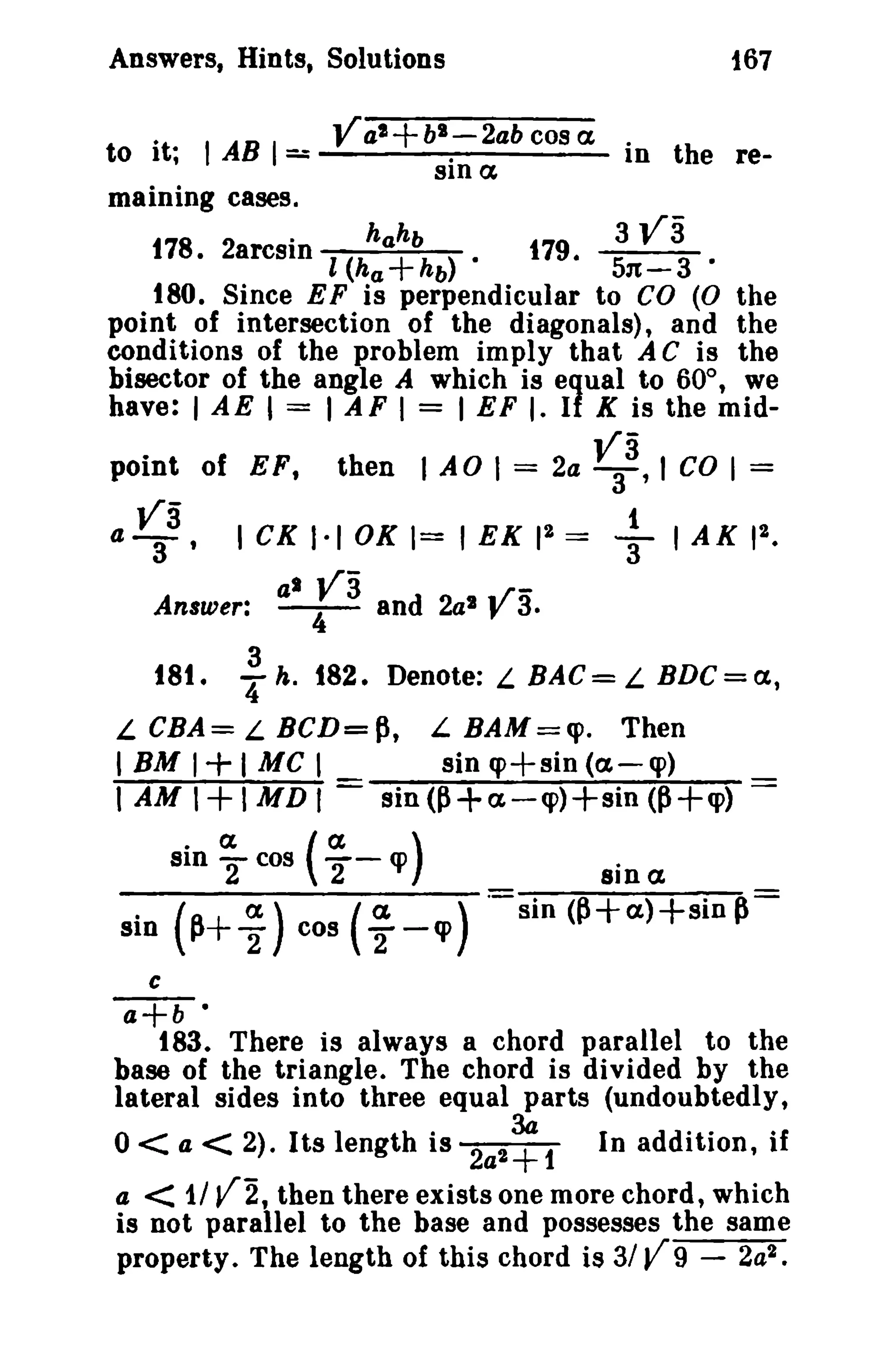
arbitrary point of the arc BC of the circle 
circumscribed about ABeD. Find the ratio 
'IBMI+IMCI 
IAMI+IMDI 
183. Each lateral side of an isosceles 
triangle is equal to 1, the base being equal 
to a. A circle is circumscribed about the 
triangle. Find the chord intersecting the 
lateral sides of the triangle and divided 
by the points of intersection into three 
equal segments. 
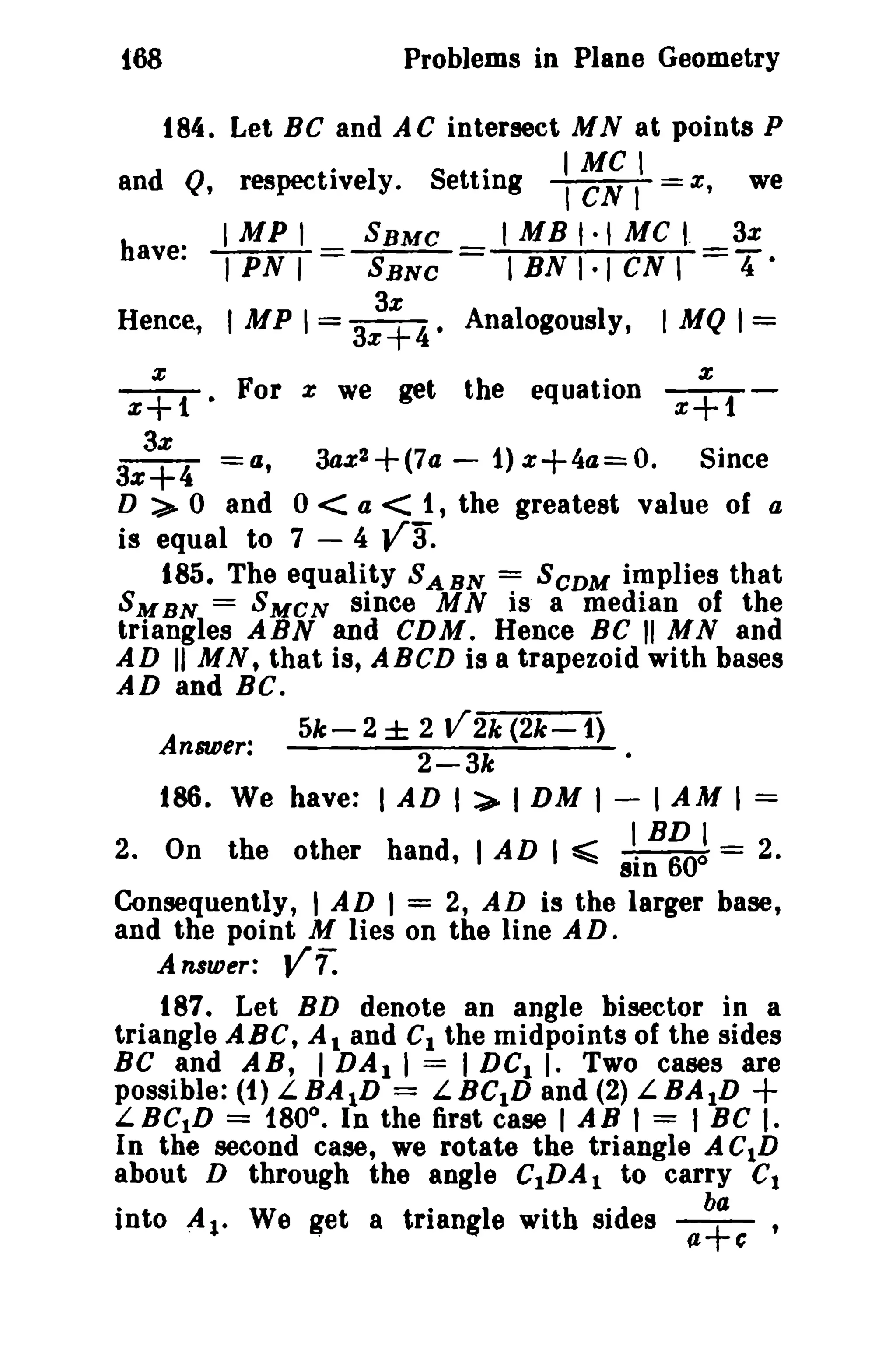
184. MN is a diameter of a circle, IMNI= 
1, A and B are points on the circle 
situated on one side from MN, C is a point 
on the other semicircle. Given: A is the 
midpoint of semicircle, I MB I = 3/5, the 
length of the line segment formed by the 
intersection of the diameter MN with the 
chords AC and Be is equal to a. What is 
the greatest value of a? 
185. ABCD is a convex quadrilateral. 
M the midpoint of AB, N the midpoint of 
CD. The areas of triangles ABN and CDM 
are known to be equal, and the area of 
their common part is 11k of the area of 
each of them. Find the ratio of the sides 
BC and AD.
40 Problems in Plane Geometry 
186. Given an equilateral trapezoid ABCD 
(AD II BC) whose acute angle at the larger 
base is equal to 60°, the diagonal being 
equal to V3. The point M is found at 
distances 1 and 3 from the vertices A and 
D, respectively. Find IMe I. 
187. The bisector of each angle of a 
triangle intersects the opposite side at a 
point equidistant from the midpoints of 
the two other sides of the triangle. Does it, 
in fact, mean that the triangle is regular? 
188. Given in triangle are two sides: 
a and b (a > a b). Find the third side if it 
is known that a + ha ~ b + hb , where ha 
and hb are the altitudes dropped on these 
sides (ha the altitude drawn to the side a). 
189. Given a convex quadrilateral ABG'D 
circumscribed about a circle of diameter 1. 
Inside ABeD, there is a point M such that 
I MA 12 + 1MB 12 + 1Me 12 + I MD 2 1 
= 
2. Find the area of ABCD. 
tOO. Given in a quadrilateral ABeD: 
I AB I = a, IBC I = b, ICD I = c, IDA 1= 
d; a2 + c2 =1= b2 + tP, c =1= d, M is a 
point on BD equidistant from A and C. 
Find the ratio I BM 1 I MD I. 
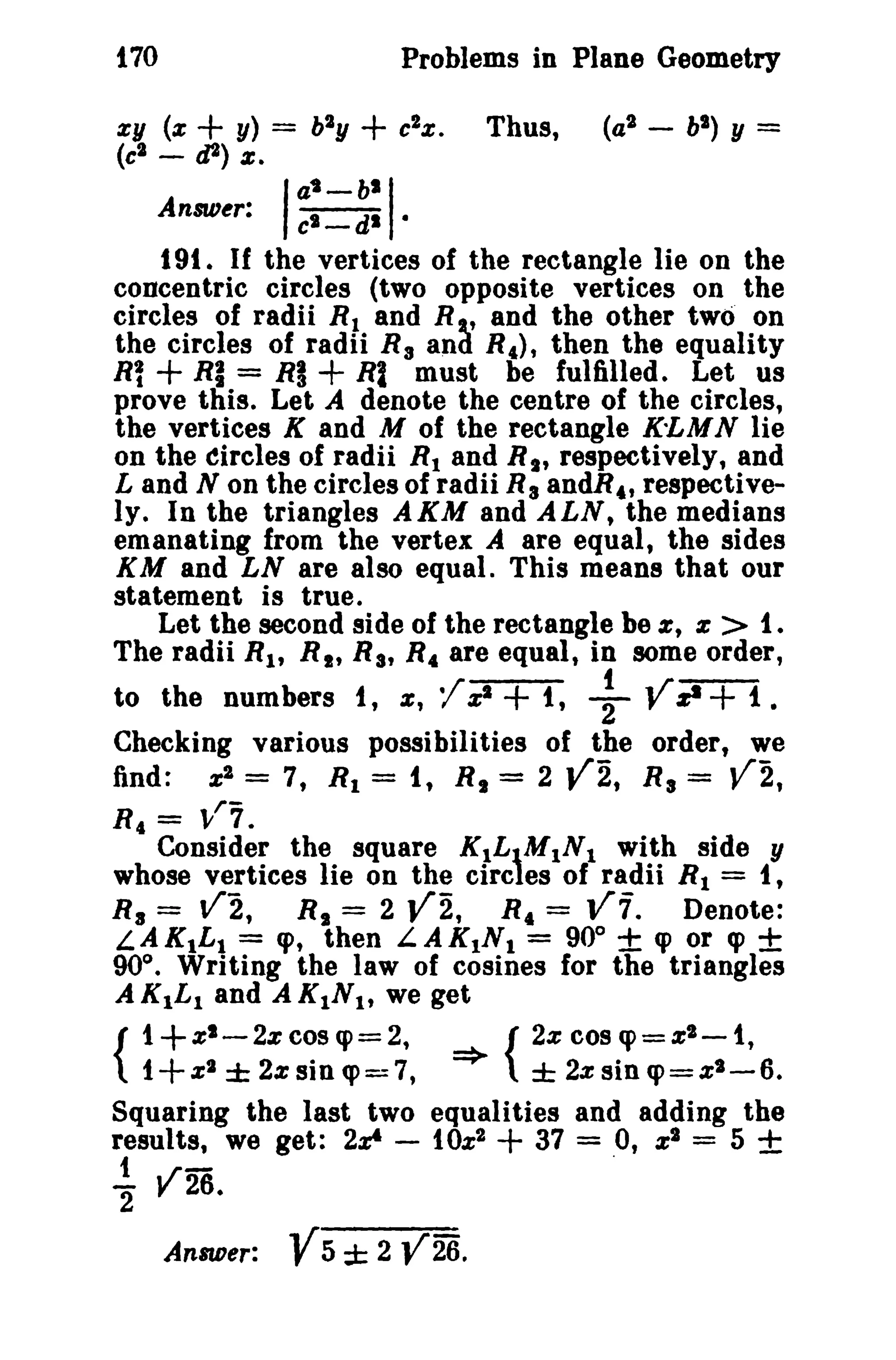
191. The smaller side of the rectangle 
ABeD is equal to 1. Consider four concentric 
circles centred at A and passing, respective­ly, 
through B, C, D, and the intersection 
point of the diagonals of the rectangle 
ABeD. There also exists a rectangle with
Sec. 1. Fundamental Facts 4t 
vertices on the constructed circles ~one 
vertice per circle). Prove that there IS a 
square whose vertices lie on the constructed 
circles. Find its side. 
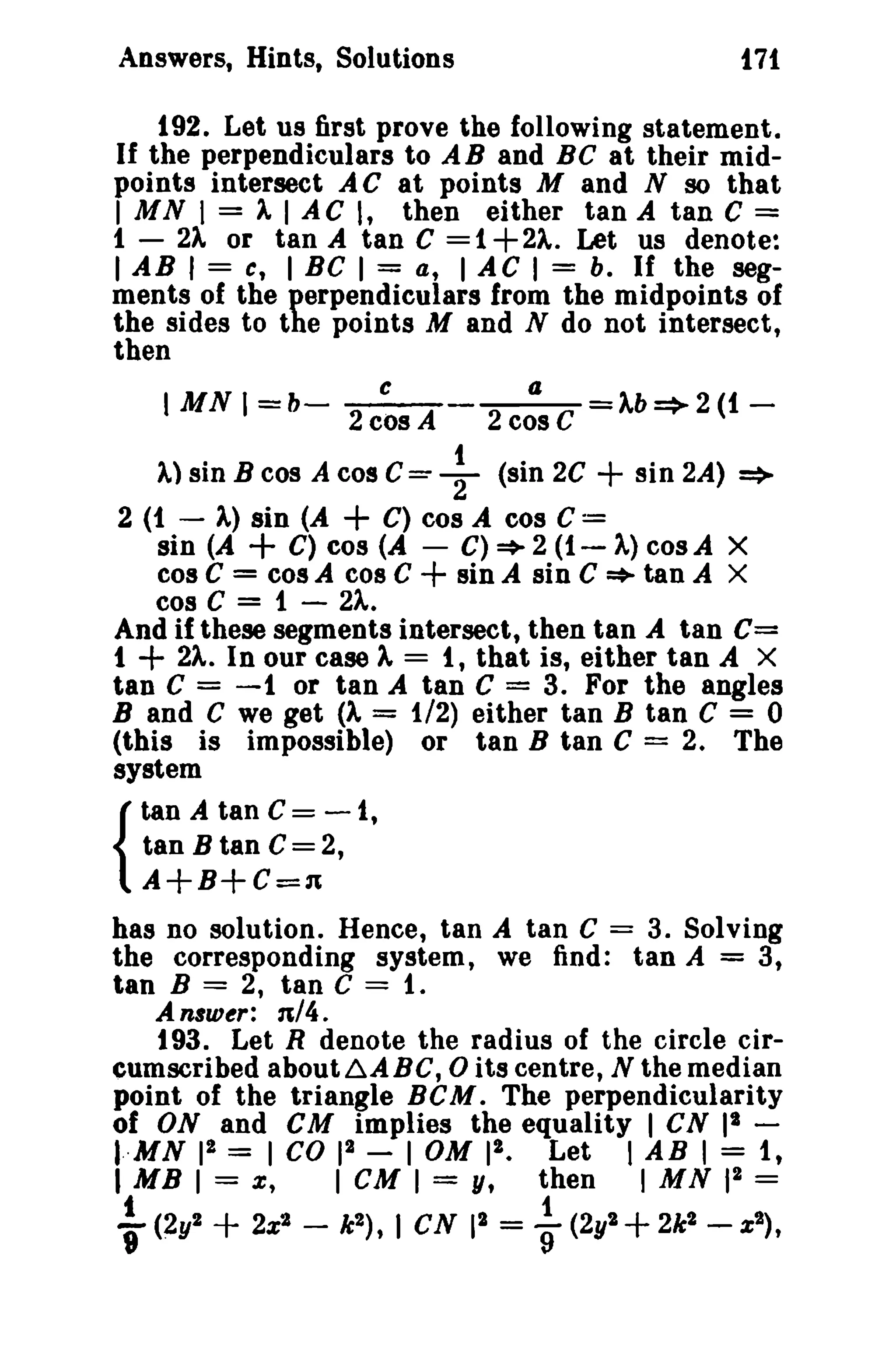
192. Given a triangle ABC. The perpen­diculars 
erected to AB and Be at their mid­points 
intersect the line AC at points M 
and N such that IMN I = I AC I. The 
perpendiculars erected to AB and AC at 
their midpoints intersect BC at points K 
and L such that 1KL I = ~ 1Be I. Find 
the smallest angle of the triangle ABC. 
193. A point M is taken on the side AB 
of a triangle ABC such that the straight 
line joining the centre of the circle cir­cumscribed 
about the triangle ABC to the 
median point of the triangle BCM is per­pendicular 
to cu. Find the ratio IBM I 
I BA I if I BC I I BA I = k. 
194. In an inscribed quadrilateral ABeD 
where IAB I = IBe I, K is the inter­section 
point of the diagonals. Find tAB I 
if IBK I = b, I KD I = d. 
195. Give the geometrical interpretations 
of equation (1) and systems (2), (3), and 
(4). Solve equation (1) and systems (2) 
and (3). In system (4) find x + y + z: 
(1)Vx2+a2-axV 3 
+-V y2+b2 - by Y3 .
42 Problems in Plane Geometry 
+VX2+ y2_ XY V3 
=Va2+ b2 (a>O, b>O). 
(2) { x = VZ2_ a2 +Vy2_a2, 
y ==Vx2 - b2+Vz2- b2 , 
Z = Vy2_ c2 +Vx2- c2. 
(3) x2+y2= (a-x2)+b2= d2+(b- y2.) 
(4) { x2+ xy + y2= a2, 
y2+yz+Z2 = b2, 
Z2+zx+x2 = a2 +b2• 
196. The side of a square is equal to a 
and the products of the distances from the 
opposite vertices to a line l are equal to 
each other. Find the distance from the centre 
of the square to the line l if it is known that 
neither of the sides of the square is parallel 
to l. 
197. One of the sides in a triangle ABC 
is twice the length of the other and LB = 
2 LC. Find the angles of the triangle. 
198. A circle touches the sides AB and 
AC of an isosceles triangle ABC. Let M 
be the point of tangency with the side AB 
and N the point of intersection of the circle 
and the base BC. Find IAN I if IAM I = 
a, IBM I = b. 
199. Given a parallelogram ABCD in 
which I AB I = k I BC I, K and L are 
points on the line CD (K on the side CD),
Sec. t. Fundamental Facts 43 
and M is a point on BC, AD being the 
bisector of the angle KAL, AM the bisector 
of the angle KAB, )BM I = a, IDL I = 
b. Find IAL I. 
200. Given a parallelogram ABCD. A 
straight line passing through the vertex C 
Intersects the lines AB and AD at points 
l( and L, respectively. The areas of the 
,triangles KBC and CDL are equal to p 
~nd q, respectively. Find the area of the 
parallelogram ABeD. 
201. Given a circle of radius R and two 
points A and B on it such that IAB I = a. 
Two circles of radii x and y touch the given 
~$rcle at points A and B. Find: (a) the 
length of the common external tangent to 
the last circles if both of them touch the 
~,:en circle in the same way (either inter­il, 
lly or externally); (b) the length of the 
~JPmon internal tangent if the circle of 
r~~ius x touches the given circle externally, 
while the circle of radius y touches the 
given circle internally. 
.:. f202. Given in a triangle ABC: IAB I = 
f2~, I BC I = 13, I CA I = 15. Taken on 
~ side AC is a point M such that the !".'.'.ii.' of the circles inscribed in the triangles . AI and ReM are equal. Find the ratio 
,!1M I : IMe ). 
i.",. 203. The radii of the circles inscribed and circumscribed about a triangle are 
iiual to rand R, respectively. Find the 
.'tea of the triangle if the circle passing
44 Problems in Plane Geometry 
through the centres of the inscribed and 
circumscribed circles and the intersection 
point of the altitudes of the triangle is 
known to pass at least through one of the 
vertices of the triangle. 
204. Given a rectangle AI1CD where 
I AB I = 2a, I BC I = a V2. On the side 
AR, as on diameter, a semicircle is con­structed 
externally. Let M be an arbitrary 
point on the semicircle, the line MD inter­sect 
AB at N, and the line Me at L. Find 
1AL 12 + I BN 12 (Fermat's" problem). 
205. Circles of radii Rand r touch each 
other internally. Find the side of the 
regular triangle, one vertex of which coin­cides 
with the point of tangency, and the 
other two, lying on the given circles. 
206. Two circles of radii Rand r (R > r) 
touch each other externally at a point A. 
Through a point B taken on the larger 
circle a straight line is drawn touching the 
smaller circle at C. Find I Be I if IAB I = 
a. 
207. In a parallelogram ABeD there are 
three pairwise tangent circles" *; one 0 f 
them also touches the sides AB and Be, the 
second the sides AB and AD, and the third 
the sides Be and AD. Find the radius of 
the third circle if the distance between the 
• Fermat, Pierre de (t60t-1665), a French 
amateur mathematician. 
•• Any two of them have a point of tangency.
Sec. 1. Fundamental Facts 45 
points of tangency on the side AB is equal 
to a. 
208. The diagonals of the quadrilateral 
ABeD intersect at a point M, the angle 
between them equalling Ct. Let 01' 02' 03' 
0« denote the centres of the circles circum­scribed 
about the triangles ARM, HeM, 
CDM, DAM, respectively. Determine the 
ratio of the areas of the quadrilaterals 
ABeD and °1°2°3°.. 209. In a parallelogram whose area is S, 
the bisectors of its interior angles are drawn 
to intersect one another. The area of the 
quadrilateral thus obtained is equal to Q. 
Find the ratio of the sides of the parallel­ogram. 
2tO. In a triangle ABC, a point M is 
taken on the side AC and a point N on the 
ade BC. The line segments AN and BM 
iBtersect at a point O. Find the area of the 
.~angle CMN if the areas of the triangles 
{)MA, DAB, and OBM are equal to 81, S2' 
ahd S3' respectively. 
211. The median point of a right triangle 
lies on the circle inscribed in this triangle. 
B'i;nd the acute angles of the triangle. 
212. The circle inscribed in a triangle 
kBC divides the median BM into three 
equal parts. Find the ratio I BC I I CA I 
-lAB I- 
213. In a triangle ABC, the midperpendic- 
·alar to the side AB intersects the line AC 
at M, and the midperpendicular to the side
46 Problems in Plane Geometry 
AC intersects the line AB at N. It is known 
that I MN I = I BC I and the line MN 
is perpendicular to the line BC. Determine 
the angles of the triangle ABC. 
214. The area of a trapezoid with bases 
AD and BC is S, IAD I : I BC I = 3; 
situated on the straight line intersecting the 
extension of the base AD beyond the point 
D there is a line segment EF such that 
AE II DF, BE II CF and I AE I : IDF I = 
I CF I IBE I = 2. Determine the area of 
the triangle EFD. 
215. In a triangle ABC the side BC is 
equal to a, and the radius of the inscribed 
circle is r. Find the area of the triangle if 
the inscribed circle touches the circle con­structed 
on BC as diameter. 
216. Given an equilateral triangle ABC 
with side a, BD being its altitude. A second 
equilateral triangle BDCl is constructed 
on BD, and a third equilateral triangle 
BDICt is constructed on the altitude BD! 
of this triangle. Find the radius of the circle 
circumscribed about the triangle CClC2 • 
Prove that its centre is found on one of the 
sides of the triangle ABC (C2 is situated 
outside the triangle ABC). 
217. The sides of a parallelogram are 
equal to a and b (a =1= b). Straight lines are 
drawn through the vertices of the obtuse 
angles of this parallelogram perpendicular 
to its sides. When intersecting, these lines 
form a parallelog~am similar to the given
Sec. t. Fundamental Facts 47 
one. Find the cosine of the acute angle of 
the given parallelogram. 
218. Two angle bisectors KN and LP 
intersecting at a point Q are drawn in a 
triangle KLM. The line segment PN has 
a length of 1, and the vertex M lies on the 
eircle passing through the points N, P, 
and Q. Find the sides and angles of the 
triangle PNQ. 
. 219. The centre of a circle of radius r 
touching the .sides AB, AD, and Be is 
located on the diagonal AC of a convex 
fluadrilateral ABeD. The centre of a circle 
of' the same radius r touching the sides 
Be, CD, and AD is found on the diagonal 
BD. Find the area of the quadrilateral 
~BCD if the indicated circles touch each 
other externally. 
220. The radius of the circle circumscribed 
.bout an acute-angled triangle ABC is equal 
lo t. The centre of the circle passing through 
the vertices A, C, and the intersection point 
"of the altitudes of the triangle ABC is known 
:~ lie on this circle. Find I AC I. 
°t i 221. Given a triangle ABC in which 
"ints M, N, and P are taken: M and N 
~ the sides AC and BC, respectively, P 
;.,. the line segment MN such that IAM I 
j~.·MC I = I CN I : INB I = IMP I : I PN I· 
lind the area of the triangle ABC if the 
.-eas of the triangles AMP and BNP are T 
~d. Q, respectively. 
~'~ 222. Given a circle of radius R and a
48 Problems in Plane Geometry 
point A at a distance a from its centre 
(a > R). Let K denote the point of the 
circle nearest to the point A. A secant line 
passing through A intersects the circle at 
points M and N. Find IMN I if the area 
of the triangle KMN is S. 
223. In an isosceles triangle ABC 
(I AB I = ,BC I), a perpendicular to AE 
is drawn through the end point E of the 
angle bisector AE to intersect the extension 
of the side AC at a point F (C lies bet-veen 
A and F). It is known that I AC I = 2m, 
I FC I = m/4. Find the area of the triangle 
ABC. 
224. Two congruent regular triangles 
ABC and CDE with side 1 are arranged 
on a plane so that they have only one com­mon 
point C, and the angle BCD is less than 
n/3. K denotes the midpoint of the side 
AC, L the midpoint of GE, and M the mid­point 
of RD. The area of the triangle KLM 
is equal to V3/5. Find IBD I. 
225. From a point K situated outside a 
circle with centre 0, two tangents KM 
and KN (M and N points of tangency) are 
drawn. A point C (I Me I < I CN I) is 
taken on the chord MN. Drawn through the 
point C perpendicular to the line segment 
OC is a straight line intersecting the line 
segment N K at B. The radius of the circle 
is known to be equal to R, LMKN = a, 
1 MC I = b. Find I CB I·
Sec. t. Fundamental Facts 49 
226. A pentagon ABCDE is inscribed in 
a circle. The points M, Q, N, and P are the 
feet of the perpendiculars dropped from the 
vertex E of the sides AB, Be, CD (or their 
extensions), and the diagonal AD, respective­ly. 
It is known that I EP I = d, and the 
ratio of the areas of the triangles MQE and 
PNE is k. Find IEM f. 
227. Given a right trapezoid. A straight 
line, parallel to the bases of the trapezoid 
separates the latter into two trapezoids 
such that a circle can be inscribed in each 
of them. Determine the bases of the original 
trapezoid if its lateral sides are equal to c 
and d (d > c). 
228. Points P and Q are chosen on the 
lateral sides KL and M N of an equilateral 
trapezoid KLMN, respectively, such that 
the line segment PQ is parallel to the bases 
of the trapezoid. A circle can be inscribed 
in each of the trapezoids KPQN and 
PLMQ, the radii of these circles being 
equal to Rand r, respectively. Determine 
the bases I LM I and I KN I· 
229. In a triangle ABC, the bisector of 
the angle A intersects the side BC at a 
point D. It is known that lAB I-IBD 1= 
a, I AC I + I CD I = b. Find I AD I· 
230. Using the result of the preceding 
problem, prove that the square of the 
bisector -of the triangle is equal to the prod­uct 
of the sides enclosing this bisector 
minus the product of the line segments of 
4-01557
50 Problems in Plane Geometry 
the third side into which the latter is divided 
by the bisector. 
231. Given a circle of diameter A B. A sec­ond 
circle centred at A intersects the first 
circle at points C and D and its diameter at 
E. A point M distinct from the points C 
and E is taken on the arc CE that does not 
include the point D. The ray BM intersects 
the first circle at a point N. It is known that 
I CN I = a, IDN I = b. Find I MN I· 
232. In a triangle ABC, the angle B is 
'Jt/4, the angle C is :1/6. Constructed on the 
medians BN and CN as diameters are cir­cles 
intersecting each other at points P 
and Q. The chord PQ intersects the side 
BC at a point D. Find the ratio I BD I 
IDC I. 
233. Let AB denote the diameter of a 
circle, 0 its centre, AB = 2R, C a point 
on the circle, M a point on the chord AC. 
From the point M, a perpendicular MN 
is dropped on AB and another one is erect­ed 
to AC intersecting the circle at L (the 
line segment CL intersects AB). Find the 
distance between the midpoints of AO 
and CL if I AN I = a. 
234. A circle is circumscribed about a 
triangle ABC. A tangent to the circle 
passing through the point B intersects the 
line AC at M. Find the ratio IAM I 
IMe I if IAB I : I BC I = k. 
235. Points A, B, C, and D are situated 
in consecutive order on a straight line,
Sec. f. Fundamental Facts 5t 
where I AC I = a, IAB I, IAD I = PIAB I· 
An arbitrary circle is described through A 
and B, CM and DN being two tangents to 
this circle (M and N are points on the circle 
lying on opposite sides of the line AB). 
In what ratio is the line segment AB divided 
by the line MN? 
236. In a circumscribed quadrilateral 
ABeD, each line segment from A to the 
points of tangency is equal to a, and each 
line segment from C to the points of tan­gency 
is b. What is the ratio in which the 
diagonal AC is divided by the diagonal 
BD? 
237. A point K lies on the base AD of the 
trapezoid ABeD. such that IAK I = 
A IAD I. Find the ratio IAM I : I MD I, 
where M is the point of intersection of the 
base AD and the line passing through the 
intersection points of the lines AB and CD 
and the lines BK and AC. 
Setting A = tin (n = 1, 2, 3, .], di-vide 
a given line segment into n equal parts 
using a straight edge only given a straight 
line parallel to this segment. 
238. In a right triangle ABC with the 
hypotenuse AB equal to c, a circle is con­structed 
on the altitude CD as diameter. 
Two tangents to this circle passing through 
the points A and B touch the circle at points 
M and N, respectively, and, when extended, 
intersect at a point K. Find I MK I. 
239. Taken on the sides AB, Be and CA 
4*
52 Problems in Plane Geometry 
of a triangle ABC are points Cl , Al and BI 
such that I ACt I : I CIB I = I BAt I : 
I Al CI = I CBt I: I BtA I = k. Taken on 
the sides AtBI , BICI , and CIA I are points 
C2 , A 2 , and B 2 , such that I A IC2 I 
I GtB I , = I BIA 2 I I AtCI I = I c.s, I 
I B 2A I I = 11k. Prove that the triangle 
AtB2C2 is similar to the triangle ABC and 
find the ratio of similitude. 
240. Given in a triangle ABC are the 
radii of the circumscribed (R) and inscribed 
(r) circles. Let At, Bt , Cl denote the points 
of intersection of the angle bisectors of the 
triangle ABC and the circumscribed circle. 
Find the ratio of the areas of the triangles 
ABC and AIBICt . 
241. There are two triangles with corre­spondingly 
parallel sides and areas 81 and 8 2 , 
one of them being inscribed in a triangle 
ABC, the other circumscribed about this 
t-riangle. Find the area of the triangle ABC. 
242. Determine the angle A of the triangle 
ABC if the bisector of this angle is per­pendicular 
to the straight line passing 
through the intersection point of the alti.. 
tudes of this triangle and the centre of the 
circumscribed circle. 
243. Find the angles of a triangle if the 
distance between the centre of the circum­scribed 
circle and the intersection point 
of the altitudes is one-half the length of the 
largest side and equals the smallest side. 
244. Given a triangle ABC. A point D
Sec. 1. Fundamental Facts 53 
is taken on the ray BA such that I BD I = 
I BA I + IAC I· Let K and M denote two 
points on the rays BA and Be, respectively, 
such that the area of the triangle BDM 
is equal to the area of the triangle BCK. 
Find LBKM if LBAC == Ct. 
245. In a trapezoid ABeD, the lateral 
side AB is perpendicular to AD and BC, 
and I AB I = VI AD 1·1 BC I. LetE denote 
the point of intersection of the nonparallel 
sides of the trapezoid, 0 the intersection 
point of the diagonals and M the midpoint 
of AB. Find LEOM. 
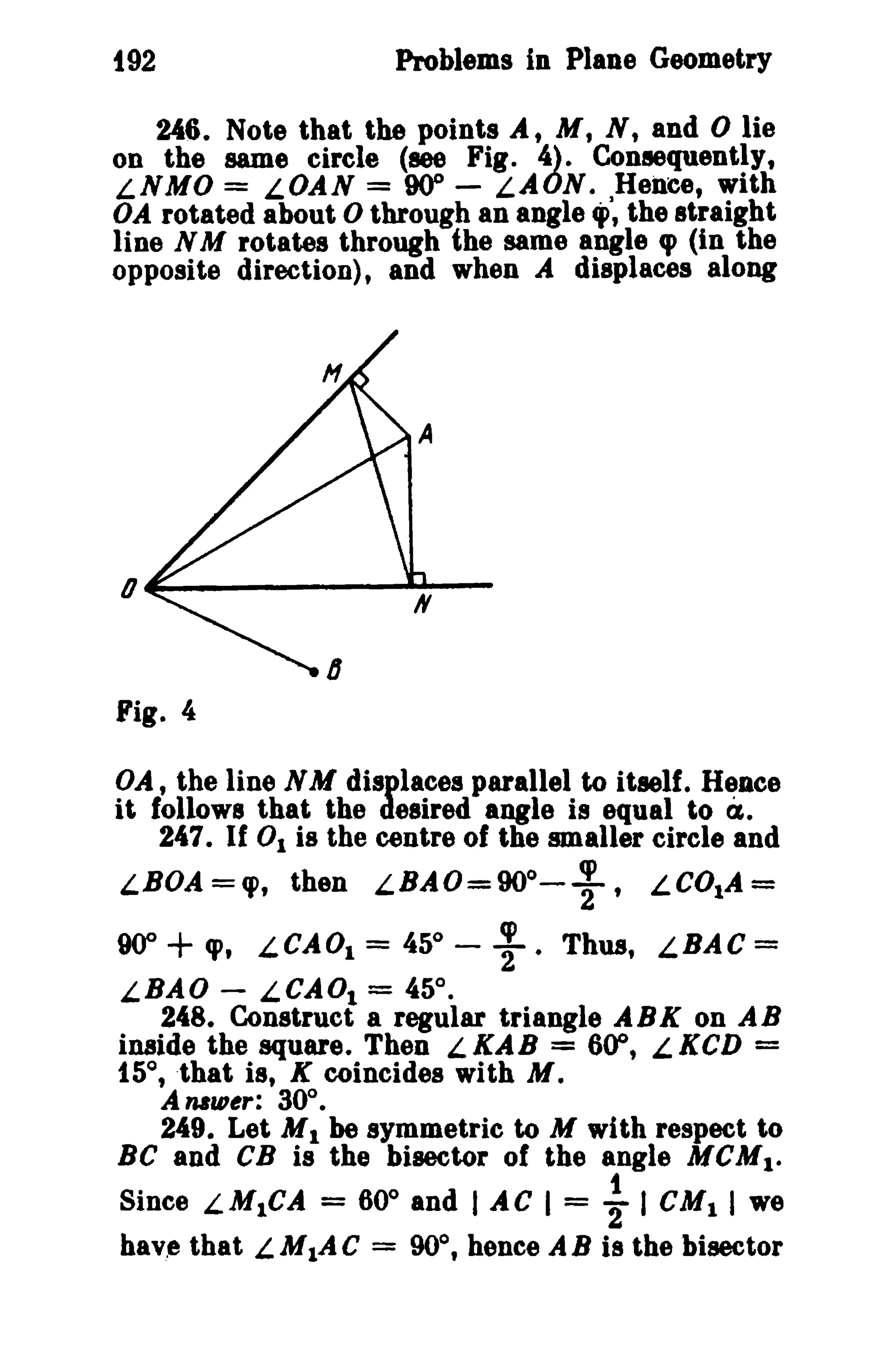
246. Two points A and B and two straight 
lines intersecting at 0 are given in a plane. 
Let us denote the feet of the perpendiculars 
dropped from the point A on the given lines 
by M and N, and the feet of the perpendic­ulars 
dropped from B by K and L, respective­ly. 
Find the angle between the lines MN 
and KL if LAOB = Ct ~ 90°. 
247. Two circles touch each other inter­nally 
at a point A. A radius OB touching 
the smaller circle at C is drawn from the 
centre 0 of the larger circle. Find the angle 
BAC. 
248. Taken inside a square ABCD is a 
point Msuch thatLMAB = 60°, LMCD = 
15°. Find LMBC. 
249. Given in a triangle ABC are two 
angles: LA = 45° and LB = 15° Taken 
on the extension of the side AC beyond the
54 Problems in Plane Geometry 
point C is a point M such that I CM I = 
2 I AC I. Find LAMB. 
250. In a triangle ABC, LB = 60° and 
the bisector of the angle A intersects BC 
at M. A point K is taken on the side AC 
such that LAMK = 30°. Find LOKe, 
where 0 is the centre of the circle circum­scribed 
about the triangle AMC. 
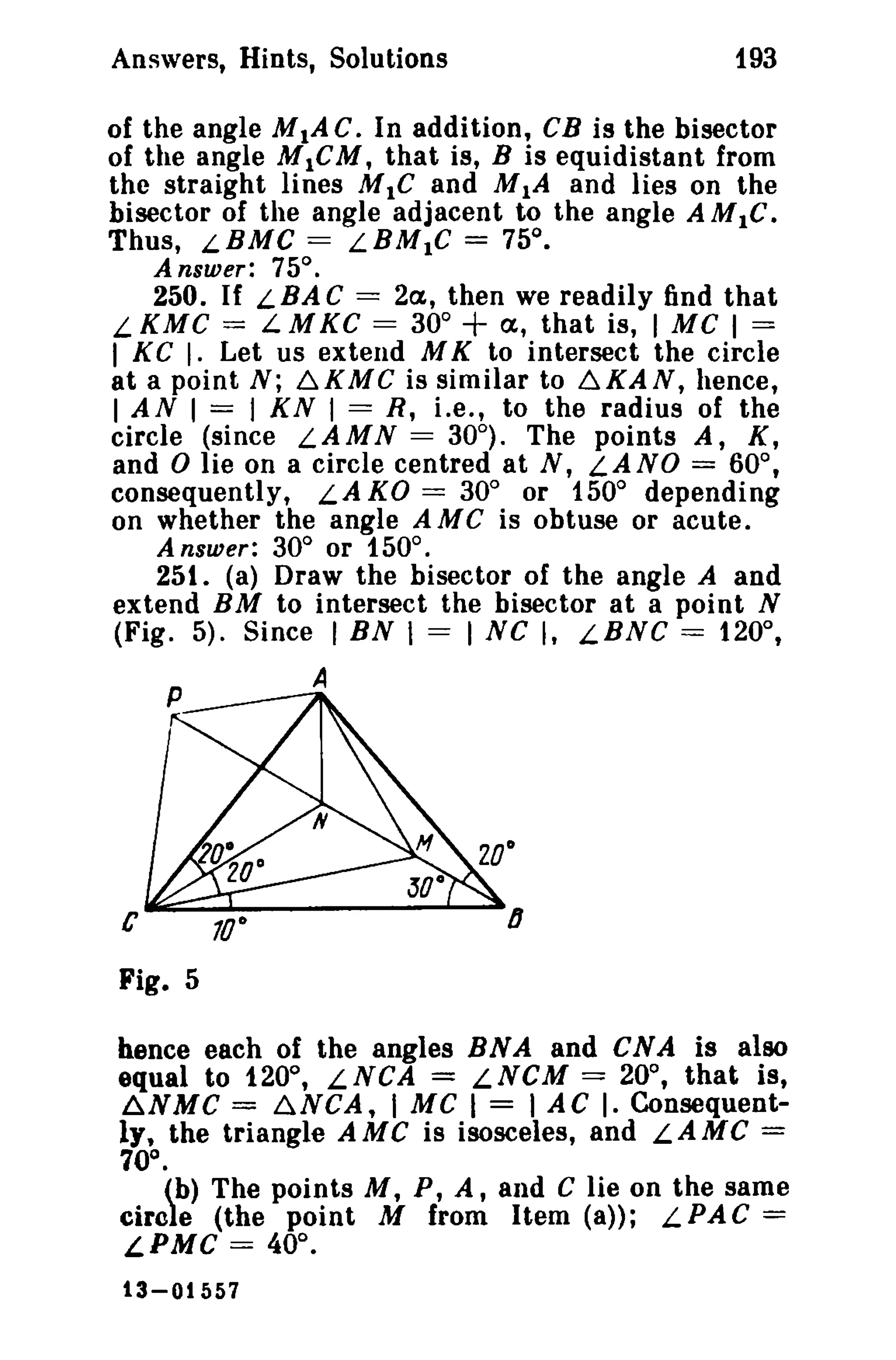
251. Given a triangle ABC in which 
1AB I = IAC I, LA = 80°. (a) A point 
M is taken inside the triangle such that 
LMBC = 30°, LMCB = 10°. Find LAMC. 
(b) A point P is taken outside the triangle 
such that LPBC = LPCA = 30°, and 
the line segment BP intersects the side 
AC. Find LPAC. 
252. In a triangle ABC, LB = 100°, 
LC = 65°; a point M is taken on AB such 
that LMCB = 55°, and a point N is taken 
on AC such that LNBC = BO°. Find 
LNMC. 
253. In a triangle ABC, I AB I = I BC I, 
LB = 20°. A point M is taken on the side 
AB such that LMCA = 60°, and a point N 
on the side CB such that LNA C = 50°. 
Find LNMC. 
254. In a triangle ABC, LB = 70°, 
LC = 50°. A point M is taken on the side 
AB such that LMCB = 40°, and a point N 
on the side AC such that LNBC = 50°. 
Find LNMC. 
255. Let M and N denote the points of 
tangency of the inscribed circle with the
Sec. 1. Fundamental Facts 55 
sides Be and BA of a triangle ABC, K the 
intersection point of the bisector of the 
angle A and the line MN. Prove that 
LAKC = 90°. 
256. Let P and Q be points of the circle 
circumscribed about a triangle ABC such 
that I PA 12 = I PB 1·1 PC I, IQA 12 = 
I QR I· IQC I (one of the points is on the 
arc AB, the other on the arc A C). Find 
LPAB - LQAC if the difference between 
the angles Band C of the triangle ABC 
is (7,. 
257. Two fixed points A and B are taken 
on a given circle and ........AB = (7,. An arbit­rary 
circle passes through the points A and 
B. An arbitrary line 1 is also drawn through 
the point A and intersects the circles at 
points C and D different from B (the point 
C is on the given circle). The tangents to 
the circles at the points C and D (C and D 
the points of tangency) intersect at M; 
N is a point on the line 1such that I eN I = 
I AD I, IDN I = I CA I· What are the 
values the LCMN can assume? 
258. Prove that if one angle of a triangle 
is equal to 120°, then the triangle formed 
by the feet of its angle bisectors is right­angled. 
259. Given in a quadrilateral ABCD: 
LDAB = 150°, LDAC + LARD = 120°, 
LDBC - LARD = 60°. Find LBDe.
56 Problems in Plane Geometry 
• * * 
260. Given in a triangle ABC: I AB I = 
1. I AC I = 2. Find I BC I if the bisectors 
of the exterior angles A and C are known 
to be congruent (i.e., the line segment of 
the bisectors from the vertex to the inter­section 
point with the straight line includ­ing 
the side of the triangle opposite to the 
angle). 
261. A point D is taken on the side CB 
of a triangle ABC such that I CD I = 
ex lAC [. The radius of the circle circum­scribed 
about the triangle ABC is R. Find 
the distance between the centres of the 
circles circumscribed about the triangles 
ABC and ADB. 
262. A circle is circumscribed about 8 
right triangle ABC (LC = 90°). Let CD 
denote the altitude of the triangle. A circle 
centred at D passes through the midpoint of 
the arc AB and intersects AB at M. Find 
J cu I if I AB I = c. 
263. Find the perimeter of the triangle 
ABC if IBC I = a and the segment of the 
straight line tangent to the inscribed circle 
and parallel to Be which is enclosed inside 
the triangle is b. 
264. Three straight lines parallel to the 
sides of a triangle and tangent to the in­scribed 
circle are drawn. These lines cut 
off three triangles from the given one. The 
radii of the circles circumscribed about them
Sec. 1. Fundamental Facts 57 
are equal to R1, R t , and R a• Find the radius 
of the circle circumscribed about the given 
triangle. 
265. Chords AB and AC are drawn in a 
circle of radius R. A point M is taken on 
AB or on its extension beyond the point B, 
the distance from M to the line AC being 
equal to I AC I. Analogously a point N 
is taken on AC or on its extension beyond 
the point C, the distance from N to) the 
line AB being equal to I AB I. Find MN. 
266. Given a circle of radius R centred 
at O. Two other circles touch the given 
circle internally and intersect at points A 
and B. Find the sum of the radii of these 
two circles if LOAB = 90°. 
267. Two mutually perpendicular inter­secting 
chords are drawn in a circle of ra­dius 
R. Find (a) the sum of the squares of 
the four segments of these chords into 
which they are divided by the point of in­tersection; 
(b) the sum of the squares of the 
chords if the distance from the centre of 
the circle to the point of their intersection 
is equal to a. 
268. Given two concentric circles of radii 
rand R (r < R). A straight line is drawn 
through a point P on the smaller circle to 
intersect the larger circle at points Band 
C. The perpendicular to Be at the point P 
intersects the smaller circle at A. Find 
I PA 1 2 + I PB 1 2 + I PC 2 
1 
• 
269. In a semicircle, two intersecting
58 Problems in Plane Geometry 
chords are drawn from the end points of the 
diameter. Prove that the sum of the prod­ucts 
of each chord segment that adjoins 
the diameter by the entire chord is equal 
to the square of the diameter. 
270. Let a, b, C and d be the sides of an 
inscribed quadrilateral (a be opposite to c), 
ha , hb , he' and hd the distances from the cen­tre 
of the circumscribed circle to' the corre­sponding 
sides. Prove that if the centre of 
the circle is inside the quadrilateral, then 
ahc + cha = bhd + dh b • 
271. Two opposite sides of a quadrilat­eral 
inscribed in a circle intersect at points 
P and Q. Find I PQ I if the tangents to the 
circle drawn from P and Q are equal to a 
and b, respectively. 
272. A quadrilateral is inscribed in a cir­cle 
of radius R. Let P, Q, and M denote 
the points of intersection of the diagonals' 
of this quadrilateral with the extensions of 
the opposite sides, respectively. Find the 
sides of the triangle PQM if the distances 
from P, Q, and M to the centre of the cir­cle 
are a, b, and c, respectively. 
273. A quadrilateral ABeD is circum­scribed 
about a circle of radius r. The point of 
tangency of the circle with the side AB 
divides the latter into segments a and b, 
and the point at which the circle touches 
the side AD divides that side into segments 
a and c. What are the limits of change of r? 
274. A circle of radius r touches inter-
Sec. 1. Fundamental Facts 59 
nally a circle of radius R, A being the point 
of tangency. A straight line perpendicular 
to the centre line intersects one of the cir­cles 
at B, the other at C. Find the radius 
of the circle circumscribed about the tri­angle 
ABC. 
275. Two circles of radii Rand r intersect 
each other, A being one of the points of in­tersection, 
BC a common tangent (B and 
C points of tangency). Find the radius of 
the circle circumscribed about the trian­gle 
ABC. 
276. Given in a quadrilateral ABCD: 
I AB I = a, I AD I = b; the sides BC, CD, 
and AD touch a circle whose centre is in the 
middle of AB. Find I BC I . 
277. Given in, an inscribed quadrilat­eral 
ABCD: IAB I = a, I AD I = b (a > 
b). Find I BC I if Be, CD, and AD 
touch a circle whose centre lies on A B. 
* • * 
278. In a convex quadrilateral ABCD, 
IAB I = IAD I. Inside the triangle 
ABC, a point M is taken such that 
LMBA = LADe, LMCA = LACD. 
Find L MAC if L BAG = cx, L ADG ­L 
ACD = q>, IAM I < I AB I· 
279. Two intersecting circles are inscribed 
in the same angle, A being the vertex of 
the angle, B one of the intersection points 
of the circles, C the midpoint of the chord 
whose end points are the points of tangency
60 Problems in Plane Geometry 
of the first circle with the sides of the an­gle. 
Find the angle ABC if the common chord 
can be observed from the centre of the 
second circle at an angle a. 
280. In an isosceles triangle ABC, 
IAC I = 1Be I, BD is an angle bisec­tor, 
BDEF is a rectangle. Find L BAF 
if L BAE = 1200 
281. A circle centred at 0 is circumscribed 
about a triangle ABC. A tangent to the cir­cle 
at point C intersects the line bisecting 
the angle B at a point K, the angle BKC be­ing 
one-half the difference between the tri­ple 
angle A and the angle C of the triangle. 
The sum of the sides AC and AB is equal 
to 2 + V3" and the sum of the distances 
from the point 0 to the sides AC and AB 
equals 2. Find the radius of the circle. 
282. The points symmetric to the verti­ces 
of a triangle with respect to the oppo­site 
sides represent the vertices of the trian-gle 
with sides VB, VB, V14. Determine the 
sides of the original triangle if their lengths 
are different. 
283. In a triangle ABC, the angle between 
the median and altitude emanating from 
the angle A is a, and the angle between the 
median and altitude emanating from B 
is ~. Find the angle between the median and 
altitude emanating from the angle C. 
284. The radius of the circle circum­scribed 
about a triangle is R. The distance
Sec. 1. Fuudamental Facts 61 
from the centre of the circle to the median 
point of the triangle is d. Find the product 
of the area of the given triangle and the 
triangle formed by the lines passing 
through its vertices perpendicular to the 
medians emanating from those vertices. 
285. The points AI' A3 and As are situated 
on one straight line, and the points A 2' 
A., and A 8 on the other intersecting the 
first line. Find the angles between these 
lines if it is known that the sides of the 
hexagon A IA 2A sA.Af)A. (possibly, a self­intersecting 
one) are equal to one another. 
286. Two circles with centres 0 1 and O2 
touch internally a circle of radius R cen­tred 
at O. It is known that I 0102 I = a. 
A straight line touching the first two cir­cles 
and intersecting the line segment 0 102 
intersects their common external tangents 
at points M and N and the larger circle at 
points A and B. Find the ratio I AB I 
I MNI if (8) the line segment 0102 con­tains 
the point 0; (b) the circles with cen­tres 
0 1 and O2 touch each other", 
287. The circle inscribed in a triangle 
ABC touches the side AC at a point M and 
the side BC at N; the bisector of the angle 
A intersects the line MN at K, and the bi­sector 
of the angle B intersects the line MN 
at L. Prove that the line segments MK, 
N L, and KL can form a triangle. Find the 
area of this triangle if the area of the 
triangle ABC is S, and the angle C is a.
62 Problems in Plane Geometry 
288. Taken on the sides AB and BC of a 
square are two points'M and N such that 
IBM I + IBN I = I AB I. Prove that 
the lines DM and DN divide the diagonal 
AC into three line segments which can form 
a triangle, one angle of this triangle being 
equal to 60°. 
289. Given an isosceles triangle ABC, 
I AB I = I BC I , AD being an angle bi­sector. 
'(he perpendicular erected to AD 
at D intersects the extension of the side 
AC at a point E; the feet of the perpendicu­lars 
dropped from Band D on AC are points 
M and N, respectively. Find I MN I if 
IAE I = a. 
290. Two rays emanate from a point A 
at an angle Cl. Two points Band BI are 
taken on one ray and two points C and CI 
on the other. Find the common chord of the 
circles circumscribed about the triangles 
ABC and ABICI if I AB I - I AC I = 
I ARI I - I AC 1 I = a. 
291. Let 0 be the centre of a circle, C 
a point on this circle, M the midpoint of 
OC. Points A and B lie on the circle on the 
same side of the line OC so that L AMO = 
L BMC. Find I AB I if IAM I - 
IBM I = a. 
292. Let A, B, and C be three points ly­ing 
on the same line. Constructed on AR, 
BC, and AC as diameters are three semicir­cles 
located on the same side of the line. 
The centre of a circle touching the three
Sec. f. Fundamental Facts 63 
semicircles is found at a distance d from the 
line AC. Find the radius of this circle. 
293. A chord AB is drawn in a circle of 
radius R. Let M denote an arbitrary point 
of the circle. A line segment MN ( IMN I = 
R) is laid off on the ray M A and on the 
ray MB a line segment M K equal to the 
distance from M to the intersection point 
of the altitudes of the triangle MAB. Find 
INK I if the smaller of the arcs sub­tended 
by AB is equal to 2a. 
294. The altitude dropped from the right 
angle of a triangle on the hypotenuse sepa­rates 
the triangle into two triangles in each 
of which a circle is inscribed. Determine the 
angles and the area of the triangle formed by 
the legs of the original triangle and the line 
passing through the centres of the circles 
if the altitude of the original triangle is h. 
295. The altitude of a fight triangle 
drawn to the hypotenuse is equal to h. 
Prove that the vertices of the acute angles 
of the triangle and the projections of the 
foot of the altitude on the legs all lie on the 
same circle. Determine the length of the 
chord cut by this circle on the line contain­ing 
the. altitude and the segments of the 
chord into which it is divided by the hypo­tenuse. 
296. A circle of radius R touches a 
line l at a point .A, AB is a diameter 
of this circle, Be is an arbitrary chord. 
Let D denote the foot of the perpendicular
Problems in Plane Geometry 
dropped from C on AB. A point E lies on the 
extension of CD beyond the point D, and 
I ED I = I BC I The tangents to the cir-cle, 
passing through E, intersect the line 
l at points K and N. Find I KN I 
297. Given in a convex quadrilateral 
ABeD: IAB I = a, I AD I = b, I Be I ~ 
p - a, IDC I = p - b. Let 0 be the 
point of intersection of the diagonals. Let 
us denote the angle BA C by a. What does 
I AO I tend to as a ~ O?
Section 2 
Selected Problems and 
Theorems of Plane Geometry 
Carnot's Theorem 
t. Given points A and B. Prove that the 
locus of points M such that IAM I 2 ­I 
MB I 2 = k (where k is a given number) 
is a straight line perpendicular to AB. 
2. Let the distances from a point M to 
the vertices A, B, and C of a triangle ABC 
be a, b, and c, respectively. Prove that there 
is no d =1= 0 and no point on the plane 
for which the distances to the vertices in the 
same order can be expressed by the numbers 
Va2 + d, Vb2 + d, Vc2 + d. 
3. Prove that for the perpendiculars drop-ped 
from the points At, B1 , and Cion the 
sides Be, CA, and AB of a triangle ABC 
to intersect at the same point, it is nec­essary 
and sufficient that 
I AlB 12 
- I BCI 12 + I CIA 12 
2+ 
_ I ABI 1 
1BtC 12 
- I CAl 1 2 = 0 (Carnot's theorem). 
4. Prove that if the perpendiculars drop... 
ped from the points AI' Bt , and Ct on the 
sides BC, CA, and AB of the triangle ABC, 
respectively, intersect at the same point, 
then the perpendiculars dropped from the 
5 -01557
66 Problems in Plane Geometry 
points A, B, and C on the lines BICI, CIA I, 
and AIBI also intersect at one point. 
5. Given a quadrilateral ABeD. Let AI, 
Bl , and C1 denote the intersection points 
of the altitudes of the triangles BCD, 
ACD, and ABD. Prove that the perpen­diculars 
dropped from A, B, and C on the 
lines BICI , CIAI , and AtBI , respectively, 
intersect at the same point. 
6. Given points A and B. -Prove that the 
locus of points M such that k I AM 1 2 + 
l I BM I 2 = d (k, l, d given numbers, 
k + l =1= 0) is either a circle with centre on 
the line AB or a point or. an empty set. 
7. Let At, A 2 , •• , An be fixed points 
and kl , k 2 , . ., k n be given numbers. Then 
the locus of points M such that the sum 
kl I AIM 1 2 + k 2 I A 2M 1 2 + · · + 
k n I A nM I 2 is constant is: (a) a circle, a 
point, or an empty set if kl + k2 +. + 
k n =1= 0; (b) a straight line, an empty set, 
or the entire plane if kl + k 2 + + 
k; -= o. 
8. Given a circle and a point A outside 
the circle. Let a circle passing through A 
touch the given circle at an arbitrary point 
B, and the tangents to the second circle 
which are drawn through the points A and 
B intersect at a point M. Find the locus of 
points M. 
9. Given points A and .B. Find the locus 
of points M such that IAM I I MB I = 
k =1= 1.
Sec. 2. Selected Problems 67 
10. Points A, B, and C lie on a straight 
line (B between A and C). Let us take an ar­bitrary 
circle centred at B and denote by M 
the intersection point of the tangents drawn 
from A and C to that circle. Find the locus 
of points M such that the points of tangency 
of straight lines AM and CM with the cir­cle 
belong to the open intervalsAMand GM. 
1I , Given two circles. Find the locus of 
points M such that the ratio of the lengths 
of the tangents drawn from M to the given 
circles is a constant k. 
12. Let a straight line intersect one cir­cle 
at points A and B and the other at 
points C and D. Prove that the intersection 
points of the tangents to the first circle 
which are drawn at points A and B and the 
tangents drawn to the second circle at 
points C and D (under consideration are the 
intersection points of tangents to distinct 
circles) lie on a circle whose centre is found 
on the straight line passing through the cen­tres 
of the given circles. 
13. Let us take three circles each of which 
touch one side of a triangle and the exten­sions 
of two other sides. Prove that the per­pendiculars 
erected to the sides of the tri­angle 
at the points of tangency of these cir­cles 
intersect at the same point. 
14. Given a triangle ABC. Consider all 
possible pairs of points M1 and M2 such that 
IAMt I : IBMt I : I CMt I = IAMI I : 
IBM2 I I CM2 I· Prove that the lines 
5*
Problems in Plane Geometry 
MIMI pass through the same fixed point 
in the plane. 
t5. The distances from a point M to the 
vertices A, B, and C of a triangle are equal 
to 1, 2, and 3, respectively, and from a 
point M1 to the same vertices to 3,V15, 5, 
respectively. Prove that the straight line 
MMl passes through the centre of the cir­cle 
circumscribed about the triangle ABC. 
16. Let AI' Bl , Gl denote the feet of the 
perpendiculars dropped from the vertices 
A, B, and C of a triangle ABC on the line l, 
Prove that the perpendiculars dropped from 
AI' Bl , and Cion Be, CA, and AB, re­spectively, 
intersect at the same point. 
17. Given a quadrilateral triangle ABC 
and an arbitrary point D. Let AI' Bl , and 
C1 denote the centres of the circles inscribed 
in the triangles BCD, CAD, and ABD, 
respectively. Prove that the perpendiculars 
dropped from the vertices A, B, and C 
on BlGl, CIAt , and AIBl , respectively, in­tersect 
at the same point. 
18. Given three pairwise intersecting cir­cles. 
Prove that the three common chords of 
these circles pass through the same- point. 
19. Points M and N are taken on lines AB 
and AC, respectively. Prove that the com­mon 
chord of two circles with diameters 
eM and BN passes through the intersection 
point of the altitudes of the triangle ABC. 
20. A circle and a point N are given in a
Sec. 2. Selected Problems 69 
plane. Let AB be an arbitrary chord of the 
circle. Let M denote the point of intersec­tion 
of the line AB and the tangent at the 
point N to the circle circumscribed about 
the triangle ABN. Find the locus of points 
M. 
21. A point A is taken inside a circle. 
Find the locus of the points of intersection 
of the tangents to the circle at the end points 
of all possible chords passing through the 
point A. 
22. Given numbers a, p, y, and k. Let 
x, y, I denote the distances from a point M 
taken inside a triangle to its sides. Prove 
that the locus of points M such that ax + 
py + "1 = k is either an empty set or 
a line segment or coincides with the set of 
all points of the triangle. 
23. Find the locus of points M situated 
inside a given triangle and such that the 
distances from M to the sides of the given 
triangle can serve as sides of a certain trian­gle. 
24. Let AI' BI , and C1 be- the midpoints 
of the sides BC, CA, and AB of a triangle 
ABC, respectively. Points A 2 , B2 , and C2 
are taken on the perpendiculars dropped 
from a point M on the sides BC, CA, and 
AR, respectively. Prove that the perpen­diculars 
dropped from At, Bt , and Cion 
the lines BtC2 , C2A'}" and A tB2 , respective­ly, 
intersect at the same point. 
25. Given a straight line l and three
70 Problems in Plane Geometry 
lines It, l2' and i, perpendicular to l. Let 
A, B, and C denote three fixed points on 
the line l, At an arbitrary point on ll' B1 
an arbitrary point on ll' C1 an arbitrary 
point on ls. Prove that if at a certain arrange­ment 
of the points At, BI , and C1 the per­pendiculars 
dropped from A, B, and C 
on the lines BIGI , CIAI , and AtBI , respec­tively, 
intersect at one and the same point, 
then these perpendiculars meet in the same 
point at any arrangement of At, Bt , G1• 
26. Let AAI , BBI , GCI be the altitudes of 
a triangle ABC, AI' Bi , and C2 be the pro­jections 
of A, B, and C on BIGI, CIAI, 
and AIBI , respectively. Prove that the per­pendiculars 
dropped from A 2 , B2 , and C" 
on BC, CA~, and AR, respectively, inter­sect 
at the same point. 
Ceva's* and Menelaus'** Theorems. 
Affine Problems 
2:1. Prove that the area of a triangle whose 
sides are equal to the medians of a given 
triangle amounts.. to 3/4 of the area of the 
latter. 
• Ceva, Giovanni (t647-t 734). An Italian 
mathematician who gave static and geometric 
proofs for concurrency of straight lines through 
vertices of triangles. 
•• Menelaus of Alexandria (first cent. A.D.). 
A geometer who wrote several books on plane and 
spherical triangles, and circles.
Sec. 2. Selected Problems 71 
28. Given a parallelogram ABCD. A 
straight line parallel to BC intersects AB 
and CD at points E and F, respectively, 
and a straight line parallel to AB intersects 
BC and DA at points G and H, respectively. 
Prove that the lines EH, GF, and BD either 
intersect at the same point or are parallel. 
29. Given four fixed points on a straight 
line l : A, B, C, and D. Two parallel lines 
are drawn arbitrarily through the points 
A and B, another two through C and D. 
The lines thus drawn form a parallelogram. 
Prove that the diagonals of that parallelo­gram 
intersect l at two fixed points. 
30. Given a quadrilateral ABeD. Let 
o be the point of intersection of the diago­nals 
AC and BD, M a point on AC such that 
IAM ( = IOC (, N a point on BD such 
that I BN I = I OD I , K and L the mid­points 
of AC and BD. Prove that the lines 
ML, N K, and the line joining the median 
points of the triangles ABC and ACD inter­sect 
at the same point. 
31. Taken on the side Be of a triangle 
ABC are points Al and A 2 which are sym­metric 
with respect to the midpoint of BC. 
In similar fashion taken on the side AC are 
points BI and B2 , and on the side AB 
points C1 and C2 • Prove that the triangles 
AIBICl and A 2B2C2 are equivalent, and 
the centres of gravity of the triangles 
AlBIC!, A 2B2C2 , and ABC are collinear. 
32. Drawn through the intersection point
72 Problems in Plane Geometry 
M of medians of a triangle ABC is a 
straight line intersecting the sides AB and 
AC at points K and. L, respectively, and 
the extension of the side BC at a point P (C 
lying between P and B). Prove that I~KI = 
1 1 
IMLI + IMPI · . 
33. Drawn through the intersection point 
of the diagonals of a quadrilateral ABCD 
is a straight line intersecting AB at a point 
M and CD at a point N. Drawn through 
the points M and N are lines parallel to 
CD and AR, respectively, intersecting AC 
and BD at points E and F. Prove that BE 
is parallel to CF. 
34. Given a quadrilateral ABCD. Taken 
on the lines AC and BD are points K and 
M, respectively, such that BK II AD and 
AM II BC. Prove that KM II CD. 
35. Let E be an arbitrary point taken on 
the side AC of a triangle ABC. Drawn 
through the vertex B of the triangle is an 
arbitrary line l. The line passing through the 
point E parallel to Be intersects the line 
l at a point N, and the line parallel to AB 
at a point M. Prove that AN is parallel to 
CM. 
• • • 
36. Each of the sides of a convex quadri­lateral 
is divided into (2n + 1) equal parts. 
The division points on the opposite sides
Sec. 2. Selected Problems 73 
are joined correspondingly. Prove that the 
area of the central quadrilateral amounts to 
1/(2n + 1)2 of the area of the entire quadri­lateral. 
37. A straight line passing through the 
midpoints of the diagonals AC and BC of a 
quadrilateral ABeD intersects its sides AB 
and DC at points M an N, respectively. 
Prove that 8 DCM = SASH·. 
38. In a parallelogram ABeD, the ver­tices 
A, B, C, and D are joined to the mid­points 
of the sides CD, AD, AB, and 
Be, respectively. Prove that the area of 
the quadrilateral formed by these line seg­ments 
is 1/5 of the area of the parallelogram. 
39. Prove that the area of the octagon 
formed by the lines joining the vertices of a 
parallelogram to the midpoints of the oppo­site 
sides is 1/6 of the area of the parallelo­gram. 
40. Two parallelograms ACDE and 
BCFG are constructed externally" on the 
sides AC and BC of a triangle ABC. When 
extended, DE and FD intersect at a point 
H. Constructed on the side AB is a paralle­logram 
ABML, whose sides AL and BM are 
equal and parallel to HC. Prove that the 
parallelogram ARML is equivalent to the 
sum of the parallelograms constructed on 
AC and Be. 
• Here and elsewhere, such a notation symbo­lizes 
the area of the figure denoted by the subscript.
74 Problems in Plane Geometry 
41. Two parallel lines intersecting the larg­er 
base are drawn through the end points 
of the smaller base of a trapezoid. Those 
lines and the diagonals of the trapezoid sepa­rate 
the trapezoid into seven triangles and 
one pentagon. Prove that the sum of the 
areas of the triangles adjoining the lateral 
sides and the smaller base of the trapezoid 
is equal to the area of the pentagon. 
42. In a parallelogram ABCD, a point E 
lies on the line AB, a point F on the line 
AD (B on the line segment AE, D on AF), 
K being the point of intersection of the 
lines ED and FB. Prove that the quadrilat­erals 
ABKD and CEKF are equivalent. 
* * * 
43. Consider an arbitrary triangle ABC. 
Let AI' B1, and C1 be three points on the 
lines BC, CA, and AB, respectively. Using 
the following notation 
R = I ACt I'. I BA I I . I CB1 I 
I CtB I I AIC I I BlA I ' 
R* _ sin LACCl • sin LBAAI • sin LCBB1 
- sin LelCB sin LA1AC sin LBIBA ' 
prove that R = R*. 
44. For the lines AAl t BBt , eel to meet 
in the same point {or for all the three to be 
parallel), it is necessary and sufficient that 
R = 1 (see the preceding problem), and of 
three points At., B., Ct the one or all the
Sec. 2. Selected Problems 75 
three lie on the sides of the triangle ABC, 
and not on their extensions (Ceva's theorem). 
45. For the points AI' BI , C1 to lie on the 
same straight line, it is necessary and suffi­cient 
that R = 1 (see Problem 43, Sec. 2), 
and of three points AI' Bt t CI no points or 
two lie on the sides of the triangle ABC, 
and not on their extensions (Menelaus' 
theorem). 
Remark. Instead of the ratio : ~~~: and 
the other two, it is possible to consider 
the ratios of directed line segments which 
AC are denoted by Cl~ and defined as foI-lows. 
· ICACtBt I.:.= II ACCtBt II ' CACtBt I-S POSIitrive 
---. ~ 
when the vectors ACt and CiB are in the 
same direction and ~~~ negative if these 
vectors are in opposite directions. 
(~~~ has sense only for points situated 
on the same straight line.) It is easily 
seen that the ratio ~~; is positive if the 
point C1 lies on the line segment AB and 
the ratio is negative if C, is outside AB. 
Accordingly, instead of R, we shall consid­er 
the product of the ratios of directed line 
segments which is denoted by If. Further, 
we introduce the notion of directed angles.
76 Problems in Plane Geometry 
For instance, by 4ACCI we shall understand 
the angle through which we have to rotate 
CA about C anticlockwise to bring the ray 
CA into coincidence with the ray eel. 
Now, instead of R* we shall consider the 
product of the ratios of the sines of directed 
angles j •. 
Now, we have to reformulate Problems 
43, 44, and 45 of this Section- in the fol­lowing 
way: 
43*. Prove that j = j •. 
44*. For the lines AAl t BBt , eel to meet 
in the same point (or to be parallel), it is 
necessary and sufficient that R= 1 
(Ceva's theorem). • 
45*. For the points AI' Bit C1 to be col­linear, 
it is necessary and sufficient that 
R= - 1 (Menelaus' theorem). 
46. Prove that if three straight lines, pas­sing 
through the vertices of a triangle, meet 
in the same point, then the lines symmet­ric 
to them with respect to the correspond­ing 
angle bisectors of the triangle also 
intersect at one point or are parallel. 
47. Let 0 denote an arbitrary point in a 
plane, M and N the feet of the perpendicu­lars 
dropped from 0 on the bisectors of the 
interior and exterior angle A of a triangle 
ABC; P and Qare defined in a similar man­ner 
for the angle B; Rand T for the angle 
C. Prove that the lines MN, PQ, and RT
Sec. 2. Selected Problems 77 
intersect at the same point or are paral­lel. 
48. Let 0 be the centre of the circle in­scribed 
in a triangle ABC, A o, Bo, Co 
the points of tangency of this circle with the 
sides BC, CA, AB, respectively. Taken on 
the rays OAo,l OBo, OCo are points L, M, 
K, respectively, equidistant from the point 
O. (a) Prove that the lines AL, BM, and 
CK meet in the same point. (b) Let AI' 
Bit C, be the projections of A, B, C, re­spectively, 
on an arbitrary line l passing 
through O. Prove that the lines AlL, BIM, 
and CIK are concurrent (that is, intersect 
at a common point). 
49. For the diagonals AD, BE, and CF 
of the hexagon ABCDEF inscribed in a cir­cle 
to meet in the same point, it is necessa­ryand 
sufficient that the equality IAB IX 
I CD I · I EF' = IBe I · IDE I I FA I 
be fulfilled. 
50. Prove that: (a) the bisectors of the ex­terior 
angles of a triangle intersect the ex­tensions 
of its opposite sides at three points 
lying on the same straight line; (b) the tan­gents 
drawn from the vertices of the trian­gle 
to the circle circumscribed about it in­tersect 
its opposite sides at three collinear 
points. 
51. A circle intersects the side AB of a 
triangle ABC at points C1 and Cit the side 
CA at points BI and BI , the side Be at 
points.d, andA.e Prove that if the li~esAAlt
78 Problems in Plane Geometry 
BBt , and CCI meet in the same point, then 
the lines AA2 , BB2 , and CC2 also intersect 
at the same point. 
52. Taken on the sides AB, BC, and CA 
of a triangle ABC are points CI , AI' and 
81 • Let C2 be the intersection point of the 
lines AB and AIBt , At the intersection point 
of the lines BC and BtCt, B2 the intersec­tion 
point of the lines AC and AICI . 
Prove that if the lines AAt , BBl , and 
eCI meet in the same point, then the 
points AI' B2 , and C2 lie on a straight 
line. 
53. A straight line intersects the sides AB, 
BC, and the extension of the side AC of 
a triangle ABC at points D, E, and F, re-_ 
spectively. Prove that the midpoints of the 
line segments DC, AE, and BF lie on a 
straight line (Gaussian· line). 
54. Given a triangle ABC. Let us define 
a point Al on the side BC in the following 
way: Al is the midpoint of the side KL 
of a regular pentagon M KLNP whose ver­tices 
K and L lie on BC, and the vertices M 
and N on AB and AC, respectively. De­fined 
in a similar way on the sides AB and 
AC are points Ct and Bt • Prove that the 
lines AA1 , BBl , and CCI intersect at the 
same point. 
• Gauss, Carl Friedrich (1777-1855). A Germ­an 
matbematician.
Sec. 2. Selected Problems 79 
55. Given three pairwise'" nonintersect­ing 
circles. Let us denote by AI' At, Aa 
the three points of intersection of common 
internal tangents -to any two of them and by 
Bl , B2 , B3 the corresponding points of inter­section 
of the external tangents. Prove that 
these points are situated on four lines, three 
on each of them (AI' A 2 , Ba; AI' B2 , A 3 ; s; A 2 , A 3 ; Bl , B2 , B3) · 
56. Prove that if the straight lines pass­ing 
through the vertices A, B, and C of a 
triangle ABC parallel to the lines BtCl , 
CIAl , and AIBI meet in the same point, 
then the straight lines passing through AI; 
BI , and CI parallel to the lines BC, CA, 
and AB also intersect at the same point (or 
are parallel). 
57. Given a triangle ABC, M being an ar­bitrary 
point in its plane. The bisectors of 
two angles formed by the lines AM and BM 
intersect the line AB at points CI and C2 
(Cl lying on the line segment AB), deter­mined 
similarly on BC and CA are points 
AI' A 2 , and Bl , B2 , respectively. Prove 
that the points AI' A 2 , Bl , Bi , CI , Ct are 
situated on four lines, three on each of them. 
58. Points AI' Bl , CI are taken on the 
sides BC, CA, and AB of a triangle ABC, 
respectively, and points At, Bt , C2 on the 
sides BICI , CIAI, AIBI of the triangle 
AIBICI- The lines AAl , BBl , eCI meet in 
• No two of which intersect.
80 Problems in Plane Geometry 
the same point, and the lines AlAI' BlBa, 
G1C., also intersect at one point. Prove that 
the lines AAs' BB2, cel' are either concur­rent 
or parallel. 
59. In 8 quadrilateral ABCD, P is the 
intersection point of Be and AD, Q that of 
CA andBD, andR thatofAB and CD. Prove 
that the intersection points of BC and 
QR, CA and RP, AB and PQ are collinear. 
60. Given an angle with vertex O. Points 
AI' As, As, A, are taken on one side of the 
angle and points Bl , Ba, Bat B, on the other 
side. The lines AlBI and A 2Ba intersect at 
a point N, and the lines AsBs and A,B, 
at a point M. Prove that for the points 
0, Nand M to be collinear, it is necessary 
and sufficient that the following equality· 
be fulfilled: 
OBI OBI BaB, OAI OA2 AsA. 
OBi • DB, • B1B1 = OAa • OA, · AlAI • 
(See Remark to Problems 43-45). 
61. Given a triangle ABC. Pairs of points 
Al and AI' B1 and Bt , C1 and Ca are taken 
on the sides BC, GA, and AB, respectively, 
such that AAI , BB1, and Gel meet in the 
same point, and AA., BB., and GCI also 
intersect at one point. Prove that: (8) the 
points of intersection of the lines AIBl and 
AB, BIGl and sc, CIAI and GA lie on a 
straight line ll. Just in the same way, the 
points A~1t BI ., and C2 determine a straight 
line lit (b) the point A, the intersection point
Sec. 2. Selected Problems 81 
of the lines II and l. and the intersection 
point of the lines BIGI and BsGs lie on one 
straight line; (c) the intersection points of 
the lines Be and BICI , CA and CIA., AB 
and AIBI are collinear. 
62. An arbitrary straight line intersects 
the lines AB, BC, and CA at points K, M, 
and L, respectively, and the lines AIBI , 
BICI , and CIAI at points KI , MI , and Lt. 
Prove that if the lines AtM, BtL, and CIK 
meet in the same point, then the lines AMI' 
BLI , and CKt are also concurrent. 
63. Given a triangle ABC and a point D. 
Points E, F, and G are situated on the lines 
AD, /J:D, and CD, respectively, K is the in­tersection 
point of AF and BE, L the inter­section 
point of BGand CF, M the intersec­tion 
point of CE and AG, P, Q, and R 
are the intersection points of DK and AB, 
DL and BC, DM and AC. Prove that all 
the six lines AL, EQ, BM, FR, CK, and 
GP meet in the same point. 
64. The points A and At are symmetric 
with respect to a line l, as are the pairs B 
and Bt , C and CI , and N is an arbitrary 
point on l. Prove that lines AN, BN, eN 
intersect, respectively, the lines BtCI , 
CtAI , and AIBl" at three points lying on a 
straight line. 
65. Let At, As, Ar. be three points situat­ed 
on one straight line, and As, A"A. on the 
other. Prove that the three points at which 
the pairs of lines 4142 and. A tA 6' A 2A 8 
6-01557
82 Problems in Plane Geometry 
and A&A" AsA. and A,AI intersect lie on 
a straight line. 
Loci of Points 
66. Drawn through the intersection point 
of two circles is a straight line intersecting 
the circles for the second time at points A 
and B. Find the locus of the midpoints of 
AB. 
67. Given a point A and a straight line I, 
B being an arbitrary point on I. Find the 
locus of points M such that ABM is a regu­lar 
triangle. 
68. Given a regular triangle ABC. Points 
D and E are taken on the extensions of its 
sides AB and A C beyond the points Band C, 
respectively, such that I BD I I CE I = 
I BC I 2. Find the locus of the points of 
intersection of the lines DC and BE. 
69. Given three points A, B, and C on a 
straight line, and an arbitrary point D 
in a plane not on the line. Straight lines par­allel 
to AD and BD intersecting the lines 
BD and AD at points P and Qare drawn 
through the point C. Find the locus of the 
feet M of perpendiculars dropped from C 
on PQ, and find all the points D for which 
M is a fixed point. 
70. A point K is taken on the side AC 
of a triangle ABC and point P on the me­dian 
BD such that the area of the triangle 
APK is equal to the area of the triangle
Sec. 2. Selected Problems 83 
BPe. Find the locus of the intersection 
points of the lines AP and BK. 
71. Two rays forming a given angle a are 
passing through a given point 0 inside a 
given angle. Let one ray intersect one side 
of the angle at a point A, and the other 
ray the other side of the angle at a point B. 
Find the locus of the feet of the perpendicu­lars 
dropped from 0 on the line AB. 
72. Two mutually perpendicular diame­ters 
AC and BD are drawn in a circle. Let 
P be an arbitrary point of the circle, and 
let PA intersect BD at a point E. The 
straight line passing through E parallel to 
AC intersects the line PB at a point M. 
Find the locus of points M. 
73. Given an angle with vertex at A 
and a point B. An arbitrary circle passing 
through the points A and B intersects the 
sides of the angle at points C and D (differ­ent 
from A). Find the locus of the centres 
of mass of triangles ACD. 
74. One vertex of a rectangle is found at a 
given point, two other vertices, not belong­ing 
to the same side, lie on two given 
mutually perpendicular straight lines. Find 
the locus of fourth vertices of such rectan­gles. 
75. Let A be one of the two intersection 
points of two given circles; drawn through 
the other point of intersection is an arbitra­ry 
line intersecting one circle at a point B 
and the other at a point C, both points differ-
84 Problems in Plane Geometry 
ent from common points of these circles. 
Find the locus of: (a) the centres of the cir­cles 
circumscribed about the triangle ABC; 
(b) the centres of mass of the triangles ABC; 
(c) the intersection points of the altitudes of 
the triangle ABC. 
76. Let Band C be two fixed points of 8 
given circle and A a variable point of this 
circle. Find the locus of the feet of the per­pendiculars 
dropped from the midpoint of 
AB on AC. 
77. Find the' locus of the intersection 
points of the diagonals of rectangles whose 
sides (or their extensions) pass through four 
given points in the plane. 
78. Given two circles touching each other 
internally at a point A. A tangent to the 
smaller circle intersects the larger one at 
points Band C. Find the locus of centres of 
circles inscribed in triangles ABC. 
79. Given two intersecting circles. Find 
the locus of centres of rectangles with ver­tices 
lying on these circles. 
80. An elastic ball whose dimensions may 
be neglected is found inside a round billi­ard 
table at a point A different from the 
centre. Indicate the locus of points A from 
which this ball can be directed so that after 
three successive boundary reflections, by­passing 
the centre of the billiard table, it 
finds itself at the point A. 
81. Through a point equidistant from two 
given parallel lines a straight line is drawn
Sec. 2. Selected Problems 85 
intersecting these lines at points M and N. 
Find the locus of vertices P of equilateral 
triangles MNP. 
82. Given two points A and B and a 
straight line I. Find the locus of the centres 
of circles passing through A and B and inter­secting 
the line l. 
83. Given two points 0 and M. Deter­mine: 
(8) the locus of points in the plane 
which can serve as one of the vertices of a 
triangle with the centre of the circumscribed 
circle at the point O~and the centre of mass 
at the point M; (b) the locus of points in 
the plane which can serve 8S one of the 
vertices of an obtuse triangle with the cen­tre'of 
the circumscribed circle at the point 0 
and the centre of mass at the point M. 
M. An equilateral triangle is inscribed 
in a circle. Find the locus of intersection 
points of the altitudes of all possible trian­gles 
inscribed in the circle if two sides of 
the triangles are parallel to those of the 
given one. 
85. Find the locus of the centres of all 
possible rectangles circumscribed about a 
given triangle. (A rectangle will be called 
circumscribed if one of the vertices of the 
triangle coincides with a vertex of the rec­tangle, 
and two others lie on two sides of 
the rectangle not including this vertex.) 
86. Given two squares whose sides are 
respectively parallel. Determine the locus 
of points M such that for any point P of the
86 Problems ,in Plane Geometry 
first square there is a point Q of the second 
one such that the triangle MPQ is equilate­ral. 
Let the side of the first square be a 
and that of the second square is b. For what 
relationship between a and b is the desired 
locus not empty? 
87. Inside a given triangle, find the locus 
of points M 'for each of which and for any 
point N on the boundary of the triangle there 
is a point P, inside the triangle or on its 
boundary, such that the area of the triangle 
MNP is not less than 1/6 of the area of the 
given triangle. 
88. Given two points A and I. Find the 
locus of poi.nts B such that there exists a 
triangle ABC with the centre of the inscribed 
circle at the point I, all of whose angles 
are less than ex (60° < a, < 90°). 
89. Points A, B, and C lie on the same 
straight line (B is found between A and 
C). Find the locus of points M such that 
cot LAMB + cot LBMC ~ k, 
90. Given two points A and Q. Find the 
locus of points B such that there exists an 
acute triangle ABC for which Qis the centre 
of mass. 
91. Given two points A and H. Find 
the locus of points B such that there is a 
triangle ABC for which H is the point of in­tersection 
of its altitudes, and each of 
whose angles is greater than a, (ex < n/4). 
92. Given two rays in a plane. Find the 
locus of points in the plane equidistant
Sec. 2. Selected Problems 87 
from these rays. (The distance from a point 
to a ray is equal to the distance from 
this point to the nearest point of the ray.) 
93. Given an angle and a circle centred at 
o inscribed in this angle. An arbitrary line 
touches the circle and intersects the sides 
of the angle at points M and N. Find the lo­cus 
of the centres of circles circumscribed 
about the triangle MON. 
94. Given two circles and two points A 
and B (one on eifher circle) equidistant 
from the midpoint of the line segment join­ing 
their centres. Find the locus of the mid­points 
of line segments AB. 
95. Given aline segment AB. Let us take 
an arbitrary point M on AB and consider 
two squares AMen and MBEF situated on 
the same side of AB. We then circumscribe 
circles about these squares and denote the 
point of their intersection by N (N is differ­ent 
from M). Prove that: (8) AF and Be 
intersect at N; (b) MN passes through a 
fixed point in the plane. Find the locus of 
the midpoints of line segments joining the 
centres of the squares. 
96. Given a circle and a point A. Let M 
denote an arbitrary point on the circle. 
Find the locus of points of intersection of 
the midperpendicular to the line segment 
AM and the tangent to the circle passing 
through the point Af. 
97. Two circles touch each other at a 
point A. One line passing through A inter-
88 Problems in Plane Geometry 
sects these circles for the second time at 
points Band C, the other line-at points B1 
and C1 (B and B1 lie on the same circle). 
Find the locus of points of intersection of 
the circles circumscribed about the trian­gles 
ABIC and ABCI • 
98. Find the locus of the vertices of right 
angles of all possible right isosceles trian­gles 
the end points of whose hypotenuses 
lie on two given circles. 
99. The sides of a given triangle serve as 
diagonals of three parallelograms. The 
sides of the parallelograms are parallel to 
two straight lines land p. Prove that the 
three diagonals of these parallelograms, 
different from the sides of the triangle, in­tersect 
at a point M. Find the locus of 
pointsM if land p are arbitrary and mutually 
perpendicular. 
tOO. Let Band C denote two fixed points 
of a circle, A being an arbitrary point of the 
circle. Let H be the intersection point of the 
altitudes of the triangle ABC and M be the 
projection of H on the bisector of the angle 
BAC. Find the, locus of points M. 
tot. Given a triangle ABC. Let D be an 
arbitrary point on the line Be. Straight 
lines passing through D parallel to AB and 
AC intersect AC and AB at points E and 
F, respectively. Find the locus of the cen­tres 
of circles passing through the points 
D, E, and F. 
102. Given a regular triangle ABC.
Sec. 2. Selected Problems 89 
Find the locus of points M inside the trian­gle 
such that L MAB + L MBG + 
LMCA = n/2. 
103. A point M is taken inside a triangle 
such that there is a straight line l passing 
through M and separating the triangle into 
two parts so that in the symmetric mapping 
with respect to lone part turns out to be in­side, 
or at the boundary of, the other. Find 
the locus of points AI. 
Triangles. A Triangle and a Circle 
104. From the vertex A of a triangle ABC, 
perpendiculars AM and AN are dropped on 
the bisectors of the exterior angles Band 
C of the triangle. Prove that the line seg­ment 
MN is equal to half the perimeter of 
the triangle ABC. 
105. An altitude BD is drawn in a trian­gle 
ABC, AN is perpendicular to AB, eM 
is perpendicular to BC, and I AN I = 
IDC I, Icu I = IAD I. Prove that 
M and N are equidistant from the vertex 
B. 
106. Prove that for any right triangle the 
radius of the circle which touches internal­ly 
the circumscribed circle and the legs is 
equal to the diameter of the inscribed cir­cle. 
107. Prove that if one of the sides of 
a triangle lies on a fixed line in 8 plane and if 
the point of intersection of the altitudes coin-
90 Problems in Plane Geometry 
cides with the fixed point, then the circle 
circumscribed about this triangle also 
passes through the fixed point. 
108. Given a triangle ABC. LetAI , Bland 
C1 be the points of the circle circumscribed 
about ABC and diametrically opposite 
to the vertices A, B, and C, respectively. 
Straight lines parallel to BC, CA, and AB 
are drawn through AI' BI , and CI , respec­tively. 
Prove that the triangle formed by 
these lines is homothetic to the triangle 
ABC, with the ratio of similitude 2 and 
centre at the intersection point of the al­titudes 
of the triangle ABC. 
109. Prove that the projections of the foot 
of the altitude of a triangle on the sides 
enclosing this altitude and on the two other 
altitudes lie on one straight line. 
110. In a triangle ABC, a point D 
is taken on the side AB extended beyond 
the point B such that I BD I = I CB I 
In the same manner, taken on the extension 
of the side CB beyond the point B is 8 
point F such that I BF I = I AB I. Prove 
that the points A, C, D, and F lie on the 
same circle whose centre is found on the 
circle circumscribed about the triangle 
ABC. 
111. Three equal circles pass through a 
point H. Prove that H is the intersection 
.point of the altitudes of the triangle whose 
vertices coincide with three other points 
of pairwise intersection of the circles.
Sec. 2. Selected Problems 9f 
112. Let P denote an arbitrary point of 
the circle circumscribed about a rectangle. 
Two straight lines passing through the 
point P parallel to the sides of the rectan­gle 
intersect the sides of the rectangle or 
their extensions at points K, L, M, and N. 
Prove that N is the intersection point of 
the altitudes of the triangle KLM. Prove 
also that the feet of the altitudes of the 
triangle KLM, different from P, lie on the 
diagonals of the rectangle. 
113. Drawn in 8 triangle ABC are the 
angle hisectorsAD, BE, and CF. The straight 
line perpendicular to AD and passing 
through the midpoint of AD intersects AC 
at a point P. The straight line perpendicu­lar 
to BE and passing through the midpoint 
of BE intersects AB at a point Q. Finally, 
the str_ght line perpendicular to CF and 
passing' through the midpoint of CF inter­sects 
CB at a point R. Prove that the tri­angles 
DEF and PQR are equivalent. 
t t4. In an isosceles triangle ABC 
( IAB I = IBC I ), D is the midpoint of 
AC, E the projection of D on BC, F the mid­point 
of DE. Prove that the lines BF and 
AE are mutually perpendicular. 
t15. A circle inscribed in a triangle ABC 
touches the sides AB and AC at points C1 
and B1 , and the circle touching the side Be 
and the extensions of AB and AC touches 
the lines AB and AC at points C2 and 
B2• Let D be the midpoint of the side BC.
92 Problems in Plane Geometry 
The line AD intersects the lines BICI and 
B,Ct at points E and F. Prove that BECF 
is a· parallelogram. 
116. A bisector AD of an interior angle is 
drawn in a triangle ABC. Let us construct 
a tangent l to the circumscribed circle at 
a point A. Prove that the straight line 
drawn through D parallel to l touches the 
inscribed circle of the triangle ABC. 
tt7. A straight line is drawn in a triangle 
ABC to intersect the sides AC and BC at 
points M and N such that I MN I = 
IAM I + I BN I Prove that all such 
lines touch the same circle. 
t18. Prove that the points symmetric to 
the centre of the circle circumscribed about 
a triangle with respect to the midpoints of 
its medians lie on the altitudes of the trian­gle. 
119. Prove that if the altitude of a triangle 
is V2times the radius of. the circumscribed 
circle, then the straight line joining the 
feet of the perpendiculars dropped from the 
foot of this altitude on the sides enclosing 
it passes through the centre of the circum­scribed 
circle. 
120. Let ABC be a right triangle (L C = 
90°), CD its altitude, K a point in the 
plane such that I AK I = I AC I Prove 
that the diameter of the circle circumscribed 
about the triangle ABK passing through 
the vertex A is perpendicular to the line 
DK.
Sec. 2. Selected Problems 93 
121. In a triangle ABC a line is drawn 
through the vertex A parallel to Be; 8 
point D is taken on this line such that 
I AD I = I AC I + IAB I; the line seg­ment 
DB intersects the side AC at a point 
E. Prove that- the line drawn through the 
point E parallel to BC passes through the 
centre of the circle inscribed in the trian­gle 
ABC. 
122. Two circles pass through a vertex of 
an angle and a point lying on the angle 
bisector. Prove that the segments of the 
sides of the angle enclosed between the cir­cles 
are congruent. 
123. Given a triangle ABC and a point D. 
The line AD', BD, and CD for the second 
time intersect the circle circumscribed about 
the triangle ABC at points AI' Bit and 
Cl , respectively. Consider two circles: the 
first passes through A and AI' the second 
through Band Bl . Prove that the end 
points of the common chord of these two 
circles and the points C and Cl lie on the 
same circle. 
124. Three parallel lines ll' l2' and Is 
are drawn through the vertices A, B, and C 
of a triangle ABC, respectively. Prove 
that the lines symmetric to i; ll' and ls 
with respect to the bisectors of the angles 
A, B, and C, respectively, intersect at a 
point situated on the circle circumscribed 
about the triangle ABC. 
125. Prove that if M is 8 point inside a
94 Problems in Plane Geometry 
triangle ABC and the lines AM, BM, 
and GM pass, respectively, through the cen­tres 
of the circles circumscribed about the 
triangles BMC, CMA, and AMB, then M 
is the centre of the circle inscribed in the 
triangle ABC. 
126. In a triangle ABC points AI' BI , 
and CI are taken on the sides BC, CA, and 
ABt respectively. Let M be an arbitrary 
point in the plane. The straight line BM 
intersects for the second time a circle pass­ing 
through AI' B, and Cl at a point Bt , 
CM intersects the circle described through 
AI' Bl , and C at a point CI , and AM­the 
circle passing through A, Bl , and C1 
at a point At. Prove that the points A 2 , 
Bit Ct t and M lie on the same circle. 
127. Let Al be a point symmetric to the 
point of tangency of the circle inscribed in 
a triangle ABC to the side BC with respect 
to the bisector of the angle A. Points R1 
and C1 can be determined in a similar way. 
Prove that the lines AAit BRI , eCl' and 
the line passing through the centres of the 
circles inscribed in and circumscribed about 
the triangle ABC meet in the same point. 
128. Let AA1 , BBl t cel be the altitudes 
of a triangle ABC. A straight line perpen­dicular 
to AB intersects AC and AlGI at 
points K and L. Prove that the centre of 
the circle circumscribed about the triangle 
KLB1 lies on the straight line BC. 
129. Four circles of equal radius pass
Sec. 2. Selected Problems 95 
through a point A. Prove that three line 
segments whose end points are different 
from A and are the points of intersection of 
two circles (the opposite end points of each 
line segment do not belong to one circle) 
meet in the same point. 
t30. Given a right triangle ABC with a 
right angle C. Let 0 be the centre of the cir­cumscribed 
circle, M the point of tangency 
of the inscribed circle and the hypotenuse. 
Let a circle centred at M passing through 0 
intersect the bisectors of the angles A and 
B at points K and L different from O. Prove 
that K and L are the centres of the cir­cles 
inscribed in the triangles ACD and BCD, 
respectively, where CD is the altitude of the 
triangle ABC. 
t3t. Prove that in a triangle A Be the 
bisector of the angle A, the midline parallel 
to A C, and the straight line joining the 
points of tangency of the inscribed circle 
with the sides CB and CA intersect at the 
same point. 
132. Given three straight lines. One of 
them passes through the feet of two altitudes 
of a triangle, the second line through the 
end points of two of its angle bisectors, and 
the third through two points at which the 
inscribed circle touches the triangle sides 
(all the points are situated on two sides of 
the triangle). Prove that the three straight 
lines intersect at one point. 
133. In a triangle ABC points AI' Bit
96 Problems in Plane Geometry 
and Cl are taken on the sides Be, CA, and 
AB, respectively, such that the lines AAl , 
BBl , and CCI meet in the same point. Prove 
that if AAI is the bisector of the angle 
BIAICI , then AAI is the altitude of the tri­angle 
ABC. 
134. Taken on the sides BC, CA, and AB 
of a triangle ABC are points AI' Bl , 
and CI/f respectively, such that L AAIC = 
LBBIA = LeCIB (the angles are measured 
in the same direction). Prove that the 
centre of the cirle circumscribed about the 
triangle bounded by the lines AAl , RBt , 
and eCI coincides with the intersection 
point of the altitudes of the triangle ABC. 
135. The vertices of "a triangle AtBtCl 
lie on the straight lines Be, CA, and AB 
(AI on Be, Bl on CA, CIon AB). Prove that 
if the triangles ABC and, AIBICI are simi­lar 
(the vertices A and AI' Band B1 , C and 
CI are similar pairwise), then the intersec­tion 
point of the altitudes of the triangle 
AIBICI is the centre of the circle circum­scribed 
about the triangle ABC. Is the 
converse true? 
136. Two points are taken on each side of 
a triangle such that all the six line segments 
joining each point to the opposite vertex are 
congruent. Prove that the midpoints of the 
six segments lie on the same circle. 
t37. In a triangle ABC, line segments 
I AM I = I CN I = p are laid off on the 
rays AB and CB, where p is the half-pe-
Sec. 2. Selected Problems 97 
rimeter of the triangle (B lies between 
A and M, and between C and N). Let K 
be a point on the circle circumscribed about 
the triangle ABC and diametrically oppo­si 
te to the point B. Prove that the perpendic­ular 
dropped from K on MN passes through 
the centre of the inscribed circle. 
138. From a point on the circle circum­scribed 
about an equilateral triangle ABC 
straight lines are drawn parallel to BC, 
CA, and AB which intersect CA, AB, and 
Be at points M, N, and Q, respectively. 
Prove that M, N, and Q lie on a straight line. 
t39. Prove that three lines which are sym­metric 
to an arbitrary straight line passing 
through the intersection point of the alti­tudes 
of a triangle with respect to the sides of 
the triangle are concurrent. 
140. Let M be an arbitrary point in the 
plane, G the centre of mass of a triangle 
ABC. Then the following equality is fulfil­led: 
3 I MG I 2 = I MA I 2 + I MB I 2 + 
IMC I 2 - ~ (I AB 12 + I BC 12 + I CA 12 
) 
(Leibniz's theorem). 
141. Let ABC be a regular triangle with 
side a, and M some point in the plane 
found at a distance d from the centre of the 
triangle ABC. Prove that the area of the 
triangle whose sides are equal to the line 
segments MA, MB, and MC can be ex-pressed 
by the formula S = ~~3 I a2_ 3d21. 
7-01 f)57
98 Problems in Plane Geometry 
142. Given two regular triangles: ABC 
and AIBICt . Find the locus of points M 
such that the two triangles formed by the 
line segments MA, MB, Me and MAt, 
MB1 , MCI are equivalent. 
143. Given a triangle ABC. Line segments 
AK and CM are laid off on the rays AB and 
CB, respectively, which are equal to AC. 
Prove that the radius of the circle circum­scribed 
about the triangle BKM is equal 
to the distance between the centres of the 
circles circumscribed about and inscribed 
in the triangle ABC, and that the straight 
line KM is perpendicular to the line join­ing 
the centres of the inscribed and cir­cumscribed 
circles. 
144. A straight line is drawn through a 
vertex of a triangle perpendicular to the 
line joining the centres of the inscribed and 
circumscribed circles. Prove that this line 
and the sides of the given triangle form two 
triangles for which the difference between 
the radii of the circumscribed circles is 
equal to the distance between the" centres 
of the circles inscribed in and circumscribed 
about the original triangle. 
145. Prove that if the lengths of the sides 
of a triangle form an arithmetic progression, 
then: (a) the radius of the inscribed circle is 
equal to 1/3 of the altitude dropped on the 
middle-length side; (b) the line joining the 
centre of mass of the triangle and the centre 
of the inscribed circle is parallel to the mid-
Sec. 2. Selected Problems 99 
dIe-length side; (c) the bisector of the in­terior 
angle opposite to the middle-length 
side is perpendicular to the line joining the 
centres of the inscribed and circumscribed 
circles; (d) for all the points of this angle 
bisector, the sum of distances to the sides 
of the triangle is constant; (e) the centre of 
the inscribed circle, the midpoints of the 
largest and smallest sides, and the vertex 
of the angle formed by them lie on the same 
circle. 
146. Let K denote the midpoint of the 
side BC of a triangle ABC, M the foot of 
the altitude dropped on BC. The circle in­scribed 
in the triangle ABC touches the side 
BC at a point D; the escribed circle touch­ing 
the extensions of AB and AC and the 
side BC touches BC at a point E. A common 
tangent to these circles, which is different 
from the sides of the triangle, intersects the 
circle passing through K and M at points 
F and G. Prove that the points D, E, F, 
and G lie on the same circle. 
* * * 
147. Prove that the centre of mass of a 
triangle, the intersection point of the al ti­tudes, 
and the centre of the circumscribed 
circle lie on a straight line (Euler's* line). 
• Euler, Leonhard (1707-1783). A Swiss math­ematician. 
7*
tOO Problems in Plane Geometry 
148. What sides are intersected by Euler's 
line in an acute and an obtuse triangles? 
149. Let K denote a point symmetric to 
the centre of the cirle circumscribed about a 
triangle ABC with respect to the side BC. 
Prove that the Euler line of the triangle 
ABC bisects the line segment AK. 
150. Prove that there is a point P on the 
Euler line of a triangle ABC such that the 
distances from the centres of mass of the 
triangles ABP, BCP, and CAP to the ver­tices 
C, A, and B, respectively, are equal. 
151. Let P be a point inside a triangle 
ABC such that each of the angles APB, 
BPC, and CPA is equal to 1200 (any inte­rior 
angle of the triangle ABC is assumed to 
be less than 120°). Prove that the Euler 
lines of the triangles APR, BPC, and CPA 
meet in the same point. ., 
Remark. When solving this problem use 
the result of Problem 296 of this section. 
152. Prove that the straight line joining 
the centres of the circles inscribed in and 
circumscribed about a given triangle is the 
Euler line of the triangle with vertices at 
the points of tangency of the inscribed circle 
with the sides of the given triangle. 
• * * 
153. Prove that the feet of the perpendicu­lars 
from an arbitrary point of the circle 
circumscribed about the triangle upon the
Sec. 2. Selected Problems 101 
sides of the triangle are collinear (Simson's· 
line). 
1M. Prove that the angle between two Sim­son's 
lines corresponding to two points of 
a circle is measured by half the arc between 
these points. 
155. Let M be a point on the circle circum­scribed 
about a triangle ABC. A straight 
line passing through M and perpendicular 
to BC intersects the circle for the second time 
at a point N. Prove that the Simson line 
corresponding to the point M is parallel to 
the line AN. 
156. Prove that the projection of the 
side AB of a triangle ABC on the Simson 
line, corresponding to the point M, is equal 
to the distance between the projections of 
the point M on the sides A C and BC. 
157. Let AAl t BBI , GCI be the altitudes 
of a triangle ABC. The lines AAl , BBl t 
eCI intersect the circle circumscribed about 
the triangle ABC for the second time at 
points A 2 , B2 , C2 , respectively. The Simson 
lines corresponding to the points A 2' B2' 
C2 form a triangle A aBaCa (A a is the inter­section 
point of the Simson lines correspond­ing 
to the points B2 and G2 , and so forth). 
Prove that the centres of mass of the trian­gles 
AIBICI and AaBaGa coincide, while 
the lines A 2A a, B 2Ba, and C2CS meet in 
the same point. 
• Robert Simson (t687-1768). A Scottish math­ematician.
102 Problems in Plane Geometry 
158. Let AI' B1 , and CI be points on the 
circle circumscribed about a triangle ABC 
such that uAAI + vBBI + uCCI = 
2kn (all the arcs are measured in the 
same direction, k an integer). Prove that the 
Simson lines for the triangle ABC corre­sponding 
to the points At, Bt , and C1 meet 
in the same point. 
159. Prove"that the tangent to a parabola 
at its vertex is a Simson line for a triangle 
formed by any three intersecting tangents to 
the same parabola. 
* • * 
160. Prove that the midpoints of the 
sides of a triangle, the feet of its altitudes, 
and the midpoints, of the line segments be­tween 
the vertices and the intersection point 
of the alti tudes all lie on a circle called the 
nine-point circle. 
161. Let H denote the ,intersection point 
of the altitudes of a triangle, D the mid­point 
of a side, and K one of the intersection 
points of the line HD and the circum­scribed 
circle, D lying between Hand K. 
Prove that D is the midpoint of the line 
segment HK. 
162. Let M denote the median 'point of a 
triangle, E the foot of an altitude, F one 
of the points of intersection of the line 
ME and the circumscribed circle, M lying 
between E and I, F. Prove that I FM I = 
21 EM I-
Sec. 2. Selected Problems 103 
163. The altitude drawn to the side BC 
of a triangle ABC intersects the circum­scribed 
circle at a point AI. Prove that the 
distance from the centre of the nine-point 
circle to the side Be is equal to t IAA1 I 
164.. In a triangle 4BC, AA1 is an alti­tude, 
H is the intersection point of the al­titudes. 
Let P denote an arbitrary point of 
the circle circumscribed about the triangle 
ABC, M a point on the line HP such that 
I HP I IHM I = I HAl I I HA I 
(H lies on the line segment MP if the trian-gle 
ABC is acute-angled and outside if 
it is obtuse-angled). Prove that M lies on 
the nine-point circle of the triangle ABC. 
165. In a triangle ABC, BK is the alti­tude 
drawn from the vertex B to the side 
AC, BL the median drawn from the same 
vertex, M and N the projections of the 
points A and C on the bisector of the angle 
B. Prove that all the points K, L, M, 
and N lie on a circle whose centre is located 
on the nine-point circle: of the triangle 
ABC. 
166, Let H be the intersection point of 
the altitudes of a triangle, and F an arbitra­ry 
point of the circumscribed circle. Prove 
that the Simson line corresponding to the 
point F passes through one of the intersec­tion 
points of the line FH and the nine-point 
circle (see Problems 153 and 159 of the 
section).
t04 Problems in Plane Geometry 
167. Let l denote an arbitrary line passing 
through the centre of the circle circum­scribed 
ahout the triangle ABC, and let At, 
B1 , and C, be the projections of A, B, and 
C on l. Three straight lines are drawn: 
through Al a line perpendicular to BC, 
through BI a line perpendicular to AC, 
and through CI a line perpendicular to AB. 
Prove that these three lines meet in a point 
situated on the nine-point circle of the 
triangle ABC. 
168. Given a triangle ABC. AA1 , BBt , 
and CCI are its altitudes. Prove that Eu­ler's 
lines of the triangles ABICI , AIBCl t 
and AlBIC intersect at a point P of the 
nine-point circles such that one of the line 
segments PA tt PSt, PCt is equal to the sum 
of the two others (Thebault's* problem). 
169. There are three circles, each of which 
passes through a vertex of a triangle and 
through the foot of the altitude drawn from 
this vertex and touches the radius of the 
circle circumscribed about the triangle 
which is drawn to this vertex. Prove that 
all the circles intersect at two points situat­ed 
on Euler's line of the given triangle. 
170. Consider three circles each of which 
passes through one of the vertices of a tri­angle 
and through the feet of two angle 
bisectors (interior and exterior) emanating 
• Thebault, Victor. A modern French geom­eter.
Sec. 2. Selected Problems 105 
from this vertex (these circles are called 
Apollonius's* circles). Prove that: (a) these 
three circles intersect at two points (MI 
and M I ) ; (b) the line MIM2 passes through 
the centre of the circle circumscribed about 
the triangle; (c) the feet of the perpendicu­lars 
from the points MI and M 2 upon the 
sides of the triangle serve as vertices of two 
regular triangles. 
171. A straight line symmetric to a me­dian 
of a triangle about the bisector of the 
angle opposite the median is called a syme­dian. 
Let the symedian emanating from the 
vertex B of a triangle ABC intersect AC 
at point K. Prove that IAK I I KC I = 
IAB I 2 : I Be I 2. 
172. Let D be an arbitrary point on the 
side BC of a triangle ABC. Let E and F 
be points on the sides AC and AB such that 
DE is parallel to AB, and DF is parallel to 
AC. A circle passing through D, E, and F 
intersects for the second time BC, CA, and 
AB at points DI , EI , and FI , respectively. 
Let M and N denote the intersection points 
of DE and FIDI , DF and DIE!, respective­ly. 
Prove that M and N lie on the symedian 
emanating from the vertex A. If D coin­cides 
with the'Ioot of the symedian, then the 
circle passing through D, E, and F touches 
• Apollonius of Perga (circa 255-170 B.C.). 
A great Greek geometer who carried on the work 
of Euclid.
106 Problems in Plane Geometry 
the side BC. (This circle is called Tucker's· 
circle.) 
173. Prove that the common chords of 
the circle circumscribed about a given tri­angle 
and Apollonius' circles are the three 
symedians of this triangle (see Problems 170 
and 171 of the section). 
• * • 
174. Given a trapezoid ABCD whose lat­eral 
side CD is perpendicular to the 'bases 
AD and BC. A circle of diameter AB in­tersects 
A'D at a point P (P is different 
from A). The tangent to the circle at the 
point P intersects CD at a point M. Another 
tangent is drawn from M to the circle 
touching it at a point Q. Prove that the 
straight line BQ bisects CD. 
175. Let M and N denote the projections 
of the intersection point of the altatudes of a 
triangle ABC on the bisectors of the inte­rior 
and exterior angles B. Prove that the 
line MN bisects the side AC. 
176. Given a circle and two points A and 
B on it. The tangents to the circle which 
pass through A and B intersect each other at a 
point C. A circle passing through C touches 
the line AB at a point B and for the sec- 
• Tucker, Howard Gregory (b. 1922). A modern 
American mathematician.
Sec. 2. Selected Problems t07 
ond time intersects the given circle at a 
point M. Prove that the line AM bisects the 
line segment CB. 
t 77. Drawn to a circle from a point A, 
situated outside this circle, are two tangents 
AM and AN (M and N the points of tangen­cy) 
and a secant intersecting the circle at 
points K and L. An arbitrary straight line 
l is drawn parallel to AM. Let KM and LM 
intersect l at points P and Q, respectively. 
Prove that the line M N bisects the line seg­ment 
PQ. 
178. A circle is inscribed in a triangle 
ABC. Its diameter passes through the point 
of tangency with the side BC and intersects 
the chord joining two other points of tan­gency 
at a point N. Prove that AN bisects 
BC. 
179. A circle is inscribed in a triangle 
ABC. Let M be the point at which the cir­cle 
touches the side AC and M K be the di­ameter. 
The line BK intersects AC at a 
point N. Prove that IAM I = I NC I 
180. A circle is inscribed in a triangle 
ABC and touches the side BC at a point M, 
MK being its diameter. The line A K inter­sects 
the circle at a point P. Prove that the 
tangent to the circle at the point P bisects 
the side BC. 
181. A straight line l touches a circle at 
a point A. Let CD be a chord parallel to l 
and B an arbitrary point on the line l, 
The lines CB and DB for the second time
108 Problems in Plane Geometry 
intersect the circle at points Land K, respec­tively. 
Prove that the line LK bisects the 
line segment AB. 
182. Given two intersecting circles. Let 
A be one of the points of their intersection. 
Drawn from an arbitrary point lying on the 
extension of the common chord of the given 
circles to one of them two tangents touching 
it at points M and N. Let P and Q denote 
the points of intersection (distinct from A) 
of the straight lines MA and NA and the sec­ond 
circle, respectively. Prove that the 
line MN bisects the line segment PQ. 
183. In a triangle ABC, constructed on the 
altitude BD as diameter is a circle inter­secting 
the sides AB and BC at points K 
and L, respectively. The lines touching the 
circle at points K and L intersect at a point 
M. Prove that the line BM bisects the side 
AC. . 
184. A ~~~aight line l is perpendicular to 
the line segment AB and passes through B. 
A circle centred on l passes through A and 
intersects l at points C and D. The tangents 
to the circle at the points A and C intersect 
at N. Prove that the line DN bisects the 
line segment AB. 
185. A circle is circumscribed about a 
triangle ABC. Let N denote the intersection 
point of the tangents to the circle which 
pass through the points Band C. M is a 
point of the circle such that AM is paral­lel 
to BC and K is the intersection point
Sec. 2. Selected Problems 109 
of MN and the circle. Prove that KA bi­sects 
BC. 
186. Let A denote the projection of the 
centre of a circle on a straight line l. Two 
points Band C are taken on this line such 
that IAB I = I AC I . Two arbitrary se­cants 
each intersecting the circle at pairs of 
points, P, Q and M, N, respectively are 
drawn through Band C. Let the lines NP 
and MQ intersect the line l at points R 
and S, respectively. Prove that I RA I = 
IASI 
187. Given a triangle ABC. At, Bl , Ct 
are the midpoints of the sides BC, CA and 
AB; K and L are the feet of the perpendicu­lars 
from the vertices Band C on the 
straight lines AlGI and AIBI , respectively; o is the centre of the nine-point circle. 
Prove that "the line AIO bisects the line 
segment KL. 
• • • 
188. Let the points At, Bl , Cl be symmet­ric 
to a point P with respect to the sides 
BC, CA, and AB of a triangle ABC. Prove 
that (a) the circles circumscribed about 
the triangles AIBC, ABIC, and ABCI have 
a common point; (b) the. circles circum­scribed 
about the triangles AlBIC, AIBCI, 
and ABtel have a common point. 
189. Let AB be the diameter of a semi­circle 
and M a point on the diameter AB.
1fO Problems in Plane Geometry 
Points C, D, E, and F lie on the semicircle 
so that LAMD = LEMB, LCMA = 
LFMB. Let P denote the intersection 
point of the lines CD and EF. Prove that 
the line PM is perpendicular to AB. 
190. In a triangle ABC, the perpendic­ular 
to the side AB at its midpoint D in­tersects 
the circle circumscribed about the 
triangle ABC at a point E (C and E lie on 
the same side of AB), F is the projection 
of E on AC. Prove that the line DF bisects 
the perimeter.of the triangle ABC, and that 
three such lines constructed for each side 
of the triangle are concurrent. 
191. Prove that a straight line dividing 
the perimeter and area of a triangle in 
the same ratio passes through the centre 
of the inscribed circle. 
192. Prove that three lines passing 
through the vertices of a triangle and bisect­ing 
its perimeter intersect at one point 
(called Nagell's* points, Let M denote the 
centre of mass of the triangle, I the centre 
of the inscribed circle, S the centre of the 
circle inscribed in the triangle with vertices 
at the midpoints of the sides of the given 
triangle. Prove that the points N, M, I, 
and S lie on a straight line and I MN I = 
2 11M I, I IS I = I SN I· 
• Nagell, Trygve (1895-1958). A Norwegian 
mathematician.
Sec. 2. Selected Problems 
* * * 
iff 
193. Let a, b, and c denote the sides of 
a triangle and a + b + c = 2p. Let G 
be the median point of the triangle and 
0, I and I a the centres of the circumscribed, 
inscribed, and escribed circles, respective­ly 
(the escribed circle touches the side 
BC and the extensions of the sides AB 
and AG), R, r, and ra being their radii, 
respectively. Prove that the following re­lationships 
are valid: 
(a) a2+b2 -f- c2 = 2p2 - 2r2 - 8Rr; 
(b) lOG 12 = R2- ~ (a2+b2+c2) ; 
1 (c) I IG 1 
2 = 9 (p2+ 5r2 - 16Rr); 
(d) 101 12 == R2- 2Rr (Euler); 
(e) lOla 12 = R2+ 2Rra; 
(f) IlIa 12 = 4R (ra - r). 
194. Let BBI and GGI denote the bisec­tors 
of the angles Band C, respectively, 
of a triangle ABC. Using the notation of 
the preceding problem, prove that IBICI 1= 
abc 0 
(b+a)(c+a) R I I a I· 
195. Prove that the points which are 
symmetric to the centr.es of the escribed 
circles with respect to the centre of the 
circumscribed circle lie on a circle which 
is concentric with the inscribed circle
112 Problems in Plane Geometry 
whose radius is equal to the diameter of the 
circumscribed circle. 
tOO. Given a triangle ABC. Prove that 
the sum of the areas of the three triangles 
the vertices of each of which are the three 
points of tangency of the escribed circle 
with the corresponding side of the triangle 
ABC and the extensions of two other sides 
is equal to twice the area of the triangle 
ABC plus the area of the triangle with 
vertices at the points of tangency of the 
circle inscribed in MBC. 
t97. Find the sum of the squares of the 
distances from the points at which the cir­cle 
inscribed=in the given triangle touches 
its sides to-the centre of the circumscribed 
clfrle if the radius of the inscribed circle 
i~ r, and that of the circumscribed circle 
i~;;R . 
t98. A circle is described through the 
feet of the angle bisectors in a triangle ABC. 
Prove that one of the chords formed by in­tersection 
of the circle with the sides of 
the triangle is equal to the sum of the other 
two chords. 
t99. Let AAI , BBl , and CCI be the angle 
bisectors of a triangle ABC, L the point of 
intersection of the lines AA1 and BICI, 
and K the point of intersection of' the 
lines cel and AIBI • Prove tha.t BBI is 
the bisector of the angle LBK. 
200. In a triangle ABC, points K and 
L are taken on the sides AB and Be such
Sec. 2. Selected Problems ii3 
that IAK I = I KL 1= ILC I. Through 
the point of intersection of the lines AL 
and CK a straight line is drawn parallel 
to the bisector of the angle B to intersect 
the line AB at a point M. Prove that 
lAM I = IBG I· 
201. In a triangle ABC, the bisector of 
the angle B intersects at a point M the line 
passing through the midpoint of AC and 
the midpoint of the altitude drawn to AC; 
N is the midpoint of the bisector of the 
angle B. Prove that the bisector of the 
angle C is also the bisector of the angle 
MeN. 
202. (a) Prove that if a triangle has two 
equal angle bisectors then such a triangle 
is isosceles (Steiner's theorem). 
(b) Prove that if in a triangle ABCt the 
bisectors of the angles adjacent to the an­gles 
A and C are equal and are either both 
inside or both outside the angle ABC, then 
I AB I = I BC I. Is it true that, if a trian­gle 
has two equal exterior angle bisectors, 
then the triangle is isosceles? 
203. Given a triangle. The triangle form­ed 
by the feet of its angle bisectors is known 
to be isosceles. Will the statement that the 
given triangle is also isosceles be true? 
• Steiner, Jakob (1796-1863).A Swiss mathem­atician. 
8-01557
114 Problems in Plane Geometry 
* * • 
204. Let ABCDEF be an inscribed hexa­gon. 
Let K denote the' point of intersection 
of AC and BF, and L the point of intersec­tion 
of CE and FD. Prove that the diagonals 
AD and BE and the line KL intersect at 
the same point (Pascal's theorem). 
205. Given a triangle ABC and a point 
M. A straight line passing through the 
point M intersects the lines AB, BC, and 
CA at points Ct , At, and Bt , respectively. 
The lines AM, BM, and CM intersect the 
circle circumscribed about the triangle ABC 
at points A 2 , B 2 , and C2 , respectively. Prove 
that the lines A tA 2 , BtB2 , and CtC2 inter­sect 
at a point situated on the circle cir­cumscribed 
about the triangle ABC. 
206. Two mutually perpendicular lines 
are drawn through the intersection point 
of the altitudes of a triangle. Prove that 
the midpoints of the line segments inter­cepted 
by these lines on the sides of the 
triangle (that is, on the lines forming the 
triangle) lie on a straight line. 
* * * 
207. Given a triangle ABC and an ar­bitrary 
point P. The feet of the perpendic­ulars 
dropped from the point P on the 
sides of the triangle ABC serve as the ver­tices 
of the triangle AIBICI. The vertices
Sec. 2. Selected Problems t15 
of the triangle A 28 2C2 are found at the 
intersection points (distinct from A, B, C) 
of the straight lines AP, BP, and CP 
with the circle circumscribed about the 
triangle ABC. Prove that the triangles 
AIBlCl and A 2B2Ct are similar. How many 
points P are there for a scalene triangle 
ABC such that the corresponding triangles 
AIBICl and A 2B2C2 are similar to the trian­gle 
ABC? 
208. Let At, e; Cl denote the feet of 
the. perpendiculars dropped from an arbit­rary 
point M on the sides BC, CA, and 
AB of a triangle ABC, respectively. Prove 
that three straight lines passing through 
the midpoints of the line segments BlCl 
and MA, CIA 1 and ME, AlBl and MC 
intersect at one point. 
209. Let 8 be the area of a given triangle, 
and R the radius of the circle circumscribed 
about this triangle. Let, further, 81 denote 
the area of the triangle formed by the feet 
of the perpendiculars dropped on the sides 
of the given triangle from a point located 
at a distance d from the centre of the cir­cumscribed 
circle. Prove that 81 = 
'~ I~ - ~t  (Euler's theorem). 
210. Prove that if A, B, C, and Dare 
arbitrary points in the plane, then the 
four circles each of which passes through 
the midpoints either of' the line 'Segment~ 
AR, AC, and AD·; or BA, BC, and BD; 
8*
1t6 Problems 'in Plane Geometry 
or CA, CB, and CD; or DA, DB, and DC 
have a common point. 
21t. Given a triangle ABC and an ar­bitrary 
point D in the plane. The triangle 
formed by the feet of the perpendiculars 
dropped from D on the sides of the triangle 
ABC will be called the pedal triangle of the 
point D with respect to the triangle ABC, and 
the circle circumscribed about the pedal 
triangle, the pedal circle. Let DI denote 
the point of intersection of the lines sym­metric 
to the lines AD, BD, and CD with 
respect to the bisectors of the angles A, B, 
and C, respectively, of the triangle ABC. 
Prove that the pedal circles of the points D 
and D1 coincide. 
212. Consider four points in the plane no 
three of which are collinear. Prove that 
the' four pedal circles each of which cor­responds 
to one of the points under consider­ation 
with respect to the triangle whose 
vertices are the remaining three points 
have a common point. 
213. A straight line passing through the 
centre of the circle circumscribed about a 
triangle ABC intersects AB and AC at 
points C1 and B1 , respectively. Prove 
that the circles constructed on BBI and CCI 
as diameters intersect at two points one of 
which lies on the circle circumscribed about 
the triangle ABC, the other on the nine­point 
circle of the. triangle ABC.
Sec. 2. Selected Problems 117 
Quadrilaterals 
214. Given an inscribed quadrilateral 
ABCD. The circle diameter is AB. Prove 
that the projections of the sides AD and BC 
on the line CD are equal in length. 
215. In a convex quadrilateral ABeD: o is the point of intersection of its diago­nals, 
E, F, and G are the projections of B, 
C, and 0 on AD. Prove that the area of 
the quadrilateral is equal to IAD '.J f~~·,' CF I. 
216. Let ABCD be a convex quadrilater­al. 
Consider four circles each of which 
touches three sides of this quadrilateral. 
(a) Prove that the centres of these circles 
lie on one circle. 
(b) Let r1 , r2 , ra, and r 4 denote the radii 
of these circles (r1 does not touch the side 
DC, r 2 the side DA, r, the side AR, and r, 
the s.ide IBC)A. ProveBthat -I- + -IC-DI = 
rl r3 
IBGI + IADI. 
r2 rt 
217. Prove that for the area S of an in-scribed 
quadrilateral the following formu­la 
holds true: 
S = V(p - a) (p - b) (p - c) (p - d), 
where p is the semiperimeter, and a, b, C, 
and d are the sides of the quadrilateral. 
218. Let 2cp be the sum of two opposite 
angles of a circumscribed quadrilateral, 
a, b, c, and d its sides, S its area. Prove 
that S = Yabcd sin cp.
118 Problems in Plane Geometry 
219. Points M and N are taken on the 
sides AB and CD of a convex quadrilateral 
ABCD to divide them in the same ratio 
(counting from the vertices A and C). Join­ing 
these points to all the vertices of the 
quadrilateral ABCD, we separate the latter 
into six triangles and a quadrilateral. Prove 
that the area of the quadrilateral thus ob­tained 
is equal to the sum of the areas of 
two triangles adjacent to the sides fiC and 
AD. 
220. A diameter AB and a chord CD 
which does not intersect that diameter are 
drawn in a circle. Let E and F denote 
the feet of the perpendiculars dropped 
from the points A and B on the line CD. 
Prove that the area of the quadrilateral 
AEFB is equal to the sum of the areas of 
the triangles ACB and ADB. 
221. Given a convex quadrilateral Ql­Four 
straight lines perpendicular to its 
sides and passing through their midpoints 
form a quadrilateral Q2. A quadrilateral 
Q3 is formed in the same way for the quad­rilateral 
02- Prove that the quadrilateral 
Q3 is similar to the original quadrilateral 
01- 
222. Points M and N are taken on oppo-site 
sides Be and DA of a convex quadri­lateral 
such that IBM I : I MC I = IAN I 
I ND I = IAB I : I CD I. Prove that the 
line MN is parallel to the bisector of the 
angle formed by the sides AB and CD_
Sec. 2. Selected Problems 1i9 
223. A convex quadrilateral is separated 
by its diagonals into four triangles. The 
circles inscribed in these triangles are of 
tile same radius. Prove that the given quad­rilateral 
is a rhombus. 
224. The diagonals of a quadrilateral sep­arate 
the latter into four triangles having 
equal perimeters. Prove that the quadri­lateral 
is a rhombus. 
225. In a quadrilateral ABeD, the cir­cles 
inscribed in the triangles ABC, BCD, 
CDA, DAB are of the same radius. Prove 
that the given quadrilateral is a rectangle. 
226. A quadrilateral ABeD is inscribed 
in a circle. Let M be the point of intersec­tion 
of the tangents to the circle passing 
through A and C, N the point of intersec­tion 
of the tangents drawn through Band 
D, K the intersection point of the bisectors 
of the angles A and C of the quadrilateral, 
L the intersection point of the angles Band 
D. Prove that if one of the four statements 
is true, i.e.: (a) M belongs to the straight 
line BD, (b) N belongs to the straight line 
AC, (c) K lies on BD, (d) L lies on AC, 
then the remaining three statements are 
also true. 
227. Prove that four lines each of which 
passes through the feet of two perpendic­ulars 
dropped from a vertex of an inscribed 
quadrilateral on the sides not including this 
vertex intersect at one point. 
228. Let AB and CD be two chords of
120 Problems in Plane Geometry 
a circle, M the point of intersection of 
two perpendiculars: one of them to AB at 
the point A and the other to CD at the 
point C. Let N be the point of intersec­tion 
of the perpendiculars to AB and CD 
at the points Band D, respectively. Prove 
that the line MN passes through the point 
of intersection of BC and AD. 
229. Given a parallelogram ABCD. A 
circle of radius R passes through the points 
A and B. Another circle of the same radius 
passes through the points Band C. Let 
M denote the second point of intersection 
of these circles. Prove that the radii of the 
circles circumscribed about the triangles 
AMD and CMD are R. 
230. Let ABeD be a parallelogram. A 
circle touches the straight lines AB and AD 
and intersects BD at points M and N. 
Prove that there is a circle passing through 
M and N and touching the lines eB and 
CD. 
231. Let ABCD be a parallelogram. Let 
us construct a circle on the diagonal AC as 
diameter and denote by M and N the points 
of intersection of the circle with the lines 
AB and AD, respectively. Prove that the 
lines BD and MN and the tangent to the 
circle at the point C intersect at the same 
point. 
232. A quadrilateral ABeD is inscribed 
in a circle. Let 01' 02' Os, o, be the cen­tres 
of the circles inscribed in the triangles
Sec. 2. Selected Problems 121 
ABC, BCD, CDA, DAB, respectively, and 
HI' Ht , H3 , and H 4 the intersection points 
of the altitudes of the same triangles. Prove 
that the quadrilateral 01010304 is a rectan­gle, 
and the quadrilateral HIH2HsHc is equal 
to the quadrilateral ABCD. 
233. Given a triangle ABC and an arbit­rary 
point D in the plane. Prove that 
the intersection points of the altitudes 
of the triangles ABD, BCD, CAD are the 
vertices of the triangle equivalent to the 
given one. 
234. Prove that if a circle can be in­scribed 
in a quadrilateral, then: (a) the 
circles inscribed in the two triangles into 
which the given quadrilateral is separated 
by a diagonal touch each other, (b) the 
points of tangency of these circles with the 
sides of the quadrilateral are the vertices 
of the inscribed quadrilateral. 
235. Prove tqat if ABCD is an inscribed 
quadrilateral, then the sum of the radii 
of the circles inscribed in the triangles ABC 
and ACD is equal to the sum of the radii 
inscribed in triangles BCD and RDA. 
• * * 
236. Let a, b, c, and d be the sides of a 
quadrilateral, m and n its diagonals, A 
and C two opposite angles, Then the follow­ing 
relationship is fulfilled: m2n2 = a2c 2 + 
bltP - 2abcd cos (A + C) (Bretschneider's
122 Problems in Plane Geometry 
theorem or the law of cosines for a quadri­lateral). 
237. Let a, b, C, and d denote the sides Qf 
an inscribed quadrilateral and m and n 
its diagonals. Prove that mn = ac + bd 
(Ptolemy's· theorem). 
238. Prove that if ABC is a regular 
triangle, M an arbitrary point in the plane 
not lying on the circle circumscribed about 
the triangle ABC, then there is a triangle 
whose sides are equal to I MA ), I MB I, 
and I MC I (Pompeiu's** theorem). Find 
the angle of this triangle which is opposite 
the side equal to I MB I if LAMC = ct. 
239. Let ABCD be an inscribed quadri­lateral. 
Four circles, (x, ~, "(, and i), touch 
the circle circumscribed about the quadrilat­eral 
ABCD at points A, B, C, and D, 
respectively. Let ta f3 denote the segment 
of the tangent to the circles ex and ~, t(J,~ 
being the segment of a common external 
tangent if ex and ~ touch the given circle 
in the same manner (internally or exter­nally), 
and the segment of a common in. 
ternal tangent if ct and ~ touch the given 
circle in a different way (the quantities 
t~'V, t a 6 , etc. are defined in a similar way). 
• Ptolemy (Caudius Ptolemaus) (circa A.D. 
150). An Alexandrian geometer, astronomer. and 
geogra pher. 
• ~. Pompeiu, Dirnitrie (1873-1954). A Rumanian 
mathematician.
Sec. 2. Selected Problems 123 
Prove that 
tcsptyr, + tf,ytr,~ = tayt{ir, (*) 
(Ptolemy's generalized theorem). 
240. Let cx, p, "I, and ~ be four circles in 
the plane. Prove that if the following re­la 
tionship is fulfilled: 
t a (3 tYlJ + tf.,y ttH1. = tavtf,t" (*) 
where taf.,' etc. are line .segments of com­mon 
external or internal tangents to the 
circles cx and ~, etc. (for any three circles 
we take either three external tangents or 
one external and two internal, then the cir­cles 
cx, p, "I, and 6 touch the same circle. 
* • * 
241. The extensions of the sides AB and 
DC of a convex quadrilateral ABCD in­tersect 
at a point K, and the extensions 
of the sides AD and Be at a point L, the 
line segment BL intersecting DK. Prove 
that if one of the three relationships 
lAB 1 + 1CD 1 = 1Be 1+ 1AD I, 
IBK 1+ IBL 1"= IDK I + IDL I, 
IAKI+ICLI=IALI+ICKI 
is fulfilled, then the two others are also ful­filled. 
242. The extensions of the sides AB and 
DC of a convex quadrilateral ABCD in­tersect 
at a point K, and those of the sides
124 Problems in Plane Geometry 
AD and BC at a point L, the line segment 
BL intersecting DK. Prove that if one of 
the three relationships 1AD I + I DC I = 
IAB I + I CB I, 1AK I + I CK I = 
I AL I~-+ 1CL I, I' BK I + IDK I = 
I BLI + IDL I is fulfilled, then the two 
others are also fulfilled. 
243. Prove that if there exists a circle 
touching the straight lines AR, BC, CD, 
and DA, then its centre and the midpoints 
of AC and BD are collinear. 
244. Let ABeD be an inscribed quad­rilateral. 
The perpendicular to BA erected 
at a point A intersects the line CD at a 
point M, the perpendicular to DA erected 
at A intersects the line Be at a point N. 
Prove that MN passes through the centre 
of the circle circumscribed about the quad­rilateral 
ABeD. 
.245. Let ABCD be an inscribed quad­rilateral, 
E an arbitrary point on the 
straight line AB, and F an arbitrary point 
on the line DC. The straight line AF inter­sects 
the circle at a point M, and the line 
DE at a point N. Prove that the lines 
Be, EF, and MN are either concurrent or 
parallel. 
246. Prove that the feet of the perpendic­ulars 
dropped from the intersection point 
of the diagonals. of an inscribed quadrilat­eral 
on its sides are the vertices of a quad­rilateral 
in which a circle can be inscribed. 
Find the radius of that circle if the diago-
Sec. 2. Selected Problems 125 
nals of the inscribed quadrilateral are mutual­ly 
perpendicular, the radius of the given 
circle is R, and the distance from its centre 
to the point of intersection of the diagonals 
is d. . 
247. The diagonals of an inscribed quad­rilateral 
are mutually perpendicular. Prove 
that the midpoints of its sides and the 
feet of the perpendiculars dropped from the 
point of intersection of the diagonals on 
the sides lie on a circle. Find the radius 
of that circle if the radius .of the given 
circle is R, and the distance from its centre 
to the point of intersection of the diagonals 
of the quadrilateral is d. 
248. Prove that if a quadrilateral is both 
inscribed in a circle of radius R and cir­cumscribed 
about a circle of radius r, the 
distance between the centres of those cir-cles 
being d, then the relationship (R~d)t+ 
(R ~ d)1 1Ir2 is true. In this case 
there are infinitely many quadrilat­erals 
both inscribed in the larger circle 
and circumscribed about the smaller one 
(any point of the larger circle may be taken 
as one of the vertices). 
249. A convex quadrilateral is separated 
by its diagonals into four triangles. Prove 
that the line joining the centres of mass 
of two opposite triangles is perpendicular 
to the straight line connecting the inter-
t26 Problems in Plane Geometry 
section points of the altitudes of two other 
triangles. 
250. Let ABCD be an inscribed quadri­lateral, 
M and N the midpoints of AC 
and BD, respectively. Prove that if BD 
is the bisector of the angle ANC, then AC 
is the bisector of the angle BMD. 
251. Let ABCD be an inscribed quad­rilateral. 
When extended, the opposite 
sides AB and CD intersect at a point K, 
and the sides BC and AD at a point L. 
Prove that the bisectors of the angles BKC 
and BLA are mutually perpendicular and 
their intersection point lies on the straight 
line joining the midpoints of AC and ED. 
252. The diagonals of a quadrilateral are 
mutually perpendicular. Prove that the 
four straight lines each of which joins 
one of the vertices of the quadrilateral to 
the centre of the circle passing through 
that vertex and two adjacent ones of the 
quadrilateral intersect at one point. 
253. Let P, Q, and M are the respective 
intersection points of the diagonals of an 
inscribed quadrilateral and the extensions 
of its opposite sides. Prove that the inter­section 
point of the altitudes of the triangle 
PQM coincides with the centre of the circle 
circumscribed about the given quadrilateral 
iBrodcard's theorem). 
254. Let ABCD be a circumscribed quad­rilateral, 
K the 'point of intersection of the 
straight lines AB and CD, L the point of in-
Sec. 2. Selected Problems t27 
tersection of AD and Be. Prove that the 
intersection point of the altitudes of the 
triangle formed by the lines KL, AC, and 
BD coincides with the centre of the circle 
inscribed in the quadrilateral ABeD. 
255. Let ABeD be a convex quadrilater­al, 
LABC = LADC, M and N the feet 
of the perpendiculars dropped from A on 
Be and CD, respectively, K the point of 
intersection of the straight lines MD and 
NB. Prove that the straight lines AK and 
MN are mutually perpendicular. 
* • * 
256. Prove that four circles circum­scribed 
about four triangles formed by four 
intersecting straight lines in the plane 
have a common point (Michell's· point). 
257. Prove that the centres of four circles 
circumscribed about four triangles formed 
by four intersecting straight lines in the 
plane lie on a circle. 
258. Given four pairwise intersecting 
lines. Let M denote the Michell's point 
corresponding to these lines (see Problem 
256 of Sec. 2). Prove that if four of the six 
points of pairwise intersection of the given 
lines lie on a circle centred at 0, then the 
straight line passing through the two re- 
• Michell, John Henry (i879-t940). An Aus­tralian 
mathematician.
128 Problems in Plane Geometry 
maining points contains the point M and 
is perpendicular to OM. 
259. Four pairwise intersecting straight 
lines form four triangles. Prove that if 
one of the lines is parallel to Euler's line 
(see Problem 147 of Sec. 2) of the triangle 
formed by the three other lines then any 
other line possesses the same property. 
260. Given a triangle ABC. A straight 
line intersects the straight lines AB, Be, 
and CA at points D, E, and F, respectively. 
The lines DC, AE, and BF form a triangle 
KLM. Prove that the circles constructed 
on DC, AE, and BF as diameters intersect 
at two points P and N (these circles are 
assumed to intersect pairwise), and the line 
PN passes through the centre of the circle 
circumscribed about the triangle KLM and 
also through the intersection points of the 
altitudes of the triangles ABC, BDE, DAF, 
and CEF. 
261. Given a triangle ABC. An arbitra­ry 
line intersects the straight lines AB, Be, 
and CA at points D, E, and F, respectively. 
Prove that the intersection points of the 
altitudes of the triangles ABC, BDE, DAF, 
and CEF lie on one line perpendicular to 
the Gaussian line (see Problem 53 of Sec. 2). 
262. Prove that the middle perpendicu­lars 
to the line segments joining the in­tersection 
points of the altitudes to the cen­tres 
of the circumscribed circles of the 
four triangles formed by four arbitrary
Sec. 2. Selected Problems f29 
straight lines in the plane intersect at one 
point (Herwey's point). 
263. Consider sixteen points serving as 
centres of all possible inscribed and escribed 
circles for four triangles formed by four 
intersecting lines in the plane. Prove that 
these sixteen points can be grouped into 
four quadruples in two ways so that each 
quadruple lies on one circle. When the first 
method is used the centres of these circles 
lie on one line, when the second-on the 
other line. These lines are mutually perpen­dicular 
and intersect at Michell's point, 
which is a common point of the circles cir­cumscribed 
about four triangles. 
Circles and Tangents. 
Feuerbach's Theorem 
264. On a straight line, points A, B, C, 
and D are situated so that I BC I = 2 I AB I, 
I CD I = I AC I. One circle passes through 
the points A and C, and the other through 
the points Band D. Prove that the common 
chord of these circles bisects the line seg­ment 
AC. 
265. Let B denote a point belonging to 
the line segment AC. The figure bounded 
by the arcs of three semicircles of diame­ters 
AR, BC, and CA lying on the same 
side of the line AC is called the shoemaker 
knife or Archimedean arbelos. Prove that 
the radii of two circles each of which 
9-015$7
130 Problems in Plane Geometry 
touches both two semicircles and the line 
perpendicular to AC and passing through 
B are equal to each other (Archimedean 
problem). 
266. Of three circles each passes through 
two given points in the plane. Let 01' 02' 
Os denote their centres. The straight line 
passing through one of the points common 
to all the three circles intersects them for 
the second time at points AI' A 2 , As, re­spectively. 
Prove that I A1A 2 I I A 2A s I = 
I 010 2 I : I 0 203 I· 
267. Given two non-intersecting circles. 
Prove that the four points of tangency of 
common external tangents to these circles 
lie on a circle; in similar fashion, the 
four points of tangency of common internal 
tangents lie on a second circle, and the four 
points of intersection of the common inter­nal 
tangents with the common external tan­gents 
lie on a third circle, all the three 
circles being concentric. 
268. Given two non-intersecting circles. 
A third circle touches them externally and 
is centred on the line passing through the 
centres of the given circles. Prove that the 
third circle intersects the common internal 
tangents to the given circles at four points 
forming a quadrilateral two sides of which 
are parallel to the common external tangents 
to the given circles. 
269. Given two circles. A straight line 
intersecting one circle at points A and C
Sec. 2. Selected Problems t3t 
and the other at points Band D is drawn 
through the centre of the first circle. Prove 
that if I AB I I BC I = IAD I : IDC I, 
then the circles are perpendicular, that 
is, the angle between the tangents to them 
at the point of their intersection is a right 
one. 
270. Points A, B, C, and D lie on a 
circle or a straight line. Four circles are 
drawn through the points A and B, B 
and C, C and D, D and A. Let BI , CI , D1 , 
and Al denote the intersection points (dis­tinct 
from A, B, C, and D) of the first and 
second, the second and third, the third and 
fourth, the fourth and first circles, respec­tively. 
Prove that the points AI' B1 , CI , 
and D1 lie on a circle (or a straight line). 
271. From a point A taken outside a 
circle, two tangents AM and AN (M and 
N points of tangency) and two secants are 
drawn. Let P and Q denote the intersec­tion 
points of the circle with the first sec­ant, 
and K and L with the second one, re­spectively. 
Prove that the straight lines 
PK, QL, and MN either intersect at a 
point or are parallel. 
Try to develop the method of construc­tion 
of a tangent to a given circle through 
a given point with a ruler alone. 
272. ·Given a circle with centre 0 and a 
point A. Let B denote an arbitrary point 
of the circle. Find the locus of intersection 
points of tangents to the circle at the point 
9*
132 Problema in Plane Geometry 
-B with the straight line passing through o perpendicular to AB. 
273. Given a circle and two points A and 
B on it. Let N be an arbitrary point on 
the line AB. We construct two circles, each 
passing through the point N and touching 
the given circle: one at a point A, the other 
at a point B. Let M denote a second point 
of intersection of those circles. Find the 
locus of points Al. . 
274. Two arbitrary chords PQ and KL 
are drawn through a "fixed point inside 
a circle. Find the locus of intersection points 
of the lines PK and QL. 
275. Two circles intersect at points A 
and B. An arbitrary straight line passes 
through the point B and, for the second time, 
intersects the first circle at a point C, 
and the second at a point D. The tangents 
to the first circle at C and to the second at 
D intersect at a point M. Through the 
point of intersection of AM and CD, there 
passes a line parallel to CM and intersect­ing 
AC at a point K. Prove that KB touches 
the second circle. 
276. Given a circle and a tangent l to 
it. Let·N denote the point of tangency, 
and NM the diameter. On the line NM 
a fixed point A is taken. Consider an ar­bitrary 
circle passing through the point 
A with centre on l. Let C and D be the points 
of intersection of this circle with l, and P 
and Q the points of intersection of the
Sec. 2. Selected Problems 133 
straight lines MC and MD with the given 
circle. Prove that the chord PQ passes 
through the fixed point in the plane. 
277. The points 01 and O2 are the centres 
of two intersecting circles, A being one of 
the points of their intersection. Two com­mon 
tangents are drawn to the circles; BC 
and EF are the chords of those circles 
with ends at the points of tangency (C and 
F being most remote from A), M and N 
are the midpoints of BC and EF, respec­tively. 
Prove that L01AOt = LMAN = 
2 LCAE. 
278. A diameter AB is drawn in a circle, 
CD being a chord perpendicular to AB. 
An arbitrary circle touches the chord CD 
and the arc CBD. Prove that a tangent to this 
circle drawn from the point A is equal to AC. 
279. Given a segment of a circle. Two 
arbitrary circles touch the chord and the 
arc .of the segment and intersect at points 
M and N. Prove that the straight line MN 
passes through a fixed point in the plane. 
280. Given two equal non-intersecting 
circles. Two arbitrary points F and F' are 
taken on two common internal tangents. 
From both points one more tangent can 
be drawn to each of the circles. Let the tan­gents 
drawn from the points F and F' to 
one circle meet in a point A, to the other 
in a point B. It is required to prove that: 
(1) the line AB is parallel to the line join­ing 
the centres of the circles (in the case
i34 Problems in Plane Geometry 
of unequal circles, it passes through the 
intersection point of the external tangents); 
(2) the line joining the midpoints of FF' 
and AB passes through the midpoint of 
the line segment joining the centres of the 
circles. 
(This problem was suggested to the read­ers 
of "The Bulletin of Experimental Phys­ics 
and Elementary Mathematics" by Pro­fessor 
V. Ermakov. This journal was is­sued 
in Russia last century. The problem 
WlS published in issue 14(2) of "The Bullet­in" 
in 1887. A prize, some mathematical 
books, was offered to readers for the correct 
solution.) 
281. Given three circles a, p, and 1. 
Let II and l2 denote the common internal 
tangents to the circles ex and p, mt and m2 
the common internal tangents to the circles 
p and "I, and n1 and n2 to the circles y and 
a. Prove that if the lines ll' ml' and nl are 
concurrent, then the lines l2' m2 , and n2 
are also concurrent. 
282. An arc AB of a circle is divided 
into three equal parts by the points C and 
D (C is nearest to A). When rotated about 
the point A through an angle of n/3, the 
points B, C, and D go into points BI , CI , 
and D1; F is the point of intersection of 
the straight lines ABI and DCI ; E is a 
point on the bisector of the angle B1BA 
such that I BD I = IDE I. Prove that the 
triangle CEF is regular (Finlay'S theorem).
Sec. 2. Selected Problems 135 
* * * 
283. Given an angle with vertex A and 
a circle inscribed in it. An arbitrary straight 
line touching the given circle intersects the 
sides of the angle at points Band C. Prove 
that the circle circumscribed about the 
triangle ABC touches the circle inscribed 
in the given angle. 
284. In a triangle ABC, a point D is 
taken on the side AC. Consider the circle 
touching the line segment AD at a point 
M, the line segment BD and the circle 
circumscribed about the triangle ABC. 
Prove that the straight line passing through 
the point M parallel to BD touches the 
circle inscribed in the triangle ABC. 
285. In a triangle ABC, a point D is 
taken on the side AG. Let 0 1 be the centre 
of the circle touching the line segments AD, 
BD, and the circle circumscribed about 
the triangle ABC, and let O2 be the centre 
of the circle touching the line segments CD, 
BD, and the circumscribed circle. Prove 
that the line 0102 passes through the centre o of the circle inscribed in the triangle 
ABC and I 0 10 I I002 I = tan'' (q>/2), 
where q> = LBDA (Thebault's theorem). 
286. Each of four circles touches inter­nally 
a given circle and two of its mutually 
intersecting chords. Prove that the diag­onals 
of the quadrilateral with vertices 
at the centres of those Iour circles are mu­tually 
perpendicular.
t36 Problems in Plane Geometry 
• • • 
287. Prove that the nine-point circle 
(see Problem 160 of Sec. 2) touches the 
circle inscribed in the triangle and all of 
the escribed circles (Feuerbach's theorem). 
288. Let H denote the intersection point 
of the altitudes of a triangle ABC. Prove 
that the nine-point circle touches all of 
the inscribed and escribed circles of the 
triangles AHB, BHC, and CHA~ 
289. Prove that the intersection point 
of the diagonals of the quadrilateral with 
vertices at the points of tangency of the 
nine-point circle of a triangle ABO with the 
inscribed and escribed circles of the triangle 
lies on its midline. 
290. Let F, F(u r; and Fe denote the 
points of tangency of the nine-point circle 
of a triangle ABC with the inscribed and 
three escribed circles (F a is the point of 
tangency with the circle centred at I a and 
so on). Let further Al and AI' B1 "and BIt 
and C1 and C2 denote the intersection points 
of the bisectors of the interior and exterior 
angles A, B, and C with the opposite 
sides, respectively. Prove that the follow­ing 
triangles are similar pairwise: 6Fa,FbFc 
and ~lBIClt 6FFbFe and ~lBIC2' 
AFFeFo and .6.B1C1A1 t 6FFa,Fb and 
l:i.C1A 1Ba (Thebault's theorem).
See. 2. Selected Problems t37 
Combinations of Figures. Displacements 
in the Plane. Polygons 
29t. Three squares BCDE, ACFG, and 
BAHK are constructed externally on the 
sides BC, CA, and AB of a triangle ABC. 
Let FCDQ and EBKP be parallelograms. 
Prove that the triangle APQ is a right 
isosceles triangle. 
292. Let ABeD be a rectangle, E a point 
on BC, F a point on DC, E1 the midpoint 
of AE1 , F1 the midpoint of AF. Prove that 
if the triangle AEF is equilateral, then the 
triangles DEle and BF1C are also equi­lateral. 
293. Two squares ACKL and BCMN are 
constructed externally on the legs AC and 
Be of a right triangle. Prove that the quad­rilateral 
bounded by the legs of the given 
triangle and the straight lines LB and 
NA is equivalent to the triangle formed 
by the lines LB, NA, and the hypotenuse 
AB. 
294. Squares are constructed externally 
on the sides of a convex quadrilateral. 
Prove that if the diagonals of the quadri­lateral 
are mutually perpendicular, then 
the line segments joining the centres of 
the opposite squares pass through the in­tersection 
point of the diagonals of the 
quadrilateral. 
295. Prove that if the centres of the 
squares constructed externally on the sides
t38 Problems in Plane Geometry 
of a given triangle serve as the vertices 
of the triangle whose area is twice the area 
of the given triangle, then the centres of 
the squares constructed internally on the 
sides of the triangle lie on a straight line. 
296. Constructed externally on the sides 
BC, CA, and AB of a triangle ABC are 
trianglesA1BC, BICA, and CtAB such that 
LAIBC = LCIBA, LC1AB = LB1AC, 
LB1CA = LAleB. Prove that the lines 
AAI , BB1, eCI intersect at a point. 
297. Let ABC be an isosceles triangle 
(I AB 1= I BC I) and BD its altitude. 
A disc of radius BD rolls along the straight 
line AC. Prove that as long as the vertex 
B is inside the disc, the length of the cir­cular 
arc inside the triangle is constant. 
298. Two points move in two intersecting 
straight lines with equal velocities. Prove 
that there is a fixed point in the plane 
which is equidistant from the moving 
points at all instants of time. 
299. Two cyclists ride round two inter­secting 
circles, each funning round his 
circle with a constant speed. Having 
started simultaneously from a point at 
which the circles intersect, the cyclists 
meet once again at this point after one 
circuit. Prove that there is a fixed point 
such that the distances from it to the cyc­list 
are equal all the time if they ride: (a) 
in the same direction (clockwise); (b) in 
opposite directions.
Sec. 2. Selected Problems 139 
300. Prove that: (a) the rotation about 
a point 0 through an angle ex is equivalent 
to two successive axial symmetry map­pings 
whose axes pass through the point ° and the angle between the axes is a/2; 
8 translation is equivalent to two axial 
symmetry mappings with parallel axes; 
(b) two successive rotations in the same di­rection, 
one about the point 0 1 through an 
angle ex, and the other about the point O2 
through an angle p (0 ~ a < 2n, 0 ~ p< 
2n) are equivalent to one rotation through 
an angle ex + p about a certain point 0 
if ex, + p=1= 2n. Find the angles of the 
triangle 01020. 
301. Given an arbitrary triangle ABC. 
Three isosceles triangles A KB, BLC, and 
CMA with the vertex angles K, L, and M 
equal to a, p, and "I, respectively, a + p+ 
"I = 2n are constructed on its sides as bases. 
All the triangles are located either out­side 
the triangle ABC or inside it. Prove 
that the angles of the triangle KLM are 
equal to a'/2, P/2, "1/2. 
302. Let ABCDEF be an inscribed 
hexagon in· which I AB I = I CD I = 
I EF I = R, where R is the radius of the 
circumscribed circle, 0 its centre. Prove 
that the points of pairwise intersections of 
the circles circumscribed about the triangles 
BOC, DOE, FOA, distinct from 0, serve as 
the vertices of an equilateral triangle with 
side R.
t40 Problems in Plane Geometry 
303. Four rhombi each having an acute 
angle a are constructed externally on the 
sides of a convex quadrilateral. The angles 
of two rhombi adjacent to one vertex of 
the quadrilateral are equal. Prove that 
the line segments joining the centres of 
opposite rhombi are equal to each other, 
and the acute angle between those segments 
is a. 
304. Given an arbitrary triangle. Con­structed 
externally on its sides are equi­lateral 
triangles whose centres serve as ver­tices 
of the triangle d. The centres of the 
equilateral triangles constructed internally 
on the sides of the original triangle serve 
as vertices of another triangle 6. Prove that: 
(a) d and 6 are equilateral triangles; (b) 
the centres of d and 6 coincide with the 
centre of mass of the original triangle; (c), 
the difference between the areas of ~ and () 
is equal to the area of the original triangle. 
305. Three points are given in a plane. 
Through these points three lines are drawn 
forming a regular triangle. Find the locus 
of centres of those triangles. 
306. Given a triangle ABC. On the line 
passing through the vertex A and perpen­dicular 
to the side BC, two points Al and 
AI are taken such that I AA1 I = I AA2 I = 
I Be I (AI being nearer to the line BC 
than A 2). Similarly, on the line perpendic­ular 
to AC and passing through B points 
8 1 and B2 are taken such that I BB1 I =
Sec. 2. Selected Problems t4i 
I BB2 I = I AC I. Prove that the line seg­ments 
AlB,. and A 2Bl are equal and mutual­ly 
perpendicular. 
* • lie 
307. Prove that a circumscribed polygon 
having equal sides is regular if the num­ber 
of its sides is odd. 
308. A straight line is drawn through 
the centre of a regular n-gon inscribed in 
a unit circle. Find the sum of the squares 
of the distances from the line to the vertices 
of the n-gon. 
309. Prove that the sum of the distances 
from an arbitrary point inside a convex 
polygon to its sides is constant if: (8) all 
the sides of the polygon are equal; (b) 
all the angles of the polygon are equal. 
310. A semicircle is divided by the 
points A o' AI' .. , ASn +1 into 2n + 1 
equal arcs (A o and At n +1 the end' points 
of the semicircle), 0 is the centre of the 
semicircle. Prove that the straight lines 
AlAin, A.Aln-l'. ., A nA n+1t when inter­secting 
the straight lines OA nand OAn+1 , 
form line segments whose sum is equal 
to the radius of the circle. 
31t. Prove that if perpendiculars are 
drawn to the sides of an inscribed 2n-gon 
form an arbitrary point of a circle, then the 
products of the lengths of the alternate 
perpendiculars are equal. 
312. Let AlAI ... An be an inscribed
142 Problems in Plane Geometry 
polygon; the centre of the circle is found 
inside the polygon. A system of circles 
touch internally the given circle at points 
AI' At,. ., An' one of the intersection 
points of two neighbouring circles lying 
on a side of the polygon. Prove that if n 
is odd, then all the circles have the same 
radius. The length of the outer boundary 
of the union of the inscribed circles is 
equal to the circumference of the given 
circle. 
313. Consider the circle in which a re­gular 
(2n + i)-gon A 1A 2 A 2 n +1 is in­scribed. 
Let A be an arbitrary point of the 
arc A1A 2 n +1• 
(a) Prove that the sum of the distances 
from A to the even vertices is equal to the 
sum of the distances from A to the odd ver­tices. 
(b) Let us construct equal circles touch­ing 
the given circle in the same manner at 
points AI' A 2 , ., A t n +1• Prove that 
the sum of the tangents drawn from A to 
the circles touching the given circle at even 
vertices is equal to the sum of the tangents 
drawn to the circles touching the given 
circle at odd vertices. 
314. (a) Two tangents are drawn to a 
given circle. Let A and B denote the points 
of tangency and C the point of intersec­tion 
of the tangents. Let us draw an arbit­rary 
straight line l which touches the given 
circle and does not pass through the points
Sec. 2. Selected Problems t43 
A and B. Let u and v be the distances from 
A and B to l, respectively, w the distance 
from C to I. Find uv/w2 if LACB = cx. 
(b) A polygon is circumscribed about 
a circle. Let I be an arbitrary line touching 
the circle and coinciding with no side of the 
polygon. Prove that the ratio of the prod­uct 
of the distances from the vertices of 
the polygon to the line l to the product of 
the distances from the points of tangency 
of the sides of the polygon with the circle 
to I is independent of the position of the 
line I. 
(c) Let A IA 2 A 2 n be a 2n-gon cir-cumscribed 
about a circle and l an arbit­rary 
tangent to the circle. Prove that the 
product of the distances from the odd ver­tices 
to the line l and the product of the 
distances from the even vertices to the line 
l are in a constant ratio independent of 
l (the line I is assumed to contain no ver­tices 
of the polygon). 
315. Drawn in an inscribed polygon are 
non-intersecting diagonals separating the 
polygon into triangles. Prove that the sum 
of the radii of the circles inscribed in those 
triangles is independent of the way the 
diagonals are drawn. 
316. Let A IA 2 • An be a polygon 
of perimeter 2p circumscribed about a 
circle of radius r, BI , B2 , ., B n the 
points at which the circle touches the 
sides A IA 2 , A 2A s, · · ., AnAl, respective-
144 Problems in Plane Geometry 
ly, and M a point found at a distance d 
from the centre of the circle. Prove that 
IMBlI211+ ·IA 1A IMB~ 12 · IA2As 1+. + 
1MBn 12.1 AnAl I = 2p (r2 + d2 
) . 
317. Let ABCD denote an inscribed 
quadrilateral, M an arbitrary point on the 
circle. Prove that the projections of the 
point M on Simson's lines (see Problem 
153 of Sec. 2), corresponding to the point M 
with respect to the triangles ABC, BCD, 
CDA, and DAB, lie in a straight line (Sim­son's 
line of a quadrilateral). 
Further, knowing Simson's line of an 
n-gon, let us determine Simson's line of 
an (n + i)-gon by induction. Namely, 
for an arbitrary inscribed (n + i)-goll 
and a point M on the circle, the projec­tions 
of this point on all possible Simson's 
lines of this point with respect to all pos­sible 
n-gons formed by n vertices of this 
(n + 1)-gon lie on a straight line which 
is Simson's line of an (n + i)-gone 
318. A circle ~ is situated inside a 
circle a. On the circle a, two sequences 
of points are given: AI' A 2 , Aa and 
Bt t B2 , B8 following in the same di­rection 
and such that the straight lines 
AlAI' AlAs, A aA4 • and BIB,., BIBa, 
BsB, ... touch the circle p. Prove that 
the straight lines AIBI , A 2B2 , AaBa 
touch one and the same circle whose centre 
is found on the straight line passing through 
the centres of the circles a and fl.
Sec. 2. Selected Problems 145 
319. Using the result of the preceding 
problem, prove the following statement 
(Poncelet's* theorem). If there is one n-gon 
inscribed in a circle a and circumscribed 
about another circle p, then there are in­finitely 
many n-gons inscribed in the circle 
ex and circumscribed about the circle ~ and 
any point of the circle can be taken as one 
of the vertices of such an n-gon. 
320. On the sides of a regular triangle 
PQR as bases, isosceles triangles PXQ, 
QYR, and RZP are constructed externally 
so that LPXQ = +- (n + 2 LA), 
t 1 LQYR = T (n + 2 LB), RZP = 3 X 
(n + 2 LC), where A, B, C are the an­gles 
of a certain triangle ABC. Let A 0 denote 
the intersection point of the straight lines 
ZP and YQ, Bo the point of intersection 
of the lines XQ and ZR, and Co the point 
of intersection of YR and XP. Prove that 
the angles of the triangle A oBoC0 are con­gruent 
to the corresponding angles of the 
triangle ABC. 
Using the obtained result, prove the fol­lowing 
Morley's·. theorem: if the angles 
of an arbitrary triangle are divided into 
three equal parts each (or trisected, hence, 
• Poncelet, Jean Victor (t 788-1867). A French 
geometer and engineer. 
•• Morley, Frank (1860-1937). An English ma­thematician. 
to-01557
t46 Problems in Plane Geometry 
the relevant lines are called trisectrices), 
then the three points which are the inter­section 
points of the pairs of trisectrices ad­jacent 
to the corresponding sides of the 
triangle are the vertices of a regular trian­gle. 
321. We arrange the vertices of a trian­gle 
ABC in positive order (anticlockwise). 
»<: 
For any two rays a and Pthe symbol (a, p) 
denotes the angle through which the ray 
a must be rotated anticlockwise to be 
brought into coincidence with the ray p. 
Let a l and a~ denote two rays emanating 
»<. »<. 
from A for which (AB, a l ) = (ai' ai) = 
(0C) = ~ LA, a2 and a; the rays for 
»<: -<. »<: 
which (AR, ( 2 ) = (a 2 , a~) = (a~, AC) = 
~ (LA + 2n), and, finally, a 3 and a~ 
»<. ~ 
the rays for which (AB, aa) = (aa, a~) = 
(DC) = ~ (LA + 4n) (ail ai, where 
i = 1, 2, 3, are called trisectrices of the 
first, second and third types). In similar 
fashion, for the vertices Band C we deter­mine 
Pl' Pi and Yilt Yi U, k = 1, 2, 3). We 
denote by aiPlYIt the triangle formed by 
respectively intersecting lines (not rays) 
a, and Pi, pj and yit, Yit and ai. Prove that
See. 2. Selected Problems 1.47 
for all i, t, k such that i + j + k - 1 is 
not multiple of three, the triangles ai~l'k 
are regular, their corresponding sides are 
parallel, and the vertices lie on nine straight 
lines, six on each line (Morley's complete 
theorem). 
Geometrical Inequalities. 
Problems on Extrema 
322. At the beginning of the nineteenth 
century, the Italian geometer Malfatti* 
suggested the following problem: from a 
given triangle, cut out three circles such 
that the sum of their areas is the greatest. 
In later investigations, Malfatti's circles 
were understood as three circles touching 
pairwise each other, each of which also 
touches two sides of the given triangle. 
Prove that for a regular triangle Malfatti's 
circles yield no solution of the original 
problem. (Only in the middle of this cen­tury 
was it proved for any triangle that 
Malfatti's circles yield no solution of the 
original problem.) 
323. Prove that p~+V6Rr, where p 
is the semiperimeter, rand R are the radii 
of the inscribed and circumscribed circles 
of a triangle, respectively. 
• Malfatti, Giovanni Francesco Giuseppe 
(t731-1807). An Italian mathematician. 
10*
148 Problems in Plane Geometry 
324. Prove that the perimeter of the 
triangle whose vertices are the feet of the 
altitudes of a given acute triangle does not 
exceed the semi perimeter of the given trian­gle. 
325. Prove that if the triangle formed 
by the medians of another triangle is ob­tuse, 
then the smallest angle of the former 
triangle is less than 45° 
326. Let ABeD be a convex quadrilat­eral. 
Prove that at least one of the four 
angles BAC, DBC, ACD, BDA does not 
exceed n/4. 
327. Prove that the median drawn to 
the largest side of a triangle forms with the 
sides enclosing this median angles each of 
which is not less than half the smallest angle 
of the triangle. 
328. Prove that if in a triangle ABC the 
angle B is obtuse and I AB I = 1AC 1/2, 
then LC > LA/2. 
329. Prove that the circle circumscribed 
about a triangle cannot pass through the 
centre of an escribed circle. 
330. In a triangle, a median, a bisector, 
and an altitude emanate from the vertex A. 
Given the angle A, find out which of the 
angles is greater: between the median and 
bisector or between the bisector and the 
altitude. 
331. Prove that if the medians drawn 
from the vertices Band C of a triangle
Sec. 2. Selected Problems t49 
ABC are mutually perpendicular, then 
cot B + cot C~ 2/3. 
332. Given a triangle ABC, I AB 1< 
I BC I. Prove that for an arbitrary point 
M on the median drawn from the vertex 
B, LBAM > LBCM. 
333. Two tangents AB and AC are 
drawn to a circle from an exterior point A; 
the midpoints D and E of the tangents are 
joined by the straight line DE. Prove that 
this line does not in tersec t the circle. 
334. Prove that if a straight line does 
not intersect a circle, then for any two 
points of the line the distance between them 
is enclosed between the sum and difference 
of the lengths of the tangents drawn from 
these points to the circle. Prove the con­verse: 
if for some two points on the straight 
line the assertion is not fulfilled, then the 
line intersects the circle. 
335. In a triangle ABC, the angles are 
related by the inequality 3 LA - LC < 
n, The angle B is divided. into four equal 
parts by the straight lines intersecting the 
side AC. Prove that the third of the line 
segments (counting from the vertex A) into 
which the side. AC is divided is less than 
lAC 1/4. 
336. Let a, b, c, d be successive sides of 
a quadrilateral. Prove that if S is its area, 
then S ~ (ac + bd)/2, an equality occur­ring 
only for an inscribed quadrilateral 
whose diagonals are mutually perpendicular.
150 Problems in Plane Geometry 
337. Prove that if the lengths of the 
angle bisectors of a triangle are less than 1, 
then its area is less than V3/3. 
338. Prove that a triangle is either acute, 
or right, or obtuse accordingly as the 
expression a2 + b2 + c2 - 8R2 is, respect­ively, 
either positive, or zero, or negative 
(a, b, c the sides of the triangle, R the ra­dius 
of the circumscribed circle). 
339. Prove that a triangle is either acute, 
or right, or obtuse accordingly as its semi­perimeter 
is, respectively, either greater 
than, or equal to, or less than the sum 
of the diameter of the circumscribed circle 
and the radius of the inscribed circle. 
340. Prove that if the lengths of the sides 
of a triangle are related by the inequality 
a2 + b2 > 5c2 
, then c is the smallest side. 
341. In a triangle ABC, LA < LB < 
LC, I is the centre of the inscribed circle, o the centre of the circumscribed circle, and 
H the intersection point of the altitudes. 
Prove that I lies inside the triangle BOH. 
342. The triangles ABC and AMC are 
arranged so that MC intersects AB at a 
point 0, and IAM I + 1MC I = IAB I + 
I BC I. Prove that if I AB I = 1Be I, 
then I OB I > IOM I· 
343. In a triangle ABC, a point M lies 
on the side BC. Prove that (I AM I ­lAC 
DI Be I~ (I AB I - I AC I) IMe I· 
344. Let a, b, C be the sides of a triangle 
ABC, and M an arbitrary point in the
Sec. 2. Selected Problems 151 
plane. Find the minimum of the sum 
1 MA 12 + 1 MB 12 + I MC 2 
1 
• 
345. The sides of an angle equal to ex 
form the sides of a billiards. What max­imum 
number of reflections from the sides 
can be done by a ball (the ball is assumed 
to be dimensionless)? 
346. Four villages are situated at the 
vertices of a square of side 2 km. The vil­lages 
are connected by roads so that each 
village is joined to any other. Is it possible 
for the total length of the roads to be less 
than 5.5 km? 
347. A point A lies between two parallel 
lines at distances a and b from them. This 
point serves as a vertex of the angle ex for 
all possible triangles, two other vertices 
of which lying on the given straight lines 
(one on either line). Find the area of the 
least triangle. 
348. In a circle of radius R centred at 
0, AB is its diameter, a point M is on 
the radius OA such that IAM I I MO I = 
k. An arbitrary chord CD is drawn through 
the point M. What is the maximal area of 
the quadrilateral ABCD? 
349. Given an angle with vertex A and 
two points M and N inside this angle. 
Drawn through M is a straight line inter­secting 
the sides of the angle at points B 
and C. Prove that for the area of the quad­rilateral 
ABNe to be minimal, it is nec­essary 
and sufficient that the straight line
{52 Problems in Plane Geometry 
Be intersects AN at a point P such that 
I BP r = I MC I. Give the method of con­struction 
of this line. 
350. The vertex of an angle ex is found at 
a point 0, A is a fixed point inside the 
angle. On the sides of the angle, points M 
and N are taken such that LMAN = 
P(a + p< n). Prove that if IAM I = 
I AN I, then the area of the quadrilateral 
OMAN reaches its maximum (of all pos­sible 
quadrilaterals resulting from change 
in M and N). 
351. Bearing in mind the result of the 
preceding problem, solve the following. 
A point A is taken inside an angle with 
vertex O. The straight line OA forms angles 
cp and", with the sides of the angle. On 
the sides of the former angle, find points M 
and N such that LMAN = P(q> +1P + 
~ < n) and the area of the quadrilateral 
OMAN is maximal. 
352. Given a triangle OBC (LBOC = a). 
For each point A on the side Be we define 
points M and N on OB and OC,respectively, 
so that LMAN = P(a + ~ < n) and the 
area of the quadrilateral OMAN is maximal. 
Prove that this maximal area reaches its 
minimum for such points A, M, and N 
for which I MA I = IAN I, and the straight 
line MN is parallel to Be. (Such points 
exist if the angles Band C of the triangle 
ABC do not exceed ~ + ~ .)
Sec. 2. Selected Problems 153 
353. Let ABCD be an inscribed quadri­lateral. 
The diagonal AC is equal to a and 
forms angles ex and pwith the sides AB and 
AD, respectively. Prove that the magnitude 
of the area of the quadrilateral lies between 
a2 sin (a + p) sin p d a2 sin (a + p) sin a 
2 sin a an 2 sin P • 
354. Given an angle a with vertex at 
a point 0 and a point A inside the angle. 
Consider all quadrilaterals OMAN with 
vertices M and N on the sides of the angle 
and such that LMAN = P(ex, + p> n), 
Prove that if among these quadrilaterals 
there is a convex one such that 1MA 1= 
IAN I, then it has the least area among 
all the quadrilaterals under consideration. 
355. Consider a point A inside an angle 
with vertex 0, OA forming angles q> and '" 
with the sides of the given angle. On the 
sides of the angle, find points M and N 
such that LMAN = P(q> +'" + ~ > '1) 
with minimal area of the quadrilateral 
OMAN. 
356. Given a triangle OBC, LBOC = a. 
For any point A on the side Be we define 
points M and N on DB and DC, respectively, 
so that LMAN = p, and the area of the 
quadrilateral OMAN is minimal. Prove 
that this minimal area is a maximum for 
such points A, M, and N for which 1MA )= 
I AN 1 and the straight line MN is paral­lel 
to Be. (If there is no such a point A, 
then the maximum is reached at the end
i54 Problems in Plane Geometry 
of the side Be for a degenerate quadrila­teral.) 
357. Find the radius of the largest circle 
which can be overlapped by three circles 
of radius R. Solve the problem in the gener­al 
case when the radii are n; R2 , n; 
358. Is it possible to cover a square 5/4 
on a side with three unit squares? 
359. What is the greatest area of an 
equilateral triangle which can be covered 
with three equilateral triangles of side 1? 
360. In a triangle ABC, on the sides 
A C and BC, points M and N are taken, 
respectively, and a point L on the line 
segment MN. Let the areas of the triangles 
ABC, AML, and BNL be equal to S, P, 
and Q, respectively. Prove that r S ~ 
3{p + YQ. 
36t. Let a, b, c, 8 denote, respectively, 
the sides and area of a triangle, and a, 
p, 'V the angles of another triangle. Prove 
that a2 cot ex + b2 cot P+ c2 cot y~ 48, 
an equality occurring only in the case 
when the triangles are similar. 
362. Prove the inequality a2 + b2 + 
c2 ~ 48 V3 + (a - b)2 + (b - C)2 + 
(c - a)2, where a, b, c, S are the sides 
and area of the triangle, respectively (the 
Einsler-Hadoiger inequality). 
363. Given a triangle with sides a, b, and 
c. Determine the area of the greatest regu­lar 
triangle circumscribed about the given
Sec. 2. Selected Problems i55 
triangle and the area of the smallest regular 
triangle inscribed in it. 
364. Let M be an arbitrary point inside 
a triangle ABC. A straight line AM inter­sects 
the circle circumscribed about the 
triangle ABC at a point At. Prove that 
(BMI·leMI . 
JAIM I ~ 2r, where r IS the ra-dius 
of the inscribed circle, .an equality 
being obtained when M coincides with the 
centre of the inscribed circle. 
365. Let M be an arbitrary point 
inside a triangle ABC. Prove that 
lAM I sin LBMC +IBM I sin LAMC + 
I CM I sin LAMB~ p (p the semiperime-ter 
of the triangle ABC), an equality occur­ring 
when M coincides with the centre of 
the inscribed circle. 
366. Let hI' h2 , hs be the altitudes of 
a triangle ABC, and u, v, w the distances 
to the corresponding sides from a point M 
situated inside the triangle ABC. Prove 
the following inequalities: 
(a) ..!!!. +~+..!!L~ u v W :::::" 9·, 
(b) hth2h3~27uvw; 
(c) (hi -u) (h2 - v) (h3 - w)~8uvw. 
367. Let h be the greatest altitude of a 
non-obtuse triangle and Rand r the radii 
of the circumscribed and inscribed circles,
156 Problems in Plane Geometry 
respectively. Prove that R + r~ h (the 
Herdesh theorem). 
368. Prove that the radius of the circle 
circumscribed about the triangle formed 
by the medians of an acute triangle is great­er 
than 5/6 of the radius of the circle cir­cumscribed 
about the original triangle. 
369. Prove that the sum of the squares 
of the distances from an arbitrary point 
in the plane to the sides of a triangle takes 
on the least value for such a point inside 
the triangle whose distances to the corre­sponding 
sides are proportional to these 
sides. Prove also that this point is the inter­section 
point of the symedians of the given 
triangle iLemuan's point). 
370. Given 8 triangle each angle of which 
is less than 1200 Prove that the sum of 
the distances from an arbitrary point inside 
it to the vertices of this triangle takes 
on the least value if each side of the triangle 
can be observed at an angle of 1200 (Torri­celli's 
point). 
371. Prove that among all triangles 
inscribed in a given acute triangle the one 
whose vertices are the feet of the altitudes 
of the given triangle has the smallest pe­rimeter. 
372. Prove that the sum of the distances 
from a point inside a triangle to its vertices 
is not less than 6r, where r is the radius 
of the inscribed circle. 
373. For an arbitrary triangle, prove the
Sec. 2. Selected Problems 157 
· Iit be cos A + < bc+al 
mequa 1 y b+ e a p < a ' 
where a, b, and c are the sides of the triangle 
and pits semiperimeter. 
374. Let K denote the intersection 
point of the diagonals of a convex quadri­lateral 
ABCD, L a point on the side AD, 
N a point on the side Be, M a point on the 
diagonal AC, KL and MN being parallel 
to AR, LM parallel to DC. Prove that 
KLMN is a parallelogram and its area is 
less than 8/27 of the area of the quadri­lateral 
ABCD (Hattori's theorem). 
375. Two triangles have a common side. 
Prove that the distance between the 
centres of the circles inscribed in them is 
less than the distance between their non­coincident 
vertices (Zalgaller's problem). 
376. Given a triangle ABC whose angles 
are equal to a, p, and y. A triangle DEF 
is circumscribed about the triangle ABC 
so that the vertices A, B, and C are found 
on the sides EF, FD, and DE, respectively, 
and LECA = LDBC = LFAB = <p. De­termine 
the value of the angle q> for which 
the area of the triangle EFD reaches its 
maximum. 
377. In a triangle ABC, points At, Bl , 
CI are taken on its sides BC, CA, and AB, 
respectively. Prove that the area of the 
triangle AIBtCl is no less than the area of 
at least one of the three triangles: ABlel , 
AtBCI , AlBIC.
i58 Problems in Plane Geometry 
378. Let 0, I, and H denote the centres 
of the circumscribed and inscribed circles 
of a triangle and the point of intersection 
of its altitudes, respectively. Prove that 
IOB I~ IIH I V2. 
379. Let M be an arbitrary point inside 
a triangle ABC; x, Y, and z the distances 
from the point M to the vertices A, B, 
and C; u, v, and w the distances from the 
point M to the sides BC, CA, and AB, 
respectively; a, b, and c the sides of the 
triangle ABC; 8 its area; Rand r are the 
radii of the circumscribed and inscribed 
circles, respectively. Prove the following 
inequalities: 
(8) ax + by + cz~ 48; 
(b) x + y + z~ 2 (u + v + w) 
(Herdesh's inequality); 
(c) xu + yv + zw~ 2 (uv + vw + wu); 
(d) 2 1 ( 
-1+-1+-1)&1-+-.t-1-. x y z ~u v w' 
R (e) xyz~2T (u+v) (v+w) (w+u); 
(f) xyz~4-R uvw; r 
(g) xy+yz+zx~ 2R (uv+vw+wu). r 
380. In a given triangle, we draw the 
median to the greatest side. This median 
separates the triangle into two parts. In 
each of the triangles thus obtained, we
Sec. 2. Selecte d Problems t59 
also draw the median to the greatest side, 
and so forth. Prove that all the triangles 
thus constructed can he divided into a 
finite number of classes in such a manner 
that all the triangles belonging to the 
same class are similar. Also, prove that 
any angle of any newly obtained triangle 
is no less than half the smallest angle of 
the original triangle. 
381. Find the triangle of the least area 
which can cover any triangle with sides 
not exceeding 1.
Answers, Hints, Solutions 
Section 1 
17. The angle bisector separates the given 
tri.ang1e ·Into two parts Whose areas are a2l"si·n 2a ' 
~sin ~ , and the area of the entire triangle is 
ab . 
T S1n a ; 
h ence al + bl) . a ab. ( 
T T'Sin '2==- T Sin a, 
2abcosT 
a l = a+b 
t 9. Let us take a circle touching the sides A B , 
BC, and CA. If this circle does not touch the side 
DA, then drawing the tangent DAJ.. (Allies on AB), 
we obtain a triangle DAA1 in Which one side is 
equal to the sum of the two others. 
20. Drawing through the vertices of the triangle 
straight lines parallel to the opposite sides, we get 
a triangle for which the a1ti tudes of the original 
triangle are perpendiculars to the sides at their 
midpoints. 
21 a+b 22!.. .. /3 va 
• 2 • 2 V :t' 
Y2-1 ( ../"-) m2 va 23. 2 a+b- r a2+b:. 24. -2-' 
25. eta. 28. I a-;b I 29. ~(a-b)lsina..
Answers, Hints, Solutions t6i 
30 h In-a. 3t 300 32 ab ·2tan -,-. • · • T· 
33. 90°. 36. rl (2 V3+3). 37. I Va(21-a). 
t 
38. 2(81+81) , 
39. If a > b, then the bisector intersects the 
lateral side CD; if a < b, then the base is BC. 
2ab t-k 
40. a+b. 41. arccos t+k. 
42. -a4+b- ,r J' 3b'+2ab-al • 43. al. 
i .. /8 
44· T .V 2· 
45. (VS1+VSJ3. 46. 90°+ ~ • 
41. I =+: I Vall+bll• 48. arcsin (+-1). 
49. (6-n): 2n: (6-n). 
SO. ~ (V2-t) [(2V2-1)n-4). 
al .r - RI (n Va) 5t. T (6 y 3-6-n). 52. T 3+2 · 
53• ..!.. ..rbl-al • 54. J!.. 55• ..!-S 2 t' 3 • 9' 
58. If a.< 90°, ~ < 90°, then the angles of 
6. ABC are equal to 90°- (z, 90°- ~, CI+p; if 
(I>90°, ~ < 90°, then they are a-OOO, 90 +P, 
tBO° - a - ~; if CI< 90°, P> 90°, then they are 
iOo+e.t, ~-goo, iSOo-a-p. 
t ..r-- a . 36 
59. T f ml - 4S . 60. 5 . 6"li- 25 hi, 
62. Vn (4n~-1) • 
11-01557
162 Problems in Plane Geometry 
63. In an isosceles triangle with the vertex angle 
of n/5, the bisector of the base angle separates the 
triangle into two isosceles triangles one of which is 
similar to the original one. 
V5-1 
Answer: 2 -+(R. 
J. 1i4. R2 [cot ~ n-a.)65. : y 10. 
66. a (4 Si~2 a+t) 67. 2r2 (2 V3-f-3). 
BSiD a · 
a2+4r2 69. 3a 70. a ViO 
68. 4r 2(5+V13)' 4 
a3b a (a. ) 71.2.72. 4(a2+b2) ' 73. 2 tan2"-cota . 
ex-~ 
a cos 2 R"-al 
74. sin (a+~) • 75. 2R • 
a V7 (Va 1.) al V3 
76. 3 va' 77. aT-+-"'2 · 78. 12' 
t ac+bd 
79. T(P+y-cx). 80. a • 
81. 2 . 2 n . 2P • 82. 1b~a IV4dZ - (b- a)2. sin ex SlD 
83. 2 (R2+at ) . 
84. Two cases are possible: the two centres 
are on both sides of the common chord and on 
the same side of it. Accordingly, we have two 
pairs of answers: a (V3-1). a 1~2 (va -1) and 
(..r« ) V2(-./'-) 3-V7 a y 3+ 1. , a 2 J' 3+1 · 86. 4 .
Answers, Hints, Solutions i63 
t ± V1-2k 
87. + V13. 88. arccos . 2 · 
II 
89. Ia.-90. ~I. 91. ~ , ~ ~ tt+ - I -:Tt--tP---:-Tt 2 2 2· 92. al 2 V3-3 8· 
(Generally speaking, two triangles are possible, but in one 
of them two vertices lie on the extensions of the 
diagonals.) 
7 V2 br ..r 
93. -We 94. c. 95. y 7. 
R ( ..r-) ..r- Vi 96. -2 y 3-1. 97." 10. 98. --- t. cos a. 
100. +V96-54 va. lOt. 3: 4. 
102 sin ~ t a+~ 
• a sin a co 2 • 
t ~ 3 
103. ill V 25al+c'+10ac cos p. 104. ,S. 
4 VRr(R-r) f06 al+bl-2ab cos a. 
105. 6Rr-rl - RI · · 2 (b-acosa) • 
.. /' bl +al+2ab sin ~ 
107• :0 c. 108. V tt 2 
2 cos T 
tOO. s cosSa.. 1tO. b V4RI-al • ru. T. 
ff2. V+l/al+b2+++2ab cos a·1 cot a I· 
113. bl 1- 
4 
; abcostt. 
1t4 • arcsi·n n2 and n - arcsi·n n2 . 
11*
164 Problems in Plane Geometry 
tt5. a2(V2- i). 116. tJ cos (a.+~) a sin (a.+~) 
. cos (2a.+1') , COB(2a + 6> • 
a. 
1 2 cos 3'+3 
117. T a (b-a cos a.) sinS a. 118. a.. 
6cosT+1 
2 Y8. (8 1+81) 119• ---...~;:;;===;::;;-- 
V4S!-SI 
120. 4 cos]-V(Rt-R1) (R. Sinll.~+Rlcost]) . 
{ 
sinl!. COSI a.+1' 
12t. 1~. 122. ~I + 2 IX 2 • 
al cost - 2 
123. Val+bl-ab, Val+bl+ab. t25. 15°, 75°. 
R Vi ../- ~r- 
126. -8-. 127. 2 , 6. 128. f 2. 
129. !(2 Y3+3). 130. 2RI. sinS a sin ~ 
3 SiD «(I+1') • 
13t. 3 va ~J3 -1). 132. 1.1 133. If 4/4 < 
R < a/2 t there is only one solution: al / (t 6R). 
If 0 < R ~ 4/4 or R ~ 2, we have two solutions: 
a'/(16 R) and a'/(8 R). 
n RI_rl 
134. T and arccos RI+rl • 135. 30°. 
136. aY7/4. 137. R(3-2V2)/3. 
.. lOt-cos ~ 39 ab tan a. 
138. 4 V a-cos ~. 1 · Val tan' cz+(a-bl) • 
(In the triangle ONP, KP and NM are altitudes, 
therefore OA is an altitude.) 
140. 2Rr/(R +r). 141. a/2.
Answers, Hints, Solutions 165 
143. The error does not exceed 0.00005 of the 
radius of the circle. 
t". 113-56 V3. t45. 7.5. t46. 3 1~ 
11.7 231 11.Q ]/3+ Vt5 11.9 2 V3 
•. 3' ~. 2 • ~. 3 • 
~r- 16 (.,-) V5 150. 4 t' 3. 151. 9 4- v 7. 152. T' 
t53. 2r2 sin 2 a. sin 2a.. tM. 2 -}. 
5 t (3 V3) 155. 12n+Tarccos 1t-T · 
156. Vi'2(2- va). 157. ar/(a+2r). 
1t 158. If a < '3' then the problem has two 
solutions: R2 sin a. ( 1 ± sin ~ ) ; if ~ ~ a.< 31, 
the only one: R2 sin a. ( 1+sin ~ ) • 
159. From ; (3 V2-4) to ;. 160. From 
I al-bl I 2abc 
a'+bl to 1. 161. ab+bc+ca' 
(Through an arbitrary point inside the triangle, 
we draw three straight lines parallel to its sides. 
Let the first line cut off the triangle which is sim ilar 
to the original one with the ratio of similitude 
equal to A, the second line, with the ratio equal to 
fit and the third-with y. Prove that A+ JJ. + 
y = 2.) 
Rr 
f62. .R+r • 
163: Take on the line BA a point Al such that 
I AlB I = I Ale I. The points A, A. D and C
tOO Problems in Plane Geometry 
o 
- LABC=LDAC). 
lie on acircle(LDA1C=90 
Consequently, L.AtAC = L.AtDC = 90°, and 
hence LBAC = 90°. 
t 13 
164. 1. 165. 2 T. 166. 15 a. 
a'+a Va2+8bS 
a 167. 4 • 168. a2-+-a- 
(db-b) Ybd. 169. 6. Q;;;;'+170. '3. 
171. If S, then the desired distance is 
v3a (.vrS-- .y.r-Q)· And if Q< T1 S, then two 
answers are possible: ~3 (Vs ± VQ). 
II-k'i 2(I+COS;) 
f72. 3rt 1+kS • t73. 
1+sin ; 
4t (a'+ bl - cS) c 
174. 400 • 
175. Let A and B denote two adjacent vertices 
of the rhombus, M the point of intersection of its 
diagonals, 0 1 and 0 1 the centres of the circles 
(01 on AM, 0, on BM). We have: lAB 12 = 
bAO~I~, ~ I,Bt:J'I')J I Zr4+I~, -=- bOJ~'~l + 
I OtM 12) = R2 + ,2 - al. 
Answer: YRI+ r2 - a 2 , 
8Ra,.a 
176. (R2+r l)l . 
Val + bl + 2ab cos C£ 177. I AB I if B lies 
sin a. 
inside the given angle or inside the angle vertical
Answers, Hints, Solutions 167 
Val +bl-2ab cos a 
to it; I AB 1== sin a in the re-maining 
cases. 
178 2 . hahb 3 113 
· arcsin l (ha+ hb)· 179. 51t-3 · 
180. Since EF is perpendicular to CO (0 the 
point of intersection of the diagonals), and the 
conditions of the problem imply that A C is the 
bisector of the angle A which is equal to 60°, we 
have: 1AE 1= I AF I = I EF I. If K is the mid- 
V3 point of EFt then I AO 1= 2a 3'I co I = 
a~3, ICKI.IOK=IEKI2 = +IAKI2. 
al va ,.r- Answer: -4- and 2al J' 3. 
3 
181. '4 h. 182. Denote: L BAC = L BDC = a, 
L CBA= L BCD=P, L BAM=(J). Then 
IBM 1+1 MC I sinq>+sin(a-q» 
1AM I+IMD t = sin(~+a-q»+sin (P+q» 
• ex (a ) sin "2cos 2'- q> sin ex. 
( a) (a. ) sin <p+a)+sin p= 
sin ~+ 2 cos 2 - q> 
c 
a+b • 
183. There is always a chord parallel to the 
base of the triangle. The chord is divided by the 
lateral sides into three equal parts (undoubtedly, 
0< a < 2). Its length is 2a2~1 In addition, if 
a < 1/ V2t then there exists one more chord, which 
is not parallel to the base and possesses the same 
property. The length of this chord is 3/V9 - 2a2 •
t68 Problems in Plane Geometry 
184. Let Be and AC intersect MN at points P 
and Q,respecti·ve1y.Sett·ing I,eMNC I, z; we 
have: IMPI SBMC IMBI·IMCI. 3% 
IPNI SBNC IBNI·ICN, =4- 
3x 
Hence, I MP 1= 3x+4. Analogously, I MQ 1= 
x x .1:+ 1 • For x we get the equation x+1 - 
3% 
3%+4 =a, 3az2+(7a - 1)%+4a=0. Since 
D :.> 0 and 0 < a < 1, the greatest value of a 
is equal to 7 - 4 va. 
185. The equality SABN = SCDM implies that 
5MBN = SMCN since MN is a median of the 
triangles ABN and CDM. Hence BC II MN and 
AD II MN, that is, ABCD is a trapezoid with bases 
AD and BC. 
Answer: 5k- 2 ± 2 V2k (2k-1) 
2-3k 
186. We have: I AD I :>- I DM I - I AM I = 
IBDI 2. On the other hand, I AD I ~ -:-"600 = 2. 
81n 
Consequently, I AD I = 2, AD is the larger base, 
and th.e point M lies on the line AD. 
Answer: Vr: 
187. Let BD denote an angle bisector in a 
triangle ABC, At and C1 the midpoints of the sides 
Be and AB, I DA1 I = I DCI I. Two cases are 
possible: (1) LBA1D = LBC1D and (2) LBA1D + 
LBC1D = 180°. In the first case lAB 1 = I BC I. 
In the second case, we rotate the triangle ACID 
about D through the angle C1DA1 to carry Ct 
into A1- We get a triangle with sides (1.~C
Answers, Hints, Solutions {G9 
a + e be . -2- , a + e (a, b, and c the sides of ~ABC), 
which is similar to the triangle ABC. Consequently, 
-b+a : a + c be a = -2- b = -+:c, so a + e == a cae 
bV'2. Since a =1= c, at least one of the two 
inequalities b =1= a, b =1= c is true. Let b -=1= c, then 
b + e = ,. V2, b = a, and we get a triangle 
with sides a, 4, a (V2 - I), possessing this 
property. Thus, there are two classes of triangles 
satisfying the conditions of the problem: regular 
triangles and triangles similar to that with sides 
i, 1, V2 - t. 
188. If a is the angle between the sides a and b, 
then we have: a + b sin a ~ b+a. sin a, (a-b)X 
(sin a; - 1) :>- 1, sin a> t. Hence, ex, = 90°. 
Amwer: Va2 + v. 
189. Prove that of all the quadrilaterals cir­cumscribed 
about the given circle, square has the 
least area. (For instance, we may take advantage 
of the inequality tan ex, + tan p:>- 2 tan (ex, + P)/2] 
where a; and pare acute angles.) On the other hand, 
t 
SABCD ~ 2(1 MA 1·1 MB I + 1MB 1·1 Me I + 
I MC I" MD 1+' MD r I MA I) :s;;~ (IMAI2+ 
I MB II) +i- (I MB 11+ I MC 11)+}<lMCII+ 
I MD II) + ~ <I MDI2 + I MA 12) = 1. Conse­quently, 
A CBD is a square whose area is 1. 
tOO. Let us denote: I BM I = z, I DM I = y, 
I AM 1= t L.AMB = cp. Suppose that M lies 
on the line segment BD. Writing the law of cosines 
for the triangles AMB and AMD and eliminating 
cos q>, we get: I' (z + y) + zy (z + U) = a2y + 
cJIz. Analogously, we get the relationship zt (z+y)+
170 Problems in Plane Geometry 
zy (z + y) = b2y + c2z. Thus, (a2 - bl ) y = 
(c2 - d2) s; 
AnMer: I;:_~: I· 
t 91. If the vertices of the rectangle lie on the 
concentric circles (two opposite vertices on the 
circles of radii R1 and R , and the other two on 
the circles of radii R3 
an~ R,), then the equality 
Rl + RI = RI + Rl must be fulfilled. Let us 
prove this. Let A denote the centre of the circles, 
the vertices K and M of the rectangle K-LMN lie 
on the circles of radii R1 and Rt , respectively, and 
Land N on the circles of radii R aandR" respective­ly. 
In the triangles AKM and ALN, the medians 
emanating from the vertex A are equal, the sides 
KM and LN are also equal. This means that our 
statement is true. 
Let the second side of the rectangle be %, z > t. 
The radii Rt , R t , Ra, R4 are equal, in some order, 
f - - t ~r­to 
the numbers I , z; ' Zl + 1, 2 y zI+ t. 
Checking various possibilities of the order, we 
find: x2 = 7, Rl = it R1 = 2 Y2, R a = V2, 
R, = ,,1"7. 
Consider the square KtLtMlNt with side y 
whose vertices lie on the circles of radii R1 = t, 
Ra = V2, R, = 2 Y2, R4 = V7. Denote: 
L.AK1L1 = cp, then L.AKINl = 90° ± cp or cp ± 
90°. Writing the law of cosines for the triangles 
AKILI and A KtNt, we get 
{ 
1+ZI_2zcosq>=2, {2zcoSq>=XI-1, 
1+z2 ± 2% sin q>=7, => ± 2% sin q>=z2-6. 
Squaring the last two equalities and adding the 
results, we get: 2z& - 10%2 + 37 = 0, zl = 5 ± 
t - . 
2" V26. 
AnBIDer: V5 ± 2 Y26.
Answers, Hints, Solutions t71 
192. Let us first prove the following statement. 
If the perpendiculars to AB and BC at their mid­points 
intersect A C at points M and N so that 
I MN I = ). I AC I, then either tan A tan C = 
1 - 2)" or tan A tan C = 1+2).. Let us denote: 
I AB I = e, I BC I = a, I AC I = b. If the seg­ments 
of the perpendiculars from the midpoints of 
the sides to the points M and N do not intersect, 
then 
I MN I = b- c C=+(a cos )"b--'-2(t 
2 cos A 2 C --r- - 
A) sin B cos A cos sin 2C + sin 2A) => 
2 (1 - ).,) sin (A + C) cos A cos C = 
sin (A + C) cos (A - C)~2(t-A)cosA X 
cos C = cos A cos C + sin A sin C * tan A X 
cos C = i - 2).,. 
And if these segments intersect, then tan A tan C= 
t + 2).,. In our case A, = t, that is, either tan A X 
tan C = -1 or tan A tan C = 3. For the angles 
Band C we get (A = 1/2) either tan B tan C = 0 
(this is impossible) or tan B tan C = 2. The 
system 
tan A tan C = - 1, 
tan B tan C= 2, 
A+B+C=n 
has no solution. Hence, tan A tan C = 3. Solving 
the corresponding system, we find: tan A = 3, 
tan B = 2, tan C = 1. 
{ 
An8w~r: n/4. 
t 93. Let R denote the radius of the circle cir­cumscribed 
about~ABC,0 its centre, N the median 
point of the triangle BCM. The perpendicularity 
of ON and cu implies the equality I cs I' ­I 
··MN 12 = I CO 12 - I OM II. Let I AB I = it 
I MB I = x, I cu I = y, then I MN 12 = 
t i 
T(~y2 + 2x2 - k2 ) , I cs II = 9 (2y2 + 2k2 -x2) ,
172 Problems in Plane Geometry 
I CO I' = Rt, 10M II = RI cos' C + (x- ~)~ 
We get equation for z: 2x" - 3% + k" = O. 
Answer: 3 ± ":9=8fs (if 1< Ie < 3r2 
I 
then both points are found inside the line seg­ment 
AB). 
194. If 0 is the midpoint of AC, then 1 AB 11 = 
, BO 11+I AO I" := I BK II - I KO 11+lAO 11= 
I BK II + (1AO I - I AK 1)( 1AO I + I AK 1)= 
IBK 11+1 AK 1·1 CK I=bl+bd. 
AnSIDer: Vhi+bd • 
195. (1) The length of a broken line of three 
segments is equal to the line segment joining its 
end points. This is possible only if all of its 'vertices 
II"e on t h·ISsegmen t · x = 2ab• r- , y = .2rab • 
a+bv3 av3+b 
(2) x, y, I are the sides of a triangle whose alti­tudes 
area, b, and c. Such a triangle must not be 
obtuse-angled. To find x, y, I, let us take advan­tage 
of the fact that a triangle whose sides are 
inversely proportional to the altitudes of the-given 
triangle is similar to the latter. 
1 t t 
z=-2as-' Y=-2b8 ' %=-c2s ,where 
'=VP{p- ~) (p-~) (p- ~). 2P=++ 
i+ ~ · Tbe problem bas a solution if :,+:1 ~ 
t 1 1~1 t t t 
Ci" ' bI+CI~7 ' -cs+ar;;'bI· 
(3) Consider the points A (a, b), B (or, 0), 
C (0, y) in a rectangular coordinate system. It 
follows from the given system that ABC is an 
equilateral triangle. When rotated about A through 
an angle of 60° in the appropriate direction, the
Answers, Hints, Solutions f73 
point B goes into e. We can find the equation of 
the straight line into which the x-axis is carried 
by this rotation. (In particular, the slope is equal 
to ± V3:) 
A nnaer: z = -4 ± b va, 1/ = -b ± 4 V3. 
(4) If z:>- 0, y > 0, I :>- 0, then e, y, J are the 
distances to the vertices of a right triangle ABC 
in which the legs Be and CA are a and b, respec­tively, 
from such a point M inside it from which 
all of its sides can be observed at an angle of 1200 
• 
To determine the sum z + y + I, let us rotate 
the triangle CMA about e through an angle of 60° 
in the direction external with respect to the tri­angle 
ABC. As a result, M and A go into M1and AJ.t 
respectively. Then BMM1A1 is a straight line and, 
consequently, z + y + z = I BM I + I CM I + 
I AM I = I BA I I = Yal + b2 + ab va. Analo­gously, 
we consider the case when one of the 
variables is negative (generally speaking, not any 
of them can be negative) and other cases. 
Answer: ± Va' +bl ± ab va. 
t96. Let z be the distance from the centre of the 
square to the straight line I, q> the acute angle 
formed by one of the diagonals of the square and 
the line I. The distances from the vertices of the 
square to l are equal to (in the order of traverse): 
V2 . V2 z+a 2 SID cp, z+a 2 cos cp, 
Iz-a ~2 sill cp I, Iz - a ~2 cos cp I. By hy­pothesis, 
Izl- ~I Silll cp I= Izl - ~I cost cp I' 
whence either tan' '1'= 1, which is impossible, 
or zl=o,l/4. 
Answer: a/2. 
197. From the condition LB = 2 L e there 
follows the relationship for the sldes of the tri-
t74 Problems in Plane Geometry 
angle: bl = cl +ac, Looking over b = 2c, a = 
2c, b = 2a, and a = 2b, we choose a == 2c since 
in other cases the triangle inequality is not 
fulfilled. 
Answer: L C = n/6, L B = n/3, LA == n/2. 
198. Let D be the midpoint of BC. We have: 
b' = I BM P&=(IBD 1+ IDN I) (I BD 1- IDN I~ == 
I BD II - IDN II = IAB I' - I AD I' - I DN I == 
(a + b)2 - I AD 12 - IDN I'. Hence, I AN pi == 
I AD 12 + IDN II = (a+b)' - b2 = a2 +2ab. 
Answer: Yal + 2ab. 
199. We take on BC a point N such that the 
triangle ABN is similar to the triangle ADL. Then 
L NMA == L MAK + L KAD = L MAB + 
LDAL = LMAN. Consequently, I MN 1= 
I AN I = k I AL I. 
a 
Answer: k'+b. 
200. 2 Vpq. 
201. (a) ;, V(R ± z) (R ± y), the plus sign 
corresponding to external tangency of the circles, 
the minus sign to internal. (b) ~ Y(R +z) (R - y). 
202. Let I AM I : I MC I = k. The equality 
of the radii of the circles inscribed in the triangles 
ABM and BCM means that the ratio of their 
areas is equal to the ratio of their perimeters. 
Hence, since the ratio of the areas is k, we get 
13k -12 . 
IBM I = 1-k • It follows from this equal-ity, 
in particular, that 12/13 < k < 1. Writing 
for the triangles ABM and BCM the laws of cosines 
(with respect to the angles BMA and BMC) and 
eliminating the cosines of the angles from those 
equations, we get for k a quadratic equation with 
roots 2/3 and 22/23. Taking into account the limi­tations 
for k, we g~t k = 22/23
Answers, Hints, Solutions 175 
203. Let ABC denote the given triangle, 0, X, 
H the centres of the circumscribed and inscribed 
circles, and the intersection point of the altitudes 
of the triangle ABC, respectively. Let us take 
advantage of the following fact: in an .arbitrary 
triangle the bisector of any of its angles makes 
equal angles both with the radius of the circum­scribed 
circle and with the altitude emanating 
from the same vertex (the proof is left to the reader). 
Since the circle passing through 0, K, and H con­tains 
at least one vertex of the triangle ABC (say, 
the vertex A), it follows that 1OK 1= I KH I. 
The point K is situated inside at least one of the 
triangles OBB and OCH. Let it be the triangle 
OBH. The angle B cannot be obtuse. In the tri­angles 
OBK and HBK, we have: 1 OK I = I HK I, 
KB is a common side, L DBK = L HB K. Hence, 
6.0BK = b.HBK, since otherwise LBOK + 
LBNK = 1800 which is impossible (K is inside 
the triangle OBH). Consequently.] BH 1=1 BO 1= 
R. The distance from 0 to AC equals 0.5 IBB 1= 
O.5R (Problem 20 of Sec. 1), that is, LB = 600 
(LB is acute), I AC 1= R V3. If now AI, B1, 
and Clare the points of tangency of the sides BC, 
CA, and AB to the inscribed circle, respectively, 
'then 1BAI I = I BCI 1= r va, I C~l 1+IAC11= 
I CBtl + t RtA I = lAC 1= R V3. The perim­eter 
of the ttiangle is equal to 2 va (R + r). It 
is now easy to find i ts area. 
Answer: va (R + r) r, 
204. Let P be the projection of M on AB, 
I API = a + e, Then I PB I = a - z, J M P I = 
aV2 
1/=Val-zl , IANI=(a+z) V .INBI= 
a 2+y 
24-(a+z) a Vi a Vi (4-Z+1/ Vi) 
a V2+y = a V2+y
t76 Problems in Plane Geometry" 
I AL I = II V2(1I+~+" V2) • 
a V2+y 
Hence 
441 
IAL 11+1 NB 11= ( ,.- r~ ( .rx: 4 
1 + 2 f 211,,+ 
aJ!2+y 
4a1 
( ..r- 
21/1+%1)- (./- )2 4 
1+2f 2ay+2yl + (0 
1- 
ay2+11 
yl») =441. 
205. Let % denote the side of the triangle, and 
the sides emanating from the common point of the 
circles form with the straight line passing through 
the centres angles ex and P; a ± P= 600 
, then 
cos ex = :R .cos J = i. (or vice versa). Finding 
sin ex and sin Pfrom the equation cos {ct ± p> = 
~. we determine the side of the regular triangle: 
RrV3 
Y RI + ,.s - Rr · 
206. We draw a straight line BA anddenote 
by D the second point of intersection with the 
smaller circle. Consider the arcs AB and AD (each 
less than a semicircle). Since the common tangent 
to the circle at A forms equal angles with JIB and 
AD, the central angles corresponding to these 
I AD I r 
arcs are also equal. Consequently, 1m= R' 
AD = a ~, I Be I = YI BD I · I BA I = 
IIYR;r. 
207. Let 01' 01' and °denote the centres of 
the circles (the first two touching AB), %, N, and R 
their radii, respectively. The common tangents to 
the c~,cles centred at 0 1 and O,t O~ and 0, 0 1 and
Answers, Hints, Solutions 177 
o are equal to 2 V Z1/, 2 VRz, 2 VRy,respective­ly. 
By hypothesis, 2 vi;:::3 4. Consider the 
right triangle OlMOs with the right angle at the 
vertex M; 0tM is parallel to BC, I 0 1°,I = 
z + y, 101M I = 2R - (z + y), I DIM I = 
I 2 VRz - 2 VRy I (OlM being equal to the 
difference between the common tangents to the 
circles with centres 0, °1 and 0, 0 1) . Thus, 
(z+y)!=(2R-z-y)I+(2YRz - 2 VBy)'. 
whence R = 2 Vzy = a. 
208. Note that°1°'1,0,°4 is a parallelogram with 
angles ex and n - ex (01°11. A C and DID' II A C. 
hence, 0 10 4 11 0IOa, etc.). f K is the midpoint of 
AM, Lthe midpoint ofMC, then I 0.0. I =I~L' = 
2I sAinCeIx· Ana1ogousIy, ,°0 I _ BD 1:1 - 2 sin a 
8lna 
I AC I · I BD I sin ex 
consequently, 8 0 10 ,0 . 0 . = 4 sin l ex 
SABCD 
2 sin l ex • 
A n'lD~r: 2 sin! a. 
209. When intersecting, the angle bisectors of 
the parallelogram form a rectangle whose diago­nals 
are parallel to the sides of the parallelogram 
and are equal to the difference of the sides of the 
parallelogram. Consequently, if a and b are the 
sides of the parallelogram and a, the angle between 
them, then S = ob sin lX, Q= ~ (a - b)1 sin lX, 
S 2ab 
Q --- (a- b)1 • 
A . S+Q+VQ'+2QS 
nllD~r: S • 
210. Let z denote the area of the triangle 
OMN, y the area of the triangle CMN, then 
12-01557
178 Probiems in Plane Geometry 
ION' % 83 8 183 I AM I . 8 1+ % 
I VA I =S-;=::8;' %=-s;- , I MC , y = 
S8a1++z8+1y. The sought-for area is equaI t 0 
8 183 (8 1+81) (83+82) 
8 1 (81-8183) 
21t . Let in the triangle ABC the angle C be 
a right one, M the median point, 0 the centre 
of the inscribed circle, r its radius, L B= a; 
then I AB I = r (cot ~ +cot ( ~ -- ~ )) = 
r vi . I cu I =-!. I AB I• 
. a. ('" (1,) 3 
sin T Sln T-T 
ICOI=r IJt -2, 10M I=r, n L OeM = a. -4. 
Writing the law of cosines for the triangle COM, 
8 8% 
we get 1=2+ ( --)2 ( y_) • where 
9 2% - JI 2 3 2% - 2 
(n) 4 V6-3 V2 z=cos T-a , whence %= 6 • 
1t 4 V6-3 Y2 
Answer: T ± arccos 6 • 
212. Let each segment of the median be equal 
to 4. We denote by :z the smallest of the line 
segments into which the side corresponding to the 
median is divided by the point of tangency. Now, 
the sides of the triangle can be expressed in terms 
of a and a; The sides enclosing the median are 
a y2" + z, 3a y2" + z, the third side is 
2a y2" + 2%. Using the formula for the length of 
a median (see Problem 1t, Sec. 1), we get 9a2 = 
1 ~r- ~r- "4 [2 (4 y 2 + x)2 + 2 (3a r 2 + x)2 - 
(2a Y2 + 2%)2], whence :z = a V2i4.
Answers, Hints, Solutions 179 
Answer: 10: 5 : 13. 
213. Let I BC I = a, L C > LB, D and E be 
the midpoints of A B and A C. The quadrilateral 
EMDN is an inscribed one (since L MEN = 
LMDN = 90°), I MN I = at I ED 1= a/2, MN 
is a diameter of the etrcle circumscribed about 
MEND. Consequently, LDME = 30°, LCAB = 
90° - LEMD = 60°, LCBA = LEDN = 
LEMN = LEMD/2 = 15°, LACB = 105°. 
Anlwer: LA = 60°, LB = 15°, LC = 105° 
or LA = 60°, LB = 105°, LC = 15°. 
214. We denote by K and M the points of 
intersection of the straight line EF with AD and 
H 6 t' 
A D K 
a 
Fig. 1 
BC, respectively. Let M lie on the extension of 
BC beyond the point B. If I AD I = 3a, I Be I = 
a, then from the similarity of the corresponding 
triangles, it follows that I DK I = I AD I = 3a, 
I MB I = I Be I = a (Fig. 1, a). 
In addition, I"ME I = I EF I = I FK I. If h 
is the altitude of the trapezoid, then the distance 
t2*
{SO Problems in Plane Geometry 
fromEtoADiSequalto: k,SBDK = ak,SBDF = 
t ah t 
"2 SEDlf = 4' = T S. 
If the line EF intersects the base Be at a point 
M, then I BM I = j a (Fig. i, b). In this ease 
I EK 1_ .5 _ 6 . I MK I - 2 · 3" - 5 and the distance from E 
to AD/equals : h. 80 that SEFD = ~ SEDK = 
t 6 9 
-·34·- h = -8. 
4 5 20 
1 9 
Anu~r: T S or 208 . '{ 
215. Let 0 be the centre of the inscribed circle, 
M the midpoint of Be, K, L and N the points of 
tangency of the inscribed circle with the sides 
ACt AB, and BC of the triangle, respectively. We 
denote: I AK I = I AL I = e, t CK I = I CN I = 
lit I BL I = I BN I = It 11 + I = tI. By hy-pothesis, 
IOMI =-f - r. Consequently, I NM I = 
Y JOM II - I ON 11 = }/ ~I -ar and one of the 
line segments, either II or s, is equal to ;- 
.. /.1 a .. ;-ar-- V T-u , and the other to 2'+V T-aT • 
Equate the expressiene for the area of the triangle 
by Hero's formula and S=pr: Y(z+y+z) %11%= 
ar 
(z+lI+ z) r ~ zar=(Z+4) rl ~ z =--. Thus, 4-r 
the sought-for area is equal to (~+(I) r= 
a-r
Answers, Hints, Solutions 181 
216. Let us prove that if C1 and C (Fig. 2) are 
situated on the other side of Be than the vertex At 
then the centre of the circle circumscribed about 
the triangle CCtC. is found at the point 0 on the 
side AB, and I BO 1= : 1AB I. Drawing the 
altitude eM from the vertex C, we obtain the 
quadrilateral BC1CM which is a rectangle. Hence 
A 1l 
Fig. ,2 
the perpendicular drawn to cel at its midp~nt 
passes through o. Taking into consideratioythat 
1 / 
'CICS II BD and I c.c, 1= '2 1BD I, w~~e that 
the middle perpendicular to C1C,also passes through 
O. Now, we find easily the desired radius: it is 
equal to VI eM 12 + , MO 12 = 
Y-34a2 +41-26= -(4J .f.r1-3. 
217. Consider two cases: (t) the feet of the 
perpendiculars are found on the sides of the paral­lelogram, 
and (2) one of the perpendiculars does 
not intersect the side on which it is dropped. In 
the first case we arrive at a contradlction, while 
I·n the second case we 0btaaim cos ex = a'l2a+b 62 t
t82 Problems in Plane Geometry 
where a is the acute angle of the given paralle­logram. 
218. Expressing the angle PQN in terms of the 
angles of the triangle and bearing in mind that 
LPMN + LPQN == f80°, we find: LPMN == 
60°; hence LNPQ == LQMN == 30°, LPNQ == 
LPMQ == 30°, that is PQN is an isosceles triangle 
with angles at the side PN of 30°, IPQI == IQNI == tlva: 
219. It follows from the conditions that ABeD 
is a trapezoid, BC II AD, and AC is the bisector of 
the angle BAD; hence I AB I == I Be I, analogous­ly, 
I Be I = I CD I. Let I AB I = IBCI =) CD 1= 
a, I AD I == b. The distance between the mid-points 
of the diagonals is 2r, consequently b ;- a = 
2r. We draw the altitude BM from the point B 
b-a 
on AD and we get that I AM I =z -2- = 2r, 
I BM I = 2r. Consequently, a = I AB I == 2r V2, 
b = 4r + 2r V2. 
A nalDer: 4,-1 (V2+ 1). 
220. Let us denote the angles A, B, and C by 
a, p, and 'V, respectively. Let H be the point of 
intersection of the altitudes, D the centre of the 
circle passing through A , H, and c. Then L HOC = 
2 LHAC = 2 (90° - 'V), LHOA = 2 LHCA = 
2(90° - a). But LADe == 180 0 
- 6(sinceBAOC 
is an inscribed quadrilateral), 2 (900 
- y) + 
2 (90° - a) == 1800 
- p, 360° - 2a - 2'' == 
180° - p, 2P = 180° - p, P== 60°, I AC I == 
2R sin p == va. 
221. Denoting the ratio ::r~: = A, we have: 
T 
SMCP = T' SCPN=).,Q, SMCP=).,SCPN; conse- 
_ 3 _ I AC I . I BC I _ 
quently, (TIQ)-A t SABC-J 
Me lIeN ISCMN-
Answers, Hints, Solutions t83 
()'~i)1 ( r+).Q) ().ti)1 (T+).IQ) = 
(A+1)3Q = (TIJs+Ql/3)3. 
222. If 0 is the centre of the circle, then the 
area of ~ OMN is ~R times the area of ~ KMN. 
a- 
U L MON=a., then ~I sin a. = a!:...R S' sina.= 
2aS . C£ .r 
RI(a-R) , 'MN I=2R SInT=R , i-cos (1= 
RVi ±Vi R'~s:.IR)1• The problem has a 
solution if S ~ RI (a-R) 
24 
223. If L BAC = L BCA = 2a., then by the law 
. 2m sin 2a 
of SInes, we find: 'AE I= S.In 3a. ,I AF I = 
I AE I_ 2m sin 2a Thus ~ m _ 2m sin 2a 
cos a - sin 3a.cos a. • '4 - sin 3a cos a ' 
7 
whence cos 2a. = 18 ' SABC = m' tan 2a = 
5m2 Vn 
7 
224. The points C, M, D, and L lie on a circle, 
consequently, LCML = LCDL = 30°. In sim­ilar 
fashion L CM K = 30°; thus, L LMK = 60° 
and ~LMK is regular, I KM I = 21V5. By the 
law of cosines, we find: cos L LCK = -3/5. Since 
L DCB = LLCK - i20°, we have: I DB I = 
2- V3 
vs 
225. Let A be the point of intersection of the 
straight lines Be and KM. The quadrilateral
fS4 Problems in Plane Geometry 
ONBC is an inscribed one (LOCB = LONB = 
90°), consequently, LOBC = LONC = a/2. Sim­ilarly, 
CMAO is also an inscribed quadrilateral and 
LCAO = LCMO = a/2, that is, OAB is an iso­sceles 
cot -a- =VR2 + bl - 2Rb cos -a cot -a 2 2 2· 
triangle. Thus, I CB I = I A C I = I CO I X 
226. The points E, M, B, and Q lie ona circle 
of diameter BE, and the points E, P, D, and N 
H 
on a circle of diameter ED (Fig. 3). Thus, LEMQ = 
LEBQ = t80° - LEDC = LEDN = LEPN, 
analogously, LEQM = LENP, that is, the tri­angle 
EMQ is similar to the triangle EPN with 
the ratio of similitude of vii: (For completeness of 
solution, it is necessary to consider other cases of 
the arrangement of the points.) 
Answer: d Vii. 
227. Extending the non-parallel sides of the 
trapezoid to their intersection, we get three similar 
triangles, the ratio of similitude of the middle to 
larger triangle and of the smaller to middle one 
being the same. Let us denote this ratio by A, the 
larger base by x, the radius of the larger circle by 
R. 'I'hen the line segments parallel to the larger 
base are, respectively. equal to ~ and 11z, the
Answers, Hints, Solutions tSS 
larger lateral side of the lower trapezoid to 2R.!!:.., 
c 
the second radius to ).R. Hence, R + ).R = ~. 
By the property of an circumscribed quadrilateral, 
Z + M = 2R + 2R~. And finally, dropping c . 
from the end point of the smaller base of the entire 
trapezoid a perpendicular on the larger base, we 
get a right triangle with legs c, z - AZz, and hy­potenuse 
Id. Thus, we have the system x(1+)') = 2R c+d , 
z(1-11) = Ydl - : I , 
R (t+1)=c/2, 
d- Vdl-c' 
whence ).= ----­c 
Anaoer: the bases are equal to d-Ydi="Ci 
c 
and d+Ydi=Ci 
e 
228. Let us draw perpendiculars from the centres 
of the circles to one of the sides and draw through 
the centre of the smaller circle a straight line 
parallel to this side. In doing 50, we obtain a right 
triangle with hypotenuse R + r, one of the legs 
R - r and an acute angle (1 at this leg equal to the 
acute angle at the base of the trapezoid. Thus 
R - r 
cos l'£ =  R + r' The ~arger base is equal to 
2R cot ~ 2R 1/R. The smaller base is 
2 "r 
equal to 2r tan ;=2rY~,
t88 Problems in Plane Geometry 
229. Let us take on the side AB a point K such 
that I BK I = I BD I, and on the extension of 
AC a point E such that I CE I = I CD I. Let us 
show that the triangle ADK is similar to the tri­angle 
ADE. If A, B, and C are the sizes of the 
interior angles of the ~ABC, then, LDKA = 
t80° - LDKB = t80° - (900 
- L B/2) = 90° + 
L 8/2, LADE = 1800 
- L CED - LA/2 = 
1800 
- ~ (LA + LC) = 900 + LBI2. Thus, 
LA KD = LADE. In addition, by hypothesis, 
LDAE = LDAK. 
Auw,,: Ya'b. 
230. Using the notation of the preceding prob­lem, 
we have: 
I AD II = (I AC I+ I CD I) (I AB I - I BD I) = 
IACI·IABI-ICDI·IBD 1+ 
(I AB 1·1 CD I - lAC 1·1 BD I). 
But the term in the parentheses is equal to zero 
. IABI IBDI . 
smce I AC I = , CD f (see Problem 9 In Sec. t). 
23t. Let us extend BN and eN to intersect the 
second circle for the second time at points K and 
L, respectively; I MN I = INK I since LANB = 
900 and M K is a chord of the circle centred at A. 
Since the corresponding arcs are equal, we have 
LLNK = LBNC = LBND. Thus, I LN 1= 
I ND 1= b, I MN 1·1 NK 1= I MN II = ab, 
I MN I = ya;;:- 
232. Note that PQ is perpendicular to CB_Let 
T be the point of intersection of MNand PQ, 
and Land K the feet of the perpendiculars dropped 
from C and B on the straight line MN (L and K 
lie on the circles constructed on CN and BM as 
diameters). Using the properties of intersecting 
chords in circles, we get: I PT I-I TQ I = I NT I X 
I LT I, 1PT 1·1 TQ I = I MT 1·1 TK I. But. 
I LT I = I CD I, I TK I = I DB I (since CLKS is 
a rectangle and PQ is perpendicular to CB). Thus,
Answers, Hints, Solutions i87 
IMT I I CD I 
I NT 1·1 CD I = I MT 1·1 DB I, I NT 1= IDB I' 
that is, the straight line PQ divides CB and MN 
in the same ratio, hence, PO passes through the 
point A, and D is the foot of the altitude. 
Answer: I BD I ; I DC I = 1 : vS: 
233. Let LBOC = 2a, LBOL = 2~. Then 
I A C I = 2R cos a, I CL I = 2R sin (a.+ P), 
I CM I = I CL I cos (900 
- P) = 2Rsin(a+ P)X 
sin p, I AM I = I AC I - I CM I = 2R (cos a.­sin 
(a. + P) sin P) = 2R cos Pcos (a. + P), and, 
finally, I AN I = a = I AM I cb's a = 2R cos a. X 
cos pcos (a + P). On the other hand, if K, P, 
and Q are the midpoints of AO, CO, and CL, re-spectively, 
then I KP I = ~ I AC I = R cos C&. 
Further I PQ I = R/2, L KPQ = L KPO + 
LOPQ = c£ + 1800 
- LCOL = 1800 
- a - 2p, 
RI 
and, by the law of cosines, I KQ 12 = T + 
R' cos' a + R' cos a. cos (a + 2~) = R2/4 + 
2R' cos c£ cos pcos (a + P> R" 
= "4 + Ra . 
.. J" R' 
Answer: V T +n« · 
234. It follows from the similarity of the tri­angles 
MAB and MBC that 
'MAl _ IMAI . IMBI _ IBAII _ , 
IMel - IMBI IMCI - IBCls - k • 
235. From Problem 234 in Sec. I, it follows 
IAMls IACI IANI' IADI 
that IMBII ~ IBCI' INBI' . IBDI - If K 
is the point of intersection of MNand AB, then 
IAKI SAlrlN IAMI-IANI sin L MAN 
IKBI = SBMN = IMBI·INBI sin L MBN - 
.. /' IACI IADI l/r a,p 
V IBel· IBDI = Y (a·-t)C8-1)
188 Problems in Plane Geometry 
236. Let K, L, M, and N be the points of tan­gency 
of the sides AB, BC, CD, and DA with the 
circle, respectively. Let P denote the point of in-tersection 
of AC and KM. If L.AKM = q>, then 
o IAPI SAKM 
L.KMC = 180 - cp. Thus, IPCI = SXMC - 
-} IAKI·IKMI sin q> IAKI a 
..!.IKMI.MCI sin (180o - q» = IMel =T' 
2 
But in the same ratio A C is divided by the straight 
line NL. Hence, the lines AC, KM, and NL meet 
in the same point. Considering the diagonal BD 
and reasoning in the same way, we prove that BD 
also passes through the point P. The sought-for 
ratio is equal to (JIb. 
237. Let P and Q be the intersection points of 
BK and AC, and AB and DC, respectively. The 
straight line QP intersects AD at a point M t and 
Be at a point N. Using the similarity of the cor- 
.. IAMI IBNI 
responding triangles we get: IMDI = INCI = 
IMKI _ IAKI-IAM' If IAMI = IADI 
IAMI - IAMI z, 
then IAMI IAMI z z 
IMDI - IAnI-IAM' =.: t-z' 1-x = 
A-X A 
-z-' whence %= A+1 
Anaoer: 
t i 
If A= n' then IAMI = n+1 IADI, Thus, 
taking first K to be coincident with D (A = 1), we 
get the midpoint of AB as M1; taking K to be
Answers, Hints, Solutions t89 
coincident with M l..' we find that M I is 1/3 distant 
from AD, and 80 forth. 
238. Let I KM I = I KN I = e, I AD I = y, 
and I DB I = I. Then I CD I = ,fYi, y + z = c. 
The radius of the circle inscribed in the triangle 
t t ..r- 
A KB is equal to 2 I CD I = 2' f 1/1. Express 
the area of the triangle AKB by Hero's formulas 
and S = pre We get the equation 
y (z + , + I) z1l1 = (z + , + I) ~ V;l. 
Knowing that y + I = C, we find z = c13. 
239. Through the point A I' draw a straight 
line parallel 'to A c. Let R be the point of inter­section 
of this line and AB. Bearing in mind that 
'ARI IBIA.I 1 IACtl 
IRel1 IA,CII =T' ICtBt =k, we find: 
IIAARBIt -- (k+Ie1)1 • In ·Sim'iIar fashilon, drawI"Dg 
through Cia straight line parallel to AC to in-tersect 
BC at a point S, we obtain that ~~II = 
(k;1)1 • Therefore the points R, AI. CI. and 
S lie on a straight line parallel to AC. Thus, the 
sides of the tri~les ABC and AIB.C, are corre­spondiDgly 
parallel. Now it is easily obtained 
that IAsCtl = IR81 - IRAsl - lelSI == t JiC I X 
( 1- (k~1)1 ). therefore the ratio of similitude 
. kl-k+t 
18 equal to (k+1}1 
240. Let us use the following formula for the 
area of a triangle: 8 = 2RI sin .If sin B sin C, where 
At B, and C are its. angles. Then the area 
of the triang~e· Al~lCl' where Alt Bt , and
too Problems in Plane Geometry 
Clare the intersection points of the angle 
bisectors of the triangle ABC with the cir­cumscribed 
circle, will be equal to 8 1 = 2RI X 
· A+B . B+C . C+A 2RA C sm --2- sin --2- sin-r= ·cos T X 
A B d 8 cos - cos - an - = 8si.nA- s.inB- X 2 2 '81 2 2 
sin ~ •On the other hand, IBeI = 2R sin A, r X 
(cot ~ +eot ~ )=2RsinA, and r~4Rsin : X 
. B. C Th S 2r 
sin 2 81n '2 · US, 8'; = If 
241. Let 0 be the centre of similarity of the 
inscribed and circumscribed triangles, M1 and Mtwo similar vertices (M1 lies on the side AB), and 
let the line segment OA intersect the inscribed 
triangle at a point K. Then SOM,K= 1S1, SOM.A = 
SOMtA I OMI I , /"8'; 
1St , S . 10M I V S' whence 
OM.A I I 
SOM A =AVS1S., where A So;'tK 
• Consider- 
I 1 
ing six such triangles and adding together their 
areas, we get: S~BC = VSISI - 
242. Let 0 denote the centre of the circum­scribed 
circle, H the intersection point of the alti­tudes 
of the triangle ABC. Since the straight line 
ON is perpendicular to the bisector of the angle A, 
it intersects the sides AB and AC at points K and 
M such that I AK I = I AM I. Thus, L AOB = 
2 LC (we assume the angle C to be acute); LOAK= 
900 
- LC = LHAM. Hence, ~OAK = 6HAM, 
and I OA I = I HA I = R (R the radius of the 
circumscribed circle). If D is the foot of the per­pendicular 
dropped from 0 on Be, then I OD I = 
I AH 1/2=R/2. Consequently, cosA =C08 LDOC== 
1/2, LA = 60°.
Answers, lIints, Solutions 191 
243. Prove that the triangle will be acute, right, 
or obtuse according as the distance between the 
centre of the circumscribed circle and the point 
of intersection of the altitudes is less than, equal 
to, or greater than half the greatest side, 
AlUwer: 90°, 60°, and 30°_ 
244. The condition S ~BDM = S ABCK means 
that I BD I-I BM I = I BK 1·1 BC I, that is, 
(lBAI+IACDIBMI=IBK(-lBCI- (1) 
Through M, draw a straight line parallel to A C; 
let L be the point of intersection of this line and 
BA. Prove that I LM I = I XL I; hence it follows 
that the desired LBKM= ~ LBAC= ; . Since 
the triangle BLM is similar to the triangle BA c, 
IBMI "IBMI 
we have ILMI = /BCI-IACI, IBLI =l'BCf X 
IABI- Now, we find IBK( from (1) and compute: 
IKLI = IBKI -IBLI = IBAI +IACI. IBM( ­IBCI 
IBMI (BMI 
IBCI • lAB I = (Bel·ACI, whence I LM I = 
(XLI. 
245. Let IADI =4, IBCI =b. Drop from 0 a 
perpendicular OK on AB. We now find: lBKI = 
..rt: b /- b 
f ab b+a' I BE I = J ab a-b 1 MK I = 
Yab ..rt: b ..rt: a-b 
~-f ab b+a =, ab 2(a+b) t IEKI = 
../- 2ab 
tBEI +IBKt = f ab- (a-b) (a-t-b) , 10K I = 
a~b • It is easy to check that IOKllI= IEKI·IMKI. 
An.a.uer: 90°.
t92 Problems in Plane Geometry 
246. Note that the points At M, s, and 0 lie 
on the same circle (see Fig. 4). Consequently, 
LNMO = LOAN = 000 - LAON. Hence, with 
OA rotated about 0 through an angle ,J, the straight 
line N M rotates through the same angle cp (in the 
opposite direction), and when A displaces along 
0 ....------.....-- 
Fig. 4 
OA, the line NM displaces parallel to itself. Hence 
it follows that the desired angle is equal to CI. 
247. If 0 1 is the centre of the smaller circle and 
"BOA='P, then "BAO=900-;, LCOIA= 
90"+ 'P, LCAOI = 45° - ; • Thus, "BAC = 
LBAO - LCADl = 45°. 
248. Construct a regular triangle ABK on AB 
inaide the square. Then L KAB = 600, L KCD = 
15°, ·that is, K coincides with M. 
A nBU1~r: 30°. 
249. Let M1 be symmetric to M with respect to 
Be and CB is the bisector of the angle MCM1• 
Since "MICA = 60" and I AC I = ~ I CMI I we 
have that LM1A C = 90°, hence AB is the bisector
Answers, Hints, Solutions 193 
of the angle MIA C. In addition, CB is the bisector 
of the angle M 1CM, that is, B is equidistant from 
the straight lines MIC and MIA and lies on the 
bisector of the angle adjacent to the angle AMIC. 
Thus, LBMC == LBMIC == 75°. 
Answer: 75°. 
250. If L BA C == 2a., then we readily find that 
LKMC = LMKC == 30° + a., that is, I Me 1= 
I KG I. Let us extend M K to intersect the circle 
at a point N; 6.KMG is similar to 6.KAN, hence, 
I AN I == I KN I = R, i.e., to the radius of the 
circle (since L.AMN = 30°). The points A, K, 
and 0 lie on a circle centred at N, LANO == 60°, 
consequently, LA KO == 30° or 150° depending 
on whether the angle A MC is obtuse or acute. 
Answer: 30° or 150°. 
251. (a) Draw the bisector of the angle A and 
extend BM to intersect the bisector at a point N 
(Fig. 5). Since I BN I = I sc I, LBNG == 120°, 
A 
c lJ 
Fig. 5 
hence each of the angles RNA and CNA is also 
equal to 120°, LNCA = LNCM == 20°, that is, 
~NMC = ~NCA, I Me I == I AC I. Consequent­ly, 
the triangle AMC is isosceles, and LAMC == 
70°. 
(b) The points M, P, A, and C lie on the same 
circle (the point M from Item (a»; LPAC == 
LPMC == 40°. 
13-01557
t94 Problems in Plane Geometry 
252. Describe a circle about the triangle MCB 
(Fig. 6) and extend BN to intersect this circle at 
a point M.; I CM. I == I CM I since the sum of 
the angles subtended by them (800 and t 00°) is 
equal to 180°; LM1CM = LM1BM = 20°, that 
A 
C 
Fig. 6 
c 
Fig. 7 
is, NC is the bisector of the angle M1CM and 
6.M1CN == ~NCM, LNMC == LNM1C = 
LCMB = 25? 
253. On Be, let us take a point K (Fig. 7) 
such that LKAC = 600 
, MK II AC. Let L be the 
intersection point of AK and MC; ALe is a regular 
triangle, ANC is an isosceles triangle (the reader 
i~ invited to determine the angles). Hence, LNC
Answers, Hints, Solutions 195 
is also an isosceles triangle, L LCN = 20°. Let us 
now find the angles NLM and M K N -each of 
them is equal to 100°. Since M K L is a regular 
triangle, each of the angles KLN and N KL is equal 
to 40°, Le., I KN I = I LN I and ~MKN = 
~MLN, LNML = L.KMN = 30°. 
254. Let us take a point K (Fig. 8) such that 
LKBC == LKCB == 30° and denote by L the 
intersection point of the straight lines MC and BK. 
A 
C 
Fig. 8 
Since b.BNC is isosceles (LNBC = LNCB = 
50°), L KNC = 40°. L is the intersection point 
of the angle bisectors of the triangle N KC (LK 
and LC are angle bisectors). Consequently, NL 
is also the bisector of the angle K N C and L LNB = 
60°; BN, in turn, is the bisector of the angle MBL; 
in addition, BN is perpendicular to M L; hence, 
BN bisects ML, and LMNB = LBNL == 60° 
and LNMC = 30°. 
255. Let 0 be the centre of the inscribed circle; 
the points C, 0, K, and M lie on the same circle 
(L COK = L. A/2 + L C/2.= 90° - L B/2 = 
13*
196 Problems in Plane Geometry 
LKMB = 180° - LKMC; if the point K lies 
on the extension of NM, then LeOK = LCMK). 
Thus, LOKC = LOMC = 90°. 
256. If P lies on the arc AR, Q on the arc AC, 
then, denoting the angle PAB by (J), and the angle 
QA C by '1', we get two relationships: 
{ 
sin2 (C - cp) == sin q> sin (B + C - cp), 
sin2 (B - 11') = sin", sin (B + C - 'l'). 
Writing out toe difference of these equalities and 
transforming it, we get: sin (B + C - q> - '1') X 
sin (B - C) + (cp - 'l')]=sin (B + C - cp-",)X 
sin (cp - '1'), whence (since 0 < B + C - «p ­;> 
< n) B - C + cp - "I' = :t - (cp - '1') and we 
get the answer. 
n-a 
Answer: -2- 
257. Let us prove that the triangle eMN is 
similar to the triangle CAB (Fi'g. 9). We have: 
CF------+--+-~--_14 
LMCN = LeBA. Since the quadrilateral CBDM 
· . ibed h ICMI sin L CBM 
is an insert one, we ave ICBI sin L CMB= 
sin L CDM sin L DBA IADI ICNI 
sin L CDB = sin L ADB =~=lAIiI·
Answers, Hints, Solutions 197 
Hence, L CMN = L BCA, that is, the desired 
angIe I·S equa1 to eiitther 2a" or n- 2a 
258. Let LABC = 120°, and BD, AE, and CM 
the angle bisectors of the triangle A Be. We are 
going to show that DE is the bisector of the angle 
BDC, and DM the bisector of the angle BDA. 
Indeed, BE is the bisector of the angle adjacent 
to the angle ABD, that is, for the triangle ABD, 
E is the intersection point of the bisectors of the 
angle BAD and the angle adjacent to the angle 
ABD; hence, the point E is equidistant from the 
strairht lines AB, BD, AD; thus, DE is the bisect­or 
0 the angle BDC. Exactly in the same way, 
DM is the bisector of the angle BDA. 
259. Denote: LABD = a, LBDC = <po By 
hypothesis, LDAC = 120° - a, LBAC = 30°+ a, LADB == 300 
- a, LDBC = 60° + a. By 
the law of sines for the triangles ABC, BCD, ACD, 
we et IBCI _ sin(300+a} _ 1 
g IACI - sin (60o+2a.) - 2cos(30o+a) , 
IDCI sin (60°+a) IACI sin (30'J - a +cp) 
IBCI == sin cp 'IDCI == sin (1211°-a) • 
Multiplying these equalities, we have: sin (300 
­a+ 
cp) ==2cos (30° + a)sin<p~2cos(60° + (X) X 
sin (300 
- <p) == 0; thus L BDC =~ cp == 30°. 
260. In Problem t 7 of Sec. 1 we derived the 
formula for the bisector of an interior angle of a 
triangle ABC. In the same way it is possible to 
prove that the bisector of the exterior angle A is 
2bc sin ~ 
computed by the 'formula LA= Ib_ c I (IABI = 
C, I BC I = a, I CA I = b). We then find 
sin : : sin : = VI"+(t-COSA) =
198 Problems in Plane Geometry 
.. / 1. ( _ bt + - a2 ) _ .. /(a+b-c) (a+c-b) 
t 
CV 2 1 2bc -- V 4be · 
FI"ndimg I.n th e same way I e S"In TAand·SID 2C I·n 
terms of the sides of the triangle, and equating 
Vc(a+b-e) Va (b+c-a) 
lA to lc. we get Ib- cl - Ib-al · 
By hypothesis, b= 2, c = 1. Hence, a must satisfy 
../- Va(3-a) 
the equation" a+1= la-21 =9 (a - 1) X 
(a2 - a- 4)= 0. But a =1= 1, consequently, IBGI=a= 
1+Vi7 
2 
261. If 0 and 0 1 are the centres of the circles 
circumscribed about the triangles ABC and ADB, 
respectively, then the triangle A 001 is similar 
to the triangle ACD. 
Answer: «n. 
262. If K is the midpoint of the arc A B, 0 the 
centre of the circle, I AB I = 2R = c, then 
I cu 12 = I CD 12 + I DM)2==1 CD 12 + I DK 1 
2= 
I AD I· I DB I +R2+ I DO 12 == (R + IDO I) X 
(R - 1DO I) + R2 + I DO pi = 2R2 == c2/2. 
Answer: c V2i2. 
263. Let KM be a line segment parallel to BC, 
and Nand L the points at which the inscribed 
circle touches the sides A C and BC. As is known 
(see Problem 18 iT Sec. f), 1 AN I = I AL I == 
p - a, where p is the semiperimeter of the triangle 
ABC. On the other hand, I AN , = , AL I is the 
semiperimeter of the triangle A KM which is 
similar to the triangle ABC. Consequently, 
p-a b a2 
--p ----a' p- -a--b- · 
2a1 
Answer: --J..- • a-v
Answers, Hints, Solutions 199 
264. If a, b, c are the sides of the given triangle, 
then the perimeters of the cu t-06 triangles are 
2 (p - a), 2 (p - b), 2 (p - c), where p is the 
semiperimeter of the given triangle. Consequently, 
if R is the radius of the circumscribed circle, then 
--+--+-- p-a p-b P-C) R 1+R,.+R3= ( 
R~R. 
p p p 
Answer: R 1 + R 2 + R a• 
IACI 265. If L A=a, then IAMI -=-.-, IAN/= 
sin a. 
I~BI , that is, IAMI:IANI = IACI:IABI; thus, 
sin a 
~ AMN is similar to ~ ABC with the ratio of 
similitude -.f_, therefore 1MN I == I~C I == 2R. 
sin ex srn c 
266. Let 0 1 and 0 1 be the centres of the inter­secting 
circles. We denote their radii by x and y, 
respectively, I OA I = a. Since, by hypothesis, 
the triangles AOO. and ADO! are equivalent, ex­pressing 
their areas by Hero's formula and bearing 
in mind that lOlA I = x, I 001 I = R - e, 
lOlA I = y, I 002 I = R - y. after transforma­tions 
we get: (R - 2x)2 = (R - 2y)2, whence 
(since x =1= y) we obtain: x + y == R. 
Answer: R. 
267. Let A B and CD be the given chords and M 
the point of their intersection. 
(a) The sum of the arcs A C and BD is equal to 
fBO° (semicircle); consequently, lAC 12+ 1BDI2= 
4R2, thus, I AM 12 + I MC 12 + 1 MB 12 + 
1 MD 12 = lAC 12 + I BD 12 = 4R2. 
Answer: 4R2. 
(b) lAB 12 + I CD 12 = (I AM I + 1MB 1)2 + 
(I CM I + I· MD 1)2 = 4R2 + 2 I AM I I MB 1+ 
2 I CMI· I MD 1 == 4R2 + 2 (R2 - a2) = 6R2 - 2a2. 
Answer: 6R2 - 2a2 • 
268. If M is the second point of intersection of 
Be and the smaller circle, then I BM I = I PC 1
200 Problems in Plane Geometry 
(M betweenB and P), I BP I = I MP I + I BM I, 
I PA 12 + I PB 12 + I PC 12 = I PA 12 + (I PB I­I 
PC 1)2 + 2 I PB 1·1 PC I == I PA 12 + IMP 12 + 
2 I PB I I PC I = 4r2 + 2 (R2 - r2) == 2 (R2+ r2) . 
269. Let us denote the lengths of the segments 
of the chords as in Fig. to and the diameter by 2r. 
Fig. to 
Taking advantage of the fact that the angles based 
on the diameter are right ones, and zy = UV, we 
get z (z + y) + u (u + v) == (u + v)2 + x2 -v2= 
(u + V)2 + m2 = 4r2 • 
270. If a, p, 'V, 6 are the arcs corresponding to 
the sides a, b, c, and d, then the equality to be 
proved corresponds to the trigonometric equality 
.a v+ a.y .~ 6+ SID - 2 cos2- cos - 2 SID -2--SID -2 cos2- 
~ . 6 . a+v . P+6 cos "2 SID 2" or SID --2- = SID --2- 
271. Let A BCD be an inscribed quadrilateral. 
A B and CD intersect at a point P, A and D lie on 
the line segments BP and CP, respectively. BC 
and AD intersect at a point Q, while C and D lie 
on the line segments BQ and AQ. Let us circum­scribe 
a circle about the triangle ADP and denote 
by M the intersection point of this circle and the 
straight line PQ. (Prove that M lies on the line 
segment PQ.) We have: LDMQ = LDAP = 
LBCD. Consequently, CDMQ is an inscribed 
quadrilateral. Since, by hypothesis, the tangents 
drawn from P and Q to the original circle are equal 
to a and b, respectively, we have I QM 1·1 QP I =
Answers, Hints, Solutions 201 
I QD t·1 QA 1= b2 
angle; thus 
, I PM 1·1 PQ' = I PD I X 
I PC I = a2 • Adding together these equalities, 
we get I PQ 12 = a2 + bi • 
Answer: Va2 + v. 
272. The line segment QP is equal to 
Y(b2 - R2) + (c2 - R2) = Vb2+ c2 - 2R2 (see 
the preceding problem). Let ABeD be the given 
quadrilateral, Q the intersection point of ABand 
CD (A lies on the line segment BQ). To find the 
length of PQ, we circumscribe a circle about the 
triangle QCA and denote the point of intersection 
of QP with this circle by N. Since L.ANP = 
LACQ = LABP, the points A, B, N, and P 
also lie on a circle. We have I QP 1·1 QN I = 
I QA 1·1 QB I = b2 
- R2, I PN I·IPOI = lCP tx 
I PA I = R2 - a2• Subtracting the second equal­ity 
from the first one, we get I QP 12 = h2 + a2 ­2R2. 
Analogously, I PM 12 = c2 + a2 - 2R2. 
Answer: I QM I Vb2 + c2 - 2R2, IQPI = 
Yb2+a2 - 2R' , IPMI=Vc2+a2-2~2. 
273. The radius of the inscribed circle is con­tained 
between the values of the radii for the two 
limiting cases. It cannot be less than the radius 
of the circle inscribed in the triangle with sides 
a + b, b + c, c + a which is equal to 81' where 
S is the area and p the semiperimeter 0 the tri- 
S V (a + b + c) abc 
r > v : a+b+c = 
Va+a:c+ e' On the other hand, r is less 
than the radius of the circle shown in Fig. 11 (on 
this figure, the opposite tangents are parallel, and 
the point C tends to infinity). Since for the angles 
a, ~, and y marked in the figure the following 
equality is fulfilled: a + Ii+ y = 1t/2, tan a.= 
clp, tan p = alp, tan y = hlp, where p is the 
radius of the shown circle, tan (a + ~) = cot y,
202 Problems in Plane Geometry 
or (e+p)p Pb' whence p == Vab + be + ca. pi-ae ,;r-a-bc- ~/ 
Thus, V a+b+c < r < " ab+bc+ca. 
IJ 
Dc 
A a 0------- 
Fig. 11 
274. Let M be the point of intersection of the 
straight line CB and the lines of centres of the 
given circles. Let us denote: I A M I = z; LA CB = 
q>; I AB pi = 2rz, I AC IS = 2Hz, sin q> = I AZC " 
If P is the radius of the circle circumscribed about 
AABC th == IABI = lAB 1·1 AC I = ..rR- u. ,en P 2· 2 yr. 
I SID cp x 
A nsuier: VRr . 
275. Let 01' O2 be the centres of the circles and 
A the point 0 their intersection most remote from 
BC, LOlAO, = <p. Let us show that LBAC = 
q>/2. (For the other point the angle is 1800 
~ - .) 
Indeed, LBAC = 1800 
- LABC - LBCA = 
t80° - (900 
- LABOt ) - (900 
- LACO,) = 
LABDt + LACOs = L.BAOl + L.eAO, = q> ­'- 
BAC). Let 1°1 o, I = a.~Drawing O.M II Be
Answers, Hints, Solutions 203 
(M on °lB), we get I BC 1 = 102M I = 
Vas - (R-r)2. From the triangle 0lA02 we find 
R? + r 2 - a2 
that cos cp = 2Rr ; thus, the radius of 
the circle circumscribed about the triangle ABC 
IBel Va2 - (R - r)2 is equal to --~ 2sin -!. }/2 J/1- R2+r2 - al 
2 2Rr 
VRr. 
A nsuier; VRr (for both triangles). 
276. DO and CO are the bisectors of the angles 
ADC and DeB. Let a, P, and y denote the corre- 
A 0 6 
Fig. 12 
spending angles (Fig. 12). But ex + 2~ + 21'+a = 
2n; hence, a + p+ y = n; hence it follows that 
LDOA = ," LeOB = p, and the triangle AOD 
is similar to the triangle COB; consequently, 
I AD 1·1 CB I == lAO 1·1 OB I = lAB 1 
2/4. 
Answer: a2/4b. 
277. It follows from the conditions of the 
problem that the bisectors of the angles C and D 
intersect on the side AB. Let us denote this point 
of intersection by o. Circumscribe a circle about 
the triangle DOC. Let K be a second point of 
intersection of this circle with AB. We 
have: LDKA = LDCO = ~ LDCB = ~ X
204 Problems in Plane Geometry 
(1800 LDAK) ~ (LDKA + LADK). 
Hence, LDKA = L.ADK and I AD I = I AK I. 
Similarly, I BC I = I BK I; consequently, 1AD 1+ 
1 CB I = I AB I. 
Answer: a-b. 
278. On the ray Me, we take a point N such 
that I AN I = I AB I = I AD I. Since 
sin L MNA I AC I lAC 1 sin'LADC 
sin L MCA = I AN , = I AD I = sin" L ACD 
and L MCA = LACD, we have: sin L.MNA 
sin LADG = sin LABM, that is, the angles 
ABM and MNA are either congruent or their 
sum totals to 1800 
• But M is inside the triangle 
ABN, hence, L.ABM == LMNA. Now, we can 
prove that ~ABM = ~AMN; LNAC == 
LMNA - LNCA = LADC - LACD = cp. 
a+q> 
Answer: -2-. 
279. Let K and L denote the points of tangency 
of the first and second circles with one of the sides 
of the angle, and M and N the other points of 
intersection of the straight line AB with the first 
and second circles, respectively. Let 0 denote the 
centre of the second circle. Since A is the centre 
oI ssiimiilaarrtityoI thiee gzirven ci'r1c es, IIAAKL II = IIAAMB I1== 
: ~:II = 1, whence I AK ',1 AL 1= 11 AL 12= 
it, I AB 1·1 AN I = I AB 12 • On the other hand, 
from the similarity of the triangles A KC and ALO 
we have: I AK 1·1 AL I = lAC 1·1 AD I. Con­sequently, 
lAC 1·1 AD I = lAB 12 ; hence, the 
triangles ABC and AOB are similar. 
a a. 
Answer: "'2 or n - 2· 
280. Let LBAF = cp, LDBA == a, LDAB == 
2a (by hypothesis, it follows that the points A, E', 
and F lie on the same side of BD, and L.BDA <
Answers, Hints, Solutions 205 
90°, that is, a. > 30°). By the law of sines, for the 
. IDEI 
triangles DEA, DAB, and BAF we have: IADI =.:: 
sin (120"-2a) 2 cos (30o + a )" IADI= ~inCL = 
sin (300+a) , IABI Sin 3ct, 
1 IABI cos (a-«p) 
4 cos (300 +a) cos (300 
_. a) , IBF I = sin <p. 
Multiplying the equalities, we find: cos ~a-q» _ 
sin q> 
2 cos (a-30°), whence L BAF=q>=30°. 
281. Consider two cases. 
(1) The line segment BI( intersects AC. From 
the condition that L.BKC = 3 L.A ;- L.C it fol-lows 
that LC = 90° (LBCK = LB + LC, 
LCBK = L 
2B, 
3 L.A ;: LC + (LB + LC) + 
~B = 1800, etc.), Consequently, the point 0 is 
found on AB, and the sum of the distances from 0 
to AC and AB is equal to ~ I BC I; thus, I BC 1= 
4 > 2 + Y3 = I A C I + I A B I > I A B I, 
that is, a leg is greater than the hypotenuse which 
is impossible. Thus, we have arrived at a contra­diction. 
(2) The line segment B K does not intersect A C. 
In this case, L CBK = 180°- L 
2 
B, L BCK = 
,A, LBKC 3 L A-L C . = 2 (by hypotheslsuhence, 
(1800 
- L 
2B) + L A+ 3 L A; L C ,1800, 
.whence L. A = 30°. 
Again, two cases are possible.
206 Problems in Plane Geometry 
(2a) The centre of the circumscribed circle 0 
is inside the triangle ABC. Let the perpendicular 
dropped from 0 on A B intersect A B at N, and A C 
at K, and let the perpendicular drawn to A C inter­sect 
AC at M and AB at L. Let us denote: IOMI== 
x; I ON I = y; x + y = 2 (by hypothesis), 
lOKI = 2x1V3, IMKI = x1V3, IAKI = 
2 INK I = 2y + 4xl V3, I A M I = I A K I 
I MK I = 2y + x1V3. Similarly, we find: IANI= 
2x + y Va: By hypothesis, I AN I + IAMI= 
~ (I AB I +' I AC I) = ~ (2 + V3). On the 
other hand, r AN I + I AM I (2 + }-13) X 
(x + y) = 2 (2 + Va), which is a contradiction. 
(2b) The point 0 is outside the triangle ABC. 
We can show that L B is obtuse. Otherwise, if 
3 LA - LC . 
L C > 90°, then 2 < 0, thus, 0 IS 
found inside the line segment A C not containing B; 
howevert this does not affect the answer. Using 
the notation of the preceding item, we have: 
I AM I = 2y - z V3, I AN I = .y V3 - 2% 
From the system y + x = 2, I AM I + I AN I :::I 
(2 + V3) y - (2 + Va) % = 2 +2V3 we find: 
_ 3 5 5 3 y"3 
% - -, Y = -, I AM 1= - - --, the 
4 4 2 4 
radius of the circle is V I AM 12 + I MO 12 = 
t/2 Y34 -15 V3. 
282. If C1 is a point symmetric to C with respect 
to AB, and B1 is symmetric to B with respect to 
AC, then (as usually, a, b, c are the sides of baABC, 
S its area) I CtB t 12 = b2 + c2 - 2bc cos 3A = 
a2 + 2bc (cos A - cos 3A) = a2 + Sbe sin 2 A X 
82 
cos A = a2 + t6 (b2 + c2 - a2) b2c2t Thus, weget
Answers, Hints. Solutions 207 
the system of equations: 
a2b2c2 + 1682 (b2 + c2 a2) = 8b2c2 a2b2c 2 + 1682 a2 + - , 
b2 c2) = 8a2b2 { 
+ (+ - , 
a2b2c 2 168 2 (e2 a2 - bl ) = 14e2a2 • 
Subtracting the second equation from the first one 
and bearing in mind that a =1= c, we find: 482 = 
bl • Replacing 8 1 by bl/4, we get: 
a2e2 + 4 (b2 - e2 - a2) = 0, 
alb2e2 + 4b2c2 + 4b2aS - 4bt - 14a2e2 = 0, 
{ 
b2 = 4S2 • 
Denoting a2e 2 = x, a2 + c2 = y, we have: 
{ 
4y - x == 4b2 , 
X (b2 - 14) + 4b2y = 4bt . 
Multiplying the first equation of the latter system 
by b2 and subtracting the result, from the second 
equation, we find: x (2b2 - 14) = 0, whence b '= 
Y7". 
Answer: 1, .f./-7, .f./-8 or 1/' 21-2V217 t 
V7, -V 21+r217 
I b2 - e2 I 283. Prove that tan a = 28 t where S 
is the area of the triangle (prove this for the other 
angles in a similar way). 
A nsurer: arctan , tan a ± tan PI. 
284. Let us find the cotangent of the angle 
between the median and the side of the triangle 
ABC. If LAtAB = q> (AA 1 a median of the tri­angle 
ABC, a, b, e the sides of the triangle, ma , 
mb, me its medians, 8 the area), then cot <p == 
2c - a cos p _ 2c2 - at cos B _ 3c2 + h2 - a2 
he - 28 - 48 • 
Let M be the median point of the triangle ABC; 
the straight lines perpendicular to the medians
208 Problems in Plane Geometry 
emanating from the vertices A and B intersect at CI ; 
L MC1B= L MAB=q>(MAC1B is an inscribed quad- . 1(2 )2 rilateral). Consequently, 5MBC 
I = '2 3' mb X 
(2a 2+2c2 - b2)(3c2+b2 - a2) cot q> 728 · The area of the 
required triangle is the sum of the areas of the six 
triangles, each area being found in a sim ilar way. 
. (a2 + b2 + C2)2 27 (R2 - cl2)2 
Finally, we get 128 = 48 
(the equality a2 + b2 + c2 = 9 (R2 - tJ2) is left 
to the reader). 
27 
Answer: '4 (R2 - d2)2. 
285. 60°. 
286. First note that I MN I is equal to the 
common external tangent to the circles with centres 
at 0 1 and O2 (Problem 142, Sec. 1). Consequently, 
if the radii of these circles are x and y and x + y = 
2R - a, then I MN I = Va2 - (x - y)2. Let q> 
denote the angle formed by AB with 0 102 , L the 
point of intersection of AB and 0 102 , We have: 
za xa. x 
lOlL I = x + y = 2R _ a' sin q> = lOlL I 
2R - a I OL I I x + lOlL I - R I 
a 
R R 
2R - a I 2x + a - 2R I = 2R _ _4 I Z - y I, 
I AB I 2 VR2 - I OL 12 sinl q> = 
2R ,r 2R 
- J' a2 - (X-y)2 = -I MN I. a a 
Answer: 2R (in both cases). 
a 
287. The angle A KB is equal to 900 (see Problem 
255, Sec. 1). Let R be the point of intersection 
of BK and ACt Q a point on BK such that NQ IIAC. 
Using the usual notation, we have: IAR I = IAB,= 
c, I MR I = c - (p - a) = p - b = I NB I,
Answers, Hints, Solutions 209 
I MK I _ I MR 1_ 1CB I a 
I KN I - I QN I - I Re I b - c (b > c). 
Since I MN I 2 (p - c) sin ;, I MK 1= 
a sin ~. Other line segments are considered in a 
similar way. The desired triangle is similar to the 
triangle ABC, the ratio of similitude being equal 
to sin (a/2). Its area equals S· sin2• (a/2) • 
288. Let I AM I = x, I eN 1= y, x + y = a, 
where a is the side of the square. We denote by E 
and F the points of intersection of MD and DN 
with AC. The line segments I AE I, I EF I, I CF I 
are readily computed in terms of a, e, y, where­upon 
it is possible to check the equality I EF 12 = 
I AE 12 + 1 FC 12 - I AE I-I FC I. 
289. Let P be the point of intersection of the 
straight line DE with AB, K a point on AB such 
that KD is parallel to A C, A KD is an isosceles 
triangle (LKDA = LDAC = LDAK). Hence, 
XD is a median in the right triangle, and I MN I = 
12. I KD I =.4! I AP I = .4! I AE 1 = .4! a. 
290. Let A I be another point of intersection of 
the circles circumscribed about tha ~ABC and 
~ABIC;. It follows from the hypothesis that 
I BBt I == I cc, I, in addition, LABAI == LACA1 
and LABIAl == LACtA t. Consequently, 
6A1BB1 = ~AICCI· Hence, I AlB I = I AIC I· 
Let LABC =~, LACB == "'I, LABAI == 
L.ACA 1 = cpo Since ~AIBC is isosceles, we have 
LA1Be == LAtCR, Le., p+ cp == V - <p, <p = 
.~ (y - p> and if the radius of the circle circum­scribed 
about the b,.ABC is R, then I AA I I = 
2R sin y ;- P; but I AB I I AC I 
2R (sin y - sin p> = 4R sin y ;- pcos Pt y 
14-01557
210 
a 
Problems in Plane Geometry 
a 
sin 2; consequently, rAA1 I 
a 
2 sin '2 
291. Note that the points A, 0, M, B lie on the 
same circle (L AMB is measured by one-half of the 
sum of the arc A B and the arc symmetric to A B 
with respect to DC, that is, LAMB = LAOB). 
We layoff on AM a line segment M K equal to MB; 
then the triangle A KB is similar to the triangle 
OMB. 
Answer: I AB I == 2a. 
292. Let I AB I == 2r, I Be I = 2R, 0 1 the 
midpoint of AB, 02 the midpoint of BC, 0 3 the 
midpoint of A C, 0 the centre of the fourth circle 
whose radius is x, From the conditions of the 
problem it follows that I 0 103 I = R, I 0 203 I = 
r, I 010 I == r + x ; I 0 20 I == R + x, I OsO I = 
R + r - x, Equating the expressions for the areas 
of the triangles 0 10 0 3 and 0 1002 obtained by 
Hero's formula and as one-half of the product of 
the corresponding base and altitude, we get two 
equations: 
{ 
.•/ 1 
y (R+r) r (R-x) x== 2 Rd. 
Y(R+r+x) Rrx=+(R+r) d, 
Squaring each of them and subtracting one from 
the other, we find: x = d/2. 
Answer: sn. 
293. Let P be the foot of the perpendicular 
dropped from N on the straight line MB, then 
IMP I = R cos a; consequently, , M P I is equal 
to the distance from the centre 0 to A B. But the 
distance from the vertex of a triangle to the point 
of intersection of its altitudes is twice the distance 
from the centre of the circumscribed circle to the 
opposite side (Problem 20, Sec. 1), Le., I .MP I =
Answers, Hints, Solutions 211 
f I MK I· Hence, it follows that if M is located 
on the major arc, that is, LAMB = a, then 
I NK 1= R; and if L.AMB = 1800 
- a (that is, 
M is found on the minor arc of the circle), then 
INK r~ = R2 (1 + 8 cos? a). 
Answer: I NK I = R if M is on the major arc 
and INK I = R V1 + 8 cost a if M lies on the 
minor arc of the circle. 
294. Let ABC be the given tr-iangle, CD its 
altitude, 0 1 and 0t the centres of the circles in­scribed 
in the triangles ACD and BDG, respective­ly, 
K and L the points of intersection of the 
straight lines DOl and DO'}, with AC and CB, 
respectively. Since the triangle ADC is similar to 
the triangle CDB, and KD and LD are the bisectors 
of the right angles of these triangles, 0 1 and °'}, 
divide, respectively, XD and LD in the same 
ratio. Hence, KL is parallel to DID". But CKDL 
is an inscribed quadrilateral (L KCL = L KDL = 
90°). Consequently, L CKL = LCDL = n/4, 
L CLK = L Cll K = 11,/4. Thus, the straight line 
0/02 forms an angle of 11,/4 with each of the legs. 
I M and N are the points of intersection of 0 102 
with CB and AC, then the triangle CMOt is con­gruent 
to the triangle cnot (C02 is a common side, 
LOtCn = LOtCM, LCD02 = LeMOt ) . Hence, 
I cu I = I NC I = h. 
Answer: the angles of the triangle are 1t/4, n/4, 
n/2, and its area is h2/2. 
295. For designation see Fig. 13. CKDL is a 
rectangle. Since L LKA = 90° + a, LLBA = 
90° - a, BLKA is an inscribed quadrilateral, 
ILC I h cos a, 1. 
tan q> === ICAT = h == T sm 2 a. (1) 
sin a, 
11 R is the radi us of the circle, then 
'R - IKLI h (2) 
~~i - 2sin q> 2 sin q> • 
:-14*
212 Problems in Plane Geometry 
Since L LOX == 2q>, we have: IONI = Rcoscp == 
2 h . h2a (we have used the equalities 
tan <p SID 
(1) and (2», I OM I = I ON I sin (90° - 2a.) = 
C 
p /( 
N a 
r; 
Fig. 13 
h :~:;: h cot 2a, and, finally, we get the ex-pression+ 
I PQ I = I QM I = VRI - 10M II = 
... / h" h2 cotl2a= V 4 sin! <p 
hV+(1+cotl cp) - COll 2a = 
h V ~ (1+ Sin~ 2a ) - cotl 2a = hrs 
IPQI =h VS. If now the segments I PD I and 
IDQI of the chord are denoted by x and y, then 
x+y = h V5, ZII=h2 , whence the desired line
Answers, Hints, Solutions 213 
V5+1 V5-1 segments are equal to 2 h, 2 h. 
296. Let (Fig. 14) P and Q be the points of 
tangency of the tangents drawn from E. Prove that 
8 
If 
, 
C....---.......----+--~E 
A N 
Fig. 14 
I EP I = I EQ 1= I BD I. Indeed, I EP 12 = 
(I ED 1+ I DC I) (I ED I - I DC I) = I ED 12 ­I 
DC 12 = I Be 12 - I DC 12 == I BD 12 (by hy­pothesis, 
I ED I = I Be I). Denote I KN I == e, 
I PN I = INA I=Y· I EQ 1==1 EP 1=1 BD 1=:. 
Then I KE I = x + y - s. We have: SKEN = 
"12 x (2R-z); on the other hand,.SKEN=SKON+ 
1 
SKOE - SEON = 2 R (x + oX + y -: - y - a) == 
1 
R (x - s). Thus, 2":t (2R-z)==-R (x-z), :t=-2R. 
Answer: 2R. 
291. First, find lim IAOI Denote: L C=p. 
a ..O lOCI ·
214 
We have: 
Problems in Plane Geometry 
1 b. 
IAOI SABD 2" a sma (1) 
lOCI = SBDe = ~ (p-a) (p- b) sin p 
But by the law of cosines, a2+bl - 2ab cos a = 
(p-a)2+ (p- b)2- 2 (p- a) (p- b) cos P=> cos p= 
p(p-a-b)+abcosa h 
(p-a) (p-b) , w ence 
sin P= V1 - cost P = V(1 - cos P) (1 + cos ~) 
Vab (1-cos a,) (2p2- 2ap- 2bp+ab+ab cos a) 
- (p-a) (p-b) 
(2) 
If a ~ 0, then cos a. ~ 1; consequently, 
V sin a VZ cos a 
2 
-+- Vi as a -+ O. Taking 
1-cosa 
this into account, we obtain from (1) and (2): 
1a·l~ IAOI "11 /' ab S· lAC lOCI = V (p-a) (p_ b) • mce I-+p, 
pVab 
~.:no I AO 1= Vab+ V(P--a) (p-b) 
Section 2 
t. Prove that if D is the projection of M on AB, 
then I AD 12 - I DB 12 = I AM 12 - 1MB 12 • 
2. Suppose that there is such a point (let us 
denote it by N), then the straight line M N is per­pendicular 
to all the three sides of the triangle. 
3. If M is the point of intersection of the per­pendiculars 
from Al and B1 on Be and AC, then 
(see Problem 1 in Sec. 2) I MB 12 - I MC II = 
I AlB 12 , _ I Ale 12 , I Me pa - I MA 12 = 
I BIC 12 - I B1A 12; adding together these equal-
Answers, Hints, Solutions 215 
ities and taking into consideration the conditions 
of the problem, we get: I MB 12 - 1 MA p~ == 
I CIB 12 - I CIA 12, that is, M lies 011 the per­pendicular 
drawn to AB through C . 
4. It follows from the result of the preceding 
problem that the condition of intersecting at one 
point for the perpendiculars dropped from A I' B I' 
and Cion the sides Be, CA, and AB is the same 
as that for the perpendiculars from A, B, and C 
on BIC., CIAt , and AlB., respectively. 
5. We note that the perpendiculars dropped from 
Alt Bit Cion BC, CA, AB, respectively, inter­sect 
at one point D and then use the result obtained 
in the preceding problem. 
6. The next problem proves a more general 
fact. From the reasoning of that problem it will 
follow that the centre of the circle lies on the 
straight 1ine A B . 
7. We introduce the rectangular coordinate 
system. If the coordinates of the points AI, A I' . ., 
A n are, respectively, (Xtt Yt), (XI' Y2)'· ., (xn , Yn) 
and those of the point M are (x, y), then the locus 
is given by the equation a (%2 + y2) + be + cy + 
d = 0, where a == kl + k 2 + + k n ; hence, 
there follows our statement. 
8. If B is the point of tangency and 0 the centre 
of the given circle, then 1 OM 12 - I AM 12 == 
I OM 12 - 1 BM 12 == 1 OB 12 == R2. Hence, M lies 
on the straight line perpendicular to OA (see Prob­lem 
t of Sec. 2). 
9. The condition defining the set of points M 
is equivalent to the condition' AM 12 -k2 , BMI2= 
0, that is, this is a circle (see Problem 7 in 
Sec. 2). This circle is called A pollonius' circle; 
obviously, its centre lies on the straight line AB. 
10. Since M B is the bisector of the angle A Me, 
IIAMMeII TIABBCIT· . Consequently, the bisector of 
the exterior angle with respect to the angle A MC 
intersects the line A C at a constant point K:
216 Problems in Plane Geometry 
TIAKCKTI =IA~BI , and the sought-for set of po.ints 
M is the arc of the circle constructed on B K as 
.diameter and enclosed between the straight lines 
perpendicular to the line segment A C and passing 
through the points A and c. 
t t. Let 0 1 and O2 be the centres of the given 
circles, 'I and r 2 their radii, M a point of the 
desired set, MAl and MAt tangents. By hypothe­sis, 
I MA11=k I MAt I. Consequently, I MOl 12 _ 
k2 I MOt 12 = r~ - k2rl . Hence (see Problem 6 of 
Sec. 2), for k =1= 1, the sought-for set of points M 
is a circle with centre on the straight line °.02 , 
while for k = 1, the desired set is a straight line 
perpendicular to 010t. 
12. Let (Fig. 15) K and L be the points of 
intersection of the tangent to the second circle 
/., 
Ii' 
Fig. i5 
passing through D and the tangents to the first 
circle passing through B and A, and M and N two 
other points. It is obvious that LDKB == L CMA 
(either of these angles is equal to one-half of the 
difference between the angles corresponding to the 
arcs A B and CD) • Therefore (in the figure) 
L.LMN + LLKN = 180°. Consequently, KLMN
Answers, Hints, Solutions 217 
is an inscribed quadrilateral. Further, we have 
IDK I sin L DBK sin ~ -- AB 
- - . The ratios I KB I -sin L BDK- · 1 -DC 
SID"2 ...... 
of the lengths of the tangents drawn through the 
points L, M, and N are found in a similar way. All 
these ratios are equal; hence, the centre of the 
circle circumscribed about KLMN lies on the 
straight line passing through the centres of the 
given circles (see Problem 6 in Sec. 2). 
13. Expressing the distances from the vertices 
of the triangle to the points of tangency, check the 
fulfillment of the conditions of Problem 3 in 
Sec. 2. 
14. Let I AMI I : I BMJ...I : I eMI I = p : q : r, 
Then the set of points M such that(r2 - q2)IAM 11+ 
(p2 _ r2) I BM 13 + (q2 - p2) I CM 12 = 0 is a 
straight line passing through Ml' M2' and the 
centre of the circle circumscribed about the triangle 
ABC (see Problem 7 in Sec. 2). 
15. Points MI and M2 belong to the set of points 
Mfofwhich5 I MA pI - 81 MB pa + 31 Me 12= 
O. This set is a straight line, and, obviously, the 
centre of the circumscribed circle satisfies the con­dition 
that defines this set (see Problem 7 of Sec. 2). 
16. Let I AAI I = a, I BBI , = b, 1 cc, I = c, 
1AtBI 1= e, I BtCI , = y, ICtAl' = s, Then 
I ABl 12 = a2 + x'l, IB1CI2 = c2 + y2 and 80 forth. 
Now, it is easy to check the conditions of Problem 3, 
Sec. 2. 
17. Let I AD I = x, I BD I = y, I CD I = z, 
I AB 1= a. Let A 2 , s ; C2 denote the points of 
tangency of the circles inscribed in the triangles 
BCD, CAD, ABD, respectively, with sides BC, 
CA, AB. The perpendiculars drawn through the 
points A I' s., Ct to the sides BC, CA, and AB coin­cide 
with those drawn to the same sides at the 
a+y-z 
points At, s ; Ct· But J BAt I = 2
218 Problems in Plane Geometry 
a+z-y 
, A 2C I = 2 ; I A C2 I, I CsB I, I A B'}, I, 
I B"C I are found in a similar way. Now, it is 
easy to check the conditions of Problem 3, Sec. 2. 
18. Apply the conditions of Problem 3 in 
Sec. 2, taking the centres of the circles as the points 
A, B, and C, and each one of the two intersection 
points of the circles as the points At, Bt , C1 (At is 
one of the points of intersection of the circles with 
.centres Band C, and so on). 
19. Take the third circle with diameter BC. The 
altitudes of the triangle drawn from the vertices 
Band C are common chords of the first and third, 
and also the second and third circles. Consequently 
(see Problem fS in Sec. 2), the common chord of the 
given circles also passes through the intersection 
point of the altitudes of the triangle ABC. 
20. Let 0 denote the centre of the given circle, 
R its radius, MC a tangent to the circle. We have 
I MO 12_1 MN 12 = I MO I' - I MB 1·1 MA 1= 
I MO 12 - 1 MC II = R2, that is, the point M 
lies on the straight line perpendicular to the 
straight line ON (see Problem 1 in Sec. 2). It can 
be easily shown that all the points of this line 
belong to the set. 
21. Let 0 denote the centre of the circle, r the 
radius of the circle, I OA I = a, Be a chord passing 
through A, and M the point of intersection of the 
tangents. Then 
I OM ra = I BM 12 + r2 , 
IAMII= IBMJI- 1IBCII+( ~ IBCI-IBAI y= 
IBMII-IBCI·IBAI +IBAI'= 
IBMI 2-IBA1·1ACI = IBMII-r2+al • 
Thus, I OM 12 - I AM 12 = 2r2 - a2 , that is (see 
Problem 1 of Sec. 2) the required set of points is 
a straight line perpendicular to OA. This line is 
called the polar of the point A with respect to the 
given circle.
Answers, Hints, Solutions 219 
22. Show that if MI and M2 are two distinct 
points belonging to the set, then any point M of 
the segment of the straight line M1M2 enclosed 
inside the triangle also belongs to this set. To this 
end, let us denote by XI' YI, and %1 the distances 
from M. to the sides of the triangle, and by %2' Y2' 
%, the distances from Mt. Then we can express the 
distances x, Y, % from M to the sides of the triangle 
in terms of those quantities and the distances 
between MI , u ; M. For instance, if I M1M 1= 
k I M IM2 I and the directions of M1M and M.M" 
coincide, then x = (1 - k) %1 + kXt, Y = 
(1 - k) YI + ky", z = (1 - k) %1 + kZt. Hence, it 
follows that if the equality is true for three non­collinear 
points inside the triangle, then it is true 
for all the points of the triangle. 
Remark. The statement of the problem remains 
true for an arbitrary convex polygon. Moreover, 
we may consider all the points in the plane, but the 
distances to the straight line from the points situat­ed 
on opposite sides of the line must be taken with 
opposite signs. 
23. For the distances z, y, % to be the sides of 
a triangle, it is necessary and sufficient that the 
inequalities x < Y + I, Y < z + x, %< X + Y he 
fulfilled. But the set of points for which, for in­stance, 
x = y + z is a line segment with the end 
points lying at the feet of the angle bisectors (at the 
foot of the angle bisector two distances are equal, 
the third being equal to zero; consequently, the 
equality is true; and from the preceding problem 
it follows that this equality is true for all points 
of the line segment). 
A nnaer: the sought-for locus consists of points 
situated inside the triangle with vertices at the 
feet of the angle bisectors. 
24. Since the perpendiculars from A 2' B 2' and 
C2 on BtCt, CtAt, and AIBt , respectively, are 
concurrent, the perpendiculars from A l' Bt , and 
CIon B 2Ci' etA 2' and A "B 2' respectively, are 
also concurrent (see Problem It of Sec. 2).
220 Problems in Plane Geometry 
25. Let al and al denote the distances from A 
to the straight lines It and 13 , respectively, bl and 
bt the distances from B to the straight lines Is 
and I., respectively, Ct and CI the distances from C 
to the straight lines 1 and It, respectively, x, y, 
and z the distances from Atl B., and Ct to l, re­spectively. 
For the perpendiculars drawn respectiv­ely 
from A, B, and C on B.C., C.A t , and AIBI , 
it is necessary and sufficient that the following 
equality be true (see Problem 3 of Sec. 2): IABI 12 _ 
I,BIC 11+1CAl I2_ 1AlB 12+IBC1 12 - 1CtA 12= 0 
or (a1+ y2)_ (ci+1I2)+ (cl+x2) - (b~+Z2)+ (bi+ 
z2)- (al+ Z2) = 0 which.. leads to the condition 
al-41+bl- bl+C~ - cl= 0, independent of e, y, z. 
26. It suffices to check the fulfillment of the 
condition (see Problem 3 of Sec. 2) I ABt II ­I 
BIC 12 + I CAl pa - 1 A 2B 12 + I Bel 12 ­I 
CsA II = O. Note that the triangles BBICI and 
AA,CI are similar, hence, I ACI 1·1 CIB I 1= 
IBCI 1·1 CtA I ; in addition, LACaBII= LBCtA lI, 
fogt~q~)~ ~i c~:~1 ~IL~~,r By ~j3~~lIth; 
corresponding equalities for I CAl 12 - I ACI 12 
and I BC I 12 - I CB 2 12 and adding them together, 
we see that the sum of the difference in the first 
parentheses yields zero (apply the conditions of 
Problem 3 of See. 2 to the triangles ABC and 
AIBICI; we get zero since the altitudes intersect 
at one point). It is easy to prove that AA I' BBl t 
and CC, pass through the centre of the circle cir­cumscribed 
about ABC, that is, the sum of the 
differences in the second parentheses is also zero. 
32. Through K and L, draw straight lines 
parallel to Be to intersect the median AD at points 
Nand S.Let I AD I = 3a, I MN I = za, I MS 1= 
. ILS! IASI ILSI fMSI 
ya. Since INKI = IANI' INKI = IMNI ' we 
have IASI IMSI (2+y) a =.L, y= 
IANI = IMNI' (2-z)a z
Answers, Hints, Solutions 221 
1~x' The equality IM~I =, I~LI + lipi 
. · 1 t 1 t 1 
IS equrva ent to IMNI = IMSI - IMDI 
- t =-1-Irt-. Suubsstt.iittuutt iing y= -x- we get ax ay a i-x' 
a true equality. 
34. Let 0 be the point of intersection of the 
diagonals A C and BD; taking advantage of the 
similarity of the appropriate triangles, we get 
lOKI lOKI lOBI IOAI 10MI IOMI 
1OCT= lOBI -lOCI=: 10DI - 10AI = IODI ' 
which was to be proved. 
35. Let F and D denote the points of intersection 
of EN and EM with AB and BC, respectively. 
Prove that the triangles A FNand MDC are simi­lar. 
Using the similarity of various triangles and 
equality of the opposite sides of the parallelogram, 
INFI INFI IFBI IBDI 
we have: '!FAT= TFBT ·TFAT == I DM I X 
I ED I IBD I I DC I IBD I I DC I 
TFAT= I DM I -TFET=== I DM I I BD I 
II~~ II ,that is, the triangle A FN is similar to 
the triangle MDC. 
36. The statement of the problem becomes 
obvious from the following two facts: 
(1) If, on the sides of the quadrilateral ABeD, 
points K, L, M, and N are taken so that the sides 
AB, BC, CD, and DA are divided by them in the 
( 
IBK I I CM I I BL I 
same ratio TKAT= I MD I - I LC I - 
II ~~: ) • then the line segments KM and LN are 
also divided in the same ratio by the point P of 
their intersection.
222 Problems in Plane Geometry 
Indeed, from the fact that the straight lines KL 
and NM are parallel to the diagonal A Cit follows 
IKPI IKLI IKLI IACI 18KI 
that IPMI = lNMI =: IACI - INMI = IBAI X 
IADI IBKI IBAI IBKI 
INDI =·=lBAT- IKAI ==lK'At- 
2) If, on the sides AB and CD of the quadri­lateral, 
points K I and K, M 1 and M are taken 
IK1KI IMIMI t 
so that IABI ICDI m ' IAKII = IKBI, 
I DMI I = CM, then the area of the quadrilateral 
KlKMM1 is...!.. of the area of the quadrilateral 
m 
IRKI 
ABCD. Indeed, SBKC= IBAI SABC, SAAlt D = 
IMIDI IRKI 
ICDt SACD = lBAI SACD. Consequently, 
( 
IRKI ) IAKI 
SAKCM1 = t-lBAT" SABCD=!BAT'SABCD. 
Sn· m·1ar Iy, S K1KMM IK1KI S Th 1 = IAKI AKCM1 • us, 
S _ IK1KI _ 1 
K1KMM1 - IABI SABCD-mS. 
37_ Let K be the midpoint of DB, L that of 
AC, SANM = SCNM (since I AL I = I LC I). In 
similar fashion, S BNM = SDNM' whence there 
follows the statement of the problem. 
38. If M is the midpoint of DC, N that of BC, 
K and L are the points of intersection of DN 
with AM and AB, respectively, then :~~I-IDMI 
t . 4 l"A'LI=T' that IS, IAKI =5 t AMI; conse- 
4 4 1 1 
quentlY,SADK= 5 SADM = 5" -T S = 5 S (8 the
Answers, Hints, Solutions 223 
area of the parallelogram). Thus, the area of 
the sought-for figure is S - 4SADK = ~ S. 
39. Let Q, N, and M be the midpoints of AD, 
Be, and DC; K, P, and R the points of intersec­tion 
of DN and AM, QC and DN, and QC and 
2 
AM, respectively. Then I DK I = 5" I DN I , 
IDPI = IPNI, IQPI = IPCI, IQRI = +IQCI, 
SRPQ IRPI IKPI 1 1 1 
SQPD IQPI · IDPI == 3" X 5 == 15 ' 
1 S S 
SRPK = 15 X 8=120 • 
Consequently, from the quadrilateral considered 
in the preceding problem, four triangles, each 
having an area of 1~O are thus cut off, the area 
ofht edesi"re d octagon beemi g '"S'5- 14280 =68 · 
40. Let the straight line He intersect ABand 
LM at points T and N, respectively, the straight 
line A L intersect ED at a point K, and the straight 
line BM intersect PG at a point P. We have: 
SACDE= SACHK == SATNL' S BCFG == S BCHP= 
SBMNT; thus, SACDE + SBCFG == SABMLo 
41. Let Q denote the area of the pentagon, 
SI' Ss, and Sa the areas of the triangles adjoining 
one of the lateral sides, the smaller base, and the 
other lateral side, respectively; x the area of the 
triangle enclosed between the triangles of areas 81 
and ss, and y the area of the triangle enclosed 
between the triangles having areas 's and 830 Then 
+ + + 1 
+ + 81 X 82 == 8 + + 2 y Sa == 2" (x y S2 Q) 
and, thus, + + + + + ++ 
+ 81 + x + 8S 82 Y 8a = 2: y 8 2 Q~ 81 8 2 Sa = Q.
224 Problems in Plane Geometry 
42. If S is the area of the parallelogram, then 
'.., 1 
SABK + SKCD = 2" S. On the other hand, 
1 
SDBC = SEKC + 8 K CD = "2 S, hence, SABK = 
SEKCo Analogously, SAKD = SKCP; adding to­gether 
the last tW9 equalities, we get: SABKD = 
IACll SACCa 
IC1BI = SeCtB = 
SCEKF· 
43. We have: 
+IACI'~~llsinLACCl IAC sinLACC) 
1 = IBe I •sin L C1CB • "2 ICC11·ICBI sin L 0lCB 
Having obtained similar equalities for the ratios 
IRA.I ICBll .. 
IAICI and IB1AI and multiplying them, we 
get the required statement. 
44. Let us show that if the straight lines in­tersect 
at the same point (let M denote this point), 
then R* = 1 (and consequently, R = 1; see 
Problem 43, Sec. 2). By the law of sines for the 
. sin LACCt I AM I 
triangle AMC we have: sin LAtAC t MC I · 
Writing out similar equalities for the triangles 
AMB and BMC and multiplying them, we get the 
required assertion. Conversely: if R = t, and all 
.the points AI' Bl , C1 lie on the sides of the triangle 
(or only one of them), then, drawing the straight 
lines AA1 and BB1, we denote the point of their 
intersection by M1; let the straight line eM1 in­tersect 
A B at a point CI. Taking into consider­ation 
the conditions of the problem and that the 
necessary condition R = 1 is proved, we have: 
I AC1 I I ACII b h f he noi d , C1B I I C"B I ' ot 0 t e points C1 an C, 
lying .either on the line segment A B or outside it. 
Consequently, C1 and C'l coincide.
Answers, Hints, Solutions 225 
45. Let AI' Bit CI be collinear. Through C, we 
draw a straight line parallel to A B and denote the 
point of its intersection with the straight line 
AIBI by M. From the similarity of appropriate 
. I 1BAI I I Bet I I CBI I 
trtang es, we get: I AIC I I eM I ' I RIA I 
II ACMellI RepIac·ing t he correspondiinnge rraattiiooss iIn 
the expression for R (see Problem 43 of Sec. 2) 
with the aid of those equalities, we get: R = 1. 
The converse is proved much in the same way as 
it was done in the preceding problem (we draw 
the straight line BIA}., denote the point of its 
intersection with AB by C", and so forth). 
46. Check the following: if for the given straight 
lines R* = 1, then for the symmetric lines the 
same is true. If the straight line passing, say, 
through the vertex A intersects the side BC, then 
the line symmetric to it with respect to the bisector 
of the angle will also intersect the side BC (see 
Problems 43 and 44 in Sec. 2). 
47. If A 0' Bo, Co are the midpoints of the line 
segments AO, BO, CO, respectively, then the 
constructed straight lines turn out to be symmetric 
to the lines AoO, BoO, CoO with respect to the 
angle bisectors of the triangle A oBoC0 (see the 
preceding problem). 
48. (a) Let the straight line BM intersect A C 
at a point H', and the line CK intersect AB at a 
point C'. Through M, we draw a straight line 
parallel to A C and denote by P and Q the points 
of its intersection with AB and BC, respectively. 
. IAB'I IPMI . 
Obviously, I B'C I -:.=...: I MQ I · Drawing through 
K a straight line parallel to A B and denoting by 
E and F the points of its intersection with CA and 
. IBC'I IFKI 
CB, respectively, we have: I C'A I - I KE t • We 
earry out a similar construction for the point L. 
Replacing the ratios entering the expression for R 
15-01557
226 Problems in Plane GeometrY 
(see Problem 43 of Sec. 2) with the aid of that 
equality we take into account that for each line 
segment in the numerator there is an equal segment 
in the denominator,for instance: I PM 1=1 KE I. 
(b) Let, for the sake of definiteness, the line I 
intersect the line segments CoA, CA 0 and form an 
acute angle q> with OK. The straight line AIL 
S 
divides the line segment M K in the ratio SLMA. 
LKA1 (starting from the point M). The ratios in which 
the sides KL and LM of the triangle KLM are 
divided can be found in a similar way. We have 
to prove that there holds the equality R = t 
(see Problem 43, Sec. 2). Let us replace the ratios 
of the line segments by the ratio of the areas of 
the corresponding triangles. Then R will contain 
SLMA 
1 
in the numerator and SKMClin the denom-inator. 
Prove that SSLMA. s~n C 
A, 
where A 
KMC1 sm 
and C are angles of the triangle ABC. Obviously 
SBoOAo sin C 
-'""'"""---- - -- In addition, L AIBoAo= S BoOCo .- sin A • 
L CoBoAo+ L AIBoCo=90° - L 
2 
B +ep (this fol­lows 
from the fact that the circle of diameter AD 
passes through Bo, Co and At) and L. BoAIO = 
L BoAO = L 
2 
A In similar fashion L BOCIO= 
~C and L CLBoCo= (90° - L 
2 
B) + L CIOL= 
(90° - L 
2 
B )+(180°- L C- L BOOCI) = 90°_ 
~B +( L BoOAI- L C)=90o- L Bj2+(1800­L 
A - L C - cp) = 900 + L B/2 - cp, Le.,
Answers, Hints, Solutions 227 
o C C 
IPoA11.IBoAol sin TOcOS2 sine 
IBoC11·IBoCol - . A A:;:; sin A 
sin T·cOS 2 
r denote the radius of the inscribed 
lOLl = lOKI = IOMI = a. We have: 
SLMA1 
__ SLOM+S LOMAt 
S KMCI - S KOM+S KOMC I 
raZrS + a S AoOBo -,: A,OBoAI - 
l 
-,:a 
I S + a S CoOBo -;- C.OBoCt 
Let 
circle 
.!r!- SAoOB, +(8AIB.At - 8AoOBo) 
!r!..SCoOB. +(SCoBoC. -SCoOBo) 
(-7 -1) 8A.OB.+8A.B.A, sin C 
- (a-r -1 ) sin A • SCoOBo+SC.BoCt 
(The latter of the equalities follows "from the 
fact that S A.OB. S A.B,At sin C ) 
SC.OB, SC.BOCI sin A • 
In similar fashion, we single out in the numerator 
and denominator of the expression for R, two more 
pairs of magnitudes whose ratios are equal to 
sin A sinB .~ 
-s-i:n---B and -s-i:n--c ,respectively. Hence, R = 1. It 
remains only to prove that the number of points 
t 5*
228 Problems in Plane Geometry 
of intersection of the straight lines LA l , KC. t and 
MBI with the line segments KM, ML, and LX, 
respectively, is odd. 
49. Consider the triangle ACE through whose 
vertices the straight lines AD, CF, and EB are 
drawn. The sines of the angles formed by these 
lines with the sides of the triangle A CE are pro­portional 
to the chords they are based on; con­sequently, 
the condition R = 1 (see Problem 44 
of Sec. 2) is equivalent to the condition given in 
the problem. 
50. Find out whether the equality R = 1 is 
fulfilled (in Item (b) use the result obtained in 
Problem 234 of Sec. 1) and all the three points lie 
on the extensions of the sides of the triangle. Thus, 
our statement follows from Menelaus' theorem 
(see Problem 45 of Sec. 2)_ 
51. By the property of the secants drawn from 
an exterior point to a circle, or by the property 
of the segments of the chords of a circle passing 
through the same point, we have: I BC1 I· , BCI I= 
I BAli-I BAIl, I CB11-1 CBgl=1 CAII·t CAli, 
I ABII·I ABII = I ACI'·I ACt ,. Now, It is easy 
to check that if the assertion in Ceva' s theorem 
(the equality R = 1) is true for the points 
AI' Bl , CIt then it is also true for the fOints A I' 
B I , Ct " It follows from the statement 0 the prob­lem 
that either all the three points A It B I' CI lie 
on the corresponding sides of the triangle or only 
one of them (see Problem 44 of Sec. 2). 
52. Writing out the equality R = 1 (according 
to Ceva's and Menelaus' theorems-see problems 
44 and 45 in Sec. 2) for the points AI, B I , C1; 
AI, BI , C.; At, B s' Cl ; and AI' Bl • CI, we get that 
for the points A It B I' Cs the equality R = 1 is also 
true. Now, it remains only to prove that either 
all the three points A It B I' and CI lie on the 
extensions of the sides of the triangle (that is the 
case when the points Alt B l , Cl are found on the 
sides of the triangle) or only one lies on the exten­sion 
(if only one of the points AI, Bland C1 is on
Answers, Hints, Solutions 229 
the sides of the triangle) and use Menelaus' theorem 
(see Problem 45 of Sec. 2). 
53. Make use of Menelaus' theorem (see Problem 
45 of Sec. 2). As the vertices of the given triangle, 
take the midpoints of the sides of the triangle ABC 
on whose sides and their extensions the points under 
consideration lie. 
54. If a is the length of the side of the pentagon 
MKLNP, b the length of the side of the pentagon 
with one side on AB, c the length of the side of 
the pentagon whose one side is on A C, then 
I BAI I =!!:.. I ACtl = !.- • I CB t I _..!. M I-I 
CIB I b' I BIAIe' I Ale I - a· u 
tiplying these equalities, we find R = 1 and then 
use Ceva's theorem (Problem 44 of Sec. 2). 
55. Check to see that the points AI' A S, A I and 
BI' B , B 3 are found either on the sides 01 the 
triangle 0 10.°8 (0 1 , 0 1 , 0 3 centres of the circles) 
or on their extensions, and the ratio of the distances 
from each of these points to the corresponding 
vertices of the triangle 0 10103 is equal to the 
ratio of the radii of the corresponding circles. 
Further, make use of Menelaus' theorem (see 
Problem 45 of Sec. 2) for each of these three points. 
56. The statement of the problem follows from 
Problems 43 and 44 of Sec. 2. 
. sin L B1AA2 58. Make use of the equality . A AC = 
Sin LIt 
IACll IB 1A2 1 
lA l 
Obtaining similar equalities for 
IAB!t t Cl the other angles and multiplying them, we get 
our statement on the strength of the results of 
Problems 43 and 44 of Sec. 2. 
59. We apply Menelaus' theorem to the trian­gles 
ABD, BDC, and DCA (Problem 45· in Sec. 2, 
AL BQ DP BM CR 
Remark): LB· QD· PA = -1, Me· RD X 
DQ AP DR CN 
QB =-1, PD • RC· NA =-1 (L,M, and N
230 Problems in Plane Geometry 
the points of intersection of AB and PQ, Be and 
QR, AC and PR, respectively). Multiplying these 
equa1I·tl·e$, we get: NCNA· LABL ·.MBMC == -,i that 
is, the points L, M and N are collinear. 
60. Consider the coordinate system whose axes 
are the given lines (this is the affine system of 
coordinates). The equation of a straight line in 
this system, in the usual fashion, has the form 
ax + by + c = o. We shall first prove the neces­sary 
condition. Let the point N have coordinates 
(u, v) and the point M the coordinates (Au, Av). 
The equations of the straight lines AlBl' A ,B?, 
A 3Ba, A.B. have the form: y - v = kl (x - U), 
Y - v = k s (x - u), y - AV = ka (x - AU), y­AV 
= It. (z - AU), respectively. Then the points 
A l' A I' A s, A. situated on the z-axis have, respec-tively, 
the coordinates on this axis: u - ! V, 
;4 '''"I 
U - :. v, )..u - ;. V, )..u - V, while the points 
Bit B I , Ba, B. situated on the y-axis have the 
coordinates v - k 1u, V - k1u, Av - k,Au, AV­k, 
Au, respectively. Now, it is easy to check the 
equality given in the hypothesis. Sufficiency, in 
usual fashion, can be proved by contradiction. 
61. In Items (a) and (c), make use of Ceva's 
and Menelaus' theorems (Problems 44 and 45 of 
Sec. 2, Remark). In Item (b), in addition, use the 
result of the preceding problem; here, it is con­venient, 
as in Problem 60, to consider the affine 
coordinate system whose axes are the straight 
lines AB and AC, and the points Band C have 
the coordinates (0, t) and (1, 0). 
62. Let S denote the point of intersection of the 
straight lines AtM, BIL, and c.s, Applying 
Menelaus' theorem (Prob em 45 in Sec. 2, Remark) 
to the triangles SMK, SKL, and SLM, we get 
KL1 • MAl. SCI =-1 LMl • KCl • SB1 = 
LIM AlB ClK 'MIK CIS B.L
Answers, Hints, Solutions 231 
-1 MKI LBI • SAl - -1 Multiplying 
(1) 
, K1L B1S AIM - . 
these equalities we get: 
KL1 • LMI • MK1 --1 
LIM MIX KIL - · 
Equality (1) is a necessary and sufficient condition 
for the lines AIM, B1L, and CIK to intersect at 
a point. The necessity has been already proved. 
The sufficiency is proved, as usually, by contra­diction. 
(Let us denote by S' the point of inter­section 
of AIM and BtL, draw S'CI , denote by K' 
the point of its intersection with the given straight 
line, and prove that K and X' coincide.) Since the 
equality (1) goes over into itself with K, L, M 
replaced by Kl , L 1 , Mh respectively, and vice 
versa, the assertion of the problem has been 
proved. 
63. Applying Ceva's theorem (Problem 44* in 
Sec. 2, Remark) to the triangles ABD, BDC and 
CDA, we get: 
AP BF DE BQ CG DF CR 
PB • FD· EA =1, QC· GD • FB =1, RA X ::·gg = 1. Multiplying these equalities, we 
get: :;. gg ·i~ = 1, that is, the straight 
lines AQ, BR and CP intersect at a point. Let us 
denote it by N. Let T bethe point of intersection of 
PG and DN. By Menelaus' theorem we have 
DT NP CG DT PC 
TN· PC • GD =-1, whence TN =- NP X 
GD CP GD AE BF 
CG ==- PN • CG· If ED =ct, FD =p, 
CG AP a CR y cs 
GD =y, then PB =If' RA =a-' NP = 
_ BA. RC = a+~ . ..!.. CP =-(1+ eN)= 
PB AR P <x' PN NP
232 Problems in Plane Geometry 
a.~+py+ya Th DT _a~+~y+ya. Th ap · us, TN - apy • e 
line segment DN is divided in the same ratio by 
the other straight lines. 
64. Let us first consider the limiting case when 
the point N is found at infinity; then the straight 
lines AN, BN, and CN are parallel to the straight 
line I. Let the distances from the points A, B, and 
C to the line l be equal to a, b, and c. (For con­venience, 
let us assume that A, B, and C are on 
the same side of l.) The straight lines parallel to l 
and passing through A, B, and C intersect the 
straight lines BtCtt CIAtt and AIBI at points 
At, B t , CI , respectively. It is easy to see that 
I Aiel I a + c I BlAt I b + a. I CtBI I 
I CtBt I = c + b ' ,A2el I = a + c ' I B2A1 I = :t ~. Multiplying these equalities, we make 
sure that the statement of Menelaus' theorem 
(Problem 45 of See. 2) is fulfilled (it is necessary 
also to make sure that an odd number of points 
from among At, B 2' C2 are found on the extensions 
of the sides ot the triangle AIBICI ) . Hence, the 
points A I' B 2' C2 are collinear. 
The general case can be reduced to the consid­ered 
one if, for instance, the given arrangement of 
the triangles is projected from a point in space on 
another plane. In choosing this point, we should 
get that the symmetry of the triangles is not vio­lated, 
and the point N tends to infinity. It is also 
possible not to resort to spatial examinations. Let 
us introduce a coordinate system with the straight 
line l as the z-axis and the origin at N. We carry 
out the transformation x' = 1/x, y' = ylx. As a 
result of this transformation, the points of the 
x-axis (y = 0) go into the straight line y' = 0; 
the points symmetric about the x-axis go into the 
points symmetric with respect to the line y' = 0; 
also straight lines go into straight lines; straight 
lines passing through the origill go into straight
Answers, Hints, Solutions 233 
lines parallel to the line y' = 0 (this transforma­tion 
is, in essence, the projection mentioned above). 
When this transformation is carried out, we get 
the arrangement we considered. 
65. We assume the given lines to be parallel. 
This can be achieved by projecting or transforming 
the coordinates (see the solution of Problem 64 
A, AJ As 
of Sec. 2). Apply Menelaus' theorem (Problem 45 
of Sec. 2) to the triangle AIA.M (Fig. 16, N'K' 
is parallel to the given straight lines). We have 
(AILI fA.K, IMNI I AlAs I IAeAl1 
tLA. I IKM I I N Al I I A4A. l • I K'M I X 
IMN'I IAIAsl IMN'I IAI A21 
t· A.AI I = I K'MI' I A.A. I I AliAI f = 
I.AtA11 IMAil (A,Asl IAIMI I MAli I 
~f AIM I • I AliA, I · I AliA! 1 I A2M I · I A&M I X 
IIA~I . MAl I 1. Thus, the points L, N, and K are 
~11inear. According to the Remark to Problems 44 
~ 45 of Sec. 2, we could consider the ratios 
"'JIlL · d I AlL I :~A. and others instea of I LA, I 
.~ others. In this case the product of the appro­priate 
ratios is equal to (-1).
234 Problems in Plane Geometry 
67. The desired locus consists of two straight 
lines passing through the point symmetric to the 
point A with respect to the straight line land 
forming angles of 60° with I. 
68. The required set is the arc BC of the circle 
circumscribed about the triangle ABC correspond­ing 
to a central angle of 120°. 
69. If N is the point of intersection of the 
. . I CN I I PC I 
straight Ilnes PQ and AB, then I AN I = I AQ I = 
 ~~ :' that is, N is a fixed point. The required 
set is a circle with diameter CN. If now M is a 
fixed point, then D lies on the straight line parallel 
to the line M N and passing through a fixed point L 
. . . I AL I I AN I 
on the straight line AB such that I LB I == I eN I' 
L being arranged relative to the line segment A B 
in the same manner as N with respect to the line 
segment AC. 
70. Let cp denote the angle between BD and AC; 
SAPK=~ I AK 1·1 PD l sin e, SBPC= ~ I BP I X 
I DC Isincp= ~ I BP 1·1 AD Isinql. Since SAPX= 
IAKI 
SBPC, IAKI·IPDI=IBPI·IADI, or TADTX 
:~~ I=1, but by Menelaus' theorem for the 
triangle BDK (see Problem 45 of Sec. 2). 
r AX I . I DP I . I BM I = 1 
I AD I I PB I I MK I 
(M the point of intersection of A P and B K), con-sequently 
I BM I = I MK I, that is, the required 
locus is the midline of the triangle ABC parallel 
to the side A C (if the points P and K are taken 
on the straight lines AC and BD, then we get a 
straight line parallel to the side AC passing through 
the midpoints of the line segments AB and Be).
~swerSt Hints, Solutions 235 
71. Let C denote the vertex of the given angle, 
and pits size. We drop perpendiculars OK and OL 
from 0 on the sides of the angle (Fig. 17t a). 
A circle can be circumscribed about the quadri­lateral 
OKAM. Consequently, LKMO = LKAO. 
Analogously, LOML = LOBL. Hence, LKML = 
L"KAO+ LOBL = a,+ p, that is, M lies on 
c c 
Fig. 17 
an arc of the circle paSSin, through K and Land 
containing the angle a, + ,all the points of this 
arc belonging to the set. I a ~ Ii, then there are 
noother points in the set. And if a, > p, then added 
to the set are points M located on the other side of 
the straight line KL for whieh L KML = a, - P 
(Fig. t 7, b). In this case, the set of points is a pair 
ef arcs whose end points are determined by the 
limiting positions of the angle A OB. If the rays 
c)!:, the fixed angle p and movable angle a are ex­tended, 
and instead of the angles, the pairs of 
straight lines are considered, then the desired 
let is a pair of circles (containing both arcs men­tioned 
above) . 
72. Consider the quadrilateral DEPM in which 
-4DEM = LDPM = 90°, consequently, this is 
~n inscribed quadrilateral. Hence, LDME = 
£ DPE = 45°. The required locus is the straight 
line DC. 
73. Consider the case when the point B lies 
inside the given angle. First of all we note that
236 Problems in Plane Geometry 
all possible triangles BCD (Fig. t8) are similar 
since LBCD == LBAD, L.BDC == LBAC. There­fore, 
if N is the midpoint of CD, then the angles 
BNC and BND are constant. Let us circumscribe 
a circle about the triangle B N C and let K be the 
second point of intersection of this circle and A C. 
Fig. 18 
Since LBKA = 1800 
- LBNG, K is a fixed 
point. Analogously, also fixed is L, the second 
point of intersection of the circle circumscribed 
about the triangle BND and the straight line AD. 
We have: LLNK = LLNB + LBNK == 1800 
+ ­LBDA 
LBCK == 180°, that is, N lies on the 
straight line LK. The set of points N is the line 
segment LXt and the locus of centres of mass of 
the triangle A CD is the line segment parallel to 
LK dividing A K in the ratio 2 : 1 (obtained with 
the aid of ahomothetic transformation with centre 
at A and the ratio of similitude equal to 2/3). 
74. If 0 is the vertex of the angle, ABCD is a 
rectangle (A fixed) , then the points A, B , C, D and
Answers, Hints, Solutions 237 
o lie on the same circle. Consequently, L COA =. 
000 
, that is, the point C lies on the straight line 
perpendicular to OA and passing through O. 
75. Note that all the triangles ABC obtained 
ar&. similar. Consequently, if we take in each 
triangle a point K dividing the side BC in the 
same ratio, then, since L.A KC remains unchanged, 
the point K describes a circle. Hence, the point M 
dividing A K in a constant ratio also describes a 
circle which is obtained from the first circle by a 
homothetic transformation with centre at A and 
the ratio of similitude k = I AM 1/1 A K I. This 
reasoning is used in all the items: (a), (b), and (c). 
76. Let K denote the midpoint of AS, and M 
the foot of the perpendicular dropped from K OD 
AC. All the triangles AKM are similar (by two 
congruent angles), consequently, all the triangles 
ABM are similar. Now, it is easy to get that the 
desired locus is a circle with a chord Be, the angles 
based on this chord being equal either to the angle 
AMB or to its complementary angle. (The minor 
are of this circle lies on the same side of Be as 
the minor arc of the original circle.) 
77. If M, N, L, and K are the given points 
(M and N lie on opposite sides of the rectangle as 
~ 
P~------40 
Fig. 19 
do Land K), P is the midpoint of MN, Q the mid­point 
of KL, 0 the intersection point of the diag­onals 
of the rectangle (Fig. 19), then L POQ =
238 Problems in Plane Geometry 
900 
• Consequently, the desired locus is the circle 
constructed on PQ as diameter. 
78. Let Rand r denote the radii of the given 
circles (R :>- r), D the point of tangency of the 
chord Be and the smaller circle. Let K and L be the 
points of intersection of the chords A C and A B 
with the smaller circle, and, finally, let D be the 
centre of the circle inscribed in the triangle ABC. 
Since the angular measures of the arcs A K and 
AC are equal, I AK I = rx; I AC I == Rx; hence, 
we get I DC 12 == I AC 1·1 CX I = (R - r) Rx". 
Similarly, I AB I = Ry, I DB 12 == (R - r) Ry2; 
I CD I x I AC I . 
consequently, 'DB I y =TABT' that IS, AD 
is the bisector of the angle BAC. Further, we have: 
I AD l I AC I Rx .. / R 
I OD I I CD I Y(R-r)Rx V n-:«: 
Thus, the desired locus is a circle touching in­ternally 
the two given circles at the same point A 
with radius 
'AD, rYR 
p=rTADT;:::: YR+YR-r • 
79. Let 0 1 and Os denote the centres of the 
given circles, the straight line DID" intersect the 
circles at points A, B, C, and D (in succession). 
Consider two cases: 
(a) The rectangle KLMN is arranged so that 
the opposite vertices K and M lie on one circle 
while Land N on the other. In this case, if P is 
the point of intersection of the diagonals 
(Fig. 20, a), then I DIP 12 - I 02P I" = (I 0lK 12_ 
I KP II) - (I O,L I" - I LP 12) = I OtK 12 ­lOlL 
12 = RY - Rl, where R1 and R" are the 
radii of the circles, that is, the point P lies on a 
common chord of the circles; the midpoint of the 
common chord and its end points are excluded, 
since in this case the rectangle degenerates. 
(b) Two neighbouring vertices of the rectangle 
KLMN lie on one circle, and two others on the
Answers, Hints, SOlutions 239
240 Problems in Plane Geometry 
other circle. Since the perpendiculars from 0 1 on 
KN -,and from 0 1 on LM must bisect them, the 
straight line 0 101 is the axis of symmetry for the 
rectangle KLMN. 
Let R t be less than R1 and the radius 02L form 
an angle cp with the line of centres. We draw 
through L a straight line parallel to OlD". This 
line intersects the circle 0 1 at two points KJ and 
KI' and to the point L there will correspon two 
rectangles: K1LMN1 and K2LMNs (Fig. 20, b). 
With q> varying from 0 to n/2, the angle", formed 
by the radius 0IKI and the ray DID' varies from 0 
to a certain value '1'0. With a further change in cp 
(from n/2 to n}, , decreases from 'i'o to O. Mean­while, 
the centres of rectangles K1LMNI will 
trace a line segment from the midpoint of CD 
to the midpoint of BC excluding the extreme points 
and the point of intersection of this line segment 
with the common chord. Analogously, the centres 
of rectangles K 2LMN I will fill in the interval with 
end points at the midpoints of AB and AD (the 
end points of the interval are not contained in the 
locus). 
If three vertices of the rectangle and, hence, 
the fourth one lie on a circle, then the centre of 
the rectangle coincides with the centre of the 
corresponding circle. 
Thus, the locus is the union of three intervals: 
the end points of the first interval-the midpoints 
of AB and AD, respectively, the end points of the 
second interval-the midpoints of Be and CD, 
the end points of the third interval-the points of 
intersection of the circles, the midpoint of the 
common chord being excluded. so. If Band C are the first and second points 
of reflection, 0 the centre, then BO is the bisector 
of the angle CBA. The path of the ball is symmet­ric 
with respect to the diameter containing C, 
therefore A lies on this diameter. If L BCD = 
L CBO = cp, then L ABO = cp, L BOA = 2q>; ap­plying 
the law of sines to the triangle ABO
Answerst Hints. S olutions 241 
(180 I = R, lOA I = a), we get: --!!--3=~, 
81n cp SID <p 
R-a R 
whence cos 2q> = ~. and for a > 3' we can 
iind cp. 
A nsurer: points situated outside the circle of 
radius RIa centred at the centre of the billiards. 
~t. The required locus are two straight lines 
perpendicular to the given lines. 
. v , 82. If the line AB is not parallel to I, then there 
are two circles passing through A and Band 
touching I. Let 0 1 and 0, denote their centres. 
The sought-for locus is the straight line 0 10 1 
ex.eluding the interval (010,.). If AB is parallel to 
I, ;then the desired locus consists of one ray per­~ 
endicular to I. 
j,.. 83. (a) Let A (Fig. 21) be a vertex of a triangle. 
Extend the line segment A M beyond M such that 
....~4 
A 
~g. 21 
:, A·' 
,~e extensio.n has a magnitude I MN 1= ~ I AM I. 
Tbe point 'N is the midpoint of the side opposite 
"',vertex A, consequently, N must lie inside the 
elreumscribed circle, that is, inside the circle of 
t8-01657'
242 Problems in Plane Geometry 
radius I OA I centred at O. Drop a perpendicular 
OR from 0 on AN. There must be fulfilled the 
inequality I AR I > I RN I. If LAMO:>- 90°, 
then this inequality is fulfilled automatically. And 
if LAMO < 90°, then I AM I - I MR I > 
IMNI + IMRI * IAMI - ~ IAMI > 
2 I MR I * I AM I > 4 I MR I. But R lies on 
the circle a of diameter OM, hence A must be loc­ated 
outside the circle which is homothetic to the 
circle ex with the ratio of similitude equal to 4 and 
centre at M. Further, the point N must not get on 
the circle a since otherwise the side of the triangle 
whose midpoint it is, being perpendicular to ON, 
would lie on the straight line AN, that is, all the 
vertices of the triangle would be located on a 
straight line. Consequently, A must not lie on the 
circle which is homothetic to a with centre .of 
similitude M and the ratio of 2. Thus, if we take 
on the straight line OM points Land K such that 
I LO I : I OM I : I M K I = 3 : 1 2, and construct 
on LM as diameter the circle 1, on M K the circle 2, 
then the required locus is represented by all the 
points outside the circle 1 excluding the points 
of the circle 2 except the point K (the point K 
belongs to the locus). 
(b) If 0 is the centre of the circumscribed cir­cle, 
M the centre of mass of the triangle, then K 
(see Item (a» is the intersection point of the altit­udes 
of the triangle (see Problem 20 in Sec. 1). 
But the distance from the centre of the circle 
circumscribed about an obtuse triangle to the 
point of intersection of the altitudes is greater 
than the rad"us of the circumscribed circle. Con­sequently, 
the ~ertices of the obtuse triangle are 
found inside th~ circle a, constructed on LK as 
diameter, outside the circle 1 excluding the points 
of the circle 2 (the vertices of obtuse angles lying 
inside the circle 2). 
84. Let ABC (Fig. 22) be the original regular 
triangle, AlBIC. an arbitrary triangle with AICI II
Answers, Hints, Solutions 243 
ACt AlB l UAB, 0 the centre of the circle, 0. 
the intersection point of the altitudes of the tri­angle 
AIBtCt. Let LBOBt == q>. Since 0lBl II DB, 
we have L.OBtOI = q>; since L.ClOlBI=L CtOBl= 
120°, the quadrilateral C10tOBl is inscribed 
in a Circle, and, hence, L OlOCl = L 0tBlCl = 
300 
- cpo Thus L 0lOB = ~ + 1200 + 300 
- cp = 
1500 
, that is, the straight line 001 is parallel to 
A 
Fig. 22 
CB. To find the path which can be "covered" by the 
point 0 1, while moving along this straight line, 
note that to determine the position of the point 0 1, 
we draw through the variable point Bl a straight 
line parallel to DB to intersect the straight line 
passing through 0 parallel to CB. Obviously, the 
most remote points are obtained for the end points 
of the diameter perpendicular to DB. Thus, MN 
(the segment of the line parallel to CB, whose length 
is 4R with the midpoint at 0) is a part of the locus, 
the entire locus consisting of three such line 
segments (with the end points of the segments 
excluded). 
85. If ABC (Fig. 23) is the given triangle, and 
the vertex of the circumscribed rectangle AKLM 
coincides with A (B on XL, C on LM), then L 
belongs to the semicircle of diameter BC, the angles 
ABL and ACL being obtuse, that is, L has two 
16*
244 Problems in Plane Geometry 
extreme positions: L1 and L s, L L1CA = L LsBA = 
90°, while the centre 0 describes an arc homothetlc 
to the arc L1L2 with the centre of similitude at A 
and ratio 172. 
A 
Fig. 23 
A nsurer; if the triangle is acute, then the desired 
set is a curvilinear triangle formed by the ares 
of the semicircles constructed on the midlines as 
diameters and faced inside the triangle formed by 
the midlines; if the triangle is not acute, then the 
required set consists of two arcs of the semicircles 
constructed on two smaller midlines in the same 
fashion. 
86. If the first square is rotated about the point 
M through an angle of 60° (see Fig. 24) either 
clockwise or anticlockwise, then it must be entirely 
inside the second square. Conversely, to each 
square situated inside the larger square, and con­gruent 
to the smaller one, whose sides form angles 
of 30° and 60° with the sides of the larger square, 
there corresponds a point M possessing the needed 
property. (This square is shown in the figure by 
a dashed Iine.) This point is the centre of the 
rotation through an angle of 60° carrying the 
square ABeD into the square A1B1C1D1; this
Answers, Hints, Solutions 245 
point can be obtained from 0 1 by rotating about 0 
in the needed direction through an angle of 60°. 
Consider the extreme positions of squares AtBtCtDt (wpen two vertices are found on the sides or the 
Fig. 24 
larger square). Their centres serve as vertices of 
the square KLRN whose side is equal to b - i a X 
(ya + 1) (the sides of the square KLRN are 
parallel to the sides of the given squares, the centre 
coinciding with the centre of the larger square). 
The centres of another family of squares forming 
angles of 30° and 60° with the sides of the larger 
square also fill up the square KLRN. Thus, the 
required locus consists of the union of two squares 
one of which is obtained from the square KLRN 
by rotating the latter about 0 through an angle of 
60° in one direction, and the other by rotating 
through an angle of 60° in the opposite direction. 
The problem has a solution if b:>- ; ('(a+ 1) 
(the points P and Q may be located on the boundary 
of the squares). 
87. There is only one such point, viz. the 
centre of mass of the triangle (the median point). 
It is easily seen, that in this case for any point N 
on the boundary of the triangle we may take one 
of the vertices of the triangle as a point P. Let us
246 Problems in Plane Geometry 
take some other point MJ• We assume that this 
point is found either inside the triangle AMD or 
on its boundary, where M is the centre of mass of 
the triangle ABC, D the midpoint of A C. We~ draw 
through M1 a straight line parallel to BD ana take 
the point of intersection of this line and A D as N, 
denoting its intersection point with AM by M,." 
Obviously, for any point P inside the triangle or 
on its boundary the area of the triangle M1NP does 
not exceed the area of one of the triangles AMIN, 
MINe, M 2NB. It i8 also obvious that SAMIN < 
SAMD= ~ S. Further, if I AD I = I DC 1=4, 
1ND 1 
= tb SM.Ne _ I MIN I • I Ne , 
», en SMDC - I MD I I DC I 
a2_z1 ~ t Finally, SM.NB _ 1MIN I X 
~~ • SAMD IMDI 
I ND I (4 -.1:) Z t 
I AD I al <. 
88. If A, B t C are the angles of the triangle 
ABC, then the angles of the triangle ABI are 
equal to ~, ~,90° + ~ (Fig. 25); consequently, 
the sought-for locus is a pair of triangles two sides 
of which are line segments, the third being an arc 
which is a part of the segment constructed on AI 
and containing an angle a/2. 
89. We erect a perpendicular to BM at the 
point M; let P denote the point of intersection of 
this perpendicular and the perpendicular erected 
to the original straight line at the point B. Let us 
show that the magnitude I PB I is constant. Let 
L MBC be q>; K and L denote the feet of the 
perpendiculars from A and C on M B . By hy- 
. IMKI ILMI 
pothesis, I KA I + r LC I =k, but I LC 1= 
J BC I sin q>, I AK I = J BA J sin q>. Hence,
Answers, Hints, Solutions 247 
JMK I I LM I k¢:!> IBMI±IBKI+ 
:I·BA Isinq> +f BC I sin<p IHAI sin q> 
., BM I =+ I BL I = k ¢:!> I BM I ( 1 + 
I BC I sin q> sin q> TBAT 
I ~C I) ± ( I iA~~i~W I B~~~i~W) =k<=> 
I 11M I_ k I SA I · l BC I ¢:!> I PB I = k lBA I · iBeI 
lin cp - I BA I+I BC I IBA I+ IBCI ' 
rig. 25 
which was to be proved. Consequently, the sought­for 
locus consists of two circles touching the 
straight line AC at a point B and whose diameters 
k I BA 1· BC I 
are equal to I BA I+ I Be l 
90. Extend AQ beyond the point Q and take 
on this ray a point M such that I QM I = ~ I AQ I 
and a point Al such that I MAl I = I AM I; M is 
t.he midpoint of the side Be of the triangle ABC; 
LeBAI = LBCA, LABAI = 1800 
- LBAC.
248 Problems in Plane Geometry 
Consequently, if we construct circles on AM, 
MAt, and AAt as diameters, then the sought-for 
locus consists of points situated outside the first 
two circles and inside the third one. 
91. Consider four cases: either the triangle ABC 
is acute, or one of the angles A, B or C is obtuse. 
In all the cases, it is possible to express the angles 
of the triangle ABH in terms of the angles of the 
triangle ABC. 
92. If the end points of the rays do not coincide, 
then the required locus is formed by the parts of 
the following lines: the bisectors of the two angles 
formed by the straight lines containing the given 
rays, the midperpendicular to the line segment 
joining the end.points of the rays, and two parabolas 
(the parabola is a locus of points equidistant from 
a given point and a given straight line). If the end 
points coincide, then the desired locus consists of 
both the bisector of the angle formed by the rays 
and the part of the plane enclosed inside the angle 
formed by the perpendiculars erected at the end 
points of the rays. 
93. Let A denote the vertex of the angle. It 
is possible to prove that the centre of the circle 
circumscribed about the triangle MON coincides 
with the point of intersection of the angle bisector 
A0 and the circle clrcumscribedjibout AMN. Let a 
be the size of the angle, r the rldius of the circle, 
K the midpoint of AD. On the angle bisector AD, 
we take points Land P such that I A L I = 
r , lAP I r . (%(1 + . (1) . (%(1 · a) sin 2" sin 2" sin 2 - SIn "2 
The sought-for locus consists of the line seg­ment 
KL (K not belonging and L belonging to 
this set) and the ray lying on the angle bisector 
with origin at P. 
94. Let 0t' 0 1 denote the centres of the circles, 
rt, rl their radii, M the midpoint of AB, 0 the mid­point 
of 0108• We have (~Y the formula for the
Answers, Hints, Solutions 249 
leJ)lth of a median, Problem 1t of Sec. t) 
,;OlM 11 = ~ (2r~ + 21 0IB II - lAB I'),IO.MII= 
t (2ri + 2 I O,A I' - I AB (I), I 0IB II = 
'~. (J 01°. 1' + 4 lOB II - 2rl) , IO.A I' = t (J OPt II + 4 I OA 12 - 2rl)· Thus, 101M 12 ­J 
~,M 12 =. rl - rl, that is (Problem t of Sec. 2) 
pOInts M Iie on the perpendicular to DID". If the 
tfreles have different radii and do not intersect, 
'tlien the sought-for locus consists of two line 
segments obtained in the following way: from the 
line segment with end points at the midpoints of 
the common external tangents, we remove the 
points situated between the midpoints of the com­. 
·on internal tangents (if M is a point on the line 
segment with end points at the midpoints of the 
common internal tangents, then the straight line 
pwing through M perpendicular to OM does not 
iJltersect the circle). In the remaining eases (the 
~ireles intersect or are equal) the sought-fo.. locus 
i. the, entire line segment with end points at the 
midpoints of the common external tangents. 
95'. (a) Since L FNB = 90°, LCNM = 135°, 
i.FNM = 45° (we suppose that 'AM I> I MB I), 
i. FNC = 900 and C, N, and B are collinear, and 
80 forth. 
(b) We consider the right isosceles triangle 
ABK with hypotenuse AB (K lying on the other 
aide of AB than the squares). The quadrilateral 
ANBK is an inscribed one, LANK = LABK = 
45°, that is, N K passes through M. , 
The desired locus is the midline of the triangle 
ALB, where L is a point symmetric to the point K 
wi,th respect to AB. 
96. Let N denote the point of intersection of the 
middle perpendicular and the tangent; 0 the centre 
of the circle, R its radiua.. We have: I ON 12 -
250 Problems in Plane Geometry 
I NA II = R2 + I M N It - INA II = RI. Thus, 
the required locus is a straight line perpendicular 
to OA (Problem 1 of Sec. 2). 
97. If 0 1 and 0t are the centres of the given 
circles, QJ,., and Q, are the centres of the circles 
circumscribed about the triangles ABCI and ABIC, 
then 0IQIO,QI is a parallelogram. The straight 
line QIQI passes through the midpoint of the line 
segment 0101 (the point D). The second point of 
intersection of the circles circumscribed about 
the triangles ABCI and ABIC is symmetric to the 
point A with respect to the straight line Q1Qle The 
sought-for locus is a circle of radius I AD I centred 
at the point De 
98. Let 0 1 and 0, denote the centres of the 
given circles, rl and r, their radii. Consider two 
right isosceles triangles 010 0 and 010,,0' with 
hypotenuse 010,e The desireJ locus is two annuli 
with centres, at 0 and 0' and the following radii: 
external ~2 (rl + r t) and internal ~21 rl - r't I. 
Let us prove this. Let M be a point on the circle 
0t, N on the circle 0 .... If M is fixed, and N trav­erses 
the second circle, then the vertices of the 
right angles of the right isosceles triangles des-cribe 
two circles of radius ~2 rtf which are ob­taioed 
from the circle 0, by rotating about M 
through an angle of 45° (both clockwise and anti­clockwise) 
followed by a homothetic transforma­tion 
with centre of similitude at M and the ratio 
V2/2. Let OM be the centre of one of those circles. 
The point OM is obtained from 0 1 by rotating the 
latter about M in the appropriate direction fol­lowed 
by a homothetic transfonnation with centre 
of similitude at M and the ratio V2l2. But OM 
can be obtained by corresponding. rotation and a 
homothetic transformation with the centre of 
similitude at 02. Consequently, when M describes
Answers, Hints, Solutions 251 
the circle 0lt OM describes a circle of radius V2 rl 
° 2 
with centre at 0 or 0'. 
99. The union of the three constructed parallelo­~ 
ams represents the parallelogram circumscribed 
about the given triangle separated into four 
maIler parallelograms. It is easy to express the 
relationships in which each of the diagonals under 
consideration is divided by the other. diagonal in 
terms of the segments of the sides of the larger 
parallelogram. 
If the parallelograms are rectangles, then, on 
having translated two of the three considered diag­onals, 
we get a triangle congruent to the given one, 
andthis means that the angles between them either 
terual the corresponding angles of the triangle or 
IUpplement them to 180°. The sought-for locus is 
• circle passing through the midpoints of the sides 
of the given triangle. -- 
100. We prove that :~~II = cos L.BAC, where 
D is the point of intersection of AM with the circle. 
~t 0 denote the centre of the circle, P the mid­J'int 
of BC, K the midpoint of AN. The triangles 
DOA and MKA are similar. Hence,  ~~ t= 
TI "ADKOII lOP I . = I OB I = I cos LBAC I· The desired 
l()cusconsists of two arcs belonging to two distinct 
Circles. 
£0, lOt. Let Bo. and Co be the midpoints of the 
sides AC and AB, BBI and cel the altitudes, K 
tbe midpoint of DE (Fig. 26), GK and CoN per­pendicular 
to A B, B oM perpendicular to A C. Then 
t.¥L I I GCI I I KP I I DC I iNM1 = I COCI I = 1CoC. I = I BC I (the last 
ttquality follows from the similarity of the triangles 
9CE and ABC, K, P and Co, C1 being the corre­8pOnding 
points in those triangles). In similar
252 Problems in Plane Geometry 
fashion, the middle perpendicular to DF intersects 
. I NL11 I BD I 
MN at a point L1 such that I NM I = I BC I' 
that is, the points Land L1 coincide. 
A 
8 D 
Fig. 26 
The sought-for locus is the straight line M N . 
t02. It is obvious that any point of any of the 
altitudes of the triangle ABC belongs to the requir­ed 
locus. We show that there are no other points. 
Let us take a point M not lying on the altitudes of 
the triangle ABC. Let the straight line BM inter­sect 
the altitudes dropped from the vertices A 
and C at points M1 and M2' respectively. If the 
conditions of the problem were fulfilled for all 
the three points M1, M" and M, then the equal­ities 
LMAM1 = LMCM1t LMAM~ = LMCM1 
would hold, and then the five points A , M, M J' M t 
and the potnt C1 symmetric to C with respect to 
the straight line BM would lie on one circlet which 
is impossible. 
103. Note that if a straight line I possessing the 
required property passes through M, then there 
exists either a straight line 11 passing through M
ADswers, Hints, Solutions 253 
wftij a vertex of the triangle or a straight line I, _mng through M and perpendicular to a side 01 
the triangle and possessing the same property. 
tldeed, let the line 1intersect the sides JIB and CB 
of~he triangle ABC at points Co and A o' and let 
there be a point Bl symmetric to B with respect 
,0 "-inside the triangle ABC. We rotate 1 about M 
ab-tbat B1, moving in the arc of the corresponding 
efrele, approaches AB or BC until the point Co 
or B 0 coincides with the vertex C or A (and we get 
~he line 11) or until !il gets on the corresponding 
Side (and we get the Iine I.). Let a denote the set of 
~h.. points of our triangle situated inside the 
quadrilateral bounded by the angle bisectors 
drawn to the smallest and largest sides of the 
.M~Dgle and the perpendiculars erected at their 
~points. (If the given triangle is isosceles, then 
t.£ is empty. In all other cases a is a quadrilateral 
or a pentagon.) The sought-for locus consists of all 
~ .points of the triangle excluding the interior 
J6lnts of C1. 
105. We have: I MB 12 = al + cl cos' A = 
.~ + c. - c' sin2 A = 4 2 + cl - at sin2 C = 
CI +42 coa2 C = I NB 12 • 
.: 107. Prove that the point symmetric to the 
bltersection point of the altitudes of a triangle 
with respect to a side of the triangle lies on the 
Circumscribed circle. 
109. Let H denote the intersection point of the 
alitudes of the triangle ABC, AD the altitude, 
g,; L, M, and N the projections of D on ACt CR, 
_RBt, and BA, respectively. Take advantage of the that K and L lie on the circle of diameter CD, 
£ and M on the circle of diameter HD, and M and 
N'on the circle of diameter DB. 
t 1I , Prove that the radius of the circle circum­~ 
ibed about the triangle under consideration is 
equal to the radius of the given circles, and these 
9lkles are symmetric to the circumscribed one 
~ith respect to the sides of the triangle. 
it2. Let ABCD denote the given rectangle,
254 Problems In Plane Geometry 
and let the points K, L, M, and N lie on the 
straight lines AB, BC, CD, and DA, respectively. 
Let PI be the second point of intersection of the 
straight line LN with the circle circumscribed 
about the given rectangle (the first point is P). 
Then BPI II KN, P1D II LM, and LBID = 90°. 
Hence, KN 1. LM. In addition, LN..L KM; 
thus, N is the intersection point of the altitudes 
of the triangle KLM. Letjiow, for definiteness, 
Land N be on the sides Be and DA. Denote: 
I AB I = a, I BC I = b, I KP I = e, I PN I = y. 
The straight line KN divides BD in the ratio 
~: ~ ~; , counting from the vertex B. The straight 
line LM divides BD in the same ratio. 
113. The line segments I AP I, I BQ I, and 
I CR I can be expressed in terms of sides of the 
triangle, for instance: I A P I = b ~ t: • 
114. Let M denote the midpoint of AD. Check 
to see that I BF II + I FM 12 = I BM I'. 
115. Draw through D a straight line perpendic­ular 
to the bisector of the angle A, then denote 
the points of its intersection with AB and A C by 
K and M, respectively, and prove that I A K I = 
I AM I = b t t:. Since I AC. I = I AB. I = 
p - a, I ACt I = I BCI I = p (p the semiperim­eter 
of the triangle ABC, and a, b, c its sides), the 
points K and M are the midpoints of the line 
segments CIC, and BIBI • 
116. Prove that I forms with AD the same 
angles as the straight line BC touching the circle. 
Hence it follows that the other tangent to the 
circle passing through D is parallel to I. 
117. We construct the circle touching the 
straight lines MN, A C and Be 80 that the points 
of tangency P and Q with the lines A C and Be 
lie outside the line segments eM and CN (this is 
a circle escribed in the triangle M CN). If R is the
Answers, Hints, Solutions 
oint of tangency of MN with the circle, then 
Y 
MP I = I MR I, + 1NQ I = I NR I, consequently, 
I MN I = I MP I + I NQ I; but we are given that 
I M N I = I M A I I N B I. Thus, one of the 
J'-Oints P or Q lies on the corresponding side, while 
the other on its extension. We have: I CP I = 
I to I = ~ (I CP I + I CQ J) = ~ (I A C I + 
I 'CB n, that is, the constructed circle is constant 
for all the straight lines. 
. t 18. If 0 is the centre of the circle circumscribed 
about the triangle ABC, D the midpoint of CB, H 
iIae point of intersection of the altitudes, L the 
midpoint of AN, then I AL I = I OD I and, since 
A·L is parallel to OD,OLbisectsAD,that is, Lis 
IJDlmetric to 0 with respect to the midpoint of AD. 
1t 9. Let BD denote the altitude of the triangle, 
and I BD I = R Y2, where R is the radius of 
tle circumscribed circle, K and M are the feet 
4JI~the perpendiculars dropped from D on ABand 
JC, respectively, 0 is the centre of the circum­f! 
I:.ihedcircle. If the angle C is acute, then L KBO = 
goo - Le. Since BMDK is an inscribed quadri­lateral, 
L.M KD = L DBM = 90° - L c. Hence, 
i.MKB = 1800 
- 900 
- (900 
- L C) = L C; con.. 
.-quently, BO is perpendicular to KM. 
Bot SBKM = ~ I BD It sin A sin B sin C = 
R*sin A sin B sin C = ~ SABe- (We have used 
tJle formula S = 2R2 sin A sin B sin C.) On the 
MIler hand, if hi is the altitude of the triangle 
f~:"· 1 
1!KM drawn from the vertex B, then 2'" s = 
Tt 1 lAC 1·1 BD I = 8 BK M = 2 I KM I hi 
FtI . I AC I BD (hi SID B, hence, h1= 2 sin B = R; bear-
256 Problems in Plane Geometry 
ing in mind that BO J. KM, we get that the point 
o lies on KM. 
120. Note that the triangles ADK and ARK 
are similar since I AK 12 = 1AC pa = IADI x 
I A B I. If 0 is the centre of the circle circumscribed 
about the triangle ABK, then LOAD + LADK = 
90° - LAKB + LADK = 900 (LAKB was as­sumed 
to be acute; if L.A KB is obtuse, our reason­ing 
is analogous). 
121. Prove that the straight line parallel to BC 
and passing through E divides the bisector of the 
angle A in the same ratio as it is divided by the 
bisector of the angle C. 
122. If 0 is the vertex of the angle, A a point on 
the angle bisector, BI and B I the intersection 
points of one circle with the sides of the angle, 
CI and CI (B1 and Cion the same side) the inter­section 
points of the other circle, then ~ABICI = 
~AB.CI· 
123. Take advantage of the fact that the com-mon 
chord of the two circles passing through A, A1 
and B, Bl passes through the point D (Problem tlS 
of Sec. 2). 
125. If 0 is the centre of the circle circumscribed 
about the triangle AMB, then L MAB = 90° ­LOMB 
= LBMC - 180°. The angle MAC has 
the same size. 
126. It is easy to prove that the circles under 
consideration intersect at one point. Let us denote 
this point by P. If the points are arranged as in 
Fig. 27, then L.PB.M = 1800 
- LBB.P = 
L PCtB = 1800 
- L PC1A LPB1A = 
L.PA sA = 180° - L PA ,M, that is, the points 
P, B I' M t and A. lie on one circle. In similar fash­ion, 
we prove that the points P, B" M t Cs lie on 
one circle, consequently, the five points P, M, A I' 
B I' Ct lie on one and the same circle. 
127. Prove that the sides of the triangle A IBIC1 
are parallel to the corresponding sides of the tri­angle 
ABC. 
128. Prove that as the straight line KL dis-
Answers, Hints. Solutions 257 
places, the centre of the circle circumscribed about 
KLB1 describes a straight line. 
129. Prove that any two line segments are 
bisected by the point of their intersection. 
w-=~-----......------...-aeC 
Fig. 27 
130. If KN is a perpendicular from K on ARt 
IKNI IAKI IAOI-IKOI 
L. CAB=a, then IOMI = lAO ,=:;-0; IAOI 
IAOI-210MI siny IAOI-2IAOI sin'T 
IAOI IAOI 
cos a= : ~~ I' • Since the triangles ACB and 
ACD are similar, it follows that KN is equal to 
the radius of the circle inscribed in the triangle 
A CD, and since K lies on the bisector of the angle 
At K is the centre of the circle inscribed in the 
triangle ACD. The proof for L is carried out in 
a similar way. 
13t. Denote by C1 and A 1 the midpoints of AB 
and BC, by B' and A' the points of tangency of 
the inscribed circle to AC and BC. Let, for definite- 
17-01557
258 Problems in Plane Geometry 
ness, c ~ b (c and b sides of the triangle A B C), 
then the bisector of the angle A intersects the 
extension of C1A t ata point K such that I AtK 1== 
C -; b , and the straight line B'A' must pass 
through the same point K since the triangles KA IA ' 
and A 'B'C' are isosceles, I A 'C I == I B'C I, 
I AIK I == I AlA' I, LA'AlK = LA'CB' 
132. Consider the angle at vertex A. Three 
points BI , B 2' B 3 are taken on one side of the angle 
and three points Cl' C2' C3 on the other side. From 
Menelaus' theorem (Problem 45 of Sec. 2, Remark) 
it follows that for the straight lines BICt , B 2C2' 
B aC3 to meet in the same point, it is necessary 
and sufficient that the following equality is ful­filled: 
AB2 GtC" ABa CtC3 
B"Bt • C2A === B3Bl • CaA 
(the ratios are understood in the sense indicated in 
Remark). Indeed, if the equality (1) is fulfilled, 
then it follows from Menelaus' theorem that the 
straight lines B 2C2 and BaC s intersect the side 
BtCI of the triangle ABICI at one point. 
(1) 
133. Through A, draw a line parallel to BC 
and denote by K and L the points of its intersec­tion 
with AtGI and AtBlt respectively. We have: 
IKAI IACtl ICBII IAtGI , 
tBAtl = ICIBI ' IBIAI =rm·And,bYCevas 
theorem (ProbIem 44 I·n Sec. 2), lIeAlCRtIl X 
tBAll ICBtl 
lAtGI • IBIAI = 1, hence, I KA I = I AL t. 
But if A A 1 is the bisector of the angle KA tL, then, 
since I KA I = I A L I, AAt is perfendicular to 
KL, that is, AA1 is the altitude 0 the triangle 
ABC. 
134. Let K be the point of intersection of .itA. 
and BBlt H the intersection point of the altitudes
Answers, Hints, Solutions 259 
of the triangle ABC. The points A, K, H, and B 
lie on a circle (the angles AKB and AHB are either 
equal to each other or their sum yields 1800 accord­ing 
as the points K. and H are located either on 
the same side of the straight line A B or on differ­ent 
sides). The radius of this circle is equal to the 
radius R of the circle circumscribed about the 
triangle ABC. If q> is the angle between AA1 and 
AN, then I KH I == 2R sin cpo 
135. Let H denote the intersection point of 
the altitudes of the triangle AIBICt - The points 
AIt H, Bland C lie on the same circle, the points 
Bit H, CI , and A also lie on a circle, the radii of 
these circles being equal; the angles HB1C and 
BBIA are either equal or supplement each other to 
fSO°. Consequently, IHA I = I HC I. The converse 
is false. For each point A I on the straight line 
Be there exist, generally speaking, two triangles: 
AIBICI and AtB;C; (B1 and B; lying on AC, CI 
and C; on AB), for which the points of intersection 
of the altitudes coincide with the centre of the 
circle circumscribed about the triangle ABC, one 
of them being similar to the triangle ABC, the 
other not. For instance, if ABC is a regular tri­angle, 
At the midpoint of BC, then we may take 
the midpoints of AC and AB as Bt and C , and, 
the points on the extensions of A C and A B teyond 
C and B, as Bi and Cl , I CB; , = 1en I, I BC; , = 
I BC I. The converse is true provided that the 
points A l' Bt , and Ct are situated on the sides of 
the triangle ABC, but not on their extensions. 
136. We prove that the' centre of the desired 
circle coincides with the orthocentre (the inter­section 
point of the altitudes). Let BD denote the 
altitude, H the intersection point of the altitudes, 
and K and L the midpoints of the constructed line 
segments emanating from the vertex B, 1BK 1 == 
I BL I = I, M the midpoint of BD. Then 
I KH 12 = I LH 12 = 1 M H 12 + 1 KM 12 = 
12 IBM 12 + I MH 12 = II _ IBDI2 + 
4 
t 7 *
260 Problems in Plane Geometry 
(I BH 1- IBf'r= II + I BH II - I BH J X 
I BD I = l2 - I BH 1·1 HD I. It remains to prove 
that the products of the segments of the altitudes 
into which each of them is divided by the point of 
their intersection are equal. We draw the altitude 
AE. Since the triangles BHE and AHD are simi­lar, 
we have: I BH 1·1 HD I = I AH 1·1 HE I, 
which was to be proved. 
137. We denote (Fig. 28): I BC I = a, I CA I = 
b, I AB I == c. Through the centre of the inscribed 
N 
Fig. 28 
circle, we draw straight lines parallel to A Band 
BC to intersect A K and K C at points P and Q. In 
the triangle OPQ we have: LPOQ == LANG, 
I OQ I = p - c, I OP I == p - a, where p is the 
semiperimeter of the triangle ABC. But, by hy-
Answers, Hints, Solutions 261 
pothesis, L.NBM = LABC, I NB I p - a, 
IMB 1== p ~ c. Consequently, ~POQ = ~NBM. 
If we take on the straight line OP a point MI such 
that I OMI I = I OQ I and on OQ a point N 1 
such that I ONI I = lOP I, then ~ONIMI::Z 
6NBM, and its corresponding sides turn out to 
be parallel, i.e., BM " OMt and BN II ONI. Hence, 
N 1M1 II N M. Let us prove that OK is perpendicular 
to N1M1. Since two opposite angles are right ones, 
in tb.e quadrilateral OPKQ, the latter is an in­scribed 
quadrilateral, consequently, L. 0 K P = 
L.OQP. Further, L.KOP + L.OMtNI = L.KOP + 
LOQP = L. KOP + LOKP == 90°, and this 
means that OK .1 MINI. 
t38. Let, for definiteness, P lie on the arc A C. 
The points A, M, P, and N lie on one and the 
same circle, hence, L N M P = L.NAP. Analo­gously, 
the points P, M, Q,and C are located on one 
and the same circle, L PMQ = 180° - L.PCQ == 
t80° - LPAN = 1800 
- LPMN. 
t39. Let ABC be the given triangle (Fig. 29), H 
the point of intersection of its altitudes. Note that 
Fig. 29 
the points symmetric to H with respect to its sides 
lie on the circle circumscribed about the triangle 
ABC (see Problem 107 in Sec. 2). If HI is a point 
symmetric to H with respect to the side Be, then 
the straight line 11 symmetric to I with respect to
262 Problems in Plane Geometry 
the same side passes through Ht . With 1 rotated 
about H through an angle <p, the lineI, rotates about 
HI through the same angle qJ in the opposite di­rection. 
Consequently, if P is the second inter­section 
point of the line It with the circumscribed 
circle, then the radius OP (0 the centre of the cir­cumscribed 
circle) rotates about 0 through an 
angle 2qJ in the appropriate direction. The same 
reasoning holds true for the two other straight lines 
symmetric to I. But if I coincides with an altitude 
of the triangle, then the statement of the problem 
is obvious (the point P coincides with the corre­sponding 
vertex of the triangle). Consequently, this 
stat-ment is always true. 
140. Let the points A, B, C, and M have the 
following coordinates in the rectangular Cartesian 
system: (ZI' YI)' (XI' Y2)' (xs t Y3), (x, y), respec­tively, 
and let the coordinates of the point G are 
(Xl +~+X3 • Y1+~+ YS) Then the validity of 
the assertion follows from the identity 3 ( x­XI+ 
x3.+x3 ) 2 = (x- XI)2+(x - %2)2+ (x - x3)2- 
1 '3 «XI-X2)t+(X2- Xa)2+(xs-Xl)2» and analogous 
relationship for the ordinates. 
141. Ccnsider the case when the point M 
(Fig. 30) lies inside the triangle ABC. Rotate the 
triangle ABM about A through an angle of 600 to 
bring B into C. We get the triangle AMIC which is 
congruent to the triangle ABM; the triangle AMM1 
is equilateral, consequently, the sides of the tri­angle 
CMMt are equal to the line segments MA , 
MB, MC. The points M 2 and M 3 are obtained in a 
similar way. The area of the hexagon AMtCMaBMI 
is twice the area of the triangle A Be, that is, 
equals a2V3l2. On the other" hand, the area of 
this hexagon is expressed as the sum of the areas
Answers, Hints, Solutions 263 
of three equilateral triangles AMMl' eMM 3, and 
BMM, and the three triangles congruent to the 
desired one. Consequently, 3S + (I MA 12 + 
I MB 12+ I Me 12) va = a2 V3. Using the result 
4 2 
of Problem 140 of Sec. 2, we get 3S + (3d2 + 
6 
Fig. 30 
as) Y3= a2V 3, whenceS= ya (a2- 3d2 ) . Other 
4 4 12 
cases of arrangement of the point M can be con­sidered 
in a similar way. 
142. Use the results of Problems 141 and 6 in 
Sec. 2. Generally speaking, the sought-for locus 
consists of a straight line and a circle. 
143. Let (Fig. 31,a) 0 be the centre of the cir­cumscribed, 
and 1 the centre of the inscribed cir­ele. 
From 0 and I, we drop perpendiculars ON, 
OP, I L, and IQ on ABand BC. If a, b, c denote the 
corresponding lengths of the sides BC, CA, and 
AB, and p the semiperimeter of the triangle ABC, 
then I BK I == 'c - b " 'BM I == I a - b I, 
IBN' == c/2, I BP I = a/2, I BL , == I BQ I = 
t 
P - b, 1 NL I = 2" I a - b I, ,PQ I =
264 Problems in Plano Geomelry 
tl c - b I (see Problem f8 in Sec. f). Consequent­ly, 
if we draw, through 0, straight lines parallel 
to the sides A B and Be to intersect the perpendir.. 
ulars dropped from I, then we get the triangle 
ORS similar to BKM with the ratio of similitude 
of 1/2. But the circle constructed on 01 as dia.. 
meter is circumscribed in the triangle DRS. Conse-o 
IJ 
A ......---............. C 
a 
Fig. 3t 
I 
6 
quently, the radius of the circle circumscribed 
about the ~BKM is equal to 01. To prove the 
second part of the problem, we note that if a line 
segment OR! equal to OR is laid off on the straight 
line OS, and a line segment OSI equal to OS-on 
the line OR, then the line SIRI is parallel to KM 
(Fig. 31,b); but LORIS! + LIORt = LORS + 
LIOS = 90°, that is, SlRIl- 01. 
144. Using the notation of the preceding prob­lem, 
we draw through A a straight llne perpen­dicular 
to 01 and denote by D the point of its in­tersection 
wi th the straight line BC. Prove that 
the difference between the radii of the circles cir­cumscribed 
about the triangles ABD and A CD is 
equal to the radius of the circle circumscribed 
about the triangle BKM. 
145. Let the sides of the triangle be equal to 
a, b, and c, and b = (a + c)/2.
Answers, Hints, Solutions 265 
(a) From the equality pr = ~bhb (p the semi­perimeter, 
r the radius of the inscribed circle, hb 
the altitude drawn to the side b), we get: 
f(a + b + c) == {-bhb ; but a + c = 2b, hence, 
kb = 3r. 
(b) This assertion follows from the fact that 
r = ~ hb and the median point divides each median 
in the ratio 2 {.J 
(e) Extend the angle bisector BD to Intersect 
the circumscribed circle at a point M. If we prove 
that 0, the centre of the inscribed circle, bisects 
BM, then thereby our statement is proved. (We 
draw the diameter BN, then the line joining the 
centres of the inscribed and circumscribed circles is 
parallel to NM, and LBMN = 900 
. ) But 
the triangle COM is isosceles since LCOM = 
{ 
LOCM = 2' (LC + LB). Hence, 1CM 1 = 
I OM). From the condition b = (a + c)/2, 
by the property of an angle bisector, we get: 
1CD 1= a/2. Let K be the midpoint of CB; 
6.CKO = 6CDO (I cs I = 1CD I, LKCO == 
LOCD); hence it follows: LBKO = LCDM; in 
addition, LDCM = LOBK == LB/2, I CD I = 
I BK I that is, ~BKO == ~CDM, I CM I = 
I 80 I, hence 1BO I = I OM I which was to be 
proved. 
(d) We take any point on the angle bisector. 
Let the distances to the sides Be and BA be equal 
to e, while to the side AC to y. We have: ~ X 
(az + ex + by) = .. 84 => b (2% + y) = 28 4 => 
2z + y = hb • 
(e) If L is the midpoint of BA, then the desired 
quadrilateral is homothetie to the quadrilateral 
BeMA with the ratio 1/2 (see Item (cj),
266 Problems in Plane Geometry 
146. Let N denote the intersection point of 
the common tangent with Be. It suffices to check 
that I FN I I NG I = I KN I I NM I == 
I DN '·1 N E I. All the line segments are readily 
computed, since I BD I = I CE I = p - b, 
IDNI r p-a I DE I = I b - c I, -tNE-I == r- = -.- (r the a p a 
radius of the circle touching the side B.C and the 
extensions of the sides AB and A C), and so on. 
147. Through the vertices of the triangle ABC, 
we draw straight lines parallel to the opposite sides 
to form a triangle AlBIC! which is similar to the 
triangle ABC. It is obtained from the triangle 
ABC by a homothetic transformation with centre 
at the centre of mass, common for the triangles 
ABC and AtBtCl , the ratio of similitude being 
equal to -2. The intersection point of the alti­tudes 
of the triangle ABC is the centre of the circle 
circumscribed about the triangle A.Bl..Clo Conse­quently, 
the. points 0 (the centre 01 the circum­scribed 
circle), G (the centre of mass), and H (the 
intersection point of the altitudes of the triangle 
ABC) lie on a straight line, and lOG I =~ I GH I, 
G lying on the line segment OR. 
148. In an acute triangle, Euler's line inter­sects 
the largest and the smallest ~ides. In an ob­tuse 
triangle-the largest and the middle sides. 
150. Show that the required property is posses­sed 
by such a point P on Euler's line for which 
I PO I = I OH I (0 the centre of the circumscribed 
circle, H the intersection point of- the altitudes); in 
this case, for each triangle the distance from the 
centre of mass to the opposite vertex of the origi-nal 
triangle is equal to ~ R, where R is the radius 
of the circle circumscribed about the triangle ABC, 
and the straight line passing through the centre of 
mass of this triangle and the opposite vertex of the 
original triangle passes through the point O.
Answers, Hints, Solutions 267 
151. Let Ct denote the centre of the circle cir­cumscribed 
about the triangle A PB, and C'}. the 
point symmetric to C1 with respect to AB. Simi­larly, 
for the triangles BPC and CPA we determine 
the points A 1 and A 2' Bt and B 2' respectively. 
Since the triangles ACtB, AC2B, BAtC, BA 2C, 
CBIA, CB2A are isosceles with vertex angles of 
1200 
, the triangles AlBICI and A 2B 2C2 are regular 
(see Problem 296 of Sec. 2). Computing the angles 
of the quadrilaterals with vertices P, A~" B 2' and 
C., we can prove that they lie on the same circle. 
'Further, if H is the intersection point of the al­titudes 
of the triangle APB, then, since I PH I = 
'I GIC'}. I and, hence, PHC2Ct is a parallelogram, 
the straight line CtH (Euler's line of the triangJ~ 
APB) passes through the midpoint of PC'}.. But 
PC I is a chord of the circle with centre at CI , con­sequently, 
CIH is perpendicular to PC2 • Thus, the 
three Euler's lines coincide with the midperpen­diculars 
of the line segments PCt , PB2 and PA 2 , 
'and since the points P, A 2' B 2' C2 lie on the same 
eircle, those lines intersect at its centre which is 
the centre of the regular triangle A 2B2C2. It fol­lows 
from the result of Problem 296 of Sec. 2 that 
these three Euler's lines intersect at the median 
point of the triangle ABC. 
152. Let ABC be the given triangle whose sides 
are a, b, and e (a > b > e), At, Bit Cl the points 
of tangency of the inscribed circle, I the centre of 
the inscribed circle, 0 the centre of the circum­scribed 
circle. Since, with respect to the triangle 
AIBICl , I is the centre of the circumscribed circle, 
it suffices to prove that the straight line 10 passes 
through the intersection point of the al ti tudes of 
the triangle AIBICt . Layoff on the rays AC and 
,BC line segments A K and BL (I A K 1= I BL I = 
:t).., and O,D the rays AB and CB line segments AM 
'and CN (I AM I = 1CN I) = b). As is known (see 
Problem 143 in Sec. 2), the line 10 is perpendicular 
to LK and MN, hence, LK" MN. Denote: 
'- KLC = L BNM = <p. By the law of sines' for
268 Problems in Plane Geometry 
the triangles KLC and BNM, we have: 
I LC I a-c sin (q>+C) 
TKCT= b-c = sin o , 
I BN I a-b sin (B-q» 
t BM I b- c = sin q> 
(1) 
(2) 
Now, in the triangle AIBJ,C1, we draw the altitude 
to the side BICI • Let Q be the point of its inter­section 
with the straight line 10. We have to prove 
that Q is the intersection point of the altitudes of 
the triangle AIBICt • But the distance from I to 
BICI is IIA I I cos Al = r sin: . Hence, the equal-it. 
y I AIQ I = 2r sin: must. be true. The angles 
of the triangle QIA t can be expressed in terms of 
the angles of the triangle ABC and «p, namely, 
o LB-LC 
L.QIA t = 180 - q>, L.QAtl = 2 · We 
. A sin q> 
have to prove that 2 B-C) SID '2= sm(. <=> CP--2- 
sin (cp + C) - sin (B - q» == sin «p. The last 
equality follows from (t) and (2). 
153. When carrying out the proof, we make use 
of the fact that if perpendiculars PK and PL are 
dropped from a point P on the straight lines inter­secting 
at a point M, then the points P, K, L, 
and M lie on the same circle. 
tM. Use the result of Problem 246, Sec. 1. 
156. The distance between the projections of M 
on AC and BC is equal to I CM I sin C. If K 
and L are the projections of M on AB and BC, 
then the projection of A B on the straight line K L 
(this is just Simson's line) is equal to I AB I X 
I cos L B K L I = I A B I I cos L.B M L I =­, 
AB I sini-CBM = I eM I sin C.
'Answers, Hints, Solutions 269 
157. Prove that the sides of the triangles 
A1BCt , A 2B2C2 , and AsBaCa are correspondingly 
parallel. 
158. Prove that Simson's line corresponding to 
Al is perpendicular to BICI (the same for the other 
points). Further it is possible to prove that Sim­son's 
line corresponding to the point Al passes 
through the midpoint of AIH, where H is the 
point of intersection of the altitudes of the triangle 
ABC (see also the solution of Problem 166 of 
Sec. 2). Consequently, Simson's lines are the alti­;' 
udes of the triangle whose vertices are the mid­points 
of the line segments AIH, BIH, CIR. 
,.Remark. We can prove that Simson's lines of arbi­trary 
points AI, B, CI with respect to the triangle 
ABC form a triang e similar to the triangle AIBIClt ahe centre of the circle circumscribed about it coin­~ 
iding with the midpoint of the line segment joining 
the points of intersection of the altitudes of the 
f,riangles ABC and AIBICt • 
1"59. First of all, we check the validity of the 
following statement: if the perpendiculars drawn 
to the sides (or their extension) of the triangle at the 
pointe of intersection with a straight line meet at 
• point M, then M lies on the circle circumscribed 
about the triangle. (This statement is the converse 
of the statement of Problem 153.) Consider the 
parabola y = az 2 • An arbitrary tangent to it has 
k2 
the form: y = ke - 4a (the. tangent has only one 
common point with the parabola, hence, the discrim­inant 
of the equation az2 = ke + b is equal to 
zero). This tangent intersects the x-axis at the 
point z = k/4a. The perpendicular to the tangent 
at this point is represented by the straight line 
1/= --1 ( x- -k ) = --x + -1. Consequently, all 
k 4a k 44 
hell perpendiculars pass through the point
270 Problems in Plane Geometry 
(0; ~) (the focus of the parabola). Now we use 
the remark at the beginning of the solution. 
160. Let ABC denote the given triangle, H 
the point of intersection of its altitudes, At, BIt Ct 
the midpoints of the line segments AH, BH, and 
CH, respectively; AA 2 the altitude, A 3 the mid­point 
of BC. We assume, for convenience, that 
ABC is an acute triangle. Since L BIAICt = 
LBAC and ~BtA2CI = 6B1HCt , we have 
LB1A 2C1 = LBtHCI = 1800 
- LBtAtC1, that 
is, the points At, Bt , A 2' and CI lie on the same 
circle. It is also easy to see that L B1A 3CI = 
L BIHCI = 1800 
- L BtAtCt , that is, the points 
Alt Bt , A s, and Ct also lie on one (that is, on the 
same) circle. Hence it follows that all the nine 
points, mentioned in the hypothesis, lie on one 
and the same circle. The case of an obtuse triangle 
ABC is considered in similar fashion. Note that the 
nine-point circle is homothetic to the circumscribed 
circle with centre of similitude at H and the ratio 
of 1/2. (The triangles ABC and AtBtCt are arranged 
just in such a manner.) On the other hand, the 
nine-point circle is homothetic to the circumscribed 
circle with centre of similitude at the median point 
of the triangle ABC and the ratio of -1/2. (The 
triangle ABC and the triangle with vertices at the 
midpoints of its sides are arranged exactly in 
such a way.) 
161. Our statement follows from the fact that 
D lies on the nine-point circle, and this circle is 
homothetic to the circumscribed circle with centre 
of similitude at H and the ratio of 1/2 (see Prob­lem 
160 of Sec. 2). 
162. Our statement follows from the fact that E 
lies on the nine-point circle, and this circle is ho­mothetic 
to the circumscribed circle with centre of 
similitude at M and the ratio of -1/2 (see Prob­lem 
160 of Sec. 2). 
163. This distance is half the sum of the dis-
Answers, Hints, Solutions 271 
tances to BC from the intersection point H of the 
altitudes and the centre of the circumscribed circle, 
the latter being equal to half I HAl. 
164. Let M 0 be the midpoint of HP, A 0 the 
midpoint of H A, and the points A 0' A It and M 0 
lie on the nine-point circle. Consequently, M also 
lies on this circle since the hypothesis implies the 
equality I MoB I·t HM 1= IAoH 1·1 HAl I, and 
J[ is simultaneously either inside or outside each 
of the line segments MoM and A oA1. 
165. We prove that M and N lie on the corre­sponding 
midlines of the triangle ABC. If P is 
the midpoint of AB, then LMPA == 2LABM = 
LABC === LAPL. Let, for the sake of definite­ness, 
ABC be an acute triangle, LC :> LA, then 
LMNK == 1800 
- LKNB == LKCB === LMLK 
(we have taken advantage of the facts that the 
points K, N, B, and C lie on the same circle and 
that M L is parallel to BC). Hence, the points M, 
L, N, and K lie on the same circle. Further 
LLMK LPMB + LNMK = ~ LB + 
LBMK =fLB +LA. If o is the centre of the 
circle circumscribed about the triangle LMK, 
then LLOK === 2LLMK == LB + 2LA == 
1800 
- LC + LA == 1800 
- LLPK (LLPK == 
LAPK - LAPL == 1800 
- 2LA - LB == 
L C - LA), that is, 0 lies on the circle passing 
through the points L, P, and K, and this is just 
the nine-point circle. 
166. Since the midpoint of FN lies on the 
nine-point circle (see Problem 160 in Sec. 2), it 
suffices to show that Simson's line corresponding to 
:lhe point F also bisects FH. Let K be the projection 
of F on a side of the triangle, D the foot of the 
altitude drawn to the same side, HI the point of 
intersection of this altitude and the circumscribed 
circle, I HID I === I HD t (see the solution of 
Problem 107 in Sec. 2), L the point of intersection
272 Problems in Plane Geometry 
of Simson's line with the same altitude, and, final­ly, 
M the point on the straight line HH1 for which 
FM "KD; then ~FMHl = ~KDL (I FM I == 
, KD I), both of them being right-angled, and 
L DLK = L.M HIF since the altitude of the tri­angle 
is the Simson line corresponding to the vertex 
it emanates from, and we may use the statement of 
Problem 154 of Sec. 2. It is also easy to show that 
-+- -. 
the directions of HIM and DL coincide, that is, 
FKHL is a parallelogram whence there follows our 
statement. 
167. In Fig. 32: 0 is the centre of the circum­scribed 
circle, A h BI , Cl the midpoints of the sides, 
A 
_____----1--..-----..8 
c 
Fig. 32 
Land K are respective projections of A and B on 
I, M the point of intersection of the straight lines 
passing through the points Land K perpendicular 
to Be and CA. For definiteness, the triangle ABC 
is acute-angled. First, we prove that Cl is the 
centre of the circle circumscribed about the tri­angle 
KLM. The points Ah 0, K, CI , and B lie 
on the same circle. Consequently, L CtKL = 
L.OAtCl = 90° - L C; in similar fashion, 
L C1LK = 900 
- L C. Hence, I KCl I = I CIL I,
Answers, Hints, Solutions 273 
LLCtK == 2LC, and since LKML = LC, our 
statement has been proved. Further, KM is per­pendicular 
to AIC h I KC I I = I C1M I, hence, 
LCIMA I = LCIKA I == 1800 
- LB, that is, M 
lies on the circle circumscribed about AIBICt • 
168. Let H denote the intersection point of the 
altitudes of the triangle ABC, and As, B 2 , C, 
the midpoints of the line segments AR, BR, CH, 
respectively. Note that the triangles ABICI , 
AIBCl , AlBIC are similar (the corresponding ver­tices 
being denoted by the same letters), A 2' B 2' 
and C2 denoting the corresponding centres of the 
circles circumscribed about them. First, we prove 
the following assertion: three straight lines passing 
through the points A 2' B 2, and C2 and occupying the 
same positions relative to the triangles AB1Clt 
AIBCI, AlBIC meet in a point on the nine-point 
circle. Note that the straight lines A sB 1, B 2B, 
and C~B I are equally arranged with respect to the 
triangles ABlel, AIBCIt and AlBIC and intersect 
at the point BI ying on the nine-point circle. Since 
the points A 2' B 2' C2 lie on the nine-point circle, 
it is obvious that the three lines obtained from the 
straight lines A 2Bl , B 2B, and C Bl by rotating 
them about the points A 2' B 2t anJ C2' respective­ly, 
through the same angle, also intersect at one 
point located on the nine-point circle. Let now P 
be the intersection point of the Euler lines of the 
triangles ABICl, AJ,.BCl.AIBIC. Denote: LPA1A = 
cpo For the sake ot convenience, we assume that 
ABC is an acute triangle, and the point P lies on 
the arc BIA 2 of the nine-point circle (see Fig. 33). 
Then LPA 2A t = 1800 
- CPt LPAtBl = 1800 
­cp 
- LBIA 2A I = 1800 
- cp - LBICIA I 
2LC - cp, LPA 2Cl = 1800 
- cp + 1800 
­2LB 
== 3600 
- cp - 2LB. Since the chords PAl' 
PBI' and PCI are proportional to the sines of the 
angles subtended by them, it remains to prove that 
one of the three quantities: sin cp, sin (2C - q», 
- sin (2B + cp), (in our case the first one) is equal 
to the sum of the two others, that is, sin cp = 
18-01557
274 Problems in Plane Geometry 
sin (2C - <p) - sin (2B + <p). But in the triangle 
AA aH1 : I AAa 1= R, I AHI I = 2B cos A (R the 
radius of the circumscribed circle, R cos A the 
distance from the centre of the circumscribed circle 
At to BtCl ) , LHIAA a = LA + 2LB - 180°. 
A 
Fig. 33 
By the law of sines for the ~AA 2"1' we have: 
2 cos A 1 . 
-.- . (2B+A+ )=>-SIO (2B+2A+cp)- SID CP sin cp 
sin (2B + q» == sin q> => sin (2C - cp) - 
sin (2B + q» = sin cp, which was required to be 
proved. Thus, we have proved the statement for an 
acute triangle. The case of an obtuse triangle ABC 
can be considered exactly in the same way. 
169. Let ABC be the given triangle, At, Bl , 
and Ct the midpoints of the corresponding sides. 
Prove that the circle passing, for instance, through 
the vertex A and satisfying the conditions of 
the problem pasaes through the points of inter­section 
of the bisectors of the internal and external 
angle A and the midline BtCI - Hence, for all 
points M of this circle the equality I BIAI I: 
I CIA! I = IB1A I : I CIA I = b : a is fulfilled (sec
Answers, Hints, Solutions 275 
Problem 9 in Sec. 2). Thus, if M1 and M2 are in­tersection 
points of two such circles, then 
I A1Ml I : 1R1MI I : ICIMI 1 = a : b : c (the same 
for the point M 2), therefore M I and M I belong to a 
third circle. In addition, Mland MI belong to a 
straight line for all points Mof which the equality 
(c' - b2 
) I AIM F~ + (a2 - e2) I BIM 12 + 
(b2 - a2) I CIM 12 = 0 is fulfilled (see Problem 14 
in Sec. 2 and its solution). This line passes through 
the centre of the circle circumscribed about the 
triangle AIBICI and through the point of inter­section 
of its medians (check this, expressing the 
lengths of the medians in terms of the lengths of 
the sides), that is, it coincides with the Euler line 
of the triangle AIBICI, and, hence, with that of 
the triangle ABC. 
170. (a) As it was done in the preceding prob­lem, 
we can prove that these three circles inter­sect 
at two points M I and M 9' and I AMI I 
I BMI I : I CMI I = be : ac ab (the same for the 
point M 2). 
(b) Follows from (a) and Problem 14 of Sec. 2. 
(c) Prove that if M is inside the triangle ABC, 
then LAMIC = 60° + LB, LBM1A = 600 + 
Le, LCMIB = 60° + LB (for this purpose, use 
Bretschneider's theorem-Problem 236 of Sec. 2). 
171. Take on BC a point Al and on BA a 
point CI such that I BA l I = I BA I, I BCI I = 
I Be I (the triangle AIBCI is symmetric to the 
triangle ABC with respect to the bisector of the 
angle B). Obviously, BK bisects AICJ . We construct 
.~wo parallelograms BAIMCI and BCND (the 
corresponding sides of the parallelograms are par­allel, 
the points B, K, M, and N are collinear); 
IBel IBCI2 
I cs I I AA1 I IBAII = IBAI ,consequently, 
IAKI IABI IABI2 
IKCI = ICNI = tBCra 
172. We have (Fig. 34) LFEIA = LEDF = 
LA, hence, I AF I = I ElF I, LFE1N =
276 Problems in Plane Geometry 
LFDB = Le, LEIFN = LA. Consequently, 
IAFI IEIFI 
~EIFN is similar to ~ABCt IFNI = IFNI == 
tACI 
IABI ' LAFN = tBO° - LA. Now, we can show 
A 
c 
Fig. 34 
that AN is symedian. To this end, consider the 
parallelogram ACAlB; AA1 bisects BC, the tri­angle 
A CAI is similar to the triangle A FN, hence 
LNAF = LAlAC. 
t 73. The Apollonius circle passing through the 
vertex B of the triangle ABC is the locus of points 
. IAMI IABI 
M for which IMCI == IBCt (Problem 170, of 
Sec. 2, Solution). Consequently, if D is the point of 
intersection of this Apollonius circle and the circle 
circumscribed about the triangle ABC, then the 
straight line BD divides AC in the ratio SSBAD:= 
BCD 
tABt·IADI _ IABI4 
ICBI·ICDI - ICBra'
Answers, Hints, Solutions 277 
t 74. Let N denote the point of intersection of 
BQ and CD, 0 the centre of the circle, R its ra-dius. 
Note that LNBe = -}LPMQ. (If Q lies on 
the line segment NB, then LNBC = 90° 
f 1 
LQBP == 90o 
- 2 L QOP ="2PMQ.) Hence, the 
triangles NBC and POM are similar, I CN I == 
R IPDI IBPI 1 
I BC I IPMI = R 1PM 1 == R 1AB 1 == 2 1BP1 == 
t "2 I CD I· 
t 75. Let H be the intersection point of the al­titudes, 
0 the centre of the circumscribed circle, B1 
the midpoint of CA. The straight line M N passes 
through K, which is the midpoint of BH, I BXI == 
I BIO I. Prove that the line M N is parallel to DB 
(if LC> LA, thenLMKN == 2LMBN = Le­LA 
= LOBH). 
t 76. Let the straight line A M intersect for the 
second time the circle passing through B, C, and 
M at a point D. Then LMDB = LMBA== 
LMAC, LMDC == LMBC = LMAB. Conse­quently, 
ABCD is a parallelogram. 
177. From the solution of Problem 234 of 
. ILMI ILNI 
Sec. 2 It follows that IMKI = INKI. We may 
assume that l passes through N. Appyling the law 
of sines to the triangle N K P and replacing the 
ratio of sines by the ratio of the corresponding 
INKI sinLNKP 
chords, we have: I N P I = sinLKPN == 
INKI sinLNKM INKI 
sinLKMA = IKMI I NMI and so forth. 
t 78. Let 0 denote the centre of the inscribed 
circle, K and L the points of tangency with the 
sides AC and AB. The straight line passing through 
N parallel to BC intersects the sides AB and AC 
at points Rand M. The quadrilateral OKMN is
278 Problems in Plane Geometry 
an inscribed one (LONM = LOKM = 90°); 
consequently, LOMN = LOKN, analogously, 
LORN = LOLN, but LOLN = LOKN, hence 
LORN = LOMN, and the triangle ORM is iso­sceles, 
ON is its altitude; thus I RN I = I N M I. 
179. If I BC I = a., I CA I = b, I AB I = c, 
then, as is known (see Problem 18 in Sec. 1), 
I a+b-c MC I - 2 · We draw through K a straight 
1ine parallel to A C, and denote its intersection 
points with AB and BC by Al and Cit respectively. 
The circle inscribed in the triangle ABC is an 
escribed one for the triangle AIBCI (it touches 
AICI and the extensions of BA I and BCI ) . But the 
triangle AIBCI is similar to the triangle ABC. 
Consequently, the circle escribed in ABC will 
touch A C at a point N; let Rand L denote the 
points of tangency of the circle with the extensions 
of BA and Be, respectively. We have: I BR I = 
1 I BL I = 2(a + b + c), hence I AN I = I AR I = 
I RB I - I BA 1= a+:-c = I Me I. 
180. Draw through K a straight line parallel 
to BC. Let L and Q denote the points of intersec­tion 
of the tangent at P with the line BC and the 
line constructed parallel to it, and N the point of 
intersection of A K and BC. Since I CN I = 
I BM I (see Problem 179 of Sec. 2), it suffices to 
prove I N L I = I LM I; but I PL I = I LM I, 
hence, have to prove that I PL I = I NL I. Since 
the triangle PLN is similar to the triangle PQK, 
in which I PQ I = I QK I we have I PL 1 = 
I NL I and I CL I = I LB I· 
t 81. Let M and N denote the points of inter­section 
of the straight line LK and the straight 
lines l and CD. Then IAM 12 = I M L 1·1 M K I. 
From the similarity of the triangles KMB and 
. IKNI·IMBI 
DKN It follows that I MK 1= IDN,·
Answers, Hints, Solutions 279 
Since the triangles CNL and MLB are similar, we 
. _ ILNI·IMBI 
have. I ML I - ICNI · 
IKNI·ILNI 
Thus, I MK I J ML 1 = ICNI.IDNI X 
1MB 12 = 1MB 12, that is I MA 12 = 1MB 12, 
I MA I = I MB I. 
182. Let B be a second common point of the 
circles, C the point on the straight line A B from 
which the tangents are drawn, and, finally, K the 
point of intersection of the straight lines MNand 
Fig. 35 
PQ (Fig. 35). Making use of the law of sines and 
the result of Problem 234 in Sec. t, we get: 
I PM I I PM I sin L PBM IbM I 
I MAl sin L PBM I MAl :: sin L BPM X 
sin L PBM .. /TCBT sin L PBM 
I MA I V ICAT'sin L BPM' Thus, de-noting 
the angle AMB by ex and the angle APB
280 Problems in Plane Geometry 
by P (ex and P constant) we get: IIMPMAI I--­.. 
;-TCBT sin (a,+P) V TCAT · sin P · Analogously, we find: 
I AN I rl"CAT sin ~ 
I NQ I .V TCBT· sin (a,+P) • But, by Mene-laus' 
theorem (see Problem 45 in Sec. 2), : ~ : X 
fAN I lQK I 
lNQI IKPI 1. Hence, IQKI/1KPI=1. 
183. Through the point M, we draw a straight 
line parallel to A C to intersect the straight lines 
BA and BC at points Al and Ct. We have: 
LA1KM = 900 
- LDKM = 90° - LKBD = 
LBAD = LKA1M; consequently, KMAI is an 
isosceles triangle, and I A1M I = I M K I. Analo­gously, 
I MCI 1= 1ML I; but I KM I = I ML I, 
hence I AIM I = I MCI I, that is, the straight line 
BM bisects AC. 
184. Let M denote the point of intersection of 
ND and A B, and P the point of intersection of the 
tangents to the circle at the points A and D. 
Since the straight lines Ne, AB, and PD are 
parallel, from the similarity of the corresponding 
triangles we get: 
(1) 
(2) 
IANI 
IAMI=IDPI·,NPI' 
I MB I'MD I I AP I 
I NC I - I ND I I ND I ' 
I API 
IMBI=INC, INPI ; 
but I DP I = lAP I, I sc I = I AN I. Consequ­ently, 
the right-hand sides of the expressions (1) 
and (2) are equal to each other, that is, I AM I = 
IMBI.
Answers, Hiots, Solutions 281 
185. We assume that D is the midpoint of CH, 
and AD intersects the circle for the second timo at 
a point K. Let us prove that the tangents to the 
circle at the points Band C intersect on the straight 
line M K. 
Consider the quadrilateral CMBK. For inter­section 
point of the tangents to the circle at the 
points C and B to lie on the diagonal M K, it is 
necessary and sufficient (see Problem 234 of See. 1) 
ICMI _ IMBI . ICMI _ IABI_ 
that ICKI - IBKI' but ICKI - ICXI-IBDI 
ICDI IACI IMBI 
IDKI = IDKI = 18KI = IBKI· (In the first 
and last equalities we have used the fact that 
I CM I = I AB I, I AC I = I MB I since AM is 
parallel to CB, in the second and fourth equali­ties- 
that the triangle ABD is similar to the tri­angle 
CDK, and the triangle ADC to the triangle 
KDB, in the third, the fact that AD is a median.) 
186. Let 0 denote the centre of the circle, Nt, 
Mit Ph R1 the points symmetric to the points N, 
M, P, R with respect to the straight line OA t re­spectively,' 
K the point of intersection of the straight 
lines NIR~· and QS. We have to prove that the 
points Rt , S, and K coincide. The points N" MI , 
and B lie on the same straight line symmetric to 
tho straight line NMC; the points Nt t PI' R1 
also lie on a straight line symmetric to the straight 
line NPR (Fig. 36). The points B, s ; Q, and K 
lie on one circle since LBN)K = LM1NI Pl = 
LMNP = LPQM = LBQK. The points B, Nt t 
Q, and R1 arc also on one circle since LN1R1B = 
LN1P1P = LN1QP = LN1QB. Consequently, 
the five points B, Nt, 0, Rlt and K are located on 
the same circle; but the points Nt t R., and K are 
colli ncar, hence RI and K coincide. 
t87. Let us confine ourselves to the case when 
A BC is an acute triangle. Consider the parallelo­gram 
AlMON (M and N on AtB) and AlGI' respec­tively). 
Since AID forms with AIC, and AlB.
282 Problems in Plane Geometry 
angles of (900 
- LB) and (900 
- LC), we have 
I AIM I I AIM I cos B I AIL I 
I A1N liMO I cos C = I A1K I • 
I 
N --+-- 
It 
I 
o 
Fig. 36 
188. The statements of the problem follow 
from the fact: if a circle is constructed on each side 
of the triangle so that the sum of the angular values 
of their arcs (located on the same side with the 
triangle) is equal to 2:t, then these circles have a 
common point. 
189. Take the points E1 and FI symmetric to 
the points E and F with respect to AB. Then the 
problem is reduced to a particular case of Problem 
186, Sec. 2. 
t90. On the extension of AC beyond the point 
C, we take a point M such that I CM I = I CB I; 
then E is the centre of the circle circumscribed 
about the triangle AMB (I AE I = I BE I, 
LAEB == LACB = 2LAMB). Hence it follows 
that F is the midpoint of AM, and DF bisects the 
perimeter of the triangle ABC. In addition, DF 
is parallel to BM, and BM is parallel to the bisector 
of the angle C of the triangle ABC that is, DF
Answers, Hints, Solutions 283 
is the bisector of the angle D of the triangle DK L, 
where K and L are the midpoints of AC and CB, 
respectively. 
t 91. Let the straight line intersect the sides A C 
and AB of the triangle ABC at points M and N. 
Denote: I AM I + I AN I = 21. The radius of the 
circle with centre on MN touching AC and AB 
is equal to SAM;ri/l, and, by hypothesis, SAMN/l = 
SA BC/P = r, where p is the semiperimeter and r 
tlie radius of the circle inscribed in the triangle 
ABC. 
t 92. Prove that in the bomothetic transforma­tion 
with centre at M and the ratio of similitude of 
-1/2 the point N goes into I (obviously, this ho­mothetic 
transformation carries the point I into 
S). Let ABC be the given triangle, A o, BQ.' and 
Co the midpoints of the sides BC, CA, and. AB, 
respectively, At a point on the side BC such that 
AA1 divides the perimeter into two equal parts. 
It is easy to see that At is the point of tangency 
with the side BC of the escribed circle which also 
touches the extensions of the sides A B and A C, A I 
the point of tangency of the inscribed circle wi th 
the side BC. We have: I BAI I = I CAJ I. We 
erect at point A 2 a perpendicular to BC and denote 
by D the point of its intersection with AAt • Repeat­ing 
the reasoning for the solution of Problem 179 
of Sec. 2, we prove that I Aal I = lID I. Conse­quently, 
the straight line A 01 is parallel to A A1- If 
we carry out the homothetic transformation men­tioned 
at the beginning, then the straight line A Al 
goes into the line A 01. In similar fashion, two other 
straight lines bisecting the perimeter go into B 01 
and Col, respectively. Hence, all these three lines 
intersect at such a point N which goes into I in 
this transformation. This implies the statement of 
the problem. 
. 193. (8) USIng the formulas r=-,;, S abc 
R= 4S ' 
S=Vp(p-a)(p-b)(p-c), where S is the area
284 Problems in Plane Geometry 
of the triangle ABC, we easily prove the given 
relationship. 
(h) Use Leibniz's formula (Problem 140 in 
Sec. 2), taking the centre of the circumscribed cir­cle 
as M. 
(c) Use Leibniz's formula (Problem 140 of 
Sec. 2), taking the centre of the inscribed circle as 
M. To compute, for instance, I MA 12, we drop a 
perpendicular M K on AB; we have: I M K I = r 
I AX I = 1J - a; hence, I AM II = (p - 4)2 +, 
r2 , 1MB II and I MC 12 are computed in a similar 
way. For simplifying the right-hand side, use the 
result of Item (a). 
(d) Let M denote the intersection point of the 
bisector of the angle B and the circumscribed circle. 
If 110 I = d, then I·BI , , 1M I = R2 - tiI'. The 
triangle IeM is isosceles (11M I = 1eM I) since 
1 1 
LC1M= '2 (LB + LC) and LICM = 2(LB + 
LC). Consequently, RS - d' = I BI I· 11M 1= 
IBI 1·1 cu I=_r_.2Rsin!!..=2Rr. 
sl.n B 2 2 
(e) Can be proved in much the same way 8S 
Item (d). 
(f) The distance between the projections of I 
and fa on AC is a. We take a point K such that, 
IK II AC, 14K 1. AC. In the right triangle IKIa , 
1 
we have: LKIla = 2LA, 11K I = at IlaK 1= 
11K P' a 
ra-r. Thus, 111a12= A -=--A 2 I I K Ix 
cos2 - sin 
2 
A 
tanT=4R(ra-r). 
194. Through the point 0, we draw straight 
lines parallel to AB and AC and denote by Land 
K the intersection points of these lines with the
Answers, Hints, Solutions 285 
perpendiculars dropped from. I (l on AB and AC, 
respectively. Let us prove that the triangles ABICI 
and OLK are similar. We have: L BIACI == L LOK, 
be be c 
I AB11=e=-+a I ACII =c-+a ,IOL l=P--2= 
t b 1 
2:(a+b), 10K I=P-T="2 (a+c); thus, 
I ABI I I AC1 I 2bc . 
lOLl = lOKI ==(c+a)(b+a)· But oi, IS 
the diameter of the circle circumscribed about 
the triangle OLK. Consequently, ,BIC1 I = 
2bc 2bc . 
(c +a) (b+a) I LK 1= (e+a) (b+a) I 01a I sin A==: 
abc 
(c+a) (b+a) R· lOla I· 
196. Prove that the area Qa of the triangle with 
vertices at the points of tangency of the escribed 
circle centred at I a can be computed by the formula 
Qa= SABC..r!!... = S~BC , where the notati.on 
2R 2R(p-a) 
is the same as in Problem 193 of Sec. 2. Analogous 
formulas can be obtained for the areas of other 
triangles. (See the solution of Problem 240 of 
Sec. 1.) 
197. Let 0 be the centre of the circle circum­scribed 
about the triangle ABC, B1the midpoint 
of A C, N the point of tangency 0 the inscribed 
circle with AC. Then I AN I = p - a, I eN I === 
p - c (see Problem 18 in Sec. 1), I ON 12 = 
IOBI 12 + I BIN 12 === 1AO II - I ABI 12 + 
I BiN ,3 = R3 - ~ + ( p - a - ~)3 R3 
(p - a) (p - c). We then determine the squares 
of the distances to the other points of tangency and 
add them together to get the desired sum; it is 
equal to 3R2 - (p - a) (P.- c) - (p - c) X 
(p - b) - (p - b) (p - a) = 3R2 - M. Making 
use of Hero's formula for the area of a triangle 
and the fonnulas S = pr and S = abcl4R, we get:
286 Problems in Plane Geometry 
~ = (p - a) (p - b) (p - c)/p, 4Rr= abclp . Add­Ing 
together the last equalities and using the iden­tity 
(p - a) (p - b) (p - c) + abc == p «p- a) X 
(p - b) + (p - b) (p - c) + (p - c) (p - a)) == 
pM, we find M == 4Rr + r2 • 
Answer: 3R2 - 4Rr - r2 • 
198. The product of the lengths of the line  seg­ments 
from the vertex A of the triangle ABC to the 
points of intersection of the side AB with the given 
circle is equal to the product for the side A C. 
Each:of these line segments can be readily expressed 
in terms of the sides of the triangle and the 
chords under consideration. Thus, we obtain a 
system of three equations enabling us to express 
the chords in terms of the sides of the triangle. To 
avoid the looking over of variants, it is conve­nient 
to choose a certain direction of traversing the 
triangle and regard the line segments to be directed 
and their lengths to be arbitrary real numbers. 
199. Let K1 and £1 be points on Be; and BAt 
respectively, such that K1K 1/ L1L 1/ BIB. It suffices 
to prove that the triangles BK1K and BLIL are 
·"1 th t" I BK1 I I ELI I W h 
SImI ar, a IS, I KIK I I LIL I· eave: 
I BK1 I I BIK I I K1K I I A1K I 
, BAI I = I BIAI I' I BBI I = I BIAI I ' and 
by the property of an angle bisector (Problem 9 in 
Se 1) I BKI I I B1K I I BAI I I CEI t 
c. , I K 1K I - I A1K I I BBI I I CAl I X 
I BAI I c I CBt I ca 
I BBI I b I BBI I - (c+a) I BBI I · The last 
expression is symmetric with respect to a and c, 
and, hence, I.t·IS aIso equaI t 0 I'BLLILI II . 
200. Let LKAL = LKLA == cp, LKCL = 
LLKC == '1'. Then LBKL = 2q>, LBLK = 2"" 
2cp + 2'l' == 1800 
- LB. If Q is the point of in­tersection 
of AL and KG, then LAQC = 1800 
- 
1 
(cp +,p) == 900 +2LB. Through M, we draw a
Answers, Hints, Solutions 287 
straight line parallel to BC to intersect K C at a 
point N, then MQis the bisector of the angle AMN 
and LAQN = 90° + ~ LB. Hence it follows that 
Q is the intersection point of the angle bisectors of 
the triangle AMN (see Problem 46 in Sec. t); 
hence the triangle AMN is similar to the triangle 
KBL, and the triangle KMN is similar to the 
triangle KBC. Let I AK I = I KL I = I LC I == x, 
I AM I y, I MN I e, Then _z_ = _Y_, 
a-x c-x 
y-x =..:.. whence y == a. 
c-x a' 
201. Let B1 be the midpoint of AC. Extend the 
angle bisector to intersect the perpendicular, erect­ed 
at the point Bl to AC, at a point B t . The 
point B 2 lies on the circumscribed circle. Through 
the point M, we draw a perpendicular to A C; 
let L be the point of its intersection with AC, K 
that with BBt , then I KM I = I ML I. We draw 
through the point K a straight line parallel to A C 
to intersect the straight lines AB and BC at points 
D and E, respectively. If Gand F are the projections 
of D and E, respectively, on AC, then M is the 
centre of the rectangle GDEF, the triangle DME 
being similar to the triangle A B2C (the triangle 
DME is obtained from the triangle AB2C by means 
of a homothetic transformation with centre at B). 
. _ ILCI ILFI 
We have. cot LMCL - IMLI == IMLI + 
IFCI IABll IFCI B 
IMLI = IB 
I 
B 
21 + 2 1EF1= cot "2 + 2 cot C. 
If now B' is the foot of the angle bisector, P and 
T are, respectively, the projection of Nand B' 
IPC, IPTI 
on BC, then cot LNCB = INPI = INPI + 
ITCI IBPI ITCI B 
INPI = INPI + 2 iB'Tl == cot 2"+ 2 cot C, 
that is, LMCA == LNCB.
288 Problems in Plane Geometry 
202. (a) This well-known problem has many 
proofs. Consider one of them based on the follow­ing 
test for the congruence of triangles. Two tri­angles 
are congruent by one equal side, an equal 
angle opposite to this side, and an equal bisector 
of this angle. Let us prove this test. Consider two 
triangles ACB and ACBI in which LB = LBl 
(B and BI lying on the same side of AC). These 
triangles have a common circumscribed circle. We 
may assume that Band BI lie on the same side of 
the diameter of this circle which is perpendicular to 
A e. Let the bisector of the angle B intersect A C at 
a point D, and the bisector of the angle BJ. at a 
point Dt , M the midpoint of AC, N the midpoint 
of the arc A C not containing the points Band BI • 
The points B, D, and N are collinear. as well as 
Bit Dt • and N. Let Band BJ be non-coincident, 
and, hence, D and D1 are also non-coincident. 
Suppose that I MD I> I MDI I; then I BN 1< 
I BIN I, I DN I > I DIN I. Consequently, 
I BIDI I = I BIN I - I NDI  > I BN I - 
I ND I = I BD rwhich is a contradiction. Let now 
the bisector AAI in the triangle ABC be equal to 
the bisector eel. Apply the test just proved to the 
triangles BAAl and BeCI • 
(b) If both bisectors of the external angles A 
and C of the triangle ABC are found inside the 
angle B, then the proof can be carried out just in 
the same manner as in Item (a). 
Let these bisectors be situated outside the angle 
B. We shall assume that I BC I > I BA I. Take on 
CB a point B1 such that I CB I I = I ABI I. Let 
LB1AC = LBCA = a.t LBlAB = cp, L the in­tersection 
point of the bisector of the external angle 
C and AB, M the intersection point of the bisector 
of the external angle A and CB. The rest of the 
notations are clear from Fig. 37. By hypothesis, 
I CL I = I AM I, in addition, I eLf I = I AMI I, 
since BtAC is an isosceles triang e, I CM; I = 
I AM I since the triangles CL1Mi and AM1M are 
congruent. Further, I cu; I > I CM; I, since
Answers, lliols, Solutions 289 
LM;M;C> LM;CA > 900 
• On the other hand, 
the points C, A, L, and Mi lie on the same circle 
in which the acute angle subtended by LC (LLA C) 
is greater than the acute angle subtended by M;C. 
Hence, I AM I = I GM; I < I GM~ I < I CL I. 
But this is a contradiction. 
In the general case, the equality of the bisector S 
of the external angles does not imply that the 
Fig. 37 
triangle is isosceles. Problem 256 of Sec. 1 gives 
an example of such a triangle. 
203. Let ABC be the given triangle, AAI, BBI , 
CCI the angle bisectors. If I AIBI I = I AlGI I, 
then either LAIBle = LAlCtB (in this case the 
~ABC is isosceles) or LAIBle + LA1CIB= 
1800. In the second case, we rotate the triangle 
AlBIC about the point At through an angle BIAICt • 
As a result, the triangles AICIB and AlBIC tum 
out to be applied to each other and form a triangle 
similar to the triangle ABC. If the sldes of the 
triangle ABC are a, b, and c, then the sides of the 
t 9-01561
290. Problems in Plane Geometry 
(2) 
. ac ab 
obtained trtangle are equal to b+c' b+c and 
aa+cb + aa+bc· Bearm. g I.n mi.nd t hat the tri.ang1es 
are similar, we get: 
c b a 
a+b +a+c = b+c 
<=> b3+eS - as+b2e+b2a+ eZb+ e'a- a2b-ate 
+abe=O. (1) 
Let us denote cos L BAG = x, By the law of cosines, 
b2+c2_-al=2bex. Multiplying the last equality, 
in succession, by a, b, and e and subtracting it 
from (1), we get: 
2 (b+e) x 
2x(a+b+c)+a=O<=> a= - 2x+1 • 
Since 0 < a < b+c, we have 
1 -4'<%<0. 
Expressing a in the law of cosines in terms of 
b, c, and % and denotinz blc = A, we obtain for A 
the equation (4x + 1) A1 - 2A (4%3 + 8%2 + x) + 
4x + 1 = 0. For this equation to have a solution 
(1 > 0, A=1= 1) under the conditions (2), the fol­lowing 
inequalities must be fulfilled: 
4%3 + 8x2 + X > 0, (3) 
D = (4x3 + 8xl + x 2) - (4% + 1)2 
= (2%+1)2 (%+1) (2%-1) (2%1+5%+1) > 0, (4) 
where D is the discriminant of the quadratic equa.. 
tion. The system of inequalities (2), (3), (4) is 
true for _.!. < x < V17-5 
fT 
4 4
Answers, Hints, Solutions 291 
Thus, the original triangle is not necessarily 
isosceles. But it has heen proved that it can be iso­sceles 
if one of the angles of the original triangle is 
obtuse and its cosine lies in the interval (-1 ' 
V~- 5) , which corresponds approximately to an 
angle from 102°40' to 104°28' If x = -1/4, then 
the constructed triangle degenerates; for x = 
V17-5 0 4 we have: LAIBlC = LAlCIB = 90 ,that 
is, the two cases considered at the beginning of the 
solution coincide for this size of the angle. 
204. Let M denote the point of intersection of 
AD and KL: 
1 IAKI·IADI sin IKMI L KAD SAKD 
2 
IMLI = SALD = ~ IDLI.IADsin LADL 
IAKI·ICDI 
- IDLI·IAFI • 
(We have used the fact that the sines of the inscribed 
angles are proportional to the chords.) Analo­gously, 
if M1 is the point of intersection of BE 
IKMII IBKI·IEFI 
and KL, then we get: IMILI = ILEI.IHel • 
But from the similarity of the triangles A KF and 
IAKI IBKI 
BKC, and CLD and FLE, we have IAFI = IBCI ' 
IIDCDLII =(LIFEETI., multiipIy·lng these equallttiies, 
IKMI IKM11 . 
we get: IMLI IMILI' that IS, M and M1 
coincide. Remark. We can show that the state­ment 
of the problem is retained if A, B, C, D, E, 
and F are six arbitrary points on the circle. Usual- 
19*
292 Problems in Plane Geometry 
ly, Pascal's theorem is formulated as follows: if 
A, B, C, D, E, F are points on a circle, then the 
three intersection points of pairs of straight Jines 
AB and DE, BC and EF, CD and FA lie on a 
straight line. 
205. Let N be the point of intersection of the 
straight line A tA 1 and the circle, N being distinct 
from A s. Apply Pascal's theorem to the hexagon 
ABCCsNA s which is possibly self-intersecting 
(Problem 204 in Sec. 2)_ Intersection points of 
two pairs of straight lines AB and CIN, Be and 
NA 2 (the point AI), CCI and AAI (tho point AI) 
lie on one straight line. Consequently, A Band 
C"N intersect at a point Ct. 
206. Let the given mutually perpendicular 
straight lines be the e- and y-axes of a rectangular 
coordinate system. Then the altitudes of the tri­angle 
lie on the lines y = k,z (; = 1, 2, 3)i ill 
this ease the sides or the triangle must have slopes 
equal to -f" and given the condition that 
the vertices (zC' Yt) belong to the altitudes we find 
the ratios of absolute terms c, in the equations of 
the sides kiY+Z=Ci: cl=ktYs+za, c,,=k.y.+z., 
YI=kaza~ cC;l-= kktk.+1 W· h 
1ka+1 
,ete. It a properly 
chosen unit of length, we may take Cl= k~, ' 
where k = k1k"ka- The points of intersection of the 
line kiY+z= k~kl with axes: (0, k~kl) 
and (k~kl ,0) , the midpoint (Pt> of the line 
ki 1) segment between them: ( 
2(k+k,) '2(k+kt) • 
The slope of the straight line PIP! is equal to 
2(k~kl) 2(k~kl) 2(k~k)1 
( - ) -;- (
Answers, Hints, Solutions 293 
k t ) . 1 2 (k+ k 
t 
) = (kl - k,,) -:- (kk2 - kk 1) = - k The 
slopes of the lines P"Ps and PsPt are [ust the 
same. Therefore the points Pit P", Ps lie on 
a straight line (its equation: ky+x = 1/2). 
Remark t. Joining the point H of intersection 
of the altitudes of the triangle to the points Pt , P2' 
and P3 with straight lines, we get an intersecting 
consequence. Let at, ex , and as be the angles of 
the triangle enumeratet anticlockwise, at, a2' and 
as the straight lines containing the sides opposite 
these angles; three straight lines Ph P2' and Ps pass 
through the point H so that the angles between the 
pairs P2 and Pa, Ps and Ph PI and Ps (measured 
anticlockwise) are equal to at, (%2' as. Then the 
points of intersection of the pairs Pt and at, P2 
and at, Ps and asHe on a straight line. The partic­ular 
cases of this theorem are left to the reader 
(many of these geometrical facts being elegant, 
and far from obvious). 
Remark 2. In our problem, instead of the mid­points 
of the line segments cut out on the sides of 
the triangle, we might have taken the points divid­ing 
them in the same ratios. These points will 
also turn out to be collinear. 
207. To determ ine the angles of the triangle 
AtBtCh take advantage of the fact that the points 
P, A), BIt and CI lie on a circle (the same is true 
for the other fours of points). I f the point Plies 
inside the triangle ABC, then LAtC1B1 = 
LA 2C2B2 = LAPB - LACB. For a scalene tri­angle 
ABC there exist eight distinct points P 
such that the corresponding triangles AtBtCI and 
AsB.C" are similar to the triangle ABC (the triangle 
A "B2C2 being congruent to it) . Of these eight 
points, six lie inside the circle circumscribed about 
the triangle ABC, and two outside it. 
208. The straight lines under consideration are 
the middle perpendiculars to the sides of the tri­angle 
AlBIC!.
294 Problems in Plane Geometry 
209. Notation: ABC is the given triangle, M 
the point situated at a distance d from the centre 
of the circle circumscribed about the triangle ABC, 
A I' B l' and C1 the feet of the perpendiculars drop­ped 
from M on BC, CA, and AB; At. B 2 , C2 the 
intersection points of AM, BM, CM with the 
circle circumscribed about the triangle ABC, re­spectively, 
a, b, and c the sides of the triangle 
ABC, ai- bh Cl and at, bi , C2 the sides of the tri­angles 
AlBICt and A~BiC2' respectively; S, Sit 
and 8,. the areas of those triangles, respectively. 
We have: 
al=IAMI sinA=IAMI 2~' (1) 
The sides bl and CI are found in a similar way. 
From the similarity of the triangles B and 
2MC2 BMC, we get: 
at IBIMI 
ICMI 
(2) 
a Analogous ratios are obtained for ~2 and :2 
The triangles AlBIC] and AtB2C,. are similar (see 
Problem 207 of Sec. 2); in addition, 
8 2 al b2c? (3) 
s=libC 
Bearing all this in mind, we have: 
(~) 3 ==~. S~ = aibtc~ • a~b~c~ 
S 81 83 alb~cl a3b3c3 
=(_1_)3 IAMIIIBMI'ICMI2 a2b2cl 
4R2 a3b3c3 •a2b2c2 
= ( 4~2 )3 IAMI 2 1BMI21CMI2 
X IB2M I IC2MI IAIMI (_1_IRI_d21)3 
ICMI IAMI IBMI 4R2
Answers, Hints, Solutions 295 
(In the second equality we have used the similarity 
of the triangles AlB1C1 and A 'l,.B 2C2 and the equali­ty 
(3), in the third the formulas (1), in the fourth 
the formulas (2).) Remark. For d = R the area of 
the triangle formed by the feet of the perpendic­ulars 
turns out to be equal to zero, that is, these 
feet are situated on a straight line. This line is 
Simson's line (see Problem 153 in Sec. 2). 
210. The statement follows from a more general 
fact: if on the sides of the triangle circles are con­structed 
so that their arcs located outside the 
triangle are totally equal to 4n or 2n, then those 
circles have a common point (in our case, as such 
a triangle, we may take the triangle with vertices 
at the midpoints of the sides of the triangle ABC 
and prove that the three circles passing through 
the midpoints of AB, AC, and AD; BA, BC, and 
BD; CA, CB, and CD have a common point). 
211. The statement is based on the following 
fact. Let an arbitrary circle intersect the sides 
of the angle with vertex N at points A, Band C, 
D; the perpendiculars erected at the points A and 
D to the sides of the angle intersect at a point K, 
and the perpendiculars erected , at the points B 
and C intersect at a point L. Then the straight 
lines N K and N L are symmetric with respect to 
the bisector of this angle. Indeed, LANK = 
L.ADK (the points A, K, D, and N lying on the 
same circle). In similar fashion, LLNC = LLBC. 
Then LADK = 90° - LADN=90o-LNBC = 
L LBC. (The quadrilateral ABCD was supposed 
to be non-self-intersecting.) 
212. Let A, B, C, and D be the given points, D1 
the point of intersection of the straight lines 
which are symmetric to AD, BD, and CD with 
respect to the corresponding angle bisectors of the 
triangle ABC. It was proved in the preceding 
problem that the pedal circles of the points D 
and DI with respect to the triangle ABC coincide. 
Let the straight lines symmetric to BA, CA, and 
DA with respect to the corresponding angle bisec-
296 Problems in Plaoe Geometry 
tors of the triangle BCD intersect at a point A,. 
It is easy to prove that the points Al and D1 are 
symmetric with respect to the straight line CB. 
Consequently, the pedal circles of the points D 
(or DI ) with respect to the triangle ABC as well 
as the points A (or A 1) with respect to the triangle 
BCD pass through, the midpoint of DIAl. On hav­ing 
determined the points B1 and CI in a similar 
way, we see that each of the pedal circles under 
consideration passes through the midpoints of the 
corresponding line segments joining the points 
AI' BI , Cl , and DI • Thus, our problem bas been 
reduced to Problem 210 of Sec. 2. 
213. Let BI and C1 be the points diametrically 
opposite to the points Band C, M the second 
point of intersection of B ...BI and the circle circum­scribed 
about the triangle ABC, Ci the point of 
intersection of AB and CIM. By Pascal's theorem 
in Problem 204 in Sec. 2 applied to the hexagon 
AB1CMBC" the points 0 (the centre of the circle), 
B1 and C; lie on one straight line, that is, Ci 
coincides with Ct. But L.BMHI = LBMBI = 90°, 
LCMC1 = LCMC, = 90°; hence, M is one of 
the intersection points of the circles with the dia­meters 
BBI and cel • Let N be the second point of 
intersection of those circles. Their common chord 
M N contains the point H of intersection of the 
altitudes of the triangle ABC (Problem 19 in 
Sec. 2). If BBo is the altitude of the triangle ABC, 
then I MH 1·1 HN I = I BH 1·1 HBo I. Hence (see 
Problem 164 in Sec. 2), N lies on the nine-point 
circle of the triangle ABC. 
218. Let the radius of the circle be r, and the 
angles between the neighbouring radii drawn to 
the points of tangency, in the order of traverse, are 
equal to 2a, 2p, 2y, 26 (a + P+ y + ~ = n). 
Then 
S = r2 (tan (X + tan P+ tan y + tan 6). (1) 
The sides of the quadrilateral (we are going to find 
one of them) arc equal to r (tan (X + tan p) =
Answers, Hints, Solutions 297 
sin (a+~) r cos a cos ~ and so for th - Since SI·D (ex + tA') = 
sin (1'+ 6), sin (~ + 1') = sin (a + 6), the for­mula 
(2) 
given in the hypothesis is reduced to 
S =r" sin (a+~) sin <P+V) sin (1'+ a) 
cos ex cos pcos y cos ., 
It remains to prove the equality or the right-hand 
members of (1) and (2) provided that ex + p + 'V + 
6 = rt. 
219. Prove that S BNA = S BMC + SAMDo If 
IAMI ICNI 
IABI = INDI =A, then SBMC= (i-A) SBAC' 
SAMD = ASBiD- On the other hand, denoting 
th.e distances rom C, D, and N by hi' hI' and h, 
respectively, we find that h = Ah1 + (t - A,) h2- 
t 1 
Consequently, SABN=TIABI-h=)., 2"IABlh1+ 
t 
(t-'A)TIABlht='ASABD+(1- A)SBAC = 
SAMD + SBMC· 
221. The angles between the sides and also 
between the sides and diagonals of the quadrilater­al 
QI are expressed in terms of the angles between 
the sides and between the sides and diagonals of the 
quadrilateral Ql- (The diagonals of the quadrilater­al 
Q2 are perpendicular to the corresponding diago­nals 
of the quadrilateral Ql and pass through their 
midpoints.) 
222_ Consider the parallelograms ABMK and 
DCML and prove that K~ divides DA in the same 
ratio as the point N, and the straight line MN is 
the bisector of the angle KML. 
223. First of all, prove that the diagonals of the 
given quadrilateral are bisected by the point of 
intersection, that is, that the quadrilateral is a par­allelogram. 
Let ABeD be the given quadrilateral, 
o the point of intersection of the diagonals. Suppose 
that I BO I< I OD I, I AD I ~ I oc I; consider
298 Problems in Plane Geometry 
the triangle OA1B1 symmetric to the triangle OAB 
with respect to the point 0; obviously, the radius 
of the circle inscribed in the triangle OAIBI is less 
than the radius of the circle inscribed in the tri­angle 
OCD, while, by hypothesis, they are equal. 
Thus, 0 is the midpoint of both diagonals. We 
prove that all the sides of the quadrilateral are 
equal. We use the formula 8 = pr (8 the area, p 
the semiperimeter, r the radius of the circle in­scribed 
in the triangle). Since the areas and the 
radii of the circles inscribed in the triangles ABO 
and BOC are equal, their perimeters are also equal, 
that is, I A B I = I BC I. 
224. Using the solution of the preceding prob­lem, 
prove that the diagonals of the quadrilateral 
are bisected by the point of their intersection. 
225. The hypothesis implies that ABCD 
(Fig. 38) is a convex quadrilateral. Consider the 
D 
~------+~C 
A, 
Fig. 38 
parallelogram ACCIAI in which the sides AAI and 
eCI are equal to each other and parallel to the 
diagonal BD. The triangles ADAI , CDCtt and 
C.DA. are congruent to the triangles ABD, BCD. 
and ABC, respectively. Consequently, the line 
segments joining D to the vertices A, C, C1,
Answers, Hints, Solutions 299 
and A t separate the parallelogram into four tri­angles 
in which the radii of the inscribed circles 
are equal. If 0 is the intersection point of the 
diagonals of the parallelogram ACC/A t , then D 
must coincide with 0 (for instance, i D is inside 
the triangle COCl' then the radius of the circle 
inscribed in the triangle ADAI is greater than the 
radius of the circle inscribed in the triangle AOAl , 
and the more so in the triangle CDCJ 
A 
). Thus, 
ABCD is a parallelogram, but, in ad Ition, it 
follows from Problem 223 of Sec. 2 that ACCtAI 
is a rhombus, that is, A BCD is a rectangle. 
226. The necessary and sufficient condition for 
all four items to he fulfilled is the equality 
lAB 1·1 CD I = IAD 1·1 BC I. For Items (a) and 
(b) it follows from the theorem on the bisector of an 
interior angle of a triangle, for Items (c) and (d) 
from the result of Problem 234 of Sec. 1. 
227. Let ABCD be the given quadrilateral. We 
assume that the angles A and D are obtuse, Band 
p 
....--A-7 
a 
Fig. 39 
C are acute. Denote the feet of the perpendiculars 
dropped from the vertex A by M and N, and 
from the vertex C by K and L (Fig. 39, a), R the 
point of intersection of M Nand LK. Note that 
the points A, K, N, C, L, and M lie on one and 
the same circle of diameter A C. Let us show that
300 Problems in Plane Geometry 
MK II LN: LMKL = L.MAL=900-LB= 
IMRI IMKI 
L KCB = L KLN. Thus, lRNT = ILNI = 
sin L M CK sin (L C + L B - 90°) 
sin L LAN - sin (L A + L. B - 90°) - 
cos (LA-LB) 
sin (LA+LB-900) Let now P and Q be the feet 
of the perpendiculars dropped from the vertex B, 
and S is the point of intersection of MNand PQ 
(Pig. 39, b). Since L PNB = L PAB = L C, PN 
is parallel to DC, that is, MQNP is 8 trapezoid 
(A NBP is an inscribed quadrilateral with 
. IMSI IA/QI 
diameter A B) · Thus lSNI = lPNI ==: 
IABt cos(LA+LD-1800) cOS(LA- LB) 
IABI sin (L B+LA - 90°) sin (L A + L B - 90°) • 
(We have used the fact that MQ is the projection 
of AB on DC; the angle between AB and DC is 
equal to LA+ LD-180o.) Thus the points Rand 
S divide M N in the same ratio, that is, they 
coincide; hence, the three straight lines intersect 
at one point. Now, it is easy to show that all the 
four straight lines intersect at the same point. 
228. Let us find the ratio in which BC divides 
MN. This ratio is equal to the ratio SSMCB ~ 
CBN 
IAICI cos LBCD .. . 
IBNI cos L CBA Analogously, the ratio In which 
AD divid MN· I lAM t cos LBAD 
IV} es IS equa to INDI cos L.ADC • 
But these ratios are equal to each other since 
LBCD = LBAD, LCBA = LCDA, and the 
triangle AMC is similar to the triangle DNB. 
229. Take M1 such that BCMMI is a parallelo­gram; 
M1 lies on the circle passing through the 
points B, M, and A. Since I AMI I = I DM I 
(ADMMJ.. is also a parallelogram), the triangles 
CDM and BAM1 are congruent, that is, the radius
Answers, Hints, Solutions 301 
of the circle circumscribed about /the triangle 
CDM is equal to R. The radius of the circl~,~jrcums­cribed 
about the triangle ADM is also equal to R. 
230. Let K and L denote the points of tangency 
of the given circle with the straight lines AB and 
AD. Let, for definiteness, K and-L be situated 
inside the line segments AB and AD. On the 
straight line CB, we take a point P such that 
IBPI = IBKI, B lying betweenPandC,andon 
the line CD a point Q such that I DQ I = I DL I, 
D lying between C and Q. We have: I CP I 
I CB I + I BK I = I CB I + I AB I - I AK I 
I CQ I. The circle passing through the points 
P and Q and touching the lines CB and CD 
intersects BD at such points M1 and N1 for which 
the equalities I BM11·' BN1 1 = 'BM 1·1 BN I; 
I CNt 1·1 CM 1 1= 1CN 1·1 CM I are valid. These 
equa ities imply that M 1 and N 1 must coincide 
with M and N,. respectively. The other cases of 
arrangement of the points are considered much in 
the same way. It is possible to avoid looking over 
alternate versions by specifying positive directions 
on the lines AB, BC, CD, and DA and considering 
directed segments on these lines. 
231. For definiteness, we assume that the 
points Band D lie inside the circle. Let P and Q 
denote the points of intersection of the straight 
line BD and the circle (P is the nearest to B), L 
the point of intersection of CB and the circle, l 
the tangent to the circle passing through the 
point c. 
Consider the triangle PCN from whose ver... 
~ices the straight lines PQ, NM, and I emanate. 
With the aid of Ceva's theorem (Problem 44 of 
$ee. 2) reasoning in the same way as ;n Problem 49 
of See. 2, we get that for the lines PQ, N M, and l 
to intersect at one point, it is necessary and suf­ftcient 
that the following equality be fulfilled: 
IPMI ICQI INCI 
fMCI • IQNI .1CPI=1. (1)
302 Problems in Plane Geometry 
On the other hand, in the hexagon ALPMCQ 
the diagonals AM, LC, and PQ intersect at one 
point. Hence (see Problem 49 in Sec. 2) 
IAL 1·1 PM 1·1 CQ 1=1 LP 1·1 Me 1·1 QA I. (2) 
Obviously, I NC I = I AL I, I QN I = I LP I, 
I CP I = I QA I. Thus, from the validity of the 
equality (2) there follows the validity of the 
equality (1). 
232. i. Since 01 is the centre of the circle in­scribed 
in the triangle ABC, we have: LBOIA = 
1 
90°+ 2 L BCA (Problem 46 of Sec. 1). Hence, 
LBOIA = LB04A, and AB0104 is an inscribed 
quadrilateral (see Fig. 40, a); consequently, the 
angle adjacent to the angle BOlO4 is equal to 
L.BAO, = ~ L.BAD. Similarly, the angle adja-cent 
to L.B010" is equal to ~ L.BCD. But 
~ (L.BAD+L.BCD) =90°; hence, 0,°1°,,=90°, 
2. To prove the second part of the statement, 
let us first show that the distance from a vertex of 
the triangle to the point of intersection of the al­titudes 
is completely determined by the size of the 
angle at this vertex and the length of the opposite 
side, namely (Fig. 40, b): I en I = I cs I X 
cos a IABI . 
. L CAB = -.-cos a, = I AB I cot ct. Since 
SIn SID a, 
ABeD is an inscribed quadrilateral, I AHa I = 
I BNs I and AH a is parallel to BH,,; hence, 
ABHIRs is a parallelogram. Thus, the point of 
intersection of AN2 and BHa bisects these line 
segments. Considering the other parallelograms, we 
see that the line segments HsA, HaB, H4C, and 
HID intersect at the same point (M) and are bi­sected 
by this point, that is, the quadrilaterals 
ABeD and H1H"HsH4 are centrally symmetric 
with respect to the point M (Fig. 40, c).
Answers, Hints, Solutions 303
304 Problems in Plane Geometry 
233. If the sides of the triangle ABC, opposite 
the vertices A, B, and C, are respectively equal to 
a, b, and e, and the angles ADB, BDC, and CDA 
are, respectively, equal to a, ~, and y (we assume 
that a + p+ y = 2n), then the distances from 
the point D to the intersection points of the alti­tudes 
of the triangles ADB, BDC, and CDA are 
equal to the magnitudes of c cot a, a cot p, b cot y, 
respectively (see the solution of Problem 232 of 
Sec. 2). I t is easy to make sure that the area of 
the triangle with vertices at the intersection points 
of the altitudes of the triangles ADB, BDC, and 
CDA is equal to ~ c cot a-a cot ~ sin B + ~ X 
a cot ~-b cot Vsin C + ~ b cot V-ccot a sin A = 
S ABC (cot ex cot ~+cot ~cot 1'+ cot ycot ex) = S ABC 
since the expression in the parentheses is equal to 
1. (Prove this taking into account that a + p+ 
l' = 2n). Analogously, we consider other cases of 
location of the point D (when one of the angles a, p, 
y is equal to the sum of two others). 
234. (a) Let ABeD be the given quadrilateral, R 
and Qthe points of tangency of the circles inscribed 
in the triangles ABC and ACD, respectively, 
with the straight line AC. Then (see Problem 18 
1 
of Sec. 1) I RQ I = II AQ I-I AR II = 2" I(lAB I + 
I A C I - I BC I) - nAD I + I A C I - ICD I) I = 
~ IIABI+ICDI-IADI-IBCII_ Since ABCD 
is a circumscribed quadrilateral, lAB I+ICD I = 
I AD I + I Be It that is, I RQ I = o. 
(b) If K, L, M t N are the points of tangency of 
the circle with the sides of the quadrilateral, and 
Kit Lit M1, and NI the points of tangency of the 
circles inscribed in the triangles ABC and ACD 
(Fig. 41), then NIK! II NK, and MILl II ML. Let 
us prove that K1L J II KL and NIM! II NM. Since 
the circles inscribed in the triangles ACB and A CD
Answers, Hints, Solutions 305 
touch each other on the diagonal at a point P, we 
have: I ANt I == I AP I :=: I AM I, that is, 
N1M1 II NM. Consequently, KtL1M1N1, as well as 
KLMN, is an inscribed quadrilateral. 
C 
o 
Fig. 41 
235. Let 01' 0,., 03' 0 4 denote the centres of 
the circles inscribed in the triangles ABC, BCD, 
A 
D 
A 
D 
Fig. 42 
CDA, and DAB, respectively, (Fig. 42, a, b). Since 
0 1020304 is a rectangle (see Problem 232 in Sec. 2), 
we have: I °103 I == I ° 2°4 I. If K and L are the 
20-01557
306 Problems in Plane Geometry 
points of tangency with A C of the circles inscribed 
in the triangles ABC and ACD, then I KL I = 
"12 I IAB I + I CDI-IBCI-tADII (see the so-lution 
of Problem 234 in Sec. 2). Analogously, if 
P and Q are the points of tangency of the corre­sponding 
circles with BD, then I PQ I = I K L I. 
Through 03' we draw a straight line parallel to A C 
to intersect the extension of 0lK. We get the 
triangle 0lOaM; we then construct the triangle 
O,,04R in a similar way. These two right triangles 
are congruent, since in them: 1010 3 I = 10,,04 I, 
I03M I = IKLt = IPQI == I04RI. Hence, IO.M.I= 
I O"R I; but ·1 0IM I equals the sum of the radii 
of the circles inscribed in the triangles ABe 
and ACD, and I 02R I is equal to the sum of 
the radii of the circles inscribed in the triangles 
ACD and BDA (see also Problem 315 in Sec. 2). 
C 
...----+--------IIll 
A 
Fig. 43 
236. In the quadrilateral ABeD (Fig. 43): 
r AB I = a, I Be I == b, I CD 1 == c, I DA I === d, 
I A C I == m, I BD ~ == n, We construct externally
Answers, Hints, Solutions 307 
on the side A B a triangle A KB similar to the 
triangle ACD, where LBAK == LDCA, LABK == 
L CAD, and on the side AD we construct the tri­angle 
AMD similar to the triangle ABC, where 
L.DAM = LBCA, LADM == LCAB. From the 
corresponding similarity we get: I A K I == ~ , 
m 
IAM I == ~, IKBI == IDMI ==~. In addi-m 
m 
tion, LKBD + L.MDB == LeAD + LABD + 
L.BDA + LCAB == 180°, that is, the quadrilater­al 
KBDM is a parallelogram. Hence, I KM I == 
I BD 1== n, But LKAM = LA + LC. By the 
law of cosines for the triangle KAM, we have: 
n2= (': )2+(~)2_2(::) (~)COS(A+C). 
whence m2n2 == a2c2 + b2d2 - 2abcd cos (A + C). 
237. The statement of Ptolemy's theorem is a 
corollary of Bretschneider's theorem (see Prob­lem 
236 of Sec. 2), since for an inscribed quadri­lateral 
LA + LC == 180°. 
238. If M B is the greatest of the line segments 
I MA I, I MB I, and I MC I, then, applying Bret­schneider's 
theorem (Problem 236 of Sec. 2) to the 
quadrilateral ABCM, we get: IMBI2= IMA II + 
I MC 12 _ 2) MA I·) MC ) cos (LAMC+600), that 
is, IMBI < IMA I+IMCI since LAMe =#= 120°. 
239. Replacing in the expression 
ta,flt v6 + t~vt6a. == ta.vtafJ (1) 
the segments of the tangents with the aid of the 
formulas obtained when solving Problem 201 of 
Sec. 1, we make sure that if the relationship (t) is 
fulfilled for some circles a, ~, "i, and 6 touching 
the given circle at points A, B, C, and D, then 
it is fulfilled for any such circles. It remains to 
check the validity of the relationship (t) for some 
particular case. If a, ~, y, and 6 are circles of 
zero radii, then we ,et an ordinary Ptolemy's theo­rem 
(Problem 2370 Sec. 2). In order not to refer to 
20*
308 Problems in Plane Geometry 
Ptolemy's theorem, we may take the circles a and 
() having a zero radius, and the circles 6 and ~ 
touching both the circle circumscribed about the 
quadrilateral ABeD and the chord AD. In this 
case, the validity of the relationship (1) is readily 
verified. Hence, in accordance with the remark 
made, we get the validity of (1) in all the cases 
(thereby we have simultaneously proved Ptolemy's 
theorem itself) . 
240. When proving our statement, we shall use 
the method of "extension" of circles. The essence 
of this method consists in the following. Let two 
circles, say a. and ~, touch externally some circle 
1:. Consider the circles a't P't and ~' which are 
concentric with a, P, and 1:, respectively. If the 
radius of the circle t' is greater than the radius of 
the circle 1: by a quantity X and the radii of the 
circles a' and P' are less than those of the circles ex 
and 6 by the same quantity Xwhich is sufficiently 
small, then the circles a' and ~' touch the 
circle 1:' externally, and the length of the common 
external tangent to the circles a' and P' is equal 
to the length of the common external tanBent to 
the circles ex and p. The case when a and p touch 
the circle 1: internally is considered in the same 
way. And if one of the circles a and 6 touches 1: 
externally, and the other internally, then, with an 
increase in the radius of ~, the radius of the first 
circle decreases and the radius of the second circle 
increases, the length of the common internal tan­gent 
to the circles a I and P' remaining unchanged. 
For the sake of definiteness, consider the case 
when in the equality (.) (see the statement of the 
problem) there appear only the segments of the 
common external tangents. (Note that none of the 
circles can be found inside the other.) Let us prove 
that the circles a, p, y, and 6 touch a certain circle 
1: in the same manner, all of them either externally 
or internally. Let not all of the circles a, p, 'V, and 
6 have equal radii (the case of equal radii is readi­ly 
considered separately), and, for definiteness,
Answers, Hints, Solutions 309 
let Tcz , the radius of the circle a, be the smallest. 
Consider the circles a', p', »', 6', where a' is a 
circle of zero radius, that is, a point coinciding 
with the centre of the circle a and ~', y', ~' circles 
concentric with the circles 6, 'V, 6 with radii re­duced 
by the quantity Ta,. For further reasoning, let 
us take advantage of the following assertion which 
is marked by (T): 
If P', 'V't 6' are three circles none of which lies 
inside another and at least one of them has a non­zero 
radius, then there are exactly two circles 1:1 
and 1:2 each of which touches the circles ~', "/', 
and 6' in the same manner. We shall return to 
this assertion at the end of the solution. 
On the circles II and ~2' take points ~l and 
t~d~' t~2P' fa,p' a2 such that ---=---=.--=A., (Xl and 
t~16' ta.26' ta,'tJ' 
al lying on the arcs not containing the point 
o tangency of the circle 1'. For three fours of 
circles (a', ~', ,,/',6'), (CXIt p', 'V', 6'), (a~" ~', s'. 
6') the relationship (.) is fulfilled: for the first 
four circles, this is the assertion of the problem, 
for two other fours-on the basis of the assertion of 
Problem 239 of Sec. 2 (a', (Itt ex! are circles of 
t p' ta, e: zero radius). Consequently, ~=__2_= 
ta 2," ta.21" 
'a,'p' --=J.1. 
ta.'v' 
But the locus of points M for which the ratio of 
tangents to two fixed circles is constant is a circle 
(see Problem tt in Sec. 1). Hence, a tt (XI' and a' 
belong both to the locus of points for which the 
ratio of the tangents drawn to the circles p' and 
6' is equal to '" and to the locus of points for which 
the ratio of the tangents drawn to the circles ~' and 
V' is equal to p:. And this means that a' must coin­cide 
either with al or a 2 • 
Let al and (X2 coincide. Prove that in this case
310 Problems in Plane Geometry 
the circles defined by the parameters Aand p. touch 
each other. Let us takeA=1= A, but sufficiently close 
to A. Then 1 defines on ~1 and ~ 2 two points ~1 
~ t'; ~' t~ ~' ~ 
and a 2 for which _1_=__2_ =A. We find: 
t~lO' t~20' 
~ t~~, t;~, 
f! = --;:}-=-t~2 . Hence, the circles correspond-tal'" 
C£2'" 
ing to the parameters rand ; have a common 
chord ~1~2- If r -.. A, then ~ -.. p., I ~lal I -+ 0, 
that is, the circles corresponding to the parameters 
At andu touch each other at a point at = as_ Thus, 
a', p', t', and 6' touch either ~ t or ~ s- "Extend­ing" 
~ 1 or ~ 2 by the quantity ±ra" we get that 
a, p, y, and 6 touch a circle or a straight line 
(1: 1 or I 2 may turn out to be a straight line) or 
have a common point. 
If in the equality (.) some of the line segments 
are segments of common internal tangents, then 
we have to prove the existence of a circle :E touch­ing 
a, p, y, and 6 and such that those of the 
circles a, ~, y, 6 for which in the equality (.) there 
appears a common internal tangent touch ~ in 
different ways. The assertion (T) must change ac­cordingly. 
Let us return to the assertion (T). By means of 
"extension", we can reduce the assertion to the 
case when one of the circles P', v', and ()' has a zero 
radius, i ,e, is a point. The reader familiar with the 
notion of inversion can easily prove that the as­sertion 
(T) now turns out to be equivalent to the 
assertion that any two circles not lying one inside 
the other have exactly two common external tan­gents 
(see Appendix). Remark. If three of the four 
given circles a, p, y, () have a zero radius (they are 
points), the proof can be considerably simplified.
Answers, Hints, Solutions 311 
Do this independently. Henceforward (see Prob­lem 
287·of Sec. 2), we shall need just this particu­lar 
case. 
24t. Show that each of these conditions is both 
necessary and sufficient for a circle inscribed in 
the quadrilateral ABCD to exist (see also Prob­lem 
19 in Sec. 1). 
242. Show that each of these conditions is both 
necessary and sufficient for a circle, touching the 
lines AR, BC, CD, and DA, whose centre is out­side 
the quadrilateral A BCD, to exist. 
243. Let ABCD be a circumscribed quadrilat­eral, 
0 the centre of the inscribed circle, M t the 
midpoint of AC, M 2 the midpoint of BD, r the 
radius of the circle (the distances from 0 to the 
sides are equal to reach), Xl' Yl' %1' and Ul the 
distances from M1 to AB, BC, CD, DA, respec-tively; 
%2' Y2' %2' and U 2 the distances from M 2 to 
the same sides, respectively. Since I A B I + 
I CD I = I BC I + I DA I, we have: I AB I r­I 
BC I r + I CD I r - I DA I r = O. In addition, 
I AB I Xl - I BC I Yt + I CD I %1 - 1DA I Ul == 
0, I AB I %2=1 Be I Y2+ I CD 1%2==1 DA I U 2= 
0, and this just means that the points 0, Ml' 
and M2 lie on a straight line (see the remark to 
Problem 22 of Sec. 2). Other cases of the arrange­ment 
of the points A, B, C, and D and the centre 
of the circle are considered exactly in the same 
way. Here, use the relationships occurring among 
the line segments I AB I, I Be I, I CD I, I DA I 
(see Problems 241 and 242 in Sec. 2), and, as is 
said in the remark to Problem 22 of Sec. 2 assign 
unlike signs to corresponding distances if any two 
points turn out to be located on both sides of a 
straight line. 
244. Let Land P denote the points of inter­section 
of the straight lines A M and A N with the 
circle, respectively. As there follows from Prob­lem 
204 of Sec. 2, the straight lines BL, D P, and 
M N meet at one point. But, being diameters, BL 
and DP intersect at the centre of the circle, conse-
312 Problems in Plane Geometry 
quently, M N passes through the centre of the 
circle. 
245. Make use of Pascal's theorem (Problem 204 
in Sec. 2). 
246. Let P denote the point of intersection of 
the diagonals, and K, L, M, and N the feet of the 
perpendiculars from P on AB, Be, CD, and DA, 
respectively, (Fig. 44). Since PKBL is an inscribed 
A 
Fig. 44 
quadrilateral, we have: L PAL = L PBC, analo­gously, 
LPKN = LPAD; but LPBC = LPAD 
since they are subtended by the same arc. Conse­quently, 
KP is the bisector of the angle N KL; 
hence, the bisectors of the angles of the quadrilater­al 
KLMN intersect at the point P which is just 
the centre of the circle inscribed in the quadrilat­eral 
KLMN. Let now AC and BD be mutually 
perpendicular, R the radius of the given circle, d 
the distance from P to its centre, I A P 1·1 PC I = 
R2 - d2 • 
The radius r of the sought-for circle is equal, in 
particular, to the distance from P to KL. Denot­ing 
L.KLP = L.ABP = a, LPBC = P, we find:
Answers, Hints, Solutions SiS 
r= IPL I sin ex. = IPBI sin ~ sin ex. = IPBI :=~: X 
~_ 2_ 2 IPBIIACI 
IABI -(R d) IRGI IABI sin (a.+~) X 
sin (a+p> (R2_d2) 2SABC • _t_ = Rt-d2 
IACI 2SABC 2R 2R 
R2~dl 
Answer: 2R 
247. Let ABCD be the given quadrilateral, P the 
point of intersection of the diagonals, K the mid­point 
of BC, L the midpoint of AD (Fig. 45). Let 
Fig. 45 
us prove that the straight line LP is perpendicular 
to BC. Denoting the point of intersection of LP 
and BC by M, we have: LBPM = LLPD = 
LADP = LPCB. Consequently, PM is perpen­dicular 
to BC. Hence, OK is parallel to LP. 
Similarly, P K is parallel to LO, and KOLP is 
a parallelogram, I LK 12 + I PO )2 = 2 (I LP 12 + 
I PK Ie) = 2 ( IAfie + IBfle ) = 2Re. (If the 
chords AD and Be are brought to a position in
314 Problems in Plane Geometry 
which they have a common end point and the cor­responding 
arcs continue each other, then a right 
triangle is formed with legs I AD I and I BC I and 
hypotenuse 2R, hence, I AD r~ + I BC 12 = 4R2.) 
Consequently, I LK 12 = 2R2 - dJ, and the points 
Land K lie on the circle with centre at S (the mid-point 
of PO) and the radius t/2 V2R2_tP. But 
LMK is a right triangle, MS is its median, 1MS 1= 
~ I LK 1= -} V2R2 -,p, that is, M lies on the 
same circle. 
. Answer: 1/2 Y2R2 - tJ2. 
248. From Problems 246 and 247 it follows 
that if the diagonals of the inscribed quadrilateral 
are mutually perpendicular, then the projections of 
the intersection point of the diagonals of this 
quadrilateral on its sides serve as vertices of a 
quadrilateral which can be inscribed ina circle and 
about which a circle can be circumscribed. The 
radii of the inscribed and circumscribed circles and 
the distance between their centres are completely 
determined by the radius of the circle circumscribed 
about the original quadrilateral and the distance 
from its centre to the intersection point of the dia­gonals 
of the quadrilateral inscribed in it. Conse­quently, 
when the diagonals of the original quadri­lateral 
are rotated about the point of their inter­section, 
the quadrilateral formed by the projections 
of this point rotates remaining inscribed in one and 
the same circle and circumscribed about one and 
the same circle. Taking into consideration the ex­pressions 
for the radii of the inscribed and circum­scribed 
circles obtained in the two previous prob­lems, 
it is easy to show that the relationship to he 
proved is fulfilled for such quadrilaterals. 
To complete the proof, it remains to prove that 
any "inscribed-clrcumscrtbed" quadrilateral can be 
obtained from an inscribed quadrilateral with 
mutually perpendicular diagonals using the above 
method. Indeed, if KLMN is an "lnscribed-clrcum-
Answers, Hints, Solutions 315 
scribed" quadrilateral, P the centre of the inscribed 
circle, then drawing the lines perpendicular to the 
angle bisectors K P, LP, M P, and N P and passing 
through the points K, L, M, and N, respectively, 
we get the quadrilateral ABeD (see Fig. 44). In 
this case, L.BPK = L.KLB = 90°-+ L.MLK 
(here, we have used the fact that in the quadrilat­eral 
PKBL the opposite angles are right ones and, 
consequently, it is an inscribed quadrilateral). Sim-ilarly. 
L.KPA = L.KNA = 90" - ~ L.MNK, 
and, hence, LBPA = LBPK + L.KPA == 
t80° - ~ (L. MLK + i. MN K) = 90°. Thus, all 
the angles BPA, APD, DPC, and CPB are right 
ones, P is the intersection point of the diagonals of 
the quadrilateral A BCD, the diagonals themselves 
being mutually perpendicular. It is easy to show 
that ABCD is an inscribed quadrilateral since 
LABC + LADC = LPBL + LPBK 
+ LPDN + LPDM = LPKL + LPLK 
+ L.PMN + L.PNM = ~ (L.NKL + L.KLM 
+ LLMN + L.MNK) = 180°. 
Note:: see also Problem 319, Sec. 2. 
249. The midpoints of the sides of the quadrilat­eral 
form a parallelogram whose diagonals are 
parallel to the line segments joining the centres of 
mass of the opposite triangles. The other parallel­ogram 
is formed by the four altitudes of the tri­angles 
in question emanating from the vertices of the 
quadrilateral. The sides of the first parallelogram 
are parallel to the diagonals of the quadrilateral, 
whileethose of the second parallelogram are perpen­dicular 
to them. In addition, the sides of the sec­ond 
parallelogram are cot a times greater than the
316 Problems in Plane Geometry 
corresponding sides of the first one «(1, is an acute 
angle between the diagonals of the quadrilateral). 
250. We prove that both assertions (BD is the 
bisector of the angle ANC, and A C is the bisector 
of the angle BMD) are equivalent to the equality 
lAB 1·1 CD I = I AD 1·1 BC I. On the arc BAD 
we take a point Al such that I DA t I = lAB [. 
The conditions of the problem imply that the 
straight line AIC passes through N, the midpoint of 
BD, that is, the areas of the triangles DA lC and 
AtBC are equal, whence I DA t 1·1 DC I = 
IBAtl·t BC I, that is lAB 1·1 CD I = I AD I X 
I BC I. 
251. The perpendicularity of the angle bisectors 
is proved quite easily. Let us prove the second 
assertion. Let M denote the midpoint of AC, and 
N the midpoint of RD. From the similarity of the 
triangles A KC and BKD, it follows that L M KA = 
IMKI IACt . . 
LNKD and IKNI = IBDI ' that IS, the bi-sector 
of the angle B KC is also the bisector of the 
angle M KN and divides the line segment MN in 
. IMKI IACI . 
the ratio IKNI = IBDt Obviously, the 
bisector of the angle A LB divides the line seg­ment 
MN in the same ratio. 
252. Let ABCD be the given quadrilateral, ° 
the centre of the circle circumscribed about the 
triangle ABC, 0 1 and 0 1 the centres of the circles 
circumscribed about the triangles DAB and BCD, 
K and L the midpoints of the sides AB and BC. 
respectively. The points 01 and 02 lie on OK and 
O 0 I d 1001 1 1002 1 ThO 
L, respective y, an 101KI 101LI. IS 
follows from the fact that 0 10t is perpendicular to 
DB and, consequently, parallel to LK (LK is par­allel 
to A C). Hence, the straight lines A 0t and 
CO. divide OB in the same ratio. (We apply Mene­laus' 
theorem (Problem 45 in Sec. 2) to the tri­angles 
OKB and OLD.)
Answers. Hints, Solutions 317 
253. Let R denote the radius of the circle, and 
(J b, and c the distances from P, Q, and M to its 
c~ntret respectively. Then (Problem 272 of Sec. t) 
f QP It == a2 + b2 - 2RI, I QM 12 = b2 + c'- ­2R1, 
I PM 12 = c2 + a2 - 2R2. If 0 is the centre 
of the circle, then for QO to be perpendicular to 
PM,it is necessary and sufficient that the inequali­ty 
I QP p~ - I QM I' = I OP 12 - I OM)2 or 
(til + b2 - 2R2) - (bl + cl - 2R2) = a2 - c2 
(Problem 1 of Sec. 2). The perpendicularity of the 
other line segments is checked in a similar way. 
2M. If M, N, P, and Q are the points of tao­poey 
of the sides AB, Be, CD, and DA with the 
efrete, respectively, then, as it follows from the 
solution of Problem 236 of Sec. 1, MP and NQ 
.meetat the point of intersection of A C and BD. In 
altoilar fashion, we prove that the lines MNand 
I'Q meet at the point of intersection of the straight 
l.lbes AC and KL, and the straight lines MQ and 
NP at the point of intersection of the lines KL 
and BD. Now, we use the result of the preceding 
problem for the quadrilateral M N PQ. 
255. Denote: LDAN = LMAB = cpo Let L 
be the point of intersection of AM and NB, P the 
~iDt of intersection of ANand DM, Q the point 
uf intersection of A K and MN. By Ceva's theorem 
(Problem 44 of Sec. 2), for the triangle AMN we 
have: 
lNQI IALI INPI SNAB SDNM __ 
1QMT= ILMI e1PAf= SNMB • SDAM - 
l~f'IAMI sin L,NAB IANI ' NM 1tan e cos L,ANM 
.. cos q> 2 
tD/ 
2 
"" t INMI tanq> cos LAMN21ANt IAMI sin LMAD 
cose
318 Problems in Plane Geometry 
IAN' cos LANM 
IAMI cos LAMN ' 
that is, Q divides NM in the same ratio as the alti­tude 
drawn from A on NM . 
257. First, prove the following additional asser­tion: 
if A, B, and C are collinear points, M is an 
arbitrary point in the plane, then the centres of 
the circles circumscribed about the triangles MAC, 
MBC, MCA and the point M lie on one and the 
same circle. Then use the result of Problem 256, 
Sec. 2. 
258. Let A, B, C, D, P, and Qdenote the inter­section 
points of the straight lines (the points are 
arranged in the same way as in the solution of 
Problem 271 of Sec. t); 0 the centre of the circle 
passing through A, B, C, and D; R its radius; a 
and b the tangents drawn to the circle from P 
and Q, respectively. The fact that M lies on PQ 
was proved when we were solving Problem 271 of 
Sec. 1. In addition, it was proved that I PM I X 
I PQ I = a2 , I QM 1·1 QP I = b2 , I QP 12 = 
Va2 + a' b2 
• Thus, I PM I Val + b2 
' I QM I = 
In addition 1 PO I = Ya2 - R2, 
Ya2+b2 
1 QO I = Vb2 - R2. Consequently, I PO 12 ­I 
QO 12 = a2 - b2 = I PM 12_1 QM 12 • And this 
means that OM is perpendicular to PQ. To 
complete the proof, we have to consider the case 
when (using the same notation) the points A, C, P, 
and Q are found on the circle (see also Problem 253 
in Sec. 2 and its solution). 
259. If one of the straight lines is displaced par­allel 
to itself, then Euler's line of the triangle one 
of whose sides is the line displaced moves parallel 
to itself. Taking this into account, we can easily
Answers, Hints, Solutions 319 
reduce the problem to the following. Let A, C, 
and D be three collinear points, and B an arbitrary 
point in the plane. If Euler's line of the triangle 
ABC is parallel to BD, then Euler's line of the 
triangle eBD is parallel to AB (Fig. 46). Let us 
prove this. We denote: LBCD == q> (we assume 
that C lies between A and D, q> ~ 90°), 0 1 and HI 
the centre of the circumscribed circle and the in­tersection 
point of the altitudes of the triangle 
H 
Fig. 46 
ABC, respectively, 02 and H 2 the centre of cir­cumscribed 
circle and the intersection point of the 
altitudes of the triangle BCD. Describe a circle 
about ABHl to intersect 0lHI at a point M. Let us 
prove that the quadrilaterals 0IAMBand 02D H2B 
are similar. First of all, the triangles 0IAB and 
,OIDB are similar isosceles triangles, and L MAB= 
LMH1B = LHIBD = LH2BD (BD is parallel to 
°IH1) , LMBA == LMH1A == LH,DB (ARI and 
DH2 are perpendicular to CB). The similarity of 
the quadrilaterals has been proved. Further: 
LOIHIB= LOIMA== L.HlMA=L HIBA ==LHIBA, 
that is, H 202 is parallel to AB .
320 Problems in Plane Geometry 
260 _ I t follows from the result of Problem 19 
in Sec. 2 that the common chord of the circles with 
the diameters AE and DC (and also DC and BF, 
B F and A E) contains the intersection points of 
the altitudes of the triangles ABC, BDE, DAF, 
and CEF° Further, let K denote the point of in­tersection 
of A E and DC and L the point of inter­section 
of AE and BF. By Menelaus' theorem 
(Problem 45 in Sec. 2), for the triangles BEA and 
. IAKI IECI IBDI_ 
EAC we have. lKET-1CBI· IDAI - t , 
IALI IEBI ICFt ... 
~°lBCl·1F"'A/ = 1. Dividing these 
equalities, one by the other, termwise and bearing 
.. ICEI IBDI IAFI 
In mind that IEBI IDAI· IFCI i, we 
. IAXI IKEI .. get. lALI=l'IEI Consider the circle with 
diameter A E. For all points P of this circle the 
ratio ~:II is constant (see Problem 9 of Sec. 2). 
The same is true for the circles with diameters DC 
and BF. Thus, these three circles intersect at two 
points PI and Pi such that the ratios of the dis­tances 
from PI and P t to K, L, and M for them are 
equal. Now, we can use the result of Problem t 4, 
Sec. 2. 
26t. The statement follows from the result of 
the preceding problem. 
262_ Let I (ABC) denote the midperpendicular 
to the line segment joining the point of intersec­tion 
of the altitudes to the centre of the circle cir­cumscribed 
about the triangle ABC. Let a straight 
line intersect the sides BC t CA and AB of the 
triangle ABe at points D, E, and F, respectively. 
Let us first prove that as the straight line DE F 
displaces parallel to itself, the point M of inter­section 
of the lines l (DFB) and l (DEC) describes 
a straight line. Let the points D1 , Elt Ft ; D 2 , E 2 ,
Answers, Hints, Solutions 321 
Ft; D a, E 3' Fa correspond to three positions of 
this line. The lines l (DiFiB) and I (DiEiC), where 
i = 1,2,3, meet at Mi and intersect the straight 
line BC at points Ni and Ki . It is easily seen that 
the point N 2 divides the line segment N IN3 in the 
same ratio in which the point K 2 divides the line 
segment KIKa. This ratio is equal to the ratio in 
which D 2 divides D1D a, E,. divides EtEs' and 
F,-F1Fa. Since the straight lines l (DiFiB) are 
parallel, and the straight lines 1 (D i EiC) are also 
parallel, the line l (D 2F2B) divides the line seg­ment 
M 1M3 in the same ratio as the line 1(D 2E 2C), 
that is, M'I. lies on the line segment M1Ma. 
Let us now show that the point M describes a 
straight line I (ABC). To this end, it suffices to 
prove that for two positions of the straight line 
DEF the corresponding point M lies on 1 (ABC). 
Consider the case when this line passes through A 
(the points E and F coincide with A). We intro­duce 
a coordinate system in which the points A, B, 
C, and D have the following coordinates: A (0, a), 
B (b, 0), C (c, 0), D (d, 0). We then find the equa­tion 
of the straight line I (A B C). The intersection 
point of the altitudes of the triangle ABC has the 
coordinates (0, - b: ),the centre of the circum-scribed 
circle the coordinates ( b~-c, ~ (a+ 
~ )) Let us write the equation of the straight 
line l (ABC): 
( 3bC) z(b+c>+y a+-a- 
Replacing c by d in this equation, we get the equa­tion 
of the line l (ABD), and replacing b by d the 
equation of the line l (A CD). 
We can verify that all the three straight lines 
have a common point Q(xo, Yo), where xo= 
21-01557
322 Problems in Plane Geometry 
Fig. 47
Answers, Hints, Solutions 323 
t 3bcd 1 T (b + c + d) - ~' Yo= 4a (a2-bc-cd-db). 
And this is the end of the proof since the case 
when the line DEF passes through B or C is 
equivalent to the above case. 
263. Let I, m, n, and p be the straight lines 
which form the triangles (Fig. 47, a). Let us intro­duce 
the following notation: P is the centre of the 
circle inscribed in the triangle formed by the lines 
I, m, and n, and P 1 is the centre of the escribed 
circle for the same triangle which touches the side 
lying on the line i. The 'notations L, M I" Nm, 
etc. have the same sense. 
L I N I Ml I Pn 
M I p I Lm I N p 
Pm I M p I Nm I Lp 
N, I Ln I P, I M n 
Ql Q2 03 Q4 
In the above table, the four points forming a 
row or a column lie on the same circle, the centres 
of the circles corresponding to the rows lying on 
one straight line (ql), while the centres correspond­ing 
to the columns on the other (q2); ql and q2 
are mutually perpendicular and intersect at Mich­ell's 
point (Problem 256 in Sec. 2). Let us prove 
this. The fact that the indicated fours lie on the 
same circle is proved easily. Let 0i' Qf (i ="1, 2, 3, 
4) denote the centres of the corresponding circles. 
Let us prove that 0 102 is perpendicular to QIQ3 
and Q2Q4. If in the triangle (l, m, n) the angle 
between land m is equal to a, then L LNM l = 
a 
L LmPM = 90°+ '2; consequently, L.L01M l = 
21*
324 Problems in Plane Geometry 
L Lm0 2M = 1800 
- a. In similar fashion, 
LLPmM= LLmP lMl=aI2, LLQ1M = LmQaMl= 
a. The triangles L01Ml , Lm02M, LQ.M, LmOaM, 
are isosceles ones, their lateral sides being respec­tively 
perpendicular (for instance, O.L and LQ1). 
Further (Fig. 47, b) IQI0112-IOI0aI2= (a2+c2) ­( 
a2 -f- cJ2) = (b2+c2 
) - (b2+cP) = 102Ql12 - I02Qa12 • 
Consequently, 0 10 2 and QIQ3 are mutually per­pendicular. 
In similar fashion, we prove that 0102 
and Q204 are also mutually perpendicular (consider 
the straight line on which the points N, P, N p» 
and P« are located). Therefore QIQ3 and Q2Q4 are 
parallel (if these points do not lie on one and the 
same straight line) .. In similar fashion, QIQ4 and 
QaQ2 are also parallel (they are perpendicular 
to °1 0 a), QIQ2 is parallel to QaQ4 (they are 
perpendicular to 0 1°.), and this means that 
the points Ql' Q2t Q3' Q4 are collinear, they lie 
on the straight line qt; the points Ott 02' 
0" 0 4 are also collinear, they lie on the line ql. 
Obviously, ql and q2 are mutually perpendicular. 
We shall displace the straight line m parallel 
to itself. Let L', u; 0;, O2 correspond to the 
1°21 ILmL:mI 
. h I· 'Th t· 1010;1 ILL'I 
straig tine m e ra 10 10 
is constant (it is equal to I~~II ). This means 
that when the line m is displaced, the line 0 1° 2' 
that is, ql passes through a fixed point. The straight 
line q2 also passes through a fixed point. Since ql 
and q2 are mutually perpendicular, the point of 
their intersection describes a circle. But when m 
passes through A (and also B or C), the points L 
and Lm coincide with A, the lines 0 102 and QIQ 3' 
that is, ql and q2 pass through A (correspondingly, 
B or C). Thus, the point of intersection of ql and 
q2 traverses the circle circumscribed about the 
triangle ABC. Displacing the other lines (l, n, p), 
we prove that the point of intersection of ql and 
q:l belongs to any circle circumscribed about one of
Answers, Hints, Solutions 325 
the triangles formed by the lines I, m, n, p , that 
is, the lines ql and q2 meet at the intersection point 
of the circles circumscribed about those triangles, 
that is, at Michell '8 point. 
Note that we have proved at the same time 
that the four circles circumscribed about the four 
triangles formed by four straight lines in the plane 
intersect at one point (Problem 256 of Sec. 2). 
266. Let C denote one of the intersection points 
through which the straight line passes. Let B1 , B-A' 
B3 be the feet of the perpendiculars dropped respec­tively 
from 01' 02' Os on the straight line, and K 
and M the points of intersection of the straight 
lines, parallel to AlA 2 and passing through 0 1 and 
01' with OtBS and OsBs. Since Bl and B 2 are the 
midpoints of the chords A 1C and CA , we have: 
I BIB,. I ~ I AlA 2 1/2. If a is the angle between the 
straight lines A1A a and 0lOa, then ~:~:: 
21B1B2 1 2 IOlK I 0 01 10 
0 
2 
1 
1 = 10 
1 
0 
21 == 2 cos a; in SImI ar 
. IA2As i 
fashion, 1020s1 2cosa. 
268. Let 0 1 and O2 be the cen tres of the circles, 
RJ and R2 their radii, 1 0 102 1 = a, M the point 
01 intersection of the common internal tangents. 
A circle of diameter 0 102 passes through the points 
of intersection of the common external and in­ternal 
tangents. In the homothetic transformation 
with the centre of similitude at the point M and 
the ratio of a - R1 - R2 this circle goes into the 
a 
circle with the centre on the straight line 0102 
which is tangent to the given circles externally. 
269. Let M be one of the points of intersection 
of the circles; then MA and MC are the bisectors 
of the (exterior and interior) angle M of the tri­angle 
BMD since the circle of diameter A C is the 
o • IMAI IMBI 
locus of points M for which IMCI IMDI
326 Problems in Plane Geometry 
(see Problem 9 in Sec. 2) 0 Using the relationships 
between the angles of the right triangle AMC and 
the triangle BMD, make sure that the radii of the 
circumscribed circles drawn from the vertex M 
are mutually perpendicular. 
271. Note (Fig 0 48, a) that the triangle A PM 
is similar to the triangle AMQ, A PL to A KQ, 
and AKN to ALN; from these facts of similarity 
. IPMI IAMI IQKI IAQI 
we get. IMQl = lAQI' (P.L""l = ~ , 
ILNI IALI M ItO lvinz th 10tO INKI == IANI· u rp ying eseequa I ies and 
taking into consideration that I A M I = I A N I, 
. IPMI IQKI ILNI 0 we get that IMQI .~. INKI=1, and this 
(see Problem 49 in Sec. 2) is just a necessary and 
sufficient condition for the straight lines MN, PK, 
and QL to meet in one point. 
The method of constructing tangent lines by a 
ruler only is clear from Fig. 48, b. The numbers 
1, 2, indicate the succession in which the 
lines are drawn, 
272. The desired set is a straight line which is 
the polar of the poi nt with respect to the given 
circle (see Problem 21 in Sec. 2). 
273. The angles A M N an d BN M can be expres­sed 
in terms of the central angle corresponding to 
the arc AB of the given circle (consider various 
cases of location of the point N); this done, it is 
possible to determine the angle A M BoThe sought­for 
locus is a circle. 
274. Take advantage of the results of Prob­lems 
271 and 21 in Sec. 2. The obtained locus coin­cides 
with the locus in Problem 21 of Sec. 2, that 
is, this is the polar of the point A with respect to 
the given circle. 
275. Let 0 denote the point of intersection of 
AM and DC (Fig. 49). Through the point B, we 
draw a tangent to the second circle and denote the 
point of its intersection with A C by K (as in the
Answers, Hints, Solutions 
327
328 Problems in Plane Geometry 
hypothesis). Obviously, the statement of the 
problem is equivalent to the assertion that KO is 
parallel to CM. Let the angle subtended by the 
arc A B in the first circle be (x, in the second p, 
then LBCM == LBAC, LBDM == LBAD, 
LDMC == 1800 
- LBDM - LBCM == 1800 
­LBAD 
- LBAC = 1800 
- LDAC; consequent-ly, 
ADMC is an inscribed quadrilateral, L AMC= 
p. Further, if the tangent B K intersects DM at a 
H 
Fig. 49 
point L, then L KBO = L LBD = L BDL == 
L CA M; hence, KABO is also an inscribed quadri­lateral, 
and L KOA = L KBA == p, that is, KO 
is parallel to eM (the cases of other relative posi­tions 
of the points D, B, and C are considered in 
similar fashion). 
276. Since the circle with diameter CD passes 
through a fixed point A on MN (MN 1. CD), the 
quantity 
I CN 1·1 ND I == INA 12 (1) 
is constant. Denote the point of intersection of PQ 
and MN by K. Let us show that '1;:11 is a con­stant. 
Note that L PNQ = 1800 
- L PMQ; hence t
Answers, Hints, Solutions 329 
IMKI _ sPMQ __ IPMI·IMQI IMNI.IMNI __ 
IKNI - SPQN··-IPNI·INQI leNI INDI- -t::,I: (we have used Equality (1) and the 
fact that the triangle MNP is similar to the 
triangle MNC, and the triangle MNQ to the tri­8J) 
gle MND). 
277. The equality L.01A02 = L.MAN follows 
from the result of Problem 279 of Sec. t , the equal­ity 
L OIA 0 2 = 2L CAE was proved when solving 
278. Let °and 0 1 denote the centres of the two 
Problem 275, Sec. t. 
circles under consideration (0 the midpoint of AB), 
K the point of tangency of the circles (K on the 
straight line DOt), N the point of contact of the 
circle 0 1 with the straight line CD, M the point 
of intersection of AB and CD. Since DIN is parallel 
to AB, and the triangles K01N and KOA are iso­sceles 
and similar, the points K, N, and A are col­linear. 
Let t denote the tangent to the circle 0 1 
from the point A (the circle 0 1 is assumed to lie 
inside the segment CBD). We have: t 2 = I AN I X 
I AK I = I AN 12 + I AN 1·1 NK I == 1AM 12 + 
I MN II + ICN 1·1 ND I = lAM 12 + I MN 12 + 
(I CM I - I MN I) (I CM I+ I MN 1)= IAMI 2 + 
I CM 12 = 1 A K 12, which was to be proved. 
279. Let A be the midpoint of the arc of the 
given circle not contained by the segment, and let 
the tangents from A to the circles inscribed in the 
segment be equal (Problem 278 in Sec. 2). This 
means that A lies on the straight line M N since 
I A01 12 - I A02 12 = 101M 12 - I 0tM 12 , where 
01 and O2 are the centres of the circles. 
280. Consider the general case of arbitrary cir­cles. 
Let the points F and F' be arranged as in 
Fig. 50. The notations are clear from the figure. 
Prove that there is a circle inscribed in the quadri­lateral 
A KBM, and then use the result of Prob­lem 
55 of Sec. 2. To this end, it suffices to prove
330 Problems in Plane Geometry 
that (see Problems 241 and 242 of Sec. 2) 
I BF I + I BF' I == I AF' I + I AF I. (1) 
Bearing in mind that I BL I ==I BT I, and I FS I = 
I FT I, we get: I BF I == I BL I - I FS I, and 
similarly, I FA I == I FQ I - I AE I, f BF' I = 
I F'P I - I BL I, I F'A I = I A E I - I F'RI. Sub­stituting 
these expressions into (1), we get: 
H 
Fig. 50 
lBLI-IFSI + IF'PI -IBLI = lAE1-IF'RI + 
IFQ1- IAE I ~ IF'R I+IF'PI = IFQ1+ 1FS I ~ 
IPR I == IsoI. The remaining cases of arrangement 
of the points F and F' on the tangents are consid-ered 
exactly in the same way (the results of 
Problems 241 and 242 of Sec. 2 being taken into 
account). Since each tangent is divided into four 
parts by the points of tangency and the point of 
intersection, we have 1/2 X 42 == 8 cases. 
To prove the second part of the problem, we 
note that the midpoints of A B, FF' and the centre 
of the third circle 03' inscribed in A KBM, lie on 
a straight line (see Problem 243 in Sec. 2). But 
since the radii of the given circles are equal, A B 
is parallel to °102 (01, O2 the centres of the given 
circles): A and B lie on the straight lines 0t.0:t and
Answers, Hints, Solutions 331 
0 1° 8' respectively. Hence, the straight line pas­sing 
through 0 3 and the midpoint of AB bisects 
OlD'. 
281. Let M be the point of intersection of the 
tangents II' ml' and nl' N the point of intersection 
of 12 and m2 (Fig. 51). Through N, we draw a 
straight line n2, touching a, distinct from 12 • In 
the same way, as it was done in Problem 280 of 
/ 
m, 
Fig. 51 
Sec. 2, we can prove that the lines mit nit m2' and 
ni touch the same circle, this circle being escribed 
with respect with the triangle PMQ (it touches 
the side PQ), that is, coincides with y. Remark. Fig­ure 
51 corresponds to the general case of the ar­rangement 
of the circles satisfying the conditions 
of the problem. 
282. Prove that the straight line DIC passes 
through 0, the centre of the arc A B, and the
332 Problems in Plane Geometry 
straight line DC I through 0t, the centre of the 
arc AB} (Fig. 52). DAD} is a regular triangle, 
I DC I = lAC J, consequently, DIG isperpendicu­lar 
to DA, and DIC passes through o. Analogously, 
c, 
Fig. 52 
DC1 is perpendicular to D1A . The point 0. lies on 
the arc A B since it is obtained from 0 by rotating 
the latter about the point A through an angle of 
:r13. Let both arcs be measured by the quantity 
6a (for convenience, a > n/6). Then, L A 0tC1 = 
2a, L 0IC.A = nl2 - (x, L FACt = 2a. Conse-quently, 
L.AFC1 = n - 2a- ( ~ ~ a) = ~­( 
X=:;LFCtA, that is, IAFI = IACtl = IACI. 
Let us prove that the triangles FAC and EDC 
are congruent. We have: IAFI = IACI = IDCI= 
IDEI, LCDE = LCDB - LBDE == It - 2a- 
(n-2 L.DBE)= -2a+2 (2a- ~ ) =2a- ; = 
L.FAC; thus, IFCI = ICEI. Further, we find 
2n n 
L DCE ==T-a, LB.FD=T-a (measured by 
half the sum of the corresponding arcs), L.BtFC= 
It 5 
n-LCFA=3+a, t.DFC==r; n, LDCF =1f,-
Answers, Hints, Solutions 333 
}n- ~+ ~ = ~ -~ and, finally, LFCE= 
(--}-~)-(~ -~)=~. 
283. Consider two cases: (1) the triangle ABC 
i. circumscribed about the given circle; (2) the 
given circle touches the extensions of the sides AB 
and AC. 
In the first case, we consider the circle touching 
both the sides of the angle at points M, N and the 
circle circumscribed about the triangle ABC inter­nally. 
Let a, b, c be the sides of the triangle ABC, 
r the radius of the given circle, LA = a, I A M I = 
I AN I = s: Let us make use of Ptolemy's general­ized 
theorem (Problem 239 in Sec. 2): za = 
2bc 
(b - z) c + (c - z) b, whence x = a + b + c 
4SABC 2r th t . · t t 
(a+b+c)sina -sina' a IS,Z18consan. 
(It is possible to prove that M N passes through the 
centre of the given circle.) 
In the second case, we have to take the circle 
touching externally both the sides of the angle 
and the circle circumscribed about the triangle 
ABC. 
284. Denote the sides of the triangle ABC in a 
usual way: a, b, c; let I BD I == d, I AD I = bl , 
I AM I = a . Use Ptolemy's generalized theorem 
(Problem 239 in Sec. 2): xa + (d - bi + z) b = 
(b - x) c whence 
(1) 
Take on A B a point N such that M N is parallel to 
BD. We have: 
IMNI = :1 d, IANI = :1 c,
334 Problems in Plane Geometry 
SAMN = ( :1 rSABV= ( :1 )2 b; SABC 
2X2SABC 
bx (b1+c-d) 
2SABC 
a+b+c ' 
r = IAMI + IAN1- 1MN I 
x t 
= bIb SABC. (2) 
Let r be the radius of the circle touching M Nand 
the extensions of AN and AM. Then from (1) and 
(2) it follows that 
2SAMN 
that is, r is equal to the radius of the circle in­scribed 
in thetriangle:ABC, which was to be proved. 
285. Let M and K denote the points of tangency 
of the circles, with centres at 0 1 and 02' and A C, 
respectively. It follows from the result of the pre-ceding 
problem that L.01DM = L.OKD = ; , 
L.02DK = L.OMD = 90°- ~ We extend OK 
and O};[ to intersect 0IM and 02K at points L 
and P, respectively (Fig. 53). In the trapezoid 
LMKP with bases LM and PK we have: "~1i,' = 
IMDt IP0 2 1 
IDKI = I02KI· Consequently, 0102 passes 
through the intersection point of the diagonals of 
the trapezoid-the point 0. In addition, 
tan! ~2 
· 
ILMI 
IPKI 
IMKI tany 
IMKI cot ; 
286. The statement of the problem follows Irom 
the results of Problems 285 and 232 Sec. 2.
Answers, Hints, Solutions 335 
287. The statement of this problem can be 
proved wi th the aid of the result of Problem 240 
more precisely, of its particular case, when th~ 
three circles have a zero radius, that is, they are 
H 
Fig. 53 
n If 
points. In this case, these points are the midpoints 
of the sides of the triangle. 
288. The statement of this problem follows 
from Feuerbach's theorem (see Problem 287 in 
Sec. 2) and from the fact that the triangles ABC, 
AHB, BRC, and eRA have the same nine-point 
circle (the proof is left to the reader). 
289. Let in the triangle ABC, for definiteness, 
a ~ b ~ c. Denote the midpoints of the sides Be, 
CA, and A B by A It Bl' and Cit respectively, and 
the points of tangency of the inscribed and escribed 
circles and the nine-point circle of the triangle 
ABC by F, Fa' Fb , Fe' respectively. We have to 
prove that in the hexagon CtFcFAtFaFb (the 
points taken in the indicated order form a hexagon 
since a ~ b ~ c) the diagonals CtA It FcFat and 
FFa meet at a point. To this end, it suffices to
336 Problems in Plane Geometry 
prove (see Problem 49 of Sec. 2) that 
I c,r, 1·1 FAt I I FaFb I = I FeF I 
X I AtFa I I FbCt I. (1) 
Using the formulas obtained in Problem 201 of 
Sec. 1, we find 
b-a • / R 
lelFel =-2- V R+2rc' 
c-b .. I'" R 
IFAII = -2- V R-2r' 
(a+b) R 
lFaFbl = , 
YR+2ra·YR+2rb 
IF FI _ (b-a) R 
c - VR-2r.YR+2rc ' 
c-b .. /' R 
IAtFal = -2- V R+2ra' 
a+b .. / R 
IFbC11 =-2- V R+2rb· 
Now, the equality (1) can be readily checked. 
Remark. It is possible to prove that the intersec­tion 
points of the opposite sides of the quadrilateral 
whose vertices are the points of tangency of the 
inscribed and escribed circles of the given triangle 
with its nine-point circle lie on the extensions of 
the midlines of this triangle. 
290. Using the formulas of Problems 193, 194, 
and 289 in Sec. 2 (in the last problem t see its 
. . IFbFcl_ (a+b) (b+c) (c+a) R3 
solution), we find. IBIGII --abc.IOlal'IOIbl.IOlci. 
The ratios of the other corresponding sides of the 
triangles FaFbFc and AIB1C I are the same. The 
similarity of the other pairs of triangles is proved 
in similar fashion. For I AlB2 I and the other
Answers, Hints, Solutions 337 
quantities, we derive formulas similar to that of 
Problem f 94, Sec. 2. 
29t. Prove that ~ABP == b.ACQ. For this 
purpose, it suffices to prove that 6.KBP == 
~ABC and 6.FCQ == LABC (by two sides and 
the angle between them): L QA P == L. CA B + 
,-CAQ + L.BAP == LCAB + L.CAQ+L.CQA= 
L CAB+fBOo- L.QCA = L. CAB-t·900- LQCF = 
90° (it was assumed that L CAB ~ 90°; the case 
L.CA B > 90° is considered in a similar way). 
292. Since L FE}E = L.FCE == 900 
, FE}EC is 
an inscribed quadrilateral, L FeEl == L.FEEl == 
60°. Analogously, FElAD is an inscribed quadri­lateral, 
and L.E1DF == L.E1AF == 60°, that is, 
DEtC is an equilateral triangle. In similar fash­ion, 
we prove that BF.C is also an equilateral tri­angle. 
293. Let P, Q, and R denote the points of in­tersection 
of LB and ACt AN and BC, LB and 
AN, respectively. Let I BC I == a, I AC I === b. 
It suffices to show that S ACQ == S APB (both of these 
areas differ from the areas under consideration 
by the area of the triangle APR). By the similarity 
of the corresponding triangles we get ICQI = 
ab 1 
IPCI = a+b. Consequently, SACQ==21ACr X 
ab2 1 
ICQI == 2(a+b) , SAPB==SACB-SPCB=T ab-a2b 
ab2 
2 (a+b) 2 (a+b) • 
295. Prove that the area of the triangle with 
vertices at the centres of the squares constructed 
on the sides of the given triangle and located 
outside it and the area of the triangle with vertices 
at the centres of the squares constructed on the 
same sides inside the given triangle are respectively 
equal to S + ~ (a2 + b2 + c2 ) and IS - ~ X 
22-01557
338 Problems in plane Geometry 
(a2 + b2 + c2) I, where a, b, and c are the sides 
and S the area of the given triangle. 
296. Denote: L.A1BC==a, LAICB=~; then 
1 IABI·IBAll sin (LB+a) 
A 
S 
AA 1 divides BC in the ratio equal to SABA! 
ACAI 
2 
c sin ~ 
~ IACI.ICA11 sin(LC+~) ·=T sina X 
sin (LB+a) H· . d ··1 
sin (LC+~). avmg carrie out simi ar com-putations 
for the other sides of the triangle ABC, 
use Cava's theorem (Problem 44 of Sec. 2). 
297. Let KL be the arc contained inside the 
triangle ABC. Extending the sides AB and BC 
A, 
Fig. 54 
beyond the point B, we get the arc M N symmetric 
to the arc KL with respect to the diameter par­allel 
to A C. Since LB is measured by the arc equal 
1 
to T(-KL + -MN) = -KL, the arc KL has
Answers, Hints, Solutions 339 
a constant length, and a central angle equal to 
the angle B corresponds to it. 
298. Let ° be the intersection point of the 
straight lines, A and Al two positions of the point 
on one line of different instants, Band BI the 
positions of the other point on the other line at 
the same instants (Fig. 54). Erect perpendiculars 
at the midpoints of AB and AIBI and denote the 
point of their intersection by M: .6.AA 1M = 
~BBIM since they have three equal sides: one is 
obtained from the other by rotation through the 
angle AOB with centre at M. This rotation makes 
a point on A°go into the corresponding position 
of a point on OB so that the point M possesses the 
required property. 
299. (a) Let A and B denote the points of in­tersection 
of the circles, A the starting point of the 
cyclists, M and N the positions of the cyclists at a 
certain instant of time. If M and N are on the 
same side of AR, then LABM = LABN, if they 
are on both sides, then LABM + LABN = 180°, 
that is, the points B, M, and N lie on a straight 
tine. If Land K are two points of the circles dia­metrically 
opposite to B (L and K are fixed), then, 
since LLNM == LNM K == 90°, the point P which 
is the midpoint of LK is equidistant from Nand 
M. We can make sure that P is symmetric to the 
point B with respect to the midpoint joining the 
centres of the circles (Fig. 55, a). 
(b) Let 0 1 and 0t denote the centres of the 
circles. Take a point A 1 such that 0IA 0IA1 is a 
parallelogram. It can be easil y seen that the triangle 
MOlAl is congruent to the triangle NOtAl. since 
IMOII = lOlA I = I 0sAl I, IOIAll = IOtA 1= 
INO,I, LM01A 1 ~ q>+LAOIAl =q>+LAOjAt= 
LNO,.A1, where q> is the angle corresponding 
to the arcs covered by the cyclist (Fig. 55, b). 
Thus, the sought-for points are symmetric to the 
points of intersection of the circles with respect 
to the midpoint of the line segment 010t. 
Remark. In Item (a) we could proceed just 
22*
340 Problems in Plane Geometry
Answers, Hints, Solutions 34t 
in the same way as in Item (b). Namely, taking 
the point P so that 60tP02 = 60tA02 (A and 
P are on the same side of°1° 2 and do not coincide), 
it is easy to prove that the corresponding triangles 
are congruent. 
300. (b) Use the result of Item (a). Replace the 
rotation about 0 1 by two axial symmetry mappings, 
taking the straight line 0 101 as the axis of sym­metry 
for the second mapping and the rotation 
about the point O2 by two symmetry mappings, 
taking the straight line 0.°2 as the axis of the 
symmetry for the first mapping. Remark. If ex + 
~ = 2n, then the application of the given rotations 
in succession, as it is easy to make sure, is 
equivalent to a translation. 
A nsuier: if a + p< 211:, then the angles are 
a P a+p . 
equal to 2' 2' n - 2 ,and If ex+p> 
221, then the angles are equal to 21 - ~ ,21- ~ , 
a-l- P 
-2- 
301. Let us carry out three successive rota­tions 
in the same direction about the points K, L, 
and M (or about Kit L 1 , and M t ) through the 
angles a, p, and y. Since a + p+ y = 2n, the 
transformation obtained in a translation (see Prob­lem 
300 in Sec. 2). But since one of the vertices 
of the original triangle remains fixed in these 
rotations, all the points of the plane must remain 
fixed. 
Thus, the centre of the third rotation (the point 
M) must coincide with the centre of the rotation 
resulting from application in succession of the 
first two rotations: about the points K and L. 
Now, take advantage of the result of the preceding 
problem. 
302. Denote: LBOC = 2a, LDOE = 2p, 
LFOA = 2y. Let K, M, and L be, respectively, 
the intersection points of the circles circumscribed
342 Problems in Plane Geometry 
about the triangles BOC and AOF, BOC and 
DOE, AOF and DOE. The point K lies inside the 
triangle AOB, and LBKO == 180° - LBCO == 
90° + a, LAKO = 90° + y, and since a + 13+ 
y = 90°, LAKB = 90° +~. Similarly, L lies 
inside the triangle FOE, and LOLF=90° + y, 
LOLE=90o+~, L FLE=900+a. Hence, lOLl == 
lAKl, LKOL = 2y + LKOA + LLOF = 2,,+ 
L. KDA + L. KAO = 90°+" = LAKO; thus, the 
triangles KOL and AKO are congruent, that is, 
I KL I == lAO I=R. We then prove in a similar 
way that each of the two other sides of the 
triangle KLM is equal to R. 
303. Let ABCD denote the given quadrilateral, 
0h 02' o; 0 .. the centres of the rhombi constructed 
on AB, Be, CD, DA, respectively; K and L the 
midpoints of the sides A Band BC, respectively, 
M the midpoint of the diagonal A C. The trian-gles 
0lKM and 0ILM are congruent (I 0lK I= 
~ I AB I I LM I, I KM I ~ I BC I = 
101LI. L01KM=LOILM) If LABC+<X< 
n, then these triangles are located inside the trian­gle 
OlMOs, and if LABC + a > 11, then they are 
found outside the triangle 0lM02 (the angles of 
the rhombi with vertex at B are equal to a). Thus, 
I 0iM I == 101M I, LOlM02 = 11 - a. In sim­ilar 
fashion, I DaM I = 104M I, LOaMO, == 
1t - a. Consequently, the triangles 0IM03 and 
02MO.. are congruent, and one is obtained from the 
other by a rotation about M through the angle 
1t - a. Hence, there follows the statement of the 
problem. 
304. Let ABC be the given triangle, A tBtCt 
the triangle ~, A 2B2C, the triangle 6 (At and 
A 2 the centres of the triangles constructed on Be), 
a, b, c the sides of the triangle A Be. 
(a) The fact that AIBiCl and A 28I CI are reg-
Answers, Hints, Solutions 343 
ular triangles follows, for instance, from the re­sult 
of Problem 301, Sec. 2. 
(b) Let us prove a more general assertion. If 
on the sides of the triangle A BC there constructed 
externally (or internally) similar triangles A tBC, 
BICA, CIAB so that LAIBC = LB1CA == 
LelAB, LAtCB == LBIAC = LCIBA, then the 
median points of the triangles ABC and AtBIC. 
coincide. First note that jf M is the point of inter­section 
of the medians of the triangle ABC, then 
~ ~ ~ 
MA + MB + MC == 0, and, conversely, if this 
equality is fulfilled, then M is the median point of 
~ 
the triangle ABC. It remains to check that MAl + 
-+- + ~ ~ -+ -+- 
MBt MCI = 0 or (MA + ACt) + (MB + 
-+ + -+- -+- ~-+- 
BAI ) (Me + CBt ) = o. But MA + MB + 
-+ ~ MC = O. In addition, ACt + -+ + -+ 
BA I CBI = 0 
-+ -+ --+- 
since each of the vectors A CIt BA t, CRt is obtained 
-+ -+ ~ 
from the vectors AB, BC, CA, respectively, by 
rotating the latter through the same angle (LAtBC) 
and multiplying by the same number. 
(c) Consider a more general case. The isosceles 
triangles AIBC, BICA, CIBA and A;BC, BiCA, 
C;BA in which the ratio of the length of the al­ti 
tude drawn to the base to the length of the base 
is equal to k are constructed on the sides of the 
triangle ABe externally and internally as on 
bases. Let 0 denote the centre of the circle circum­scribed 
about the triangle ABC; a, b, c its sides; 
A 0' B o' Co the midpoints of BC,CA, A B, respective­ly. 
For definiteness, we assume ABC to be acute 
triangle. Then, SAIOCl= ~ IAIOI·leIOI sinB = 
~ (IOAol + ka) (IOCol + kc) sin B = ~ IOAol X
344 Problems in Plane Geometry 
IOCol sinB+ ~ klaesinB+ ~ (aIOCol+eIOAol)x 
sin B = k2SABC + SAoOCo+ : i». Obtaining similar 
relationships for the triangles AIOBI and BIOCI 
and adding + 1)them together, we find: SAIBICI = 
( 3kl SABC + : (a l + bl + el ) (this equality 
is also valid for an obtuse triangle ABC). For the 
triangle A~B;C; Ik 
we have: S A'B'C' == 4 
(a2+ b2+ 
I· III 
el ) - ( 3kl +1)SABC ConsequentlyI 1)if : X 
(al + bl + el ) - (3kl + SABC ~ 0, then 
SAIBICI - SAiBiCi = (6kl +nSABc,andif~X 
(a l +bl + el ) - (3kl + 1)SABC < 0, then 
k 
SAIBICI- S A'B'C' = -2·(a2+b2+c2 
) . We can prove 
1 1 I 
that always a2+bl +c2 ;a, 4 ya S ABC (in Prob­lem 
362 of Sec. 2, a stronger inequality is 
proved), and this means that for k = ~ the 
2V3 
difference between the areas of the triangles 
AIBtCI and AiB~C; is equal to SABe. 
305. Let the three given points form a triangle 
ABC. Two families of regular triangles circum­scribed 
about the triangle ABC are possible. The 
first family is obtained in the following way. 
Let us construct circles on the sides of the triangle 
so that the arcs of these circles lying outside the 
triangle are measured by the angle of 4n/3. We 
take an arbitrary point A I on the circle constructed 
on BC. The straight line A IB intersects the circle 
constructed on BA for the second time at a point
Answers, Hints, Solutions 345 
Cit and the straight line AlC intersects the circle 
constructed on CA at a point BI . The triangle 
A IB1CI is one of the triangles belonging to the 
first family. Let E, F, and G denote the intersection 
points of the angle bisectors of the triangle AtBtCl 
and the circles constructed on the sides 01 the 
given triangle. The points E, F, and G are fixed 
(E the midpoint of the arc of the circle constructed 
on BC and situated on the same side of BC with the 
triangle ABC). The points E, F, and G are the 
centres of the equilateral triangles constructed 
on the sides of the triangle A BC internally. The 
triangle EFG is a regular one (see Problem 304 in 
Sec. 2), its centre coinciding with the median point 
of the triangle ABC. The centre of the triangle 
AIBICt lies on the circle circumscribed about the 
triangle EFG; the square of the radius of this 
1. ( a2+h2+c2 
circle being equal to 9' 2 28 V3-) , 
where a, b, and c are the sides and 8 the area of 
the triangle A BC (see the solution of Prob-lem 
304, of Sec. 2). 
The second family of equilateral triangles cir­cumscribed 
about the triangle A BC is obtained if 
on the sides of the triangle ABC circles are con­structed 
whose arcs located outside the triangle 
ABC are equal to 2n/3 (each). 
The required locus consists of two concentric 
circles whose centres coincide with the median 
point of the triangle ABC, and the radii are equal 
t .. /" 1 ~- 
to "3 V 2 (a2 + h2 + c2 
) ± 28 V 3. 
306. Prove that the triangles CBtA 2 and CAtB! 
are obtained one from the other by rotation about 
the point C through an angle of 90°. Indeed, 
~CAAl = ~CBBI (I BBi I = I AC I, I BC I = 
IAA11, LCBBt = LCAAt ) , and since AAt 1- BC 
and BBt 1- AC, we have: BtC 1. AtC. Similarly, 
AtC and BIC are equal to each other and mutually 
perpendicu ar.
346 Problems in Plane G·eometry 
307. Prove that the tangents to the circle drawn 
from the vertices between which one of the vertices 
of the polygon is located are equal to each other. 
Hence, it follows that for a polygon with an odd 
number of sides the points of tangency are the 
midpoints of the sides. 
308. Note that if we consider the system of 
vectors whose initial points lie at the centre of 
the regular n-gon and whose terminal points are 
at its vertices, then the sum of these vectors equals 
zero. Indeed, if all of these vectors are rotated 
through an angle of 2n/n, then their sum remains 
unchanged, and on the other hand, the vector equal 
to their sum rotates through the same angle. 
Hence, the sum of the projections of these vectors 
on any axis is also equal to zero. 
Let us return to our problem. If q> is the angle 
between the given straight line (let us denote it 
by l) and one of the vectors, then the remaining 
2n 2n 
vectors form the angles cp+-- , q> + 2 - , 
n n 
q> + (n - 1) 2n . The square of the distance from 
n 
the kth vertex to l is equal to sin! (cp+k 2:Y= 
~ (1-cos ( 2cp+k :n )) But the quantities 
( 2cp+k 4: ) can be regarded as projections on 
l of the system of n vectors forming angles 2q> + 
k 411 (k=O, 1, n-1) with t, If It is odd, 
n 
these vectors form a regular n-gon, if n is even, 
then they yield an ; -gOD repeated twice. 
n 
Answer: 2. 
309. (a) If the side of the polygon is equal to 
at S is its area, %1' %:U •••, %n are distances from
Answers, Hints, Solutions 347 
a certain point inside the polygon to its sides, 
then the statement of the problem follows from the 
equality S = (axJ + aXg+ . + ax n }/2. 
(b) Consider the regular polygon containing 
the given one whose sides are parallel to the sides 
of the given polygon. The sum of distances from 
an arbitrary point inside the given polygon to the 
'sides of the regular polygon is constant (Item (a» 
and differs from the sum of the distances to the 
sides of the given polygon by a constant. 
310. Let Bit B 2 , ., Bn+l denote the points 
symmetric to At, A 2' •••, A n+l with respect to 
the diameter A oA2n+I' Ck and Ci the points of in-tersection 
of the straight line A kAsn+l-k with OA n 
and OA n+l. Let Dk - l and D k be the points of in­tersection 
of the straight lines A hBk-1 and A kBk+l 
with the diameter. Obviously, the same points are 
the points of intersection of the straight lines 
BkAk-1 and BkA k+1 with the diameter. It is also 
obvious that the triangle Dk-1AkDk is congruent 
to the triangle CkOCk. Thus, the sum of the line 
segments eke;" is equal to the sum of the line seg­ments 
Dk-1Dk (k = it . · .t n), Do = A o' Dn = 
0, that is, equals the radius. 
311. Let A (Fig. 56) be the given point, A k a 
vertex of the 2n-gon, Bk-l and B k the feet of the 
perpendiculars dropped from the. point A on the 
sides enclosing A k» and elk and ~k the angles 
formed by the straight line AA k with those sides 
<Pit = LAAkBk- 1t ak = LAAkBk). Since a circle 
can be circumscribed about the quadrilateral 
ABk-1AkBk, we have: LABA-1Bk = ak' 
LABkBk-1= Pk (or supplement these angles to 
180°)· thus by the law of sines, IABA-li 
t , IABkl 
sin Ph IABk-11 IABk+11 sin ~k sin ak+l 
sin ak ' IABk 12 sin ak sin ~k+l '. 
Multiplying those equalities for k = 2, 4, ...,
348 Problems in Plane Geometry 
2n and replacing the index 2n + t by t, we 
get the desired result. 
312. Prove that if Ok and 0k+1 are the centres 
of the circles touching the given circle at points 
A", and Ak+l; B the point of their intersection lying 
on the chord AkA",+!; rk' rk+1 their radii, 
then rk + rk +1 = r, LAkOkB = LAk +10 k +lB = 
LAADAk +1 (r the radius of the given eire e, 0 
A 
Fig. 56 
its centre). Hence it follows the equality of every 
other radii, which for an odd n means that all of 
them are equal to r/2. In addition, -AkB + 
'-'BA It +1 = --A h,A It +1 (the minor arcs of the cor­responding 
circles are taken). 
313. (a) Let A be an arbitrary point of the 
circle (A on the arc A tAtn+1). Let a denote the 
side of the polygon, and b the length of the diagonal 
joining every other vertex. By Ptolemy's theorem 
(Problem 237 in Sec. 2), for the quadrilateral 
AAAAk+1A k +1 we have: I AAk I a+ I AAk +21 a= 
IAAk+ll b (k = t , 2, .. , 2n - 1). Similar 
relationships can be written for the quadri-laterals 
A 2nA 2n+1AAI and A 2n+lA A tA 2: 
I AA1 I a + I AA 2n+1 J b == , AA2n I a, 
I AA In+l I a + I AA1 I b = I AA I I a.
Answers, Hints, Solutions 349 
Adding together all these equalities and leaving 
even vertices on the right and odd vertices on the 
left, we get the required statement. 
(b) Our statement follows from Item (a) and 
the result of the Problem 206 of Sec. 1 (A similar 
formula can be obtained for the case of internal 
tangency.) 
314. (8) Let l intersect A C and BC at points 
K and N, respectively, and touch the circle at 
a point M (Fig. 57). Let us denote: I A C I == 
c 
Fig. 57 
I Be I = a, I A K I = I KM I = x, I BN I == 
I NM 1= y. Obviously w2 (a-x) (a-y) 
'uv xy 
but, by the law of cosines, for the triangle CKN 
the following equality holds true: (x + y)2 == 
(a - X)2 + (a - y)2 - 2 (a - x) (a - y) cos a => 
. a xy Th uu _ . 2 ex. 
sln 
2 2 (a _ x) (a _ y) us, 7-SIn "2. 
(Other cases of arrangement of the line I are con­sidered 
in a similar way.) 
(b) Let us use the result of Item (a). Multiplying 
the corresponding equalities for all the angles of 
the n-gon, we get the square of the sought-for ra­tio, 
and the ratio itself turns out to be equal to 
1/ (sin ~' sin ~z sin ~n ) where !Xl. 
a., ..., an arc the angles of the polygon.
350 Problems in Plane Geometry 
(e) We use the result of Item (a). We denote 
the points of tangency of the sides AlA. 2' A 2A 3' 
A2n-IA2n, A 2nAI with the circle by Bit B 2 , - _, 
Bsn - I , B 2n t respectively; the distances from 
At, A 2' - - -, A In to l by Zit X 2, - -, X2n-l, %In, 
respectively; the distances from B19 B2 , 0 - 0' Bin 
to l by Yl' Ys, Yin' respectively 0 Then we 
get: 
x~ 
Y2nYI 
t 
sin2~ 
2 
--=L== 1 
YIY2 sin 2 !:! 
2 
1 
Y2n-1Y2n sin2 aln 
2 
where (Xl' a f, · . 0' a2 n are the angles of the 
polygon. Mu tiplying the equalities containing 
Xl' Xs, • - 0' X2n-l and dividing them by the pro­duct 
of the remaining equalities, we get: 
( 
%IX3 - _. Xln-l ) 2 
X,X4 x2n 
sine-xn2 - )2 
o a.t~-l 
Sln--2 
- . aJ • (xs 
SlDTS1DT 
( 
. a2 . a4 
Sln-Sln- 2 2 
315. The statement of the problem can be prov­ed 
by induction. The beginning step of the proof, 
n = 4, is considered in Problem 235 of Sec. 2. 
However, we can suggest another way of solu­tion 
based on the following equality_ Let in the 
triangle ABe the angle A be the greatest, rand R 
the radii of the inscribed and circumscribed cir­cles, 
respectively, da, db, and de the distances from 
the centre of the circumscribed circle to the corre­sponding 
sides of the trtangle. Then 
r+ R = dCJ + db + de (1)
Answers, Hints, Solutions 35! 
for an acute triangle and 
r + R == - da + db + de (2) 
for an obtuse one (for a right triangle, da = 0 and 
for it any of the above relationships holds true). 
Proof. Let ABC be an acute triangle; A o' Bo' 
Co the midpoints of the sides BC, CA, A B, respec­tively; 
0 the centre of the circumscribed circle. 
By Ptolemy's theorem (Problem 237 in Sec. 2), 
for the quadrilateral ABoOCo we have: ~ dc+ 
2c db=a=TR W·· . °1 I to ° riting two more SImI ar re a ion-ships 
for the quadrilaterals BCoOA o and CBoOAo 
and adding them together, we get: 
(; + ~ ) dc+( ; + ~ ) db+ ( ~ + ~ ) da 
1 =2(a+b+c) R=pR, 
1 
whence p (da + db + de) - '2 (cdc+bdb+ ada) = 
pR. Since ~ (cdc+bdb+ada) = S = pr, after 
reducing by p, we get the equality (1). The case 
LA > 90° is considered in a similar way. 
The statement of the problem follows from 
the relationships (1) and (2). To this end, let us 
write the corresponding equalities for all the trian­gles 
of the partition. Note that each of the diago­nals 
serves as a side for the two triangles. Conse­quently, 
the distance to the chosen diagonal enters 
the relationships, corresponding to these triangles, 
with opposite signs. Hence, adding together all 
these equalities, we get (provided that the centre 
of the circle lies inside the polygon): ~ r+R = 
d1+d2+... +dn , where dt , d2 , ••• , dn are the 
distances from the centre of the circle to the
352 Problems in Plane Geometry 
sides of the polygon. If the centre of the circle 
is outside the polygon, then the distance to the 
greatest side should be taken with the minus sign. 
316. Consider, for definiteness, the case when 
the point M is found inside the polygon. Let u 
and v denote the distances from M to AlA 2 and 
AlA n' respectively; x and y the projections of 
AtM on A IA 2 and AtA (x and y should be as­sumed 
to be positive, ifthese projections are sit­uated 
on the rays A 1A a and AlAn, and negative 
otherwise). 1 AtBI I = IAtBn 1 = a, LAtA1An = 
a. The distances u and v can be expressed in terms 
of x and y: u = _.y_-x c~ a vc::---:-- 
SIn a SI n a ' SIn a 
cos a t - cos a, 
y sin a ; hence u + v = (x + y) sin a - 
a r 
(x + y) tan 2 = (x + Y) (;e We now have: 
(I MBt 12 + I MBn 12) a = «x - a)1 + u2 
+ (y - a)2 + v2) a 
= «x - a)2 + (u - r)2 + (y - a)2 + (v - r)2 
+ 2r (u + v) - 2r2) a 
=== 2d2a + 2ra (u + v) - 2r2a === 2d2a 
+ 2r2 (x + y) - 2r2a. 
Writing similar equalities for each of the vertices 
and adding them together, we get the statement of 
the problem. 
317. Consider three triangles ABC, ACD, 
and ADB having a common vertex A. Denote the 
projections of M on AB, AC, and AD by B t , Ct , 
and D., respectively. The straight lines BICt , 
CtDh and DtBt are Simson's lines of the point M 
with respect to the triangles ABC, ACD, and 
ADB. But the points A, M, B t , CI , and DI lie 
on the same circle (A M being its diameter). Con­sequently, 
the projections of the point M on BI Cit
Answers, Hints, Solutions 353 
CtD1, and D1B. lie on a straight line which is 
the Simson line of the point M with respect to 
the triangle BICtDI. Considering then the pro­jections 
of the point on Simson's lines correspond­ing 
to the three triangles with a common vertex 
B, we get that those three projections also lie on 
a straight line, hence, the four projections are col­linear. 
The passage by induction from n to n + 1 is 
performed exactly in the same way. 
318. Let, for definiteness, B. lie on the arc AlA 2 
which bounds the segment not containing the circle 
Fig. 58 
Ji. Let CI , c; denote the points of tangency 
of AlA 2' A sAa, with the circle p, respectively; 
DI , D s' • the points of tangency of BIB'}., 
BIBs, with the same circle (Fig. 58); K, L, 
23-01557
354 Problems in Plane Geometry 
and P the points of tangency of D.CI and AIBI, 
DICt and AgBI , AIBI and A 2Bg• 
In the triangles A1KCI and DILB 2 , we have: 
LKCIAI = LLDIB 2 , LC.A1K = LD1B2L; hence, 
LC1KA I = LDILB 2 , that is, KPL is an iso­sceles 
triangle, I KP I = I PL I. 
Consider the circle y touching K P and PLat 
points K and L, respectively. The centre of this 
circle is found on the straight line passing through 
the centres of ex and ~ (see Problem 12 in Sec. 2). 
Let the line D 2C'}, intersect A 2B, and AaBa at 
points L' and M, respectively. As In the preced­ing 
case, let us prove that there is a circle y' with 
centre on the straight line passing through the 
centres of ex and p and touching A 2B 2 and A 3B 3 
at points L' and M, respectively. Let us prove that 
y and V' coincide. To this end, it suffices to prove 
the coincidence of Land L' We have: :~~~: t: 
s 21IDICll·IAsCtlsinL.AIClDl 
A2CIDI 
SB2 CI D l ~ ID1C11·IBIID11 sin LBlID1C1 
IAICII S· °1 I IAzL'1 IAzCII IAICII 
IB2D1 1 • nm ar y IL'B11 IBIDI I : IBi D 1 1 ' 
that is, Land L' coincide. Remark. It follows from 
our reasoning that in the case under consideration 
the points of tangency of y with the straight lines 
A 1Blt A IB2 , •• , are fOfnd inside the line seg-ments 
AlBI , A tB2 , •• ~ 
319. Using the notati n of the preceding prob-lem, 
the statement is re uced to the following: if 
An +1 coincides with 1, then Bn +1 coincides 
with BI • Suppose. the contrary. Then AIBI and 
AlBn +1 touch the circle "I, A l A 2 intersects y, and 
BI and Bn +1 lie on the arc AlA 2 corresponding to 
the segment not containing ~. The points of tan­gency 
of AIBI and AIBn+t with y lie inside the 
line segments AIBI and AlBn+l . Thus, we have 
obtained that two tangents are drawn from Al to
Answers, Hints, Solutions 355 
"It the points of their contact with y being located 
on the same side of the secant AlA 2. But this is im­possible. 
320. Let us consider the triangle BoXCo. The 
straight line XR is the bisector of the angle CoXBo' 
It is readily checked that LCoRBo = ~ + 
~ LCoXBo- Hence, it follows that CoR and BoR 
are the bisectors of the angles XCoB o and XBoC o, 
respectively (see Problem 46 in Sec. i). In similar 
fashion, in the triangles CoYA 0 and A oZB0 the 
points P and Q are the points of intersection of 
the angle bisectors. Hence, taking into considera­tion 
that LPAoQ = LA/3, LQBoR = LBI3, 
LRCoP = LC/3, we get the statement from which 
Morley's theorem follows. 
32t. When solving the problem, we use the 
followinf assertions which can be easily proved. 
(a) I a point N is taken on the bisector of 
the angle M of the triangle KLM (inside this 
triangle) so that LKNL = ~ (31 + LKML), 
then N is the intersection point of the angle bi­sectors 
of the triangle KLM (see Problem 46 of 
Sec. t). 
(b) If a point N is taken inside the angle KML 
and outside the triangle KLM on the extension 
of the bisector of the interior angle M so that 
LKNL = -} (31 - LKML), then N is the in­tersection 
point of the bisector of the angle M and 
the bisectors of the exterior angles K and L. 
(c) If a point N is taken inside the angle KML 
and on the bisector of the exterior angle K of the 
triangle KML so that LMNL = ~ LMKL, 
then N is the intersection point of the bisector 
of the angle M and the bisectors of the exterior 
angles K and L. 
23*
356 Problems in Plane Geometry 
We carry out the proof of the assertion for all 
possible values of t, t, k (all in all, seven cases) 
according to one scheme. Each time we formulate 
and prove the corresponding converse assertion 
equivalent to the considered case of Morley's theo­rem. 
The preceding problem is an example of 
following such a scheme. In order to avoid repeti­tion, 
let us first single out the general part of rea­soning. 
Consider the regular triangle PQR. Con­structed 
on its sides as bases are isosceles triangles 
PXQ, QYR, RZP (what triangles and how they 
are constructed is explained for each of the seven 
cases). Let A 0 denote the point of intersection of 
the straight lines ZP and YQ, Bothe point of 
intersection of XQ and ZR, and Co the point of 
intersection of YR and XP. Then we prove for each 
case that the triangle AoBoCo is similar to the 
triangle ABC, and that the rays AoP and AoQ, 
BoQ and BoR, CoR and CoP are its angle trisectors 
of the corresponding kind. 
Let us now indicate what triangles and how they 
should be constructed on the sides of the triangle 
PQR in each case. 
(1) i = j = k = 1; LPXQ = f (31 +2 LA), 
1 1 
LQYR= 3 (n+2 LB), LRZP=3 (n+2 LC). 
All the triangles are arranged externally with 
respect to the triangle PQR. 
(2) i=1, j=k=2, LPXQ= ~ (31-2 LA), 
2LB 2LC 
LQYR = l'--- LRZP = n --- 
3 ' 3 · 
All the triangles are arranged externally with 
respect to the triangle PQR. (We assume that 
LA < n/2. If LA > n/2, then the triangle PXQ 
is "turned out" on the other side of the triangle 
1 
PQR, LPXQ = 3" (2 LA - n). If LA = n/2,
Answers, Hints, Solutions 357 
then the triangle PXQ turns to a pair of parallel 
straight lines. This note should be borne in mind 
when considering the further cases.) 
(3) i = j=1, k=3; LPXQ= ~ (n-2 LA), 
1 t 
LQYR=T(n-2 LB), LRZP = 3" (n+2 LC). 
The triangles PXQ and QYR are arranged exter­nally 
and RZP internally with respect to the 
triangle PQR {see Item (2». 
(4) i = j = k = 2; LPXQ = ~ (n - 2 LA), 
1 t 
LQYR= 3 (1t-2LB), LRZP=3 (1t-2 LC). 
All the triangles and the triangle PQR itself are 
arranged on the same side of the corresponding 
sides of the triangle PQR, (see Item (2». 
(5) i=1, j =2, k=3; LPXQ=+ (n + 2LA), 
1 2LC 
LQYR=T(n-2LB), LRZP=n-- 
3- 
The 
triangle PXQ is constructed externally with 
respect to the triangle PQR, while the other two 
internally (see Item 2». 
(6) i=2, j=k=3; LPXQ=n- 2~A , 
1 1 
LQYR=3(n+2LB), L RZP==T(n + 2 LC). 
The triangle PXQ is arranged externally and the 
two others internally with respect to the triangle 
PQR. 
(7) i=j=k=3; LPXQ=n- 2~A , LQYR= 
2LB 2LC . 
n--a- , LRZP=1t-- 
- . All the trian-gles 
3 
are arranged inside the triangle PQR . 
Item (1) was proved in Problem 320, Sec. 2. 
Let us, for example, prove Item (2).
358 Problems in Plane Geometry 
Let LA < 1t/2. Consider the triangle BoXCo 
in which XR "is the bisector of the angle BoXCo. 
In addition, LBoRCo = ~ (:It + LBoXCo). In 
accordance with the assertion (a), R is the inter­section 
point of the angle bisectors of this triangle 
(if A > 'Jt/2, then BoR and CoR are the bisectors 
of the exterior angles of the triangle BoXCo). Fur­ther, 
in the triangle CoYA o we have: YP is the 
+bisector of the exterior angle Y, LAoPCo= LAYCo (this can be readily checked). In ac­cordance 
with the assertion (c), P is the intersec­tion 
point of the bisector of the angle CoA 0Y and the 
bisectors of the exterior angles A oCoY and CoYA 0 
of the triangle CoYA e- In similar fashion, the 
point Q with respect to the triangle A oZB0 is the 
intersection point of the bisector of the angle ZA oB0 
and the bisectors of the exterior angles A oZBo 
and A oBoZ. (This implies that the triangle PQR, 
with respect to the triangle AoBoC o, is formed by 
the intersection of the trisectors of the first kind 
of the angle A 0 with the trisectors of the second 
kind of the angles Bo and Co (Item (2) is meant).) 
The triangle A oBoC0 itself is similar to the triangle 
ABC. 
In all the remaining itemt(from 3 to 7) we rea­son 
in a similar way varying only the assertion 
used «a), (b), (c». 
Interchanging the indices i, t, k, we note that 
to Itern 5 there correspond six regular triangles, 
to each of I terns (2), (3), and (6) three regular 
triangles, to each of Items (1), (4), and (7) one equi­lateral 
triangle. Thus, the total number of regular 
triangles obtained is eighteen. 
Now, in each case we choose the dimensions of 
the triangle PQR so that the corresponding triangle 
AoBoCo is equal to the triangle ABC. We superim­pose 
the eighteen obtained drawings by turns so 
that the trianglesABC are brought into coincidence.
Answers, Hints, Solutions 359 
It should be done in the following succession: 
first, we take the drawing corresponding to Itern 
(1), then the three drawings corresponding to I tern 
(3), then the six drawings corresponding to Item 
(5), then the three drawings corresponding to 
Item (2), and, finally, the three drawings from Item 
(6), one from I tern (4) and one from I tern (7). In 
each successive superposition, at least one of the 
vertices of the corresponding regular triangle 
must coincide with one of the vertices of the trian­gles 
already superimposed. If we count the angles 
we can see that five vertices of two equilateral 
triangles, having a common vertex, lie on two 
straight lines passing through this common vertex. 
Thus, the vertices of all the eighteen equilateral 
triangles "must" be arranged, without fail, as in 
Fig. 59. (In this figure, alP; denotes the point of 
intersection of the trisectrices at and P;, etc.). 
322. For the equilateral triangle with side 
equal to 1 the radius of each of Malfatti' s circles 
. ~3-1 
IS equal to 4 • The sum of the areas of the 
correspondi1ng ei·reIes equa1s 3n (2 -8V"3) . And 
the sum of the three circles one of which is in­scribed 
in this triangle and each of the two others 
touches this circle and two of the sides of the 
.. iin 3n (2- V3) 
triangle IS equal to 108 > 8 • 
323. Use the equality Rr= ~~ and inequal­ity 
2p = a + b + c:>- 3 Vabc (the mean-value 
theorem). 
324. If PI is the semiperimeter of the triangle 
with its vertices at the feet of the altitudes of the 
given triangle; p, S, r, and R the semiperimeter, 
the area, the radii of the inscribed and circum­scribed 
circles, respectively, then S = pr and, in 
addition, S = P1R (the latter follows from the fact
360 Problems in Plane Geometry 
that the radius of the circumscribed circle drawn 
into the vertex of the triangle is perpendicular to 
the line segment joining the feet of the altitudes 
dropped on the sides emanating from this vertex). 
r 1 
Consequently, Pl=PR~2 p . 
Fig. 59 
325. Let ma be the greatest of the medians. 
If we use the relationship m~ > mi + m~, follow-ing 
from the hypothesis, and replace the medians 
by the sides a, b, and c of the triangle (Problem 11 
of Sec. 1), we get: 5al < b2 + c2 , whence cos A > 
2 (b2 + e2 
) ~ (-!?"'+.!-) ~ i- Vi 
5be 5 c b ~ 5 > 2 ·
Answers, Hints, Solutions 361 
326. Let 0 denote the intersection point of 
the diagonals of the quadrilateral A BCD. Suppose 
that all the angles indicated in the hypothesis 
are greater than 1t/4. Then, on the line segments 
OB and DC, we can take, respectively, points B1 
and Ct such that LBtAO = LOB1C1 = 1t/4. Let 
LBOA = a > n/4. We have: 
lOCI> IOCII = IO"Btl 
V2sin (a- ~) 
IOAI -~~IOAI. 
~ 
2 sin • ( a. - 4 'It ) sin ( Ct+T 
'It ) cos 2a In similar fashion, we prove the inequality 
I OA I > I DC r. Thus, we have arrived at a 
contradiction. 
327. Let the sides in the triangle ABC be relat­ed 
by the inequalities c ~ b ~ Q. We take on CB 
a point M such that LCAM= ~ LC. Now, we 
a 
have to prove that I eM I ~ 2 . By the law of 
sines, for the triangle CAM we have: I CM I = 
b 
. C 
slnT 
. 3C 
sln-2- 
328. Let D denote the midpoint of A c. We erect 
at D a perpendicular to A C and denote the point 
of its intersection with BC by M. AMC is an iso­sceles 
triangle, hence, LMA C = LBCA. By hy­pothesis, 
A BD is also an isosceles triangle, 
LABD = LBDA, LABM > 90° (by hypothesis), 
LADM = 90°, hence, LMBD > LMDB, and 
IMDI > IBMI. Hence it follows that LMAD > 
LMAB (if B is mapped symmetrically with re­spect 
to the straight line AM, then we get a point B1
362 Problems in Plane Geometry 
inside the angle MAD since MD is perpendicular 
to AD and I MD I > I MB I = I MBI I); thus 
LC> LA - LC, LC >{-LA. 
329. If the circle touches the extensions of the 
sides AB and AC of the triangle ABC, and its 
centre is 0, then it is easy to find that LBOC = 
900 
~ + = 0 + 
i- - LA. Thus, LBOC LA 90LA =i= 1800 
• 
330. Let AD denote the altitude, AL the angle 
bisector, AM the median. We extend the angle 
bisector to intersect the circle circumscribed about 
the triangle at a point A I. Since MAl is parallel 
to AD, we have: LMA1A = LLAD. 
A nsuier; if LA < 90°, then the angle between 
the median and angle bisector is less than the angle 
between the angle bisector and altitude. If LA > 
90°, then vice versa; if LA = 90°, then the angles 
are equal. 
33t. If AD is the altitude, A N the median, M 
the median point then cot B + cot C= :~~: + 
ICDI ICBI ICBI ICBI 2 
lADT== IADI ~ IANI =::3IMNI==a· 
332. From the fact that SBAM = SBeM, 
I BC I > I BA I, and I CM I > I MA I it follows 
that sin LBAM> sin LBCM. Hence, if the 
angles are acute, then LBAM> LBCM; only 
the angle BAM can be obtuse. Thus, we always 
have: LBAM > LBCM. 
333. If I OA I = a, R the radius of the circle, 
K the point of intersection of OA and DE, then 
a"-R2 
it is easy to find that I OK I = a - ~= 
a2 + R" 
24 > n.
Answers, Hints, Solutions 363 
334. The notation is given in Fig. 60. In the 
first case (Fig. 60, a), IABI<IAAII+IAtBII+ 
IB1BI = IAAII + IAIGI + IBIDI + )BBII = 
IA CI + IBD I. In the second case (Fig. 60, b), 
a 
Fig. 60 
IABI > IBKI - IAKI > I BE I - I AC I. The 
converse can be readily proved by contradiction. 
335. Let K, L, and M denote the points at 
which the drawn lines intersect A C; we further 
denote: I AC I = b, I BC I = a, I AB I = c, 
I BL I = I. By the theorem on the bisector of an 
interior angle. we find: ILCI = a+b ; applying 
a c 
this theorem once more to the triangle BeL, we find 
ILMI=ba--·-l -==b-a - ( t--a-) ; but 
a+c l+a a+c a+l 
LBLA ={- LB + LC = n-L;+LC > LA 
(since LC>3 L.A-ll). Hence, c>l and ILMI < 
ba ( a) ac b 
a+c 1- a+c = b (a+e)i ~ T · 
336. Let ABCD be the given quadrilateral. 
Consider the quadrilateral ABICD, where Bl is 
symmetric to B with respect to the midperpendic­ular 
to the diagonal AC. Obviously, the areas 
ABCD and ABICD are equal to each other, the 
sides of the quadrilateral ABICD, in the order of 
traverse, are equal to b, a, c~ d. For this quadrilat-
364 Problems in Plane Geometry 
eral, the inequality S =::;; ~ (ae + bd) is obvious, 
the equality occurring if LDAB1 = LB""CD == 
90°, that is, ABtCD is an inscribed quadrilateral 
with two opposite angles of 90° each; hence, the 
quadrilateral ABCD is also inscribed (in the same 
circle), and its diagonals are mutually perpen­dicular. 
337. Consider two cases. 
(1) The given triangle (ABC) is acute. Let 
LB be the greatest: 60° ~ LB < 90°. Since the bi­sectors 
of the angles A and C are less than 1, the 
altitudes of these angles hA and he are also less 
hAke va than 1. We have: SABC= 2 sin B <-3-· 
(2) If one of the angles of the triangle, say B, 
is not acute, then the sides containing this angle 
are less than the corresponding angle bisectors, 
that is, less than 1, and the area does not exceed 1/2. 
338. Let c be the greatest side lying opposite 
the vertex C. If a2 + b2 + c2 - BR2 > 0, then 
a2 + b2 > 8R2 - c2 > c2 (since c ~ 2R), that is, 
the triangle is acute. Conversely, let the triangle 
3 
be acute, then a2 + b2 + c2 = 2m~+2c2 (mr. the 
median to the side c); therefore, the less the medi­an, 
the less the sum a2 + b2 + c2 • But the medi­an 
is maximal if C is the midpoint of the arc and 
its length decreases as C displaces in the arc. When 
the triangle becomes right-angled, the sum a2 + 
b2 + c2 - 8R2 is equal to o. 
339. Replacing Rand r by the formulas R == 
abc S . 
~, T= p' for computing S make use of 
Hero's formula and the equality 
481 (( 
p-a-be--S-) p+a-b.c+-S-) 28 p 28 . p 
= ~ (at+bt-et) (at-bt+et) (-at+bt+et).
Answers, Hints, Solutions 365 
340. Let us assume the contrary, for instance, 
c::>- a; then 2c::>- c + a > b; squaring the in­equalities 
and adding them together, we get: 
5e2 > a2 + b2 , which is a contradiction. 
341. The bisector of the angle B is the bisector 
of LOBH, and the bisector of the angle A is the 
bisector of L OAB. Further, L BAH= 90°- L B< 
900-LA=LABH; hence, IAHI> IBHI. If K 
and M are the intersection points of the bisectors 
of the angles A and B with OB, then II~~I = 
IABI IABI IBNI IBNI IHM, 
IAOI==-R-> -R-=lOBI = IMOI • 
Thus, I HK I > I HM I, and the point of inter­section 
of the bisectors is found inside the tri­angle 
BOH. 
342. Denote: IABI = IBel = a, IAMI = c, 
IMCI=b, 1MB I==m, LBMO="P, LMBO=cp. 
We have to prove that lOBI> IOMI or"l'>cp 
or cos", < cos q>. By the law of cosines for the 
triangles MBA and MBC, we get: 
m2-t·a2-c2 m2+b2-a2 
cos q:> - cos '" 2ma 2mb 
m2 (b-a)-a (b2-a2)+b (a2-c2) 
2mab 
But a-e=b-a; hence, 
(b-a) (m2-ab-a2+ab+bc) 
cos cp - cos 'l'= 2mab 
(b-a) (rn2 - 4 2 - b (24- b» 
2mab 
(b-a) (m+b-a) (m-a+b) 0 
= 2mab > , 
which was to be proved. 
343. Through the point M, we draw a straight 
line parallel to AC to intersect AB at. a point K.
366 Problems in Plane Geometry 
We easily find: I AK I = I eM I':~:II .IMKI= 
IMBI· ::i', Since IAMI:;;;; IAKI + IKMI. re­placing 
IAKI and IKMI, we get IAMI ~ 
ICMI·IABI + IMBI·IAC( =}(IAMI-IACI) X 
IBCI ICBI 
IBCI ~ (IABI- lAC!) IMCI, which was to be 
proved. 
a2+b2 
2 
+ C 
344. The minimum is equal to --3~-- 
and is reached if M is the centre of mass of the 
triangle ABC. (This can be proved, for instance, 
using the method of coordinates or Leibniz ' theor­em- 
see Problem 140 in Sec. 2). 
345. Let us "rectify" the path of the ball. To 
this end, instead of "reflecting" the ball from the 
A 
II 
II 
I 
J 
tI 
D 
Fig. 61 
side of the billiards, we shall specularly reflect 
the billiards itself with respect to this side. As 
a result, we obtain a system of rays with a com­mon 
vertex; any two neighbouring rays form an 
angle a.. The maximal number of rays in the sys­tem 
which can be intersected by a straight line 
is just the maximal number of reflections of the
Answers, Hints, Solutions 367 
ball. This number is equal to [ : ] +1 if : is 
not a whole number ([xl the integral part of the 
number z}; if ~ is a whole number, then it is a 
equal to the maximal number of reflections. 
346. If the roads are constructed as is shown in 
Fig. 61 (A, B, C and D denote the villages, and 
the roads are shown by continuous lines), then 
their total length is 2+ 2 Y3< 5.5. It is possible 
to show that the indicated arrangement of the roads 
realizes the minimum of their total length. 
347. If one of the sides of the triangle through 
A forms an angle q> with the straight line perpen­dicular 
to the given parallel straight lines, then 
the other side forms an angle of 1800 
- q> - ex; 
on having found these sides, we get that the area 
of th e trriiangIe'IS equaI to 2 ab sin (a + ) cos q> cos cp ex 
tal- sin ex This expression is 
cos a + ~s (a + 2q» 
minimal if ctl + 2q> = 1800 
• 
a. 
Answer: $'ftiln = ab cot '"2. 
IABI 
348. We have: SACBD= IMOI SOCD = 
2 (k+1) SOCD. Consequently, SABCD is the great­est 
if the area of the triangle OeD is the greatest. 
But OCD is an isosceles triangle with lateral side 
equal to R, hence, its area is maximal when the 
sine of the angle at the vertex 0 reaches its max­imum. 
Let us denote this angle by q>. Obviously 
q> ~ q> < n, where «Po corresponds' to the case 
wten AB and CD are mutually perpendicular. 
Consequently, if CPo ~ n/2, then the maximal area 
of the triangle OCD corresponds to the value q>t = 
n/2, and if <Po > n/2, then to the value fJ't = (J'o. 
Answer: if s«; V2-1, then Smax=(k+1) R2; 
if k ;» l/2-1, then Smax=2R2 Yk (k+2)/(k+1).
368 Problems in Plane Geometry 
3i9. Let the straight line BC satisfy the con­dition: 
I BP I == I MC I (the order in which the 
points follow is B, P, M, C)0 Weare going to 
prove that the area of the quadrilateral ABNC 
is the smallest. We draw another straight line 
intersecting the sides of the angle at points B1 
and Ct " Let the point B lie between the points A 
and Bh then the point Ct lies between A and C. 
We have to prove that SBBIN > SCCIN0 This 
inequality is equivalent to the inequality SBBtP > 
. SBBtP SCCtP IAPI . 
SCCIP' since S 8 = IANI Adding 
RBIN CCIN 
8 sec, to both sides of the last inequality, we get: 
S BBIP + 8 BPCt == S BBIPCI == 8CICBl (follows 
from the equality I BP I = I MC I) for the left­hand 
member and SCCtP + SBPC. == SC1CB for 
the right-hand member. But, obviously, SCtCBI > 
SCICB. The case when the point B1 lies between A 
and B is considered in a similar way. 
Construction. It suffices to draw a straight line 
to intersect the sides of the given angle and the 
straight lines A N and A M at points B0' Po, M0' 
and Co, respectively, so that I BoP o I = I MoCo I 
and then to draw through M a straight line paral­lel 
to BoGoo Consider the parallelogram ABoDCo; 
let K and L denote the points of intersection of 
the straight lines A Po and AM0 with BoD and CoD, 
respectively. It follows from the equality 
IBoP o I = IMoCo I that SABoK = SACOI... The 
problem is reduced to constructing two equivalent 
triangles ABoK and ACoL all of whose angles are 
known. Taking B o arbitrarily, we construct the 
triangle ABoK. We then take on ABo a point 
E such that LBoKE = LALCo and construct 
the line segment A Coequal to YI B oE I IBoA I. 
BoC~ is the required straight line. 
Remark. Consider the following problem. 
Through a point M lying inside a given angle draw
Answers, Hints, Solutions 369 
a straight line intersecting the sides of the angle 
at points Band C so that the line segment BC 
is the smallest. I t follows from the above problem 
that BC will be the smallest line segment if 
I BPI == I M C I, where P is the projection of 
the vertex of the given angle on Be. (It follows 
even a stronger assertion, namely, if the line seg­ment 
BC possesses the indicated property, then 
for any other straight line passing through M and 
intersecting the sides of the angle at points BI 
and C1 the projection of the line segment RICI on 
the line segment BC is greater than I BC l-) How­ever, 
it is not always possible to construct such a 
line segment by means of a pair of compasses and 
a ruler. 
350. Let M 1 and N 1 be two other points on the 
sides of the angle (Fig. 62). Then LMIAN1 = ~, 
o~.u....-.._""""'--~"'----_ 
Fig. 62 Fig. 63 
LAM1M 360° - a - ~ - LON1A > 180° ­LON1A 
= LAN1N. Hence, bearing in mind that 
LMAM1 == LNAN1 , we get that I MIA 1< 
I N1A I, and, hence, SMIAM < SNtA N; thus, 
SOMtANl < SOMAN· 
351. Taking into account the results of the pre­ceding 
problem, we have to find out on what con­ditions 
we can find on the sides of the angle points 
M and N such that LMAN = ~ and I MA I == 
I A N I. Circumscribe a circle about the triangle 
MON (Fig. 63). Since q> + "I' + P< 180°, the 
2~-01557
370 Problems in Plane Geometry 
point A is located outside this circle. If L is the 
point of intersection of the straight line OA and 
the circle, then the following inequalities must be 
fulfilled: LAMN=900 
- ~ > LLMN=LLON 
and LANM = 900 
- : > LLOM. Thus, if 
'P < 900 
- ~ and 1jl < 900 
- ~ , then it is 
possible to "find points M and N such that 
I MA I == I AN I and LMAN = ~. If the con­ditions 
are not fulfilled, then such points cannot 
be found. In this case, the quadrilateral of the 
maximal area degenerates into a triangle (either 
M or N coincides with 0). 
352. Let us take a point Al on BC (Fig. 64). 
The quadrilateral OMA IN is equivalent to the 
lJ 
o 
Fig. 64 
quadrilateral OMAN, LMA1N< LMAN; conse­quently, 
if we take on OB a point M1 such that 
LM1A1N = LMAN, then SOMIAIN> SOMAN; 
hence, the area of the quadrilateral corresponding 
to the point AI' which, taking into consideration 
the results of the two previous problems, proves 
the statement. 
353. Let, for definiteness, sin a:>- sin~; on 
the extension of AB, we take a point K such that 
LBKC ==~. Since LCBK = LADC (since
Answers, Hints, Solutions 371 
ABeD is an inscribed quadrilateral), the triangle 
KBC is similar to the triangle ACD. But I BC I:> 
I CD I, consequently, SBCK ~SADC and SAKe ~ 
S B t S at sin (a+p)sina h 
ABeD· U AKC = 2 sin ~ ,ence, 
a2 sin (a +p) sin a. .. . 
SABCD ~ 2 . A. In similar Iashion, 
SIn ... 
a2 sin (a, +~) sin ~ 
we can prove that S ABCD ~ ----:2~.---..;.---------­SID 
a. 
354. Consider the other positions of the points 
Mt and Nt (LM1AN1 = ~) and, bearing in mind 
the condition ex + ~ > 180°, show that the "added" 
triangle has a greater area than the triangle by 
which the area is reduced (similar to the solution 
of Problem 350 of Sec. 2). 
355. Taking into account the result of the pre­ceding 
problem and reasoning exactly as in Prob-lem 
351 in Sec. 2, we get: if cp > 90°- ~ and 
'!'> 90° - ~ ,then a quadrilateral of the smallest 
area exists and for it IMA I == IA N I. If this con­dition 
is not fulfilled, then the desired quadrilat­eral 
degenerates (one of the points M or N coincides 
with the vertex 0). 
356. We take the point A for which the condi­tions 
of the problem are fulfilled and some other 
point A to Drawing through Al straight lines paral­lel 
to A M and A N and which intersect the sides 
at points M1 and N l' we make sure that 
SOM1AINl < SOMAN and, consequently, the more 
so, the area of the minimal quadrilateral corre­sponding 
to the foint A 1 is less than the area of 
the quadrilatera OMAN which is the minimal 
quadrilateral corresponding to A. 
357. The radius of the largest circle is equal to 
2RI Y3, that is, to the radius of the circle circum­scribed 
about the regular triangle with side 2R. 
(Let us take such a triangle and, on its sides as 
2~·
372 Problems in Plane Geometry 
diameters, construct the circles.) For any circle 
of a greater radius, provided it is coverable by the 
given circles, there is an arc of at least 1200 covered 
by one circle, but such an arc contains a chord 
greater than 2R. Thus, we have arrived at a con­tradiction. 
In the general case, if there is an acute triangle 
with sides 2R It 2R 2' 2R 3' then the radius of the 
circle circumscribed about this triangle is the re­quired 
one. In all other cases, the radius of the 
greatest circle is equal to the greatest of the num­bers 
s.; R 2 , R 3 • 
358. It is possible. Figure 65 shows three 
unit squares covering a square 5/4 on a side. 
Fig. 65 
359. Let us first note that the side of the 
smallest regular triangle covering the rhombus 
with side a and acute angle of 60° is equal to 2a. 
Indeed, if the vertices of the acute angles M and 
N of the rhombus lie on the sides AB and Be of 
the regular triangle ABC and LBNM = a, 30° ~ 
a ~ 90°, then, using the law of sines for finding 
I BN I from the triangle BNM and I cs I from 
the triangle KNC (K the vertex of the obtuse angle 
of the rhombus which may be assumed to lie on 
the side A C), we get after transformations: IBeI =
Answers, Hints, Solutions 373 
2a cos (6°;0-':- a) . Taking into account that 30o~ 
cos 
a ~ 90°, we find that I BC 1:>- 2a. It is easy to 
see that an equilateral triangle 3/2 on a side can 
be covered by three regular triangles with side 1. 
To this end, we place each of the unit triangles so 
that one of its vertices is brought into coincidence 
with one of the vertices of the triangle to be covered, 
while the midpoint of the opposite side coincides 
with the centre of the covered triangle. 
Let us now show that it is impossible to cover 
an equilateral triangle with side b > 3/2 with three 
equilateral triangles of unit area. If such a cover­ing 
were possible, then the vertices A, B, and C 
would be covered by different triangles, and each 
of the sides AB, BC, and CA would be covered by 
two triangles. Let A belong to the triangle I, B 
to the triangle I I, C to the triangle I I I, the centre 
o of the triangle belonging, say, to the triangle I. 
Let us take on A B and A C points Maud N, respec-tively, 
such that IAMI = IANI =+b. Since 
I BM I = I cs I = ; b> 1, the points M and 
N also belong to the triangle I and, consequently, 
the rhombus AMON is entirely covered by the 
triangle whose side' is less than 21 AM I(21 AM I > 1), 
which is impossible. 
. IAMI ICNI 
360. Denote the ratios IMel ' INBI and 
:~;: by a, ~, and y. Then (see the solution of 
Problem 221 in Sec. f) P == Qa~," S = Q(a+ f) X 
<p + 1) (V + 1). Finally, take advantage of the 
inequality (a + 1) <p + t) (1'+ 1) :>- (Vap1'+ 1)3. 
36t. Let cot a=x, cotp=y, then cot''= 
-xy+1 x2+ 1 
z+y . z+y - x , a2 cot a + b2cot~ +
374 Problems in Plane Geometry 
x 2+1 
e2 cot Y=(a2 - b'l.- el ) x + b2 (x+ y) + c2-+. x y 
The minimum of the expression bl (x + y)+ 
c2 x 
2++1 
with x fixed and x + y > 0 is reached 
x y 
for such an y for which the following equality is 
fulfilled: b2(x+y)"=e2 x 
2++1 = ;'+Y _ cb . 
x y x'+1 
• c x+y sin y 
Thus, -b= V · n . Hence, the least 
x 2+1 sm p 
value of the given expression is reached for such 
a, p, and y whose sines are proportional to the 
sides a, b, and c, that is, when the triangles 
under consideration are similar. But in this case 
an equality occurs (it is readily checked). 
362. Denote: p - a = x, p - b = y, p - c = 
z (p the semi perimeter). Leaving 48 V3 in the 
right-hand side of the inequality, we get, after 
transforming the left-hand side (for instance, 
a2 - (b - c)2 = 4 (p - b) (p - c) = 4yz) and re­placing 
S by Hero's formula, the inequality xy + 
yz + zx:).. V3 (x + y + s) xyz. Dividing both 
sides of the inequality by V;Y% and making the 
substitutions u = V (xy)/z, v = V (yz)/x, w = 
V (zz)/y (x = UW, Y = vu, z = wv), we get the 
inequality u + v + w> V3 (uv + vw + wu), 
which, on squaring, is reduced to the known in­equality 
u2 + v2 + w2 :>- uv + vw + wu. 
363. There are two families of regular triangles 
circumscribed about the given triangle (see Prob­lem 
305 in Sec. 2). On the sides of the triangle ABC, 
we construct externally the triangles ABClt BCA1 , 
and CA Bland circumscribe circles about them. 
The vertices of the triangles of the first family lie 
on these circles (one per each circle). Let °1°2° 3 
denote the centres of those circles (0 10208 is a 
regular triangle, see Problem 304 in Sec. 2). The 
triangle whose sides are parallel to the sides of
Answers, Hints, Solutions 375 
the triangle °1°2° 3 has the greatest area (the sec­ant 
passing through the point of intersection of 
the two circles has the greatest length when it is 
parallel to the line of centres; in this case its length 
is twice the distance between the centres). The 
area of the greatest triangle is 8 0 == 48010203 = 
V3 (a2 + b2 + e2 wr-) -3- 2 +28 y 3 ,where S is the area 
of the given triangle (see the solution of Problem 
305 in Sec. 2). The area of the greatest triangle 
belonging to the second family is less. Among 
the regular triangles inscribed in the given one, 
the triangle whose sides are parallel to the sides 
of the greatest circumscribed triangle has the 
smallest area. This follows from the result of Prob­lem 
241 of Sec. 1. Its area is equal to 8 1 = 8 2/ So. 
Thus, the area of the greatest circumscribed regular 
11 3(a2 + b2 + e2 ) triangle is So = 6 + 28, and 
the area of the smallest inscribed triangle equals 
81 = ~2 ,where 8 is the area of the given triangle. 
361 Circumscribe a circle about the triangle 
AMC. All the triangles AtMC obtained as M 
displaces in the arc A C are similar, consequently, 
the ratio II~~II is the same for them. Therefore, 
if M is the point of minimum of the expression 
IBM 1·1 CM I 
/ (M) = IAtMI ,then BM must pass 
through the centre of the circle circumscribed about 
the triangle AMC, otherwise we can reduce IBM' 
leaving the ratio I';::iI u~changed. Let now B1 
and Ct be, respectively, the points of intersection 
of the straight lines BM and CM with the circle 
circumscribed about the triangle ABC, then
376 Problems in Plane Geometry 
IBMI·ICMI ICM 1·1 AM I IAMI·IBMI 
IA1MI IB1MI ICIMI 
Consequently, the straight lines A M and CM 
must also pass through the centres of the circles 
circumscribed about the triangles B M C and 
AMB, respectively. Thus, the point M is the 
centre of the inscribed circle (see Problem 125 of 
Sec. 2). In addition, in this case A 1 is the centre 
of the circle circumscribed about the triangle 
CMB, sin LMBC = I;BI sin ~BC - 
IBMI·ICMI 
21A1MI; hence, IAIMI === 2r. 
Let us return to the question of the least value 
for the function f (M). One of the theorems of 
mathematical analysis states that a function, 
continuous on a closed set, always reaches its 
greatest and least values on that set. In particular, 
this theorem is true for a function of two var­iables 
defined on a polygon. But the theorem is not 
applicable directly to this problem, since the 
function f (M) is not defined at the vertices of 
the triangle ABC. But cutting away from the 
triangle its small corners, we get a hexagon on 
which / (M) becomes a continuous function and 
has, consequently, its least value. It is possible 
to prove that near the boundary of the triangle 
f (M) > 2r. Therefore, if the cut-away corners 
are sufficiently small, then the function / (M) 
reaches its least value on the hexagons, and hence, 
on the triangle, when M is the centre of the inscribed 
circle, this least value being equal to 2r. On the 
other hand, the function f (M) does not attain 
its greatest value although it is bounded. Prove 
that / (M) < I, where l is the length of the greatest 
side of the triangle ABC, for all the points of the 
triangle with the exception of the vertices, and that 
f (M) can take on values arbitrarily close to I. 
365. On the rays MB and MC, we take points 
C1 and BI , respectively, such that I MCI I =
Answers, Hints, Solutions 377 
I MC I, I MBI I = I MB J (the triangle MC1Bl 
is symmetric to the triangle MBC with respect 
to the bisector of the angle B M C), C~ and B 2 are 
the projections of Cl and B1 on the straight line 
AM, respectively. We have: I BM I sin LAMC + 
ICMI sin LAMB= IBIMI sin LAMC+ lelMI X 
sin LAMB = I BIB" I + I CtC, 1:>- I BtCI I = a. 
Writing two more such inequalities and adding 
them together, we prove the statement of the 
problem. It is easy to check that if M coincides 
with the centre of the inscribed circle, then the 
inequality turns into an equality. 
366. (a) Let us first solve the following prob­lem. 
Let M he a point on the side A B of the trian­gle 
ABC; the distances from M to the sides Be and 
A C are equal to u and v, respectively; hI and hs 
are the altitudes drawn to BC and A C, respectively. 
Prove that the expression ~+~ reaches the 
u v 
least value when M is the midpoint of AB. We 
denote, as usually: I BC I == a, I A C I = b, S 
the area of the triangle ABC. We have: au.+ bv = 
28 , v = 28 -b au • Subssttiituti·ng v I.nto the expres-sion 
~+~==t,we get: atu2-2Stu + 2hIS == O. 
u v 
The discriminant of this equation is nonnegative, 
S2 (t 2 - 4t) :>- 0, whence t:>- 4. The least value 
t = 4 is reached for u == Sia = hJ/2, u = h2/2. 
It follows from this problem that the least value 
of the left-hand member of the inequality of Item 
(a) is attained when M is the median point. The 
inequalities of Items (b) and (c) are proved in a 
similar way. In Item (b) we have to determine for 
what point M on the side AB the product uu reaches 
its greatest value. In Item (c), we first divide both 
sides of the inequality by uvw and solve the prob­lem 
on the minimum of the function (hl/u - 1) X 
(h,/v - 1) for the point M on AB. 
367. Let for the acute triangle ABC the inequal-
378 Problems in Plane Geometry 
ity I AC I ~ I AB I ~ I BC I be fulfilled; BD the 
altitude, 0 the centre of the circumscribed and I 
the centre of the inscribed circle of the triangle 
ABC, E the projection of Ion BD. Since I ED I = 
r, we have to prove that I BE I:> R = I BO l. 
But BI is the bisector of the angle EBO (BI is the 
bisector of the angle ABC and LABD = LOBe), 
LBEI = 90°, LBOI"> 90° (the latter follows 
from the fact that the projection of CIon BC does 
not exceed IBCI/2). Consequently, IBEI:>- I BO I 
(we map BO symmetrically with respect to BI). 
368. Since the area of the triangle formed by 
the medians of the other triangle is 3/4 of the 
area of the original triangle, and for any triangle 
abc = 4RS, we have to prove that for an acute 
triangle the following inequality holds true: 
5 
mambmc> 8 abc. (t) 
Let, for the convenience of computations, one of 
the sides be equal to 2d, and the median drawn 
to this side be m, Since the triangle is acute-angled, 
we have: m > d. Let t denote the cosine of the 
acute angle formed by this median and the side 
2d, 0 ~ t < dim (t < dim is the condition for 
a triangle to be acute-angled). Expressing the 
sides and median in terms of d, m, and t and 
substituting the found expressions into the 
inequality (t), we get after transformations: 
m2 (9d2 + m2)2 - 25d2 (d2 + m2)1 > t2d2m2 (64m2 ­tOOd2). 
The left-hand member of the inequality 
is reduced to the form: (m2 - 4dm + 5d2) X 
(m2 + 4dm + 5d2) (m2 - d2). For m > d this 
expression is positive. In addition, if m = d 
(the triangle is right-angled), then the left-hand 
member of the inequality is no less than the 
right-hand member (equality for t = 0). Further, 
if d < m ~ : s, then the right-hand member 
of the inequality is nonpositive, and the inequality
Answers, Hints, Solutions 379 
holds true. Let m > i d. In this case, the right­hand 
member of the inequality is less than the 
value obtained for t == dim. But for t == dim the 
original triangle is right-angled, and for right 
triangles the validity of a slack inequality has 
been already proved. (It suffices to repeat the same 
reasoning with respect to the other side of the 
triangle.) Thus, it has been proved that the in­equality 
(1) is valid for any nonobtuse triangles 
except for isosceles right triangles; for the latter 
an equality occurs. 
369. Let M lie inside ABC at distances z, y, 
and %from the sides BC, CA, and A B, respectively. 
The problem is to find the minimum of Z2 + y2+ 
.;2 provided that a% + by + cz = 2SA BC • Obvious­ly, 
this minimum is reached for the same values 
of x, y, .; as the minimum of z2 + y2+ z2 ­21 
(a%+ by +cz) == (x- )"a)2+ (y-1b)2+ (Z-Ac)2­)., 
2 (a2 + b2 + c2) , where 1 is an arbitrary fixed 
number (also provided that az + by+Col= 28A Be). 
Taking A= al 
~s:SB.+ cl (A is found from the 
equations % = Aa, y = )"b, z = Ac, ax + by + 
cz = 2SA BC) , we see that the minimum of the 
last expression is reached for % = ).,a, y = ).,b, 
z = Ac. Let now the point M be at distances Aa, 
).,b, and Ac from Be, CA, and AB, respectively, 
and the point M1 symmetric to M with respect 
to the bisector of the angle A. Since S AMIC = 
SAMIB' M I lies on the median emanating from 
A, and this means that J! lies on the symedian 
of this angle (see Problem 171 in Sec. 2). 
370. Let M be a point inside the triangle ABC 
whose greatest angle is less than 120°. We rotate 
the triangle AMC about the point A through an 
angle of 60° externally with respect to the triangle 
ABC. As a result, the point C goes into the point 
Ch and the point M into the point Mil The 
sum I AM I + IBM I + ICM I is equal to the
380 Problems in Plane Geometry 
broken line BMMtC. This line is the smallest 
when the points M and Mt lie on the line segment 
BCl.: Hence, there follows the statement of the 
problem. 
371. Let ABC be the given acute triangle, Al 
a point on the side BC, BI a point on the side CA , 
Ct a point on the side AB; A and A 3 points sym­metric 
to At with respect to the sides AB and AC, 
respectively. The broken line A sCtBtA 3 is equal 
to the perimeter of the triangle AIB1Ct ; conse­quently, 
with the point At fixed, this perimeter 
is the smallest and equa s I A 2A 3 I when the 
points C1 and B1 lie on the line segment A sA 3. 
But AA sA 3 is an isosceles triangle, LA 2A A 3"= 
2 LBAC, I AlA I = I AlA I = IAA t ,. Hence, 
I A,As I is the smallest i AA1 is the altitude of 
the triangle BAC. In similar fashion, BBt and cel 
must also be altitudes. 
372. If the greatest angle of the triangle is 
less than 1.20°, then the sum of the distances takes 
on the least value for the point from which the 
sides can be observed at an angle of 120° (see 
Problem 370 in Sec. 2). This sum is equal to I BC. I 
(using the notation of Problem 370 of Sec. 2). The 
square of this sum is equal to a2 + b2 - 
1 ~;- 
2ab cos (LC+600) = 2 (at + b" + c2)+ 2S JI 3. 
But it + follows + from Problem 362 of Sec. 2 
that al bl cl ~ 48 V3. It remains to prove 
the inequality S ::.>- 3 V3r2 • It is proved in a rather 
simple way; it implies that among all the triangles 
circumscribed about a given circle the equilateral 
triangle has the smallest area (for this triangle the 
equality is fulfilled). To complete the proof, it 
is + necessary to check whether the inequality 
a b:>- 6r is true, since for a triangle with an 
angle exceeding 120° the least value is reached by 
the sum of the distances to the vertices at the vertex 
of the obtuse angle.
Answers, Hints, Sotutlons 381 
373. Let us prove the right-hand member of 
the inequality. Let, for definiteness, b:>- e. 
(1) If a ~ b, then 2p=a+b+e=(b-a)+e+ 
be be+a' 
2a<2e+2a~2-+2a=2---. 
a a 
(2) If a~b~c, then a<2b and 2p=a+b+ 
2be be+al 
c=(b+c-a)+2a ~ c+2a<--+2a=2 --. 
II a 
The left-hand member of the inequality follows 
from the right-hand member and the identity 
(b+c)(p-a)-bccosA=a bca+al P) 
( 
IBNJ IAMI IALI 
374. We have: INCI = IMCI = ILDI ==: 
I~~II 'that is, KN is parallel to CD, the quad­rilateral 
KLMN is aparallelogram. Let IAK I = a, 
% a 
IKCI=b, IBK!=x, IKDI=Y, y;;:::l); then 
SKLM=SALM-SAKL= (z~y )2 SADC 
x a x 
- z+y • a+b SADC= x+y 
( 
X a) y %Iy 
• z+y- a+b y+z SABCD< (x+y)3 SABCD· 
We denote: ylx = t, It is easy to prove that the 
greatest value 4/27 is attained by the function 
t/ (1 + t)S for t = t/2 (for instance, by taking 
the derivative of this function). Thus, SKLMN = 
2SK LM < 2~ SA sco- 
375. Let at band c denote the sides of the trian­gle 
ABet I the centre of the inscribed circle. The 
following vector equality holds true (it follows
382 Problems in Plane Geometry 
from the property of the angle bisector, see Problem 
9 in Sec. 1): 
~ -+- -+ 
IA·a + IB·b + IC-e = O. (1) 
In addition, I IB I < c, I tc I < b. These inequal­ities 
follow from the fact that the angles AlB 
and AIC are obtuse. Let us take a point Al suffi­ciently 
close to the point A so that the inequali­ties 
are fulfilled as before: I ItB I < c, I le I < 
bt where II is the centre of the circle inscribed in 
the triangle A tBC. The sides of the triangle A IBC 
are equal to at bl , CI. The same as for the triangle 
ABC, we write the equality 
-+- ~ ~ 
I 1At·a+ItB.b1+/tC.cl =0. 
Subtract (1) from (2): 
(2) 
--+- -. --+- -. ~ --+- 
a (I lAt - I A)+ IIB·b t - I B·b+ / lC·Ct-1C.c= O. 
(3) 
Note that 
-.. --+- -+- --+­I 
1A1-IA=/1/+AAt , 
-.. -+ --+- -+ 
I IB.bl- IB·b-/tB (b1-b)+I.I·b, 
(4) 
(5) 
--.... -+ ~ --+ 
I Ie·CI- IC ·c+ I Ie (CI- c)+11/ -c, (6) 
Replacing in (3) the corresponding differences 
by the formulas (4), (5), (6), we get 
--+- -+--+ 
I II (a+ b+c)+AA1 -a+liB (bl - b) 
--+ 
+/tC (Cl- c)=O. 
-+ -+ 
Since 1/1BI <c, IItCI <b, Ibl-hl < IAIAI, 
~ 1 
ICl - cl < IAIAI, we have: I/t/l a+b+c X 
--+ -+ -+ 
fAAt·a + I 1B(bl - b) + I1C(Cl - e)] < IAAtl X
Answers, Hints, Solutions 383 
aa++bb++cc == IAA11, whence we can derive the 
statement of the problem for any position of AI. 
Remark. We have actually differentiated the 
equality (1) and proved that IVA I > IVII, where 
VA and VI are the velocities of displacement of 
the points A and I, respectively. 
376. Circumscribe circles about the triangles 
ABF, BCD, and CAE. They have a common point 
M. Since the angles of the triangle DEF are con­stant, 
LD = 'V, LE = a, LF == 6, the con­structed 
circles and point M are independent of 
fP. The side DF (and, consequently, EF and ED) 
is the smallest when DF is perpendicular to BM. 
Let '0 be the angle corresponding to this position. 
"hen LMBC == LMCA = LMAB = 900 
- CPo. 
Extend CM to intersect the circle circumscribed 
ahout the triangle AMB at a point Fl. We can find 
that LF1BA == e , LF1AB = ~; FIB turns out 
to be parallel to A C. From FI and B, we drop 
perpendiculars FIN and BL, respectively, on A C. 
Since I FIN I = I BL I, we have: tan «Po = 
o ICNI IANI IALI 
cot (90 - «Po) == IF1NI =~ IFINI +IBL'I+ 
l'IBCLLIT=cot p+ cot ex + cot y. Thus, tan CPo = 
cot a + cot P+ cot y. Remark. The angle (a) == 
90° - CPo is called the Brocard angle, and the 
point M the Brocard point. There are two Brocard 
points for each triangle. The position of the sec­ond 
point MI is determined by the condition: 
LM1BA = LM1AC = LMICB. 
IACII 'BAli ICBll 
377. Set: l'AliI=x, lBCI=y, tCA! =z. 
We _assume that x ~ 1/2. Suppose that the areas 
of the triangles ABlel , BCIAlt and CAIB1 are 
greater than the area of the triangle AIBtCl • Then 
z ~ 1/2 (otherwise S ACIBI ~ S AtCIBI) and y ~ 1/2. 
The areas of all the triangles under consideration 
are readily expressed in terms of SABe and x , y,
384 Problems in Plane Geometry 
z, for instance: SAB Ct = x (1 - s) SABe- The 
inequality SAIBICl <ISABICI is reduced to the 
form 1 - x (1 - s) - y (1 - x) - z (1 - y) < 
x (t - z) _ Adding three such inequalities toge­ther, 
we get: 3 - 4x (1 - s) - 4y (t - x) ­4z 
(1 - y) < o. The last inequality is linear with 
respect to x, y, s , If it were fulfilled for certain 
%, y, z between 0 and 1/2, it should also be fulfilled 
for a set of the extreme values of the variables, 
that is, when each variable is equal ei ther to 0 or 
1/2. But it is possible to check to see that this 
is not so. The obtained contradiction proves our 
statement. 
378. Let Q denote the midpoint of OH. As is 
known, Q is the centre of the nine-point circle 
(see Problem 160 in Sec. 2). We have: I OH 12 + 
4 1 ot 12 = 2 I 01 12 + 2 I HI 12 • Since I Qf 1 = 
R/2 - r (by Feuerbach's theorem, Problem 287 
of Sec. 2), I 01 12 = R2 - 2Rr (Euler's formula, 
Problem 193 of Sec. 2), and bearing in mind that 
R:>- 2r, we get: 
1 OH 12 = 2 I IH 12 + R2 - 4r2 :>- 2 I IH 12 • 
379. An elegant idea for proving inequalities 
of such a type was suggested by Kazarinoff (Michi­gan 
Mathematical Journal, 1957, No.2, pp. 97-98). 
I ts main point consists in the following. Take 
points HI and CIon the raysAB and A C, respective­ly. 
It is obvious that the sum of the areas of the 
parallelograms constructed on ABI and AM and 
on AC1 and AM is equal to the area of the paral­lelogram 
one of whose side is BICl , the other being 
parallel to A M and equal to 1 AMI (see also 
Problem 40 of Sec. 2). Consequently, 
I AC1 I v + 1 AB1 I w ~ I B 1C1 1 x, (1) 
(a) Let us take the points B 1 and Cl coinciding 
with the points Band C; then the inequality (1) 
yields the inequality bv + cw ~ ax. Adding to­gether 
three such inequalities, we get the required 
inequality.
Answers, Hints, Solutions 385 
(b) If I ABI I = I'AC I, I AC1 I = I AB I, then 
the inequality (1) will yield co + bui ~ ax or x:> 
~ v+~ w. Adding together three such inequali-a 
a 
ties, we get: 
x+y+z;;" ( : + ~ )u+ ( : + ; ) v 
+t'-ba+Ta ) w~2(u+v+w). 
(c) In Item (a), we proved the inequality ax ~ 
bv+cw, whence xu ~ ~ uv+"':- wu. In similar 
a a 
. a cab 
Iashion, yv ~ b uV+b WV, zw ~C uw -t- c VID. 
Adding together these three inequalities, we get: 
xu+yv+zw> ( : + :) uv+(++ ~ ) vw+ 
( ; + : )wu >2(uv+vw+wu), 
(d) Let Alt BIt and C1 denote, respectively, the 
projections of the point M on the sides Be, CA, 
and AB of the triangle ABC. On the rays MA, 
MAl' MB, MBlt MC, uc., take, respectively, 
points A', A~, B', B;, C', C; such that I MA i X 
I MAil = I MAli I MA; I = 1MB 1·1 MB' 1= 
I MBI 11MB; I = I Me I · I MC' I = I Mel I x 
1MC; I = d2• • It is possible to prove that the 
points AI, B', C' lie on the straight lines BiC;, 
C;A~, A;B;, respectively, MA', MB', Me' being 
respectively perpendicular to these lines. Thus, 
in the triangle AiBiC;, the distances from M 
• This transformation is called inversion. See 
the Remark to the solution of Problem 240, Sec. 2, 
and also Appendix. 
1/2 25-01557
386 Problems in Plane Geometry 
zyz~ 
d2 
to the vertices are equal to U'V' W 
d2 d2 dB 
and to the opposite sides to - , 7' y z 
Applying the inequality of Item (b), we get the 
required inequality. 
(e) Let us take in the inequality (1) bl = CI = l; 
then al=2lsin ; . We have x;;;;" .1 A (u+v). 
281D 2 
On having obtained similar inequalities for y 
and a, and multiplying them, we get: 
/1 
. A . B " C (u+v) (v+w) (w+u) 
8S1D -Sill -sln- 
222 
R 
=2r"(~+v) (v+w) (w+u) 
( th e equal 1"t y si"n TA · si·n TB · si"n TC=4Rr was 
proved when solving Problem 240 in Sec. 1 ,) • 
(f) From the inequality of the preceding item it 
follows: zyz ~ 2R 2 yuv. 2 yrViD. 2 ViDU =4R X 
r . r 
uvw. 
(g) Dividing the inequality of Item (d) by the 
inequality of Item (f), we get the required in­equality. 
Remark. In the inequality of Item (a), equality 
is achieved for any acute triangle when M coincides 
with the intersection point of the altitudes of the 
triangle" In Items (b), (c), (d), and (g), equality 
is achieved for an equilateral triangle, when M 
is the centre of this triangle. In Items (e) and (f), 
equality is achieved in any triangle, when M is 
the centre of the inscribed circle. 
380. Consider the class of similar triangles.
Answers, Hints, Solutions 387 
As a representative of this class we choose such 
a triangle ABC in which t AB I == v, t BC I = u, 
I ..t C I = 1, u ~ v ~ 1. Thus, to each class of 
similar triangles there corresponds a point B in­side 
the curvilinear triangle CDE, where D is the 
midpoint of the arc A C, the arc EC is an arc of 
the circle with centre at A and the radius of t , 
ED being perpendicular toAC (Fig. 66). The trian- 
E 
A L o 
Fig. 66 
gle ABD will be called a "left-hand" triangle, the 
triangle BDC a "right-hand" triangle. Consider 
the process described in the hypothesis; in doing 
so, at each step we shall leave only the triangles 
similar to which we have not met before. For each 
triangle we shall take the representative of the 
class described above. Let X, Y, Z be midpoints of 
AR, DB, CB, respectively; m = I DB I, h the 
altitude of the triangle ABC. For "right-hand" 
triangles, the following three cases are possible. 
25*
388 Problems in Plane Geometry 
(1) u~ 1/2, m~ 1/2 or u~ m, 1/2~ m, that 
is, the greatest is the side DC or BD. This case 
occurs if B is located inside the figure DMFC, 
where DM is an arc of the circle of radius 1/2 
centred at the point C, FC the right-hand part of 
the arc EC, I DM I = I MC I = 1/2, DC and FM 
line segments, FM .1 DC. In this case, the arc 
MC (centred at D) separates the domain for which 
DC is the greatest side in the triangle DBC 
from the domain for which the greatest side is 
DM. In this case, the representative of the 
triangle DEC has an altitude equal to 2h if D.C 
is the greatest side, or 2~a:> 2 I D~412 
5 h = ql (h) h, ql (h) > 1 if h < 
--2 V1 - h2 
2 
¥7/4. 
(2) u > m, U > 1/2, v > 2m. Note that the 
equality v = 2m occurs for the circle with dia­meter 
LC, where I A L I = 1/3. Inside this circle 
v > 2m. This case takes place if the point B is in­side 
the curvilinear triangle DKN (KN and ND 
arcs, DK a line segment). Since the triangle DZC 
is similar to the original triangle ABC, we con­sider 
only the triangle DZB . I ts greatest side is 
DZ equal to v12. Its representative has the altitude 
h h" h h 
equal to 4 (V/2)2 7> I AB2 12 ~ IABal"= 
h =q(h)h q(h»1. 
5/9 ~ (4/3) ~119 __ h2 2 l' 2 
(3) U:>- 1/2, u=> m, v ~ 2m. In this case, the 
greatest side in the triangle BZD is BD equal to 
m; and there is no need to consider the parts of the 
triangle BDC since the triangle BYZ is similar 
to the triangle BDC, and the triangle DYZ is 
similar to the triangle A BD (we do not consider 
the triangle DZC any longer).
Answers, Hints, Solutions 389 
For "left-hand" triangles, two cases are possible, 
they are analogous to Cases 2 and 3 for "right­hand" 
triangles. 
(2') If B is inside the figure DKNC, then the 
triangle DXB, congruent to the triangle DZB, is 
left for further consideration; its representative 
has an altitude no less than 92 (h) h. 
(3') If B is outside the figure DKNC, then 
further consideration of parts of the triangle ABD 
is ceased. 
Note that, with an increase in h, the coefficient 
q2 (h) increases, while ql (h) decreases and becomes 
equal to 1 at the point F, h = v'7/4. Let us take 
points P and Qon FM and the arc FC, respectively, 
sufficiently close to F. Inside the figure 
B1KNM PQB 4, the inequalities ql (h):>- qo, qs (h) ~ 
qo, and s« > t are fulfilled. Consequently, in all 
cases the rate of increase of h is no less than qo, 
and in a finite number of steps or for all the trian­gles 
under consideration either Case 3 will occur or 
the vertex of the triangle will be located inside 
the curvilinear triangle PFQ. The case when the 
point B is inside the triangle PFQ involves no dif­ficulties 
and is considered separately. In that case, 
"right-hand" triangles should be considered. It 
suffices to meet the condition I FP I ~ I FM I = 
117-; 1/3 . In the triangle BDC, the side BD 
equal to m is the greatest, h2 <: 7/t6. We can 
show that to the representative of the class of 
triangles similar to the triangle BDC, there will 
correspond a point lying outside the curvilinear 
triangle PFQ. And since the altitude is not de­creased 
in this case, Case 3 will occur for both 
parts of the triangle BDC. The proof of the first 
part has been thereby completed. 
The second part follows from the result of Prob­lem 
327 of Sec. 2 and also from the fact that all 
the triangles which are considered after the first 
division have a representative whose altitude is
390 Problems in Plane Geometry 
no less than h, and, consequently, the smallest 
1 
angle is 'no less than LB..AC> 2 LB1AC,> 
1 
yLBAC. 
381. Let us formulate and prove the result 
obtained by M. D. Kovalev which is stronger 
than it is required by the hypothesis. Among all 
the convex figures covering any triangle with sides 
not exceeding unityt the smallest area is possessed 
by the triangle ABC in which LA =60°, IAB 1=1, 
and the altitude drawn to AB is equal to cos 10°. 
The area of this triangle equals ~ cos tOO ~ 
0.4924. 
(1) Note that it suffices to find a triangle cov­ering 
any isosceles triangle whose lateral sides 
are equal to I, the angle q> between them not ex­ceeding 
60°. This follows Irom the fact that any 
triangle with sides not exceeding 1 can be covered 
by an isosceles triangle of the indicated type. 
(2) Let us prove that any isosceles triangle 
mentioned in Item (1) can be covered by the triangle 
ABe. We construct a circle of radius 1 and centred 
at the point C. Let K, L, M, and N be the suc­cessive 
points of its intersection with CB, BA, 
and AC (L and M are found on BA), LLCM = 
LMCN = 20°. Hence, isosceles triangles with the 
angle 0 ~ cp ~ 20° are coverable by the sector 
CMN, whereas triangles in which 20° < cp ~ L C 
are covered by the triangle ABe if the end points 
of the base are taken on the arcs K Land M Nand 
the third vertex at the point C. Let us now con­struct 
a circle of unit radius with centre at the 
point A. This circle passes through the point B, 
again intersects Be at a point P, intersects the 
side AC at a point Q. We get: LPAB = 
180° -2 LB < Le, since B is the greatest angle 
of the triangle A Be. Hence, taking the vertex 
of the isosceles triangle at the point A and the
Answers, Hints, Solutions 391 
end points of the base at the point B and the 
arc PQ, we can cover any isosceles ·triangle for 
which LC < «p ~ 60° (even 180° - 2 LB ~ 
«p ~ 60°). 
(3) Let us prOVA that whatever the arrange­ment 
(in the plane) of the isosceles triangle DEF 
in which LDEF = 20°, I DE I = I EF f = 1 and 
the equilateral triangle XYZ with side 1, the 
area of the smallest convex figure containing the 
triangles DEF and'XYZ is no less than 0.5 cos 10°. 
First note that the side of the regular triangle con-taining 
DEF is equal to ~3 cos tOo. (The follow-ing 
statement is true: if one triangle can be placed 
inside the other, then it can be arranged so that two 
of its vertices are found on the .sides of the larger 
triangle. Weare not going to prove this general 
statement. It suffices to check to see its validity 
in the case when one of them is the triangle DEF, 
the other being a regular triangle. This can be 
done easily.) Now, consider the smallest regular 
triangle X1Y1Z1 with sides parallel to those of the 
triangle XYZ, and containing the triangles DEF 
and XYZ. The side of ~ X1Y1Z1 is no less 
than (2/ V3)cos 10°, and the altitude is no less 
than cos 10°. The vertices of the triangle DEF 
must lie on the sides of the triangle X1Y1Z1 not 
containing the sides of the triangle XYZ. Conse­quently, 
the sum of the distances from the vertices 
of the triangle DEF which are outside the triangle 
XYZ to the corresponding sides of the triangle 
XYZ must be at least cos 10°- J!3/2, and the area 
of the smallest convex polygon containing the 
triangles DEF and XYZ is no less than 
O.5(cos tOO-V3/2)+ J!3/4=O.5 cos 10°. 
(M. D. Kovalev also proved that the smallest (by 
area) convex cover found for triangles with sides 
exceeding unity is unique.)
Appendix: Inversion 
Definitions 
Consider in the plane a circle a, of radius R 
centred at a point O. For any point A, distinct from 
0, let us define the point A' in the following way. 
The point A' is located on the ray OA so that 
lOA 1·1 OA I = R2. Thus, for all points in the 
plane, except for the point 0, a transformation 
is assigned which is called the inverston with respect 
to the circle a. This transformation is also called 
a symmetry with respect to a circle, the points A 
and A' being said to be symmetric with respect to 
the circle cx. (If a straight line is assumed to be a 
circle of infinite radius, then the symmetry with 
respect to a straight line can be represented as a 
limiting case of symmetry with respect to-a circle.) 
The point 0 is called the centre of inverston, the 
quantity k = R2, the power of inversion. Obviously, 
the points A and A' are interchanged: A goes into 
A " and A ' goes into A. All the points of the circle 
a, and only those points, remain fixed. The inter­ior 
points of the circle cx become exterior, and vice 
versa. 
We can "supplement" the plane with a point 
at infinity (00) and assume that as a result of the 
inversion the point 0 goes into 00, and 00 into O. 
Henceforward, the points into which the 
points A, B, C, .•. go 8S a result of the inversion 
are denoted by A', B', C', 
Basic Properties of Inversion 
Let us consider the basic properties of an in­version 
leaving the simplest and obvious proper­ties 
unproved and outlining a scheme for reasoning 
in the rest of the cases. (Completing the reasoning 
with missing links, considering various configu­rations, 
as well as carrying out computations and 
making drawings are left to the reader.)
Appendix: Inversion 393 
t , A straight line passing through the centre 
of inversion goes into Itself. 
2. If- the points 0, A, and B are not collinear, 
then the triangles OAB and OB'A' are similar. The 
vertices A and B', B and A' are similar. In addi­tion, 
I A'B' I = (k I AB 1)/ lOA I- lOB I· 
Note that the last equality is also true if the 
points 0, A, and B are collinear. 
3. A'straight line not passing through the cen­tre 
of inversion 0, goes into a circle passing through 
O. In this case, if l is a given line, A the foot of 
the perpendicular from 0 on It then l goes into a 
circle of diameter OA'. 
Let us take an arbitrary point B on I. From 
the similarity of the triangles OAB and OB'A' 
(Property 2) it follows that LOB'A ' = LOAB = 
90°. 
4. A circle CI) passing through the centre of 
inversion 0, goes into a straight line perpendicu­lar 
to the straight line passing through 0 and the 
centre of the circle 6>. 
5. If a straight line l and a circle (J) go' into 
each other in an inversion with centre at 0, then 
the tangent to (il at the point 0 is parallel to I. 
6. A circle CI) not passing through 0 goes Into 
the circle CD' which does Dot contaiD 0 either. 
In this case, 0 is the external centre of similitude 
of the circles (a) and 6>'. 
To prove this property, let us draw a straight 
line through 0 and denote by A and B the points 
of its intersection with the circle (in particular, 
we may assume A and B to be diametrically oppo­site 
points on e). Suppose that B lies on the line 
segment OA. Then A belongs to the line segment 
OB'. If C is an arbitrary point of the circle, then, 
taking into account the similarity of ap~ropriate 
triangles (Property 2), we have: LA C'B' = 
LOC'B' - LOC'A' = LOBe - LOAC:::;: 
LACB. 
Since the number of intersection points of two 
lines remains unchanged in inversion, we have: 
26-015&7
394 Problems in Plane Geometry 
7. Depending on the position of the centre of 
inversion, two touching circles go into: 
(8) two touching circles (if 0 lies on neither 
of them); 
(b) a circle and a line tangent to this circle 
(0 lies on one of the circles, but does not coincide 
with the point of tangency); 
(c) a pair of parallel lines (0 coincides with 
the point of tangency). 
The Angle Between Circles 
The angle between two intersecting circles is 
defined as the angle between the tangents to the 
circles passing through one of the points of, their 
intersection. The angle between a circle imd a 
straight line intersecting this circle is defined as 
the angle between that line and the tangent to 
the circle passing through one of the points of 
intersection. Here, we may assume that the angle 
between the lines does not exceed 90°. 
Obviously, the choice of the point of intersec­tion 
is of no importance,for determining the angle 
between two circles. It is also obvious that the 
angle between the circles is equal to the angle 
between their radii drawn to the point of inter­section. 
8. The inversion retains the angle between 
straight Hnes, I.e., the angle between straight 
lines is equal to the angle between their images. 
If the centre of inversion coincides with the 
point of intersection of the lines, then the asser­tion 
is trivial. And if this centre does not coincide 
with the point of intersection of ·.the lines, then 
it follows from Property 5 and the definition of 
the angle between two circles or between a circle 
and a straight line. 
9. In inversion. the angle between two circles 
is equal to the angle between their images. 
Consider the case when the centre of inversion 
does not lie on given circles. Let A be one of the
/tppendix: Inversion 395 
intersection points of the circles 001 and 002, ~ 
and li the tangents to WI and 6)2' respectively, 
passing through A. Let us also assume that the 
centre of inversion 0 does not lie on the straight 
lines 't and '2' In the inversion with centre 0, 
the circles (a)t and Cl)2 go into w~ and co~, respective­ly, 
and the lines '1 and 12 into the circles I; and 
'i touching ro; and ro~ at the point A' of their 
intersection (Property 7), that is, the angle be­tween 
1; and 12 is equal to the angle between ~~ 
and m;, and since the angle between 1; and ,; is 
equal to the angle between 11 and It (Property 8), 
the angle between (J) ~ and CO2is equal to the angle 
between (0 and (Ot' to. If the circles ex and CI) are orthogonal, that 
is, the angle between them is equal to 90°, then 
In io,:ersion with respect to ex the circle CI) goes 
into itself. And conversely, if in inversion with 
respect to the circle ex the circle CI) not coinciding 
with ex goes into itself, then a and (a) are orthogonal. 
Obviously, the last property is symmetric with 
respect to a and CI). The radii of the circles a and 
6) are, respectively, equal to the tangents drawn 
from the centre of one circle to the other circle. 
On the basis of Property 10, the inversion can 
be defined in the following way. All the points 
of the circle a go into themselves. If A does not 
belong to a and does not coincide with its centre, 
then the image of the point ..-i is represented by 
the point A' which is the second point of inter- 
.section of any two circles orthogonal to a and pas­sing 
through A, Now, the sense of the synonymic 
name for inversion-symmetry with respect to 
a circle-becomes clearer. From this definition 
and the property of inversion to preserve the "angle 
between two Intersecting circles, it follows that: 
t t , For any circle CIl and two points A and B 
going into each other in the inversion with respect 
to (0 their images in the inversion with respect 
to the circle a whose centre does not belong to 
(a) are represented by the circle ro' and polnta A' 
26*
396 Problems in Plane Geometry 
80d B' which go into each other in the inversion 
with respect to (0'. If the centre of a, lies on 0), 
then CJ) goes into the straight line l, and the 
points A and B into the points A' and B', sym­metric 
with respect to I. 
The Radical Axis of Two Circles 
Solve the following problem. 
Given two non-concentric circles 6)1 and (lls. 
Find the locus of points M for which the tan­gents 
drawn to the circles (1)1 - and (llt are equal. 
Solution. Let 01. and 0. denote the centres 
of the circles Ctll and (1)2' Tl and TI their radii, Al 
and A I the points of tangency, respectively. We 
have IM01 12 - I MO" 12 = (I MAl 12 + rl) - 
(I MA" 12 + T~) = rf - rl. Thus, all the points 
belong to one and the same straight line perpendic­ular 
to 0 101 - This line is called the radical axis 
of the circles 6)1 and (I)". To complete the solu­tion 
of the problem, it remains to determine which 
points of the found line satisfy its conditions. 
I t is possible to show that if the circles do not 
.intersect, then all the points of the radical axis 
.are suitable. If (1)1 and (1)2 intersect, then the rad­ical 
axis contains their common chord; but all 
the points of the common chord are not contained 
in the required locus of points. Therefore, if (1)1 and 
(1),1 touch each other, then the point of tangency 
is' -excluded. 
Consider the circle a with centre M on the 
radical axis of the circles 0)1 and 0), and radius 
equal to the length of the tangent drawn from 
M to (01 or (1)1. (M is assumed to be located out­side 
0)1 and (1),-) The circle a is orthogonal to the 
circles (01 and (01. Thus, the points of the radical 
axis situated outside the circles which intersect 
or touch each other constitute the locus of centres 
of the circles orthogonal simultaneously to 0)1 
and (0" and there is an inversion that carries 
each ot them into itself.
Appendix: Inversion 397 
Now, let us prove one more property of the 
inversion. 
12. If the circles WI and 002 do Dot Jntersect, 
then there is an inventon carrying them into 
eoncentric circles. " 
Let us take a circle a orthogonal to"~l and 
ro2 with centre on the straight line I containing 
the centres of rot and IDs. Since the circle~l and 
(Ill do not intersect, such a circle a is ~tent. 
Let 0 be one of the intersection pointsref the 
circle a and the line I. In the-inversion with centre 
0, the line t goes into itself, and the circle a into 
the straight line p _The lines I and p intersect and 
are orthogonal to the circles co; and roi whieh are 
the images of 0)1 and COt in the inversion with 
respect to a. Hence it fol ows that the centres of 
Q); and ro~ coincide with the point of intersection 
of the lines I and p, that is, CIlI and ro' are concen­tric 
circles, (Prove that if a straight fine is ortho­gonal 
to a circle, then the former passes through 
its centre.) 
Here, we should like to note that any circle 
orthogonal to the concentric circles 0)' and 00; 
is a straight line, that is, a circle of infinite ra­dius. 
Hence, in the inversion with respect to the 
circle a all the circles, orthogonal to the circles 
(1)1 and CJ)t must go into straight lines. Consequent­ly, 
all the circles orthogonal to rol and IDs intersect 
the line l at two fixed points. 
13. For aoy two circles (&)1 and (1)2' there exists 
at least one inversion which carries them into 
each other. The circle defining this inversion 
is called the middle circle of WI and CJ)I_ 
Theorem 13 should be formulated more exactly 
in the Iollowing way. If 6)1 and w, intersect, then 
there exist exactly two inversions in which 001 
goes into W2 t and vice versa. If W1 and CJ)B touch 
each other or do", not intersect, then there is only 
one such inversion. 
Let us first consider the case of intersecting 
circles CDtand CIl~. Apply an inversion I with centre
398 Problems in Plane Geometry 
in one of the points of their intersection; a8 a re­sult, 
(01 and IDs go into intersecting straight lines 
11 and ll' The lines 11 and 't have two bisectors with 
respect to which 11 and " are symmetric, Conse­quently 
(Property t 1), in the inversion I those 
bisectors go into two circles with respect to which 
(1)1 and 6) t are symmetric, 
If ml and ID. do not intersect, then there is an 
inversion I (Property i2) carrying them into con­centric 
circles 00; and 6)g. Let 0 denote the centre 
of m; and m;, and rl and r. their radii. Inversion 
with respect to the circle a,' with centre at 0 and 
radius './TIT, carries 6>i and 6)2 into each other, 
In the inversion I applied, the circle a' goes into 
the required circle ex with respect to which 6>1 
and (01 are symmetric. 
To conclude this section, let us give the defini­tion 
of the radical centre of three circles. Consider 
three circles Cl)t, CI)~H and 6>3 whose centres do not 
lie on a straight line. It is possible to prove that 
three radical axes corresponding to three pairs 
of those circles intersect at a point M. This point 
is called the radical centre of the circles COt, CI) 2' 
and Cila, The tangents drawn from M to the circles 
<tll' (I)" and 6)3 are equal to one another, Hence, 
there is an inversion with centre M that carries 
each of the circles (01' (02' and (03 into itself. 
Problems and Exercises 
t , Find the image of a square in the inversion 
with respect to the circle inscribed in the square. 
2. Given a triangle ABC. Find all points 0 
such that the inversion with centre 0 carries the 
straight lines A B, Be, and CA into circles of 
the same radius. 
3. Let A', B', and C' denote the images of 
the points A, B, and C, respectively, in the in­version 
with centre at a point o. Prove that: 
(a) if 0 coincides with the centre of the circle 
circumscribed about the triangle ABe. then the
..Appendix: Inversion 399 
·triangle A 'B'C' is similar to the triangle ABC; 
(b) if 0 coincides with the centre of the inscribed 
circle, then the triangle A'B'C' is similar to 
the triangle whose vertices lie at the centres of 
the escribed circles; 
(c) if 0 coincides with the intersection point 
of the alti tudes of the triangle ABe, then the 
!l'iangle A'B'C' is similar to the triangle with 
vertices at the feet of the altitudes of the triangle. 
4. Points A and A' are symmetric with re­spect 
to a circle a, M is an arbitrary point of the 
circle. Prove that t AM 1/1 A'M I is constant. 
5. Two mutually perpendicular diameters are 
drawn in a circle a. The straight lines joining the 
end points of one of the diameters to an arbitrary 
point of the circle a intersect the second diameter 
and its extension at points A and A'. Prove that 
A and A ' are symmetric with respect· to the circle a. 
6. Prove that if a circle CJ) passes through the 
centre of a circle a, then the image of CJ) in the 
inversion with respect to a is their radical axis. 
7. Given a circle and two points A and B on 
it. Consider all possible pairs of circles touching 
the given circle at the points A and B· and touch­ing 
each other at a point M. Find the locus of 
points M. 
8. Given two touching circles. An arbitrary 
circle touches one of them at point A and the other 
at B. Prove that the straight line AB passes through 
a fixed point in the plane. (In the case of equal 
circles A B is parallel to the straight line passing 
through their centres.) 
9. Given three circles aI' a 2 , as, passing 
through the same point. The straight line passing 
through the points of intersection of the circles 
I al and a 2 contains the centre of the circle as; the 
straight line passing through the points of inter­section 
(L2 and as contains the centre of the circle 
at. Prove that the straight line passing through 
the points of intersection as and at contains thQ 
centre of the circle a2 •
400 Problems in Plane Geometry 
10. Given two circles (1)1 and ro2 • Consider 
two arbitrary circles which touch the given circles 
at some points and also each other at a point M. 
Find the locus of points M. 
11. Prove that by inversion any two circles 
can be carried into two equal circles. 
12. Prove that by inversion any four points 
A, B, C, D, not lying on a straight line can be 
carried into the vertices of a parallelogram. 
13. The inversion with respect to a circle with 
centre 0 and radius R carries the circle with centre 
A and radius r into the circle of radius r' Prove 
that r' = (rR2)/1l OA 12 - r2 I. 
t4. Four points A, B, C, and D are given in 
a plane. Prove that I AB I· I CD I + 
I AD I· 1BC 1:>- lAC 1• I BD ~. 
15. In a triangle ABC, the side AC is the 
greatest. Prove that for any point M the following 
inequality holds: I AM I + I CM I:> I BM I· 
~ 16. Prove that all the circles passing through 
a 'given fo.nt A and intersecting a circle <X at dia­metrical 
y opposite points contain one more 
fixed point distinct from A. 
t 7. Given four pointsx , B, C, and D. Prove 
that the angle between the circles circumscribed 
about the triangles ABC and BCD is equal to 
the angle between the circles circumscribed about 
the triangles CDA and DAB. 
t8. A circle CI) passes through the centre of a 
circle ct. A is an arbitrary point of the circle <I). 
The straight line passing through A and the centre 
of the circle a intersects a common chord of the 
circles a and ro at a point A '. Prove that A and A' 
are symmetric with respect to the circle <X. 
19. Given two non-intersecting circles, which 
do not contain each other, and a point A lying 
outside the circles. Prove that there are exactly 
four circles (straight lines can also occur among 
them) passing through A and touching the given 
circles. 
20. Let s denote the area of the circle whose
Appendix: Inversion 401 
centre is found at a distance a from the point o. 
The inversion with respect to the circle with centre 
o and radius R carries the given circle into the 
circle of area a'. Prove that 8' = s- R4/(a2 - R2)2. 
21. Given two circles tangent to each other. 
Consider two other circles tangent to the given 
circles and to each other. Let r and r I denote the 
radii of the last two circles, and dJ and d l the dis­tances 
from their centres to the straight line 
passing through the centres I of the given circles. 
P rove t h at Id, --- dt =2 or -,-=dt dl I 2. 
rt rl rt rl 
22. Let 0)1 and CJ)t be two circles tangent to 
each other. Consider the sequence of distinct circles 
a o, at, a2, •• , an' ..., each of which touches 
6)1 and 0)1' and, in addition, the circle ak +1 touches 
the circle all' Denote the radii of the circles 
a o, at, · .., an, ··t by ro, rl t • ., rn , ··t 
and the distances from their centres to the 
straight line passing through the centres of 0)1 
and (J)2 by elt , d1, ., dn , Express dn in 
terms of rn if: 
(a) do =·0 (this case is possible if 0)1 and CJ)2 
touch each other internally); 
(b) do = kro. . 
23. Let al and at denote two intersecting circles, 
A and B the points of their intersection, 0) an 
arbitrary circle touching (Xl and a , r the radius 
of the circle (I), and d the distance from its centre 
to the straight line AB. Prove that the ratio rld 
can take on only two distinct values. 
24. Given two non-intersecting circles at and 
a 2 and a collection of circles CJ)1' O)~" •• , O)n' 
touching al and ai' where (J)2 touches COt, 0)3 touches 
6)2' ., (i)n touobes COn-t. We say that the sys-tem 
of circles (J)1' 6)". ., CJ)n forms a chain 
if O)n and (i)t touch each other. Prove that if for the 
circles at and at there exists at least one chain 
consisting of n circles, then there are infinitely 
many chains. In this case, for any point A on either 
(11 or (XI there is a chain for which A is the point
402 Problems in Plane Geometry 
of tangency of one of the circles of the chain. 
25. Prove that if for the circles at and a. there 
exists a chain of n non-intersecting clreles (see 
the preceding problem), then (8 ± r)1 -- tJI = 
4Rr tanl (nln), where Rand r are the radii of the 
circles al and at and d is the distance between 
their centres. (The minus sign is taken iF one circle 
is located inside the other, and the pl us sign if 
otherwise.) 
26. Consider three circles each of which touches 
three escribed circles of a triangle, each of those 
circles touching QDe of the escribed circles internally 
and the two other escribed circles externally. 
Prove that the three circles intersect at one point. 
270 Let dl , dl , . ., dn denote the distances 
from a point M lying on the arc AlA n of the circle 
circumscribed about the regular n-gon A IAI ••,4 n 
to the vertices Alt At·, An· Prove that dl~'+ 
_1_+ +_1-_=_1_ 
tJ.da dn -ldn d1dn • 
28. Let 4lt a., . an-I' ao denote the sides 
AlAs, A,A s, -, An-lAn, AnAl of the n-gon 
AlA" ., An; Pit P2' 0 0' Pn-l' Po the distances 
from an arbitrary point M on the arc A nAt of tho 
circle to the straight lines AlA 2' A .tA3' 
An-tAn; AnAl· 
Prove that ~=..!!..-r-~-t + ~ 
Po Pl PI 0 - • I' fa - 1 • 
Hints and Solutions 
2. There are four points possessing the required 
property: the centre of the circle inscribed in 
the triangle and the centres of the three escrl bed 
cireles. 
3. (b) Prove that the triangles OAB and Olbla 
are similar. Now from Property 2 it follows that 
the straight lines A'8.1-/and I a1b are parallel.
Appendix: Inversion 
7. Let a and ~ be circles touching the given 
circle <I) at points A and B. In the inversion with 
centre at A, the circles ID and a go into parallel 
straight lines land p, the circle 8 into the circle 6' 
which touches 1 at a fixed point h' and the straight 
line p at a point M'. Thus, M' lies on the straight 
line passing through B' perpendicular to I. The 
required locus is a circle passing through A and B 
and orthogonal to 00. (The points A and B them­selves 
a e excluded.) Its centre is found at 'the point 
of intersection of the tangents to CI) passing through 
A and B. I 
8. Let 0 denote the point of tangency of the 
given circles. In the inversion with centre at 0 
those circles go into a pair of parallel straifht lines 
containing the points A' and B', the ine seg­ment 
A 'B' being perpendicular- to them. The 
straight line AB goes into the circle circumscribed 
about the triangle A'B'O; this circle, obviously, 
passes through the point P symmetric to the point 
o with respect to a straight line equidistant from 
the obtained parallel lines. 
9. Let 0 be the point of intersection of the cir­cles 
(Zt, a2,a.; and AI' AI, .A8 , respectively, the 
points of intersection, distinct from 0, of the cir­cles 
a l and aa, a. and aI' (1,1 and ag. The inversion 
with centre at D carries the circles ai' a2, Ct. into 
the straight lines forming the triangle A ;A~A3. 
From the hypothesis and Property 3 it follows 
that AiD 1. A ~A~, A;O 1. AlA;. Hence, 0 is the in­tersection 
point of the altitudes of the triangle 
A;A,Ai and A'O -L AiA;. to. If (all and (Il, intersect, then the desired locus 
consists of two circles-the middle circles (01 and 
(01 (Theorem f3) excluding the points of inter­section 
of (Ill and (0, themselves. If they touch each 
other, then it consists' of one middle circle, ex­cluding 
the point of tangency. To prove this, It 
suffices to apply an inversion with! centre at a 
common point of the circles ID and 6)1' If Cl)l and 
COs have no points in cOinmon" then the entire mid-
Problems in Plane Geometry 
dIe circle is the locus. In this case, we have to apply 
the inversion carrying (1)1 and CJ)t into concentric 
circles. 
1t. Any inversion with centre on the middle 
circle possesses the desired property since this 
inversion carries the middle circle into a straight 
line with respect to which the images of the given 
circles are symmetric. 
12. Consider two cases. 
(1) The points A, B, Ct and D lie on the same 
circle (I). The given points may be regarded as the 
successive vertices of the inscribed quadrilateral. 
Let 0 be the 'point of intersection of the circle 
orthogonal to (I) and passing through A and C with 
the circle orthogonal to ID and passing through B 
and D, In the inversion with centre 0 the quadri­lateral 
ABeD goes into the inscribed quadrilater­al 
A 'B'C'D' whose diagonals are diameters, .that 
is, A 'B'C'D' is a rectangle. 
(2) At B, .C, and D do not lie on the same-circle. 
Let IDA' CI)B' COe, Cl)D denote the ~~Jcles-circumscribed 
about the triangles BCD;- CDA, DAB, ABC, 
respectively. We take the middle circle for (J) B 
and (OD separating the point B from the point D 
and tlie middle circle for IDA and IDc separating 
.the points A and C. Let 0 denote the point of 
their intersection. (Prove that those circles in­tersect.) 
In the inversion with centre 0, the given 
points go into the vertices of a convex q.uadrilater­al 
A 'B'C'D' each of whose diagonals separates 
it into two triangles with equal circumscribed 
circles (see Problem 11); consequently, the opposite 
angles of the quadrilateral are equal, hence it fol­lows 
that A 'B'C'D' is a parallelogram (prove it). 
t3. Let the line OA intersect the circle with 
centre at A at points Band C. Then' B'C' I = 2r' 
Now, we can use the formula given in Item 2. 
14. We afply the inversion with centre at A'. 
We have I B C' I + I C'D' 1:>- I B'D' I. Then use 
the formula given in Item 2.
Appendix: Inversion 405 
15. It follows from the preceding problem that 
I AC 1·1 BM , ~ I AB I- I cu I + I BC I· lAM I. 
Since A C is the largest side, I BM I =0;;; II~ : ' 
IBCI J I eM 1+ I AC I · lAM I ~ I AM I + ·1 Me I.· 
16. Let A' be obtained from A by inversion 
'lith respect to the circle a; A1 is symmetric to A ' 
about the centre of the circle ct. Prove that all the 
mentioned circles pass through AI. 
17.We apply the inversion with centre at A. 
The first angle is equal to the angle between, the 
straight line B'C' and the circle' circumscrib~d 
about B'C'D', the second-to the angle between 
the lines D'C' and D'B'. 
18. The inversion with respect to the circle 
a carries the straiflht line AB into 6). 
19. We apply .ihe inversion with centre at A. 
Then the statement of the problem is equivalent 
to the statement that two circles arranged outside 
each other have exactly four tangent lines. . 
20. Let the straight line passing through the 
centre of the inversion and the centre of the given· 
circle intersect the given circle at points whose 
coordinates are %1 and %1 (the origin lying at the 
po•int 0). Then s, = -14t (R-I--R-')2= 
%1 %1' 
n R4 R4 
T tX 
l - %1)'(%IX,)1= s (41 - RI)I • 
21. Note that in the inversion with centre at 0, 
for any straight line t passing through 0 the f.l­lowing 
equality is true: dlr = d'lr' for an arbi­trary 
circle, where rand r' are the radii of the 
given circle and its image, respectively, d and 
d' are the distances from their centres to the line 
" respectively. This follows from the fact that 
o is the external centre of similitude of both cir-cles 
(Property 6). " 
Let us return to our problem, We apply the 
inversion with centre at the point 0' tangency of
406 Problems in Plane Geometry 
the given circles. The given circles go .into a pair 
of parallel straight lines, the line I passing through 
the centres of the given circles is perpendicular 
to them. The circles with the radii rl and r, go 
into a pair of circles of the same radius r' which 
touch each other and also a pair of parallel lines 
obtained. Now it is obvious that if the centres of 
the last two circles lie on the same side of I, and, 
for defim°teness, d2' > d'l' th en rd~rr::d:i di+, 2r' r r r 
d' d' d' 
+==2. If on both sides, then --++4-=2. r r r 
22. Use the result of the preceding problem. 
We get in Case (a) dn = 2nrn ; in .Case (b) two an­swers 
are possible: dn = (2n + k) r n and dn = 
I k - 2n I rn • 
23. We apply the inversion with centre at A; 
the circles a l and a l go into the straight lines 
11 and 'I intersecting' at the point B' situated on 
the straight line AB., As was proved when solv­ing 
Problem 21, rid = r'ld', But r'ld'is the ratio of 
the radius of the circle touching the lines 11 and '2 
to the distance from its centre to the fixed straight 
line passing through the point of intersection of '1 and I •. Hence, r'ld' takes on only two values 
depending on which of the two pairs of the vertical 
angles formed by IJ and I. the circle is located. 
24. We apply the inversion carrying <Xl and as 
into concentric circles (see Theorem 12). This done, 
the assertion of the problem becomes obvious. 
This theorem is called Steiner's porism, 
25. If aJ and as are concentric circles with 
radii Rand r, then the validity of the equality 
(R - r)2 = 4Rr· tan2 (nln) (d = 0) is readily ob­tained 
from the obvious relationship R - r = 
(R + r) sin (nln), R > r. We apply the inversion 
whose centre is at a distance 4 from the common 
centre of the circles al and at. Let, for definiteness, 
a > R. The circles at and <XI will go into the 
circles at and a;, ai inside a.i. In this case, by
Appendix: Inversion 401 
the formula from Problem 13, we have R' = 
:..a Rpl r' = rpl hi· th f 2 _ RI , a2 _ rI ' wr ere p IS e power 0 
inversion. To find d' (the distance between the 
centres of the circles al and at) we draw a straight 
1ine through the centre of tile inversion and the 
centres of (1,1 and (I, ; the segment of this line en­closed 
between the ~rst two points of Intersection 
with the circles (1,1 and fl, is equal to the width of 
the annulus (R - r). Tlie inversion carries ~ 
segment into the segment of length b = 
(R-r)p2 
::: (4-r) (a-R) (see Item ·2), consequently, 
d' = I R' - r' -b 1 = I Rpt _ rp' 
(~-r) p2 I a (R'- r 2) pi 
4 1 - RI al-r~ 
: (4 - r) (a - R) = (a2 - rt ) (at _ RI) • Further, 
replacing R' and r' with the aid of the formulas 
. , , (R-r)(al+Rr)p~ 
derived above, we get R - r = (al - r'> (a' _ RI) · 
We have to verify the validity of the equality 
(11' - r')2 - (d')2 = 4R'r' tan' (n/n). Expressing 
all the quantities entering this equality in terms 
of R, r, a, and p and simplifying the result ob­tained, 
we lead to the equality (R - r)2 (a2 + 
Rr)2 - (R - r)2 a2 (R + r)2 = 4Rr (a2 - r 2) X 
(a2- R2) tan2 (n/n)'o But (R - r)I=4Rr tan (n/n). 
Hence, we have to check to see that (a2 + 
Rr)1 - a2 (R + r)2 = (a2 - r2) (a2 - R2). This 
can be done easily. 
The case a < R Is identic to the above. And 
if r < a < R, then ex; and a; are located outside 
@8ch other, and in the given formula the plus sign 
should be taken. 
26. We apply the inversion with centre in 
the radical centre of the escribed circles in which 
the escribed circles go into themselves. This inypr­lion 
carries the straight lines containjpO' 6h~ sIdes 
of the triangle into the cir~les--~oned In the
408 
'hypothesis. All the three cilftles p,8SS .through the 
radical centre of the e$Crib,e¢,eircles of thetriangle. 
27. We apply the' inversion- with centre at M 
and of power 1. A~ a.re.8u.l.t,the.points At, AI ..., 
.A•. go. into the pOints A;, Ai, ..., 4.;: situated 
on a straight Ilne, .~et the side of the n-gon beequal 
to CJ. From the formula of Item 2 it follows that 
" 1 t 
I A;A·~ I = dla, a; I A~A3 I = drla a; 
I A~_lA~ I = d t d 4; I A;An1= d td 4. Sub-n- 
l n 1 n 
stituting these expresSions into the obvious rela-tionshlp 
I A;AnI= I AiAil +" A~Ai I + ..+ 
lA n' -lAn' I -- -tln--l p' , 
Pn-l 
IA~_IA': 't we get the desired result. 
28. We apply the inversion with centre at M. 
The vertices of the given n-gon go into n points 
lying on a straight line, and 
I A;A~ I= I AiA, I + IA,Ail +. ··+I A~-lA~ I· 
(.) 
Let p' denote the length of the perpendicular from 
the point M on the straight line A ;Ati. From the 
similarity of the triangles AlMA land A ;MAt (Prop-erty 
2) it follows that : ~;~illl ~. IAiA~1 = 
..!!. p'. Simil~lY, 
PI 
I AlAs 1= ;: P'. 
I A;AnI=-!Lp ' 
Po 
Substituting these expressions into the relationship 
(.) and redu~ing by p', we get the required equality.
SHARIGUIN_problems_in_plane_geometry_

SHARIGUIN_problems_in_plane_geometry_

  • 4.
  • 5.
    0.«1». maplllrHB 3a~aqHno reOMeTpHH TIJIaHHMeTpHH HSJUlTeJlbCTBO tHayKa~, MOCKB8
  • 6.
    I.F. Sharygin Problemsin Plane Geometry Mir Publishers Moscow
  • 7.
    Translated from Russian by Leonid Levant First published 1988 Revised from the 1986 Russian edition m17020'0000-304 21-88 2 056(01)-88 ' •• Ha ane..uucIWM Jl.awlCe Printed In the Union of Soviet Soetalis; Republic. @ HSAateJIbCTBO 4lHayxat I'nasaaa peAaxD;HJI t!»B8HKo-Ma­TeM8TB1fOOKOii JlHTepaTypw, t986 @ English translation, Mir Publishers, 1988 ISBN 5-03-000180-8
  • 8.
    Contents Preface tothe English Edition . 6 Section t. Fundamental Geometrical Facts and Theorems. Computational Problems . . . 8 Section 2. Selected Problems and Theo­rems of Plane Geometry 65. Car­not's Theorem 65. Ceva's and Menelaus' Theorems. Affine Prob­lems 70. Loci of Points 82. Triangles. A Triangle and a Circle 89. Quadrilaterals t t 7. Circles aod Tangents. Feuer­bach's Theorem t29. Combina­tions of Figures. Displacements in the Plane. Polygons t37. Geo­metrical Inequalities. Problems on Extrema 147 Answers, Hint!, Solutions too Section t too Section 2 . . . 214 Appendix. Inversion 392
  • 9.
    Preface to theEnglish Edition This is a translation from the revised edition of the Russian book which was issued in 1982. It is- actually the first in a two-volume work on solving problems in geometry, the second volume "Problems in Solid Geometry" having been published in English first by Mir Publishers in ~986. Both volumes are designed for school­children and teachers. This volume contains over 600 problems in plane geometry and" consists of two parts. The first part contains rather simple problems to be solved in classes and at home. The second part also contains hints and detailed solutions. Over ~OO new prob­lems have been added to the 1982 edition, the simpler problems in the first addition having been eliminated, and a number of new sections- (circles and tangents, poly­gons, combinations of figures, etc.) having been introduced, The general structure of the book has been changed somewhat to accord with the new, more detailed, clas­sification of the problems. As a result, all the problems in this volume have been rearranged. Although the problems in this collection vary in "age" (some of them can be found in old books and journals, others were offered at mathematical olympiads or pub­lished in the journal "Quant" (Moscow», I still hope that some of the problems in
  • 10.
    Preface this collectionwill be of interest to expe­rienced geometers. Almost every geometrical problem is non­standard (as compared with routine exer­cises on solving equations, inequalities, etc.): one has to think of what additional constructions must be made, or which for­mulas and theorems must be used. There­fore, this collection cannot be regarded as a problem-book in geometry; it is rather a collection of geometrical puzzles aimed at demonstrating the elegance of elementary geometrical techniques of proof and methods of computation (without using vector alge­bra and with a minimal use of the method of coordinates, geometrical transforms­tions, though a somewhat wider use of trig­onometry). In conclusion, I should like to thank A.Z. Bershtein who assisted me in prepar­ing the first section of the book for print. I am also grateful to A.A. Yagubiants who let me know several elegant geometrical facts. The Author
  • 11.
    Section 1 FundamentalGeometrical Facts and Theorems. Computational Problems t. Prove that the medians in a triangle intersect at one point (the median point) and are divided by this point in the ratio 1 : 2. •2. Prove that the medians separate the triangle into six equivalent parts. 3. Prove that the diameter of the circle circumscribed about a triangle is equal to the ratio of its side to the sine of the opposite angle. 4. Let the vertex of an angle be located outside a circle, and let the sides of the angle intersect the circle. Prove that the angle is measured by the half-difference of the arcs inside the angle which are cut out by its sides on the circle. 5. Let the vertex of an angle lie inside a circle. Prove that the angle is measured by the half-sum of the arcs one of which is enclosed between its sides and the other between their extensions. 6. Let AB denote a chord of a circle, and l the tangent to the circle at the point A. Prove that either of the two angles between AB and l is measured by the half-arc of the
  • 12.
    Sec. f. FundamentalFacts 9 circle enclosed inside the angle under con­sideration. 7. Through the point M located at a dis­tance a from the centre of a circle of radius R (a > R), a secant is drawn intersecting the circle at points A and B. Prove that the product IMA 1·1 MB J is constant for all the secants and equals a2 - R2 (which is the squared length of the tangent). 8. A chord AB is drawn through the point M situated at a distance a from the centre of a circle of radius R (a < R). Prove that IAM I-I MB I is constant for all the chords and equals RI - a2• 9. Let AM be an angle bisector in the triangle ABC. Prove that IBM I: I CMf = IAB I IAC I. The same is true for the bisector of the exterior angle of the triangle. (In this case the .point M lies on the extension of the side Be.) 10. Prove that the sum of the squares of the lengths of the diagonals of a parallelo­gram is equal to the sum of the squares of the lengths of its sides. 1t. Given the sides of a triangle (a, b, and e). Prove that the median mel drawn to the side a can be computed by the formula ma = ~ V2lJ2+ 2c2-a2 • 12. Given two triangles having one ver­tex A in common, the other vertices being situated on two straight lines passing
  • 13.
    10 Problems inPlane Geometry through A. Prove that the ratio of the areas of these triangles is equal to the ratio of the products of the two sides of each triangle emanating from the vertex A. 13. Prove that the area of the circum­scribed polygon is equal to rp, where r is the radius of the inscribed circle and p its half-perimeter (in particular, this for­mula holds true for a triangle). 14. Prove that the area of a quadrilateral is equal to half the product of its diagonals' and the sine of the angle between them. '­15. Prove the validity of the following formulas for the area of a triangle: al sin B sin C 2... S = 2s.mA'S= 2R SID A SID B sm C, where A, B, C are its angles, a is the side lying opposite the angle A, and R is the radius of the circumscribed circle. 16. Prove that the radius of the circle inscribed in a right triangle can be com-a+ b-c puted by the formula r = 2 ' where a and b are the legs and c is the hypotenuse. 17. Prove that if a and b are two sides of a triangle, a the angle between them, and l the bisector of this angle, then (£ 2abc08 T 1= a+b
  • 14.
    Sec. 1. FundamentalFacts it 18. Prove that the distances from the vertex A of the triangle ABC to the points of tangency of the inscribed circle with the sides AB and AC are equal to p - a (each), where p is the half-perimeter of the triangle ABC, a = I BC I. 19. Prove that if in a convex quadrilat­eral ABeD I AB I + I CD I = I AD I + I BC I, then there is a circle touching all of its sides. 20. (a) Prove that the altitudes in a triangle 'are concurrent (that is intersect at one point). (b) Prove that the distance from any vertex of a triangle to the point of intersection of the altitudes is twice the distance from the centre of the cir­cumscribed circle to the opposite side. • • • 21. Points A and B are taken on one side of a right angle with vertex 0 and lOA I = a, I OB I = b. Find the radius of the circle passing through the points A and Band touching the other side of the angle. 22. The hypotenuse of a right triangle is .equal to c, one of the acute angles being 30°. Find the radius of the circle with centre at the vertex of the angle of 30° which separates the triangle into two equi v­alent parts. 23. The legs of a right triangle are a and b. Find the distance from the vertex of the
  • 15.
    t2 Problems inPlane Geometry right angle to the nearest point of the inscribed circle. 24. One of the medians of a right triangle is equal to m and divides the right angle in the ratio 1 : 2. Find the area of the triangle. 25. Given in a triangle ABC are three sides: I Be I = a, I CA I = b, I AB I = c. Find the ratio in which the point of inter­section of the angle bisectors divides the bisector of the angle B. 26. Prove that the sum of the distances from any point of the base of an isosceles triangle to its sides is equal to the altitude drawn to either of the sides. 1:1. Prove that the sum of distances from any point inside an equilateral triangle to its sides is equal to the altitude of this triangle. 28. In an isosceles triangle ABC, taken on the base AC is a point M such that IAM I = a, IMe I = b. Circles are in­scribed in the triangles ABM and CBM. Find the distance between the points at which these circles touch the side BM. 29. Find the area of the quadrilateral bounded by the angle bisectors of a paral­lelogram with sides a and b and angle Ct. 30. A circle is inscribed in a rhombus with altitude h and acute angle C%. Find the radius of the greatest of two possible circles each of which touches the given circle and two sides of the rhombus.
  • 16.
    Sec. 1. FundamentalFacts 13 3t . Determine the acute angle of the rhombus whose side is the geometric mean of its diagonals. 32. The diagonals of a convex quadrilat­eral are equal to a and b, the line segments joining the midpoints of the opposite sides are congruent. Find the area of the quadri­lateral. 33. The side AD of the rectangle ABCD is three times the side AB; points M and N divide AD into three equal parts. Find LAMB + LANB + LADB. 34. Two circles intersect at points A and B. Chords A C and AD touching the given circles are drawn through the point A. Prove that lAC 12.1 BD I = IAD 2 1 • IBC I. 35. Prove that the bisector of the right angle in a right triangle bisects the angle between the median and the altitude drawn to the hypotenuse. 36. On a circle of radius r, three points are chosen 80 that the circle is divided into three arcs in the ratio 3 : 4 : 5. At the division points, tangents are drawn to the circle. Find the area of the triangle formed by the tangents. 37. An equilateral trapezoid is circum­scribed about a circle, the lateral side of the trapezoid is I, one of its bases is equal to 4. Find the area of the trapezoid. 38. Two straight lines parallel to the bases of a trapezoid divide each lateral
  • 17.
    14 Problems inPlane Geometry side into three equal parts. The entire trapezoid is separated by the lines into three parts. Find the area of the middle part if the areas of the upper and lower parts are 81 and S2' respectively. 39. In the trapezoid ABCD I AB I = a, IBC I = b (a =1= b). The bisector of the angle A intersects either the base BC or the lateral side CD. Find out which of them? 40. Find the length of the line segment parallel to the bases of a trapezoid and passing through the point of intersection of its diagonals if the bases of the trapezoid are a and b. 41. In an equilateral trapezoid circum­scribed about 8 circle, the ratio of the parallel sides is k. Find the angle at the base. 42. In a trapezoid ABCD, the base AB is equal to a, and the base CD to b. .Find the area of the trapezoid if the diagonals of the trapezoid are known to be the bisec­tors of the angles DAB and ABC. 43. In an equilateral trapezoid, the mid­line is equal to a, and the diagonals are mutually perpendicular. Find the area of the trapezoid. 44. The area of an equilateral trapezoid circumscribed about a circle is equal to S, and the altitude of the trapezoid is half its lateral side. Determine the radius of the circle inscribed in the trapezoid. 45. The areas of the triangles formed by
  • 18.
    Sec. f. FundamentalFacts i5 the segments of the diagonals of a trapezoid and its bases are equal to 81 and 8 1• Find the area of the trapezoid. 46. In a triangle ABC, the angle ABC is tX. Find the angle AOe, where 0 is the centre of the inscribed circle. 47. The bisector of the right angle is drawn in a right triangle. Find the distance between the points of intersection of the altitudes of the triangles thus obtained, if the legs of the given triangle are a and b. 48. A straight line perpendicular to two sides of a parallelogram divides the latter into two trapezoids in each of which a circle can .be inscribed. Find the acute angle of the parallelogram if its sides are a and b (a < b). . 49. Given a half-disc with diameter AB. Two straight lines are drawn through the midpoint of the semicircle which divide the half-disc into three equivalent areas. In what ratio is the diameter AB divided by these lines? 50. A square ABCD with side a and two circles are constructed. The first circle is entirely inside the square touching the side AB at a point E and also the side Be and diagonal AC. The second circle with centre at A passes through the point E. Find the area of the common part of the two discs bounded by these circles. 51. The vertices of a regular hexagon with side a are the centres of the circles
  • 19.
    16 Problems inPlane Geometry with radius a/y'2. Find the area of the part of the hexagon not enclosed by these circles. 52. A point A is taken outslde a circle of radius R. Two secants are drawn from this point: one passes through the centre, the other at a distance of R/2 from the centre. Find the area of the region enclosed between these secants. 53. In a quadrilateral ABeD: LDAB = 90°, LDBC = 90°. IDB I= a, and IDC 1= b. Find the distance between the centres of two circles one of which passes through the points D, A and B, the other through the points B, C, and D. 54. On the sides AB and AD of the rhombus ABCD points M and N are taken such that the straight lines Me and NC separate the rhombus into three equivalent parts. Find IMN I if I BD I = d. 55. Points M and N are taken on the side AB of a triangle ABC such that lAM I: IMN I: INB I = 1: 2 : 3.',Through the points M and N straight Iines are drawn parallel to tHe side AC. Find the area of the part of the triangle enclosed between these lines if the area of the triangle ABC is equal to S. 56. Given a circle and a point A located outside of this circle, straight lines AB and AC are tangent to it (B and C points of tangency). Prove that the centre of the
  • 20.
    Sec. t. FundamentalFacts i7 circle inscribed in the triangle ABC lies on the given circle. 57. A circle is circumscribed about an equilateral triangle ABC, and an arbitrary point M is taken on the arc BC. Prove that IAM I = I EM I + I CM I· 58. Let H be the point of intersection of the altitudes in a triangle ABC. Find the interior angles of the triangle ABC if LBAH = a, LABH = ~. 59. The area of a rhombus is equal to S, the sum of its diagonals is m, Find the side of the rhombus. 60. A square with side a is inscribed in a circle. Find the side of the square in­scribed in one of the segments thus ob­tained. 61. In a 1200 segment of a circle with altitude h a rectangle ABCD is inscribed so that I AB I : I BC I = 1 4 (BC lies on the chord). Find the area of the rect­angle. 62. The area of an annulus is equal to S. The radius of the larger circle is equal to the circumference of the smaller. Find the radius of the smaller circle. 63. Express the side of a regular decagon in terms of the radius R of the circumscribed circle. 64. Tangents MA and MB are drawn from an exterior point M to a circle of radius R forming an angle a. Determine 2-01557
  • 21.
    18 Problems inPlane Geometry the area of the figure bounded by the tan­gents and the minor arc of the circle. 65. Given a square ABCD with side a. Find the centre of the circle passing through the following points: the midpoint of the side AB, the centre of the square, and the vertex C. 66. Given a rhombus with side a and acute angle Ct. Find the radius of the circle pass­ing through two neighbouring vertices of the rhombus and touching the opposite side of the rhombus or its extension. 67. Given three pairwise tangent circles of radius r. Find the area of the triangle formed by three lines each of which touches two circles and does not intersect the third one. 68. A circle of radius r touches a straight line at a point M. Two, points A and B are chosen on this line on opposite sides of M such that I MAl = 1MB I = a. Find the radius of the circle passing through A and B and touching the given circle. 69. Given a square ABCD with side a. Taken on the side BC is a point M such that IBM I = 3 I MC I and on the side CD a point N such that 2 I CN I = I ND I. Find the radius of the circle inscribed in the triangle AMN. 70. Given a square ABeD with side a. Determine the distance between the mid­point of the line segment AM, where M is
  • 22.
    Sec. 1. FundamentalFacts 19 the midpoint of Be, and a point N on the side CD such that I CN I I ND I = 3 1. 71. A straight line emanating from the vertex A in a triangle ABC bisects the median BD (the point D lies on the side AC). What is the ratio in which this line divides the side BC? 72. In a right triangle ABC the leg CA is equal to b, the leg eB is equal to a, CH is the altitude, and AM is the median. Find the area of the triangle BMH. 73. Given an isosceles triangle ABC whose LA = a > 90° and I Be I = a. Find the distance between the point of intersection of the altitudes and the centre of the cir­cumscribed circle. 74. A circle is circumscribed about a triangle ABC where I BC I = a, LB = a, LC = p. The bisector of the angle A meets the circle at a point K. Find IAK I. 75. In a circle of radius R, a diameter is drawn with a point A taken at a distance a from the centre. Find the radius of another circle which is tangent to the diameter at the point A and touches internally the given circle. 76. In a circle, three pairwise intersecting chords are drawn. Each chord is divided into three equal parts by the points of intersection. Find the radius of the circle if one of the chords is equal to a. 77. One regular hexagon is inscribed in a circle, the other is circumscribed about 2*
  • 23.
    20 Problems inPlane Geometry it. Find the radius of the circle if the differ­ence between the perimeters of these hexa­gons is equal to a. 78. In an equilateral triangle ABC whose side is equal to a, the altitude BK is drawn. A circle is inscribed in each of the triangles ABK and BCK, and a common external tangent, different from the side AC, is drawn to them. Find the area of the triangle cut off by this tangent from the triangle ABC. 79. Given in an inscribed quadrilateral ABCD are the angles: LDAB = a, LABC= p, LBKC = y, where K is the point of intersection of the diagonals. Find the angle ACD. 80. In an inscribed quadrilateral ABeD whose diagonals intersect at a point K, lAB I = a, 18K 1= b, IAK 1= c, I CDI= d. Find I AC I. 8t. A circle is circumscribed about a trapezoid. The angle between one of the bases of the trapezoid and a lateral side is equal to ex and the angle between this base and one of the diagonals is equal to p. Find the ratio of the area of the circle to the area of the trapezoid. 82. In an equilateral trapezoid ABCD, the base AD is equal to a, the base Be is equal to b, I AB I = d. Drawn through the vertex B is a straight line bisecting the diagonal AC and intersecting AD at a point K. Find the area of the triangle BDK . 83. Find the sum of the squares of the
  • 24.
    Sec. 1. FundamentalFacts 21 distances from the point M taken on a diam­eter of a circle to the end points of any chord parallel to this diameter if the radius of the circle is R, and the distance from M to the centre of the circle is a. 84. A common chord of two intersecting circles can be observed from their centres at angles of 90° and 60°. Find the radii of the circles if the distance between their centres is equal to a. 85. Given a regular triangle ABC. A point K di vides the side A C in the ratio 2 : 1, and a point M divides the side AB in the ratio t 2 (as measured from the vertex A in both cases). Prove that the length of the line segment KM is equal to the radius of the circle circumscribed about the triangle ABC. 86. Two circles of radii Rand R/2 touch each other externally. One of the end points of the line segment of length 2R forming an angle of 30° with the centre line coincides with the centre of the circle of the smaller radius. What part of the line segment lies outside both circles? (The line segment intersects both circles.) 87. A median BK, an angle bisector BE, and an altitude AD are drawn in a triangle ABC. Find the side AC if it is known that thelines EX and BE divide the line segment AD into three equal parts and IAB I = 4. 88. The ratio of the radius of the circle inscribed in an isosceles trrangle to the
  • 25.
    22 Problems inPlane Geometry radius of the circle circumscribed about this triangle is equal to k. Find the base angle of the triangle. 89. Find the cosine of the angle at the base of an isosceles triangle if the point of intersection of its altitudes lies on the circle inscribed in the triangle. 90. Find the area of the pentagon bounded by the lines BC, CD, AN, AM, and BD, where A, B, and D are the vertices of a square ABCD, N the midpoint of the side BC, and M divides the side CD in the ratio 2 : 1 (counting from the vertex C) if the side of the square ABCD is equal to a. 91. Given in a triangle ABC: LBAC = a, LABC =~. A circle centred at B passes through A and intersects the line AC at a point K different from A, and the line Be at points E and F. Find the angles of the triangle EKF. 92. Given a square with side a. Find the area of the regular triangle one of whose vertices coincides with the midpoint of one of the sides of the square, the other two lying on the diagonals of the square. 93. Points M, N, and K are taken on the sides of a square ABeD, where M is the midpoint of AB, N lies on the side BC (2 I BN I = I NC I). K lies on the side DA (2 IDK I = I KA I). Find the sine of the angle between the lines MC and N K. 94. A circle of radius r passes through the vertices A and B of the triangle ABC and
  • 26.
    Sec. 1. FundamentalFacts 23 intersects the side BC at a point D. Find the radius of the circle passing through the points A,D, and C if IAB 1=c, IAC I=b. 95. In a triangle ABC, the side AB is equal to 3, and the altitude CD dropped on the side AB is equal to V3: The foot D of the altitude CD lies on the side AB, and the line segment AD is equal to the side BC. Find I AC I. 96. A regular hexagon ABCDEF is in­scribed in a circle of radius R. Find ·the radius of the circle inscribed in the triangle ACD. 97. The side AB of a square ABCD is equal to 1 and is a chord of a circle, the rest of the sides of the square lying outside this circle. The length of the tangent CK drawn from the vertex C to the circle is equal to 2. Find the diameter of the circle. 98. In a right triangle, the smaller angle is equal to a. A straight line drawn per­pendicularly to the hypotenuse divides the triangle into two equivalent parts. Determine the ratio in which this line divides the hypotenuse. 99. Drawn inside a regular triangle with side equal to 1 are two circles touching each other. Each of the circles touches two sides of the triangle (each side of the triangle touches at least one of the circles). Prove that the sum of the radii of these circles is not less than (va - 1}/2.
  • 27.
    24 Problems inPlane Geometry tOO. In a right triangle ABC with an acute angle A equal to 30°, the bisector of the other acute angle is drawn. Find the distance between the centres of the two circles inscribed in the triangles ABD and CBD if the smaller leg is equal to t. 10t. In a trapezoid ABeD, the angles A and D at the base AD are equal to 60° and 30°, respectively. A point N lies on the base Be, and IBN I : I NC I = 2. A point M lies on the base AD; the straight line M N is perpendicular to the bases of the trapezoid and divides its area into two equal parts. Find IAM I : IMD I. 102. Given in a triangle ABC: I Be I = a, LA = a, LB = p. Find the radius of the circle touching both the side ACat a point A and the side BC. 103. Given in a triangle ABC: I AB I = c, IRG I = a, LB =~. On the side AR, a point M is taken such that 2 IAM I = 3 IMB I. Find the distance from M to the midpoint of the side AC. t04. In a triangle ABC, a point M is taken on the side AB and a point N on the side AC such that IAM I = 3 I MB I and 2 IAN I = I NC I. Find the area of the quadrilateral MBCN if the area of the triangle ABC is equal to S. t05. Given two concentric circles .of radii Rand r (R > r) with a common centre O. A third circle touches both of them. Find the tangent of the angle between the
  • 28.
    Sec. t. FundamentalFacts 25 tangent lines to the third circle emanating from the point O. t06. Given in a parallelogram ABeD: I AB I = a, IAD I = b (b > a), LBAD = a (ex < 90°). On the sides AD and BC, points K and M are taken such that BKDM is a rhombus. Find the side of the rhombus. 107. In a right triangle, the hypotenuse is equal to c. The centres of three circles of radius cl5 are found at its vertices. Find the radius of a fourth circle which touches the three given circles and does not enclose them. 108. Find the radius of the circle which cuts on both sides of an angle ex chords of length a if the distance between the nearest end points of these chords is known to be equal to b. 109. A circle is constructed on the side BC of a triangle ABC as diameter. This circle intersects the sides AB and AC at points M and N, a' .respectively. Find the area of the triangle AMN if the area of the triangle ABC is equal to S, and LBAC=a. 110. In a circle of radius R two mutually perpendicular chords MNand PQ are drawn. Find the distance between the points M and P if I NQ I = a. ttl. In a triangle ABC, on the largest side BC equal to b, a point M is chosen. Find the shortest distance between the centres of the circles circumscribed about the triangles BAM and AGM.
  • 29.
    26 Problems inPlane Geometry 112. Given in a parallelogram ABeD: IAB I = a, I Be I = b, LABC = ct. Find the distance between the centres of the circles circumscribed about the triangles BCD and DAB. 113. In a triangle ABC, LA = a, I BA 1= a, lAC 1 = b. On the sides AC and AR, points M and N are taken, M being the midpoint of AC. Find the length of the line segment MN if the area of the triangle AMN is 1/3 of the area of the triangle ABC. 114. Find the angles of a rhombus if the area of the circle inscribed in it is half the area of the rhombus. tt5. Find the common area of two equal squares of side a if one can be obtained from the other by rotating through an angle of 45° about its vertex. 116. In a quadrilateral inscribed in a circle, two opposite sides are mutually perpendicular, one of them being equal to a, the adjacent acute angle is divided by one of the diagonals into ct and ~. Determine the diagonals of the quadrilateral (the angle a is adjacent to the given side). 117. Given a parallelogram ABeD with an acute angle DAB equal to a in which IAB I = a, IAD I = b (a < b). Let K denote the foot of the perpendicular dropped from the vertex B on AD, and M the foot of the perpendicular dropped from the point K on the extension of the side CD. Find the area of the triangle BKM.
  • 30.
    Sec. 1. FundamentalFacts 27 118. In a triangle ABC, drawn from the vertex C are two rays dividing the angle ACB into three equal parts. Find the ratio of the segments of these rays enclosed inside the triangle if I BC I = 3 I AC I, LACB = Ct. 119. In an isosceles triangle ABC (I AB 1= I BC I) the angle bisector AD is drawn. The areas of the triangles ABD and ADC are equal to 8 1 and 8 2 , respectively. Find lAC I. 120. A circle of radius R1 is inscribed in an angle Ct. Another circle of radius R 2 touches one of the sides of the angle at the same point as the first one and inter­sects the other side of the angle at points A and B. Find IAB I. 121. On a straight line passing through the centre 0 of the circle of radius 12, points A and B are taken such that 1OA I = 15, I AB 1 = 5. From the points A and B, tangents are drawn to the circle whose points of tangency lie on one side of the line OAB. Find the area of the triangle ABC, where C is the point of intersection of these tangents. 122. Given in a triangle ABC: I BC I = a, LA = a, LB = p. Find the radius of the circle intersecting all of i ts sides and cutting off on each of them a chord of length d. 123. In a convex quadrilateral, the line segments joining the midpoints of the oppo-
  • 31.
    28 Problems inPlane Geometry site sides are equal to a and b and intersect at an angle of 60° Find the diagonals of the quadrilateral. 124. In a triangle ABC, taken on the side Be is a point M such that the distance from the vertex B to the centre of gravity of the triangle AMC is equal to the distance from the vertex C to the centre of gravity of the triangle AMB. Prove that IBM I = IDC I where D is the foot of the altitude dropped from the vertex A to Be. 125. In a right triangle ABC, the bisector BE of the right angle B is divided by the centre 0 of the inscribed circle so that I BO I I OE I = V3 V2. Find· the acute angles of the triangle. 126. A circle is constructed on a line segment AB of length R as diameter. A sec­ond circle of the same radius is centred at the point A. A third circle touches the first circle internally and the second circle externally; it also touches the line segment AB. Find the radius of the third circle. 127. Given a triangle ABC. It is known that IAB I = 4, I AC I = 2, and I BC I = 3. The bisector of the angle A intersects the side BC at a point K. The straight line passing through the point B and being parallel to AC intersects the extension of the angle bisector AK at the point M. Find IKMI· 128. A circle centred inside a right angle touches one of the sides of the angle, inter-
  • 32.
    Sec. 1. FundamentalFacts 29 sects the other side at points A and Band intersects the bisector of the angle at points C and D. The chord AB is equal to V~ the chord CD to V7. Find the radius of the circle. 129. Two circles of radius 1 lie in a paral­lelogram, each circle touching the other circle and three sides of the parallelogram. One of the segments of the side from the vertex to the point of tangency is equal to Va Find the area of the parallelogram. 130. A circle of radius R passes through the vertices A and B of the triangle ABC and touches the line AC at A. Find the area of the triangle ABC if LB = a, LA = ~. 131. In a triangle ABC, the angle bisector AK is perpendicular to the median BM, and the angle B is equal to 120°. Find the ratio of the area of the triangle A-BC to the area of the circle circumscribed about this triangle. 132. In a right triangle ABC, a circle touching the side Be is drawn through the midpoints of AB and AC. Find the part of the hypotenuse AC which lies inside this circle if I AB I = 3, I BC I = 4. 133. Given a line segment a. Three circles of radius R are centred at the end points and midpoint of the line segment. Find the radius of the fourth circle which touches the three given circles.
  • 33.
    30 Problems inPlane Geometry 134. Find the angle between the common external and internal tangents to two circles of radii Rand r if the distance between their centres equals -V 2 (R2 + r 2) (the cen­tres of the circles are on the same side of the common external tangent and on both sides of the common internal tangent). 135. The line segment AB is the diameter of a circle, and the point C lies outside this circle. The line segments AC and BC intersect the circle at points D and E, respectively. Find the angle CBD if the ratio of the areas of the triangles DCE and ABC is 1 4. 136. In a rhombus ABCD of side a, the angle at the vertex A is equal to 1200 • Points E and F lie on the sides BC and AD, respectively, the line segment EF and the diagonal AC of the rhombus intersect at M. The ratio of the areas of the quadrilaterals REFA and ECDF is 1 : 2. Find IEM I if IAM I I MC I = 1 3. 137. Given a circle of radius R centred at O. A tangent AK is drawn to the circle from the end point A of the line segment VA, which meets the circle at M. Find the radius of the circle touching the line segments AK, AM, and the arc MK if LOAK = 60°. t38. Inscribed in a circle is an isosceles triangle ABC in which I AB I = I Be I and LB = p. The midline of the triangle
  • 34.
    Sec. 1. FundamentalFacts 31 is extended to intersect the circle at points D and E (DE II AC). Find the ratio of the areas of the triangles ABC and pBE. t39. Given an angle ex with vertex O. A point M is taken on one of its sides and a perpendicular is erected at this point to intersect the other side of the angle at a point N. Just in the same way, at a point K taken on the other side of the angle a perpendicular is erected to intersect the first side at a point P. Let B denote the point of intersection of the lines MNand KP, and A the point of intersection of the lines OB and NB. Find lOA I if 10M I = a and I OP I === b. t40. Two circles of radii Rand r touch the sides of a given angle and each other. Find the radius of a third circle touching the sides of the same angle and whose centre is found at the point at which the given circles touch each other. t41. The distance between the centres of two non-intersecting circles is equal to a. Prove that the four points of intersection of common external and internal tangents lie on one circle. Find the radius of this circle. t42. Prove that the segment of a common external tangent to two circles which is enclosed between common internal tangents is equal to the length of a common internal tangent. 143. Two mutually perpendicular ra-
  • 35.
    32 Problems inPlane Geometry dii VA and OB are drawn in a circle centred at O. A point C is on the arc AB such that LAOe = 60° (LBOC = 30°). A circle of radius AB centred at A inter­sects the extension of OC beyond the point C at D. Prove that the line segment CD is equal to the side of a regular decagon inscribed in the circle. Let us now take a point M diametrically opposite to the point C. The line segment MD, increased by 1/5 of its length, is assum­ed to be approximately equal to half the circumference. Estimate the error of this approximation. 144. Given a rectangle 7 X 8. One vertex of a regular triangle coincides with one of the vertices of the rectangle, the two other vertices lying on its sides not containing this vertex. Find the side of the regular triangle. 145. Find the radius of the minimal circle containing an equilateral trapezoid with bases of 15 and 4 and lateral side of 9.. 146. ABCD is a rectangle in which I AB I = 9, I BC I = 7. A point M is taken on the side CD such that I CM I = 3, and point N on the side AD such that I AN I = 2.5. Find the greatest radius of the circle which goes inside the pentagon ABCMN. 147. Find the greatest angle of a triangle if the radius of the circle inscribed in the triangle with vertices at the feet of the
  • 36.
    Sec. 1. FundamentalFacts 33 altitudes of the given triangle is half the least altitude of the given triangle. 148. In a triangle ABC, the bisector of the angle C is perpendicular to the median emanating from the vertex B. The centre of the inscribed circle lies on the circle passing through the points A and C and the centre of the circumscribed circle. Find IAB I if I BC I = 1. 149. A point M is at distances of 2, 3 and 6 from the sides of a regular triangle (that is, from the lines on which its sides are situated). Find the side of the regular triangle if its area is less than 14. 150. A point M is at distances -of va and 3 va from the sides of an angle of 60° (the feet of the perpendiculars dropped from M on the sides of the angle lie on the sides themselves, but not on their extensions). A straight line passing through the point M intersects the sides of the angle and cuts off a triangle whose perimeter is 12. Find the area of this triangle. 151. Given a rectangle ABeD in which I AB I = 4, I Be I = 3. Find the side of the rhombus one vertex of which coincides with A, and three others lie on the line segments AB, BC and BD (one vertex on each segment). 152. Given a square ABCD with a side equal to 1. Find the side of the rhombus one vertex of which coincides with A, the oppo- 3-01557
  • 37.
    34 'Problems inPlane Geometry site vertex lies on the line BD, and the two remaining vertices on the lines BC and CD. 153. In a parallelogram ABCD the acute angle is equal to cx,. A circle of radius r passes through the vertices A, B, and C and intersects the lines AD and CD at points M and N. Find the area of the triangle BMN. 154. A circle passing through the vertices A, B, and C of the parallelogram ABCD intersects the lines AD and CD at points M and N. The point M is at distances of 4, 3 and 2 from the vertices B, C, and D, respectively. Find I MN I. 155. Given a triangle ABC in which LBAC = n/6. The circle centred at A with radius equal to the altitude dropped on BC separates the triangle into two equal areas. Find the greatest angle of the triangle ABC. 156. In an isosceles triangle ABC LB = 120°. Find the common chord of two circles: one is circumscribed about ABC, the other passes through the centre of the inscribed circle and the feet of the bisectors of the angles A and C if I AC I = 1. 157. In a triangle ABC the side Be is equal to a, the radius of the inscribed circle is equal to r, Determine the radii of two equal circles tangent to each other, one of them touching the sides Be and BA, the other-the sides Be and CA. 158. A trapezoid is inscribed in a circle
  • 38.
    Sec. 1. FundamentalFacts. 35 of radius R. Straight lines passing through the end points of one of the bases of the trapezoid parallel to the lateral sides inter­sect at the centre of the circle. The lateral side .can be observed from the centre at an angle tX. Find the area of the trapezoid. 159. The hypotenuse of a right triangle is equal to c. What are the limits of change of the distance between the centre of the inscribed circle and the point of intersec­tion of the medians? 160. The sides of a parallelogram are equal to a and b (a =1= b). What are the limits of change of the cosine of the acute angle between the diagonals? 161. Three straight lines are drawn through a point M inside a triangle ABC parallel to its sides. The segments of the lines enclosed inside the triangle are equal to one another. Find their length if the sides of the triangle are a, b, and c. 162. Three equal circles are drawn inside a triangle ABC each of which touches two of its sides. The three circles have a common point. Find their radii if the radii of the circles inscribed in and circumscribed about the triangle ABe are equal to rand R, respectively. 163. In a triangle A·BC, a median AD is drawn, LDAC + LABC = 90° Find LBA"C if I AB I =1= IAC I· 164. Three circles of radii 1, 2, and 3 touch one another externally. Find the 3*
  • 39.
    36 Problems inPlane Geometry radius of the circle passing through the points of tangency of these circles. 165. A square of unit area is inscribed in an isosceles triangle, one of the sides of the square lies on the base of the triangle. Find the area of the triangle if the centres of gravity of the triangle and square are known to coincide. 166. In an equilateral triangle ABC, the side is equal to a. Taken on the side Be is a point D, and on the side AB a point E such that 1BD 1 = a/3, 1AE 1 = I DE I. Find 1 CE I· 167. Given a right triangle ABC. The angle bisector CL (I CL I = a) and the median cu (I CM I = b) are drawn from the vertex of the right angle C. Find the area of the triangle ABC. 168. A circle is inscribed in a trapezoid. Find the area of the trapezoid given the length a of one of the bases and the line segments band d into which one of the lateral sides is divided by the point of tangency (the segment b adjoins the base a). 169. The diagonals of a trapezoid are equal to 3 and 5, and the line segment joining the midpoints of the bases is equal to 2. Find the area of the trapezoid. 170. A circle of radius 1 is inscribed in a triangle ABC for which cos B = 0.8. This circle touches the midline of the triangle ABC parallel to the side AC. Find AC.
  • 40.
    Sec. 1. FundamentalFacts 37 171. Given a regular triangle ABC of area S. Drawn parallel to its sides at equal distances from them are three straight lines intersecting inside the triangle to form a triangle AIBICl whose area is Q. Find the distance between the parallel sides of the triangles ABC and AIBICl • 172. The sides AB and CD of a quadri­lateral ABeD are mutually perpendicular; they are the diameters of two equal circles of radius r which touch each other. Find the area of the quadrilateral ABCD if I Be I : IAD I = k. 173. Two circles touching each other are inscribed in an angle whose size is ct. Determine the ratio of the radius of the smaller circle to the radius of a third circle touching both the circles and one of the sides of the angle. 174. In a triangle ABC, circle intersect­ing the sides AC and BC at points M and N, respectively, is constructed on the Midline DE, parallel to AB, as on the diameter. Find IMN I if IBC I = a, lAC I= b, I AB 1= c. 175. The distance between the centres of two circles is equal to a. Find the side of a rhombus two opposite vertices of which lie on one circle, and the other two on the other if the radii of the circles are R and r. 176. Find the area of the rhombus LiBeD if the radii of the circles circumscribed
  • 41.
    Problems in PlaneGeometry about the triangles ABC and ABD are R and r, respectively. 177. Given an angle of size a with vertex at A and a point B at distances a and b from the sides of the angle. Find I AB I. t 78. In a triangle ABC, the altitudes ha and hb drawn from the vertices A and B, respectively, and the length l of the bisector of the angle C are given. Find Le. 179. A circle is circumscribed about a right triangle. Another circle of the same radius touches the legs of this triangle, one of the vertices of the triangle being one of the points of tangency. Find the ratio of the area of the triangle to the area of the common part of the two given circles. 180. Given ina trapezoidABCD: lAB 1= IBC I = ICD I = a, I DA I = 2a. Taken respectively on the straight lines AB and AD are points E and F, other than the vertices of the trapezoid, so that the point of intersection of the altitudes of the triangle CEF coincides with the point of intersection of the diagonals of the trape­zoid ABCD. Find the area of the triangle CEF. * • * 18t. The altitude of a right triangle ABC drawn to the hypotenuse AB is h, D being its foot; M and N are the midpoints of the line segments AD and DB, respectively.
  • 42.
    Sec. 1. FundamentalFacts 39 Find the distance from the vertex C to the point of intersection of the altitudes of the triangle CMN. 182. Given an equilateral trapezoid with bases AD and Be: I AB I = I CD I = a, I AC I = IED I = b, IBe I = c, M an arbitrary point of the arc BC of the circle circumscribed about ABeD. Find the ratio 'IBMI+IMCI IAMI+IMDI 183. Each lateral side of an isosceles triangle is equal to 1, the base being equal to a. A circle is circumscribed about the triangle. Find the chord intersecting the lateral sides of the triangle and divided by the points of intersection into three equal segments. 184. MN is a diameter of a circle, IMNI= 1, A and B are points on the circle situated on one side from MN, C is a point on the other semicircle. Given: A is the midpoint of semicircle, I MB I = 3/5, the length of the line segment formed by the intersection of the diameter MN with the chords AC and Be is equal to a. What is the greatest value of a? 185. ABCD is a convex quadrilateral. M the midpoint of AB, N the midpoint of CD. The areas of triangles ABN and CDM are known to be equal, and the area of their common part is 11k of the area of each of them. Find the ratio of the sides BC and AD.
  • 43.
    40 Problems inPlane Geometry 186. Given an equilateral trapezoid ABCD (AD II BC) whose acute angle at the larger base is equal to 60°, the diagonal being equal to V3. The point M is found at distances 1 and 3 from the vertices A and D, respectively. Find IMe I. 187. The bisector of each angle of a triangle intersects the opposite side at a point equidistant from the midpoints of the two other sides of the triangle. Does it, in fact, mean that the triangle is regular? 188. Given in triangle are two sides: a and b (a > a b). Find the third side if it is known that a + ha ~ b + hb , where ha and hb are the altitudes dropped on these sides (ha the altitude drawn to the side a). 189. Given a convex quadrilateral ABG'D circumscribed about a circle of diameter 1. Inside ABeD, there is a point M such that I MA 12 + 1MB 12 + 1Me 12 + I MD 2 1 = 2. Find the area of ABCD. tOO. Given in a quadrilateral ABeD: I AB I = a, IBC I = b, ICD I = c, IDA 1= d; a2 + c2 =1= b2 + tP, c =1= d, M is a point on BD equidistant from A and C. Find the ratio I BM 1 I MD I. 191. The smaller side of the rectangle ABeD is equal to 1. Consider four concentric circles centred at A and passing, respective­ly, through B, C, D, and the intersection point of the diagonals of the rectangle ABeD. There also exists a rectangle with
  • 44.
    Sec. 1. FundamentalFacts 4t vertices on the constructed circles ~one vertice per circle). Prove that there IS a square whose vertices lie on the constructed circles. Find its side. 192. Given a triangle ABC. The perpen­diculars erected to AB and Be at their mid­points intersect the line AC at points M and N such that IMN I = I AC I. The perpendiculars erected to AB and AC at their midpoints intersect BC at points K and L such that 1KL I = ~ 1Be I. Find the smallest angle of the triangle ABC. 193. A point M is taken on the side AB of a triangle ABC such that the straight line joining the centre of the circle cir­cumscribed about the triangle ABC to the median point of the triangle BCM is per­pendicular to cu. Find the ratio IBM I I BA I if I BC I I BA I = k. 194. In an inscribed quadrilateral ABeD where IAB I = IBe I, K is the inter­section point of the diagonals. Find tAB I if IBK I = b, I KD I = d. 195. Give the geometrical interpretations of equation (1) and systems (2), (3), and (4). Solve equation (1) and systems (2) and (3). In system (4) find x + y + z: (1)Vx2+a2-axV 3 +-V y2+b2 - by Y3 .
  • 45.
    42 Problems inPlane Geometry +VX2+ y2_ XY V3 =Va2+ b2 (a>O, b>O). (2) { x = VZ2_ a2 +Vy2_a2, y ==Vx2 - b2+Vz2- b2 , Z = Vy2_ c2 +Vx2- c2. (3) x2+y2= (a-x2)+b2= d2+(b- y2.) (4) { x2+ xy + y2= a2, y2+yz+Z2 = b2, Z2+zx+x2 = a2 +b2• 196. The side of a square is equal to a and the products of the distances from the opposite vertices to a line l are equal to each other. Find the distance from the centre of the square to the line l if it is known that neither of the sides of the square is parallel to l. 197. One of the sides in a triangle ABC is twice the length of the other and LB = 2 LC. Find the angles of the triangle. 198. A circle touches the sides AB and AC of an isosceles triangle ABC. Let M be the point of tangency with the side AB and N the point of intersection of the circle and the base BC. Find IAN I if IAM I = a, IBM I = b. 199. Given a parallelogram ABCD in which I AB I = k I BC I, K and L are points on the line CD (K on the side CD),
  • 46.
    Sec. t. FundamentalFacts 43 and M is a point on BC, AD being the bisector of the angle KAL, AM the bisector of the angle KAB, )BM I = a, IDL I = b. Find IAL I. 200. Given a parallelogram ABCD. A straight line passing through the vertex C Intersects the lines AB and AD at points l( and L, respectively. The areas of the ,triangles KBC and CDL are equal to p ~nd q, respectively. Find the area of the parallelogram ABeD. 201. Given a circle of radius R and two points A and B on it such that IAB I = a. Two circles of radii x and y touch the given ~$rcle at points A and B. Find: (a) the length of the common external tangent to the last circles if both of them touch the ~,:en circle in the same way (either inter­il, lly or externally); (b) the length of the ~JPmon internal tangent if the circle of r~~ius x touches the given circle externally, while the circle of radius y touches the given circle internally. .:. f202. Given in a triangle ABC: IAB I = f2~, I BC I = 13, I CA I = 15. Taken on ~ side AC is a point M such that the !".'.'.ii.' of the circles inscribed in the triangles . AI and ReM are equal. Find the ratio ,!1M I : IMe ). i.",. 203. The radii of the circles inscribed and circumscribed about a triangle are iiual to rand R, respectively. Find the .'tea of the triangle if the circle passing
  • 47.
    44 Problems inPlane Geometry through the centres of the inscribed and circumscribed circles and the intersection point of the altitudes of the triangle is known to pass at least through one of the vertices of the triangle. 204. Given a rectangle AI1CD where I AB I = 2a, I BC I = a V2. On the side AR, as on diameter, a semicircle is con­structed externally. Let M be an arbitrary point on the semicircle, the line MD inter­sect AB at N, and the line Me at L. Find 1AL 12 + I BN 12 (Fermat's" problem). 205. Circles of radii Rand r touch each other internally. Find the side of the regular triangle, one vertex of which coin­cides with the point of tangency, and the other two, lying on the given circles. 206. Two circles of radii Rand r (R > r) touch each other externally at a point A. Through a point B taken on the larger circle a straight line is drawn touching the smaller circle at C. Find I Be I if IAB I = a. 207. In a parallelogram ABeD there are three pairwise tangent circles" *; one 0 f them also touches the sides AB and Be, the second the sides AB and AD, and the third the sides Be and AD. Find the radius of the third circle if the distance between the • Fermat, Pierre de (t60t-1665), a French amateur mathematician. •• Any two of them have a point of tangency.
  • 48.
    Sec. 1. FundamentalFacts 45 points of tangency on the side AB is equal to a. 208. The diagonals of the quadrilateral ABeD intersect at a point M, the angle between them equalling Ct. Let 01' 02' 03' 0« denote the centres of the circles circum­scribed about the triangles ARM, HeM, CDM, DAM, respectively. Determine the ratio of the areas of the quadrilaterals ABeD and °1°2°3°.. 209. In a parallelogram whose area is S, the bisectors of its interior angles are drawn to intersect one another. The area of the quadrilateral thus obtained is equal to Q. Find the ratio of the sides of the parallel­ogram. 2tO. In a triangle ABC, a point M is taken on the side AC and a point N on the ade BC. The line segments AN and BM iBtersect at a point O. Find the area of the .~angle CMN if the areas of the triangles {)MA, DAB, and OBM are equal to 81, S2' ahd S3' respectively. 211. The median point of a right triangle lies on the circle inscribed in this triangle. B'i;nd the acute angles of the triangle. 212. The circle inscribed in a triangle kBC divides the median BM into three equal parts. Find the ratio I BC I I CA I -lAB I- 213. In a triangle ABC, the midperpendic- ·alar to the side AB intersects the line AC at M, and the midperpendicular to the side
  • 49.
    46 Problems inPlane Geometry AC intersects the line AB at N. It is known that I MN I = I BC I and the line MN is perpendicular to the line BC. Determine the angles of the triangle ABC. 214. The area of a trapezoid with bases AD and BC is S, IAD I : I BC I = 3; situated on the straight line intersecting the extension of the base AD beyond the point D there is a line segment EF such that AE II DF, BE II CF and I AE I : IDF I = I CF I IBE I = 2. Determine the area of the triangle EFD. 215. In a triangle ABC the side BC is equal to a, and the radius of the inscribed circle is r. Find the area of the triangle if the inscribed circle touches the circle con­structed on BC as diameter. 216. Given an equilateral triangle ABC with side a, BD being its altitude. A second equilateral triangle BDCl is constructed on BD, and a third equilateral triangle BDICt is constructed on the altitude BD! of this triangle. Find the radius of the circle circumscribed about the triangle CClC2 • Prove that its centre is found on one of the sides of the triangle ABC (C2 is situated outside the triangle ABC). 217. The sides of a parallelogram are equal to a and b (a =1= b). Straight lines are drawn through the vertices of the obtuse angles of this parallelogram perpendicular to its sides. When intersecting, these lines form a parallelog~am similar to the given
  • 50.
    Sec. t. FundamentalFacts 47 one. Find the cosine of the acute angle of the given parallelogram. 218. Two angle bisectors KN and LP intersecting at a point Q are drawn in a triangle KLM. The line segment PN has a length of 1, and the vertex M lies on the eircle passing through the points N, P, and Q. Find the sides and angles of the triangle PNQ. . 219. The centre of a circle of radius r touching the .sides AB, AD, and Be is located on the diagonal AC of a convex fluadrilateral ABeD. The centre of a circle of' the same radius r touching the sides Be, CD, and AD is found on the diagonal BD. Find the area of the quadrilateral ~BCD if the indicated circles touch each other externally. 220. The radius of the circle circumscribed .bout an acute-angled triangle ABC is equal lo t. The centre of the circle passing through the vertices A, C, and the intersection point "of the altitudes of the triangle ABC is known :~ lie on this circle. Find I AC I. °t i 221. Given a triangle ABC in which "ints M, N, and P are taken: M and N ~ the sides AC and BC, respectively, P ;.,. the line segment MN such that IAM I j~.·MC I = I CN I : INB I = IMP I : I PN I· lind the area of the triangle ABC if the .-eas of the triangles AMP and BNP are T ~d. Q, respectively. ~'~ 222. Given a circle of radius R and a
  • 51.
    48 Problems inPlane Geometry point A at a distance a from its centre (a > R). Let K denote the point of the circle nearest to the point A. A secant line passing through A intersects the circle at points M and N. Find IMN I if the area of the triangle KMN is S. 223. In an isosceles triangle ABC (I AB I = ,BC I), a perpendicular to AE is drawn through the end point E of the angle bisector AE to intersect the extension of the side AC at a point F (C lies bet-veen A and F). It is known that I AC I = 2m, I FC I = m/4. Find the area of the triangle ABC. 224. Two congruent regular triangles ABC and CDE with side 1 are arranged on a plane so that they have only one com­mon point C, and the angle BCD is less than n/3. K denotes the midpoint of the side AC, L the midpoint of GE, and M the mid­point of RD. The area of the triangle KLM is equal to V3/5. Find IBD I. 225. From a point K situated outside a circle with centre 0, two tangents KM and KN (M and N points of tangency) are drawn. A point C (I Me I < I CN I) is taken on the chord MN. Drawn through the point C perpendicular to the line segment OC is a straight line intersecting the line segment N K at B. The radius of the circle is known to be equal to R, LMKN = a, 1 MC I = b. Find I CB I·
  • 52.
    Sec. t. FundamentalFacts 49 226. A pentagon ABCDE is inscribed in a circle. The points M, Q, N, and P are the feet of the perpendiculars dropped from the vertex E of the sides AB, Be, CD (or their extensions), and the diagonal AD, respective­ly. It is known that I EP I = d, and the ratio of the areas of the triangles MQE and PNE is k. Find IEM f. 227. Given a right trapezoid. A straight line, parallel to the bases of the trapezoid separates the latter into two trapezoids such that a circle can be inscribed in each of them. Determine the bases of the original trapezoid if its lateral sides are equal to c and d (d > c). 228. Points P and Q are chosen on the lateral sides KL and M N of an equilateral trapezoid KLMN, respectively, such that the line segment PQ is parallel to the bases of the trapezoid. A circle can be inscribed in each of the trapezoids KPQN and PLMQ, the radii of these circles being equal to Rand r, respectively. Determine the bases I LM I and I KN I· 229. In a triangle ABC, the bisector of the angle A intersects the side BC at a point D. It is known that lAB I-IBD 1= a, I AC I + I CD I = b. Find I AD I· 230. Using the result of the preceding problem, prove that the square of the bisector -of the triangle is equal to the prod­uct of the sides enclosing this bisector minus the product of the line segments of 4-01557
  • 53.
    50 Problems inPlane Geometry the third side into which the latter is divided by the bisector. 231. Given a circle of diameter A B. A sec­ond circle centred at A intersects the first circle at points C and D and its diameter at E. A point M distinct from the points C and E is taken on the arc CE that does not include the point D. The ray BM intersects the first circle at a point N. It is known that I CN I = a, IDN I = b. Find I MN I· 232. In a triangle ABC, the angle B is 'Jt/4, the angle C is :1/6. Constructed on the medians BN and CN as diameters are cir­cles intersecting each other at points P and Q. The chord PQ intersects the side BC at a point D. Find the ratio I BD I IDC I. 233. Let AB denote the diameter of a circle, 0 its centre, AB = 2R, C a point on the circle, M a point on the chord AC. From the point M, a perpendicular MN is dropped on AB and another one is erect­ed to AC intersecting the circle at L (the line segment CL intersects AB). Find the distance between the midpoints of AO and CL if I AN I = a. 234. A circle is circumscribed about a triangle ABC. A tangent to the circle passing through the point B intersects the line AC at M. Find the ratio IAM I IMe I if IAB I : I BC I = k. 235. Points A, B, C, and D are situated in consecutive order on a straight line,
  • 54.
    Sec. f. FundamentalFacts 5t where I AC I = a, IAB I, IAD I = PIAB I· An arbitrary circle is described through A and B, CM and DN being two tangents to this circle (M and N are points on the circle lying on opposite sides of the line AB). In what ratio is the line segment AB divided by the line MN? 236. In a circumscribed quadrilateral ABeD, each line segment from A to the points of tangency is equal to a, and each line segment from C to the points of tan­gency is b. What is the ratio in which the diagonal AC is divided by the diagonal BD? 237. A point K lies on the base AD of the trapezoid ABeD. such that IAK I = A IAD I. Find the ratio IAM I : I MD I, where M is the point of intersection of the base AD and the line passing through the intersection points of the lines AB and CD and the lines BK and AC. Setting A = tin (n = 1, 2, 3, .], di-vide a given line segment into n equal parts using a straight edge only given a straight line parallel to this segment. 238. In a right triangle ABC with the hypotenuse AB equal to c, a circle is con­structed on the altitude CD as diameter. Two tangents to this circle passing through the points A and B touch the circle at points M and N, respectively, and, when extended, intersect at a point K. Find I MK I. 239. Taken on the sides AB, Be and CA 4*
  • 55.
    52 Problems inPlane Geometry of a triangle ABC are points Cl , Al and BI such that I ACt I : I CIB I = I BAt I : I Al CI = I CBt I: I BtA I = k. Taken on the sides AtBI , BICI , and CIA I are points C2 , A 2 , and B 2 , such that I A IC2 I I GtB I , = I BIA 2 I I AtCI I = I c.s, I I B 2A I I = 11k. Prove that the triangle AtB2C2 is similar to the triangle ABC and find the ratio of similitude. 240. Given in a triangle ABC are the radii of the circumscribed (R) and inscribed (r) circles. Let At, Bt , Cl denote the points of intersection of the angle bisectors of the triangle ABC and the circumscribed circle. Find the ratio of the areas of the triangles ABC and AIBICt . 241. There are two triangles with corre­spondingly parallel sides and areas 81 and 8 2 , one of them being inscribed in a triangle ABC, the other circumscribed about this t-riangle. Find the area of the triangle ABC. 242. Determine the angle A of the triangle ABC if the bisector of this angle is per­pendicular to the straight line passing through the intersection point of the alti.. tudes of this triangle and the centre of the circumscribed circle. 243. Find the angles of a triangle if the distance between the centre of the circum­scribed circle and the intersection point of the altitudes is one-half the length of the largest side and equals the smallest side. 244. Given a triangle ABC. A point D
  • 56.
    Sec. 1. FundamentalFacts 53 is taken on the ray BA such that I BD I = I BA I + IAC I· Let K and M denote two points on the rays BA and Be, respectively, such that the area of the triangle BDM is equal to the area of the triangle BCK. Find LBKM if LBAC == Ct. 245. In a trapezoid ABeD, the lateral side AB is perpendicular to AD and BC, and I AB I = VI AD 1·1 BC I. LetE denote the point of intersection of the nonparallel sides of the trapezoid, 0 the intersection point of the diagonals and M the midpoint of AB. Find LEOM. 246. Two points A and B and two straight lines intersecting at 0 are given in a plane. Let us denote the feet of the perpendiculars dropped from the point A on the given lines by M and N, and the feet of the perpendic­ulars dropped from B by K and L, respective­ly. Find the angle between the lines MN and KL if LAOB = Ct ~ 90°. 247. Two circles touch each other inter­nally at a point A. A radius OB touching the smaller circle at C is drawn from the centre 0 of the larger circle. Find the angle BAC. 248. Taken inside a square ABCD is a point Msuch thatLMAB = 60°, LMCD = 15°. Find LMBC. 249. Given in a triangle ABC are two angles: LA = 45° and LB = 15° Taken on the extension of the side AC beyond the
  • 57.
    54 Problems inPlane Geometry point C is a point M such that I CM I = 2 I AC I. Find LAMB. 250. In a triangle ABC, LB = 60° and the bisector of the angle A intersects BC at M. A point K is taken on the side AC such that LAMK = 30°. Find LOKe, where 0 is the centre of the circle circum­scribed about the triangle AMC. 251. Given a triangle ABC in which 1AB I = IAC I, LA = 80°. (a) A point M is taken inside the triangle such that LMBC = 30°, LMCB = 10°. Find LAMC. (b) A point P is taken outside the triangle such that LPBC = LPCA = 30°, and the line segment BP intersects the side AC. Find LPAC. 252. In a triangle ABC, LB = 100°, LC = 65°; a point M is taken on AB such that LMCB = 55°, and a point N is taken on AC such that LNBC = BO°. Find LNMC. 253. In a triangle ABC, I AB I = I BC I, LB = 20°. A point M is taken on the side AB such that LMCA = 60°, and a point N on the side CB such that LNA C = 50°. Find LNMC. 254. In a triangle ABC, LB = 70°, LC = 50°. A point M is taken on the side AB such that LMCB = 40°, and a point N on the side AC such that LNBC = 50°. Find LNMC. 255. Let M and N denote the points of tangency of the inscribed circle with the
  • 58.
    Sec. 1. FundamentalFacts 55 sides Be and BA of a triangle ABC, K the intersection point of the bisector of the angle A and the line MN. Prove that LAKC = 90°. 256. Let P and Q be points of the circle circumscribed about a triangle ABC such that I PA 12 = I PB 1·1 PC I, IQA 12 = I QR I· IQC I (one of the points is on the arc AB, the other on the arc A C). Find LPAB - LQAC if the difference between the angles Band C of the triangle ABC is (7,. 257. Two fixed points A and B are taken on a given circle and ........AB = (7,. An arbit­rary circle passes through the points A and B. An arbitrary line 1 is also drawn through the point A and intersects the circles at points C and D different from B (the point C is on the given circle). The tangents to the circles at the points C and D (C and D the points of tangency) intersect at M; N is a point on the line 1such that I eN I = I AD I, IDN I = I CA I· What are the values the LCMN can assume? 258. Prove that if one angle of a triangle is equal to 120°, then the triangle formed by the feet of its angle bisectors is right­angled. 259. Given in a quadrilateral ABCD: LDAB = 150°, LDAC + LARD = 120°, LDBC - LARD = 60°. Find LBDe.
  • 59.
    56 Problems inPlane Geometry • * * 260. Given in a triangle ABC: I AB I = 1. I AC I = 2. Find I BC I if the bisectors of the exterior angles A and C are known to be congruent (i.e., the line segment of the bisectors from the vertex to the inter­section point with the straight line includ­ing the side of the triangle opposite to the angle). 261. A point D is taken on the side CB of a triangle ABC such that I CD I = ex lAC [. The radius of the circle circum­scribed about the triangle ABC is R. Find the distance between the centres of the circles circumscribed about the triangles ABC and ADB. 262. A circle is circumscribed about 8 right triangle ABC (LC = 90°). Let CD denote the altitude of the triangle. A circle centred at D passes through the midpoint of the arc AB and intersects AB at M. Find J cu I if I AB I = c. 263. Find the perimeter of the triangle ABC if IBC I = a and the segment of the straight line tangent to the inscribed circle and parallel to Be which is enclosed inside the triangle is b. 264. Three straight lines parallel to the sides of a triangle and tangent to the in­scribed circle are drawn. These lines cut off three triangles from the given one. The radii of the circles circumscribed about them
  • 60.
    Sec. 1. FundamentalFacts 57 are equal to R1, R t , and R a• Find the radius of the circle circumscribed about the given triangle. 265. Chords AB and AC are drawn in a circle of radius R. A point M is taken on AB or on its extension beyond the point B, the distance from M to the line AC being equal to I AC I. Analogously a point N is taken on AC or on its extension beyond the point C, the distance from N to) the line AB being equal to I AB I. Find MN. 266. Given a circle of radius R centred at O. Two other circles touch the given circle internally and intersect at points A and B. Find the sum of the radii of these two circles if LOAB = 90°. 267. Two mutually perpendicular inter­secting chords are drawn in a circle of ra­dius R. Find (a) the sum of the squares of the four segments of these chords into which they are divided by the point of in­tersection; (b) the sum of the squares of the chords if the distance from the centre of the circle to the point of their intersection is equal to a. 268. Given two concentric circles of radii rand R (r < R). A straight line is drawn through a point P on the smaller circle to intersect the larger circle at points Band C. The perpendicular to Be at the point P intersects the smaller circle at A. Find I PA 1 2 + I PB 1 2 + I PC 2 1 • 269. In a semicircle, two intersecting
  • 61.
    58 Problems inPlane Geometry chords are drawn from the end points of the diameter. Prove that the sum of the prod­ucts of each chord segment that adjoins the diameter by the entire chord is equal to the square of the diameter. 270. Let a, b, C and d be the sides of an inscribed quadrilateral (a be opposite to c), ha , hb , he' and hd the distances from the cen­tre of the circumscribed circle to' the corre­sponding sides. Prove that if the centre of the circle is inside the quadrilateral, then ahc + cha = bhd + dh b • 271. Two opposite sides of a quadrilat­eral inscribed in a circle intersect at points P and Q. Find I PQ I if the tangents to the circle drawn from P and Q are equal to a and b, respectively. 272. A quadrilateral is inscribed in a cir­cle of radius R. Let P, Q, and M denote the points of intersection of the diagonals' of this quadrilateral with the extensions of the opposite sides, respectively. Find the sides of the triangle PQM if the distances from P, Q, and M to the centre of the cir­cle are a, b, and c, respectively. 273. A quadrilateral ABeD is circum­scribed about a circle of radius r. The point of tangency of the circle with the side AB divides the latter into segments a and b, and the point at which the circle touches the side AD divides that side into segments a and c. What are the limits of change of r? 274. A circle of radius r touches inter-
  • 62.
    Sec. 1. FundamentalFacts 59 nally a circle of radius R, A being the point of tangency. A straight line perpendicular to the centre line intersects one of the cir­cles at B, the other at C. Find the radius of the circle circumscribed about the tri­angle ABC. 275. Two circles of radii Rand r intersect each other, A being one of the points of in­tersection, BC a common tangent (B and C points of tangency). Find the radius of the circle circumscribed about the trian­gle ABC. 276. Given in a quadrilateral ABCD: I AB I = a, I AD I = b; the sides BC, CD, and AD touch a circle whose centre is in the middle of AB. Find I BC I . 277. Given in, an inscribed quadrilat­eral ABCD: IAB I = a, I AD I = b (a > b). Find I BC I if Be, CD, and AD touch a circle whose centre lies on A B. * • * 278. In a convex quadrilateral ABCD, IAB I = IAD I. Inside the triangle ABC, a point M is taken such that LMBA = LADe, LMCA = LACD. Find L MAC if L BAG = cx, L ADG ­L ACD = q>, IAM I < I AB I· 279. Two intersecting circles are inscribed in the same angle, A being the vertex of the angle, B one of the intersection points of the circles, C the midpoint of the chord whose end points are the points of tangency
  • 63.
    60 Problems inPlane Geometry of the first circle with the sides of the an­gle. Find the angle ABC if the common chord can be observed from the centre of the second circle at an angle a. 280. In an isosceles triangle ABC, IAC I = 1Be I, BD is an angle bisec­tor, BDEF is a rectangle. Find L BAF if L BAE = 1200 281. A circle centred at 0 is circumscribed about a triangle ABC. A tangent to the cir­cle at point C intersects the line bisecting the angle B at a point K, the angle BKC be­ing one-half the difference between the tri­ple angle A and the angle C of the triangle. The sum of the sides AC and AB is equal to 2 + V3" and the sum of the distances from the point 0 to the sides AC and AB equals 2. Find the radius of the circle. 282. The points symmetric to the verti­ces of a triangle with respect to the oppo­site sides represent the vertices of the trian-gle with sides VB, VB, V14. Determine the sides of the original triangle if their lengths are different. 283. In a triangle ABC, the angle between the median and altitude emanating from the angle A is a, and the angle between the median and altitude emanating from B is ~. Find the angle between the median and altitude emanating from the angle C. 284. The radius of the circle circum­scribed about a triangle is R. The distance
  • 64.
    Sec. 1. FuudamentalFacts 61 from the centre of the circle to the median point of the triangle is d. Find the product of the area of the given triangle and the triangle formed by the lines passing through its vertices perpendicular to the medians emanating from those vertices. 285. The points AI' A3 and As are situated on one straight line, and the points A 2' A., and A 8 on the other intersecting the first line. Find the angles between these lines if it is known that the sides of the hexagon A IA 2A sA.Af)A. (possibly, a self­intersecting one) are equal to one another. 286. Two circles with centres 0 1 and O2 touch internally a circle of radius R cen­tred at O. It is known that I 0102 I = a. A straight line touching the first two cir­cles and intersecting the line segment 0 102 intersects their common external tangents at points M and N and the larger circle at points A and B. Find the ratio I AB I I MNI if (8) the line segment 0102 con­tains the point 0; (b) the circles with cen­tres 0 1 and O2 touch each other", 287. The circle inscribed in a triangle ABC touches the side AC at a point M and the side BC at N; the bisector of the angle A intersects the line MN at K, and the bi­sector of the angle B intersects the line MN at L. Prove that the line segments MK, N L, and KL can form a triangle. Find the area of this triangle if the area of the triangle ABC is S, and the angle C is a.
  • 65.
    62 Problems inPlane Geometry 288. Taken on the sides AB and BC of a square are two points'M and N such that IBM I + IBN I = I AB I. Prove that the lines DM and DN divide the diagonal AC into three line segments which can form a triangle, one angle of this triangle being equal to 60°. 289. Given an isosceles triangle ABC, I AB I = I BC I , AD being an angle bi­sector. '(he perpendicular erected to AD at D intersects the extension of the side AC at a point E; the feet of the perpendicu­lars dropped from Band D on AC are points M and N, respectively. Find I MN I if IAE I = a. 290. Two rays emanate from a point A at an angle Cl. Two points Band BI are taken on one ray and two points C and CI on the other. Find the common chord of the circles circumscribed about the triangles ABC and ABICI if I AB I - I AC I = I ARI I - I AC 1 I = a. 291. Let 0 be the centre of a circle, C a point on this circle, M the midpoint of OC. Points A and B lie on the circle on the same side of the line OC so that L AMO = L BMC. Find I AB I if IAM I - IBM I = a. 292. Let A, B, and C be three points ly­ing on the same line. Constructed on AR, BC, and AC as diameters are three semicir­cles located on the same side of the line. The centre of a circle touching the three
  • 66.
    Sec. f. FundamentalFacts 63 semicircles is found at a distance d from the line AC. Find the radius of this circle. 293. A chord AB is drawn in a circle of radius R. Let M denote an arbitrary point of the circle. A line segment MN ( IMN I = R) is laid off on the ray M A and on the ray MB a line segment M K equal to the distance from M to the intersection point of the altitudes of the triangle MAB. Find INK I if the smaller of the arcs sub­tended by AB is equal to 2a. 294. The altitude dropped from the right angle of a triangle on the hypotenuse sepa­rates the triangle into two triangles in each of which a circle is inscribed. Determine the angles and the area of the triangle formed by the legs of the original triangle and the line passing through the centres of the circles if the altitude of the original triangle is h. 295. The altitude of a fight triangle drawn to the hypotenuse is equal to h. Prove that the vertices of the acute angles of the triangle and the projections of the foot of the altitude on the legs all lie on the same circle. Determine the length of the chord cut by this circle on the line contain­ing the. altitude and the segments of the chord into which it is divided by the hypo­tenuse. 296. A circle of radius R touches a line l at a point .A, AB is a diameter of this circle, Be is an arbitrary chord. Let D denote the foot of the perpendicular
  • 67.
    Problems in PlaneGeometry dropped from C on AB. A point E lies on the extension of CD beyond the point D, and I ED I = I BC I The tangents to the cir-cle, passing through E, intersect the line l at points K and N. Find I KN I 297. Given in a convex quadrilateral ABeD: IAB I = a, I AD I = b, I Be I ~ p - a, IDC I = p - b. Let 0 be the point of intersection of the diagonals. Let us denote the angle BA C by a. What does I AO I tend to as a ~ O?
  • 68.
    Section 2 SelectedProblems and Theorems of Plane Geometry Carnot's Theorem t. Given points A and B. Prove that the locus of points M such that IAM I 2 ­I MB I 2 = k (where k is a given number) is a straight line perpendicular to AB. 2. Let the distances from a point M to the vertices A, B, and C of a triangle ABC be a, b, and c, respectively. Prove that there is no d =1= 0 and no point on the plane for which the distances to the vertices in the same order can be expressed by the numbers Va2 + d, Vb2 + d, Vc2 + d. 3. Prove that for the perpendiculars drop-ped from the points At, B1 , and Cion the sides Be, CA, and AB of a triangle ABC to intersect at the same point, it is nec­essary and sufficient that I AlB 12 - I BCI 12 + I CIA 12 2+ _ I ABI 1 1BtC 12 - I CAl 1 2 = 0 (Carnot's theorem). 4. Prove that if the perpendiculars drop... ped from the points AI' Bt , and Ct on the sides BC, CA, and AB of the triangle ABC, respectively, intersect at the same point, then the perpendiculars dropped from the 5 -01557
  • 69.
    66 Problems inPlane Geometry points A, B, and C on the lines BICI, CIA I, and AIBI also intersect at one point. 5. Given a quadrilateral ABeD. Let AI, Bl , and C1 denote the intersection points of the altitudes of the triangles BCD, ACD, and ABD. Prove that the perpen­diculars dropped from A, B, and C on the lines BICI , CIAI , and AtBI , respectively, intersect at the same point. 6. Given points A and B. -Prove that the locus of points M such that k I AM 1 2 + l I BM I 2 = d (k, l, d given numbers, k + l =1= 0) is either a circle with centre on the line AB or a point or. an empty set. 7. Let At, A 2 , •• , An be fixed points and kl , k 2 , . ., k n be given numbers. Then the locus of points M such that the sum kl I AIM 1 2 + k 2 I A 2M 1 2 + · · + k n I A nM I 2 is constant is: (a) a circle, a point, or an empty set if kl + k2 +. + k n =1= 0; (b) a straight line, an empty set, or the entire plane if kl + k 2 + + k; -= o. 8. Given a circle and a point A outside the circle. Let a circle passing through A touch the given circle at an arbitrary point B, and the tangents to the second circle which are drawn through the points A and B intersect at a point M. Find the locus of points M. 9. Given points A and .B. Find the locus of points M such that IAM I I MB I = k =1= 1.
  • 70.
    Sec. 2. SelectedProblems 67 10. Points A, B, and C lie on a straight line (B between A and C). Let us take an ar­bitrary circle centred at B and denote by M the intersection point of the tangents drawn from A and C to that circle. Find the locus of points M such that the points of tangency of straight lines AM and CM with the cir­cle belong to the open intervalsAMand GM. 1I , Given two circles. Find the locus of points M such that the ratio of the lengths of the tangents drawn from M to the given circles is a constant k. 12. Let a straight line intersect one cir­cle at points A and B and the other at points C and D. Prove that the intersection points of the tangents to the first circle which are drawn at points A and B and the tangents drawn to the second circle at points C and D (under consideration are the intersection points of tangents to distinct circles) lie on a circle whose centre is found on the straight line passing through the cen­tres of the given circles. 13. Let us take three circles each of which touch one side of a triangle and the exten­sions of two other sides. Prove that the per­pendiculars erected to the sides of the tri­angle at the points of tangency of these cir­cles intersect at the same point. 14. Given a triangle ABC. Consider all possible pairs of points M1 and M2 such that IAMt I : IBMt I : I CMt I = IAMI I : IBM2 I I CM2 I· Prove that the lines 5*
  • 71.
    Problems in PlaneGeometry MIMI pass through the same fixed point in the plane. t5. The distances from a point M to the vertices A, B, and C of a triangle are equal to 1, 2, and 3, respectively, and from a point M1 to the same vertices to 3,V15, 5, respectively. Prove that the straight line MMl passes through the centre of the cir­cle circumscribed about the triangle ABC. 16. Let AI' Bl , Gl denote the feet of the perpendiculars dropped from the vertices A, B, and C of a triangle ABC on the line l, Prove that the perpendiculars dropped from AI' Bl , and Cion Be, CA, and AB, re­spectively, intersect at the same point. 17. Given a quadrilateral triangle ABC and an arbitrary point D. Let AI' Bl , and C1 denote the centres of the circles inscribed in the triangles BCD, CAD, and ABD, respectively. Prove that the perpendiculars dropped from the vertices A, B, and C on BlGl, CIAt , and AIBl , respectively, in­tersect at the same point. 18. Given three pairwise intersecting cir­cles. Prove that the three common chords of these circles pass through the same- point. 19. Points M and N are taken on lines AB and AC, respectively. Prove that the com­mon chord of two circles with diameters eM and BN passes through the intersection point of the altitudes of the triangle ABC. 20. A circle and a point N are given in a
  • 72.
    Sec. 2. SelectedProblems 69 plane. Let AB be an arbitrary chord of the circle. Let M denote the point of intersec­tion of the line AB and the tangent at the point N to the circle circumscribed about the triangle ABN. Find the locus of points M. 21. A point A is taken inside a circle. Find the locus of the points of intersection of the tangents to the circle at the end points of all possible chords passing through the point A. 22. Given numbers a, p, y, and k. Let x, y, I denote the distances from a point M taken inside a triangle to its sides. Prove that the locus of points M such that ax + py + "1 = k is either an empty set or a line segment or coincides with the set of all points of the triangle. 23. Find the locus of points M situated inside a given triangle and such that the distances from M to the sides of the given triangle can serve as sides of a certain trian­gle. 24. Let AI' BI , and C1 be- the midpoints of the sides BC, CA, and AB of a triangle ABC, respectively. Points A 2 , B2 , and C2 are taken on the perpendiculars dropped from a point M on the sides BC, CA, and AR, respectively. Prove that the perpen­diculars dropped from At, Bt , and Cion the lines BtC2 , C2A'}" and A tB2 , respective­ly, intersect at the same point. 25. Given a straight line l and three
  • 73.
    70 Problems inPlane Geometry lines It, l2' and i, perpendicular to l. Let A, B, and C denote three fixed points on the line l, At an arbitrary point on ll' B1 an arbitrary point on ll' C1 an arbitrary point on ls. Prove that if at a certain arrange­ment of the points At, BI , and C1 the per­pendiculars dropped from A, B, and C on the lines BIGI , CIAI , and AtBI , respec­tively, intersect at one and the same point, then these perpendiculars meet in the same point at any arrangement of At, Bt , G1• 26. Let AAI , BBI , GCI be the altitudes of a triangle ABC, AI' Bi , and C2 be the pro­jections of A, B, and C on BIGI, CIAI, and AIBI , respectively. Prove that the per­pendiculars dropped from A 2 , B2 , and C" on BC, CA~, and AR, respectively, inter­sect at the same point. Ceva's* and Menelaus'** Theorems. Affine Problems 2:1. Prove that the area of a triangle whose sides are equal to the medians of a given triangle amounts.. to 3/4 of the area of the latter. • Ceva, Giovanni (t647-t 734). An Italian mathematician who gave static and geometric proofs for concurrency of straight lines through vertices of triangles. •• Menelaus of Alexandria (first cent. A.D.). A geometer who wrote several books on plane and spherical triangles, and circles.
  • 74.
    Sec. 2. SelectedProblems 71 28. Given a parallelogram ABCD. A straight line parallel to BC intersects AB and CD at points E and F, respectively, and a straight line parallel to AB intersects BC and DA at points G and H, respectively. Prove that the lines EH, GF, and BD either intersect at the same point or are parallel. 29. Given four fixed points on a straight line l : A, B, C, and D. Two parallel lines are drawn arbitrarily through the points A and B, another two through C and D. The lines thus drawn form a parallelogram. Prove that the diagonals of that parallelo­gram intersect l at two fixed points. 30. Given a quadrilateral ABeD. Let o be the point of intersection of the diago­nals AC and BD, M a point on AC such that IAM ( = IOC (, N a point on BD such that I BN I = I OD I , K and L the mid­points of AC and BD. Prove that the lines ML, N K, and the line joining the median points of the triangles ABC and ACD inter­sect at the same point. 31. Taken on the side Be of a triangle ABC are points Al and A 2 which are sym­metric with respect to the midpoint of BC. In similar fashion taken on the side AC are points BI and B2 , and on the side AB points C1 and C2 • Prove that the triangles AIBICl and A 2B2C2 are equivalent, and the centres of gravity of the triangles AlBIC!, A 2B2C2 , and ABC are collinear. 32. Drawn through the intersection point
  • 75.
    72 Problems inPlane Geometry M of medians of a triangle ABC is a straight line intersecting the sides AB and AC at points K and. L, respectively, and the extension of the side BC at a point P (C lying between P and B). Prove that I~KI = 1 1 IMLI + IMPI · . 33. Drawn through the intersection point of the diagonals of a quadrilateral ABCD is a straight line intersecting AB at a point M and CD at a point N. Drawn through the points M and N are lines parallel to CD and AR, respectively, intersecting AC and BD at points E and F. Prove that BE is parallel to CF. 34. Given a quadrilateral ABCD. Taken on the lines AC and BD are points K and M, respectively, such that BK II AD and AM II BC. Prove that KM II CD. 35. Let E be an arbitrary point taken on the side AC of a triangle ABC. Drawn through the vertex B of the triangle is an arbitrary line l. The line passing through the point E parallel to Be intersects the line l at a point N, and the line parallel to AB at a point M. Prove that AN is parallel to CM. • • • 36. Each of the sides of a convex quadri­lateral is divided into (2n + 1) equal parts. The division points on the opposite sides
  • 76.
    Sec. 2. SelectedProblems 73 are joined correspondingly. Prove that the area of the central quadrilateral amounts to 1/(2n + 1)2 of the area of the entire quadri­lateral. 37. A straight line passing through the midpoints of the diagonals AC and BC of a quadrilateral ABeD intersects its sides AB and DC at points M an N, respectively. Prove that 8 DCM = SASH·. 38. In a parallelogram ABeD, the ver­tices A, B, C, and D are joined to the mid­points of the sides CD, AD, AB, and Be, respectively. Prove that the area of the quadrilateral formed by these line seg­ments is 1/5 of the area of the parallelogram. 39. Prove that the area of the octagon formed by the lines joining the vertices of a parallelogram to the midpoints of the oppo­site sides is 1/6 of the area of the parallelo­gram. 40. Two parallelograms ACDE and BCFG are constructed externally" on the sides AC and BC of a triangle ABC. When extended, DE and FD intersect at a point H. Constructed on the side AB is a paralle­logram ABML, whose sides AL and BM are equal and parallel to HC. Prove that the parallelogram ARML is equivalent to the sum of the parallelograms constructed on AC and Be. • Here and elsewhere, such a notation symbo­lizes the area of the figure denoted by the subscript.
  • 77.
    74 Problems inPlane Geometry 41. Two parallel lines intersecting the larg­er base are drawn through the end points of the smaller base of a trapezoid. Those lines and the diagonals of the trapezoid sepa­rate the trapezoid into seven triangles and one pentagon. Prove that the sum of the areas of the triangles adjoining the lateral sides and the smaller base of the trapezoid is equal to the area of the pentagon. 42. In a parallelogram ABCD, a point E lies on the line AB, a point F on the line AD (B on the line segment AE, D on AF), K being the point of intersection of the lines ED and FB. Prove that the quadrilat­erals ABKD and CEKF are equivalent. * * * 43. Consider an arbitrary triangle ABC. Let AI' B1, and C1 be three points on the lines BC, CA, and AB, respectively. Using the following notation R = I ACt I'. I BA I I . I CB1 I I CtB I I AIC I I BlA I ' R* _ sin LACCl • sin LBAAI • sin LCBB1 - sin LelCB sin LA1AC sin LBIBA ' prove that R = R*. 44. For the lines AAl t BBt , eel to meet in the same point {or for all the three to be parallel), it is necessary and sufficient that R = 1 (see the preceding problem), and of three points At., B., Ct the one or all the
  • 78.
    Sec. 2. SelectedProblems 75 three lie on the sides of the triangle ABC, and not on their extensions (Ceva's theorem). 45. For the points AI' BI , C1 to lie on the same straight line, it is necessary and suffi­cient that R = 1 (see Problem 43, Sec. 2), and of three points AI' Bt t CI no points or two lie on the sides of the triangle ABC, and not on their extensions (Menelaus' theorem). Remark. Instead of the ratio : ~~~: and the other two, it is possible to consider the ratios of directed line segments which AC are denoted by Cl~ and defined as foI-lows. · ICACtBt I.:.= II ACCtBt II ' CACtBt I-S POSIitrive ---. ~ when the vectors ACt and CiB are in the same direction and ~~~ negative if these vectors are in opposite directions. (~~~ has sense only for points situated on the same straight line.) It is easily seen that the ratio ~~; is positive if the point C1 lies on the line segment AB and the ratio is negative if C, is outside AB. Accordingly, instead of R, we shall consid­er the product of the ratios of directed line segments which is denoted by If. Further, we introduce the notion of directed angles.
  • 79.
    76 Problems inPlane Geometry For instance, by 4ACCI we shall understand the angle through which we have to rotate CA about C anticlockwise to bring the ray CA into coincidence with the ray eel. Now, instead of R* we shall consider the product of the ratios of the sines of directed angles j •. Now, we have to reformulate Problems 43, 44, and 45 of this Section- in the fol­lowing way: 43*. Prove that j = j •. 44*. For the lines AAl t BBt , eel to meet in the same point (or to be parallel), it is necessary and sufficient that R= 1 (Ceva's theorem). • 45*. For the points AI' Bit C1 to be col­linear, it is necessary and sufficient that R= - 1 (Menelaus' theorem). 46. Prove that if three straight lines, pas­sing through the vertices of a triangle, meet in the same point, then the lines symmet­ric to them with respect to the correspond­ing angle bisectors of the triangle also intersect at one point or are parallel. 47. Let 0 denote an arbitrary point in a plane, M and N the feet of the perpendicu­lars dropped from 0 on the bisectors of the interior and exterior angle A of a triangle ABC; P and Qare defined in a similar man­ner for the angle B; Rand T for the angle C. Prove that the lines MN, PQ, and RT
  • 80.
    Sec. 2. SelectedProblems 77 intersect at the same point or are paral­lel. 48. Let 0 be the centre of the circle in­scribed in a triangle ABC, A o, Bo, Co the points of tangency of this circle with the sides BC, CA, AB, respectively. Taken on the rays OAo,l OBo, OCo are points L, M, K, respectively, equidistant from the point O. (a) Prove that the lines AL, BM, and CK meet in the same point. (b) Let AI' Bit C, be the projections of A, B, C, re­spectively, on an arbitrary line l passing through O. Prove that the lines AlL, BIM, and CIK are concurrent (that is, intersect at a common point). 49. For the diagonals AD, BE, and CF of the hexagon ABCDEF inscribed in a cir­cle to meet in the same point, it is necessa­ryand sufficient that the equality IAB IX I CD I · I EF' = IBe I · IDE I I FA I be fulfilled. 50. Prove that: (a) the bisectors of the ex­terior angles of a triangle intersect the ex­tensions of its opposite sides at three points lying on the same straight line; (b) the tan­gents drawn from the vertices of the trian­gle to the circle circumscribed about it in­tersect its opposite sides at three collinear points. 51. A circle intersects the side AB of a triangle ABC at points C1 and Cit the side CA at points BI and BI , the side Be at points.d, andA.e Prove that if the li~esAAlt
  • 81.
    78 Problems inPlane Geometry BBt , and CCI meet in the same point, then the lines AA2 , BB2 , and CC2 also intersect at the same point. 52. Taken on the sides AB, BC, and CA of a triangle ABC are points CI , AI' and 81 • Let C2 be the intersection point of the lines AB and AIBt , At the intersection point of the lines BC and BtCt, B2 the intersec­tion point of the lines AC and AICI . Prove that if the lines AAt , BBl , and eCI meet in the same point, then the points AI' B2 , and C2 lie on a straight line. 53. A straight line intersects the sides AB, BC, and the extension of the side AC of a triangle ABC at points D, E, and F, re-_ spectively. Prove that the midpoints of the line segments DC, AE, and BF lie on a straight line (Gaussian· line). 54. Given a triangle ABC. Let us define a point Al on the side BC in the following way: Al is the midpoint of the side KL of a regular pentagon M KLNP whose ver­tices K and L lie on BC, and the vertices M and N on AB and AC, respectively. De­fined in a similar way on the sides AB and AC are points Ct and Bt • Prove that the lines AA1 , BBl , and CCI intersect at the same point. • Gauss, Carl Friedrich (1777-1855). A Germ­an matbematician.
  • 82.
    Sec. 2. SelectedProblems 79 55. Given three pairwise'" nonintersect­ing circles. Let us denote by AI' At, Aa the three points of intersection of common internal tangents -to any two of them and by Bl , B2 , B3 the corresponding points of inter­section of the external tangents. Prove that these points are situated on four lines, three on each of them (AI' A 2 , Ba; AI' B2 , A 3 ; s; A 2 , A 3 ; Bl , B2 , B3) · 56. Prove that if the straight lines pass­ing through the vertices A, B, and C of a triangle ABC parallel to the lines BtCl , CIAl , and AIBI meet in the same point, then the straight lines passing through AI; BI , and CI parallel to the lines BC, CA, and AB also intersect at the same point (or are parallel). 57. Given a triangle ABC, M being an ar­bitrary point in its plane. The bisectors of two angles formed by the lines AM and BM intersect the line AB at points CI and C2 (Cl lying on the line segment AB), deter­mined similarly on BC and CA are points AI' A 2 , and Bl , B2 , respectively. Prove that the points AI' A 2 , Bl , Bi , CI , Ct are situated on four lines, three on each of them. 58. Points AI' Bl , CI are taken on the sides BC, CA, and AB of a triangle ABC, respectively, and points At, Bt , C2 on the sides BICI , CIAI, AIBI of the triangle AIBICI- The lines AAl , BBl , eCI meet in • No two of which intersect.
  • 83.
    80 Problems inPlane Geometry the same point, and the lines AlAI' BlBa, G1C., also intersect at one point. Prove that the lines AAs' BB2, cel' are either concur­rent or parallel. 59. In 8 quadrilateral ABCD, P is the intersection point of Be and AD, Q that of CA andBD, andR thatofAB and CD. Prove that the intersection points of BC and QR, CA and RP, AB and PQ are collinear. 60. Given an angle with vertex O. Points AI' As, As, A, are taken on one side of the angle and points Bl , Ba, Bat B, on the other side. The lines AlBI and A 2Ba intersect at a point N, and the lines AsBs and A,B, at a point M. Prove that for the points 0, Nand M to be collinear, it is necessary and sufficient that the following equality· be fulfilled: OBI OBI BaB, OAI OA2 AsA. OBi • DB, • B1B1 = OAa • OA, · AlAI • (See Remark to Problems 43-45). 61. Given a triangle ABC. Pairs of points Al and AI' B1 and Bt , C1 and Ca are taken on the sides BC, GA, and AB, respectively, such that AAI , BB1, and Gel meet in the same point, and AA., BB., and GCI also intersect at one point. Prove that: (8) the points of intersection of the lines AIBl and AB, BIGl and sc, CIAI and GA lie on a straight line ll. Just in the same way, the points A~1t BI ., and C2 determine a straight line lit (b) the point A, the intersection point
  • 84.
    Sec. 2. SelectedProblems 81 of the lines II and l. and the intersection point of the lines BIGI and BsGs lie on one straight line; (c) the intersection points of the lines Be and BICI , CA and CIA., AB and AIBI are collinear. 62. An arbitrary straight line intersects the lines AB, BC, and CA at points K, M, and L, respectively, and the lines AIBI , BICI , and CIAI at points KI , MI , and Lt. Prove that if the lines AtM, BtL, and CIK meet in the same point, then the lines AMI' BLI , and CKt are also concurrent. 63. Given a triangle ABC and a point D. Points E, F, and G are situated on the lines AD, /J:D, and CD, respectively, K is the in­tersection point of AF and BE, L the inter­section point of BGand CF, M the intersec­tion point of CE and AG, P, Q, and R are the intersection points of DK and AB, DL and BC, DM and AC. Prove that all the six lines AL, EQ, BM, FR, CK, and GP meet in the same point. 64. The points A and At are symmetric with respect to a line l, as are the pairs B and Bt , C and CI , and N is an arbitrary point on l. Prove that lines AN, BN, eN intersect, respectively, the lines BtCI , CtAI , and AIBl" at three points lying on a straight line. 65. Let At, As, Ar. be three points situat­ed on one straight line, and As, A"A. on the other. Prove that the three points at which the pairs of lines 4142 and. A tA 6' A 2A 8 6-01557
  • 85.
    82 Problems inPlane Geometry and A&A" AsA. and A,AI intersect lie on a straight line. Loci of Points 66. Drawn through the intersection point of two circles is a straight line intersecting the circles for the second time at points A and B. Find the locus of the midpoints of AB. 67. Given a point A and a straight line I, B being an arbitrary point on I. Find the locus of points M such that ABM is a regu­lar triangle. 68. Given a regular triangle ABC. Points D and E are taken on the extensions of its sides AB and A C beyond the points Band C, respectively, such that I BD I I CE I = I BC I 2. Find the locus of the points of intersection of the lines DC and BE. 69. Given three points A, B, and C on a straight line, and an arbitrary point D in a plane not on the line. Straight lines par­allel to AD and BD intersecting the lines BD and AD at points P and Qare drawn through the point C. Find the locus of the feet M of perpendiculars dropped from C on PQ, and find all the points D for which M is a fixed point. 70. A point K is taken on the side AC of a triangle ABC and point P on the me­dian BD such that the area of the triangle APK is equal to the area of the triangle
  • 86.
    Sec. 2. SelectedProblems 83 BPe. Find the locus of the intersection points of the lines AP and BK. 71. Two rays forming a given angle a are passing through a given point 0 inside a given angle. Let one ray intersect one side of the angle at a point A, and the other ray the other side of the angle at a point B. Find the locus of the feet of the perpendicu­lars dropped from 0 on the line AB. 72. Two mutually perpendicular diame­ters AC and BD are drawn in a circle. Let P be an arbitrary point of the circle, and let PA intersect BD at a point E. The straight line passing through E parallel to AC intersects the line PB at a point M. Find the locus of points M. 73. Given an angle with vertex at A and a point B. An arbitrary circle passing through the points A and B intersects the sides of the angle at points C and D (differ­ent from A). Find the locus of the centres of mass of triangles ACD. 74. One vertex of a rectangle is found at a given point, two other vertices, not belong­ing to the same side, lie on two given mutually perpendicular straight lines. Find the locus of fourth vertices of such rectan­gles. 75. Let A be one of the two intersection points of two given circles; drawn through the other point of intersection is an arbitra­ry line intersecting one circle at a point B and the other at a point C, both points differ-
  • 87.
    84 Problems inPlane Geometry ent from common points of these circles. Find the locus of: (a) the centres of the cir­cles circumscribed about the triangle ABC; (b) the centres of mass of the triangles ABC; (c) the intersection points of the altitudes of the triangle ABC. 76. Let Band C be two fixed points of 8 given circle and A a variable point of this circle. Find the locus of the feet of the per­pendiculars dropped from the midpoint of AB on AC. 77. Find the' locus of the intersection points of the diagonals of rectangles whose sides (or their extensions) pass through four given points in the plane. 78. Given two circles touching each other internally at a point A. A tangent to the smaller circle intersects the larger one at points Band C. Find the locus of centres of circles inscribed in triangles ABC. 79. Given two intersecting circles. Find the locus of centres of rectangles with ver­tices lying on these circles. 80. An elastic ball whose dimensions may be neglected is found inside a round billi­ard table at a point A different from the centre. Indicate the locus of points A from which this ball can be directed so that after three successive boundary reflections, by­passing the centre of the billiard table, it finds itself at the point A. 81. Through a point equidistant from two given parallel lines a straight line is drawn
  • 88.
    Sec. 2. SelectedProblems 85 intersecting these lines at points M and N. Find the locus of vertices P of equilateral triangles MNP. 82. Given two points A and B and a straight line I. Find the locus of the centres of circles passing through A and B and inter­secting the line l. 83. Given two points 0 and M. Deter­mine: (8) the locus of points in the plane which can serve as one of the vertices of a triangle with the centre of the circumscribed circle at the point O~and the centre of mass at the point M; (b) the locus of points in the plane which can serve 8S one of the vertices of an obtuse triangle with the cen­tre'of the circumscribed circle at the point 0 and the centre of mass at the point M. M. An equilateral triangle is inscribed in a circle. Find the locus of intersection points of the altitudes of all possible trian­gles inscribed in the circle if two sides of the triangles are parallel to those of the given one. 85. Find the locus of the centres of all possible rectangles circumscribed about a given triangle. (A rectangle will be called circumscribed if one of the vertices of the triangle coincides with a vertex of the rec­tangle, and two others lie on two sides of the rectangle not including this vertex.) 86. Given two squares whose sides are respectively parallel. Determine the locus of points M such that for any point P of the
  • 89.
    86 Problems ,inPlane Geometry first square there is a point Q of the second one such that the triangle MPQ is equilate­ral. Let the side of the first square be a and that of the second square is b. For what relationship between a and b is the desired locus not empty? 87. Inside a given triangle, find the locus of points M 'for each of which and for any point N on the boundary of the triangle there is a point P, inside the triangle or on its boundary, such that the area of the triangle MNP is not less than 1/6 of the area of the given triangle. 88. Given two points A and I. Find the locus of poi.nts B such that there exists a triangle ABC with the centre of the inscribed circle at the point I, all of whose angles are less than ex (60° < a, < 90°). 89. Points A, B, and C lie on the same straight line (B is found between A and C). Find the locus of points M such that cot LAMB + cot LBMC ~ k, 90. Given two points A and Q. Find the locus of points B such that there exists an acute triangle ABC for which Qis the centre of mass. 91. Given two points A and H. Find the locus of points B such that there is a triangle ABC for which H is the point of in­tersection of its altitudes, and each of whose angles is greater than a, (ex < n/4). 92. Given two rays in a plane. Find the locus of points in the plane equidistant
  • 90.
    Sec. 2. SelectedProblems 87 from these rays. (The distance from a point to a ray is equal to the distance from this point to the nearest point of the ray.) 93. Given an angle and a circle centred at o inscribed in this angle. An arbitrary line touches the circle and intersects the sides of the angle at points M and N. Find the lo­cus of the centres of circles circumscribed about the triangle MON. 94. Given two circles and two points A and B (one on eifher circle) equidistant from the midpoint of the line segment join­ing their centres. Find the locus of the mid­points of line segments AB. 95. Given aline segment AB. Let us take an arbitrary point M on AB and consider two squares AMen and MBEF situated on the same side of AB. We then circumscribe circles about these squares and denote the point of their intersection by N (N is differ­ent from M). Prove that: (8) AF and Be intersect at N; (b) MN passes through a fixed point in the plane. Find the locus of the midpoints of line segments joining the centres of the squares. 96. Given a circle and a point A. Let M denote an arbitrary point on the circle. Find the locus of points of intersection of the midperpendicular to the line segment AM and the tangent to the circle passing through the point Af. 97. Two circles touch each other at a point A. One line passing through A inter-
  • 91.
    88 Problems inPlane Geometry sects these circles for the second time at points Band C, the other line-at points B1 and C1 (B and B1 lie on the same circle). Find the locus of points of intersection of the circles circumscribed about the trian­gles ABIC and ABCI • 98. Find the locus of the vertices of right angles of all possible right isosceles trian­gles the end points of whose hypotenuses lie on two given circles. 99. The sides of a given triangle serve as diagonals of three parallelograms. The sides of the parallelograms are parallel to two straight lines land p. Prove that the three diagonals of these parallelograms, different from the sides of the triangle, in­tersect at a point M. Find the locus of pointsM if land p are arbitrary and mutually perpendicular. tOO. Let Band C denote two fixed points of a circle, A being an arbitrary point of the circle. Let H be the intersection point of the altitudes of the triangle ABC and M be the projection of H on the bisector of the angle BAC. Find the, locus of points M. tot. Given a triangle ABC. Let D be an arbitrary point on the line Be. Straight lines passing through D parallel to AB and AC intersect AC and AB at points E and F, respectively. Find the locus of the cen­tres of circles passing through the points D, E, and F. 102. Given a regular triangle ABC.
  • 92.
    Sec. 2. SelectedProblems 89 Find the locus of points M inside the trian­gle such that L MAB + L MBG + LMCA = n/2. 103. A point M is taken inside a triangle such that there is a straight line l passing through M and separating the triangle into two parts so that in the symmetric mapping with respect to lone part turns out to be in­side, or at the boundary of, the other. Find the locus of points AI. Triangles. A Triangle and a Circle 104. From the vertex A of a triangle ABC, perpendiculars AM and AN are dropped on the bisectors of the exterior angles Band C of the triangle. Prove that the line seg­ment MN is equal to half the perimeter of the triangle ABC. 105. An altitude BD is drawn in a trian­gle ABC, AN is perpendicular to AB, eM is perpendicular to BC, and I AN I = IDC I, Icu I = IAD I. Prove that M and N are equidistant from the vertex B. 106. Prove that for any right triangle the radius of the circle which touches internal­ly the circumscribed circle and the legs is equal to the diameter of the inscribed cir­cle. 107. Prove that if one of the sides of a triangle lies on a fixed line in 8 plane and if the point of intersection of the altitudes coin-
  • 93.
    90 Problems inPlane Geometry cides with the fixed point, then the circle circumscribed about this triangle also passes through the fixed point. 108. Given a triangle ABC. LetAI , Bland C1 be the points of the circle circumscribed about ABC and diametrically opposite to the vertices A, B, and C, respectively. Straight lines parallel to BC, CA, and AB are drawn through AI' BI , and CI , respec­tively. Prove that the triangle formed by these lines is homothetic to the triangle ABC, with the ratio of similitude 2 and centre at the intersection point of the al­titudes of the triangle ABC. 109. Prove that the projections of the foot of the altitude of a triangle on the sides enclosing this altitude and on the two other altitudes lie on one straight line. 110. In a triangle ABC, a point D is taken on the side AB extended beyond the point B such that I BD I = I CB I In the same manner, taken on the extension of the side CB beyond the point B is 8 point F such that I BF I = I AB I. Prove that the points A, C, D, and F lie on the same circle whose centre is found on the circle circumscribed about the triangle ABC. 111. Three equal circles pass through a point H. Prove that H is the intersection .point of the altitudes of the triangle whose vertices coincide with three other points of pairwise intersection of the circles.
  • 94.
    Sec. 2. SelectedProblems 9f 112. Let P denote an arbitrary point of the circle circumscribed about a rectangle. Two straight lines passing through the point P parallel to the sides of the rectan­gle intersect the sides of the rectangle or their extensions at points K, L, M, and N. Prove that N is the intersection point of the altitudes of the triangle KLM. Prove also that the feet of the altitudes of the triangle KLM, different from P, lie on the diagonals of the rectangle. 113. Drawn in 8 triangle ABC are the angle hisectorsAD, BE, and CF. The straight line perpendicular to AD and passing through the midpoint of AD intersects AC at a point P. The straight line perpendicu­lar to BE and passing through the midpoint of BE intersects AB at a point Q. Finally, the str_ght line perpendicular to CF and passing' through the midpoint of CF inter­sects CB at a point R. Prove that the tri­angles DEF and PQR are equivalent. t t4. In an isosceles triangle ABC ( IAB I = IBC I ), D is the midpoint of AC, E the projection of D on BC, F the mid­point of DE. Prove that the lines BF and AE are mutually perpendicular. t15. A circle inscribed in a triangle ABC touches the sides AB and AC at points C1 and B1 , and the circle touching the side Be and the extensions of AB and AC touches the lines AB and AC at points C2 and B2• Let D be the midpoint of the side BC.
  • 95.
    92 Problems inPlane Geometry The line AD intersects the lines BICI and B,Ct at points E and F. Prove that BECF is a· parallelogram. 116. A bisector AD of an interior angle is drawn in a triangle ABC. Let us construct a tangent l to the circumscribed circle at a point A. Prove that the straight line drawn through D parallel to l touches the inscribed circle of the triangle ABC. tt7. A straight line is drawn in a triangle ABC to intersect the sides AC and BC at points M and N such that I MN I = IAM I + I BN I Prove that all such lines touch the same circle. t18. Prove that the points symmetric to the centre of the circle circumscribed about a triangle with respect to the midpoints of its medians lie on the altitudes of the trian­gle. 119. Prove that if the altitude of a triangle is V2times the radius of. the circumscribed circle, then the straight line joining the feet of the perpendiculars dropped from the foot of this altitude on the sides enclosing it passes through the centre of the circum­scribed circle. 120. Let ABC be a right triangle (L C = 90°), CD its altitude, K a point in the plane such that I AK I = I AC I Prove that the diameter of the circle circumscribed about the triangle ABK passing through the vertex A is perpendicular to the line DK.
  • 96.
    Sec. 2. SelectedProblems 93 121. In a triangle ABC a line is drawn through the vertex A parallel to Be; 8 point D is taken on this line such that I AD I = I AC I + IAB I; the line seg­ment DB intersects the side AC at a point E. Prove that- the line drawn through the point E parallel to BC passes through the centre of the circle inscribed in the trian­gle ABC. 122. Two circles pass through a vertex of an angle and a point lying on the angle bisector. Prove that the segments of the sides of the angle enclosed between the cir­cles are congruent. 123. Given a triangle ABC and a point D. The line AD', BD, and CD for the second time intersect the circle circumscribed about the triangle ABC at points AI' Bit and Cl , respectively. Consider two circles: the first passes through A and AI' the second through Band Bl . Prove that the end points of the common chord of these two circles and the points C and Cl lie on the same circle. 124. Three parallel lines ll' l2' and Is are drawn through the vertices A, B, and C of a triangle ABC, respectively. Prove that the lines symmetric to i; ll' and ls with respect to the bisectors of the angles A, B, and C, respectively, intersect at a point situated on the circle circumscribed about the triangle ABC. 125. Prove that if M is 8 point inside a
  • 97.
    94 Problems inPlane Geometry triangle ABC and the lines AM, BM, and GM pass, respectively, through the cen­tres of the circles circumscribed about the triangles BMC, CMA, and AMB, then M is the centre of the circle inscribed in the triangle ABC. 126. In a triangle ABC points AI' BI , and CI are taken on the sides BC, CA, and ABt respectively. Let M be an arbitrary point in the plane. The straight line BM intersects for the second time a circle pass­ing through AI' B, and Cl at a point Bt , CM intersects the circle described through AI' Bl , and C at a point CI , and AM­the circle passing through A, Bl , and C1 at a point At. Prove that the points A 2 , Bit Ct t and M lie on the same circle. 127. Let Al be a point symmetric to the point of tangency of the circle inscribed in a triangle ABC to the side BC with respect to the bisector of the angle A. Points R1 and C1 can be determined in a similar way. Prove that the lines AAit BRI , eCl' and the line passing through the centres of the circles inscribed in and circumscribed about the triangle ABC meet in the same point. 128. Let AA1 , BBl t cel be the altitudes of a triangle ABC. A straight line perpen­dicular to AB intersects AC and AlGI at points K and L. Prove that the centre of the circle circumscribed about the triangle KLB1 lies on the straight line BC. 129. Four circles of equal radius pass
  • 98.
    Sec. 2. SelectedProblems 95 through a point A. Prove that three line segments whose end points are different from A and are the points of intersection of two circles (the opposite end points of each line segment do not belong to one circle) meet in the same point. t30. Given a right triangle ABC with a right angle C. Let 0 be the centre of the cir­cumscribed circle, M the point of tangency of the inscribed circle and the hypotenuse. Let a circle centred at M passing through 0 intersect the bisectors of the angles A and B at points K and L different from O. Prove that K and L are the centres of the cir­cles inscribed in the triangles ACD and BCD, respectively, where CD is the altitude of the triangle ABC. t3t. Prove that in a triangle A Be the bisector of the angle A, the midline parallel to A C, and the straight line joining the points of tangency of the inscribed circle with the sides CB and CA intersect at the same point. 132. Given three straight lines. One of them passes through the feet of two altitudes of a triangle, the second line through the end points of two of its angle bisectors, and the third through two points at which the inscribed circle touches the triangle sides (all the points are situated on two sides of the triangle). Prove that the three straight lines intersect at one point. 133. In a triangle ABC points AI' Bit
  • 99.
    96 Problems inPlane Geometry and Cl are taken on the sides Be, CA, and AB, respectively, such that the lines AAl , BBl , and CCI meet in the same point. Prove that if AAI is the bisector of the angle BIAICI , then AAI is the altitude of the tri­angle ABC. 134. Taken on the sides BC, CA, and AB of a triangle ABC are points AI' Bl , and CI/f respectively, such that L AAIC = LBBIA = LeCIB (the angles are measured in the same direction). Prove that the centre of the cirle circumscribed about the triangle bounded by the lines AAl , RBt , and eCI coincides with the intersection point of the altitudes of the triangle ABC. 135. The vertices of "a triangle AtBtCl lie on the straight lines Be, CA, and AB (AI on Be, Bl on CA, CIon AB). Prove that if the triangles ABC and, AIBICI are simi­lar (the vertices A and AI' Band B1 , C and CI are similar pairwise), then the intersec­tion point of the altitudes of the triangle AIBICI is the centre of the circle circum­scribed about the triangle ABC. Is the converse true? 136. Two points are taken on each side of a triangle such that all the six line segments joining each point to the opposite vertex are congruent. Prove that the midpoints of the six segments lie on the same circle. t37. In a triangle ABC, line segments I AM I = I CN I = p are laid off on the rays AB and CB, where p is the half-pe-
  • 100.
    Sec. 2. SelectedProblems 97 rimeter of the triangle (B lies between A and M, and between C and N). Let K be a point on the circle circumscribed about the triangle ABC and diametrically oppo­si te to the point B. Prove that the perpendic­ular dropped from K on MN passes through the centre of the inscribed circle. 138. From a point on the circle circum­scribed about an equilateral triangle ABC straight lines are drawn parallel to BC, CA, and AB which intersect CA, AB, and Be at points M, N, and Q, respectively. Prove that M, N, and Q lie on a straight line. t39. Prove that three lines which are sym­metric to an arbitrary straight line passing through the intersection point of the alti­tudes of a triangle with respect to the sides of the triangle are concurrent. 140. Let M be an arbitrary point in the plane, G the centre of mass of a triangle ABC. Then the following equality is fulfil­led: 3 I MG I 2 = I MA I 2 + I MB I 2 + IMC I 2 - ~ (I AB 12 + I BC 12 + I CA 12 ) (Leibniz's theorem). 141. Let ABC be a regular triangle with side a, and M some point in the plane found at a distance d from the centre of the triangle ABC. Prove that the area of the triangle whose sides are equal to the line segments MA, MB, and MC can be ex-pressed by the formula S = ~~3 I a2_ 3d21. 7-01 f)57
  • 101.
    98 Problems inPlane Geometry 142. Given two regular triangles: ABC and AIBICt . Find the locus of points M such that the two triangles formed by the line segments MA, MB, Me and MAt, MB1 , MCI are equivalent. 143. Given a triangle ABC. Line segments AK and CM are laid off on the rays AB and CB, respectively, which are equal to AC. Prove that the radius of the circle circum­scribed about the triangle BKM is equal to the distance between the centres of the circles circumscribed about and inscribed in the triangle ABC, and that the straight line KM is perpendicular to the line join­ing the centres of the inscribed and cir­cumscribed circles. 144. A straight line is drawn through a vertex of a triangle perpendicular to the line joining the centres of the inscribed and circumscribed circles. Prove that this line and the sides of the given triangle form two triangles for which the difference between the radii of the circumscribed circles is equal to the distance between the" centres of the circles inscribed in and circumscribed about the original triangle. 145. Prove that if the lengths of the sides of a triangle form an arithmetic progression, then: (a) the radius of the inscribed circle is equal to 1/3 of the altitude dropped on the middle-length side; (b) the line joining the centre of mass of the triangle and the centre of the inscribed circle is parallel to the mid-
  • 102.
    Sec. 2. SelectedProblems 99 dIe-length side; (c) the bisector of the in­terior angle opposite to the middle-length side is perpendicular to the line joining the centres of the inscribed and circumscribed circles; (d) for all the points of this angle bisector, the sum of distances to the sides of the triangle is constant; (e) the centre of the inscribed circle, the midpoints of the largest and smallest sides, and the vertex of the angle formed by them lie on the same circle. 146. Let K denote the midpoint of the side BC of a triangle ABC, M the foot of the altitude dropped on BC. The circle in­scribed in the triangle ABC touches the side BC at a point D; the escribed circle touch­ing the extensions of AB and AC and the side BC touches BC at a point E. A common tangent to these circles, which is different from the sides of the triangle, intersects the circle passing through K and M at points F and G. Prove that the points D, E, F, and G lie on the same circle. * * * 147. Prove that the centre of mass of a triangle, the intersection point of the al ti­tudes, and the centre of the circumscribed circle lie on a straight line (Euler's* line). • Euler, Leonhard (1707-1783). A Swiss math­ematician. 7*
  • 103.
    tOO Problems inPlane Geometry 148. What sides are intersected by Euler's line in an acute and an obtuse triangles? 149. Let K denote a point symmetric to the centre of the cirle circumscribed about a triangle ABC with respect to the side BC. Prove that the Euler line of the triangle ABC bisects the line segment AK. 150. Prove that there is a point P on the Euler line of a triangle ABC such that the distances from the centres of mass of the triangles ABP, BCP, and CAP to the ver­tices C, A, and B, respectively, are equal. 151. Let P be a point inside a triangle ABC such that each of the angles APB, BPC, and CPA is equal to 1200 (any inte­rior angle of the triangle ABC is assumed to be less than 120°). Prove that the Euler lines of the triangles APR, BPC, and CPA meet in the same point. ., Remark. When solving this problem use the result of Problem 296 of this section. 152. Prove that the straight line joining the centres of the circles inscribed in and circumscribed about a given triangle is the Euler line of the triangle with vertices at the points of tangency of the inscribed circle with the sides of the given triangle. • * * 153. Prove that the feet of the perpendicu­lars from an arbitrary point of the circle circumscribed about the triangle upon the
  • 104.
    Sec. 2. SelectedProblems 101 sides of the triangle are collinear (Simson's· line). 1M. Prove that the angle between two Sim­son's lines corresponding to two points of a circle is measured by half the arc between these points. 155. Let M be a point on the circle circum­scribed about a triangle ABC. A straight line passing through M and perpendicular to BC intersects the circle for the second time at a point N. Prove that the Simson line corresponding to the point M is parallel to the line AN. 156. Prove that the projection of the side AB of a triangle ABC on the Simson line, corresponding to the point M, is equal to the distance between the projections of the point M on the sides A C and BC. 157. Let AAl t BBI , GCI be the altitudes of a triangle ABC. The lines AAl , BBl t eCI intersect the circle circumscribed about the triangle ABC for the second time at points A 2 , B2 , C2 , respectively. The Simson lines corresponding to the points A 2' B2' C2 form a triangle A aBaCa (A a is the inter­section point of the Simson lines correspond­ing to the points B2 and G2 , and so forth). Prove that the centres of mass of the trian­gles AIBICI and AaBaGa coincide, while the lines A 2A a, B 2Ba, and C2CS meet in the same point. • Robert Simson (t687-1768). A Scottish math­ematician.
  • 105.
    102 Problems inPlane Geometry 158. Let AI' B1 , and CI be points on the circle circumscribed about a triangle ABC such that uAAI + vBBI + uCCI = 2kn (all the arcs are measured in the same direction, k an integer). Prove that the Simson lines for the triangle ABC corre­sponding to the points At, Bt , and C1 meet in the same point. 159. Prove"that the tangent to a parabola at its vertex is a Simson line for a triangle formed by any three intersecting tangents to the same parabola. * • * 160. Prove that the midpoints of the sides of a triangle, the feet of its altitudes, and the midpoints, of the line segments be­tween the vertices and the intersection point of the alti tudes all lie on a circle called the nine-point circle. 161. Let H denote the ,intersection point of the altitudes of a triangle, D the mid­point of a side, and K one of the intersection points of the line HD and the circum­scribed circle, D lying between Hand K. Prove that D is the midpoint of the line segment HK. 162. Let M denote the median 'point of a triangle, E the foot of an altitude, F one of the points of intersection of the line ME and the circumscribed circle, M lying between E and I, F. Prove that I FM I = 21 EM I-
  • 106.
    Sec. 2. SelectedProblems 103 163. The altitude drawn to the side BC of a triangle ABC intersects the circum­scribed circle at a point AI. Prove that the distance from the centre of the nine-point circle to the side Be is equal to t IAA1 I 164.. In a triangle 4BC, AA1 is an alti­tude, H is the intersection point of the al­titudes. Let P denote an arbitrary point of the circle circumscribed about the triangle ABC, M a point on the line HP such that I HP I IHM I = I HAl I I HA I (H lies on the line segment MP if the trian-gle ABC is acute-angled and outside if it is obtuse-angled). Prove that M lies on the nine-point circle of the triangle ABC. 165. In a triangle ABC, BK is the alti­tude drawn from the vertex B to the side AC, BL the median drawn from the same vertex, M and N the projections of the points A and C on the bisector of the angle B. Prove that all the points K, L, M, and N lie on a circle whose centre is located on the nine-point circle: of the triangle ABC. 166, Let H be the intersection point of the altitudes of a triangle, and F an arbitra­ry point of the circumscribed circle. Prove that the Simson line corresponding to the point F passes through one of the intersec­tion points of the line FH and the nine-point circle (see Problems 153 and 159 of the section).
  • 107.
    t04 Problems inPlane Geometry 167. Let l denote an arbitrary line passing through the centre of the circle circum­scribed ahout the triangle ABC, and let At, B1 , and C, be the projections of A, B, and C on l. Three straight lines are drawn: through Al a line perpendicular to BC, through BI a line perpendicular to AC, and through CI a line perpendicular to AB. Prove that these three lines meet in a point situated on the nine-point circle of the triangle ABC. 168. Given a triangle ABC. AA1 , BBt , and CCI are its altitudes. Prove that Eu­ler's lines of the triangles ABICI , AIBCl t and AlBIC intersect at a point P of the nine-point circles such that one of the line segments PA tt PSt, PCt is equal to the sum of the two others (Thebault's* problem). 169. There are three circles, each of which passes through a vertex of a triangle and through the foot of the altitude drawn from this vertex and touches the radius of the circle circumscribed about the triangle which is drawn to this vertex. Prove that all the circles intersect at two points situat­ed on Euler's line of the given triangle. 170. Consider three circles each of which passes through one of the vertices of a tri­angle and through the feet of two angle bisectors (interior and exterior) emanating • Thebault, Victor. A modern French geom­eter.
  • 108.
    Sec. 2. SelectedProblems 105 from this vertex (these circles are called Apollonius's* circles). Prove that: (a) these three circles intersect at two points (MI and M I ) ; (b) the line MIM2 passes through the centre of the circle circumscribed about the triangle; (c) the feet of the perpendicu­lars from the points MI and M 2 upon the sides of the triangle serve as vertices of two regular triangles. 171. A straight line symmetric to a me­dian of a triangle about the bisector of the angle opposite the median is called a syme­dian. Let the symedian emanating from the vertex B of a triangle ABC intersect AC at point K. Prove that IAK I I KC I = IAB I 2 : I Be I 2. 172. Let D be an arbitrary point on the side BC of a triangle ABC. Let E and F be points on the sides AC and AB such that DE is parallel to AB, and DF is parallel to AC. A circle passing through D, E, and F intersects for the second time BC, CA, and AB at points DI , EI , and FI , respectively. Let M and N denote the intersection points of DE and FIDI , DF and DIE!, respective­ly. Prove that M and N lie on the symedian emanating from the vertex A. If D coin­cides with the'Ioot of the symedian, then the circle passing through D, E, and F touches • Apollonius of Perga (circa 255-170 B.C.). A great Greek geometer who carried on the work of Euclid.
  • 109.
    106 Problems inPlane Geometry the side BC. (This circle is called Tucker's· circle.) 173. Prove that the common chords of the circle circumscribed about a given tri­angle and Apollonius' circles are the three symedians of this triangle (see Problems 170 and 171 of the section). • * • 174. Given a trapezoid ABCD whose lat­eral side CD is perpendicular to the 'bases AD and BC. A circle of diameter AB in­tersects A'D at a point P (P is different from A). The tangent to the circle at the point P intersects CD at a point M. Another tangent is drawn from M to the circle touching it at a point Q. Prove that the straight line BQ bisects CD. 175. Let M and N denote the projections of the intersection point of the altatudes of a triangle ABC on the bisectors of the inte­rior and exterior angles B. Prove that the line MN bisects the side AC. 176. Given a circle and two points A and B on it. The tangents to the circle which pass through A and B intersect each other at a point C. A circle passing through C touches the line AB at a point B and for the sec- • Tucker, Howard Gregory (b. 1922). A modern American mathematician.
  • 110.
    Sec. 2. SelectedProblems t07 ond time intersects the given circle at a point M. Prove that the line AM bisects the line segment CB. t 77. Drawn to a circle from a point A, situated outside this circle, are two tangents AM and AN (M and N the points of tangen­cy) and a secant intersecting the circle at points K and L. An arbitrary straight line l is drawn parallel to AM. Let KM and LM intersect l at points P and Q, respectively. Prove that the line M N bisects the line seg­ment PQ. 178. A circle is inscribed in a triangle ABC. Its diameter passes through the point of tangency with the side BC and intersects the chord joining two other points of tan­gency at a point N. Prove that AN bisects BC. 179. A circle is inscribed in a triangle ABC. Let M be the point at which the cir­cle touches the side AC and M K be the di­ameter. The line BK intersects AC at a point N. Prove that IAM I = I NC I 180. A circle is inscribed in a triangle ABC and touches the side BC at a point M, MK being its diameter. The line A K inter­sects the circle at a point P. Prove that the tangent to the circle at the point P bisects the side BC. 181. A straight line l touches a circle at a point A. Let CD be a chord parallel to l and B an arbitrary point on the line l, The lines CB and DB for the second time
  • 111.
    108 Problems inPlane Geometry intersect the circle at points Land K, respec­tively. Prove that the line LK bisects the line segment AB. 182. Given two intersecting circles. Let A be one of the points of their intersection. Drawn from an arbitrary point lying on the extension of the common chord of the given circles to one of them two tangents touching it at points M and N. Let P and Q denote the points of intersection (distinct from A) of the straight lines MA and NA and the sec­ond circle, respectively. Prove that the line MN bisects the line segment PQ. 183. In a triangle ABC, constructed on the altitude BD as diameter is a circle inter­secting the sides AB and BC at points K and L, respectively. The lines touching the circle at points K and L intersect at a point M. Prove that the line BM bisects the side AC. . 184. A ~~~aight line l is perpendicular to the line segment AB and passes through B. A circle centred on l passes through A and intersects l at points C and D. The tangents to the circle at the points A and C intersect at N. Prove that the line DN bisects the line segment AB. 185. A circle is circumscribed about a triangle ABC. Let N denote the intersection point of the tangents to the circle which pass through the points Band C. M is a point of the circle such that AM is paral­lel to BC and K is the intersection point
  • 112.
    Sec. 2. SelectedProblems 109 of MN and the circle. Prove that KA bi­sects BC. 186. Let A denote the projection of the centre of a circle on a straight line l. Two points Band C are taken on this line such that IAB I = I AC I . Two arbitrary se­cants each intersecting the circle at pairs of points, P, Q and M, N, respectively are drawn through Band C. Let the lines NP and MQ intersect the line l at points R and S, respectively. Prove that I RA I = IASI 187. Given a triangle ABC. At, Bl , Ct are the midpoints of the sides BC, CA and AB; K and L are the feet of the perpendicu­lars from the vertices Band C on the straight lines AlGI and AIBI , respectively; o is the centre of the nine-point circle. Prove that "the line AIO bisects the line segment KL. • • • 188. Let the points At, Bl , Cl be symmet­ric to a point P with respect to the sides BC, CA, and AB of a triangle ABC. Prove that (a) the circles circumscribed about the triangles AIBC, ABIC, and ABCI have a common point; (b) the. circles circum­scribed about the triangles AlBIC, AIBCI, and ABtel have a common point. 189. Let AB be the diameter of a semi­circle and M a point on the diameter AB.
  • 113.
    1fO Problems inPlane Geometry Points C, D, E, and F lie on the semicircle so that LAMD = LEMB, LCMA = LFMB. Let P denote the intersection point of the lines CD and EF. Prove that the line PM is perpendicular to AB. 190. In a triangle ABC, the perpendic­ular to the side AB at its midpoint D in­tersects the circle circumscribed about the triangle ABC at a point E (C and E lie on the same side of AB), F is the projection of E on AC. Prove that the line DF bisects the perimeter.of the triangle ABC, and that three such lines constructed for each side of the triangle are concurrent. 191. Prove that a straight line dividing the perimeter and area of a triangle in the same ratio passes through the centre of the inscribed circle. 192. Prove that three lines passing through the vertices of a triangle and bisect­ing its perimeter intersect at one point (called Nagell's* points, Let M denote the centre of mass of the triangle, I the centre of the inscribed circle, S the centre of the circle inscribed in the triangle with vertices at the midpoints of the sides of the given triangle. Prove that the points N, M, I, and S lie on a straight line and I MN I = 2 11M I, I IS I = I SN I· • Nagell, Trygve (1895-1958). A Norwegian mathematician.
  • 114.
    Sec. 2. SelectedProblems * * * iff 193. Let a, b, and c denote the sides of a triangle and a + b + c = 2p. Let G be the median point of the triangle and 0, I and I a the centres of the circumscribed, inscribed, and escribed circles, respective­ly (the escribed circle touches the side BC and the extensions of the sides AB and AG), R, r, and ra being their radii, respectively. Prove that the following re­lationships are valid: (a) a2+b2 -f- c2 = 2p2 - 2r2 - 8Rr; (b) lOG 12 = R2- ~ (a2+b2+c2) ; 1 (c) I IG 1 2 = 9 (p2+ 5r2 - 16Rr); (d) 101 12 == R2- 2Rr (Euler); (e) lOla 12 = R2+ 2Rra; (f) IlIa 12 = 4R (ra - r). 194. Let BBI and GGI denote the bisec­tors of the angles Band C, respectively, of a triangle ABC. Using the notation of the preceding problem, prove that IBICI 1= abc 0 (b+a)(c+a) R I I a I· 195. Prove that the points which are symmetric to the centr.es of the escribed circles with respect to the centre of the circumscribed circle lie on a circle which is concentric with the inscribed circle
  • 115.
    112 Problems inPlane Geometry whose radius is equal to the diameter of the circumscribed circle. tOO. Given a triangle ABC. Prove that the sum of the areas of the three triangles the vertices of each of which are the three points of tangency of the escribed circle with the corresponding side of the triangle ABC and the extensions of two other sides is equal to twice the area of the triangle ABC plus the area of the triangle with vertices at the points of tangency of the circle inscribed in MBC. t97. Find the sum of the squares of the distances from the points at which the cir­cle inscribed=in the given triangle touches its sides to-the centre of the circumscribed clfrle if the radius of the inscribed circle i~ r, and that of the circumscribed circle i~;;R . t98. A circle is described through the feet of the angle bisectors in a triangle ABC. Prove that one of the chords formed by in­tersection of the circle with the sides of the triangle is equal to the sum of the other two chords. t99. Let AAI , BBl , and CCI be the angle bisectors of a triangle ABC, L the point of intersection of the lines AA1 and BICI, and K the point of intersection of' the lines cel and AIBI • Prove tha.t BBI is the bisector of the angle LBK. 200. In a triangle ABC, points K and L are taken on the sides AB and Be such
  • 116.
    Sec. 2. SelectedProblems ii3 that IAK I = I KL 1= ILC I. Through the point of intersection of the lines AL and CK a straight line is drawn parallel to the bisector of the angle B to intersect the line AB at a point M. Prove that lAM I = IBG I· 201. In a triangle ABC, the bisector of the angle B intersects at a point M the line passing through the midpoint of AC and the midpoint of the altitude drawn to AC; N is the midpoint of the bisector of the angle B. Prove that the bisector of the angle C is also the bisector of the angle MeN. 202. (a) Prove that if a triangle has two equal angle bisectors then such a triangle is isosceles (Steiner's theorem). (b) Prove that if in a triangle ABCt the bisectors of the angles adjacent to the an­gles A and C are equal and are either both inside or both outside the angle ABC, then I AB I = I BC I. Is it true that, if a trian­gle has two equal exterior angle bisectors, then the triangle is isosceles? 203. Given a triangle. The triangle form­ed by the feet of its angle bisectors is known to be isosceles. Will the statement that the given triangle is also isosceles be true? • Steiner, Jakob (1796-1863).A Swiss mathem­atician. 8-01557
  • 117.
    114 Problems inPlane Geometry * * • 204. Let ABCDEF be an inscribed hexa­gon. Let K denote the' point of intersection of AC and BF, and L the point of intersec­tion of CE and FD. Prove that the diagonals AD and BE and the line KL intersect at the same point (Pascal's theorem). 205. Given a triangle ABC and a point M. A straight line passing through the point M intersects the lines AB, BC, and CA at points Ct , At, and Bt , respectively. The lines AM, BM, and CM intersect the circle circumscribed about the triangle ABC at points A 2 , B 2 , and C2 , respectively. Prove that the lines A tA 2 , BtB2 , and CtC2 inter­sect at a point situated on the circle cir­cumscribed about the triangle ABC. 206. Two mutually perpendicular lines are drawn through the intersection point of the altitudes of a triangle. Prove that the midpoints of the line segments inter­cepted by these lines on the sides of the triangle (that is, on the lines forming the triangle) lie on a straight line. * * * 207. Given a triangle ABC and an ar­bitrary point P. The feet of the perpendic­ulars dropped from the point P on the sides of the triangle ABC serve as the ver­tices of the triangle AIBICI. The vertices
  • 118.
    Sec. 2. SelectedProblems t15 of the triangle A 28 2C2 are found at the intersection points (distinct from A, B, C) of the straight lines AP, BP, and CP with the circle circumscribed about the triangle ABC. Prove that the triangles AIBlCl and A 2B2Ct are similar. How many points P are there for a scalene triangle ABC such that the corresponding triangles AIBICl and A 2B2C2 are similar to the trian­gle ABC? 208. Let At, e; Cl denote the feet of the. perpendiculars dropped from an arbit­rary point M on the sides BC, CA, and AB of a triangle ABC, respectively. Prove that three straight lines passing through the midpoints of the line segments BlCl and MA, CIA 1 and ME, AlBl and MC intersect at one point. 209. Let 8 be the area of a given triangle, and R the radius of the circle circumscribed about this triangle. Let, further, 81 denote the area of the triangle formed by the feet of the perpendiculars dropped on the sides of the given triangle from a point located at a distance d from the centre of the cir­cumscribed circle. Prove that 81 = '~ I~ - ~t (Euler's theorem). 210. Prove that if A, B, C, and Dare arbitrary points in the plane, then the four circles each of which passes through the midpoints either of' the line 'Segment~ AR, AC, and AD·; or BA, BC, and BD; 8*
  • 119.
    1t6 Problems 'inPlane Geometry or CA, CB, and CD; or DA, DB, and DC have a common point. 21t. Given a triangle ABC and an ar­bitrary point D in the plane. The triangle formed by the feet of the perpendiculars dropped from D on the sides of the triangle ABC will be called the pedal triangle of the point D with respect to the triangle ABC, and the circle circumscribed about the pedal triangle, the pedal circle. Let DI denote the point of intersection of the lines sym­metric to the lines AD, BD, and CD with respect to the bisectors of the angles A, B, and C, respectively, of the triangle ABC. Prove that the pedal circles of the points D and D1 coincide. 212. Consider four points in the plane no three of which are collinear. Prove that the' four pedal circles each of which cor­responds to one of the points under consider­ation with respect to the triangle whose vertices are the remaining three points have a common point. 213. A straight line passing through the centre of the circle circumscribed about a triangle ABC intersects AB and AC at points C1 and B1 , respectively. Prove that the circles constructed on BBI and CCI as diameters intersect at two points one of which lies on the circle circumscribed about the triangle ABC, the other on the nine­point circle of the. triangle ABC.
  • 120.
    Sec. 2. SelectedProblems 117 Quadrilaterals 214. Given an inscribed quadrilateral ABCD. The circle diameter is AB. Prove that the projections of the sides AD and BC on the line CD are equal in length. 215. In a convex quadrilateral ABeD: o is the point of intersection of its diago­nals, E, F, and G are the projections of B, C, and 0 on AD. Prove that the area of the quadrilateral is equal to IAD '.J f~~·,' CF I. 216. Let ABCD be a convex quadrilater­al. Consider four circles each of which touches three sides of this quadrilateral. (a) Prove that the centres of these circles lie on one circle. (b) Let r1 , r2 , ra, and r 4 denote the radii of these circles (r1 does not touch the side DC, r 2 the side DA, r, the side AR, and r, the s.ide IBC)A. ProveBthat -I- + -IC-DI = rl r3 IBGI + IADI. r2 rt 217. Prove that for the area S of an in-scribed quadrilateral the following formu­la holds true: S = V(p - a) (p - b) (p - c) (p - d), where p is the semiperimeter, and a, b, C, and d are the sides of the quadrilateral. 218. Let 2cp be the sum of two opposite angles of a circumscribed quadrilateral, a, b, c, and d its sides, S its area. Prove that S = Yabcd sin cp.
  • 121.
    118 Problems inPlane Geometry 219. Points M and N are taken on the sides AB and CD of a convex quadrilateral ABCD to divide them in the same ratio (counting from the vertices A and C). Join­ing these points to all the vertices of the quadrilateral ABCD, we separate the latter into six triangles and a quadrilateral. Prove that the area of the quadrilateral thus ob­tained is equal to the sum of the areas of two triangles adjacent to the sides fiC and AD. 220. A diameter AB and a chord CD which does not intersect that diameter are drawn in a circle. Let E and F denote the feet of the perpendiculars dropped from the points A and B on the line CD. Prove that the area of the quadrilateral AEFB is equal to the sum of the areas of the triangles ACB and ADB. 221. Given a convex quadrilateral Ql­Four straight lines perpendicular to its sides and passing through their midpoints form a quadrilateral Q2. A quadrilateral Q3 is formed in the same way for the quad­rilateral 02- Prove that the quadrilateral Q3 is similar to the original quadrilateral 01- 222. Points M and N are taken on oppo-site sides Be and DA of a convex quadri­lateral such that IBM I : I MC I = IAN I I ND I = IAB I : I CD I. Prove that the line MN is parallel to the bisector of the angle formed by the sides AB and CD_
  • 122.
    Sec. 2. SelectedProblems 1i9 223. A convex quadrilateral is separated by its diagonals into four triangles. The circles inscribed in these triangles are of tile same radius. Prove that the given quad­rilateral is a rhombus. 224. The diagonals of a quadrilateral sep­arate the latter into four triangles having equal perimeters. Prove that the quadri­lateral is a rhombus. 225. In a quadrilateral ABeD, the cir­cles inscribed in the triangles ABC, BCD, CDA, DAB are of the same radius. Prove that the given quadrilateral is a rectangle. 226. A quadrilateral ABeD is inscribed in a circle. Let M be the point of intersec­tion of the tangents to the circle passing through A and C, N the point of intersec­tion of the tangents drawn through Band D, K the intersection point of the bisectors of the angles A and C of the quadrilateral, L the intersection point of the angles Band D. Prove that if one of the four statements is true, i.e.: (a) M belongs to the straight line BD, (b) N belongs to the straight line AC, (c) K lies on BD, (d) L lies on AC, then the remaining three statements are also true. 227. Prove that four lines each of which passes through the feet of two perpendic­ulars dropped from a vertex of an inscribed quadrilateral on the sides not including this vertex intersect at one point. 228. Let AB and CD be two chords of
  • 123.
    120 Problems inPlane Geometry a circle, M the point of intersection of two perpendiculars: one of them to AB at the point A and the other to CD at the point C. Let N be the point of intersec­tion of the perpendiculars to AB and CD at the points Band D, respectively. Prove that the line MN passes through the point of intersection of BC and AD. 229. Given a parallelogram ABCD. A circle of radius R passes through the points A and B. Another circle of the same radius passes through the points Band C. Let M denote the second point of intersection of these circles. Prove that the radii of the circles circumscribed about the triangles AMD and CMD are R. 230. Let ABeD be a parallelogram. A circle touches the straight lines AB and AD and intersects BD at points M and N. Prove that there is a circle passing through M and N and touching the lines eB and CD. 231. Let ABCD be a parallelogram. Let us construct a circle on the diagonal AC as diameter and denote by M and N the points of intersection of the circle with the lines AB and AD, respectively. Prove that the lines BD and MN and the tangent to the circle at the point C intersect at the same point. 232. A quadrilateral ABeD is inscribed in a circle. Let 01' 02' Os, o, be the cen­tres of the circles inscribed in the triangles
  • 124.
    Sec. 2. SelectedProblems 121 ABC, BCD, CDA, DAB, respectively, and HI' Ht , H3 , and H 4 the intersection points of the altitudes of the same triangles. Prove that the quadrilateral 01010304 is a rectan­gle, and the quadrilateral HIH2HsHc is equal to the quadrilateral ABCD. 233. Given a triangle ABC and an arbit­rary point D in the plane. Prove that the intersection points of the altitudes of the triangles ABD, BCD, CAD are the vertices of the triangle equivalent to the given one. 234. Prove that if a circle can be in­scribed in a quadrilateral, then: (a) the circles inscribed in the two triangles into which the given quadrilateral is separated by a diagonal touch each other, (b) the points of tangency of these circles with the sides of the quadrilateral are the vertices of the inscribed quadrilateral. 235. Prove tqat if ABCD is an inscribed quadrilateral, then the sum of the radii of the circles inscribed in the triangles ABC and ACD is equal to the sum of the radii inscribed in triangles BCD and RDA. • * * 236. Let a, b, c, and d be the sides of a quadrilateral, m and n its diagonals, A and C two opposite angles, Then the follow­ing relationship is fulfilled: m2n2 = a2c 2 + bltP - 2abcd cos (A + C) (Bretschneider's
  • 125.
    122 Problems inPlane Geometry theorem or the law of cosines for a quadri­lateral). 237. Let a, b, C, and d denote the sides Qf an inscribed quadrilateral and m and n its diagonals. Prove that mn = ac + bd (Ptolemy's· theorem). 238. Prove that if ABC is a regular triangle, M an arbitrary point in the plane not lying on the circle circumscribed about the triangle ABC, then there is a triangle whose sides are equal to I MA ), I MB I, and I MC I (Pompeiu's** theorem). Find the angle of this triangle which is opposite the side equal to I MB I if LAMC = ct. 239. Let ABCD be an inscribed quadri­lateral. Four circles, (x, ~, "(, and i), touch the circle circumscribed about the quadrilat­eral ABCD at points A, B, C, and D, respectively. Let ta f3 denote the segment of the tangent to the circles ex and ~, t(J,~ being the segment of a common external tangent if ex and ~ touch the given circle in the same manner (internally or exter­nally), and the segment of a common in. ternal tangent if ct and ~ touch the given circle in a different way (the quantities t~'V, t a 6 , etc. are defined in a similar way). • Ptolemy (Caudius Ptolemaus) (circa A.D. 150). An Alexandrian geometer, astronomer. and geogra pher. • ~. Pompeiu, Dirnitrie (1873-1954). A Rumanian mathematician.
  • 126.
    Sec. 2. SelectedProblems 123 Prove that tcsptyr, + tf,ytr,~ = tayt{ir, (*) (Ptolemy's generalized theorem). 240. Let cx, p, "I, and ~ be four circles in the plane. Prove that if the following re­la tionship is fulfilled: t a (3 tYlJ + tf.,y ttH1. = tavtf,t" (*) where taf.,' etc. are line .segments of com­mon external or internal tangents to the circles cx and ~, etc. (for any three circles we take either three external tangents or one external and two internal, then the cir­cles cx, p, "I, and 6 touch the same circle. * • * 241. The extensions of the sides AB and DC of a convex quadrilateral ABCD in­tersect at a point K, and the extensions of the sides AD and Be at a point L, the line segment BL intersecting DK. Prove that if one of the three relationships lAB 1 + 1CD 1 = 1Be 1+ 1AD I, IBK 1+ IBL 1"= IDK I + IDL I, IAKI+ICLI=IALI+ICKI is fulfilled, then the two others are also ful­filled. 242. The extensions of the sides AB and DC of a convex quadrilateral ABCD in­tersect at a point K, and those of the sides
  • 127.
    124 Problems inPlane Geometry AD and BC at a point L, the line segment BL intersecting DK. Prove that if one of the three relationships 1AD I + I DC I = IAB I + I CB I, 1AK I + I CK I = I AL I~-+ 1CL I, I' BK I + IDK I = I BLI + IDL I is fulfilled, then the two others are also fulfilled. 243. Prove that if there exists a circle touching the straight lines AR, BC, CD, and DA, then its centre and the midpoints of AC and BD are collinear. 244. Let ABeD be an inscribed quad­rilateral. The perpendicular to BA erected at a point A intersects the line CD at a point M, the perpendicular to DA erected at A intersects the line Be at a point N. Prove that MN passes through the centre of the circle circumscribed about the quad­rilateral ABeD. .245. Let ABCD be an inscribed quad­rilateral, E an arbitrary point on the straight line AB, and F an arbitrary point on the line DC. The straight line AF inter­sects the circle at a point M, and the line DE at a point N. Prove that the lines Be, EF, and MN are either concurrent or parallel. 246. Prove that the feet of the perpendic­ulars dropped from the intersection point of the diagonals. of an inscribed quadrilat­eral on its sides are the vertices of a quad­rilateral in which a circle can be inscribed. Find the radius of that circle if the diago-
  • 128.
    Sec. 2. SelectedProblems 125 nals of the inscribed quadrilateral are mutual­ly perpendicular, the radius of the given circle is R, and the distance from its centre to the point of intersection of the diagonals is d. . 247. The diagonals of an inscribed quad­rilateral are mutually perpendicular. Prove that the midpoints of its sides and the feet of the perpendiculars dropped from the point of intersection of the diagonals on the sides lie on a circle. Find the radius of that circle if the radius .of the given circle is R, and the distance from its centre to the point of intersection of the diagonals of the quadrilateral is d. 248. Prove that if a quadrilateral is both inscribed in a circle of radius R and cir­cumscribed about a circle of radius r, the distance between the centres of those cir-cles being d, then the relationship (R~d)t+ (R ~ d)1 1Ir2 is true. In this case there are infinitely many quadrilat­erals both inscribed in the larger circle and circumscribed about the smaller one (any point of the larger circle may be taken as one of the vertices). 249. A convex quadrilateral is separated by its diagonals into four triangles. Prove that the line joining the centres of mass of two opposite triangles is perpendicular to the straight line connecting the inter-
  • 129.
    t26 Problems inPlane Geometry section points of the altitudes of two other triangles. 250. Let ABCD be an inscribed quadri­lateral, M and N the midpoints of AC and BD, respectively. Prove that if BD is the bisector of the angle ANC, then AC is the bisector of the angle BMD. 251. Let ABCD be an inscribed quad­rilateral. When extended, the opposite sides AB and CD intersect at a point K, and the sides BC and AD at a point L. Prove that the bisectors of the angles BKC and BLA are mutually perpendicular and their intersection point lies on the straight line joining the midpoints of AC and ED. 252. The diagonals of a quadrilateral are mutually perpendicular. Prove that the four straight lines each of which joins one of the vertices of the quadrilateral to the centre of the circle passing through that vertex and two adjacent ones of the quadrilateral intersect at one point. 253. Let P, Q, and M are the respective intersection points of the diagonals of an inscribed quadrilateral and the extensions of its opposite sides. Prove that the inter­section point of the altitudes of the triangle PQM coincides with the centre of the circle circumscribed about the given quadrilateral iBrodcard's theorem). 254. Let ABCD be a circumscribed quad­rilateral, K the 'point of intersection of the straight lines AB and CD, L the point of in-
  • 130.
    Sec. 2. SelectedProblems t27 tersection of AD and Be. Prove that the intersection point of the altitudes of the triangle formed by the lines KL, AC, and BD coincides with the centre of the circle inscribed in the quadrilateral ABeD. 255. Let ABeD be a convex quadrilater­al, LABC = LADC, M and N the feet of the perpendiculars dropped from A on Be and CD, respectively, K the point of intersection of the straight lines MD and NB. Prove that the straight lines AK and MN are mutually perpendicular. * • * 256. Prove that four circles circum­scribed about four triangles formed by four intersecting straight lines in the plane have a common point (Michell's· point). 257. Prove that the centres of four circles circumscribed about four triangles formed by four intersecting straight lines in the plane lie on a circle. 258. Given four pairwise intersecting lines. Let M denote the Michell's point corresponding to these lines (see Problem 256 of Sec. 2). Prove that if four of the six points of pairwise intersection of the given lines lie on a circle centred at 0, then the straight line passing through the two re- • Michell, John Henry (i879-t940). An Aus­tralian mathematician.
  • 131.
    128 Problems inPlane Geometry maining points contains the point M and is perpendicular to OM. 259. Four pairwise intersecting straight lines form four triangles. Prove that if one of the lines is parallel to Euler's line (see Problem 147 of Sec. 2) of the triangle formed by the three other lines then any other line possesses the same property. 260. Given a triangle ABC. A straight line intersects the straight lines AB, Be, and CA at points D, E, and F, respectively. The lines DC, AE, and BF form a triangle KLM. Prove that the circles constructed on DC, AE, and BF as diameters intersect at two points P and N (these circles are assumed to intersect pairwise), and the line PN passes through the centre of the circle circumscribed about the triangle KLM and also through the intersection points of the altitudes of the triangles ABC, BDE, DAF, and CEF. 261. Given a triangle ABC. An arbitra­ry line intersects the straight lines AB, Be, and CA at points D, E, and F, respectively. Prove that the intersection points of the altitudes of the triangles ABC, BDE, DAF, and CEF lie on one line perpendicular to the Gaussian line (see Problem 53 of Sec. 2). 262. Prove that the middle perpendicu­lars to the line segments joining the in­tersection points of the altitudes to the cen­tres of the circumscribed circles of the four triangles formed by four arbitrary
  • 132.
    Sec. 2. SelectedProblems f29 straight lines in the plane intersect at one point (Herwey's point). 263. Consider sixteen points serving as centres of all possible inscribed and escribed circles for four triangles formed by four intersecting lines in the plane. Prove that these sixteen points can be grouped into four quadruples in two ways so that each quadruple lies on one circle. When the first method is used the centres of these circles lie on one line, when the second-on the other line. These lines are mutually perpen­dicular and intersect at Michell's point, which is a common point of the circles cir­cumscribed about four triangles. Circles and Tangents. Feuerbach's Theorem 264. On a straight line, points A, B, C, and D are situated so that I BC I = 2 I AB I, I CD I = I AC I. One circle passes through the points A and C, and the other through the points Band D. Prove that the common chord of these circles bisects the line seg­ment AC. 265. Let B denote a point belonging to the line segment AC. The figure bounded by the arcs of three semicircles of diame­ters AR, BC, and CA lying on the same side of the line AC is called the shoemaker knife or Archimedean arbelos. Prove that the radii of two circles each of which 9-015$7
  • 133.
    130 Problems inPlane Geometry touches both two semicircles and the line perpendicular to AC and passing through B are equal to each other (Archimedean problem). 266. Of three circles each passes through two given points in the plane. Let 01' 02' Os denote their centres. The straight line passing through one of the points common to all the three circles intersects them for the second time at points AI' A 2 , As, re­spectively. Prove that I A1A 2 I I A 2A s I = I 010 2 I : I 0 203 I· 267. Given two non-intersecting circles. Prove that the four points of tangency of common external tangents to these circles lie on a circle; in similar fashion, the four points of tangency of common internal tangents lie on a second circle, and the four points of intersection of the common inter­nal tangents with the common external tan­gents lie on a third circle, all the three circles being concentric. 268. Given two non-intersecting circles. A third circle touches them externally and is centred on the line passing through the centres of the given circles. Prove that the third circle intersects the common internal tangents to the given circles at four points forming a quadrilateral two sides of which are parallel to the common external tangents to the given circles. 269. Given two circles. A straight line intersecting one circle at points A and C
  • 134.
    Sec. 2. SelectedProblems t3t and the other at points Band D is drawn through the centre of the first circle. Prove that if I AB I I BC I = IAD I : IDC I, then the circles are perpendicular, that is, the angle between the tangents to them at the point of their intersection is a right one. 270. Points A, B, C, and D lie on a circle or a straight line. Four circles are drawn through the points A and B, B and C, C and D, D and A. Let BI , CI , D1 , and Al denote the intersection points (dis­tinct from A, B, C, and D) of the first and second, the second and third, the third and fourth, the fourth and first circles, respec­tively. Prove that the points AI' B1 , CI , and D1 lie on a circle (or a straight line). 271. From a point A taken outside a circle, two tangents AM and AN (M and N points of tangency) and two secants are drawn. Let P and Q denote the intersec­tion points of the circle with the first sec­ant, and K and L with the second one, re­spectively. Prove that the straight lines PK, QL, and MN either intersect at a point or are parallel. Try to develop the method of construc­tion of a tangent to a given circle through a given point with a ruler alone. 272. ·Given a circle with centre 0 and a point A. Let B denote an arbitrary point of the circle. Find the locus of intersection points of tangents to the circle at the point 9*
  • 135.
    132 Problema inPlane Geometry -B with the straight line passing through o perpendicular to AB. 273. Given a circle and two points A and B on it. Let N be an arbitrary point on the line AB. We construct two circles, each passing through the point N and touching the given circle: one at a point A, the other at a point B. Let M denote a second point of intersection of those circles. Find the locus of points Al. . 274. Two arbitrary chords PQ and KL are drawn through a "fixed point inside a circle. Find the locus of intersection points of the lines PK and QL. 275. Two circles intersect at points A and B. An arbitrary straight line passes through the point B and, for the second time, intersects the first circle at a point C, and the second at a point D. The tangents to the first circle at C and to the second at D intersect at a point M. Through the point of intersection of AM and CD, there passes a line parallel to CM and intersect­ing AC at a point K. Prove that KB touches the second circle. 276. Given a circle and a tangent l to it. Let·N denote the point of tangency, and NM the diameter. On the line NM a fixed point A is taken. Consider an ar­bitrary circle passing through the point A with centre on l. Let C and D be the points of intersection of this circle with l, and P and Q the points of intersection of the
  • 136.
    Sec. 2. SelectedProblems 133 straight lines MC and MD with the given circle. Prove that the chord PQ passes through the fixed point in the plane. 277. The points 01 and O2 are the centres of two intersecting circles, A being one of the points of their intersection. Two com­mon tangents are drawn to the circles; BC and EF are the chords of those circles with ends at the points of tangency (C and F being most remote from A), M and N are the midpoints of BC and EF, respec­tively. Prove that L01AOt = LMAN = 2 LCAE. 278. A diameter AB is drawn in a circle, CD being a chord perpendicular to AB. An arbitrary circle touches the chord CD and the arc CBD. Prove that a tangent to this circle drawn from the point A is equal to AC. 279. Given a segment of a circle. Two arbitrary circles touch the chord and the arc .of the segment and intersect at points M and N. Prove that the straight line MN passes through a fixed point in the plane. 280. Given two equal non-intersecting circles. Two arbitrary points F and F' are taken on two common internal tangents. From both points one more tangent can be drawn to each of the circles. Let the tan­gents drawn from the points F and F' to one circle meet in a point A, to the other in a point B. It is required to prove that: (1) the line AB is parallel to the line join­ing the centres of the circles (in the case
  • 137.
    i34 Problems inPlane Geometry of unequal circles, it passes through the intersection point of the external tangents); (2) the line joining the midpoints of FF' and AB passes through the midpoint of the line segment joining the centres of the circles. (This problem was suggested to the read­ers of "The Bulletin of Experimental Phys­ics and Elementary Mathematics" by Pro­fessor V. Ermakov. This journal was is­sued in Russia last century. The problem WlS published in issue 14(2) of "The Bullet­in" in 1887. A prize, some mathematical books, was offered to readers for the correct solution.) 281. Given three circles a, p, and 1. Let II and l2 denote the common internal tangents to the circles ex and p, mt and m2 the common internal tangents to the circles p and "I, and n1 and n2 to the circles y and a. Prove that if the lines ll' ml' and nl are concurrent, then the lines l2' m2 , and n2 are also concurrent. 282. An arc AB of a circle is divided into three equal parts by the points C and D (C is nearest to A). When rotated about the point A through an angle of n/3, the points B, C, and D go into points BI , CI , and D1; F is the point of intersection of the straight lines ABI and DCI ; E is a point on the bisector of the angle B1BA such that I BD I = IDE I. Prove that the triangle CEF is regular (Finlay'S theorem).
  • 138.
    Sec. 2. SelectedProblems 135 * * * 283. Given an angle with vertex A and a circle inscribed in it. An arbitrary straight line touching the given circle intersects the sides of the angle at points Band C. Prove that the circle circumscribed about the triangle ABC touches the circle inscribed in the given angle. 284. In a triangle ABC, a point D is taken on the side AC. Consider the circle touching the line segment AD at a point M, the line segment BD and the circle circumscribed about the triangle ABC. Prove that the straight line passing through the point M parallel to BD touches the circle inscribed in the triangle ABC. 285. In a triangle ABC, a point D is taken on the side AG. Let 0 1 be the centre of the circle touching the line segments AD, BD, and the circle circumscribed about the triangle ABC, and let O2 be the centre of the circle touching the line segments CD, BD, and the circumscribed circle. Prove that the line 0102 passes through the centre o of the circle inscribed in the triangle ABC and I 0 10 I I002 I = tan'' (q>/2), where q> = LBDA (Thebault's theorem). 286. Each of four circles touches inter­nally a given circle and two of its mutually intersecting chords. Prove that the diag­onals of the quadrilateral with vertices at the centres of those Iour circles are mu­tually perpendicular.
  • 139.
    t36 Problems inPlane Geometry • • • 287. Prove that the nine-point circle (see Problem 160 of Sec. 2) touches the circle inscribed in the triangle and all of the escribed circles (Feuerbach's theorem). 288. Let H denote the intersection point of the altitudes of a triangle ABC. Prove that the nine-point circle touches all of the inscribed and escribed circles of the triangles AHB, BHC, and CHA~ 289. Prove that the intersection point of the diagonals of the quadrilateral with vertices at the points of tangency of the nine-point circle of a triangle ABO with the inscribed and escribed circles of the triangle lies on its midline. 290. Let F, F(u r; and Fe denote the points of tangency of the nine-point circle of a triangle ABC with the inscribed and three escribed circles (F a is the point of tangency with the circle centred at I a and so on). Let further Al and AI' B1 "and BIt and C1 and C2 denote the intersection points of the bisectors of the interior and exterior angles A, B, and C with the opposite sides, respectively. Prove that the follow­ing triangles are similar pairwise: 6Fa,FbFc and ~lBIClt 6FFbFe and ~lBIC2' AFFeFo and .6.B1C1A1 t 6FFa,Fb and l:i.C1A 1Ba (Thebault's theorem).
  • 140.
    See. 2. SelectedProblems t37 Combinations of Figures. Displacements in the Plane. Polygons 29t. Three squares BCDE, ACFG, and BAHK are constructed externally on the sides BC, CA, and AB of a triangle ABC. Let FCDQ and EBKP be parallelograms. Prove that the triangle APQ is a right isosceles triangle. 292. Let ABeD be a rectangle, E a point on BC, F a point on DC, E1 the midpoint of AE1 , F1 the midpoint of AF. Prove that if the triangle AEF is equilateral, then the triangles DEle and BF1C are also equi­lateral. 293. Two squares ACKL and BCMN are constructed externally on the legs AC and Be of a right triangle. Prove that the quad­rilateral bounded by the legs of the given triangle and the straight lines LB and NA is equivalent to the triangle formed by the lines LB, NA, and the hypotenuse AB. 294. Squares are constructed externally on the sides of a convex quadrilateral. Prove that if the diagonals of the quadri­lateral are mutually perpendicular, then the line segments joining the centres of the opposite squares pass through the in­tersection point of the diagonals of the quadrilateral. 295. Prove that if the centres of the squares constructed externally on the sides
  • 141.
    t38 Problems inPlane Geometry of a given triangle serve as the vertices of the triangle whose area is twice the area of the given triangle, then the centres of the squares constructed internally on the sides of the triangle lie on a straight line. 296. Constructed externally on the sides BC, CA, and AB of a triangle ABC are trianglesA1BC, BICA, and CtAB such that LAIBC = LCIBA, LC1AB = LB1AC, LB1CA = LAleB. Prove that the lines AAI , BB1, eCI intersect at a point. 297. Let ABC be an isosceles triangle (I AB 1= I BC I) and BD its altitude. A disc of radius BD rolls along the straight line AC. Prove that as long as the vertex B is inside the disc, the length of the cir­cular arc inside the triangle is constant. 298. Two points move in two intersecting straight lines with equal velocities. Prove that there is a fixed point in the plane which is equidistant from the moving points at all instants of time. 299. Two cyclists ride round two inter­secting circles, each funning round his circle with a constant speed. Having started simultaneously from a point at which the circles intersect, the cyclists meet once again at this point after one circuit. Prove that there is a fixed point such that the distances from it to the cyc­list are equal all the time if they ride: (a) in the same direction (clockwise); (b) in opposite directions.
  • 142.
    Sec. 2. SelectedProblems 139 300. Prove that: (a) the rotation about a point 0 through an angle ex is equivalent to two successive axial symmetry map­pings whose axes pass through the point ° and the angle between the axes is a/2; 8 translation is equivalent to two axial symmetry mappings with parallel axes; (b) two successive rotations in the same di­rection, one about the point 0 1 through an angle ex, and the other about the point O2 through an angle p (0 ~ a < 2n, 0 ~ p< 2n) are equivalent to one rotation through an angle ex + p about a certain point 0 if ex, + p=1= 2n. Find the angles of the triangle 01020. 301. Given an arbitrary triangle ABC. Three isosceles triangles A KB, BLC, and CMA with the vertex angles K, L, and M equal to a, p, and "I, respectively, a + p+ "I = 2n are constructed on its sides as bases. All the triangles are located either out­side the triangle ABC or inside it. Prove that the angles of the triangle KLM are equal to a'/2, P/2, "1/2. 302. Let ABCDEF be an inscribed hexagon in· which I AB I = I CD I = I EF I = R, where R is the radius of the circumscribed circle, 0 its centre. Prove that the points of pairwise intersections of the circles circumscribed about the triangles BOC, DOE, FOA, distinct from 0, serve as the vertices of an equilateral triangle with side R.
  • 143.
    t40 Problems inPlane Geometry 303. Four rhombi each having an acute angle a are constructed externally on the sides of a convex quadrilateral. The angles of two rhombi adjacent to one vertex of the quadrilateral are equal. Prove that the line segments joining the centres of opposite rhombi are equal to each other, and the acute angle between those segments is a. 304. Given an arbitrary triangle. Con­structed externally on its sides are equi­lateral triangles whose centres serve as ver­tices of the triangle d. The centres of the equilateral triangles constructed internally on the sides of the original triangle serve as vertices of another triangle 6. Prove that: (a) d and 6 are equilateral triangles; (b) the centres of d and 6 coincide with the centre of mass of the original triangle; (c), the difference between the areas of ~ and () is equal to the area of the original triangle. 305. Three points are given in a plane. Through these points three lines are drawn forming a regular triangle. Find the locus of centres of those triangles. 306. Given a triangle ABC. On the line passing through the vertex A and perpen­dicular to the side BC, two points Al and AI are taken such that I AA1 I = I AA2 I = I Be I (AI being nearer to the line BC than A 2). Similarly, on the line perpendic­ular to AC and passing through B points 8 1 and B2 are taken such that I BB1 I =
  • 144.
    Sec. 2. SelectedProblems t4i I BB2 I = I AC I. Prove that the line seg­ments AlB,. and A 2Bl are equal and mutual­ly perpendicular. * • lie 307. Prove that a circumscribed polygon having equal sides is regular if the num­ber of its sides is odd. 308. A straight line is drawn through the centre of a regular n-gon inscribed in a unit circle. Find the sum of the squares of the distances from the line to the vertices of the n-gon. 309. Prove that the sum of the distances from an arbitrary point inside a convex polygon to its sides is constant if: (8) all the sides of the polygon are equal; (b) all the angles of the polygon are equal. 310. A semicircle is divided by the points A o' AI' .. , ASn +1 into 2n + 1 equal arcs (A o and At n +1 the end' points of the semicircle), 0 is the centre of the semicircle. Prove that the straight lines AlAin, A.Aln-l'. ., A nA n+1t when inter­secting the straight lines OA nand OAn+1 , form line segments whose sum is equal to the radius of the circle. 31t. Prove that if perpendiculars are drawn to the sides of an inscribed 2n-gon form an arbitrary point of a circle, then the products of the lengths of the alternate perpendiculars are equal. 312. Let AlAI ... An be an inscribed
  • 145.
    142 Problems inPlane Geometry polygon; the centre of the circle is found inside the polygon. A system of circles touch internally the given circle at points AI' At,. ., An' one of the intersection points of two neighbouring circles lying on a side of the polygon. Prove that if n is odd, then all the circles have the same radius. The length of the outer boundary of the union of the inscribed circles is equal to the circumference of the given circle. 313. Consider the circle in which a re­gular (2n + i)-gon A 1A 2 A 2 n +1 is in­scribed. Let A be an arbitrary point of the arc A1A 2 n +1• (a) Prove that the sum of the distances from A to the even vertices is equal to the sum of the distances from A to the odd ver­tices. (b) Let us construct equal circles touch­ing the given circle in the same manner at points AI' A 2 , ., A t n +1• Prove that the sum of the tangents drawn from A to the circles touching the given circle at even vertices is equal to the sum of the tangents drawn to the circles touching the given circle at odd vertices. 314. (a) Two tangents are drawn to a given circle. Let A and B denote the points of tangency and C the point of intersec­tion of the tangents. Let us draw an arbit­rary straight line l which touches the given circle and does not pass through the points
  • 146.
    Sec. 2. SelectedProblems t43 A and B. Let u and v be the distances from A and B to l, respectively, w the distance from C to I. Find uv/w2 if LACB = cx. (b) A polygon is circumscribed about a circle. Let I be an arbitrary line touching the circle and coinciding with no side of the polygon. Prove that the ratio of the prod­uct of the distances from the vertices of the polygon to the line l to the product of the distances from the points of tangency of the sides of the polygon with the circle to I is independent of the position of the line I. (c) Let A IA 2 A 2 n be a 2n-gon cir-cumscribed about a circle and l an arbit­rary tangent to the circle. Prove that the product of the distances from the odd ver­tices to the line l and the product of the distances from the even vertices to the line l are in a constant ratio independent of l (the line I is assumed to contain no ver­tices of the polygon). 315. Drawn in an inscribed polygon are non-intersecting diagonals separating the polygon into triangles. Prove that the sum of the radii of the circles inscribed in those triangles is independent of the way the diagonals are drawn. 316. Let A IA 2 • An be a polygon of perimeter 2p circumscribed about a circle of radius r, BI , B2 , ., B n the points at which the circle touches the sides A IA 2 , A 2A s, · · ., AnAl, respective-
  • 147.
    144 Problems inPlane Geometry ly, and M a point found at a distance d from the centre of the circle. Prove that IMBlI211+ ·IA 1A IMB~ 12 · IA2As 1+. + 1MBn 12.1 AnAl I = 2p (r2 + d2 ) . 317. Let ABCD denote an inscribed quadrilateral, M an arbitrary point on the circle. Prove that the projections of the point M on Simson's lines (see Problem 153 of Sec. 2), corresponding to the point M with respect to the triangles ABC, BCD, CDA, and DAB, lie in a straight line (Sim­son's line of a quadrilateral). Further, knowing Simson's line of an n-gon, let us determine Simson's line of an (n + i)-gon by induction. Namely, for an arbitrary inscribed (n + i)-goll and a point M on the circle, the projec­tions of this point on all possible Simson's lines of this point with respect to all pos­sible n-gons formed by n vertices of this (n + 1)-gon lie on a straight line which is Simson's line of an (n + i)-gone 318. A circle ~ is situated inside a circle a. On the circle a, two sequences of points are given: AI' A 2 , Aa and Bt t B2 , B8 following in the same di­rection and such that the straight lines AlAI' AlAs, A aA4 • and BIB,., BIBa, BsB, ... touch the circle p. Prove that the straight lines AIBI , A 2B2 , AaBa touch one and the same circle whose centre is found on the straight line passing through the centres of the circles a and fl.
  • 148.
    Sec. 2. SelectedProblems 145 319. Using the result of the preceding problem, prove the following statement (Poncelet's* theorem). If there is one n-gon inscribed in a circle a and circumscribed about another circle p, then there are in­finitely many n-gons inscribed in the circle ex and circumscribed about the circle ~ and any point of the circle can be taken as one of the vertices of such an n-gon. 320. On the sides of a regular triangle PQR as bases, isosceles triangles PXQ, QYR, and RZP are constructed externally so that LPXQ = +- (n + 2 LA), t 1 LQYR = T (n + 2 LB), RZP = 3 X (n + 2 LC), where A, B, C are the an­gles of a certain triangle ABC. Let A 0 denote the intersection point of the straight lines ZP and YQ, Bo the point of intersection of the lines XQ and ZR, and Co the point of intersection of YR and XP. Prove that the angles of the triangle A oBoC0 are con­gruent to the corresponding angles of the triangle ABC. Using the obtained result, prove the fol­lowing Morley's·. theorem: if the angles of an arbitrary triangle are divided into three equal parts each (or trisected, hence, • Poncelet, Jean Victor (t 788-1867). A French geometer and engineer. •• Morley, Frank (1860-1937). An English ma­thematician. to-01557
  • 149.
    t46 Problems inPlane Geometry the relevant lines are called trisectrices), then the three points which are the inter­section points of the pairs of trisectrices ad­jacent to the corresponding sides of the triangle are the vertices of a regular trian­gle. 321. We arrange the vertices of a trian­gle ABC in positive order (anticlockwise). »<: For any two rays a and Pthe symbol (a, p) denotes the angle through which the ray a must be rotated anticlockwise to be brought into coincidence with the ray p. Let a l and a~ denote two rays emanating »<. »<. from A for which (AB, a l ) = (ai' ai) = (0C) = ~ LA, a2 and a; the rays for »<: -<. »<: which (AR, ( 2 ) = (a 2 , a~) = (a~, AC) = ~ (LA + 2n), and, finally, a 3 and a~ »<. ~ the rays for which (AB, aa) = (aa, a~) = (DC) = ~ (LA + 4n) (ail ai, where i = 1, 2, 3, are called trisectrices of the first, second and third types). In similar fashion, for the vertices Band C we deter­mine Pl' Pi and Yilt Yi U, k = 1, 2, 3). We denote by aiPlYIt the triangle formed by respectively intersecting lines (not rays) a, and Pi, pj and yit, Yit and ai. Prove that
  • 150.
    See. 2. SelectedProblems 1.47 for all i, t, k such that i + j + k - 1 is not multiple of three, the triangles ai~l'k are regular, their corresponding sides are parallel, and the vertices lie on nine straight lines, six on each line (Morley's complete theorem). Geometrical Inequalities. Problems on Extrema 322. At the beginning of the nineteenth century, the Italian geometer Malfatti* suggested the following problem: from a given triangle, cut out three circles such that the sum of their areas is the greatest. In later investigations, Malfatti's circles were understood as three circles touching pairwise each other, each of which also touches two sides of the given triangle. Prove that for a regular triangle Malfatti's circles yield no solution of the original problem. (Only in the middle of this cen­tury was it proved for any triangle that Malfatti's circles yield no solution of the original problem.) 323. Prove that p~+V6Rr, where p is the semiperimeter, rand R are the radii of the inscribed and circumscribed circles of a triangle, respectively. • Malfatti, Giovanni Francesco Giuseppe (t731-1807). An Italian mathematician. 10*
  • 151.
    148 Problems inPlane Geometry 324. Prove that the perimeter of the triangle whose vertices are the feet of the altitudes of a given acute triangle does not exceed the semi perimeter of the given trian­gle. 325. Prove that if the triangle formed by the medians of another triangle is ob­tuse, then the smallest angle of the former triangle is less than 45° 326. Let ABeD be a convex quadrilat­eral. Prove that at least one of the four angles BAC, DBC, ACD, BDA does not exceed n/4. 327. Prove that the median drawn to the largest side of a triangle forms with the sides enclosing this median angles each of which is not less than half the smallest angle of the triangle. 328. Prove that if in a triangle ABC the angle B is obtuse and I AB I = 1AC 1/2, then LC > LA/2. 329. Prove that the circle circumscribed about a triangle cannot pass through the centre of an escribed circle. 330. In a triangle, a median, a bisector, and an altitude emanate from the vertex A. Given the angle A, find out which of the angles is greater: between the median and bisector or between the bisector and the altitude. 331. Prove that if the medians drawn from the vertices Band C of a triangle
  • 152.
    Sec. 2. SelectedProblems t49 ABC are mutually perpendicular, then cot B + cot C~ 2/3. 332. Given a triangle ABC, I AB 1< I BC I. Prove that for an arbitrary point M on the median drawn from the vertex B, LBAM > LBCM. 333. Two tangents AB and AC are drawn to a circle from an exterior point A; the midpoints D and E of the tangents are joined by the straight line DE. Prove that this line does not in tersec t the circle. 334. Prove that if a straight line does not intersect a circle, then for any two points of the line the distance between them is enclosed between the sum and difference of the lengths of the tangents drawn from these points to the circle. Prove the con­verse: if for some two points on the straight line the assertion is not fulfilled, then the line intersects the circle. 335. In a triangle ABC, the angles are related by the inequality 3 LA - LC < n, The angle B is divided. into four equal parts by the straight lines intersecting the side AC. Prove that the third of the line segments (counting from the vertex A) into which the side. AC is divided is less than lAC 1/4. 336. Let a, b, c, d be successive sides of a quadrilateral. Prove that if S is its area, then S ~ (ac + bd)/2, an equality occur­ring only for an inscribed quadrilateral whose diagonals are mutually perpendicular.
  • 153.
    150 Problems inPlane Geometry 337. Prove that if the lengths of the angle bisectors of a triangle are less than 1, then its area is less than V3/3. 338. Prove that a triangle is either acute, or right, or obtuse accordingly as the expression a2 + b2 + c2 - 8R2 is, respect­ively, either positive, or zero, or negative (a, b, c the sides of the triangle, R the ra­dius of the circumscribed circle). 339. Prove that a triangle is either acute, or right, or obtuse accordingly as its semi­perimeter is, respectively, either greater than, or equal to, or less than the sum of the diameter of the circumscribed circle and the radius of the inscribed circle. 340. Prove that if the lengths of the sides of a triangle are related by the inequality a2 + b2 > 5c2 , then c is the smallest side. 341. In a triangle ABC, LA < LB < LC, I is the centre of the inscribed circle, o the centre of the circumscribed circle, and H the intersection point of the altitudes. Prove that I lies inside the triangle BOH. 342. The triangles ABC and AMC are arranged so that MC intersects AB at a point 0, and IAM I + 1MC I = IAB I + I BC I. Prove that if I AB I = 1Be I, then I OB I > IOM I· 343. In a triangle ABC, a point M lies on the side BC. Prove that (I AM I ­lAC DI Be I~ (I AB I - I AC I) IMe I· 344. Let a, b, C be the sides of a triangle ABC, and M an arbitrary point in the
  • 154.
    Sec. 2. SelectedProblems 151 plane. Find the minimum of the sum 1 MA 12 + 1 MB 12 + I MC 2 1 • 345. The sides of an angle equal to ex form the sides of a billiards. What max­imum number of reflections from the sides can be done by a ball (the ball is assumed to be dimensionless)? 346. Four villages are situated at the vertices of a square of side 2 km. The vil­lages are connected by roads so that each village is joined to any other. Is it possible for the total length of the roads to be less than 5.5 km? 347. A point A lies between two parallel lines at distances a and b from them. This point serves as a vertex of the angle ex for all possible triangles, two other vertices of which lying on the given straight lines (one on either line). Find the area of the least triangle. 348. In a circle of radius R centred at 0, AB is its diameter, a point M is on the radius OA such that IAM I I MO I = k. An arbitrary chord CD is drawn through the point M. What is the maximal area of the quadrilateral ABCD? 349. Given an angle with vertex A and two points M and N inside this angle. Drawn through M is a straight line inter­secting the sides of the angle at points B and C. Prove that for the area of the quad­rilateral ABNe to be minimal, it is nec­essary and sufficient that the straight line
  • 155.
    {52 Problems inPlane Geometry Be intersects AN at a point P such that I BP r = I MC I. Give the method of con­struction of this line. 350. The vertex of an angle ex is found at a point 0, A is a fixed point inside the angle. On the sides of the angle, points M and N are taken such that LMAN = P(a + p< n). Prove that if IAM I = I AN I, then the area of the quadrilateral OMAN reaches its maximum (of all pos­sible quadrilaterals resulting from change in M and N). 351. Bearing in mind the result of the preceding problem, solve the following. A point A is taken inside an angle with vertex O. The straight line OA forms angles cp and", with the sides of the angle. On the sides of the former angle, find points M and N such that LMAN = P(q> +1P + ~ < n) and the area of the quadrilateral OMAN is maximal. 352. Given a triangle OBC (LBOC = a). For each point A on the side Be we define points M and N on OB and OC,respectively, so that LMAN = P(a + ~ < n) and the area of the quadrilateral OMAN is maximal. Prove that this maximal area reaches its minimum for such points A, M, and N for which I MA I = IAN I, and the straight line MN is parallel to Be. (Such points exist if the angles Band C of the triangle ABC do not exceed ~ + ~ .)
  • 156.
    Sec. 2. SelectedProblems 153 353. Let ABCD be an inscribed quadri­lateral. The diagonal AC is equal to a and forms angles ex and pwith the sides AB and AD, respectively. Prove that the magnitude of the area of the quadrilateral lies between a2 sin (a + p) sin p d a2 sin (a + p) sin a 2 sin a an 2 sin P • 354. Given an angle a with vertex at a point 0 and a point A inside the angle. Consider all quadrilaterals OMAN with vertices M and N on the sides of the angle and such that LMAN = P(ex, + p> n), Prove that if among these quadrilaterals there is a convex one such that 1MA 1= IAN I, then it has the least area among all the quadrilaterals under consideration. 355. Consider a point A inside an angle with vertex 0, OA forming angles q> and '" with the sides of the given angle. On the sides of the angle, find points M and N such that LMAN = P(q> +'" + ~ > '1) with minimal area of the quadrilateral OMAN. 356. Given a triangle OBC, LBOC = a. For any point A on the side Be we define points M and N on DB and DC, respectively, so that LMAN = p, and the area of the quadrilateral OMAN is minimal. Prove that this minimal area is a maximum for such points A, M, and N for which 1MA )= I AN 1 and the straight line MN is paral­lel to Be. (If there is no such a point A, then the maximum is reached at the end
  • 157.
    i54 Problems inPlane Geometry of the side Be for a degenerate quadrila­teral.) 357. Find the radius of the largest circle which can be overlapped by three circles of radius R. Solve the problem in the gener­al case when the radii are n; R2 , n; 358. Is it possible to cover a square 5/4 on a side with three unit squares? 359. What is the greatest area of an equilateral triangle which can be covered with three equilateral triangles of side 1? 360. In a triangle ABC, on the sides A C and BC, points M and N are taken, respectively, and a point L on the line segment MN. Let the areas of the triangles ABC, AML, and BNL be equal to S, P, and Q, respectively. Prove that r S ~ 3{p + YQ. 36t. Let a, b, c, 8 denote, respectively, the sides and area of a triangle, and a, p, 'V the angles of another triangle. Prove that a2 cot ex + b2 cot P+ c2 cot y~ 48, an equality occurring only in the case when the triangles are similar. 362. Prove the inequality a2 + b2 + c2 ~ 48 V3 + (a - b)2 + (b - C)2 + (c - a)2, where a, b, c, S are the sides and area of the triangle, respectively (the Einsler-Hadoiger inequality). 363. Given a triangle with sides a, b, and c. Determine the area of the greatest regu­lar triangle circumscribed about the given
  • 158.
    Sec. 2. SelectedProblems i55 triangle and the area of the smallest regular triangle inscribed in it. 364. Let M be an arbitrary point inside a triangle ABC. A straight line AM inter­sects the circle circumscribed about the triangle ABC at a point At. Prove that (BMI·leMI . JAIM I ~ 2r, where r IS the ra-dius of the inscribed circle, .an equality being obtained when M coincides with the centre of the inscribed circle. 365. Let M be an arbitrary point inside a triangle ABC. Prove that lAM I sin LBMC +IBM I sin LAMC + I CM I sin LAMB~ p (p the semiperime-ter of the triangle ABC), an equality occur­ring when M coincides with the centre of the inscribed circle. 366. Let hI' h2 , hs be the altitudes of a triangle ABC, and u, v, w the distances to the corresponding sides from a point M situated inside the triangle ABC. Prove the following inequalities: (a) ..!!!. +~+..!!L~ u v W :::::" 9·, (b) hth2h3~27uvw; (c) (hi -u) (h2 - v) (h3 - w)~8uvw. 367. Let h be the greatest altitude of a non-obtuse triangle and Rand r the radii of the circumscribed and inscribed circles,
  • 159.
    156 Problems inPlane Geometry respectively. Prove that R + r~ h (the Herdesh theorem). 368. Prove that the radius of the circle circumscribed about the triangle formed by the medians of an acute triangle is great­er than 5/6 of the radius of the circle cir­cumscribed about the original triangle. 369. Prove that the sum of the squares of the distances from an arbitrary point in the plane to the sides of a triangle takes on the least value for such a point inside the triangle whose distances to the corre­sponding sides are proportional to these sides. Prove also that this point is the inter­section point of the symedians of the given triangle iLemuan's point). 370. Given 8 triangle each angle of which is less than 1200 Prove that the sum of the distances from an arbitrary point inside it to the vertices of this triangle takes on the least value if each side of the triangle can be observed at an angle of 1200 (Torri­celli's point). 371. Prove that among all triangles inscribed in a given acute triangle the one whose vertices are the feet of the altitudes of the given triangle has the smallest pe­rimeter. 372. Prove that the sum of the distances from a point inside a triangle to its vertices is not less than 6r, where r is the radius of the inscribed circle. 373. For an arbitrary triangle, prove the
  • 160.
    Sec. 2. SelectedProblems 157 · Iit be cos A + < bc+al mequa 1 y b+ e a p < a ' where a, b, and c are the sides of the triangle and pits semiperimeter. 374. Let K denote the intersection point of the diagonals of a convex quadri­lateral ABCD, L a point on the side AD, N a point on the side Be, M a point on the diagonal AC, KL and MN being parallel to AR, LM parallel to DC. Prove that KLMN is a parallelogram and its area is less than 8/27 of the area of the quadri­lateral ABCD (Hattori's theorem). 375. Two triangles have a common side. Prove that the distance between the centres of the circles inscribed in them is less than the distance between their non­coincident vertices (Zalgaller's problem). 376. Given a triangle ABC whose angles are equal to a, p, and y. A triangle DEF is circumscribed about the triangle ABC so that the vertices A, B, and C are found on the sides EF, FD, and DE, respectively, and LECA = LDBC = LFAB = <p. De­termine the value of the angle q> for which the area of the triangle EFD reaches its maximum. 377. In a triangle ABC, points At, Bl , CI are taken on its sides BC, CA, and AB, respectively. Prove that the area of the triangle AIBtCl is no less than the area of at least one of the three triangles: ABlel , AtBCI , AlBIC.
  • 161.
    i58 Problems inPlane Geometry 378. Let 0, I, and H denote the centres of the circumscribed and inscribed circles of a triangle and the point of intersection of its altitudes, respectively. Prove that IOB I~ IIH I V2. 379. Let M be an arbitrary point inside a triangle ABC; x, Y, and z the distances from the point M to the vertices A, B, and C; u, v, and w the distances from the point M to the sides BC, CA, and AB, respectively; a, b, and c the sides of the triangle ABC; 8 its area; Rand r are the radii of the circumscribed and inscribed circles, respectively. Prove the following inequalities: (8) ax + by + cz~ 48; (b) x + y + z~ 2 (u + v + w) (Herdesh's inequality); (c) xu + yv + zw~ 2 (uv + vw + wu); (d) 2 1 ( -1+-1+-1)&1-+-.t-1-. x y z ~u v w' R (e) xyz~2T (u+v) (v+w) (w+u); (f) xyz~4-R uvw; r (g) xy+yz+zx~ 2R (uv+vw+wu). r 380. In a given triangle, we draw the median to the greatest side. This median separates the triangle into two parts. In each of the triangles thus obtained, we
  • 162.
    Sec. 2. Selected Problems t59 also draw the median to the greatest side, and so forth. Prove that all the triangles thus constructed can he divided into a finite number of classes in such a manner that all the triangles belonging to the same class are similar. Also, prove that any angle of any newly obtained triangle is no less than half the smallest angle of the original triangle. 381. Find the triangle of the least area which can cover any triangle with sides not exceeding 1.
  • 163.
    Answers, Hints, Solutions Section 1 17. The angle bisector separates the given tri.ang1e ·Into two parts Whose areas are a2l"si·n 2a ' ~sin ~ , and the area of the entire triangle is ab . T S1n a ; h ence al + bl) . a ab. ( T T'Sin '2==- T Sin a, 2abcosT a l = a+b t 9. Let us take a circle touching the sides A B , BC, and CA. If this circle does not touch the side DA, then drawing the tangent DAJ.. (Allies on AB), we obtain a triangle DAA1 in Which one side is equal to the sum of the two others. 20. Drawing through the vertices of the triangle straight lines parallel to the opposite sides, we get a triangle for which the a1ti tudes of the original triangle are perpendiculars to the sides at their midpoints. 21 a+b 22!.. .. /3 va • 2 • 2 V :t' Y2-1 ( ../"-) m2 va 23. 2 a+b- r a2+b:. 24. -2-' 25. eta. 28. I a-;b I 29. ~(a-b)lsina..
  • 164.
    Answers, Hints, Solutionst6i 30 h In-a. 3t 300 32 ab ·2tan -,-. • · • T· 33. 90°. 36. rl (2 V3+3). 37. I Va(21-a). t 38. 2(81+81) , 39. If a > b, then the bisector intersects the lateral side CD; if a < b, then the base is BC. 2ab t-k 40. a+b. 41. arccos t+k. 42. -a4+b- ,r J' 3b'+2ab-al • 43. al. i .. /8 44· T .V 2· 45. (VS1+VSJ3. 46. 90°+ ~ • 41. I =+: I Vall+bll• 48. arcsin (+-1). 49. (6-n): 2n: (6-n). SO. ~ (V2-t) [(2V2-1)n-4). al .r - RI (n Va) 5t. T (6 y 3-6-n). 52. T 3+2 · 53• ..!.. ..rbl-al • 54. J!.. 55• ..!-S 2 t' 3 • 9' 58. If a.< 90°, ~ < 90°, then the angles of 6. ABC are equal to 90°- (z, 90°- ~, CI+p; if (I>90°, ~ < 90°, then they are a-OOO, 90 +P, tBO° - a - ~; if CI< 90°, P> 90°, then they are iOo+e.t, ~-goo, iSOo-a-p. t ..r-- a . 36 59. T f ml - 4S . 60. 5 . 6"li- 25 hi, 62. Vn (4n~-1) • 11-01557
  • 165.
    162 Problems inPlane Geometry 63. In an isosceles triangle with the vertex angle of n/5, the bisector of the base angle separates the triangle into two isosceles triangles one of which is similar to the original one. V5-1 Answer: 2 -+(R. J. 1i4. R2 [cot ~ n-a.)65. : y 10. 66. a (4 Si~2 a+t) 67. 2r2 (2 V3-f-3). BSiD a · a2+4r2 69. 3a 70. a ViO 68. 4r 2(5+V13)' 4 a3b a (a. ) 71.2.72. 4(a2+b2) ' 73. 2 tan2"-cota . ex-~ a cos 2 R"-al 74. sin (a+~) • 75. 2R • a V7 (Va 1.) al V3 76. 3 va' 77. aT-+-"'2 · 78. 12' t ac+bd 79. T(P+y-cx). 80. a • 81. 2 . 2 n . 2P • 82. 1b~a IV4dZ - (b- a)2. sin ex SlD 83. 2 (R2+at ) . 84. Two cases are possible: the two centres are on both sides of the common chord and on the same side of it. Accordingly, we have two pairs of answers: a (V3-1). a 1~2 (va -1) and (..r« ) V2(-./'-) 3-V7 a y 3+ 1. , a 2 J' 3+1 · 86. 4 .
  • 166.
    Answers, Hints, Solutionsi63 t ± V1-2k 87. + V13. 88. arccos . 2 · II 89. Ia.-90. ~I. 91. ~ , ~ ~ tt+ - I -:Tt--tP---:-Tt 2 2 2· 92. al 2 V3-3 8· (Generally speaking, two triangles are possible, but in one of them two vertices lie on the extensions of the diagonals.) 7 V2 br ..r 93. -We 94. c. 95. y 7. R ( ..r-) ..r- Vi 96. -2 y 3-1. 97." 10. 98. --- t. cos a. 100. +V96-54 va. lOt. 3: 4. 102 sin ~ t a+~ • a sin a co 2 • t ~ 3 103. ill V 25al+c'+10ac cos p. 104. ,S. 4 VRr(R-r) f06 al+bl-2ab cos a. 105. 6Rr-rl - RI · · 2 (b-acosa) • .. /' bl +al+2ab sin ~ 107• :0 c. 108. V tt 2 2 cos T tOO. s cosSa.. 1tO. b V4RI-al • ru. T. ff2. V+l/al+b2+++2ab cos a·1 cot a I· 113. bl 1- 4 ; abcostt. 1t4 • arcsi·n n2 and n - arcsi·n n2 . 11*
  • 167.
    164 Problems inPlane Geometry tt5. a2(V2- i). 116. tJ cos (a.+~) a sin (a.+~) . cos (2a.+1') , COB(2a + 6> • a. 1 2 cos 3'+3 117. T a (b-a cos a.) sinS a. 118. a.. 6cosT+1 2 Y8. (8 1+81) 119• ---...~;:;;===;::;;-- V4S!-SI 120. 4 cos]-V(Rt-R1) (R. Sinll.~+Rlcost]) . { sinl!. COSI a.+1' 12t. 1~. 122. ~I + 2 IX 2 • al cost - 2 123. Val+bl-ab, Val+bl+ab. t25. 15°, 75°. R Vi ../- ~r- 126. -8-. 127. 2 , 6. 128. f 2. 129. !(2 Y3+3). 130. 2RI. sinS a sin ~ 3 SiD «(I+1') • 13t. 3 va ~J3 -1). 132. 1.1 133. If 4/4 < R < a/2 t there is only one solution: al / (t 6R). If 0 < R ~ 4/4 or R ~ 2, we have two solutions: a'/(16 R) and a'/(8 R). n RI_rl 134. T and arccos RI+rl • 135. 30°. 136. aY7/4. 137. R(3-2V2)/3. .. lOt-cos ~ 39 ab tan a. 138. 4 V a-cos ~. 1 · Val tan' cz+(a-bl) • (In the triangle ONP, KP and NM are altitudes, therefore OA is an altitude.) 140. 2Rr/(R +r). 141. a/2.
  • 168.
    Answers, Hints, Solutions165 143. The error does not exceed 0.00005 of the radius of the circle. t". 113-56 V3. t45. 7.5. t46. 3 1~ 11.7 231 11.Q ]/3+ Vt5 11.9 2 V3 •. 3' ~. 2 • ~. 3 • ~r- 16 (.,-) V5 150. 4 t' 3. 151. 9 4- v 7. 152. T' t53. 2r2 sin 2 a. sin 2a.. tM. 2 -}. 5 t (3 V3) 155. 12n+Tarccos 1t-T · 156. Vi'2(2- va). 157. ar/(a+2r). 1t 158. If a < '3' then the problem has two solutions: R2 sin a. ( 1 ± sin ~ ) ; if ~ ~ a.< 31, the only one: R2 sin a. ( 1+sin ~ ) • 159. From ; (3 V2-4) to ;. 160. From I al-bl I 2abc a'+bl to 1. 161. ab+bc+ca' (Through an arbitrary point inside the triangle, we draw three straight lines parallel to its sides. Let the first line cut off the triangle which is sim ilar to the original one with the ratio of similitude equal to A, the second line, with the ratio equal to fit and the third-with y. Prove that A+ JJ. + y = 2.) Rr f62. .R+r • 163: Take on the line BA a point Al such that I AlB I = I Ale I. The points A, A. D and C
  • 169.
    tOO Problems inPlane Geometry o - LABC=LDAC). lie on acircle(LDA1C=90 Consequently, L.AtAC = L.AtDC = 90°, and hence LBAC = 90°. t 13 164. 1. 165. 2 T. 166. 15 a. a'+a Va2+8bS a 167. 4 • 168. a2-+-a- (db-b) Ybd. 169. 6. Q;;;;'+170. '3. 171. If S, then the desired distance is v3a (.vrS-- .y.r-Q)· And if Q< T1 S, then two answers are possible: ~3 (Vs ± VQ). II-k'i 2(I+COS;) f72. 3rt 1+kS • t73. 1+sin ; 4t (a'+ bl - cS) c 174. 400 • 175. Let A and B denote two adjacent vertices of the rhombus, M the point of intersection of its diagonals, 0 1 and 0 1 the centres of the circles (01 on AM, 0, on BM). We have: lAB 12 = bAO~I~, ~ I,Bt:J'I')J I Zr4+I~, -=- bOJ~'~l + I OtM 12) = R2 + ,2 - al. Answer: YRI+ r2 - a 2 , 8Ra,.a 176. (R2+r l)l . Val + bl + 2ab cos C£ 177. I AB I if B lies sin a. inside the given angle or inside the angle vertical
  • 170.
    Answers, Hints, Solutions167 Val +bl-2ab cos a to it; I AB 1== sin a in the re-maining cases. 178 2 . hahb 3 113 · arcsin l (ha+ hb)· 179. 51t-3 · 180. Since EF is perpendicular to CO (0 the point of intersection of the diagonals), and the conditions of the problem imply that A C is the bisector of the angle A which is equal to 60°, we have: 1AE 1= I AF I = I EF I. If K is the mid- V3 point of EFt then I AO 1= 2a 3'I co I = a~3, ICKI.IOK=IEKI2 = +IAKI2. al va ,.r- Answer: -4- and 2al J' 3. 3 181. '4 h. 182. Denote: L BAC = L BDC = a, L CBA= L BCD=P, L BAM=(J). Then IBM 1+1 MC I sinq>+sin(a-q» 1AM I+IMD t = sin(~+a-q»+sin (P+q» • ex (a ) sin "2cos 2'- q> sin ex. ( a) (a. ) sin <p+a)+sin p= sin ~+ 2 cos 2 - q> c a+b • 183. There is always a chord parallel to the base of the triangle. The chord is divided by the lateral sides into three equal parts (undoubtedly, 0< a < 2). Its length is 2a2~1 In addition, if a < 1/ V2t then there exists one more chord, which is not parallel to the base and possesses the same property. The length of this chord is 3/V9 - 2a2 •
  • 171.
    t68 Problems inPlane Geometry 184. Let Be and AC intersect MN at points P and Q,respecti·ve1y.Sett·ing I,eMNC I, z; we have: IMPI SBMC IMBI·IMCI. 3% IPNI SBNC IBNI·ICN, =4- 3x Hence, I MP 1= 3x+4. Analogously, I MQ 1= x x .1:+ 1 • For x we get the equation x+1 - 3% 3%+4 =a, 3az2+(7a - 1)%+4a=0. Since D :.> 0 and 0 < a < 1, the greatest value of a is equal to 7 - 4 va. 185. The equality SABN = SCDM implies that 5MBN = SMCN since MN is a median of the triangles ABN and CDM. Hence BC II MN and AD II MN, that is, ABCD is a trapezoid with bases AD and BC. Answer: 5k- 2 ± 2 V2k (2k-1) 2-3k 186. We have: I AD I :>- I DM I - I AM I = IBDI 2. On the other hand, I AD I ~ -:-"600 = 2. 81n Consequently, I AD I = 2, AD is the larger base, and th.e point M lies on the line AD. Answer: Vr: 187. Let BD denote an angle bisector in a triangle ABC, At and C1 the midpoints of the sides Be and AB, I DA1 I = I DCI I. Two cases are possible: (1) LBA1D = LBC1D and (2) LBA1D + LBC1D = 180°. In the first case lAB 1 = I BC I. In the second case, we rotate the triangle ACID about D through the angle C1DA1 to carry Ct into A1- We get a triangle with sides (1.~C
  • 172.
    Answers, Hints, Solutions{G9 a + e be . -2- , a + e (a, b, and c the sides of ~ABC), which is similar to the triangle ABC. Consequently, -b+a : a + c be a = -2- b = -+:c, so a + e == a cae bV'2. Since a =1= c, at least one of the two inequalities b =1= a, b =1= c is true. Let b -=1= c, then b + e = ,. V2, b = a, and we get a triangle with sides a, 4, a (V2 - I), possessing this property. Thus, there are two classes of triangles satisfying the conditions of the problem: regular triangles and triangles similar to that with sides i, 1, V2 - t. 188. If a is the angle between the sides a and b, then we have: a + b sin a ~ b+a. sin a, (a-b)X (sin a; - 1) :>- 1, sin a> t. Hence, ex, = 90°. Amwer: Va2 + v. 189. Prove that of all the quadrilaterals cir­cumscribed about the given circle, square has the least area. (For instance, we may take advantage of the inequality tan ex, + tan p:>- 2 tan (ex, + P)/2] where a; and pare acute angles.) On the other hand, t SABCD ~ 2(1 MA 1·1 MB I + 1MB 1·1 Me I + I MC I" MD 1+' MD r I MA I) :s;;~ (IMAI2+ I MB II) +i- (I MB 11+ I MC 11)+}<lMCII+ I MD II) + ~ <I MDI2 + I MA 12) = 1. Conse­quently, A CBD is a square whose area is 1. tOO. Let us denote: I BM I = z, I DM I = y, I AM 1= t L.AMB = cp. Suppose that M lies on the line segment BD. Writing the law of cosines for the triangles AMB and AMD and eliminating cos q>, we get: I' (z + y) + zy (z + U) = a2y + cJIz. Analogously, we get the relationship zt (z+y)+
  • 173.
    170 Problems inPlane Geometry zy (z + y) = b2y + c2z. Thus, (a2 - bl ) y = (c2 - d2) s; AnMer: I;:_~: I· t 91. If the vertices of the rectangle lie on the concentric circles (two opposite vertices on the circles of radii R1 and R , and the other two on the circles of radii R3 an~ R,), then the equality Rl + RI = RI + Rl must be fulfilled. Let us prove this. Let A denote the centre of the circles, the vertices K and M of the rectangle K-LMN lie on the circles of radii R1 and Rt , respectively, and Land N on the circles of radii R aandR" respective­ly. In the triangles AKM and ALN, the medians emanating from the vertex A are equal, the sides KM and LN are also equal. This means that our statement is true. Let the second side of the rectangle be %, z > t. The radii Rt , R t , Ra, R4 are equal, in some order, f - - t ~r­to the numbers I , z; ' Zl + 1, 2 y zI+ t. Checking various possibilities of the order, we find: x2 = 7, Rl = it R1 = 2 Y2, R a = V2, R, = ,,1"7. Consider the square KtLtMlNt with side y whose vertices lie on the circles of radii R1 = t, Ra = V2, R, = 2 Y2, R4 = V7. Denote: L.AK1L1 = cp, then L.AKINl = 90° ± cp or cp ± 90°. Writing the law of cosines for the triangles AKILI and A KtNt, we get { 1+ZI_2zcosq>=2, {2zcoSq>=XI-1, 1+z2 ± 2% sin q>=7, => ± 2% sin q>=z2-6. Squaring the last two equalities and adding the results, we get: 2z& - 10%2 + 37 = 0, zl = 5 ± t - . 2" V26. AnBIDer: V5 ± 2 Y26.
  • 174.
    Answers, Hints, Solutionst71 192. Let us first prove the following statement. If the perpendiculars to AB and BC at their mid­points intersect A C at points M and N so that I MN I = ). I AC I, then either tan A tan C = 1 - 2)" or tan A tan C = 1+2).. Let us denote: I AB I = e, I BC I = a, I AC I = b. If the seg­ments of the perpendiculars from the midpoints of the sides to the points M and N do not intersect, then I MN I = b- c C=+(a cos )"b--'-2(t 2 cos A 2 C --r- - A) sin B cos A cos sin 2C + sin 2A) => 2 (1 - ).,) sin (A + C) cos A cos C = sin (A + C) cos (A - C)~2(t-A)cosA X cos C = cos A cos C + sin A sin C * tan A X cos C = i - 2).,. And if these segments intersect, then tan A tan C= t + 2).,. In our case A, = t, that is, either tan A X tan C = -1 or tan A tan C = 3. For the angles Band C we get (A = 1/2) either tan B tan C = 0 (this is impossible) or tan B tan C = 2. The system tan A tan C = - 1, tan B tan C= 2, A+B+C=n has no solution. Hence, tan A tan C = 3. Solving the corresponding system, we find: tan A = 3, tan B = 2, tan C = 1. { An8w~r: n/4. t 93. Let R denote the radius of the circle cir­cumscribed about~ABC,0 its centre, N the median point of the triangle BCM. The perpendicularity of ON and cu implies the equality I cs I' ­I ··MN 12 = I CO 12 - I OM II. Let I AB I = it I MB I = x, I cu I = y, then I MN 12 = t i T(~y2 + 2x2 - k2 ) , I cs II = 9 (2y2 + 2k2 -x2) ,
  • 175.
    172 Problems inPlane Geometry I CO I' = Rt, 10M II = RI cos' C + (x- ~)~ We get equation for z: 2x" - 3% + k" = O. Answer: 3 ± ":9=8fs (if 1< Ie < 3r2 I then both points are found inside the line seg­ment AB). 194. If 0 is the midpoint of AC, then 1 AB 11 = , BO 11+I AO I" := I BK II - I KO 11+lAO 11= I BK II + (1AO I - I AK 1)( 1AO I + I AK 1)= IBK 11+1 AK 1·1 CK I=bl+bd. AnSIDer: Vhi+bd • 195. (1) The length of a broken line of three segments is equal to the line segment joining its end points. This is possible only if all of its 'vertices II"e on t h·ISsegmen t · x = 2ab• r- , y = .2rab • a+bv3 av3+b (2) x, y, I are the sides of a triangle whose alti­tudes area, b, and c. Such a triangle must not be obtuse-angled. To find x, y, I, let us take advan­tage of the fact that a triangle whose sides are inversely proportional to the altitudes of the-given triangle is similar to the latter. 1 t t z=-2as-' Y=-2b8 ' %=-c2s ,where '=VP{p- ~) (p-~) (p- ~). 2P=++ i+ ~ · Tbe problem bas a solution if :,+:1 ~ t 1 1~1 t t t Ci" ' bI+CI~7 ' -cs+ar;;'bI· (3) Consider the points A (a, b), B (or, 0), C (0, y) in a rectangular coordinate system. It follows from the given system that ABC is an equilateral triangle. When rotated about A through an angle of 60° in the appropriate direction, the
  • 176.
    Answers, Hints, Solutionsf73 point B goes into e. We can find the equation of the straight line into which the x-axis is carried by this rotation. (In particular, the slope is equal to ± V3:) A nnaer: z = -4 ± b va, 1/ = -b ± 4 V3. (4) If z:>- 0, y > 0, I :>- 0, then e, y, J are the distances to the vertices of a right triangle ABC in which the legs Be and CA are a and b, respec­tively, from such a point M inside it from which all of its sides can be observed at an angle of 1200 • To determine the sum z + y + I, let us rotate the triangle CMA about e through an angle of 60° in the direction external with respect to the tri­angle ABC. As a result, M and A go into M1and AJ.t respectively. Then BMM1A1 is a straight line and, consequently, z + y + z = I BM I + I CM I + I AM I = I BA I I = Yal + b2 + ab va. Analo­gously, we consider the case when one of the variables is negative (generally speaking, not any of them can be negative) and other cases. Answer: ± Va' +bl ± ab va. t96. Let z be the distance from the centre of the square to the straight line I, q> the acute angle formed by one of the diagonals of the square and the line I. The distances from the vertices of the square to l are equal to (in the order of traverse): V2 . V2 z+a 2 SID cp, z+a 2 cos cp, Iz-a ~2 sill cp I, Iz - a ~2 cos cp I. By hy­pothesis, Izl- ~I Silll cp I= Izl - ~I cost cp I' whence either tan' '1'= 1, which is impossible, or zl=o,l/4. Answer: a/2. 197. From the condition LB = 2 L e there follows the relationship for the sldes of the tri-
  • 177.
    t74 Problems inPlane Geometry angle: bl = cl +ac, Looking over b = 2c, a = 2c, b = 2a, and a = 2b, we choose a == 2c since in other cases the triangle inequality is not fulfilled. Answer: L C = n/6, L B = n/3, LA == n/2. 198. Let D be the midpoint of BC. We have: b' = I BM P&=(IBD 1+ IDN I) (I BD 1- IDN I~ == I BD II - IDN II = IAB I' - I AD I' - I DN I == (a + b)2 - I AD 12 - IDN I'. Hence, I AN pi == I AD 12 + IDN II = (a+b)' - b2 = a2 +2ab. Answer: Yal + 2ab. 199. We take on BC a point N such that the triangle ABN is similar to the triangle ADL. Then L NMA == L MAK + L KAD = L MAB + LDAL = LMAN. Consequently, I MN 1= I AN I = k I AL I. a Answer: k'+b. 200. 2 Vpq. 201. (a) ;, V(R ± z) (R ± y), the plus sign corresponding to external tangency of the circles, the minus sign to internal. (b) ~ Y(R +z) (R - y). 202. Let I AM I : I MC I = k. The equality of the radii of the circles inscribed in the triangles ABM and BCM means that the ratio of their areas is equal to the ratio of their perimeters. Hence, since the ratio of the areas is k, we get 13k -12 . IBM I = 1-k • It follows from this equal-ity, in particular, that 12/13 < k < 1. Writing for the triangles ABM and BCM the laws of cosines (with respect to the angles BMA and BMC) and eliminating the cosines of the angles from those equations, we get for k a quadratic equation with roots 2/3 and 22/23. Taking into account the limi­tations for k, we g~t k = 22/23
  • 178.
    Answers, Hints, Solutions175 203. Let ABC denote the given triangle, 0, X, H the centres of the circumscribed and inscribed circles, and the intersection point of the altitudes of the triangle ABC, respectively. Let us take advantage of the following fact: in an .arbitrary triangle the bisector of any of its angles makes equal angles both with the radius of the circum­scribed circle and with the altitude emanating from the same vertex (the proof is left to the reader). Since the circle passing through 0, K, and H con­tains at least one vertex of the triangle ABC (say, the vertex A), it follows that 1OK 1= I KH I. The point K is situated inside at least one of the triangles OBB and OCH. Let it be the triangle OBH. The angle B cannot be obtuse. In the tri­angles OBK and HBK, we have: 1 OK I = I HK I, KB is a common side, L DBK = L HB K. Hence, 6.0BK = b.HBK, since otherwise LBOK + LBNK = 1800 which is impossible (K is inside the triangle OBH). Consequently.] BH 1=1 BO 1= R. The distance from 0 to AC equals 0.5 IBB 1= O.5R (Problem 20 of Sec. 1), that is, LB = 600 (LB is acute), I AC 1= R V3. If now AI, B1, and Clare the points of tangency of the sides BC, CA, and AB to the inscribed circle, respectively, 'then 1BAI I = I BCI 1= r va, I C~l 1+IAC11= I CBtl + t RtA I = lAC 1= R V3. The perim­eter of the ttiangle is equal to 2 va (R + r). It is now easy to find i ts area. Answer: va (R + r) r, 204. Let P be the projection of M on AB, I API = a + e, Then I PB I = a - z, J M P I = aV2 1/=Val-zl , IANI=(a+z) V .INBI= a 2+y 24-(a+z) a Vi a Vi (4-Z+1/ Vi) a V2+y = a V2+y
  • 179.
    t76 Problems inPlane Geometry" I AL I = II V2(1I+~+" V2) • a V2+y Hence 441 IAL 11+1 NB 11= ( ,.- r~ ( .rx: 4 1 + 2 f 211,,+ aJ!2+y 4a1 ( ..r- 21/1+%1)- (./- )2 4 1+2f 2ay+2yl + (0 1- ay2+11 yl») =441. 205. Let % denote the side of the triangle, and the sides emanating from the common point of the circles form with the straight line passing through the centres angles ex and P; a ± P= 600 , then cos ex = :R .cos J = i. (or vice versa). Finding sin ex and sin Pfrom the equation cos {ct ± p> = ~. we determine the side of the regular triangle: RrV3 Y RI + ,.s - Rr · 206. We draw a straight line BA anddenote by D the second point of intersection with the smaller circle. Consider the arcs AB and AD (each less than a semicircle). Since the common tangent to the circle at A forms equal angles with JIB and AD, the central angles corresponding to these I AD I r arcs are also equal. Consequently, 1m= R' AD = a ~, I Be I = YI BD I · I BA I = IIYR;r. 207. Let 01' 01' and °denote the centres of the circles (the first two touching AB), %, N, and R their radii, respectively. The common tangents to the c~,cles centred at 0 1 and O,t O~ and 0, 0 1 and
  • 180.
    Answers, Hints, Solutions177 o are equal to 2 V Z1/, 2 VRz, 2 VRy,respective­ly. By hypothesis, 2 vi;:::3 4. Consider the right triangle OlMOs with the right angle at the vertex M; 0tM is parallel to BC, I 0 1°,I = z + y, 101M I = 2R - (z + y), I DIM I = I 2 VRz - 2 VRy I (OlM being equal to the difference between the common tangents to the circles with centres 0, °1 and 0, 0 1) . Thus, (z+y)!=(2R-z-y)I+(2YRz - 2 VBy)'. whence R = 2 Vzy = a. 208. Note that°1°'1,0,°4 is a parallelogram with angles ex and n - ex (01°11. A C and DID' II A C. hence, 0 10 4 11 0IOa, etc.). f K is the midpoint of AM, Lthe midpoint ofMC, then I 0.0. I =I~L' = 2I sAinCeIx· Ana1ogousIy, ,°0 I _ BD 1:1 - 2 sin a 8lna I AC I · I BD I sin ex consequently, 8 0 10 ,0 . 0 . = 4 sin l ex SABCD 2 sin l ex • A n'lD~r: 2 sin! a. 209. When intersecting, the angle bisectors of the parallelogram form a rectangle whose diago­nals are parallel to the sides of the parallelogram and are equal to the difference of the sides of the parallelogram. Consequently, if a and b are the sides of the parallelogram and a, the angle between them, then S = ob sin lX, Q= ~ (a - b)1 sin lX, S 2ab Q --- (a- b)1 • A . S+Q+VQ'+2QS nllD~r: S • 210. Let z denote the area of the triangle OMN, y the area of the triangle CMN, then 12-01557
  • 181.
    178 Probiems inPlane Geometry ION' % 83 8 183 I AM I . 8 1+ % I VA I =S-;=::8;' %=-s;- , I MC , y = S8a1++z8+1y. The sought-for area is equaI t 0 8 183 (8 1+81) (83+82) 8 1 (81-8183) 21t . Let in the triangle ABC the angle C be a right one, M the median point, 0 the centre of the inscribed circle, r its radius, L B= a; then I AB I = r (cot ~ +cot ( ~ -- ~ )) = r vi . I cu I =-!. I AB I• . a. ('" (1,) 3 sin T Sln T-T ICOI=r IJt -2, 10M I=r, n L OeM = a. -4. Writing the law of cosines for the triangle COM, 8 8% we get 1=2+ ( --)2 ( y_) • where 9 2% - JI 2 3 2% - 2 (n) 4 V6-3 V2 z=cos T-a , whence %= 6 • 1t 4 V6-3 Y2 Answer: T ± arccos 6 • 212. Let each segment of the median be equal to 4. We denote by :z the smallest of the line segments into which the side corresponding to the median is divided by the point of tangency. Now, the sides of the triangle can be expressed in terms of a and a; The sides enclosing the median are a y2" + z, 3a y2" + z, the third side is 2a y2" + 2%. Using the formula for the length of a median (see Problem 1t, Sec. 1), we get 9a2 = 1 ~r- ~r- "4 [2 (4 y 2 + x)2 + 2 (3a r 2 + x)2 - (2a Y2 + 2%)2], whence :z = a V2i4.
  • 182.
    Answers, Hints, Solutions179 Answer: 10: 5 : 13. 213. Let I BC I = a, L C > LB, D and E be the midpoints of A B and A C. The quadrilateral EMDN is an inscribed one (since L MEN = LMDN = 90°), I MN I = at I ED 1= a/2, MN is a diameter of the etrcle circumscribed about MEND. Consequently, LDME = 30°, LCAB = 90° - LEMD = 60°, LCBA = LEDN = LEMN = LEMD/2 = 15°, LACB = 105°. Anlwer: LA = 60°, LB = 15°, LC = 105° or LA = 60°, LB = 105°, LC = 15°. 214. We denote by K and M the points of intersection of the straight line EF with AD and H 6 t' A D K a Fig. 1 BC, respectively. Let M lie on the extension of BC beyond the point B. If I AD I = 3a, I Be I = a, then from the similarity of the corresponding triangles, it follows that I DK I = I AD I = 3a, I MB I = I Be I = a (Fig. 1, a). In addition, I"ME I = I EF I = I FK I. If h is the altitude of the trapezoid, then the distance t2*
  • 183.
    {SO Problems inPlane Geometry fromEtoADiSequalto: k,SBDK = ak,SBDF = t ah t "2 SEDlf = 4' = T S. If the line EF intersects the base Be at a point M, then I BM I = j a (Fig. i, b). In this ease I EK 1_ .5 _ 6 . I MK I - 2 · 3" - 5 and the distance from E to AD/equals : h. 80 that SEFD = ~ SEDK = t 6 9 -·34·- h = -8. 4 5 20 1 9 Anu~r: T S or 208 . '{ 215. Let 0 be the centre of the inscribed circle, M the midpoint of Be, K, L and N the points of tangency of the inscribed circle with the sides ACt AB, and BC of the triangle, respectively. We denote: I AK I = I AL I = e, t CK I = I CN I = lit I BL I = I BN I = It 11 + I = tI. By hy-pothesis, IOMI =-f - r. Consequently, I NM I = Y JOM II - I ON 11 = }/ ~I -ar and one of the line segments, either II or s, is equal to ;- .. /.1 a .. ;-ar-- V T-u , and the other to 2'+V T-aT • Equate the expressiene for the area of the triangle by Hero's formula and S=pr: Y(z+y+z) %11%= ar (z+lI+ z) r ~ zar=(Z+4) rl ~ z =--. Thus, 4-r the sought-for area is equal to (~+(I) r= a-r
  • 184.
    Answers, Hints, Solutions181 216. Let us prove that if C1 and C (Fig. 2) are situated on the other side of Be than the vertex At then the centre of the circle circumscribed about the triangle CCtC. is found at the point 0 on the side AB, and I BO 1= : 1AB I. Drawing the altitude eM from the vertex C, we obtain the quadrilateral BC1CM which is a rectangle. Hence A 1l Fig. ,2 the perpendicular drawn to cel at its midp~nt passes through o. Taking into consideratioythat 1 / 'CICS II BD and I c.c, 1= '2 1BD I, w~~e that the middle perpendicular to C1C,also passes through O. Now, we find easily the desired radius: it is equal to VI eM 12 + , MO 12 = Y-34a2 +41-26= -(4J .f.r1-3. 217. Consider two cases: (t) the feet of the perpendiculars are found on the sides of the paral­lelogram, and (2) one of the perpendiculars does not intersect the side on which it is dropped. In the first case we arrive at a contradlction, while I·n the second case we 0btaaim cos ex = a'l2a+b 62 t
  • 185.
    t82 Problems inPlane Geometry where a is the acute angle of the given paralle­logram. 218. Expressing the angle PQN in terms of the angles of the triangle and bearing in mind that LPMN + LPQN == f80°, we find: LPMN == 60°; hence LNPQ == LQMN == 30°, LPNQ == LPMQ == 30°, that is PQN is an isosceles triangle with angles at the side PN of 30°, IPQI == IQNI == tlva: 219. It follows from the conditions that ABeD is a trapezoid, BC II AD, and AC is the bisector of the angle BAD; hence I AB I == I Be I, analogous­ly, I Be I = I CD I. Let I AB I = IBCI =) CD 1= a, I AD I == b. The distance between the mid-points of the diagonals is 2r, consequently b ;- a = 2r. We draw the altitude BM from the point B b-a on AD and we get that I AM I =z -2- = 2r, I BM I = 2r. Consequently, a = I AB I == 2r V2, b = 4r + 2r V2. A nalDer: 4,-1 (V2+ 1). 220. Let us denote the angles A, B, and C by a, p, and 'V, respectively. Let H be the point of intersection of the altitudes, D the centre of the circle passing through A , H, and c. Then L HOC = 2 LHAC = 2 (90° - 'V), LHOA = 2 LHCA = 2(90° - a). But LADe == 180 0 - 6(sinceBAOC is an inscribed quadrilateral), 2 (900 - y) + 2 (90° - a) == 1800 - p, 360° - 2a - 2'' == 180° - p, 2P = 180° - p, P== 60°, I AC I == 2R sin p == va. 221. Denoting the ratio ::r~: = A, we have: T SMCP = T' SCPN=).,Q, SMCP=).,SCPN; conse- _ 3 _ I AC I . I BC I _ quently, (TIQ)-A t SABC-J Me lIeN ISCMN-
  • 186.
    Answers, Hints, Solutionst83 ()'~i)1 ( r+).Q) ().ti)1 (T+).IQ) = (A+1)3Q = (TIJs+Ql/3)3. 222. If 0 is the centre of the circle, then the area of ~ OMN is ~R times the area of ~ KMN. a- U L MON=a., then ~I sin a. = a!:...R S' sina.= 2aS . C£ .r RI(a-R) , 'MN I=2R SInT=R , i-cos (1= RVi ±Vi R'~s:.IR)1• The problem has a solution if S ~ RI (a-R) 24 223. If L BAC = L BCA = 2a., then by the law . 2m sin 2a of SInes, we find: 'AE I= S.In 3a. ,I AF I = I AE I_ 2m sin 2a Thus ~ m _ 2m sin 2a cos a - sin 3a.cos a. • '4 - sin 3a cos a ' 7 whence cos 2a. = 18 ' SABC = m' tan 2a = 5m2 Vn 7 224. The points C, M, D, and L lie on a circle, consequently, LCML = LCDL = 30°. In sim­ilar fashion L CM K = 30°; thus, L LMK = 60° and ~LMK is regular, I KM I = 21V5. By the law of cosines, we find: cos L LCK = -3/5. Since L DCB = LLCK - i20°, we have: I DB I = 2- V3 vs 225. Let A be the point of intersection of the straight lines Be and KM. The quadrilateral
  • 187.
    fS4 Problems inPlane Geometry ONBC is an inscribed one (LOCB = LONB = 90°), consequently, LOBC = LONC = a/2. Sim­ilarly, CMAO is also an inscribed quadrilateral and LCAO = LCMO = a/2, that is, OAB is an iso­sceles cot -a- =VR2 + bl - 2Rb cos -a cot -a 2 2 2· triangle. Thus, I CB I = I A C I = I CO I X 226. The points E, M, B, and Q lie ona circle of diameter BE, and the points E, P, D, and N H on a circle of diameter ED (Fig. 3). Thus, LEMQ = LEBQ = t80° - LEDC = LEDN = LEPN, analogously, LEQM = LENP, that is, the tri­angle EMQ is similar to the triangle EPN with the ratio of similitude of vii: (For completeness of solution, it is necessary to consider other cases of the arrangement of the points.) Answer: d Vii. 227. Extending the non-parallel sides of the trapezoid to their intersection, we get three similar triangles, the ratio of similitude of the middle to larger triangle and of the smaller to middle one being the same. Let us denote this ratio by A, the larger base by x, the radius of the larger circle by R. 'I'hen the line segments parallel to the larger base are, respectively. equal to ~ and 11z, the
  • 188.
    Answers, Hints, SolutionstSS larger lateral side of the lower trapezoid to 2R.!!:.., c the second radius to ).R. Hence, R + ).R = ~. By the property of an circumscribed quadrilateral, Z + M = 2R + 2R~. And finally, dropping c . from the end point of the smaller base of the entire trapezoid a perpendicular on the larger base, we get a right triangle with legs c, z - AZz, and hy­potenuse Id. Thus, we have the system x(1+)') = 2R c+d , z(1-11) = Ydl - : I , R (t+1)=c/2, d- Vdl-c' whence ).= ----­c Anaoer: the bases are equal to d-Ydi="Ci c and d+Ydi=Ci e 228. Let us draw perpendiculars from the centres of the circles to one of the sides and draw through the centre of the smaller circle a straight line parallel to this side. In doing 50, we obtain a right triangle with hypotenuse R + r, one of the legs R - r and an acute angle (1 at this leg equal to the acute angle at the base of the trapezoid. Thus R - r cos l'£ = R + r' The ~arger base is equal to 2R cot ~ 2R 1/R. The smaller base is 2 "r equal to 2r tan ;=2rY~,
  • 189.
    t88 Problems inPlane Geometry 229. Let us take on the side AB a point K such that I BK I = I BD I, and on the extension of AC a point E such that I CE I = I CD I. Let us show that the triangle ADK is similar to the tri­angle ADE. If A, B, and C are the sizes of the interior angles of the ~ABC, then, LDKA = t80° - LDKB = t80° - (900 - L B/2) = 90° + L 8/2, LADE = 1800 - L CED - LA/2 = 1800 - ~ (LA + LC) = 900 + LBI2. Thus, LA KD = LADE. In addition, by hypothesis, LDAE = LDAK. Auw,,: Ya'b. 230. Using the notation of the preceding prob­lem, we have: I AD II = (I AC I+ I CD I) (I AB I - I BD I) = IACI·IABI-ICDI·IBD 1+ (I AB 1·1 CD I - lAC 1·1 BD I). But the term in the parentheses is equal to zero . IABI IBDI . smce I AC I = , CD f (see Problem 9 In Sec. t). 23t. Let us extend BN and eN to intersect the second circle for the second time at points K and L, respectively; I MN I = INK I since LANB = 900 and M K is a chord of the circle centred at A. Since the corresponding arcs are equal, we have LLNK = LBNC = LBND. Thus, I LN 1= I ND 1= b, I MN 1·1 NK 1= I MN II = ab, I MN I = ya;;:- 232. Note that PQ is perpendicular to CB_Let T be the point of intersection of MNand PQ, and Land K the feet of the perpendiculars dropped from C and B on the straight line MN (L and K lie on the circles constructed on CN and BM as diameters). Using the properties of intersecting chords in circles, we get: I PT I-I TQ I = I NT I X I LT I, 1PT 1·1 TQ I = I MT 1·1 TK I. But. I LT I = I CD I, I TK I = I DB I (since CLKS is a rectangle and PQ is perpendicular to CB). Thus,
  • 190.
    Answers, Hints, Solutionsi87 IMT I I CD I I NT 1·1 CD I = I MT 1·1 DB I, I NT 1= IDB I' that is, the straight line PQ divides CB and MN in the same ratio, hence, PO passes through the point A, and D is the foot of the altitude. Answer: I BD I ; I DC I = 1 : vS: 233. Let LBOC = 2a, LBOL = 2~. Then I A C I = 2R cos a, I CL I = 2R sin (a.+ P), I CM I = I CL I cos (900 - P) = 2Rsin(a+ P)X sin p, I AM I = I AC I - I CM I = 2R (cos a.­sin (a. + P) sin P) = 2R cos Pcos (a. + P), and, finally, I AN I = a = I AM I cb's a = 2R cos a. X cos pcos (a + P). On the other hand, if K, P, and Q are the midpoints of AO, CO, and CL, re-spectively, then I KP I = ~ I AC I = R cos C&. Further I PQ I = R/2, L KPQ = L KPO + LOPQ = c£ + 1800 - LCOL = 1800 - a - 2p, RI and, by the law of cosines, I KQ 12 = T + R' cos' a + R' cos a. cos (a + 2~) = R2/4 + 2R' cos c£ cos pcos (a + P> R" = "4 + Ra . .. J" R' Answer: V T +n« · 234. It follows from the similarity of the tri­angles MAB and MBC that 'MAl _ IMAI . IMBI _ IBAII _ , IMel - IMBI IMCI - IBCls - k • 235. From Problem 234 in Sec. I, it follows IAMls IACI IANI' IADI that IMBII ~ IBCI' INBI' . IBDI - If K is the point of intersection of MNand AB, then IAKI SAlrlN IAMI-IANI sin L MAN IKBI = SBMN = IMBI·INBI sin L MBN - .. /' IACI IADI l/r a,p V IBel· IBDI = Y (a·-t)C8-1)
  • 191.
    188 Problems inPlane Geometry 236. Let K, L, M, and N be the points of tan­gency of the sides AB, BC, CD, and DA with the circle, respectively. Let P denote the point of in-tersection of AC and KM. If L.AKM = q>, then o IAPI SAKM L.KMC = 180 - cp. Thus, IPCI = SXMC - -} IAKI·IKMI sin q> IAKI a ..!.IKMI.MCI sin (180o - q» = IMel =T' 2 But in the same ratio A C is divided by the straight line NL. Hence, the lines AC, KM, and NL meet in the same point. Considering the diagonal BD and reasoning in the same way, we prove that BD also passes through the point P. The sought-for ratio is equal to (JIb. 237. Let P and Q be the intersection points of BK and AC, and AB and DC, respectively. The straight line QP intersects AD at a point M t and Be at a point N. Using the similarity of the cor- .. IAMI IBNI responding triangles we get: IMDI = INCI = IMKI _ IAKI-IAM' If IAMI = IADI IAMI - IAMI z, then IAMI IAMI z z IMDI - IAnI-IAM' =.: t-z' 1-x = A-X A -z-' whence %= A+1 Anaoer: t i If A= n' then IAMI = n+1 IADI, Thus, taking first K to be coincident with D (A = 1), we get the midpoint of AB as M1; taking K to be
  • 192.
    Answers, Hints, Solutionst89 coincident with M l..' we find that M I is 1/3 distant from AD, and 80 forth. 238. Let I KM I = I KN I = e, I AD I = y, and I DB I = I. Then I CD I = ,fYi, y + z = c. The radius of the circle inscribed in the triangle t t ..r- A KB is equal to 2 I CD I = 2' f 1/1. Express the area of the triangle AKB by Hero's formulas and S = pre We get the equation y (z + , + I) z1l1 = (z + , + I) ~ V;l. Knowing that y + I = C, we find z = c13. 239. Through the point A I' draw a straight line parallel 'to A c. Let R be the point of inter­section of this line and AB. Bearing in mind that 'ARI IBIA.I 1 IACtl IRel1 IA,CII =T' ICtBt =k, we find: IIAARBIt -- (k+Ie1)1 • In ·Sim'iIar fashilon, drawI"Dg through Cia straight line parallel to AC to in-tersect BC at a point S, we obtain that ~~II = (k;1)1 • Therefore the points R, AI. CI. and S lie on a straight line parallel to AC. Thus, the sides of the tri~les ABC and AIB.C, are corre­spondiDgly parallel. Now it is easily obtained that IAsCtl = IR81 - IRAsl - lelSI == t JiC I X ( 1- (k~1)1 ). therefore the ratio of similitude . kl-k+t 18 equal to (k+1}1 240. Let us use the following formula for the area of a triangle: 8 = 2RI sin .If sin B sin C, where At B, and C are its. angles. Then the area of the triang~e· Al~lCl' where Alt Bt , and
  • 193.
    too Problems inPlane Geometry Clare the intersection points of the angle bisectors of the triangle ABC with the cir­cumscribed circle, will be equal to 8 1 = 2RI X · A+B . B+C . C+A 2RA C sm --2- sin --2- sin-r= ·cos T X A B d 8 cos - cos - an - = 8si.nA- s.inB- X 2 2 '81 2 2 sin ~ •On the other hand, IBeI = 2R sin A, r X (cot ~ +eot ~ )=2RsinA, and r~4Rsin : X . B. C Th S 2r sin 2 81n '2 · US, 8'; = If 241. Let 0 be the centre of similarity of the inscribed and circumscribed triangles, M1 and Mtwo similar vertices (M1 lies on the side AB), and let the line segment OA intersect the inscribed triangle at a point K. Then SOM,K= 1S1, SOM.A = SOMtA I OMI I , /"8'; 1St , S . 10M I V S' whence OM.A I I SOM A =AVS1S., where A So;'tK • Consider- I 1 ing six such triangles and adding together their areas, we get: S~BC = VSISI - 242. Let 0 denote the centre of the circum­scribed circle, H the intersection point of the alti­tudes of the triangle ABC. Since the straight line ON is perpendicular to the bisector of the angle A, it intersects the sides AB and AC at points K and M such that I AK I = I AM I. Thus, L AOB = 2 LC (we assume the angle C to be acute); LOAK= 900 - LC = LHAM. Hence, ~OAK = 6HAM, and I OA I = I HA I = R (R the radius of the circumscribed circle). If D is the foot of the per­pendicular dropped from 0 on Be, then I OD I = I AH 1/2=R/2. Consequently, cosA =C08 LDOC== 1/2, LA = 60°.
  • 194.
    Answers, lIints, Solutions191 243. Prove that the triangle will be acute, right, or obtuse according as the distance between the centre of the circumscribed circle and the point of intersection of the altitudes is less than, equal to, or greater than half the greatest side, AlUwer: 90°, 60°, and 30°_ 244. The condition S ~BDM = S ABCK means that I BD I-I BM I = I BK 1·1 BC I, that is, (lBAI+IACDIBMI=IBK(-lBCI- (1) Through M, draw a straight line parallel to A C; let L be the point of intersection of this line and BA. Prove that I LM I = I XL I; hence it follows that the desired LBKM= ~ LBAC= ; . Since the triangle BLM is similar to the triangle BA c, IBMI "IBMI we have ILMI = /BCI-IACI, IBLI =l'BCf X IABI- Now, we find IBK( from (1) and compute: IKLI = IBKI -IBLI = IBAI +IACI. IBM( ­IBCI IBMI (BMI IBCI • lAB I = (Bel·ACI, whence I LM I = (XLI. 245. Let IADI =4, IBCI =b. Drop from 0 a perpendicular OK on AB. We now find: lBKI = ..rt: b /- b f ab b+a' I BE I = J ab a-b 1 MK I = Yab ..rt: b ..rt: a-b ~-f ab b+a =, ab 2(a+b) t IEKI = ../- 2ab tBEI +IBKt = f ab- (a-b) (a-t-b) , 10K I = a~b • It is easy to check that IOKllI= IEKI·IMKI. An.a.uer: 90°.
  • 195.
    t92 Problems inPlane Geometry 246. Note that the points At M, s, and 0 lie on the same circle (see Fig. 4). Consequently, LNMO = LOAN = 000 - LAON. Hence, with OA rotated about 0 through an angle ,J, the straight line N M rotates through the same angle cp (in the opposite direction), and when A displaces along 0 ....------.....-- Fig. 4 OA, the line NM displaces parallel to itself. Hence it follows that the desired angle is equal to CI. 247. If 0 1 is the centre of the smaller circle and "BOA='P, then "BAO=900-;, LCOIA= 90"+ 'P, LCAOI = 45° - ; • Thus, "BAC = LBAO - LCADl = 45°. 248. Construct a regular triangle ABK on AB inaide the square. Then L KAB = 600, L KCD = 15°, ·that is, K coincides with M. A nBU1~r: 30°. 249. Let M1 be symmetric to M with respect to Be and CB is the bisector of the angle MCM1• Since "MICA = 60" and I AC I = ~ I CMI I we have that LM1A C = 90°, hence AB is the bisector
  • 196.
    Answers, Hints, Solutions193 of the angle MIA C. In addition, CB is the bisector of the angle M 1CM, that is, B is equidistant from the straight lines MIC and MIA and lies on the bisector of the angle adjacent to the angle AMIC. Thus, LBMC == LBMIC == 75°. Answer: 75°. 250. If L BA C == 2a., then we readily find that LKMC = LMKC == 30° + a., that is, I Me 1= I KG I. Let us extend M K to intersect the circle at a point N; 6.KMG is similar to 6.KAN, hence, I AN I == I KN I = R, i.e., to the radius of the circle (since L.AMN = 30°). The points A, K, and 0 lie on a circle centred at N, LANO == 60°, consequently, LA KO == 30° or 150° depending on whether the angle A MC is obtuse or acute. Answer: 30° or 150°. 251. (a) Draw the bisector of the angle A and extend BM to intersect the bisector at a point N (Fig. 5). Since I BN I = I sc I, LBNG == 120°, A c lJ Fig. 5 hence each of the angles RNA and CNA is also equal to 120°, LNCA = LNCM == 20°, that is, ~NMC = ~NCA, I Me I == I AC I. Consequent­ly, the triangle AMC is isosceles, and LAMC == 70°. (b) The points M, P, A, and C lie on the same circle (the point M from Item (a»; LPAC == LPMC == 40°. 13-01557
  • 197.
    t94 Problems inPlane Geometry 252. Describe a circle about the triangle MCB (Fig. 6) and extend BN to intersect this circle at a point M.; I CM. I == I CM I since the sum of the angles subtended by them (800 and t 00°) is equal to 180°; LM1CM = LM1BM = 20°, that A C Fig. 6 c Fig. 7 is, NC is the bisector of the angle M1CM and 6.M1CN == ~NCM, LNMC == LNM1C = LCMB = 25? 253. On Be, let us take a point K (Fig. 7) such that LKAC = 600 , MK II AC. Let L be the intersection point of AK and MC; ALe is a regular triangle, ANC is an isosceles triangle (the reader i~ invited to determine the angles). Hence, LNC
  • 198.
    Answers, Hints, Solutions195 is also an isosceles triangle, L LCN = 20°. Let us now find the angles NLM and M K N -each of them is equal to 100°. Since M K L is a regular triangle, each of the angles KLN and N KL is equal to 40°, Le., I KN I = I LN I and ~MKN = ~MLN, LNML = L.KMN = 30°. 254. Let us take a point K (Fig. 8) such that LKBC == LKCB == 30° and denote by L the intersection point of the straight lines MC and BK. A C Fig. 8 Since b.BNC is isosceles (LNBC = LNCB = 50°), L KNC = 40°. L is the intersection point of the angle bisectors of the triangle N KC (LK and LC are angle bisectors). Consequently, NL is also the bisector of the angle K N C and L LNB = 60°; BN, in turn, is the bisector of the angle MBL; in addition, BN is perpendicular to M L; hence, BN bisects ML, and LMNB = LBNL == 60° and LNMC = 30°. 255. Let 0 be the centre of the inscribed circle; the points C, 0, K, and M lie on the same circle (L COK = L. A/2 + L C/2.= 90° - L B/2 = 13*
  • 199.
    196 Problems inPlane Geometry LKMB = 180° - LKMC; if the point K lies on the extension of NM, then LeOK = LCMK). Thus, LOKC = LOMC = 90°. 256. If P lies on the arc AR, Q on the arc AC, then, denoting the angle PAB by (J), and the angle QA C by '1', we get two relationships: { sin2 (C - cp) == sin q> sin (B + C - cp), sin2 (B - 11') = sin", sin (B + C - 'l'). Writing out toe difference of these equalities and transforming it, we get: sin (B + C - q> - '1') X sin (B - C) + (cp - 'l')]=sin (B + C - cp-",)X sin (cp - '1'), whence (since 0 < B + C - «p ­;> < n) B - C + cp - "I' = :t - (cp - '1') and we get the answer. n-a Answer: -2- 257. Let us prove that the triangle eMN is similar to the triangle CAB (Fi'g. 9). We have: CF------+--+-~--_14 LMCN = LeBA. Since the quadrilateral CBDM · . ibed h ICMI sin L CBM is an insert one, we ave ICBI sin L CMB= sin L CDM sin L DBA IADI ICNI sin L CDB = sin L ADB =~=lAIiI·
  • 200.
    Answers, Hints, Solutions197 Hence, L CMN = L BCA, that is, the desired angIe I·S equa1 to eiitther 2a" or n- 2a 258. Let LABC = 120°, and BD, AE, and CM the angle bisectors of the triangle A Be. We are going to show that DE is the bisector of the angle BDC, and DM the bisector of the angle BDA. Indeed, BE is the bisector of the angle adjacent to the angle ABD, that is, for the triangle ABD, E is the intersection point of the bisectors of the angle BAD and the angle adjacent to the angle ABD; hence, the point E is equidistant from the strairht lines AB, BD, AD; thus, DE is the bisect­or 0 the angle BDC. Exactly in the same way, DM is the bisector of the angle BDA. 259. Denote: LABD = a, LBDC = <po By hypothesis, LDAC = 120° - a, LBAC = 30°+ a, LADB == 300 - a, LDBC = 60° + a. By the law of sines for the triangles ABC, BCD, ACD, we et IBCI _ sin(300+a} _ 1 g IACI - sin (60o+2a.) - 2cos(30o+a) , IDCI sin (60°+a) IACI sin (30'J - a +cp) IBCI == sin cp 'IDCI == sin (1211°-a) • Multiplying these equalities, we have: sin (300 ­a+ cp) ==2cos (30° + a)sin<p~2cos(60° + (X) X sin (300 - <p) == 0; thus L BDC =~ cp == 30°. 260. In Problem t 7 of Sec. 1 we derived the formula for the bisector of an interior angle of a triangle ABC. In the same way it is possible to prove that the bisector of the exterior angle A is 2bc sin ~ computed by the 'formula LA= Ib_ c I (IABI = C, I BC I = a, I CA I = b). We then find sin : : sin : = VI"+(t-COSA) =
  • 201.
    198 Problems inPlane Geometry .. / 1. ( _ bt + - a2 ) _ .. /(a+b-c) (a+c-b) t CV 2 1 2bc -- V 4be · FI"ndimg I.n th e same way I e S"In TAand·SID 2C I·n terms of the sides of the triangle, and equating Vc(a+b-e) Va (b+c-a) lA to lc. we get Ib- cl - Ib-al · By hypothesis, b= 2, c = 1. Hence, a must satisfy ../- Va(3-a) the equation" a+1= la-21 =9 (a - 1) X (a2 - a- 4)= 0. But a =1= 1, consequently, IBGI=a= 1+Vi7 2 261. If 0 and 0 1 are the centres of the circles circumscribed about the triangles ABC and ADB, respectively, then the triangle A 001 is similar to the triangle ACD. Answer: «n. 262. If K is the midpoint of the arc A B, 0 the centre of the circle, I AB I = 2R = c, then I cu 12 = I CD 12 + I DM)2==1 CD 12 + I DK 1 2= I AD I· I DB I +R2+ I DO 12 == (R + IDO I) X (R - 1DO I) + R2 + I DO pi = 2R2 == c2/2. Answer: c V2i2. 263. Let KM be a line segment parallel to BC, and Nand L the points at which the inscribed circle touches the sides A C and BC. As is known (see Problem 18 iT Sec. f), 1 AN I = I AL I == p - a, where p is the semiperimeter of the triangle ABC. On the other hand, I AN , = , AL I is the semiperimeter of the triangle A KM which is similar to the triangle ABC. Consequently, p-a b a2 --p ----a' p- -a--b- · 2a1 Answer: --J..- • a-v
  • 202.
    Answers, Hints, Solutions199 264. If a, b, c are the sides of the given triangle, then the perimeters of the cu t-06 triangles are 2 (p - a), 2 (p - b), 2 (p - c), where p is the semiperimeter of the given triangle. Consequently, if R is the radius of the circumscribed circle, then --+--+-- p-a p-b P-C) R 1+R,.+R3= ( R~R. p p p Answer: R 1 + R 2 + R a• IACI 265. If L A=a, then IAMI -=-.-, IAN/= sin a. I~BI , that is, IAMI:IANI = IACI:IABI; thus, sin a ~ AMN is similar to ~ ABC with the ratio of similitude -.f_, therefore 1MN I == I~C I == 2R. sin ex srn c 266. Let 0 1 and 0 1 be the centres of the inter­secting circles. We denote their radii by x and y, respectively, I OA I = a. Since, by hypothesis, the triangles AOO. and ADO! are equivalent, ex­pressing their areas by Hero's formula and bearing in mind that lOlA I = x, I 001 I = R - e, lOlA I = y, I 002 I = R - y. after transforma­tions we get: (R - 2x)2 = (R - 2y)2, whence (since x =1= y) we obtain: x + y == R. Answer: R. 267. Let A B and CD be the given chords and M the point of their intersection. (a) The sum of the arcs A C and BD is equal to fBO° (semicircle); consequently, lAC 12+ 1BDI2= 4R2, thus, I AM 12 + I MC 12 + 1 MB 12 + 1 MD 12 = lAC 12 + I BD 12 = 4R2. Answer: 4R2. (b) lAB 12 + I CD 12 = (I AM I + 1MB 1)2 + (I CM I + I· MD 1)2 = 4R2 + 2 I AM I I MB 1+ 2 I CMI· I MD 1 == 4R2 + 2 (R2 - a2) = 6R2 - 2a2. Answer: 6R2 - 2a2 • 268. If M is the second point of intersection of Be and the smaller circle, then I BM I = I PC 1
  • 203.
    200 Problems inPlane Geometry (M betweenB and P), I BP I = I MP I + I BM I, I PA 12 + I PB 12 + I PC 12 = I PA 12 + (I PB I­I PC 1)2 + 2 I PB 1·1 PC I == I PA 12 + IMP 12 + 2 I PB I I PC I = 4r2 + 2 (R2 - r2) == 2 (R2+ r2) . 269. Let us denote the lengths of the segments of the chords as in Fig. to and the diameter by 2r. Fig. to Taking advantage of the fact that the angles based on the diameter are right ones, and zy = UV, we get z (z + y) + u (u + v) == (u + v)2 + x2 -v2= (u + V)2 + m2 = 4r2 • 270. If a, p, 'V, 6 are the arcs corresponding to the sides a, b, c, and d, then the equality to be proved corresponds to the trigonometric equality .a v+ a.y .~ 6+ SID - 2 cos2- cos - 2 SID -2--SID -2 cos2- ~ . 6 . a+v . P+6 cos "2 SID 2" or SID --2- = SID --2- 271. Let A BCD be an inscribed quadrilateral. A B and CD intersect at a point P, A and D lie on the line segments BP and CP, respectively. BC and AD intersect at a point Q, while C and D lie on the line segments BQ and AQ. Let us circum­scribe a circle about the triangle ADP and denote by M the intersection point of this circle and the straight line PQ. (Prove that M lies on the line segment PQ.) We have: LDMQ = LDAP = LBCD. Consequently, CDMQ is an inscribed quadrilateral. Since, by hypothesis, the tangents drawn from P and Q to the original circle are equal to a and b, respectively, we have I QM 1·1 QP I =
  • 204.
    Answers, Hints, Solutions201 I QD t·1 QA 1= b2 angle; thus , I PM 1·1 PQ' = I PD I X I PC I = a2 • Adding together these equalities, we get I PQ 12 = a2 + bi • Answer: Va2 + v. 272. The line segment QP is equal to Y(b2 - R2) + (c2 - R2) = Vb2+ c2 - 2R2 (see the preceding problem). Let ABeD be the given quadrilateral, Q the intersection point of ABand CD (A lies on the line segment BQ). To find the length of PQ, we circumscribe a circle about the triangle QCA and denote the point of intersection of QP with this circle by N. Since L.ANP = LACQ = LABP, the points A, B, N, and P also lie on a circle. We have I QP 1·1 QN I = I QA 1·1 QB I = b2 - R2, I PN I·IPOI = lCP tx I PA I = R2 - a2• Subtracting the second equal­ity from the first one, we get I QP 12 = h2 + a2 ­2R2. Analogously, I PM 12 = c2 + a2 - 2R2. Answer: I QM I Vb2 + c2 - 2R2, IQPI = Yb2+a2 - 2R' , IPMI=Vc2+a2-2~2. 273. The radius of the inscribed circle is con­tained between the values of the radii for the two limiting cases. It cannot be less than the radius of the circle inscribed in the triangle with sides a + b, b + c, c + a which is equal to 81' where S is the area and p the semiperimeter 0 the tri- S V (a + b + c) abc r > v : a+b+c = Va+a:c+ e' On the other hand, r is less than the radius of the circle shown in Fig. 11 (on this figure, the opposite tangents are parallel, and the point C tends to infinity). Since for the angles a, ~, and y marked in the figure the following equality is fulfilled: a + Ii+ y = 1t/2, tan a.= clp, tan p = alp, tan y = hlp, where p is the radius of the shown circle, tan (a + ~) = cot y,
  • 205.
    202 Problems inPlane Geometry or (e+p)p Pb' whence p == Vab + be + ca. pi-ae ,;r-a-bc- ~/ Thus, V a+b+c < r < " ab+bc+ca. IJ Dc A a 0------- Fig. 11 274. Let M be the point of intersection of the straight line CB and the lines of centres of the given circles. Let us denote: I A M I = z; LA CB = q>; I AB pi = 2rz, I AC IS = 2Hz, sin q> = I AZC " If P is the radius of the circle circumscribed about AABC th == IABI = lAB 1·1 AC I = ..rR- u. ,en P 2· 2 yr. I SID cp x A nsuier: VRr . 275. Let 01' O2 be the centres of the circles and A the point 0 their intersection most remote from BC, LOlAO, = <p. Let us show that LBAC = q>/2. (For the other point the angle is 1800 ~ - .) Indeed, LBAC = 1800 - LABC - LBCA = t80° - (900 - LABOt ) - (900 - LACO,) = LABDt + LACOs = L.BAOl + L.eAO, = q> ­'- BAC). Let 1°1 o, I = a.~Drawing O.M II Be
  • 206.
    Answers, Hints, Solutions203 (M on °lB), we get I BC 1 = 102M I = Vas - (R-r)2. From the triangle 0lA02 we find R? + r 2 - a2 that cos cp = 2Rr ; thus, the radius of the circle circumscribed about the triangle ABC IBel Va2 - (R - r)2 is equal to --~ 2sin -!. }/2 J/1- R2+r2 - al 2 2Rr VRr. A nsuier; VRr (for both triangles). 276. DO and CO are the bisectors of the angles ADC and DeB. Let a, P, and y denote the corre- A 0 6 Fig. 12 spending angles (Fig. 12). But ex + 2~ + 21'+a = 2n; hence, a + p+ y = n; hence it follows that LDOA = ," LeOB = p, and the triangle AOD is similar to the triangle COB; consequently, I AD 1·1 CB I == lAO 1·1 OB I = lAB 1 2/4. Answer: a2/4b. 277. It follows from the conditions of the problem that the bisectors of the angles C and D intersect on the side AB. Let us denote this point of intersection by o. Circumscribe a circle about the triangle DOC. Let K be a second point of intersection of this circle with AB. We have: LDKA = LDCO = ~ LDCB = ~ X
  • 207.
    204 Problems inPlane Geometry (1800 LDAK) ~ (LDKA + LADK). Hence, LDKA = L.ADK and I AD I = I AK I. Similarly, I BC I = I BK I; consequently, 1AD 1+ 1 CB I = I AB I. Answer: a-b. 278. On the ray Me, we take a point N such that I AN I = I AB I = I AD I. Since sin L MNA I AC I lAC 1 sin'LADC sin L MCA = I AN , = I AD I = sin" L ACD and L MCA = LACD, we have: sin L.MNA sin LADG = sin LABM, that is, the angles ABM and MNA are either congruent or their sum totals to 1800 • But M is inside the triangle ABN, hence, L.ABM == LMNA. Now, we can prove that ~ABM = ~AMN; LNAC == LMNA - LNCA = LADC - LACD = cp. a+q> Answer: -2-. 279. Let K and L denote the points of tangency of the first and second circles with one of the sides of the angle, and M and N the other points of intersection of the straight line AB with the first and second circles, respectively. Let 0 denote the centre of the second circle. Since A is the centre oI ssiimiilaarrtityoI thiee gzirven ci'r1c es, IIAAKL II = IIAAMB I1== : ~:II = 1, whence I AK ',1 AL 1= 11 AL 12= it, I AB 1·1 AN I = I AB 12 • On the other hand, from the similarity of the triangles A KC and ALO we have: I AK 1·1 AL I = lAC 1·1 AD I. Con­sequently, lAC 1·1 AD I = lAB 12 ; hence, the triangles ABC and AOB are similar. a a. Answer: "'2 or n - 2· 280. Let LBAF = cp, LDBA == a, LDAB == 2a (by hypothesis, it follows that the points A, E', and F lie on the same side of BD, and L.BDA <
  • 208.
    Answers, Hints, Solutions205 90°, that is, a. > 30°). By the law of sines, for the . IDEI triangles DEA, DAB, and BAF we have: IADI =.:: sin (120"-2a) 2 cos (30o + a )" IADI= ~inCL = sin (300+a) , IABI Sin 3ct, 1 IABI cos (a-«p) 4 cos (300 +a) cos (300 _. a) , IBF I = sin <p. Multiplying the equalities, we find: cos ~a-q» _ sin q> 2 cos (a-30°), whence L BAF=q>=30°. 281. Consider two cases. (1) The line segment BI( intersects AC. From the condition that L.BKC = 3 L.A ;- L.C it fol-lows that LC = 90° (LBCK = LB + LC, LCBK = L 2B, 3 L.A ;: LC + (LB + LC) + ~B = 1800, etc.), Consequently, the point 0 is found on AB, and the sum of the distances from 0 to AC and AB is equal to ~ I BC I; thus, I BC 1= 4 > 2 + Y3 = I A C I + I A B I > I A B I, that is, a leg is greater than the hypotenuse which is impossible. Thus, we have arrived at a contra­diction. (2) The line segment B K does not intersect A C. In this case, L CBK = 180°- L 2 B, L BCK = ,A, LBKC 3 L A-L C . = 2 (by hypotheslsuhence, (1800 - L 2B) + L A+ 3 L A; L C ,1800, .whence L. A = 30°. Again, two cases are possible.
  • 209.
    206 Problems inPlane Geometry (2a) The centre of the circumscribed circle 0 is inside the triangle ABC. Let the perpendicular dropped from 0 on A B intersect A B at N, and A C at K, and let the perpendicular drawn to A C inter­sect AC at M and AB at L. Let us denote: IOMI== x; I ON I = y; x + y = 2 (by hypothesis), lOKI = 2x1V3, IMKI = x1V3, IAKI = 2 INK I = 2y + 4xl V3, I A M I = I A K I I MK I = 2y + x1V3. Similarly, we find: IANI= 2x + y Va: By hypothesis, I AN I + IAMI= ~ (I AB I +' I AC I) = ~ (2 + V3). On the other hand, r AN I + I AM I (2 + }-13) X (x + y) = 2 (2 + Va), which is a contradiction. (2b) The point 0 is outside the triangle ABC. We can show that L B is obtuse. Otherwise, if 3 LA - LC . L C > 90°, then 2 < 0, thus, 0 IS found inside the line segment A C not containing B; howevert this does not affect the answer. Using the notation of the preceding item, we have: I AM I = 2y - z V3, I AN I = .y V3 - 2% From the system y + x = 2, I AM I + I AN I :::I (2 + V3) y - (2 + Va) % = 2 +2V3 we find: _ 3 5 5 3 y"3 % - -, Y = -, I AM 1= - - --, the 4 4 2 4 radius of the circle is V I AM 12 + I MO 12 = t/2 Y34 -15 V3. 282. If C1 is a point symmetric to C with respect to AB, and B1 is symmetric to B with respect to AC, then (as usually, a, b, c are the sides of baABC, S its area) I CtB t 12 = b2 + c2 - 2bc cos 3A = a2 + 2bc (cos A - cos 3A) = a2 + Sbe sin 2 A X 82 cos A = a2 + t6 (b2 + c2 - a2) b2c2t Thus, weget
  • 210.
    Answers, Hints. Solutions207 the system of equations: a2b2c2 + 1682 (b2 + c2 a2) = 8b2c2 a2b2c 2 + 1682 a2 + - , b2 c2) = 8a2b2 { + (+ - , a2b2c 2 168 2 (e2 a2 - bl ) = 14e2a2 • Subtracting the second equation from the first one and bearing in mind that a =1= c, we find: 482 = bl • Replacing 8 1 by bl/4, we get: a2e2 + 4 (b2 - e2 - a2) = 0, alb2e2 + 4b2c2 + 4b2aS - 4bt - 14a2e2 = 0, { b2 = 4S2 • Denoting a2e 2 = x, a2 + c2 = y, we have: { 4y - x == 4b2 , X (b2 - 14) + 4b2y = 4bt . Multiplying the first equation of the latter system by b2 and subtracting the result, from the second equation, we find: x (2b2 - 14) = 0, whence b '= Y7". Answer: 1, .f./-7, .f./-8 or 1/' 21-2V217 t V7, -V 21+r217 I b2 - e2 I 283. Prove that tan a = 28 t where S is the area of the triangle (prove this for the other angles in a similar way). A nsurer: arctan , tan a ± tan PI. 284. Let us find the cotangent of the angle between the median and the side of the triangle ABC. If LAtAB = q> (AA 1 a median of the tri­angle ABC, a, b, e the sides of the triangle, ma , mb, me its medians, 8 the area), then cot <p == 2c - a cos p _ 2c2 - at cos B _ 3c2 + h2 - a2 he - 28 - 48 • Let M be the median point of the triangle ABC; the straight lines perpendicular to the medians
  • 211.
    208 Problems inPlane Geometry emanating from the vertices A and B intersect at CI ; L MC1B= L MAB=q>(MAC1B is an inscribed quad- . 1(2 )2 rilateral). Consequently, 5MBC I = '2 3' mb X (2a 2+2c2 - b2)(3c2+b2 - a2) cot q> 728 · The area of the required triangle is the sum of the areas of the six triangles, each area being found in a sim ilar way. . (a2 + b2 + C2)2 27 (R2 - cl2)2 Finally, we get 128 = 48 (the equality a2 + b2 + c2 = 9 (R2 - tJ2) is left to the reader). 27 Answer: '4 (R2 - d2)2. 285. 60°. 286. First note that I MN I is equal to the common external tangent to the circles with centres at 0 1 and O2 (Problem 142, Sec. 1). Consequently, if the radii of these circles are x and y and x + y = 2R - a, then I MN I = Va2 - (x - y)2. Let q> denote the angle formed by AB with 0 102 , L the point of intersection of AB and 0 102 , We have: za xa. x lOlL I = x + y = 2R _ a' sin q> = lOlL I 2R - a I OL I I x + lOlL I - R I a R R 2R - a I 2x + a - 2R I = 2R _ _4 I Z - y I, I AB I 2 VR2 - I OL 12 sinl q> = 2R ,r 2R - J' a2 - (X-y)2 = -I MN I. a a Answer: 2R (in both cases). a 287. The angle A KB is equal to 900 (see Problem 255, Sec. 1). Let R be the point of intersection of BK and ACt Q a point on BK such that NQ IIAC. Using the usual notation, we have: IAR I = IAB,= c, I MR I = c - (p - a) = p - b = I NB I,
  • 212.
    Answers, Hints, Solutions209 I MK I _ I MR 1_ 1CB I a I KN I - I QN I - I Re I b - c (b > c). Since I MN I 2 (p - c) sin ;, I MK 1= a sin ~. Other line segments are considered in a similar way. The desired triangle is similar to the triangle ABC, the ratio of similitude being equal to sin (a/2). Its area equals S· sin2• (a/2) • 288. Let I AM I = x, I eN 1= y, x + y = a, where a is the side of the square. We denote by E and F the points of intersection of MD and DN with AC. The line segments I AE I, I EF I, I CF I are readily computed in terms of a, e, y, where­upon it is possible to check the equality I EF 12 = I AE 12 + 1 FC 12 - I AE I-I FC I. 289. Let P be the point of intersection of the straight line DE with AB, K a point on AB such that KD is parallel to A C, A KD is an isosceles triangle (LKDA = LDAC = LDAK). Hence, XD is a median in the right triangle, and I MN I = 12. I KD I =.4! I AP I = .4! I AE 1 = .4! a. 290. Let A I be another point of intersection of the circles circumscribed about tha ~ABC and ~ABIC;. It follows from the hypothesis that I BBt I == I cc, I, in addition, LABAI == LACA1 and LABIAl == LACtA t. Consequently, 6A1BB1 = ~AICCI· Hence, I AlB I = I AIC I· Let LABC =~, LACB == "'I, LABAI == L.ACA 1 = cpo Since ~AIBC is isosceles, we have LA1Be == LAtCR, Le., p+ cp == V - <p, <p = .~ (y - p> and if the radius of the circle circum­scribed about the b,.ABC is R, then I AA I I = 2R sin y ;- P; but I AB I I AC I 2R (sin y - sin p> = 4R sin y ;- pcos Pt y 14-01557
  • 213.
    210 a Problemsin Plane Geometry a sin 2; consequently, rAA1 I a 2 sin '2 291. Note that the points A, 0, M, B lie on the same circle (L AMB is measured by one-half of the sum of the arc A B and the arc symmetric to A B with respect to DC, that is, LAMB = LAOB). We layoff on AM a line segment M K equal to MB; then the triangle A KB is similar to the triangle OMB. Answer: I AB I == 2a. 292. Let I AB I == 2r, I Be I = 2R, 0 1 the midpoint of AB, 02 the midpoint of BC, 0 3 the midpoint of A C, 0 the centre of the fourth circle whose radius is x, From the conditions of the problem it follows that I 0 103 I = R, I 0 203 I = r, I 010 I == r + x ; I 0 20 I == R + x, I OsO I = R + r - x, Equating the expressions for the areas of the triangles 0 10 0 3 and 0 1002 obtained by Hero's formula and as one-half of the product of the corresponding base and altitude, we get two equations: { .•/ 1 y (R+r) r (R-x) x== 2 Rd. Y(R+r+x) Rrx=+(R+r) d, Squaring each of them and subtracting one from the other, we find: x = d/2. Answer: sn. 293. Let P be the foot of the perpendicular dropped from N on the straight line MB, then IMP I = R cos a; consequently, , M P I is equal to the distance from the centre 0 to A B. But the distance from the vertex of a triangle to the point of intersection of its altitudes is twice the distance from the centre of the circumscribed circle to the opposite side (Problem 20, Sec. 1), Le., I .MP I =
  • 214.
    Answers, Hints, Solutions211 f I MK I· Hence, it follows that if M is located on the major arc, that is, LAMB = a, then I NK 1= R; and if L.AMB = 1800 - a (that is, M is found on the minor arc of the circle), then INK r~ = R2 (1 + 8 cos? a). Answer: I NK I = R if M is on the major arc and INK I = R V1 + 8 cost a if M lies on the minor arc of the circle. 294. Let ABC be the given tr-iangle, CD its altitude, 0 1 and 0t the centres of the circles in­scribed in the triangles ACD and BDG, respective­ly, K and L the points of intersection of the straight lines DOl and DO'}, with AC and CB, respectively. Since the triangle ADC is similar to the triangle CDB, and KD and LD are the bisectors of the right angles of these triangles, 0 1 and °'}, divide, respectively, XD and LD in the same ratio. Hence, KL is parallel to DID". But CKDL is an inscribed quadrilateral (L KCL = L KDL = 90°). Consequently, L CKL = LCDL = n/4, L CLK = L Cll K = 11,/4. Thus, the straight line 0/02 forms an angle of 11,/4 with each of the legs. I M and N are the points of intersection of 0 102 with CB and AC, then the triangle CMOt is con­gruent to the triangle cnot (C02 is a common side, LOtCn = LOtCM, LCD02 = LeMOt ) . Hence, I cu I = I NC I = h. Answer: the angles of the triangle are 1t/4, n/4, n/2, and its area is h2/2. 295. For designation see Fig. 13. CKDL is a rectangle. Since L LKA = 90° + a, LLBA = 90° - a, BLKA is an inscribed quadrilateral, ILC I h cos a, 1. tan q> === ICAT = h == T sm 2 a. (1) sin a, 11 R is the radi us of the circle, then 'R - IKLI h (2) ~~i - 2sin q> 2 sin q> • :-14*
  • 215.
    212 Problems inPlane Geometry Since L LOX == 2q>, we have: IONI = Rcoscp == 2 h . h2a (we have used the equalities tan <p SID (1) and (2», I OM I = I ON I sin (90° - 2a.) = C p /( N a r; Fig. 13 h :~:;: h cot 2a, and, finally, we get the ex-pression+ I PQ I = I QM I = VRI - 10M II = ... / h" h2 cotl2a= V 4 sin! <p hV+(1+cotl cp) - COll 2a = h V ~ (1+ Sin~ 2a ) - cotl 2a = hrs IPQI =h VS. If now the segments I PD I and IDQI of the chord are denoted by x and y, then x+y = h V5, ZII=h2 , whence the desired line
  • 216.
    Answers, Hints, Solutions213 V5+1 V5-1 segments are equal to 2 h, 2 h. 296. Let (Fig. 14) P and Q be the points of tangency of the tangents drawn from E. Prove that 8 If , C....---.......----+--~E A N Fig. 14 I EP I = I EQ 1= I BD I. Indeed, I EP 12 = (I ED 1+ I DC I) (I ED I - I DC I) = I ED 12 ­I DC 12 = I Be 12 - I DC 12 == I BD 12 (by hy­pothesis, I ED I = I Be I). Denote I KN I == e, I PN I = INA I=Y· I EQ 1==1 EP 1=1 BD 1=:. Then I KE I = x + y - s. We have: SKEN = "12 x (2R-z); on the other hand,.SKEN=SKON+ 1 SKOE - SEON = 2 R (x + oX + y -: - y - a) == 1 R (x - s). Thus, 2":t (2R-z)==-R (x-z), :t=-2R. Answer: 2R. 291. First, find lim IAOI Denote: L C=p. a ..O lOCI ·
  • 217.
    214 We have: Problems in Plane Geometry 1 b. IAOI SABD 2" a sma (1) lOCI = SBDe = ~ (p-a) (p- b) sin p But by the law of cosines, a2+bl - 2ab cos a = (p-a)2+ (p- b)2- 2 (p- a) (p- b) cos P=> cos p= p(p-a-b)+abcosa h (p-a) (p-b) , w ence sin P= V1 - cost P = V(1 - cos P) (1 + cos ~) Vab (1-cos a,) (2p2- 2ap- 2bp+ab+ab cos a) - (p-a) (p-b) (2) If a ~ 0, then cos a. ~ 1; consequently, V sin a VZ cos a 2 -+- Vi as a -+ O. Taking 1-cosa this into account, we obtain from (1) and (2): 1a·l~ IAOI "11 /' ab S· lAC lOCI = V (p-a) (p_ b) • mce I-+p, pVab ~.:no I AO 1= Vab+ V(P--a) (p-b) Section 2 t. Prove that if D is the projection of M on AB, then I AD 12 - I DB 12 = I AM 12 - 1MB 12 • 2. Suppose that there is such a point (let us denote it by N), then the straight line M N is per­pendicular to all the three sides of the triangle. 3. If M is the point of intersection of the per­pendiculars from Al and B1 on Be and AC, then (see Problem 1 in Sec. 2) I MB 12 - I MC II = I AlB 12 , _ I Ale 12 , I Me pa - I MA 12 = I BIC 12 - I B1A 12; adding together these equal-
  • 218.
    Answers, Hints, Solutions215 ities and taking into consideration the conditions of the problem, we get: I MB 12 - 1 MA p~ == I CIB 12 - I CIA 12, that is, M lies 011 the per­pendicular drawn to AB through C . 4. It follows from the result of the preceding problem that the condition of intersecting at one point for the perpendiculars dropped from A I' B I' and Cion the sides Be, CA, and AB is the same as that for the perpendiculars from A, B, and C on BIC., CIAt , and AlB., respectively. 5. We note that the perpendiculars dropped from Alt Bit Cion BC, CA, AB, respectively, inter­sect at one point D and then use the result obtained in the preceding problem. 6. The next problem proves a more general fact. From the reasoning of that problem it will follow that the centre of the circle lies on the straight 1ine A B . 7. We introduce the rectangular coordinate system. If the coordinates of the points AI, A I' . ., A n are, respectively, (Xtt Yt), (XI' Y2)'· ., (xn , Yn) and those of the point M are (x, y), then the locus is given by the equation a (%2 + y2) + be + cy + d = 0, where a == kl + k 2 + + k n ; hence, there follows our statement. 8. If B is the point of tangency and 0 the centre of the given circle, then 1 OM 12 - I AM 12 == I OM 12 - 1 BM 12 == 1 OB 12 == R2. Hence, M lies on the straight line perpendicular to OA (see Prob­lem t of Sec. 2). 9. The condition defining the set of points M is equivalent to the condition' AM 12 -k2 , BMI2= 0, that is, this is a circle (see Problem 7 in Sec. 2). This circle is called A pollonius' circle; obviously, its centre lies on the straight line AB. 10. Since M B is the bisector of the angle A Me, IIAMMeII TIABBCIT· . Consequently, the bisector of the exterior angle with respect to the angle A MC intersects the line A C at a constant point K:
  • 219.
    216 Problems inPlane Geometry TIAKCKTI =IA~BI , and the sought-for set of po.ints M is the arc of the circle constructed on B K as .diameter and enclosed between the straight lines perpendicular to the line segment A C and passing through the points A and c. t t. Let 0 1 and O2 be the centres of the given circles, 'I and r 2 their radii, M a point of the desired set, MAl and MAt tangents. By hypothe­sis, I MA11=k I MAt I. Consequently, I MOl 12 _ k2 I MOt 12 = r~ - k2rl . Hence (see Problem 6 of Sec. 2), for k =1= 1, the sought-for set of points M is a circle with centre on the straight line °.02 , while for k = 1, the desired set is a straight line perpendicular to 010t. 12. Let (Fig. 15) K and L be the points of intersection of the tangent to the second circle /., Ii' Fig. i5 passing through D and the tangents to the first circle passing through B and A, and M and N two other points. It is obvious that LDKB == L CMA (either of these angles is equal to one-half of the difference between the angles corresponding to the arcs A B and CD) • Therefore (in the figure) L.LMN + LLKN = 180°. Consequently, KLMN
  • 220.
    Answers, Hints, Solutions217 is an inscribed quadrilateral. Further, we have IDK I sin L DBK sin ~ -- AB - - . The ratios I KB I -sin L BDK- · 1 -DC SID"2 ...... of the lengths of the tangents drawn through the points L, M, and N are found in a similar way. All these ratios are equal; hence, the centre of the circle circumscribed about KLMN lies on the straight line passing through the centres of the given circles (see Problem 6 in Sec. 2). 13. Expressing the distances from the vertices of the triangle to the points of tangency, check the fulfillment of the conditions of Problem 3 in Sec. 2. 14. Let I AMI I : I BMJ...I : I eMI I = p : q : r, Then the set of points M such that(r2 - q2)IAM 11+ (p2 _ r2) I BM 13 + (q2 - p2) I CM 12 = 0 is a straight line passing through Ml' M2' and the centre of the circle circumscribed about the triangle ABC (see Problem 7 in Sec. 2). 15. Points MI and M2 belong to the set of points Mfofwhich5 I MA pI - 81 MB pa + 31 Me 12= O. This set is a straight line, and, obviously, the centre of the circumscribed circle satisfies the con­dition that defines this set (see Problem 7 of Sec. 2). 16. Let I AAI I = a, I BBI , = b, 1 cc, I = c, 1AtBI 1= e, I BtCI , = y, ICtAl' = s, Then I ABl 12 = a2 + x'l, IB1CI2 = c2 + y2 and 80 forth. Now, it is easy to check the conditions of Problem 3, Sec. 2. 17. Let I AD I = x, I BD I = y, I CD I = z, I AB 1= a. Let A 2 , s ; C2 denote the points of tangency of the circles inscribed in the triangles BCD, CAD, ABD, respectively, with sides BC, CA, AB. The perpendiculars drawn through the points A I' s., Ct to the sides BC, CA, and AB coin­cide with those drawn to the same sides at the a+y-z points At, s ; Ct· But J BAt I = 2
  • 221.
    218 Problems inPlane Geometry a+z-y , A 2C I = 2 ; I A C2 I, I CsB I, I A B'}, I, I B"C I are found in a similar way. Now, it is easy to check the conditions of Problem 3, Sec. 2. 18. Apply the conditions of Problem 3 in Sec. 2, taking the centres of the circles as the points A, B, and C, and each one of the two intersection points of the circles as the points At, Bt , C1 (At is one of the points of intersection of the circles with .centres Band C, and so on). 19. Take the third circle with diameter BC. The altitudes of the triangle drawn from the vertices Band C are common chords of the first and third, and also the second and third circles. Consequently (see Problem fS in Sec. 2), the common chord of the given circles also passes through the intersection point of the altitudes of the triangle ABC. 20. Let 0 denote the centre of the given circle, R its radius, MC a tangent to the circle. We have I MO 12_1 MN 12 = I MO I' - I MB 1·1 MA 1= I MO 12 - 1 MC II = R2, that is, the point M lies on the straight line perpendicular to the straight line ON (see Problem 1 in Sec. 2). It can be easily shown that all the points of this line belong to the set. 21. Let 0 denote the centre of the circle, r the radius of the circle, I OA I = a, Be a chord passing through A, and M the point of intersection of the tangents. Then I OM ra = I BM 12 + r2 , IAMII= IBMJI- 1IBCII+( ~ IBCI-IBAI y= IBMII-IBCI·IBAI +IBAI'= IBMI 2-IBA1·1ACI = IBMII-r2+al • Thus, I OM 12 - I AM 12 = 2r2 - a2 , that is (see Problem 1 of Sec. 2) the required set of points is a straight line perpendicular to OA. This line is called the polar of the point A with respect to the given circle.
  • 222.
    Answers, Hints, Solutions219 22. Show that if MI and M2 are two distinct points belonging to the set, then any point M of the segment of the straight line M1M2 enclosed inside the triangle also belongs to this set. To this end, let us denote by XI' YI, and %1 the distances from M. to the sides of the triangle, and by %2' Y2' %, the distances from Mt. Then we can express the distances x, Y, % from M to the sides of the triangle in terms of those quantities and the distances between MI , u ; M. For instance, if I M1M 1= k I M IM2 I and the directions of M1M and M.M" coincide, then x = (1 - k) %1 + kXt, Y = (1 - k) YI + ky", z = (1 - k) %1 + kZt. Hence, it follows that if the equality is true for three non­collinear points inside the triangle, then it is true for all the points of the triangle. Remark. The statement of the problem remains true for an arbitrary convex polygon. Moreover, we may consider all the points in the plane, but the distances to the straight line from the points situat­ed on opposite sides of the line must be taken with opposite signs. 23. For the distances z, y, % to be the sides of a triangle, it is necessary and sufficient that the inequalities x < Y + I, Y < z + x, %< X + Y he fulfilled. But the set of points for which, for in­stance, x = y + z is a line segment with the end points lying at the feet of the angle bisectors (at the foot of the angle bisector two distances are equal, the third being equal to zero; consequently, the equality is true; and from the preceding problem it follows that this equality is true for all points of the line segment). A nnaer: the sought-for locus consists of points situated inside the triangle with vertices at the feet of the angle bisectors. 24. Since the perpendiculars from A 2' B 2' and C2 on BtCt, CtAt, and AIBt , respectively, are concurrent, the perpendiculars from A l' Bt , and CIon B 2Ci' etA 2' and A "B 2' respectively, are also concurrent (see Problem It of Sec. 2).
  • 223.
    220 Problems inPlane Geometry 25. Let al and al denote the distances from A to the straight lines It and 13 , respectively, bl and bt the distances from B to the straight lines Is and I., respectively, Ct and CI the distances from C to the straight lines 1 and It, respectively, x, y, and z the distances from Atl B., and Ct to l, re­spectively. For the perpendiculars drawn respectiv­ely from A, B, and C on B.C., C.A t , and AIBI , it is necessary and sufficient that the following equality be true (see Problem 3 of Sec. 2): IABI 12 _ I,BIC 11+1CAl I2_ 1AlB 12+IBC1 12 - 1CtA 12= 0 or (a1+ y2)_ (ci+1I2)+ (cl+x2) - (b~+Z2)+ (bi+ z2)- (al+ Z2) = 0 which.. leads to the condition al-41+bl- bl+C~ - cl= 0, independent of e, y, z. 26. It suffices to check the fulfillment of the condition (see Problem 3 of Sec. 2) I ABt II ­I BIC 12 + I CAl pa - 1 A 2B 12 + I Bel 12 ­I CsA II = O. Note that the triangles BBICI and AA,CI are similar, hence, I ACI 1·1 CIB I 1= IBCI 1·1 CtA I ; in addition, LACaBII= LBCtA lI, fogt~q~)~ ~i c~:~1 ~IL~~,r By ~j3~~lIth; corresponding equalities for I CAl 12 - I ACI 12 and I BC I 12 - I CB 2 12 and adding them together, we see that the sum of the difference in the first parentheses yields zero (apply the conditions of Problem 3 of See. 2 to the triangles ABC and AIBICI; we get zero since the altitudes intersect at one point). It is easy to prove that AA I' BBl t and CC, pass through the centre of the circle cir­cumscribed about ABC, that is, the sum of the differences in the second parentheses is also zero. 32. Through K and L, draw straight lines parallel to Be to intersect the median AD at points Nand S.Let I AD I = 3a, I MN I = za, I MS 1= . ILS! IASI ILSI fMSI ya. Since INKI = IANI' INKI = IMNI ' we have IASI IMSI (2+y) a =.L, y= IANI = IMNI' (2-z)a z
  • 224.
    Answers, Hints, Solutions221 1~x' The equality IM~I =, I~LI + lipi . · 1 t 1 t 1 IS equrva ent to IMNI = IMSI - IMDI - t =-1-Irt-. Suubsstt.iittuutt iing y= -x- we get ax ay a i-x' a true equality. 34. Let 0 be the point of intersection of the diagonals A C and BD; taking advantage of the similarity of the appropriate triangles, we get lOKI lOKI lOBI IOAI 10MI IOMI 1OCT= lOBI -lOCI=: 10DI - 10AI = IODI ' which was to be proved. 35. Let F and D denote the points of intersection of EN and EM with AB and BC, respectively. Prove that the triangles A FNand MDC are simi­lar. Using the similarity of various triangles and equality of the opposite sides of the parallelogram, INFI INFI IFBI IBDI we have: '!FAT= TFBT ·TFAT == I DM I X I ED I IBD I I DC I IBD I I DC I TFAT= I DM I -TFET=== I DM I I BD I II~~ II ,that is, the triangle A FN is similar to the triangle MDC. 36. The statement of the problem becomes obvious from the following two facts: (1) If, on the sides of the quadrilateral ABeD, points K, L, M, and N are taken so that the sides AB, BC, CD, and DA are divided by them in the ( IBK I I CM I I BL I same ratio TKAT= I MD I - I LC I - II ~~: ) • then the line segments KM and LN are also divided in the same ratio by the point P of their intersection.
  • 225.
    222 Problems inPlane Geometry Indeed, from the fact that the straight lines KL and NM are parallel to the diagonal A Cit follows IKPI IKLI IKLI IACI 18KI that IPMI = lNMI =: IACI - INMI = IBAI X IADI IBKI IBAI IBKI INDI =·=lBAT- IKAI ==lK'At- 2) If, on the sides AB and CD of the quadri­lateral, points K I and K, M 1 and M are taken IK1KI IMIMI t so that IABI ICDI m ' IAKII = IKBI, I DMI I = CM, then the area of the quadrilateral KlKMM1 is...!.. of the area of the quadrilateral m IRKI ABCD. Indeed, SBKC= IBAI SABC, SAAlt D = IMIDI IRKI ICDt SACD = lBAI SACD. Consequently, ( IRKI ) IAKI SAKCM1 = t-lBAT" SABCD=!BAT'SABCD. Sn· m·1ar Iy, S K1KMM IK1KI S Th 1 = IAKI AKCM1 • us, S _ IK1KI _ 1 K1KMM1 - IABI SABCD-mS. 37_ Let K be the midpoint of DB, L that of AC, SANM = SCNM (since I AL I = I LC I). In similar fashion, S BNM = SDNM' whence there follows the statement of the problem. 38. If M is the midpoint of DC, N that of BC, K and L are the points of intersection of DN with AM and AB, respectively, then :~~I-IDMI t . 4 l"A'LI=T' that IS, IAKI =5 t AMI; conse- 4 4 1 1 quentlY,SADK= 5 SADM = 5" -T S = 5 S (8 the
  • 226.
    Answers, Hints, Solutions223 area of the parallelogram). Thus, the area of the sought-for figure is S - 4SADK = ~ S. 39. Let Q, N, and M be the midpoints of AD, Be, and DC; K, P, and R the points of intersec­tion of DN and AM, QC and DN, and QC and 2 AM, respectively. Then I DK I = 5" I DN I , IDPI = IPNI, IQPI = IPCI, IQRI = +IQCI, SRPQ IRPI IKPI 1 1 1 SQPD IQPI · IDPI == 3" X 5 == 15 ' 1 S S SRPK = 15 X 8=120 • Consequently, from the quadrilateral considered in the preceding problem, four triangles, each having an area of 1~O are thus cut off, the area ofht edesi"re d octagon beemi g '"S'5- 14280 =68 · 40. Let the straight line He intersect ABand LM at points T and N, respectively, the straight line A L intersect ED at a point K, and the straight line BM intersect PG at a point P. We have: SACDE= SACHK == SATNL' S BCFG == S BCHP= SBMNT; thus, SACDE + SBCFG == SABMLo 41. Let Q denote the area of the pentagon, SI' Ss, and Sa the areas of the triangles adjoining one of the lateral sides, the smaller base, and the other lateral side, respectively; x the area of the triangle enclosed between the triangles of areas 81 and ss, and y the area of the triangle enclosed between the triangles having areas 's and 830 Then + + + 1 + + 81 X 82 == 8 + + 2 y Sa == 2" (x y S2 Q) and, thus, + + + + + ++ + 81 + x + 8S 82 Y 8a = 2: y 8 2 Q~ 81 8 2 Sa = Q.
  • 227.
    224 Problems inPlane Geometry 42. If S is the area of the parallelogram, then '.., 1 SABK + SKCD = 2" S. On the other hand, 1 SDBC = SEKC + 8 K CD = "2 S, hence, SABK = SEKCo Analogously, SAKD = SKCP; adding to­gether the last tW9 equalities, we get: SABKD = IACll SACCa IC1BI = SeCtB = SCEKF· 43. We have: +IACI'~~llsinLACCl IAC sinLACC) 1 = IBe I •sin L C1CB • "2 ICC11·ICBI sin L 0lCB Having obtained similar equalities for the ratios IRA.I ICBll .. IAICI and IB1AI and multiplying them, we get the required statement. 44. Let us show that if the straight lines in­tersect at the same point (let M denote this point), then R* = 1 (and consequently, R = 1; see Problem 43, Sec. 2). By the law of sines for the . sin LACCt I AM I triangle AMC we have: sin LAtAC t MC I · Writing out similar equalities for the triangles AMB and BMC and multiplying them, we get the required assertion. Conversely: if R = t, and all .the points AI' Bl , C1 lie on the sides of the triangle (or only one of them), then, drawing the straight lines AA1 and BB1, we denote the point of their intersection by M1; let the straight line eM1 in­tersect A B at a point CI. Taking into consider­ation the conditions of the problem and that the necessary condition R = 1 is proved, we have: I AC1 I I ACII b h f he noi d , C1B I I C"B I ' ot 0 t e points C1 an C, lying .either on the line segment A B or outside it. Consequently, C1 and C'l coincide.
  • 228.
    Answers, Hints, Solutions225 45. Let AI' Bit CI be collinear. Through C, we draw a straight line parallel to A B and denote the point of its intersection with the straight line AIBI by M. From the similarity of appropriate . I 1BAI I I Bet I I CBI I trtang es, we get: I AIC I I eM I ' I RIA I II ACMellI RepIac·ing t he correspondiinnge rraattiiooss iIn the expression for R (see Problem 43 of Sec. 2) with the aid of those equalities, we get: R = 1. The converse is proved much in the same way as it was done in the preceding problem (we draw the straight line BIA}., denote the point of its intersection with AB by C", and so forth). 46. Check the following: if for the given straight lines R* = 1, then for the symmetric lines the same is true. If the straight line passing, say, through the vertex A intersects the side BC, then the line symmetric to it with respect to the bisector of the angle will also intersect the side BC (see Problems 43 and 44 in Sec. 2). 47. If A 0' Bo, Co are the midpoints of the line segments AO, BO, CO, respectively, then the constructed straight lines turn out to be symmetric to the lines AoO, BoO, CoO with respect to the angle bisectors of the triangle A oBoC0 (see the preceding problem). 48. (a) Let the straight line BM intersect A C at a point H', and the line CK intersect AB at a point C'. Through M, we draw a straight line parallel to A C and denote by P and Q the points of its intersection with AB and BC, respectively. . IAB'I IPMI . Obviously, I B'C I -:.=...: I MQ I · Drawing through K a straight line parallel to A B and denoting by E and F the points of its intersection with CA and . IBC'I IFKI CB, respectively, we have: I C'A I - I KE t • We earry out a similar construction for the point L. Replacing the ratios entering the expression for R 15-01557
  • 229.
    226 Problems inPlane GeometrY (see Problem 43 of Sec. 2) with the aid of that equality we take into account that for each line segment in the numerator there is an equal segment in the denominator,for instance: I PM 1=1 KE I. (b) Let, for the sake of definiteness, the line I intersect the line segments CoA, CA 0 and form an acute angle q> with OK. The straight line AIL S divides the line segment M K in the ratio SLMA. LKA1 (starting from the point M). The ratios in which the sides KL and LM of the triangle KLM are divided can be found in a similar way. We have to prove that there holds the equality R = t (see Problem 43, Sec. 2). Let us replace the ratios of the line segments by the ratio of the areas of the corresponding triangles. Then R will contain SLMA 1 in the numerator and SKMClin the denom-inator. Prove that SSLMA. s~n C A, where A KMC1 sm and C are angles of the triangle ABC. Obviously SBoOAo sin C -'""'"""---- - -- In addition, L AIBoAo= S BoOCo .- sin A • L CoBoAo+ L AIBoCo=90° - L 2 B +ep (this fol­lows from the fact that the circle of diameter AD passes through Bo, Co and At) and L. BoAIO = L BoAO = L 2 A In similar fashion L BOCIO= ~C and L CLBoCo= (90° - L 2 B) + L CIOL= (90° - L 2 B )+(180°- L C- L BOOCI) = 90°_ ~B +( L BoOAI- L C)=90o- L Bj2+(1800­L A - L C - cp) = 900 + L B/2 - cp, Le.,
  • 230.
    Answers, Hints, Solutions227 o C C IPoA11.IBoAol sin TOcOS2 sine IBoC11·IBoCol - . A A:;:; sin A sin T·cOS 2 r denote the radius of the inscribed lOLl = lOKI = IOMI = a. We have: SLMA1 __ SLOM+S LOMAt S KMCI - S KOM+S KOMC I raZrS + a S AoOBo -,: A,OBoAI - l -,:a I S + a S CoOBo -;- C.OBoCt Let circle .!r!- SAoOB, +(8AIB.At - 8AoOBo) !r!..SCoOB. +(SCoBoC. -SCoOBo) (-7 -1) 8A.OB.+8A.B.A, sin C - (a-r -1 ) sin A • SCoOBo+SC.BoCt (The latter of the equalities follows "from the fact that S A.OB. S A.B,At sin C ) SC.OB, SC.BOCI sin A • In similar fashion, we single out in the numerator and denominator of the expression for R, two more pairs of magnitudes whose ratios are equal to sin A sinB .~ -s-i:n---B and -s-i:n--c ,respectively. Hence, R = 1. It remains only to prove that the number of points t 5*
  • 231.
    228 Problems inPlane Geometry of intersection of the straight lines LA l , KC. t and MBI with the line segments KM, ML, and LX, respectively, is odd. 49. Consider the triangle ACE through whose vertices the straight lines AD, CF, and EB are drawn. The sines of the angles formed by these lines with the sides of the triangle A CE are pro­portional to the chords they are based on; con­sequently, the condition R = 1 (see Problem 44 of Sec. 2) is equivalent to the condition given in the problem. 50. Find out whether the equality R = 1 is fulfilled (in Item (b) use the result obtained in Problem 234 of Sec. 1) and all the three points lie on the extensions of the sides of the triangle. Thus, our statement follows from Menelaus' theorem (see Problem 45 of Sec. 2)_ 51. By the property of the secants drawn from an exterior point to a circle, or by the property of the segments of the chords of a circle passing through the same point, we have: I BC1 I· , BCI I= I BAli-I BAIl, I CB11-1 CBgl=1 CAII·t CAli, I ABII·I ABII = I ACI'·I ACt ,. Now, It is easy to check that if the assertion in Ceva' s theorem (the equality R = 1) is true for the points AI' Bl , CIt then it is also true for the fOints A I' B I , Ct " It follows from the statement 0 the prob­lem that either all the three points A It B I' CI lie on the corresponding sides of the triangle or only one of them (see Problem 44 of Sec. 2). 52. Writing out the equality R = 1 (according to Ceva's and Menelaus' theorems-see problems 44 and 45 in Sec. 2) for the points AI, B I , C1; AI, BI , C.; At, B s' Cl ; and AI' Bl • CI, we get that for the points A It B I' Cs the equality R = 1 is also true. Now, it remains only to prove that either all the three points A It B I' and CI lie on the extensions of the sides of the triangle (that is the case when the points Alt B l , Cl are found on the sides of the triangle) or only one lies on the exten­sion (if only one of the points AI, Bland C1 is on
  • 232.
    Answers, Hints, Solutions229 the sides of the triangle) and use Menelaus' theorem (see Problem 45 of Sec. 2). 53. Make use of Menelaus' theorem (see Problem 45 of Sec. 2). As the vertices of the given triangle, take the midpoints of the sides of the triangle ABC on whose sides and their extensions the points under consideration lie. 54. If a is the length of the side of the pentagon MKLNP, b the length of the side of the pentagon with one side on AB, c the length of the side of the pentagon whose one side is on A C, then I BAI I =!!:.. I ACtl = !.- • I CB t I _..!. M I-I CIB I b' I BIAIe' I Ale I - a· u tiplying these equalities, we find R = 1 and then use Ceva's theorem (Problem 44 of Sec. 2). 55. Check to see that the points AI' A S, A I and BI' B , B 3 are found either on the sides 01 the triangle 0 10.°8 (0 1 , 0 1 , 0 3 centres of the circles) or on their extensions, and the ratio of the distances from each of these points to the corresponding vertices of the triangle 0 10103 is equal to the ratio of the radii of the corresponding circles. Further, make use of Menelaus' theorem (see Problem 45 of Sec. 2) for each of these three points. 56. The statement of the problem follows from Problems 43 and 44 of Sec. 2. . sin L B1AA2 58. Make use of the equality . A AC = Sin LIt IACll IB 1A2 1 lA l Obtaining similar equalities for IAB!t t Cl the other angles and multiplying them, we get our statement on the strength of the results of Problems 43 and 44 of Sec. 2. 59. We apply Menelaus' theorem to the trian­gles ABD, BDC, and DCA (Problem 45· in Sec. 2, AL BQ DP BM CR Remark): LB· QD· PA = -1, Me· RD X DQ AP DR CN QB =-1, PD • RC· NA =-1 (L,M, and N
  • 233.
    230 Problems inPlane Geometry the points of intersection of AB and PQ, Be and QR, AC and PR, respectively). Multiplying these equa1I·tl·e$, we get: NCNA· LABL ·.MBMC == -,i that is, the points L, M and N are collinear. 60. Consider the coordinate system whose axes are the given lines (this is the affine system of coordinates). The equation of a straight line in this system, in the usual fashion, has the form ax + by + c = o. We shall first prove the neces­sary condition. Let the point N have coordinates (u, v) and the point M the coordinates (Au, Av). The equations of the straight lines AlBl' A ,B?, A 3Ba, A.B. have the form: y - v = kl (x - U), Y - v = k s (x - u), y - AV = ka (x - AU), y­AV = It. (z - AU), respectively. Then the points A l' A I' A s, A. situated on the z-axis have, respec-tively, the coordinates on this axis: u - ! V, ;4 '''"I U - :. v, )..u - ;. V, )..u - V, while the points Bit B I , Ba, B. situated on the y-axis have the coordinates v - k 1u, V - k1u, Av - k,Au, AV­k, Au, respectively. Now, it is easy to check the equality given in the hypothesis. Sufficiency, in usual fashion, can be proved by contradiction. 61. In Items (a) and (c), make use of Ceva's and Menelaus' theorems (Problems 44 and 45 of Sec. 2, Remark). In Item (b), in addition, use the result of the preceding problem; here, it is con­venient, as in Problem 60, to consider the affine coordinate system whose axes are the straight lines AB and AC, and the points Band C have the coordinates (0, t) and (1, 0). 62. Let S denote the point of intersection of the straight lines AtM, BIL, and c.s, Applying Menelaus' theorem (Prob em 45 in Sec. 2, Remark) to the triangles SMK, SKL, and SLM, we get KL1 • MAl. SCI =-1 LMl • KCl • SB1 = LIM AlB ClK 'MIK CIS B.L
  • 234.
    Answers, Hints, Solutions231 -1 MKI LBI • SAl - -1 Multiplying (1) , K1L B1S AIM - . these equalities we get: KL1 • LMI • MK1 --1 LIM MIX KIL - · Equality (1) is a necessary and sufficient condition for the lines AIM, B1L, and CIK to intersect at a point. The necessity has been already proved. The sufficiency is proved, as usually, by contra­diction. (Let us denote by S' the point of inter­section of AIM and BtL, draw S'CI , denote by K' the point of its intersection with the given straight line, and prove that K and X' coincide.) Since the equality (1) goes over into itself with K, L, M replaced by Kl , L 1 , Mh respectively, and vice versa, the assertion of the problem has been proved. 63. Applying Ceva's theorem (Problem 44* in Sec. 2, Remark) to the triangles ABD, BDC and CDA, we get: AP BF DE BQ CG DF CR PB • FD· EA =1, QC· GD • FB =1, RA X ::·gg = 1. Multiplying these equalities, we get: :;. gg ·i~ = 1, that is, the straight lines AQ, BR and CP intersect at a point. Let us denote it by N. Let T bethe point of intersection of PG and DN. By Menelaus' theorem we have DT NP CG DT PC TN· PC • GD =-1, whence TN =- NP X GD CP GD AE BF CG ==- PN • CG· If ED =ct, FD =p, CG AP a CR y cs GD =y, then PB =If' RA =a-' NP = _ BA. RC = a+~ . ..!.. CP =-(1+ eN)= PB AR P <x' PN NP
  • 235.
    232 Problems inPlane Geometry a.~+py+ya Th DT _a~+~y+ya. Th ap · us, TN - apy • e line segment DN is divided in the same ratio by the other straight lines. 64. Let us first consider the limiting case when the point N is found at infinity; then the straight lines AN, BN, and CN are parallel to the straight line I. Let the distances from the points A, B, and C to the line l be equal to a, b, and c. (For con­venience, let us assume that A, B, and C are on the same side of l.) The straight lines parallel to l and passing through A, B, and C intersect the straight lines BtCtt CIAtt and AIBI at points At, B t , CI , respectively. It is easy to see that I Aiel I a + c I BlAt I b + a. I CtBI I I CtBt I = c + b ' ,A2el I = a + c ' I B2A1 I = :t ~. Multiplying these equalities, we make sure that the statement of Menelaus' theorem (Problem 45 of See. 2) is fulfilled (it is necessary also to make sure that an odd number of points from among At, B 2' C2 are found on the extensions of the sides ot the triangle AIBICI ) . Hence, the points A I' B 2' C2 are collinear. The general case can be reduced to the consid­ered one if, for instance, the given arrangement of the triangles is projected from a point in space on another plane. In choosing this point, we should get that the symmetry of the triangles is not vio­lated, and the point N tends to infinity. It is also possible not to resort to spatial examinations. Let us introduce a coordinate system with the straight line l as the z-axis and the origin at N. We carry out the transformation x' = 1/x, y' = ylx. As a result of this transformation, the points of the x-axis (y = 0) go into the straight line y' = 0; the points symmetric about the x-axis go into the points symmetric with respect to the line y' = 0; also straight lines go into straight lines; straight lines passing through the origill go into straight
  • 236.
    Answers, Hints, Solutions233 lines parallel to the line y' = 0 (this transforma­tion is, in essence, the projection mentioned above). When this transformation is carried out, we get the arrangement we considered. 65. We assume the given lines to be parallel. This can be achieved by projecting or transforming the coordinates (see the solution of Problem 64 A, AJ As of Sec. 2). Apply Menelaus' theorem (Problem 45 of Sec. 2) to the triangle AIA.M (Fig. 16, N'K' is parallel to the given straight lines). We have (AILI fA.K, IMNI I AlAs I IAeAl1 tLA. I IKM I I N Al I I A4A. l • I K'M I X IMN'I IAIAsl IMN'I IAI A21 t· A.AI I = I K'MI' I A.A. I I AliAI f = I.AtA11 IMAil (A,Asl IAIMI I MAli I ~f AIM I • I AliA, I · I AliA! 1 I A2M I · I A&M I X IIA~I . MAl I 1. Thus, the points L, N, and K are ~11inear. According to the Remark to Problems 44 ~ 45 of Sec. 2, we could consider the ratios "'JIlL · d I AlL I :~A. and others instea of I LA, I .~ others. In this case the product of the appro­priate ratios is equal to (-1).
  • 237.
    234 Problems inPlane Geometry 67. The desired locus consists of two straight lines passing through the point symmetric to the point A with respect to the straight line land forming angles of 60° with I. 68. The required set is the arc BC of the circle circumscribed about the triangle ABC correspond­ing to a central angle of 120°. 69. If N is the point of intersection of the . . I CN I I PC I straight Ilnes PQ and AB, then I AN I = I AQ I = ~~ :' that is, N is a fixed point. The required set is a circle with diameter CN. If now M is a fixed point, then D lies on the straight line parallel to the line M N and passing through a fixed point L . . . I AL I I AN I on the straight line AB such that I LB I == I eN I' L being arranged relative to the line segment A B in the same manner as N with respect to the line segment AC. 70. Let cp denote the angle between BD and AC; SAPK=~ I AK 1·1 PD l sin e, SBPC= ~ I BP I X I DC Isincp= ~ I BP 1·1 AD Isinql. Since SAPX= IAKI SBPC, IAKI·IPDI=IBPI·IADI, or TADTX :~~ I=1, but by Menelaus' theorem for the triangle BDK (see Problem 45 of Sec. 2). r AX I . I DP I . I BM I = 1 I AD I I PB I I MK I (M the point of intersection of A P and B K), con-sequently I BM I = I MK I, that is, the required locus is the midline of the triangle ABC parallel to the side A C (if the points P and K are taken on the straight lines AC and BD, then we get a straight line parallel to the side AC passing through the midpoints of the line segments AB and Be).
  • 238.
    ~swerSt Hints, Solutions235 71. Let C denote the vertex of the given angle, and pits size. We drop perpendiculars OK and OL from 0 on the sides of the angle (Fig. 17t a). A circle can be circumscribed about the quadri­lateral OKAM. Consequently, LKMO = LKAO. Analogously, LOML = LOBL. Hence, LKML = L"KAO+ LOBL = a,+ p, that is, M lies on c c Fig. 17 an arc of the circle paSSin, through K and Land containing the angle a, + ,all the points of this arc belonging to the set. I a ~ Ii, then there are noother points in the set. And if a, > p, then added to the set are points M located on the other side of the straight line KL for whieh L KML = a, - P (Fig. t 7, b). In this case, the set of points is a pair ef arcs whose end points are determined by the limiting positions of the angle A OB. If the rays c)!:, the fixed angle p and movable angle a are ex­tended, and instead of the angles, the pairs of straight lines are considered, then the desired let is a pair of circles (containing both arcs men­tioned above) . 72. Consider the quadrilateral DEPM in which -4DEM = LDPM = 90°, consequently, this is ~n inscribed quadrilateral. Hence, LDME = £ DPE = 45°. The required locus is the straight line DC. 73. Consider the case when the point B lies inside the given angle. First of all we note that
  • 239.
    236 Problems inPlane Geometry all possible triangles BCD (Fig. t8) are similar since LBCD == LBAD, L.BDC == LBAC. There­fore, if N is the midpoint of CD, then the angles BNC and BND are constant. Let us circumscribe a circle about the triangle B N C and let K be the second point of intersection of this circle and A C. Fig. 18 Since LBKA = 1800 - LBNG, K is a fixed point. Analogously, also fixed is L, the second point of intersection of the circle circumscribed about the triangle BND and the straight line AD. We have: LLNK = LLNB + LBNK == 1800 + ­LBDA LBCK == 180°, that is, N lies on the straight line LK. The set of points N is the line segment LXt and the locus of centres of mass of the triangle A CD is the line segment parallel to LK dividing A K in the ratio 2 : 1 (obtained with the aid of ahomothetic transformation with centre at A and the ratio of similitude equal to 2/3). 74. If 0 is the vertex of the angle, ABCD is a rectangle (A fixed) , then the points A, B , C, D and
  • 240.
    Answers, Hints, Solutions237 o lie on the same circle. Consequently, L COA =. 000 , that is, the point C lies on the straight line perpendicular to OA and passing through O. 75. Note that all the triangles ABC obtained ar&. similar. Consequently, if we take in each triangle a point K dividing the side BC in the same ratio, then, since L.A KC remains unchanged, the point K describes a circle. Hence, the point M dividing A K in a constant ratio also describes a circle which is obtained from the first circle by a homothetic transformation with centre at A and the ratio of similitude k = I AM 1/1 A K I. This reasoning is used in all the items: (a), (b), and (c). 76. Let K denote the midpoint of AS, and M the foot of the perpendicular dropped from K OD AC. All the triangles AKM are similar (by two congruent angles), consequently, all the triangles ABM are similar. Now, it is easy to get that the desired locus is a circle with a chord Be, the angles based on this chord being equal either to the angle AMB or to its complementary angle. (The minor are of this circle lies on the same side of Be as the minor arc of the original circle.) 77. If M, N, L, and K are the given points (M and N lie on opposite sides of the rectangle as ~ P~------40 Fig. 19 do Land K), P is the midpoint of MN, Q the mid­point of KL, 0 the intersection point of the diag­onals of the rectangle (Fig. 19), then L POQ =
  • 241.
    238 Problems inPlane Geometry 900 • Consequently, the desired locus is the circle constructed on PQ as diameter. 78. Let Rand r denote the radii of the given circles (R :>- r), D the point of tangency of the chord Be and the smaller circle. Let K and L be the points of intersection of the chords A C and A B with the smaller circle, and, finally, let D be the centre of the circle inscribed in the triangle ABC. Since the angular measures of the arcs A K and AC are equal, I AK I = rx; I AC I == Rx; hence, we get I DC 12 == I AC 1·1 CX I = (R - r) Rx". Similarly, I AB I = Ry, I DB 12 == (R - r) Ry2; I CD I x I AC I . consequently, 'DB I y =TABT' that IS, AD is the bisector of the angle BAC. Further, we have: I AD l I AC I Rx .. / R I OD I I CD I Y(R-r)Rx V n-:«: Thus, the desired locus is a circle touching in­ternally the two given circles at the same point A with radius 'AD, rYR p=rTADT;:::: YR+YR-r • 79. Let 0 1 and Os denote the centres of the given circles, the straight line DID" intersect the circles at points A, B, C, and D (in succession). Consider two cases: (a) The rectangle KLMN is arranged so that the opposite vertices K and M lie on one circle while Land N on the other. In this case, if P is the point of intersection of the diagonals (Fig. 20, a), then I DIP 12 - I 02P I" = (I 0lK 12_ I KP II) - (I O,L I" - I LP 12) = I OtK 12 ­lOlL 12 = RY - Rl, where R1 and R" are the radii of the circles, that is, the point P lies on a common chord of the circles; the midpoint of the common chord and its end points are excluded, since in this case the rectangle degenerates. (b) Two neighbouring vertices of the rectangle KLMN lie on one circle, and two others on the
  • 242.
  • 243.
    240 Problems inPlane Geometry other circle. Since the perpendiculars from 0 1 on KN -,and from 0 1 on LM must bisect them, the straight line 0 101 is the axis of symmetry for the rectangle KLMN. Let R t be less than R1 and the radius 02L form an angle cp with the line of centres. We draw through L a straight line parallel to OlD". This line intersects the circle 0 1 at two points KJ and KI' and to the point L there will correspon two rectangles: K1LMN1 and K2LMNs (Fig. 20, b). With q> varying from 0 to n/2, the angle", formed by the radius 0IKI and the ray DID' varies from 0 to a certain value '1'0. With a further change in cp (from n/2 to n}, , decreases from 'i'o to O. Mean­while, the centres of rectangles K1LMNI will trace a line segment from the midpoint of CD to the midpoint of BC excluding the extreme points and the point of intersection of this line segment with the common chord. Analogously, the centres of rectangles K 2LMN I will fill in the interval with end points at the midpoints of AB and AD (the end points of the interval are not contained in the locus). If three vertices of the rectangle and, hence, the fourth one lie on a circle, then the centre of the rectangle coincides with the centre of the corresponding circle. Thus, the locus is the union of three intervals: the end points of the first interval-the midpoints of AB and AD, respectively, the end points of the second interval-the midpoints of Be and CD, the end points of the third interval-the points of intersection of the circles, the midpoint of the common chord being excluded. so. If Band C are the first and second points of reflection, 0 the centre, then BO is the bisector of the angle CBA. The path of the ball is symmet­ric with respect to the diameter containing C, therefore A lies on this diameter. If L BCD = L CBO = cp, then L ABO = cp, L BOA = 2q>; ap­plying the law of sines to the triangle ABO
  • 244.
    Answerst Hints. Solutions 241 (180 I = R, lOA I = a), we get: --!!--3=~, 81n cp SID <p R-a R whence cos 2q> = ~. and for a > 3' we can iind cp. A nsurer: points situated outside the circle of radius RIa centred at the centre of the billiards. ~t. The required locus are two straight lines perpendicular to the given lines. . v , 82. If the line AB is not parallel to I, then there are two circles passing through A and Band touching I. Let 0 1 and 0, denote their centres. The sought-for locus is the straight line 0 10 1 ex.eluding the interval (010,.). If AB is parallel to I, ;then the desired locus consists of one ray per­~ endicular to I. j,.. 83. (a) Let A (Fig. 21) be a vertex of a triangle. Extend the line segment A M beyond M such that ....~4 A ~g. 21 :, A·' ,~e extensio.n has a magnitude I MN 1= ~ I AM I. Tbe point 'N is the midpoint of the side opposite "',vertex A, consequently, N must lie inside the elreumscribed circle, that is, inside the circle of t8-01657'
  • 245.
    242 Problems inPlane Geometry radius I OA I centred at O. Drop a perpendicular OR from 0 on AN. There must be fulfilled the inequality I AR I > I RN I. If LAMO:>- 90°, then this inequality is fulfilled automatically. And if LAMO < 90°, then I AM I - I MR I > IMNI + IMRI * IAMI - ~ IAMI > 2 I MR I * I AM I > 4 I MR I. But R lies on the circle a of diameter OM, hence A must be loc­ated outside the circle which is homothetic to the circle ex with the ratio of similitude equal to 4 and centre at M. Further, the point N must not get on the circle a since otherwise the side of the triangle whose midpoint it is, being perpendicular to ON, would lie on the straight line AN, that is, all the vertices of the triangle would be located on a straight line. Consequently, A must not lie on the circle which is homothetic to a with centre .of similitude M and the ratio of 2. Thus, if we take on the straight line OM points Land K such that I LO I : I OM I : I M K I = 3 : 1 2, and construct on LM as diameter the circle 1, on M K the circle 2, then the required locus is represented by all the points outside the circle 1 excluding the points of the circle 2 except the point K (the point K belongs to the locus). (b) If 0 is the centre of the circumscribed cir­cle, M the centre of mass of the triangle, then K (see Item (a» is the intersection point of the altit­udes of the triangle (see Problem 20 in Sec. 1). But the distance from the centre of the circle circumscribed about an obtuse triangle to the point of intersection of the altitudes is greater than the rad"us of the circumscribed circle. Con­sequently, the ~ertices of the obtuse triangle are found inside th~ circle a, constructed on LK as diameter, outside the circle 1 excluding the points of the circle 2 (the vertices of obtuse angles lying inside the circle 2). 84. Let ABC (Fig. 22) be the original regular triangle, AlBIC. an arbitrary triangle with AICI II
  • 246.
    Answers, Hints, Solutions243 ACt AlB l UAB, 0 the centre of the circle, 0. the intersection point of the altitudes of the tri­angle AIBtCt. Let LBOBt == q>. Since 0lBl II DB, we have L.OBtOI = q>; since L.ClOlBI=L CtOBl= 120°, the quadrilateral C10tOBl is inscribed in a Circle, and, hence, L OlOCl = L 0tBlCl = 300 - cpo Thus L 0lOB = ~ + 1200 + 300 - cp = 1500 , that is, the straight line 001 is parallel to A Fig. 22 CB. To find the path which can be "covered" by the point 0 1, while moving along this straight line, note that to determine the position of the point 0 1, we draw through the variable point Bl a straight line parallel to DB to intersect the straight line passing through 0 parallel to CB. Obviously, the most remote points are obtained for the end points of the diameter perpendicular to DB. Thus, MN (the segment of the line parallel to CB, whose length is 4R with the midpoint at 0) is a part of the locus, the entire locus consisting of three such line segments (with the end points of the segments excluded). 85. If ABC (Fig. 23) is the given triangle, and the vertex of the circumscribed rectangle AKLM coincides with A (B on XL, C on LM), then L belongs to the semicircle of diameter BC, the angles ABL and ACL being obtuse, that is, L has two 16*
  • 247.
    244 Problems inPlane Geometry extreme positions: L1 and L s, L L1CA = L LsBA = 90°, while the centre 0 describes an arc homothetlc to the arc L1L2 with the centre of similitude at A and ratio 172. A Fig. 23 A nsurer; if the triangle is acute, then the desired set is a curvilinear triangle formed by the ares of the semicircles constructed on the midlines as diameters and faced inside the triangle formed by the midlines; if the triangle is not acute, then the required set consists of two arcs of the semicircles constructed on two smaller midlines in the same fashion. 86. If the first square is rotated about the point M through an angle of 60° (see Fig. 24) either clockwise or anticlockwise, then it must be entirely inside the second square. Conversely, to each square situated inside the larger square, and con­gruent to the smaller one, whose sides form angles of 30° and 60° with the sides of the larger square, there corresponds a point M possessing the needed property. (This square is shown in the figure by a dashed Iine.) This point is the centre of the rotation through an angle of 60° carrying the square ABeD into the square A1B1C1D1; this
  • 248.
    Answers, Hints, Solutions245 point can be obtained from 0 1 by rotating about 0 in the needed direction through an angle of 60°. Consider the extreme positions of squares AtBtCtDt (wpen two vertices are found on the sides or the Fig. 24 larger square). Their centres serve as vertices of the square KLRN whose side is equal to b - i a X (ya + 1) (the sides of the square KLRN are parallel to the sides of the given squares, the centre coinciding with the centre of the larger square). The centres of another family of squares forming angles of 30° and 60° with the sides of the larger square also fill up the square KLRN. Thus, the required locus consists of the union of two squares one of which is obtained from the square KLRN by rotating the latter about 0 through an angle of 60° in one direction, and the other by rotating through an angle of 60° in the opposite direction. The problem has a solution if b:>- ; ('(a+ 1) (the points P and Q may be located on the boundary of the squares). 87. There is only one such point, viz. the centre of mass of the triangle (the median point). It is easily seen, that in this case for any point N on the boundary of the triangle we may take one of the vertices of the triangle as a point P. Let us
  • 249.
    246 Problems inPlane Geometry take some other point MJ• We assume that this point is found either inside the triangle AMD or on its boundary, where M is the centre of mass of the triangle ABC, D the midpoint of A C. We~ draw through M1 a straight line parallel to BD ana take the point of intersection of this line and A D as N, denoting its intersection point with AM by M,." Obviously, for any point P inside the triangle or on its boundary the area of the triangle M1NP does not exceed the area of one of the triangles AMIN, MINe, M 2NB. It i8 also obvious that SAMIN < SAMD= ~ S. Further, if I AD I = I DC 1=4, 1ND 1 = tb SM.Ne _ I MIN I • I Ne , », en SMDC - I MD I I DC I a2_z1 ~ t Finally, SM.NB _ 1MIN I X ~~ • SAMD IMDI I ND I (4 -.1:) Z t I AD I al <. 88. If A, B t C are the angles of the triangle ABC, then the angles of the triangle ABI are equal to ~, ~,90° + ~ (Fig. 25); consequently, the sought-for locus is a pair of triangles two sides of which are line segments, the third being an arc which is a part of the segment constructed on AI and containing an angle a/2. 89. We erect a perpendicular to BM at the point M; let P denote the point of intersection of this perpendicular and the perpendicular erected to the original straight line at the point B. Let us show that the magnitude I PB I is constant. Let L MBC be q>; K and L denote the feet of the perpendiculars from A and C on M B . By hy- . IMKI ILMI pothesis, I KA I + r LC I =k, but I LC 1= J BC I sin q>, I AK I = J BA J sin q>. Hence,
  • 250.
    Answers, Hints, Solutions247 JMK I I LM I k¢:!> IBMI±IBKI+ :I·BA Isinq> +f BC I sin<p IHAI sin q> ., BM I =+ I BL I = k ¢:!> I BM I ( 1 + I BC I sin q> sin q> TBAT I ~C I) ± ( I iA~~i~W I B~~~i~W) =k<=> I 11M I_ k I SA I · l BC I ¢:!> I PB I = k lBA I · iBeI lin cp - I BA I+I BC I IBA I+ IBCI ' rig. 25 which was to be proved. Consequently, the sought­for locus consists of two circles touching the straight line AC at a point B and whose diameters k I BA 1· BC I are equal to I BA I+ I Be l 90. Extend AQ beyond the point Q and take on this ray a point M such that I QM I = ~ I AQ I and a point Al such that I MAl I = I AM I; M is t.he midpoint of the side Be of the triangle ABC; LeBAI = LBCA, LABAI = 1800 - LBAC.
  • 251.
    248 Problems inPlane Geometry Consequently, if we construct circles on AM, MAt, and AAt as diameters, then the sought-for locus consists of points situated outside the first two circles and inside the third one. 91. Consider four cases: either the triangle ABC is acute, or one of the angles A, B or C is obtuse. In all the cases, it is possible to express the angles of the triangle ABH in terms of the angles of the triangle ABC. 92. If the end points of the rays do not coincide, then the required locus is formed by the parts of the following lines: the bisectors of the two angles formed by the straight lines containing the given rays, the midperpendicular to the line segment joining the end.points of the rays, and two parabolas (the parabola is a locus of points equidistant from a given point and a given straight line). If the end points coincide, then the desired locus consists of both the bisector of the angle formed by the rays and the part of the plane enclosed inside the angle formed by the perpendiculars erected at the end points of the rays. 93. Let A denote the vertex of the angle. It is possible to prove that the centre of the circle circumscribed about the triangle MON coincides with the point of intersection of the angle bisector A0 and the circle clrcumscribedjibout AMN. Let a be the size of the angle, r the rldius of the circle, K the midpoint of AD. On the angle bisector AD, we take points Land P such that I A L I = r , lAP I r . (%(1 + . (1) . (%(1 · a) sin 2" sin 2" sin 2 - SIn "2 The sought-for locus consists of the line seg­ment KL (K not belonging and L belonging to this set) and the ray lying on the angle bisector with origin at P. 94. Let 0t' 0 1 denote the centres of the circles, rt, rl their radii, M the midpoint of AB, 0 the mid­point of 0108• We have (~Y the formula for the
  • 252.
    Answers, Hints, Solutions249 leJ)lth of a median, Problem 1t of Sec. t) ,;OlM 11 = ~ (2r~ + 21 0IB II - lAB I'),IO.MII= t (2ri + 2 I O,A I' - I AB (I), I 0IB II = '~. (J 01°. 1' + 4 lOB II - 2rl) , IO.A I' = t (J OPt II + 4 I OA 12 - 2rl)· Thus, 101M 12 ­J ~,M 12 =. rl - rl, that is (Problem t of Sec. 2) pOInts M Iie on the perpendicular to DID". If the tfreles have different radii and do not intersect, 'tlien the sought-for locus consists of two line segments obtained in the following way: from the line segment with end points at the midpoints of the common external tangents, we remove the points situated between the midpoints of the com­. ·on internal tangents (if M is a point on the line segment with end points at the midpoints of the common internal tangents, then the straight line pwing through M perpendicular to OM does not iJltersect the circle). In the remaining eases (the ~ireles intersect or are equal) the sought-fo.. locus i. the, entire line segment with end points at the midpoints of the common external tangents. 95'. (a) Since L FNB = 90°, LCNM = 135°, i.FNM = 45° (we suppose that 'AM I> I MB I), i. FNC = 900 and C, N, and B are collinear, and 80 forth. (b) We consider the right isosceles triangle ABK with hypotenuse AB (K lying on the other aide of AB than the squares). The quadrilateral ANBK is an inscribed one, LANK = LABK = 45°, that is, N K passes through M. , The desired locus is the midline of the triangle ALB, where L is a point symmetric to the point K wi,th respect to AB. 96. Let N denote the point of intersection of the middle perpendicular and the tangent; 0 the centre of the circle, R its radiua.. We have: I ON 12 -
  • 253.
    250 Problems inPlane Geometry I NA II = R2 + I M N It - INA II = RI. Thus, the required locus is a straight line perpendicular to OA (Problem 1 of Sec. 2). 97. If 0 1 and 0t are the centres of the given circles, QJ,., and Q, are the centres of the circles circumscribed about the triangles ABCI and ABIC, then 0IQIO,QI is a parallelogram. The straight line QIQI passes through the midpoint of the line segment 0101 (the point D). The second point of intersection of the circles circumscribed about the triangles ABCI and ABIC is symmetric to the point A with respect to the straight line Q1Qle The sought-for locus is a circle of radius I AD I centred at the point De 98. Let 0 1 and 0, denote the centres of the given circles, rl and r, their radii. Consider two right isosceles triangles 010 0 and 010,,0' with hypotenuse 010,e The desireJ locus is two annuli with centres, at 0 and 0' and the following radii: external ~2 (rl + r t) and internal ~21 rl - r't I. Let us prove this. Let M be a point on the circle 0t, N on the circle 0 .... If M is fixed, and N trav­erses the second circle, then the vertices of the right angles of the right isosceles triangles des-cribe two circles of radius ~2 rtf which are ob­taioed from the circle 0, by rotating about M through an angle of 45° (both clockwise and anti­clockwise) followed by a homothetic transforma­tion with centre of similitude at M and the ratio V2/2. Let OM be the centre of one of those circles. The point OM is obtained from 0 1 by rotating the latter about M in the appropriate direction fol­lowed by a homothetic transfonnation with centre of similitude at M and the ratio V2l2. But OM can be obtained by corresponding. rotation and a homothetic transformation with the centre of similitude at 02. Consequently, when M describes
  • 254.
    Answers, Hints, Solutions251 the circle 0lt OM describes a circle of radius V2 rl ° 2 with centre at 0 or 0'. 99. The union of the three constructed parallelo­~ ams represents the parallelogram circumscribed about the given triangle separated into four maIler parallelograms. It is easy to express the relationships in which each of the diagonals under consideration is divided by the other. diagonal in terms of the segments of the sides of the larger parallelogram. If the parallelograms are rectangles, then, on having translated two of the three considered diag­onals, we get a triangle congruent to the given one, andthis means that the angles between them either terual the corresponding angles of the triangle or IUpplement them to 180°. The sought-for locus is • circle passing through the midpoints of the sides of the given triangle. -- 100. We prove that :~~II = cos L.BAC, where D is the point of intersection of AM with the circle. ~t 0 denote the centre of the circle, P the mid­J'int of BC, K the midpoint of AN. The triangles DOA and MKA are similar. Hence, ~~ t= TI "ADKOII lOP I . = I OB I = I cos LBAC I· The desired l()cusconsists of two arcs belonging to two distinct Circles. £0, lOt. Let Bo. and Co be the midpoints of the sides AC and AB, BBI and cel the altitudes, K tbe midpoint of DE (Fig. 26), GK and CoN per­pendicular to A B, B oM perpendicular to A C. Then t.¥L I I GCI I I KP I I DC I iNM1 = I COCI I = 1CoC. I = I BC I (the last ttquality follows from the similarity of the triangles 9CE and ABC, K, P and Co, C1 being the corre­8pOnding points in those triangles). In similar
  • 255.
    252 Problems inPlane Geometry fashion, the middle perpendicular to DF intersects . I NL11 I BD I MN at a point L1 such that I NM I = I BC I' that is, the points Land L1 coincide. A 8 D Fig. 26 The sought-for locus is the straight line M N . t02. It is obvious that any point of any of the altitudes of the triangle ABC belongs to the requir­ed locus. We show that there are no other points. Let us take a point M not lying on the altitudes of the triangle ABC. Let the straight line BM inter­sect the altitudes dropped from the vertices A and C at points M1 and M2' respectively. If the conditions of the problem were fulfilled for all the three points M1, M" and M, then the equal­ities LMAM1 = LMCM1t LMAM~ = LMCM1 would hold, and then the five points A , M, M J' M t and the potnt C1 symmetric to C with respect to the straight line BM would lie on one circlet which is impossible. 103. Note that if a straight line I possessing the required property passes through M, then there exists either a straight line 11 passing through M
  • 256.
    ADswers, Hints, Solutions253 wftij a vertex of the triangle or a straight line I, _mng through M and perpendicular to a side 01 the triangle and possessing the same property. tldeed, let the line 1intersect the sides JIB and CB of~he triangle ABC at points Co and A o' and let there be a point Bl symmetric to B with respect ,0 "-inside the triangle ABC. We rotate 1 about M ab-tbat B1, moving in the arc of the corresponding efrele, approaches AB or BC until the point Co or B 0 coincides with the vertex C or A (and we get ~he line 11) or until !il gets on the corresponding Side (and we get the Iine I.). Let a denote the set of ~h.. points of our triangle situated inside the quadrilateral bounded by the angle bisectors drawn to the smallest and largest sides of the .M~Dgle and the perpendiculars erected at their ~points. (If the given triangle is isosceles, then t.£ is empty. In all other cases a is a quadrilateral or a pentagon.) The sought-for locus consists of all ~ .points of the triangle excluding the interior J6lnts of C1. 105. We have: I MB 12 = al + cl cos' A = .~ + c. - c' sin2 A = 4 2 + cl - at sin2 C = CI +42 coa2 C = I NB 12 • .: 107. Prove that the point symmetric to the bltersection point of the altitudes of a triangle with respect to a side of the triangle lies on the Circumscribed circle. 109. Let H denote the intersection point of the alitudes of the triangle ABC, AD the altitude, g,; L, M, and N the projections of D on ACt CR, _RBt, and BA, respectively. Take advantage of the that K and L lie on the circle of diameter CD, £ and M on the circle of diameter HD, and M and N'on the circle of diameter DB. t 1I , Prove that the radius of the circle circum­~ ibed about the triangle under consideration is equal to the radius of the given circles, and these 9lkles are symmetric to the circumscribed one ~ith respect to the sides of the triangle. it2. Let ABCD denote the given rectangle,
  • 257.
    254 Problems InPlane Geometry and let the points K, L, M, and N lie on the straight lines AB, BC, CD, and DA, respectively. Let PI be the second point of intersection of the straight line LN with the circle circumscribed about the given rectangle (the first point is P). Then BPI II KN, P1D II LM, and LBID = 90°. Hence, KN 1. LM. In addition, LN..L KM; thus, N is the intersection point of the altitudes of the triangle KLM. Letjiow, for definiteness, Land N be on the sides Be and DA. Denote: I AB I = a, I BC I = b, I KP I = e, I PN I = y. The straight line KN divides BD in the ratio ~: ~ ~; , counting from the vertex B. The straight line LM divides BD in the same ratio. 113. The line segments I AP I, I BQ I, and I CR I can be expressed in terms of sides of the triangle, for instance: I A P I = b ~ t: • 114. Let M denote the midpoint of AD. Check to see that I BF II + I FM 12 = I BM I'. 115. Draw through D a straight line perpendic­ular to the bisector of the angle A, then denote the points of its intersection with AB and A C by K and M, respectively, and prove that I A K I = I AM I = b t t:. Since I AC. I = I AB. I = p - a, I ACt I = I BCI I = p (p the semiperim­eter of the triangle ABC, and a, b, c its sides), the points K and M are the midpoints of the line segments CIC, and BIBI • 116. Prove that I forms with AD the same angles as the straight line BC touching the circle. Hence it follows that the other tangent to the circle passing through D is parallel to I. 117. We construct the circle touching the straight lines MN, A C and Be 80 that the points of tangency P and Q with the lines A C and Be lie outside the line segments eM and CN (this is a circle escribed in the triangle M CN). If R is the
  • 258.
    Answers, Hints, Solutions oint of tangency of MN with the circle, then Y MP I = I MR I, + 1NQ I = I NR I, consequently, I MN I = I MP I + I NQ I; but we are given that I M N I = I M A I I N B I. Thus, one of the J'-Oints P or Q lies on the corresponding side, while the other on its extension. We have: I CP I = I to I = ~ (I CP I + I CQ J) = ~ (I A C I + I 'CB n, that is, the constructed circle is constant for all the straight lines. . t 18. If 0 is the centre of the circle circumscribed about the triangle ABC, D the midpoint of CB, H iIae point of intersection of the altitudes, L the midpoint of AN, then I AL I = I OD I and, since A·L is parallel to OD,OLbisectsAD,that is, Lis IJDlmetric to 0 with respect to the midpoint of AD. 1t 9. Let BD denote the altitude of the triangle, and I BD I = R Y2, where R is the radius of tle circumscribed circle, K and M are the feet 4JI~the perpendiculars dropped from D on ABand JC, respectively, 0 is the centre of the circum­f! I:.ihedcircle. If the angle C is acute, then L KBO = goo - Le. Since BMDK is an inscribed quadri­lateral, L.M KD = L DBM = 90° - L c. Hence, i.MKB = 1800 - 900 - (900 - L C) = L C; con.. .-quently, BO is perpendicular to KM. Bot SBKM = ~ I BD It sin A sin B sin C = R*sin A sin B sin C = ~ SABe- (We have used tJle formula S = 2R2 sin A sin B sin C.) On the MIler hand, if hi is the altitude of the triangle f~:"· 1 1!KM drawn from the vertex B, then 2'" s = Tt 1 lAC 1·1 BD I = 8 BK M = 2 I KM I hi FtI . I AC I BD (hi SID B, hence, h1= 2 sin B = R; bear-
  • 259.
    256 Problems inPlane Geometry ing in mind that BO J. KM, we get that the point o lies on KM. 120. Note that the triangles ADK and ARK are similar since I AK 12 = 1AC pa = IADI x I A B I. If 0 is the centre of the circle circumscribed about the triangle ABK, then LOAD + LADK = 90° - LAKB + LADK = 900 (LAKB was as­sumed to be acute; if L.A KB is obtuse, our reason­ing is analogous). 121. Prove that the straight line parallel to BC and passing through E divides the bisector of the angle A in the same ratio as it is divided by the bisector of the angle C. 122. If 0 is the vertex of the angle, A a point on the angle bisector, BI and B I the intersection points of one circle with the sides of the angle, CI and CI (B1 and Cion the same side) the inter­section points of the other circle, then ~ABICI = ~AB.CI· 123. Take advantage of the fact that the com-mon chord of the two circles passing through A, A1 and B, Bl passes through the point D (Problem tlS of Sec. 2). 125. If 0 is the centre of the circle circumscribed about the triangle AMB, then L MAB = 90° ­LOMB = LBMC - 180°. The angle MAC has the same size. 126. It is easy to prove that the circles under consideration intersect at one point. Let us denote this point by P. If the points are arranged as in Fig. 27, then L.PB.M = 1800 - LBB.P = L PCtB = 1800 - L PC1A LPB1A = L.PA sA = 180° - L PA ,M, that is, the points P, B I' M t and A. lie on one circle. In similar fash­ion, we prove that the points P, B" M t Cs lie on one circle, consequently, the five points P, M, A I' B I' Ct lie on one and the same circle. 127. Prove that the sides of the triangle A IBIC1 are parallel to the corresponding sides of the tri­angle ABC. 128. Prove that as the straight line KL dis-
  • 260.
    Answers, Hints. Solutions257 places, the centre of the circle circumscribed about KLB1 describes a straight line. 129. Prove that any two line segments are bisected by the point of their intersection. w-=~-----......------...-aeC Fig. 27 130. If KN is a perpendicular from K on ARt IKNI IAKI IAOI-IKOI L. CAB=a, then IOMI = lAO ,=:;-0; IAOI IAOI-210MI siny IAOI-2IAOI sin'T IAOI IAOI cos a= : ~~ I' • Since the triangles ACB and ACD are similar, it follows that KN is equal to the radius of the circle inscribed in the triangle A CD, and since K lies on the bisector of the angle At K is the centre of the circle inscribed in the triangle ACD. The proof for L is carried out in a similar way. 13t. Denote by C1 and A 1 the midpoints of AB and BC, by B' and A' the points of tangency of the inscribed circle to AC and BC. Let, for definite- 17-01557
  • 261.
    258 Problems inPlane Geometry ness, c ~ b (c and b sides of the triangle A B C), then the bisector of the angle A intersects the extension of C1A t ata point K such that I AtK 1== C -; b , and the straight line B'A' must pass through the same point K since the triangles KA IA ' and A 'B'C' are isosceles, I A 'C I == I B'C I, I AIK I == I AlA' I, LA'AlK = LA'CB' 132. Consider the angle at vertex A. Three points BI , B 2' B 3 are taken on one side of the angle and three points Cl' C2' C3 on the other side. From Menelaus' theorem (Problem 45 of Sec. 2, Remark) it follows that for the straight lines BICt , B 2C2' B aC3 to meet in the same point, it is necessary and sufficient that the following equality is ful­filled: AB2 GtC" ABa CtC3 B"Bt • C2A === B3Bl • CaA (the ratios are understood in the sense indicated in Remark). Indeed, if the equality (1) is fulfilled, then it follows from Menelaus' theorem that the straight lines B 2C2 and BaC s intersect the side BtCI of the triangle ABICI at one point. (1) 133. Through A, draw a line parallel to BC and denote by K and L the points of its intersec­tion with AtGI and AtBlt respectively. We have: IKAI IACtl ICBII IAtGI , tBAtl = ICIBI ' IBIAI =rm·And,bYCevas theorem (ProbIem 44 I·n Sec. 2), lIeAlCRtIl X tBAll ICBtl lAtGI • IBIAI = 1, hence, I KA I = I AL t. But if A A 1 is the bisector of the angle KA tL, then, since I KA I = I A L I, AAt is perfendicular to KL, that is, AA1 is the altitude 0 the triangle ABC. 134. Let K be the point of intersection of .itA. and BBlt H the intersection point of the altitudes
  • 262.
    Answers, Hints, Solutions259 of the triangle ABC. The points A, K, H, and B lie on a circle (the angles AKB and AHB are either equal to each other or their sum yields 1800 accord­ing as the points K. and H are located either on the same side of the straight line A B or on differ­ent sides). The radius of this circle is equal to the radius R of the circle circumscribed about the triangle ABC. If q> is the angle between AA1 and AN, then I KH I == 2R sin cpo 135. Let H denote the intersection point of the altitudes of the triangle AIBICt - The points AIt H, Bland C lie on the same circle, the points Bit H, CI , and A also lie on a circle, the radii of these circles being equal; the angles HB1C and BBIA are either equal or supplement each other to fSO°. Consequently, IHA I = I HC I. The converse is false. For each point A I on the straight line Be there exist, generally speaking, two triangles: AIBICI and AtB;C; (B1 and B; lying on AC, CI and C; on AB), for which the points of intersection of the altitudes coincide with the centre of the circle circumscribed about the triangle ABC, one of them being similar to the triangle ABC, the other not. For instance, if ABC is a regular tri­angle, At the midpoint of BC, then we may take the midpoints of AC and AB as Bt and C , and, the points on the extensions of A C and A B teyond C and B, as Bi and Cl , I CB; , = 1en I, I BC; , = I BC I. The converse is true provided that the points A l' Bt , and Ct are situated on the sides of the triangle ABC, but not on their extensions. 136. We prove that the' centre of the desired circle coincides with the orthocentre (the inter­section point of the altitudes). Let BD denote the altitude, H the intersection point of the altitudes, and K and L the midpoints of the constructed line segments emanating from the vertex B, 1BK 1 == I BL I = I, M the midpoint of BD. Then I KH 12 = I LH 12 = 1 M H 12 + 1 KM 12 = 12 IBM 12 + I MH 12 = II _ IBDI2 + 4 t 7 *
  • 263.
    260 Problems inPlane Geometry (I BH 1- IBf'r= II + I BH II - I BH J X I BD I = l2 - I BH 1·1 HD I. It remains to prove that the products of the segments of the altitudes into which each of them is divided by the point of their intersection are equal. We draw the altitude AE. Since the triangles BHE and AHD are simi­lar, we have: I BH 1·1 HD I = I AH 1·1 HE I, which was to be proved. 137. We denote (Fig. 28): I BC I = a, I CA I = b, I AB I == c. Through the centre of the inscribed N Fig. 28 circle, we draw straight lines parallel to A Band BC to intersect A K and K C at points P and Q. In the triangle OPQ we have: LPOQ == LANG, I OQ I = p - c, I OP I == p - a, where p is the semiperimeter of the triangle ABC. But, by hy-
  • 264.
    Answers, Hints, Solutions261 pothesis, L.NBM = LABC, I NB I p - a, IMB 1== p ~ c. Consequently, ~POQ = ~NBM. If we take on the straight line OP a point MI such that I OMI I = I OQ I and on OQ a point N 1 such that I ONI I = lOP I, then ~ONIMI::Z 6NBM, and its corresponding sides turn out to be parallel, i.e., BM " OMt and BN II ONI. Hence, N 1M1 II N M. Let us prove that OK is perpendicular to N1M1. Since two opposite angles are right ones, in tb.e quadrilateral OPKQ, the latter is an in­scribed quadrilateral, consequently, L. 0 K P = L.OQP. Further, L.KOP + L.OMtNI = L.KOP + LOQP = L. KOP + LOKP == 90°, and this means that OK .1 MINI. t38. Let, for definiteness, P lie on the arc A C. The points A, M, P, and N lie on one and the same circle, hence, L N M P = L.NAP. Analo­gously, the points P, M, Q,and C are located on one and the same circle, L PMQ = 180° - L.PCQ == t80° - LPAN = 1800 - LPMN. t39. Let ABC be the given triangle (Fig. 29), H the point of intersection of its altitudes. Note that Fig. 29 the points symmetric to H with respect to its sides lie on the circle circumscribed about the triangle ABC (see Problem 107 in Sec. 2). If HI is a point symmetric to H with respect to the side Be, then the straight line 11 symmetric to I with respect to
  • 265.
    262 Problems inPlane Geometry the same side passes through Ht . With 1 rotated about H through an angle <p, the lineI, rotates about HI through the same angle qJ in the opposite di­rection. Consequently, if P is the second inter­section point of the line It with the circumscribed circle, then the radius OP (0 the centre of the cir­cumscribed circle) rotates about 0 through an angle 2qJ in the appropriate direction. The same reasoning holds true for the two other straight lines symmetric to I. But if I coincides with an altitude of the triangle, then the statement of the problem is obvious (the point P coincides with the corre­sponding vertex of the triangle). Consequently, this stat-ment is always true. 140. Let the points A, B, C, and M have the following coordinates in the rectangular Cartesian system: (ZI' YI)' (XI' Y2)' (xs t Y3), (x, y), respec­tively, and let the coordinates of the point G are (Xl +~+X3 • Y1+~+ YS) Then the validity of the assertion follows from the identity 3 ( x­XI+ x3.+x3 ) 2 = (x- XI)2+(x - %2)2+ (x - x3)2- 1 '3 «XI-X2)t+(X2- Xa)2+(xs-Xl)2» and analogous relationship for the ordinates. 141. Ccnsider the case when the point M (Fig. 30) lies inside the triangle ABC. Rotate the triangle ABM about A through an angle of 600 to bring B into C. We get the triangle AMIC which is congruent to the triangle ABM; the triangle AMM1 is equilateral, consequently, the sides of the tri­angle CMMt are equal to the line segments MA , MB, MC. The points M 2 and M 3 are obtained in a similar way. The area of the hexagon AMtCMaBMI is twice the area of the triangle A Be, that is, equals a2V3l2. On the other" hand, the area of this hexagon is expressed as the sum of the areas
  • 266.
    Answers, Hints, Solutions263 of three equilateral triangles AMMl' eMM 3, and BMM, and the three triangles congruent to the desired one. Consequently, 3S + (I MA 12 + I MB 12+ I Me 12) va = a2 V3. Using the result 4 2 of Problem 140 of Sec. 2, we get 3S + (3d2 + 6 Fig. 30 as) Y3= a2V 3, whenceS= ya (a2- 3d2 ) . Other 4 4 12 cases of arrangement of the point M can be con­sidered in a similar way. 142. Use the results of Problems 141 and 6 in Sec. 2. Generally speaking, the sought-for locus consists of a straight line and a circle. 143. Let (Fig. 31,a) 0 be the centre of the cir­cumscribed, and 1 the centre of the inscribed cir­ele. From 0 and I, we drop perpendiculars ON, OP, I L, and IQ on ABand BC. If a, b, c denote the corresponding lengths of the sides BC, CA, and AB, and p the semiperimeter of the triangle ABC, then I BK I == 'c - b " 'BM I == I a - b I, IBN' == c/2, I BP I = a/2, I BL , == I BQ I = t P - b, 1 NL I = 2" I a - b I, ,PQ I =
  • 267.
    264 Problems inPlano Geomelry tl c - b I (see Problem f8 in Sec. f). Consequent­ly, if we draw, through 0, straight lines parallel to the sides A B and Be to intersect the perpendir.. ulars dropped from I, then we get the triangle ORS similar to BKM with the ratio of similitude of 1/2. But the circle constructed on 01 as dia.. meter is circumscribed in the triangle DRS. Conse-o IJ A ......---............. C a Fig. 3t I 6 quently, the radius of the circle circumscribed about the ~BKM is equal to 01. To prove the second part of the problem, we note that if a line segment OR! equal to OR is laid off on the straight line OS, and a line segment OSI equal to OS-on the line OR, then the line SIRI is parallel to KM (Fig. 31,b); but LORIS! + LIORt = LORS + LIOS = 90°, that is, SlRIl- 01. 144. Using the notation of the preceding prob­lem, we draw through A a straight llne perpen­dicular to 01 and denote by D the point of its in­tersection wi th the straight line BC. Prove that the difference between the radii of the circles cir­cumscribed about the triangles ABD and A CD is equal to the radius of the circle circumscribed about the triangle BKM. 145. Let the sides of the triangle be equal to a, b, and c, and b = (a + c)/2.
  • 268.
    Answers, Hints, Solutions265 (a) From the equality pr = ~bhb (p the semi­perimeter, r the radius of the inscribed circle, hb the altitude drawn to the side b), we get: f(a + b + c) == {-bhb ; but a + c = 2b, hence, kb = 3r. (b) This assertion follows from the fact that r = ~ hb and the median point divides each median in the ratio 2 {.J (e) Extend the angle bisector BD to Intersect the circumscribed circle at a point M. If we prove that 0, the centre of the inscribed circle, bisects BM, then thereby our statement is proved. (We draw the diameter BN, then the line joining the centres of the inscribed and circumscribed circles is parallel to NM, and LBMN = 900 . ) But the triangle COM is isosceles since LCOM = { LOCM = 2' (LC + LB). Hence, 1CM 1 = I OM). From the condition b = (a + c)/2, by the property of an angle bisector, we get: 1CD 1= a/2. Let K be the midpoint of CB; 6.CKO = 6CDO (I cs I = 1CD I, LKCO == LOCD); hence it follows: LBKO = LCDM; in addition, LDCM = LOBK == LB/2, I CD I = I BK I that is, ~BKO == ~CDM, I CM I = I 80 I, hence 1BO I = I OM I which was to be proved. (d) We take any point on the angle bisector. Let the distances to the sides Be and BA be equal to e, while to the side AC to y. We have: ~ X (az + ex + by) = .. 84 => b (2% + y) = 28 4 => 2z + y = hb • (e) If L is the midpoint of BA, then the desired quadrilateral is homothetie to the quadrilateral BeMA with the ratio 1/2 (see Item (cj),
  • 269.
    266 Problems inPlane Geometry 146. Let N denote the intersection point of the common tangent with Be. It suffices to check that I FN I I NG I = I KN I I NM I == I DN '·1 N E I. All the line segments are readily computed, since I BD I = I CE I = p - b, IDNI r p-a I DE I = I b - c I, -tNE-I == r- = -.- (r the a p a radius of the circle touching the side B.C and the extensions of the sides AB and A C), and so on. 147. Through the vertices of the triangle ABC, we draw straight lines parallel to the opposite sides to form a triangle AlBIC! which is similar to the triangle ABC. It is obtained from the triangle ABC by a homothetic transformation with centre at the centre of mass, common for the triangles ABC and AtBtCl , the ratio of similitude being equal to -2. The intersection point of the alti­tudes of the triangle ABC is the centre of the circle circumscribed about the triangle A.Bl..Clo Conse­quently, the. points 0 (the centre 01 the circum­scribed circle), G (the centre of mass), and H (the intersection point of the altitudes of the triangle ABC) lie on a straight line, and lOG I =~ I GH I, G lying on the line segment OR. 148. In an acute triangle, Euler's line inter­sects the largest and the smallest ~ides. In an ob­tuse triangle-the largest and the middle sides. 150. Show that the required property is posses­sed by such a point P on Euler's line for which I PO I = I OH I (0 the centre of the circumscribed circle, H the intersection point of- the altitudes); in this case, for each triangle the distance from the centre of mass to the opposite vertex of the origi-nal triangle is equal to ~ R, where R is the radius of the circle circumscribed about the triangle ABC, and the straight line passing through the centre of mass of this triangle and the opposite vertex of the original triangle passes through the point O.
  • 270.
    Answers, Hints, Solutions267 151. Let Ct denote the centre of the circle cir­cumscribed about the triangle A PB, and C'}. the point symmetric to C1 with respect to AB. Simi­larly, for the triangles BPC and CPA we determine the points A 1 and A 2' Bt and B 2' respectively. Since the triangles ACtB, AC2B, BAtC, BA 2C, CBIA, CB2A are isosceles with vertex angles of 1200 , the triangles AlBICI and A 2B 2C2 are regular (see Problem 296 of Sec. 2). Computing the angles of the quadrilaterals with vertices P, A~" B 2' and C., we can prove that they lie on the same circle. 'Further, if H is the intersection point of the al­titudes of the triangle APB, then, since I PH I = 'I GIC'}. I and, hence, PHC2Ct is a parallelogram, the straight line CtH (Euler's line of the triangJ~ APB) passes through the midpoint of PC'}.. But PC I is a chord of the circle with centre at CI , con­sequently, CIH is perpendicular to PC2 • Thus, the three Euler's lines coincide with the midperpen­diculars of the line segments PCt , PB2 and PA 2 , 'and since the points P, A 2' B 2' C2 lie on the same eircle, those lines intersect at its centre which is the centre of the regular triangle A 2B2C2. It fol­lows from the result of Problem 296 of Sec. 2 that these three Euler's lines intersect at the median point of the triangle ABC. 152. Let ABC be the given triangle whose sides are a, b, and e (a > b > e), At, Bit Cl the points of tangency of the inscribed circle, I the centre of the inscribed circle, 0 the centre of the circum­scribed circle. Since, with respect to the triangle AIBICl , I is the centre of the circumscribed circle, it suffices to prove that the straight line 10 passes through the intersection point of the al ti tudes of the triangle AIBICt . Layoff on the rays AC and ,BC line segments A K and BL (I A K 1= I BL I = :t).., and O,D the rays AB and CB line segments AM 'and CN (I AM I = 1CN I) = b). As is known (see Problem 143 in Sec. 2), the line 10 is perpendicular to LK and MN, hence, LK" MN. Denote: '- KLC = L BNM = <p. By the law of sines' for
  • 271.
    268 Problems inPlane Geometry the triangles KLC and BNM, we have: I LC I a-c sin (q>+C) TKCT= b-c = sin o , I BN I a-b sin (B-q» t BM I b- c = sin q> (1) (2) Now, in the triangle AIBJ,C1, we draw the altitude to the side BICI • Let Q be the point of its inter­section with the straight line 10. We have to prove that Q is the intersection point of the altitudes of the triangle AIBICt • But the distance from I to BICI is IIA I I cos Al = r sin: . Hence, the equal-it. y I AIQ I = 2r sin: must. be true. The angles of the triangle QIA t can be expressed in terms of the angles of the triangle ABC and «p, namely, o LB-LC L.QIA t = 180 - q>, L.QAtl = 2 · We . A sin q> have to prove that 2 B-C) SID '2= sm(. <=> CP--2- sin (cp + C) - sin (B - q» == sin «p. The last equality follows from (t) and (2). 153. When carrying out the proof, we make use of the fact that if perpendiculars PK and PL are dropped from a point P on the straight lines inter­secting at a point M, then the points P, K, L, and M lie on the same circle. tM. Use the result of Problem 246, Sec. 1. 156. The distance between the projections of M on AC and BC is equal to I CM I sin C. If K and L are the projections of M on AB and BC, then the projection of A B on the straight line K L (this is just Simson's line) is equal to I AB I X I cos L B K L I = I A B I I cos L.B M L I =­, AB I sini-CBM = I eM I sin C.
  • 272.
    'Answers, Hints, Solutions269 157. Prove that the sides of the triangles A1BCt , A 2B2C2 , and AsBaCa are correspondingly parallel. 158. Prove that Simson's line corresponding to Al is perpendicular to BICI (the same for the other points). Further it is possible to prove that Sim­son's line corresponding to the point Al passes through the midpoint of AIH, where H is the point of intersection of the altitudes of the triangle ABC (see also the solution of Problem 166 of Sec. 2). Consequently, Simson's lines are the alti­;' udes of the triangle whose vertices are the mid­points of the line segments AIH, BIH, CIR. ,.Remark. We can prove that Simson's lines of arbi­trary points AI, B, CI with respect to the triangle ABC form a triang e similar to the triangle AIBIClt ahe centre of the circle circumscribed about it coin­~ iding with the midpoint of the line segment joining the points of intersection of the altitudes of the f,riangles ABC and AIBICt • 1"59. First of all, we check the validity of the following statement: if the perpendiculars drawn to the sides (or their extension) of the triangle at the pointe of intersection with a straight line meet at • point M, then M lies on the circle circumscribed about the triangle. (This statement is the converse of the statement of Problem 153.) Consider the parabola y = az 2 • An arbitrary tangent to it has k2 the form: y = ke - 4a (the. tangent has only one common point with the parabola, hence, the discrim­inant of the equation az2 = ke + b is equal to zero). This tangent intersects the x-axis at the point z = k/4a. The perpendicular to the tangent at this point is represented by the straight line 1/= --1 ( x- -k ) = --x + -1. Consequently, all k 4a k 44 hell perpendiculars pass through the point
  • 273.
    270 Problems inPlane Geometry (0; ~) (the focus of the parabola). Now we use the remark at the beginning of the solution. 160. Let ABC denote the given triangle, H the point of intersection of its altitudes, At, BIt Ct the midpoints of the line segments AH, BH, and CH, respectively; AA 2 the altitude, A 3 the mid­point of BC. We assume, for convenience, that ABC is an acute triangle. Since L BIAICt = LBAC and ~BtA2CI = 6B1HCt , we have LB1A 2C1 = LBtHCI = 1800 - LBtAtC1, that is, the points At, Bt , A 2' and CI lie on the same circle. It is also easy to see that L B1A 3CI = L BIHCI = 1800 - L BtAtCt , that is, the points Alt Bt , A s, and Ct also lie on one (that is, on the same) circle. Hence it follows that all the nine points, mentioned in the hypothesis, lie on one and the same circle. The case of an obtuse triangle ABC is considered in similar fashion. Note that the nine-point circle is homothetic to the circumscribed circle with centre of similitude at H and the ratio of 1/2. (The triangles ABC and AtBtCt are arranged just in such a manner.) On the other hand, the nine-point circle is homothetic to the circumscribed circle with centre of similitude at the median point of the triangle ABC and the ratio of -1/2. (The triangle ABC and the triangle with vertices at the midpoints of its sides are arranged exactly in such a way.) 161. Our statement follows from the fact that D lies on the nine-point circle, and this circle is homothetic to the circumscribed circle with centre of similitude at H and the ratio of 1/2 (see Prob­lem 160 of Sec. 2). 162. Our statement follows from the fact that E lies on the nine-point circle, and this circle is ho­mothetic to the circumscribed circle with centre of similitude at M and the ratio of -1/2 (see Prob­lem 160 of Sec. 2). 163. This distance is half the sum of the dis-
  • 274.
    Answers, Hints, Solutions271 tances to BC from the intersection point H of the altitudes and the centre of the circumscribed circle, the latter being equal to half I HAl. 164. Let M 0 be the midpoint of HP, A 0 the midpoint of H A, and the points A 0' A It and M 0 lie on the nine-point circle. Consequently, M also lies on this circle since the hypothesis implies the equality I MoB I·t HM 1= IAoH 1·1 HAl I, and J[ is simultaneously either inside or outside each of the line segments MoM and A oA1. 165. We prove that M and N lie on the corre­sponding midlines of the triangle ABC. If P is the midpoint of AB, then LMPA == 2LABM = LABC === LAPL. Let, for the sake of definite­ness, ABC be an acute triangle, LC :> LA, then LMNK == 1800 - LKNB == LKCB === LMLK (we have taken advantage of the facts that the points K, N, B, and C lie on the same circle and that M L is parallel to BC). Hence, the points M, L, N, and K lie on the same circle. Further LLMK LPMB + LNMK = ~ LB + LBMK =fLB +LA. If o is the centre of the circle circumscribed about the triangle LMK, then LLOK === 2LLMK == LB + 2LA == 1800 - LC + LA == 1800 - LLPK (LLPK == LAPK - LAPL == 1800 - 2LA - LB == L C - LA), that is, 0 lies on the circle passing through the points L, P, and K, and this is just the nine-point circle. 166. Since the midpoint of FN lies on the nine-point circle (see Problem 160 in Sec. 2), it suffices to show that Simson's line corresponding to :lhe point F also bisects FH. Let K be the projection of F on a side of the triangle, D the foot of the altitude drawn to the same side, HI the point of intersection of this altitude and the circumscribed circle, I HID I === I HD t (see the solution of Problem 107 in Sec. 2), L the point of intersection
  • 275.
    272 Problems inPlane Geometry of Simson's line with the same altitude, and, final­ly, M the point on the straight line HH1 for which FM "KD; then ~FMHl = ~KDL (I FM I == , KD I), both of them being right-angled, and L DLK = L.M HIF since the altitude of the tri­angle is the Simson line corresponding to the vertex it emanates from, and we may use the statement of Problem 154 of Sec. 2. It is also easy to show that -+- -. the directions of HIM and DL coincide, that is, FKHL is a parallelogram whence there follows our statement. 167. In Fig. 32: 0 is the centre of the circum­scribed circle, A h BI , Cl the midpoints of the sides, A _____----1--..-----..8 c Fig. 32 Land K are respective projections of A and B on I, M the point of intersection of the straight lines passing through the points Land K perpendicular to Be and CA. For definiteness, the triangle ABC is acute-angled. First, we prove that Cl is the centre of the circle circumscribed about the tri­angle KLM. The points Ah 0, K, CI , and B lie on the same circle. Consequently, L CtKL = L.OAtCl = 90° - L C; in similar fashion, L C1LK = 900 - L C. Hence, I KCl I = I CIL I,
  • 276.
    Answers, Hints, Solutions273 LLCtK == 2LC, and since LKML = LC, our statement has been proved. Further, KM is per­pendicular to AIC h I KC I I = I C1M I, hence, LCIMA I = LCIKA I == 1800 - LB, that is, M lies on the circle circumscribed about AIBICt • 168. Let H denote the intersection point of the altitudes of the triangle ABC, and As, B 2 , C, the midpoints of the line segments AR, BR, CH, respectively. Note that the triangles ABICI , AIBCl , AlBIC are similar (the corresponding ver­tices being denoted by the same letters), A 2' B 2' and C2 denoting the corresponding centres of the circles circumscribed about them. First, we prove the following assertion: three straight lines passing through the points A 2' B 2, and C2 and occupying the same positions relative to the triangles AB1Clt AIBCI, AlBIC meet in a point on the nine-point circle. Note that the straight lines A sB 1, B 2B, and C~B I are equally arranged with respect to the triangles ABlel, AIBCIt and AlBIC and intersect at the point BI ying on the nine-point circle. Since the points A 2' B 2' C2 lie on the nine-point circle, it is obvious that the three lines obtained from the straight lines A 2Bl , B 2B, and C Bl by rotating them about the points A 2' B 2t anJ C2' respective­ly, through the same angle, also intersect at one point located on the nine-point circle. Let now P be the intersection point of the Euler lines of the triangles ABICl, AJ,.BCl.AIBIC. Denote: LPA1A = cpo For the sake ot convenience, we assume that ABC is an acute triangle, and the point P lies on the arc BIA 2 of the nine-point circle (see Fig. 33). Then LPA 2A t = 1800 - CPt LPAtBl = 1800 ­cp - LBIA 2A I = 1800 - cp - LBICIA I 2LC - cp, LPA 2Cl = 1800 - cp + 1800 ­2LB == 3600 - cp - 2LB. Since the chords PAl' PBI' and PCI are proportional to the sines of the angles subtended by them, it remains to prove that one of the three quantities: sin cp, sin (2C - q», - sin (2B + cp), (in our case the first one) is equal to the sum of the two others, that is, sin cp = 18-01557
  • 277.
    274 Problems inPlane Geometry sin (2C - <p) - sin (2B + <p). But in the triangle AA aH1 : I AAa 1= R, I AHI I = 2B cos A (R the radius of the circumscribed circle, R cos A the distance from the centre of the circumscribed circle At to BtCl ) , LHIAA a = LA + 2LB - 180°. A Fig. 33 By the law of sines for the ~AA 2"1' we have: 2 cos A 1 . -.- . (2B+A+ )=>-SIO (2B+2A+cp)- SID CP sin cp sin (2B + q» == sin q> => sin (2C - cp) - sin (2B + q» = sin cp, which was required to be proved. Thus, we have proved the statement for an acute triangle. The case of an obtuse triangle ABC can be considered exactly in the same way. 169. Let ABC be the given triangle, At, Bl , and Ct the midpoints of the corresponding sides. Prove that the circle passing, for instance, through the vertex A and satisfying the conditions of the problem pasaes through the points of inter­section of the bisectors of the internal and external angle A and the midline BtCI - Hence, for all points M of this circle the equality I BIAI I: I CIA! I = IB1A I : I CIA I = b : a is fulfilled (sec
  • 278.
    Answers, Hints, Solutions275 Problem 9 in Sec. 2). Thus, if M1 and M2 are in­tersection points of two such circles, then I A1Ml I : 1R1MI I : ICIMI 1 = a : b : c (the same for the point M 2), therefore M I and M I belong to a third circle. In addition, Mland MI belong to a straight line for all points Mof which the equality (c' - b2 ) I AIM F~ + (a2 - e2) I BIM 12 + (b2 - a2) I CIM 12 = 0 is fulfilled (see Problem 14 in Sec. 2 and its solution). This line passes through the centre of the circle circumscribed about the triangle AIBICI and through the point of inter­section of its medians (check this, expressing the lengths of the medians in terms of the lengths of the sides), that is, it coincides with the Euler line of the triangle AIBICI, and, hence, with that of the triangle ABC. 170. (a) As it was done in the preceding prob­lem, we can prove that these three circles inter­sect at two points M I and M 9' and I AMI I I BMI I : I CMI I = be : ac ab (the same for the point M 2). (b) Follows from (a) and Problem 14 of Sec. 2. (c) Prove that if M is inside the triangle ABC, then LAMIC = 60° + LB, LBM1A = 600 + Le, LCMIB = 60° + LB (for this purpose, use Bretschneider's theorem-Problem 236 of Sec. 2). 171. Take on BC a point Al and on BA a point CI such that I BA l I = I BA I, I BCI I = I Be I (the triangle AIBCI is symmetric to the triangle ABC with respect to the bisector of the angle B). Obviously, BK bisects AICJ . We construct .~wo parallelograms BAIMCI and BCND (the corresponding sides of the parallelograms are par­allel, the points B, K, M, and N are collinear); IBel IBCI2 I cs I I AA1 I IBAII = IBAI ,consequently, IAKI IABI IABI2 IKCI = ICNI = tBCra 172. We have (Fig. 34) LFEIA = LEDF = LA, hence, I AF I = I ElF I, LFE1N =
  • 279.
    276 Problems inPlane Geometry LFDB = Le, LEIFN = LA. Consequently, IAFI IEIFI ~EIFN is similar to ~ABCt IFNI = IFNI == tACI IABI ' LAFN = tBO° - LA. Now, we can show A c Fig. 34 that AN is symedian. To this end, consider the parallelogram ACAlB; AA1 bisects BC, the tri­angle A CAI is similar to the triangle A FN, hence LNAF = LAlAC. t 73. The Apollonius circle passing through the vertex B of the triangle ABC is the locus of points . IAMI IABI M for which IMCI == IBCt (Problem 170, of Sec. 2, Solution). Consequently, if D is the point of intersection of this Apollonius circle and the circle circumscribed about the triangle ABC, then the straight line BD divides AC in the ratio SSBAD:= BCD tABt·IADI _ IABI4 ICBI·ICDI - ICBra'
  • 280.
    Answers, Hints, Solutions277 t 74. Let N denote the point of intersection of BQ and CD, 0 the centre of the circle, R its ra-dius. Note that LNBe = -}LPMQ. (If Q lies on the line segment NB, then LNBC = 90° f 1 LQBP == 90o - 2 L QOP ="2PMQ.) Hence, the triangles NBC and POM are similar, I CN I == R IPDI IBPI 1 I BC I IPMI = R 1PM 1 == R 1AB 1 == 2 1BP1 == t "2 I CD I· t 75. Let H be the intersection point of the al­titudes, 0 the centre of the circumscribed circle, B1 the midpoint of CA. The straight line M N passes through K, which is the midpoint of BH, I BXI == I BIO I. Prove that the line M N is parallel to DB (if LC> LA, thenLMKN == 2LMBN = Le­LA = LOBH). t 76. Let the straight line A M intersect for the second time the circle passing through B, C, and M at a point D. Then LMDB = LMBA== LMAC, LMDC == LMBC = LMAB. Conse­quently, ABCD is a parallelogram. 177. From the solution of Problem 234 of . ILMI ILNI Sec. 2 It follows that IMKI = INKI. We may assume that l passes through N. Appyling the law of sines to the triangle N K P and replacing the ratio of sines by the ratio of the corresponding INKI sinLNKP chords, we have: I N P I = sinLKPN == INKI sinLNKM INKI sinLKMA = IKMI I NMI and so forth. t 78. Let 0 denote the centre of the inscribed circle, K and L the points of tangency with the sides AC and AB. The straight line passing through N parallel to BC intersects the sides AB and AC at points Rand M. The quadrilateral OKMN is
  • 281.
    278 Problems inPlane Geometry an inscribed one (LONM = LOKM = 90°); consequently, LOMN = LOKN, analogously, LORN = LOLN, but LOLN = LOKN, hence LORN = LOMN, and the triangle ORM is iso­sceles, ON is its altitude; thus I RN I = I N M I. 179. If I BC I = a., I CA I = b, I AB I = c, then, as is known (see Problem 18 in Sec. 1), I a+b-c MC I - 2 · We draw through K a straight 1ine parallel to A C, and denote its intersection points with AB and BC by Al and Cit respectively. The circle inscribed in the triangle ABC is an escribed one for the triangle AIBCI (it touches AICI and the extensions of BA I and BCI ) . But the triangle AIBCI is similar to the triangle ABC. Consequently, the circle escribed in ABC will touch A C at a point N; let Rand L denote the points of tangency of the circle with the extensions of BA and Be, respectively. We have: I BR I = 1 I BL I = 2(a + b + c), hence I AN I = I AR I = I RB I - I BA 1= a+:-c = I Me I. 180. Draw through K a straight line parallel to BC. Let L and Q denote the points of intersec­tion of the tangent at P with the line BC and the line constructed parallel to it, and N the point of intersection of A K and BC. Since I CN I = I BM I (see Problem 179 of Sec. 2), it suffices to prove I N L I = I LM I; but I PL I = I LM I, hence, have to prove that I PL I = I NL I. Since the triangle PLN is similar to the triangle PQK, in which I PQ I = I QK I we have I PL 1 = I NL I and I CL I = I LB I· t 81. Let M and N denote the points of inter­section of the straight line LK and the straight lines l and CD. Then IAM 12 = I M L 1·1 M K I. From the similarity of the triangles KMB and . IKNI·IMBI DKN It follows that I MK 1= IDN,·
  • 282.
    Answers, Hints, Solutions279 Since the triangles CNL and MLB are similar, we . _ ILNI·IMBI have. I ML I - ICNI · IKNI·ILNI Thus, I MK I J ML 1 = ICNI.IDNI X 1MB 12 = 1MB 12, that is I MA 12 = 1MB 12, I MA I = I MB I. 182. Let B be a second common point of the circles, C the point on the straight line A B from which the tangents are drawn, and, finally, K the point of intersection of the straight lines MNand Fig. 35 PQ (Fig. 35). Making use of the law of sines and the result of Problem 234 in Sec. t, we get: I PM I I PM I sin L PBM IbM I I MAl sin L PBM I MAl :: sin L BPM X sin L PBM .. /TCBT sin L PBM I MA I V ICAT'sin L BPM' Thus, de-noting the angle AMB by ex and the angle APB
  • 283.
    280 Problems inPlane Geometry by P (ex and P constant) we get: IIMPMAI I--­.. ;-TCBT sin (a,+P) V TCAT · sin P · Analogously, we find: I AN I rl"CAT sin ~ I NQ I .V TCBT· sin (a,+P) • But, by Mene-laus' theorem (see Problem 45 in Sec. 2), : ~ : X fAN I lQK I lNQI IKPI 1. Hence, IQKI/1KPI=1. 183. Through the point M, we draw a straight line parallel to A C to intersect the straight lines BA and BC at points Al and Ct. We have: LA1KM = 900 - LDKM = 90° - LKBD = LBAD = LKA1M; consequently, KMAI is an isosceles triangle, and I A1M I = I M K I. Analo­gously, I MCI 1= 1ML I; but I KM I = I ML I, hence I AIM I = I MCI I, that is, the straight line BM bisects AC. 184. Let M denote the point of intersection of ND and A B, and P the point of intersection of the tangents to the circle at the points A and D. Since the straight lines Ne, AB, and PD are parallel, from the similarity of the corresponding triangles we get: (1) (2) IANI IAMI=IDPI·,NPI' I MB I'MD I I AP I I NC I - I ND I I ND I ' I API IMBI=INC, INPI ; but I DP I = lAP I, I sc I = I AN I. Consequ­ently, the right-hand sides of the expressions (1) and (2) are equal to each other, that is, I AM I = IMBI.
  • 284.
    Answers, Hiots, Solutions281 185. We assume that D is the midpoint of CH, and AD intersects the circle for the second timo at a point K. Let us prove that the tangents to the circle at the points Band C intersect on the straight line M K. Consider the quadrilateral CMBK. For inter­section point of the tangents to the circle at the points C and B to lie on the diagonal M K, it is necessary and sufficient (see Problem 234 of See. 1) ICMI _ IMBI . ICMI _ IABI_ that ICKI - IBKI' but ICKI - ICXI-IBDI ICDI IACI IMBI IDKI = IDKI = 18KI = IBKI· (In the first and last equalities we have used the fact that I CM I = I AB I, I AC I = I MB I since AM is parallel to CB, in the second and fourth equali­ties- that the triangle ABD is similar to the tri­angle CDK, and the triangle ADC to the triangle KDB, in the third, the fact that AD is a median.) 186. Let 0 denote the centre of the circle, Nt, Mit Ph R1 the points symmetric to the points N, M, P, R with respect to the straight line OA t re­spectively,' K the point of intersection of the straight lines NIR~· and QS. We have to prove that the points Rt , S, and K coincide. The points N" MI , and B lie on the same straight line symmetric to tho straight line NMC; the points Nt t PI' R1 also lie on a straight line symmetric to the straight line NPR (Fig. 36). The points B, s ; Q, and K lie on one circle since LBN)K = LM1NI Pl = LMNP = LPQM = LBQK. The points B, Nt t Q, and R1 arc also on one circle since LN1R1B = LN1P1P = LN1QP = LN1QB. Consequently, the five points B, Nt, 0, Rlt and K are located on the same circle; but the points Nt t R., and K are colli ncar, hence RI and K coincide. t87. Let us confine ourselves to the case when A BC is an acute triangle. Consider the parallelo­gram AlMON (M and N on AtB) and AlGI' respec­tively). Since AID forms with AIC, and AlB.
  • 285.
    282 Problems inPlane Geometry angles of (900 - LB) and (900 - LC), we have I AIM I I AIM I cos B I AIL I I A1N liMO I cos C = I A1K I • I N --+-- It I o Fig. 36 188. The statements of the problem follow from the fact: if a circle is constructed on each side of the triangle so that the sum of the angular values of their arcs (located on the same side with the triangle) is equal to 2:t, then these circles have a common point. 189. Take the points E1 and FI symmetric to the points E and F with respect to AB. Then the problem is reduced to a particular case of Problem 186, Sec. 2. t90. On the extension of AC beyond the point C, we take a point M such that I CM I = I CB I; then E is the centre of the circle circumscribed about the triangle AMB (I AE I = I BE I, LAEB == LACB = 2LAMB). Hence it follows that F is the midpoint of AM, and DF bisects the perimeter of the triangle ABC. In addition, DF is parallel to BM, and BM is parallel to the bisector of the angle C of the triangle ABC that is, DF
  • 286.
    Answers, Hints, Solutions283 is the bisector of the angle D of the triangle DK L, where K and L are the midpoints of AC and CB, respectively. t 91. Let the straight line intersect the sides A C and AB of the triangle ABC at points M and N. Denote: I AM I + I AN I = 21. The radius of the circle with centre on MN touching AC and AB is equal to SAM;ri/l, and, by hypothesis, SAMN/l = SA BC/P = r, where p is the semiperimeter and r tlie radius of the circle inscribed in the triangle ABC. t 92. Prove that in the bomothetic transforma­tion with centre at M and the ratio of similitude of -1/2 the point N goes into I (obviously, this ho­mothetic transformation carries the point I into S). Let ABC be the given triangle, A o, BQ.' and Co the midpoints of the sides BC, CA, and. AB, respectively, At a point on the side BC such that AA1 divides the perimeter into two equal parts. It is easy to see that At is the point of tangency with the side BC of the escribed circle which also touches the extensions of the sides A B and A C, A I the point of tangency of the inscribed circle wi th the side BC. We have: I BAI I = I CAJ I. We erect at point A 2 a perpendicular to BC and denote by D the point of its intersection with AAt • Repeat­ing the reasoning for the solution of Problem 179 of Sec. 2, we prove that I Aal I = lID I. Conse­quently, the straight line A 01 is parallel to A A1- If we carry out the homothetic transformation men­tioned at the beginning, then the straight line A Al goes into the line A 01. In similar fashion, two other straight lines bisecting the perimeter go into B 01 and Col, respectively. Hence, all these three lines intersect at such a point N which goes into I in this transformation. This implies the statement of the problem. . 193. (8) USIng the formulas r=-,;, S abc R= 4S ' S=Vp(p-a)(p-b)(p-c), where S is the area
  • 287.
    284 Problems inPlane Geometry of the triangle ABC, we easily prove the given relationship. (h) Use Leibniz's formula (Problem 140 in Sec. 2), taking the centre of the circumscribed cir­cle as M. (c) Use Leibniz's formula (Problem 140 of Sec. 2), taking the centre of the inscribed circle as M. To compute, for instance, I MA 12, we drop a perpendicular M K on AB; we have: I M K I = r I AX I = 1J - a; hence, I AM II = (p - 4)2 +, r2 , 1MB II and I MC 12 are computed in a similar way. For simplifying the right-hand side, use the result of Item (a). (d) Let M denote the intersection point of the bisector of the angle B and the circumscribed circle. If 110 I = d, then I·BI , , 1M I = R2 - tiI'. The triangle IeM is isosceles (11M I = 1eM I) since 1 1 LC1M= '2 (LB + LC) and LICM = 2(LB + LC). Consequently, RS - d' = I BI I· 11M 1= IBI 1·1 cu I=_r_.2Rsin!!..=2Rr. sl.n B 2 2 (e) Can be proved in much the same way 8S Item (d). (f) The distance between the projections of I and fa on AC is a. We take a point K such that, IK II AC, 14K 1. AC. In the right triangle IKIa , 1 we have: LKIla = 2LA, 11K I = at IlaK 1= 11K P' a ra-r. Thus, 111a12= A -=--A 2 I I K Ix cos2 - sin 2 A tanT=4R(ra-r). 194. Through the point 0, we draw straight lines parallel to AB and AC and denote by Land K the intersection points of these lines with the
  • 288.
    Answers, Hints, Solutions285 perpendiculars dropped from. I (l on AB and AC, respectively. Let us prove that the triangles ABICI and OLK are similar. We have: L BIACI == L LOK, be be c I AB11=e=-+a I ACII =c-+a ,IOL l=P--2= t b 1 2:(a+b), 10K I=P-T="2 (a+c); thus, I ABI I I AC1 I 2bc . lOLl = lOKI ==(c+a)(b+a)· But oi, IS the diameter of the circle circumscribed about the triangle OLK. Consequently, ,BIC1 I = 2bc 2bc . (c +a) (b+a) I LK 1= (e+a) (b+a) I 01a I sin A==: abc (c+a) (b+a) R· lOla I· 196. Prove that the area Qa of the triangle with vertices at the points of tangency of the escribed circle centred at I a can be computed by the formula Qa= SABC..r!!... = S~BC , where the notati.on 2R 2R(p-a) is the same as in Problem 193 of Sec. 2. Analogous formulas can be obtained for the areas of other triangles. (See the solution of Problem 240 of Sec. 1.) 197. Let 0 be the centre of the circle circum­scribed about the triangle ABC, B1the midpoint of A C, N the point of tangency 0 the inscribed circle with AC. Then I AN I = p - a, I eN I === p - c (see Problem 18 in Sec. 1), I ON 12 = IOBI 12 + I BIN 12 === 1AO II - I ABI 12 + I BiN ,3 = R3 - ~ + ( p - a - ~)3 R3 (p - a) (p - c). We then determine the squares of the distances to the other points of tangency and add them together to get the desired sum; it is equal to 3R2 - (p - a) (P.- c) - (p - c) X (p - b) - (p - b) (p - a) = 3R2 - M. Making use of Hero's formula for the area of a triangle and the fonnulas S = pr and S = abcl4R, we get:
  • 289.
    286 Problems inPlane Geometry ~ = (p - a) (p - b) (p - c)/p, 4Rr= abclp . Add­Ing together the last equalities and using the iden­tity (p - a) (p - b) (p - c) + abc == p «p- a) X (p - b) + (p - b) (p - c) + (p - c) (p - a)) == pM, we find M == 4Rr + r2 • Answer: 3R2 - 4Rr - r2 • 198. The product of the lengths of the line seg­ments from the vertex A of the triangle ABC to the points of intersection of the side AB with the given circle is equal to the product for the side A C. Each:of these line segments can be readily expressed in terms of the sides of the triangle and the chords under consideration. Thus, we obtain a system of three equations enabling us to express the chords in terms of the sides of the triangle. To avoid the looking over of variants, it is conve­nient to choose a certain direction of traversing the triangle and regard the line segments to be directed and their lengths to be arbitrary real numbers. 199. Let K1 and £1 be points on Be; and BAt respectively, such that K1K 1/ L1L 1/ BIB. It suffices to prove that the triangles BK1K and BLIL are ·"1 th t" I BK1 I I ELI I W h SImI ar, a IS, I KIK I I LIL I· eave: I BK1 I I BIK I I K1K I I A1K I , BAI I = I BIAI I' I BBI I = I BIAI I ' and by the property of an angle bisector (Problem 9 in Se 1) I BKI I I B1K I I BAI I I CEI t c. , I K 1K I - I A1K I I BBI I I CAl I X I BAI I c I CBt I ca I BBI I b I BBI I - (c+a) I BBI I · The last expression is symmetric with respect to a and c, and, hence, I.t·IS aIso equaI t 0 I'BLLILI II . 200. Let LKAL = LKLA == cp, LKCL = LLKC == '1'. Then LBKL = 2q>, LBLK = 2"" 2cp + 2'l' == 1800 - LB. If Q is the point of in­tersection of AL and KG, then LAQC = 1800 - 1 (cp +,p) == 900 +2LB. Through M, we draw a
  • 290.
    Answers, Hints, Solutions287 straight line parallel to BC to intersect K C at a point N, then MQis the bisector of the angle AMN and LAQN = 90° + ~ LB. Hence it follows that Q is the intersection point of the angle bisectors of the triangle AMN (see Problem 46 in Sec. t); hence the triangle AMN is similar to the triangle KBL, and the triangle KMN is similar to the triangle KBC. Let I AK I = I KL I = I LC I == x, I AM I y, I MN I e, Then _z_ = _Y_, a-x c-x y-x =..:.. whence y == a. c-x a' 201. Let B1 be the midpoint of AC. Extend the angle bisector to intersect the perpendicular, erect­ed at the point Bl to AC, at a point B t . The point B 2 lies on the circumscribed circle. Through the point M, we draw a perpendicular to A C; let L be the point of its intersection with AC, K that with BBt , then I KM I = I ML I. We draw through the point K a straight line parallel to A C to intersect the straight lines AB and BC at points D and E, respectively. If Gand F are the projections of D and E, respectively, on AC, then M is the centre of the rectangle GDEF, the triangle DME being similar to the triangle A B2C (the triangle DME is obtained from the triangle AB2C by means of a homothetic transformation with centre at B). . _ ILCI ILFI We have. cot LMCL - IMLI == IMLI + IFCI IABll IFCI B IMLI = IB I B 21 + 2 1EF1= cot "2 + 2 cot C. If now B' is the foot of the angle bisector, P and T are, respectively, the projection of Nand B' IPC, IPTI on BC, then cot LNCB = INPI = INPI + ITCI IBPI ITCI B INPI = INPI + 2 iB'Tl == cot 2"+ 2 cot C, that is, LMCA == LNCB.
  • 291.
    288 Problems inPlane Geometry 202. (a) This well-known problem has many proofs. Consider one of them based on the follow­ing test for the congruence of triangles. Two tri­angles are congruent by one equal side, an equal angle opposite to this side, and an equal bisector of this angle. Let us prove this test. Consider two triangles ACB and ACBI in which LB = LBl (B and BI lying on the same side of AC). These triangles have a common circumscribed circle. We may assume that Band BI lie on the same side of the diameter of this circle which is perpendicular to A e. Let the bisector of the angle B intersect A C at a point D, and the bisector of the angle BJ. at a point Dt , M the midpoint of AC, N the midpoint of the arc A C not containing the points Band BI • The points B, D, and N are collinear. as well as Bit Dt • and N. Let Band BJ be non-coincident, and, hence, D and D1 are also non-coincident. Suppose that I MD I> I MDI I; then I BN 1< I BIN I, I DN I > I DIN I. Consequently, I BIDI I = I BIN I - I NDI > I BN I - I ND I = I BD rwhich is a contradiction. Let now the bisector AAI in the triangle ABC be equal to the bisector eel. Apply the test just proved to the triangles BAAl and BeCI • (b) If both bisectors of the external angles A and C of the triangle ABC are found inside the angle B, then the proof can be carried out just in the same manner as in Item (a). Let these bisectors be situated outside the angle B. We shall assume that I BC I > I BA I. Take on CB a point B1 such that I CB I I = I ABI I. Let LB1AC = LBCA = a.t LBlAB = cp, L the in­tersection point of the bisector of the external angle C and AB, M the intersection point of the bisector of the external angle A and CB. The rest of the notations are clear from Fig. 37. By hypothesis, I CL I = I AM I, in addition, I eLf I = I AMI I, since BtAC is an isosceles triang e, I CM; I = I AM I since the triangles CL1Mi and AM1M are congruent. Further, I cu; I > I CM; I, since
  • 292.
    Answers, lliols, Solutions289 LM;M;C> LM;CA > 900 • On the other hand, the points C, A, L, and Mi lie on the same circle in which the acute angle subtended by LC (LLA C) is greater than the acute angle subtended by M;C. Hence, I AM I = I GM; I < I GM~ I < I CL I. But this is a contradiction. In the general case, the equality of the bisector S of the external angles does not imply that the Fig. 37 triangle is isosceles. Problem 256 of Sec. 1 gives an example of such a triangle. 203. Let ABC be the given triangle, AAI, BBI , CCI the angle bisectors. If I AIBI I = I AlGI I, then either LAIBle = LAlCtB (in this case the ~ABC is isosceles) or LAIBle + LA1CIB= 1800. In the second case, we rotate the triangle AlBIC about the point At through an angle BIAICt • As a result, the triangles AICIB and AlBIC tum out to be applied to each other and form a triangle similar to the triangle ABC. If the sldes of the triangle ABC are a, b, and c, then the sides of the t 9-01561
  • 293.
    290. Problems inPlane Geometry (2) . ac ab obtained trtangle are equal to b+c' b+c and aa+cb + aa+bc· Bearm. g I.n mi.nd t hat the tri.ang1es are similar, we get: c b a a+b +a+c = b+c <=> b3+eS - as+b2e+b2a+ eZb+ e'a- a2b-ate +abe=O. (1) Let us denote cos L BAG = x, By the law of cosines, b2+c2_-al=2bex. Multiplying the last equality, in succession, by a, b, and e and subtracting it from (1), we get: 2 (b+e) x 2x(a+b+c)+a=O<=> a= - 2x+1 • Since 0 < a < b+c, we have 1 -4'<%<0. Expressing a in the law of cosines in terms of b, c, and % and denotinz blc = A, we obtain for A the equation (4x + 1) A1 - 2A (4%3 + 8%2 + x) + 4x + 1 = 0. For this equation to have a solution (1 > 0, A=1= 1) under the conditions (2), the fol­lowing inequalities must be fulfilled: 4%3 + 8x2 + X > 0, (3) D = (4x3 + 8xl + x 2) - (4% + 1)2 = (2%+1)2 (%+1) (2%-1) (2%1+5%+1) > 0, (4) where D is the discriminant of the quadratic equa.. tion. The system of inequalities (2), (3), (4) is true for _.!. < x < V17-5 fT 4 4
  • 294.
    Answers, Hints, Solutions291 Thus, the original triangle is not necessarily isosceles. But it has heen proved that it can be iso­sceles if one of the angles of the original triangle is obtuse and its cosine lies in the interval (-1 ' V~- 5) , which corresponds approximately to an angle from 102°40' to 104°28' If x = -1/4, then the constructed triangle degenerates; for x = V17-5 0 4 we have: LAIBlC = LAlCIB = 90 ,that is, the two cases considered at the beginning of the solution coincide for this size of the angle. 204. Let M denote the point of intersection of AD and KL: 1 IAKI·IADI sin IKMI L KAD SAKD 2 IMLI = SALD = ~ IDLI.IADsin LADL IAKI·ICDI - IDLI·IAFI • (We have used the fact that the sines of the inscribed angles are proportional to the chords.) Analo­gously, if M1 is the point of intersection of BE IKMII IBKI·IEFI and KL, then we get: IMILI = ILEI.IHel • But from the similarity of the triangles A KF and IAKI IBKI BKC, and CLD and FLE, we have IAFI = IBCI ' IIDCDLII =(LIFEETI., multiipIy·lng these equallttiies, IKMI IKM11 . we get: IMLI IMILI' that IS, M and M1 coincide. Remark. We can show that the state­ment of the problem is retained if A, B, C, D, E, and F are six arbitrary points on the circle. Usual- 19*
  • 295.
    292 Problems inPlane Geometry ly, Pascal's theorem is formulated as follows: if A, B, C, D, E, F are points on a circle, then the three intersection points of pairs of straight Jines AB and DE, BC and EF, CD and FA lie on a straight line. 205. Let N be the point of intersection of the straight line A tA 1 and the circle, N being distinct from A s. Apply Pascal's theorem to the hexagon ABCCsNA s which is possibly self-intersecting (Problem 204 in Sec. 2)_ Intersection points of two pairs of straight lines AB and CIN, Be and NA 2 (the point AI), CCI and AAI (tho point AI) lie on one straight line. Consequently, A Band C"N intersect at a point Ct. 206. Let the given mutually perpendicular straight lines be the e- and y-axes of a rectangular coordinate system. Then the altitudes of the tri­angle lie on the lines y = k,z (; = 1, 2, 3)i ill this ease the sides or the triangle must have slopes equal to -f" and given the condition that the vertices (zC' Yt) belong to the altitudes we find the ratios of absolute terms c, in the equations of the sides kiY+Z=Ci: cl=ktYs+za, c,,=k.y.+z., YI=kaza~ cC;l-= kktk.+1 W· h 1ka+1 ,ete. It a properly chosen unit of length, we may take Cl= k~, ' where k = k1k"ka- The points of intersection of the line kiY+z= k~kl with axes: (0, k~kl) and (k~kl ,0) , the midpoint (Pt> of the line ki 1) segment between them: ( 2(k+k,) '2(k+kt) • The slope of the straight line PIP! is equal to 2(k~kl) 2(k~kl) 2(k~k)1 ( - ) -;- (
  • 296.
    Answers, Hints, Solutions293 k t ) . 1 2 (k+ k t ) = (kl - k,,) -:- (kk2 - kk 1) = - k The slopes of the lines P"Ps and PsPt are [ust the same. Therefore the points Pit P", Ps lie on a straight line (its equation: ky+x = 1/2). Remark t. Joining the point H of intersection of the altitudes of the triangle to the points Pt , P2' and P3 with straight lines, we get an intersecting consequence. Let at, ex , and as be the angles of the triangle enumeratet anticlockwise, at, a2' and as the straight lines containing the sides opposite these angles; three straight lines Ph P2' and Ps pass through the point H so that the angles between the pairs P2 and Pa, Ps and Ph PI and Ps (measured anticlockwise) are equal to at, (%2' as. Then the points of intersection of the pairs Pt and at, P2 and at, Ps and asHe on a straight line. The partic­ular cases of this theorem are left to the reader (many of these geometrical facts being elegant, and far from obvious). Remark 2. In our problem, instead of the mid­points of the line segments cut out on the sides of the triangle, we might have taken the points divid­ing them in the same ratios. These points will also turn out to be collinear. 207. To determ ine the angles of the triangle AtBtCh take advantage of the fact that the points P, A), BIt and CI lie on a circle (the same is true for the other fours of points). I f the point Plies inside the triangle ABC, then LAtC1B1 = LA 2C2B2 = LAPB - LACB. For a scalene tri­angle ABC there exist eight distinct points P such that the corresponding triangles AtBtCI and AsB.C" are similar to the triangle ABC (the triangle A "B2C2 being congruent to it) . Of these eight points, six lie inside the circle circumscribed about the triangle ABC, and two outside it. 208. The straight lines under consideration are the middle perpendiculars to the sides of the tri­angle AlBIC!.
  • 297.
    294 Problems inPlane Geometry 209. Notation: ABC is the given triangle, M the point situated at a distance d from the centre of the circle circumscribed about the triangle ABC, A I' B l' and C1 the feet of the perpendiculars drop­ped from M on BC, CA, and AB; At. B 2 , C2 the intersection points of AM, BM, CM with the circle circumscribed about the triangle ABC, re­spectively, a, b, and c the sides of the triangle ABC, ai- bh Cl and at, bi , C2 the sides of the tri­angles AlBICt and A~BiC2' respectively; S, Sit and 8,. the areas of those triangles, respectively. We have: al=IAMI sinA=IAMI 2~' (1) The sides bl and CI are found in a similar way. From the similarity of the triangles B and 2MC2 BMC, we get: at IBIMI ICMI (2) a Analogous ratios are obtained for ~2 and :2 The triangles AlBIC] and AtB2C,. are similar (see Problem 207 of Sec. 2); in addition, 8 2 al b2c? (3) s=libC Bearing all this in mind, we have: (~) 3 ==~. S~ = aibtc~ • a~b~c~ S 81 83 alb~cl a3b3c3 =(_1_)3 IAMIIIBMI'ICMI2 a2b2cl 4R2 a3b3c3 •a2b2c2 = ( 4~2 )3 IAMI 2 1BMI21CMI2 X IB2M I IC2MI IAIMI (_1_IRI_d21)3 ICMI IAMI IBMI 4R2
  • 298.
    Answers, Hints, Solutions295 (In the second equality we have used the similarity of the triangles AlB1C1 and A 'l,.B 2C2 and the equali­ty (3), in the third the formulas (1), in the fourth the formulas (2).) Remark. For d = R the area of the triangle formed by the feet of the perpendic­ulars turns out to be equal to zero, that is, these feet are situated on a straight line. This line is Simson's line (see Problem 153 in Sec. 2). 210. The statement follows from a more general fact: if on the sides of the triangle circles are con­structed so that their arcs located outside the triangle are totally equal to 4n or 2n, then those circles have a common point (in our case, as such a triangle, we may take the triangle with vertices at the midpoints of the sides of the triangle ABC and prove that the three circles passing through the midpoints of AB, AC, and AD; BA, BC, and BD; CA, CB, and CD have a common point). 211. The statement is based on the following fact. Let an arbitrary circle intersect the sides of the angle with vertex N at points A, Band C, D; the perpendiculars erected at the points A and D to the sides of the angle intersect at a point K, and the perpendiculars erected , at the points B and C intersect at a point L. Then the straight lines N K and N L are symmetric with respect to the bisector of this angle. Indeed, LANK = L.ADK (the points A, K, D, and N lying on the same circle). In similar fashion, LLNC = LLBC. Then LADK = 90° - LADN=90o-LNBC = L LBC. (The quadrilateral ABCD was supposed to be non-self-intersecting.) 212. Let A, B, C, and D be the given points, D1 the point of intersection of the straight lines which are symmetric to AD, BD, and CD with respect to the corresponding angle bisectors of the triangle ABC. It was proved in the preceding problem that the pedal circles of the points D and DI with respect to the triangle ABC coincide. Let the straight lines symmetric to BA, CA, and DA with respect to the corresponding angle bisec-
  • 299.
    296 Problems inPlaoe Geometry tors of the triangle BCD intersect at a point A,. It is easy to prove that the points Al and D1 are symmetric with respect to the straight line CB. Consequently, the pedal circles of the points D (or DI ) with respect to the triangle ABC as well as the points A (or A 1) with respect to the triangle BCD pass through, the midpoint of DIAl. On hav­ing determined the points B1 and CI in a similar way, we see that each of the pedal circles under consideration passes through the midpoints of the corresponding line segments joining the points AI' BI , Cl , and DI • Thus, our problem bas been reduced to Problem 210 of Sec. 2. 213. Let BI and C1 be the points diametrically opposite to the points Band C, M the second point of intersection of B ...BI and the circle circum­scribed about the triangle ABC, Ci the point of intersection of AB and CIM. By Pascal's theorem in Problem 204 in Sec. 2 applied to the hexagon AB1CMBC" the points 0 (the centre of the circle), B1 and C; lie on one straight line, that is, Ci coincides with Ct. But L.BMHI = LBMBI = 90°, LCMC1 = LCMC, = 90°; hence, M is one of the intersection points of the circles with the dia­meters BBI and cel • Let N be the second point of intersection of those circles. Their common chord M N contains the point H of intersection of the altitudes of the triangle ABC (Problem 19 in Sec. 2). If BBo is the altitude of the triangle ABC, then I MH 1·1 HN I = I BH 1·1 HBo I. Hence (see Problem 164 in Sec. 2), N lies on the nine-point circle of the triangle ABC. 218. Let the radius of the circle be r, and the angles between the neighbouring radii drawn to the points of tangency, in the order of traverse, are equal to 2a, 2p, 2y, 26 (a + P+ y + ~ = n). Then S = r2 (tan (X + tan P+ tan y + tan 6). (1) The sides of the quadrilateral (we are going to find one of them) arc equal to r (tan (X + tan p) =
  • 300.
    Answers, Hints, Solutions297 sin (a+~) r cos a cos ~ and so for th - Since SI·D (ex + tA') = sin (1'+ 6), sin (~ + 1') = sin (a + 6), the for­mula (2) given in the hypothesis is reduced to S =r" sin (a+~) sin <P+V) sin (1'+ a) cos ex cos pcos y cos ., It remains to prove the equality or the right-hand members of (1) and (2) provided that ex + p + 'V + 6 = rt. 219. Prove that S BNA = S BMC + SAMDo If IAMI ICNI IABI = INDI =A, then SBMC= (i-A) SBAC' SAMD = ASBiD- On the other hand, denoting th.e distances rom C, D, and N by hi' hI' and h, respectively, we find that h = Ah1 + (t - A,) h2- t 1 Consequently, SABN=TIABI-h=)., 2"IABlh1+ t (t-'A)TIABlht='ASABD+(1- A)SBAC = SAMD + SBMC· 221. The angles between the sides and also between the sides and diagonals of the quadrilater­al QI are expressed in terms of the angles between the sides and between the sides and diagonals of the quadrilateral Ql- (The diagonals of the quadrilater­al Q2 are perpendicular to the corresponding diago­nals of the quadrilateral Ql and pass through their midpoints.) 222_ Consider the parallelograms ABMK and DCML and prove that K~ divides DA in the same ratio as the point N, and the straight line MN is the bisector of the angle KML. 223. First of all, prove that the diagonals of the given quadrilateral are bisected by the point of intersection, that is, that the quadrilateral is a par­allelogram. Let ABeD be the given quadrilateral, o the point of intersection of the diagonals. Suppose that I BO I< I OD I, I AD I ~ I oc I; consider
  • 301.
    298 Problems inPlane Geometry the triangle OA1B1 symmetric to the triangle OAB with respect to the point 0; obviously, the radius of the circle inscribed in the triangle OAIBI is less than the radius of the circle inscribed in the tri­angle OCD, while, by hypothesis, they are equal. Thus, 0 is the midpoint of both diagonals. We prove that all the sides of the quadrilateral are equal. We use the formula 8 = pr (8 the area, p the semiperimeter, r the radius of the circle in­scribed in the triangle). Since the areas and the radii of the circles inscribed in the triangles ABO and BOC are equal, their perimeters are also equal, that is, I A B I = I BC I. 224. Using the solution of the preceding prob­lem, prove that the diagonals of the quadrilateral are bisected by the point of their intersection. 225. The hypothesis implies that ABCD (Fig. 38) is a convex quadrilateral. Consider the D ~------+~C A, Fig. 38 parallelogram ACCIAI in which the sides AAI and eCI are equal to each other and parallel to the diagonal BD. The triangles ADAI , CDCtt and C.DA. are congruent to the triangles ABD, BCD. and ABC, respectively. Consequently, the line segments joining D to the vertices A, C, C1,
  • 302.
    Answers, Hints, Solutions299 and A t separate the parallelogram into four tri­angles in which the radii of the inscribed circles are equal. If 0 is the intersection point of the diagonals of the parallelogram ACC/A t , then D must coincide with 0 (for instance, i D is inside the triangle COCl' then the radius of the circle inscribed in the triangle ADAI is greater than the radius of the circle inscribed in the triangle AOAl , and the more so in the triangle CDCJ A ). Thus, ABCD is a parallelogram, but, in ad Ition, it follows from Problem 223 of Sec. 2 that ACCtAI is a rhombus, that is, A BCD is a rectangle. 226. The necessary and sufficient condition for all four items to he fulfilled is the equality lAB 1·1 CD I = IAD 1·1 BC I. For Items (a) and (b) it follows from the theorem on the bisector of an interior angle of a triangle, for Items (c) and (d) from the result of Problem 234 of Sec. 1. 227. Let ABCD be the given quadrilateral. We assume that the angles A and D are obtuse, Band p ....--A-7 a Fig. 39 C are acute. Denote the feet of the perpendiculars dropped from the vertex A by M and N, and from the vertex C by K and L (Fig. 39, a), R the point of intersection of M Nand LK. Note that the points A, K, N, C, L, and M lie on one and the same circle of diameter A C. Let us show that
  • 303.
    300 Problems inPlane Geometry MK II LN: LMKL = L.MAL=900-LB= IMRI IMKI L KCB = L KLN. Thus, lRNT = ILNI = sin L M CK sin (L C + L B - 90°) sin L LAN - sin (L A + L. B - 90°) - cos (LA-LB) sin (LA+LB-900) Let now P and Q be the feet of the perpendiculars dropped from the vertex B, and S is the point of intersection of MNand PQ (Pig. 39, b). Since L PNB = L PAB = L C, PN is parallel to DC, that is, MQNP is 8 trapezoid (A NBP is an inscribed quadrilateral with . IMSI IA/QI diameter A B) · Thus lSNI = lPNI ==: IABt cos(LA+LD-1800) cOS(LA- LB) IABI sin (L B+LA - 90°) sin (L A + L B - 90°) • (We have used the fact that MQ is the projection of AB on DC; the angle between AB and DC is equal to LA+ LD-180o.) Thus the points Rand S divide M N in the same ratio, that is, they coincide; hence, the three straight lines intersect at one point. Now, it is easy to show that all the four straight lines intersect at the same point. 228. Let us find the ratio in which BC divides MN. This ratio is equal to the ratio SSMCB ~ CBN IAICI cos LBCD .. . IBNI cos L CBA Analogously, the ratio In which AD divid MN· I lAM t cos LBAD IV} es IS equa to INDI cos L.ADC • But these ratios are equal to each other since LBCD = LBAD, LCBA = LCDA, and the triangle AMC is similar to the triangle DNB. 229. Take M1 such that BCMMI is a parallelo­gram; M1 lies on the circle passing through the points B, M, and A. Since I AMI I = I DM I (ADMMJ.. is also a parallelogram), the triangles CDM and BAM1 are congruent, that is, the radius
  • 304.
    Answers, Hints, Solutions301 of the circle circumscribed about /the triangle CDM is equal to R. The radius of the circl~,~jrcums­cribed about the triangle ADM is also equal to R. 230. Let K and L denote the points of tangency of the given circle with the straight lines AB and AD. Let, for definiteness, K and-L be situated inside the line segments AB and AD. On the straight line CB, we take a point P such that IBPI = IBKI, B lying betweenPandC,andon the line CD a point Q such that I DQ I = I DL I, D lying between C and Q. We have: I CP I I CB I + I BK I = I CB I + I AB I - I AK I I CQ I. The circle passing through the points P and Q and touching the lines CB and CD intersects BD at such points M1 and N1 for which the equalities I BM11·' BN1 1 = 'BM 1·1 BN I; I CNt 1·1 CM 1 1= 1CN 1·1 CM I are valid. These equa ities imply that M 1 and N 1 must coincide with M and N,. respectively. The other cases of arrangement of the points are considered much in the same way. It is possible to avoid looking over alternate versions by specifying positive directions on the lines AB, BC, CD, and DA and considering directed segments on these lines. 231. For definiteness, we assume that the points Band D lie inside the circle. Let P and Q denote the points of intersection of the straight line BD and the circle (P is the nearest to B), L the point of intersection of CB and the circle, l the tangent to the circle passing through the point c. Consider the triangle PCN from whose ver... ~ices the straight lines PQ, NM, and I emanate. With the aid of Ceva's theorem (Problem 44 of $ee. 2) reasoning in the same way as ;n Problem 49 of See. 2, we get that for the lines PQ, N M, and l to intersect at one point, it is necessary and suf­ftcient that the following equality be fulfilled: IPMI ICQI INCI fMCI • IQNI .1CPI=1. (1)
  • 305.
    302 Problems inPlane Geometry On the other hand, in the hexagon ALPMCQ the diagonals AM, LC, and PQ intersect at one point. Hence (see Problem 49 in Sec. 2) IAL 1·1 PM 1·1 CQ 1=1 LP 1·1 Me 1·1 QA I. (2) Obviously, I NC I = I AL I, I QN I = I LP I, I CP I = I QA I. Thus, from the validity of the equality (2) there follows the validity of the equality (1). 232. i. Since 01 is the centre of the circle in­scribed in the triangle ABC, we have: LBOIA = 1 90°+ 2 L BCA (Problem 46 of Sec. 1). Hence, LBOIA = LB04A, and AB0104 is an inscribed quadrilateral (see Fig. 40, a); consequently, the angle adjacent to the angle BOlO4 is equal to L.BAO, = ~ L.BAD. Similarly, the angle adja-cent to L.B010" is equal to ~ L.BCD. But ~ (L.BAD+L.BCD) =90°; hence, 0,°1°,,=90°, 2. To prove the second part of the statement, let us first show that the distance from a vertex of the triangle to the point of intersection of the al­titudes is completely determined by the size of the angle at this vertex and the length of the opposite side, namely (Fig. 40, b): I en I = I cs I X cos a IABI . . L CAB = -.-cos a, = I AB I cot ct. Since SIn SID a, ABeD is an inscribed quadrilateral, I AHa I = I BNs I and AH a is parallel to BH,,; hence, ABHIRs is a parallelogram. Thus, the point of intersection of AN2 and BHa bisects these line segments. Considering the other parallelograms, we see that the line segments HsA, HaB, H4C, and HID intersect at the same point (M) and are bi­sected by this point, that is, the quadrilaterals ABeD and H1H"HsH4 are centrally symmetric with respect to the point M (Fig. 40, c).
  • 306.
  • 307.
    304 Problems inPlane Geometry 233. If the sides of the triangle ABC, opposite the vertices A, B, and C, are respectively equal to a, b, and e, and the angles ADB, BDC, and CDA are, respectively, equal to a, ~, and y (we assume that a + p+ y = 2n), then the distances from the point D to the intersection points of the alti­tudes of the triangles ADB, BDC, and CDA are equal to the magnitudes of c cot a, a cot p, b cot y, respectively (see the solution of Problem 232 of Sec. 2). I t is easy to make sure that the area of the triangle with vertices at the intersection points of the altitudes of the triangles ADB, BDC, and CDA is equal to ~ c cot a-a cot ~ sin B + ~ X a cot ~-b cot Vsin C + ~ b cot V-ccot a sin A = S ABC (cot ex cot ~+cot ~cot 1'+ cot ycot ex) = S ABC since the expression in the parentheses is equal to 1. (Prove this taking into account that a + p+ l' = 2n). Analogously, we consider other cases of location of the point D (when one of the angles a, p, y is equal to the sum of two others). 234. (a) Let ABeD be the given quadrilateral, R and Qthe points of tangency of the circles inscribed in the triangles ABC and ACD, respectively, with the straight line AC. Then (see Problem 18 1 of Sec. 1) I RQ I = II AQ I-I AR II = 2" I(lAB I + I A C I - I BC I) - nAD I + I A C I - ICD I) I = ~ IIABI+ICDI-IADI-IBCII_ Since ABCD is a circumscribed quadrilateral, lAB I+ICD I = I AD I + I Be It that is, I RQ I = o. (b) If K, L, M t N are the points of tangency of the circle with the sides of the quadrilateral, and Kit Lit M1, and NI the points of tangency of the circles inscribed in the triangles ABC and ACD (Fig. 41), then NIK! II NK, and MILl II ML. Let us prove that K1L J II KL and NIM! II NM. Since the circles inscribed in the triangles ACB and A CD
  • 308.
    Answers, Hints, Solutions305 touch each other on the diagonal at a point P, we have: I ANt I == I AP I :=: I AM I, that is, N1M1 II NM. Consequently, KtL1M1N1, as well as KLMN, is an inscribed quadrilateral. C o Fig. 41 235. Let 01' 0,., 03' 0 4 denote the centres of the circles inscribed in the triangles ABC, BCD, A D A D Fig. 42 CDA, and DAB, respectively, (Fig. 42, a, b). Since 0 1020304 is a rectangle (see Problem 232 in Sec. 2), we have: I °103 I == I ° 2°4 I. If K and L are the 20-01557
  • 309.
    306 Problems inPlane Geometry points of tangency with A C of the circles inscribed in the triangles ABC and ACD, then I KL I = "12 I IAB I + I CDI-IBCI-tADII (see the so-lution of Problem 234 in Sec. 2). Analogously, if P and Q are the points of tangency of the corre­sponding circles with BD, then I PQ I = I K L I. Through 03' we draw a straight line parallel to A C to intersect the extension of 0lK. We get the triangle 0lOaM; we then construct the triangle O,,04R in a similar way. These two right triangles are congruent, since in them: 1010 3 I = 10,,04 I, I03M I = IKLt = IPQI == I04RI. Hence, IO.M.I= I O"R I; but ·1 0IM I equals the sum of the radii of the circles inscribed in the triangles ABe and ACD, and I 02R I is equal to the sum of the radii of the circles inscribed in the triangles ACD and BDA (see also Problem 315 in Sec. 2). C ...----+--------IIll A Fig. 43 236. In the quadrilateral ABeD (Fig. 43): r AB I = a, I Be I == b, I CD 1 == c, I DA I === d, I A C I == m, I BD ~ == n, We construct externally
  • 310.
    Answers, Hints, Solutions307 on the side A B a triangle A KB similar to the triangle ACD, where LBAK == LDCA, LABK == L CAD, and on the side AD we construct the tri­angle AMD similar to the triangle ABC, where L.DAM = LBCA, LADM == LCAB. From the corresponding similarity we get: I A K I == ~ , m IAM I == ~, IKBI == IDMI ==~. In addi-m m tion, LKBD + L.MDB == LeAD + LABD + L.BDA + LCAB == 180°, that is, the quadrilater­al KBDM is a parallelogram. Hence, I KM I == I BD 1== n, But LKAM = LA + LC. By the law of cosines for the triangle KAM, we have: n2= (': )2+(~)2_2(::) (~)COS(A+C). whence m2n2 == a2c2 + b2d2 - 2abcd cos (A + C). 237. The statement of Ptolemy's theorem is a corollary of Bretschneider's theorem (see Prob­lem 236 of Sec. 2), since for an inscribed quadri­lateral LA + LC == 180°. 238. If M B is the greatest of the line segments I MA I, I MB I, and I MC I, then, applying Bret­schneider's theorem (Problem 236 of Sec. 2) to the quadrilateral ABCM, we get: IMBI2= IMA II + I MC 12 _ 2) MA I·) MC ) cos (LAMC+600), that is, IMBI < IMA I+IMCI since LAMe =#= 120°. 239. Replacing in the expression ta,flt v6 + t~vt6a. == ta.vtafJ (1) the segments of the tangents with the aid of the formulas obtained when solving Problem 201 of Sec. 1, we make sure that if the relationship (t) is fulfilled for some circles a, ~, "i, and 6 touching the given circle at points A, B, C, and D, then it is fulfilled for any such circles. It remains to check the validity of the relationship (t) for some particular case. If a, ~, y, and 6 are circles of zero radii, then we ,et an ordinary Ptolemy's theo­rem (Problem 2370 Sec. 2). In order not to refer to 20*
  • 311.
    308 Problems inPlane Geometry Ptolemy's theorem, we may take the circles a and () having a zero radius, and the circles 6 and ~ touching both the circle circumscribed about the quadrilateral ABeD and the chord AD. In this case, the validity of the relationship (1) is readily verified. Hence, in accordance with the remark made, we get the validity of (1) in all the cases (thereby we have simultaneously proved Ptolemy's theorem itself) . 240. When proving our statement, we shall use the method of "extension" of circles. The essence of this method consists in the following. Let two circles, say a. and ~, touch externally some circle 1:. Consider the circles a't P't and ~' which are concentric with a, P, and 1:, respectively. If the radius of the circle t' is greater than the radius of the circle 1: by a quantity X and the radii of the circles a' and P' are less than those of the circles ex and 6 by the same quantity Xwhich is sufficiently small, then the circles a' and ~' touch the circle 1:' externally, and the length of the common external tangent to the circles a' and P' is equal to the length of the common external tanBent to the circles ex and p. The case when a and p touch the circle 1: internally is considered in the same way. And if one of the circles a and 6 touches 1: externally, and the other internally, then, with an increase in the radius of ~, the radius of the first circle decreases and the radius of the second circle increases, the length of the common internal tan­gent to the circles a I and P' remaining unchanged. For the sake of definiteness, consider the case when in the equality (.) (see the statement of the problem) there appear only the segments of the common external tangents. (Note that none of the circles can be found inside the other.) Let us prove that the circles a, p, y, and 6 touch a certain circle 1: in the same manner, all of them either externally or internally. Let not all of the circles a, p, 'V, and 6 have equal radii (the case of equal radii is readi­ly considered separately), and, for definiteness,
  • 312.
    Answers, Hints, Solutions309 let Tcz , the radius of the circle a, be the smallest. Consider the circles a', p', »', 6', where a' is a circle of zero radius, that is, a point coinciding with the centre of the circle a and ~', y', ~' circles concentric with the circles 6, 'V, 6 with radii re­duced by the quantity Ta,. For further reasoning, let us take advantage of the following assertion which is marked by (T): If P', 'V't 6' are three circles none of which lies inside another and at least one of them has a non­zero radius, then there are exactly two circles 1:1 and 1:2 each of which touches the circles ~', "/', and 6' in the same manner. We shall return to this assertion at the end of the solution. On the circles II and ~2' take points ~l and t~d~' t~2P' fa,p' a2 such that ---=---=.--=A., (Xl and t~16' ta.26' ta,'tJ' al lying on the arcs not containing the point o tangency of the circle 1'. For three fours of circles (a', ~', ,,/',6'), (CXIt p', 'V', 6'), (a~" ~', s'. 6') the relationship (.) is fulfilled: for the first four circles, this is the assertion of the problem, for two other fours-on the basis of the assertion of Problem 239 of Sec. 2 (a', (Itt ex! are circles of t p' ta, e: zero radius). Consequently, ~=__2_= ta 2," ta.21" 'a,'p' --=J.1. ta.'v' But the locus of points M for which the ratio of tangents to two fixed circles is constant is a circle (see Problem tt in Sec. 1). Hence, a tt (XI' and a' belong both to the locus of points for which the ratio of the tangents drawn to the circles p' and 6' is equal to '" and to the locus of points for which the ratio of the tangents drawn to the circles ~' and V' is equal to p:. And this means that a' must coin­cide either with al or a 2 • Let al and (X2 coincide. Prove that in this case
  • 313.
    310 Problems inPlane Geometry the circles defined by the parameters Aand p. touch each other. Let us takeA=1= A, but sufficiently close to A. Then 1 defines on ~1 and ~ 2 two points ~1 ~ t'; ~' t~ ~' ~ and a 2 for which _1_=__2_ =A. We find: t~lO' t~20' ~ t~~, t;~, f! = --;:}-=-t~2 . Hence, the circles correspond-tal'" C£2'" ing to the parameters rand ; have a common chord ~1~2- If r -.. A, then ~ -.. p., I ~lal I -+ 0, that is, the circles corresponding to the parameters At andu touch each other at a point at = as_ Thus, a', p', t', and 6' touch either ~ t or ~ s- "Extend­ing" ~ 1 or ~ 2 by the quantity ±ra" we get that a, p, y, and 6 touch a circle or a straight line (1: 1 or I 2 may turn out to be a straight line) or have a common point. If in the equality (.) some of the line segments are segments of common internal tangents, then we have to prove the existence of a circle :E touch­ing a, p, y, and 6 and such that those of the circles a, ~, y, 6 for which in the equality (.) there appears a common internal tangent touch ~ in different ways. The assertion (T) must change ac­cordingly. Let us return to the assertion (T). By means of "extension", we can reduce the assertion to the case when one of the circles P', v', and ()' has a zero radius, i ,e, is a point. The reader familiar with the notion of inversion can easily prove that the as­sertion (T) now turns out to be equivalent to the assertion that any two circles not lying one inside the other have exactly two common external tan­gents (see Appendix). Remark. If three of the four given circles a, p, y, () have a zero radius (they are points), the proof can be considerably simplified.
  • 314.
    Answers, Hints, Solutions311 Do this independently. Henceforward (see Prob­lem 287·of Sec. 2), we shall need just this particu­lar case. 24t. Show that each of these conditions is both necessary and sufficient for a circle inscribed in the quadrilateral ABCD to exist (see also Prob­lem 19 in Sec. 1). 242. Show that each of these conditions is both necessary and sufficient for a circle, touching the lines AR, BC, CD, and DA, whose centre is out­side the quadrilateral A BCD, to exist. 243. Let ABCD be a circumscribed quadrilat­eral, 0 the centre of the inscribed circle, M t the midpoint of AC, M 2 the midpoint of BD, r the radius of the circle (the distances from 0 to the sides are equal to reach), Xl' Yl' %1' and Ul the distances from M1 to AB, BC, CD, DA, respec-tively; %2' Y2' %2' and U 2 the distances from M 2 to the same sides, respectively. Since I A B I + I CD I = I BC I + I DA I, we have: I AB I r­I BC I r + I CD I r - I DA I r = O. In addition, I AB I Xl - I BC I Yt + I CD I %1 - 1DA I Ul == 0, I AB I %2=1 Be I Y2+ I CD 1%2==1 DA I U 2= 0, and this just means that the points 0, Ml' and M2 lie on a straight line (see the remark to Problem 22 of Sec. 2). Other cases of the arrange­ment of the points A, B, C, and D and the centre of the circle are considered exactly in the same way. Here, use the relationships occurring among the line segments I AB I, I Be I, I CD I, I DA I (see Problems 241 and 242 in Sec. 2), and, as is said in the remark to Problem 22 of Sec. 2 assign unlike signs to corresponding distances if any two points turn out to be located on both sides of a straight line. 244. Let Land P denote the points of inter­section of the straight lines A M and A N with the circle, respectively. As there follows from Prob­lem 204 of Sec. 2, the straight lines BL, D P, and M N meet at one point. But, being diameters, BL and DP intersect at the centre of the circle, conse-
  • 315.
    312 Problems inPlane Geometry quently, M N passes through the centre of the circle. 245. Make use of Pascal's theorem (Problem 204 in Sec. 2). 246. Let P denote the point of intersection of the diagonals, and K, L, M, and N the feet of the perpendiculars from P on AB, Be, CD, and DA, respectively, (Fig. 44). Since PKBL is an inscribed A Fig. 44 quadrilateral, we have: L PAL = L PBC, analo­gously, LPKN = LPAD; but LPBC = LPAD since they are subtended by the same arc. Conse­quently, KP is the bisector of the angle N KL; hence, the bisectors of the angles of the quadrilater­al KLMN intersect at the point P which is just the centre of the circle inscribed in the quadrilat­eral KLMN. Let now AC and BD be mutually perpendicular, R the radius of the given circle, d the distance from P to its centre, I A P 1·1 PC I = R2 - d2 • The radius r of the sought-for circle is equal, in particular, to the distance from P to KL. Denot­ing L.KLP = L.ABP = a, LPBC = P, we find:
  • 316.
    Answers, Hints, SolutionsSiS r= IPL I sin ex. = IPBI sin ~ sin ex. = IPBI :=~: X ~_ 2_ 2 IPBIIACI IABI -(R d) IRGI IABI sin (a.+~) X sin (a+p> (R2_d2) 2SABC • _t_ = Rt-d2 IACI 2SABC 2R 2R R2~dl Answer: 2R 247. Let ABCD be the given quadrilateral, P the point of intersection of the diagonals, K the mid­point of BC, L the midpoint of AD (Fig. 45). Let Fig. 45 us prove that the straight line LP is perpendicular to BC. Denoting the point of intersection of LP and BC by M, we have: LBPM = LLPD = LADP = LPCB. Consequently, PM is perpen­dicular to BC. Hence, OK is parallel to LP. Similarly, P K is parallel to LO, and KOLP is a parallelogram, I LK 12 + I PO )2 = 2 (I LP 12 + I PK Ie) = 2 ( IAfie + IBfle ) = 2Re. (If the chords AD and Be are brought to a position in
  • 317.
    314 Problems inPlane Geometry which they have a common end point and the cor­responding arcs continue each other, then a right triangle is formed with legs I AD I and I BC I and hypotenuse 2R, hence, I AD r~ + I BC 12 = 4R2.) Consequently, I LK 12 = 2R2 - dJ, and the points Land K lie on the circle with centre at S (the mid-point of PO) and the radius t/2 V2R2_tP. But LMK is a right triangle, MS is its median, 1MS 1= ~ I LK 1= -} V2R2 -,p, that is, M lies on the same circle. . Answer: 1/2 Y2R2 - tJ2. 248. From Problems 246 and 247 it follows that if the diagonals of the inscribed quadrilateral are mutually perpendicular, then the projections of the intersection point of the diagonals of this quadrilateral on its sides serve as vertices of a quadrilateral which can be inscribed ina circle and about which a circle can be circumscribed. The radii of the inscribed and circumscribed circles and the distance between their centres are completely determined by the radius of the circle circumscribed about the original quadrilateral and the distance from its centre to the intersection point of the dia­gonals of the quadrilateral inscribed in it. Conse­quently, when the diagonals of the original quadri­lateral are rotated about the point of their inter­section, the quadrilateral formed by the projections of this point rotates remaining inscribed in one and the same circle and circumscribed about one and the same circle. Taking into consideration the ex­pressions for the radii of the inscribed and circum­scribed circles obtained in the two previous prob­lems, it is easy to show that the relationship to he proved is fulfilled for such quadrilaterals. To complete the proof, it remains to prove that any "inscribed-clrcumscrtbed" quadrilateral can be obtained from an inscribed quadrilateral with mutually perpendicular diagonals using the above method. Indeed, if KLMN is an "lnscribed-clrcum-
  • 318.
    Answers, Hints, Solutions315 scribed" quadrilateral, P the centre of the inscribed circle, then drawing the lines perpendicular to the angle bisectors K P, LP, M P, and N P and passing through the points K, L, M, and N, respectively, we get the quadrilateral ABeD (see Fig. 44). In this case, L.BPK = L.KLB = 90°-+ L.MLK (here, we have used the fact that in the quadrilat­eral PKBL the opposite angles are right ones and, consequently, it is an inscribed quadrilateral). Sim-ilarly. L.KPA = L.KNA = 90" - ~ L.MNK, and, hence, LBPA = LBPK + L.KPA == t80° - ~ (L. MLK + i. MN K) = 90°. Thus, all the angles BPA, APD, DPC, and CPB are right ones, P is the intersection point of the diagonals of the quadrilateral A BCD, the diagonals themselves being mutually perpendicular. It is easy to show that ABCD is an inscribed quadrilateral since LABC + LADC = LPBL + LPBK + LPDN + LPDM = LPKL + LPLK + L.PMN + L.PNM = ~ (L.NKL + L.KLM + LLMN + L.MNK) = 180°. Note:: see also Problem 319, Sec. 2. 249. The midpoints of the sides of the quadrilat­eral form a parallelogram whose diagonals are parallel to the line segments joining the centres of mass of the opposite triangles. The other parallel­ogram is formed by the four altitudes of the tri­angles in question emanating from the vertices of the quadrilateral. The sides of the first parallelogram are parallel to the diagonals of the quadrilateral, whileethose of the second parallelogram are perpen­dicular to them. In addition, the sides of the sec­ond parallelogram are cot a times greater than the
  • 319.
    316 Problems inPlane Geometry corresponding sides of the first one «(1, is an acute angle between the diagonals of the quadrilateral). 250. We prove that both assertions (BD is the bisector of the angle ANC, and A C is the bisector of the angle BMD) are equivalent to the equality lAB 1·1 CD I = I AD 1·1 BC I. On the arc BAD we take a point Al such that I DA t I = lAB [. The conditions of the problem imply that the straight line AIC passes through N, the midpoint of BD, that is, the areas of the triangles DA lC and AtBC are equal, whence I DA t 1·1 DC I = IBAtl·t BC I, that is lAB 1·1 CD I = I AD I X I BC I. 251. The perpendicularity of the angle bisectors is proved quite easily. Let us prove the second assertion. Let M denote the midpoint of AC, and N the midpoint of RD. From the similarity of the triangles A KC and BKD, it follows that L M KA = IMKI IACt . . LNKD and IKNI = IBDI ' that IS, the bi-sector of the angle B KC is also the bisector of the angle M KN and divides the line segment MN in . IMKI IACI . the ratio IKNI = IBDt Obviously, the bisector of the angle A LB divides the line seg­ment MN in the same ratio. 252. Let ABCD be the given quadrilateral, ° the centre of the circle circumscribed about the triangle ABC, 0 1 and 0 1 the centres of the circles circumscribed about the triangles DAB and BCD, K and L the midpoints of the sides AB and BC. respectively. The points 01 and 02 lie on OK and O 0 I d 1001 1 1002 1 ThO L, respective y, an 101KI 101LI. IS follows from the fact that 0 10t is perpendicular to DB and, consequently, parallel to LK (LK is par­allel to A C). Hence, the straight lines A 0t and CO. divide OB in the same ratio. (We apply Mene­laus' theorem (Problem 45 in Sec. 2) to the tri­angles OKB and OLD.)
  • 320.
    Answers. Hints, Solutions317 253. Let R denote the radius of the circle, and (J b, and c the distances from P, Q, and M to its c~ntret respectively. Then (Problem 272 of Sec. t) f QP It == a2 + b2 - 2RI, I QM 12 = b2 + c'- ­2R1, I PM 12 = c2 + a2 - 2R2. If 0 is the centre of the circle, then for QO to be perpendicular to PM,it is necessary and sufficient that the inequali­ty I QP p~ - I QM I' = I OP 12 - I OM)2 or (til + b2 - 2R2) - (bl + cl - 2R2) = a2 - c2 (Problem 1 of Sec. 2). The perpendicularity of the other line segments is checked in a similar way. 2M. If M, N, P, and Q are the points of tao­poey of the sides AB, Be, CD, and DA with the efrete, respectively, then, as it follows from the solution of Problem 236 of Sec. 1, MP and NQ .meetat the point of intersection of A C and BD. In altoilar fashion, we prove that the lines MNand I'Q meet at the point of intersection of the straight l.lbes AC and KL, and the straight lines MQ and NP at the point of intersection of the lines KL and BD. Now, we use the result of the preceding problem for the quadrilateral M N PQ. 255. Denote: LDAN = LMAB = cpo Let L be the point of intersection of AM and NB, P the ~iDt of intersection of ANand DM, Q the point uf intersection of A K and MN. By Ceva's theorem (Problem 44 of Sec. 2), for the triangle AMN we have: lNQI IALI INPI SNAB SDNM __ 1QMT= ILMI e1PAf= SNMB • SDAM - l~f'IAMI sin L,NAB IANI ' NM 1tan e cos L,ANM .. cos q> 2 tD/ 2 "" t INMI tanq> cos LAMN21ANt IAMI sin LMAD cose
  • 321.
    318 Problems inPlane Geometry IAN' cos LANM IAMI cos LAMN ' that is, Q divides NM in the same ratio as the alti­tude drawn from A on NM . 257. First, prove the following additional asser­tion: if A, B, and C are collinear points, M is an arbitrary point in the plane, then the centres of the circles circumscribed about the triangles MAC, MBC, MCA and the point M lie on one and the same circle. Then use the result of Problem 256, Sec. 2. 258. Let A, B, C, D, P, and Qdenote the inter­section points of the straight lines (the points are arranged in the same way as in the solution of Problem 271 of Sec. t); 0 the centre of the circle passing through A, B, C, and D; R its radius; a and b the tangents drawn to the circle from P and Q, respectively. The fact that M lies on PQ was proved when we were solving Problem 271 of Sec. 1. In addition, it was proved that I PM I X I PQ I = a2 , I QM 1·1 QP I = b2 , I QP 12 = Va2 + a' b2 • Thus, I PM I Val + b2 ' I QM I = In addition 1 PO I = Ya2 - R2, Ya2+b2 1 QO I = Vb2 - R2. Consequently, I PO 12 ­I QO 12 = a2 - b2 = I PM 12_1 QM 12 • And this means that OM is perpendicular to PQ. To complete the proof, we have to consider the case when (using the same notation) the points A, C, P, and Q are found on the circle (see also Problem 253 in Sec. 2 and its solution). 259. If one of the straight lines is displaced par­allel to itself, then Euler's line of the triangle one of whose sides is the line displaced moves parallel to itself. Taking this into account, we can easily
  • 322.
    Answers, Hints, Solutions319 reduce the problem to the following. Let A, C, and D be three collinear points, and B an arbitrary point in the plane. If Euler's line of the triangle ABC is parallel to BD, then Euler's line of the triangle eBD is parallel to AB (Fig. 46). Let us prove this. We denote: LBCD == q> (we assume that C lies between A and D, q> ~ 90°), 0 1 and HI the centre of the circumscribed circle and the in­tersection point of the altitudes of the triangle H Fig. 46 ABC, respectively, 02 and H 2 the centre of cir­cumscribed circle and the intersection point of the altitudes of the triangle BCD. Describe a circle about ABHl to intersect 0lHI at a point M. Let us prove that the quadrilaterals 0IAMBand 02D H2B are similar. First of all, the triangles 0IAB and ,OIDB are similar isosceles triangles, and L MAB= LMH1B = LHIBD = LH2BD (BD is parallel to °IH1) , LMBA == LMH1A == LH,DB (ARI and DH2 are perpendicular to CB). The similarity of the quadrilaterals has been proved. Further: LOIHIB= LOIMA== L.HlMA=L HIBA ==LHIBA, that is, H 202 is parallel to AB .
  • 323.
    320 Problems inPlane Geometry 260 _ I t follows from the result of Problem 19 in Sec. 2 that the common chord of the circles with the diameters AE and DC (and also DC and BF, B F and A E) contains the intersection points of the altitudes of the triangles ABC, BDE, DAF, and CEF° Further, let K denote the point of in­tersection of A E and DC and L the point of inter­section of AE and BF. By Menelaus' theorem (Problem 45 in Sec. 2), for the triangles BEA and . IAKI IECI IBDI_ EAC we have. lKET-1CBI· IDAI - t , IALI IEBI ICFt ... ~°lBCl·1F"'A/ = 1. Dividing these equalities, one by the other, termwise and bearing .. ICEI IBDI IAFI In mind that IEBI IDAI· IFCI i, we . IAXI IKEI .. get. lALI=l'IEI Consider the circle with diameter A E. For all points P of this circle the ratio ~:II is constant (see Problem 9 of Sec. 2). The same is true for the circles with diameters DC and BF. Thus, these three circles intersect at two points PI and Pi such that the ratios of the dis­tances from PI and P t to K, L, and M for them are equal. Now, we can use the result of Problem t 4, Sec. 2. 26t. The statement follows from the result of the preceding problem. 262_ Let I (ABC) denote the midperpendicular to the line segment joining the point of intersec­tion of the altitudes to the centre of the circle cir­cumscribed about the triangle ABC. Let a straight line intersect the sides BC t CA and AB of the triangle ABe at points D, E, and F, respectively. Let us first prove that as the straight line DE F displaces parallel to itself, the point M of inter­section of the lines l (DFB) and l (DEC) describes a straight line. Let the points D1 , Elt Ft ; D 2 , E 2 ,
  • 324.
    Answers, Hints, Solutions321 Ft; D a, E 3' Fa correspond to three positions of this line. The lines l (DiFiB) and I (DiEiC), where i = 1,2,3, meet at Mi and intersect the straight line BC at points Ni and Ki . It is easily seen that the point N 2 divides the line segment N IN3 in the same ratio in which the point K 2 divides the line segment KIKa. This ratio is equal to the ratio in which D 2 divides D1D a, E,. divides EtEs' and F,-F1Fa. Since the straight lines l (DiFiB) are parallel, and the straight lines 1 (D i EiC) are also parallel, the line l (D 2F2B) divides the line seg­ment M 1M3 in the same ratio as the line 1(D 2E 2C), that is, M'I. lies on the line segment M1Ma. Let us now show that the point M describes a straight line I (ABC). To this end, it suffices to prove that for two positions of the straight line DEF the corresponding point M lies on 1 (ABC). Consider the case when this line passes through A (the points E and F coincide with A). We intro­duce a coordinate system in which the points A, B, C, and D have the following coordinates: A (0, a), B (b, 0), C (c, 0), D (d, 0). We then find the equa­tion of the straight line I (A B C). The intersection point of the altitudes of the triangle ABC has the coordinates (0, - b: ),the centre of the circum-scribed circle the coordinates ( b~-c, ~ (a+ ~ )) Let us write the equation of the straight line l (ABC): ( 3bC) z(b+c>+y a+-a- Replacing c by d in this equation, we get the equa­tion of the line l (ABD), and replacing b by d the equation of the line l (A CD). We can verify that all the three straight lines have a common point Q(xo, Yo), where xo= 21-01557
  • 325.
    322 Problems inPlane Geometry Fig. 47
  • 326.
    Answers, Hints, Solutions323 t 3bcd 1 T (b + c + d) - ~' Yo= 4a (a2-bc-cd-db). And this is the end of the proof since the case when the line DEF passes through B or C is equivalent to the above case. 263. Let I, m, n, and p be the straight lines which form the triangles (Fig. 47, a). Let us intro­duce the following notation: P is the centre of the circle inscribed in the triangle formed by the lines I, m, and n, and P 1 is the centre of the escribed circle for the same triangle which touches the side lying on the line i. The 'notations L, M I" Nm, etc. have the same sense. L I N I Ml I Pn M I p I Lm I N p Pm I M p I Nm I Lp N, I Ln I P, I M n Ql Q2 03 Q4 In the above table, the four points forming a row or a column lie on the same circle, the centres of the circles corresponding to the rows lying on one straight line (ql), while the centres correspond­ing to the columns on the other (q2); ql and q2 are mutually perpendicular and intersect at Mich­ell's point (Problem 256 in Sec. 2). Let us prove this. The fact that the indicated fours lie on the same circle is proved easily. Let 0i' Qf (i ="1, 2, 3, 4) denote the centres of the corresponding circles. Let us prove that 0 102 is perpendicular to QIQ3 and Q2Q4. If in the triangle (l, m, n) the angle between land m is equal to a, then L LNM l = a L LmPM = 90°+ '2; consequently, L.L01M l = 21*
  • 327.
    324 Problems inPlane Geometry L Lm0 2M = 1800 - a. In similar fashion, LLPmM= LLmP lMl=aI2, LLQ1M = LmQaMl= a. The triangles L01Ml , Lm02M, LQ.M, LmOaM, are isosceles ones, their lateral sides being respec­tively perpendicular (for instance, O.L and LQ1). Further (Fig. 47, b) IQI0112-IOI0aI2= (a2+c2) ­( a2 -f- cJ2) = (b2+c2 ) - (b2+cP) = 102Ql12 - I02Qa12 • Consequently, 0 10 2 and QIQ3 are mutually per­pendicular. In similar fashion, we prove that 0102 and Q204 are also mutually perpendicular (consider the straight line on which the points N, P, N p» and P« are located). Therefore QIQ3 and Q2Q4 are parallel (if these points do not lie on one and the same straight line) .. In similar fashion, QIQ4 and QaQ2 are also parallel (they are perpendicular to °1 0 a), QIQ2 is parallel to QaQ4 (they are perpendicular to 0 1°.), and this means that the points Ql' Q2t Q3' Q4 are collinear, they lie on the straight line qt; the points Ott 02' 0" 0 4 are also collinear, they lie on the line ql. Obviously, ql and q2 are mutually perpendicular. We shall displace the straight line m parallel to itself. Let L', u; 0;, O2 correspond to the 1°21 ILmL:mI . h I· 'Th t· 1010;1 ILL'I straig tine m e ra 10 10 is constant (it is equal to I~~II ). This means that when the line m is displaced, the line 0 1° 2' that is, ql passes through a fixed point. The straight line q2 also passes through a fixed point. Since ql and q2 are mutually perpendicular, the point of their intersection describes a circle. But when m passes through A (and also B or C), the points L and Lm coincide with A, the lines 0 102 and QIQ 3' that is, ql and q2 pass through A (correspondingly, B or C). Thus, the point of intersection of ql and q2 traverses the circle circumscribed about the triangle ABC. Displacing the other lines (l, n, p), we prove that the point of intersection of ql and q:l belongs to any circle circumscribed about one of
  • 328.
    Answers, Hints, Solutions325 the triangles formed by the lines I, m, n, p , that is, the lines ql and q2 meet at the intersection point of the circles circumscribed about those triangles, that is, at Michell '8 point. Note that we have proved at the same time that the four circles circumscribed about the four triangles formed by four straight lines in the plane intersect at one point (Problem 256 of Sec. 2). 266. Let C denote one of the intersection points through which the straight line passes. Let B1 , B-A' B3 be the feet of the perpendiculars dropped respec­tively from 01' 02' Os on the straight line, and K and M the points of intersection of the straight lines, parallel to AlA 2 and passing through 0 1 and 01' with OtBS and OsBs. Since Bl and B 2 are the midpoints of the chords A 1C and CA , we have: I BIB,. I ~ I AlA 2 1/2. If a is the angle between the straight lines A1A a and 0lOa, then ~:~:: 21B1B2 1 2 IOlK I 0 01 10 0 2 1 1 = 10 1 0 21 == 2 cos a; in SImI ar . IA2As i fashion, 1020s1 2cosa. 268. Let 0 1 and O2 be the cen tres of the circles, RJ and R2 their radii, 1 0 102 1 = a, M the point 01 intersection of the common internal tangents. A circle of diameter 0 102 passes through the points of intersection of the common external and in­ternal tangents. In the homothetic transformation with the centre of similitude at the point M and the ratio of a - R1 - R2 this circle goes into the a circle with the centre on the straight line 0102 which is tangent to the given circles externally. 269. Let M be one of the points of intersection of the circles; then MA and MC are the bisectors of the (exterior and interior) angle M of the tri­angle BMD since the circle of diameter A C is the o • IMAI IMBI locus of points M for which IMCI IMDI
  • 329.
    326 Problems inPlane Geometry (see Problem 9 in Sec. 2) 0 Using the relationships between the angles of the right triangle AMC and the triangle BMD, make sure that the radii of the circumscribed circles drawn from the vertex M are mutually perpendicular. 271. Note (Fig 0 48, a) that the triangle A PM is similar to the triangle AMQ, A PL to A KQ, and AKN to ALN; from these facts of similarity . IPMI IAMI IQKI IAQI we get. IMQl = lAQI' (P.L""l = ~ , ILNI IALI M ItO lvinz th 10tO INKI == IANI· u rp ying eseequa I ies and taking into consideration that I A M I = I A N I, . IPMI IQKI ILNI 0 we get that IMQI .~. INKI=1, and this (see Problem 49 in Sec. 2) is just a necessary and sufficient condition for the straight lines MN, PK, and QL to meet in one point. The method of constructing tangent lines by a ruler only is clear from Fig. 48, b. The numbers 1, 2, indicate the succession in which the lines are drawn, 272. The desired set is a straight line which is the polar of the poi nt with respect to the given circle (see Problem 21 in Sec. 2). 273. The angles A M N an d BN M can be expres­sed in terms of the central angle corresponding to the arc AB of the given circle (consider various cases of location of the point N); this done, it is possible to determine the angle A M BoThe sought­for locus is a circle. 274. Take advantage of the results of Prob­lems 271 and 21 in Sec. 2. The obtained locus coin­cides with the locus in Problem 21 of Sec. 2, that is, this is the polar of the point A with respect to the given circle. 275. Let 0 denote the point of intersection of AM and DC (Fig. 49). Through the point B, we draw a tangent to the second circle and denote the point of its intersection with A C by K (as in the
  • 330.
  • 331.
    328 Problems inPlane Geometry hypothesis). Obviously, the statement of the problem is equivalent to the assertion that KO is parallel to CM. Let the angle subtended by the arc A B in the first circle be (x, in the second p, then LBCM == LBAC, LBDM == LBAD, LDMC == 1800 - LBDM - LBCM == 1800 ­LBAD - LBAC = 1800 - LDAC; consequent-ly, ADMC is an inscribed quadrilateral, L AMC= p. Further, if the tangent B K intersects DM at a H Fig. 49 point L, then L KBO = L LBD = L BDL == L CA M; hence, KABO is also an inscribed quadri­lateral, and L KOA = L KBA == p, that is, KO is parallel to eM (the cases of other relative posi­tions of the points D, B, and C are considered in similar fashion). 276. Since the circle with diameter CD passes through a fixed point A on MN (MN 1. CD), the quantity I CN 1·1 ND I == INA 12 (1) is constant. Denote the point of intersection of PQ and MN by K. Let us show that '1;:11 is a con­stant. Note that L PNQ = 1800 - L PMQ; hence t
  • 332.
    Answers, Hints, Solutions329 IMKI _ sPMQ __ IPMI·IMQI IMNI.IMNI __ IKNI - SPQN··-IPNI·INQI leNI INDI- -t::,I: (we have used Equality (1) and the fact that the triangle MNP is similar to the triangle MNC, and the triangle MNQ to the tri­8J) gle MND). 277. The equality L.01A02 = L.MAN follows from the result of Problem 279 of Sec. t , the equal­ity L OIA 0 2 = 2L CAE was proved when solving 278. Let °and 0 1 denote the centres of the two Problem 275, Sec. t. circles under consideration (0 the midpoint of AB), K the point of tangency of the circles (K on the straight line DOt), N the point of contact of the circle 0 1 with the straight line CD, M the point of intersection of AB and CD. Since DIN is parallel to AB, and the triangles K01N and KOA are iso­sceles and similar, the points K, N, and A are col­linear. Let t denote the tangent to the circle 0 1 from the point A (the circle 0 1 is assumed to lie inside the segment CBD). We have: t 2 = I AN I X I AK I = I AN 12 + I AN 1·1 NK I == 1AM 12 + I MN II + ICN 1·1 ND I = lAM 12 + I MN 12 + (I CM I - I MN I) (I CM I+ I MN 1)= IAMI 2 + I CM 12 = 1 A K 12, which was to be proved. 279. Let A be the midpoint of the arc of the given circle not contained by the segment, and let the tangents from A to the circles inscribed in the segment be equal (Problem 278 in Sec. 2). This means that A lies on the straight line M N since I A01 12 - I A02 12 = 101M 12 - I 0tM 12 , where 01 and O2 are the centres of the circles. 280. Consider the general case of arbitrary cir­cles. Let the points F and F' be arranged as in Fig. 50. The notations are clear from the figure. Prove that there is a circle inscribed in the quadri­lateral A KBM, and then use the result of Prob­lem 55 of Sec. 2. To this end, it suffices to prove
  • 333.
    330 Problems inPlane Geometry that (see Problems 241 and 242 of Sec. 2) I BF I + I BF' I == I AF' I + I AF I. (1) Bearing in mind that I BL I ==I BT I, and I FS I = I FT I, we get: I BF I == I BL I - I FS I, and similarly, I FA I == I FQ I - I AE I, f BF' I = I F'P I - I BL I, I F'A I = I A E I - I F'RI. Sub­stituting these expressions into (1), we get: H Fig. 50 lBLI-IFSI + IF'PI -IBLI = lAE1-IF'RI + IFQ1- IAE I ~ IF'R I+IF'PI = IFQ1+ 1FS I ~ IPR I == IsoI. The remaining cases of arrangement of the points F and F' on the tangents are consid-ered exactly in the same way (the results of Problems 241 and 242 of Sec. 2 being taken into account). Since each tangent is divided into four parts by the points of tangency and the point of intersection, we have 1/2 X 42 == 8 cases. To prove the second part of the problem, we note that the midpoints of A B, FF' and the centre of the third circle 03' inscribed in A KBM, lie on a straight line (see Problem 243 in Sec. 2). But since the radii of the given circles are equal, A B is parallel to °102 (01, O2 the centres of the given circles): A and B lie on the straight lines 0t.0:t and
  • 334.
    Answers, Hints, Solutions331 0 1° 8' respectively. Hence, the straight line pas­sing through 0 3 and the midpoint of AB bisects OlD'. 281. Let M be the point of intersection of the tangents II' ml' and nl' N the point of intersection of 12 and m2 (Fig. 51). Through N, we draw a straight line n2, touching a, distinct from 12 • In the same way, as it was done in Problem 280 of / m, Fig. 51 Sec. 2, we can prove that the lines mit nit m2' and ni touch the same circle, this circle being escribed with respect with the triangle PMQ (it touches the side PQ), that is, coincides with y. Remark. Fig­ure 51 corresponds to the general case of the ar­rangement of the circles satisfying the conditions of the problem. 282. Prove that the straight line DIC passes through 0, the centre of the arc A B, and the
  • 335.
    332 Problems inPlane Geometry straight line DC I through 0t, the centre of the arc AB} (Fig. 52). DAD} is a regular triangle, I DC I = lAC J, consequently, DIG isperpendicu­lar to DA, and DIC passes through o. Analogously, c, Fig. 52 DC1 is perpendicular to D1A . The point 0. lies on the arc A B since it is obtained from 0 by rotating the latter about the point A through an angle of :r13. Let both arcs be measured by the quantity 6a (for convenience, a > n/6). Then, L A 0tC1 = 2a, L 0IC.A = nl2 - (x, L FACt = 2a. Conse-quently, L.AFC1 = n - 2a- ( ~ ~ a) = ~­( X=:;LFCtA, that is, IAFI = IACtl = IACI. Let us prove that the triangles FAC and EDC are congruent. We have: IAFI = IACI = IDCI= IDEI, LCDE = LCDB - LBDE == It - 2a- (n-2 L.DBE)= -2a+2 (2a- ~ ) =2a- ; = L.FAC; thus, IFCI = ICEI. Further, we find 2n n L DCE ==T-a, LB.FD=T-a (measured by half the sum of the corresponding arcs), L.BtFC= It 5 n-LCFA=3+a, t.DFC==r; n, LDCF =1f,-
  • 336.
    Answers, Hints, Solutions333 }n- ~+ ~ = ~ -~ and, finally, LFCE= (--}-~)-(~ -~)=~. 283. Consider two cases: (1) the triangle ABC i. circumscribed about the given circle; (2) the given circle touches the extensions of the sides AB and AC. In the first case, we consider the circle touching both the sides of the angle at points M, N and the circle circumscribed about the triangle ABC inter­nally. Let a, b, c be the sides of the triangle ABC, r the radius of the given circle, LA = a, I A M I = I AN I = s: Let us make use of Ptolemy's general­ized theorem (Problem 239 in Sec. 2): za = 2bc (b - z) c + (c - z) b, whence x = a + b + c 4SABC 2r th t . · t t (a+b+c)sina -sina' a IS,Z18consan. (It is possible to prove that M N passes through the centre of the given circle.) In the second case, we have to take the circle touching externally both the sides of the angle and the circle circumscribed about the triangle ABC. 284. Denote the sides of the triangle ABC in a usual way: a, b, c; let I BD I == d, I AD I = bl , I AM I = a . Use Ptolemy's generalized theorem (Problem 239 in Sec. 2): xa + (d - bi + z) b = (b - x) c whence (1) Take on A B a point N such that M N is parallel to BD. We have: IMNI = :1 d, IANI = :1 c,
  • 337.
    334 Problems inPlane Geometry SAMN = ( :1 rSABV= ( :1 )2 b; SABC 2X2SABC bx (b1+c-d) 2SABC a+b+c ' r = IAMI + IAN1- 1MN I x t = bIb SABC. (2) Let r be the radius of the circle touching M Nand the extensions of AN and AM. Then from (1) and (2) it follows that 2SAMN that is, r is equal to the radius of the circle in­scribed in thetriangle:ABC, which was to be proved. 285. Let M and K denote the points of tangency of the circles, with centres at 0 1 and 02' and A C, respectively. It follows from the result of the pre-ceding problem that L.01DM = L.OKD = ; , L.02DK = L.OMD = 90°- ~ We extend OK and O};[ to intersect 0IM and 02K at points L and P, respectively (Fig. 53). In the trapezoid LMKP with bases LM and PK we have: "~1i,' = IMDt IP0 2 1 IDKI = I02KI· Consequently, 0102 passes through the intersection point of the diagonals of the trapezoid-the point 0. In addition, tan! ~2 · ILMI IPKI IMKI tany IMKI cot ; 286. The statement of the problem follows Irom the results of Problems 285 and 232 Sec. 2.
  • 338.
    Answers, Hints, Solutions335 287. The statement of this problem can be proved wi th the aid of the result of Problem 240 more precisely, of its particular case, when th~ three circles have a zero radius, that is, they are H Fig. 53 n If points. In this case, these points are the midpoints of the sides of the triangle. 288. The statement of this problem follows from Feuerbach's theorem (see Problem 287 in Sec. 2) and from the fact that the triangles ABC, AHB, BRC, and eRA have the same nine-point circle (the proof is left to the reader). 289. Let in the triangle ABC, for definiteness, a ~ b ~ c. Denote the midpoints of the sides Be, CA, and A B by A It Bl' and Cit respectively, and the points of tangency of the inscribed and escribed circles and the nine-point circle of the triangle ABC by F, Fa' Fb , Fe' respectively. We have to prove that in the hexagon CtFcFAtFaFb (the points taken in the indicated order form a hexagon since a ~ b ~ c) the diagonals CtA It FcFat and FFa meet at a point. To this end, it suffices to
  • 339.
    336 Problems inPlane Geometry prove (see Problem 49 of Sec. 2) that I c,r, 1·1 FAt I I FaFb I = I FeF I X I AtFa I I FbCt I. (1) Using the formulas obtained in Problem 201 of Sec. 1, we find b-a • / R lelFel =-2- V R+2rc' c-b .. I'" R IFAII = -2- V R-2r' (a+b) R lFaFbl = , YR+2ra·YR+2rb IF FI _ (b-a) R c - VR-2r.YR+2rc ' c-b .. /' R IAtFal = -2- V R+2ra' a+b .. / R IFbC11 =-2- V R+2rb· Now, the equality (1) can be readily checked. Remark. It is possible to prove that the intersec­tion points of the opposite sides of the quadrilateral whose vertices are the points of tangency of the inscribed and escribed circles of the given triangle with its nine-point circle lie on the extensions of the midlines of this triangle. 290. Using the formulas of Problems 193, 194, and 289 in Sec. 2 (in the last problem t see its . . IFbFcl_ (a+b) (b+c) (c+a) R3 solution), we find. IBIGII --abc.IOlal'IOIbl.IOlci. The ratios of the other corresponding sides of the triangles FaFbFc and AIB1C I are the same. The similarity of the other pairs of triangles is proved in similar fashion. For I AlB2 I and the other
  • 340.
    Answers, Hints, Solutions337 quantities, we derive formulas similar to that of Problem f 94, Sec. 2. 29t. Prove that ~ABP == b.ACQ. For this purpose, it suffices to prove that 6.KBP == ~ABC and 6.FCQ == LABC (by two sides and the angle between them): L QA P == L. CA B + ,-CAQ + L.BAP == LCAB + L.CAQ+L.CQA= L CAB+fBOo- L.QCA = L. CAB-t·900- LQCF = 90° (it was assumed that L CAB ~ 90°; the case L.CA B > 90° is considered in a similar way). 292. Since L FE}E = L.FCE == 900 , FE}EC is an inscribed quadrilateral, L FeEl == L.FEEl == 60°. Analogously, FElAD is an inscribed quadri­lateral, and L.E1DF == L.E1AF == 60°, that is, DEtC is an equilateral triangle. In similar fash­ion, we prove that BF.C is also an equilateral tri­angle. 293. Let P, Q, and R denote the points of in­tersection of LB and ACt AN and BC, LB and AN, respectively. Let I BC I == a, I AC I === b. It suffices to show that S ACQ == S APB (both of these areas differ from the areas under consideration by the area of the triangle APR). By the similarity of the corresponding triangles we get ICQI = ab 1 IPCI = a+b. Consequently, SACQ==21ACr X ab2 1 ICQI == 2(a+b) , SAPB==SACB-SPCB=T ab-a2b ab2 2 (a+b) 2 (a+b) • 295. Prove that the area of the triangle with vertices at the centres of the squares constructed on the sides of the given triangle and located outside it and the area of the triangle with vertices at the centres of the squares constructed on the same sides inside the given triangle are respectively equal to S + ~ (a2 + b2 + c2 ) and IS - ~ X 22-01557
  • 341.
    338 Problems inplane Geometry (a2 + b2 + c2) I, where a, b, and c are the sides and S the area of the given triangle. 296. Denote: L.A1BC==a, LAICB=~; then 1 IABI·IBAll sin (LB+a) A S AA 1 divides BC in the ratio equal to SABA! ACAI 2 c sin ~ ~ IACI.ICA11 sin(LC+~) ·=T sina X sin (LB+a) H· . d ··1 sin (LC+~). avmg carrie out simi ar com-putations for the other sides of the triangle ABC, use Cava's theorem (Problem 44 of Sec. 2). 297. Let KL be the arc contained inside the triangle ABC. Extending the sides AB and BC A, Fig. 54 beyond the point B, we get the arc M N symmetric to the arc KL with respect to the diameter par­allel to A C. Since LB is measured by the arc equal 1 to T(-KL + -MN) = -KL, the arc KL has
  • 342.
    Answers, Hints, Solutions339 a constant length, and a central angle equal to the angle B corresponds to it. 298. Let ° be the intersection point of the straight lines, A and Al two positions of the point on one line of different instants, Band BI the positions of the other point on the other line at the same instants (Fig. 54). Erect perpendiculars at the midpoints of AB and AIBI and denote the point of their intersection by M: .6.AA 1M = ~BBIM since they have three equal sides: one is obtained from the other by rotation through the angle AOB with centre at M. This rotation makes a point on A°go into the corresponding position of a point on OB so that the point M possesses the required property. 299. (a) Let A and B denote the points of in­tersection of the circles, A the starting point of the cyclists, M and N the positions of the cyclists at a certain instant of time. If M and N are on the same side of AR, then LABM = LABN, if they are on both sides, then LABM + LABN = 180°, that is, the points B, M, and N lie on a straight tine. If Land K are two points of the circles dia­metrically opposite to B (L and K are fixed), then, since LLNM == LNM K == 90°, the point P which is the midpoint of LK is equidistant from Nand M. We can make sure that P is symmetric to the point B with respect to the midpoint joining the centres of the circles (Fig. 55, a). (b) Let 0 1 and 0t denote the centres of the circles. Take a point A 1 such that 0IA 0IA1 is a parallelogram. It can be easil y seen that the triangle MOlAl is congruent to the triangle NOtAl. since IMOII = lOlA I = I 0sAl I, IOIAll = IOtA 1= INO,I, LM01A 1 ~ q>+LAOIAl =q>+LAOjAt= LNO,.A1, where q> is the angle corresponding to the arcs covered by the cyclist (Fig. 55, b). Thus, the sought-for points are symmetric to the points of intersection of the circles with respect to the midpoint of the line segment 010t. Remark. In Item (a) we could proceed just 22*
  • 343.
    340 Problems inPlane Geometry
  • 344.
    Answers, Hints, Solutions34t in the same way as in Item (b). Namely, taking the point P so that 60tP02 = 60tA02 (A and P are on the same side of°1° 2 and do not coincide), it is easy to prove that the corresponding triangles are congruent. 300. (b) Use the result of Item (a). Replace the rotation about 0 1 by two axial symmetry mappings, taking the straight line 0 101 as the axis of sym­metry for the second mapping and the rotation about the point O2 by two symmetry mappings, taking the straight line 0.°2 as the axis of the symmetry for the first mapping. Remark. If ex + ~ = 2n, then the application of the given rotations in succession, as it is easy to make sure, is equivalent to a translation. A nsuier: if a + p< 211:, then the angles are a P a+p . equal to 2' 2' n - 2 ,and If ex+p> 221, then the angles are equal to 21 - ~ ,21- ~ , a-l- P -2- 301. Let us carry out three successive rota­tions in the same direction about the points K, L, and M (or about Kit L 1 , and M t ) through the angles a, p, and y. Since a + p+ y = 2n, the transformation obtained in a translation (see Prob­lem 300 in Sec. 2). But since one of the vertices of the original triangle remains fixed in these rotations, all the points of the plane must remain fixed. Thus, the centre of the third rotation (the point M) must coincide with the centre of the rotation resulting from application in succession of the first two rotations: about the points K and L. Now, take advantage of the result of the preceding problem. 302. Denote: LBOC = 2a, LDOE = 2p, LFOA = 2y. Let K, M, and L be, respectively, the intersection points of the circles circumscribed
  • 345.
    342 Problems inPlane Geometry about the triangles BOC and AOF, BOC and DOE, AOF and DOE. The point K lies inside the triangle AOB, and LBKO == 180° - LBCO == 90° + a, LAKO = 90° + y, and since a + 13+ y = 90°, LAKB = 90° +~. Similarly, L lies inside the triangle FOE, and LOLF=90° + y, LOLE=90o+~, L FLE=900+a. Hence, lOLl == lAKl, LKOL = 2y + LKOA + LLOF = 2,,+ L. KDA + L. KAO = 90°+" = LAKO; thus, the triangles KOL and AKO are congruent, that is, I KL I == lAO I=R. We then prove in a similar way that each of the two other sides of the triangle KLM is equal to R. 303. Let ABCD denote the given quadrilateral, 0h 02' o; 0 .. the centres of the rhombi constructed on AB, Be, CD, DA, respectively; K and L the midpoints of the sides A Band BC, respectively, M the midpoint of the diagonal A C. The trian-gles 0lKM and 0ILM are congruent (I 0lK I= ~ I AB I I LM I, I KM I ~ I BC I = 101LI. L01KM=LOILM) If LABC+<X< n, then these triangles are located inside the trian­gle OlMOs, and if LABC + a > 11, then they are found outside the triangle 0lM02 (the angles of the rhombi with vertex at B are equal to a). Thus, I 0iM I == 101M I, LOlM02 = 11 - a. In sim­ilar fashion, I DaM I = 104M I, LOaMO, == 1t - a. Consequently, the triangles 0IM03 and 02MO.. are congruent, and one is obtained from the other by a rotation about M through the angle 1t - a. Hence, there follows the statement of the problem. 304. Let ABC be the given triangle, A tBtCt the triangle ~, A 2B2C, the triangle 6 (At and A 2 the centres of the triangles constructed on Be), a, b, c the sides of the triangle A Be. (a) The fact that AIBiCl and A 28I CI are reg-
  • 346.
    Answers, Hints, Solutions343 ular triangles follows, for instance, from the re­sult of Problem 301, Sec. 2. (b) Let us prove a more general assertion. If on the sides of the triangle A BC there constructed externally (or internally) similar triangles A tBC, BICA, CIAB so that LAIBC = LB1CA == LelAB, LAtCB == LBIAC = LCIBA, then the median points of the triangles ABC and AtBIC. coincide. First note that jf M is the point of inter­section of the medians of the triangle ABC, then ~ ~ ~ MA + MB + MC == 0, and, conversely, if this equality is fulfilled, then M is the median point of ~ the triangle ABC. It remains to check that MAl + -+- + ~ ~ -+ -+- MBt MCI = 0 or (MA + ACt) + (MB + -+ + -+- -+- ~-+- BAI ) (Me + CBt ) = o. But MA + MB + -+ ~ MC = O. In addition, ACt + -+ + -+ BA I CBI = 0 -+ -+ --+- since each of the vectors A CIt BA t, CRt is obtained -+ -+ ~ from the vectors AB, BC, CA, respectively, by rotating the latter through the same angle (LAtBC) and multiplying by the same number. (c) Consider a more general case. The isosceles triangles AIBC, BICA, CIBA and A;BC, BiCA, C;BA in which the ratio of the length of the al­ti tude drawn to the base to the length of the base is equal to k are constructed on the sides of the triangle ABe externally and internally as on bases. Let 0 denote the centre of the circle circum­scribed about the triangle ABC; a, b, c its sides; A 0' B o' Co the midpoints of BC,CA, A B, respective­ly. For definiteness, we assume ABC to be acute triangle. Then, SAIOCl= ~ IAIOI·leIOI sinB = ~ (IOAol + ka) (IOCol + kc) sin B = ~ IOAol X
  • 347.
    344 Problems inPlane Geometry IOCol sinB+ ~ klaesinB+ ~ (aIOCol+eIOAol)x sin B = k2SABC + SAoOCo+ : i». Obtaining similar relationships for the triangles AIOBI and BIOCI and adding + 1)them together, we find: SAIBICI = ( 3kl SABC + : (a l + bl + el ) (this equality is also valid for an obtuse triangle ABC). For the triangle A~B;C; Ik we have: S A'B'C' == 4 (a2+ b2+ I· III el ) - ( 3kl +1)SABC ConsequentlyI 1)if : X (al + bl + el ) - (3kl + SABC ~ 0, then SAIBICI - SAiBiCi = (6kl +nSABc,andif~X (a l +bl + el ) - (3kl + 1)SABC < 0, then k SAIBICI- S A'B'C' = -2·(a2+b2+c2 ) . We can prove 1 1 I that always a2+bl +c2 ;a, 4 ya S ABC (in Prob­lem 362 of Sec. 2, a stronger inequality is proved), and this means that for k = ~ the 2V3 difference between the areas of the triangles AIBtCI and AiB~C; is equal to SABe. 305. Let the three given points form a triangle ABC. Two families of regular triangles circum­scribed about the triangle ABC are possible. The first family is obtained in the following way. Let us construct circles on the sides of the triangle so that the arcs of these circles lying outside the triangle are measured by the angle of 4n/3. We take an arbitrary point A I on the circle constructed on BC. The straight line A IB intersects the circle constructed on BA for the second time at a point
  • 348.
    Answers, Hints, Solutions345 Cit and the straight line AlC intersects the circle constructed on CA at a point BI . The triangle A IB1CI is one of the triangles belonging to the first family. Let E, F, and G denote the intersection points of the angle bisectors of the triangle AtBtCl and the circles constructed on the sides 01 the given triangle. The points E, F, and G are fixed (E the midpoint of the arc of the circle constructed on BC and situated on the same side of BC with the triangle ABC). The points E, F, and G are the centres of the equilateral triangles constructed on the sides of the triangle A BC internally. The triangle EFG is a regular one (see Problem 304 in Sec. 2), its centre coinciding with the median point of the triangle ABC. The centre of the triangle AIBICt lies on the circle circumscribed about the triangle EFG; the square of the radius of this 1. ( a2+h2+c2 circle being equal to 9' 2 28 V3-) , where a, b, and c are the sides and 8 the area of the triangle A BC (see the solution of Prob-lem 304, of Sec. 2). The second family of equilateral triangles cir­cumscribed about the triangle A BC is obtained if on the sides of the triangle ABC circles are con­structed whose arcs located outside the triangle ABC are equal to 2n/3 (each). The required locus consists of two concentric circles whose centres coincide with the median point of the triangle ABC, and the radii are equal t .. /" 1 ~- to "3 V 2 (a2 + h2 + c2 ) ± 28 V 3. 306. Prove that the triangles CBtA 2 and CAtB! are obtained one from the other by rotation about the point C through an angle of 90°. Indeed, ~CAAl = ~CBBI (I BBi I = I AC I, I BC I = IAA11, LCBBt = LCAAt ) , and since AAt 1- BC and BBt 1- AC, we have: BtC 1. AtC. Similarly, AtC and BIC are equal to each other and mutually perpendicu ar.
  • 349.
    346 Problems inPlane G·eometry 307. Prove that the tangents to the circle drawn from the vertices between which one of the vertices of the polygon is located are equal to each other. Hence, it follows that for a polygon with an odd number of sides the points of tangency are the midpoints of the sides. 308. Note that if we consider the system of vectors whose initial points lie at the centre of the regular n-gon and whose terminal points are at its vertices, then the sum of these vectors equals zero. Indeed, if all of these vectors are rotated through an angle of 2n/n, then their sum remains unchanged, and on the other hand, the vector equal to their sum rotates through the same angle. Hence, the sum of the projections of these vectors on any axis is also equal to zero. Let us return to our problem. If q> is the angle between the given straight line (let us denote it by l) and one of the vectors, then the remaining 2n 2n vectors form the angles cp+-- , q> + 2 - , n n q> + (n - 1) 2n . The square of the distance from n the kth vertex to l is equal to sin! (cp+k 2:Y= ~ (1-cos ( 2cp+k :n )) But the quantities ( 2cp+k 4: ) can be regarded as projections on l of the system of n vectors forming angles 2q> + k 411 (k=O, 1, n-1) with t, If It is odd, n these vectors form a regular n-gon, if n is even, then they yield an ; -gOD repeated twice. n Answer: 2. 309. (a) If the side of the polygon is equal to at S is its area, %1' %:U •••, %n are distances from
  • 350.
    Answers, Hints, Solutions347 a certain point inside the polygon to its sides, then the statement of the problem follows from the equality S = (axJ + aXg+ . + ax n }/2. (b) Consider the regular polygon containing the given one whose sides are parallel to the sides of the given polygon. The sum of distances from an arbitrary point inside the given polygon to the 'sides of the regular polygon is constant (Item (a» and differs from the sum of the distances to the sides of the given polygon by a constant. 310. Let Bit B 2 , ., Bn+l denote the points symmetric to At, A 2' •••, A n+l with respect to the diameter A oA2n+I' Ck and Ci the points of in-tersection of the straight line A kAsn+l-k with OA n and OA n+l. Let Dk - l and D k be the points of in­tersection of the straight lines A hBk-1 and A kBk+l with the diameter. Obviously, the same points are the points of intersection of the straight lines BkAk-1 and BkA k+1 with the diameter. It is also obvious that the triangle Dk-1AkDk is congruent to the triangle CkOCk. Thus, the sum of the line segments eke;" is equal to the sum of the line seg­ments Dk-1Dk (k = it . · .t n), Do = A o' Dn = 0, that is, equals the radius. 311. Let A (Fig. 56) be the given point, A k a vertex of the 2n-gon, Bk-l and B k the feet of the perpendiculars dropped from the. point A on the sides enclosing A k» and elk and ~k the angles formed by the straight line AA k with those sides <Pit = LAAkBk- 1t ak = LAAkBk). Since a circle can be circumscribed about the quadrilateral ABk-1AkBk, we have: LABA-1Bk = ak' LABkBk-1= Pk (or supplement these angles to 180°)· thus by the law of sines, IABA-li t , IABkl sin Ph IABk-11 IABk+11 sin ~k sin ak+l sin ak ' IABk 12 sin ak sin ~k+l '. Multiplying those equalities for k = 2, 4, ...,
  • 351.
    348 Problems inPlane Geometry 2n and replacing the index 2n + t by t, we get the desired result. 312. Prove that if Ok and 0k+1 are the centres of the circles touching the given circle at points A", and Ak+l; B the point of their intersection lying on the chord AkA",+!; rk' rk+1 their radii, then rk + rk +1 = r, LAkOkB = LAk +10 k +lB = LAADAk +1 (r the radius of the given eire e, 0 A Fig. 56 its centre). Hence it follows the equality of every other radii, which for an odd n means that all of them are equal to r/2. In addition, -AkB + '-'BA It +1 = --A h,A It +1 (the minor arcs of the cor­responding circles are taken). 313. (a) Let A be an arbitrary point of the circle (A on the arc A tAtn+1). Let a denote the side of the polygon, and b the length of the diagonal joining every other vertex. By Ptolemy's theorem (Problem 237 in Sec. 2), for the quadrilateral AAAAk+1A k +1 we have: I AAk I a+ I AAk +21 a= IAAk+ll b (k = t , 2, .. , 2n - 1). Similar relationships can be written for the quadri-laterals A 2nA 2n+1AAI and A 2n+lA A tA 2: I AA1 I a + I AA 2n+1 J b == , AA2n I a, I AA In+l I a + I AA1 I b = I AA I I a.
  • 352.
    Answers, Hints, Solutions349 Adding together all these equalities and leaving even vertices on the right and odd vertices on the left, we get the required statement. (b) Our statement follows from Item (a) and the result of the Problem 206 of Sec. 1 (A similar formula can be obtained for the case of internal tangency.) 314. (8) Let l intersect A C and BC at points K and N, respectively, and touch the circle at a point M (Fig. 57). Let us denote: I A C I == c Fig. 57 I Be I = a, I A K I = I KM I = x, I BN I == I NM 1= y. Obviously w2 (a-x) (a-y) 'uv xy but, by the law of cosines, for the triangle CKN the following equality holds true: (x + y)2 == (a - X)2 + (a - y)2 - 2 (a - x) (a - y) cos a => . a xy Th uu _ . 2 ex. sln 2 2 (a _ x) (a _ y) us, 7-SIn "2. (Other cases of arrangement of the line I are con­sidered in a similar way.) (b) Let us use the result of Item (a). Multiplying the corresponding equalities for all the angles of the n-gon, we get the square of the sought-for ra­tio, and the ratio itself turns out to be equal to 1/ (sin ~' sin ~z sin ~n ) where !Xl. a., ..., an arc the angles of the polygon.
  • 353.
    350 Problems inPlane Geometry (e) We use the result of Item (a). We denote the points of tangency of the sides AlA. 2' A 2A 3' A2n-IA2n, A 2nAI with the circle by Bit B 2 , - _, Bsn - I , B 2n t respectively; the distances from At, A 2' - - -, A In to l by Zit X 2, - -, X2n-l, %In, respectively; the distances from B19 B2 , 0 - 0' Bin to l by Yl' Ys, Yin' respectively 0 Then we get: x~ Y2nYI t sin2~ 2 --=L== 1 YIY2 sin 2 !:! 2 1 Y2n-1Y2n sin2 aln 2 where (Xl' a f, · . 0' a2 n are the angles of the polygon. Mu tiplying the equalities containing Xl' Xs, • - 0' X2n-l and dividing them by the pro­duct of the remaining equalities, we get: ( %IX3 - _. Xln-l ) 2 X,X4 x2n sine-xn2 - )2 o a.t~-l Sln--2 - . aJ • (xs SlDTS1DT ( . a2 . a4 Sln-Sln- 2 2 315. The statement of the problem can be prov­ed by induction. The beginning step of the proof, n = 4, is considered in Problem 235 of Sec. 2. However, we can suggest another way of solu­tion based on the following equality_ Let in the triangle ABe the angle A be the greatest, rand R the radii of the inscribed and circumscribed cir­cles, respectively, da, db, and de the distances from the centre of the circumscribed circle to the corre­sponding sides of the trtangle. Then r+ R = dCJ + db + de (1)
  • 354.
    Answers, Hints, Solutions35! for an acute triangle and r + R == - da + db + de (2) for an obtuse one (for a right triangle, da = 0 and for it any of the above relationships holds true). Proof. Let ABC be an acute triangle; A o' Bo' Co the midpoints of the sides BC, CA, A B, respec­tively; 0 the centre of the circumscribed circle. By Ptolemy's theorem (Problem 237 in Sec. 2), for the quadrilateral ABoOCo we have: ~ dc+ 2c db=a=TR W·· . °1 I to ° riting two more SImI ar re a ion-ships for the quadrilaterals BCoOA o and CBoOAo and adding them together, we get: (; + ~ ) dc+( ; + ~ ) db+ ( ~ + ~ ) da 1 =2(a+b+c) R=pR, 1 whence p (da + db + de) - '2 (cdc+bdb+ ada) = pR. Since ~ (cdc+bdb+ada) = S = pr, after reducing by p, we get the equality (1). The case LA > 90° is considered in a similar way. The statement of the problem follows from the relationships (1) and (2). To this end, let us write the corresponding equalities for all the trian­gles of the partition. Note that each of the diago­nals serves as a side for the two triangles. Conse­quently, the distance to the chosen diagonal enters the relationships, corresponding to these triangles, with opposite signs. Hence, adding together all these equalities, we get (provided that the centre of the circle lies inside the polygon): ~ r+R = d1+d2+... +dn , where dt , d2 , ••• , dn are the distances from the centre of the circle to the
  • 355.
    352 Problems inPlane Geometry sides of the polygon. If the centre of the circle is outside the polygon, then the distance to the greatest side should be taken with the minus sign. 316. Consider, for definiteness, the case when the point M is found inside the polygon. Let u and v denote the distances from M to AlA 2 and AlA n' respectively; x and y the projections of AtM on A IA 2 and AtA (x and y should be as­sumed to be positive, ifthese projections are sit­uated on the rays A 1A a and AlAn, and negative otherwise). 1 AtBI I = IAtBn 1 = a, LAtA1An = a. The distances u and v can be expressed in terms of x and y: u = _.y_-x c~ a vc::---:-- SIn a SI n a ' SIn a cos a t - cos a, y sin a ; hence u + v = (x + y) sin a - a r (x + y) tan 2 = (x + Y) (;e We now have: (I MBt 12 + I MBn 12) a = «x - a)1 + u2 + (y - a)2 + v2) a = «x - a)2 + (u - r)2 + (y - a)2 + (v - r)2 + 2r (u + v) - 2r2) a === 2d2a + 2ra (u + v) - 2r2a === 2d2a + 2r2 (x + y) - 2r2a. Writing similar equalities for each of the vertices and adding them together, we get the statement of the problem. 317. Consider three triangles ABC, ACD, and ADB having a common vertex A. Denote the projections of M on AB, AC, and AD by B t , Ct , and D., respectively. The straight lines BICt , CtDh and DtBt are Simson's lines of the point M with respect to the triangles ABC, ACD, and ADB. But the points A, M, B t , CI , and DI lie on the same circle (A M being its diameter). Con­sequently, the projections of the point M on BI Cit
  • 356.
    Answers, Hints, Solutions353 CtD1, and D1B. lie on a straight line which is the Simson line of the point M with respect to the triangle BICtDI. Considering then the pro­jections of the point on Simson's lines correspond­ing to the three triangles with a common vertex B, we get that those three projections also lie on a straight line, hence, the four projections are col­linear. The passage by induction from n to n + 1 is performed exactly in the same way. 318. Let, for definiteness, B. lie on the arc AlA 2 which bounds the segment not containing the circle Fig. 58 Ji. Let CI , c; denote the points of tangency of AlA 2' A sAa, with the circle p, respectively; DI , D s' • the points of tangency of BIB'}., BIBs, with the same circle (Fig. 58); K, L, 23-01557
  • 357.
    354 Problems inPlane Geometry and P the points of tangency of D.CI and AIBI, DICt and AgBI , AIBI and A 2Bg• In the triangles A1KCI and DILB 2 , we have: LKCIAI = LLDIB 2 , LC.A1K = LD1B2L; hence, LC1KA I = LDILB 2 , that is, KPL is an iso­sceles triangle, I KP I = I PL I. Consider the circle y touching K P and PLat points K and L, respectively. The centre of this circle is found on the straight line passing through the centres of ex and ~ (see Problem 12 in Sec. 2). Let the line D 2C'}, intersect A 2B, and AaBa at points L' and M, respectively. As In the preced­ing case, let us prove that there is a circle y' with centre on the straight line passing through the centres of ex and p and touching A 2B 2 and A 3B 3 at points L' and M, respectively. Let us prove that y and V' coincide. To this end, it suffices to prove the coincidence of Land L' We have: :~~~: t: s 21IDICll·IAsCtlsinL.AIClDl A2CIDI SB2 CI D l ~ ID1C11·IBIID11 sin LBlID1C1 IAICII S· °1 I IAzL'1 IAzCII IAICII IB2D1 1 • nm ar y IL'B11 IBIDI I : IBi D 1 1 ' that is, Land L' coincide. Remark. It follows from our reasoning that in the case under consideration the points of tangency of y with the straight lines A 1Blt A IB2 , •• , are fOfnd inside the line seg-ments AlBI , A tB2 , •• ~ 319. Using the notati n of the preceding prob-lem, the statement is re uced to the following: if An +1 coincides with 1, then Bn +1 coincides with BI • Suppose. the contrary. Then AIBI and AlBn +1 touch the circle "I, A l A 2 intersects y, and BI and Bn +1 lie on the arc AlA 2 corresponding to the segment not containing ~. The points of tan­gency of AIBI and AIBn+t with y lie inside the line segments AIBI and AlBn+l . Thus, we have obtained that two tangents are drawn from Al to
  • 358.
    Answers, Hints, Solutions355 "It the points of their contact with y being located on the same side of the secant AlA 2. But this is im­possible. 320. Let us consider the triangle BoXCo. The straight line XR is the bisector of the angle CoXBo' It is readily checked that LCoRBo = ~ + ~ LCoXBo- Hence, it follows that CoR and BoR are the bisectors of the angles XCoB o and XBoC o, respectively (see Problem 46 in Sec. i). In similar fashion, in the triangles CoYA 0 and A oZB0 the points P and Q are the points of intersection of the angle bisectors. Hence, taking into considera­tion that LPAoQ = LA/3, LQBoR = LBI3, LRCoP = LC/3, we get the statement from which Morley's theorem follows. 32t. When solving the problem, we use the followinf assertions which can be easily proved. (a) I a point N is taken on the bisector of the angle M of the triangle KLM (inside this triangle) so that LKNL = ~ (31 + LKML), then N is the intersection point of the angle bi­sectors of the triangle KLM (see Problem 46 of Sec. t). (b) If a point N is taken inside the angle KML and outside the triangle KLM on the extension of the bisector of the interior angle M so that LKNL = -} (31 - LKML), then N is the in­tersection point of the bisector of the angle M and the bisectors of the exterior angles K and L. (c) If a point N is taken inside the angle KML and on the bisector of the exterior angle K of the triangle KML so that LMNL = ~ LMKL, then N is the intersection point of the bisector of the angle M and the bisectors of the exterior angles K and L. 23*
  • 359.
    356 Problems inPlane Geometry We carry out the proof of the assertion for all possible values of t, t, k (all in all, seven cases) according to one scheme. Each time we formulate and prove the corresponding converse assertion equivalent to the considered case of Morley's theo­rem. The preceding problem is an example of following such a scheme. In order to avoid repeti­tion, let us first single out the general part of rea­soning. Consider the regular triangle PQR. Con­structed on its sides as bases are isosceles triangles PXQ, QYR, RZP (what triangles and how they are constructed is explained for each of the seven cases). Let A 0 denote the point of intersection of the straight lines ZP and YQ, Bothe point of intersection of XQ and ZR, and Co the point of intersection of YR and XP. Then we prove for each case that the triangle AoBoCo is similar to the triangle ABC, and that the rays AoP and AoQ, BoQ and BoR, CoR and CoP are its angle trisectors of the corresponding kind. Let us now indicate what triangles and how they should be constructed on the sides of the triangle PQR in each case. (1) i = j = k = 1; LPXQ = f (31 +2 LA), 1 1 LQYR= 3 (n+2 LB), LRZP=3 (n+2 LC). All the triangles are arranged externally with respect to the triangle PQR. (2) i=1, j=k=2, LPXQ= ~ (31-2 LA), 2LB 2LC LQYR = l'--- LRZP = n --- 3 ' 3 · All the triangles are arranged externally with respect to the triangle PQR. (We assume that LA < n/2. If LA > n/2, then the triangle PXQ is "turned out" on the other side of the triangle 1 PQR, LPXQ = 3" (2 LA - n). If LA = n/2,
  • 360.
    Answers, Hints, Solutions357 then the triangle PXQ turns to a pair of parallel straight lines. This note should be borne in mind when considering the further cases.) (3) i = j=1, k=3; LPXQ= ~ (n-2 LA), 1 t LQYR=T(n-2 LB), LRZP = 3" (n+2 LC). The triangles PXQ and QYR are arranged exter­nally and RZP internally with respect to the triangle PQR {see Item (2». (4) i = j = k = 2; LPXQ = ~ (n - 2 LA), 1 t LQYR= 3 (1t-2LB), LRZP=3 (1t-2 LC). All the triangles and the triangle PQR itself are arranged on the same side of the corresponding sides of the triangle PQR, (see Item (2». (5) i=1, j =2, k=3; LPXQ=+ (n + 2LA), 1 2LC LQYR=T(n-2LB), LRZP=n-- 3- The triangle PXQ is constructed externally with respect to the triangle PQR, while the other two internally (see Item 2». (6) i=2, j=k=3; LPXQ=n- 2~A , 1 1 LQYR=3(n+2LB), L RZP==T(n + 2 LC). The triangle PXQ is arranged externally and the two others internally with respect to the triangle PQR. (7) i=j=k=3; LPXQ=n- 2~A , LQYR= 2LB 2LC . n--a- , LRZP=1t-- - . All the trian-gles 3 are arranged inside the triangle PQR . Item (1) was proved in Problem 320, Sec. 2. Let us, for example, prove Item (2).
  • 361.
    358 Problems inPlane Geometry Let LA < 1t/2. Consider the triangle BoXCo in which XR "is the bisector of the angle BoXCo. In addition, LBoRCo = ~ (:It + LBoXCo). In accordance with the assertion (a), R is the inter­section point of the angle bisectors of this triangle (if A > 'Jt/2, then BoR and CoR are the bisectors of the exterior angles of the triangle BoXCo). Fur­ther, in the triangle CoYA o we have: YP is the +bisector of the exterior angle Y, LAoPCo= LAYCo (this can be readily checked). In ac­cordance with the assertion (c), P is the intersec­tion point of the bisector of the angle CoA 0Y and the bisectors of the exterior angles A oCoY and CoYA 0 of the triangle CoYA e- In similar fashion, the point Q with respect to the triangle A oZB0 is the intersection point of the bisector of the angle ZA oB0 and the bisectors of the exterior angles A oZBo and A oBoZ. (This implies that the triangle PQR, with respect to the triangle AoBoC o, is formed by the intersection of the trisectors of the first kind of the angle A 0 with the trisectors of the second kind of the angles Bo and Co (Item (2) is meant).) The triangle A oBoC0 itself is similar to the triangle ABC. In all the remaining itemt(from 3 to 7) we rea­son in a similar way varying only the assertion used «a), (b), (c». Interchanging the indices i, t, k, we note that to Itern 5 there correspond six regular triangles, to each of I terns (2), (3), and (6) three regular triangles, to each of Items (1), (4), and (7) one equi­lateral triangle. Thus, the total number of regular triangles obtained is eighteen. Now, in each case we choose the dimensions of the triangle PQR so that the corresponding triangle AoBoCo is equal to the triangle ABC. We superim­pose the eighteen obtained drawings by turns so that the trianglesABC are brought into coincidence.
  • 362.
    Answers, Hints, Solutions359 It should be done in the following succession: first, we take the drawing corresponding to Itern (1), then the three drawings corresponding to I tern (3), then the six drawings corresponding to Item (5), then the three drawings corresponding to Item (2), and, finally, the three drawings from Item (6), one from I tern (4) and one from I tern (7). In each successive superposition, at least one of the vertices of the corresponding regular triangle must coincide with one of the vertices of the trian­gles already superimposed. If we count the angles we can see that five vertices of two equilateral triangles, having a common vertex, lie on two straight lines passing through this common vertex. Thus, the vertices of all the eighteen equilateral triangles "must" be arranged, without fail, as in Fig. 59. (In this figure, alP; denotes the point of intersection of the trisectrices at and P;, etc.). 322. For the equilateral triangle with side equal to 1 the radius of each of Malfatti' s circles . ~3-1 IS equal to 4 • The sum of the areas of the correspondi1ng ei·reIes equa1s 3n (2 -8V"3) . And the sum of the three circles one of which is in­scribed in this triangle and each of the two others touches this circle and two of the sides of the .. iin 3n (2- V3) triangle IS equal to 108 > 8 • 323. Use the equality Rr= ~~ and inequal­ity 2p = a + b + c:>- 3 Vabc (the mean-value theorem). 324. If PI is the semiperimeter of the triangle with its vertices at the feet of the altitudes of the given triangle; p, S, r, and R the semiperimeter, the area, the radii of the inscribed and circum­scribed circles, respectively, then S = pr and, in addition, S = P1R (the latter follows from the fact
  • 363.
    360 Problems inPlane Geometry that the radius of the circumscribed circle drawn into the vertex of the triangle is perpendicular to the line segment joining the feet of the altitudes dropped on the sides emanating from this vertex). r 1 Consequently, Pl=PR~2 p . Fig. 59 325. Let ma be the greatest of the medians. If we use the relationship m~ > mi + m~, follow-ing from the hypothesis, and replace the medians by the sides a, b, and c of the triangle (Problem 11 of Sec. 1), we get: 5al < b2 + c2 , whence cos A > 2 (b2 + e2 ) ~ (-!?"'+.!-) ~ i- Vi 5be 5 c b ~ 5 > 2 ·
  • 364.
    Answers, Hints, Solutions361 326. Let 0 denote the intersection point of the diagonals of the quadrilateral A BCD. Suppose that all the angles indicated in the hypothesis are greater than 1t/4. Then, on the line segments OB and DC, we can take, respectively, points B1 and Ct such that LBtAO = LOB1C1 = 1t/4. Let LBOA = a > n/4. We have: lOCI> IOCII = IO"Btl V2sin (a- ~) IOAI -~~IOAI. ~ 2 sin • ( a. - 4 'It ) sin ( Ct+T 'It ) cos 2a In similar fashion, we prove the inequality I OA I > I DC r. Thus, we have arrived at a contradiction. 327. Let the sides in the triangle ABC be relat­ed by the inequalities c ~ b ~ Q. We take on CB a point M such that LCAM= ~ LC. Now, we a have to prove that I eM I ~ 2 . By the law of sines, for the triangle CAM we have: I CM I = b . C slnT . 3C sln-2- 328. Let D denote the midpoint of A c. We erect at D a perpendicular to A C and denote the point of its intersection with BC by M. AMC is an iso­sceles triangle, hence, LMA C = LBCA. By hy­pothesis, A BD is also an isosceles triangle, LABD = LBDA, LABM > 90° (by hypothesis), LADM = 90°, hence, LMBD > LMDB, and IMDI > IBMI. Hence it follows that LMAD > LMAB (if B is mapped symmetrically with re­spect to the straight line AM, then we get a point B1
  • 365.
    362 Problems inPlane Geometry inside the angle MAD since MD is perpendicular to AD and I MD I > I MB I = I MBI I); thus LC> LA - LC, LC >{-LA. 329. If the circle touches the extensions of the sides AB and AC of the triangle ABC, and its centre is 0, then it is easy to find that LBOC = 900 ~ + = 0 + i- - LA. Thus, LBOC LA 90LA =i= 1800 • 330. Let AD denote the altitude, AL the angle bisector, AM the median. We extend the angle bisector to intersect the circle circumscribed about the triangle at a point A I. Since MAl is parallel to AD, we have: LMA1A = LLAD. A nsuier; if LA < 90°, then the angle between the median and angle bisector is less than the angle between the angle bisector and altitude. If LA > 90°, then vice versa; if LA = 90°, then the angles are equal. 33t. If AD is the altitude, A N the median, M the median point then cot B + cot C= :~~: + ICDI ICBI ICBI ICBI 2 lADT== IADI ~ IANI =::3IMNI==a· 332. From the fact that SBAM = SBeM, I BC I > I BA I, and I CM I > I MA I it follows that sin LBAM> sin LBCM. Hence, if the angles are acute, then LBAM> LBCM; only the angle BAM can be obtuse. Thus, we always have: LBAM > LBCM. 333. If I OA I = a, R the radius of the circle, K the point of intersection of OA and DE, then a"-R2 it is easy to find that I OK I = a - ~= a2 + R" 24 > n.
  • 366.
    Answers, Hints, Solutions363 334. The notation is given in Fig. 60. In the first case (Fig. 60, a), IABI<IAAII+IAtBII+ IB1BI = IAAII + IAIGI + IBIDI + )BBII = IA CI + IBD I. In the second case (Fig. 60, b), a Fig. 60 IABI > IBKI - IAKI > I BE I - I AC I. The converse can be readily proved by contradiction. 335. Let K, L, and M denote the points at which the drawn lines intersect A C; we further denote: I AC I = b, I BC I = a, I AB I = c, I BL I = I. By the theorem on the bisector of an interior angle. we find: ILCI = a+b ; applying a c this theorem once more to the triangle BeL, we find ILMI=ba--·-l -==b-a - ( t--a-) ; but a+c l+a a+c a+l LBLA ={- LB + LC = n-L;+LC > LA (since LC>3 L.A-ll). Hence, c>l and ILMI < ba ( a) ac b a+c 1- a+c = b (a+e)i ~ T · 336. Let ABCD be the given quadrilateral. Consider the quadrilateral ABICD, where Bl is symmetric to B with respect to the midperpendic­ular to the diagonal AC. Obviously, the areas ABCD and ABICD are equal to each other, the sides of the quadrilateral ABICD, in the order of traverse, are equal to b, a, c~ d. For this quadrilat-
  • 367.
    364 Problems inPlane Geometry eral, the inequality S =::;; ~ (ae + bd) is obvious, the equality occurring if LDAB1 = LB""CD == 90°, that is, ABtCD is an inscribed quadrilateral with two opposite angles of 90° each; hence, the quadrilateral ABCD is also inscribed (in the same circle), and its diagonals are mutually perpen­dicular. 337. Consider two cases. (1) The given triangle (ABC) is acute. Let LB be the greatest: 60° ~ LB < 90°. Since the bi­sectors of the angles A and C are less than 1, the altitudes of these angles hA and he are also less hAke va than 1. We have: SABC= 2 sin B <-3-· (2) If one of the angles of the triangle, say B, is not acute, then the sides containing this angle are less than the corresponding angle bisectors, that is, less than 1, and the area does not exceed 1/2. 338. Let c be the greatest side lying opposite the vertex C. If a2 + b2 + c2 - BR2 > 0, then a2 + b2 > 8R2 - c2 > c2 (since c ~ 2R), that is, the triangle is acute. Conversely, let the triangle 3 be acute, then a2 + b2 + c2 = 2m~+2c2 (mr. the median to the side c); therefore, the less the medi­an, the less the sum a2 + b2 + c2 • But the medi­an is maximal if C is the midpoint of the arc and its length decreases as C displaces in the arc. When the triangle becomes right-angled, the sum a2 + b2 + c2 - 8R2 is equal to o. 339. Replacing Rand r by the formulas R == abc S . ~, T= p' for computing S make use of Hero's formula and the equality 481 (( p-a-be--S-) p+a-b.c+-S-) 28 p 28 . p = ~ (at+bt-et) (at-bt+et) (-at+bt+et).
  • 368.
    Answers, Hints, Solutions365 340. Let us assume the contrary, for instance, c::>- a; then 2c::>- c + a > b; squaring the in­equalities and adding them together, we get: 5e2 > a2 + b2 , which is a contradiction. 341. The bisector of the angle B is the bisector of LOBH, and the bisector of the angle A is the bisector of L OAB. Further, L BAH= 90°- L B< 900-LA=LABH; hence, IAHI> IBHI. If K and M are the intersection points of the bisectors of the angles A and B with OB, then II~~I = IABI IABI IBNI IBNI IHM, IAOI==-R-> -R-=lOBI = IMOI • Thus, I HK I > I HM I, and the point of inter­section of the bisectors is found inside the tri­angle BOH. 342. Denote: IABI = IBel = a, IAMI = c, IMCI=b, 1MB I==m, LBMO="P, LMBO=cp. We have to prove that lOBI> IOMI or"l'>cp or cos", < cos q>. By the law of cosines for the triangles MBA and MBC, we get: m2-t·a2-c2 m2+b2-a2 cos q:> - cos '" 2ma 2mb m2 (b-a)-a (b2-a2)+b (a2-c2) 2mab But a-e=b-a; hence, (b-a) (m2-ab-a2+ab+bc) cos cp - cos 'l'= 2mab (b-a) (rn2 - 4 2 - b (24- b» 2mab (b-a) (m+b-a) (m-a+b) 0 = 2mab > , which was to be proved. 343. Through the point M, we draw a straight line parallel to AC to intersect AB at. a point K.
  • 369.
    366 Problems inPlane Geometry We easily find: I AK I = I eM I':~:II .IMKI= IMBI· ::i', Since IAMI:;;;; IAKI + IKMI. re­placing IAKI and IKMI, we get IAMI ~ ICMI·IABI + IMBI·IAC( =}(IAMI-IACI) X IBCI ICBI IBCI ~ (IABI- lAC!) IMCI, which was to be proved. a2+b2 2 + C 344. The minimum is equal to --3~-- and is reached if M is the centre of mass of the triangle ABC. (This can be proved, for instance, using the method of coordinates or Leibniz ' theor­em- see Problem 140 in Sec. 2). 345. Let us "rectify" the path of the ball. To this end, instead of "reflecting" the ball from the A II II I J tI D Fig. 61 side of the billiards, we shall specularly reflect the billiards itself with respect to this side. As a result, we obtain a system of rays with a com­mon vertex; any two neighbouring rays form an angle a.. The maximal number of rays in the sys­tem which can be intersected by a straight line is just the maximal number of reflections of the
  • 370.
    Answers, Hints, Solutions367 ball. This number is equal to [ : ] +1 if : is not a whole number ([xl the integral part of the number z}; if ~ is a whole number, then it is a equal to the maximal number of reflections. 346. If the roads are constructed as is shown in Fig. 61 (A, B, C and D denote the villages, and the roads are shown by continuous lines), then their total length is 2+ 2 Y3< 5.5. It is possible to show that the indicated arrangement of the roads realizes the minimum of their total length. 347. If one of the sides of the triangle through A forms an angle q> with the straight line perpen­dicular to the given parallel straight lines, then the other side forms an angle of 1800 - q> - ex; on having found these sides, we get that the area of th e trriiangIe'IS equaI to 2 ab sin (a + ) cos q> cos cp ex tal- sin ex This expression is cos a + ~s (a + 2q» minimal if ctl + 2q> = 1800 • a. Answer: $'ftiln = ab cot '"2. IABI 348. We have: SACBD= IMOI SOCD = 2 (k+1) SOCD. Consequently, SABCD is the great­est if the area of the triangle OeD is the greatest. But OCD is an isosceles triangle with lateral side equal to R, hence, its area is maximal when the sine of the angle at the vertex 0 reaches its max­imum. Let us denote this angle by q>. Obviously q> ~ q> < n, where «Po corresponds' to the case wten AB and CD are mutually perpendicular. Consequently, if CPo ~ n/2, then the maximal area of the triangle OCD corresponds to the value q>t = n/2, and if <Po > n/2, then to the value fJ't = (J'o. Answer: if s«; V2-1, then Smax=(k+1) R2; if k ;» l/2-1, then Smax=2R2 Yk (k+2)/(k+1).
  • 371.
    368 Problems inPlane Geometry 3i9. Let the straight line BC satisfy the con­dition: I BP I == I MC I (the order in which the points follow is B, P, M, C)0 Weare going to prove that the area of the quadrilateral ABNC is the smallest. We draw another straight line intersecting the sides of the angle at points B1 and Ct " Let the point B lie between the points A and Bh then the point Ct lies between A and C. We have to prove that SBBIN > SCCIN0 This inequality is equivalent to the inequality SBBtP > . SBBtP SCCtP IAPI . SCCIP' since S 8 = IANI Adding RBIN CCIN 8 sec, to both sides of the last inequality, we get: S BBIP + 8 BPCt == S BBIPCI == 8CICBl (follows from the equality I BP I = I MC I) for the left­hand member and SCCtP + SBPC. == SC1CB for the right-hand member. But, obviously, SCtCBI > SCICB. The case when the point B1 lies between A and B is considered in a similar way. Construction. It suffices to draw a straight line to intersect the sides of the given angle and the straight lines A N and A M at points B0' Po, M0' and Co, respectively, so that I BoP o I = I MoCo I and then to draw through M a straight line paral­lel to BoGoo Consider the parallelogram ABoDCo; let K and L denote the points of intersection of the straight lines A Po and AM0 with BoD and CoD, respectively. It follows from the equality IBoP o I = IMoCo I that SABoK = SACOI... The problem is reduced to constructing two equivalent triangles ABoK and ACoL all of whose angles are known. Taking B o arbitrarily, we construct the triangle ABoK. We then take on ABo a point E such that LBoKE = LALCo and construct the line segment A Coequal to YI B oE I IBoA I. BoC~ is the required straight line. Remark. Consider the following problem. Through a point M lying inside a given angle draw
  • 372.
    Answers, Hints, Solutions369 a straight line intersecting the sides of the angle at points Band C so that the line segment BC is the smallest. I t follows from the above problem that BC will be the smallest line segment if I BPI == I M C I, where P is the projection of the vertex of the given angle on Be. (It follows even a stronger assertion, namely, if the line seg­ment BC possesses the indicated property, then for any other straight line passing through M and intersecting the sides of the angle at points BI and C1 the projection of the line segment RICI on the line segment BC is greater than I BC l-) How­ever, it is not always possible to construct such a line segment by means of a pair of compasses and a ruler. 350. Let M 1 and N 1 be two other points on the sides of the angle (Fig. 62). Then LMIAN1 = ~, o~.u....-.._""""'--~"'----_ Fig. 62 Fig. 63 LAM1M 360° - a - ~ - LON1A > 180° ­LON1A = LAN1N. Hence, bearing in mind that LMAM1 == LNAN1 , we get that I MIA 1< I N1A I, and, hence, SMIAM < SNtA N; thus, SOMtANl < SOMAN· 351. Taking into account the results of the pre­ceding problem, we have to find out on what con­ditions we can find on the sides of the angle points M and N such that LMAN = ~ and I MA I == I A N I. Circumscribe a circle about the triangle MON (Fig. 63). Since q> + "I' + P< 180°, the 2~-01557
  • 373.
    370 Problems inPlane Geometry point A is located outside this circle. If L is the point of intersection of the straight line OA and the circle, then the following inequalities must be fulfilled: LAMN=900 - ~ > LLMN=LLON and LANM = 900 - : > LLOM. Thus, if 'P < 900 - ~ and 1jl < 900 - ~ , then it is possible to "find points M and N such that I MA I == I AN I and LMAN = ~. If the con­ditions are not fulfilled, then such points cannot be found. In this case, the quadrilateral of the maximal area degenerates into a triangle (either M or N coincides with 0). 352. Let us take a point Al on BC (Fig. 64). The quadrilateral OMA IN is equivalent to the lJ o Fig. 64 quadrilateral OMAN, LMA1N< LMAN; conse­quently, if we take on OB a point M1 such that LM1A1N = LMAN, then SOMIAIN> SOMAN; hence, the area of the quadrilateral corresponding to the point AI' which, taking into consideration the results of the two previous problems, proves the statement. 353. Let, for definiteness, sin a:>- sin~; on the extension of AB, we take a point K such that LBKC ==~. Since LCBK = LADC (since
  • 374.
    Answers, Hints, Solutions371 ABeD is an inscribed quadrilateral), the triangle KBC is similar to the triangle ACD. But I BC I:> I CD I, consequently, SBCK ~SADC and SAKe ~ S B t S at sin (a+p)sina h ABeD· U AKC = 2 sin ~ ,ence, a2 sin (a +p) sin a. .. . SABCD ~ 2 . A. In similar Iashion, SIn ... a2 sin (a, +~) sin ~ we can prove that S ABCD ~ ----:2~.---..;.---------­SID a. 354. Consider the other positions of the points Mt and Nt (LM1AN1 = ~) and, bearing in mind the condition ex + ~ > 180°, show that the "added" triangle has a greater area than the triangle by which the area is reduced (similar to the solution of Problem 350 of Sec. 2). 355. Taking into account the result of the pre­ceding problem and reasoning exactly as in Prob-lem 351 in Sec. 2, we get: if cp > 90°- ~ and '!'> 90° - ~ ,then a quadrilateral of the smallest area exists and for it IMA I == IA N I. If this con­dition is not fulfilled, then the desired quadrilat­eral degenerates (one of the points M or N coincides with the vertex 0). 356. We take the point A for which the condi­tions of the problem are fulfilled and some other point A to Drawing through Al straight lines paral­lel to A M and A N and which intersect the sides at points M1 and N l' we make sure that SOM1AINl < SOMAN and, consequently, the more so, the area of the minimal quadrilateral corre­sponding to the foint A 1 is less than the area of the quadrilatera OMAN which is the minimal quadrilateral corresponding to A. 357. The radius of the largest circle is equal to 2RI Y3, that is, to the radius of the circle circum­scribed about the regular triangle with side 2R. (Let us take such a triangle and, on its sides as 2~·
  • 375.
    372 Problems inPlane Geometry diameters, construct the circles.) For any circle of a greater radius, provided it is coverable by the given circles, there is an arc of at least 1200 covered by one circle, but such an arc contains a chord greater than 2R. Thus, we have arrived at a con­tradiction. In the general case, if there is an acute triangle with sides 2R It 2R 2' 2R 3' then the radius of the circle circumscribed about this triangle is the re­quired one. In all other cases, the radius of the greatest circle is equal to the greatest of the num­bers s.; R 2 , R 3 • 358. It is possible. Figure 65 shows three unit squares covering a square 5/4 on a side. Fig. 65 359. Let us first note that the side of the smallest regular triangle covering the rhombus with side a and acute angle of 60° is equal to 2a. Indeed, if the vertices of the acute angles M and N of the rhombus lie on the sides AB and Be of the regular triangle ABC and LBNM = a, 30° ~ a ~ 90°, then, using the law of sines for finding I BN I from the triangle BNM and I cs I from the triangle KNC (K the vertex of the obtuse angle of the rhombus which may be assumed to lie on the side A C), we get after transformations: IBeI =
  • 376.
    Answers, Hints, Solutions373 2a cos (6°;0-':- a) . Taking into account that 30o~ cos a ~ 90°, we find that I BC 1:>- 2a. It is easy to see that an equilateral triangle 3/2 on a side can be covered by three regular triangles with side 1. To this end, we place each of the unit triangles so that one of its vertices is brought into coincidence with one of the vertices of the triangle to be covered, while the midpoint of the opposite side coincides with the centre of the covered triangle. Let us now show that it is impossible to cover an equilateral triangle with side b > 3/2 with three equilateral triangles of unit area. If such a cover­ing were possible, then the vertices A, B, and C would be covered by different triangles, and each of the sides AB, BC, and CA would be covered by two triangles. Let A belong to the triangle I, B to the triangle I I, C to the triangle I I I, the centre o of the triangle belonging, say, to the triangle I. Let us take on A B and A C points Maud N, respec-tively, such that IAMI = IANI =+b. Since I BM I = I cs I = ; b> 1, the points M and N also belong to the triangle I and, consequently, the rhombus AMON is entirely covered by the triangle whose side' is less than 21 AM I(21 AM I > 1), which is impossible. . IAMI ICNI 360. Denote the ratios IMel ' INBI and :~;: by a, ~, and y. Then (see the solution of Problem 221 in Sec. f) P == Qa~," S = Q(a+ f) X <p + 1) (V + 1). Finally, take advantage of the inequality (a + 1) <p + t) (1'+ 1) :>- (Vap1'+ 1)3. 36t. Let cot a=x, cotp=y, then cot''= -xy+1 x2+ 1 z+y . z+y - x , a2 cot a + b2cot~ +
  • 377.
    374 Problems inPlane Geometry x 2+1 e2 cot Y=(a2 - b'l.- el ) x + b2 (x+ y) + c2-+. x y The minimum of the expression bl (x + y)+ c2 x 2++1 with x fixed and x + y > 0 is reached x y for such an y for which the following equality is fulfilled: b2(x+y)"=e2 x 2++1 = ;'+Y _ cb . x y x'+1 • c x+y sin y Thus, -b= V · n . Hence, the least x 2+1 sm p value of the given expression is reached for such a, p, and y whose sines are proportional to the sides a, b, and c, that is, when the triangles under consideration are similar. But in this case an equality occurs (it is readily checked). 362. Denote: p - a = x, p - b = y, p - c = z (p the semi perimeter). Leaving 48 V3 in the right-hand side of the inequality, we get, after transforming the left-hand side (for instance, a2 - (b - c)2 = 4 (p - b) (p - c) = 4yz) and re­placing S by Hero's formula, the inequality xy + yz + zx:).. V3 (x + y + s) xyz. Dividing both sides of the inequality by V;Y% and making the substitutions u = V (xy)/z, v = V (yz)/x, w = V (zz)/y (x = UW, Y = vu, z = wv), we get the inequality u + v + w> V3 (uv + vw + wu), which, on squaring, is reduced to the known in­equality u2 + v2 + w2 :>- uv + vw + wu. 363. There are two families of regular triangles circumscribed about the given triangle (see Prob­lem 305 in Sec. 2). On the sides of the triangle ABC, we construct externally the triangles ABClt BCA1 , and CA Bland circumscribe circles about them. The vertices of the triangles of the first family lie on these circles (one per each circle). Let °1°2° 3 denote the centres of those circles (0 10208 is a regular triangle, see Problem 304 in Sec. 2). The triangle whose sides are parallel to the sides of
  • 378.
    Answers, Hints, Solutions375 the triangle °1°2° 3 has the greatest area (the sec­ant passing through the point of intersection of the two circles has the greatest length when it is parallel to the line of centres; in this case its length is twice the distance between the centres). The area of the greatest triangle is 8 0 == 48010203 = V3 (a2 + b2 + e2 wr-) -3- 2 +28 y 3 ,where S is the area of the given triangle (see the solution of Problem 305 in Sec. 2). The area of the greatest triangle belonging to the second family is less. Among the regular triangles inscribed in the given one, the triangle whose sides are parallel to the sides of the greatest circumscribed triangle has the smallest area. This follows from the result of Prob­lem 241 of Sec. 1. Its area is equal to 8 1 = 8 2/ So. Thus, the area of the greatest circumscribed regular 11 3(a2 + b2 + e2 ) triangle is So = 6 + 28, and the area of the smallest inscribed triangle equals 81 = ~2 ,where 8 is the area of the given triangle. 361 Circumscribe a circle about the triangle AMC. All the triangles AtMC obtained as M displaces in the arc A C are similar, consequently, the ratio II~~II is the same for them. Therefore, if M is the point of minimum of the expression IBM 1·1 CM I / (M) = IAtMI ,then BM must pass through the centre of the circle circumscribed about the triangle AMC, otherwise we can reduce IBM' leaving the ratio I';::iI u~changed. Let now B1 and Ct be, respectively, the points of intersection of the straight lines BM and CM with the circle circumscribed about the triangle ABC, then
  • 379.
    376 Problems inPlane Geometry IBMI·ICMI ICM 1·1 AM I IAMI·IBMI IA1MI IB1MI ICIMI Consequently, the straight lines A M and CM must also pass through the centres of the circles circumscribed about the triangles B M C and AMB, respectively. Thus, the point M is the centre of the inscribed circle (see Problem 125 of Sec. 2). In addition, in this case A 1 is the centre of the circle circumscribed about the triangle CMB, sin LMBC = I;BI sin ~BC - IBMI·ICMI 21A1MI; hence, IAIMI === 2r. Let us return to the question of the least value for the function f (M). One of the theorems of mathematical analysis states that a function, continuous on a closed set, always reaches its greatest and least values on that set. In particular, this theorem is true for a function of two var­iables defined on a polygon. But the theorem is not applicable directly to this problem, since the function f (M) is not defined at the vertices of the triangle ABC. But cutting away from the triangle its small corners, we get a hexagon on which / (M) becomes a continuous function and has, consequently, its least value. It is possible to prove that near the boundary of the triangle f (M) > 2r. Therefore, if the cut-away corners are sufficiently small, then the function / (M) reaches its least value on the hexagons, and hence, on the triangle, when M is the centre of the inscribed circle, this least value being equal to 2r. On the other hand, the function f (M) does not attain its greatest value although it is bounded. Prove that / (M) < I, where l is the length of the greatest side of the triangle ABC, for all the points of the triangle with the exception of the vertices, and that f (M) can take on values arbitrarily close to I. 365. On the rays MB and MC, we take points C1 and BI , respectively, such that I MCI I =
  • 380.
    Answers, Hints, Solutions377 I MC I, I MBI I = I MB J (the triangle MC1Bl is symmetric to the triangle MBC with respect to the bisector of the angle B M C), C~ and B 2 are the projections of Cl and B1 on the straight line AM, respectively. We have: I BM I sin LAMC + ICMI sin LAMB= IBIMI sin LAMC+ lelMI X sin LAMB = I BIB" I + I CtC, 1:>- I BtCI I = a. Writing two more such inequalities and adding them together, we prove the statement of the problem. It is easy to check that if M coincides with the centre of the inscribed circle, then the inequality turns into an equality. 366. (a) Let us first solve the following prob­lem. Let M he a point on the side A B of the trian­gle ABC; the distances from M to the sides Be and A C are equal to u and v, respectively; hI and hs are the altitudes drawn to BC and A C, respectively. Prove that the expression ~+~ reaches the u v least value when M is the midpoint of AB. We denote, as usually: I BC I == a, I A C I = b, S the area of the triangle ABC. We have: au.+ bv = 28 , v = 28 -b au • Subssttiituti·ng v I.nto the expres-sion ~+~==t,we get: atu2-2Stu + 2hIS == O. u v The discriminant of this equation is nonnegative, S2 (t 2 - 4t) :>- 0, whence t:>- 4. The least value t = 4 is reached for u == Sia = hJ/2, u = h2/2. It follows from this problem that the least value of the left-hand member of the inequality of Item (a) is attained when M is the median point. The inequalities of Items (b) and (c) are proved in a similar way. In Item (b) we have to determine for what point M on the side AB the product uu reaches its greatest value. In Item (c), we first divide both sides of the inequality by uvw and solve the prob­lem on the minimum of the function (hl/u - 1) X (h,/v - 1) for the point M on AB. 367. Let for the acute triangle ABC the inequal-
  • 381.
    378 Problems inPlane Geometry ity I AC I ~ I AB I ~ I BC I be fulfilled; BD the altitude, 0 the centre of the circumscribed and I the centre of the inscribed circle of the triangle ABC, E the projection of Ion BD. Since I ED I = r, we have to prove that I BE I:> R = I BO l. But BI is the bisector of the angle EBO (BI is the bisector of the angle ABC and LABD = LOBe), LBEI = 90°, LBOI"> 90° (the latter follows from the fact that the projection of CIon BC does not exceed IBCI/2). Consequently, IBEI:>- I BO I (we map BO symmetrically with respect to BI). 368. Since the area of the triangle formed by the medians of the other triangle is 3/4 of the area of the original triangle, and for any triangle abc = 4RS, we have to prove that for an acute triangle the following inequality holds true: 5 mambmc> 8 abc. (t) Let, for the convenience of computations, one of the sides be equal to 2d, and the median drawn to this side be m, Since the triangle is acute-angled, we have: m > d. Let t denote the cosine of the acute angle formed by this median and the side 2d, 0 ~ t < dim (t < dim is the condition for a triangle to be acute-angled). Expressing the sides and median in terms of d, m, and t and substituting the found expressions into the inequality (t), we get after transformations: m2 (9d2 + m2)2 - 25d2 (d2 + m2)1 > t2d2m2 (64m2 ­tOOd2). The left-hand member of the inequality is reduced to the form: (m2 - 4dm + 5d2) X (m2 + 4dm + 5d2) (m2 - d2). For m > d this expression is positive. In addition, if m = d (the triangle is right-angled), then the left-hand member of the inequality is no less than the right-hand member (equality for t = 0). Further, if d < m ~ : s, then the right-hand member of the inequality is nonpositive, and the inequality
  • 382.
    Answers, Hints, Solutions379 holds true. Let m > i d. In this case, the right­hand member of the inequality is less than the value obtained for t == dim. But for t == dim the original triangle is right-angled, and for right triangles the validity of a slack inequality has been already proved. (It suffices to repeat the same reasoning with respect to the other side of the triangle.) Thus, it has been proved that the in­equality (1) is valid for any nonobtuse triangles except for isosceles right triangles; for the latter an equality occurs. 369. Let M lie inside ABC at distances z, y, and %from the sides BC, CA, and A B, respectively. The problem is to find the minimum of Z2 + y2+ .;2 provided that a% + by + cz = 2SA BC • Obvious­ly, this minimum is reached for the same values of x, y, .; as the minimum of z2 + y2+ z2 ­21 (a%+ by +cz) == (x- )"a)2+ (y-1b)2+ (Z-Ac)2­)., 2 (a2 + b2 + c2) , where 1 is an arbitrary fixed number (also provided that az + by+Col= 28A Be). Taking A= al ~s:SB.+ cl (A is found from the equations % = Aa, y = )"b, z = Ac, ax + by + cz = 2SA BC) , we see that the minimum of the last expression is reached for % = ).,a, y = ).,b, z = Ac. Let now the point M be at distances Aa, ).,b, and Ac from Be, CA, and AB, respectively, and the point M1 symmetric to M with respect to the bisector of the angle A. Since S AMIC = SAMIB' M I lies on the median emanating from A, and this means that J! lies on the symedian of this angle (see Problem 171 in Sec. 2). 370. Let M be a point inside the triangle ABC whose greatest angle is less than 120°. We rotate the triangle AMC about the point A through an angle of 60° externally with respect to the triangle ABC. As a result, the point C goes into the point Ch and the point M into the point Mil The sum I AM I + IBM I + ICM I is equal to the
  • 383.
    380 Problems inPlane Geometry broken line BMMtC. This line is the smallest when the points M and Mt lie on the line segment BCl.: Hence, there follows the statement of the problem. 371. Let ABC be the given acute triangle, Al a point on the side BC, BI a point on the side CA , Ct a point on the side AB; A and A 3 points sym­metric to At with respect to the sides AB and AC, respectively. The broken line A sCtBtA 3 is equal to the perimeter of the triangle AIB1Ct ; conse­quently, with the point At fixed, this perimeter is the smallest and equa s I A 2A 3 I when the points C1 and B1 lie on the line segment A sA 3. But AA sA 3 is an isosceles triangle, LA 2A A 3"= 2 LBAC, I AlA I = I AlA I = IAA t ,. Hence, I A,As I is the smallest i AA1 is the altitude of the triangle BAC. In similar fashion, BBt and cel must also be altitudes. 372. If the greatest angle of the triangle is less than 1.20°, then the sum of the distances takes on the least value for the point from which the sides can be observed at an angle of 120° (see Problem 370 in Sec. 2). This sum is equal to I BC. I (using the notation of Problem 370 of Sec. 2). The square of this sum is equal to a2 + b2 - 1 ~;- 2ab cos (LC+600) = 2 (at + b" + c2)+ 2S JI 3. But it + follows + from Problem 362 of Sec. 2 that al bl cl ~ 48 V3. It remains to prove the inequality S ::.>- 3 V3r2 • It is proved in a rather simple way; it implies that among all the triangles circumscribed about a given circle the equilateral triangle has the smallest area (for this triangle the equality is fulfilled). To complete the proof, it is + necessary to check whether the inequality a b:>- 6r is true, since for a triangle with an angle exceeding 120° the least value is reached by the sum of the distances to the vertices at the vertex of the obtuse angle.
  • 384.
    Answers, Hints, Sotutlons381 373. Let us prove the right-hand member of the inequality. Let, for definiteness, b:>- e. (1) If a ~ b, then 2p=a+b+e=(b-a)+e+ be be+a' 2a<2e+2a~2-+2a=2---. a a (2) If a~b~c, then a<2b and 2p=a+b+ 2be be+al c=(b+c-a)+2a ~ c+2a<--+2a=2 --. II a The left-hand member of the inequality follows from the right-hand member and the identity (b+c)(p-a)-bccosA=a bca+al P) ( IBNJ IAMI IALI 374. We have: INCI = IMCI = ILDI ==: I~~II 'that is, KN is parallel to CD, the quad­rilateral KLMN is aparallelogram. Let IAK I = a, % a IKCI=b, IBK!=x, IKDI=Y, y;;:::l); then SKLM=SALM-SAKL= (z~y )2 SADC x a x - z+y • a+b SADC= x+y ( X a) y %Iy • z+y- a+b y+z SABCD< (x+y)3 SABCD· We denote: ylx = t, It is easy to prove that the greatest value 4/27 is attained by the function t/ (1 + t)S for t = t/2 (for instance, by taking the derivative of this function). Thus, SKLMN = 2SK LM < 2~ SA sco- 375. Let at band c denote the sides of the trian­gle ABet I the centre of the inscribed circle. The following vector equality holds true (it follows
  • 385.
    382 Problems inPlane Geometry from the property of the angle bisector, see Problem 9 in Sec. 1): ~ -+- -+ IA·a + IB·b + IC-e = O. (1) In addition, I IB I < c, I tc I < b. These inequal­ities follow from the fact that the angles AlB and AIC are obtuse. Let us take a point Al suffi­ciently close to the point A so that the inequali­ties are fulfilled as before: I ItB I < c, I le I < bt where II is the centre of the circle inscribed in the triangle A tBC. The sides of the triangle A IBC are equal to at bl , CI. The same as for the triangle ABC, we write the equality -+- ~ ~ I 1At·a+ItB.b1+/tC.cl =0. Subtract (1) from (2): (2) --+- -. --+- -. ~ --+- a (I lAt - I A)+ IIB·b t - I B·b+ / lC·Ct-1C.c= O. (3) Note that -.. --+- -+- --+­I 1A1-IA=/1/+AAt , -.. -+ --+- -+ I IB.bl- IB·b-/tB (b1-b)+I.I·b, (4) (5) --.... -+ ~ --+ I Ie·CI- IC ·c+ I Ie (CI- c)+11/ -c, (6) Replacing in (3) the corresponding differences by the formulas (4), (5), (6), we get --+- -+--+ I II (a+ b+c)+AA1 -a+liB (bl - b) --+ +/tC (Cl- c)=O. -+ -+ Since 1/1BI <c, IItCI <b, Ibl-hl < IAIAI, ~ 1 ICl - cl < IAIAI, we have: I/t/l a+b+c X --+ -+ -+ fAAt·a + I 1B(bl - b) + I1C(Cl - e)] < IAAtl X
  • 386.
    Answers, Hints, Solutions383 aa++bb++cc == IAA11, whence we can derive the statement of the problem for any position of AI. Remark. We have actually differentiated the equality (1) and proved that IVA I > IVII, where VA and VI are the velocities of displacement of the points A and I, respectively. 376. Circumscribe circles about the triangles ABF, BCD, and CAE. They have a common point M. Since the angles of the triangle DEF are con­stant, LD = 'V, LE = a, LF == 6, the con­structed circles and point M are independent of fP. The side DF (and, consequently, EF and ED) is the smallest when DF is perpendicular to BM. Let '0 be the angle corresponding to this position. "hen LMBC == LMCA = LMAB = 900 - CPo. Extend CM to intersect the circle circumscribed ahout the triangle AMB at a point Fl. We can find that LF1BA == e , LF1AB = ~; FIB turns out to be parallel to A C. From FI and B, we drop perpendiculars FIN and BL, respectively, on A C. Since I FIN I = I BL I, we have: tan «Po = o ICNI IANI IALI cot (90 - «Po) == IF1NI =~ IFINI +IBL'I+ l'IBCLLIT=cot p+ cot ex + cot y. Thus, tan CPo = cot a + cot P+ cot y. Remark. The angle (a) == 90° - CPo is called the Brocard angle, and the point M the Brocard point. There are two Brocard points for each triangle. The position of the sec­ond point MI is determined by the condition: LM1BA = LM1AC = LMICB. IACII 'BAli ICBll 377. Set: l'AliI=x, lBCI=y, tCA! =z. We _assume that x ~ 1/2. Suppose that the areas of the triangles ABlel , BCIAlt and CAIB1 are greater than the area of the triangle AIBtCl • Then z ~ 1/2 (otherwise S ACIBI ~ S AtCIBI) and y ~ 1/2. The areas of all the triangles under consideration are readily expressed in terms of SABe and x , y,
  • 387.
    384 Problems inPlane Geometry z, for instance: SAB Ct = x (1 - s) SABe- The inequality SAIBICl <ISABICI is reduced to the form 1 - x (1 - s) - y (1 - x) - z (1 - y) < x (t - z) _ Adding three such inequalities toge­ther, we get: 3 - 4x (1 - s) - 4y (t - x) ­4z (1 - y) < o. The last inequality is linear with respect to x, y, s , If it were fulfilled for certain %, y, z between 0 and 1/2, it should also be fulfilled for a set of the extreme values of the variables, that is, when each variable is equal ei ther to 0 or 1/2. But it is possible to check to see that this is not so. The obtained contradiction proves our statement. 378. Let Q denote the midpoint of OH. As is known, Q is the centre of the nine-point circle (see Problem 160 in Sec. 2). We have: I OH 12 + 4 1 ot 12 = 2 I 01 12 + 2 I HI 12 • Since I Qf 1 = R/2 - r (by Feuerbach's theorem, Problem 287 of Sec. 2), I 01 12 = R2 - 2Rr (Euler's formula, Problem 193 of Sec. 2), and bearing in mind that R:>- 2r, we get: 1 OH 12 = 2 I IH 12 + R2 - 4r2 :>- 2 I IH 12 • 379. An elegant idea for proving inequalities of such a type was suggested by Kazarinoff (Michi­gan Mathematical Journal, 1957, No.2, pp. 97-98). I ts main point consists in the following. Take points HI and CIon the raysAB and A C, respective­ly. It is obvious that the sum of the areas of the parallelograms constructed on ABI and AM and on AC1 and AM is equal to the area of the paral­lelogram one of whose side is BICl , the other being parallel to A M and equal to 1 AMI (see also Problem 40 of Sec. 2). Consequently, I AC1 I v + 1 AB1 I w ~ I B 1C1 1 x, (1) (a) Let us take the points B 1 and Cl coinciding with the points Band C; then the inequality (1) yields the inequality bv + cw ~ ax. Adding to­gether three such inequalities, we get the required inequality.
  • 388.
    Answers, Hints, Solutions385 (b) If I ABI I = I'AC I, I AC1 I = I AB I, then the inequality (1) will yield co + bui ~ ax or x:> ~ v+~ w. Adding together three such inequali-a a ties, we get: x+y+z;;" ( : + ~ )u+ ( : + ; ) v +t'-ba+Ta ) w~2(u+v+w). (c) In Item (a), we proved the inequality ax ~ bv+cw, whence xu ~ ~ uv+"':- wu. In similar a a . a cab Iashion, yv ~ b uV+b WV, zw ~C uw -t- c VID. Adding together these three inequalities, we get: xu+yv+zw> ( : + :) uv+(++ ~ ) vw+ ( ; + : )wu >2(uv+vw+wu), (d) Let Alt BIt and C1 denote, respectively, the projections of the point M on the sides Be, CA, and AB of the triangle ABC. On the rays MA, MAl' MB, MBlt MC, uc., take, respectively, points A', A~, B', B;, C', C; such that I MA i X I MAil = I MAli I MA; I = 1MB 1·1 MB' 1= I MBI 11MB; I = I Me I · I MC' I = I Mel I x 1MC; I = d2• • It is possible to prove that the points AI, B', C' lie on the straight lines BiC;, C;A~, A;B;, respectively, MA', MB', Me' being respectively perpendicular to these lines. Thus, in the triangle AiBiC;, the distances from M • This transformation is called inversion. See the Remark to the solution of Problem 240, Sec. 2, and also Appendix. 1/2 25-01557
  • 389.
    386 Problems inPlane Geometry zyz~ d2 to the vertices are equal to U'V' W d2 d2 dB and to the opposite sides to - , 7' y z Applying the inequality of Item (b), we get the required inequality. (e) Let us take in the inequality (1) bl = CI = l; then al=2lsin ; . We have x;;;;" .1 A (u+v). 281D 2 On having obtained similar inequalities for y and a, and multiplying them, we get: /1 . A . B " C (u+v) (v+w) (w+u) 8S1D -Sill -sln- 222 R =2r"(~+v) (v+w) (w+u) ( th e equal 1"t y si"n TA · si·n TB · si"n TC=4Rr was proved when solving Problem 240 in Sec. 1 ,) • (f) From the inequality of the preceding item it follows: zyz ~ 2R 2 yuv. 2 yrViD. 2 ViDU =4R X r . r uvw. (g) Dividing the inequality of Item (d) by the inequality of Item (f), we get the required in­equality. Remark. In the inequality of Item (a), equality is achieved for any acute triangle when M coincides with the intersection point of the altitudes of the triangle" In Items (b), (c), (d), and (g), equality is achieved for an equilateral triangle, when M is the centre of this triangle. In Items (e) and (f), equality is achieved in any triangle, when M is the centre of the inscribed circle. 380. Consider the class of similar triangles.
  • 390.
    Answers, Hints, Solutions387 As a representative of this class we choose such a triangle ABC in which t AB I == v, t BC I = u, I ..t C I = 1, u ~ v ~ 1. Thus, to each class of similar triangles there corresponds a point B in­side the curvilinear triangle CDE, where D is the midpoint of the arc A C, the arc EC is an arc of the circle with centre at A and the radius of t , ED being perpendicular toAC (Fig. 66). The trian- E A L o Fig. 66 gle ABD will be called a "left-hand" triangle, the triangle BDC a "right-hand" triangle. Consider the process described in the hypothesis; in doing so, at each step we shall leave only the triangles similar to which we have not met before. For each triangle we shall take the representative of the class described above. Let X, Y, Z be midpoints of AR, DB, CB, respectively; m = I DB I, h the altitude of the triangle ABC. For "right-hand" triangles, the following three cases are possible. 25*
  • 391.
    388 Problems inPlane Geometry (1) u~ 1/2, m~ 1/2 or u~ m, 1/2~ m, that is, the greatest is the side DC or BD. This case occurs if B is located inside the figure DMFC, where DM is an arc of the circle of radius 1/2 centred at the point C, FC the right-hand part of the arc EC, I DM I = I MC I = 1/2, DC and FM line segments, FM .1 DC. In this case, the arc MC (centred at D) separates the domain for which DC is the greatest side in the triangle DBC from the domain for which the greatest side is DM. In this case, the representative of the triangle DEC has an altitude equal to 2h if D.C is the greatest side, or 2~a:> 2 I D~412 5 h = ql (h) h, ql (h) > 1 if h < --2 V1 - h2 2 ¥7/4. (2) u > m, U > 1/2, v > 2m. Note that the equality v = 2m occurs for the circle with dia­meter LC, where I A L I = 1/3. Inside this circle v > 2m. This case takes place if the point B is in­side the curvilinear triangle DKN (KN and ND arcs, DK a line segment). Since the triangle DZC is similar to the original triangle ABC, we con­sider only the triangle DZB . I ts greatest side is DZ equal to v12. Its representative has the altitude h h" h h equal to 4 (V/2)2 7> I AB2 12 ~ IABal"= h =q(h)h q(h»1. 5/9 ~ (4/3) ~119 __ h2 2 l' 2 (3) U:>- 1/2, u=> m, v ~ 2m. In this case, the greatest side in the triangle BZD is BD equal to m; and there is no need to consider the parts of the triangle BDC since the triangle BYZ is similar to the triangle BDC, and the triangle DYZ is similar to the triangle A BD (we do not consider the triangle DZC any longer).
  • 392.
    Answers, Hints, Solutions389 For "left-hand" triangles, two cases are possible, they are analogous to Cases 2 and 3 for "right­hand" triangles. (2') If B is inside the figure DKNC, then the triangle DXB, congruent to the triangle DZB, is left for further consideration; its representative has an altitude no less than 92 (h) h. (3') If B is outside the figure DKNC, then further consideration of parts of the triangle ABD is ceased. Note that, with an increase in h, the coefficient q2 (h) increases, while ql (h) decreases and becomes equal to 1 at the point F, h = v'7/4. Let us take points P and Qon FM and the arc FC, respectively, sufficiently close to F. Inside the figure B1KNM PQB 4, the inequalities ql (h):>- qo, qs (h) ~ qo, and s« > t are fulfilled. Consequently, in all cases the rate of increase of h is no less than qo, and in a finite number of steps or for all the trian­gles under consideration either Case 3 will occur or the vertex of the triangle will be located inside the curvilinear triangle PFQ. The case when the point B is inside the triangle PFQ involves no dif­ficulties and is considered separately. In that case, "right-hand" triangles should be considered. It suffices to meet the condition I FP I ~ I FM I = 117-; 1/3 . In the triangle BDC, the side BD equal to m is the greatest, h2 <: 7/t6. We can show that to the representative of the class of triangles similar to the triangle BDC, there will correspond a point lying outside the curvilinear triangle PFQ. And since the altitude is not de­creased in this case, Case 3 will occur for both parts of the triangle BDC. The proof of the first part has been thereby completed. The second part follows from the result of Prob­lem 327 of Sec. 2 and also from the fact that all the triangles which are considered after the first division have a representative whose altitude is
  • 393.
    390 Problems inPlane Geometry no less than h, and, consequently, the smallest 1 angle is 'no less than LB..AC> 2 LB1AC,> 1 yLBAC. 381. Let us formulate and prove the result obtained by M. D. Kovalev which is stronger than it is required by the hypothesis. Among all the convex figures covering any triangle with sides not exceeding unityt the smallest area is possessed by the triangle ABC in which LA =60°, IAB 1=1, and the altitude drawn to AB is equal to cos 10°. The area of this triangle equals ~ cos tOO ~ 0.4924. (1) Note that it suffices to find a triangle cov­ering any isosceles triangle whose lateral sides are equal to I, the angle q> between them not ex­ceeding 60°. This follows Irom the fact that any triangle with sides not exceeding 1 can be covered by an isosceles triangle of the indicated type. (2) Let us prove that any isosceles triangle mentioned in Item (1) can be covered by the triangle ABe. We construct a circle of radius 1 and centred at the point C. Let K, L, M, and N be the suc­cessive points of its intersection with CB, BA, and AC (L and M are found on BA), LLCM = LMCN = 20°. Hence, isosceles triangles with the angle 0 ~ cp ~ 20° are coverable by the sector CMN, whereas triangles in which 20° < cp ~ L C are covered by the triangle ABe if the end points of the base are taken on the arcs K Land M Nand the third vertex at the point C. Let us now con­struct a circle of unit radius with centre at the point A. This circle passes through the point B, again intersects Be at a point P, intersects the side AC at a point Q. We get: LPAB = 180° -2 LB < Le, since B is the greatest angle of the triangle A Be. Hence, taking the vertex of the isosceles triangle at the point A and the
  • 394.
    Answers, Hints, Solutions391 end points of the base at the point B and the arc PQ, we can cover any isosceles ·triangle for which LC < «p ~ 60° (even 180° - 2 LB ~ «p ~ 60°). (3) Let us prOVA that whatever the arrange­ment (in the plane) of the isosceles triangle DEF in which LDEF = 20°, I DE I = I EF f = 1 and the equilateral triangle XYZ with side 1, the area of the smallest convex figure containing the triangles DEF and'XYZ is no less than 0.5 cos 10°. First note that the side of the regular triangle con-taining DEF is equal to ~3 cos tOo. (The follow-ing statement is true: if one triangle can be placed inside the other, then it can be arranged so that two of its vertices are found on the .sides of the larger triangle. Weare not going to prove this general statement. It suffices to check to see its validity in the case when one of them is the triangle DEF, the other being a regular triangle. This can be done easily.) Now, consider the smallest regular triangle X1Y1Z1 with sides parallel to those of the triangle XYZ, and containing the triangles DEF and XYZ. The side of ~ X1Y1Z1 is no less than (2/ V3)cos 10°, and the altitude is no less than cos 10°. The vertices of the triangle DEF must lie on the sides of the triangle X1Y1Z1 not containing the sides of the triangle XYZ. Conse­quently, the sum of the distances from the vertices of the triangle DEF which are outside the triangle XYZ to the corresponding sides of the triangle XYZ must be at least cos 10°- J!3/2, and the area of the smallest convex polygon containing the triangles DEF and XYZ is no less than O.5(cos tOO-V3/2)+ J!3/4=O.5 cos 10°. (M. D. Kovalev also proved that the smallest (by area) convex cover found for triangles with sides exceeding unity is unique.)
  • 395.
    Appendix: Inversion Definitions Consider in the plane a circle a, of radius R centred at a point O. For any point A, distinct from 0, let us define the point A' in the following way. The point A' is located on the ray OA so that lOA 1·1 OA I = R2. Thus, for all points in the plane, except for the point 0, a transformation is assigned which is called the inverston with respect to the circle a. This transformation is also called a symmetry with respect to a circle, the points A and A' being said to be symmetric with respect to the circle cx. (If a straight line is assumed to be a circle of infinite radius, then the symmetry with respect to a straight line can be represented as a limiting case of symmetry with respect to-a circle.) The point 0 is called the centre of inverston, the quantity k = R2, the power of inversion. Obviously, the points A and A' are interchanged: A goes into A " and A ' goes into A. All the points of the circle a, and only those points, remain fixed. The inter­ior points of the circle cx become exterior, and vice versa. We can "supplement" the plane with a point at infinity (00) and assume that as a result of the inversion the point 0 goes into 00, and 00 into O. Henceforward, the points into which the points A, B, C, .•. go 8S a result of the inversion are denoted by A', B', C', Basic Properties of Inversion Let us consider the basic properties of an in­version leaving the simplest and obvious proper­ties unproved and outlining a scheme for reasoning in the rest of the cases. (Completing the reasoning with missing links, considering various configu­rations, as well as carrying out computations and making drawings are left to the reader.)
  • 396.
    Appendix: Inversion 393 t , A straight line passing through the centre of inversion goes into Itself. 2. If- the points 0, A, and B are not collinear, then the triangles OAB and OB'A' are similar. The vertices A and B', B and A' are similar. In addi­tion, I A'B' I = (k I AB 1)/ lOA I- lOB I· Note that the last equality is also true if the points 0, A, and B are collinear. 3. A'straight line not passing through the cen­tre of inversion 0, goes into a circle passing through O. In this case, if l is a given line, A the foot of the perpendicular from 0 on It then l goes into a circle of diameter OA'. Let us take an arbitrary point B on I. From the similarity of the triangles OAB and OB'A' (Property 2) it follows that LOB'A ' = LOAB = 90°. 4. A circle CI) passing through the centre of inversion 0, goes into a straight line perpendicu­lar to the straight line passing through 0 and the centre of the circle 6>. 5. If a straight line l and a circle (J) go' into each other in an inversion with centre at 0, then the tangent to (il at the point 0 is parallel to I. 6. A circle CI) not passing through 0 goes Into the circle CD' which does Dot contaiD 0 either. In this case, 0 is the external centre of similitude of the circles (a) and 6>'. To prove this property, let us draw a straight line through 0 and denote by A and B the points of its intersection with the circle (in particular, we may assume A and B to be diametrically oppo­site points on e). Suppose that B lies on the line segment OA. Then A belongs to the line segment OB'. If C is an arbitrary point of the circle, then, taking into account the similarity of ap~ropriate triangles (Property 2), we have: LA C'B' = LOC'B' - LOC'A' = LOBe - LOAC:::;: LACB. Since the number of intersection points of two lines remains unchanged in inversion, we have: 26-015&7
  • 397.
    394 Problems inPlane Geometry 7. Depending on the position of the centre of inversion, two touching circles go into: (8) two touching circles (if 0 lies on neither of them); (b) a circle and a line tangent to this circle (0 lies on one of the circles, but does not coincide with the point of tangency); (c) a pair of parallel lines (0 coincides with the point of tangency). The Angle Between Circles The angle between two intersecting circles is defined as the angle between the tangents to the circles passing through one of the points of, their intersection. The angle between a circle imd a straight line intersecting this circle is defined as the angle between that line and the tangent to the circle passing through one of the points of intersection. Here, we may assume that the angle between the lines does not exceed 90°. Obviously, the choice of the point of intersec­tion is of no importance,for determining the angle between two circles. It is also obvious that the angle between the circles is equal to the angle between their radii drawn to the point of inter­section. 8. The inversion retains the angle between straight Hnes, I.e., the angle between straight lines is equal to the angle between their images. If the centre of inversion coincides with the point of intersection of the lines, then the asser­tion is trivial. And if this centre does not coincide with the point of intersection of ·.the lines, then it follows from Property 5 and the definition of the angle between two circles or between a circle and a straight line. 9. In inversion. the angle between two circles is equal to the angle between their images. Consider the case when the centre of inversion does not lie on given circles. Let A be one of the
  • 398.
    /tppendix: Inversion 395 intersection points of the circles 001 and 002, ~ and li the tangents to WI and 6)2' respectively, passing through A. Let us also assume that the centre of inversion 0 does not lie on the straight lines 't and '2' In the inversion with centre 0, the circles (a)t and Cl)2 go into w~ and co~, respective­ly, and the lines '1 and 12 into the circles I; and 'i touching ro; and ro~ at the point A' of their intersection (Property 7), that is, the angle be­tween 1; and 12 is equal to the angle between ~~ and m;, and since the angle between 1; and ,; is equal to the angle between 11 and It (Property 8), the angle between (J) ~ and CO2is equal to the angle between (0 and (Ot' to. If the circles ex and CI) are orthogonal, that is, the angle between them is equal to 90°, then In io,:ersion with respect to ex the circle CI) goes into itself. And conversely, if in inversion with respect to the circle ex the circle CI) not coinciding with ex goes into itself, then a and (a) are orthogonal. Obviously, the last property is symmetric with respect to a and CI). The radii of the circles a and 6) are, respectively, equal to the tangents drawn from the centre of one circle to the other circle. On the basis of Property 10, the inversion can be defined in the following way. All the points of the circle a go into themselves. If A does not belong to a and does not coincide with its centre, then the image of the point ..-i is represented by the point A' which is the second point of inter- .section of any two circles orthogonal to a and pas­sing through A, Now, the sense of the synonymic name for inversion-symmetry with respect to a circle-becomes clearer. From this definition and the property of inversion to preserve the "angle between two Intersecting circles, it follows that: t t , For any circle CIl and two points A and B going into each other in the inversion with respect to (0 their images in the inversion with respect to the circle a whose centre does not belong to (a) are represented by the circle ro' and polnta A' 26*
  • 399.
    396 Problems inPlane Geometry 80d B' which go into each other in the inversion with respect to (0'. If the centre of a, lies on 0), then CJ) goes into the straight line l, and the points A and B into the points A' and B', sym­metric with respect to I. The Radical Axis of Two Circles Solve the following problem. Given two non-concentric circles 6)1 and (lls. Find the locus of points M for which the tan­gents drawn to the circles (1)1 - and (llt are equal. Solution. Let 01. and 0. denote the centres of the circles Ctll and (1)2' Tl and TI their radii, Al and A I the points of tangency, respectively. We have IM01 12 - I MO" 12 = (I MAl 12 + rl) - (I MA" 12 + T~) = rf - rl. Thus, all the points belong to one and the same straight line perpendic­ular to 0 101 - This line is called the radical axis of the circles 6)1 and (I)". To complete the solu­tion of the problem, it remains to determine which points of the found line satisfy its conditions. I t is possible to show that if the circles do not .intersect, then all the points of the radical axis .are suitable. If (1)1 and (1)2 intersect, then the rad­ical axis contains their common chord; but all the points of the common chord are not contained in the required locus of points. Therefore, if (1)1 and (1),1 touch each other, then the point of tangency is' -excluded. Consider the circle a with centre M on the radical axis of the circles 0)1 and 0), and radius equal to the length of the tangent drawn from M to (01 or (1)1. (M is assumed to be located out­side 0)1 and (1),-) The circle a is orthogonal to the circles (01 and (01. Thus, the points of the radical axis situated outside the circles which intersect or touch each other constitute the locus of centres of the circles orthogonal simultaneously to 0)1 and (0" and there is an inversion that carries each ot them into itself.
  • 400.
    Appendix: Inversion 397 Now, let us prove one more property of the inversion. 12. If the circles WI and 002 do Dot Jntersect, then there is an inventon carrying them into eoncentric circles. " Let us take a circle a orthogonal to"~l and ro2 with centre on the straight line I containing the centres of rot and IDs. Since the circle~l and (Ill do not intersect, such a circle a is ~tent. Let 0 be one of the intersection pointsref the circle a and the line I. In the-inversion with centre 0, the line t goes into itself, and the circle a into the straight line p _The lines I and p intersect and are orthogonal to the circles co; and roi whieh are the images of 0)1 and COt in the inversion with respect to a. Hence it fol ows that the centres of Q); and ro~ coincide with the point of intersection of the lines I and p, that is, CIlI and ro' are concen­tric circles, (Prove that if a straight fine is ortho­gonal to a circle, then the former passes through its centre.) Here, we should like to note that any circle orthogonal to the concentric circles 0)' and 00; is a straight line, that is, a circle of infinite ra­dius. Hence, in the inversion with respect to the circle a all the circles, orthogonal to the circles (1)1 and CJ)t must go into straight lines. Consequent­ly, all the circles orthogonal to rol and IDs intersect the line l at two fixed points. 13. For aoy two circles (&)1 and (1)2' there exists at least one inversion which carries them into each other. The circle defining this inversion is called the middle circle of WI and CJ)I_ Theorem 13 should be formulated more exactly in the Iollowing way. If 6)1 and w, intersect, then there exist exactly two inversions in which 001 goes into W2 t and vice versa. If W1 and CJ)B touch each other or do", not intersect, then there is only one such inversion. Let us first consider the case of intersecting circles CDtand CIl~. Apply an inversion I with centre
  • 401.
    398 Problems inPlane Geometry in one of the points of their intersection; a8 a re­sult, (01 and IDs go into intersecting straight lines 11 and ll' The lines 11 and 't have two bisectors with respect to which 11 and " are symmetric, Conse­quently (Property t 1), in the inversion I those bisectors go into two circles with respect to which (1)1 and 6) t are symmetric, If ml and ID. do not intersect, then there is an inversion I (Property i2) carrying them into con­centric circles 00; and 6)g. Let 0 denote the centre of m; and m;, and rl and r. their radii. Inversion with respect to the circle a,' with centre at 0 and radius './TIT, carries 6>i and 6)2 into each other, In the inversion I applied, the circle a' goes into the required circle ex with respect to which 6>1 and (01 are symmetric. To conclude this section, let us give the defini­tion of the radical centre of three circles. Consider three circles Cl)t, CI)~H and 6>3 whose centres do not lie on a straight line. It is possible to prove that three radical axes corresponding to three pairs of those circles intersect at a point M. This point is called the radical centre of the circles COt, CI) 2' and Cila, The tangents drawn from M to the circles <tll' (I)" and 6)3 are equal to one another, Hence, there is an inversion with centre M that carries each of the circles (01' (02' and (03 into itself. Problems and Exercises t , Find the image of a square in the inversion with respect to the circle inscribed in the square. 2. Given a triangle ABC. Find all points 0 such that the inversion with centre 0 carries the straight lines A B, Be, and CA into circles of the same radius. 3. Let A', B', and C' denote the images of the points A, B, and C, respectively, in the in­version with centre at a point o. Prove that: (a) if 0 coincides with the centre of the circle circumscribed about the triangle ABe. then the
  • 402.
    ..Appendix: Inversion 399 ·triangle A 'B'C' is similar to the triangle ABC; (b) if 0 coincides with the centre of the inscribed circle, then the triangle A'B'C' is similar to the triangle whose vertices lie at the centres of the escribed circles; (c) if 0 coincides with the intersection point of the alti tudes of the triangle ABe, then the !l'iangle A'B'C' is similar to the triangle with vertices at the feet of the altitudes of the triangle. 4. Points A and A' are symmetric with re­spect to a circle a, M is an arbitrary point of the circle. Prove that t AM 1/1 A'M I is constant. 5. Two mutually perpendicular diameters are drawn in a circle a. The straight lines joining the end points of one of the diameters to an arbitrary point of the circle a intersect the second diameter and its extension at points A and A'. Prove that A and A ' are symmetric with respect· to the circle a. 6. Prove that if a circle CJ) passes through the centre of a circle a, then the image of CJ) in the inversion with respect to a is their radical axis. 7. Given a circle and two points A and B on it. Consider all possible pairs of circles touching the given circle at the points A and B· and touch­ing each other at a point M. Find the locus of points M. 8. Given two touching circles. An arbitrary circle touches one of them at point A and the other at B. Prove that the straight line AB passes through a fixed point in the plane. (In the case of equal circles A B is parallel to the straight line passing through their centres.) 9. Given three circles aI' a 2 , as, passing through the same point. The straight line passing through the points of intersection of the circles I al and a 2 contains the centre of the circle as; the straight line passing through the points of inter­section (L2 and as contains the centre of the circle at. Prove that the straight line passing through the points of intersection as and at contains thQ centre of the circle a2 •
  • 403.
    400 Problems inPlane Geometry 10. Given two circles (1)1 and ro2 • Consider two arbitrary circles which touch the given circles at some points and also each other at a point M. Find the locus of points M. 11. Prove that by inversion any two circles can be carried into two equal circles. 12. Prove that by inversion any four points A, B, C, D, not lying on a straight line can be carried into the vertices of a parallelogram. 13. The inversion with respect to a circle with centre 0 and radius R carries the circle with centre A and radius r into the circle of radius r' Prove that r' = (rR2)/1l OA 12 - r2 I. t4. Four points A, B, C, and D are given in a plane. Prove that I AB I· I CD I + I AD I· 1BC 1:>- lAC 1• I BD ~. 15. In a triangle ABC, the side AC is the greatest. Prove that for any point M the following inequality holds: I AM I + I CM I:> I BM I· ~ 16. Prove that all the circles passing through a 'given fo.nt A and intersecting a circle <X at dia­metrical y opposite points contain one more fixed point distinct from A. t 7. Given four pointsx , B, C, and D. Prove that the angle between the circles circumscribed about the triangles ABC and BCD is equal to the angle between the circles circumscribed about the triangles CDA and DAB. t8. A circle CI) passes through the centre of a circle ct. A is an arbitrary point of the circle <I). The straight line passing through A and the centre of the circle a intersects a common chord of the circles a and ro at a point A '. Prove that A and A' are symmetric with respect to the circle <X. 19. Given two non-intersecting circles, which do not contain each other, and a point A lying outside the circles. Prove that there are exactly four circles (straight lines can also occur among them) passing through A and touching the given circles. 20. Let s denote the area of the circle whose
  • 404.
    Appendix: Inversion 401 centre is found at a distance a from the point o. The inversion with respect to the circle with centre o and radius R carries the given circle into the circle of area a'. Prove that 8' = s- R4/(a2 - R2)2. 21. Given two circles tangent to each other. Consider two other circles tangent to the given circles and to each other. Let r and r I denote the radii of the last two circles, and dJ and d l the dis­tances from their centres to the straight line passing through the centres I of the given circles. P rove t h at Id, --- dt =2 or -,-=dt dl I 2. rt rl rt rl 22. Let 0)1 and CJ)t be two circles tangent to each other. Consider the sequence of distinct circles a o, at, a2, •• , an' ..., each of which touches 6)1 and 0)1' and, in addition, the circle ak +1 touches the circle all' Denote the radii of the circles a o, at, · .., an, ··t by ro, rl t • ., rn , ··t and the distances from their centres to the straight line passing through the centres of 0)1 and (J)2 by elt , d1, ., dn , Express dn in terms of rn if: (a) do =·0 (this case is possible if 0)1 and CJ)2 touch each other internally); (b) do = kro. . 23. Let al and at denote two intersecting circles, A and B the points of their intersection, 0) an arbitrary circle touching (Xl and a , r the radius of the circle (I), and d the distance from its centre to the straight line AB. Prove that the ratio rld can take on only two distinct values. 24. Given two non-intersecting circles at and a 2 and a collection of circles CJ)1' O)~" •• , O)n' touching al and ai' where (J)2 touches COt, 0)3 touches 6)2' ., (i)n touobes COn-t. We say that the sys-tem of circles (J)1' 6)". ., CJ)n forms a chain if O)n and (i)t touch each other. Prove that if for the circles at and at there exists at least one chain consisting of n circles, then there are infinitely many chains. In this case, for any point A on either (11 or (XI there is a chain for which A is the point
  • 405.
    402 Problems inPlane Geometry of tangency of one of the circles of the chain. 25. Prove that if for the circles at and a. there exists a chain of n non-intersecting clreles (see the preceding problem), then (8 ± r)1 -- tJI = 4Rr tanl (nln), where Rand r are the radii of the circles al and at and d is the distance between their centres. (The minus sign is taken iF one circle is located inside the other, and the pl us sign if otherwise.) 26. Consider three circles each of which touches three escribed circles of a triangle, each of those circles touching QDe of the escribed circles internally and the two other escribed circles externally. Prove that the three circles intersect at one point. 270 Let dl , dl , . ., dn denote the distances from a point M lying on the arc AlA n of the circle circumscribed about the regular n-gon A IAI ••,4 n to the vertices Alt At·, An· Prove that dl~'+ _1_+ +_1-_=_1_ tJ.da dn -ldn d1dn • 28. Let 4lt a., . an-I' ao denote the sides AlAs, A,A s, -, An-lAn, AnAl of the n-gon AlA" ., An; Pit P2' 0 0' Pn-l' Po the distances from an arbitrary point M on the arc A nAt of tho circle to the straight lines AlA 2' A .tA3' An-tAn; AnAl· Prove that ~=..!!..-r-~-t + ~ Po Pl PI 0 - • I' fa - 1 • Hints and Solutions 2. There are four points possessing the required property: the centre of the circle inscribed in the triangle and the centres of the three escrl bed cireles. 3. (b) Prove that the triangles OAB and Olbla are similar. Now from Property 2 it follows that the straight lines A'8.1-/and I a1b are parallel.
  • 406.
    Appendix: Inversion 7.Let a and ~ be circles touching the given circle <I) at points A and B. In the inversion with centre at A, the circles ID and a go into parallel straight lines land p, the circle 8 into the circle 6' which touches 1 at a fixed point h' and the straight line p at a point M'. Thus, M' lies on the straight line passing through B' perpendicular to I. The required locus is a circle passing through A and B and orthogonal to 00. (The points A and B them­selves a e excluded.) Its centre is found at 'the point of intersection of the tangents to CI) passing through A and B. I 8. Let 0 denote the point of tangency of the given circles. In the inversion with centre at 0 those circles go into a pair of parallel straifht lines containing the points A' and B', the ine seg­ment A 'B' being perpendicular- to them. The straight line AB goes into the circle circumscribed about the triangle A'B'O; this circle, obviously, passes through the point P symmetric to the point o with respect to a straight line equidistant from the obtained parallel lines. 9. Let 0 be the point of intersection of the cir­cles (Zt, a2,a.; and AI' AI, .A8 , respectively, the points of intersection, distinct from 0, of the cir­cles a l and aa, a. and aI' (1,1 and ag. The inversion with centre at D carries the circles ai' a2, Ct. into the straight lines forming the triangle A ;A~A3. From the hypothesis and Property 3 it follows that AiD 1. A ~A~, A;O 1. AlA;. Hence, 0 is the in­tersection point of the altitudes of the triangle A;A,Ai and A'O -L AiA;. to. If (all and (Il, intersect, then the desired locus consists of two circles-the middle circles (01 and (01 (Theorem f3) excluding the points of inter­section of (Ill and (0, themselves. If they touch each other, then it consists' of one middle circle, ex­cluding the point of tangency. To prove this, It suffices to apply an inversion with! centre at a common point of the circles ID and 6)1' If Cl)l and COs have no points in cOinmon" then the entire mid-
  • 407.
    Problems in PlaneGeometry dIe circle is the locus. In this case, we have to apply the inversion carrying (1)1 and CJ)t into concentric circles. 1t. Any inversion with centre on the middle circle possesses the desired property since this inversion carries the middle circle into a straight line with respect to which the images of the given circles are symmetric. 12. Consider two cases. (1) The points A, B, Ct and D lie on the same circle (I). The given points may be regarded as the successive vertices of the inscribed quadrilateral. Let 0 be the 'point of intersection of the circle orthogonal to (I) and passing through A and C with the circle orthogonal to ID and passing through B and D, In the inversion with centre 0 the quadri­lateral ABeD goes into the inscribed quadrilater­al A 'B'C'D' whose diagonals are diameters, .that is, A 'B'C'D' is a rectangle. (2) At B, .C, and D do not lie on the same-circle. Let IDA' CI)B' COe, Cl)D denote the ~~Jcles-circumscribed about the triangles BCD;- CDA, DAB, ABC, respectively. We take the middle circle for (J) B and (OD separating the point B from the point D and tlie middle circle for IDA and IDc separating .the points A and C. Let 0 denote the point of their intersection. (Prove that those circles in­tersect.) In the inversion with centre 0, the given points go into the vertices of a convex q.uadrilater­al A 'B'C'D' each of whose diagonals separates it into two triangles with equal circumscribed circles (see Problem 11); consequently, the opposite angles of the quadrilateral are equal, hence it fol­lows that A 'B'C'D' is a parallelogram (prove it). t3. Let the line OA intersect the circle with centre at A at points Band C. Then' B'C' I = 2r' Now, we can use the formula given in Item 2. 14. We afply the inversion with centre at A'. We have I B C' I + I C'D' 1:>- I B'D' I. Then use the formula given in Item 2.
  • 408.
    Appendix: Inversion 405 15. It follows from the preceding problem that I AC 1·1 BM , ~ I AB I- I cu I + I BC I· lAM I. Since A C is the largest side, I BM I =0;;; II~ : ' IBCI J I eM 1+ I AC I · lAM I ~ I AM I + ·1 Me I.· 16. Let A' be obtained from A by inversion 'lith respect to the circle a; A1 is symmetric to A ' about the centre of the circle ct. Prove that all the mentioned circles pass through AI. 17.We apply the inversion with centre at A. The first angle is equal to the angle between, the straight line B'C' and the circle' circumscrib~d about B'C'D', the second-to the angle between the lines D'C' and D'B'. 18. The inversion with respect to the circle a carries the straiflht line AB into 6). 19. We apply .ihe inversion with centre at A. Then the statement of the problem is equivalent to the statement that two circles arranged outside each other have exactly four tangent lines. . 20. Let the straight line passing through the centre of the inversion and the centre of the given· circle intersect the given circle at points whose coordinates are %1 and %1 (the origin lying at the po•int 0). Then s, = -14t (R-I--R-')2= %1 %1' n R4 R4 T tX l - %1)'(%IX,)1= s (41 - RI)I • 21. Note that in the inversion with centre at 0, for any straight line t passing through 0 the f.l­lowing equality is true: dlr = d'lr' for an arbi­trary circle, where rand r' are the radii of the given circle and its image, respectively, d and d' are the distances from their centres to the line " respectively. This follows from the fact that o is the external centre of similitude of both cir-cles (Property 6). " Let us return to our problem, We apply the inversion with centre at the point 0' tangency of
  • 409.
    406 Problems inPlane Geometry the given circles. The given circles go .into a pair of parallel straight lines, the line I passing through the centres of the given circles is perpendicular to them. The circles with the radii rl and r, go into a pair of circles of the same radius r' which touch each other and also a pair of parallel lines obtained. Now it is obvious that if the centres of the last two circles lie on the same side of I, and, for defim°teness, d2' > d'l' th en rd~rr::d:i di+, 2r' r r r d' d' d' +==2. If on both sides, then --++4-=2. r r r 22. Use the result of the preceding problem. We get in Case (a) dn = 2nrn ; in .Case (b) two an­swers are possible: dn = (2n + k) r n and dn = I k - 2n I rn • 23. We apply the inversion with centre at A; the circles a l and a l go into the straight lines 11 and 'I intersecting' at the point B' situated on the straight line AB., As was proved when solv­ing Problem 21, rid = r'ld', But r'ld'is the ratio of the radius of the circle touching the lines 11 and '2 to the distance from its centre to the fixed straight line passing through the point of intersection of '1 and I •. Hence, r'ld' takes on only two values depending on which of the two pairs of the vertical angles formed by IJ and I. the circle is located. 24. We apply the inversion carrying <Xl and as into concentric circles (see Theorem 12). This done, the assertion of the problem becomes obvious. This theorem is called Steiner's porism, 25. If aJ and as are concentric circles with radii Rand r, then the validity of the equality (R - r)2 = 4Rr· tan2 (nln) (d = 0) is readily ob­tained from the obvious relationship R - r = (R + r) sin (nln), R > r. We apply the inversion whose centre is at a distance 4 from the common centre of the circles al and at. Let, for definiteness, a > R. The circles at and <XI will go into the circles at and a;, ai inside a.i. In this case, by
  • 410.
    Appendix: Inversion 401 the formula from Problem 13, we have R' = :..a Rpl r' = rpl hi· th f 2 _ RI , a2 _ rI ' wr ere p IS e power 0 inversion. To find d' (the distance between the centres of the circles al and at) we draw a straight 1ine through the centre of tile inversion and the centres of (1,1 and (I, ; the segment of this line en­closed between the ~rst two points of Intersection with the circles (1,1 and fl, is equal to the width of the annulus (R - r). Tlie inversion carries ~ segment into the segment of length b = (R-r)p2 ::: (4-r) (a-R) (see Item ·2), consequently, d' = I R' - r' -b 1 = I Rpt _ rp' (~-r) p2 I a (R'- r 2) pi 4 1 - RI al-r~ : (4 - r) (a - R) = (a2 - rt ) (at _ RI) • Further, replacing R' and r' with the aid of the formulas . , , (R-r)(al+Rr)p~ derived above, we get R - r = (al - r'> (a' _ RI) · We have to verify the validity of the equality (11' - r')2 - (d')2 = 4R'r' tan' (n/n). Expressing all the quantities entering this equality in terms of R, r, a, and p and simplifying the result ob­tained, we lead to the equality (R - r)2 (a2 + Rr)2 - (R - r)2 a2 (R + r)2 = 4Rr (a2 - r 2) X (a2- R2) tan2 (n/n)'o But (R - r)I=4Rr tan (n/n). Hence, we have to check to see that (a2 + Rr)1 - a2 (R + r)2 = (a2 - r2) (a2 - R2). This can be done easily. The case a < R Is identic to the above. And if r < a < R, then ex; and a; are located outside @8ch other, and in the given formula the plus sign should be taken. 26. We apply the inversion with centre in the radical centre of the escribed circles in which the escribed circles go into themselves. This inypr­lion carries the straight lines containjpO' 6h~ sIdes of the triangle into the cir~les--~oned In the
  • 411.
    408 'hypothesis. Allthe three cilftles p,8SS .through the radical centre of the e$Crib,e¢,eircles of thetriangle. 27. We apply the' inversion- with centre at M and of power 1. A~ a.re.8u.l.t,the.points At, AI ..., .A•. go. into the pOints A;, Ai, ..., 4.;: situated on a straight Ilne, .~et the side of the n-gon beequal to CJ. From the formula of Item 2 it follows that " 1 t I A;A·~ I = dla, a; I A~A3 I = drla a; I A~_lA~ I = d t d 4; I A;An1= d td 4. Sub-n- l n 1 n stituting these expresSions into the obvious rela-tionshlp I A;AnI= I AiAil +" A~Ai I + ..+ lA n' -lAn' I -- -tln--l p' , Pn-l IA~_IA': 't we get the desired result. 28. We apply the inversion with centre at M. The vertices of the given n-gon go into n points lying on a straight line, and I A;A~ I= I AiA, I + IA,Ail +. ··+I A~-lA~ I· (.) Let p' denote the length of the perpendicular from the point M on the straight line A ;Ati. From the similarity of the triangles AlMA land A ;MAt (Prop-erty 2) it follows that : ~;~illl ~. IAiA~1 = ..!!. p'. Simil~lY, PI I AlAs 1= ;: P'. I A;AnI=-!Lp ' Po Substituting these expressions into the relationship (.) and redu~ing by p', we get the required equality.