Energy Partner of Choice
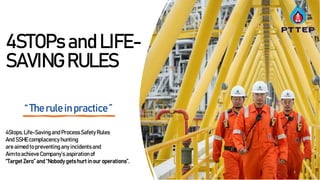
4STOPs and LIFE-
SAVING RULES
1
“ The rule in practice ”
4Stops, Life-Savingand Process Safety Rules
And SSHEcomplacency hunting
are aimed to preventing any incidentsand
Aim to achieve Company’s aspirationof
“Target Zero” and “Nobody gets hurt in our operations”.
Energy Partner of Choice
2
Energy Partner of Choice
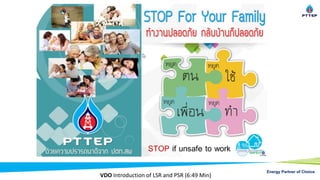
VDO Introduction of LSR and PSR (6:49 Min)
Energy Partner of Choice
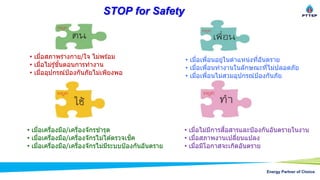
STOP for Safety
• เมื่อสภาพร่างกาย/ใจ ไม่พร ้อม
• เมื่อไม่รู้ขั้นตอนการทางาน
• เมื่ออุปกรณ์ป้องกันภัยไม่เพียงพอ
• เมื่อเพื่อนอยู่ในตาแหน่งที่อันตราย
• เมื่อเพื่อนทางานในลักษณะที่ไม่ปลอดภัย
• เมื่อเพื่อนไม่สวมอุปกรณ์ป้องกันภัย
• เมื่อเครื่องมือ/เครื่องจักรชารุด
• เมื่อเครื่องมือ/เครื่องจักรไม่ได ้ตรวจเช็ค
• เมื่อเครื่องมือ/เครื่องจักรไม่มีระบบป้องกันอันตราย
• เมื่อไม่มีการสื่อสารและป้องกันอันตรายในงาน
• เมื่อสภาพงานเปลี่ยนแปลง
• เมื่อมีโอกาสจะเกิดอันตราย
Energy Partner of Choice
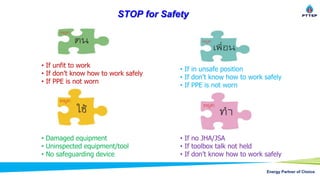
• If unfit to work
• If don’t know how to work safely
• If PPE is not worn
• If in unsafe position
• If don’t know how to work safely
• If PPE is not worn
• Damaged equipment
• Uninspected equipment/tool
• No safeguarding device
• If no JHA/JSA
• If toolbox talk not held
• If don’t know how to work safely
STOP for Safety
Energy Partner of Choice
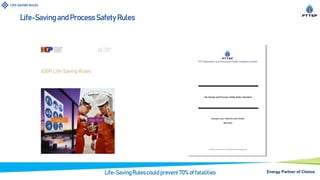
Life-SavingRulescould prevent 70% of fatalities
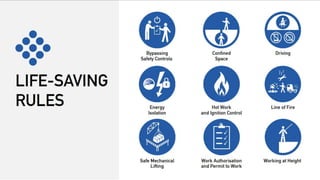
Life-Savingand Process Safety Rules
Energy Partner of Choice
Focus of Life-Saving rules
• Key actionsto prevent fatality andseriousinjuriesduringhigher-risk
activities
• Drawattentionto the activitiesmost likely to lead to a fatality and
seriousinjury
• Not intendedto addressall risksandhazards
• Focused on thosethingsan individualhascontrol over
• Rely on existingPTTEP systems being in place
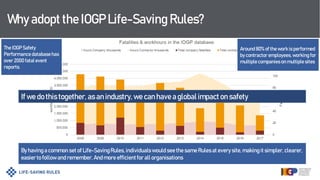
The IOGP Safety
Performance databasehas
over 2000 fatal event
reports.
Around 80% of the work is performed
by contractor employees,working for
multiple companies on multiple sites
By havinga common set of Life-SavingRules, individualswould see the same Rulesat every site,making it simpler, clearer,
easierto follow and remember. And more efficientfor all organisations.
Why adopt the IOGP Life-Saving Rules?
If we do this together, as an industry, we can have a global impact on safety
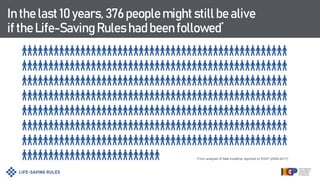
*From analysis of fatal incidents reported to IOGP (2008-2017)
In the last 10 years, 376 people might still be alive
if the Life-Saving Rules had been followed*
Energy Partner of Choice
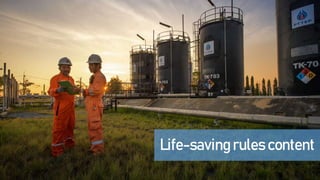
Life-saving rules content
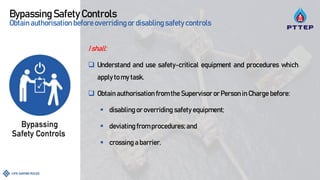
I shall:
 Understand and use safety-critical equipment and procedures which
apply to my task.
 Obtain authorisation from the Supervisor or Person in Charge before:
 disabling or overriding safety equipment;
 deviating from procedures; and
 crossing a barrier.
Bypassing Safety Controls
Obtain authorisation before overridingor disabling safety controls
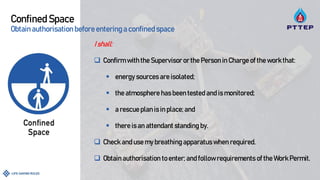
Confined Space
Obtain authorisation before entering a confined space
I shall:
 Confirm with the Supervisor or the Person in Charge of the work that:
 energy sources are isolated;
 the atmosphere has been tested and is monitored;
 a rescue plan is in place; and
 there is an attendant standing by.
 Check and use my breathing apparatus when required.
 Obtain authorisation to enter; and follow requirements of the Work Permit.
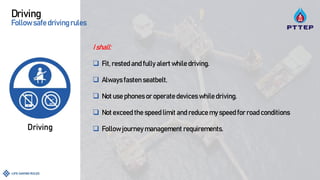
Driving
Follow safedrivingrules
I shall:
 Fit, rested and fully alert while driving.
 Always fasten seatbelt.
 Not use phones or operate devices while driving.
 Not exceed the speed limit and reduce my speed for road conditions
 Follow journey management requirements.
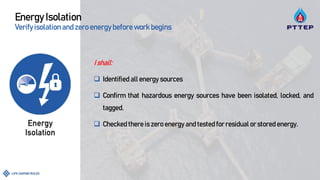
Energy Isolation
Verify isolation and zero energybefore work begins
I shall:
 Identified all energy sources
 Confirm that hazardous energy sources have been isolated, locked, and
tagged.
 Checked there is zero energy and tested for residual or stored energy.
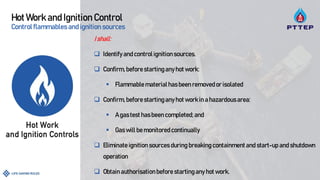
Hot Work and Ignition Control
Control flammables and ignition sources
Ishall:
 Identifyandcontrol ignitionsources.
 Confirm, before startinganyhot work:
 Flammable materialhasbeen removed or isolated
 Confirm, before startinganyhot workin a hazardousarea:
 A gastest has been completed; and
 Gaswill be monitored continually
 Eliminate ignition sources during breaking containment and start-up and shutdown
operation
 Obtain authorisationbefore startingany hot work.
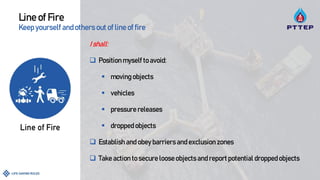
Line of Fire
Keep yourself andothers out of line of fire
I shall:
 Position myself to avoid:
 moving objects
 vehicles
 pressure releases
 dropped objects
 Establish and obey barriers and exclusion zones
 Take action to secure loose objects and report potential dropped objects
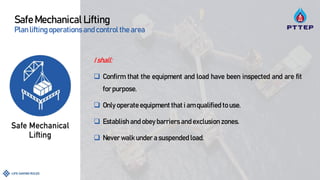
Safe Mechanical Lifting
Plan lifting operations and control the area
I shall:
 Confirm that the equipment and load have been inspected and are fit
for purpose.
 Only operate equipment that i am qualified to use.
 Establish and obey barriers and exclusion zones.
 Never walk under a suspended load.
Work authorizationand Permit to work
Work with a validpermit when required
I shall:
 Confirm if a permit is required
 Authorised to perform the work
 Understand the Permit to work and follow it.
 Confirm that hazards are controlled, and it is safe to start
 Stop and reassess if conditions change.
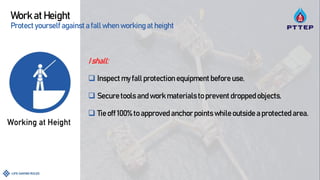
Ishall:
 Inspect my fall protection equipment before use.
 Secure tools and work materials to prevent dropped objects.
 Tie off 100% to approved anchor points while outside a protected area.
Work at Height
Protect yourself against a fall when working at height

01_ Stop Work Policy, Life saving rules (KII).pptx

  • 1.
    Energy Partner ofChoice 4STOPs and LIFE- SAVING RULES 1 “ The rule in practice ” 4Stops, Life-Savingand Process Safety Rules And SSHEcomplacency hunting are aimed to preventing any incidentsand Aim to achieve Company’s aspirationof “Target Zero” and “Nobody gets hurt in our operations”.
  • 2.
  • 3.
    Energy Partner ofChoice VDO Introduction of LSR and PSR (6:49 Min)
  • 4.
    Energy Partner ofChoice STOP for Safety • เมื่อสภาพร่างกาย/ใจ ไม่พร ้อม • เมื่อไม่รู้ขั้นตอนการทางาน • เมื่ออุปกรณ์ป้องกันภัยไม่เพียงพอ • เมื่อเพื่อนอยู่ในตาแหน่งที่อันตราย • เมื่อเพื่อนทางานในลักษณะที่ไม่ปลอดภัย • เมื่อเพื่อนไม่สวมอุปกรณ์ป้องกันภัย • เมื่อเครื่องมือ/เครื่องจักรชารุด • เมื่อเครื่องมือ/เครื่องจักรไม่ได ้ตรวจเช็ค • เมื่อเครื่องมือ/เครื่องจักรไม่มีระบบป้องกันอันตราย • เมื่อไม่มีการสื่อสารและป้องกันอันตรายในงาน • เมื่อสภาพงานเปลี่ยนแปลง • เมื่อมีโอกาสจะเกิดอันตราย
  • 5.
    Energy Partner ofChoice • If unfit to work • If don’t know how to work safely • If PPE is not worn • If in unsafe position • If don’t know how to work safely • If PPE is not worn • Damaged equipment • Uninspected equipment/tool • No safeguarding device • If no JHA/JSA • If toolbox talk not held • If don’t know how to work safely STOP for Safety
  • 6.
    Energy Partner ofChoice Life-SavingRulescould prevent 70% of fatalities Life-Savingand Process Safety Rules
  • 7.
    Energy Partner ofChoice Focus of Life-Saving rules • Key actionsto prevent fatality andseriousinjuriesduringhigher-risk activities • Drawattentionto the activitiesmost likely to lead to a fatality and seriousinjury • Not intendedto addressall risksandhazards • Focused on thosethingsan individualhascontrol over • Rely on existingPTTEP systems being in place
  • 8.
    The IOGP Safety Performancedatabasehas over 2000 fatal event reports. Around 80% of the work is performed by contractor employees,working for multiple companies on multiple sites By havinga common set of Life-SavingRules, individualswould see the same Rulesat every site,making it simpler, clearer, easierto follow and remember. And more efficientfor all organisations. Why adopt the IOGP Life-Saving Rules? If we do this together, as an industry, we can have a global impact on safety
  • 9.
    *From analysis offatal incidents reported to IOGP (2008-2017) In the last 10 years, 376 people might still be alive if the Life-Saving Rules had been followed*
  • 10.
  • 11.
  • 12.
    I shall:  Understandand use safety-critical equipment and procedures which apply to my task.  Obtain authorisation from the Supervisor or Person in Charge before:  disabling or overriding safety equipment;  deviating from procedures; and  crossing a barrier. Bypassing Safety Controls Obtain authorisation before overridingor disabling safety controls
  • 13.
    Confined Space Obtain authorisationbefore entering a confined space I shall:  Confirm with the Supervisor or the Person in Charge of the work that:  energy sources are isolated;  the atmosphere has been tested and is monitored;  a rescue plan is in place; and  there is an attendant standing by.  Check and use my breathing apparatus when required.  Obtain authorisation to enter; and follow requirements of the Work Permit.
  • 14.
    Driving Follow safedrivingrules I shall: Fit, rested and fully alert while driving.  Always fasten seatbelt.  Not use phones or operate devices while driving.  Not exceed the speed limit and reduce my speed for road conditions  Follow journey management requirements.
  • 15.
    Energy Isolation Verify isolationand zero energybefore work begins I shall:  Identified all energy sources  Confirm that hazardous energy sources have been isolated, locked, and tagged.  Checked there is zero energy and tested for residual or stored energy.
  • 16.
    Hot Work andIgnition Control Control flammables and ignition sources Ishall:  Identifyandcontrol ignitionsources.  Confirm, before startinganyhot work:  Flammable materialhasbeen removed or isolated  Confirm, before startinganyhot workin a hazardousarea:  A gastest has been completed; and  Gaswill be monitored continually  Eliminate ignition sources during breaking containment and start-up and shutdown operation  Obtain authorisationbefore startingany hot work.
  • 17.
    Line of Fire Keepyourself andothers out of line of fire I shall:  Position myself to avoid:  moving objects  vehicles  pressure releases  dropped objects  Establish and obey barriers and exclusion zones  Take action to secure loose objects and report potential dropped objects
  • 18.
    Safe Mechanical Lifting Planlifting operations and control the area I shall:  Confirm that the equipment and load have been inspected and are fit for purpose.  Only operate equipment that i am qualified to use.  Establish and obey barriers and exclusion zones.  Never walk under a suspended load.
  • 19.
    Work authorizationand Permitto work Work with a validpermit when required I shall:  Confirm if a permit is required  Authorised to perform the work  Understand the Permit to work and follow it.  Confirm that hazards are controlled, and it is safe to start  Stop and reassess if conditions change.
  • 20.
    Ishall:  Inspect myfall protection equipment before use.  Secure tools and work materials to prevent dropped objects.  Tie off 100% to approved anchor points while outside a protected area. Work at Height Protect yourself against a fall when working at height