Urban Geography

              Su-Yeul Chung


1. An Introduction to the Changing
   Field of Urban Geography
1. Introduction
2. The Field of Urban Geography
3. The Four Traditions, 1900-1970
4. Geographic Information Science and Urban
  Geography
5. Substantive Trends in Urban Geography
6. The Chicago and Los Angeles Schools of
  Urban Geography
7. The New Urbanism


                                              1
1. Introduction
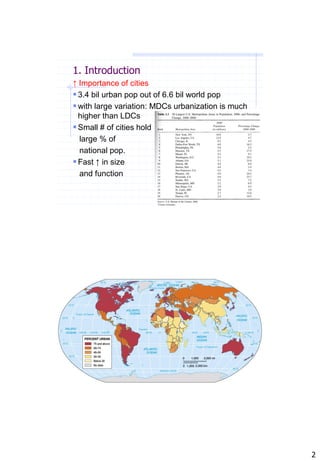
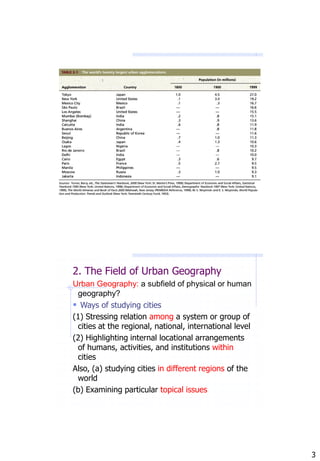
↑ Importance of cities
 3.4 bil urban pop out of 6.6 bil world pop
 with large variation: MDCs urbanization is much
  higher than LDCs
 Small # of cities hold
  large % of
  national pop.
 Fast ↑ in size
  and function


                                                    2
2. The Field of Urban Geography
Urban Geography: a subfield of physical or human
 geography?
 Ways of studying cities
(1) Stressing relation among a system or group of
 cities at the regional, national, international level
(2) Highlighting internal locational arrangements
 of humans, activities, and institutions within
 cities
Also, (a) studying cities in different regions of the
 world
(b) Examining particular topical issues


                                                         3
2. The Field of Urban Geography
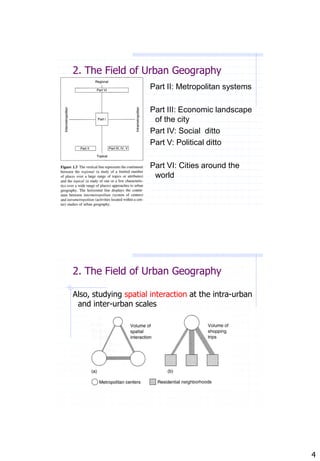
                      Part II: Metropolitan systems

                      Part III: Economic landscape
                       of the city
                      Part IV: Social ditto
                      Part V: Political ditto

                      Part VI: Cities around the
                       world


2. The Field of Urban Geography

Also, studying spatial interaction at the intra-urban
 and inter-urban scales


                                                        4
3. Origin and Evolution of Urban Geography

Urban Geography(UG) has developed through 20C

 In US Geography,
In 1900: main issue is physical geography
1st half of 20C: ↑ # of UG studies
Late 1940s: UG course was first taught in colleges
21C: UG group becomes 2nd largest group next to
 GIS group


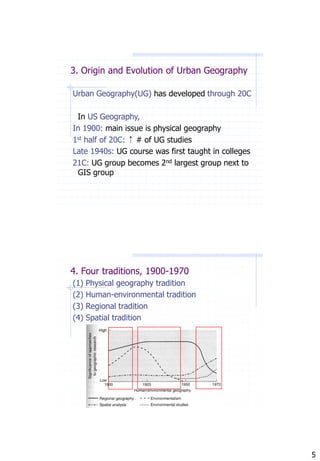
4. Four traditions, 1900-1970
(1) Physical geography tradition
(2) Human-environmental tradition
(3) Regional tradition
(4) Spatial tradition


                                                     5
4.1. Physical Tradition

    • Dominant in 1st half of 20C
    • Applied to UG:
     - high-income residence in areas of high elevation
      with a view
     - Manhattan skyscrapers supported by strong
      bedrock
     - Impacts of natural hazards
     - urban heat islands
    • Impacts of physical environment on human
      activities in cities


   4.2. Human-Environment Tradition

• Environmental determinism: physical env. „determines
 or controls‟ the development of human civilization
 - civilizations flourish in area with variable climates rather than
 monotonous
 - Mountainous env. discourages growth of a city

• Possibilism: Physical env. set limits or possibilities for
 human activities, but human behaviors are expressed
 thr. cultural traditions that create a given way of life.
- humans survive in N. Siberia
- high-elevation city such as Zürich still grows


                                                                       6
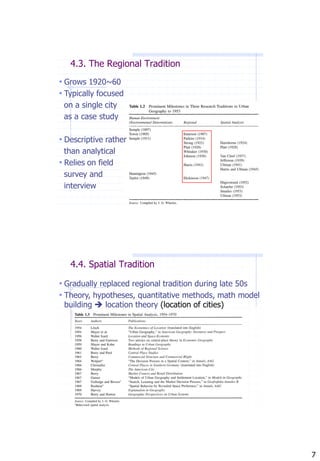
4.3. The Regional Tradition
• Grows 1920~60
• Typically focused
 on a single city
 as a case study

• Descriptive rather
  than analytical
• Relies on field
  survey and
  interview


   4.4. Spatial Tradition

• Gradually replaced regional tradition during late 50s
• Theory, hypotheses, quantitative methods, math model
 building  location theory (location of cities)


                                                          7
4.4. Spatial Tradition
(1) Precursors of Spatial Analysis in UG (~‟50s)
- Only small # of studies
- Platt(„28) microgeography of Ellison Bay, WI studied its linkage
  with other places
- Jefferson(„39) Law of the Primate City
- Harris and Ullman(„45) Multi-nuclei model
(2) European Influences on SA in UG
- Christaller(„33) Central Place Theory
- Lösch(„38) „Economics of Location‟
- Weber(„29) Industrial location
- Hägerstrand(„53) „Innovation Diffusion as a Spatial Process‟
- Haggett(„66) „Locational Analysis in Human Geography‟


    4.4. Spatial Tradition
(3) Extradisciplinary Influences on SA in UG
- Statistical and Math Modelling was introduced
- Taaffe(‟74): Hypothesizing, Testing,
 Generalization, Theorizing
- Using computer to handle
   large spatial data (Graphics)
- Isard formed „Regional Science
   Association‟ in 1954


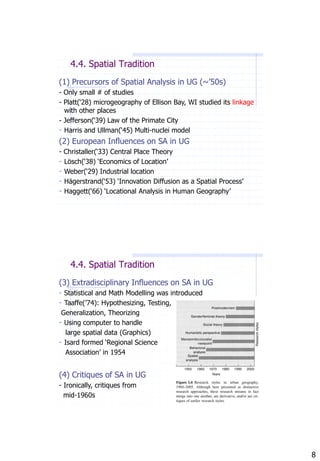
(4) Critiques of SA in UG
- Ironically, critiques from
  mid-1960s


                                                                     8
4.4. Spatial Tradition

1) Behavioral UG
- Wolpert, Golledge, Brown, Rushton
- Focus: individual‟s spatial decision making process
- Emphases: person‟ attitude and expectations of place
2) Marxist Interpretations
- „Antipode: A Radical Journal of Geography‟ from 1969
- Focus: Capitalist production and labor relations that causes
  urban inequity, poverty, discrimination, underdevelopment
- e.g. cheap shipment of strawberries from Cal. to NY vs. low-paid
  migrant pickers in Cal.
- Peet: socio-economic problems with spatial magnifications
- Harvey : conflict b/w capitalists and workers


   4.4. Spatial Tradition

3) Humanistic UG
- Yi-Fu Tuan(‟76): feelings and ideas about space and place
- Topophilia: attitudes, perceptions and values toward landscape
- Walk downtown and feel and smell it

4) Social Theory (late 70s and 80s)
- Critical political perspective, human emancipation
- Socially constructed human reality rather than spatial attribute
- e.g. Social and power relation rather than distance in explaining
  migration


                                                                      9
4.4. Spatial Tradition

5) Postmodernism
- Dear(„88) and Soja(„89)
- Rejects modernity (logic, reason, and science since 18C
  Enlightenment)
- Postmodern perspective 

- Los Angeles School‟s
  Postmodern Urbanism
“global-local connection, a
 social polarization, and urban
 process in which hinterland
 organizes the center”


   5. GIS and UG         (from‟80s in AAG and College)

- Evolved from cartography, remote sensing, satellite
  image processing and geodata coding
- [Def] “a system of hardware, software, and procedures
  designed to support the capture, management,
  manipulation, analysis, modeling, and display of
  spatially referenced data for solving complex planning
  and management problem”
- Geographic data
   Geographic space: point, line, and area
   Geographic scale
- Used for analyses, research, and planning


                                                            10
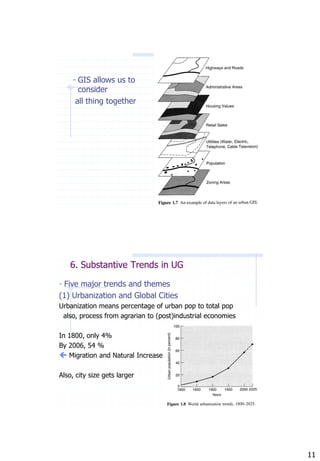
- GIS allows us to
      consider
     all thing together


    6. Substantive Trends in UG

- Five major trends and themes
(1) Urbanization and Global Cities
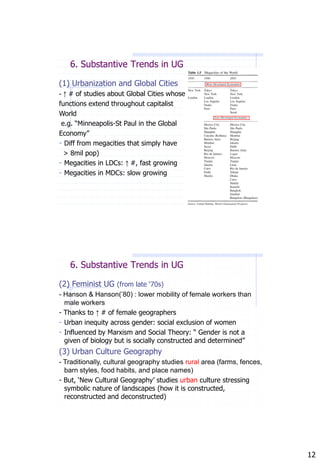
Urbanization means percentage of urban pop to total pop
 also, process from agrarian to (post)industrial economies

In 1800, only 4%
By 2006, 54 %
 Migration and Natural Increase

Also, city size gets larger


                                                             11
6. Substantive Trends in UG

(1) Urbanization and Global Cities
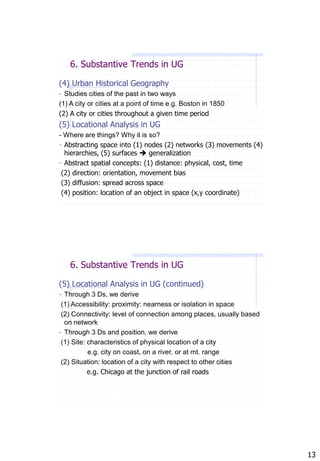
- ↑ # of studies about Global Cities whose
functions extend throughout capitalist
World
 e.g. “Minneapolis-St Paul in the Global
Economy”
- Diff from megacities that simply have
  > 8mil pop)
- Megacities in LDCs: ↑ #, fast growing
- Megacities in MDCs: slow growing


   6. Substantive Trends in UG

(2) Feminist UG (from late „70s)
- Hanson & Hanson(’80) : lower mobility of female workers than
  male workers
- Thanks to ↑ # of female geographers
- Urban inequity across gender: social exclusion of women
- Influenced by Marxism and Social Theory: “ Gender is not a
  given of biology but is socially constructed and determined”
(3) Urban Culture Geography
- Traditionally, cultural geography studies rural area (farms, fences,
  barn styles, food habits, and place names)
- But, „New Cultural Geography‟ studies urban culture stressing
  symbolic nature of landscapes (how it is constructed,
  reconstructed and deconstructed)


                                                                         12
6. Substantive Trends in UG

(4) Urban Historical Geography
- Studies cities of the past in two ways
(1) A city or cities at a point of time e.g. Boston in 1850
(2) A city or cities throughout a given time period
(5) Locational Analysis in UG
- Where are things? Why it is so?
- Abstracting space into (1) nodes (2) networks (3) movements (4)
  hierarchies, (5) surfaces  generalization
- Abstract spatial concepts: (1) distance: physical, cost, time
 (2) direction: orientation, movement bias
 (3) diffusion: spread across space
 (4) position: location of an object in space (x,y coordinate)


   6. Substantive Trends in UG

(5) Locational Analysis in UG (continued)
- Through 3 Ds, we derive
 (1) Accessibility: proximity: nearness or isolation in space
 (2) Connectivity: level of connection among places, usually based
  on network
- Through 3 Ds and position, we derive
 (1) Site: characteristics of physical location of a city
           e.g. city on coast, on a river, or at mt. range
 (2) Situation: location of a city with respect to other cities
           e.g. Chicago at the junction of rail roads


                                                                     13
7. Chicago and LA Schools of UG
(1) The Chicago School of UG
- Berry at U of Chicago; Harris and Mayer; Taaffe
- Major theme: systems of cities, commercial land uses, central
 place theory, residential pattern, racial composition
(2) Los Angeles School of UG
- Postmodern thinking: hinterlands organize the CBD and entire
  metropolitan area
- Advocates pluralism
   8. New Urbanism          (1980s~)
- A complex planning paradigm and social movement in planning,
  residential development, and government housing
- Utopia: sustainable, family-oriented, livable places
- Pedestrian-oriented, mixed-use, accessible, and open space,
  high-density land use


                                                                  14

01 intro urban_geog

  • 1.
    Urban Geography Su-Yeul Chung 1. An Introduction to the Changing Field of Urban Geography 1. Introduction 2. The Field of Urban Geography 3. The Four Traditions, 1900-1970 4. Geographic Information Science and Urban Geography 5. Substantive Trends in Urban Geography 6. The Chicago and Los Angeles Schools of Urban Geography 7. The New Urbanism 1
  • 2.
    1. Introduction ↑ Importanceof cities  3.4 bil urban pop out of 6.6 bil world pop  with large variation: MDCs urbanization is much higher than LDCs  Small # of cities hold large % of national pop.  Fast ↑ in size and function 2
  • 3.
    2. The Fieldof Urban Geography Urban Geography: a subfield of physical or human geography?  Ways of studying cities (1) Stressing relation among a system or group of cities at the regional, national, international level (2) Highlighting internal locational arrangements of humans, activities, and institutions within cities Also, (a) studying cities in different regions of the world (b) Examining particular topical issues 3
  • 4.
    2. The Fieldof Urban Geography Part II: Metropolitan systems Part III: Economic landscape of the city Part IV: Social ditto Part V: Political ditto Part VI: Cities around the world 2. The Field of Urban Geography Also, studying spatial interaction at the intra-urban and inter-urban scales 4
  • 5.
    3. Origin andEvolution of Urban Geography Urban Geography(UG) has developed through 20C In US Geography, In 1900: main issue is physical geography 1st half of 20C: ↑ # of UG studies Late 1940s: UG course was first taught in colleges 21C: UG group becomes 2nd largest group next to GIS group 4. Four traditions, 1900-1970 (1) Physical geography tradition (2) Human-environmental tradition (3) Regional tradition (4) Spatial tradition 5
  • 6.
    4.1. Physical Tradition • Dominant in 1st half of 20C • Applied to UG: - high-income residence in areas of high elevation with a view - Manhattan skyscrapers supported by strong bedrock - Impacts of natural hazards - urban heat islands • Impacts of physical environment on human activities in cities 4.2. Human-Environment Tradition • Environmental determinism: physical env. „determines or controls‟ the development of human civilization - civilizations flourish in area with variable climates rather than monotonous - Mountainous env. discourages growth of a city • Possibilism: Physical env. set limits or possibilities for human activities, but human behaviors are expressed thr. cultural traditions that create a given way of life. - humans survive in N. Siberia - high-elevation city such as Zürich still grows 6
  • 7.
    4.3. The RegionalTradition • Grows 1920~60 • Typically focused on a single city as a case study • Descriptive rather than analytical • Relies on field survey and interview 4.4. Spatial Tradition • Gradually replaced regional tradition during late 50s • Theory, hypotheses, quantitative methods, math model building  location theory (location of cities) 7
  • 8.
    4.4. Spatial Tradition (1)Precursors of Spatial Analysis in UG (~‟50s) - Only small # of studies - Platt(„28) microgeography of Ellison Bay, WI studied its linkage with other places - Jefferson(„39) Law of the Primate City - Harris and Ullman(„45) Multi-nuclei model (2) European Influences on SA in UG - Christaller(„33) Central Place Theory - Lösch(„38) „Economics of Location‟ - Weber(„29) Industrial location - Hägerstrand(„53) „Innovation Diffusion as a Spatial Process‟ - Haggett(„66) „Locational Analysis in Human Geography‟ 4.4. Spatial Tradition (3) Extradisciplinary Influences on SA in UG - Statistical and Math Modelling was introduced - Taaffe(‟74): Hypothesizing, Testing, Generalization, Theorizing - Using computer to handle large spatial data (Graphics) - Isard formed „Regional Science Association‟ in 1954 (4) Critiques of SA in UG - Ironically, critiques from mid-1960s 8
  • 9.
    4.4. Spatial Tradition 1)Behavioral UG - Wolpert, Golledge, Brown, Rushton - Focus: individual‟s spatial decision making process - Emphases: person‟ attitude and expectations of place 2) Marxist Interpretations - „Antipode: A Radical Journal of Geography‟ from 1969 - Focus: Capitalist production and labor relations that causes urban inequity, poverty, discrimination, underdevelopment - e.g. cheap shipment of strawberries from Cal. to NY vs. low-paid migrant pickers in Cal. - Peet: socio-economic problems with spatial magnifications - Harvey : conflict b/w capitalists and workers 4.4. Spatial Tradition 3) Humanistic UG - Yi-Fu Tuan(‟76): feelings and ideas about space and place - Topophilia: attitudes, perceptions and values toward landscape - Walk downtown and feel and smell it 4) Social Theory (late 70s and 80s) - Critical political perspective, human emancipation - Socially constructed human reality rather than spatial attribute - e.g. Social and power relation rather than distance in explaining migration 9
  • 10.
    4.4. Spatial Tradition 5)Postmodernism - Dear(„88) and Soja(„89) - Rejects modernity (logic, reason, and science since 18C Enlightenment) - Postmodern perspective  - Los Angeles School‟s Postmodern Urbanism “global-local connection, a social polarization, and urban process in which hinterland organizes the center” 5. GIS and UG (from‟80s in AAG and College) - Evolved from cartography, remote sensing, satellite image processing and geodata coding - [Def] “a system of hardware, software, and procedures designed to support the capture, management, manipulation, analysis, modeling, and display of spatially referenced data for solving complex planning and management problem” - Geographic data Geographic space: point, line, and area Geographic scale - Used for analyses, research, and planning 10
  • 11.
    - GIS allowsus to consider all thing together 6. Substantive Trends in UG - Five major trends and themes (1) Urbanization and Global Cities Urbanization means percentage of urban pop to total pop also, process from agrarian to (post)industrial economies In 1800, only 4% By 2006, 54 %  Migration and Natural Increase Also, city size gets larger 11
  • 12.
    6. Substantive Trendsin UG (1) Urbanization and Global Cities - ↑ # of studies about Global Cities whose functions extend throughout capitalist World e.g. “Minneapolis-St Paul in the Global Economy” - Diff from megacities that simply have > 8mil pop) - Megacities in LDCs: ↑ #, fast growing - Megacities in MDCs: slow growing 6. Substantive Trends in UG (2) Feminist UG (from late „70s) - Hanson & Hanson(’80) : lower mobility of female workers than male workers - Thanks to ↑ # of female geographers - Urban inequity across gender: social exclusion of women - Influenced by Marxism and Social Theory: “ Gender is not a given of biology but is socially constructed and determined” (3) Urban Culture Geography - Traditionally, cultural geography studies rural area (farms, fences, barn styles, food habits, and place names) - But, „New Cultural Geography‟ studies urban culture stressing symbolic nature of landscapes (how it is constructed, reconstructed and deconstructed) 12
  • 13.
    6. Substantive Trendsin UG (4) Urban Historical Geography - Studies cities of the past in two ways (1) A city or cities at a point of time e.g. Boston in 1850 (2) A city or cities throughout a given time period (5) Locational Analysis in UG - Where are things? Why it is so? - Abstracting space into (1) nodes (2) networks (3) movements (4) hierarchies, (5) surfaces  generalization - Abstract spatial concepts: (1) distance: physical, cost, time (2) direction: orientation, movement bias (3) diffusion: spread across space (4) position: location of an object in space (x,y coordinate) 6. Substantive Trends in UG (5) Locational Analysis in UG (continued) - Through 3 Ds, we derive (1) Accessibility: proximity: nearness or isolation in space (2) Connectivity: level of connection among places, usually based on network - Through 3 Ds and position, we derive (1) Site: characteristics of physical location of a city e.g. city on coast, on a river, or at mt. range (2) Situation: location of a city with respect to other cities e.g. Chicago at the junction of rail roads 13
  • 14.
    7. Chicago andLA Schools of UG (1) The Chicago School of UG - Berry at U of Chicago; Harris and Mayer; Taaffe - Major theme: systems of cities, commercial land uses, central place theory, residential pattern, racial composition (2) Los Angeles School of UG - Postmodern thinking: hinterlands organize the CBD and entire metropolitan area - Advocates pluralism 8. New Urbanism (1980s~) - A complex planning paradigm and social movement in planning, residential development, and government housing - Utopia: sustainable, family-oriented, livable places - Pedestrian-oriented, mixed-use, accessible, and open space, high-density land use 14