Institut für Informatik und
Wirtschaftsinformatik (ICB)‫‏‬
Adapting e-Learning Situations for International Reuse
Internationalization of e-Learning
Thomas Richter, Jan M. Pawlowski, Maxie Lutze
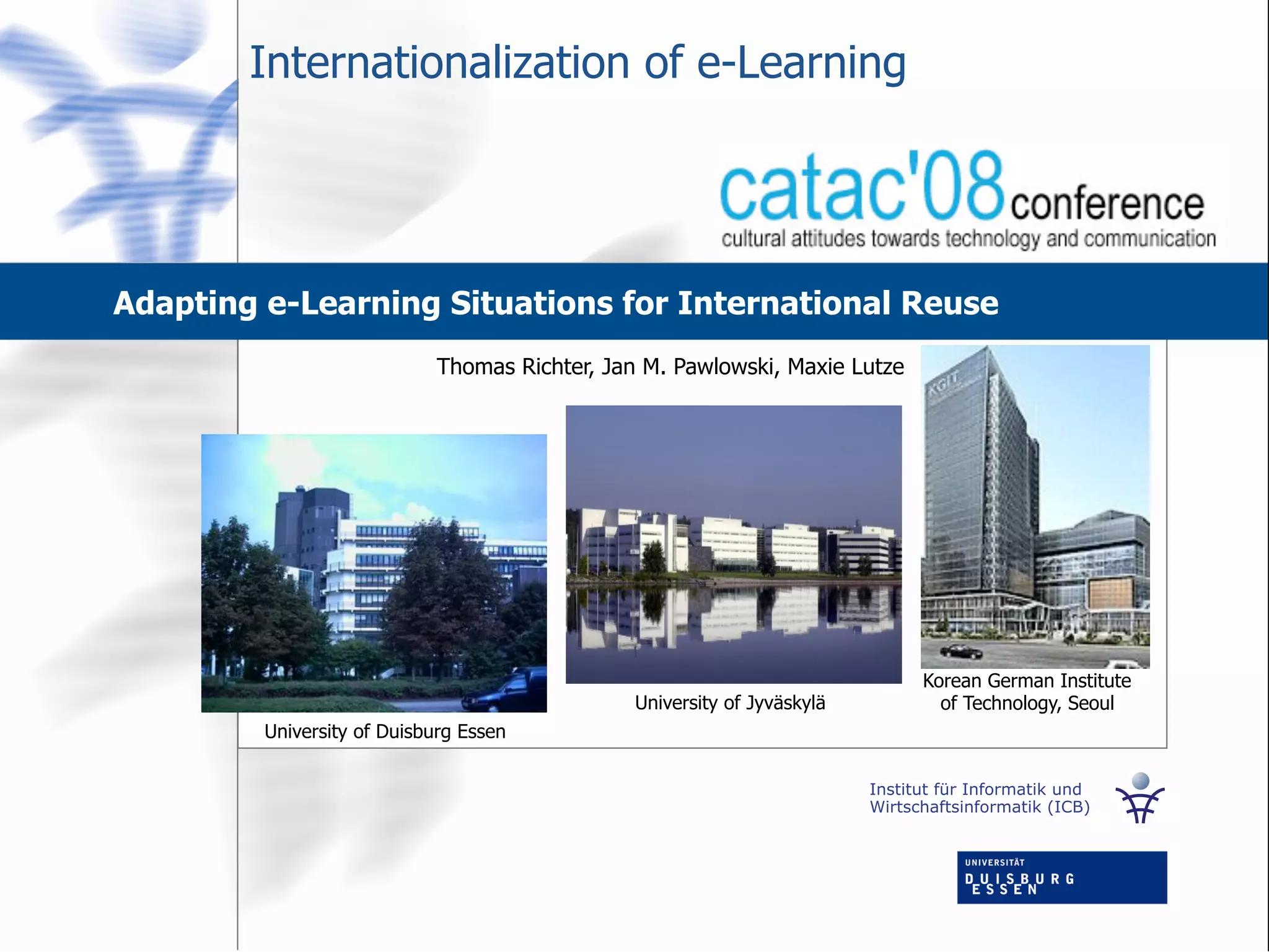
University of Duisburg Essen
Korean German Institute
of Technology, SeoulUniversity of Jyväskylä
Thomas Richter, Jan M. Pawlowski, Maxie Lutze
Internationalization of e-Learning
2
n  Motivation
n  Context of e-Learning, Adaptation Process Model, Influence factors
n  Korean-German study
n  Discussion of results
n  Limitations
n  Conclusion
n  Further research
Overview
Thomas Richter, Jan M. Pawlowski, Maxie Lutze
Internationalization of e-Learning
3
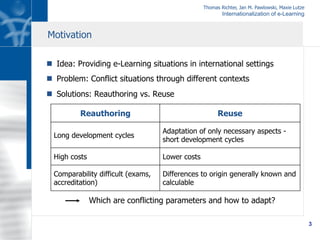
n  Idea: Providing e-Learning situations in international settings
n  Problem: Conflict situations through different contexts
n  Solutions: Reauthoring vs. Reuse
Which are conflicting parameters and how to adapt?
Motivation
Reauthoring Reuse
Long development cycles
Adaptation of only necessary aspects -
short development cycles
High costs Lower costs
Comparability difficult (exams,
accreditation)
Differences to origin generally known and
calculable
Thomas Richter, Jan M. Pawlowski, Maxie Lutze
Internationalization of e-Learning
4
The Context of e-Learning
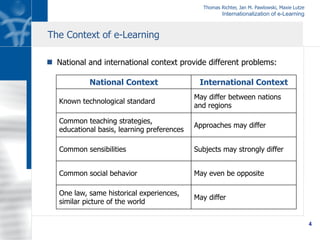
n  National and international context provide different problems:
National Context International Context
Known technological standard
May differ between nations
and regions
Common teaching strategies,
educational basis, learning preferences
Approaches may differ
Common sensibilities Subjects may strongly differ
Common social behavior May even be opposite
One law, same historical experiences,
similar picture of the world
May differ
Thomas Richter, Jan M. Pawlowski, Maxie Lutze
Internationalization of e-Learning
5
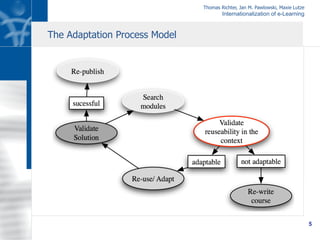
The Adaptation Process Model
Thomas Richter, Jan M. Pawlowski, Maxie Lutze
Internationalization of e-Learning
6
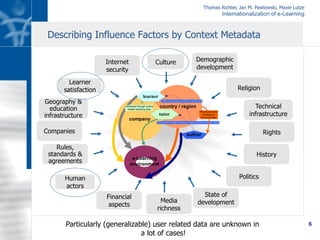
Describing Influence Factors by Context Metadata
Culture
Companies
Rules,
standards &
agreements
Financial
aspects
Media
richness
Internet
security
Demographic
development
Religion
Geography &
education
infrastructure
Technical
infrastructure
Rights
History
Politics
State of
development
Human
actors
Learner
satisfaction
e-Learning
environment
country / region
company
learner
author
Influences through culture
related assisting style
Influences through different world-view
Influences through implying content related learning needs
Influences author
building up
his world view
tutor
Particularly (generalizable) user related data are unknown in
a lot of cases!
Thomas Richter, Jan M. Pawlowski, Maxie Lutze
Internationalization of e-Learning
7
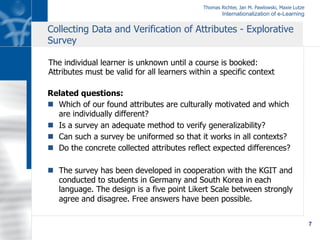
Related questions:
n  Which of our found attributes are culturally motivated and which
are individually different?
n  Is a survey an adequate method to verify generalizability?
n  Can such a survey be uniformed so that it works in all contexts?
n  Do the concrete collected attributes reflect expected differences?
n  The survey has been developed in cooperation with the KGIT and
conducted to students in Germany and South Korea in each
language. The design is a five point Likert Scale between strongly
agree and disagree. Free answers have been possible.
Collecting Data and Verification of Attributes - Explorative
Survey
The individual learner is unknown until a course is booked:
Attributes must be valid for all learners within a specific context
Thomas Richter, Jan M. Pawlowski, Maxie Lutze
Internationalization of e-Learning
8
Explorative Survey - South Korea and Germany
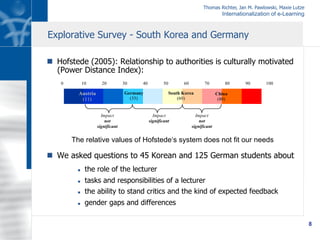
n  Hofstede (2005): Relationship to authorities is culturally motivated
(Power Distance Index):
n  We asked questions to 45 Korean and 125 German students about
n  the role of the lecturer
n  tasks and responsibilities of a lecturer
n  the ability to stand critics and the kind of expected feedback
n  gender gaps and differences
The relative values of Hofstede‘s system does not fit our needs
10 20 30 40 50 60 70 80 90 1000
Impact
significant
Germany
(35)
Austria
(11)
South Korea
(60)
China
(80)
Impact
not
significant
Impact
not
significant
Thomas Richter, Jan M. Pawlowski, Maxie Lutze
Internationalization of e-Learning
9
Discussion of results (excerpt, 1/5)
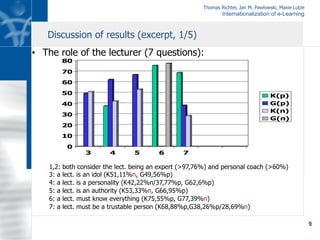
•  The role of the lecturer (7 questions):
0
10
20
30
40
50
60
70
80
3 4 5 6 7
K(p)
G(p)
K(n)
G(n)
1,2: both consider the lect. being an expert (>97,76%) and personal coach (>60%)
3: a lect. is an idol (K51,11%n, G49,56%p)
4: a lect. is a personality (K42,22%n/37,77%p, G62,6%p)
5: a lect. is an authority (K53,33%n, G66,95%p)
6: a lect. must know everything (K75,55%p, G77,39%n)
7: a lect. must be a trustable person (K68,88%p,G38,26%p/28,69%n)
Thomas Richter, Jan M. Pawlowski, Maxie Lutze
Internationalization of e-Learning
10
Discussion of results (excerpt, 2/5)
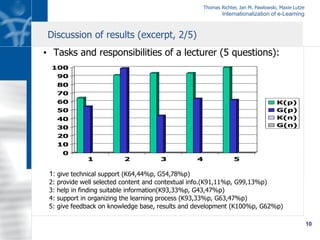
•  Tasks and responsibilities of a lecturer (5 questions):
0
10
20
30
40
50
60
70
80
90
100
1 2 3 4 5
K(p)
G(p)
K(n)
G(n)
1: give technical support (K64,44%p, G54,78%p)
2: provide well selected content and contextual info.(K91,11%p, G99,13%p)
3: help in finding suitable information(K93,33%p, G43,47%p)
4: support in organizing the learning process (K93,33%p, G63,47%p)
5: give feedback on knowledge base, results and development (K100%p, G62%p)
Thomas Richter, Jan M. Pawlowski, Maxie Lutze
Internationalization of e-Learning
11
Discussion of results (excerpt, 3/5)
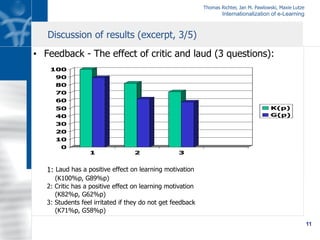
•  Feedback - The effect of critic and laud (3 questions):
0
10
20
30
40
50
60
70
80
90
100
1 2 3
K(p)
G(p)
1: Laud has a positive effect on learning motivation
(K100%p, G89%p)
2: Critic has a positive effect on learning motivation
(K82%p, G62%p)
3: Students feel irritated if they do not get feedback
(K71%p, G58%p)
Thomas Richter, Jan M. Pawlowski, Maxie Lutze
Internationalization of e-Learning
12
Discussion of results (excerpt, 4/5)
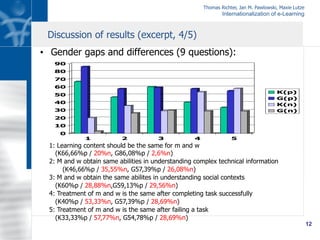
•  Gender gaps and differences (9 questions):
0
10
20
30
40
50
60
70
80
90
1 2 3 4 5
K(p)
G(p)
K(n)
G(n)
1: Learning content should be the same for m and w
(K66,66%p / 20%n, G86,08%p / 2,6%n)
2: M and w obtain same abilities in understanding complex technical information
(K46,66%p / 35,55%n, G57,39%p / 26,08%n)
3: M and w obtain the same abilites in understanding social contexts
(K60%p / 28,88%n,G59,13%p / 29,56%n)
4: Treatment of m and w is the same after completing task successfully
(K40%p / 53,33%n, G57,39%p / 28,69%n)
5: Treatment of m and w is the same after failing a task
(K33,33%p / 57,77%n, G54,78%p / 28,69%n)
Thomas Richter, Jan M. Pawlowski, Maxie Lutze
Internationalization of e-Learning
13
Discussion of results (excerpt, 5/5)
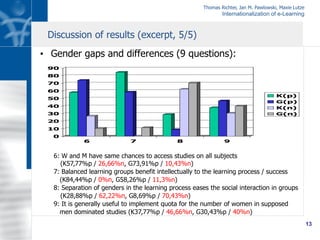
•  Gender gaps and differences (9 questions):
6: W and M have same chances to access studies on all subjects
(K57,77%p / 26,66%n, G73,91%p / 10,43%n)
7: Balanced learning groups benefit intellectually to the learning process / success
(K84,44%p / 0%n, G58,26%p / 11,3%n)
8: Separation of genders in the learning process eases the social interaction in groups
(K28,88%p / 62,22%n, G8,69%p / 70,43%n)
9: It is generally useful to implement quota for the number of women in supposed
men dominated studies (K37,77%p / 46,66%n, G30,43%p / 40%n)
0
10
20
30
40
50
60
70
80
90
6 7 8 9
K(p)
G(p)
K(n)
G(n)
Thomas Richter, Jan M. Pawlowski, Maxie Lutze
Internationalization of e-Learning
14
n  Female and male interviewees in Germany unbalanced: 15f, 100m, total 115
samples; In Korea: 20f / 25m, total 45 samples
n  Different interview locations in Korea and Germany: In Germany interviews
have been conducted in class during lesson time, in Korea at street and
cafés
n  Studied subjects in German survey mainly technical; Students in other fields
may give different answers
n  Only students have been asked. The results may not allow deductions for
learners in professional trainings.
n  Until the comparative study is finished, the numbers of male and female as
well as the numbers of students in different fields of study shall be much
more balanced and numbers in the Korean survey enhanced
n  An additional study shall show if learners in professional trainings think
different to the interviewed students
Limitations for the results of the Survey
Thomas Richter, Jan M. Pawlowski, Maxie Lutze
Internationalization of e-Learning
15
n  Survey is adequate method collecting data as well as to show
generalizability by using the Likert scale. (unclear results not
necessarily show the opposite but can also point on unclear
questions). A review is necessary and will be proceeded.
n  The same survey design (translated in each country’s language)
has been conducted to students in both countries and showed
usable and comparable results. The same survey-design for
different countries (no cultural misunderstandings) showed
meaningful results (in this study)
n  Open questions (answers) allowed the definition of new influence
factors
Conclusions
Thomas Richter, Jan M. Pawlowski, Maxie Lutze
Internationalization of e-Learning
16
n  Further surveys on other user oriented subjects are intended (2008 /
2009)
n  Review of surveys and repeated conducting is planned in cases of
unclear results (2008 / 2009)
n  After finishing data collection process, the results shall be verified in
further countries to exclude coincidences (2009 / 2010)
n  It has to be found out how far differences in learning strategies inflict
the learning success if not adapted (changing need). A testing
method already has been defined
n  The results shall lead to a recommender tool, which helps to proceed
the adaptation of learning situations (3 - 4 years)
Further research steps
Thomas Richter, Jan M. Pawlowski, Maxie Lutze
Internationalization of e-Learning
17
Thank you for your interest!
Are there any questions?
Contact:
Thomas Richter
richter-bonn@arcor.de
Institut für Informatik und
Wirtschaftsinformatik (ICB)

Adapting E-Learning Situations for International Reuse

  • 1.
    Institut für Informatikund Wirtschaftsinformatik (ICB)‫‏‬ Adapting e-Learning Situations for International Reuse Internationalization of e-Learning Thomas Richter, Jan M. Pawlowski, Maxie Lutze University of Duisburg Essen Korean German Institute of Technology, SeoulUniversity of Jyväskylä
  • 2.
    Thomas Richter, JanM. Pawlowski, Maxie Lutze Internationalization of e-Learning 2 n  Motivation n  Context of e-Learning, Adaptation Process Model, Influence factors n  Korean-German study n  Discussion of results n  Limitations n  Conclusion n  Further research Overview
  • 3.
    Thomas Richter, JanM. Pawlowski, Maxie Lutze Internationalization of e-Learning 3 n  Idea: Providing e-Learning situations in international settings n  Problem: Conflict situations through different contexts n  Solutions: Reauthoring vs. Reuse Which are conflicting parameters and how to adapt? Motivation Reauthoring Reuse Long development cycles Adaptation of only necessary aspects - short development cycles High costs Lower costs Comparability difficult (exams, accreditation) Differences to origin generally known and calculable
  • 4.
    Thomas Richter, JanM. Pawlowski, Maxie Lutze Internationalization of e-Learning 4 The Context of e-Learning n  National and international context provide different problems: National Context International Context Known technological standard May differ between nations and regions Common teaching strategies, educational basis, learning preferences Approaches may differ Common sensibilities Subjects may strongly differ Common social behavior May even be opposite One law, same historical experiences, similar picture of the world May differ
  • 5.
    Thomas Richter, JanM. Pawlowski, Maxie Lutze Internationalization of e-Learning 5 The Adaptation Process Model
  • 6.
    Thomas Richter, JanM. Pawlowski, Maxie Lutze Internationalization of e-Learning 6 Describing Influence Factors by Context Metadata Culture Companies Rules, standards & agreements Financial aspects Media richness Internet security Demographic development Religion Geography & education infrastructure Technical infrastructure Rights History Politics State of development Human actors Learner satisfaction e-Learning environment country / region company learner author Influences through culture related assisting style Influences through different world-view Influences through implying content related learning needs Influences author building up his world view tutor Particularly (generalizable) user related data are unknown in a lot of cases!
  • 7.
    Thomas Richter, JanM. Pawlowski, Maxie Lutze Internationalization of e-Learning 7 Related questions: n  Which of our found attributes are culturally motivated and which are individually different? n  Is a survey an adequate method to verify generalizability? n  Can such a survey be uniformed so that it works in all contexts? n  Do the concrete collected attributes reflect expected differences? n  The survey has been developed in cooperation with the KGIT and conducted to students in Germany and South Korea in each language. The design is a five point Likert Scale between strongly agree and disagree. Free answers have been possible. Collecting Data and Verification of Attributes - Explorative Survey The individual learner is unknown until a course is booked: Attributes must be valid for all learners within a specific context
  • 8.
    Thomas Richter, JanM. Pawlowski, Maxie Lutze Internationalization of e-Learning 8 Explorative Survey - South Korea and Germany n  Hofstede (2005): Relationship to authorities is culturally motivated (Power Distance Index): n  We asked questions to 45 Korean and 125 German students about n  the role of the lecturer n  tasks and responsibilities of a lecturer n  the ability to stand critics and the kind of expected feedback n  gender gaps and differences The relative values of Hofstede‘s system does not fit our needs 10 20 30 40 50 60 70 80 90 1000 Impact significant Germany (35) Austria (11) South Korea (60) China (80) Impact not significant Impact not significant
  • 9.
    Thomas Richter, JanM. Pawlowski, Maxie Lutze Internationalization of e-Learning 9 Discussion of results (excerpt, 1/5) •  The role of the lecturer (7 questions): 0 10 20 30 40 50 60 70 80 3 4 5 6 7 K(p) G(p) K(n) G(n) 1,2: both consider the lect. being an expert (>97,76%) and personal coach (>60%) 3: a lect. is an idol (K51,11%n, G49,56%p) 4: a lect. is a personality (K42,22%n/37,77%p, G62,6%p) 5: a lect. is an authority (K53,33%n, G66,95%p) 6: a lect. must know everything (K75,55%p, G77,39%n) 7: a lect. must be a trustable person (K68,88%p,G38,26%p/28,69%n)
  • 10.
    Thomas Richter, JanM. Pawlowski, Maxie Lutze Internationalization of e-Learning 10 Discussion of results (excerpt, 2/5) •  Tasks and responsibilities of a lecturer (5 questions): 0 10 20 30 40 50 60 70 80 90 100 1 2 3 4 5 K(p) G(p) K(n) G(n) 1: give technical support (K64,44%p, G54,78%p) 2: provide well selected content and contextual info.(K91,11%p, G99,13%p) 3: help in finding suitable information(K93,33%p, G43,47%p) 4: support in organizing the learning process (K93,33%p, G63,47%p) 5: give feedback on knowledge base, results and development (K100%p, G62%p)
  • 11.
    Thomas Richter, JanM. Pawlowski, Maxie Lutze Internationalization of e-Learning 11 Discussion of results (excerpt, 3/5) •  Feedback - The effect of critic and laud (3 questions): 0 10 20 30 40 50 60 70 80 90 100 1 2 3 K(p) G(p) 1: Laud has a positive effect on learning motivation (K100%p, G89%p) 2: Critic has a positive effect on learning motivation (K82%p, G62%p) 3: Students feel irritated if they do not get feedback (K71%p, G58%p)
  • 12.
    Thomas Richter, JanM. Pawlowski, Maxie Lutze Internationalization of e-Learning 12 Discussion of results (excerpt, 4/5) •  Gender gaps and differences (9 questions): 0 10 20 30 40 50 60 70 80 90 1 2 3 4 5 K(p) G(p) K(n) G(n) 1: Learning content should be the same for m and w (K66,66%p / 20%n, G86,08%p / 2,6%n) 2: M and w obtain same abilities in understanding complex technical information (K46,66%p / 35,55%n, G57,39%p / 26,08%n) 3: M and w obtain the same abilites in understanding social contexts (K60%p / 28,88%n,G59,13%p / 29,56%n) 4: Treatment of m and w is the same after completing task successfully (K40%p / 53,33%n, G57,39%p / 28,69%n) 5: Treatment of m and w is the same after failing a task (K33,33%p / 57,77%n, G54,78%p / 28,69%n)
  • 13.
    Thomas Richter, JanM. Pawlowski, Maxie Lutze Internationalization of e-Learning 13 Discussion of results (excerpt, 5/5) •  Gender gaps and differences (9 questions): 6: W and M have same chances to access studies on all subjects (K57,77%p / 26,66%n, G73,91%p / 10,43%n) 7: Balanced learning groups benefit intellectually to the learning process / success (K84,44%p / 0%n, G58,26%p / 11,3%n) 8: Separation of genders in the learning process eases the social interaction in groups (K28,88%p / 62,22%n, G8,69%p / 70,43%n) 9: It is generally useful to implement quota for the number of women in supposed men dominated studies (K37,77%p / 46,66%n, G30,43%p / 40%n) 0 10 20 30 40 50 60 70 80 90 6 7 8 9 K(p) G(p) K(n) G(n)
  • 14.
    Thomas Richter, JanM. Pawlowski, Maxie Lutze Internationalization of e-Learning 14 n  Female and male interviewees in Germany unbalanced: 15f, 100m, total 115 samples; In Korea: 20f / 25m, total 45 samples n  Different interview locations in Korea and Germany: In Germany interviews have been conducted in class during lesson time, in Korea at street and cafés n  Studied subjects in German survey mainly technical; Students in other fields may give different answers n  Only students have been asked. The results may not allow deductions for learners in professional trainings. n  Until the comparative study is finished, the numbers of male and female as well as the numbers of students in different fields of study shall be much more balanced and numbers in the Korean survey enhanced n  An additional study shall show if learners in professional trainings think different to the interviewed students Limitations for the results of the Survey
  • 15.
    Thomas Richter, JanM. Pawlowski, Maxie Lutze Internationalization of e-Learning 15 n  Survey is adequate method collecting data as well as to show generalizability by using the Likert scale. (unclear results not necessarily show the opposite but can also point on unclear questions). A review is necessary and will be proceeded. n  The same survey design (translated in each country’s language) has been conducted to students in both countries and showed usable and comparable results. The same survey-design for different countries (no cultural misunderstandings) showed meaningful results (in this study) n  Open questions (answers) allowed the definition of new influence factors Conclusions
  • 16.
    Thomas Richter, JanM. Pawlowski, Maxie Lutze Internationalization of e-Learning 16 n  Further surveys on other user oriented subjects are intended (2008 / 2009) n  Review of surveys and repeated conducting is planned in cases of unclear results (2008 / 2009) n  After finishing data collection process, the results shall be verified in further countries to exclude coincidences (2009 / 2010) n  It has to be found out how far differences in learning strategies inflict the learning success if not adapted (changing need). A testing method already has been defined n  The results shall lead to a recommender tool, which helps to proceed the adaptation of learning situations (3 - 4 years) Further research steps
  • 17.
    Thomas Richter, JanM. Pawlowski, Maxie Lutze Internationalization of e-Learning 17 Thank you for your interest! Are there any questions? Contact: Thomas Richter richter-bonn@arcor.de Institut für Informatik und Wirtschaftsinformatik (ICB)