68
13 A-NET
Part 1
SPEAKING / CONVERSATION TEST
1. A: “I saw you at the movie yesterday.
How did you find it?”
B: “_____”
a. I found it in the newspaper
b. It was at Siam Theatre
c. It was very exciting
d. It took me almost 10 minutes to find it
2. You’re planning to go to England in July. You ask
your British teacher: “_______”
a. What’s the weather like in July?
b. What can I do with July’s weather?
c. How do you think about July weather?
d. How about the July-like weather?
3. A tourist stops you on the street and asks you
how to get to a place you do not know.
You say “ _________”
a. I don’t know. Find it yourself
b. I’m happy to help me
c. Just keep walking straight ahead and
you’ll find it.
d. I’m not sure. You’d better ask somebody
4. Tom disagrees with his teacher but does not want to make
him angry so he says “_______”
a. May I suggest another idea?
b. How could you say that?
c. You’ve got to be reasonable
d. I couldn’t agree with you
5. Are these your suitcases, Madam? Do you have anything to
declare? Where is this dialogue most likely to take place at?
a. a tour agency b. a bus stop
c. a police station d. the Customs
6. You told your friend you’ve got a job interview. He said, “Good
for you! I’ll keep my fingers crossed.” He meant to say
___________.
a. Take it easy
b. I wish you luck
c. Take it for granted
d. I’m glad to hear that
7. You went shopping; you didn’t have cash on you.
You asked the cashier: “____________”
a. Do you take credit cards
b. How much can you offer
c. Could you give me a card
d. Would you mind if I didn’t have cash
8. After a part, you turn to your friend to offer him
a ride. You say. “____________”
a. I can pick you up
b. I can give you a lift home
c. You can come and get me
d. You can get a long with me
9. A customer in a fast food restaurant orders
a hamburger and French fires. The man behind
the counter asks him. “___________”
a. Would you like anything to drink with that?
b. Is that all you’re going to order?
c. Are you thinking of going out?
d. Would you like to suggest something else?
10. You can’t hear the news clearly on the radio so
you say to your American friend,“_________”
a. Could you pick it up please?
b. How about switching it on?
c. Would you mind turning it up?
d. Can you please put it on?
11. You ask to speak to your boss on the phone.
You say, “___________”
a. I’d like Mr. Baxter to speak to me
b. I intend to talk to Mr. Baxter
c. Can you direct me to Mr. Baxter?
d. Could you put me through to Mr. Baxter
please?
12. You are in Bangkok, talking to your friend in Singapore. You
mention that you are flying
down next weekend.
Your friend says “_________ at the airport.”
a. I’ll pick you up
b. I’ll go and receive you
c. I’ll come after you
d. I’ll be there for you
13. You ordered a medium steak but it’s too rare. You told the
waiter about the steak and asked for the medium steak.
What would the waiter says: “____”
a. Yes, sir. I’ll see to that that right away
b. Very good, Sir. I’ll bring you the menu.
c. You’d better see how it taste
d. Excuse me, I’m afraid that cant’ be
Accepted
14. A: “How would you like you coffee” B: “_____”
a. I like it very much
b. Only half a cup, please
c. I usually have 2 cups a day
d. I take it black
69
15. Customer: I gave you a five- dollar bill for that
shirt. Isn’t there any change? Salesman says:
“________”
a. Sorry, I forgot
b. Yes, coming soon
c. No, you can change nothing
d. Okay, if you want to
SITUATIONAL DIALOGUE
Laura: _____16_____.Doing the test is horrible.
Donna: _____17_____. And what did your
instructor ______18_____?
Laura: He said I have to work harder and see
him more.
Donna: Why don’t you ______19______?
Laura: Do you really think so? I’m so nervous.
Donna: Sure, _______20______.
16. a. I’m doing well
b. I’ve failed twice
c. I got off to a flying start
d. I took it as a grain of salt
17. a. I’m feeling a bit out of sorts
b. I’ll never be able to clarify it.
c. I really think it’s at the deep end
d. I know exactly what you’re talking about
18. a. talk b. tell
c. say d. speak
19. a. call it a day b. make a shot at it
c. give it another try d. put your faith in it
20. a. second to none
b. two’s company
c. third time lucky
d. first come, first serve
Salesman: Good morning, sir. Can I help you ?
Customer: Yes, I’d like to return this blouse I
bought here the other day.
Salesman: ______21______, sir?
Customer: Not really. I bought this blouse for my
daughter, but she has already had one.
I’d like a refund.
Salesman: Oh, I’m afraid we don’t have a refund
policy. Would you like to look for
another style or color for her, sir?
Customer: Mmmm. ____22_____. I’m afraid I
might not be able to choose something
that would fit her._____23______?
Salesman: Actually, if you have a receipt with you,
you can exchange the blouse for
anything you like in any department,
say…..you can get a shirt for yourself,
____24___ that its price is not more
than the price of this blouse.
Customer: Oh great…____25_____. Thank you.
21. a. Why don’t you want it.
b. What do you want it for
c. Was there a problem with it
d. Why do you see the problem
22. a. I think so b. You are sure
c. I won’t agree d. I don’t think so
23. a. What else
b. What would I care
c. What would you suggest me to do
d. What a threat could I receive from this store
24. a. or please understand
b. but please make sure
c. and you have to certify
d. and then I try to remember that
25. a. I’ll have a look
b. I may remember it
c. I doubt if I need to buy it
d. You may have to look at it
Part 2
Sentence completions
1. Thais bow with their palms together and fingers
outstretched, _______ people from Cambodia
and Laos bow with their hands in front of their
chests.
a. therefore b. while
c. now that d. and
2. In the early sixties, Bangkok was a confusing
maze of low buildings,
________ , and visually not very attractive.
a. some as tall as modern skyscrapers
b. the majority of which were well designed
c. few of them taller than three or four
stories
d. all were beautifully painted
3. Uruguay became an area of longstanding Spanish
– Portuguese rivalry. Liberated in 1825, it
remained relatively backward and disunited
through the 19th c., but in the 20th c., ________
its small size, it has emerged as one of the
most prosperous and literate nations in the
continent, boasting a high rate of economic
growth and an extensive social-welfare system.
a. on the other hand b. yet
c. in spite d. despite
4. Children to ________ to the cruel words day
after day can cause lifelong damage.
a. expose b. be exposing
c. be exposed d. exposing
5. The President of the Board had no support from
the Committee; ____________.
a. therefore, he decided to resign
b. thus, the workers made an insurance
claim
c. in addition, the company gained a lot of
profit
d. furthermore, the shareholders all voted
for him
Part 3
Error recognition
1. That new person from the head office who is working with us
reminds me to my uncle.
2. On our trip to Central America, We spent a lot
of time visiting too old Mayan ruins.
3. The future of our company depends finishing
the project quickly.
70
4. The company rules are establishing to increase
morale and profits.
5. The communication center will have moved as soon as the
reception area nears completion.
6. Be certain to provide the manager with a analysis of the
problems you face in carrying out your duties.
7. They have not still paid the annual retainer that
we agreed upon.
8. The cartel has little opportunities to keep prices
at a level that they feel is appropriate.
9. We set the merchandise next to the window to
keep it from get in our way.
10. Our supervisor has gone to London for meeting
with the head office.
Part 4
Writing
The forces of …..1….. eventually act …..2….. even
the most …..3….. buried igneous rocks. When this occurs, the
rock will crumble and decompose under the influence of
chemical and …..4….. weathering, and particles will be
dissolved in water or washed away by streams, …..5….. by
winds, or carried away by glaciers. Water is …..6….. active
factor in transporting sediment, as this weathered material is
called, for rivers and streams …..7….. shape the landscape and
carry the sediment either as particles …..8….. in solution. Such
material may settle out of the water ….9…. its weight, or it
maybe precipitated chemically from a …..10…..state. When this
sediment becomes lithified into solid rock, it is termed
sedimentary rock. When sand particles …..11.., …..12…, they
become sandstone; gravel becomes conglomerate; clay or mud
becomes shale. Rock salt and beds of borax are also …..13…..
rocks.
1. a. erode b. erosion
c. eroded d. erosive
2. a. in b. for
c. upon d. of
3. a. depth b. deep
c. deeply d. deepest
4. a. mechanic b. mechanical
c. mechanize d. mechanism
5. a. blow b. blew
c. blown d. blowing
6. a. the more b. most
c. the most d. more than
7. a. continues b. continued
c. continuing d. continually
8. a. nor b. and
c. or d. as
9. a. because of b. as a result
c. moreover d. even if
10. a. dissolve b. dissolving
c. dissolved d. dissolution
11. a. solidly b. solidity
c. solidified d. solidify
12. a. likewise b. since
c. for instance d. nevertheless
13. a. sedimentation b. sedimentary
c. sediment d. sediments
Part 5
Reading comprehension
The basic morphology of plants reflects their
evolutionary history as terrestrial organisms. The algal
ancestors of plants were bathed in a solution of water and
minerals, including bicarbonate, the source of carbon dioxide
for photosynthesis in aquatic habitats. In contrast, the
resources a terrestrial plant needs are divided between the soil
and air, and the plant must inhabit these two very different
environments at the same time. Soil provides water and
minerals, but air is the main source of carbon dioxide, and light
does not penetrate far into the soil. The evolutionary solution to
this separation of resources was differentiation of the plant
body into two main systems: a subterranean root system and
aerial shoot system consisting of stems, leaves and flowers.
Neither system can live without the other. Lacking chloroplasts
and living in the dark, roots would starve without sugar and
other organic nutrients imported from the photosynthetic
tissues of the shoot system. Conversely, the shoot system
depends on water and minerals absorbed from the soil by roots.
1. The ancestors of plants used nutrients from the:
a. soil b. air
c. water d. algae
2. A terrestrial plant lives in the:
a. soil b. air
c. water d. soil and air
3. The plant's evolutionary solution was:
a. assimilation b. photosynthesis
c. organic d. differentiation
4. The two main plant systems are:
a. stems and leaves
b. roots and shoots
c. chloroplasts and roots
d. flowers and roots
5. The two plant systems:
a. require each other b. are independent
c. lack chloroplasts d. are subterranean
Part 6
Cloze test
Estrogern
Is it for you?
This little pill can keep a woman young, but
for some it’s risky.
When a new patient strode into the office of
gynecologist Robert A Wilson in the early 1960s, he could
hardly believe his eyes “Mrs. P. G.” as he later called her, was
52 years old, but she had the smooth skin and youthful body of
woman half her age.
71
Asked about menopause, Mrs. P.G. laughed and replied, Dr.
Wilson, I have never yet …….1……. a period. I’m so regular,
.…2…… could use me for timing the moon. She later revealed
that she was ……3.…. birth-control pills containing estrogen and
a second female hormone, progesterone.
The patient was a walking, talking confirmation of
Wilson’s most deeply held medicine ….4.… that treating
menopausal women with female hormones could actually
prevent menopause and the “fast and painful aging process”
that attend it. Three years later, Wilson’s best selling book,
Feminine forever, announced the good news to all women.
Since then, estrogen-either alone or combined with
other hormones in a treatment known as hormones
replacement …5... has indeed become the closest thing in a
modern medicine to a woman’s …6…. of youth. “I have a
hunch that I’ll remain on HRT for the rest of my life, says Frida,
a university instructor in her early 70s who feels that estrogen
gives her “more energy” and a more …7….appearance.
1. a. missed b. miscarried
c. neglected d. lacked
2. a. meteorologist b. astronomers
c. hydrologist d. ecologist
3. a. having b. ingesting
c. taking d. swallowing
4. a. viewpoint b. credence
c. conclusion d. conviction
5. a. therapy b. treatment
c. remedy d. cure
6. a. aging b. elixir
c. waning d. weary
7. a. youthful b. elocution
c. elucidation d. embodiment
Part 7
Vocabulary
1. _________ mounted as time and again their designs were
rejected by the sales force.
a. Disappoint b. Disappointing
c. Disappointedly d. Disappointment
2. A commitment is a ___________
a. condition b. contact
c. promise d. period
3. Scientists have recently discovered that man has
latent senses. Fingertip seeing would be an example
of such sense. SO would the sense that blind people
use to “Hear” their locations.
a. lasting b. temporary
c. active d. hidden.
4. The modern reader pre-reads every piece of factual
prose before he actually reads it.
a. really b. usually
c. likely d. partly
5. The fight against a chemical storage site has
transformed a normally sedate village into
a battle ground.
a. sober b. fearful
c. sleek d. druged
6. I’m not connoisseur but I know a good champagne
when I taste one.
a. portrait artist b. violent upheaval
c. historival documents d. critical judge
7. In 2006, the world economy were………and
people became poorer.
a. dominant b. elegant
c. dissonant d. stagnant
8. Palmy was a ……… child who could read and
write at the age of three.
a. laggard b. precocious
c. puny d. timorous
9. One of the Mekong ………… flooded several
provinces.
a. tributaries b. territories
c. techniques d. troopships
10. The standard ……….. at good restaurant is
15 per cent of the bill.
a. gravity b. gratitude
c. gradation d. gratuity
Part 8
Speed reading
Required Courses (SLIS)
**701 Introduction to Library, Information and Media
Professions. (3) Nature,development,
and roles of library, media, and information professions;
the discipline and practice
of library and information science; current professional
issues.
**Must be taken in your first semester.
703 Introduction to Information Sources and Services. (3)
Information transfer process
in libraries, media centers, and other
informationagencies, including interpersonal
communication; bibliographic control; selection,
evaluation, and use of information
resources; management of information resources;
management of information services.
704 Introduction to the Management of Libraries, Media
Centers, and Information Agencies.
(3) The nature, development, roles, and fundamental
issues in the administration and management of
libraries, media centers, and information agencies.
705 Introduction to Research in Library and Information
Science. (3) The research process,including problem
identification, hypothesis testing, data collection,
analysis and interpretation of results. Emphasis on
research methods and on critical evaluation of reported
research in library and information science.
706 Introduction to Information Technologies. (3)
Information technologies in libraries, mediacenters, &
other information agencies; operation & applications of
computers & telecommunications; database design;
online access methods.
Elective Courses
Development of Libraries, Printing and Publishing
710 History of Information Organizations and Technologies.
(3) (Prereq: SLIS 701)
A survey, from ancient times to the present, of the
evolution and social role of information
organizations (libraries, archives, information centers,
etc.) and technologies (books, journals, computers,
etc.). Emphasis on the U.S. in the 19th and 20th
centuries.
72
715 Printing. (1) Introduction to printing with movable type.
This course is designed to
give students some experience in designing and printing
books and broadsides.
Examination of paper, typefaces,composition
work, and simple bookbinding are included.
716 Introduction to Bibliography and Textual Studies [=
ENGL 776] (3) Introduction to
analytical, descriptive and textual bibliography, and to
the principles and practice of editing.
719 Preservation Planning and Administration.
(3) The planning and administration of
preservation programs in libraries, archives,
records centers and manuscript depositories. Focus is on
basic conservation principles and techniques
Library and Information Organizations
720 School Library Media Program Development. (3)
(Prereq: SLIS 701,702, 703, 704, 705, 706) Roles,
functions, and organization of school library media
programs. Systematic program planning and evaluation,
facilitation of instructional team partnerships, and
integration of program into the curriculum.
721 Seminar in School Media Programs. (3) (Prereq: SLIS
701, 702, 703, 705, 706, 720,
or consent of professor) Problems relating to
contemporary school media programs
will be identified and analyzed by students, drawing
from their own experiences,
pertinent literature in the field, and field investigations.
722 Libraries in Correctional Institutions. (3) (Prereq: SLIS
701, 704) Offered irregularly.
Management, services, and programming in prison
libraries. 723 Libraries in Institutions
for Ill or Severely Disabled Persons. (3) (Prereq: SLIS
701, 704) Offered irregularly.
Management, services, and programming in patient
services in general hospitals,Mental
hospitals, institutions for mentally retarded persons,
73
13 A-NET
Part 1. SPEAKING/CONVERSATION TEST
1.  c. It was very exciting
2.  a. What’s the weather like in July?
3.  d. I’m not sure. You’d better ask
somebody
4.  a. May I suggest another idea?
5.  d. the Customs
6.  b. I wish you luck
7.  a. Do you take credit cards
8.  b. I can give you a lift home
9.  a. Would you like anything to drink
with that?
10.  c. Would you mind turning it up?
11.  d. Could you put me through to
Mr. Baxter please?
12.  a. I’ll pick you up
13.  a. Yes, sir. I’ll see to that that right
away
14.  d. I take it black
15.  a. Sorry, I forgot
16.  b. I’ve failed twice
17.  c. I really think it’s at the deep end
18  c. say
19.  c. give it another try
20.  c. third time lucky
21.  c. Was there a problem with it
22.  d. I don’t think so
23.  c. What would you suggest me to do
24.  b. but please make sure
25.  a. I’ll have a look
Part 2. Sentence completions
1.  b. while
2.  b. the majority of which were well
designed
3.  d. despite
4.  c. be exposed
5.  a. therefore, he decided to resign
Part 3. Error recognition
1. to
2. too old
3. depends finishing
4. establishing
5. will have moved
6. a
7. still
8. little
9. get
10. for meeting
Part 4. Writing
1.  b. erosion
2.  c. upon
3.  c. deeply
4.  b. mechanical
5.  c. blown
6.  c. the most
7.  d. continually
8.  c. or
9.  a. because of
10.  c. dissolved
11.  d. solidify
12.  c. for instance
13.  b. sedimentary
Part 5.
Reading comprehension
1.  c. water
2.  d. soil and air
3.  d. differentiation
4.  b. roots and shoots
5.  a. require each other
Part 6. Cloze test
1.  a. missed
2.  b. astronomers
3.  c. taking
4.  d. conviction
5.  a. therapy
6.  b. elixir
7.  a. youthful
Part 7. Vocabulary
1.  d. Disappointment
2.  c. promise
3.  d. hidden.
4.  a. really
5.  a. sober
6.  d. critical judge
7.  d. stagnant
8.  b. precocious
9.  a. tributaries
10.  d. gratuity
Part 8. Speed reading
Required Courses (SLIS)
1.  a. 723
2.  a. Printing
3.  c. Differential and integral calculus
4.  a. Digital Libraries
5.  b. 723

002 eng a-net

  • 1.
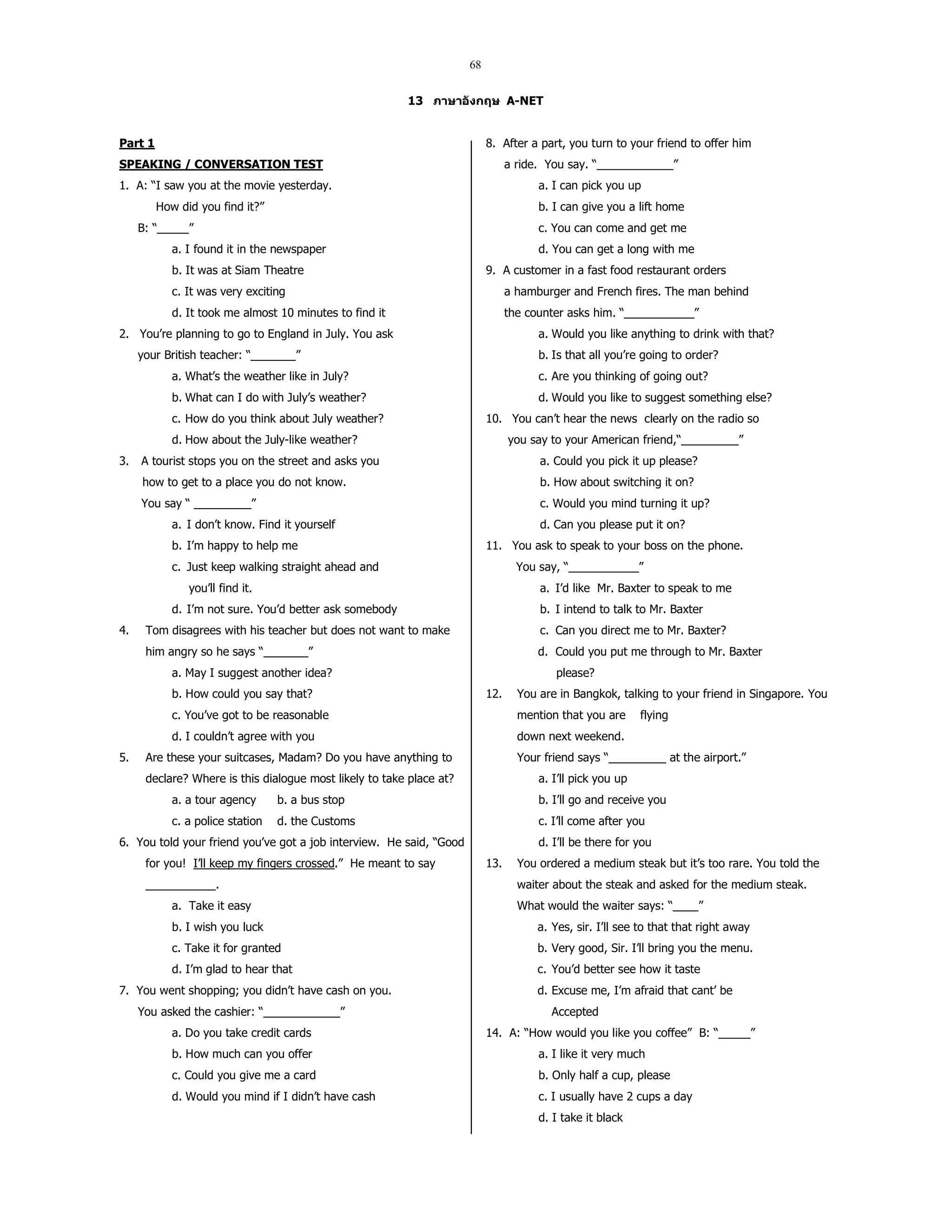
    68 13 A-NET Part 1 SPEAKING/ CONVERSATION TEST 1. A: “I saw you at the movie yesterday. How did you find it?” B: “_____” a. I found it in the newspaper b. It was at Siam Theatre c. It was very exciting d. It took me almost 10 minutes to find it 2. You’re planning to go to England in July. You ask your British teacher: “_______” a. What’s the weather like in July? b. What can I do with July’s weather? c. How do you think about July weather? d. How about the July-like weather? 3. A tourist stops you on the street and asks you how to get to a place you do not know. You say “ _________” a. I don’t know. Find it yourself b. I’m happy to help me c. Just keep walking straight ahead and you’ll find it. d. I’m not sure. You’d better ask somebody 4. Tom disagrees with his teacher but does not want to make him angry so he says “_______” a. May I suggest another idea? b. How could you say that? c. You’ve got to be reasonable d. I couldn’t agree with you 5. Are these your suitcases, Madam? Do you have anything to declare? Where is this dialogue most likely to take place at? a. a tour agency b. a bus stop c. a police station d. the Customs 6. You told your friend you’ve got a job interview. He said, “Good for you! I’ll keep my fingers crossed.” He meant to say ___________. a. Take it easy b. I wish you luck c. Take it for granted d. I’m glad to hear that 7. You went shopping; you didn’t have cash on you. You asked the cashier: “____________” a. Do you take credit cards b. How much can you offer c. Could you give me a card d. Would you mind if I didn’t have cash 8. After a part, you turn to your friend to offer him a ride. You say. “____________” a. I can pick you up b. I can give you a lift home c. You can come and get me d. You can get a long with me 9. A customer in a fast food restaurant orders a hamburger and French fires. The man behind the counter asks him. “___________” a. Would you like anything to drink with that? b. Is that all you’re going to order? c. Are you thinking of going out? d. Would you like to suggest something else? 10. You can’t hear the news clearly on the radio so you say to your American friend,“_________” a. Could you pick it up please? b. How about switching it on? c. Would you mind turning it up? d. Can you please put it on? 11. You ask to speak to your boss on the phone. You say, “___________” a. I’d like Mr. Baxter to speak to me b. I intend to talk to Mr. Baxter c. Can you direct me to Mr. Baxter? d. Could you put me through to Mr. Baxter please? 12. You are in Bangkok, talking to your friend in Singapore. You mention that you are flying down next weekend. Your friend says “_________ at the airport.” a. I’ll pick you up b. I’ll go and receive you c. I’ll come after you d. I’ll be there for you 13. You ordered a medium steak but it’s too rare. You told the waiter about the steak and asked for the medium steak. What would the waiter says: “____” a. Yes, sir. I’ll see to that that right away b. Very good, Sir. I’ll bring you the menu. c. You’d better see how it taste d. Excuse me, I’m afraid that cant’ be Accepted 14. A: “How would you like you coffee” B: “_____” a. I like it very much b. Only half a cup, please c. I usually have 2 cups a day d. I take it black
  • 2.
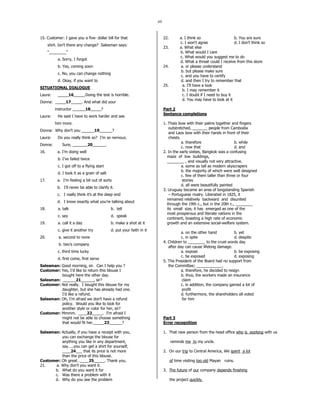
    69 15. Customer: Igave you a five- dollar bill for that shirt. Isn’t there any change? Salesman says: “________” a. Sorry, I forgot b. Yes, coming soon c. No, you can change nothing d. Okay, if you want to SITUATIONAL DIALOGUE Laura: _____16_____.Doing the test is horrible. Donna: _____17_____. And what did your instructor ______18_____? Laura: He said I have to work harder and see him more. Donna: Why don’t you ______19______? Laura: Do you really think so? I’m so nervous. Donna: Sure, _______20______. 16. a. I’m doing well b. I’ve failed twice c. I got off to a flying start d. I took it as a grain of salt 17. a. I’m feeling a bit out of sorts b. I’ll never be able to clarify it. c. I really think it’s at the deep end d. I know exactly what you’re talking about 18. a. talk b. tell c. say d. speak 19. a. call it a day b. make a shot at it c. give it another try d. put your faith in it 20. a. second to none b. two’s company c. third time lucky d. first come, first serve Salesman: Good morning, sir. Can I help you ? Customer: Yes, I’d like to return this blouse I bought here the other day. Salesman: ______21______, sir? Customer: Not really. I bought this blouse for my daughter, but she has already had one. I’d like a refund. Salesman: Oh, I’m afraid we don’t have a refund policy. Would you like to look for another style or color for her, sir? Customer: Mmmm. ____22_____. I’m afraid I might not be able to choose something that would fit her._____23______? Salesman: Actually, if you have a receipt with you, you can exchange the blouse for anything you like in any department, say…..you can get a shirt for yourself, ____24___ that its price is not more than the price of this blouse. Customer: Oh great…____25_____. Thank you. 21. a. Why don’t you want it. b. What do you want it for c. Was there a problem with it d. Why do you see the problem 22. a. I think so b. You are sure c. I won’t agree d. I don’t think so 23. a. What else b. What would I care c. What would you suggest me to do d. What a threat could I receive from this store 24. a. or please understand b. but please make sure c. and you have to certify d. and then I try to remember that 25. a. I’ll have a look b. I may remember it c. I doubt if I need to buy it d. You may have to look at it Part 2 Sentence completions 1. Thais bow with their palms together and fingers outstretched, _______ people from Cambodia and Laos bow with their hands in front of their chests. a. therefore b. while c. now that d. and 2. In the early sixties, Bangkok was a confusing maze of low buildings, ________ , and visually not very attractive. a. some as tall as modern skyscrapers b. the majority of which were well designed c. few of them taller than three or four stories d. all were beautifully painted 3. Uruguay became an area of longstanding Spanish – Portuguese rivalry. Liberated in 1825, it remained relatively backward and disunited through the 19th c., but in the 20th c., ________ its small size, it has emerged as one of the most prosperous and literate nations in the continent, boasting a high rate of economic growth and an extensive social-welfare system. a. on the other hand b. yet c. in spite d. despite 4. Children to ________ to the cruel words day after day can cause lifelong damage. a. expose b. be exposing c. be exposed d. exposing 5. The President of the Board had no support from the Committee; ____________. a. therefore, he decided to resign b. thus, the workers made an insurance claim c. in addition, the company gained a lot of profit d. furthermore, the shareholders all voted for him Part 3 Error recognition 1. That new person from the head office who is working with us reminds me to my uncle. 2. On our trip to Central America, We spent a lot of time visiting too old Mayan ruins. 3. The future of our company depends finishing the project quickly.
  • 3.
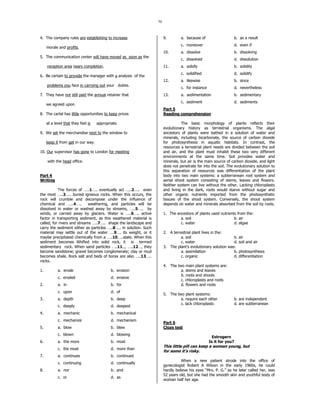
    70 4. The companyrules are establishing to increase morale and profits. 5. The communication center will have moved as soon as the reception area nears completion. 6. Be certain to provide the manager with a analysis of the problems you face in carrying out your duties. 7. They have not still paid the annual retainer that we agreed upon. 8. The cartel has little opportunities to keep prices at a level that they feel is appropriate. 9. We set the merchandise next to the window to keep it from get in our way. 10. Our supervisor has gone to London for meeting with the head office. Part 4 Writing The forces of …..1….. eventually act …..2….. even the most …..3….. buried igneous rocks. When this occurs, the rock will crumble and decompose under the influence of chemical and …..4….. weathering, and particles will be dissolved in water or washed away by streams, …..5….. by winds, or carried away by glaciers. Water is …..6….. active factor in transporting sediment, as this weathered material is called, for rivers and streams …..7….. shape the landscape and carry the sediment either as particles …..8….. in solution. Such material may settle out of the water ….9…. its weight, or it maybe precipitated chemically from a …..10…..state. When this sediment becomes lithified into solid rock, it is termed sedimentary rock. When sand particles …..11.., …..12…, they become sandstone; gravel becomes conglomerate; clay or mud becomes shale. Rock salt and beds of borax are also …..13….. rocks. 1. a. erode b. erosion c. eroded d. erosive 2. a. in b. for c. upon d. of 3. a. depth b. deep c. deeply d. deepest 4. a. mechanic b. mechanical c. mechanize d. mechanism 5. a. blow b. blew c. blown d. blowing 6. a. the more b. most c. the most d. more than 7. a. continues b. continued c. continuing d. continually 8. a. nor b. and c. or d. as 9. a. because of b. as a result c. moreover d. even if 10. a. dissolve b. dissolving c. dissolved d. dissolution 11. a. solidly b. solidity c. solidified d. solidify 12. a. likewise b. since c. for instance d. nevertheless 13. a. sedimentation b. sedimentary c. sediment d. sediments Part 5 Reading comprehension The basic morphology of plants reflects their evolutionary history as terrestrial organisms. The algal ancestors of plants were bathed in a solution of water and minerals, including bicarbonate, the source of carbon dioxide for photosynthesis in aquatic habitats. In contrast, the resources a terrestrial plant needs are divided between the soil and air, and the plant must inhabit these two very different environments at the same time. Soil provides water and minerals, but air is the main source of carbon dioxide, and light does not penetrate far into the soil. The evolutionary solution to this separation of resources was differentiation of the plant body into two main systems: a subterranean root system and aerial shoot system consisting of stems, leaves and flowers. Neither system can live without the other. Lacking chloroplasts and living in the dark, roots would starve without sugar and other organic nutrients imported from the photosynthetic tissues of the shoot system. Conversely, the shoot system depends on water and minerals absorbed from the soil by roots. 1. The ancestors of plants used nutrients from the: a. soil b. air c. water d. algae 2. A terrestrial plant lives in the: a. soil b. air c. water d. soil and air 3. The plant's evolutionary solution was: a. assimilation b. photosynthesis c. organic d. differentiation 4. The two main plant systems are: a. stems and leaves b. roots and shoots c. chloroplasts and roots d. flowers and roots 5. The two plant systems: a. require each other b. are independent c. lack chloroplasts d. are subterranean Part 6 Cloze test Estrogern Is it for you? This little pill can keep a woman young, but for some it’s risky. When a new patient strode into the office of gynecologist Robert A Wilson in the early 1960s, he could hardly believe his eyes “Mrs. P. G.” as he later called her, was 52 years old, but she had the smooth skin and youthful body of woman half her age.
  • 4.
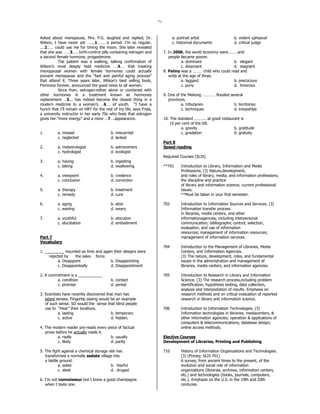
    71 Asked about menopause,Mrs. P.G. laughed and replied, Dr. Wilson, I have never yet …….1……. a period. I’m so regular, .…2…… could use me for timing the moon. She later revealed that she was ……3.…. birth-control pills containing estrogen and a second female hormone, progesterone. The patient was a walking, talking confirmation of Wilson’s most deeply held medicine ….4.… that treating menopausal women with female hormones could actually prevent menopause and the “fast and painful aging process” that attend it. Three years later, Wilson’s best selling book, Feminine forever, announced the good news to all women. Since then, estrogen-either alone or combined with other hormones in a treatment known as hormones replacement …5... has indeed become the closest thing in a modern medicine to a woman’s …6…. of youth. “I have a hunch that I’ll remain on HRT for the rest of my life, says Frida, a university instructor in her early 70s who feels that estrogen gives her “more energy” and a more …7….appearance. 1. a. missed b. miscarried c. neglected d. lacked 2. a. meteorologist b. astronomers c. hydrologist d. ecologist 3. a. having b. ingesting c. taking d. swallowing 4. a. viewpoint b. credence c. conclusion d. conviction 5. a. therapy b. treatment c. remedy d. cure 6. a. aging b. elixir c. waning d. weary 7. a. youthful b. elocution c. elucidation d. embodiment Part 7 Vocabulary 1. _________ mounted as time and again their designs were rejected by the sales force. a. Disappoint b. Disappointing c. Disappointedly d. Disappointment 2. A commitment is a ___________ a. condition b. contact c. promise d. period 3. Scientists have recently discovered that man has latent senses. Fingertip seeing would be an example of such sense. SO would the sense that blind people use to “Hear” their locations. a. lasting b. temporary c. active d. hidden. 4. The modern reader pre-reads every piece of factual prose before he actually reads it. a. really b. usually c. likely d. partly 5. The fight against a chemical storage site has transformed a normally sedate village into a battle ground. a. sober b. fearful c. sleek d. druged 6. I’m not connoisseur but I know a good champagne when I taste one. a. portrait artist b. violent upheaval c. historival documents d. critical judge 7. In 2006, the world economy were………and people became poorer. a. dominant b. elegant c. dissonant d. stagnant 8. Palmy was a ……… child who could read and write at the age of three. a. laggard b. precocious c. puny d. timorous 9. One of the Mekong ………… flooded several provinces. a. tributaries b. territories c. techniques d. troopships 10. The standard ……….. at good restaurant is 15 per cent of the bill. a. gravity b. gratitude c. gradation d. gratuity Part 8 Speed reading Required Courses (SLIS) **701 Introduction to Library, Information and Media Professions. (3) Nature,development, and roles of library, media, and information professions; the discipline and practice of library and information science; current professional issues. **Must be taken in your first semester. 703 Introduction to Information Sources and Services. (3) Information transfer process in libraries, media centers, and other informationagencies, including interpersonal communication; bibliographic control; selection, evaluation, and use of information resources; management of information resources; management of information services. 704 Introduction to the Management of Libraries, Media Centers, and Information Agencies. (3) The nature, development, roles, and fundamental issues in the administration and management of libraries, media centers, and information agencies. 705 Introduction to Research in Library and Information Science. (3) The research process,including problem identification, hypothesis testing, data collection, analysis and interpretation of results. Emphasis on research methods and on critical evaluation of reported research in library and information science. 706 Introduction to Information Technologies. (3) Information technologies in libraries, mediacenters, & other information agencies; operation & applications of computers & telecommunications; database design; online access methods. Elective Courses Development of Libraries, Printing and Publishing 710 History of Information Organizations and Technologies. (3) (Prereq: SLIS 701) A survey, from ancient times to the present, of the evolution and social role of information organizations (libraries, archives, information centers, etc.) and technologies (books, journals, computers, etc.). Emphasis on the U.S. in the 19th and 20th centuries.
  • 5.
    72 715 Printing. (1)Introduction to printing with movable type. This course is designed to give students some experience in designing and printing books and broadsides. Examination of paper, typefaces,composition work, and simple bookbinding are included. 716 Introduction to Bibliography and Textual Studies [= ENGL 776] (3) Introduction to analytical, descriptive and textual bibliography, and to the principles and practice of editing. 719 Preservation Planning and Administration. (3) The planning and administration of preservation programs in libraries, archives, records centers and manuscript depositories. Focus is on basic conservation principles and techniques Library and Information Organizations 720 School Library Media Program Development. (3) (Prereq: SLIS 701,702, 703, 704, 705, 706) Roles, functions, and organization of school library media programs. Systematic program planning and evaluation, facilitation of instructional team partnerships, and integration of program into the curriculum. 721 Seminar in School Media Programs. (3) (Prereq: SLIS 701, 702, 703, 705, 706, 720, or consent of professor) Problems relating to contemporary school media programs will be identified and analyzed by students, drawing from their own experiences, pertinent literature in the field, and field investigations. 722 Libraries in Correctional Institutions. (3) (Prereq: SLIS 701, 704) Offered irregularly. Management, services, and programming in prison libraries. 723 Libraries in Institutions for Ill or Severely Disabled Persons. (3) (Prereq: SLIS 701, 704) Offered irregularly. Management, services, and programming in patient services in general hospitals,Mental hospitals, institutions for mentally retarded persons,
  • 6.
    73 13 A-NET Part 1.SPEAKING/CONVERSATION TEST 1.  c. It was very exciting 2.  a. What’s the weather like in July? 3.  d. I’m not sure. You’d better ask somebody 4.  a. May I suggest another idea? 5.  d. the Customs 6.  b. I wish you luck 7.  a. Do you take credit cards 8.  b. I can give you a lift home 9.  a. Would you like anything to drink with that? 10.  c. Would you mind turning it up? 11.  d. Could you put me through to Mr. Baxter please? 12.  a. I’ll pick you up 13.  a. Yes, sir. I’ll see to that that right away 14.  d. I take it black 15.  a. Sorry, I forgot 16.  b. I’ve failed twice 17.  c. I really think it’s at the deep end 18  c. say 19.  c. give it another try 20.  c. third time lucky 21.  c. Was there a problem with it 22.  d. I don’t think so 23.  c. What would you suggest me to do 24.  b. but please make sure 25.  a. I’ll have a look Part 2. Sentence completions 1.  b. while 2.  b. the majority of which were well designed 3.  d. despite 4.  c. be exposed 5.  a. therefore, he decided to resign Part 3. Error recognition 1. to 2. too old 3. depends finishing 4. establishing 5. will have moved 6. a 7. still 8. little 9. get 10. for meeting Part 4. Writing 1.  b. erosion 2.  c. upon 3.  c. deeply 4.  b. mechanical 5.  c. blown 6.  c. the most 7.  d. continually 8.  c. or 9.  a. because of 10.  c. dissolved 11.  d. solidify 12.  c. for instance 13.  b. sedimentary Part 5. Reading comprehension 1.  c. water 2.  d. soil and air 3.  d. differentiation 4.  b. roots and shoots 5.  a. require each other Part 6. Cloze test 1.  a. missed 2.  b. astronomers 3.  c. taking 4.  d. conviction 5.  a. therapy 6.  b. elixir 7.  a. youthful Part 7. Vocabulary 1.  d. Disappointment 2.  c. promise 3.  d. hidden. 4.  a. really 5.  a. sober 6.  d. critical judge 7.  d. stagnant 8.  b. precocious 9.  a. tributaries 10.  d. gratuity Part 8. Speed reading Required Courses (SLIS) 1.  a. 723 2.  a. Printing 3.  c. Differential and integral calculus 4.  a. Digital Libraries 5.  b. 723