WEB 1.0 TO WEB 3.0 –
Evolution of the Web and
It’s Various Challenges
MARIO B. CADAY
Instructor I
Outline
• Difference between Web & Internet
• Web 1.0 (Read-only Static Web)
• Sad Facts of Web 1.0
• Web 2.0(Read-Write Interactive Web)
• Principles of Web 2.0
• Web 1.0 vs Web 2.0
• Sad Facts of Web 2.0
• Web 3.0 (Read-write Intelligent Web)
• Technologies of Web 3.0
• Comparison among Existing Web
Introduction
WORLD WIDE WEB ≠ Internet Service
We must remember that both are not the
same Web is different to internet.
WHAT IS WEB?
World Wide Web
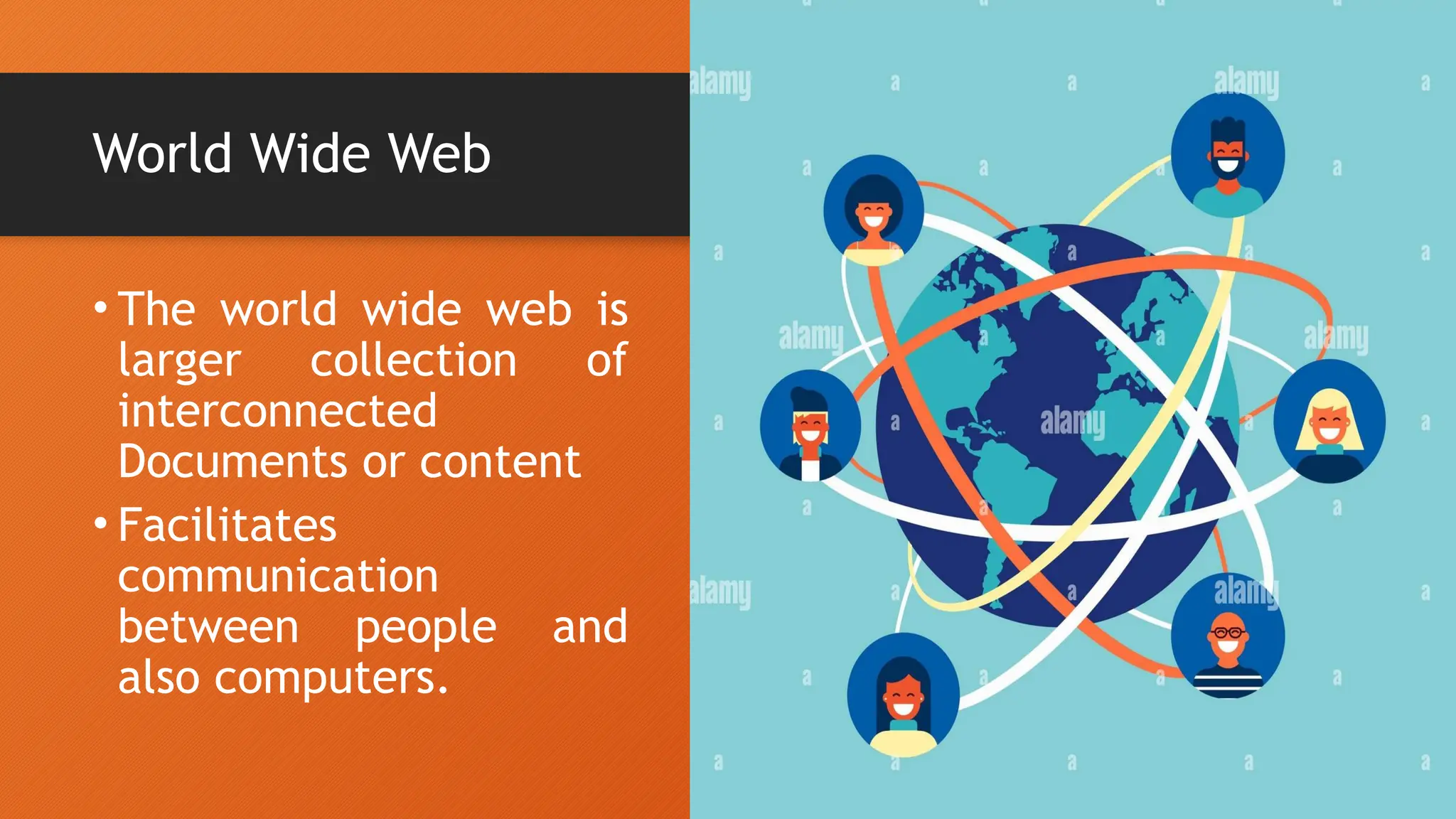
• The world wide web is
larger collection of
interconnected
Documents or content
• Facilitates
communication
between people and
also computers.
World Wide Web
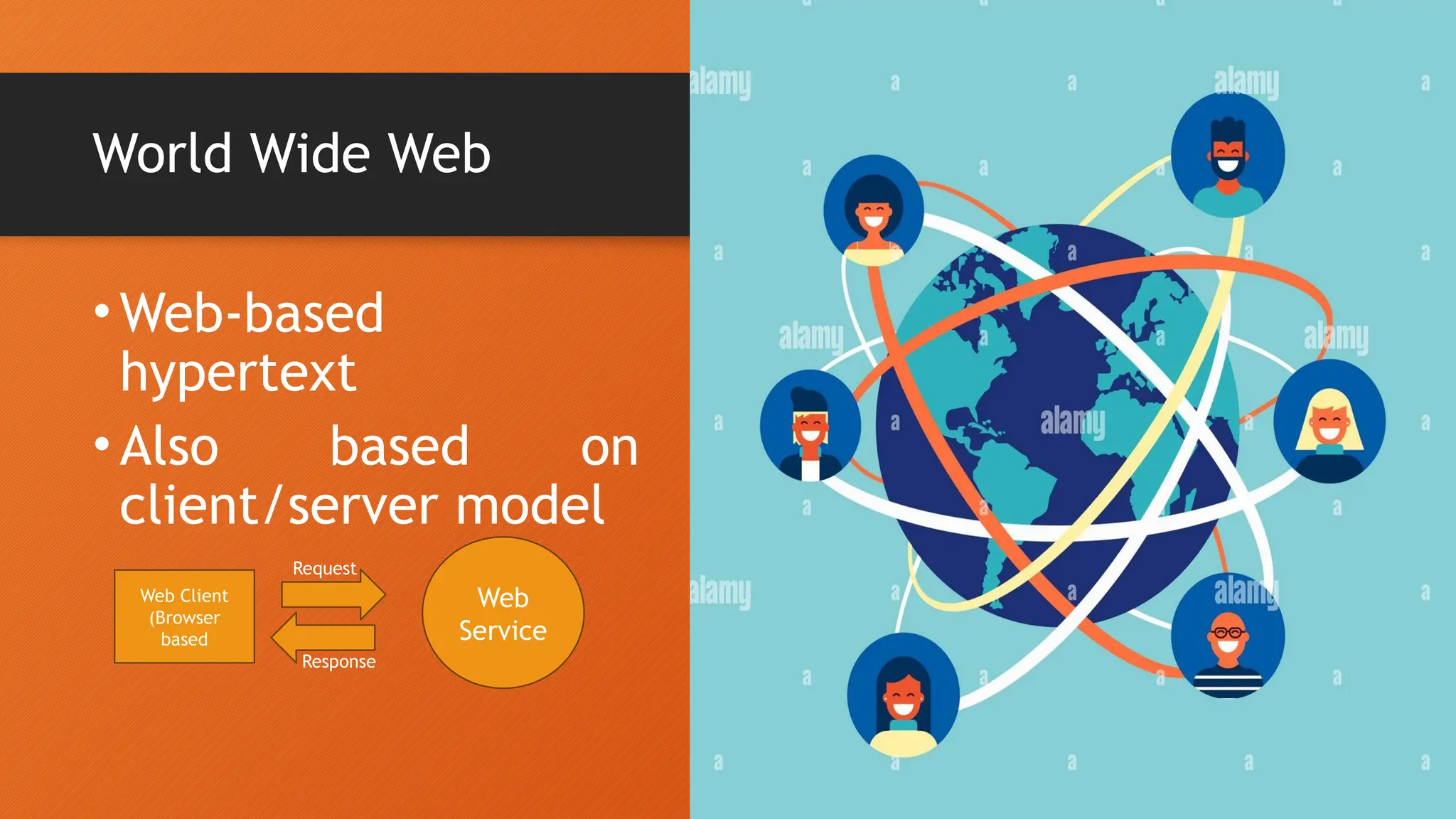
•Web-based
hypertext
•Also based on
client/server model
Web Client
(Browser
based
Web
Service
Request
Response
What is internet?
What is Internet?
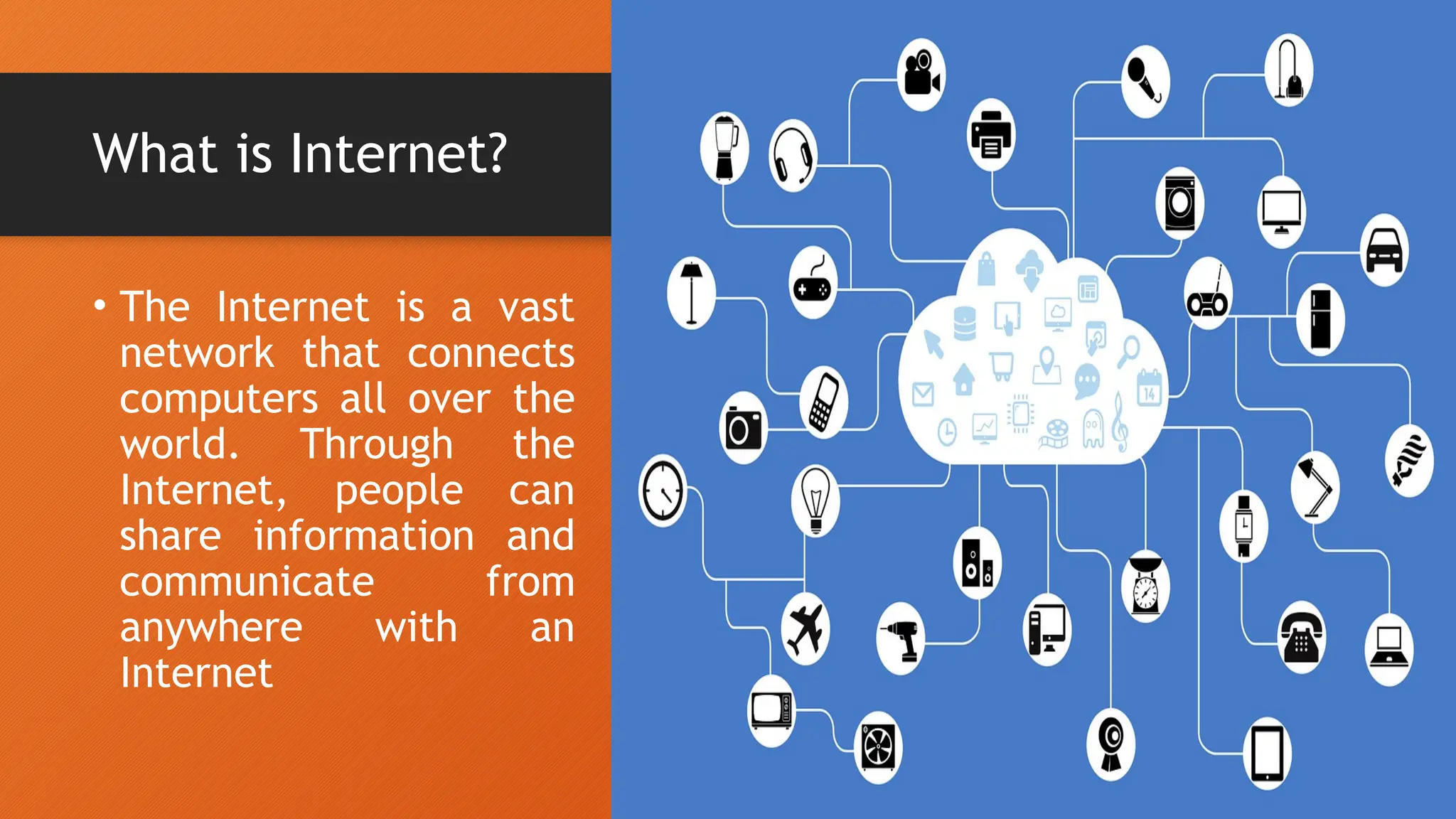
• The Internet is a vast
network that connects
computers all over the
world. Through the
Internet, people can
share information and
communicate from
anywhere with an
Internet
WEB 1.0
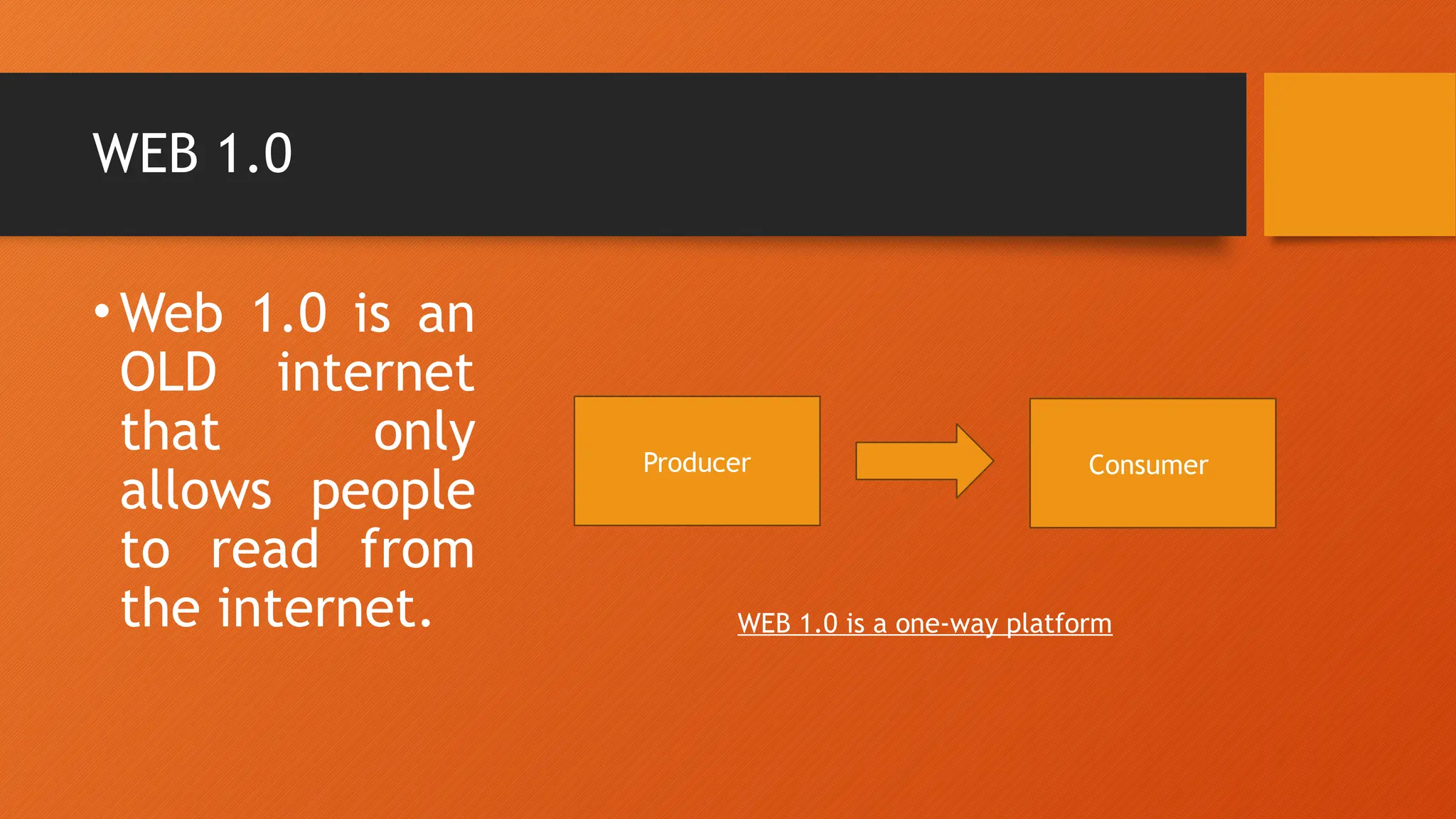
•Web 1.0 is an
OLD internet
that only
allows people
to read from
the internet.
Producer Consumer
WEB 1.0 is a one-way platform
Web 1.0 (Read only Static Web)
• First stage of the world wide linking web pages and hyperlink
• Most read only web. It focused on companies home pages.
• Dividing the world wide web into usable directories.
• It means Web is use as “Information Portal”.
• Everyone has their personal own little corner in the cyberspace.
• It started with the simple idea “Put content together”.
• Media companies put content in the web and pushes it to user.
• Using WEB 1.0 Companies like BBC, CNN are able to get online.
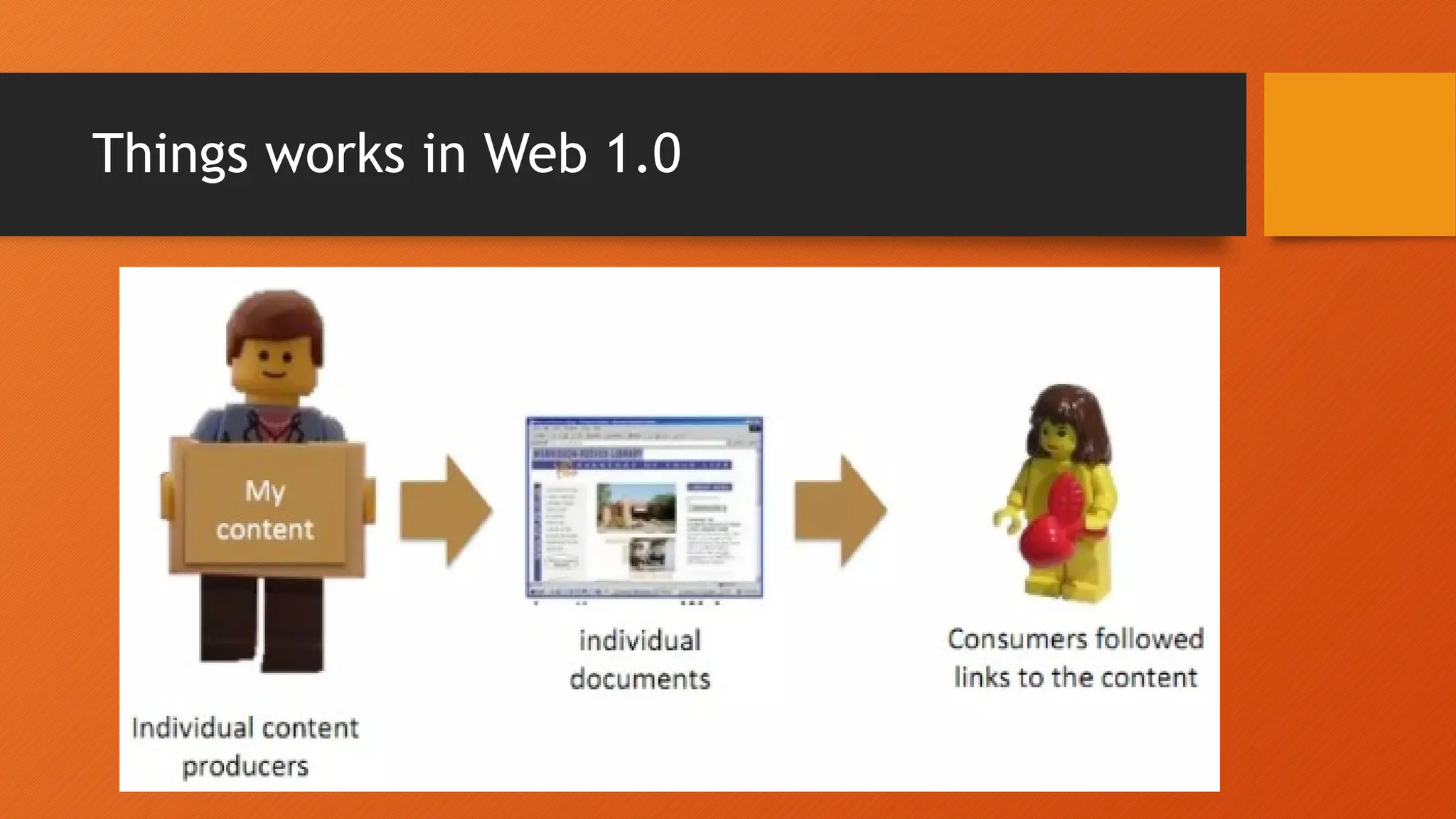
Things works in Web 1.0
SAD FACTS OF WEB 1.0
• Read only web
• Limited user interaction
• Keyword based (dumb) search Web directories
• The lack of standards --- Browswer WAR
When we got a grip on the technical part, web became clearer and
then we discover
 Power of Networks
 Power of links
 Power of collaboration
 Power of content and reach
 Power of Friends
WEB 2.0
WEB 2.0 [Share] Web 2.0 is a two way Platform
• A term used to describe a new generation of web services and
applications with an increasing emphasis on human
collaboration.
WEB 2.0 Producer/Consumer
Collective
intelligence
Data
Information
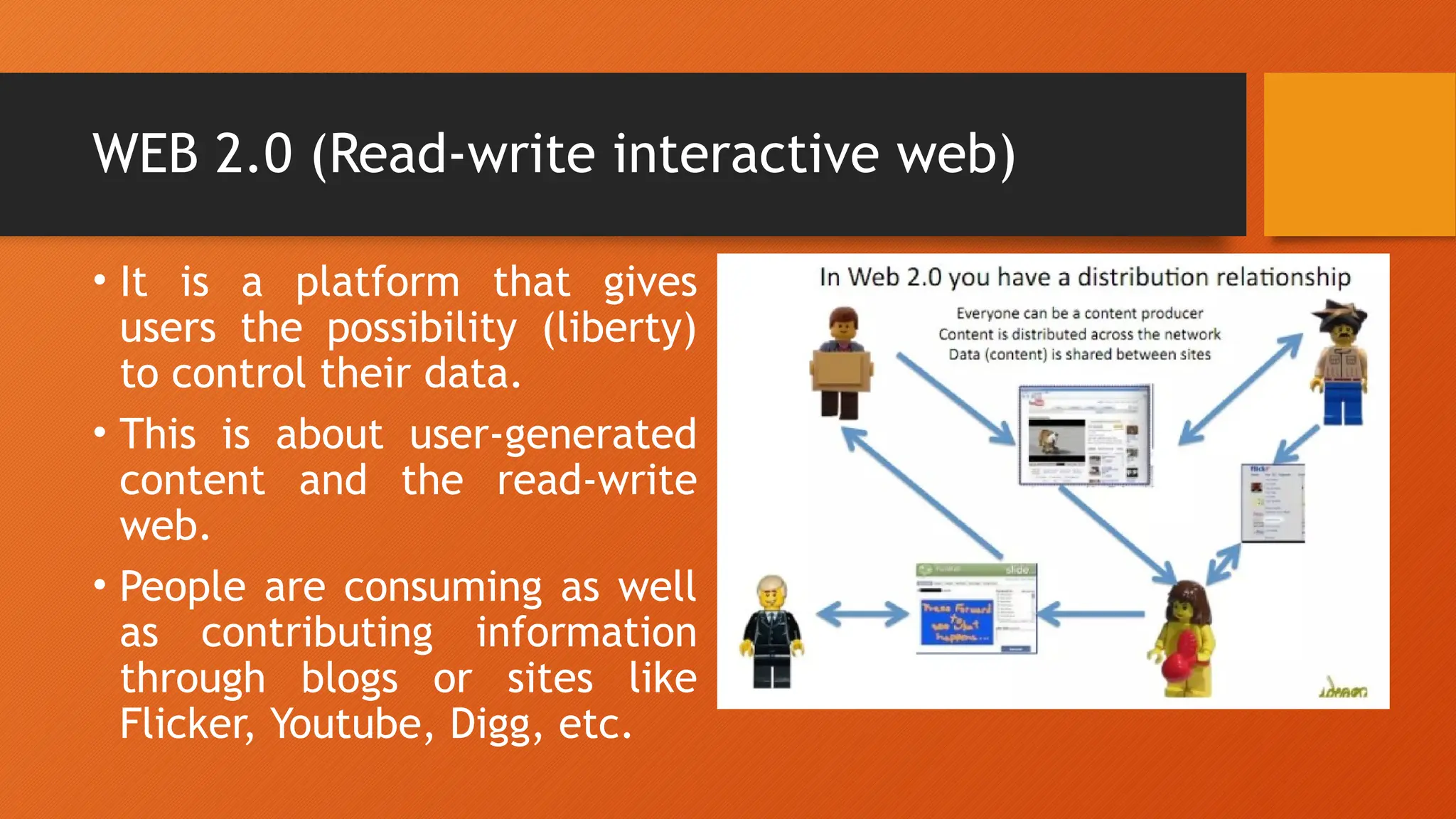
WEB 2.0 (Read-write interactive web)
• It is a platform that gives
users the possibility (liberty)
to control their data.
• This is about user-generated
content and the read-write
web.
• People are consuming as well
as contributing information
through blogs or sites like
Flicker, Youtube, Digg, etc.
Principles of Web 2.0
NO PRODUCTS BUT SERVICES
•“There are no products, only solutions”
•A problem solving approach
•Must provide simple solutions
Customization
• Every individual is unique
• Some people want to be different
• Allow him to choose instead of forcing him to use
what you have made.
• Make him feel home
• E.g. My Yahoo, Google Homepage, MySpace, Firefox
Extensions
Concepts
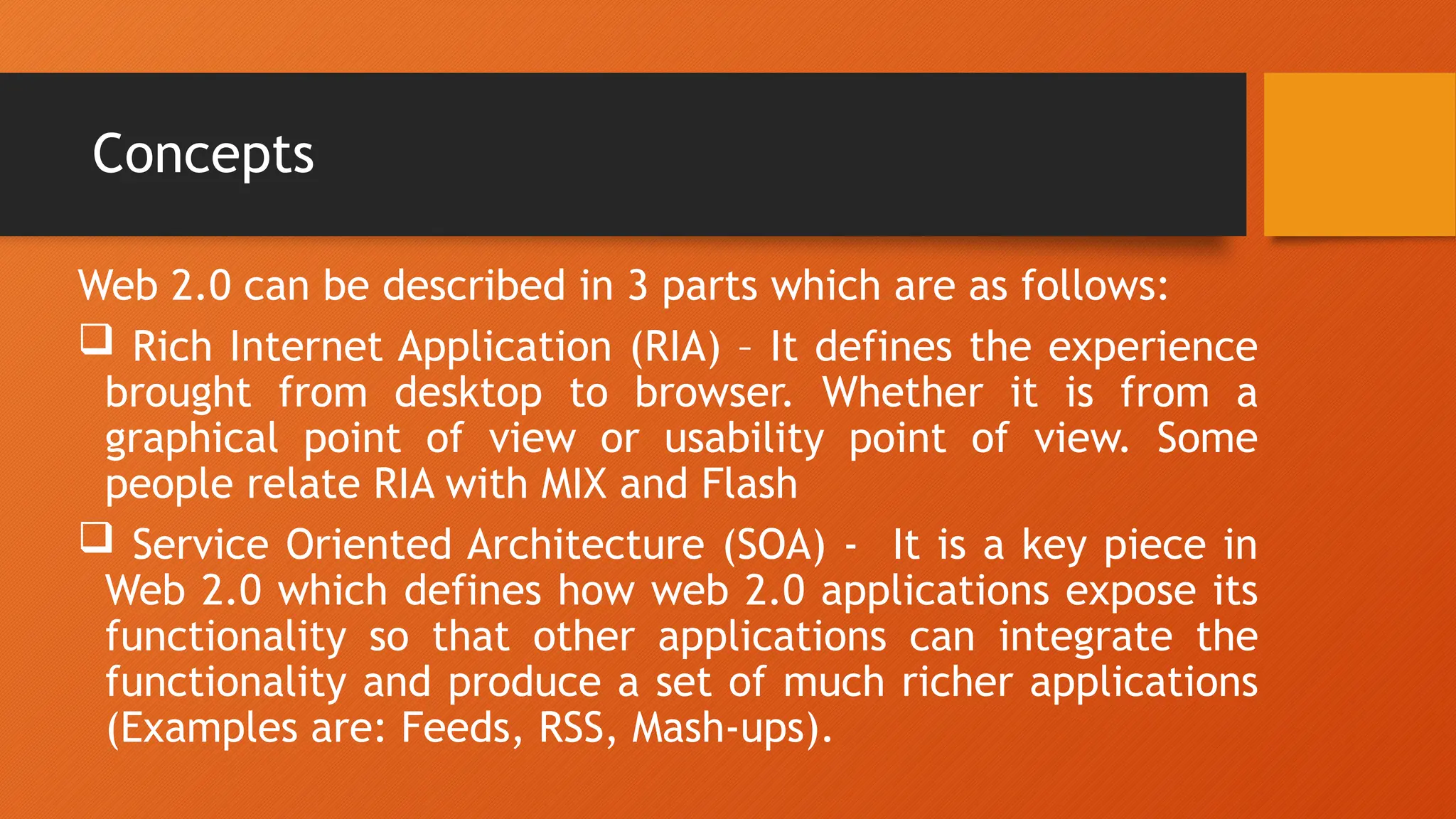
Web 2.0 can be described in 3 parts which are as follows:
 Rich Internet Application (RIA) – It defines the experience
brought from desktop to browser. Whether it is from a
graphical point of view or usability point of view. Some
people relate RIA with MIX and Flash
 Service Oriented Architecture (SOA) - It is a key piece in
Web 2.0 which defines how web 2.0 applications expose its
functionality so that other applications can integrate the
functionality and produce a set of much richer applications
(Examples are: Feeds, RSS, Mash-ups).
To be Continue Next meeting….
001-introduction of the Evolution of Web Technologies

001-introduction of the Evolution of Web Technologies

  • 1.
    WEB 1.0 TOWEB 3.0 – Evolution of the Web and It’s Various Challenges MARIO B. CADAY Instructor I
  • 2.
    Outline • Difference betweenWeb & Internet • Web 1.0 (Read-only Static Web) • Sad Facts of Web 1.0 • Web 2.0(Read-Write Interactive Web) • Principles of Web 2.0 • Web 1.0 vs Web 2.0 • Sad Facts of Web 2.0 • Web 3.0 (Read-write Intelligent Web) • Technologies of Web 3.0 • Comparison among Existing Web
  • 3.
    Introduction WORLD WIDE WEB≠ Internet Service We must remember that both are not the same Web is different to internet.
  • 4.
  • 5.
    World Wide Web •The world wide web is larger collection of interconnected Documents or content • Facilitates communication between people and also computers.
  • 6.
    World Wide Web •Web-based hypertext •Alsobased on client/server model Web Client (Browser based Web Service Request Response
  • 7.
  • 8.
    What is Internet? •The Internet is a vast network that connects computers all over the world. Through the Internet, people can share information and communicate from anywhere with an Internet
  • 9.
    WEB 1.0 •Web 1.0is an OLD internet that only allows people to read from the internet. Producer Consumer WEB 1.0 is a one-way platform
  • 10.
    Web 1.0 (Readonly Static Web) • First stage of the world wide linking web pages and hyperlink • Most read only web. It focused on companies home pages. • Dividing the world wide web into usable directories. • It means Web is use as “Information Portal”. • Everyone has their personal own little corner in the cyberspace. • It started with the simple idea “Put content together”. • Media companies put content in the web and pushes it to user. • Using WEB 1.0 Companies like BBC, CNN are able to get online.
  • 11.
  • 12.
    SAD FACTS OFWEB 1.0 • Read only web • Limited user interaction • Keyword based (dumb) search Web directories • The lack of standards --- Browswer WAR
  • 13.
    When we gota grip on the technical part, web became clearer and then we discover  Power of Networks  Power of links  Power of collaboration  Power of content and reach  Power of Friends
  • 14.
    WEB 2.0 WEB 2.0[Share] Web 2.0 is a two way Platform • A term used to describe a new generation of web services and applications with an increasing emphasis on human collaboration. WEB 2.0 Producer/Consumer Collective intelligence Data Information
  • 15.
    WEB 2.0 (Read-writeinteractive web) • It is a platform that gives users the possibility (liberty) to control their data. • This is about user-generated content and the read-write web. • People are consuming as well as contributing information through blogs or sites like Flicker, Youtube, Digg, etc.
  • 16.
    Principles of Web2.0 NO PRODUCTS BUT SERVICES •“There are no products, only solutions” •A problem solving approach •Must provide simple solutions
  • 17.
    Customization • Every individualis unique • Some people want to be different • Allow him to choose instead of forcing him to use what you have made. • Make him feel home • E.g. My Yahoo, Google Homepage, MySpace, Firefox Extensions
  • 18.
    Concepts Web 2.0 canbe described in 3 parts which are as follows:  Rich Internet Application (RIA) – It defines the experience brought from desktop to browser. Whether it is from a graphical point of view or usability point of view. Some people relate RIA with MIX and Flash  Service Oriented Architecture (SOA) - It is a key piece in Web 2.0 which defines how web 2.0 applications expose its functionality so that other applications can integrate the functionality and produce a set of much richer applications (Examples are: Feeds, RSS, Mash-ups).
  • 19.
    To be ContinueNext meeting….