ICROIT 2014
WEB 1.0 TO WEB 3.0 - EVOLUTION
OF THE WEB AND ITS VARIOUS
CHALLENGES
Outline
 Difference Between Web & Internet.
 Web 1.0(Read-only Static web).
 Sad Facts of Web 1.0.
 Web 2.0(Read-write interactive web).
 Principles of Web 2.0.
 Web 1.0 vs Web 2.0.
 Sad Facts of Web 2.0.
 Web 3.0 (Read-write intelligent web).
 Technologies of Web 3.0
 Comparison Among Existing Web
Paper ID: 97
2
Before describing web we need to understand one thing very
clearly
Paper ID: 97
3
Introduction
World Wide Web ≠ Internet Service
We must remember that both are not the same
Web is different then Internet
Paper ID: 97
4
Paper ID: 97
5
World Wide Web
• The world wide web is larger collection of interconnected Documents
or Content
• Facilitates communication between people …..and also computers
Paper ID: 97
6
Contd...
 Web based on Hypertext
 Also based on client/server model
Paper ID: 97
Web
Service
Request
Response
Web Client
(browser)
7
Internet
Paper ID: 97
The Internet is the collection
of interconnected computer
Networks.
8
Web 1.0
Web 1.0 [Push]
Web 1.0 is an old internet that only allows people to
read from the internet.
Paper ID: 97
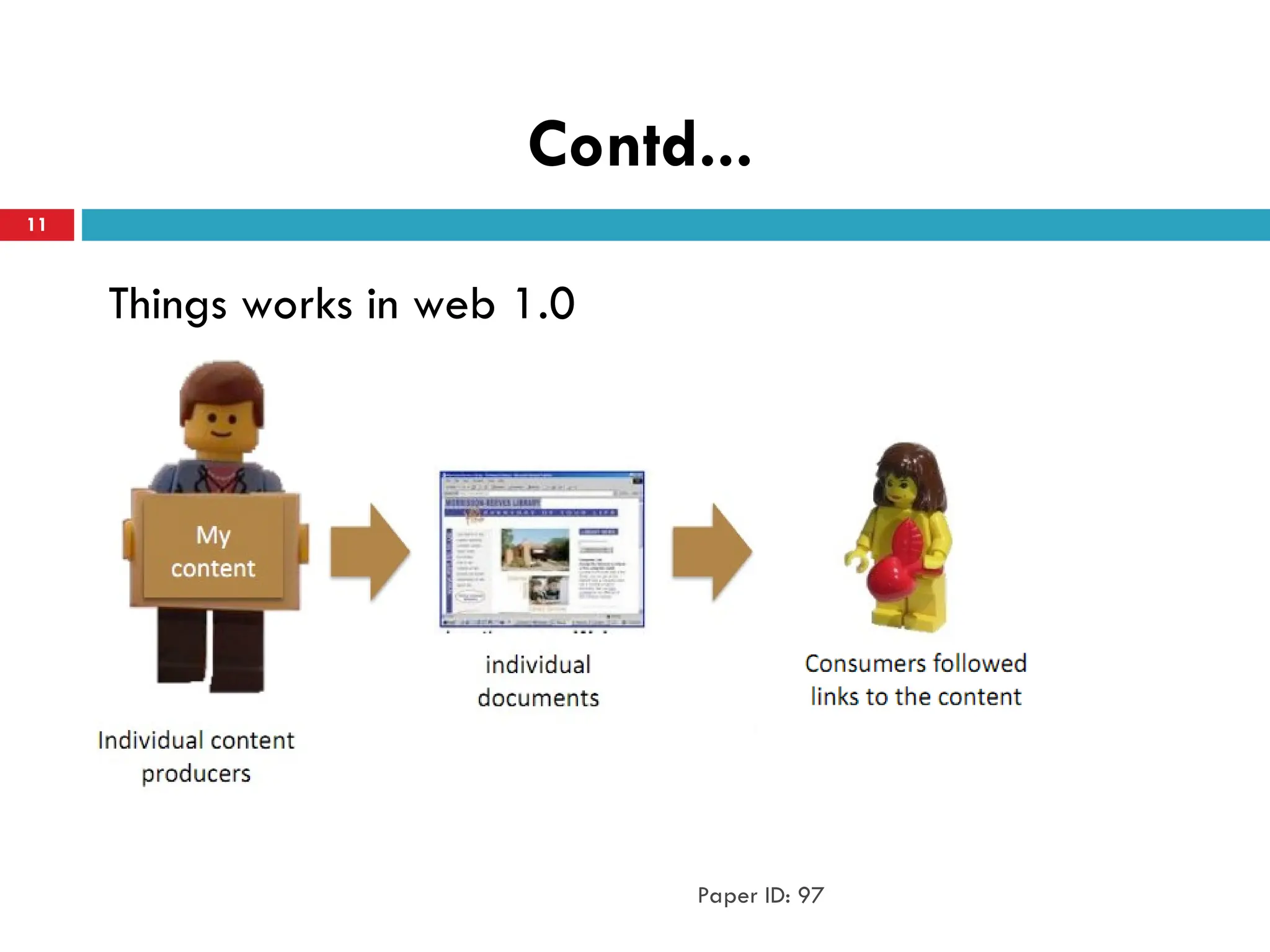
Web1.0 is a one-way
platform
9
Web 1.0(Read-only Static web)
• First stage of the World Wide linking web pages and hyperlink
• Most read-only Web. It focused on companies home pages
• Dividing the world wide web into usable directories
• It means Web is use as “Information Portal”.
• Everyone has their personal own little corner in the cyberspace
• It started with the simple idea “Put content together”
• Media companies put content in the web and pushes it to user.
using web 1.0 Companies Like BBC,CNN able to get online.
Paper ID: 97
10
Things works in web 1.0
Paper ID: 97
Contd...
11
Contd...
Paper ID: 97
12
Sad facts of Web 1.0
SAD FACTS
• Read only Web
• Limited user interaction
• Keyword based (dumb) search ------ Web Directories
• The Lack of standards -------Browsers war
Paper ID: 97
13
Next Step
When we got a grip on the technical part, web became
clearer and then we discover
 Power of Networks
 Power of Links
 Power of Collaboration
 Power of content and reach
 Power of Friends
Paper ID: 97
14
And then the Next step is
Web 2.0
Paper ID: 97
15
Paper ID: 97
A term used to describe a new generation of Web
services and applications with an increasing emphasis
on human collaboration.
 Web 2.0 [Share] Web2.0 is a two-way
Platform
16
Web 2.0(Read-write interactive web)
 It is a platform that gives users the
possibility (liberty) to control their
data.
 This is about user-generated
content and the read-write web.
 People are consuming as well as
contributing information through
blogs or sites like Flicker, YouTube,
Digg, etc.
Paper ID: 97
17
Paper ID: 97
18
Paper ID: 97
19
Principles of Web 2.0
No Products but Services
• “There are no products, only solutions”
• A problem solving approach
• Must Provide Simple Solutions
Paper ID: 97
20
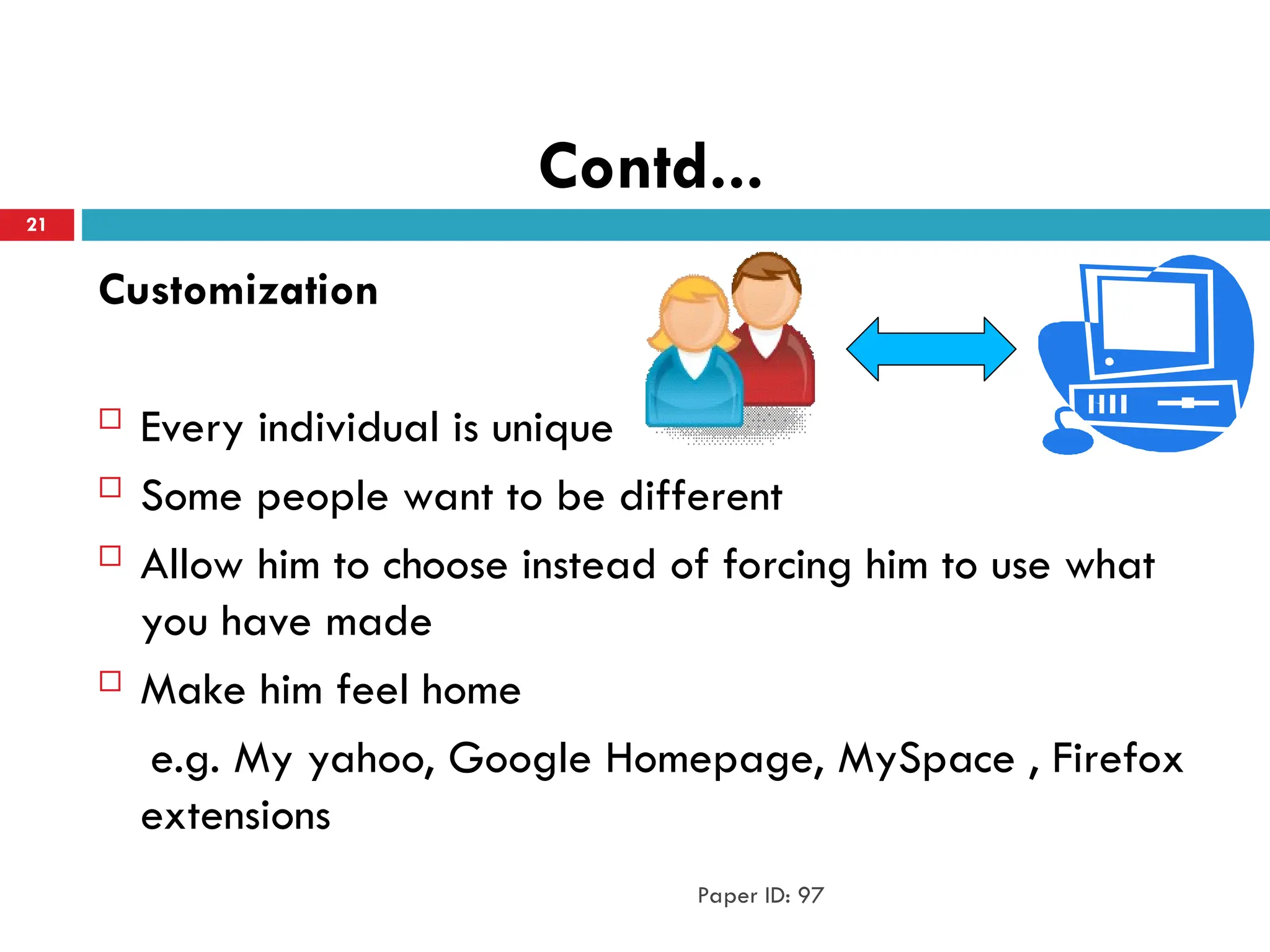
Contd...
Customization
 Every individual is unique
 Some people want to be different
 Allow him to choose instead of forcing him to use what
you have made
 Make him feel home
e.g. My yahoo, Google Homepage, MySpace , Firefox
extensions
Paper ID: 97
21
Contd...
Concepts
Web 2.0 can be described in 3 parts which are as follows:
 Rich Internet Application (RIA) - It defines the experience
brought from desktop to browser .whether it is from a graphical
point of view or usability point of view. Some people relate RIA
with AJAX and Flash.
 Service-oriented Architecture (SOA) - It is a key piece in Web
2.0 which defines how Web 2.0 applications expose its
functionality so that other applications can integrate the
functionality and produce a set of much richer applications
(Examples are: Feeds, RSS, Mash-ups)
Paper ID: 97
22
Contd...
Social Web – It defines how Web 2.0 tend to interact
much more with the end user and making the end user
an integral part.
Paper ID: 97
23
Contd...
Social Web
 A third important part of Web 2.0 is the Social Web. The term
is currently used to describe how people socialize or interact
with each other throughout the Web .
 The social web consists of a number of online tools and
platforms where people share their perspectives, opinions,
thoughts and experiences
 Web 2.0 Applications tend to interact much more with the end
user. As such, the end user is not only a user of the application
but also a participant
Paper ID: 97
24
Contd...
User can participate by :-
 Podcasting
 Blogging
 Tagging
 Contributing to RSS
 Social bookmarking
 Social networking
Paper ID: 97
25
Contd...
Technologies
The client-side/web browser technologies used in Web 2.0
development are :
Ajax(Asynchronous JavaScript +XML)
Ajax programming uses JavaScript to upload and download new
data from the web server without full page reload.
Adobe Flex
Flex makes it easier for programmers to populate large data
grids, charts, and other heavy user interactions. Applications
programmed in Flex, are compiled and displayed
as Flash within the browser
Paper ID: 97
26
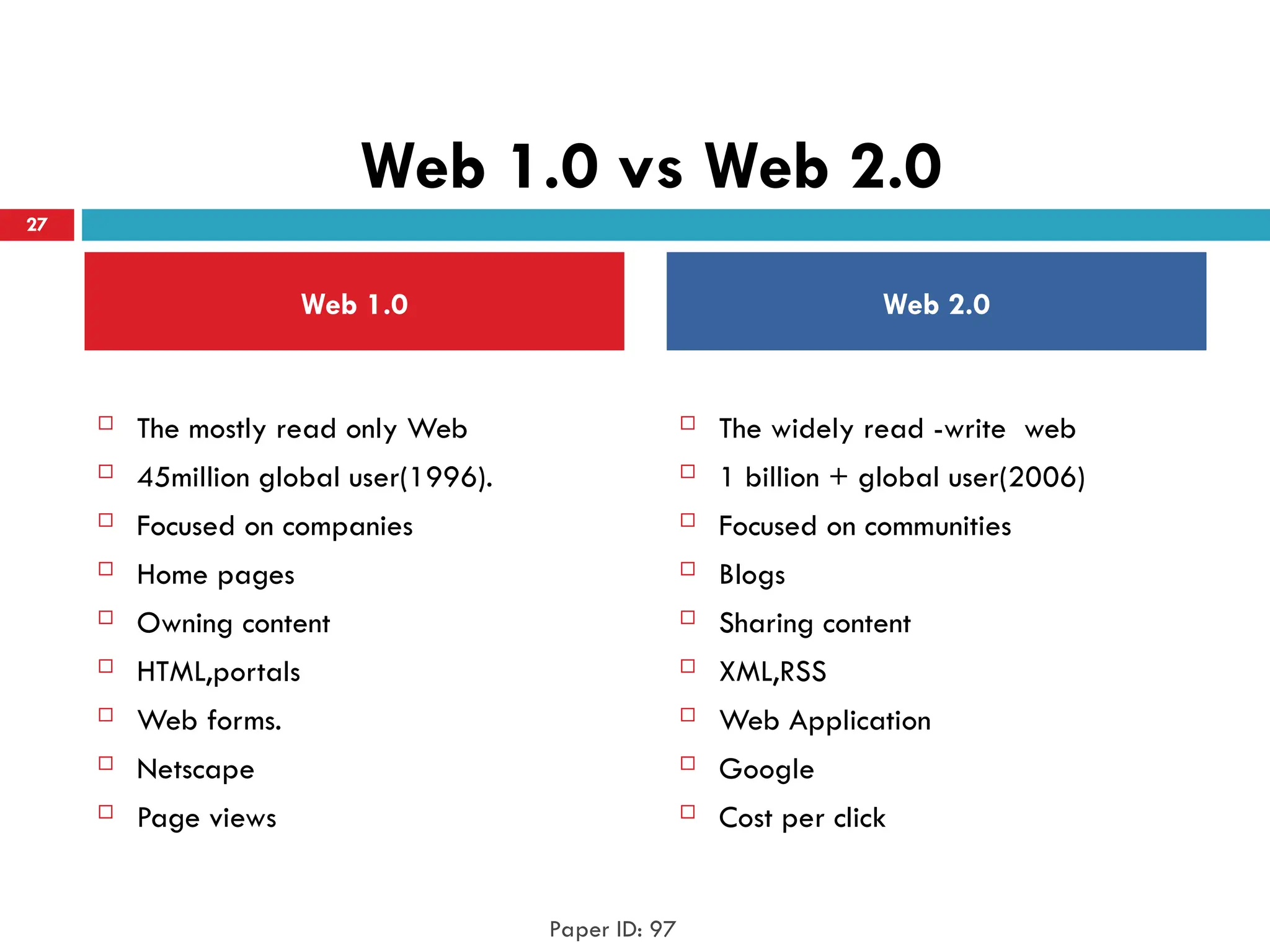
Web 1.0 vs Web 2.0
 The mostly read only Web
 45million global user(1996).
 Focused on companies
 Home pages
 Owning content
 HTML,portals
 Web forms.
 Netscape
 Page views
 The widely read -write web
 1 billion + global user(2006)
 Focused on communities
 Blogs
 Sharing content
 XML,RSS
 Web Application
 Google
 Cost per click
Web 1.0 Web 2.0
Paper ID: 97
27
Web 2.0
Sad Facts
 Same old Keyword based search.
 Web application are still rigid
 Each Website have its own data and
it is not sharing it.
 Computers can not understand any
thing
 Web 2.0 is Social change. The
technical part has not change much.
Paper ID: 97
28
Introducing New Kind of Web
Main Reasons
 How will our information be organized.
 Will we still do the “surfing” or will the machine surf
for us
Paper ID: 97
29
New Concept Is Web Of Data
Beyond the present Web Lets move towards the web of
Data
Paper ID: 97
30
Web Of Data
New kind of Web capable of reading and understanding
content and context.
When the web can understanding content it can better satisfy
the request of people and machines.
Paper ID: 97
31
Paper ID: 97
32
Web 3.0 (Read-write intelligent
web)
Semantic Web
 It is a Web of data.
 changing the web into a language that can be read and
categorized by the system rather then humans.
Artificial Intelligence
 Extracting meaning from the way people interact with the web.
Mobility
 everything, everywhere, all the time
Paper ID: 97
33
Example
 Suppose, I am a stamp collector...
 Over the years I’ve collected a lot of stamps.
 About every stamp, I made a document
 That’s a lot of documents
Paper ID: 97
34
Contd...
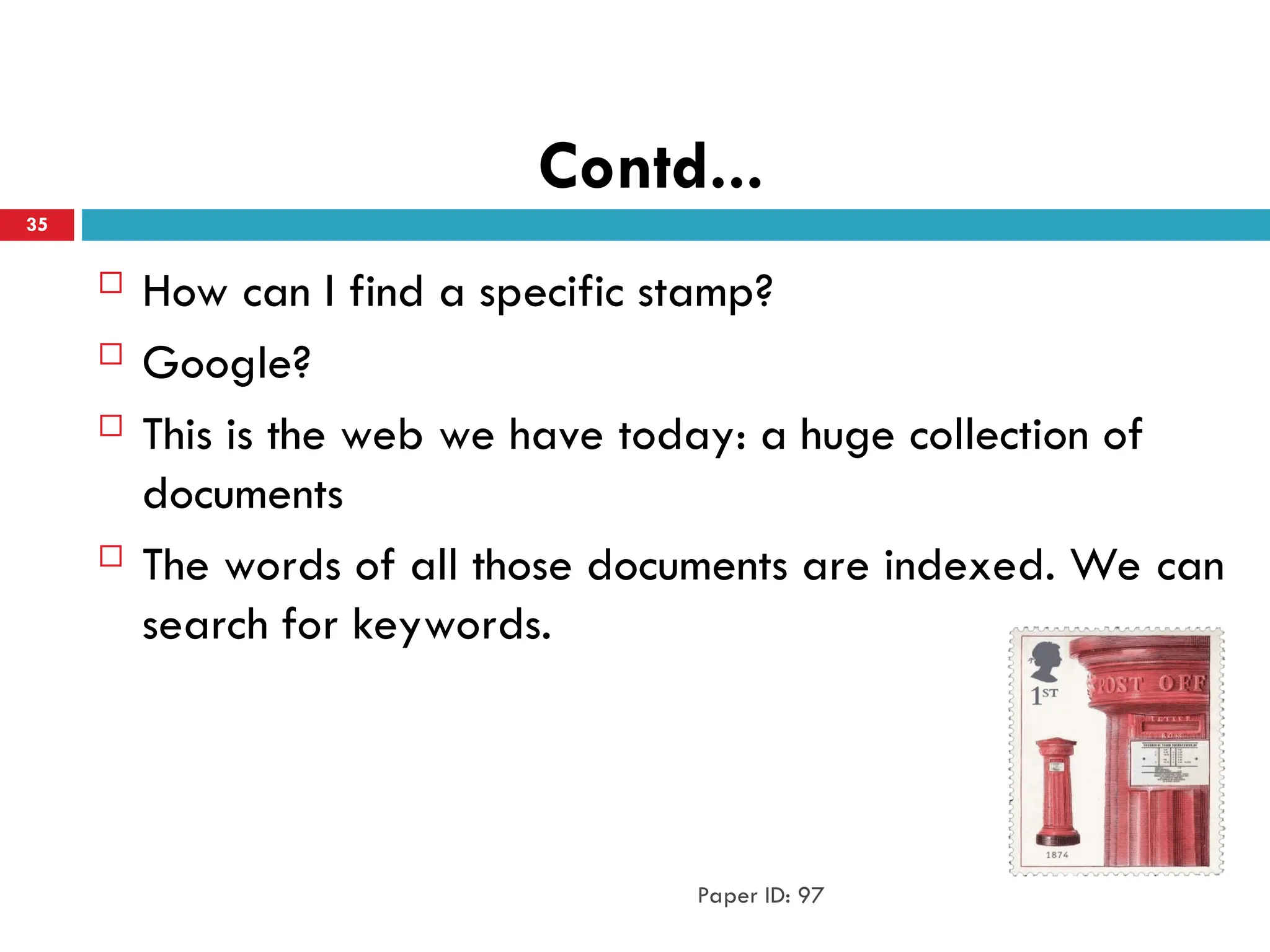
 How can I find a specific stamp?
 Google?
 This is the web we have today: a huge collection of
documents
 The words of all those documents are indexed. We can
search for keywords.
Paper ID: 97
35
Contd...
 Now, suppose I Google for all red stamps
 Not very intelligent…
Paper ID: 97
Red stamps
Stamps from Cambodia (Khmer
Rouge)
Stamps from the Red Sea
Stamps from the 140th
anniversary of the Red Cross
Stamps with red dragons
36
Contd...
 Not very intelligent, but how can a computer know what I
mean?
 When we structurally describe that
a stamp is a stamp and red is a color.
 Describing data in a structured way can best be done in a
database.
 Different databases can be connected.
Paper ID: 97
37
Contd...
This is a stamp
This stamp is from the United Kingdom
This stamp is designed by John Bryan Dunmore
In 1980 you could buy this stamp for 1 cent
Now it’s worth 3 euros
This stamp is used between 1978 - 1981
The picture on the stamp is a PO Box
38
Paper ID: 97
Contd...
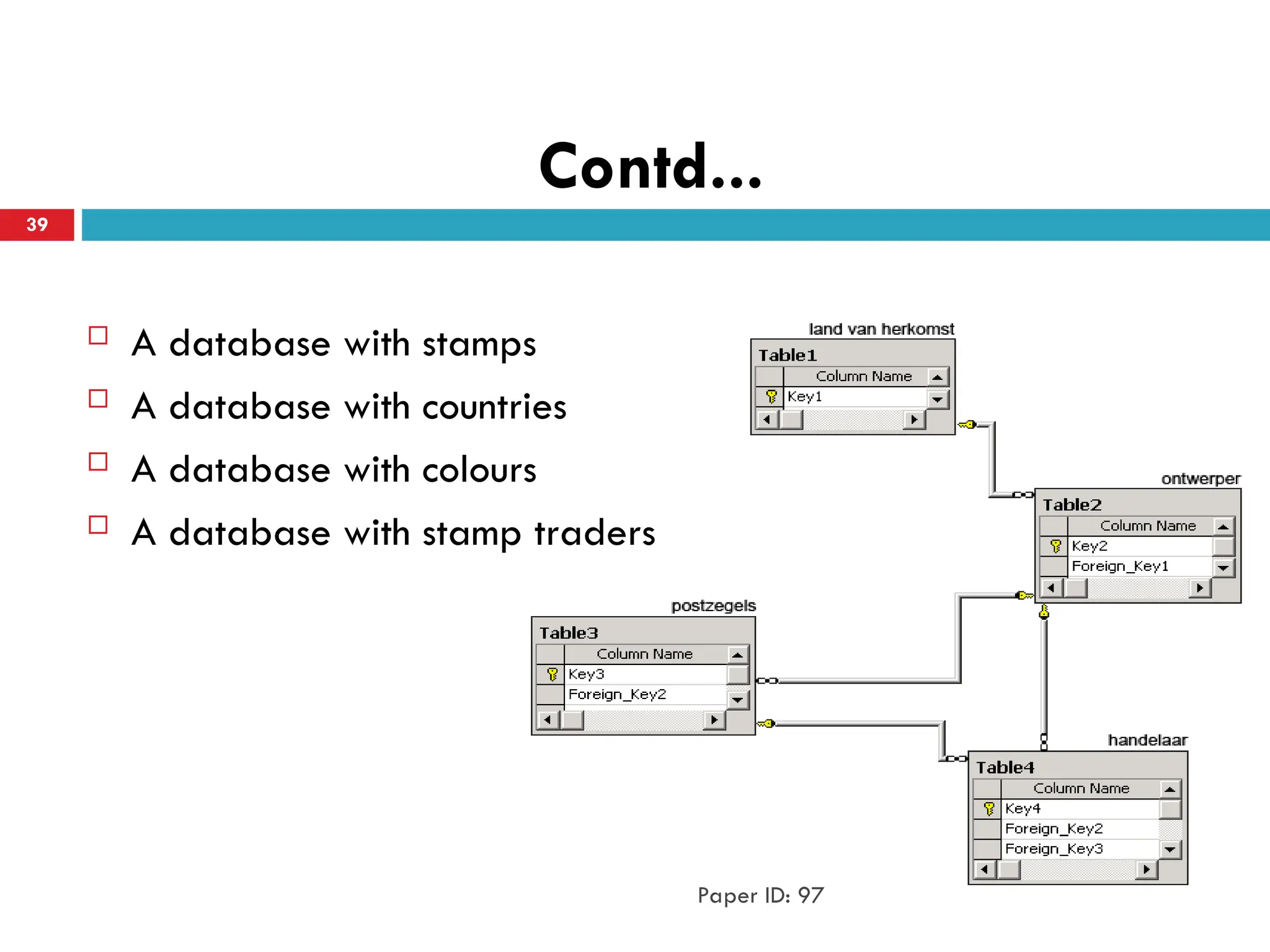
 A database with stamps
 A database with countries
 A database with colours
 A database with stamp traders
Paper ID: 97
39
Example – Web 3.0 as Databases
Integration
• One view of Web 3.0 is the web being a big collection of databases
which can be connected on demand.
• Agreements are made on the structure of data and the way data is
described. Where the data is located is irrelevant.
• Linking data is the power of web 3.0.
• So, “I want all the red stamps, designed in Europe, but used in the
U.S.A., between 1980 and 1990” is a question that will get a better
answer with web 3.0
Paper ID: 97
40
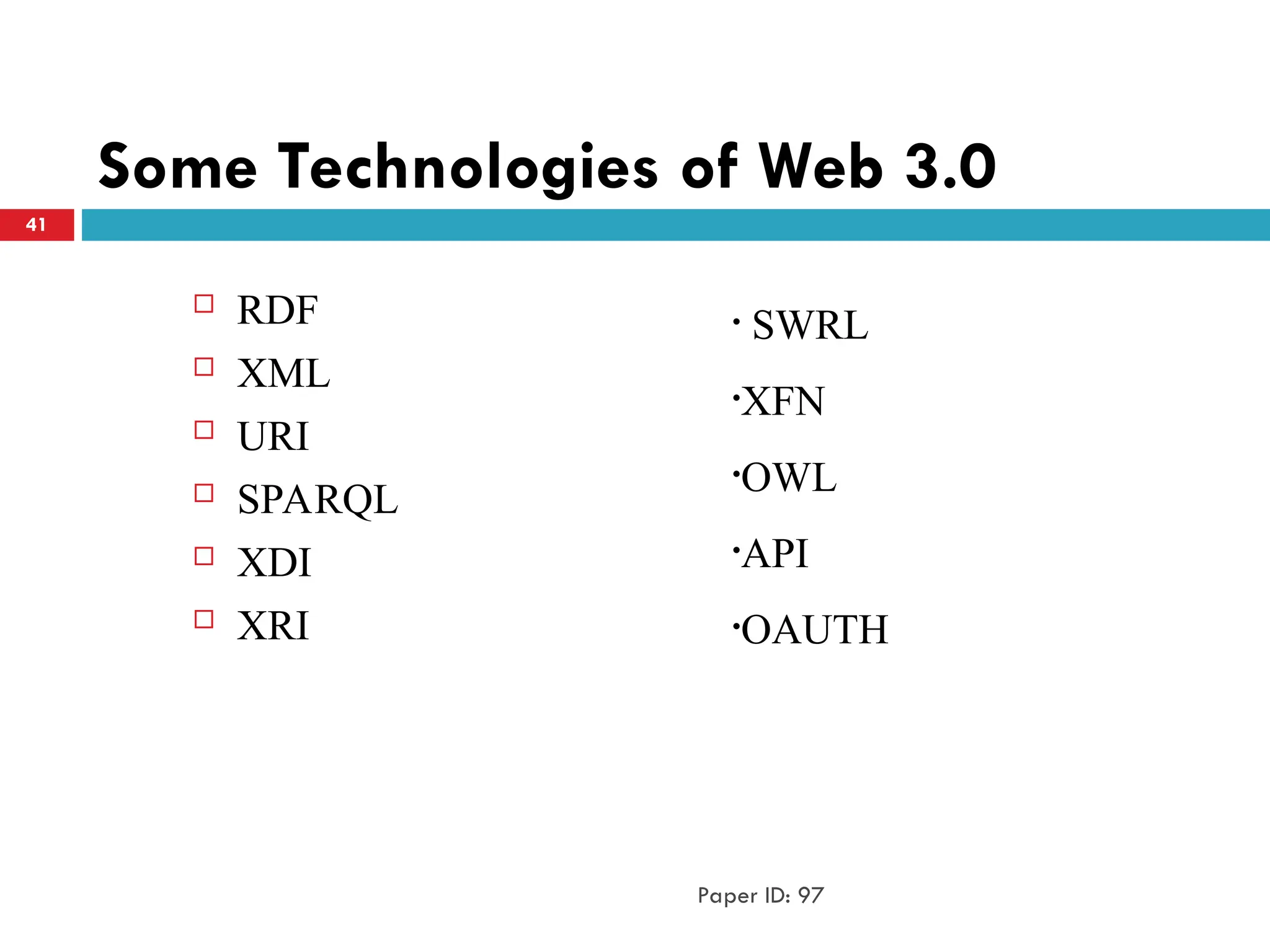
Some Technologies of Web 3.0
 RDF
 XML
 URI
 SPARQL
 XDI
 XRI
Paper ID: 97
• SWRL
•XFN
•OWL
•API
•OAUTH
41
Contd...
Ingredients:
XML (Extensible Markup Language ) :
 Meaning is about understanding.
 To understand we need a language.
 A language starts with words.
 Things mean something in words.
 Online, we describe things with XML.
42
Paper ID: 97
Contd...
Ingredients:
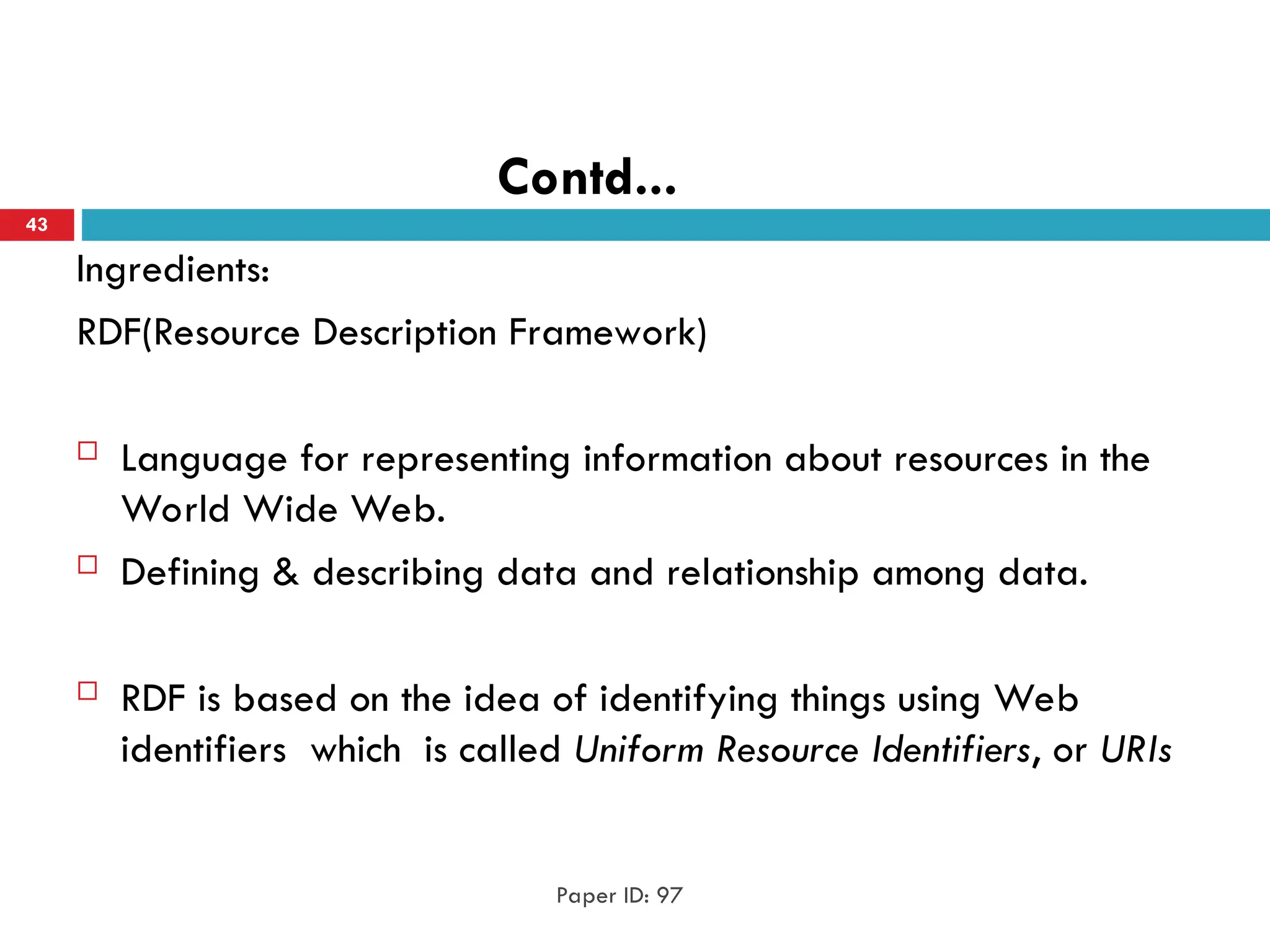
RDF(Resource Description Framework)
 Language for representing information about resources in the
World Wide Web.
 Defining & describing data and relationship among data.
 RDF is based on the idea of identifying things using Web
identifiers which is called Uniform Resource Identifiers, or URIs
Paper ID: 97
43
Web 3.0
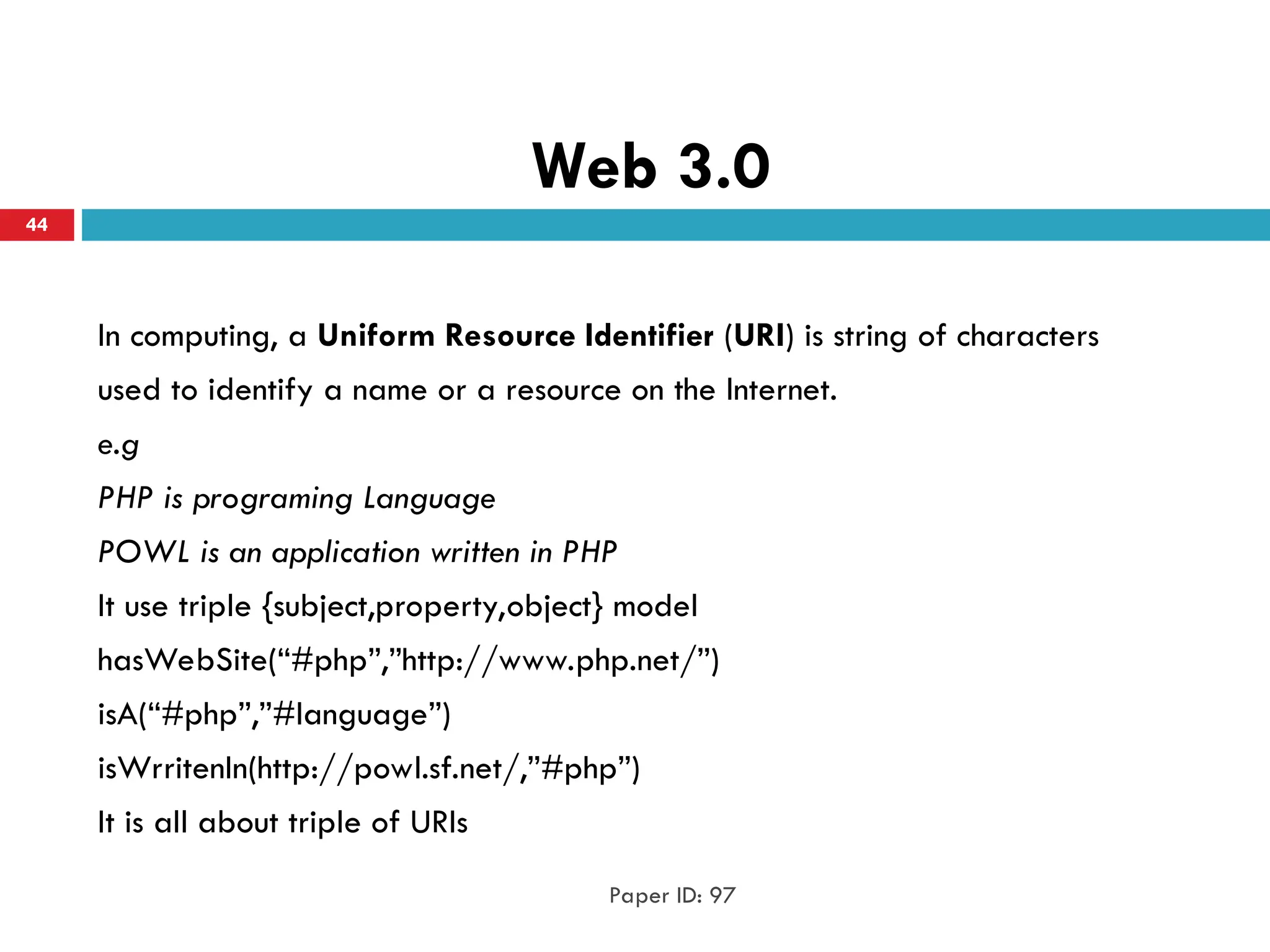
In computing, a Uniform Resource Identifier (URI) is string of characters
used to identify a name or a resource on the Internet.
e.g
PHP is programing Language
POWL is an application written in PHP
It use triple {subject,property,object} model
hasWebSite(“#php”,”http://www.php.net/”)
isA(“#php”,”#language”)
isWrritenIn(http://powl.sf.net/,”#php”)
It is all about triple of URIs
Paper ID: 97
44
Web 3.0
Ingredients:
OWL(Web Ontology Language)
 With RDF Scheme we can define concepts and make simple
relations between them.
 But, RDF scheme is limited. A language needs more expression
and logic to make good reasoning possible.
 That’s why OWL (The Web Ontology Language) was
invented.
 Its mean to reason you need rules
Paper ID: 97
45
Web 3.0 – Video Web
Spatial Media Fragments Video Content
 Reed Hasting, the founder and CEO of Netflix, described Web 3.0
as being the full-video Web that will be made possible by the
increasing growth in bandwidth available to customers that will
allow transmission of full movies over the Web.
Paper ID: 97
46
Web 3.0 – 3D Web
 Thousands of users worldwide linger in
 3D-worlds like Second Life or
 3D-Games such as Entropiauniverse and Active worlds.
 Philip Rosedale, founder of Second Life, believes that one day
1500 million people will have a second existence.
 The adding of the third dimension will shift the internet into a
hyper-realistic parallel world .
Paper ID: 97
47
Web 2.0 vs 3.0
 Web 2.0 is all about the power of networks
 Basically, web 2.0 is a social change. The technical part of the
web hasn’t changed very much.
 But, web 3.0 will be driven by technological changes
 Web 3.0 - the semantic web - is about the meaning of
information.
Paper ID: 97
48
Web History and Future
Paper ID: 97
49
Example Web 3.0
 Freebase
• http://www.freebase.com
 Amazon (“If you liked this, you will like this!”
• http://www.amazon.com
 Netvibes (pull your Web 2.0 apps together!)
• http://www.netvibes.com
Paper ID: 97
50
Comparison
Web1.0 Web2.0 Web3.0
Read-only Static web Read-write interactive web Read-write intelligent web
Company-oriented Community-oriented Individually oriented
Low-portability (computing
equipment)
Medium portability(mobile) High portability(mobile and
consumer electronics)
Professionally developed
stand-alone applications
User-developed open
applications
User-developed smart applications
Syntax-aware basic browsing
and search capabilities
Syntax-aware advanced
browsing and search
capabilities
Content(semantic)-aware and
context-aware next-generation
browsing and search capabilities
Low data richness(HTML) Medium data richness(XML) High data richness(RDF)
Point-to-point/hub & spoke
architecture
Service-oriented
architecture(SOA)
Web oriented architecture(WOA)
andinternet of things
Sliced data Light interlinked data Worldwide database
51
Paper ID: 97
Reference
[1] Dr Mike Evans.”The Evolution of the Web-From Web1.0toWeb4.0”.
[2] San, Murugesan (2007), “Understanding Web 2.0”, Journal IT Professional.
[3]Akhilesh Dwivedi ,SureshKumar, Abhishek Dwivedi Dr. Manjeet Sing
“Current Security Considerations for Issues and Challenges of Trustworthy
Semantic Web” Int. J. Advanced Networking and Applications Volume: 03,
Issue: 01, Pages: 978-983 (2011).
[4]http://en.wikibooks.org/wiki/
Web_2.0_and_Emerging_Learning_Technologies/
Learning_Theory#Emerging_Web_2.0_Related_Learning_Theory.
[5]David Rook “The Security Risks of Web 2.0”DefCon 17, Las Vegas.
[6]George Lawton ”Web 2.0 Creates Security Challenges” Published by the
IEEE Computer Society October 2007.
Paper ID: 97
52
[7]McAfee “White Paper The Security Implications of
Web2.0”http://www.ingrammicro.com/visitor/servicesdivision/McAfee-
SaaS-Web-2-0-White-paper.pdf.
[8]Juan M. Silva , Abu Saleh Md. Mahfujur Rahman , Abdulmotaleb El Saddik
“Web 3.0: A Vision for Bridging the Gap between Real and Virtual
CommunicabilityMS '08 Proceedings of the 1st ACM international workshop
on Communicability design and evaluation in cultural and ecological
multimedia system.
[9]Second Life Official Website: http://secondlife.com
[10] Red-light Official Website: http://redlightcenter.com.
[11]Karim Sabbagh Olaf Acker Danny Karam Jad Rahban Designing
theTranscendent WebThe Power of Web 3.0 Booz & Company.
Paper ID: 97
53
Paper ID: 97
54

001-Evolution of Web Technologies - Continuation

  • 1.
    ICROIT 2014 WEB 1.0TO WEB 3.0 - EVOLUTION OF THE WEB AND ITS VARIOUS CHALLENGES
  • 2.
    Outline  Difference BetweenWeb & Internet.  Web 1.0(Read-only Static web).  Sad Facts of Web 1.0.  Web 2.0(Read-write interactive web).  Principles of Web 2.0.  Web 1.0 vs Web 2.0.  Sad Facts of Web 2.0.  Web 3.0 (Read-write intelligent web).  Technologies of Web 3.0  Comparison Among Existing Web Paper ID: 97 2
  • 3.
    Before describing webwe need to understand one thing very clearly Paper ID: 97 3
  • 4.
    Introduction World Wide Web≠ Internet Service We must remember that both are not the same Web is different then Internet Paper ID: 97 4
  • 5.
  • 6.
    World Wide Web •The world wide web is larger collection of interconnected Documents or Content • Facilitates communication between people …..and also computers Paper ID: 97 6
  • 7.
    Contd...  Web basedon Hypertext  Also based on client/server model Paper ID: 97 Web Service Request Response Web Client (browser) 7
  • 8.
    Internet Paper ID: 97 TheInternet is the collection of interconnected computer Networks. 8
  • 9.
    Web 1.0 Web 1.0[Push] Web 1.0 is an old internet that only allows people to read from the internet. Paper ID: 97 Web1.0 is a one-way platform 9
  • 10.
    Web 1.0(Read-only Staticweb) • First stage of the World Wide linking web pages and hyperlink • Most read-only Web. It focused on companies home pages • Dividing the world wide web into usable directories • It means Web is use as “Information Portal”. • Everyone has their personal own little corner in the cyberspace • It started with the simple idea “Put content together” • Media companies put content in the web and pushes it to user. using web 1.0 Companies Like BBC,CNN able to get online. Paper ID: 97 10
  • 11.
    Things works inweb 1.0 Paper ID: 97 Contd... 11
  • 12.
  • 13.
    Sad facts ofWeb 1.0 SAD FACTS • Read only Web • Limited user interaction • Keyword based (dumb) search ------ Web Directories • The Lack of standards -------Browsers war Paper ID: 97 13
  • 14.
    Next Step When wegot a grip on the technical part, web became clearer and then we discover  Power of Networks  Power of Links  Power of Collaboration  Power of content and reach  Power of Friends Paper ID: 97 14
  • 15.
    And then theNext step is Web 2.0 Paper ID: 97 15
  • 16.
    Paper ID: 97 Aterm used to describe a new generation of Web services and applications with an increasing emphasis on human collaboration.  Web 2.0 [Share] Web2.0 is a two-way Platform 16
  • 17.
    Web 2.0(Read-write interactiveweb)  It is a platform that gives users the possibility (liberty) to control their data.  This is about user-generated content and the read-write web.  People are consuming as well as contributing information through blogs or sites like Flicker, YouTube, Digg, etc. Paper ID: 97 17
  • 18.
  • 19.
  • 20.
    Principles of Web2.0 No Products but Services • “There are no products, only solutions” • A problem solving approach • Must Provide Simple Solutions Paper ID: 97 20
  • 21.
    Contd... Customization  Every individualis unique  Some people want to be different  Allow him to choose instead of forcing him to use what you have made  Make him feel home e.g. My yahoo, Google Homepage, MySpace , Firefox extensions Paper ID: 97 21
  • 22.
    Contd... Concepts Web 2.0 canbe described in 3 parts which are as follows:  Rich Internet Application (RIA) - It defines the experience brought from desktop to browser .whether it is from a graphical point of view or usability point of view. Some people relate RIA with AJAX and Flash.  Service-oriented Architecture (SOA) - It is a key piece in Web 2.0 which defines how Web 2.0 applications expose its functionality so that other applications can integrate the functionality and produce a set of much richer applications (Examples are: Feeds, RSS, Mash-ups) Paper ID: 97 22
  • 23.
    Contd... Social Web –It defines how Web 2.0 tend to interact much more with the end user and making the end user an integral part. Paper ID: 97 23
  • 24.
    Contd... Social Web  Athird important part of Web 2.0 is the Social Web. The term is currently used to describe how people socialize or interact with each other throughout the Web .  The social web consists of a number of online tools and platforms where people share their perspectives, opinions, thoughts and experiences  Web 2.0 Applications tend to interact much more with the end user. As such, the end user is not only a user of the application but also a participant Paper ID: 97 24
  • 25.
    Contd... User can participateby :-  Podcasting  Blogging  Tagging  Contributing to RSS  Social bookmarking  Social networking Paper ID: 97 25
  • 26.
    Contd... Technologies The client-side/web browsertechnologies used in Web 2.0 development are : Ajax(Asynchronous JavaScript +XML) Ajax programming uses JavaScript to upload and download new data from the web server without full page reload. Adobe Flex Flex makes it easier for programmers to populate large data grids, charts, and other heavy user interactions. Applications programmed in Flex, are compiled and displayed as Flash within the browser Paper ID: 97 26
  • 27.
    Web 1.0 vsWeb 2.0  The mostly read only Web  45million global user(1996).  Focused on companies  Home pages  Owning content  HTML,portals  Web forms.  Netscape  Page views  The widely read -write web  1 billion + global user(2006)  Focused on communities  Blogs  Sharing content  XML,RSS  Web Application  Google  Cost per click Web 1.0 Web 2.0 Paper ID: 97 27
  • 28.
    Web 2.0 Sad Facts Same old Keyword based search.  Web application are still rigid  Each Website have its own data and it is not sharing it.  Computers can not understand any thing  Web 2.0 is Social change. The technical part has not change much. Paper ID: 97 28
  • 29.
    Introducing New Kindof Web Main Reasons  How will our information be organized.  Will we still do the “surfing” or will the machine surf for us Paper ID: 97 29
  • 30.
    New Concept IsWeb Of Data Beyond the present Web Lets move towards the web of Data Paper ID: 97 30
  • 31.
    Web Of Data Newkind of Web capable of reading and understanding content and context. When the web can understanding content it can better satisfy the request of people and machines. Paper ID: 97 31
  • 32.
  • 33.
    Web 3.0 (Read-writeintelligent web) Semantic Web  It is a Web of data.  changing the web into a language that can be read and categorized by the system rather then humans. Artificial Intelligence  Extracting meaning from the way people interact with the web. Mobility  everything, everywhere, all the time Paper ID: 97 33
  • 34.
    Example  Suppose, Iam a stamp collector...  Over the years I’ve collected a lot of stamps.  About every stamp, I made a document  That’s a lot of documents Paper ID: 97 34
  • 35.
    Contd...  How canI find a specific stamp?  Google?  This is the web we have today: a huge collection of documents  The words of all those documents are indexed. We can search for keywords. Paper ID: 97 35
  • 36.
    Contd...  Now, supposeI Google for all red stamps  Not very intelligent… Paper ID: 97 Red stamps Stamps from Cambodia (Khmer Rouge) Stamps from the Red Sea Stamps from the 140th anniversary of the Red Cross Stamps with red dragons 36
  • 37.
    Contd...  Not veryintelligent, but how can a computer know what I mean?  When we structurally describe that a stamp is a stamp and red is a color.  Describing data in a structured way can best be done in a database.  Different databases can be connected. Paper ID: 97 37
  • 38.
    Contd... This is astamp This stamp is from the United Kingdom This stamp is designed by John Bryan Dunmore In 1980 you could buy this stamp for 1 cent Now it’s worth 3 euros This stamp is used between 1978 - 1981 The picture on the stamp is a PO Box 38 Paper ID: 97
  • 39.
    Contd...  A databasewith stamps  A database with countries  A database with colours  A database with stamp traders Paper ID: 97 39
  • 40.
    Example – Web3.0 as Databases Integration • One view of Web 3.0 is the web being a big collection of databases which can be connected on demand. • Agreements are made on the structure of data and the way data is described. Where the data is located is irrelevant. • Linking data is the power of web 3.0. • So, “I want all the red stamps, designed in Europe, but used in the U.S.A., between 1980 and 1990” is a question that will get a better answer with web 3.0 Paper ID: 97 40
  • 41.
    Some Technologies ofWeb 3.0  RDF  XML  URI  SPARQL  XDI  XRI Paper ID: 97 • SWRL •XFN •OWL •API •OAUTH 41
  • 42.
    Contd... Ingredients: XML (Extensible MarkupLanguage ) :  Meaning is about understanding.  To understand we need a language.  A language starts with words.  Things mean something in words.  Online, we describe things with XML. 42 Paper ID: 97
  • 43.
    Contd... Ingredients: RDF(Resource Description Framework) Language for representing information about resources in the World Wide Web.  Defining & describing data and relationship among data.  RDF is based on the idea of identifying things using Web identifiers which is called Uniform Resource Identifiers, or URIs Paper ID: 97 43
  • 44.
    Web 3.0 In computing,a Uniform Resource Identifier (URI) is string of characters used to identify a name or a resource on the Internet. e.g PHP is programing Language POWL is an application written in PHP It use triple {subject,property,object} model hasWebSite(“#php”,”http://www.php.net/”) isA(“#php”,”#language”) isWrritenIn(http://powl.sf.net/,”#php”) It is all about triple of URIs Paper ID: 97 44
  • 45.
    Web 3.0 Ingredients: OWL(Web OntologyLanguage)  With RDF Scheme we can define concepts and make simple relations between them.  But, RDF scheme is limited. A language needs more expression and logic to make good reasoning possible.  That’s why OWL (The Web Ontology Language) was invented.  Its mean to reason you need rules Paper ID: 97 45
  • 46.
    Web 3.0 –Video Web Spatial Media Fragments Video Content  Reed Hasting, the founder and CEO of Netflix, described Web 3.0 as being the full-video Web that will be made possible by the increasing growth in bandwidth available to customers that will allow transmission of full movies over the Web. Paper ID: 97 46
  • 47.
    Web 3.0 –3D Web  Thousands of users worldwide linger in  3D-worlds like Second Life or  3D-Games such as Entropiauniverse and Active worlds.  Philip Rosedale, founder of Second Life, believes that one day 1500 million people will have a second existence.  The adding of the third dimension will shift the internet into a hyper-realistic parallel world . Paper ID: 97 47
  • 48.
    Web 2.0 vs3.0  Web 2.0 is all about the power of networks  Basically, web 2.0 is a social change. The technical part of the web hasn’t changed very much.  But, web 3.0 will be driven by technological changes  Web 3.0 - the semantic web - is about the meaning of information. Paper ID: 97 48
  • 49.
    Web History andFuture Paper ID: 97 49
  • 50.
    Example Web 3.0 Freebase • http://www.freebase.com  Amazon (“If you liked this, you will like this!” • http://www.amazon.com  Netvibes (pull your Web 2.0 apps together!) • http://www.netvibes.com Paper ID: 97 50
  • 51.
    Comparison Web1.0 Web2.0 Web3.0 Read-onlyStatic web Read-write interactive web Read-write intelligent web Company-oriented Community-oriented Individually oriented Low-portability (computing equipment) Medium portability(mobile) High portability(mobile and consumer electronics) Professionally developed stand-alone applications User-developed open applications User-developed smart applications Syntax-aware basic browsing and search capabilities Syntax-aware advanced browsing and search capabilities Content(semantic)-aware and context-aware next-generation browsing and search capabilities Low data richness(HTML) Medium data richness(XML) High data richness(RDF) Point-to-point/hub & spoke architecture Service-oriented architecture(SOA) Web oriented architecture(WOA) andinternet of things Sliced data Light interlinked data Worldwide database 51 Paper ID: 97
  • 52.
    Reference [1] Dr MikeEvans.”The Evolution of the Web-From Web1.0toWeb4.0”. [2] San, Murugesan (2007), “Understanding Web 2.0”, Journal IT Professional. [3]Akhilesh Dwivedi ,SureshKumar, Abhishek Dwivedi Dr. Manjeet Sing “Current Security Considerations for Issues and Challenges of Trustworthy Semantic Web” Int. J. Advanced Networking and Applications Volume: 03, Issue: 01, Pages: 978-983 (2011). [4]http://en.wikibooks.org/wiki/ Web_2.0_and_Emerging_Learning_Technologies/ Learning_Theory#Emerging_Web_2.0_Related_Learning_Theory. [5]David Rook “The Security Risks of Web 2.0”DefCon 17, Las Vegas. [6]George Lawton ”Web 2.0 Creates Security Challenges” Published by the IEEE Computer Society October 2007. Paper ID: 97 52
  • 53.
    [7]McAfee “White PaperThe Security Implications of Web2.0”http://www.ingrammicro.com/visitor/servicesdivision/McAfee- SaaS-Web-2-0-White-paper.pdf. [8]Juan M. Silva , Abu Saleh Md. Mahfujur Rahman , Abdulmotaleb El Saddik “Web 3.0: A Vision for Bridging the Gap between Real and Virtual CommunicabilityMS '08 Proceedings of the 1st ACM international workshop on Communicability design and evaluation in cultural and ecological multimedia system. [9]Second Life Official Website: http://secondlife.com [10] Red-light Official Website: http://redlightcenter.com. [11]Karim Sabbagh Olaf Acker Danny Karam Jad Rahban Designing theTranscendent WebThe Power of Web 3.0 Booz & Company. Paper ID: 97 53
  • 54.