Web 2.0
Web 1.0
 World Wide Web was primarily a place for
viewers to retrieve information
 The information flowed in a one-way direction
 Websites were mostly built by Web Experts
 Traditional websites, email, newsletters,
banner ads, etc.
Web 2.0
“A second generation of services available on
the World Wide Web that let people
collaborate, and share information online. In
contrast to the first generation,
Web 2.0 gives users an experience closer to
desktop applications than the traditional static
Web pages.” (emphasis mine)
• http://en.wikipedia.org/wiki/Web_2.0
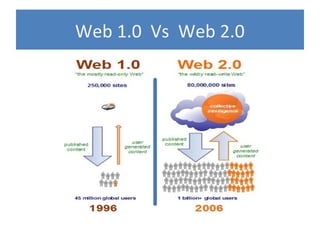
Web 1.0 Vs Web 2.0
Web 1.0 Vs Web 2.0
 Read-only web vs. read/write web
 Yahoo mail vs. Gmail
 E-mail vs. IM
 Newsletters vs. blogs
 Static vs. dynamic
 Isolated vs. interactive
Web 2.0 Concepts
 Rich Internet application (RIA)
• Ajax and Flash.
 Web-oriented architecture (WOA)
• Examples are feeds, RSS, Web Services, mash-
ups.
 Social Web
• End-user an integral part.
Web 2.0 - Features
 Common people can add content to the web
with Programming skills
 Publishing their own journals, photographs,
videos, auctions, podcasts, wikis, slideshows
and more
Web 2.0 – Higher Education
 Teachers are using Web 2.0 tools to launch
their classroom
 Students are creating online content,
collaborating with other students around the
world and showcasing their work to a global
audience
 Web 2.0 facilitates professional networking
Web 2.0 – Higher Education
 It provides
 Authentic learning experiences for students
 Encourages global awareness
 Creativity
 Innovation,
 Critical thinking and
 Collaboration.
 Web 2.0 tools are easy to use

Web 2.0

  • 1.
  • 2.
    Web 1.0  WorldWide Web was primarily a place for viewers to retrieve information  The information flowed in a one-way direction  Websites were mostly built by Web Experts  Traditional websites, email, newsletters, banner ads, etc.
  • 3.
    Web 2.0 “A secondgeneration of services available on the World Wide Web that let people collaborate, and share information online. In contrast to the first generation, Web 2.0 gives users an experience closer to desktop applications than the traditional static Web pages.” (emphasis mine) • http://en.wikipedia.org/wiki/Web_2.0
  • 4.
    Web 1.0 VsWeb 2.0
  • 5.
    Web 1.0 VsWeb 2.0  Read-only web vs. read/write web  Yahoo mail vs. Gmail  E-mail vs. IM  Newsletters vs. blogs  Static vs. dynamic  Isolated vs. interactive
  • 6.
    Web 2.0 Concepts Rich Internet application (RIA) • Ajax and Flash.  Web-oriented architecture (WOA) • Examples are feeds, RSS, Web Services, mash- ups.  Social Web • End-user an integral part.
  • 8.
    Web 2.0 -Features  Common people can add content to the web with Programming skills  Publishing their own journals, photographs, videos, auctions, podcasts, wikis, slideshows and more
  • 9.
    Web 2.0 –Higher Education  Teachers are using Web 2.0 tools to launch their classroom  Students are creating online content, collaborating with other students around the world and showcasing their work to a global audience  Web 2.0 facilitates professional networking
  • 10.
    Web 2.0 –Higher Education  It provides  Authentic learning experiences for students  Encourages global awareness  Creativity  Innovation,  Critical thinking and  Collaboration.  Web 2.0 tools are easy to use