Why 0!=1
Example (1)
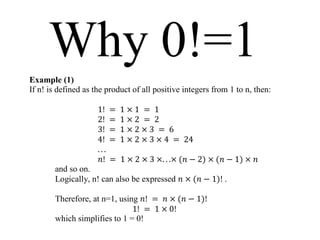
If n! is defined as the product of all positive integers from 1 to n, then:

                     1!    =   1×1 = 1
                     2!    =   1×2 = 2
                     3!    =   1×2×3 = 6
                     4!    =   1 × 2 × 3 × 4 = 24
                     ...
                      𝑛!   = 1 × 2 × 3 ×. . .× (𝑛 − 2) × (𝑛 − 1) × 𝑛
       and so on.
       Logically, n! can also be expressed 𝑛 × (𝑛 − 1)! .

       Therefore, at n=1, using 𝑛! = 𝑛 × (𝑛 − 1)!
                              1! = 1 × 0!
       which simplifies to 1 = 0!
Example (2)
                     Why 0!=1
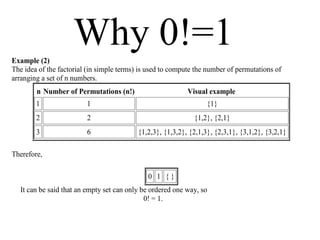
The idea of the factorial (in simple terms) is used to compute the number of permutations of
arranging a set of n numbers.
        n Number of Permutations (n!)                       Visual example
        1                1                                         {1}
        2                2                                    {1,2}, {2,1}
        3                6                 {1,2,3}, {1,3,2}, {2,1,3}, {2,3,1}, {3,1,2}, {3,2,1}

Therefore,

                                              0 1 {}
  It can be said that an empty set can only be ordered one way, so
                                             0! = 1.

0!

  • 1.
    Why 0!=1 Example (1) Ifn! is defined as the product of all positive integers from 1 to n, then: 1! = 1×1 = 1 2! = 1×2 = 2 3! = 1×2×3 = 6 4! = 1 × 2 × 3 × 4 = 24 ... 𝑛! = 1 × 2 × 3 ×. . .× (𝑛 − 2) × (𝑛 − 1) × 𝑛 and so on. Logically, n! can also be expressed 𝑛 × (𝑛 − 1)! . Therefore, at n=1, using 𝑛! = 𝑛 × (𝑛 − 1)! 1! = 1 × 0! which simplifies to 1 = 0!
  • 2.
    Example (2) Why 0!=1 The idea of the factorial (in simple terms) is used to compute the number of permutations of arranging a set of n numbers. n Number of Permutations (n!) Visual example 1 1 {1} 2 2 {1,2}, {2,1} 3 6 {1,2,3}, {1,3,2}, {2,1,3}, {2,3,1}, {3,1,2}, {3,2,1} Therefore, 0 1 {} It can be said that an empty set can only be ordered one way, so 0! = 1.