Intrauterine growth restriction (IUGR)
Dr. P Usha Devi
AMC/VGH
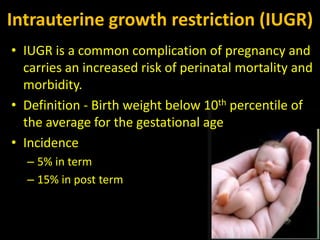
Intrauterine growth restriction (IUGR)
• IUGR is a common complication of pregnancy and
carries an increased risk of perinatal mortality and
morbidity.
• Definition - Birth weight below 10th percentile of
the average for the gestational age
• Incidence
– 5% in term
– 15% in post term
SGA vs IUGR
• Small Fetuses
–Physiological
–Pathological
• Type I or Symmetrical
• Type II Asymmetrical
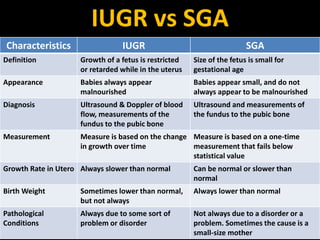
IUGR vs SGA
Characteristics IUGR SGA
Definition Growth of a fetus is restricted
or retarded while in the uterus
Size of the fetus is small for
gestational age
Appearance Babies always appear
malnourished
Babies appear small, and do not
always appear to be malnourished
Diagnosis Ultrasound & Doppler of blood
flow, measurements of the
fundus to the pubic bone
Ultrasound and measurements of
the fundus to the pubic bone
Measurement Measure is based on the change
in growth over time
Measure is based on a one-time
measurement that fails below
statistical value
Growth Rate in Utero Always slower than normal Can be normal or slower than
normal
Birth Weight Sometimes lower than normal,
but not always
Always lower than normal
Pathological
Conditions
Always due to some sort of
problem or disorder
Not always due to a disorder or a
problem. Sometimes the cause is a
small-size mother
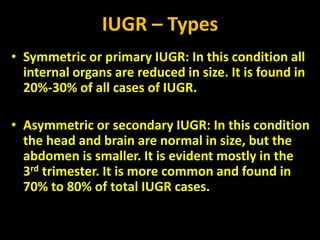
IUGR – Types
• Symmetric or primary IUGR: In this condition all
internal organs are reduced in size. It is found in
20%-30% of all cases of IUGR.
• Asymmetric or secondary IUGR: In this condition
the head and brain are normal in size, but the
abdomen is smaller. It is evident mostly in the
3rd trimester. It is more common and found in
70% to 80% of total IUGR cases.
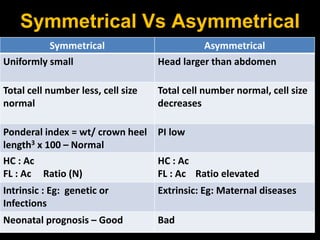
Symmetrical Vs Asymmetrical
Symmetrical Asymmetrical
Uniformly small Head larger than abdomen
Total cell number less, cell size
normal
Total cell number normal, cell size
decreases
Ponderal index = wt/ crown heel
length3 x 100 – Normal
PI low
HC : Ac
FL : Ac Ratio (N)
HC : Ac
FL : Ac Ratio elevated
Intrinsic : Eg: genetic or
Infections
Extrinsic: Eg: Maternal diseases
Neonatal prognosis – Good Bad
Causes of IUGR
• Causes :- Maternal, fetal, placental, Unknown
• Maternal
– Constitutional,
– Nutritional,
– Maternal diseases
• Anemia,
• PIH,
• HTN,
• Heart Diseases,
• Renal Disease’
• Thrombotic Diseases,
• Collagen Vascular diseases
– Toxins – Alcohol, smoking, cocaine, heroine, drugs
Causes of IUGR
• Fetal
– Structural Anomalies Eg: CVS, Renal
– Chromosomal : Trisomy, Turners
– Infections : TORCH, Malaria
– Multiple Pregnancies
• Placental :
– Chronic Placental insufficiency
– Placenta Previa,
– Abruption,
– Circumvallate Placenta
– Infarction,
– Mosaicism
Predictors of IUGR
• High Risk Factors
– Obstetric
– Medical
• PAPP – A
• Uterine Artery Notching
• Fetal Echogenic bowel
• Pathophysiology of IUGR …….
Diagnosis
• Clinical :-
–Examination
–Symphysio fundal height > 3 cm lag
–Abdominal girth measurement
–Maternal weight
Diagnosis
• Ultrasound :-
–HC /AC > 1, 1, < 1
–Transcerebellar diameter
–Alone AC & EFW Serial Measurement
–FL / AC > 23.5
–AFI
–TIFFA
Diagnosis
• USG Doppler
– SD Ratio, RI, PI
– Uterine Artery – Diastolic Notch
– Umbilical Artery Doppler
• S/D Ratio due to decreased EDV
• AREDV
– Middle Cerebral Artery : Brain Sparing Effect
– Umbilical Venus Pulsations
– Ductus Venosus Doppler
Post Natal Diagnosis
• Low APGAR score
• Low Birth weight
• Height
• HC > AC
• Dry wrinkled skin, scaphoid abdomen,
meconium stain, old man look
• Baby is alert, active, eyes open
Complications
• Antenatal :
– Chronic Fetal distress
– Acute fetal distress
• Postnatal :
– Asphyxiated,
– RDS
– Hypoglycemia,
– MAS
– Hypothermia,
– Polycythemia, Anemia, Thrombocytopenia, DIC
– IVH
Complications
Continued …..
Postnatal :
– Hyper Viscosity Syndrome
– Hypocalcemia, Hypokalemia
– Hyperbilirubinemia
– Increased Perinatal morbidity, mortality
Late Complications
• Retarded Neurological, Intellectual
Development
• Increased chances of Metabolic Syndrome
like Obesity, HTN, DM, CAD
Management
• Constitutional small - No treatment
• Symmetrical IUGR - No treatment
• Asymmetrical IUGR
– Bed rest
– Correct Malnutrition
– Avoid smoking, Alcoholism
– Treat maternal diseases
– LDA
– Oxygen, Amino acid infusion, Volume Expansion
– Antepartum Evaluation
• USG
• Doppler
• BPP
Management - Intrapartum
• NICU facility
• Higher Centers
• Term gest:
– Immediate delivery
• Preterm gest:
– Antenatal Steroids
– Mg.SO4
– Then delivery
• Delivery: Vaginal vs LSCS
Management - Intrapartum
• Care during delivery:
– Forceps application
– Quick cord clamping
– Cord to be kept long
• After Delivery:
– Clear mucus from air passages
– Baby wrapped in warm sterile towel
– Keep in warmer
– Inj Vit K 1mg IM
– NICU Admission if required
– Early feeds
– More frequent feeds
Prevention
Although IUGR can occur even when a mother is perfectly
healthy, still there are some measures to reduce the risk of
IUGR and increase the chances of a healthy pregnancy and
baby.
Care before pregnancy:
• Providing care to women before and between pregnancies
(inter-conception care) improves the chances of mothers
and babies being healthy.
• Advocating healthy eating and physical activity to women
in their daily routine to improve weight and cardiovascular
status before pregnancy.
• Diagnosis and management of chronic diseases such as
hypertension, diabetes before pregnancy.
• Correction of anemia/folic acid supplementation before
pregnancy.
Prevention
Care during pregnancy:
• All pregnant mothers should get antenatal checkups as advised
by medical persons/ Pradhan Mantri Surakshit Matritva Abhiyan
(PMSMA)- Programme aims to provide comprehensive and
quality antenatal care, free of cost, universally to all pregnant
women on the 9th of every month throughout the country.
• Pregnant mothers should take only those medicines which are
prescribed by doctors.
• Healthy diet should be advised to pregnant women with
behavior change to encourage healthier eating patterns during
pregnancy. Foods fortified with nutrients can be provided to
pregnant women.
Prevention
• Pregnant women are advised to take enough rest with
proper duration of sleep during night and an hour or
two of rest in the afternoon.
• Expectant mothers should follow healthy lifestyle
habits. Tobacco use, smoking and alcohol intake
should be avoided during pregnancy.
• Low dose Aspirin, High dose Calcium
Discussion

PPT on IUGR .pptx

  • 1.
    Intrauterine growth restriction(IUGR) Dr. P Usha Devi AMC/VGH
  • 2.
    Intrauterine growth restriction(IUGR) • IUGR is a common complication of pregnancy and carries an increased risk of perinatal mortality and morbidity. • Definition - Birth weight below 10th percentile of the average for the gestational age • Incidence – 5% in term – 15% in post term
  • 3.
    SGA vs IUGR •Small Fetuses –Physiological –Pathological • Type I or Symmetrical • Type II Asymmetrical
  • 4.
    IUGR vs SGA CharacteristicsIUGR SGA Definition Growth of a fetus is restricted or retarded while in the uterus Size of the fetus is small for gestational age Appearance Babies always appear malnourished Babies appear small, and do not always appear to be malnourished Diagnosis Ultrasound & Doppler of blood flow, measurements of the fundus to the pubic bone Ultrasound and measurements of the fundus to the pubic bone Measurement Measure is based on the change in growth over time Measure is based on a one-time measurement that fails below statistical value Growth Rate in Utero Always slower than normal Can be normal or slower than normal Birth Weight Sometimes lower than normal, but not always Always lower than normal Pathological Conditions Always due to some sort of problem or disorder Not always due to a disorder or a problem. Sometimes the cause is a small-size mother
  • 5.
    IUGR – Types •Symmetric or primary IUGR: In this condition all internal organs are reduced in size. It is found in 20%-30% of all cases of IUGR. • Asymmetric or secondary IUGR: In this condition the head and brain are normal in size, but the abdomen is smaller. It is evident mostly in the 3rd trimester. It is more common and found in 70% to 80% of total IUGR cases.
  • 6.
    Symmetrical Vs Asymmetrical SymmetricalAsymmetrical Uniformly small Head larger than abdomen Total cell number less, cell size normal Total cell number normal, cell size decreases Ponderal index = wt/ crown heel length3 x 100 – Normal PI low HC : Ac FL : Ac Ratio (N) HC : Ac FL : Ac Ratio elevated Intrinsic : Eg: genetic or Infections Extrinsic: Eg: Maternal diseases Neonatal prognosis – Good Bad
  • 7.
    Causes of IUGR •Causes :- Maternal, fetal, placental, Unknown • Maternal – Constitutional, – Nutritional, – Maternal diseases • Anemia, • PIH, • HTN, • Heart Diseases, • Renal Disease’ • Thrombotic Diseases, • Collagen Vascular diseases – Toxins – Alcohol, smoking, cocaine, heroine, drugs
  • 8.
    Causes of IUGR •Fetal – Structural Anomalies Eg: CVS, Renal – Chromosomal : Trisomy, Turners – Infections : TORCH, Malaria – Multiple Pregnancies • Placental : – Chronic Placental insufficiency – Placenta Previa, – Abruption, – Circumvallate Placenta – Infarction, – Mosaicism
  • 9.
    Predictors of IUGR •High Risk Factors – Obstetric – Medical • PAPP – A • Uterine Artery Notching • Fetal Echogenic bowel • Pathophysiology of IUGR …….
  • 10.
    Diagnosis • Clinical :- –Examination –Symphysiofundal height > 3 cm lag –Abdominal girth measurement –Maternal weight
  • 11.
    Diagnosis • Ultrasound :- –HC/AC > 1, 1, < 1 –Transcerebellar diameter –Alone AC & EFW Serial Measurement –FL / AC > 23.5 –AFI –TIFFA
  • 12.
    Diagnosis • USG Doppler –SD Ratio, RI, PI – Uterine Artery – Diastolic Notch – Umbilical Artery Doppler • S/D Ratio due to decreased EDV • AREDV – Middle Cerebral Artery : Brain Sparing Effect – Umbilical Venus Pulsations – Ductus Venosus Doppler
  • 13.
    Post Natal Diagnosis •Low APGAR score • Low Birth weight • Height • HC > AC • Dry wrinkled skin, scaphoid abdomen, meconium stain, old man look • Baby is alert, active, eyes open
  • 14.
    Complications • Antenatal : –Chronic Fetal distress – Acute fetal distress • Postnatal : – Asphyxiated, – RDS – Hypoglycemia, – MAS – Hypothermia, – Polycythemia, Anemia, Thrombocytopenia, DIC – IVH
  • 15.
    Complications Continued ….. Postnatal : –Hyper Viscosity Syndrome – Hypocalcemia, Hypokalemia – Hyperbilirubinemia – Increased Perinatal morbidity, mortality
  • 16.
    Late Complications • RetardedNeurological, Intellectual Development • Increased chances of Metabolic Syndrome like Obesity, HTN, DM, CAD
  • 17.
    Management • Constitutional small- No treatment • Symmetrical IUGR - No treatment • Asymmetrical IUGR – Bed rest – Correct Malnutrition – Avoid smoking, Alcoholism – Treat maternal diseases – LDA – Oxygen, Amino acid infusion, Volume Expansion – Antepartum Evaluation • USG • Doppler • BPP
  • 18.
    Management - Intrapartum •NICU facility • Higher Centers • Term gest: – Immediate delivery • Preterm gest: – Antenatal Steroids – Mg.SO4 – Then delivery • Delivery: Vaginal vs LSCS
  • 19.
    Management - Intrapartum •Care during delivery: – Forceps application – Quick cord clamping – Cord to be kept long • After Delivery: – Clear mucus from air passages – Baby wrapped in warm sterile towel – Keep in warmer – Inj Vit K 1mg IM – NICU Admission if required – Early feeds – More frequent feeds
  • 20.
    Prevention Although IUGR canoccur even when a mother is perfectly healthy, still there are some measures to reduce the risk of IUGR and increase the chances of a healthy pregnancy and baby. Care before pregnancy: • Providing care to women before and between pregnancies (inter-conception care) improves the chances of mothers and babies being healthy. • Advocating healthy eating and physical activity to women in their daily routine to improve weight and cardiovascular status before pregnancy. • Diagnosis and management of chronic diseases such as hypertension, diabetes before pregnancy. • Correction of anemia/folic acid supplementation before pregnancy.
  • 21.
    Prevention Care during pregnancy: •All pregnant mothers should get antenatal checkups as advised by medical persons/ Pradhan Mantri Surakshit Matritva Abhiyan (PMSMA)- Programme aims to provide comprehensive and quality antenatal care, free of cost, universally to all pregnant women on the 9th of every month throughout the country. • Pregnant mothers should take only those medicines which are prescribed by doctors. • Healthy diet should be advised to pregnant women with behavior change to encourage healthier eating patterns during pregnancy. Foods fortified with nutrients can be provided to pregnant women.
  • 22.
    Prevention • Pregnant womenare advised to take enough rest with proper duration of sleep during night and an hour or two of rest in the afternoon. • Expectant mothers should follow healthy lifestyle habits. Tobacco use, smoking and alcohol intake should be avoided during pregnancy. • Low dose Aspirin, High dose Calcium
  • 23.