STUDY ON AIR TO GROUND DATALINK COMMUNICATION

ACARS
HISTORY

• Airborne Communication
• VHF Voice communications
• AM
• Telex formats
INTRODUCTION
• ACARS: Aircraft Communications Addressing and Reporting System
• Full-duplex datalink
• Effort to improve data integrity and reduce crew workload

• Introduced in 1978
• 2400 baud rate
WORKING
• An on board person or system can create a message and send it via ACARS to a system or
user on the ground, and vice versa.
• Remote Ground Stations
• VHF Subnetwork: Line-of-sight propagation
• HF Subnetwork: Continental Coverage
• Satellite Communication: World-wide coverage
USES
• OOOI Events: Out of the gate, Off the ground, On the ground, and Into the gate
• ADS : Automatic Dependent Surveillance – Position reporting of a/c
• Flight management system interface: Flight plans and weather conditions etc.,

• Maintenance data download: Operational performance
• Interactive crew interface: Crew communication
• Online black-box
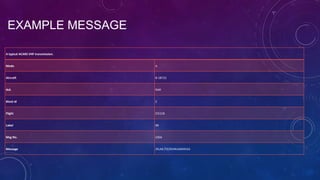
EXAMPLE MESSAGE
A typical ACARS VHF transmission.

Mode

A

Aircraft

B-18722

Ack

NAK

Block id

2

Flight

CI5118

Label

B9

Msg No.

L05A

Message

/KLAX.TI2/024KLAXA91A1
WHAT ARE WE USING TODAY?
• Aircraft Communication Addressing and Reporting System (ACARS)
• Character based transmissions
• 2400 bps transmission speeds
• In use since 1978

• Current statistics (ARINC)
• Service provided through 196 stations

• System is reaching it’s capacity in U.S./Europe

Page 8
PROBLEM
•

Growing number of ACARS aircraft

•

Potential new demand from new participants

•
•

Military: Non-Tactical Aircraft, Air National Guard

•
•

Civil: Large Scheduled (Regional), Cargo, and Business

Estimated potential at larger scale

Increasing number of data link applications
•
•

Crew Management

•
•

Aircraft Performance

In-flight Operations

Many areas are already experiencing congestion on en route frequencies
Page 9
SOLUTION
• Managing spectrum congestion and availability will be a growing and
continuing concern for the airline industry.

• Over the next 20 years, ACARS will be superseded by the Aeronautical
Telecommunications Network (ATN) protocol for Air Traffic Control
communications and by the Internet Protocol for airline communications.
Presented By:
V SHYAM PRASADA RAO
shyamforever@live.com

ACARS

  • 1.
    STUDY ON AIRTO GROUND DATALINK COMMUNICATION ACARS
  • 2.
    HISTORY • Airborne Communication •VHF Voice communications • AM • Telex formats
  • 3.
    INTRODUCTION • ACARS: AircraftCommunications Addressing and Reporting System • Full-duplex datalink • Effort to improve data integrity and reduce crew workload • Introduced in 1978 • 2400 baud rate
  • 5.
    WORKING • An onboard person or system can create a message and send it via ACARS to a system or user on the ground, and vice versa. • Remote Ground Stations • VHF Subnetwork: Line-of-sight propagation • HF Subnetwork: Continental Coverage • Satellite Communication: World-wide coverage
  • 6.
    USES • OOOI Events:Out of the gate, Off the ground, On the ground, and Into the gate • ADS : Automatic Dependent Surveillance – Position reporting of a/c • Flight management system interface: Flight plans and weather conditions etc., • Maintenance data download: Operational performance • Interactive crew interface: Crew communication • Online black-box
  • 7.
    EXAMPLE MESSAGE A typicalACARS VHF transmission. Mode A Aircraft B-18722 Ack NAK Block id 2 Flight CI5118 Label B9 Msg No. L05A Message /KLAX.TI2/024KLAXA91A1
  • 8.
    WHAT ARE WEUSING TODAY? • Aircraft Communication Addressing and Reporting System (ACARS) • Character based transmissions • 2400 bps transmission speeds • In use since 1978 • Current statistics (ARINC) • Service provided through 196 stations • System is reaching it’s capacity in U.S./Europe Page 8
  • 9.
    PROBLEM • Growing number ofACARS aircraft • Potential new demand from new participants • • Military: Non-Tactical Aircraft, Air National Guard • • Civil: Large Scheduled (Regional), Cargo, and Business Estimated potential at larger scale Increasing number of data link applications • • Crew Management • • Aircraft Performance In-flight Operations Many areas are already experiencing congestion on en route frequencies Page 9
  • 10.
    SOLUTION • Managing spectrumcongestion and availability will be a growing and continuing concern for the airline industry. • Over the next 20 years, ACARS will be superseded by the Aeronautical Telecommunications Network (ATN) protocol for Air Traffic Control communications and by the Internet Protocol for airline communications.
  • 11.
    Presented By: V SHYAMPRASADA RAO shyamforever@live.com