Prepared by : ARFAN AHMED SHOUROV 
Date Originated: April 9,2014 | Revision No: 00 | Revision Date: 
Shourov 
Shourov
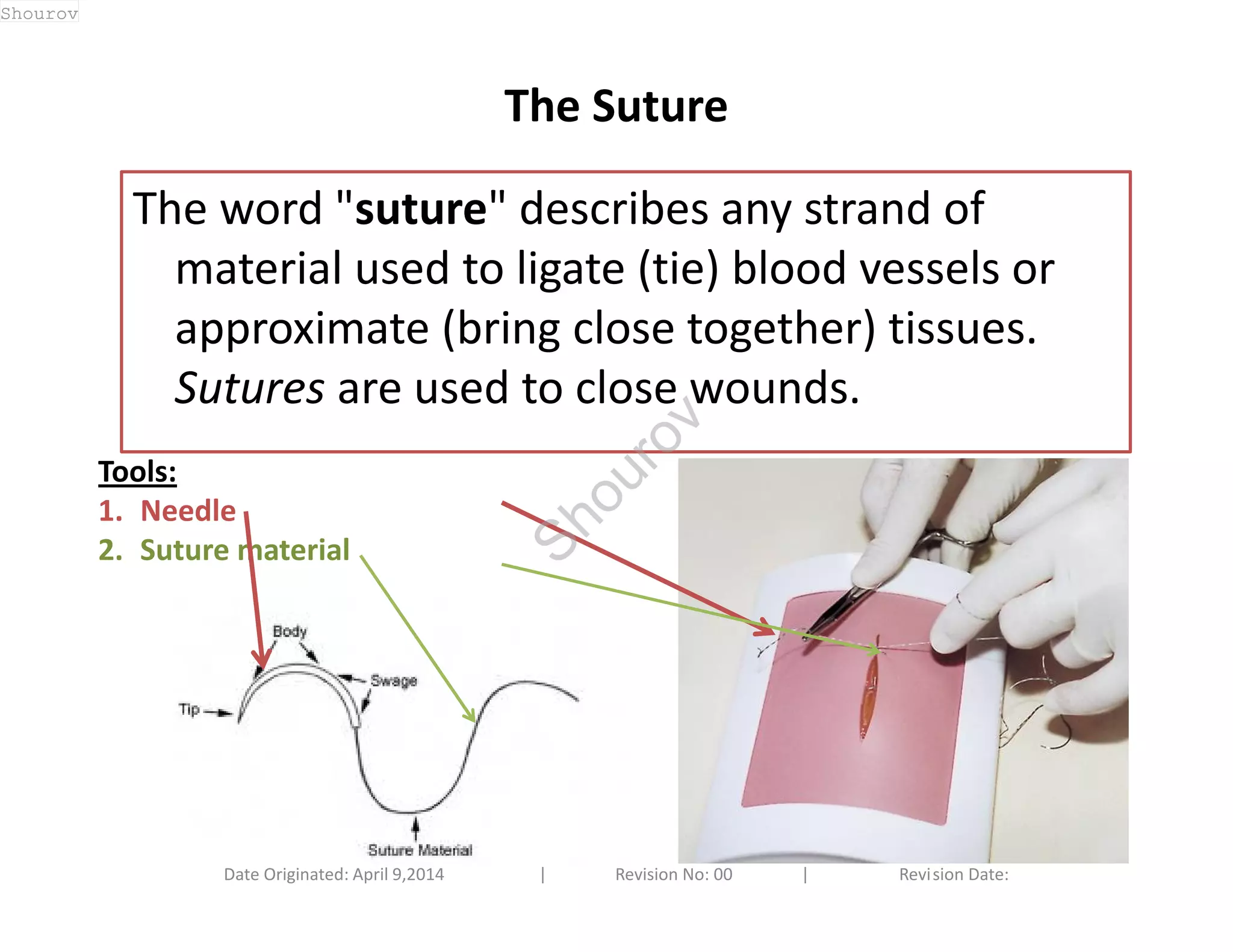
Tools: 
1. Needle 
2. Suture material 
The Suture 
The word "suture" describes any strand of 
material used to ligate (tie) blood vessels or 
approximate (bring close together) tissues. 
Sutures are used to close wounds. 
Date Originated: April 9,2014 | Revision No: 00 | Revision Date: 
Shourov 
Shourov
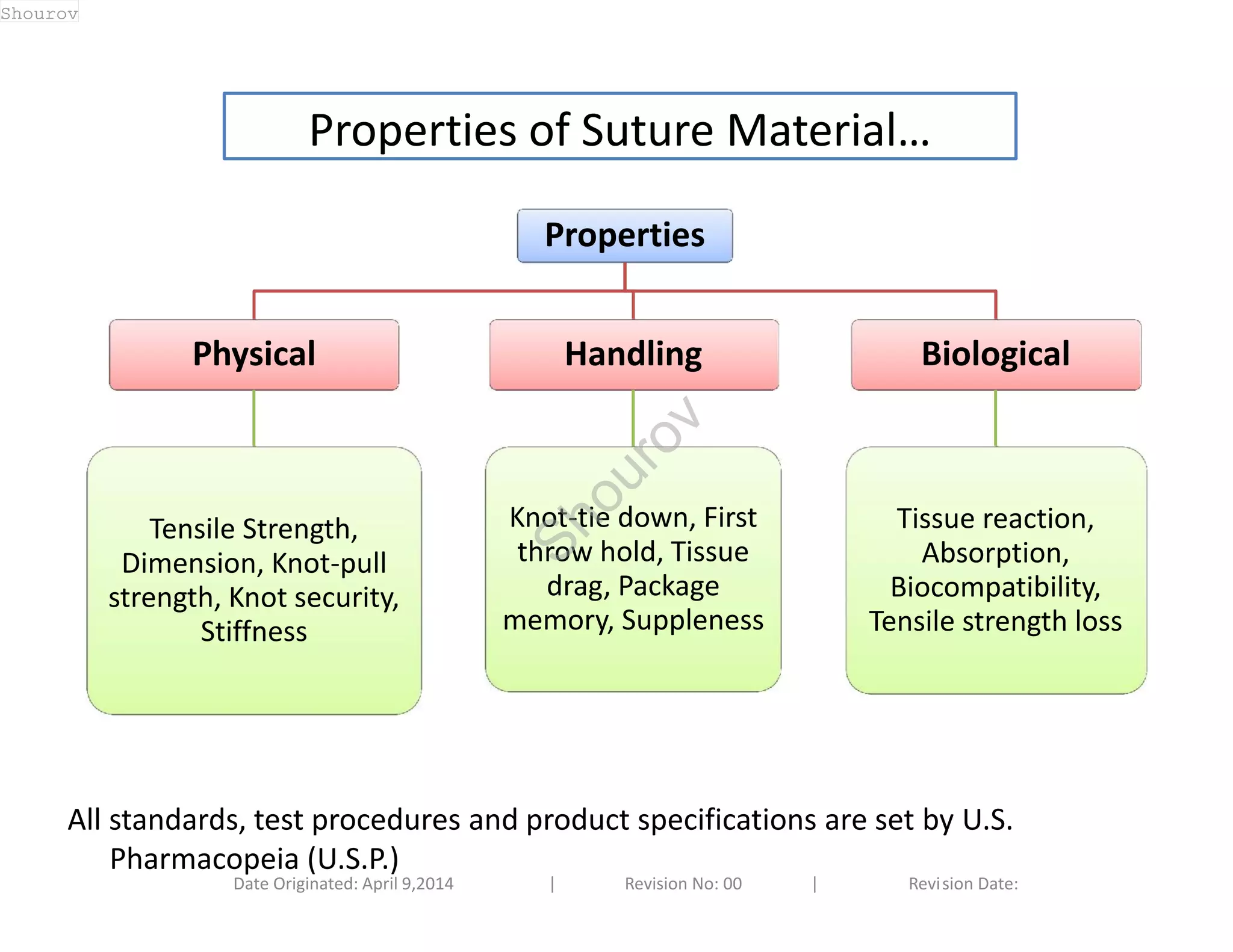
Properties of Suture Material… 
Properties 
Physical 
Tensile Strength, 
Dimension, Knot-pull 
strength, Knot security, 
Stiffness 
Handling 
Knot-tie down, First 
throw hold, Tissue 
drag, Package 
memory, Suppleness 
Biological 
Tissue reaction, 
Absorption, 
Biocompatibility, 
Tensile strength loss 
All standards, test procedures and product specifications are set by U.S. 
Pharmacopeia (U.S.P.) 
Date Originated: April 9,2014 | Revision No: 00 | Revision Date: 
Shourov 
Shourov
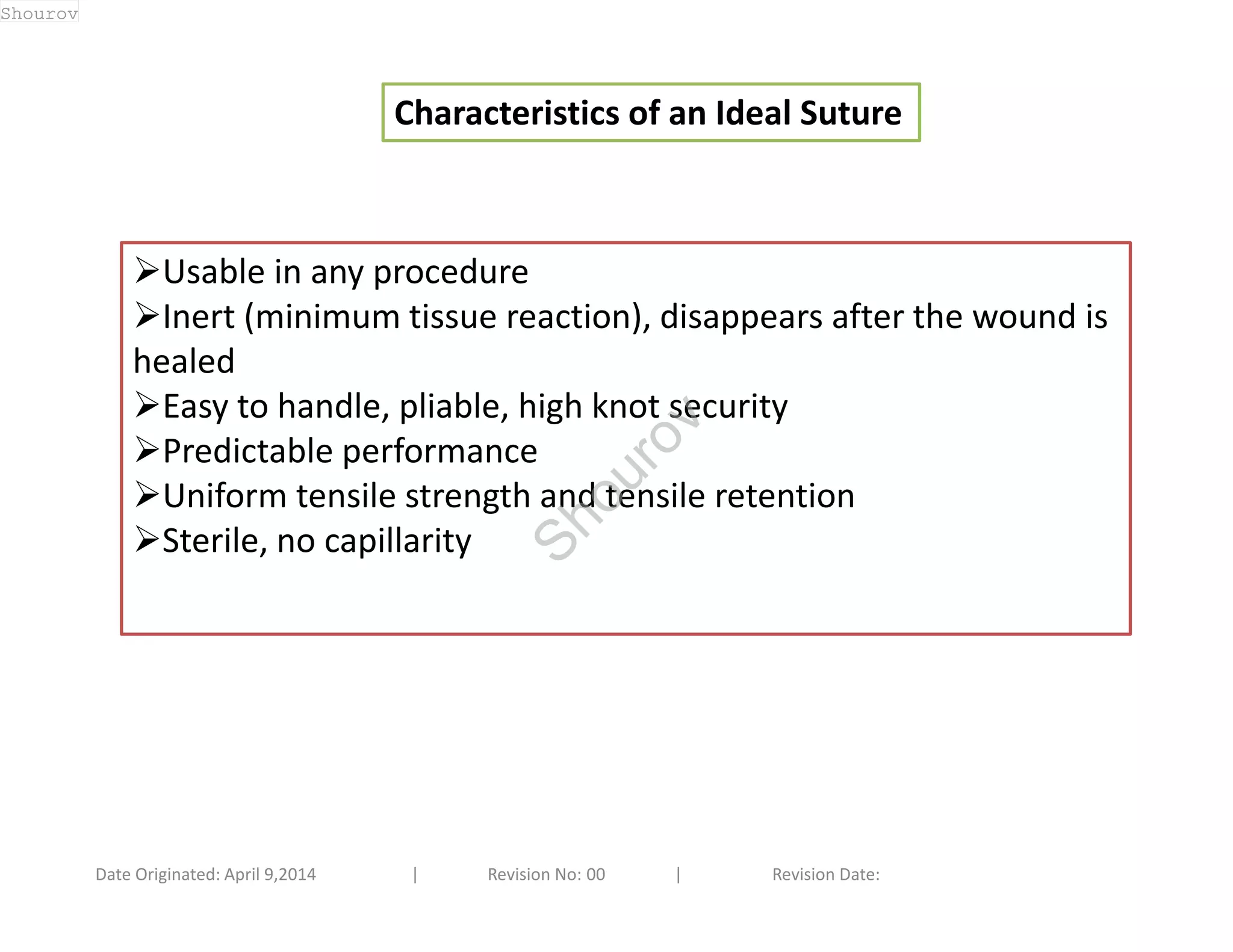
Characteristics of an Ideal Suture 
Usable in any procedure 
Inert (minimum tissue reaction), disappears after the wound is 
healed 
Easy to handle, pliable, high knot security 
Predictable performance 
Uniform tensile strength and tensile retention 
Sterile, no capillarity 
Date Originated: April 9,2014 | Revision No: 00 | Revision Date: 
Shourov 
Shourov
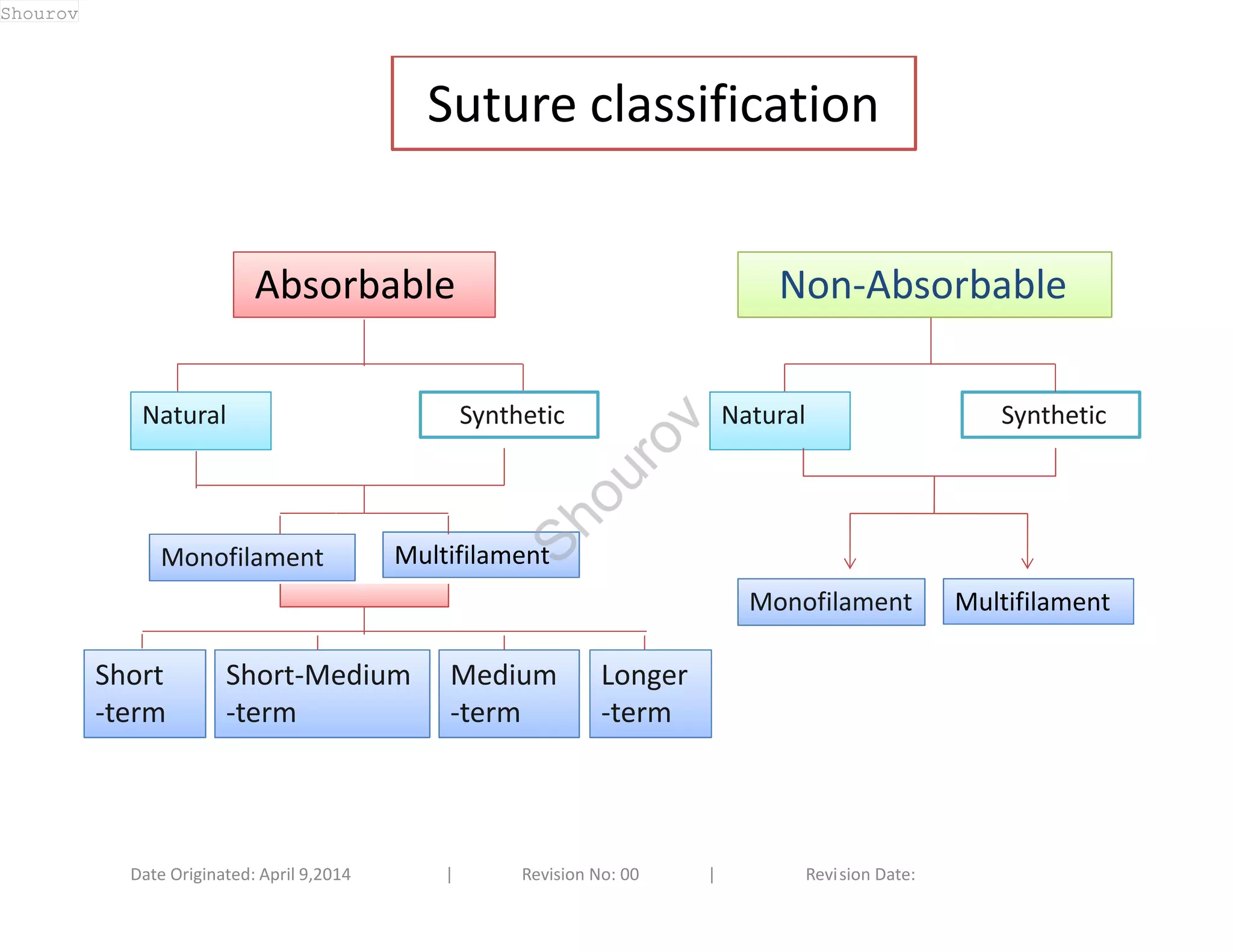
Suture classification 
AAbbssoorrbbaabbllee NNoonn--AAbbssoorrbbaabbllee 
NNaattuurraall Synthetic NNaattuurraall Synthetic 
MMoonnooffiillaammeenntt MMuullttiiffiillaammeenntt 
Short-Medium 
-term 
Medium 
-term 
Longer 
-term 
MMoonnooffiillaammeenntt MMuullttiiffiillaammeenntt 
Short 
-term 
Date Originated: April 9,2014 | Revision No: 00 | Revision Date: 
Shourov 
Shourov
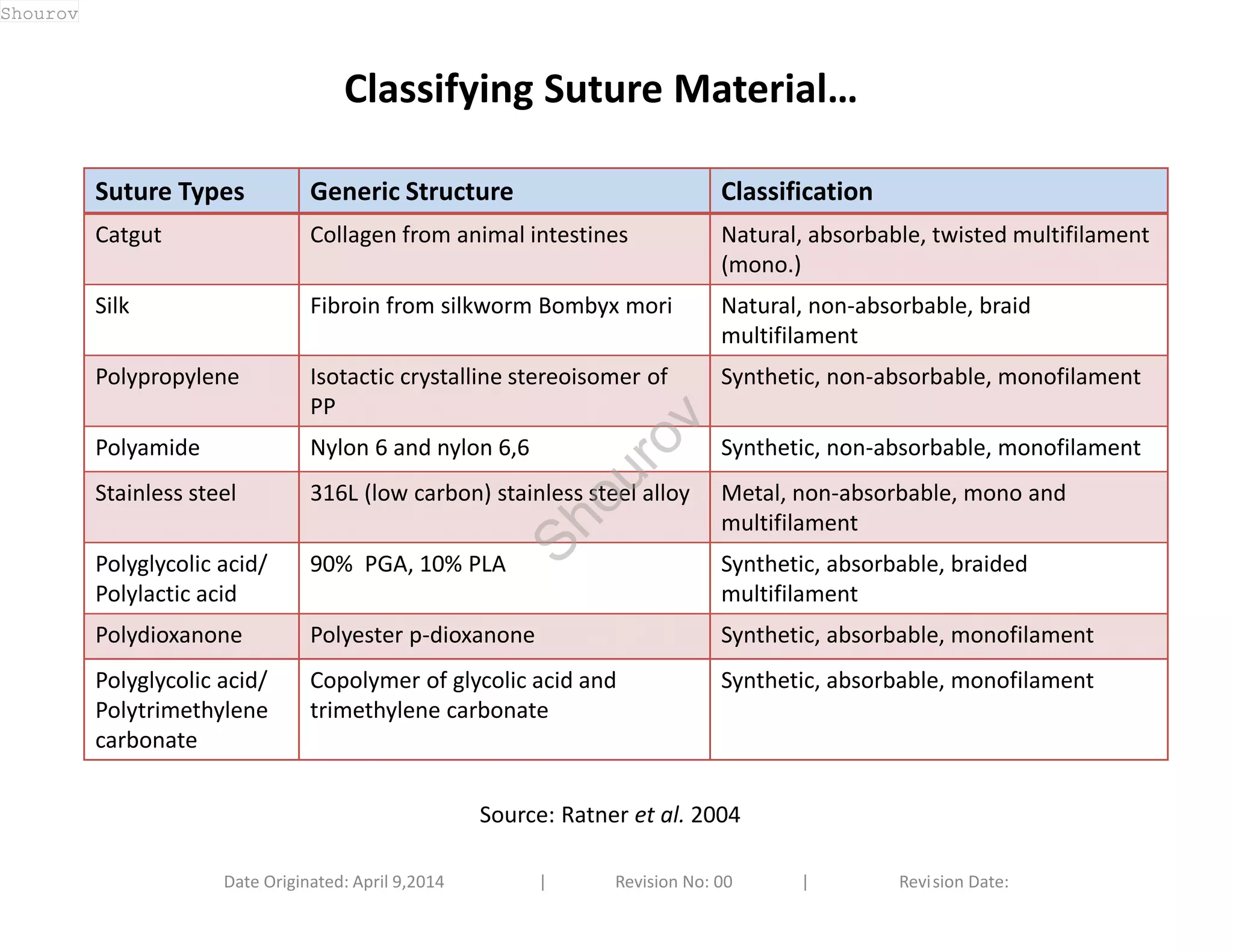
Classifying Suture Material… 
Suture Types Generic Structure Classification 
Catgut Collagen from animal intestines Natural, absorbable, twisted multifilament 
(mono.) 
Silk Fibroin from silkworm Bombyx mori Natural, non-absorbable, braid 
multifilament 
Polypropylene Isotactic crystalline stereoisomer of 
PP 
Synthetic, non-absorbable, monofilament 
Polyamide Nylon 6 and nylon 6,6 Synthetic, non-absorbable, monofilament 
Stainless steel 316L (low carbon) stainless steel alloy Metal, non-absorbable, mono and 
multifilament 
Polyglycolic acid/ 
Polylactic acid 
90% PGA, 10% PLA Synthetic, absorbable, braided 
multifilament 
Polydioxanone Polyester p-dioxanone Synthetic, absorbable, monofilament 
Polyglycolic acid/ 
Copolymer of glycolic acid and 
Synthetic, absorbable, monofilament 
Polytrimethylene 
trimethylene carbonate 
carbonate 
Source: Ratner et al. 2004 
Date Originated: April 9,2014 | Revision No: 00 | Revision Date: 
Shourov 
Shourov
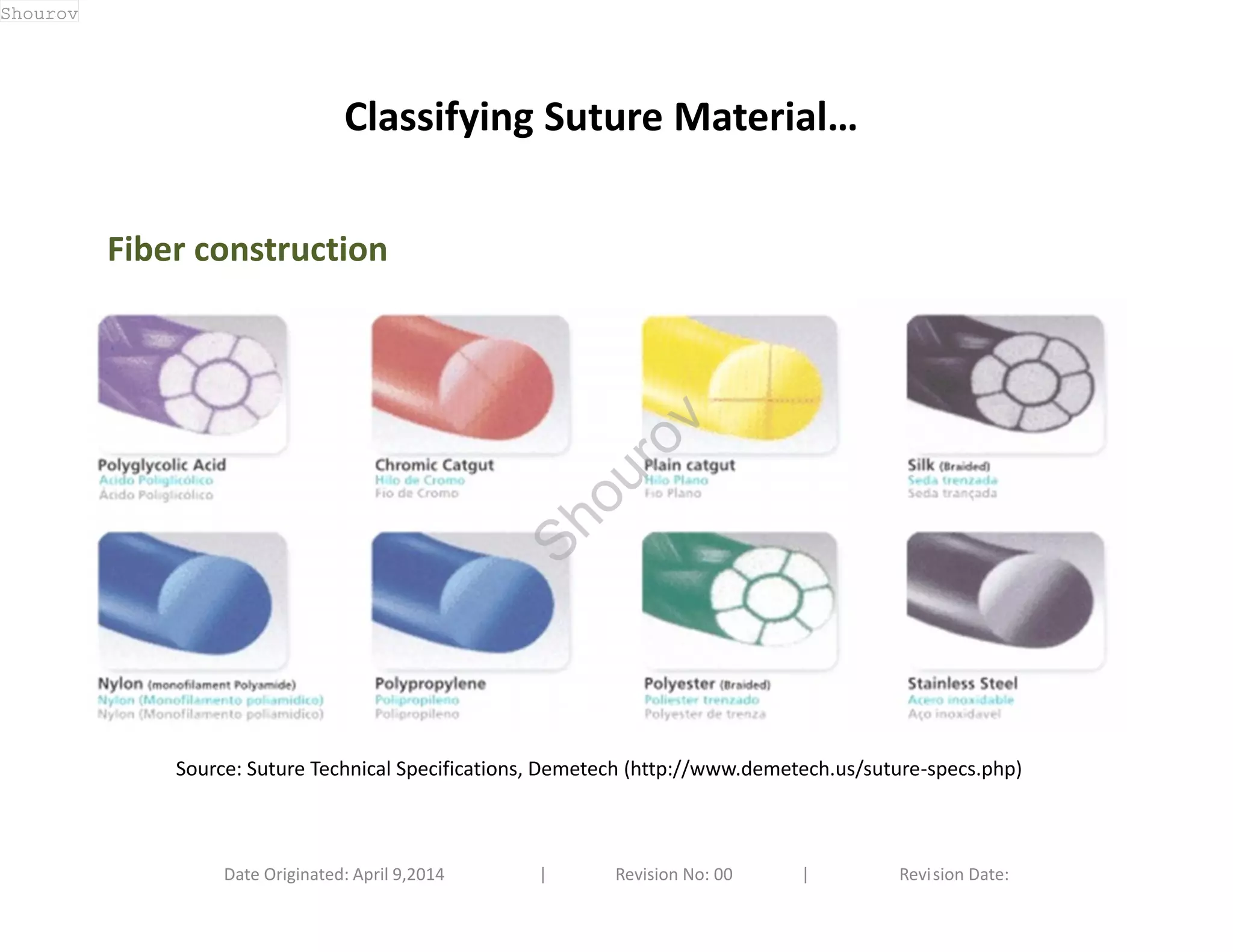
Classifying Suture Material… 
Fiber construction 
Source: Suture Technical Specifications, Demetech (http://www.demetech.us/suture-specs.php) 
Date Originated: April 9,2014 | Revision No: 00 | Revision Date: 
Shourov 
Shourov
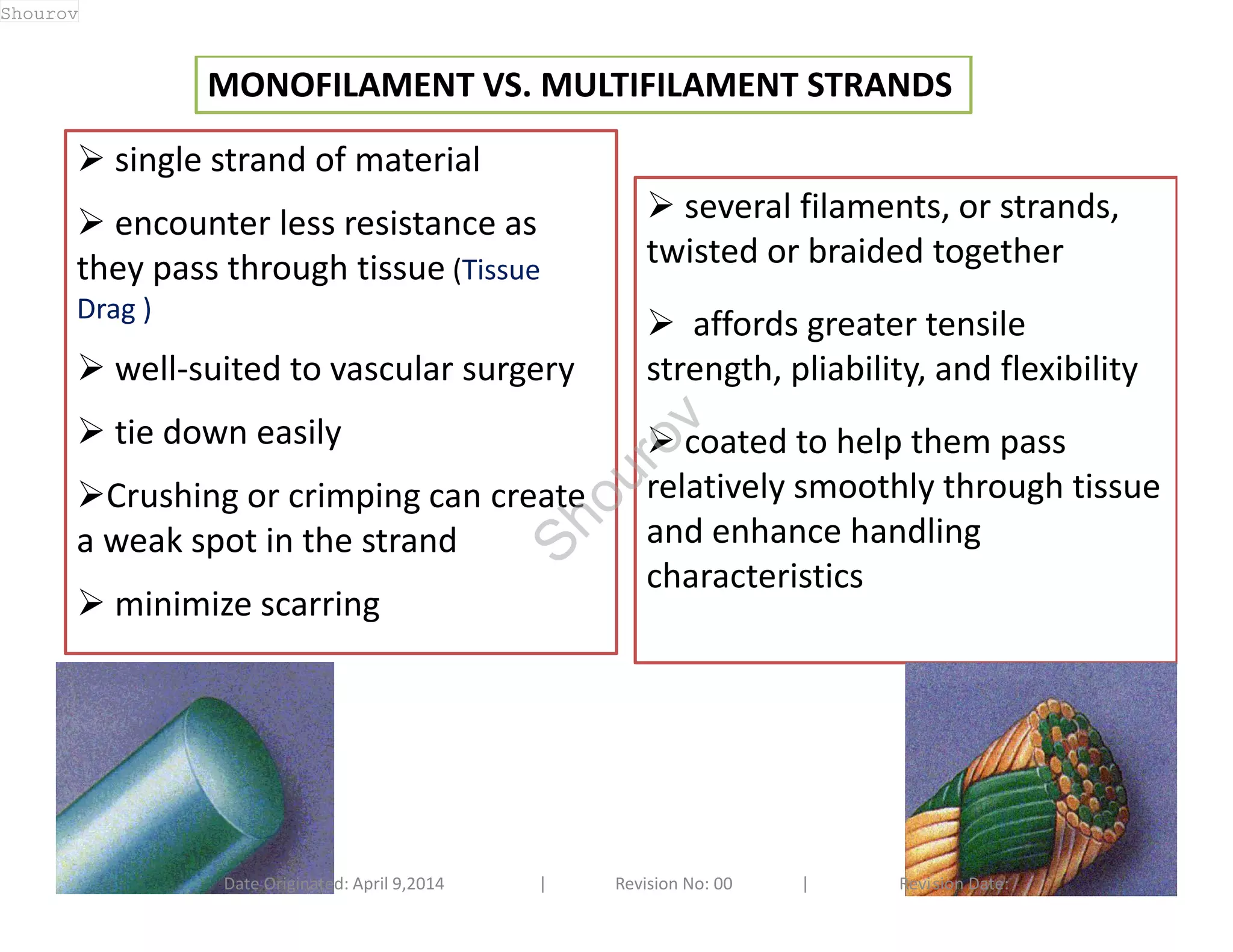
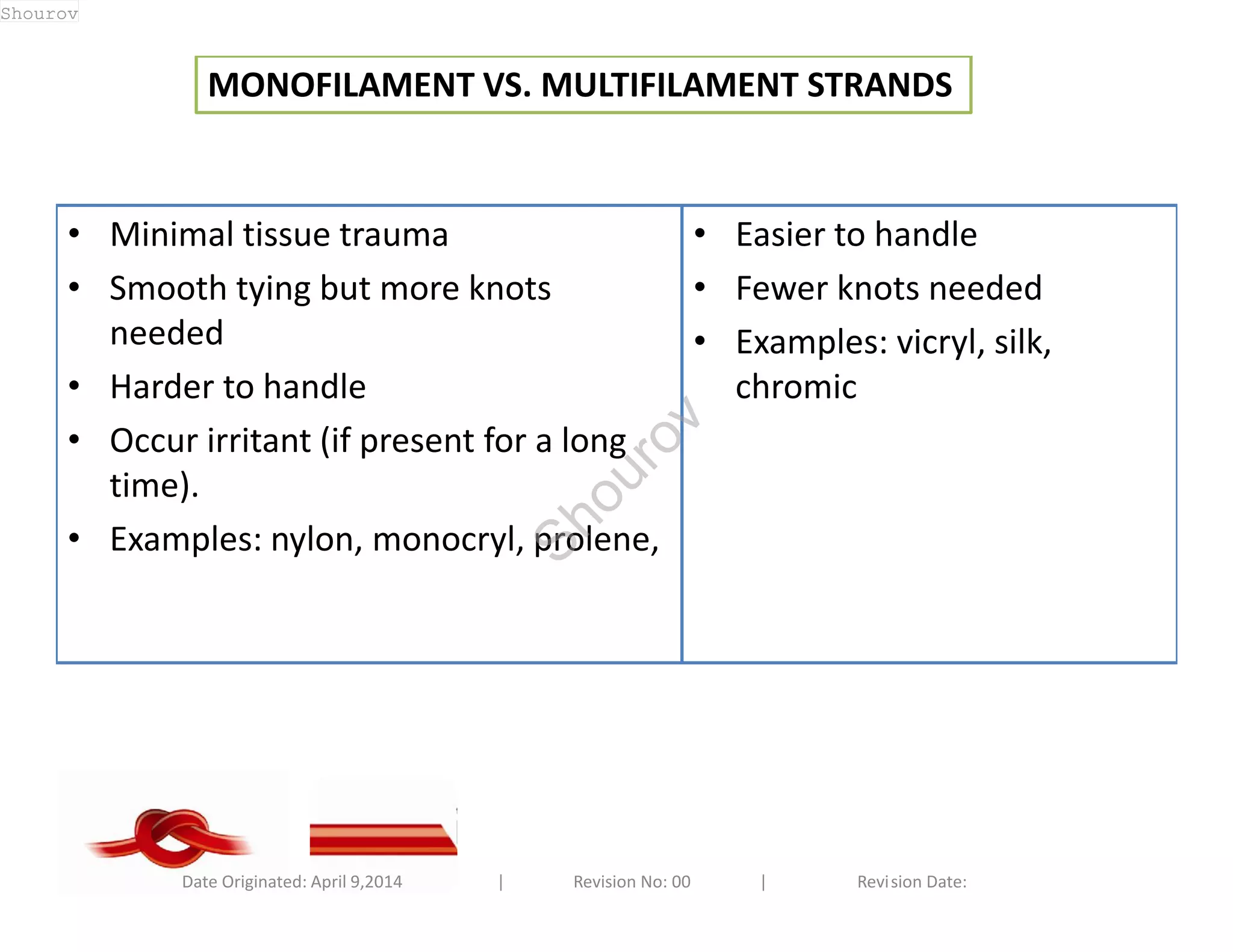
MONOFILAMENT VS. MULTIFILAMENT STRANDS 
 single strand of material 
 encounter less resistance as 
they pass through tissue (Tissue 
Drag ) 
 well-suited to vascular surgery 
 tie down easily 
Crushing or crimping can create 
a weak spot in the strand 
 minimize scarring 
 several filaments, or strands, 
twisted or braided together 
 affords greater tensile 
strength, pliability, and flexibility 
 coated to help them pass 
relatively smoothly through tissue 
and enhance handling 
characteristics 
Date Originated: April 9,2014 | Revision No: 00 | Revision Date: 
Shourov 
Shourov
MONOFILAMENT VS. MULTIFILAMENT STRANDS 
• Minimal tissue trauma 
• Smooth tying but more knots 
needed 
• Harder to handle 
• Occur irritant (if present for a long 
time). 
• Examples: nylon, monocryl, prolene, 
• Easier to handle 
• Fewer knots needed 
• Examples: vicryl, silk, 
chromic 
Date Originated: April 9,2014 | Revision No: 00 | Revision Date: 
Shourov 
Shourov
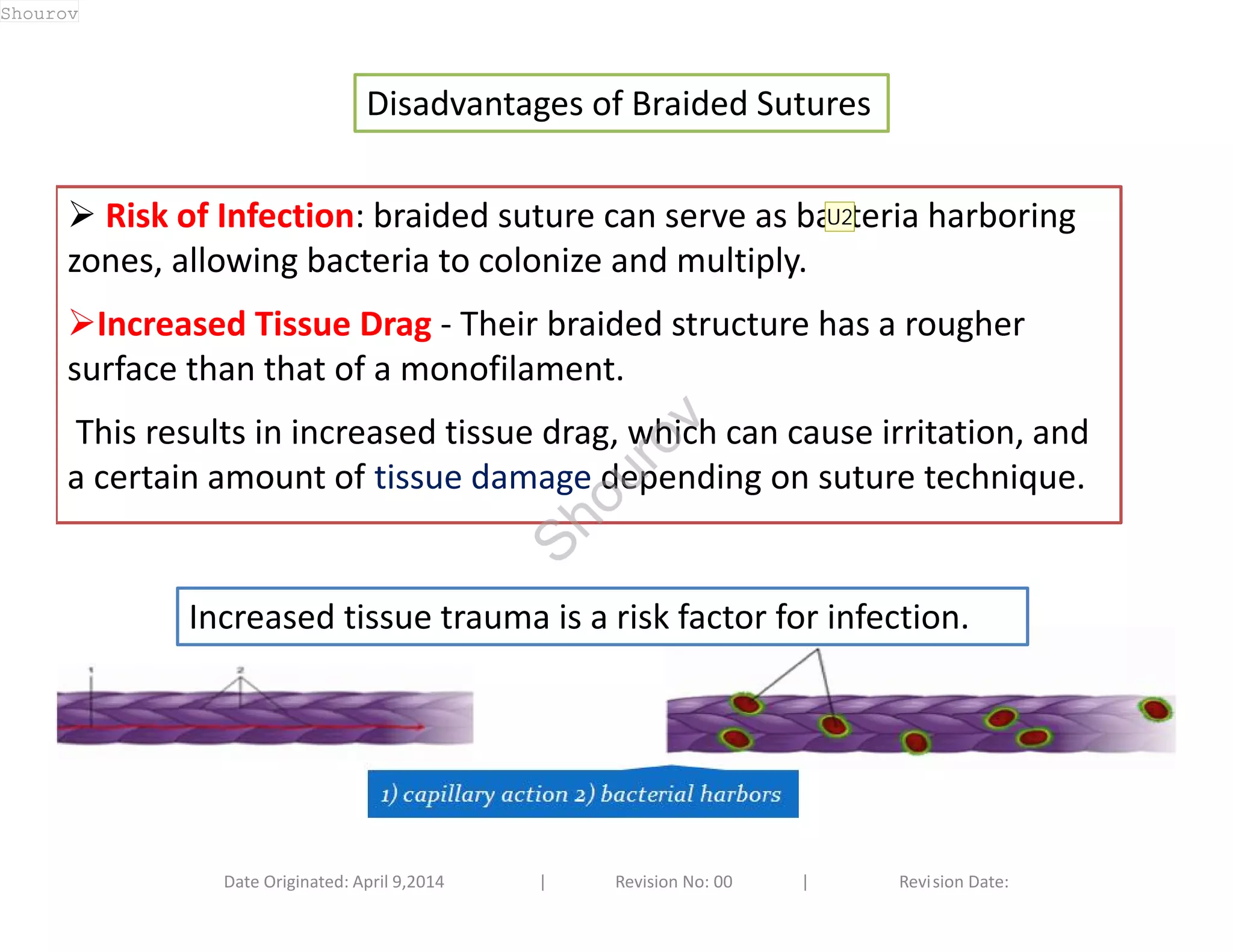
Disadvantages of Braided Sutures 
 Risk of Infection: braided suture can serve as bacteria U2 
harboring 
zones, allowing bacteria to colonize and multiply. 
Increased Tissue Drag - Their braided structure has a rougher 
surface than that of a monofilament. 
This results in increased tissue drag, which can cause irritation, and 
a certain amount of tissue damage depending on suture technique. 
Increased tissue trauma is a risk factor for infection. 
Date Originated: April 9,2014 | Revision No: 00 | Revision Date: 
Shourov 
Shourov
Slide 10 
U2 interstices serve as highways over which bacteria can travel; This movement of bacteria along the suture line is called capillarity. 
User, 4/8/2014 
Shourov 
Shourov
In order to minimize scarring, 
a monofilament suture such as DemeCAPRONE (poliglecaprone 25) 
Suture might be chosen over a braided suture such as 
DemeCRYL* (polyglactin 910) 
a monofilament suture is that its smooth surface reduces the 
chance of harboring bacteria. 
Date Originated: April 9,2014 | Revision No: 00 | Revision Date: 
Shourov 
Shourov
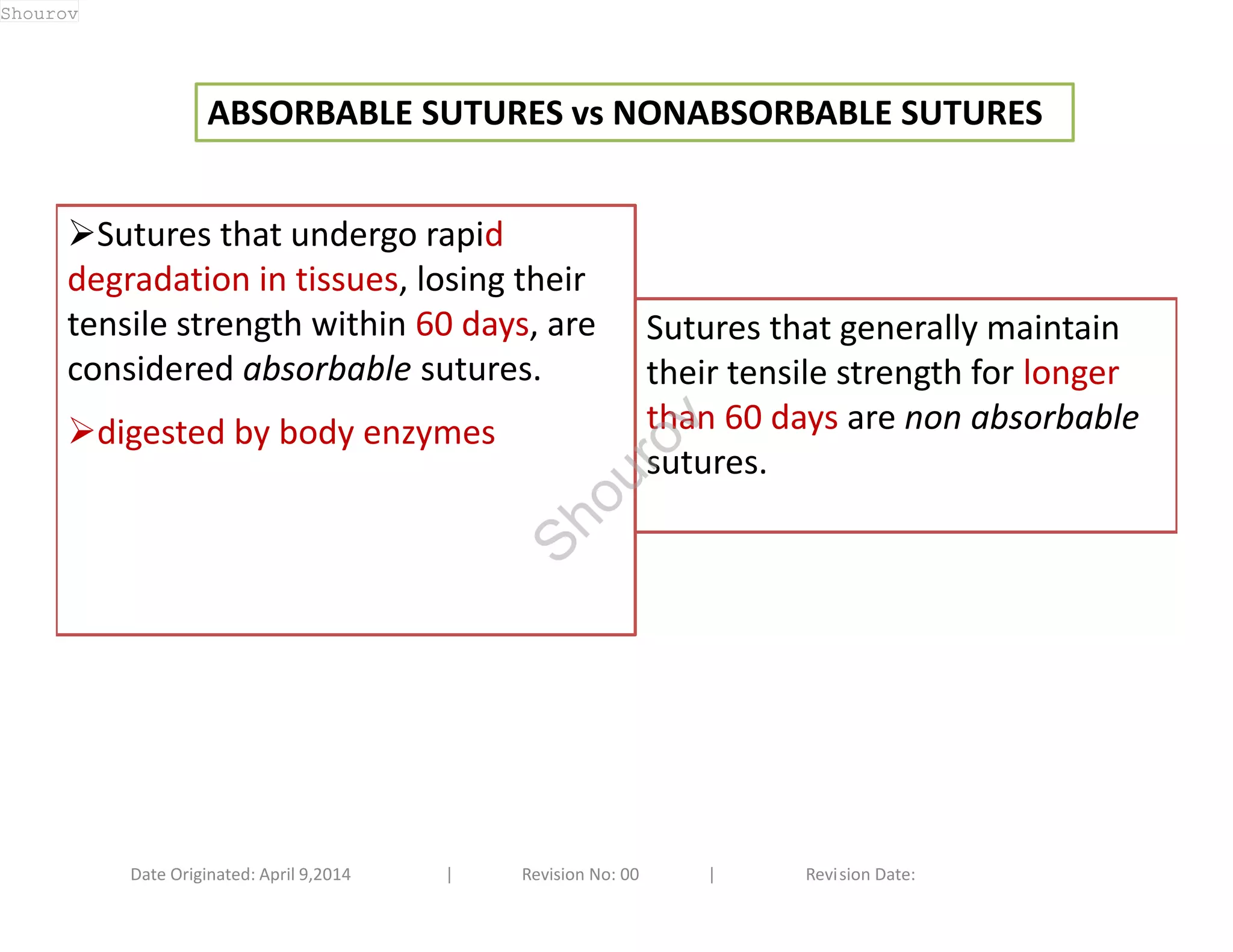
ABSORBABLE SUTURES vs NONABSORBABLE SUTURES 
Sutures that undergo rapid 
degradation in tissues, losing their 
tensile strength within 60 days, are 
considered absorbable sutures. 
digested by body enzymes 
Sutures that generally maintain 
their tensile strength for longer 
than 60 days are non absorbable 
sutures. 
Date Originated: April 9,2014 | Revision No: 00 | Revision Date: 
Shourov 
Shourov
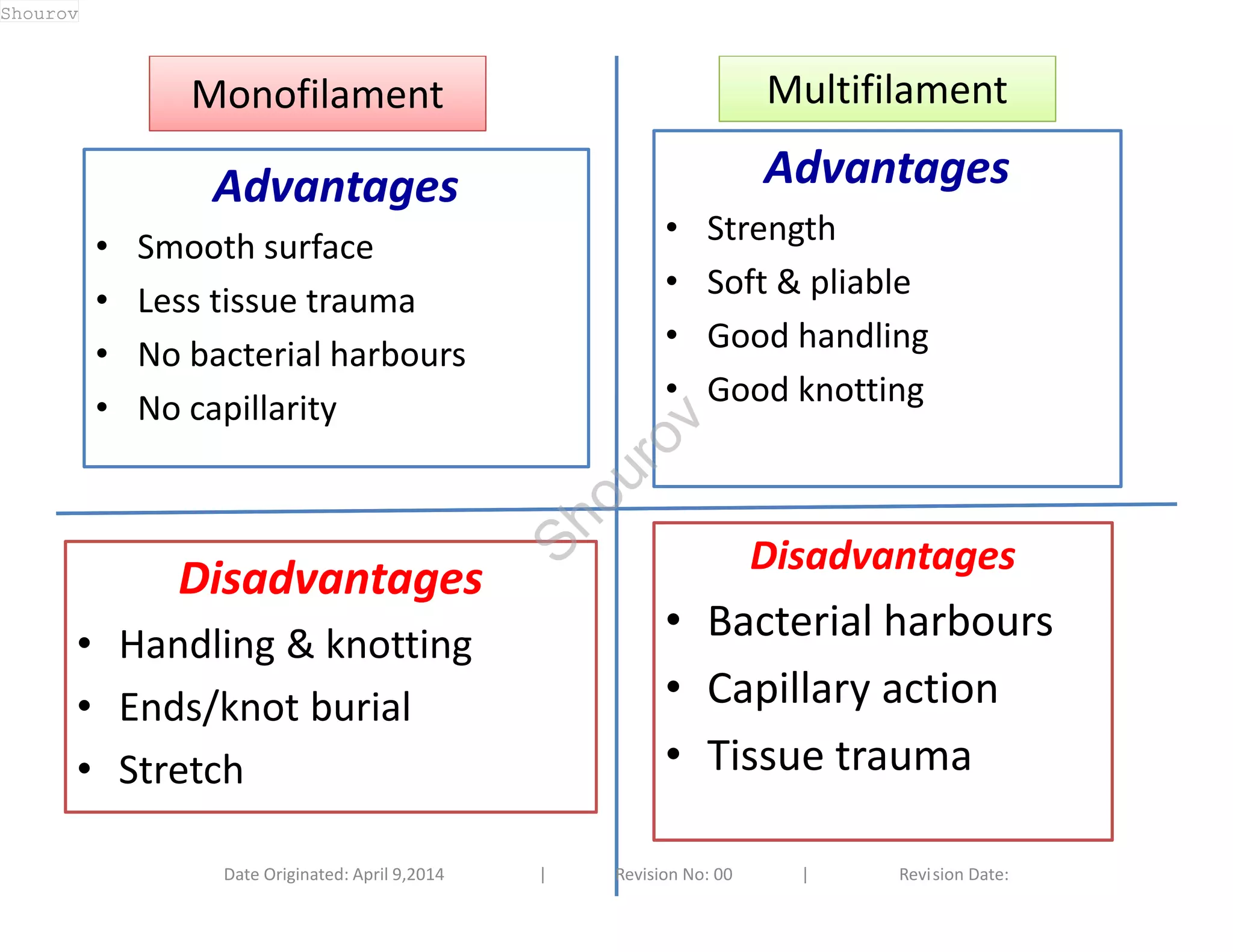
MMoonnooffiillaammeenntt 
Advantages 
• Smooth surface 
• Less tissue trauma 
• No bacterial harbours 
• No capillarity 
Disadvantages 
• Handling & knotting 
• Ends/knot burial 
• Stretch 
MMuullttiiffiillaammeenntt 
Advantages 
• Strength 
• Soft & pliable 
• Good handling 
• Good knotting 
Disadvantages 
• Bacterial harbours 
• Capillary action 
• Tissue trauma 
Date Originated: April 9,2014 | Revision No: 00 | Revision Date: 
Shourov 
Shourov
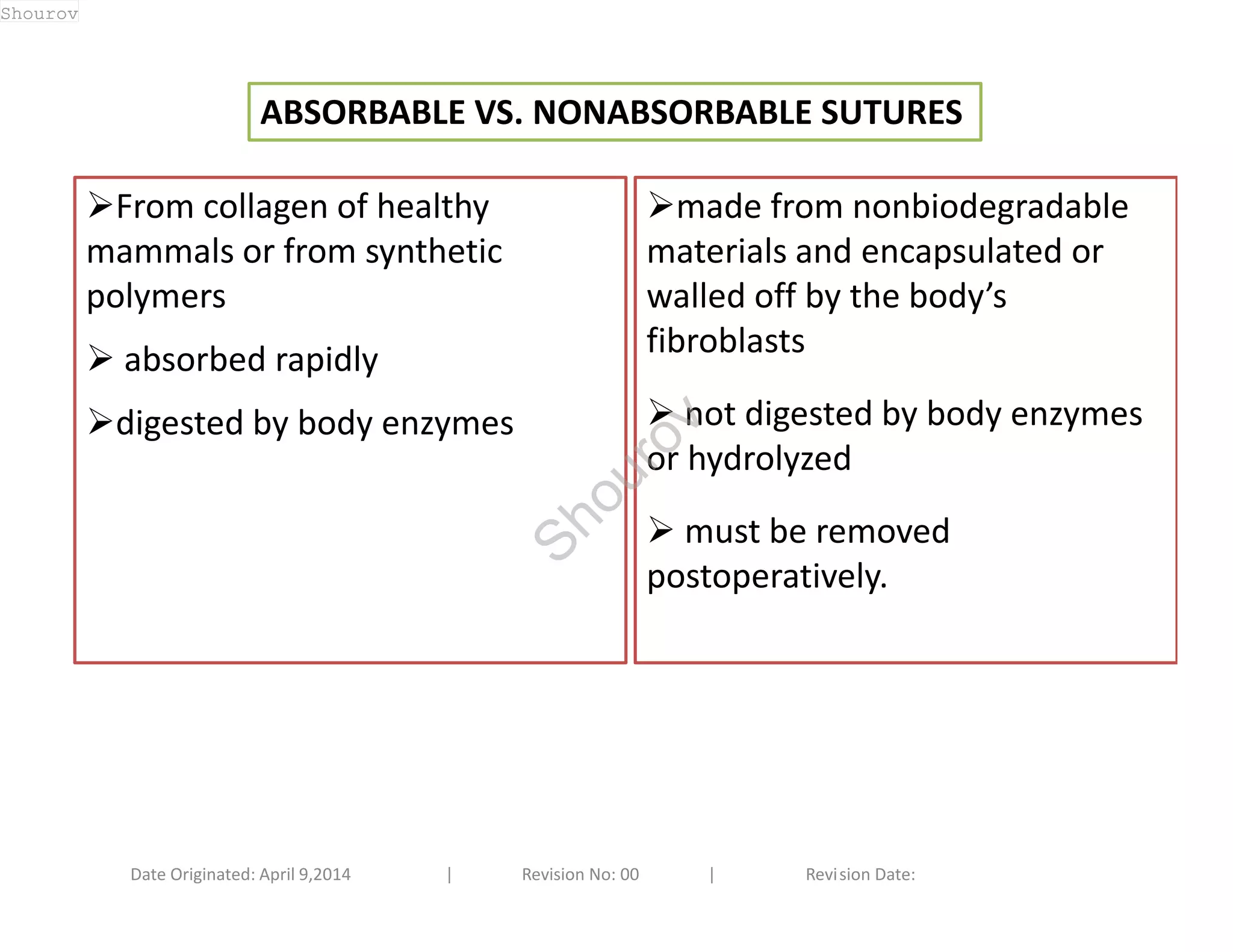
ABSORBABLE VS. NONABSORBABLE SUTURES 
From collagen of healthy 
mammals or from synthetic 
polymers 
 absorbed rapidly 
digested by body enzymes 
made from nonbiodegradable 
materials and encapsulated or 
walled off by the body’s 
fibroblasts 
 not digested by body enzymes 
or hydrolyzed 
 must be removed 
postoperatively. 
Date Originated: April 9,2014 | Revision No: 00 | Revision Date: 
Shourov 
Shourov
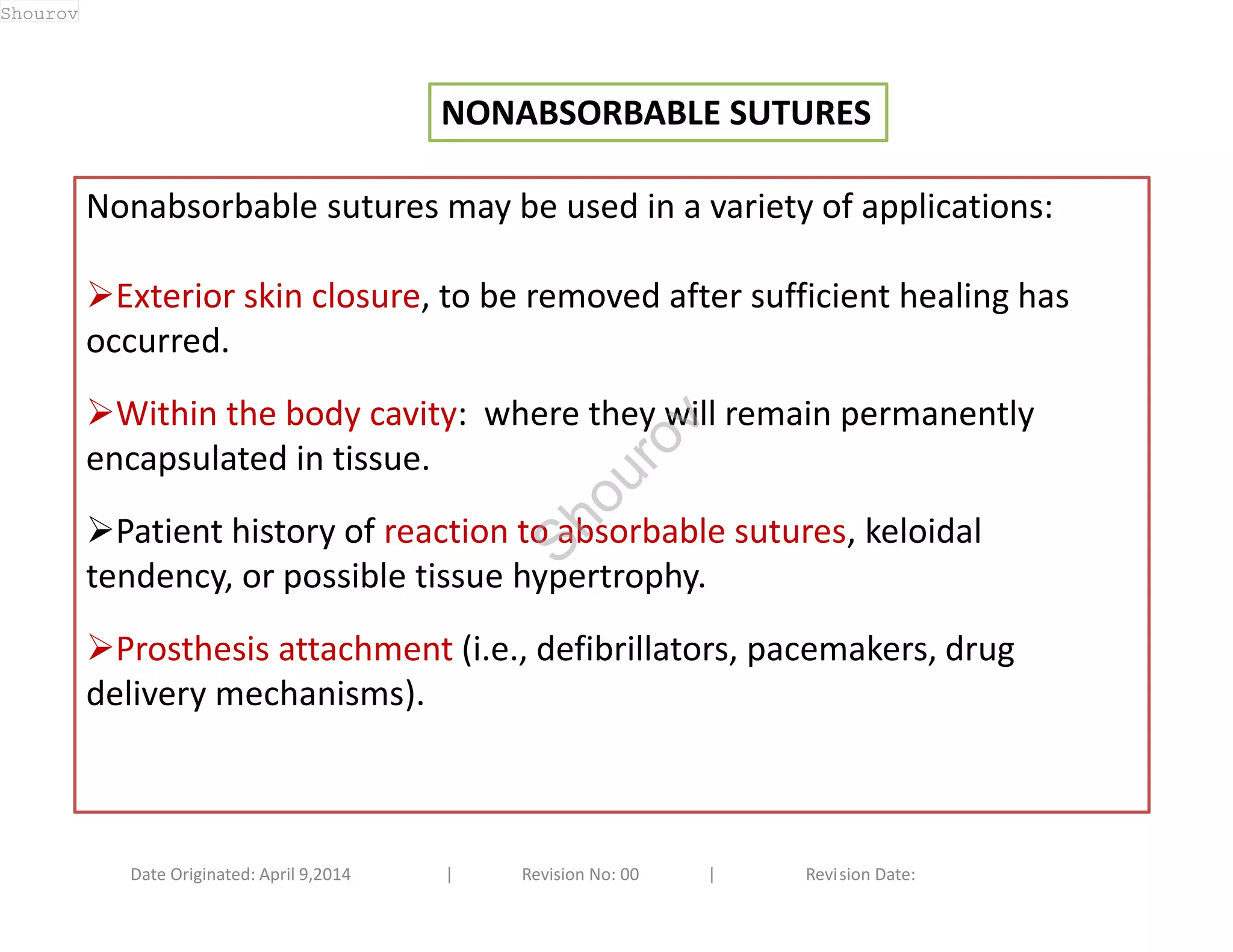
NONABSORBABLE SUTURES 
Nonabsorbable sutures may be used in a variety of applications: 
Exterior skin closure, to be removed after sufficient healing has 
occurred. 
Within the body cavity: where they will remain permanently 
encapsulated in tissue. 
Patient history of reaction to absorbable sutures, keloidal 
tendency, or possible tissue hypertrophy. 
Prosthesis attachment (i.e., defibrillators, pacemakers, drug 
delivery mechanisms). 
Date Originated: April 9,2014 | Revision No: 00 | Revision Date: 
Shourov 
Shourov
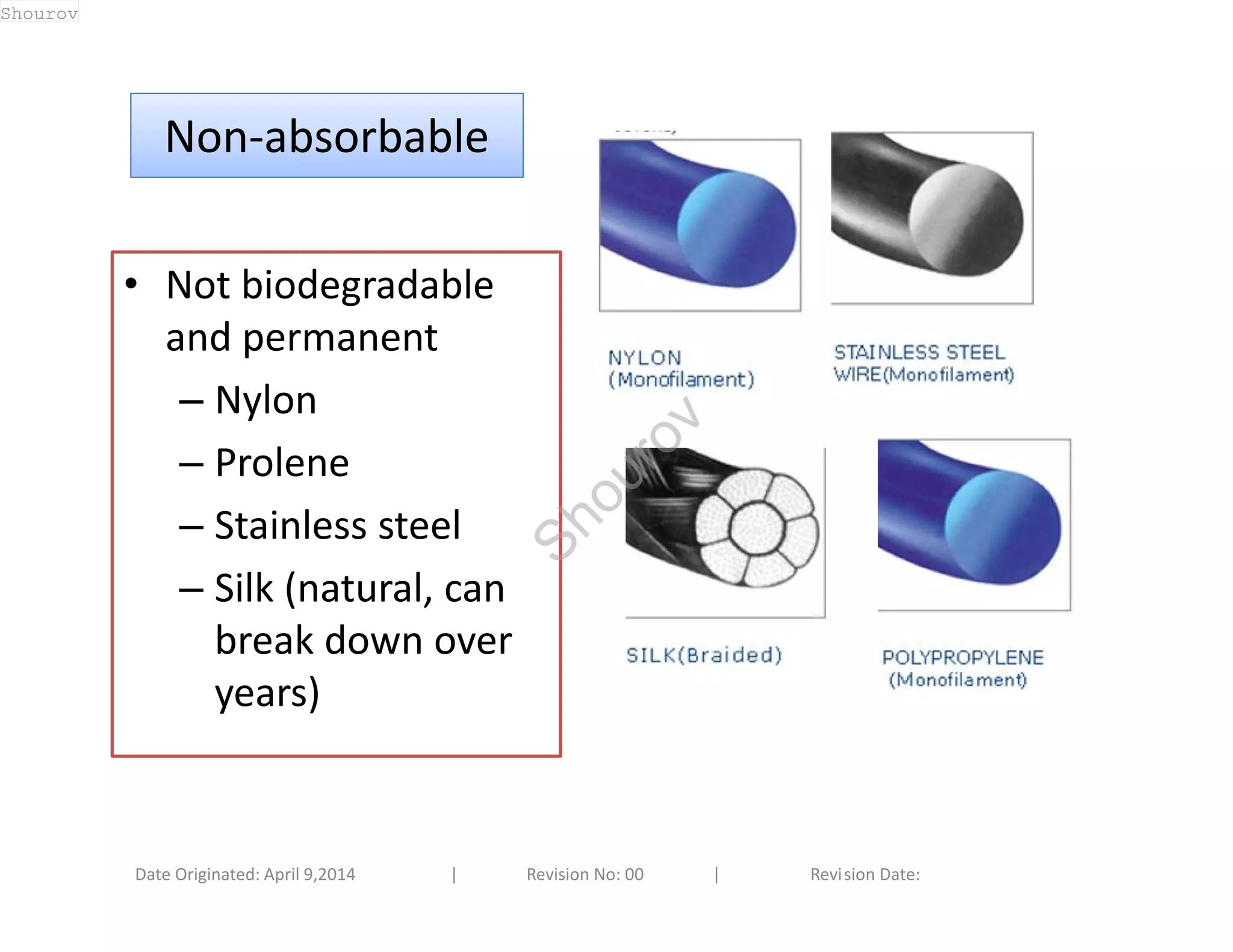
NNoonn--aabbssoorrbbaabbllee 
• Not biodegradable 
and permanent 
– Nylon 
– Prolene 
– Stainless steel 
– Silk (natural, can 
break down over 
years) 
Date Originated: April 9,2014 | Revision No: 00 | Revision Date: 
Shourov 
Shourov
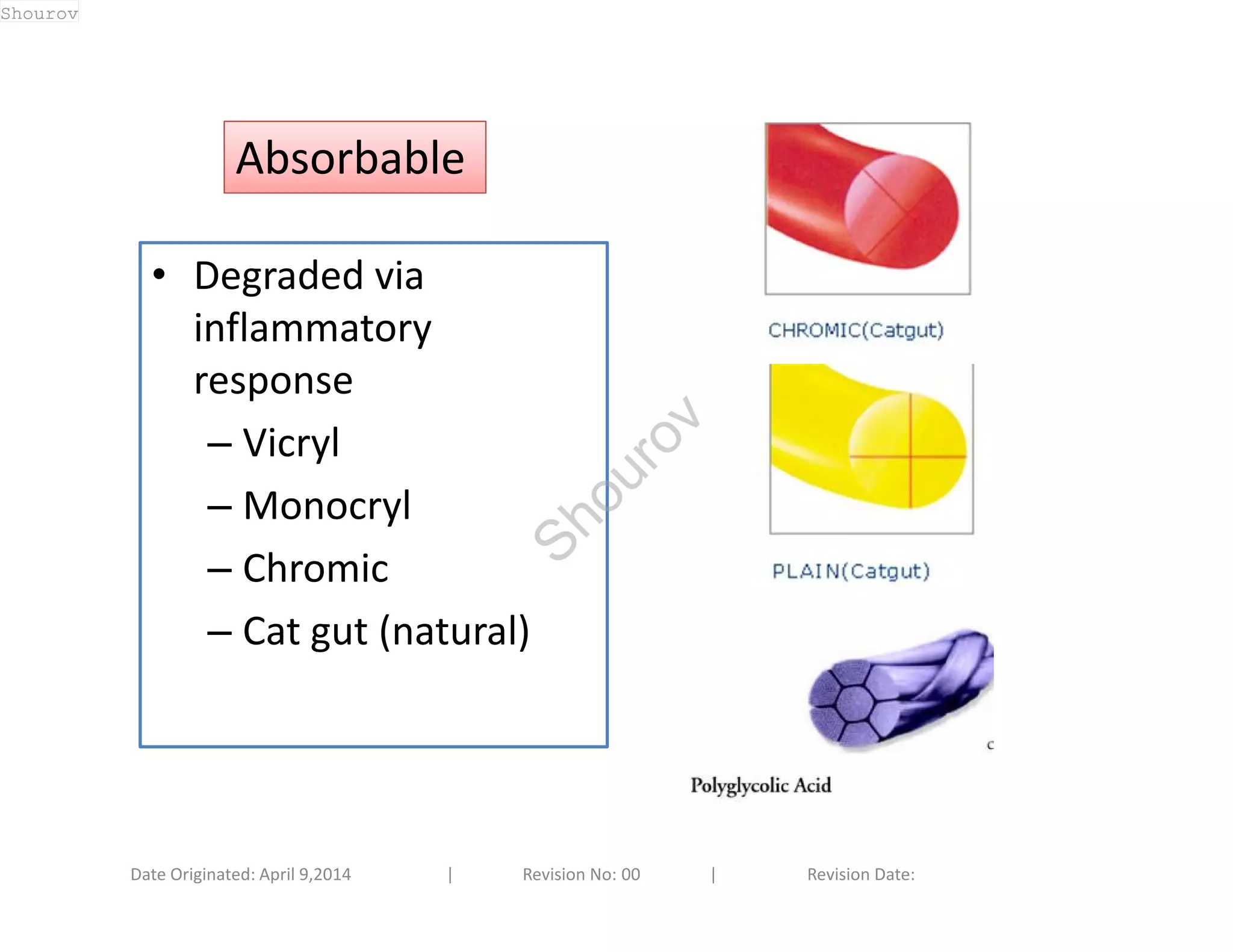
AAbbssoorrbbaabbllee 
• Degraded via 
inflammatory 
response 
– Vicryl 
– Monocryl 
– Chromic 
– Cat gut (natural) 
Date Originated: April 9,2014 | Revision No: 00 | Revision Date: 
Shourov 
Shourov
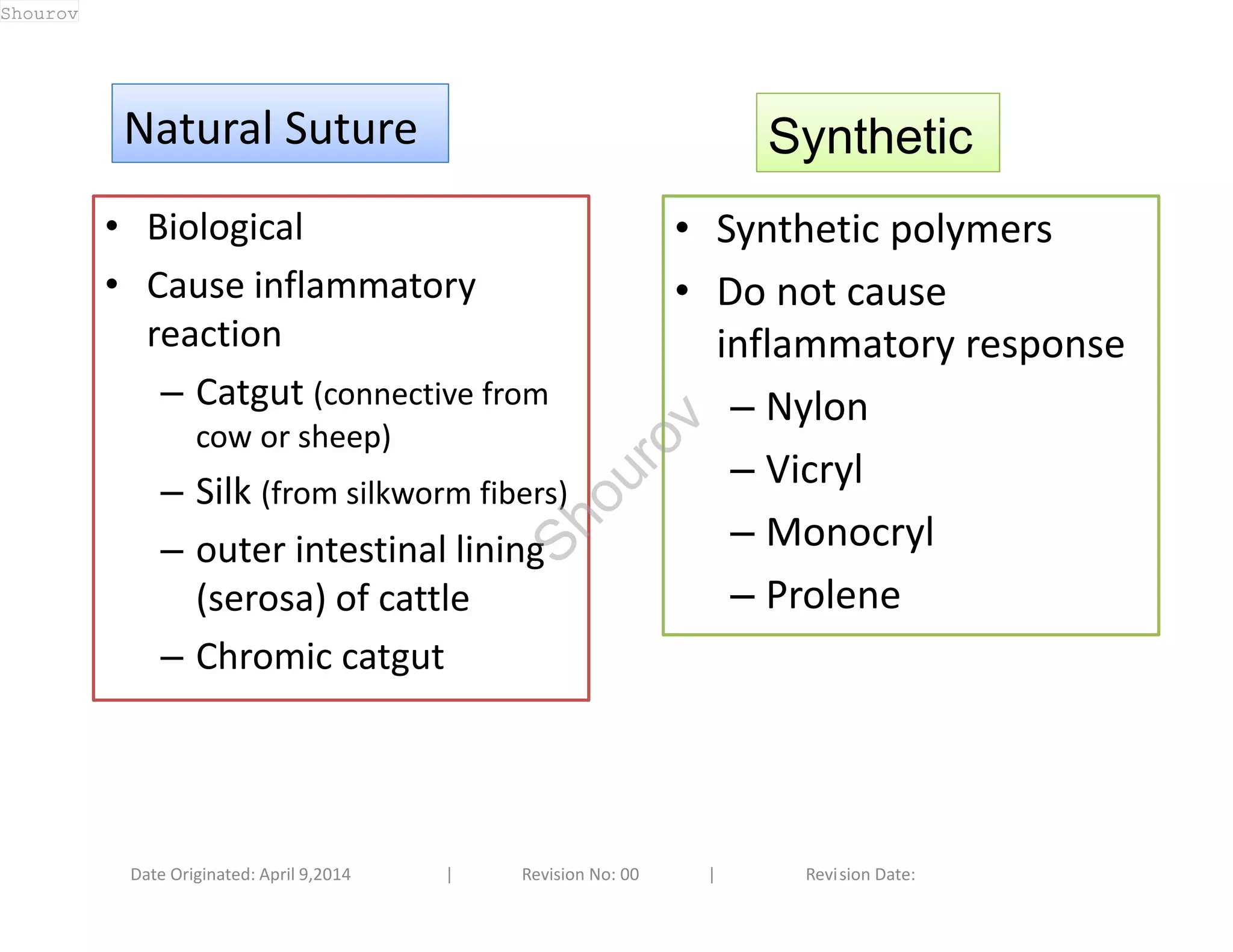
NNaattuurraall SSuuttuurree 
• Biological 
• Cause inflammatory 
reaction 
– Catgut (connective from 
cow or sheep) 
– Silk (from silkworm fibers) 
– outer intestinal lining 
(serosa) of cattle 
– Chromic catgut 
Synthetic 
• Synthetic polymers 
• Do not cause 
inflammatory response 
– Nylon 
– Vicryl 
– Monocryl 
– Prolene 
Date Originated: April 9,2014 | Revision No: 00 | Revision Date: 
Shourov 
Shourov
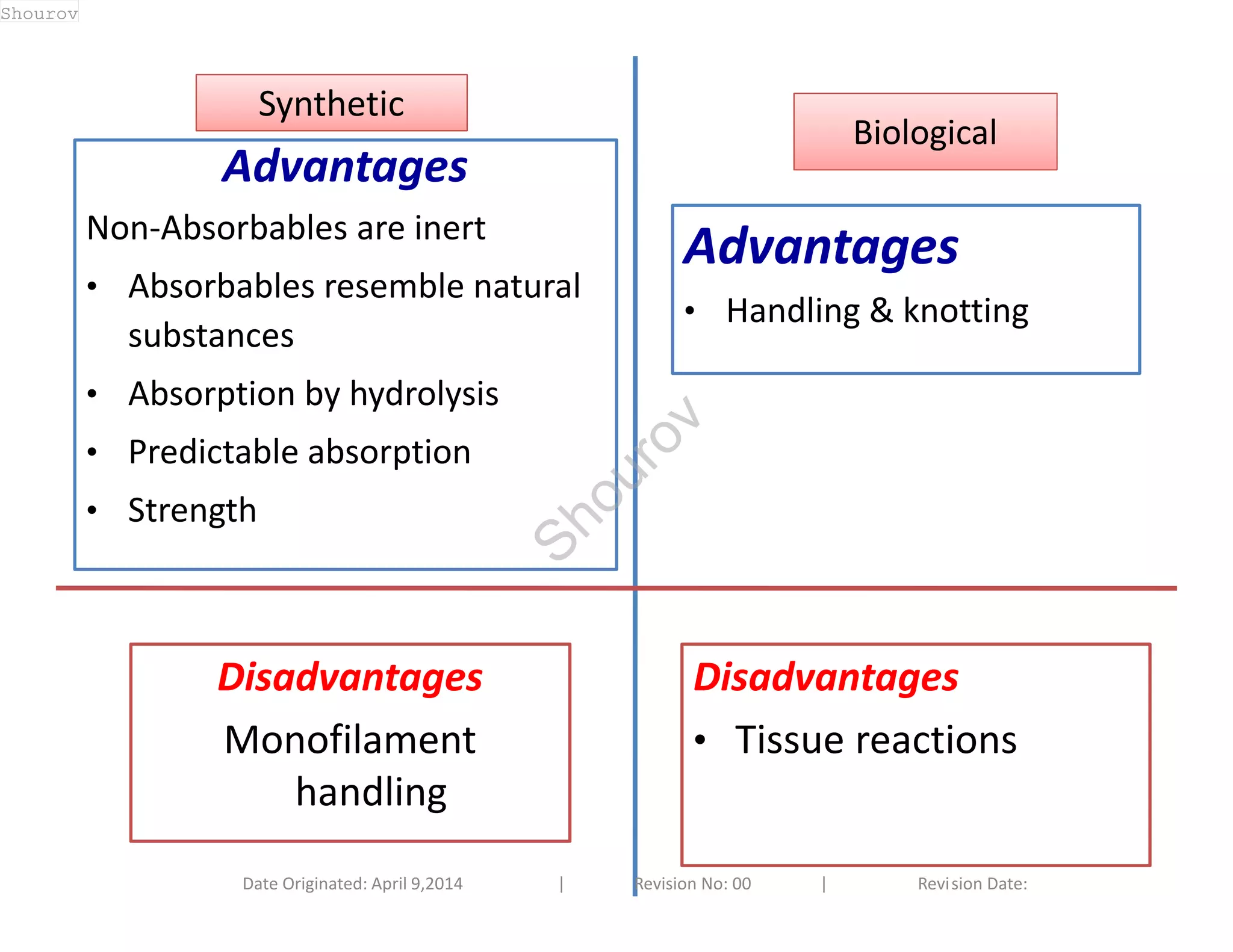
SSyynntthheettiicc 
Advantages 
Non-Absorbables are inert 
• Absorbables resemble natural 
substances 
• Absorption by hydrolysis 
• Predictable absorption 
• Strength 
Disadvantages 
Monofilament 
handling 
BBiioollooggiiccaall 
Advantages 
• Handling & knotting 
Disadvantages 
• Tissue reactions 
Date Originated: April 9,2014 | Revision No: 00 | Revision Date: 
Shourov 
Shourov
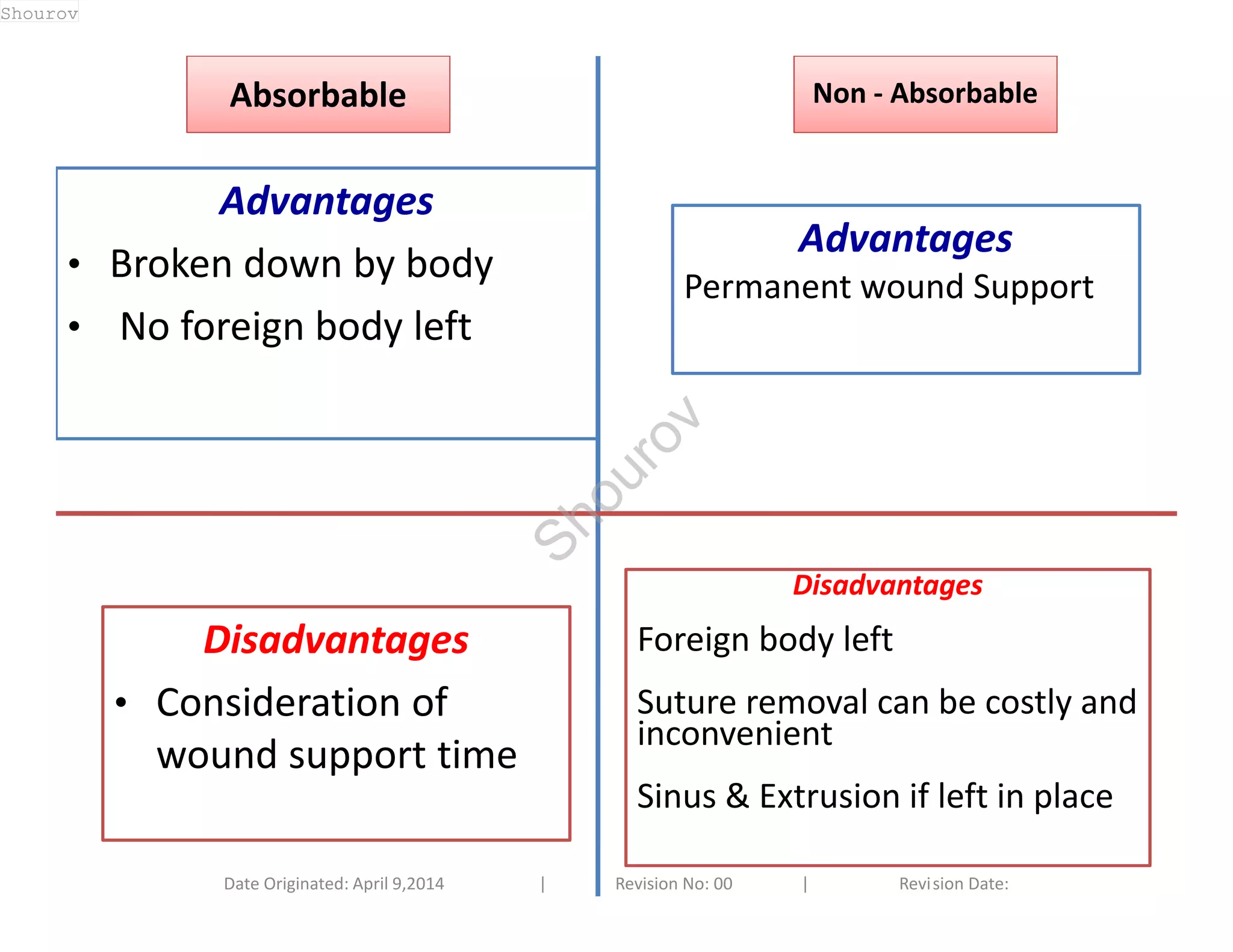
Advantages 
• Broken down by body 
• No foreign body left 
Disadvantages 
• Consideration of 
wound support time 
NNoonn -- AAbbssoorrbbaabbllee 
Advantages 
Permanent wound Support 
Disadvantages 
Foreign body left 
Suture removal can be costly and 
inconvenient 
Sinus & Extrusion if left in place 
AAbbssoorrbbaabbllee 
Date Originated: April 9,2014 | Revision No: 00 | Revision Date: 
Shourov 
Shourov
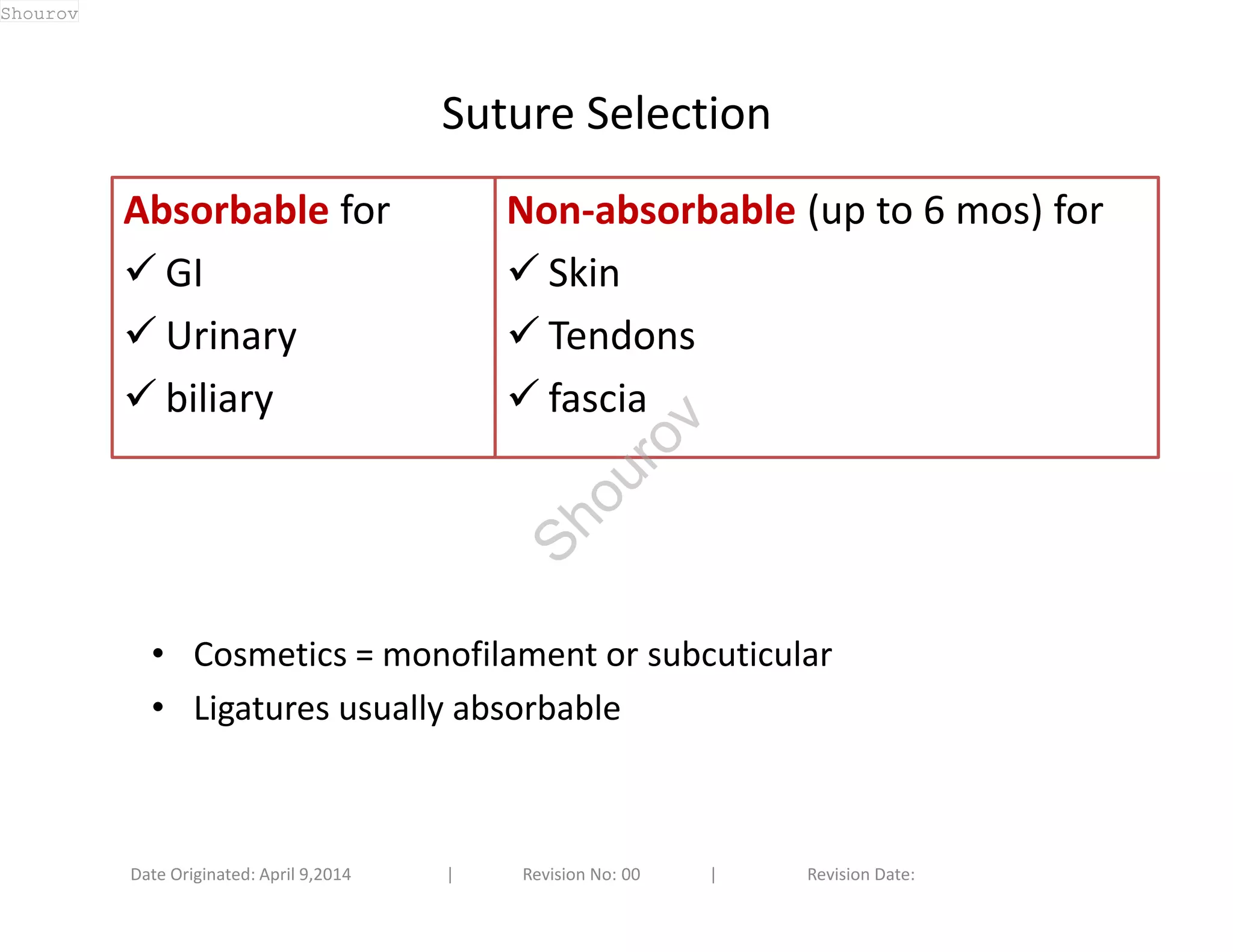
Suture Selection 
Absorbable for 
 GI 
 Urinary 
 biliary 
Non-absorbable (up to 6 mos) for 
 Skin 
 Tendons 
 fascia 
• Cosmetics = monofilament or subcuticular 
• Ligatures usually absorbable 
Date Originated: April 9,2014 | Revision No: 00 | Revision Date: 
Shourov 
Shourov
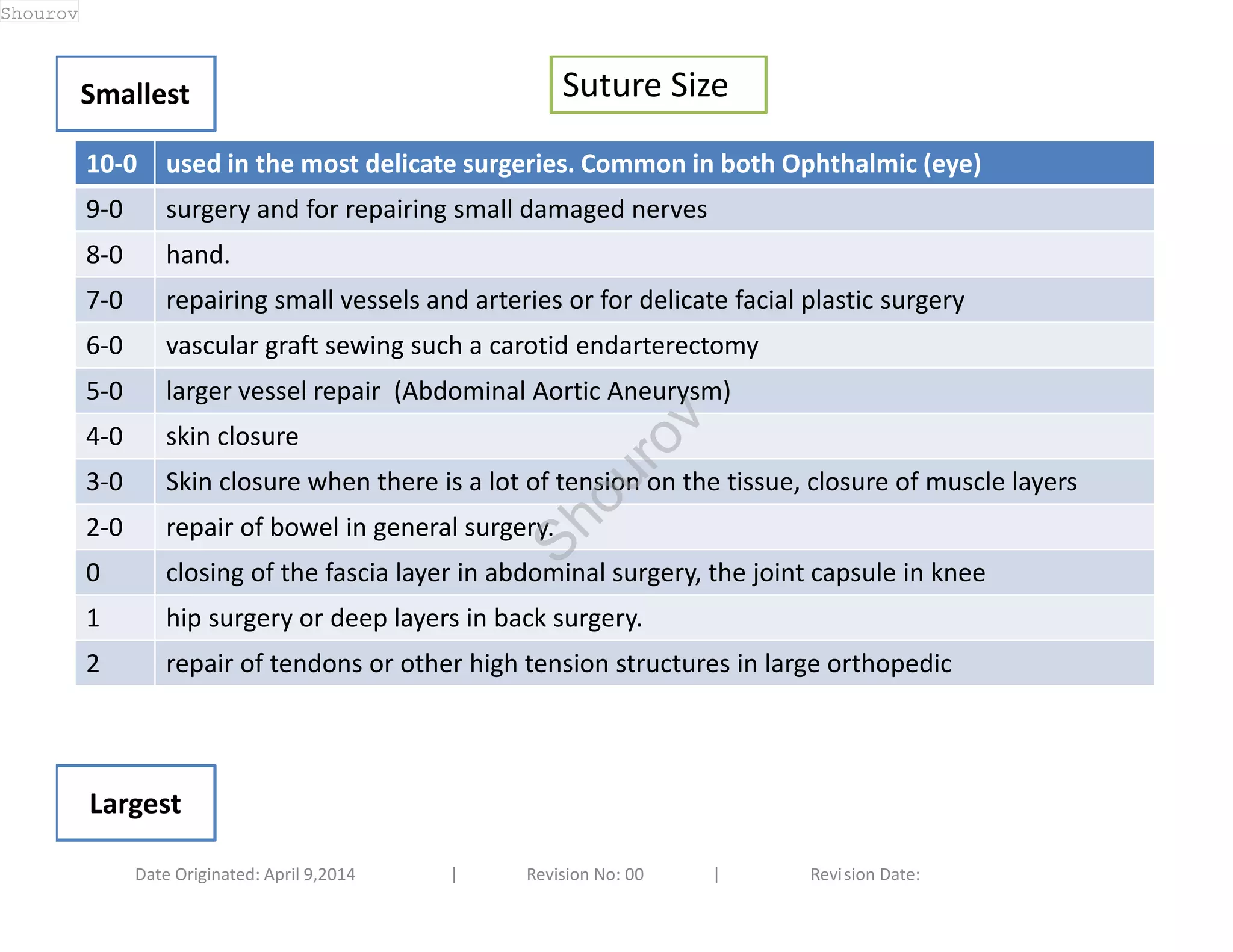
Suture Size 
Smallest 
10-0 used in the most delicate surgeries. Common in both Ophthalmic (eye) 
9-0 surgery and for repairing small damaged nerves 
8-0 hand. 
7-0 repairing small vessels and arteries or for delicate facial plastic surgery 
6-0 vascular graft sewing such a carotid endarterectomy 
5-0 larger vessel repair (Abdominal Aortic Aneurysm) 
4-0 skin closure 
3-0 Skin closure when there is a lot of tension on the tissue, closure of muscle layers 
2-0 repair of bowel in general surgery. 
0 closing of the fascia layer in abdominal surgery, the joint capsule in knee 
1 hip surgery or deep layers in back surgery. 
2 repair of tendons or other high tension structures in large orthopedic 
Largest 
Date Originated: April 9,2014 | Revision No: 00 | Revision Date: 
Shourov 
Shourov
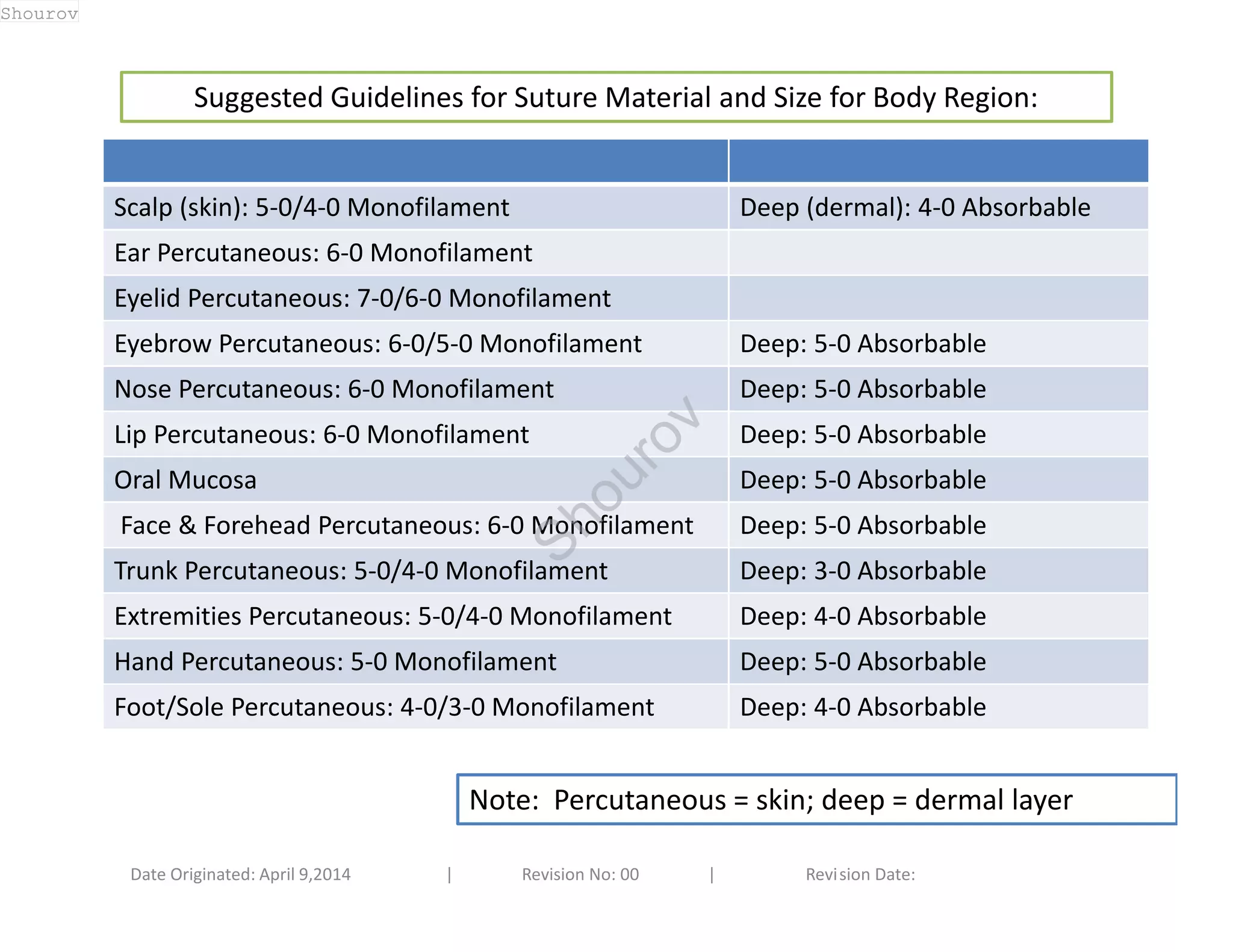
Suggested Guidelines for Suture Material and Size for Body Region: 
Scalp (skin): 5-0/4-0 Monofilament Deep (dermal): 4-0 Absorbable 
Ear Percutaneous: 6-0 Monofilament 
Eyelid Percutaneous: 7-0/6-0 Monofilament 
Eyebrow Percutaneous: 6-0/5-0 Monofilament Deep: 5-0 Absorbable 
Nose Percutaneous: 6-0 Monofilament Deep: 5-0 Absorbable 
Lip Percutaneous: 6-0 Monofilament Deep: 5-0 Absorbable 
Oral Mucosa Deep: 5-0 Absorbable 
Face & Forehead Percutaneous: 6-0 Monofilament Deep: 5-0 Absorbable 
Trunk Percutaneous: 5-0/4-0 Monofilament Deep: 3-0 Absorbable 
Extremities Percutaneous: 5-0/4-0 Monofilament Deep: 4-0 Absorbable 
Hand Percutaneous: 5-0 Monofilament Deep: 5-0 Absorbable 
Foot/Sole Percutaneous: 4-0/3-0 Monofilament Deep: 4-0 Absorbable 
Note: Percutaneous = skin; deep = dermal layer 
Date Originated: April 9,2014 | Revision No: 00 | Revision Date: 
Shourov 
Shourov
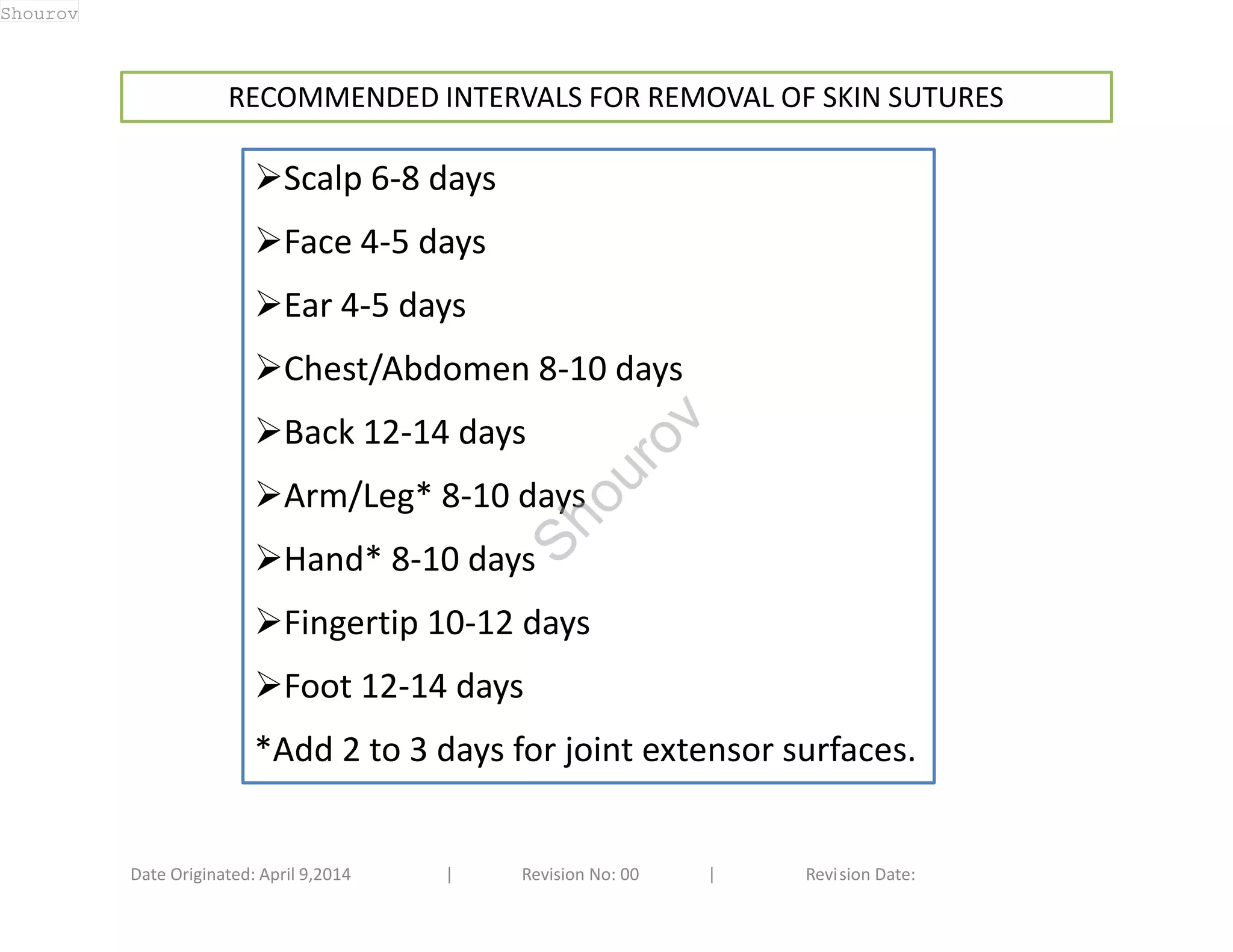
RECOMMENDED INTERVALS FOR REMOVAL OF SKIN SUTURES 
Scalp 6-8 days 
Face 4-5 days 
Ear 4-5 days 
Chest/Abdomen 8-10 days 
Back 12-14 days 
Arm/Leg* 8-10 days 
Hand* 8-10 days 
Fingertip 10-12 days 
Foot 12-14 days 
*Add 2 to 3 days for joint extensor surfaces. 
Date Originated: April 9,2014 | Revision No: 00 | Revision Date: 
Shourov 
Shourov
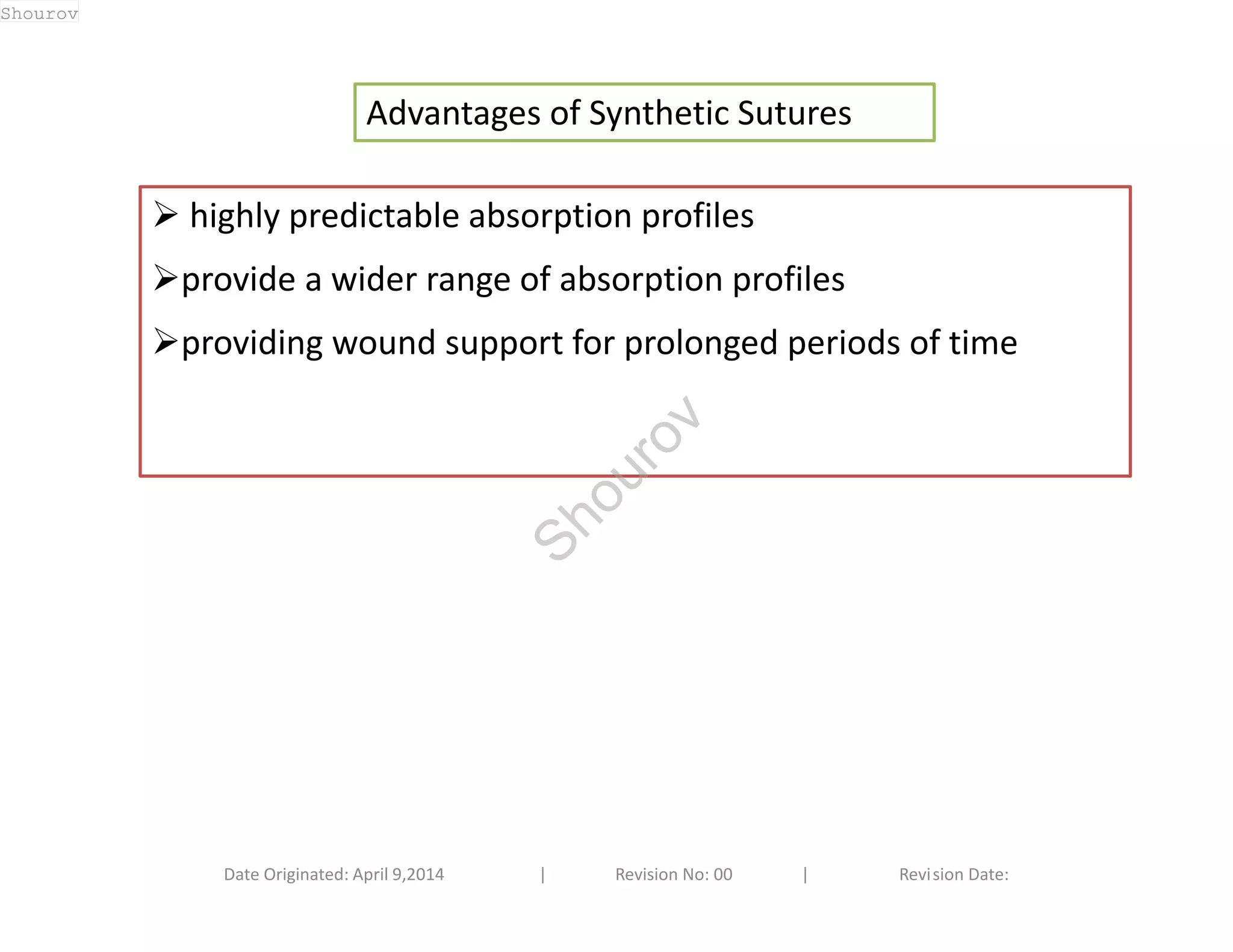
Advantages of Synthetic Sutures 
 highly predictable absorption profiles 
provide a wider range of absorption profiles 
providing wound support for prolonged periods of time 
Date Originated: April 9,2014 | Revision No: 00 | Revision Date: 
Shourov 
Shourov
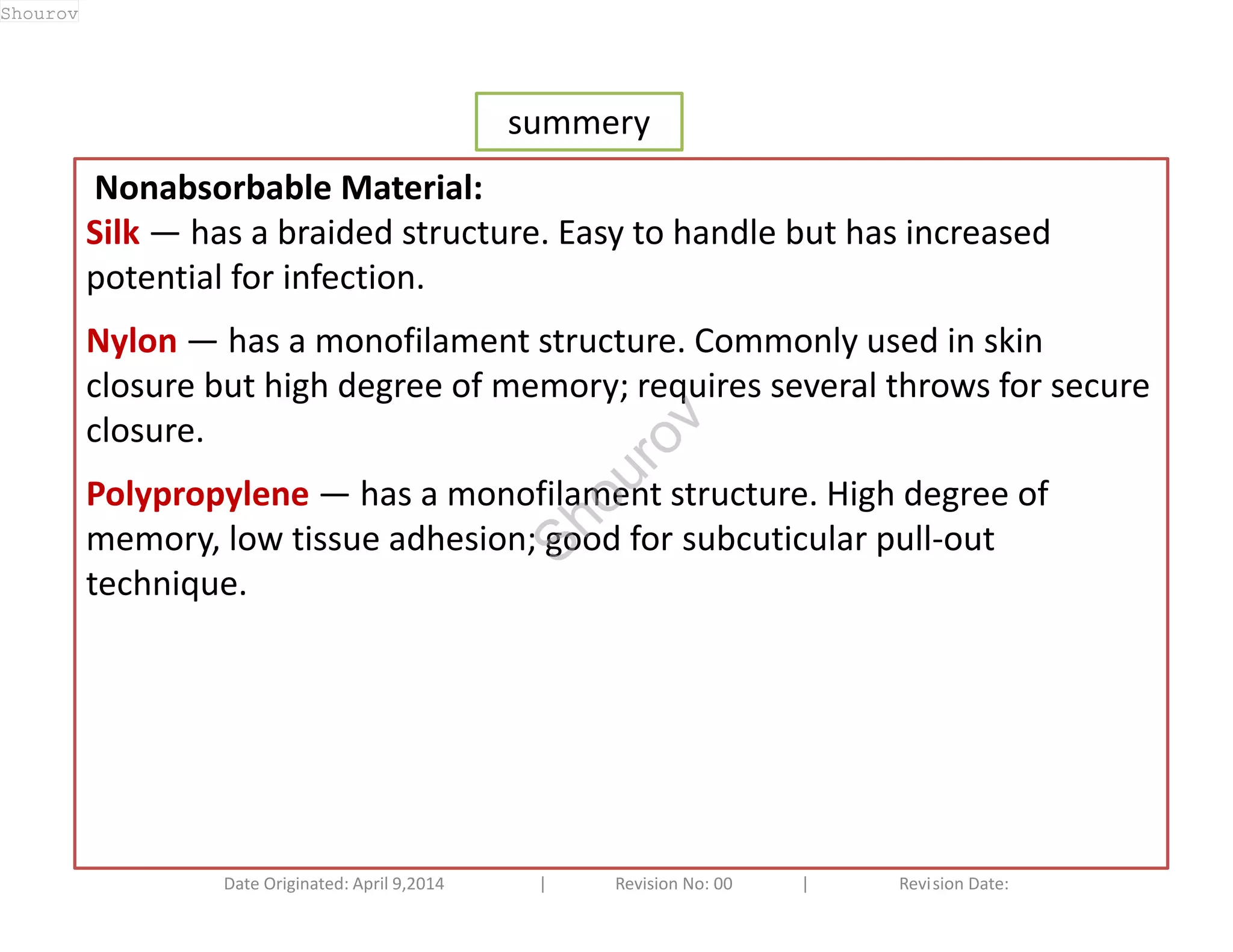
summery 
Nonabsorbable Material: 
Silk — has a braided structure. Easy to handle but has increased 
potential for infection. 
Nylon — has a monofilament structure. Commonly used in skin 
closure but high degree of memory; requires several throws for secure 
closure. 
Polypropylene — has a monofilament structure. High degree of 
memory, low tissue adhesion; good for subcuticular pull-out 
technique. 
Date Originated: April 9,2014 | Revision No: 00 | Revision Date: 
Shourov 
Shourov
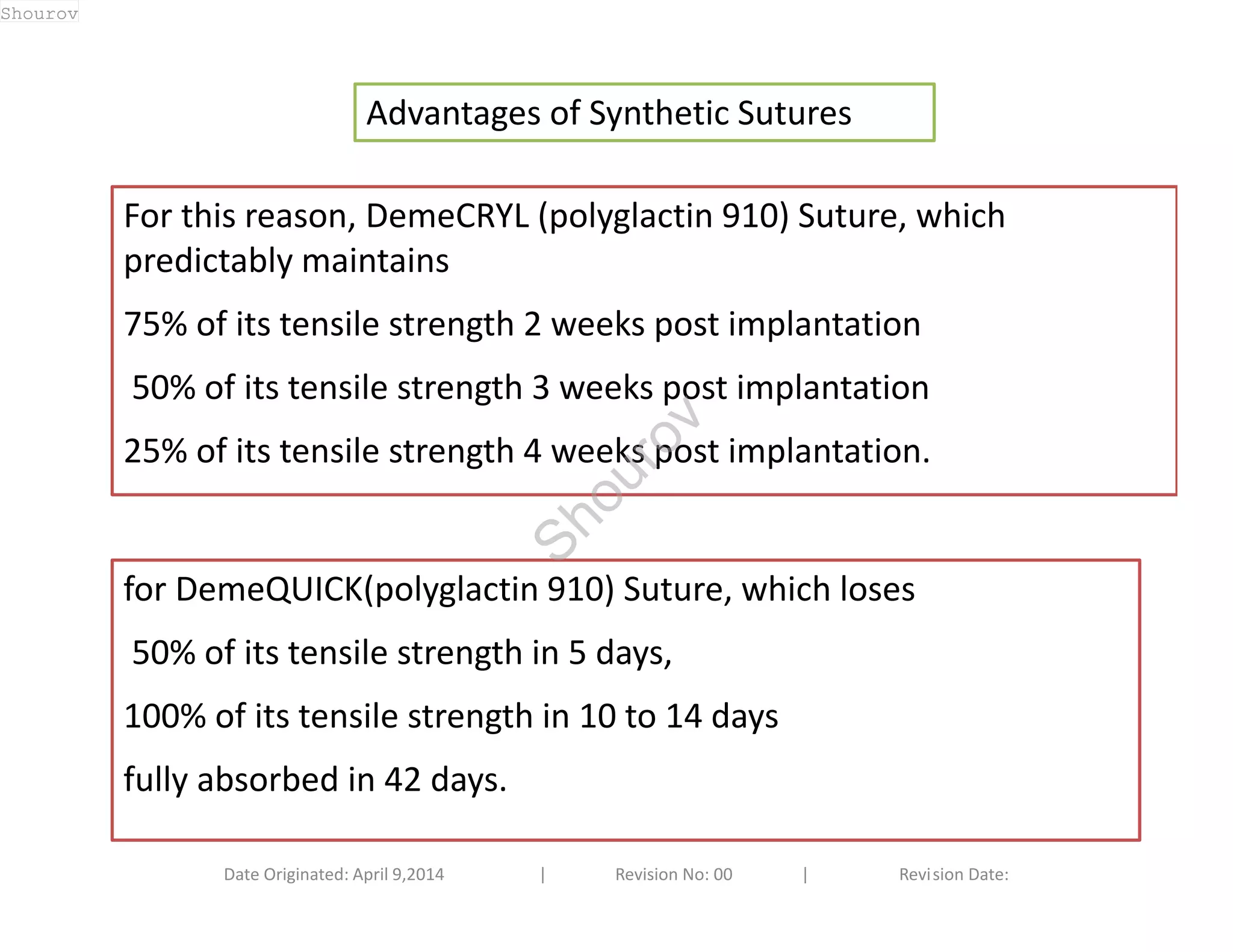
Advantages of Synthetic Sutures 
For this reason, DemeCRYL (polyglactin 910) Suture, which 
predictably maintains 
75% of its tensile strength 2 weeks post implantation 
50% of its tensile strength 3 weeks post implantation 
25% of its tensile strength 4 weeks post implantation. 
for DemeQUICK(polyglactin 910) Suture, which loses 
50% of its tensile strength in 5 days, 
100% of its tensile strength in 10 to 14 days 
fully absorbed in 42 days. 
Date Originated: April 9,2014 | Revision No: 00 | Revision Date: 
Shourov 
Shourov
Date Originated: April 9,2014 | Revision No: 00 | Revision Date: 
Shourov 
Shourov

Surgical suture basics

  • 1.
    Prepared by :ARFAN AHMED SHOUROV Date Originated: April 9,2014 | Revision No: 00 | Revision Date: Shourov Shourov
  • 2.
    Tools: 1. Needle 2. Suture material The Suture The word "suture" describes any strand of material used to ligate (tie) blood vessels or approximate (bring close together) tissues. Sutures are used to close wounds. Date Originated: April 9,2014 | Revision No: 00 | Revision Date: Shourov Shourov
  • 3.
    Properties of SutureMaterial… Properties Physical Tensile Strength, Dimension, Knot-pull strength, Knot security, Stiffness Handling Knot-tie down, First throw hold, Tissue drag, Package memory, Suppleness Biological Tissue reaction, Absorption, Biocompatibility, Tensile strength loss All standards, test procedures and product specifications are set by U.S. Pharmacopeia (U.S.P.) Date Originated: April 9,2014 | Revision No: 00 | Revision Date: Shourov Shourov
  • 4.
    Characteristics of anIdeal Suture Usable in any procedure Inert (minimum tissue reaction), disappears after the wound is healed Easy to handle, pliable, high knot security Predictable performance Uniform tensile strength and tensile retention Sterile, no capillarity Date Originated: April 9,2014 | Revision No: 00 | Revision Date: Shourov Shourov
  • 5.
    Suture classification AAbbssoorrbbaabblleeNNoonn--AAbbssoorrbbaabbllee NNaattuurraall Synthetic NNaattuurraall Synthetic MMoonnooffiillaammeenntt MMuullttiiffiillaammeenntt Short-Medium -term Medium -term Longer -term MMoonnooffiillaammeenntt MMuullttiiffiillaammeenntt Short -term Date Originated: April 9,2014 | Revision No: 00 | Revision Date: Shourov Shourov
  • 6.
    Classifying Suture Material… Suture Types Generic Structure Classification Catgut Collagen from animal intestines Natural, absorbable, twisted multifilament (mono.) Silk Fibroin from silkworm Bombyx mori Natural, non-absorbable, braid multifilament Polypropylene Isotactic crystalline stereoisomer of PP Synthetic, non-absorbable, monofilament Polyamide Nylon 6 and nylon 6,6 Synthetic, non-absorbable, monofilament Stainless steel 316L (low carbon) stainless steel alloy Metal, non-absorbable, mono and multifilament Polyglycolic acid/ Polylactic acid 90% PGA, 10% PLA Synthetic, absorbable, braided multifilament Polydioxanone Polyester p-dioxanone Synthetic, absorbable, monofilament Polyglycolic acid/ Copolymer of glycolic acid and Synthetic, absorbable, monofilament Polytrimethylene trimethylene carbonate carbonate Source: Ratner et al. 2004 Date Originated: April 9,2014 | Revision No: 00 | Revision Date: Shourov Shourov
  • 7.
    Classifying Suture Material… Fiber construction Source: Suture Technical Specifications, Demetech (http://www.demetech.us/suture-specs.php) Date Originated: April 9,2014 | Revision No: 00 | Revision Date: Shourov Shourov
  • 8.
    MONOFILAMENT VS. MULTIFILAMENTSTRANDS  single strand of material  encounter less resistance as they pass through tissue (Tissue Drag )  well-suited to vascular surgery  tie down easily Crushing or crimping can create a weak spot in the strand  minimize scarring  several filaments, or strands, twisted or braided together  affords greater tensile strength, pliability, and flexibility  coated to help them pass relatively smoothly through tissue and enhance handling characteristics Date Originated: April 9,2014 | Revision No: 00 | Revision Date: Shourov Shourov
  • 9.
    MONOFILAMENT VS. MULTIFILAMENTSTRANDS • Minimal tissue trauma • Smooth tying but more knots needed • Harder to handle • Occur irritant (if present for a long time). • Examples: nylon, monocryl, prolene, • Easier to handle • Fewer knots needed • Examples: vicryl, silk, chromic Date Originated: April 9,2014 | Revision No: 00 | Revision Date: Shourov Shourov
  • 10.
    Disadvantages of BraidedSutures  Risk of Infection: braided suture can serve as bacteria U2 harboring zones, allowing bacteria to colonize and multiply. Increased Tissue Drag - Their braided structure has a rougher surface than that of a monofilament. This results in increased tissue drag, which can cause irritation, and a certain amount of tissue damage depending on suture technique. Increased tissue trauma is a risk factor for infection. Date Originated: April 9,2014 | Revision No: 00 | Revision Date: Shourov Shourov
  • 11.
    Slide 10 U2interstices serve as highways over which bacteria can travel; This movement of bacteria along the suture line is called capillarity. User, 4/8/2014 Shourov Shourov
  • 12.
    In order tominimize scarring, a monofilament suture such as DemeCAPRONE (poliglecaprone 25) Suture might be chosen over a braided suture such as DemeCRYL* (polyglactin 910) a monofilament suture is that its smooth surface reduces the chance of harboring bacteria. Date Originated: April 9,2014 | Revision No: 00 | Revision Date: Shourov Shourov
  • 13.
    ABSORBABLE SUTURES vsNONABSORBABLE SUTURES Sutures that undergo rapid degradation in tissues, losing their tensile strength within 60 days, are considered absorbable sutures. digested by body enzymes Sutures that generally maintain their tensile strength for longer than 60 days are non absorbable sutures. Date Originated: April 9,2014 | Revision No: 00 | Revision Date: Shourov Shourov
  • 14.
    MMoonnooffiillaammeenntt Advantages •Smooth surface • Less tissue trauma • No bacterial harbours • No capillarity Disadvantages • Handling & knotting • Ends/knot burial • Stretch MMuullttiiffiillaammeenntt Advantages • Strength • Soft & pliable • Good handling • Good knotting Disadvantages • Bacterial harbours • Capillary action • Tissue trauma Date Originated: April 9,2014 | Revision No: 00 | Revision Date: Shourov Shourov
  • 15.
    ABSORBABLE VS. NONABSORBABLESUTURES From collagen of healthy mammals or from synthetic polymers  absorbed rapidly digested by body enzymes made from nonbiodegradable materials and encapsulated or walled off by the body’s fibroblasts  not digested by body enzymes or hydrolyzed  must be removed postoperatively. Date Originated: April 9,2014 | Revision No: 00 | Revision Date: Shourov Shourov
  • 16.
    NONABSORBABLE SUTURES Nonabsorbablesutures may be used in a variety of applications: Exterior skin closure, to be removed after sufficient healing has occurred. Within the body cavity: where they will remain permanently encapsulated in tissue. Patient history of reaction to absorbable sutures, keloidal tendency, or possible tissue hypertrophy. Prosthesis attachment (i.e., defibrillators, pacemakers, drug delivery mechanisms). Date Originated: April 9,2014 | Revision No: 00 | Revision Date: Shourov Shourov
  • 17.
    NNoonn--aabbssoorrbbaabbllee • Notbiodegradable and permanent – Nylon – Prolene – Stainless steel – Silk (natural, can break down over years) Date Originated: April 9,2014 | Revision No: 00 | Revision Date: Shourov Shourov
  • 18.
    AAbbssoorrbbaabbllee • Degradedvia inflammatory response – Vicryl – Monocryl – Chromic – Cat gut (natural) Date Originated: April 9,2014 | Revision No: 00 | Revision Date: Shourov Shourov
  • 19.
    NNaattuurraall SSuuttuurree •Biological • Cause inflammatory reaction – Catgut (connective from cow or sheep) – Silk (from silkworm fibers) – outer intestinal lining (serosa) of cattle – Chromic catgut Synthetic • Synthetic polymers • Do not cause inflammatory response – Nylon – Vicryl – Monocryl – Prolene Date Originated: April 9,2014 | Revision No: 00 | Revision Date: Shourov Shourov
  • 20.
    SSyynntthheettiicc Advantages Non-Absorbablesare inert • Absorbables resemble natural substances • Absorption by hydrolysis • Predictable absorption • Strength Disadvantages Monofilament handling BBiioollooggiiccaall Advantages • Handling & knotting Disadvantages • Tissue reactions Date Originated: April 9,2014 | Revision No: 00 | Revision Date: Shourov Shourov
  • 21.
    Advantages • Brokendown by body • No foreign body left Disadvantages • Consideration of wound support time NNoonn -- AAbbssoorrbbaabbllee Advantages Permanent wound Support Disadvantages Foreign body left Suture removal can be costly and inconvenient Sinus & Extrusion if left in place AAbbssoorrbbaabbllee Date Originated: April 9,2014 | Revision No: 00 | Revision Date: Shourov Shourov
  • 22.
    Suture Selection Absorbablefor  GI  Urinary  biliary Non-absorbable (up to 6 mos) for  Skin  Tendons  fascia • Cosmetics = monofilament or subcuticular • Ligatures usually absorbable Date Originated: April 9,2014 | Revision No: 00 | Revision Date: Shourov Shourov
  • 23.
    Suture Size Smallest 10-0 used in the most delicate surgeries. Common in both Ophthalmic (eye) 9-0 surgery and for repairing small damaged nerves 8-0 hand. 7-0 repairing small vessels and arteries or for delicate facial plastic surgery 6-0 vascular graft sewing such a carotid endarterectomy 5-0 larger vessel repair (Abdominal Aortic Aneurysm) 4-0 skin closure 3-0 Skin closure when there is a lot of tension on the tissue, closure of muscle layers 2-0 repair of bowel in general surgery. 0 closing of the fascia layer in abdominal surgery, the joint capsule in knee 1 hip surgery or deep layers in back surgery. 2 repair of tendons or other high tension structures in large orthopedic Largest Date Originated: April 9,2014 | Revision No: 00 | Revision Date: Shourov Shourov
  • 24.
    Suggested Guidelines forSuture Material and Size for Body Region: Scalp (skin): 5-0/4-0 Monofilament Deep (dermal): 4-0 Absorbable Ear Percutaneous: 6-0 Monofilament Eyelid Percutaneous: 7-0/6-0 Monofilament Eyebrow Percutaneous: 6-0/5-0 Monofilament Deep: 5-0 Absorbable Nose Percutaneous: 6-0 Monofilament Deep: 5-0 Absorbable Lip Percutaneous: 6-0 Monofilament Deep: 5-0 Absorbable Oral Mucosa Deep: 5-0 Absorbable Face & Forehead Percutaneous: 6-0 Monofilament Deep: 5-0 Absorbable Trunk Percutaneous: 5-0/4-0 Monofilament Deep: 3-0 Absorbable Extremities Percutaneous: 5-0/4-0 Monofilament Deep: 4-0 Absorbable Hand Percutaneous: 5-0 Monofilament Deep: 5-0 Absorbable Foot/Sole Percutaneous: 4-0/3-0 Monofilament Deep: 4-0 Absorbable Note: Percutaneous = skin; deep = dermal layer Date Originated: April 9,2014 | Revision No: 00 | Revision Date: Shourov Shourov
  • 25.
    RECOMMENDED INTERVALS FORREMOVAL OF SKIN SUTURES Scalp 6-8 days Face 4-5 days Ear 4-5 days Chest/Abdomen 8-10 days Back 12-14 days Arm/Leg* 8-10 days Hand* 8-10 days Fingertip 10-12 days Foot 12-14 days *Add 2 to 3 days for joint extensor surfaces. Date Originated: April 9,2014 | Revision No: 00 | Revision Date: Shourov Shourov
  • 26.
    Advantages of SyntheticSutures  highly predictable absorption profiles provide a wider range of absorption profiles providing wound support for prolonged periods of time Date Originated: April 9,2014 | Revision No: 00 | Revision Date: Shourov Shourov
  • 27.
    summery Nonabsorbable Material: Silk — has a braided structure. Easy to handle but has increased potential for infection. Nylon — has a monofilament structure. Commonly used in skin closure but high degree of memory; requires several throws for secure closure. Polypropylene — has a monofilament structure. High degree of memory, low tissue adhesion; good for subcuticular pull-out technique. Date Originated: April 9,2014 | Revision No: 00 | Revision Date: Shourov Shourov
  • 28.
    Advantages of SyntheticSutures For this reason, DemeCRYL (polyglactin 910) Suture, which predictably maintains 75% of its tensile strength 2 weeks post implantation 50% of its tensile strength 3 weeks post implantation 25% of its tensile strength 4 weeks post implantation. for DemeQUICK(polyglactin 910) Suture, which loses 50% of its tensile strength in 5 days, 100% of its tensile strength in 10 to 14 days fully absorbed in 42 days. Date Originated: April 9,2014 | Revision No: 00 | Revision Date: Shourov Shourov
  • 29.
    Date Originated: April9,2014 | Revision No: 00 | Revision Date: Shourov Shourov