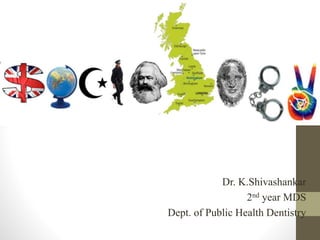



SOCIOLOGY, LIFESTYLE
AND
ORAL HEALTH
Dr. K.Shivashankar
2nd year MDS
Dept. of Public Health Dentistry
CONTENTS
• Introduction
• Specialization within sociology
• Theories in sociology
• Concepts in sociology
• Social organizations
• Social class
• Socioeconomic status
• Sociology and Health
• Sociology and Oral Health
• Conclusion
• References
INTRODUCTION
• Social science = anthropology + political sciences + psychology
+ sociology………….
• Sociology is derived from Latin socio, meaning society
Greek logos, meaning science
• Society is derived from socius, meaning individual
societa, meaning group
INTRODUCTION
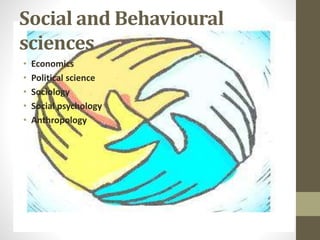
Social and Behavioural
sciences
• Economics
• Political science
• Sociology
• Social psychology
• Anthropology
Sociology
Auguste comte – founder of sociology
Sociology - study of individual & groups in a society.
Deals with
• Study of relationships between human beings
• Study of human behavior
Concerned with the effects on…individual of the ways in which
other individuals think and act.
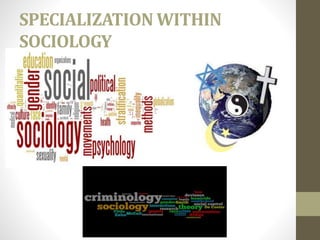
SPECIALIZATION WITHIN
SOCIOLOGY
Concepts in sociology
SOCIETY
• Defined in simple terms as an organization of member agents.
• Importance of society…..controls and regulates the behavior
of individual both by laws and customs
• exerts pressure to conform to its norms
Concepts in sociology
Community:
• The people living in a particular place or region….linked by common
interest.
WHO:
• A community is a social group determined by geographical boundaries
and or common values and interest.
• Members know and interact with each other.
• It functions within a particular social structure and exhibits and creates
certain norms, values and social institutions.
• The individual belongs to the border society through his family and
community
Concepts in sociology
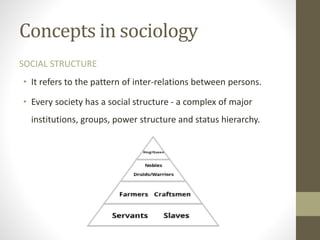
SOCIAL STRUCTURE
• It refers to the pattern of inter-relations between persons.
• Every society has a social structure - a complex of major
institutions, groups, power structure and status hierarchy.
Concepts in sociology
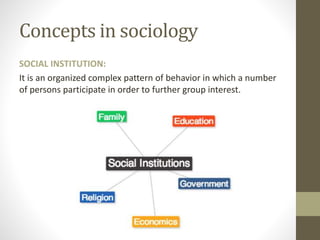
SOCIAL INSTITUTION:
It is an organized complex pattern of behavior in which a number
of persons participate in order to further group interest.
Concepts in sociology
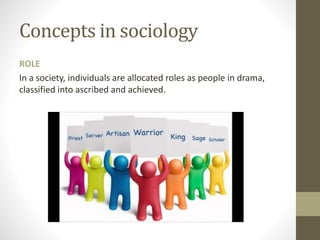
ROLE
In a society, individuals are allocated roles as people in drama,
classified into ascribed and achieved.
Concepts in sociology
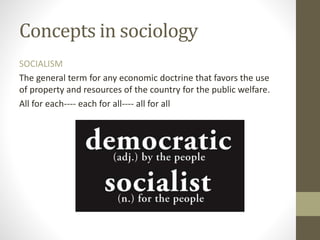
SOCIALISM
The general term for any economic doctrine that favors the use
of property and resources of the country for the public welfare.
All for each---- each for all---- all for all
Concepts in sociology
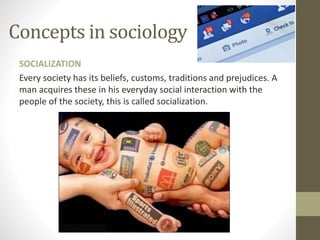
SOCIALIZATION
Every society has its beliefs, customs, traditions and prejudices. A
man acquires these in his everyday social interaction with the
people of the society, this is called socialization.
Concepts in sociology
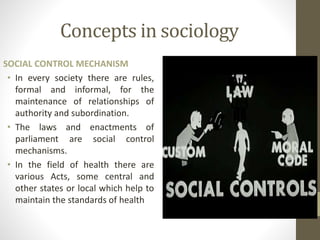
SOCIAL CONTROL MECHANISM
• In every society there are rules,
formal and informal, for the
maintenance of relationships of
authority and subordination.
• The laws and enactments of
parliament are social control
mechanisms.
• In the field of health there are
various Acts, some central and
other states or local which help to
maintain the standards of health
Concepts in sociology
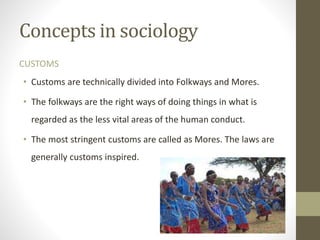
CUSTOMS
• Customs are technically divided into Folkways and Mores.
• The folkways are the right ways of doing things in what is
regarded as the less vital areas of the human conduct.
• The most stringent customs are called as Mores. The laws are
generally customs inspired.
Concepts in sociology
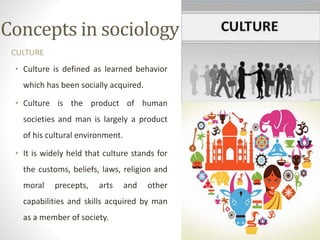
CULTURE
• Culture is defined as learned behavior
which has been socially acquired.
• Culture is the product of human
societies and man is largely a product
of his cultural environment.
• It is widely held that culture stands for
the customs, beliefs, laws, religion and
moral precepts, arts and other
capabilities and skills acquired by man
as a member of society.
Concepts in sociology
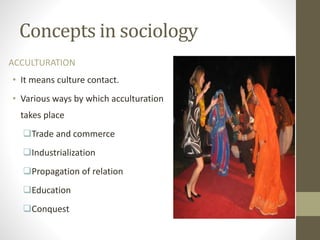
ACCULTURATION
• It means culture contact.
• Various ways by which acculturation
takes place
Trade and commerce
Industrialization
Propagation of relation
Education
Conquest
Concepts in sociology
STANDARD OF LIVING
• The standard of living in a country
depends upon
The level of national income
The total amount of goods and
services a country is able to
produce
The size of the population
The level of education
General price level
Concepts in sociology
DYNAMICS OF SOCIAL CHANGE
• The interaction between social factors and health issues is
complex and unpredictable.
• A typical feature of traditional societies is a sense of continuity
and immutability in patterns of social life.
• Traditional societies may be better able to cope with change
and modern societies are perhaps best adapted to assimilate
rapid changes. (WHO 1986)
Concepts in sociology
SOCIAL STRESS
A major source of stress particularly in traditional societies is the
conflict generated by new opportunities and frustrations arising from
societal changes.
These stresses inducing conditions include-
• The wave of migration from rural to urban areas and the consequent
diminution in the traditional family support system
• A greater exposure through mass media to ideas that had been
previously culturally alien
• Tourism
• Change in technological needs of the society requiring skills that are
different from those of previous generations and for which the
training or education available may be inadequate
Concepts in sociology
SOCIAL PROBLEMS
Individual and social problem
Poverty, crime and disease common social problems.
Many public health problems are social problems and vice versa.
Concepts in sociology
SOCIAL PATHOLOGY
• The term is given a restricted
interpretation linking it to poverty,
crime, delinquency and vagrancy.
• In the modern context, the term is
also used to describe the relation
between disease and social
conditions.
Concepts in sociology
SOCIAL SURVEYS
They disclose social pathology. When the objective of an
epidemiological research is to study the etiology of disease, the
two merge into what is known as ‘social epidemiology’.
Concepts in sociology
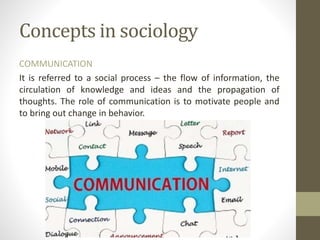
COMMUNICATION
It is referred to a social process – the flow of information, the
circulation of knowledge and ideas and the propagation of
thoughts. The role of communication is to motivate people and
to bring out change in behavior.
Concepts in sociology
SOCIAL DEFENCE
It covers the entire gamut of preventive, therapeutic and
rehabilitative services for the protection of society from
antisocial, criminal or deviant, conduct of man.
Concepts in sociology
CASE STUDY
Method of exploring and analyzing the life of a social unit.
Collects large amount of information from a small group
survey+ case study= more information
Concepts in sociology
FIELD STUDY
Field studies are concerned with depth of knowledge; involve
observation of people in situ.
SOCIAL ORGANIZATION
• The groups to which people belong are the
The family: it is the basic unit in all societies.
Religion and caste
Temporary social groups
• Crowd
• Mob
• Herd
Permanent special groups
• Band
• Village
• Towns and cities
• States
Government and political organizations
THE FAMILY
• The family is a primary unit in all societies.
• It is a group of biologically related individuals living together
and eating from a common kitchen.
• As a biological unit….. genes
• As a social unit….. Physical and social environment
• As a cultural unit…… culture of a society
• An epidemiological unit for providing social services as well as
comprehensive medical care.
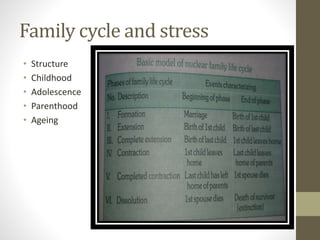
Family cycle and stress
• Structure
• Childhood
• Adolescence
• Parenthood
• Ageing
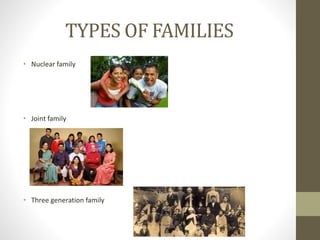
TYPES OF FAMILIES
• Nuclear family
• Joint family
• Three generation family
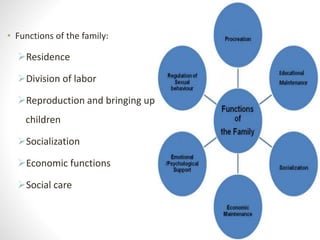
• Functions of the family:
Residence
Division of labor
Reproduction and bringing up
children
Socialization
Economic functions
Social care
• Family in health and disease:
Child rearing
Socialization
Personality formation
Care of dependent adults
Stabilization of adult personality
Family susceptible to disease
Broken family
Problem families
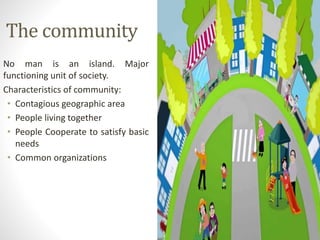
The community
No man is an island. Major
functioning unit of society.
Characteristics of community:
• Contagious geographic area
• People living together
• People Cooperate to satisfy basic
needs
• Common organizations
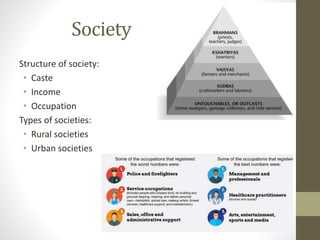
Society
Structure of society:
• Caste
• Income
• Occupation
Types of societies:
• Rural societies
• Urban societies
Society
Social morbidity:
Indian society --- caste system
• Closed- class
• Open-class
SOCIAL CLASS
• People in a community are differentiated by certain characteristics
which they bear.
• These characteristics may be personal, economic, cultural and
educational.
• Social scientists have used occupation widely as a means of determining
the level of social standing of an individual in a community, because
occupation has an enormous importance in all societies for
understanding human behavior.
• Occupation is a major determinant of;
• Economic rewards
• Extent of authority
• Extent of obligations
• Degree of status
• Values and lifestyles
THE UK REGISTRAR GENERAL’S OCCUPATIONAL CLASSIFICATION
• Professional
• Intermediate
• Skilled non manual
• Skilled Manual
• Partly skilled
• Unskilled
LIMITATIONS OF OCCUPATIONAL CLASSIFICATION
• Heterogeneous grouping
• Occupational mobility
• Women
TYPES OF WORKERS
• Skilled employee
capable of working independently and efficiently capable of reading and working
on simple drawing circuits and process, if necessary.
e.g. electrician, mechanic, tailor
• Semi-skilled
Sufficient knowledge of the particular trade or above to do respective work and
simple job with the help of simple tools and machines.
e.g. asst.operator, asst.electrician
• Un-skilled Worker
Possesses no special training
Simple duties requiring the exercise of little or no independent judgment or
previous experience although a familiarity with the occupational environment is
necessary.
e.g. watchman, cleaner, sweeper
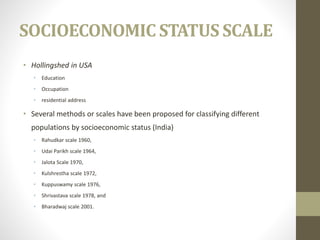
Other measure of social
differentiation
• Education
• Income
• Purchasing power
• Religion
• Rural and urban
SOCIOECONOMIC STATUS SCALE
• Hollingshed in USA
• Education
• Occupation
• residential address
• Several methods or scales have been proposed for classifying different
populations by socioeconomic status (India)
• Rahudkar scale 1960,
• Udai Parikh scale 1964,
• Jalota Scale 1970,
• Kulshrestha scale 1972,
• Kuppuswamy scale 1976,
• Shrivastava scale 1978, and
• Bharadwaj scale 2001.
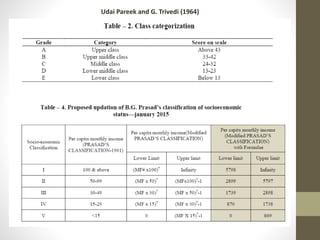
Udai Pareek and G. Trivedi (1964)
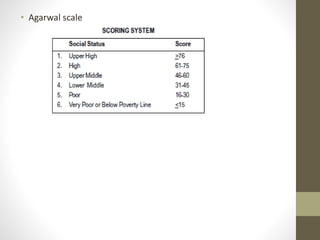
• Agarwal scale
Kuppuswamy’s scale Wealth index
economic status of
households
SOCIAL CLASS AND HEALTH
• Public health is viewed as a science that seeks to intervene, control, and
prevent large – scale processes that negatively affect public’s health.
• By these criteria, there is a strong logical fit of sociological principles and
practices within public health.
• Despite psychology having become the key social science discipline in
public health, many of the primary concerns of present day public
health, with large scale variables such as social capital, social inequality,
social status, and health care organization and financing, remain topics
best suited to the sociological perspective and methodology.
SOCIETY AND ORAL HEALTH
• The future challenges to dentistry and public health care
planning are confined to areas of expertise that relate to the
non clinical dimension of dental practice – health promotion,
community based preventive care and outreach activities.
• A proper understanding of the social context of the oral health
and illness is a prerequisite to the provision of such care by
the dental profession and its participation in the public health
action programs.
SOCIAL AND STRATIFICATION
ORAL HEALTH
UPPER MIDDLE CLASS
The professional, business and executive group, well educated, living
in preferred areas in well-maintained homes.
They value their teeth, are interested in preventive dentistry and
actively pursue various types of dental care.
Visualize the dentist as a professional who not only repairs teeth but
also prevents decay and loss of teeth and makes person teeth more
attractive and useful.
Desire to have their own teeth for as long as possible.
LOWER MIDDLE CLASS
“Owners of small business, minor executives, teachers,
salesman and white – collar workers”.
The dentist is considered as one who gives directions as to
how teeth should be cared for and who is useful for
preventive dentistry.
Dental health habits begin early and followed with
persistence.
UPPER LOWER CLASS
• Skilled and semi skilled blue collar workers. They are people of
limited education; law abiding respectable, hard working citizens.
• Feel there is little they can do to stance off the inevitable, including
the loss of their teeth.
• They receive artificial dentures at a relatively early age and are
happy with them. Self-medications based on popular notions
interests them.
• They instruct their children how to care of their teeth, but the
children are more or less on their own after that.
LOWER CLASS
• Also called the underprivileged or disadvantaged
• Unskilled laborers, people who shift from job to job, have a
limited education, live in slum areas and exhibit no stable
pattern of life.
• Most consistent neglect of teeth and they require careful
understanding if they are to receive adequate care in public
health facilities.
SOCIOLOGY AND DENTAL
CARIES
Dental caries…..lifestyle and self-controlled behavioral factors,
including poor oral hygiene, poor diet and inappropriate feeding of
infants. Other factors….. poverty, deprivation, education, dental
insurance coverage and use of fissure sealants .
WHO….. caries has declined in many developed countries from a
high DMFT level, at age 12 years, of about 4.5 in 1980 to about 2.5 in
1998. Across the same period, caries levels for developing countries
always were lower, but they have been increasing constantly, at the
same age, from about 1.5 to 2.5. This increase is particularly
alarming owing to the fact that the developing countries represent
most of our world
SOCIOLOGY AND PERIODONTAL
DISEASE
Periodontal disease is related strongly with smoking and decreases
alongside a reduction in smoking. As previously noted, smoking is
heaviest among lowest-income households in developing economies
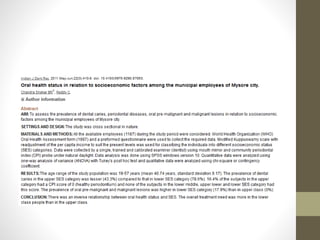
According to a study people from higher social classes, those with
more education, people living in urban areas and females have less
severe periodontal disease than their lower social class counterparts
who are less educated, male and live in rural areas.
SOCIOLOGY AND ORAL
CANCER
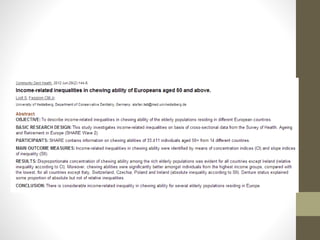
The prevalence…..particularly high among developing
countries and is the eighth most common cancer globally.
Oral cancer incidence levels among men range from one to 10
cases per 100,000 and generally are twice as high in
developing countries as they are in developed countries.
SOCIOLOGY AND TOOTH LOSS
Incomes equal to or above twice the poverty guideline had an
average complete tooth loss of 4.41 percent, as compared with 9.28
percent among those with incomes below the poverty guideline.
At ages 65 years and older, those with incomes equal to or above
twice the poverty guideline had an average complete tooth loss of
26.9 percent, as compared with an average complete tooth loss of
44.19 per-cent among people with incomes below this level
SOCIOLOGY AND OROFACIAL
PAIN
• Acute pain is more common in orofacial region. Any pain
which exists for more than 6 months and it does not respond
to treatment is chronic, it involves psychological component in
terms of its onset and consequences and may create many
psychological problems for patients and families, such as
changes in roles, conflicts in marital and other relationships,
and issues of legitimation in defining the scope of the problem
for the purpose of litigation
MALOCCLUSION, SOCIAL AND
PSYCHOLOGICAL OUTCOMES
• Cleft lip and cleft palate plays a major role here.
• Earlier research were based on the significance of face and
oral cavity for self – image and self – esteem, social interaction
and social relationships.
• Recent studies showed that perceived facial and physical
attractiveness is associated with the attribution of other
socially desirable characteristics.
Inequalities in oral health: a review of
the evidence and recommendations
for action
• Reviewed the evidence on social inequalities in oral health in
Britain.
• Widening inequalities in oral health existed between social
classes, regions of England, and among certain minority ethnic
groups in pre-school children. Wide district and regional
differences also existed in prevalence of caries in young
children. The area differences related very strongly to
deprivation.
• In adults the differences in decay experience was less unequal than
in children but there were marked social class inequalities in
edentulousness.
• The main causes of the inequalities were differences in patterns of
consumption of non milk extrinsic sugars and fluoridated
toothpaste.
• Conclusion: Oral health inequalities will only be reduced through the
implementation of effective and appropriate oral health promotion
policy and that treatment services will never successfully tackle the
underlying cause of oral diseases.
CONCLUSION
• Dentist around the world should not only treat patients on
biological context rather they should understand the
sociological factors that contribute to oral health status of
patients.
THANK YOU
References
• Park’s textbook of preventive and social medicine, 22nd edition, Bhanot
publishers, Jabalpur.
• Teodora Timis, Danila I, Socioeconomic status and oral health, Journal
of Preventive Medicine. 2005; 13 (1-2): 116-121.
• Bhasin SK, Sharma AK, Chhabra P, Rajoura OP. A New Instrument
(Scale) for Measuring the Socioeconomic Status of a Family: Preliminary
Study. Indian Journal of Community Medicine. 2005; 30:111-4.
• Thakur A S, Acharya S, Singhal D, Nivedita Rewal. Socioeconomic Status
And Oral Health In India - A Critical Review. Indian Journal of Dental
Sciences. October 2012 Supplementary Issue Issue:4, Vol.:4
• Cynthia M pine, Community oral health; Read educational and
professional public Limited. 1997; New Delhi
• Lois K. Cohen, Helen C. Gift, Disease prevention and oral health
promotion
• Petersen PE. The World Oral Health Report 2003: continuous
improvement of oral health in the 21st century - the approach of the
WHO Global Oral Health Programme. Community Dent Oral
Epidemiology 2003;31(supplement 1):3-23.
• Selwitz RH, Ismail AL, Pitts NB. Dental caries. Lancet 2007;
369(9555):519.
• Harold D. Sgan-Cohen, Jonathan Mann. Health, oral health and
poverty. Journal of American dental association 2007: 138: 1437-
1442.
• Hobdell MH, Oliveira ER, Bautista R. Oral diseases and socio-
economic status (SES). Br Dent J 2003;194(2):91-6.
• Dye BA, Tan S, Smith V. Trends in oral health status: United
States, 1988-1994 and 1999-2004. Vital Health Stat 2007; 11(248):1-
92.
• R.N. Gupta. A scale to measure socio-economic status in urban &
rural communities in India. Indian J Med Res 122, October 2005, pp
288-289
• Guru Raj M.S., Shilpa S, Maheshwaran, R. Revised socio-economic
status scale for urban and rural india – revision for 2015. The
Scientific Journal for Theory and Practice of Socio-economic
Development. 2015, 4(7): 167-174

Social science shiva

  • 1.
    SOCIOLOGY, LIFESTYLE AND ORAL HEALTH Dr.K.Shivashankar 2nd year MDS Dept. of Public Health Dentistry
  • 2.
    CONTENTS • Introduction • Specializationwithin sociology • Theories in sociology • Concepts in sociology • Social organizations • Social class • Socioeconomic status • Sociology and Health • Sociology and Oral Health • Conclusion • References
  • 3.
    INTRODUCTION • Social science= anthropology + political sciences + psychology + sociology…………. • Sociology is derived from Latin socio, meaning society Greek logos, meaning science • Society is derived from socius, meaning individual societa, meaning group
  • 4.
  • 5.
    Social and Behavioural sciences •Economics • Political science • Sociology • Social psychology • Anthropology
  • 6.
    Sociology Auguste comte –founder of sociology Sociology - study of individual & groups in a society. Deals with • Study of relationships between human beings • Study of human behavior Concerned with the effects on…individual of the ways in which other individuals think and act.
  • 7.
  • 8.
    Concepts in sociology SOCIETY •Defined in simple terms as an organization of member agents. • Importance of society…..controls and regulates the behavior of individual both by laws and customs • exerts pressure to conform to its norms
  • 9.
    Concepts in sociology Community: •The people living in a particular place or region….linked by common interest. WHO: • A community is a social group determined by geographical boundaries and or common values and interest. • Members know and interact with each other. • It functions within a particular social structure and exhibits and creates certain norms, values and social institutions. • The individual belongs to the border society through his family and community
  • 10.
    Concepts in sociology SOCIALSTRUCTURE • It refers to the pattern of inter-relations between persons. • Every society has a social structure - a complex of major institutions, groups, power structure and status hierarchy.
  • 11.
    Concepts in sociology SOCIALINSTITUTION: It is an organized complex pattern of behavior in which a number of persons participate in order to further group interest.
  • 12.
    Concepts in sociology ROLE Ina society, individuals are allocated roles as people in drama, classified into ascribed and achieved.
  • 13.
    Concepts in sociology SOCIALISM Thegeneral term for any economic doctrine that favors the use of property and resources of the country for the public welfare. All for each---- each for all---- all for all
  • 14.
    Concepts in sociology SOCIALIZATION Everysociety has its beliefs, customs, traditions and prejudices. A man acquires these in his everyday social interaction with the people of the society, this is called socialization.
  • 15.
    Concepts in sociology SOCIALCONTROL MECHANISM • In every society there are rules, formal and informal, for the maintenance of relationships of authority and subordination. • The laws and enactments of parliament are social control mechanisms. • In the field of health there are various Acts, some central and other states or local which help to maintain the standards of health
  • 16.
    Concepts in sociology CUSTOMS •Customs are technically divided into Folkways and Mores. • The folkways are the right ways of doing things in what is regarded as the less vital areas of the human conduct. • The most stringent customs are called as Mores. The laws are generally customs inspired.
  • 17.
    Concepts in sociology CULTURE •Culture is defined as learned behavior which has been socially acquired. • Culture is the product of human societies and man is largely a product of his cultural environment. • It is widely held that culture stands for the customs, beliefs, laws, religion and moral precepts, arts and other capabilities and skills acquired by man as a member of society.
  • 18.
    Concepts in sociology ACCULTURATION •It means culture contact. • Various ways by which acculturation takes place Trade and commerce Industrialization Propagation of relation Education Conquest
  • 19.
    Concepts in sociology STANDARDOF LIVING • The standard of living in a country depends upon The level of national income The total amount of goods and services a country is able to produce The size of the population The level of education General price level
  • 20.
    Concepts in sociology DYNAMICSOF SOCIAL CHANGE • The interaction between social factors and health issues is complex and unpredictable. • A typical feature of traditional societies is a sense of continuity and immutability in patterns of social life. • Traditional societies may be better able to cope with change and modern societies are perhaps best adapted to assimilate rapid changes. (WHO 1986)
  • 21.
    Concepts in sociology SOCIALSTRESS A major source of stress particularly in traditional societies is the conflict generated by new opportunities and frustrations arising from societal changes. These stresses inducing conditions include- • The wave of migration from rural to urban areas and the consequent diminution in the traditional family support system • A greater exposure through mass media to ideas that had been previously culturally alien • Tourism • Change in technological needs of the society requiring skills that are different from those of previous generations and for which the training or education available may be inadequate
  • 22.
    Concepts in sociology SOCIALPROBLEMS Individual and social problem Poverty, crime and disease common social problems. Many public health problems are social problems and vice versa.
  • 23.
    Concepts in sociology SOCIALPATHOLOGY • The term is given a restricted interpretation linking it to poverty, crime, delinquency and vagrancy. • In the modern context, the term is also used to describe the relation between disease and social conditions.
  • 24.
    Concepts in sociology SOCIALSURVEYS They disclose social pathology. When the objective of an epidemiological research is to study the etiology of disease, the two merge into what is known as ‘social epidemiology’.
  • 25.
    Concepts in sociology COMMUNICATION Itis referred to a social process – the flow of information, the circulation of knowledge and ideas and the propagation of thoughts. The role of communication is to motivate people and to bring out change in behavior.
  • 26.
    Concepts in sociology SOCIALDEFENCE It covers the entire gamut of preventive, therapeutic and rehabilitative services for the protection of society from antisocial, criminal or deviant, conduct of man.
  • 27.
    Concepts in sociology CASESTUDY Method of exploring and analyzing the life of a social unit. Collects large amount of information from a small group survey+ case study= more information
  • 28.
    Concepts in sociology FIELDSTUDY Field studies are concerned with depth of knowledge; involve observation of people in situ.
  • 29.
    SOCIAL ORGANIZATION • Thegroups to which people belong are the The family: it is the basic unit in all societies. Religion and caste Temporary social groups • Crowd • Mob • Herd Permanent special groups • Band • Village • Towns and cities • States Government and political organizations
  • 30.
    THE FAMILY • Thefamily is a primary unit in all societies. • It is a group of biologically related individuals living together and eating from a common kitchen. • As a biological unit….. genes • As a social unit….. Physical and social environment • As a cultural unit…… culture of a society • An epidemiological unit for providing social services as well as comprehensive medical care.
  • 31.
    Family cycle andstress • Structure • Childhood • Adolescence • Parenthood • Ageing
  • 32.
    TYPES OF FAMILIES •Nuclear family • Joint family • Three generation family
  • 33.
    • Functions ofthe family: Residence Division of labor Reproduction and bringing up children Socialization Economic functions Social care
  • 34.
    • Family inhealth and disease: Child rearing Socialization Personality formation Care of dependent adults Stabilization of adult personality Family susceptible to disease Broken family Problem families
  • 35.
    The community No manis an island. Major functioning unit of society. Characteristics of community: • Contagious geographic area • People living together • People Cooperate to satisfy basic needs • Common organizations
  • 36.
    Society Structure of society: •Caste • Income • Occupation Types of societies: • Rural societies • Urban societies
  • 37.
    Society Social morbidity: Indian society--- caste system • Closed- class • Open-class
  • 38.
    SOCIAL CLASS • Peoplein a community are differentiated by certain characteristics which they bear. • These characteristics may be personal, economic, cultural and educational. • Social scientists have used occupation widely as a means of determining the level of social standing of an individual in a community, because occupation has an enormous importance in all societies for understanding human behavior. • Occupation is a major determinant of; • Economic rewards • Extent of authority • Extent of obligations • Degree of status • Values and lifestyles
  • 39.
    THE UK REGISTRARGENERAL’S OCCUPATIONAL CLASSIFICATION • Professional • Intermediate • Skilled non manual • Skilled Manual • Partly skilled • Unskilled LIMITATIONS OF OCCUPATIONAL CLASSIFICATION • Heterogeneous grouping • Occupational mobility • Women
  • 40.
    TYPES OF WORKERS •Skilled employee capable of working independently and efficiently capable of reading and working on simple drawing circuits and process, if necessary. e.g. electrician, mechanic, tailor • Semi-skilled Sufficient knowledge of the particular trade or above to do respective work and simple job with the help of simple tools and machines. e.g. asst.operator, asst.electrician • Un-skilled Worker Possesses no special training Simple duties requiring the exercise of little or no independent judgment or previous experience although a familiarity with the occupational environment is necessary. e.g. watchman, cleaner, sweeper
  • 41.
    Other measure ofsocial differentiation • Education • Income • Purchasing power • Religion • Rural and urban
  • 42.
    SOCIOECONOMIC STATUS SCALE •Hollingshed in USA • Education • Occupation • residential address • Several methods or scales have been proposed for classifying different populations by socioeconomic status (India) • Rahudkar scale 1960, • Udai Parikh scale 1964, • Jalota Scale 1970, • Kulshrestha scale 1972, • Kuppuswamy scale 1976, • Shrivastava scale 1978, and • Bharadwaj scale 2001.
  • 43.
    Udai Pareek andG. Trivedi (1964)
  • 44.
  • 45.
    Kuppuswamy’s scale Wealthindex economic status of households
  • 46.
    SOCIAL CLASS ANDHEALTH • Public health is viewed as a science that seeks to intervene, control, and prevent large – scale processes that negatively affect public’s health. • By these criteria, there is a strong logical fit of sociological principles and practices within public health. • Despite psychology having become the key social science discipline in public health, many of the primary concerns of present day public health, with large scale variables such as social capital, social inequality, social status, and health care organization and financing, remain topics best suited to the sociological perspective and methodology.
  • 47.
    SOCIETY AND ORALHEALTH • The future challenges to dentistry and public health care planning are confined to areas of expertise that relate to the non clinical dimension of dental practice – health promotion, community based preventive care and outreach activities. • A proper understanding of the social context of the oral health and illness is a prerequisite to the provision of such care by the dental profession and its participation in the public health action programs.
  • 48.
    SOCIAL AND STRATIFICATION ORALHEALTH UPPER MIDDLE CLASS The professional, business and executive group, well educated, living in preferred areas in well-maintained homes. They value their teeth, are interested in preventive dentistry and actively pursue various types of dental care. Visualize the dentist as a professional who not only repairs teeth but also prevents decay and loss of teeth and makes person teeth more attractive and useful. Desire to have their own teeth for as long as possible.
  • 49.
    LOWER MIDDLE CLASS “Ownersof small business, minor executives, teachers, salesman and white – collar workers”. The dentist is considered as one who gives directions as to how teeth should be cared for and who is useful for preventive dentistry. Dental health habits begin early and followed with persistence.
  • 50.
    UPPER LOWER CLASS •Skilled and semi skilled blue collar workers. They are people of limited education; law abiding respectable, hard working citizens. • Feel there is little they can do to stance off the inevitable, including the loss of their teeth. • They receive artificial dentures at a relatively early age and are happy with them. Self-medications based on popular notions interests them. • They instruct their children how to care of their teeth, but the children are more or less on their own after that.
  • 51.
    LOWER CLASS • Alsocalled the underprivileged or disadvantaged • Unskilled laborers, people who shift from job to job, have a limited education, live in slum areas and exhibit no stable pattern of life. • Most consistent neglect of teeth and they require careful understanding if they are to receive adequate care in public health facilities.
  • 52.
    SOCIOLOGY AND DENTAL CARIES Dentalcaries…..lifestyle and self-controlled behavioral factors, including poor oral hygiene, poor diet and inappropriate feeding of infants. Other factors….. poverty, deprivation, education, dental insurance coverage and use of fissure sealants . WHO….. caries has declined in many developed countries from a high DMFT level, at age 12 years, of about 4.5 in 1980 to about 2.5 in 1998. Across the same period, caries levels for developing countries always were lower, but they have been increasing constantly, at the same age, from about 1.5 to 2.5. This increase is particularly alarming owing to the fact that the developing countries represent most of our world
  • 53.
    SOCIOLOGY AND PERIODONTAL DISEASE Periodontaldisease is related strongly with smoking and decreases alongside a reduction in smoking. As previously noted, smoking is heaviest among lowest-income households in developing economies According to a study people from higher social classes, those with more education, people living in urban areas and females have less severe periodontal disease than their lower social class counterparts who are less educated, male and live in rural areas.
  • 54.
    SOCIOLOGY AND ORAL CANCER Theprevalence…..particularly high among developing countries and is the eighth most common cancer globally. Oral cancer incidence levels among men range from one to 10 cases per 100,000 and generally are twice as high in developing countries as they are in developed countries.
  • 55.
    SOCIOLOGY AND TOOTHLOSS Incomes equal to or above twice the poverty guideline had an average complete tooth loss of 4.41 percent, as compared with 9.28 percent among those with incomes below the poverty guideline. At ages 65 years and older, those with incomes equal to or above twice the poverty guideline had an average complete tooth loss of 26.9 percent, as compared with an average complete tooth loss of 44.19 per-cent among people with incomes below this level
  • 56.
    SOCIOLOGY AND OROFACIAL PAIN •Acute pain is more common in orofacial region. Any pain which exists for more than 6 months and it does not respond to treatment is chronic, it involves psychological component in terms of its onset and consequences and may create many psychological problems for patients and families, such as changes in roles, conflicts in marital and other relationships, and issues of legitimation in defining the scope of the problem for the purpose of litigation
  • 57.
    MALOCCLUSION, SOCIAL AND PSYCHOLOGICALOUTCOMES • Cleft lip and cleft palate plays a major role here. • Earlier research were based on the significance of face and oral cavity for self – image and self – esteem, social interaction and social relationships. • Recent studies showed that perceived facial and physical attractiveness is associated with the attribution of other socially desirable characteristics.
  • 58.
    Inequalities in oralhealth: a review of the evidence and recommendations for action • Reviewed the evidence on social inequalities in oral health in Britain. • Widening inequalities in oral health existed between social classes, regions of England, and among certain minority ethnic groups in pre-school children. Wide district and regional differences also existed in prevalence of caries in young children. The area differences related very strongly to deprivation.
  • 59.
    • In adultsthe differences in decay experience was less unequal than in children but there were marked social class inequalities in edentulousness. • The main causes of the inequalities were differences in patterns of consumption of non milk extrinsic sugars and fluoridated toothpaste. • Conclusion: Oral health inequalities will only be reduced through the implementation of effective and appropriate oral health promotion policy and that treatment services will never successfully tackle the underlying cause of oral diseases.
  • 62.
    CONCLUSION • Dentist aroundthe world should not only treat patients on biological context rather they should understand the sociological factors that contribute to oral health status of patients.
  • 63.
  • 64.
    References • Park’s textbookof preventive and social medicine, 22nd edition, Bhanot publishers, Jabalpur. • Teodora Timis, Danila I, Socioeconomic status and oral health, Journal of Preventive Medicine. 2005; 13 (1-2): 116-121. • Bhasin SK, Sharma AK, Chhabra P, Rajoura OP. A New Instrument (Scale) for Measuring the Socioeconomic Status of a Family: Preliminary Study. Indian Journal of Community Medicine. 2005; 30:111-4. • Thakur A S, Acharya S, Singhal D, Nivedita Rewal. Socioeconomic Status And Oral Health In India - A Critical Review. Indian Journal of Dental Sciences. October 2012 Supplementary Issue Issue:4, Vol.:4 • Cynthia M pine, Community oral health; Read educational and professional public Limited. 1997; New Delhi • Lois K. Cohen, Helen C. Gift, Disease prevention and oral health promotion • Petersen PE. The World Oral Health Report 2003: continuous improvement of oral health in the 21st century - the approach of the WHO Global Oral Health Programme. Community Dent Oral Epidemiology 2003;31(supplement 1):3-23.
  • 65.
    • Selwitz RH,Ismail AL, Pitts NB. Dental caries. Lancet 2007; 369(9555):519. • Harold D. Sgan-Cohen, Jonathan Mann. Health, oral health and poverty. Journal of American dental association 2007: 138: 1437- 1442. • Hobdell MH, Oliveira ER, Bautista R. Oral diseases and socio- economic status (SES). Br Dent J 2003;194(2):91-6. • Dye BA, Tan S, Smith V. Trends in oral health status: United States, 1988-1994 and 1999-2004. Vital Health Stat 2007; 11(248):1- 92. • R.N. Gupta. A scale to measure socio-economic status in urban & rural communities in India. Indian J Med Res 122, October 2005, pp 288-289 • Guru Raj M.S., Shilpa S, Maheshwaran, R. Revised socio-economic status scale for urban and rural india – revision for 2015. The Scientific Journal for Theory and Practice of Socio-economic Development. 2015, 4(7): 167-174