

SEMINAR ON
COMMUNICATION DEVICES
PRESENTED BY:-
SANCHIT SHARMA
Website:-www.upgc.org.in
COMMUNICATION DEVICES
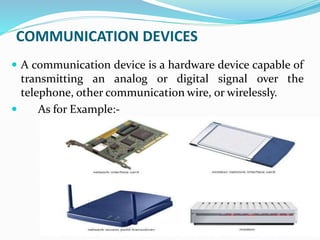
 A communication device is a hardware device capable of
transmitting an analog or digital signal over the
telephone, other communication wire, or wirelessly.
 As for Example:-
HISTORY OF COMMUNICATION DEVICES
 The first means of communication was, of course, the
human voice but about 3200 BC writing was invented
in Iraq and Egypt. It was invented about 1500 BC in
China
 The only America civilization to invent a true system
of writing were the Mayans.
=> Advantages:
 Flexibility
 Documented
 Relevance
 Community
 Limitless
=>Disadvantages:
 No physical cues
 Information overload
 Threads
 Time lag
Some Communication Devices are
as follow:
Modem
Router
Hub
Switch
Mobile phone
Bridge
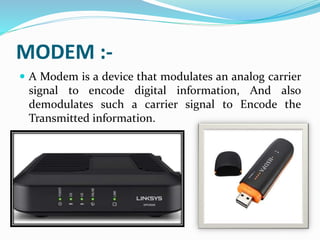
MODEM :-
 A Modem is a device that modulates an analog carrier
signal to encode digital information, And also
demodulates such a carrier signal to Encode the
Transmitted information.
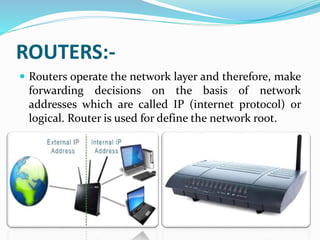
ROUTERS:-
 Routers operate the network layer and therefore, make
forwarding decisions on the basis of network
addresses which are called IP (internet protocol) or
logical. Router is used for define the network root.
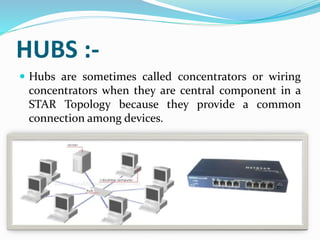
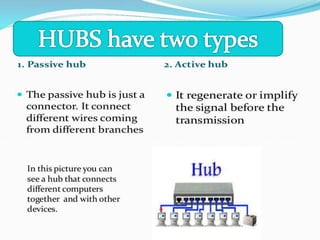
HUBS :-
 Hubs are sometimes called concentrators or wiring
concentrators when they are central component in a
STAR Topology because they provide a common
connection among devices.
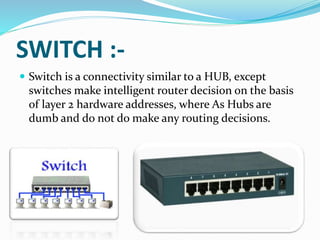
SWITCH :-
 Switch is a connectivity similar to a HUB, except
switches make intelligent router decision on the basis
of layer 2 hardware addresses, where As Hubs are
dumb and do not do make any routing decisions.
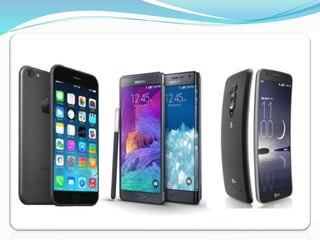
MOBILE PHONE :-
 A mobile phone is a wireless handheld device that
allows users to make calls and send text messages,
among other features. The earliest generation of
mobile phones could only make and receive calls.
Today’s mobile phones, however, are packed with
many additional features, such as web browsers,
games, cameras, video players and even navigational
systems.
A mobile phone may also be known as a cellular
phone or simply cellphone.
BRIDGE :-
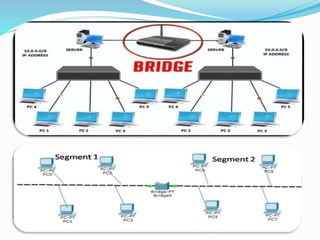
 Bridges are networking devices that connect
networks.
 Sometime it is necessary to divide networks, into
subnets to reduce the amount of traffic on each
larger subnet or for security reasons.
 Once divided, the bridge connects the two subnet
and manages the traffic flow between them.
 Today, network switches have largely replaced
bridges
REPEATER:-
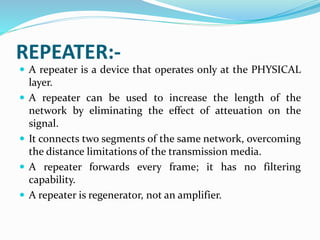
 A repeater is a device that operates only at the PHYSICAL
layer.
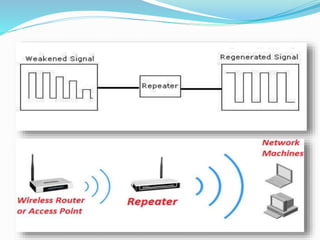
 A repeater can be used to increase the length of the
network by eliminating the effect of atteuation on the
signal.
 It connects two segments of the same network, overcoming
the distance limitations of the transmission media.
 A repeater forwards every frame; it has no filtering
capability.
 A repeater is regenerator, not an amplifier.
communication devices

communication devices

  • 1.
    SEMINAR ON COMMUNICATION DEVICES PRESENTEDBY:- SANCHIT SHARMA Website:-www.upgc.org.in
  • 2.
    COMMUNICATION DEVICES  Acommunication device is a hardware device capable of transmitting an analog or digital signal over the telephone, other communication wire, or wirelessly.  As for Example:-
  • 3.
    HISTORY OF COMMUNICATIONDEVICES  The first means of communication was, of course, the human voice but about 3200 BC writing was invented in Iraq and Egypt. It was invented about 1500 BC in China  The only America civilization to invent a true system of writing were the Mayans.
  • 4.
    => Advantages:  Flexibility Documented  Relevance  Community  Limitless =>Disadvantages:  No physical cues  Information overload  Threads  Time lag
  • 5.
    Some Communication Devicesare as follow: Modem Router Hub Switch Mobile phone Bridge
  • 6.
    MODEM :-  AModem is a device that modulates an analog carrier signal to encode digital information, And also demodulates such a carrier signal to Encode the Transmitted information.
  • 7.
    ROUTERS:-  Routers operatethe network layer and therefore, make forwarding decisions on the basis of network addresses which are called IP (internet protocol) or logical. Router is used for define the network root.
  • 8.
    HUBS :-  Hubsare sometimes called concentrators or wiring concentrators when they are central component in a STAR Topology because they provide a common connection among devices.
  • 10.
    SWITCH :-  Switchis a connectivity similar to a HUB, except switches make intelligent router decision on the basis of layer 2 hardware addresses, where As Hubs are dumb and do not do make any routing decisions.
  • 11.
    MOBILE PHONE :- A mobile phone is a wireless handheld device that allows users to make calls and send text messages, among other features. The earliest generation of mobile phones could only make and receive calls. Today’s mobile phones, however, are packed with many additional features, such as web browsers, games, cameras, video players and even navigational systems. A mobile phone may also be known as a cellular phone or simply cellphone.
  • 13.
    BRIDGE :-  Bridgesare networking devices that connect networks.  Sometime it is necessary to divide networks, into subnets to reduce the amount of traffic on each larger subnet or for security reasons.  Once divided, the bridge connects the two subnet and manages the traffic flow between them.  Today, network switches have largely replaced bridges
  • 15.
    REPEATER:-  A repeateris a device that operates only at the PHYSICAL layer.  A repeater can be used to increase the length of the network by eliminating the effect of atteuation on the signal.  It connects two segments of the same network, overcoming the distance limitations of the transmission media.  A repeater forwards every frame; it has no filtering capability.  A repeater is regenerator, not an amplifier.