THE VISUAL COMPUTING COMPANY
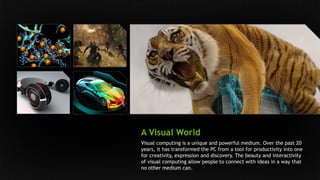
A Visual World
Visual computing is a unique and powerful medium. Over the past 20
years, it has transformed the PC from a tool for productivity into one
for creativity, expression and discovery. The beauty and interactivity
of visual computing allow people to connect with ideas in a way that
no other medium can.
NVIDIA — The Visual Computing Company
Since 1993, NVIDIA has pioneered the art and science of visual
computing. Our passionate work has resulted in thousands of patented
inventions, breakthrough technologies, deep industry relationships
and a powerful brand.
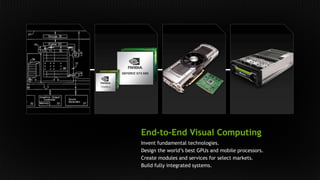
End-to-End Visual Computing
Invent fundamental technologies.
Design the world’s best GPUs and mobile processors.
Create modules and services for select markets.
Build fully integrated systems.
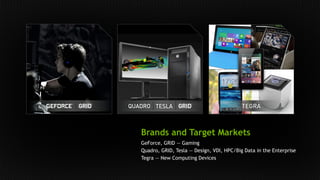
Brands and Target Markets
GeForce, GRID — Gaming
Quadro, GRID, Tesla — Design, VDI, HPC/Big Data in the Enterprise
Tegra — New Computing Devices
Blockbuster games
consistently outsell the
biggest Hollywood films —
Call of Duty: Black Ops 2
reached $500M in sales in its
first 24 hours. By 2016, the
PC gaming market is expected
to reach over $20B. GeForce
GPUs are the engines behind
the creation and enjoyment
of this thriving market.
Source: Activision, DFC Intelligence
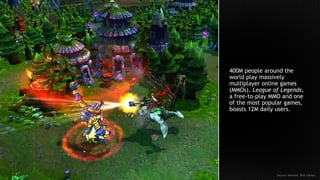
400M people around the
world play massively
multiplayer online games
(MMOs). League of Legends,
a free-to-play MMO and one
of the most popular games,
boasts 12M daily users.
Source: Newzoo, Riot Games
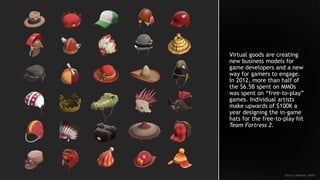
Virtual goods are creating
new business models for
game developers and a new
way for gamers to engage.
In 2012, more than half of
the $6.5B spent on MMOs
was spent on “free-to-play”
games. Individual artists
make upwards of $100K a
year designing the in-game
hats for the free-to-play hit
Team Fortress 2.
Source: Newzoo, Valve
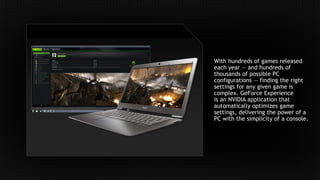
With hundreds of games released
each year — and hundreds of
thousands of possible PC
configurations — finding the right
settings for any given game is
complex. GeForce Experience
is an NVIDIA application that
automatically optimizes game
settings, delivering the power of a
PC with the simplicity of a console.
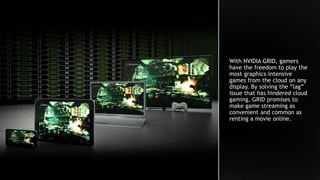
With NVIDIA GRID, gamers
have the freedom to play the
most graphics-intensive
games from the cloud on any
display. By solving the “lag”
issue that has hindered cloud
gaming, GRID promises to
make game streaming as
convenient and common as
renting a movie online.
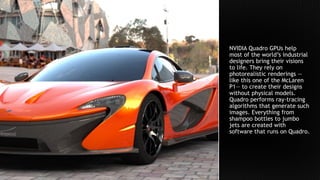
NVIDIA Quadro GPUs help
most of the world’s industrial
designers bring their visions
to life. They rely on
photorealistic renderings —
like this one of the McLaren
P1— to create their designs
without physical models.
Quadro performs ray-tracing
algorithms that generate such
images. Everything from
shampoo bottles to jumbo
jets are created with
software that runs on Quadro.
Visual computing is making
movies more immersive and
imaginative. NVIDIA is playing
a major role. 2013 marked
the fourth year in a row when
all films nominated for the
Best Visual Effects Academy
Award were created on
Quadro GPUs, including
Oscar-winner, Life of Pi.
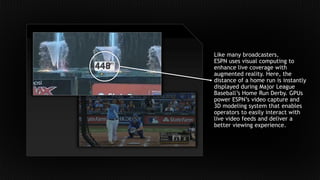
Like many broadcasters,
ESPN uses visual computing to
enhance live coverage with
augmented reality. Here, the
distance of a home run is instantly
displayed during Major League
Baseball’s Home Run Derby. GPUs
power ESPN’s video capture and
3D modeling system that enables
operators to easily interact with
live video feeds and deliver a
better viewing experience.
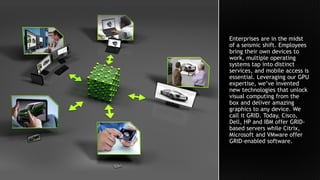
Enterprises are in the midst
of a seismic shift. Employees
bring their own devices to
work, multiple operating
systems tap into distinct
services, and mobile access is
essential. Leveraging our GPU
expertise, we’ve invented
new technologies that unlock
visual computing from the
box and deliver amazing
graphics to any device. We
call it GRID. Today, Cisco,
Dell, HP and IBM offer GRID-
based servers while Citrix,
Microsoft and VMware offer
GRID-enabled software.
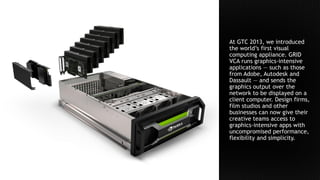
At GTC 2013, we introduced
the world’s first visual
computing appliance. GRID
VCA runs graphics-intensive
applications — such as those
from Adobe, Autodesk and
Dassault — and sends the
graphics output over the
network to be displayed on a
client computer. Design firms,
film studios and other
businesses can now give their
creative teams access to
graphics-intensive apps with
uncompromised performance,
flexibility and simplicity.
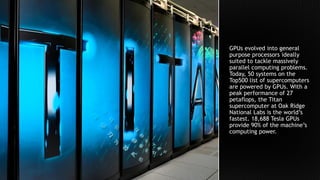
GPUs evolved into general
purpose processors ideally
suited to tackle massively
parallel computing problems.
Today, 50 systems on the
Top500 list of supercomputers
are powered by GPUs. With a
peak performance of 27
petaflops, the Titan
supercomputer at Oak Ridge
National Labs is the world’s
fastest. 18,688 Tesla GPUs
provide 90% of the machine’s
computing power.
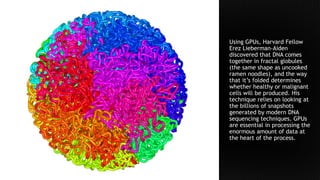
Using GPUs, Harvard Fellow
Erez Lieberman-Aiden
discovered that DNA comes
together in fractal globules
(the same shape as uncooked
ramen noodles), and the way
that it’s folded determines
whether healthy or malignant
cells will be produced. His
technique relies on looking at
the billions of snapshots
generated by modern DNA
sequencing techniques. GPUs
are essential in processing the
enormous amount of data at
the heart of the process.
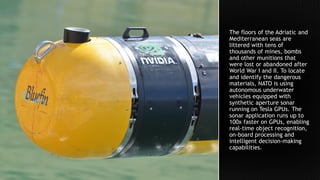
The floors of the Adriatic and
Mediterranean seas are
littered with tens of
thousands of mines, bombs
and other munitions that
were lost or abandoned after
World War I and II. To locate
and identify the dangerous
materials, NATO is using
autonomous underwater
vehicles equipped with
synthetic aperture sonar
running on Tesla GPUs. The
sonar application runs up to
100x faster on GPUs, enabling
real-time object recognition,
on-board processing and
intelligent decision-making
capabilities.
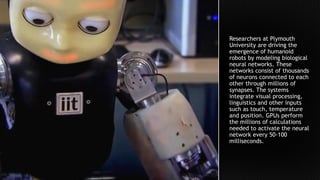
Researchers at Plymouth
University are driving the
emergence of humanoid
robots by modeling biological
neural networks. These
networks consist of thousands
of neurons connected to each
other through millions of
synapses. The systems
integrate visual processing,
linguistics and other inputs
such as touch, temperature
and position. GPUs perform
the millions of calculations
needed to activate the neural
network every 50-100
milliseconds.
Top enterprise and mobile
application companies are
using Tesla GPUs to tackle big
data analytics and advanced
search. For example, Shazam
uses GPUs to instantly search
and identify songs from its 27
million track database for its
300 million users.
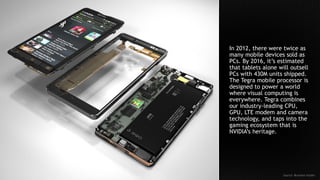
In 2012, there were twice as
many mobile devices sold as
PCs. By 2016, it’s estimated
that tablets alone will outsell
PCs with 430M units shipped.
The Tegra mobile processor is
designed to power a world
where visual computing is
everywhere. Tegra combines
our industry-leading CPU,
GPU, LTE modem and camera
technology, and taps into the
gaming ecosystem that is
NVIDIA’s heritage.
Source: Business Insider
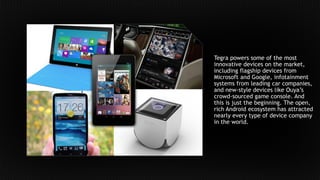
Tegra powers some of the most
innovative devices on the market,
including flagship devices from
Microsoft and Google, infotainment
systems from leading car companies,
and new-style devices like Ouya’s
crowd-sourced game console. And
this is just the beginning. The open,
rich Android ecosystem has attracted
nearly every type of device company
in the world.
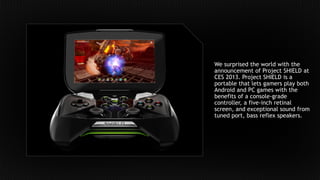
We surprised the world with the
announcement of Project SHIELD at
CES 2013. Project SHIELD is a
portable that lets gamers play both
Android and PC games with the
benefits of a console-grade
controller, a five-inch retinal
screen, and exceptional sound from
tuned port, bass reflex speakers.
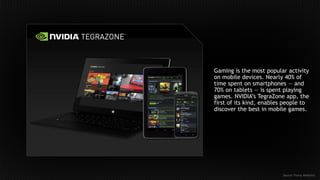
Gaming is the most popular activity
on mobile devices. Nearly 40% of
time spent on smartphones — and
70% on tablets — is spent playing
games. NVIDIA’s TegraZone app, the
first of its kind, enables people to
discover the best in mobile games.
Source: Flurry Analytics
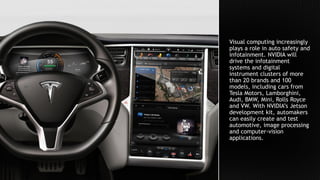
Visual computing increasingly
plays a role in auto safety and
infotainment. NVIDIA will
drive the infotainment
systems and digital
instrument clusters of more
than 20 brands and 100
models, including cars from
Tesla Motors, Lamborghini,
Audi, BMW, Mini, Rolls Royce
and VW. With NVIDIA’s Jetson
development kit, automakers
can easily create and test
automotive, image processing
and computer-vision
applications.
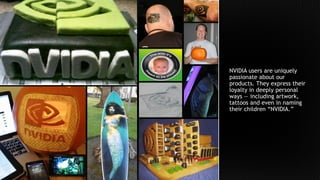
NVIDIA users are uniquely
passionate about our
products. They express their
loyalty in deeply personal
ways — including artwork,
tattoos and even in naming
their children “NVIDIA.”
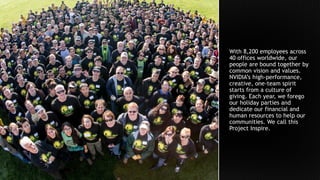
With 8,200 employees across
40 offices worldwide, our
people are bound together by
common vision and values.
NVIDIA’s high-performance,
creative, one-team spirit
starts from a culture of
giving. Each year, we forego
our holiday parties and
dedicate our financial and
human resources to help our
communities. We call this
Project Inspire.
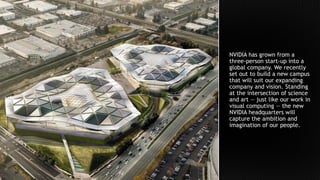
NVIDIA has grown from a
three-person start-up into a
global company. We recently
set out to build a new campus
that will suit our expanding
company and vision. Standing
at the intersection of science
and art — just like our work in
visual computing — the new
NVIDIA headquarters will
capture the ambition and
imagination of our people.
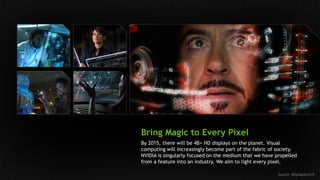
Bring Magic to Every Pixel
By 2015, there will be 4B+ HD displays on the planet. Visual
computing will increasingly become part of the fabric of society.
NVIDIA is singularly focused on the medium that we have propelled
from a feature into an industry. We aim to light every pixel.
Source: DisplaySearch
Much of what we will see in the future will
likely come from NVIDIA technology as we
increasingly struggle to differentiate
between what is real and what has been
created from someone's imagination.
“
”
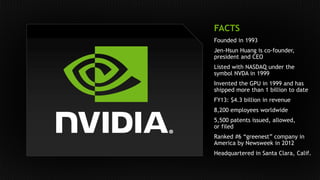
FACTS
Founded in 1993
Jen-Hsun Huang is co-founder,
president and CEO
Listed with NASDAQ under the
symbol NVDA in 1999
Invented the GPU in 1999 and has
shipped more than 1 billion to date
FY13: $4.3 billion in revenue
8,200 employees worldwide
5,500 patents issued, allowed,
or filed
Ranked #6 “greenest” company in
America by Newsweek in 2012
Headquartered in Santa Clara, Calif.
Nvidia Corporate Presentation

Nvidia Corporate Presentation

  • 1.
  • 2.
    A Visual World Visualcomputing is a unique and powerful medium. Over the past 20 years, it has transformed the PC from a tool for productivity into one for creativity, expression and discovery. The beauty and interactivity of visual computing allow people to connect with ideas in a way that no other medium can.
  • 3.
    NVIDIA — TheVisual Computing Company Since 1993, NVIDIA has pioneered the art and science of visual computing. Our passionate work has resulted in thousands of patented inventions, breakthrough technologies, deep industry relationships and a powerful brand.
  • 4.
    End-to-End Visual Computing Inventfundamental technologies. Design the world’s best GPUs and mobile processors. Create modules and services for select markets. Build fully integrated systems.
  • 5.
    Brands and TargetMarkets GeForce, GRID — Gaming Quadro, GRID, Tesla — Design, VDI, HPC/Big Data in the Enterprise Tegra — New Computing Devices
  • 6.
    Blockbuster games consistently outsellthe biggest Hollywood films — Call of Duty: Black Ops 2 reached $500M in sales in its first 24 hours. By 2016, the PC gaming market is expected to reach over $20B. GeForce GPUs are the engines behind the creation and enjoyment of this thriving market. Source: Activision, DFC Intelligence
  • 7.
    400M people aroundthe world play massively multiplayer online games (MMOs). League of Legends, a free-to-play MMO and one of the most popular games, boasts 12M daily users. Source: Newzoo, Riot Games
  • 8.
    Virtual goods arecreating new business models for game developers and a new way for gamers to engage. In 2012, more than half of the $6.5B spent on MMOs was spent on “free-to-play” games. Individual artists make upwards of $100K a year designing the in-game hats for the free-to-play hit Team Fortress 2. Source: Newzoo, Valve
  • 9.
    With hundreds ofgames released each year — and hundreds of thousands of possible PC configurations — finding the right settings for any given game is complex. GeForce Experience is an NVIDIA application that automatically optimizes game settings, delivering the power of a PC with the simplicity of a console.
  • 10.
    With NVIDIA GRID,gamers have the freedom to play the most graphics-intensive games from the cloud on any display. By solving the “lag” issue that has hindered cloud gaming, GRID promises to make game streaming as convenient and common as renting a movie online.
  • 11.
    NVIDIA Quadro GPUshelp most of the world’s industrial designers bring their visions to life. They rely on photorealistic renderings — like this one of the McLaren P1— to create their designs without physical models. Quadro performs ray-tracing algorithms that generate such images. Everything from shampoo bottles to jumbo jets are created with software that runs on Quadro.
  • 12.
    Visual computing ismaking movies more immersive and imaginative. NVIDIA is playing a major role. 2013 marked the fourth year in a row when all films nominated for the Best Visual Effects Academy Award were created on Quadro GPUs, including Oscar-winner, Life of Pi.
  • 13.
    Like many broadcasters, ESPNuses visual computing to enhance live coverage with augmented reality. Here, the distance of a home run is instantly displayed during Major League Baseball’s Home Run Derby. GPUs power ESPN’s video capture and 3D modeling system that enables operators to easily interact with live video feeds and deliver a better viewing experience.
  • 14.
    Enterprises are inthe midst of a seismic shift. Employees bring their own devices to work, multiple operating systems tap into distinct services, and mobile access is essential. Leveraging our GPU expertise, we’ve invented new technologies that unlock visual computing from the box and deliver amazing graphics to any device. We call it GRID. Today, Cisco, Dell, HP and IBM offer GRID- based servers while Citrix, Microsoft and VMware offer GRID-enabled software.
  • 15.
    At GTC 2013,we introduced the world’s first visual computing appliance. GRID VCA runs graphics-intensive applications — such as those from Adobe, Autodesk and Dassault — and sends the graphics output over the network to be displayed on a client computer. Design firms, film studios and other businesses can now give their creative teams access to graphics-intensive apps with uncompromised performance, flexibility and simplicity.
  • 16.
    GPUs evolved intogeneral purpose processors ideally suited to tackle massively parallel computing problems. Today, 50 systems on the Top500 list of supercomputers are powered by GPUs. With a peak performance of 27 petaflops, the Titan supercomputer at Oak Ridge National Labs is the world’s fastest. 18,688 Tesla GPUs provide 90% of the machine’s computing power.
  • 17.
    Using GPUs, HarvardFellow Erez Lieberman-Aiden discovered that DNA comes together in fractal globules (the same shape as uncooked ramen noodles), and the way that it’s folded determines whether healthy or malignant cells will be produced. His technique relies on looking at the billions of snapshots generated by modern DNA sequencing techniques. GPUs are essential in processing the enormous amount of data at the heart of the process.
  • 18.
    The floors ofthe Adriatic and Mediterranean seas are littered with tens of thousands of mines, bombs and other munitions that were lost or abandoned after World War I and II. To locate and identify the dangerous materials, NATO is using autonomous underwater vehicles equipped with synthetic aperture sonar running on Tesla GPUs. The sonar application runs up to 100x faster on GPUs, enabling real-time object recognition, on-board processing and intelligent decision-making capabilities.
  • 19.
    Researchers at Plymouth Universityare driving the emergence of humanoid robots by modeling biological neural networks. These networks consist of thousands of neurons connected to each other through millions of synapses. The systems integrate visual processing, linguistics and other inputs such as touch, temperature and position. GPUs perform the millions of calculations needed to activate the neural network every 50-100 milliseconds.
  • 20.
    Top enterprise andmobile application companies are using Tesla GPUs to tackle big data analytics and advanced search. For example, Shazam uses GPUs to instantly search and identify songs from its 27 million track database for its 300 million users.
  • 21.
    In 2012, therewere twice as many mobile devices sold as PCs. By 2016, it’s estimated that tablets alone will outsell PCs with 430M units shipped. The Tegra mobile processor is designed to power a world where visual computing is everywhere. Tegra combines our industry-leading CPU, GPU, LTE modem and camera technology, and taps into the gaming ecosystem that is NVIDIA’s heritage. Source: Business Insider
  • 22.
    Tegra powers someof the most innovative devices on the market, including flagship devices from Microsoft and Google, infotainment systems from leading car companies, and new-style devices like Ouya’s crowd-sourced game console. And this is just the beginning. The open, rich Android ecosystem has attracted nearly every type of device company in the world.
  • 23.
    We surprised theworld with the announcement of Project SHIELD at CES 2013. Project SHIELD is a portable that lets gamers play both Android and PC games with the benefits of a console-grade controller, a five-inch retinal screen, and exceptional sound from tuned port, bass reflex speakers.
  • 24.
    Gaming is themost popular activity on mobile devices. Nearly 40% of time spent on smartphones — and 70% on tablets — is spent playing games. NVIDIA’s TegraZone app, the first of its kind, enables people to discover the best in mobile games. Source: Flurry Analytics
  • 25.
    Visual computing increasingly playsa role in auto safety and infotainment. NVIDIA will drive the infotainment systems and digital instrument clusters of more than 20 brands and 100 models, including cars from Tesla Motors, Lamborghini, Audi, BMW, Mini, Rolls Royce and VW. With NVIDIA’s Jetson development kit, automakers can easily create and test automotive, image processing and computer-vision applications.
  • 26.
    NVIDIA users areuniquely passionate about our products. They express their loyalty in deeply personal ways — including artwork, tattoos and even in naming their children “NVIDIA.”
  • 27.
    With 8,200 employeesacross 40 offices worldwide, our people are bound together by common vision and values. NVIDIA’s high-performance, creative, one-team spirit starts from a culture of giving. Each year, we forego our holiday parties and dedicate our financial and human resources to help our communities. We call this Project Inspire.
  • 28.
    NVIDIA has grownfrom a three-person start-up into a global company. We recently set out to build a new campus that will suit our expanding company and vision. Standing at the intersection of science and art — just like our work in visual computing — the new NVIDIA headquarters will capture the ambition and imagination of our people.
  • 29.
    Bring Magic toEvery Pixel By 2015, there will be 4B+ HD displays on the planet. Visual computing will increasingly become part of the fabric of society. NVIDIA is singularly focused on the medium that we have propelled from a feature into an industry. We aim to light every pixel. Source: DisplaySearch
  • 30.
    Much of whatwe will see in the future will likely come from NVIDIA technology as we increasingly struggle to differentiate between what is real and what has been created from someone's imagination. “ ”
  • 31.
    FACTS Founded in 1993 Jen-HsunHuang is co-founder, president and CEO Listed with NASDAQ under the symbol NVDA in 1999 Invented the GPU in 1999 and has shipped more than 1 billion to date FY13: $4.3 billion in revenue 8,200 employees worldwide 5,500 patents issued, allowed, or filed Ranked #6 “greenest” company in America by Newsweek in 2012 Headquartered in Santa Clara, Calif.