

ISSUES ON THE “BEAUTIFUL”:
ART AS REPRESENTATION
Presented by:
Shaina Mavreen D. Villaroza
Philosophy 1N
WHAT IS REPRESENTATIONAL ART?
 The word "representational," means that the work
depicts something easily recognized by most people.
 The value of art lies, not with any ‘aesthetic’ qualities
of the artwork itself (perceptual richness, natural
beauty etc.);
 nor with any ‘formal’ features the work possesses (the
intrinsic properties of ‘form’, ‘balance’, ‘harmony’ etc.)
 nor with the emotions the work evokes or possesses
intrinsically.
 But rather with what a work of art can teach us. This
could be termed cognitivism: a work of art is about
thoughts .
ART INFORMS US BY:
 illuminating our experience
 revealing truths’ in ways other media can’t
 it reveals a ‘vision’. It shows us a version of the
world that is particular to the artist, unique to
them, but which we can ourselves appreciate
 representing authentically.
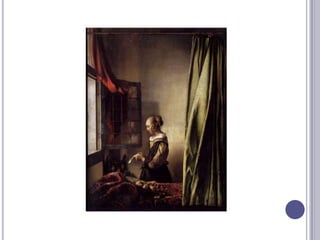
 To represent authentically, perhaps art must have a
certain realism.
 Consider the next three pictures.
EXAMPLE OF REPRESENTATIONAL ART
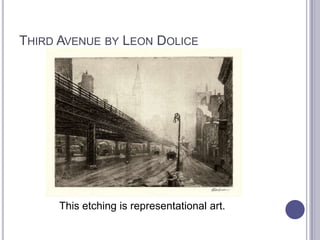
 Leon Dolice - Third Avenue,
 depicts a street scene in New York City.
 You can see a street, an automobile and lots of
buildings - one of which is only found in New York
City.
THIRD AVENUE BY LEON DOLICE
This etching is representational art.
ABSTRACT (NON-REPRESENTATIONAL)
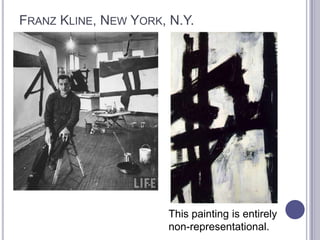
 Franz Kline (Abstract Expressionist artist) - New
York, New York.
 It's not a scene of New York City. There are no
identifiable objects or people within. In fact, one is
left free to interpret whatever one wishes about this
piece.
FRANZ KLINE, NEW YORK, N.Y.
This painting is entirely
non-representational.
ORIGIN/HISTORY OF REPRESENTATIONAL ART
 Started many millennia ago with Late
Paleolithic figurines and carvings.
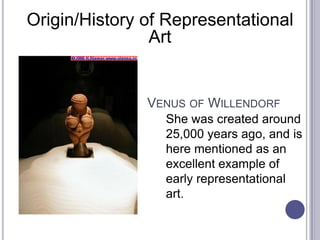
 Example: Venus of Willendorf - while not too
terribly realistic, is clearly meant to show the
figure of a woman.
VENUS OF WILLENDORF
She was created around
25,000 years ago, and is
here mentioned as an
excellent example of
early representational
art.
Origin/History of Representational
Art
 Throughout our history as art-creating
humans, most art has been representational.
 Even when art was symbolic, or non-figurative, it
was usually representative of something.
 Abstract (non-representational) art is a relatively
recent invention, and didn't evolve until the early
20th-century.
Origin/History of Representational
Art
PRESENT STATUS OF REPRESENTATIONAL
ART
 Thriving
 More viewer-friendly to the vast majority of
people than abstract or conceptual art
 This is not to say that abstract art isn't a thing
of beauty
 We humans are compelled
to understand things and use words in an
attempt to do so
OVERVIEW
 Modernism promoted originality, &
 experimentation, anti-realism,
individualism and a stress on the cerebral
rather than emotive aspects.
 Postmodernism renounces mimesis
altogether.
 free-wheeling creations constructed of a
language that largely points to itself
REPRESENTATIONAL THEORIES IN HISTORY
PLATO AND REALITY
 Plato’s account in Book X of his ‘Republic’
 because art was merely a ‘copy of a copy’
(represented a reality which was itself only a
pale representation of the true reality of
Forms), it could not be regarded as ‘truth-
functional’ and thus had no place in a ‘well run’
society.
 Platonic view: art merely ‘copies’ ( mimesis ) the
world badly.
REPRESENTATIONAL THEORIES IN HISTORY
ARISTOTLE AND MIMESIS
• Aristotle: disagrees. For him, art had the
capacity to:
- Be morally educative (Homer, Greek Tragedy
reinforce our view of the virtues
- Represent reality (and truths about it) in a way
that other mediums could not (the ability to
reveal universals, confront us with timeless
beauty etc.)
EVEN IF ART INFORMS US, IS THAT WHY WE
VALUE IT AS ART?
 Valuing art in terms of its cognitive value means
that the artwork itself – both its aesthetic and its
formal and its emotional qualities – must be
disregarded.
 Yet this is unacceptable, since if we are going to
provide an adequate account of why we value
art, we need to explain aesthetic, formal and
emotional qualities. ‘All Art aspires to the condition
of music’, or ‘Art for art’s sake’!
END.

Art as representation

  • 1.
    ISSUES ON THE“BEAUTIFUL”: ART AS REPRESENTATION Presented by: Shaina Mavreen D. Villaroza Philosophy 1N
  • 2.
    WHAT IS REPRESENTATIONALART?  The word "representational," means that the work depicts something easily recognized by most people.  The value of art lies, not with any ‘aesthetic’ qualities of the artwork itself (perceptual richness, natural beauty etc.);  nor with any ‘formal’ features the work possesses (the intrinsic properties of ‘form’, ‘balance’, ‘harmony’ etc.)  nor with the emotions the work evokes or possesses intrinsically.  But rather with what a work of art can teach us. This could be termed cognitivism: a work of art is about thoughts .
  • 3.
    ART INFORMS USBY:  illuminating our experience  revealing truths’ in ways other media can’t  it reveals a ‘vision’. It shows us a version of the world that is particular to the artist, unique to them, but which we can ourselves appreciate  representing authentically.
  • 4.
     To representauthentically, perhaps art must have a certain realism.  Consider the next three pictures.
  • 8.
    EXAMPLE OF REPRESENTATIONALART  Leon Dolice - Third Avenue,  depicts a street scene in New York City.  You can see a street, an automobile and lots of buildings - one of which is only found in New York City.
  • 9.
    THIRD AVENUE BYLEON DOLICE This etching is representational art.
  • 10.
    ABSTRACT (NON-REPRESENTATIONAL)  FranzKline (Abstract Expressionist artist) - New York, New York.  It's not a scene of New York City. There are no identifiable objects or people within. In fact, one is left free to interpret whatever one wishes about this piece.
  • 11.
    FRANZ KLINE, NEWYORK, N.Y. This painting is entirely non-representational.
  • 12.
    ORIGIN/HISTORY OF REPRESENTATIONALART  Started many millennia ago with Late Paleolithic figurines and carvings.  Example: Venus of Willendorf - while not too terribly realistic, is clearly meant to show the figure of a woman.
  • 13.
    VENUS OF WILLENDORF Shewas created around 25,000 years ago, and is here mentioned as an excellent example of early representational art. Origin/History of Representational Art
  • 14.
     Throughout ourhistory as art-creating humans, most art has been representational.  Even when art was symbolic, or non-figurative, it was usually representative of something.  Abstract (non-representational) art is a relatively recent invention, and didn't evolve until the early 20th-century. Origin/History of Representational Art
  • 15.
    PRESENT STATUS OFREPRESENTATIONAL ART  Thriving  More viewer-friendly to the vast majority of people than abstract or conceptual art  This is not to say that abstract art isn't a thing of beauty  We humans are compelled to understand things and use words in an attempt to do so
  • 16.
    OVERVIEW  Modernism promotedoriginality, &  experimentation, anti-realism, individualism and a stress on the cerebral rather than emotive aspects.  Postmodernism renounces mimesis altogether.  free-wheeling creations constructed of a language that largely points to itself
  • 17.
    REPRESENTATIONAL THEORIES INHISTORY PLATO AND REALITY  Plato’s account in Book X of his ‘Republic’  because art was merely a ‘copy of a copy’ (represented a reality which was itself only a pale representation of the true reality of Forms), it could not be regarded as ‘truth- functional’ and thus had no place in a ‘well run’ society.  Platonic view: art merely ‘copies’ ( mimesis ) the world badly.
  • 18.
    REPRESENTATIONAL THEORIES INHISTORY ARISTOTLE AND MIMESIS • Aristotle: disagrees. For him, art had the capacity to: - Be morally educative (Homer, Greek Tragedy reinforce our view of the virtues - Represent reality (and truths about it) in a way that other mediums could not (the ability to reveal universals, confront us with timeless beauty etc.)
  • 19.
    EVEN IF ARTINFORMS US, IS THAT WHY WE VALUE IT AS ART?  Valuing art in terms of its cognitive value means that the artwork itself – both its aesthetic and its formal and its emotional qualities – must be disregarded.  Yet this is unacceptable, since if we are going to provide an adequate account of why we value art, we need to explain aesthetic, formal and emotional qualities. ‘All Art aspires to the condition of music’, or ‘Art for art’s sake’!
  • 20.

Editor's Notes

  • #4 Revealing truths examples: (e.g. Homer’s heroes in the Iliad and Odyssey reveal moral truths about traits the virtuous character must cultivate (bravery and cunning); Universal/timeless truths (Michelangelo’s ‘David’ as portraying eternal youth, the timeless and universal beauty and perfection of the human ‘form’, revealing the universal in the particular); Psychological truths (Hamlets ‘to be or not to be’ soliloquy as confronting the question of whether existence is preferable to non-existence); Religious truths (Michelangelo’s ‘Creation of Adam’ as revealing the truth of genesis and creationism; Dante’s depiction of the inferno , purgatorio and paradiso ); Practical truths (cave-painting as a a means for communicating hunting skills)
  • #16 We (absolutely including myself) have a higher degree of comfort with art when something recognizable catches the eye and registers.Most of it stands alone, appreciable on the basis of light, color and design. Too many words - and often too big and too obscure, to boot. All of those words cloud an experience that is seen and felt on an individual basis.