IMPRESSED CURRENT CATHODIC
PROTECTION
By:
Shailesh Shukla
M.Tech - D&H
1340010200423 May 2015
Under the Guidance of:
Mrs. Madhu Joshi
Scientist - B
IMU Visakhapatnam
What is Corrosion ?
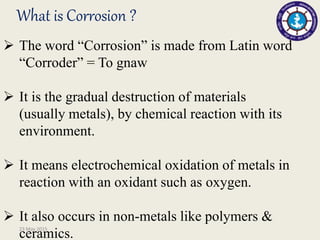
 The word “Corrosion” is made from Latin word
“Corroder” = To gnaw
 It is the gradual destruction of materials
(usually metals), by chemical reaction with its
environment.
 It means electrochemical oxidation of metals in
reaction with an oxidant such as oxygen.
 It also occurs in non-metals like polymers &
ceramics.23 May 2015
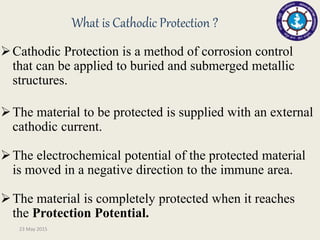
Cathodic Protection is a method of corrosion control
that can be applied to buried and submerged metallic
structures.
The material to be protected is supplied with an external
cathodic current.
The electrochemical potential of the protected material
is moved in a negative direction to the immune area.
The material is completely protected when it reaches
the Protection Potential.
What is Cathodic Protection ?
23 May 2015
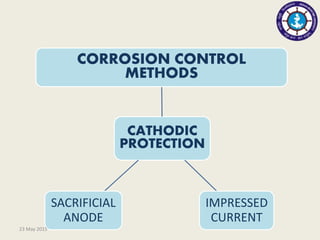
CATHODIC
PROTECTION
CORROSION CONTROL
METHODS
IMPRESSED
CURRENT
SACRIFICIAL
ANODE
23 May 2015
HISTORY
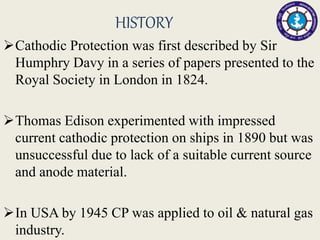
Cathodic Protection was first described by Sir
Humphry Davy in a series of papers presented to the
Royal Society in London in 1824.
Thomas Edison experimented with impressed
current cathodic protection on ships in 1890 but was
unsuccessful due to lack of a suitable current source
and anode material.
In USA by 1945 CP was applied to oil & natural gas
industry.
DISCRIPTION
 The simplest method to apply CP is by connecting the metal to
be protected with another more easily corroded “Sacrificial
Metal” to act as the anode of the electrochemical cell.
 The sacrificial metal then corrodes instead of the protected
metal. When passive galvanic CP is not adequate, then we
provide an external Dc source.
 Common applications are: Steel water or oil pipe lines,
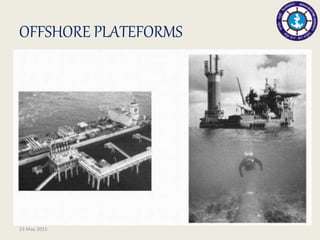
storage tanks, ship & boat hulls, offshore platforms, metal
reinforcement bars in concrete buildings.
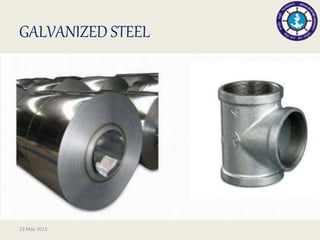
 In galvanized steels , in which a sacrificial coating of zinc on
steel parts protect them from rust.
23 May 2015
Why it is important ?
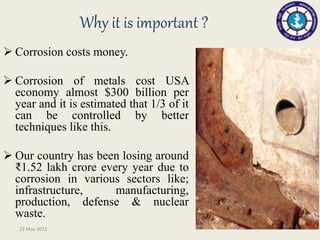
 Corrosion costs money.
 Corrosion of metals cost USA
economy almost $300 billion per
year and it is estimated that 1/3 of it
can be controlled by better
techniques like this.
 Our country has been losing around
₹1.52 lakh crore every year due to
corrosion in various sectors like;
infrastructure, manufacturing,
production, defense & nuclear
waste.
23 May 2015
Reaction
The basic process at an anodic site is the release of
iron (Fe) from the steel surface into the environment
and can be expressed as:
Fe Fe2+ + 2e-
 During the process two electrons are generated
which must be consumed by the environment.
4H++ O2 + 4e- 2H2O
2Fe + 2H2O + O2 2Fe(OH)2
 The term Fe(OH)2 is iron oxide which can be
oxidized to form the Red-brown Fe(OH)3 called
Rust.23 May 2015
SACRIFICIAL ANODE
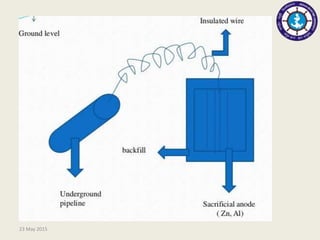
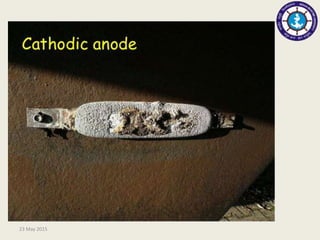
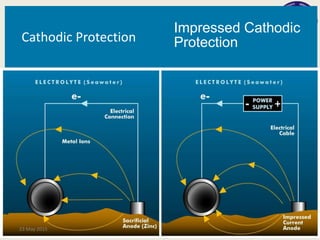
 In the usual application, a galvanic anode, a piece of a more
electrochemically active metal, attached to the vulnerable
metal surface where it is exposed to the corrosive liquid.
Galvanic anodes have more active voltage that the target
material usually steel.
 For effective CP, the potential of the steel surface is polarized
more negative until the surface has a uniform potential.
 Metals like Zn, Al & Mg are used for making anodes.
 For increasing electrical contact the active metal is placed in
back fill (Coal & NaCl).
23 May 2015
23 May 2015
23 May 2015
IMPRESSED CURRENT CATHODIC
PROTECTION
 For larger structures, galvanic anodes can’t economically deliver
enough current to provide complete protection.
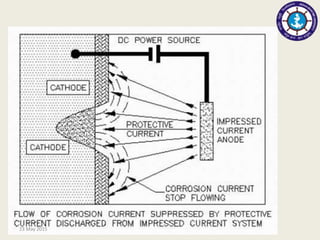
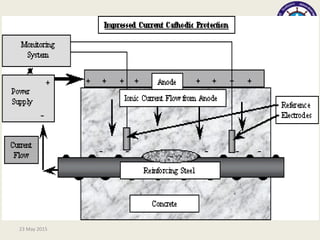
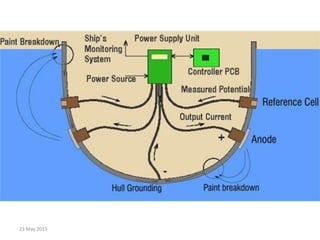
 In this method, an impressed current is applied in opposite
direction to nullify the corrosion current and convert the corroding
metal from anode to cathode.
 ICCP systems use anodes connected to a DC source.
 This current is given to insoluble anode like graphite, stainless steel
or scrap iron buried in soil.
 The negative terminal of DC is connected to pipeline to be
protected. The anode is kept in back fill to increase the electrical
contact with the surrounding soil.23 May 2015
23 May 2015
Impressed Cathodic
ProtectionCathodic Protection
23 May 2015
23 May 2015
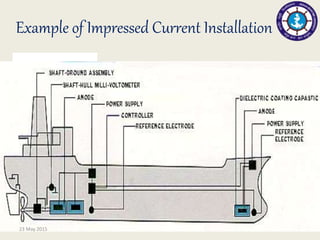
Example of Impressed Current Installation
23 May 2015
23 May 2015
Applications of Impressed Current
Applied on steel in seawater or soil
Oil Platforms in steel and concrete
Subsea Pipelines
Hull
Quay structures and sheet pile curtains
Concrete bridges placed in seawater
Pipelines buried in soil
Vessels/tanks buried in soil
23 May 2015
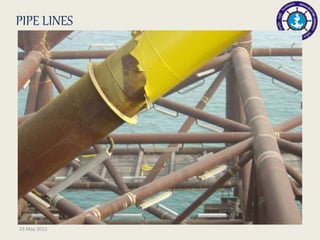
PIPE LINES
23 May 2015
SHIPS
23 May 2015
OFFSHORE PLATEFORMS
23 May 2015
GALVANIZED STEEL
23 May 2015
IMPRESSED CURRENT
Advantages:
High driving voltage (30 V)
Few anodes – reduced resistance
Disadvantages:
Vulnerable components
Need for regulation/control system
 Risk of overprotection of highly charged materials
 Coating damages – cathodic accouplement
Need for/recommended protection shield around the
anodes
Need for maintenance23 May 2015
Problems Arised Due To CP
Production of hydrogen ions
Cathodic Disbonding
Cathodic Shielding
Safety
23 May 2015
23 May 2015

IMPRESSED CURRENT CATHODIC PROTECTION

  • 1.
    IMPRESSED CURRENT CATHODIC PROTECTION By: ShaileshShukla M.Tech - D&H 1340010200423 May 2015 Under the Guidance of: Mrs. Madhu Joshi Scientist - B IMU Visakhapatnam
  • 2.
    What is Corrosion?  The word “Corrosion” is made from Latin word “Corroder” = To gnaw  It is the gradual destruction of materials (usually metals), by chemical reaction with its environment.  It means electrochemical oxidation of metals in reaction with an oxidant such as oxygen.  It also occurs in non-metals like polymers & ceramics.23 May 2015
  • 3.
    Cathodic Protection isa method of corrosion control that can be applied to buried and submerged metallic structures. The material to be protected is supplied with an external cathodic current. The electrochemical potential of the protected material is moved in a negative direction to the immune area. The material is completely protected when it reaches the Protection Potential. What is Cathodic Protection ? 23 May 2015
  • 4.
  • 5.
    HISTORY Cathodic Protection wasfirst described by Sir Humphry Davy in a series of papers presented to the Royal Society in London in 1824. Thomas Edison experimented with impressed current cathodic protection on ships in 1890 but was unsuccessful due to lack of a suitable current source and anode material. In USA by 1945 CP was applied to oil & natural gas industry.
  • 6.
    DISCRIPTION  The simplestmethod to apply CP is by connecting the metal to be protected with another more easily corroded “Sacrificial Metal” to act as the anode of the electrochemical cell.  The sacrificial metal then corrodes instead of the protected metal. When passive galvanic CP is not adequate, then we provide an external Dc source.  Common applications are: Steel water or oil pipe lines, storage tanks, ship & boat hulls, offshore platforms, metal reinforcement bars in concrete buildings.  In galvanized steels , in which a sacrificial coating of zinc on steel parts protect them from rust. 23 May 2015
  • 7.
    Why it isimportant ?  Corrosion costs money.  Corrosion of metals cost USA economy almost $300 billion per year and it is estimated that 1/3 of it can be controlled by better techniques like this.  Our country has been losing around ₹1.52 lakh crore every year due to corrosion in various sectors like; infrastructure, manufacturing, production, defense & nuclear waste. 23 May 2015
  • 8.
    Reaction The basic processat an anodic site is the release of iron (Fe) from the steel surface into the environment and can be expressed as: Fe Fe2+ + 2e-  During the process two electrons are generated which must be consumed by the environment. 4H++ O2 + 4e- 2H2O 2Fe + 2H2O + O2 2Fe(OH)2  The term Fe(OH)2 is iron oxide which can be oxidized to form the Red-brown Fe(OH)3 called Rust.23 May 2015
  • 9.
    SACRIFICIAL ANODE  Inthe usual application, a galvanic anode, a piece of a more electrochemically active metal, attached to the vulnerable metal surface where it is exposed to the corrosive liquid. Galvanic anodes have more active voltage that the target material usually steel.  For effective CP, the potential of the steel surface is polarized more negative until the surface has a uniform potential.  Metals like Zn, Al & Mg are used for making anodes.  For increasing electrical contact the active metal is placed in back fill (Coal & NaCl). 23 May 2015
  • 10.
  • 11.
  • 12.
    IMPRESSED CURRENT CATHODIC PROTECTION For larger structures, galvanic anodes can’t economically deliver enough current to provide complete protection.  In this method, an impressed current is applied in opposite direction to nullify the corrosion current and convert the corroding metal from anode to cathode.  ICCP systems use anodes connected to a DC source.  This current is given to insoluble anode like graphite, stainless steel or scrap iron buried in soil.  The negative terminal of DC is connected to pipeline to be protected. The anode is kept in back fill to increase the electrical contact with the surrounding soil.23 May 2015
  • 13.
  • 14.
  • 15.
  • 16.
    Example of ImpressedCurrent Installation 23 May 2015
  • 17.
  • 18.
    Applications of ImpressedCurrent Applied on steel in seawater or soil Oil Platforms in steel and concrete Subsea Pipelines Hull Quay structures and sheet pile curtains Concrete bridges placed in seawater Pipelines buried in soil Vessels/tanks buried in soil 23 May 2015
  • 19.
  • 20.
  • 21.
  • 22.
  • 23.
    IMPRESSED CURRENT Advantages: High drivingvoltage (30 V) Few anodes – reduced resistance Disadvantages: Vulnerable components Need for regulation/control system  Risk of overprotection of highly charged materials  Coating damages – cathodic accouplement Need for/recommended protection shield around the anodes Need for maintenance23 May 2015
  • 24.
    Problems Arised DueTo CP Production of hydrogen ions Cathodic Disbonding Cathodic Shielding Safety 23 May 2015
  • 25.

Editor's Notes