Lower Mainland Major Transit StudiesFraser Valley Transit StudyUBC Line StudySurrey Rapid  Transit  StudyPresentersJohn Schnablegger ,MoTI  South Coast Region Ed Storm, MoTI Transit BranchApril 19, 2011
Fraser Valley Transit StudyPurpose of the StudyTo determine current and future transit travel needs in the Fraser ValleyTo develop and assess transit service options to meet those needsTo develop a transit Vision with local governments to assist in guiding transit investments for the Fraser ValleyOrganizationThis was a Ministry led study with partnership from the Fraser Valley Regional District, BC Transit, and TransLink2
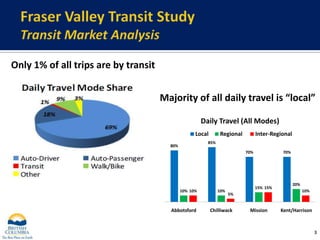
Fraser Valley Transit StudyTransit Market AnalysisOnly 1% of all trips are by transit3Majority of all daily travel is “local”
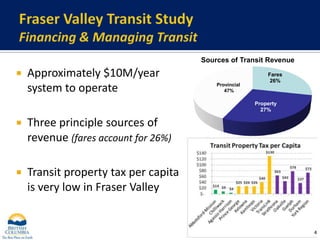
Fraser Valley Transit StudyFinancing & Managing TransitApproximately $10M/year system to operateThree principle sources of revenue (fares account for 26%)Transit property tax per capita is very low in Fraser Valley4
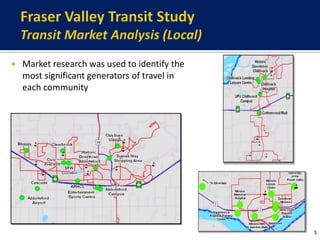
Fraser Valley Transit StudyTransit Market Analysis (Local)Market research was used to identify the most significant generators of travel in each community5
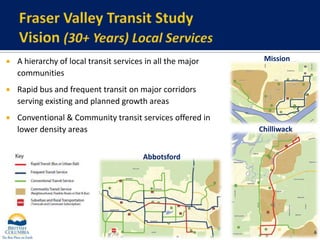
Fraser Valley Transit StudyVision (30+ Years) Local ServicesMissionA hierarchy of local transit services in all the major communitiesRapid bus and frequent transit on major corridors serving existing and planned growth areasConventional & Community transit services offered in lower density areasChilliwackAbbotsford6
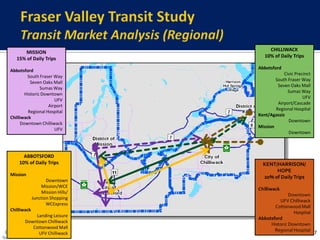
Fraser Valley Transit StudyTransit Market Analysis (Regional)7CHILLIWACK10% of Daily TripsAbbotsford Civic PrecinctSouth Fraser WaySeven Oaks MallSumas WayUFV Airport/Cascade Regional HospitalKent/AgassizDowntownMission DowntownMISSION15% of Daily TripsAbbotsford South Fraser WaySeven Oaks MallSumas WayHistoric DowntownUFV AirportRegional HospitalChilliwackDowntown ChilliwackUFVABBOTSFORD10% of Daily TripsMissionDowntown Mission/WCEMission Hills/ Junction ShoppingWCExpressChilliwackLanding LeisureDowntown ChilliwackCottonwood MallUFV ChilliwackKENT/HARRISON/ HOPE20% of Daily TripsChilliwack DowntownUFV ChilliwackCottonwood Mall HospitalAbbotsfordHistoric DowntownRegional Hospital
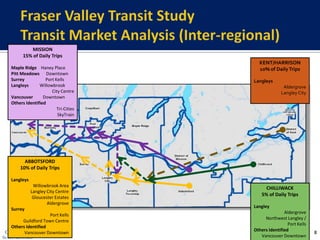
Fraser Valley Transit StudyTransit Market Analysis (Inter-regional)8MISSION15% of Daily TripsMaple Ridge    Haney PlacePitt Meadows      DowntownSurrey                   Port KellsLangleys          WillowbrookCity CentreVancouver         DowntownOthers IdentifiedTri-CitiesSkyTrainKENT/HARRISON10% of Daily TripsLangleysAldergroveLangley CityABBOTSFORD10% of Daily TripsLangleys Willowbrook AreaLangley City CentreGloucester EstatesAldergroveSurreyPort KellsGuildford Town CentreOthers IdentifiedVancouver DowntownCHILLIWACK5% of Daily TripsLangleyAldergroveNorthwest Langley /Port KellsOthers IdentifiedVancouver Downtown
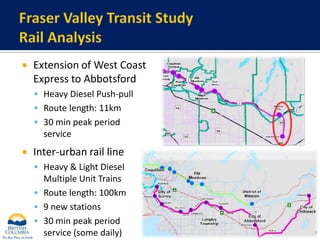
Fraser Valley Transit StudyRail AnalysisExtension of West Coast Express to AbbotsfordHeavy Diesel Push-pull Route length: 11km30 min peak period serviceInter-urban rail lineHeavy & Light Diesel Multiple Unit TrainsRoute length: 100km9 new stations30 min peak period service (some daily)9
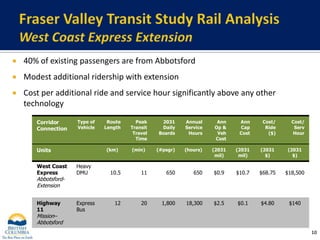
Fraser Valley Transit Study Rail Analysis West Coast Express Extension 40% of existing passengers are from AbbotsfordModest additional ridership with extensionCost per additional ride and service hour significantly above any other technology10
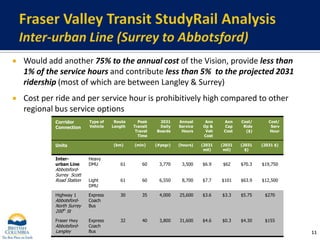
Fraser Valley Transit StudyRailAnalysis Inter-urban Line (Surrey to Abbotsford)Would add another 75% to the annual cost of the Vision, provide less than 1% of the service hours and contribute less than 5%  to the projected 2031 ridership (most of which are between Langley & Surrey)Cost per ride and per service hour is prohibitively high compared to other regional bus service options11
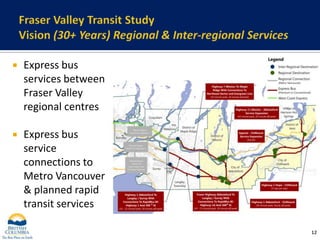
Fraser Valley Transit StudyVision (30+ Years) Regional & Inter-regional ServicesExpress bus services between Fraser Valley regional centresExpress bus service connections to Metro Vancouver & planned rapid transit services12
Rapid Transit StudiesThe Ministry is participating with TransLink in two rapid transit studiesUBC Line Rapid Transit StudySurrey Rapid Transit StudyThe Ministry and TransLink are also looking at options to increase capacity on the Expo Line
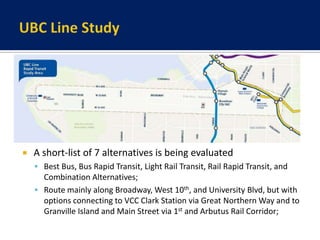
UBC Line StudyA short-list of 7 alternatives is being evaluatedBest Bus, Bus Rapid Transit, Light Rail Transit, Rail Rapid Transit, and Combination Alternatives;Route mainly along Broadway, West 10th, and University Blvd, but with options connecting to VCC Clark Station via Great Northern Way and to Granville Island and Main Street via 1st and Arbutus Rail Corridor;
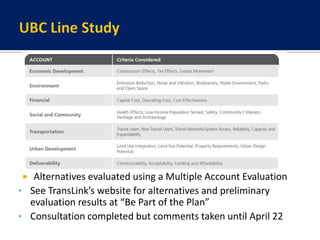
UBC Line StudyAlternatives evaluated using a Multiple Account EvaluationSee TransLink’s website for alternatives and preliminary evaluation results at “Be Part of the Plan”
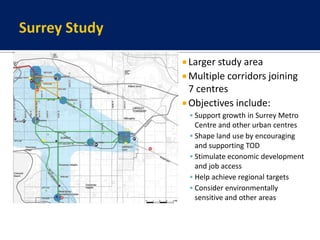
Consultation completed but comments taken until April 22Surrey StudyLarger study areaMultiple corridors joining 7 centresObjectives include:Support growth in Surrey Metro Centre and other urban centresShape land use by encouraging and supporting TODStimulate economic development and job accessHelp achieve regional targetsConsider environmentally sensitive and other areas
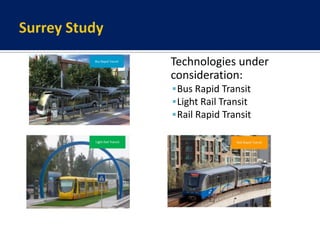
Surrey StudyTechnologies under consideration:Bus Rapid TransitLight Rail TransitRail Rapid Transit
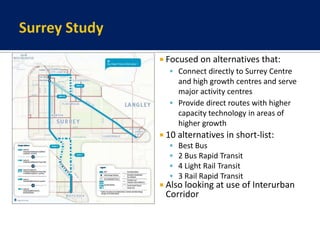
Surrey StudyFocused on alternatives that:Connect directly to Surrey Centre and high growth centres and serve major activity centresProvide direct routes with higher capacity technology in areas of higher growth 10 alternatives in short-list:Best Bus2 Bus Rapid Transit4 Light Rail Transit3 Rail Rapid TransitAlso looking at use of Interurban Corridor
Surrey StudyAlternative designs, technical work, and preliminary evaluation now underwayWill provide level of detail similar to what was produced for the UBC Line Study includingEstimated capital and operating costsRidership projectionsIndicative travel timesPreliminary evaluation and rationaleMore information on “Be Part of the Plan”

BC Ministry of Transportation Transit Presentation

  • 1.
    Lower Mainland MajorTransit StudiesFraser Valley Transit StudyUBC Line StudySurrey Rapid Transit StudyPresentersJohn Schnablegger ,MoTI South Coast Region Ed Storm, MoTI Transit BranchApril 19, 2011
  • 2.
    Fraser Valley TransitStudyPurpose of the StudyTo determine current and future transit travel needs in the Fraser ValleyTo develop and assess transit service options to meet those needsTo develop a transit Vision with local governments to assist in guiding transit investments for the Fraser ValleyOrganizationThis was a Ministry led study with partnership from the Fraser Valley Regional District, BC Transit, and TransLink2
  • 3.
    Fraser Valley TransitStudyTransit Market AnalysisOnly 1% of all trips are by transit3Majority of all daily travel is “local”
  • 4.
    Fraser Valley TransitStudyFinancing & Managing TransitApproximately $10M/year system to operateThree principle sources of revenue (fares account for 26%)Transit property tax per capita is very low in Fraser Valley4
  • 5.
    Fraser Valley TransitStudyTransit Market Analysis (Local)Market research was used to identify the most significant generators of travel in each community5
  • 6.
    Fraser Valley TransitStudyVision (30+ Years) Local ServicesMissionA hierarchy of local transit services in all the major communitiesRapid bus and frequent transit on major corridors serving existing and planned growth areasConventional & Community transit services offered in lower density areasChilliwackAbbotsford6
  • 7.
    Fraser Valley TransitStudyTransit Market Analysis (Regional)7CHILLIWACK10% of Daily TripsAbbotsford Civic PrecinctSouth Fraser WaySeven Oaks MallSumas WayUFV Airport/Cascade Regional HospitalKent/AgassizDowntownMission DowntownMISSION15% of Daily TripsAbbotsford South Fraser WaySeven Oaks MallSumas WayHistoric DowntownUFV AirportRegional HospitalChilliwackDowntown ChilliwackUFVABBOTSFORD10% of Daily TripsMissionDowntown Mission/WCEMission Hills/ Junction ShoppingWCExpressChilliwackLanding LeisureDowntown ChilliwackCottonwood MallUFV ChilliwackKENT/HARRISON/ HOPE20% of Daily TripsChilliwack DowntownUFV ChilliwackCottonwood Mall HospitalAbbotsfordHistoric DowntownRegional Hospital
  • 8.
    Fraser Valley TransitStudyTransit Market Analysis (Inter-regional)8MISSION15% of Daily TripsMaple Ridge Haney PlacePitt Meadows DowntownSurrey Port KellsLangleys WillowbrookCity CentreVancouver DowntownOthers IdentifiedTri-CitiesSkyTrainKENT/HARRISON10% of Daily TripsLangleysAldergroveLangley CityABBOTSFORD10% of Daily TripsLangleys Willowbrook AreaLangley City CentreGloucester EstatesAldergroveSurreyPort KellsGuildford Town CentreOthers IdentifiedVancouver DowntownCHILLIWACK5% of Daily TripsLangleyAldergroveNorthwest Langley /Port KellsOthers IdentifiedVancouver Downtown
  • 9.
    Fraser Valley TransitStudyRail AnalysisExtension of West Coast Express to AbbotsfordHeavy Diesel Push-pull Route length: 11km30 min peak period serviceInter-urban rail lineHeavy & Light Diesel Multiple Unit TrainsRoute length: 100km9 new stations30 min peak period service (some daily)9
  • 10.
    Fraser Valley TransitStudy Rail Analysis West Coast Express Extension 40% of existing passengers are from AbbotsfordModest additional ridership with extensionCost per additional ride and service hour significantly above any other technology10
  • 11.
    Fraser Valley TransitStudyRailAnalysis Inter-urban Line (Surrey to Abbotsford)Would add another 75% to the annual cost of the Vision, provide less than 1% of the service hours and contribute less than 5% to the projected 2031 ridership (most of which are between Langley & Surrey)Cost per ride and per service hour is prohibitively high compared to other regional bus service options11
  • 12.
    Fraser Valley TransitStudyVision (30+ Years) Regional & Inter-regional ServicesExpress bus services between Fraser Valley regional centresExpress bus service connections to Metro Vancouver & planned rapid transit services12
  • 13.
    Rapid Transit StudiesTheMinistry is participating with TransLink in two rapid transit studiesUBC Line Rapid Transit StudySurrey Rapid Transit StudyThe Ministry and TransLink are also looking at options to increase capacity on the Expo Line
  • 14.
    UBC Line StudyAshort-list of 7 alternatives is being evaluatedBest Bus, Bus Rapid Transit, Light Rail Transit, Rail Rapid Transit, and Combination Alternatives;Route mainly along Broadway, West 10th, and University Blvd, but with options connecting to VCC Clark Station via Great Northern Way and to Granville Island and Main Street via 1st and Arbutus Rail Corridor;
  • 15.
    UBC Line StudyAlternativesevaluated using a Multiple Account EvaluationSee TransLink’s website for alternatives and preliminary evaluation results at “Be Part of the Plan”
  • 16.
    Consultation completed butcomments taken until April 22Surrey StudyLarger study areaMultiple corridors joining 7 centresObjectives include:Support growth in Surrey Metro Centre and other urban centresShape land use by encouraging and supporting TODStimulate economic development and job accessHelp achieve regional targetsConsider environmentally sensitive and other areas
  • 17.
    Surrey StudyTechnologies underconsideration:Bus Rapid TransitLight Rail TransitRail Rapid Transit
  • 18.
    Surrey StudyFocused onalternatives that:Connect directly to Surrey Centre and high growth centres and serve major activity centresProvide direct routes with higher capacity technology in areas of higher growth 10 alternatives in short-list:Best Bus2 Bus Rapid Transit4 Light Rail Transit3 Rail Rapid TransitAlso looking at use of Interurban Corridor
  • 19.
    Surrey StudyAlternative designs,technical work, and preliminary evaluation now underwayWill provide level of detail similar to what was produced for the UBC Line Study includingEstimated capital and operating costsRidership projectionsIndicative travel timesPreliminary evaluation and rationaleMore information on “Be Part of the Plan”

Editor's Notes

  • #2 Mission Abbotsford Transit Committee
  • #3 Purpose of the Study:The studies primary purpose was to understand how people travel today and are forecasted to travel in the future. Understanding this would then allow us to design concepts for transit that could meet the demand forecasted. Developing a Vision for transit that is supported by local governments and stakeholders offers the best chance of success in following through on a focused, implementable transit plan for the future.Organization: The study was lead by the Ministry of Transportation and Infrastructure and a partnership between the Fraser Valley Regional District, BC Transit, and TransLink. The study is valued at $400K.
  • #4 The Fraser Valley generates close to 800,000 trips daily. This amount considers all modes of travel at the local, regional and inter-regional level.Only 1% of all travel is made by transit today. This modal share has remained relatively unchanged since 1994.The majority of all travel remains at the local level. By community, the trips are broken down as follows:Abbotsford: Local (280,000), Regional (33,000), Inter-regional (33,000)Chilliwack: Local (218,000), Regional (25,000), Inter-regional (11,000)Mission: Local (75,000), Regional (16,000), Inter-regional (16,000)Kent/Harrison: Local (4,200), Regional (1,200), Inter-regional (600)The largest communities make up the strongest markets in terms of travel.***Refer to Maps on Poster Boards show local, regional and inter-regional travel markets
  • #5 Transit services in the Fraser Valley cost approximately $9.5M per year to operate and maintain today. Funding for this is split between the Province at 47% and 53% funded locally through property taxes & fares.Property taxes in the Fraser Valley are amongst the lowest in the Province and for communities of similar size.Increasing transit services means additional funding will be required to support capital and operating costs.
  • #6 The Fraser Valley generates close to 800,000 trips daily. This amount considers all modes of travel at the local, regional and inter-regional level.Only 1% of all travel is made by transit today. This modal share has remained relatively unchanged since 1994.The majority of all travel remains at the local level. By community, the trips are broken down as follows:Abbotsford: Local (280,000), Regional (33,000), Inter-regional (33,000)Chilliwack: Local (218,000), Regional (25,000), Inter-regional (11,000)Mission: Local (75,000), Regional (16,000), Inter-regional (16,000)Kent/Harrison: Local (4,200), Regional (1,200), Inter-regional (600)The largest communities make up the strongest markets in terms of travel.***Refer to Maps on Poster Boards show local, regional and inter-regional travel markets
  • #7  The Vision for local transit in all the major communities therefore involves concepts that look at a broader ranger of services versus the one conventional service universally operated in the Fraser Valley. All routes are reorganized so they are more direct, with more rapid and frequent transit routes. These are supplemented by conventional or community based transit services to lower density areas. Community transit services include a broad ranges of services (presented in an earlier slide) designed to deal with lower density corridors in a way that is more efficient than your traditional bus route.
  • #8 The Fraser Valley generates close to 800,000 trips daily. This amount considers all modes of travel at the local, regional and inter-regional level.Only 1% of all travel is made by transit today. This modal share has remained relatively unchanged since 1994.The majority of all travel remains at the local level. By community, the trips are broken down as follows:Abbotsford: Local (280,000), Regional (33,000), Inter-regional (33,000)Chilliwack: Local (218,000), Regional (25,000), Inter-regional (11,000)Mission: Local (75,000), Regional (16,000), Inter-regional (16,000)Kent/Harrison: Local (4,200), Regional (1,200), Inter-regional (600)The largest communities make up the strongest markets in terms of travel.***Refer to Maps on Poster Boards show local, regional and inter-regional travel markets
  • #9 The Fraser Valley generates close to 800,000 trips daily. This amount considers all modes of travel at the local, regional and inter-regional level.Only 1% of all travel is made by transit today. This modal share has remained relatively unchanged since 1994.The majority of all travel remains at the local level. By community, the trips are broken down as follows:Abbotsford: Local (280,000), Regional (33,000), Inter-regional (33,000)Chilliwack: Local (218,000), Regional (25,000), Inter-regional (11,000)Mission: Local (75,000), Regional (16,000), Inter-regional (16,000)Kent/Harrison: Local (4,200), Regional (1,200), Inter-regional (600)The largest communities make up the strongest markets in terms of travel.***Refer to Maps on Poster Boards show local, regional and inter-regional travel markets
  • #10 West Coast Express extension to Abbotsford : Services involves extending the track south by 11 km to Abbotsford 30 min peak hour only to run with existing West Coast Express serviceEstimated travel time is 11 minutes. Services involves: Relocating the existing station at MissionNew Silverdale Station Expansion of the Mission Park and Ride lot New park and ride lots in Abbotsford and Silverdale New rail storage facility in Abbotsford Transit integration strategies at station areasInter-urban rail line: Rail length from Chilliwack to Surrey is 100km. 30 min peak period service analysed so as to minimize conflict with freightEstimated transit travel time (Chilliwack to Surrey): 91 minutes. 9 new stations between Chilliwack and Scott Road inclusive 4 new park and ride lots
  • #11 Annual operating and capital costs include: right of way preparation, track work, stations,systems, grade crossings, passenger stations, utility relocations, facilities, work vehicles, equipment and tools, operation during construction. Costs not included: Property acquisition, relocation of business/residents, engineering and design, project management, owners representative, environmental impacts & mitigation, permits, community outreach, future years costs escalation, interest on debt, consulting and legal fees. Both options prove to be quite costly when compared against bus based services that would generate comparable ridership at a fraction of the overall cost. Rail based operations are only able to offer a peak period service given freight services on both the West Coast Express line and the Inter-urban line.
  • #12 Annual operating and capital costs include: right of way preparation, track work, stations,systems, grade crossings, passenger stations, utility relocations, facilities, work vehicles, equipment and tools, operation during construction. Costs not included: Property acquisition, relocation of business/residents, engineering and design, project management, owners representative, environmental impacts & mitigation, permits, community outreach, future years costs escalation, interest on debt, consulting and legal fees. Both options prove to be quite costly when compared against bus based services that would generate comparable ridership at a fraction of the overall cost. Rail based operations are only able to offer a peak period service given freight services on both the West Coast Express line and the Inter-urban line.
  • #13  At the regional and inter-regional concept level, you see a better interconnectivity between the major Fraser Valley communities of Abbotsford, Chilliwack and Mission and with Metro Vancouver. The Vision provides concepts for transit services along Highway 1 from Hope to Langley with further connections along future Rapid Bus Lines; enhanced connections between communities along Highway 11 and Highway 9, and increased connections along Highway 7 with connections to Maple Ridge and further West.
  • #14 Mission Abbotsford Transit Committee
  • #15 UBC Line Rapid Transit Study
  • #16 UBC Line Rapid Transit Study
  • #17 Surrey Rapid Transit StudyRegional targets includeReduce auto share from current 84% to 50%Increase Transit and Walk/Cycle share from 16% to 50%Reduce GHG
  • #18 Surrey Rapid Transit StudyBus Rapid TransitRubber-tire, low-floor articulated buses that can run on diesel, compressed natural gas or electricity. Typically operate in the street in reserved lanes or on street-level dedicated rights of way separated from other traffic to improve travel time and reliability.Use signal priority at intersections and serve moderately-spaced stations at key destinations to improve journey times.Can typically move 2,000 to 3,000 people each hour in each direction.Light Rail TransitDriver-operated, electrically-powered systemsTypically operate in the street in reserved lanes or on street-level dedicated rights of way separated from other traffic to improve travel time and reliabilityVariants include diesel light rail and tram-trainCan typically move 6,000 to 10,000 people each hour in each directionRail Rapid TransitHigh capacity rail services that come in a variety of typesSkyTrain is automated, driverless systems powered by electricityTypically operate completely separated from traffic in a tunnel or on an elevated structureDepending on type of system, can typically move 10,000 to 25,000 people each hour in each direct
  • #19 Surrey Rapid Transit StudyBest Bus: Enhanced bus service on multiple corridors includingmore frequent servicenew routes including B-Lines and express busesnew vehicleslow cost infrastructure improvements like transit signal priority or bus lanesBus Rapid Transit:Including 104th to Guildford, King George Blvd to White Rock, Fraser Highway to LangleyAs above but KGB only to NewtonLight Rail Transit:104th to Guildford, King George Blvd to Newton, Fraser Highway to Langley, plus BRT from Newton to White Rock104th to Guildford, King George Blvd to Newton, BRT to White Rock and Langley City104th to Guildford, King George Blvd to Newton, BRT to Langley City, conventional bus to White Rock104th to Guildford, King George BlvdRail Rapid TransitSkyTrain to Langley CitySkyTrain to Newton plus BRT on 104th to Guildford and on Fraser Highway to Langley City, conventional bus to White RockSkyTrain to Newton, conventional bus elsewhere
  • #20 Surrey Rapid Transit StudyTimeline Surrey StudyEarly 2010 – Fall 2010 (Oct): Identified shortlist of alternatives and validated through consultation with stakeholders and the publicCurrent Work: Developing preliminary designs and evaluations of alternatives, leading to public consultation later this spring / summerNext Steps: Fine-tuning alternatives and evaluation based on feedback, will report back to public late 2011 or early 2012, preferred alternative spring / summer 2012