The Genomic Era 
• DNA era – May 25, 1953 – Watson and Crick characterize 
DNA 
• First DNA characterization of human disease – 
thalassemia - 1979 
• Genomic Era - April 14, 2003 – The Human Genome 
Project completed, full sequencing of a human’s DNA
The Human Genome 
• 3+ billion base pairs of DNA 
• > 99.9% of human’s DNA is identical 
• 33,000 genes 
• Millions of polymorhpic alleles 
• 2.6 million SNPs with >1% frequency 
• Many more rare variants
The Human Genome 
- Scope of Human Disease 
• 100,000+ mutations in 3,700 genes have been identified 
that correlate with human disease 
• It is thought that mutations in 15,000+ genes cause 
heritable human disease
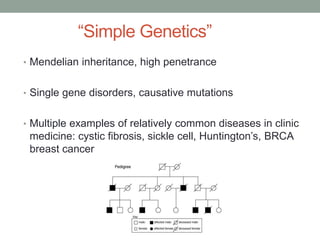
“Simple Genetics” 
• Mendelian inheritance, high penetrance 
• Single gene disorders, causative mutations 
• Multiple examples of relatively common diseases in clinic 
medicine: cystic fibrosis, sickle cell, Huntington’s, BRCA 
breast cancer
What about complicated diseases like 
scleroderma? 
Enter: Genomics
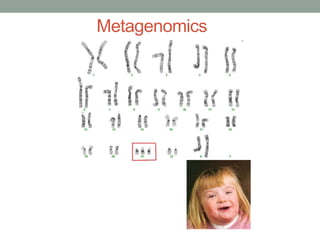
Metagenomics
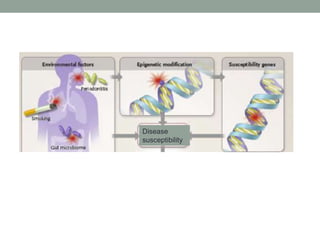
Genomics… of complex diseases 
• Multiple genes involved 
• Each contributes only a small part to disease 
susceptibility 
• Having any one variant doesn’t cause disease 
• Also complicated by environmental factors 
• Furthermore, gene-gene and gene-environment 
interactions
Disease 
susceptibility
Evidence Scleroderma Has a Genetic 
Component 
• Family preponderance of autoimmune diseases 
• Twin and sibling concordance studies 
• Siblings of scleroderma patients are 15 times more likely to 
develop scleroderma than non-relatives 
• But….. 
• It is a rare disease and 
• only 2.6% of patients’ siblings develop SSc
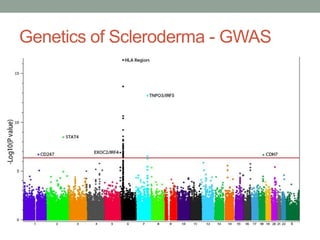
Genetics of Scleroderma - GWAS
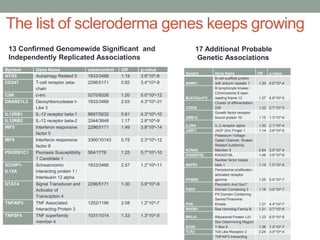
The list of scleroderma genes keeps growing 
13 Confirmed Genomewide Significant and 
Independently Replicated Associations 
Symbol Gene Name case/control OR p-value 
ATG5 Autophagy Related 5 1833/3466 1.19 3.8*10^-8 
CD247 T-cell receptor zeta-chain 
2296/5171 0.82 3.4*10^-9 
CSK c-src 5270/8326 1.20 5.0*10^-12 
DNASE1L3 Deoxyribonuclease I-Like 
3 
1833/3466 2.03 4.3*10^-31 
IL12RB1 IL-12 receptor beta-1 8697/5032 0.81 4.3*10^-10 
IL12RB2 IL-12 receptor beta-2 3344/3848 1.17 2.8*10^-9 
IRF5 Interferon responsive 
factor 5 
2296/5171 1.49 3.8*10^-14 
IRF8 Interferon responsive 
factor 8 
3360/10143 0.75 2.3*10^-12 
PSORS1C1 Psoriasis Susceptibility 
1 Candidate 1 
564/1776 1.25 5.7*10^-10 
SCHIP1- 
IL12A 
Schwannomin 
interacting protein 1 / 
Interleukin 12 alpha 
1833/3466 2.57 1.2*10^-11 
STAT4 Signal Transducer and 
Activator of 
Transciption 4 
2296/5171 1.30 3.9*10^-9 
TNFAIP3 TNF Associated 
Interacting Protein 3 
1202/1196 2.08 1.2*10^-7 
TNFSF4 TNF superfamily 
member 4 
1031/1014 1.33 1.3*10^-5 
17 Additional Probable 
Genetic Associations 
Symbol Gene Name OR p-value 
BANK1 
B-cell scaffold protein 
with ankyrin repeats 1 1.30 4.0*10^-4 
BLK/C8orf13 
B-lymphocyte kinase / 
Chromosome 8 open 
reading frame 13 1.27 6.8*10^-5 
CD226 
Cluster of differentiation 
226 1.22 5.7*10^-5 
GRB10 
Growth factor receptor 
bound protein 10 1.15 1.3*10^-6 
IL2RA IL-2 receptor alpha 1.30 2.1*10^-4 
JAZF1 JAZF Zinc Finger 1 1.14 3.6*10^-5 
KCNA5 
Potassium Voltage- 
Gated Channel, Shaker- 
Related Subfamily, 
Member 5 0.64 3.0*10^-4 
KIAA0319L KIAA0319L 1.46 3.9*10^-6 
NKFB1 
Nuclear factor kappa 
beta 1 1.14 1.0*10^-6 
PPARG 
Peroxisome proliferator-activated 
receptor 
gamma 1.25 5.0*10^-7 
PSD3 
Pleckstrin And Sec7 
Domain Containing 3 1.18 3.0*10^-7 
PXK 
PX Domain Containing 
Serine/Threonine 
Kinase 1.21 4.4*10^-7 
RHOB1 Ras Homolog Family B 1.21 3.7*10^-6 
RPL41 Ribosomal Protein L41 1.23 6.0*10^-8 
SOX5 
Sex Determining Region 
Y-Box 5 1.36 1.4*10^-7 
TLR2 Toll Like Receptor 2 2.24 3.0*10^-4 
TNFAIP3 interacting
Significant Overlap with Other 
Autoimmune Diseases 
• Most genes we have found in scleroderma are the same 
genes that have been found in other autoimmune disease 
like lupus and RA 
• HLA is the biggest genetic risk factor for all of these 
diseases 
• Its unclear why individuals with the same “genetic 
background” develop one autoimmune disease instead of 
another
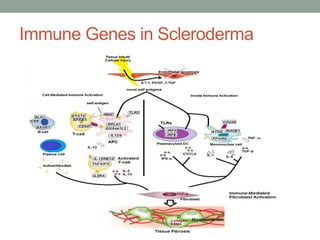
Immune Genes in Scleroderma
What We’ve Learned 
• Lots of genetic associations – now 30 and probably 100s 
of genes 
• Genetics doesn’t explain everything (~50%) 
• Genetics probably make patients susceptible not only to 
getting scleroderma but also getting different types of 
scleroderma
What we still don’t know 
• Why there aren’t any fibrosis/scarring genes showing up 
• How having a given gene influences getting scleroderma 
or a scleroderma manifestation 
• The role of environmental factors 
• Are there “private mutations” that cause individual 
patients’ disease entirely? 
• Next-generation sequencing
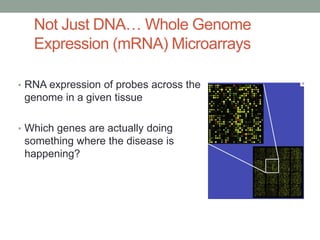
Not Just DNA… Whole Genome 
Expression (mRNA) Microarrays 
• RNA expression of probes across the 
genome in a given tissue 
• Which genes are actually doing 
something where the disease is 
happening?
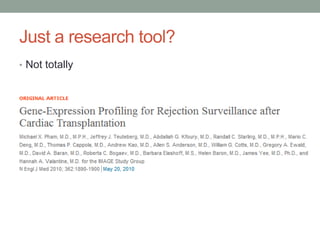
Just a research tool? 
• Not totally
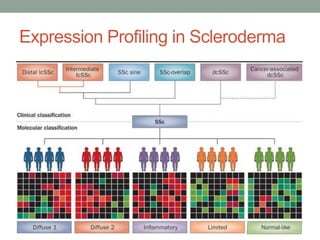
Expression Profiling in Scleroderma
Pharmacogenetics 
• The study of the genetic determinants of drug effects
What can pharmacogenetics do for you? 
• Create More Powerful Medicines 
• Better, Safer Drugs the First Time 
• More Accurate Methods of Determining Appropriate Drug 
Dosages 
• Improvements in the Drug Discovery and Approval Process 
• Targeted therapies 
• Lots of examples in oncology
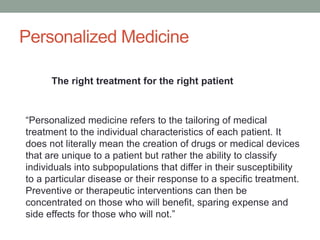
Personalized Medicine 
The right treatment for the right patient 
“Personalized medicine refers to the tailoring of medical 
treatment to the individual characteristics of each patient. It 
does not literally mean the creation of drugs or medical devices 
that are unique to a patient but rather the ability to classify 
individuals into subpopulations that differ in their susceptibility 
to a particular disease or their response to a specific treatment. 
Preventive or therapeutic interventions can then be 
concentrated on those who will benefit, sparing expense and 
side effects for those who will not.”
Personalized Medicine in the Genomic Era 
• Goal: 
• To use information ascertained from genomic 
technologies to treat patients based on their 
genetic makeup
Personalized Medicine Should… 
•Aid in diagnosis, prediction of risk 
•Help doctors detect disease earlier when it’s easier to treat 
•Classify disease subtypes 
• define prognosis 
• predict and prevent complications 
•Treat patients with drugs they are likely to respond to 
•Not treat patients with drugs they are unlikely to respond to 
•Reduce adverse drug reactions 
•Identify new molecular targets, develop therapies directed at the molecular 
problem in appropriate patients
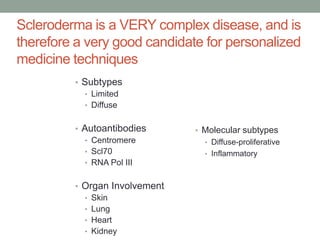
Scleroderma is a VERY complex disease, and is 
therefore a very good candidate for personalized 
medicine techniques 
• Subtypes 
• Limited 
• Diffuse 
• Autoantibodies 
• Centromere 
• Scl70 
• RNA Pol III 
• Organ Involvement 
• Skin 
• Lung 
• Heart 
• Kidney 
• Molecular subtypes 
• Diffuse-proliferative 
• Inflammatory
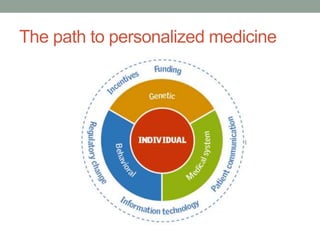
The path to personalized medicine
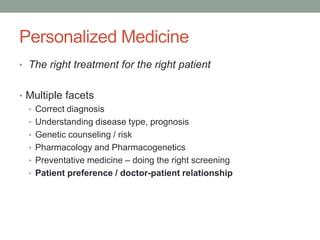
Personalized Medicine 
• The right treatment for the right patient 
• Multiple facets 
• Correct diagnosis 
• Understanding disease type, prognosis 
• Genetic counseling / risk 
• Pharmacology and Pharmacogenetics 
• Preventative medicine – doing the right screening 
• Patient preference / doctor-patient relationship
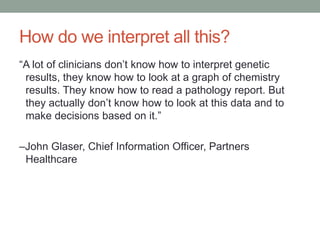
How do we interpret all this? 
“A lot of clinicians don’t know how to interpret genetic 
results, they know how to look at a graph of chemistry 
results. They know how to read a pathology report. But 
they actually don’t know how to look at this data and to 
make decisions based on it.” 
–John Glaser, Chief Information Officer, Partners 
Healthcare
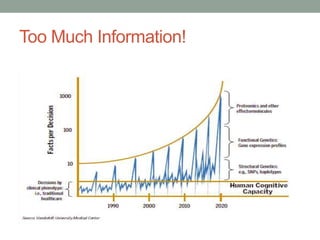
Too Much Information!
Challenges for personalized medicine 
• Current tests aren’t that useful 
• Confusion/lack of information 
• Genetic Privacy 
• Cost
More challenges for personalized medicine 
• Genotype/phenotype discordance 
• Same disease may be caused by many varied mechanisms / genetic defects 
• Environmental factors 
• Multiple gene effects 
• Epigenetics / copy number variation 
• Direct to consumer genetic testing 
• Interpretation of personal implications of population test 
results
Conclusions 
• Genetics and genomics are complicated, and getting more so every 
day 
• Every patient is genetically unique 
• New technology will make it easier to understand individuals’ genetic 
susceptibility to disease and response to therapy 
• We’ve learned a lot about the genetics of scleroderma but we still 
have a lot to learn

Genetics of Scleroderma: Towards Personalized Medicine in the Genomic Age

  • 2.
    The Genomic Era • DNA era – May 25, 1953 – Watson and Crick characterize DNA • First DNA characterization of human disease – thalassemia - 1979 • Genomic Era - April 14, 2003 – The Human Genome Project completed, full sequencing of a human’s DNA
  • 3.
    The Human Genome • 3+ billion base pairs of DNA • > 99.9% of human’s DNA is identical • 33,000 genes • Millions of polymorhpic alleles • 2.6 million SNPs with >1% frequency • Many more rare variants
  • 4.
    The Human Genome - Scope of Human Disease • 100,000+ mutations in 3,700 genes have been identified that correlate with human disease • It is thought that mutations in 15,000+ genes cause heritable human disease
  • 5.
    “Simple Genetics” •Mendelian inheritance, high penetrance • Single gene disorders, causative mutations • Multiple examples of relatively common diseases in clinic medicine: cystic fibrosis, sickle cell, Huntington’s, BRCA breast cancer
  • 6.
    What about complicateddiseases like scleroderma? Enter: Genomics
  • 7.
  • 8.
    Genomics… of complexdiseases • Multiple genes involved • Each contributes only a small part to disease susceptibility • Having any one variant doesn’t cause disease • Also complicated by environmental factors • Furthermore, gene-gene and gene-environment interactions
  • 9.
  • 10.
    Evidence Scleroderma Hasa Genetic Component • Family preponderance of autoimmune diseases • Twin and sibling concordance studies • Siblings of scleroderma patients are 15 times more likely to develop scleroderma than non-relatives • But….. • It is a rare disease and • only 2.6% of patients’ siblings develop SSc
  • 11.
  • 12.
    The list ofscleroderma genes keeps growing 13 Confirmed Genomewide Significant and Independently Replicated Associations Symbol Gene Name case/control OR p-value ATG5 Autophagy Related 5 1833/3466 1.19 3.8*10^-8 CD247 T-cell receptor zeta-chain 2296/5171 0.82 3.4*10^-9 CSK c-src 5270/8326 1.20 5.0*10^-12 DNASE1L3 Deoxyribonuclease I-Like 3 1833/3466 2.03 4.3*10^-31 IL12RB1 IL-12 receptor beta-1 8697/5032 0.81 4.3*10^-10 IL12RB2 IL-12 receptor beta-2 3344/3848 1.17 2.8*10^-9 IRF5 Interferon responsive factor 5 2296/5171 1.49 3.8*10^-14 IRF8 Interferon responsive factor 8 3360/10143 0.75 2.3*10^-12 PSORS1C1 Psoriasis Susceptibility 1 Candidate 1 564/1776 1.25 5.7*10^-10 SCHIP1- IL12A Schwannomin interacting protein 1 / Interleukin 12 alpha 1833/3466 2.57 1.2*10^-11 STAT4 Signal Transducer and Activator of Transciption 4 2296/5171 1.30 3.9*10^-9 TNFAIP3 TNF Associated Interacting Protein 3 1202/1196 2.08 1.2*10^-7 TNFSF4 TNF superfamily member 4 1031/1014 1.33 1.3*10^-5 17 Additional Probable Genetic Associations Symbol Gene Name OR p-value BANK1 B-cell scaffold protein with ankyrin repeats 1 1.30 4.0*10^-4 BLK/C8orf13 B-lymphocyte kinase / Chromosome 8 open reading frame 13 1.27 6.8*10^-5 CD226 Cluster of differentiation 226 1.22 5.7*10^-5 GRB10 Growth factor receptor bound protein 10 1.15 1.3*10^-6 IL2RA IL-2 receptor alpha 1.30 2.1*10^-4 JAZF1 JAZF Zinc Finger 1 1.14 3.6*10^-5 KCNA5 Potassium Voltage- Gated Channel, Shaker- Related Subfamily, Member 5 0.64 3.0*10^-4 KIAA0319L KIAA0319L 1.46 3.9*10^-6 NKFB1 Nuclear factor kappa beta 1 1.14 1.0*10^-6 PPARG Peroxisome proliferator-activated receptor gamma 1.25 5.0*10^-7 PSD3 Pleckstrin And Sec7 Domain Containing 3 1.18 3.0*10^-7 PXK PX Domain Containing Serine/Threonine Kinase 1.21 4.4*10^-7 RHOB1 Ras Homolog Family B 1.21 3.7*10^-6 RPL41 Ribosomal Protein L41 1.23 6.0*10^-8 SOX5 Sex Determining Region Y-Box 5 1.36 1.4*10^-7 TLR2 Toll Like Receptor 2 2.24 3.0*10^-4 TNFAIP3 interacting
  • 13.
    Significant Overlap withOther Autoimmune Diseases • Most genes we have found in scleroderma are the same genes that have been found in other autoimmune disease like lupus and RA • HLA is the biggest genetic risk factor for all of these diseases • Its unclear why individuals with the same “genetic background” develop one autoimmune disease instead of another
  • 14.
    Immune Genes inScleroderma
  • 15.
    What We’ve Learned • Lots of genetic associations – now 30 and probably 100s of genes • Genetics doesn’t explain everything (~50%) • Genetics probably make patients susceptible not only to getting scleroderma but also getting different types of scleroderma
  • 16.
    What we stilldon’t know • Why there aren’t any fibrosis/scarring genes showing up • How having a given gene influences getting scleroderma or a scleroderma manifestation • The role of environmental factors • Are there “private mutations” that cause individual patients’ disease entirely? • Next-generation sequencing
  • 17.
    Not Just DNA…Whole Genome Expression (mRNA) Microarrays • RNA expression of probes across the genome in a given tissue • Which genes are actually doing something where the disease is happening?
  • 18.
    Just a researchtool? • Not totally
  • 19.
  • 20.
    Pharmacogenetics • Thestudy of the genetic determinants of drug effects
  • 21.
    What can pharmacogeneticsdo for you? • Create More Powerful Medicines • Better, Safer Drugs the First Time • More Accurate Methods of Determining Appropriate Drug Dosages • Improvements in the Drug Discovery and Approval Process • Targeted therapies • Lots of examples in oncology
  • 22.
    Personalized Medicine Theright treatment for the right patient “Personalized medicine refers to the tailoring of medical treatment to the individual characteristics of each patient. It does not literally mean the creation of drugs or medical devices that are unique to a patient but rather the ability to classify individuals into subpopulations that differ in their susceptibility to a particular disease or their response to a specific treatment. Preventive or therapeutic interventions can then be concentrated on those who will benefit, sparing expense and side effects for those who will not.”
  • 23.
    Personalized Medicine inthe Genomic Era • Goal: • To use information ascertained from genomic technologies to treat patients based on their genetic makeup
  • 24.
    Personalized Medicine Should… •Aid in diagnosis, prediction of risk •Help doctors detect disease earlier when it’s easier to treat •Classify disease subtypes • define prognosis • predict and prevent complications •Treat patients with drugs they are likely to respond to •Not treat patients with drugs they are unlikely to respond to •Reduce adverse drug reactions •Identify new molecular targets, develop therapies directed at the molecular problem in appropriate patients
  • 25.
    Scleroderma is aVERY complex disease, and is therefore a very good candidate for personalized medicine techniques • Subtypes • Limited • Diffuse • Autoantibodies • Centromere • Scl70 • RNA Pol III • Organ Involvement • Skin • Lung • Heart • Kidney • Molecular subtypes • Diffuse-proliferative • Inflammatory
  • 26.
    The path topersonalized medicine
  • 27.
    Personalized Medicine •The right treatment for the right patient • Multiple facets • Correct diagnosis • Understanding disease type, prognosis • Genetic counseling / risk • Pharmacology and Pharmacogenetics • Preventative medicine – doing the right screening • Patient preference / doctor-patient relationship
  • 28.
    How do weinterpret all this? “A lot of clinicians don’t know how to interpret genetic results, they know how to look at a graph of chemistry results. They know how to read a pathology report. But they actually don’t know how to look at this data and to make decisions based on it.” –John Glaser, Chief Information Officer, Partners Healthcare
  • 29.
  • 30.
    Challenges for personalizedmedicine • Current tests aren’t that useful • Confusion/lack of information • Genetic Privacy • Cost
  • 31.
    More challenges forpersonalized medicine • Genotype/phenotype discordance • Same disease may be caused by many varied mechanisms / genetic defects • Environmental factors • Multiple gene effects • Epigenetics / copy number variation • Direct to consumer genetic testing • Interpretation of personal implications of population test results
  • 32.
    Conclusions • Geneticsand genomics are complicated, and getting more so every day • Every patient is genetically unique • New technology will make it easier to understand individuals’ genetic susceptibility to disease and response to therapy • We’ve learned a lot about the genetics of scleroderma but we still have a lot to learn