E - content
IFTM University, Moradabad
Topic: Personalized Medicine
By
Swati Gautam
M. Pharm
Pharmacy Academy,
IFTM University, Moradabad, U.P. India
2024
Introduction
▪ The concept of personalized medicines date back hundred of
years .
▪ Development in chemistry ,histochemistry ,and
microscopy allowed scientist to begin to understand the
underlying causes of disease.
▪ Personalized medicine (PM) has the potential to tailor
therapy with the best response and highest safety
margin to ensure better patient care. By enabling each
patient to receive earlier diagnoses, risk assessments,
and optimal treatments, PM holds promise for
improving health care while also lowering costs.
Definition
▪ The term “personalized medicine” is often described
as providing “the right patient with the right
drug at the right dose at the right time”.
▪ More broadly “personalized medicine” may be
thought of as the tailoring medical treatment to
the individual characteristics, needs and
preferences of a patient during all stages of
care ,including prevention
,diagnosis, treatments.
Need for personalized
medicine
▪Similar symptoms but different illness
▪Medical interventions may work in some people
but not in others
▪Advances in genomics helps to treat a
patient precisely and effectively
▪To avoid any allergic and adverse effect
Pharmacogenetics
▪ Pharmacogenetics involves the search for genetic variations
that lead to inter individual difference in drug response.
▪ The goals of pharmacogenetics are to optimize drug therapy
and limit drug toxicity based on an individual’s
genetic profile. Thus, pharmacogenetics aims to
use genetic information to choose a drug, drug dose,
and treatment duration that will have the greatest
likelihood for achieving therapeutic outcomes with the
least potential for harm in a given patient.
▪Personalized medicine for breast cancer is an approach to
diagnosis, treatment and prevention that takes into account the
genes you're born with (your genetic makeup) and the genes or
others markers present within the cancer cells.
▪With this approach, your blood or tumour tissue is collected for
analysis, often genetic. The information may help predict or
diagnose disease and guide treatment decisions.
Personalized medicine for
cancer
▪For example, cells from a breast tumor may be tested to
determine whether they produce too much of a protein called
HER2. Someone with HER2-positive breast cancer is likely
to respond to the drugs that target that protein.
▪Some genetic tests will reveal whether your body will turn on
(activate) certain medications thus helping to determine
which treatment may be best for you.
▪Personalized medicine for breast cancer may involve
analyzing the genetic makeup of your cells or, if you have
cancer, the makeup of your cancer cells. Tests might
include
Genes may influence the way your body processes
medications, including those used to treat breast cancer.
doctor may use information from a genetic test of your cells
to determine which medications and dosages are most
appropriate for you. The field of drug-gene interactions is
called pharmacogenomics.
Drug–gene testing
Advance cancer
▪ If cancer progresses despite treatment, doctor
might recommend testing the genetic makeup of
cancer cells.
▪ This test, called tumor sequencing, is used to look for
changes or alterations in the cancer so that doctor can
choose the best drug for type of tumor.
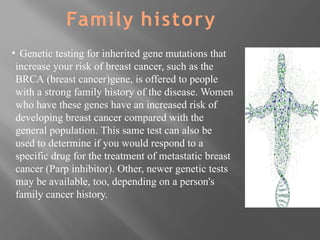
▪ Genetic testing for inherited gene mutations that
increase your risk of breast cancer, such as the
BRCA (breast cancer)gene, is offered to people
with a strong family history of the disease. Women
who have these genes have an increased risk of
developing breast cancer compared with the
general population. This same test can also be
used to determine if you would respond to a
specific drug for the treatment of metastatic breast
cancer (Parp inhibitor). Other, newer genetic tests
may be available, too, depending on a person's
family cancer history.
Family history
Personalized cancer
vaccines
▪ Personalized cancer vaccines can be patient
specific or antigen specific examples are given
below:
▪ Patient specific cancer vaccines
This approach may generate an antigen specific
response even when the tumor antigens are not
known . A cell therapy product is created using a
technique that fuses the patients own tumor cells with
powerful,
immune-stimulating dendritic cells (DC). The
fusion product is then injected back into the
patient
Antigen –specific vaccine
the goal of sparking a specific immune
response against with the cancer
▪If genes are identified in the majority of all
cancers ,a more universal approach to
cancer vaccines are considered. success
with these
strategies will greatly depend on whether
it is possible to
induce robust immunity against
antigens identified .
▪To create this vaccine ,the antigen bearing
tumor cells are fused to antibody –
churning out large quantities of the protein
antigens which are then given back to the
patients with an immune system booster .
The vaccine induces an immune
response against the cancerous cells.
Thank you

personalised medicine, pharmacovigilance

  • 1.
    E - content IFTMUniversity, Moradabad
  • 2.
    Topic: Personalized Medicine By SwatiGautam M. Pharm Pharmacy Academy, IFTM University, Moradabad, U.P. India 2024
  • 3.
    Introduction ▪ The conceptof personalized medicines date back hundred of years . ▪ Development in chemistry ,histochemistry ,and microscopy allowed scientist to begin to understand the underlying causes of disease. ▪ Personalized medicine (PM) has the potential to tailor therapy with the best response and highest safety margin to ensure better patient care. By enabling each patient to receive earlier diagnoses, risk assessments, and optimal treatments, PM holds promise for improving health care while also lowering costs.
  • 4.
    Definition ▪ The term“personalized medicine” is often described as providing “the right patient with the right drug at the right dose at the right time”. ▪ More broadly “personalized medicine” may be thought of as the tailoring medical treatment to the individual characteristics, needs and preferences of a patient during all stages of care ,including prevention ,diagnosis, treatments.
  • 5.
    Need for personalized medicine ▪Similarsymptoms but different illness ▪Medical interventions may work in some people but not in others ▪Advances in genomics helps to treat a patient precisely and effectively ▪To avoid any allergic and adverse effect
  • 6.
    Pharmacogenetics ▪ Pharmacogenetics involvesthe search for genetic variations that lead to inter individual difference in drug response. ▪ The goals of pharmacogenetics are to optimize drug therapy and limit drug toxicity based on an individual’s genetic profile. Thus, pharmacogenetics aims to use genetic information to choose a drug, drug dose, and treatment duration that will have the greatest likelihood for achieving therapeutic outcomes with the least potential for harm in a given patient.
  • 7.
    ▪Personalized medicine forbreast cancer is an approach to diagnosis, treatment and prevention that takes into account the genes you're born with (your genetic makeup) and the genes or others markers present within the cancer cells. ▪With this approach, your blood or tumour tissue is collected for analysis, often genetic. The information may help predict or diagnose disease and guide treatment decisions. Personalized medicine for cancer
  • 8.
    ▪For example, cellsfrom a breast tumor may be tested to determine whether they produce too much of a protein called HER2. Someone with HER2-positive breast cancer is likely to respond to the drugs that target that protein. ▪Some genetic tests will reveal whether your body will turn on (activate) certain medications thus helping to determine which treatment may be best for you. ▪Personalized medicine for breast cancer may involve analyzing the genetic makeup of your cells or, if you have cancer, the makeup of your cancer cells. Tests might include
  • 9.
    Genes may influencethe way your body processes medications, including those used to treat breast cancer. doctor may use information from a genetic test of your cells to determine which medications and dosages are most appropriate for you. The field of drug-gene interactions is called pharmacogenomics. Drug–gene testing
  • 10.
    Advance cancer ▪ Ifcancer progresses despite treatment, doctor might recommend testing the genetic makeup of cancer cells. ▪ This test, called tumor sequencing, is used to look for changes or alterations in the cancer so that doctor can choose the best drug for type of tumor.
  • 11.
    ▪ Genetic testingfor inherited gene mutations that increase your risk of breast cancer, such as the BRCA (breast cancer)gene, is offered to people with a strong family history of the disease. Women who have these genes have an increased risk of developing breast cancer compared with the general population. This same test can also be used to determine if you would respond to a specific drug for the treatment of metastatic breast cancer (Parp inhibitor). Other, newer genetic tests may be available, too, depending on a person's family cancer history. Family history
  • 12.
    Personalized cancer vaccines ▪ Personalizedcancer vaccines can be patient specific or antigen specific examples are given below: ▪ Patient specific cancer vaccines This approach may generate an antigen specific response even when the tumor antigens are not known . A cell therapy product is created using a technique that fuses the patients own tumor cells with powerful, immune-stimulating dendritic cells (DC). The fusion product is then injected back into the patient
  • 13.
    Antigen –specific vaccine thegoal of sparking a specific immune response against with the cancer ▪If genes are identified in the majority of all cancers ,a more universal approach to cancer vaccines are considered. success with these strategies will greatly depend on whether it is possible to induce robust immunity against antigens identified . ▪To create this vaccine ,the antigen bearing tumor cells are fused to antibody –
  • 14.
    churning out largequantities of the protein antigens which are then given back to the patients with an immune system booster . The vaccine induces an immune response against the cancerous cells.
  • 15.