COMPRESSIVE STRENGTH
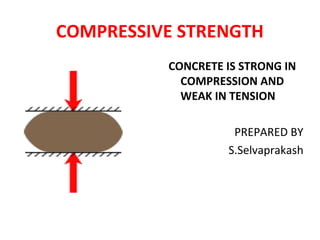
CONCRETE IS STRONG IN
COMPRESSION AND
WEAK IN TENSION
PREPARED BY
S.Selvaprakash
COMPRESSIVE STRENGTH
• Compressive strength is the capacity of a
material or structure to withstand axially
directed pushing forces.
• When the limit of compressive strength is
reached, brittle materials are crushed.
• The compressive strength is used to
determine the hardness of cubical and
cylindrical specimens of concrete.
COMPRESSIVE STRENGTH
• The strength of concrete specimen depends
upon cement, aggregate, bond, w/c ratio,
curing temperature, and size of specimen.
• The cube specimen is of the size 15 x 15 x 15
cm. If the largest nominal size of the
aggregate does not exceed 20 mm, 10 cm size
cubes may also be used as an alternative.
• Cylindrical test specimens have a length equal
to twice the diameter. They are 15 cm in
diameter and 30 cm long.
COMPACTION
• compaction of the concrete with neither
segregation nor excessive laitance.
• The concrete is filled into the mould in layers
approximately 5 cm deep.
Compacting by Hand
• For cubical specimens, in no case should the
concrete be subject to less than 35 strokes per layer
for 15 cm or 25 strokes per layer for 10 cm cubes.
• For cylindrical specimens, the number of strokes are
not less than thirty per layer.
TEST PROCEDURE
Scope:
• The test method covers determination of
compressive strength of cubic concrete
specimens.
• It consists of applying a compressive axial load to
molded cubes at a rate which is within a
prescribed range until failure occurs.
• The compressive strength is calculated by
dividing the maximum load attained during the
test by the cross sectional area of the specimen.
APPARATUS
1- Weighing device.
2- Tools and containers for mixing.
3- Tamper (16mm dia & 600mm height)
4- Testing machine.
5- Three cubes (150 mm side)
PROCEDURE
• Prepare a concrete mix with the proportions
suggested Such as: 1: 2: 4 with w/c = 0.55 by
mechanical mixer.
• Prepare three testing cubes; make sure that
they are clean and greased or oiled thinly.
• Metal molds should be sealed to their base
plates to prevent loss of water.
PROCEDURE
• Fill the cubes in three layers, tamping each
layer with (35) strokes using a tamper.
• Fill the molds completely, smooth off the tops
evenly, and clean up any concrete outside the
cubes.
• Leave the specimens in the curing room for 24
hours.
PROCEDURE
• After that open the molds and immerse the
concrete cubes in a water basin for 7 days or
28 days.
• Before testing, ensure that all testing machine
bearing surfaces are wiped clean.
• Carefully center the cube on the lower platen
and ensure that the load will be applied to
two opposite cast faces of the cube.
PROCEDURE
• Without shock, apply and increase the load
continuously at a nominal rate within the
range of ( 0.2 N/mm2.s to 0.4 N/mm2.s ) until
no greater load can be sustained.
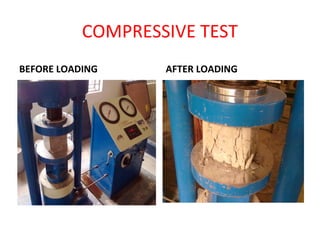
COMPRESSIVE TEST
BEFORE LOADING AFTER LOADING
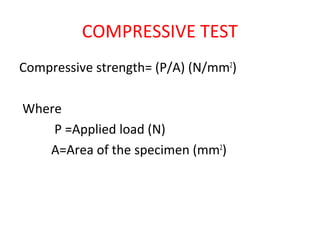
COMPRESSIVE TEST
Compressive strength= (P/A) (N/mm2
)
Where
P =Applied load (N)
A=Area of the specimen (mm2
)

Compressive strength in concrete test

  • 1.
    COMPRESSIVE STRENGTH CONCRETE ISSTRONG IN COMPRESSION AND WEAK IN TENSION PREPARED BY S.Selvaprakash
  • 2.
    COMPRESSIVE STRENGTH • Compressivestrength is the capacity of a material or structure to withstand axially directed pushing forces. • When the limit of compressive strength is reached, brittle materials are crushed. • The compressive strength is used to determine the hardness of cubical and cylindrical specimens of concrete.
  • 3.
    COMPRESSIVE STRENGTH • Thestrength of concrete specimen depends upon cement, aggregate, bond, w/c ratio, curing temperature, and size of specimen. • The cube specimen is of the size 15 x 15 x 15 cm. If the largest nominal size of the aggregate does not exceed 20 mm, 10 cm size cubes may also be used as an alternative. • Cylindrical test specimens have a length equal to twice the diameter. They are 15 cm in diameter and 30 cm long.
  • 4.
    COMPACTION • compaction ofthe concrete with neither segregation nor excessive laitance. • The concrete is filled into the mould in layers approximately 5 cm deep. Compacting by Hand • For cubical specimens, in no case should the concrete be subject to less than 35 strokes per layer for 15 cm or 25 strokes per layer for 10 cm cubes. • For cylindrical specimens, the number of strokes are not less than thirty per layer.
  • 5.
    TEST PROCEDURE Scope: • Thetest method covers determination of compressive strength of cubic concrete specimens. • It consists of applying a compressive axial load to molded cubes at a rate which is within a prescribed range until failure occurs. • The compressive strength is calculated by dividing the maximum load attained during the test by the cross sectional area of the specimen.
  • 6.
    APPARATUS 1- Weighing device. 2-Tools and containers for mixing. 3- Tamper (16mm dia & 600mm height) 4- Testing machine. 5- Three cubes (150 mm side)
  • 7.
    PROCEDURE • Prepare aconcrete mix with the proportions suggested Such as: 1: 2: 4 with w/c = 0.55 by mechanical mixer. • Prepare three testing cubes; make sure that they are clean and greased or oiled thinly. • Metal molds should be sealed to their base plates to prevent loss of water.
  • 8.
    PROCEDURE • Fill thecubes in three layers, tamping each layer with (35) strokes using a tamper. • Fill the molds completely, smooth off the tops evenly, and clean up any concrete outside the cubes. • Leave the specimens in the curing room for 24 hours.
  • 9.
    PROCEDURE • After thatopen the molds and immerse the concrete cubes in a water basin for 7 days or 28 days. • Before testing, ensure that all testing machine bearing surfaces are wiped clean. • Carefully center the cube on the lower platen and ensure that the load will be applied to two opposite cast faces of the cube.
  • 10.
    PROCEDURE • Without shock,apply and increase the load continuously at a nominal rate within the range of ( 0.2 N/mm2.s to 0.4 N/mm2.s ) until no greater load can be sustained.
  • 12.
  • 14.
    COMPRESSIVE TEST Compressive strength=(P/A) (N/mm2 ) Where P =Applied load (N) A=Area of the specimen (mm2 )