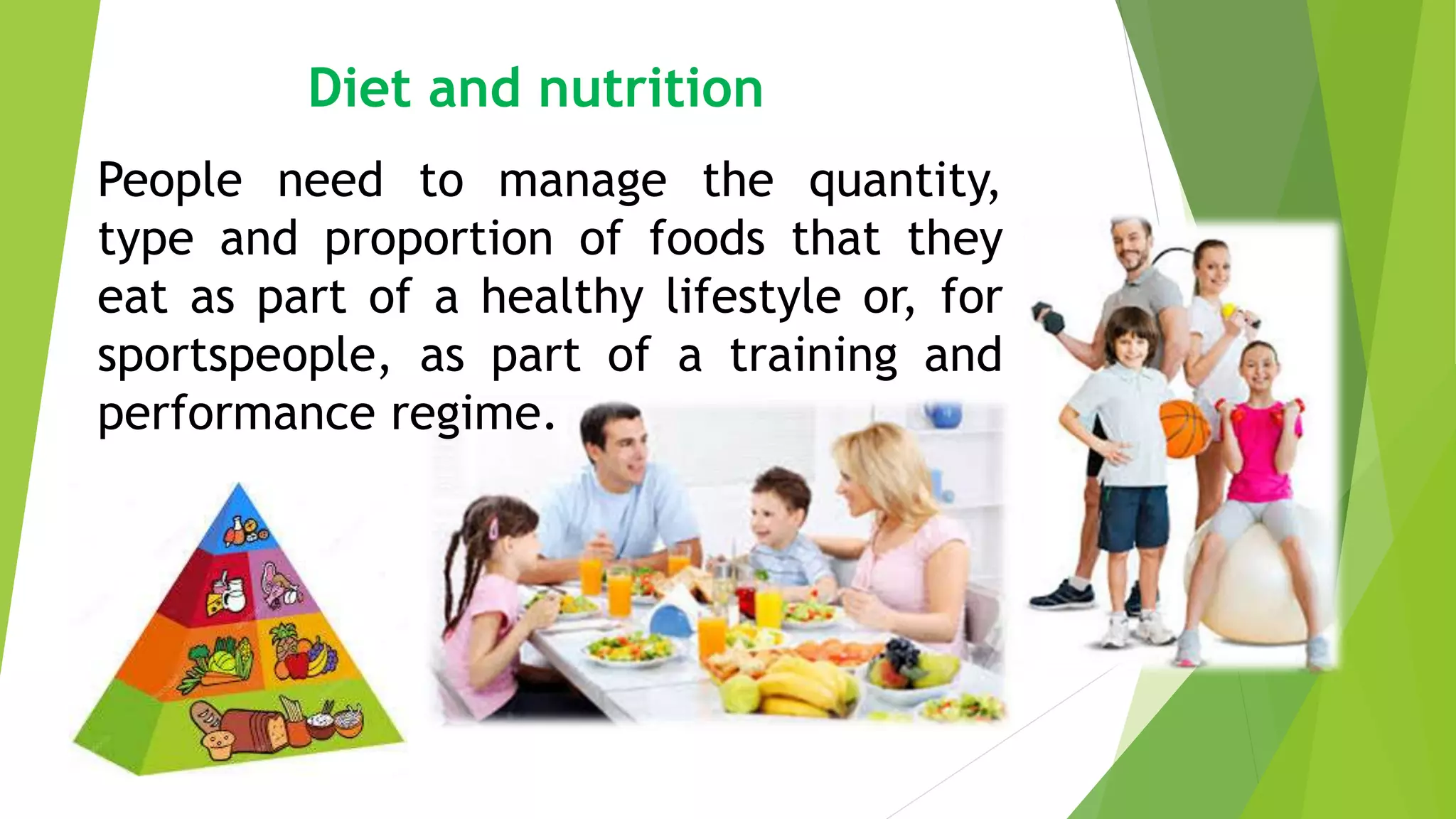
People need to manage the quantity,
type and proportion of foods that they
eat as part of a healthy lifestyle or, for
sportspeople, as part of a training and
performance regime.
Diet and nutrition
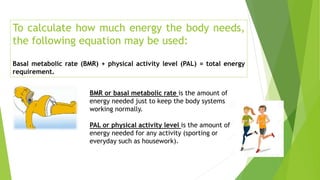
To calculate how much energy the body needs,
the following equation may be used:
Basal metabolic rate (BMR) + physical activity level (PAL) = total energy
requirement.
BMR or basal metabolic rate is the amount of
energy needed just to keep the body systems
working normally.
PAL or physical activity level is the amount of
energy needed for any activity (sporting or
everyday such as housework).
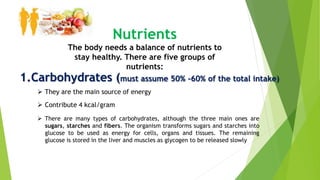
Nutrients
The body needs a balance of nutrients to
stay healthy. There are five groups of
nutrients:
1.Carbohydrates (must assume 50% -60% of the total intake)
 Contribute 4 kcal/gram
 They are the main source of energy
 There are many types of carbohydrates, although the three main ones are
sugars, starches and fibers. The organism transforms sugars and starches into
glucose to be used as energy for cells, organs and tissues. The remaining
glucose is stored in the liver and muscles as glycogen to be released slowly
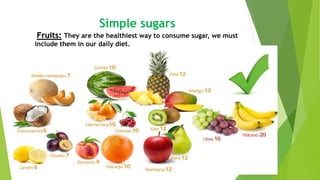
Simple sugars
Fruits: They are the healthiest way to consume sugar, we must
include them in our daily diet.
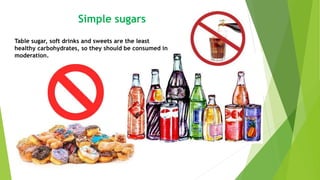
Simple sugars
Table sugar, soft drinks and sweets are the least
healthy carbohydrates, so they should be consumed in
moderation.
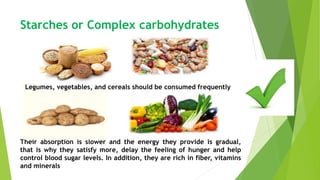
Starches or Complex carbohydrates
Their absorption is slower and the energy they provide is gradual,
that is why they satisfy more, delay the feeling of hunger and help
control blood sugar levels. In addition, they are rich in fiber, vitamins
and minerals
Legumes, vegetables, and cereals should be consumed frequently
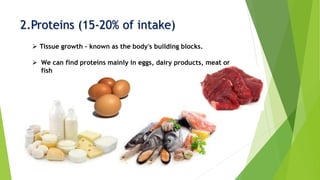
2.Proteins (15-20% of intake)
 Tissue growth – known as the body's building blocks.
 We can find proteins mainly in eggs, dairy products, meat or
fish
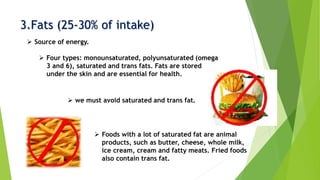
3.Fats (25-30% of intake)
 Source of energy.
 Four types: monounsaturated, polyunsaturated (omega
3 and 6), saturated and trans fats. Fats are stored
under the skin and are essential for health.
 we must avoid saturated and trans fat.
 Foods with a lot of saturated fat are animal
products, such as butter, cheese, whole milk,
ice cream, cream and fatty meats. Fried foods
also contain trans fat.
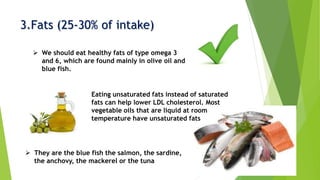
3.Fats (25-30% of intake)
 Eating unsaturated fats instead of saturated
fats can help lower LDL cholesterol. Most
vegetable oils that are liquid at room
temperature have unsaturated fats
 We should eat healthy fats of type omega 3
and 6, which are found mainly in olive oil and
blue fish.
 They are the blue fish the salmon, the sardine,
the anchovy, the mackerel or the tuna
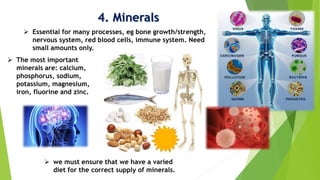
4. Minerals
 Essential for many processes, eg bone growth/strength,
nervous system, red blood cells, immune system. Need
small amounts only.
 The most important
minerals are: calcium,
phosphorus, sodium,
potassium, magnesium,
iron, fluorine and zinc.
 we must ensure that we have a varied
diet for the correct supply of minerals.
5.Vitamins
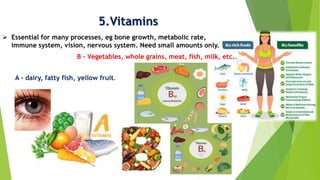
 Essential for many processes, eg bone growth, metabolic rate,
immune system, vision, nervous system. Need small amounts only.
A - dairy, fatty fish, yellow fruit.
B - Vegetables, whole grains, meat, fish, milk, etc..
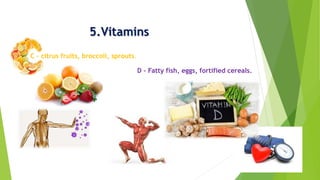
C - citrus fruits, broccoli, sprouts.
D - Fatty fish, eggs, fortified cereals.
Water
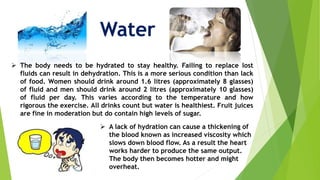
 The body needs to be hydrated to stay healthy. Failing to replace lost
fluids can result in dehydration. This is a more serious condition than lack
of food. Women should drink around 1.6 litres (approximately 8 glasses)
of fluid and men should drink around 2 litres (approximately 10 glasses)
of fluid per day. This varies according to the temperature and how
rigorous the exercise. All drinks count but water is healthiest. Fruit juices
are fine in moderation but do contain high levels of sugar.
 A lack of hydration can cause a thickening of
the blood known as increased viscosity which
slows down blood flow. As a result the heart
works harder to produce the same output.
The body then becomes hotter and might
overheat.
Additional advice
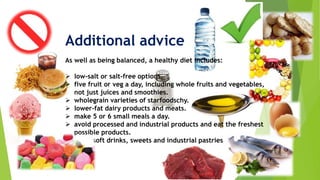
As well as being balanced, a healthy diet includes:
 low-salt or salt-free options.
 five fruit or veg a day, including whole fruits and vegetables,
not just juices and smoothies.
 wholegrain varieties of starfoodschy.
 lower-fat dairy products and meats.
 make 5 or 6 small meals a day.
 avoid processed and industrial products and eat the freshest
possible products.
 avoid soft drinks, sweets and industrial pastries
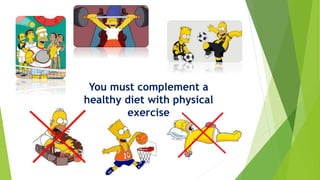
You must complement a
healthy diet with physical
exercise
Homework
1. Record the diet that you carry out on
any given day, noting all the food
eaten.
2. Compare your diet with the
recommendations given in this post and
discuss what changes you would make to
make your diet healthier

YOU ARE WHAT YOU EAT

  • 1.
    People need tomanage the quantity, type and proportion of foods that they eat as part of a healthy lifestyle or, for sportspeople, as part of a training and performance regime. Diet and nutrition
  • 3.
    To calculate howmuch energy the body needs, the following equation may be used: Basal metabolic rate (BMR) + physical activity level (PAL) = total energy requirement. BMR or basal metabolic rate is the amount of energy needed just to keep the body systems working normally. PAL or physical activity level is the amount of energy needed for any activity (sporting or everyday such as housework).
  • 4.
    Nutrients The body needsa balance of nutrients to stay healthy. There are five groups of nutrients: 1.Carbohydrates (must assume 50% -60% of the total intake)  Contribute 4 kcal/gram  They are the main source of energy  There are many types of carbohydrates, although the three main ones are sugars, starches and fibers. The organism transforms sugars and starches into glucose to be used as energy for cells, organs and tissues. The remaining glucose is stored in the liver and muscles as glycogen to be released slowly
  • 5.
    Simple sugars Fruits: Theyare the healthiest way to consume sugar, we must include them in our daily diet.
  • 6.
    Simple sugars Table sugar,soft drinks and sweets are the least healthy carbohydrates, so they should be consumed in moderation.
  • 7.
    Starches or Complexcarbohydrates Their absorption is slower and the energy they provide is gradual, that is why they satisfy more, delay the feeling of hunger and help control blood sugar levels. In addition, they are rich in fiber, vitamins and minerals Legumes, vegetables, and cereals should be consumed frequently
  • 8.
    2.Proteins (15-20% ofintake)  Tissue growth – known as the body's building blocks.  We can find proteins mainly in eggs, dairy products, meat or fish
  • 9.
    3.Fats (25-30% ofintake)  Source of energy.  Four types: monounsaturated, polyunsaturated (omega 3 and 6), saturated and trans fats. Fats are stored under the skin and are essential for health.  we must avoid saturated and trans fat.  Foods with a lot of saturated fat are animal products, such as butter, cheese, whole milk, ice cream, cream and fatty meats. Fried foods also contain trans fat.
  • 10.
    3.Fats (25-30% ofintake)  Eating unsaturated fats instead of saturated fats can help lower LDL cholesterol. Most vegetable oils that are liquid at room temperature have unsaturated fats  We should eat healthy fats of type omega 3 and 6, which are found mainly in olive oil and blue fish.  They are the blue fish the salmon, the sardine, the anchovy, the mackerel or the tuna
  • 12.
    4. Minerals  Essentialfor many processes, eg bone growth/strength, nervous system, red blood cells, immune system. Need small amounts only.  The most important minerals are: calcium, phosphorus, sodium, potassium, magnesium, iron, fluorine and zinc.  we must ensure that we have a varied diet for the correct supply of minerals.
  • 13.
    5.Vitamins  Essential formany processes, eg bone growth, metabolic rate, immune system, vision, nervous system. Need small amounts only. A - dairy, fatty fish, yellow fruit. B - Vegetables, whole grains, meat, fish, milk, etc..
  • 14.
    C - citrusfruits, broccoli, sprouts. D - Fatty fish, eggs, fortified cereals.
  • 15.
    Water  The bodyneeds to be hydrated to stay healthy. Failing to replace lost fluids can result in dehydration. This is a more serious condition than lack of food. Women should drink around 1.6 litres (approximately 8 glasses) of fluid and men should drink around 2 litres (approximately 10 glasses) of fluid per day. This varies according to the temperature and how rigorous the exercise. All drinks count but water is healthiest. Fruit juices are fine in moderation but do contain high levels of sugar.  A lack of hydration can cause a thickening of the blood known as increased viscosity which slows down blood flow. As a result the heart works harder to produce the same output. The body then becomes hotter and might overheat.
  • 16.
    Additional advice As wellas being balanced, a healthy diet includes:  low-salt or salt-free options.  five fruit or veg a day, including whole fruits and vegetables, not just juices and smoothies.  wholegrain varieties of starfoodschy.  lower-fat dairy products and meats.  make 5 or 6 small meals a day.  avoid processed and industrial products and eat the freshest possible products.  avoid soft drinks, sweets and industrial pastries
  • 17.
    You must complementa healthy diet with physical exercise
  • 18.
    Homework 1. Record thediet that you carry out on any given day, noting all the food eaten. 2. Compare your diet with the recommendations given in this post and discuss what changes you would make to make your diet healthier