Title: Deviation and
Root Cause Analysis
Content
Deviation and Type of Deviation
Regulatory expectation
Basic process flow for Deviation handling
Root Cause Analysis
Tools and Technique for Root Cause Analysis
Presented By: Subhash Sanghani
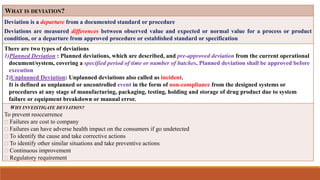
WHAT IS DEVIATION?
Deviation is a departure from a documented standard or procedure
Deviations are measured differences between observed value and expected or normal value for a process or product
condition, or a departure from approved procedure or established standard or specification
There are two types of deviations
1)Planned Deviation : Planned deviations, which are described, and pre-approved deviation from the current operational
document/system, covering a specified period of time or number of batches. Planned deviation shall be approved before
execution
2)Unplanned Deviation: Unplanned deviations also called as incident.
It is defined as unplanned or uncontrolled event in the form of non-compliance from the designed systems or
procedures at any stage of manufacturing, packaging, testing, holding and storage of drug product due to system
failure or equipment breakdown or manual error.
WHY INVEISTIGATE DEVIATION?
To prevent reoccurrence
Failures are cost to company
Failures can have adverse health impact on the consumers if go undetected
To identify the cause and take corrective actions
To identify other similar situations and take preventive actions
Continuous improvement
Regulatory requirement
Regulatory Expectation
• “Any unexplained discrepancy…shall be thoroughly investigated…The
investigation shall extend to other batches …that can have been associated with the
specific failure or discrepancy. A written record of the investigation shall be made
and shall include the conclusions and follow-up
21 CFR 211.192
•“Any deviations from instructions or procedures should be avoided as far as
possible. If a deviation occurs, it should be approved in writing by a competent
person…”
• Any significant deviations [from defined procedures and instructions] are fully
recorded and investigated
EC Guide to GMP, Chapter 5
(5.15)
• Any deviation from established procedures should be documented and explained.
Critical deviations should be investigated, and the investigation and its conclusions
should be documented.
ICHQ7A
• The organization should ensure process outputs, products, and services that do not conform to
requirements are identified and controlled to prevent unintended use or delivery. The
organization should take appropriate action based on nature of nonconformity and its impact on
conformity of products and services. This is applicable also to nonconforming products and
services detected after delivery of products during or after provision of service
ISO 9001:2015,Clause 8.7
When a deviation occurs the responsible firm must undertake and investigation to determine what went wrong
and what damage, if any , the product might have suffered.
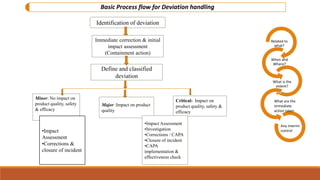
Basic Process flow for Deviation handling
Identification of deviation
Immediate correction & initial
impact assessment
(Containment action)
Define and classified
deviation
Major :Impact on product
quality
Critical: Impact on
product quality, safety &
efficacy
Minor: No impact on
product quality, safety
& efficacy
•Impact
Assessment
•Corrections &
closure of incident
•Impact Assessment
•Investigation
•Corrections / CAPA
•Closure of incident
•CAPA
implementation &
effectiveness check
Related to
what?
When and
Where?
What is the
extent?
What are the
immediate
action taken
Any interim
control
Root Cause Analysis
Root cause analysis(RCA) is a method that used to address a deviation or non conformance in order to get to the true root
cause of the problem.
RCA is application of a series of well known technique which can produce a systematic, quantified and documented
approach to the identification, under stand and resolution of under causes.
As a PROCESS it is more effective when it’s adequately defined, provisioned with appropriate resources, and performed by
trained personnel.
Goals - Failure identification - Failure analysis - Failure resolution
Iterative Process: - Complete prevention of recurrence by a single intervention is not always possible.
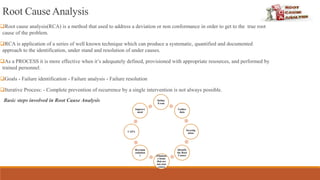
Basic steps involved in Root Cause Analysis Define
Event
Gather
data
Investig
ation
Identify
the Root
CausesEliminat
e items
that are
not root
causes
Recomm
endation
s
CAPA
Improve
ment
RCATools and Technique
 Brainstorming
A creative approach to generate a high volume of ideas free of criticism and judgment.
What are the rules?
 Every idea is captured.
 Ideas are written as said.
 No comments, discussion, or criticism.
 Everyone contributes.
 Five Whys?
The 5 Whys is a questions‐asking method used to explore the cause/effect relationships underlying a particular problem.
Ultimately, the goal of applying the 5 Whys method is to determine a root cause of a defect or problem.
Keep asking Why till you reach root cause
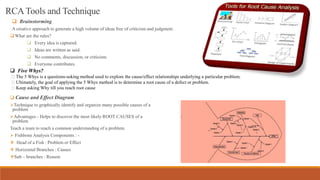
 Cause and Effect Diagram
Technique to graphically identify and organize many possible causes of a
problem
Advantages - Helps to discover the most likely ROOT CAUSES of a
problem
Teach a team to reach a common understanding of a problem.
 Fishbone Analysis Components : -
 Head of a Fish : Problem or Effect
 Horizontal Branches : Causes
Sub – branches : Reason
Deviation and root cause analysis in Pharma

Deviation and root cause analysis in Pharma

  • 1.
    Title: Deviation and RootCause Analysis Content Deviation and Type of Deviation Regulatory expectation Basic process flow for Deviation handling Root Cause Analysis Tools and Technique for Root Cause Analysis Presented By: Subhash Sanghani
  • 2.
    WHAT IS DEVIATION? Deviationis a departure from a documented standard or procedure Deviations are measured differences between observed value and expected or normal value for a process or product condition, or a departure from approved procedure or established standard or specification There are two types of deviations 1)Planned Deviation : Planned deviations, which are described, and pre-approved deviation from the current operational document/system, covering a specified period of time or number of batches. Planned deviation shall be approved before execution 2)Unplanned Deviation: Unplanned deviations also called as incident. It is defined as unplanned or uncontrolled event in the form of non-compliance from the designed systems or procedures at any stage of manufacturing, packaging, testing, holding and storage of drug product due to system failure or equipment breakdown or manual error. WHY INVEISTIGATE DEVIATION? To prevent reoccurrence Failures are cost to company Failures can have adverse health impact on the consumers if go undetected To identify the cause and take corrective actions To identify other similar situations and take preventive actions Continuous improvement Regulatory requirement
  • 3.
    Regulatory Expectation • “Anyunexplained discrepancy…shall be thoroughly investigated…The investigation shall extend to other batches …that can have been associated with the specific failure or discrepancy. A written record of the investigation shall be made and shall include the conclusions and follow-up 21 CFR 211.192 •“Any deviations from instructions or procedures should be avoided as far as possible. If a deviation occurs, it should be approved in writing by a competent person…” • Any significant deviations [from defined procedures and instructions] are fully recorded and investigated EC Guide to GMP, Chapter 5 (5.15) • Any deviation from established procedures should be documented and explained. Critical deviations should be investigated, and the investigation and its conclusions should be documented. ICHQ7A • The organization should ensure process outputs, products, and services that do not conform to requirements are identified and controlled to prevent unintended use or delivery. The organization should take appropriate action based on nature of nonconformity and its impact on conformity of products and services. This is applicable also to nonconforming products and services detected after delivery of products during or after provision of service ISO 9001:2015,Clause 8.7 When a deviation occurs the responsible firm must undertake and investigation to determine what went wrong and what damage, if any , the product might have suffered.
  • 4.
    Basic Process flowfor Deviation handling Identification of deviation Immediate correction & initial impact assessment (Containment action) Define and classified deviation Major :Impact on product quality Critical: Impact on product quality, safety & efficacy Minor: No impact on product quality, safety & efficacy •Impact Assessment •Corrections & closure of incident •Impact Assessment •Investigation •Corrections / CAPA •Closure of incident •CAPA implementation & effectiveness check Related to what? When and Where? What is the extent? What are the immediate action taken Any interim control
  • 5.
    Root Cause Analysis Rootcause analysis(RCA) is a method that used to address a deviation or non conformance in order to get to the true root cause of the problem. RCA is application of a series of well known technique which can produce a systematic, quantified and documented approach to the identification, under stand and resolution of under causes. As a PROCESS it is more effective when it’s adequately defined, provisioned with appropriate resources, and performed by trained personnel. Goals - Failure identification - Failure analysis - Failure resolution Iterative Process: - Complete prevention of recurrence by a single intervention is not always possible. Basic steps involved in Root Cause Analysis Define Event Gather data Investig ation Identify the Root CausesEliminat e items that are not root causes Recomm endation s CAPA Improve ment
  • 6.
    RCATools and Technique Brainstorming A creative approach to generate a high volume of ideas free of criticism and judgment. What are the rules?  Every idea is captured.  Ideas are written as said.  No comments, discussion, or criticism.  Everyone contributes.  Five Whys? The 5 Whys is a questions‐asking method used to explore the cause/effect relationships underlying a particular problem. Ultimately, the goal of applying the 5 Whys method is to determine a root cause of a defect or problem. Keep asking Why till you reach root cause  Cause and Effect Diagram Technique to graphically identify and organize many possible causes of a problem Advantages - Helps to discover the most likely ROOT CAUSES of a problem Teach a team to reach a common understanding of a problem.  Fishbone Analysis Components : -  Head of a Fish : Problem or Effect  Horizontal Branches : Causes Sub – branches : Reason