2012 Summer Internship Program
Cleveland Clinic Reproductive Research Center


    Sandro Esteves, MD, PhD
          Director, ANDROFERT
Center for Male Reproduction and Infertility
            Campinas, BRAZIL
Learning Objectives
               Understand azoospermia and the differences
             between obstructive and nonobstructive subtypes


             Learn the available methods for sperm acquisition
                    in azoospermia and their indications

               Learn the success rates of sperm retrieval in
                     different azoospermia scenarios

                 Understand the reproductive potential of
             azoospermic men undergoing assisted conception

Esteves, 2
Review this lecture at:

http://bit.ly/ccfsummerinterns2012
               Pdf slides
                 Videos
           Reference papers
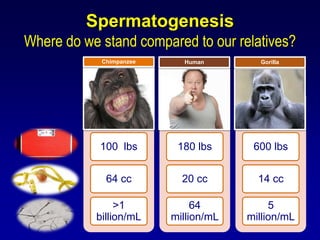
Spermatogenesis
Where do we stand compared to our relatives?
            Chimpanzee     Human        Gorilla


            100 lbs       180 lbs      600 lbs


             64 cc         20 cc        14 cc

                >1            64           5
           billion/mL    million/mL   million/mL
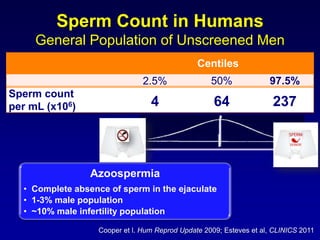
Sperm Count in Humans
     General Population of Unscreened Men
                                                Centiles
                                2.5%                50%              97.5%
Sperm count
per mL (x106)                     4                  64               237


                 Azoospermia
  • Complete absence of sperm in the ejaculate
  • 1-3% male population
  • ~10% male infertility population

                   Cooper et l. Hum Reprod Update 2009; Esteves et al, CLINICS 2011
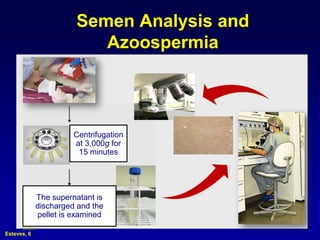
Semen Analysis and
                          Azoospermia


                       Centrifugation
                       at 3,000g for
                        15 minutes


             The supernatant is
             discharged and the
             pellet is examined

Esteves, 6
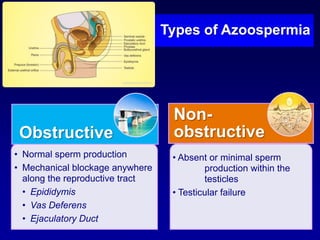
Types of Azoospermia


                                  Non-
 Obstructive                      obstructive
• Normal sperm production         • Absent or minimal sperm
• Mechanical blockage anywhere            production within the
  along the reproductive tract            testicles
  • Epididymis                    • Testicular failure
  • Vas Deferens
  • Ejaculatory Duct
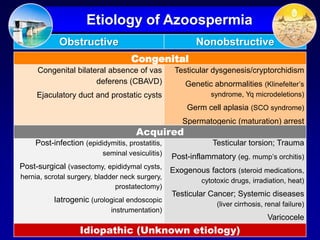
Etiology of Azoospermia
            Obstructive                                 Nonobstructive
                                   Congenital
     Congenital bilateral absence of vas          Testicular dysgenesis/cryptorchidism
                      deferens (CBAVD)               Genetic abnormalities (Klinefelter’s
     Ejaculatory duct and prostatic cysts                    syndrome, Yq microdeletions)
                                                     Germ cell aplasia (SCO syndrome)
                                                    Spermatogenic (maturation) arrest
                                     Acquired
    Post-infection (epididymitis, prostatitis,               Testicular torsion; Trauma
                          seminal vesiculitis)
                                                 Post-inflammatory (eg. mump’s orchitis)
Post-surgical (vasectomy, epididymal cysts,      Exogenous factors (steroid medications,
hernia, scrotal surgery, bladder neck surgery,
                                                          cytotoxic drugs, irradiation, heat)
                               prostatectomy)
                                                 Testicular Cancer; Systemic diseases
          Iatrogenic (urological endoscopic
                                                               (liver cirrhosis, renal failure)
                             instrumentation)
                                                                                 Varicocele
                   Idiopathic (Unknown etiology)
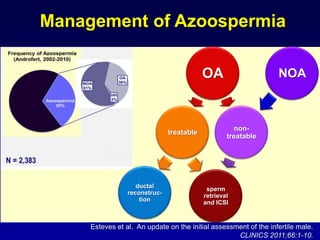
Management of Azoospermia

                                           OA                     NOA


                                                      non-
                               treatable
                                                   treatable


                    ductal                  sperm
                 reconstruc-               retrieval
                     tion                  and ICSI


     Esteves et al. An update on the initial assessment of the infertile male.
                                                    CLINICS 2011;66:1-10.
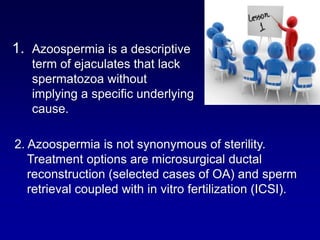
1. Azoospermia is a descriptive
   term of ejaculates that lack
   spermatozoa without
   implying a specific underlying
   cause.

2. Azoospermia is not synonymous of sterility.
   Treatment options are microsurgical ductal
   reconstruction (selected cases of OA) and sperm
   retrieval coupled with in vitro fertilization (ICSI).
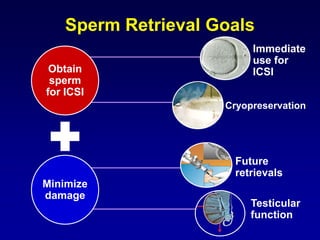
Sperm Retrieval Goals
                          Immediate
                          use for
 Obtain                   ICSI
 sperm
for ICSI
                     Cryopreservation


                      Future
                      retrievals
Minimize
damage
                          Testicular
                          function
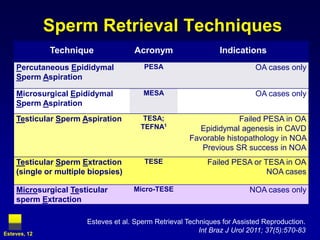
Sperm Retrieval Techniques
              Technique              Acronym                    Indications
    Percutaneous Epididymal              PESA                               OA cases only
    Sperm Aspiration

    Microsurgical Epididymal            MESA                                OA cases only
    Sperm Aspiration
    Testicular Sperm Aspiration         TESA;                        Failed PESA in OA
                                       TEFNA1            Epididymal agenesis in CAVD
                                                       Favorable histopathology in NOA
                                                          Previous SR success in NOA
    Testicular Sperm Extraction          TESE               Failed PESA or TESA in OA
    (single or multiple biopsies)                                           NOA cases

    Microsurgical Testicular         Micro-TESE                           NOA cases only
    sperm Extraction

                       Esteves et al. Sperm Retrieval Techniques for Assisted Reproduction.
Esteves, 12
                                                          Int Braz J Urol 2011; 37(5):570-83
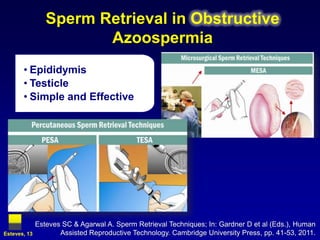
Sperm Retrieval in Obstructive
                        Azoospermia
       • Epididymis
       • Testicle
       • Simple and Effective


              Esteves SC & Agarwal A. Sperm Retrieval Techniques; In: Gardner D et al (Eds.), Human
Esteves, 13          Assisted Reproductive Technology. Cambridge University Press, pp. 41-53, 2011.
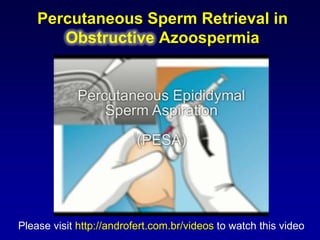
Percutaneous Sperm Retrieval in
       Obstructive Azoospermia


Please visit http://androfert.com.br/videos to watch this video
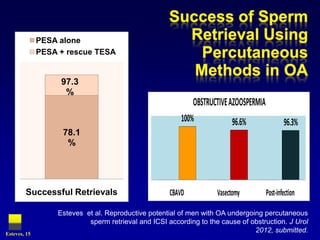
PESA alone
              PESA + rescue TESA


                   97.3
                    %
                                                             OBSTRUCTIVE AZOOSPERMIA
                                                         100%            96.6%                 96.3%
                    78.1
                     %


        Successful Retrievals                        CBAVD          Vasectomy          Post-infection

                  Esteves et al. Reproductive potential of men with OA undergoing percutaneous
                           sperm retrieval and ICSI according to the cause of obstruction. J Urol
Esteves, 15
                                                                               2012, submitted.
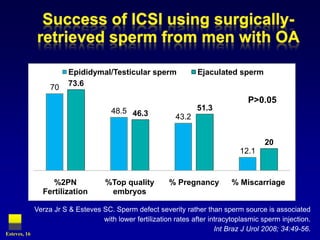
Epididymal/Testicular sperm               Ejaculated sperm
                   70    73.6

                                                                                    P>0.05
                                       48.5 46.3                   51.3
                                                            43.2


                                                                                         20
                                                                                 12.1


                   %2PN              %Top quality         % Pregnancy         % Miscarriage
                Fertilization         embryos

              Verza Jr S & Esteves SC. Sperm defect severity rather than sperm source is associated
                                   with lower fertilization rates after intracytoplasmic sperm injection.
                                                                          Int Braz J Urol 2008; 34:49-56.
Esteves, 16
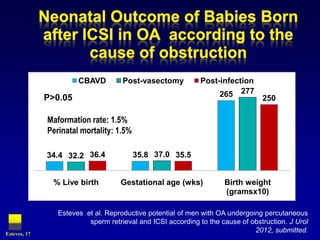
CBAVD         Post-vasectomy           Post-infection

              P>0.05                                               265 277       250

              Maformation rate: 1.5%
              Perinatal mortality: 1.5%

              34.4 32.2 36.4              35.8 37.0 35.5


                % Live birth        Gestational age (wks)            Birth weight
                                                                     (gramsx10)

                 Esteves et al. Reproductive potential of men with OA undergoing percutaneous
                          sperm retrieval and ICSI according to the cause of obstruction. J Urol
Esteves, 17
                                                                              2012, submitted.
Sperm Retrieval
In Obstructive Azoospermia
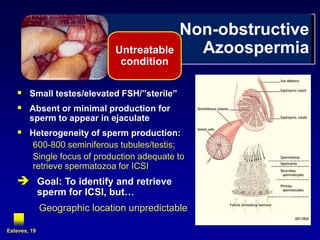
Non-obstructive
                              Untreatable      Azoospermia
                               condition

    Small testes/elevated FSH/”sterile”
    Absent or minimal production for
        sperm to appear in ejaculate
    Heterogeneity of sperm production:
         600-800 seminiferous tubules/testis;
         Single focus of production adequate to
         retrieve spermatozoa for ICSI
    Goal: To identify and retrieve
              sperm for ICSI, but…
              Geographic location unpredictable

Esteves, 19
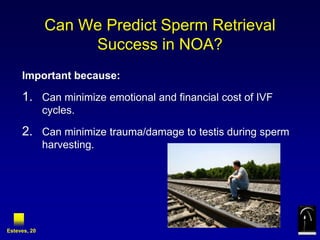
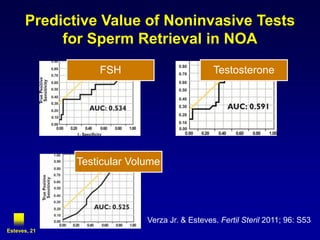
Can We Predict Sperm Retrieval
                   Success in NOA?
     Important because:

     1. Can minimize emotional and financial cost of IVF
              cycles.

     2. Can minimize trauma/damage to testis during sperm
              harvesting.


Esteves, 20
Predictive Value of Noninvasive Tests
           for Sperm Retrieval in NOA
                  FSH                          Testosterone


              Testicular Volume


                            Verza Jr. & Esteves. Fertil Steril 2011; 96: S53
Esteves, 21
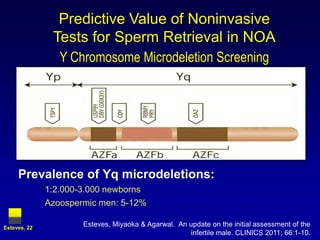
Predictive Value of Noninvasive
               Tests for Sperm Retrieval in NOA
                 Y Chromosome Microdeletion Screening


     Prevalence of Yq microdeletions:
              1:2.000-3.000 newborns
              Azoospermic men: 5-12%

Esteves, 22
                      Esteves, Miyaoka & Agarwal. An update on the initial assessment of the
                                                     infertile male. CLINICS 2011; 66:1-10.
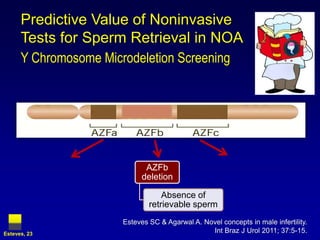
Predictive Value of Noninvasive
      Tests for Sperm Retrieval in NOA
      Y Chromosome Microdeletion Screening


                              AZFb
                             deletion

                                   Absence of
                               retrievable sperm
                       Esteves SC & Agarwal A. Novel concepts in male infertility.
Esteves, 23
                                                 Int Braz J Urol 2011; 37:5-15.
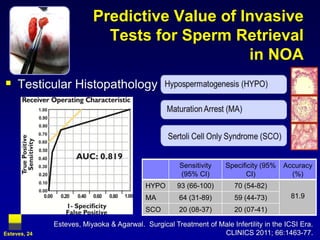
Predictive Value of Invasive
                            Tests for Sperm Retrieval
                                               in NOA
 Testicular Histopathology


                                                      Sensitivity   Specificity (95%   Accuracy
                                                      (95% CI)            CI)            (%)
                                           HYPO      93 (66-100)       70 (54-82)
                                           MA         64 (31-89)       59 (44-73)        81.9
                                           SCO        20 (08-37)       20 (07-41)

              Esteves, Miyaoka & Agarwal. Surgical Treatment of Male Infertility in the ICSI Era.
Esteves, 24                                                      CLINICS 2011; 66:1463-77.
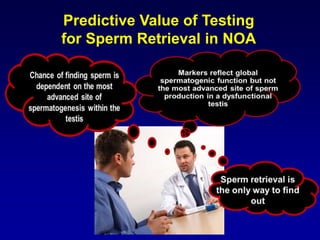
Predictive Value of Testing
for Sperm Retrieval in NOA
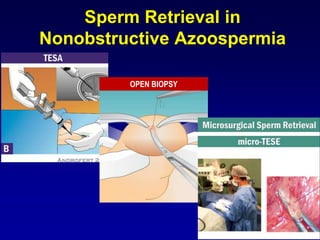
Sperm Retrieval in
Nonobstructive Azoospermia

         OPEN BIOPSY
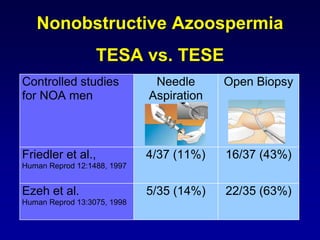
Nonobstructive Azoospermia
                  TESA vs. TESE
Controlled studies            Needle      Open Biopsy
for NOA men                  Aspiration


Friedler et al.,             4/37 (11%)   16/37 (43%)
Human Reprod 12:1488, 1997


Ezeh et al.                  5/35 (14%)   22/35 (63%)
Human Reprod 13:3075, 1998
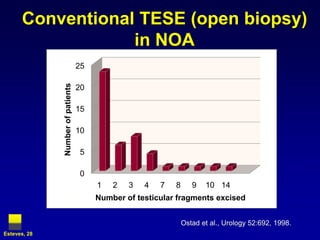
Conventional TESE (open biopsy)
                  in NOA
              Number of patients   25

                                   20

                                   15

                                   10

                                   5

                                   0
                                        1   2   3   4   7   8      9   10 14
                                        Number of testicular fragments excised


                                                                Ostad et al., Urology 52:692, 1998.
Esteves, 28
Nonobstructive Azoospermia
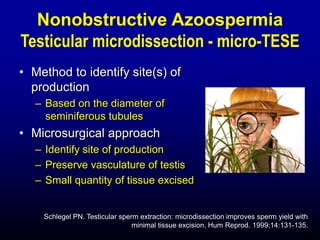
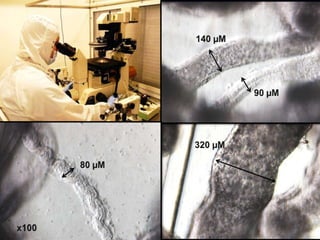
Testicular microdissection - micro-TESE
• Method to identify site(s) of
  production
   – Based on the diameter of
     seminiferous tubules
• Microsurgical approach
   – Identify site of production
   – Preserve vasculature of testis
   – Small quantity of tissue excised


    Schlegel PN. Testicular sperm extraction: microdissection improves sperm yield with
                                minimal tissue excision. Hum Reprod. 1999;14:131-135.
Please visit http://androfert.com.br/videos to watch this video
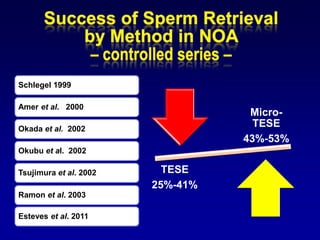
Schlegel 1999

Amer et al. 2000
                                   Micro-
Okada et al. 2002
                                    TESE
                                  43%-53%
Okubu et al. 2002

Tsujimura et al. 2002     TESE
                        25%-41%
Ramon et al. 2003

Esteves et al. 2011
1. Sperm retrieval
  techniques are surgical
  methods to collect
  spermatozoa from the
  epididimys or the testis of
  azoospermic men seeking
  fertility.
2. The method of choice is based primarily upon
   the type of azoospermia being obstructive or
   nonobstructive.

3. Retrieved sperm should be used for ICSI or
   cryopreserved for a future ICSI attempt.
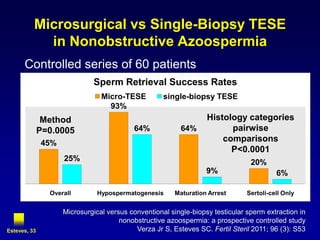
Microsurgical vs Single-Biopsy TESE
            in Nonobstructive Azoospermia
      Controlled series of 60 patients
                             Sperm Retrieval Success Rates
                                Micro-TESE          single-biopsy TESE
                                  93%
               Method                                             Histology categories
              P=0.0005                    64%            64%            pairwise
              45%
                                                                      comparisons
                                                                        P<0.0001
                    25%                                                         20%
                                                                  9%                     6%

                Overall       Hypospermatogenesis      Maturation Arrest       Sertoli-cell Only


                    Microsurgical versus conventional single-biopsy testicular sperm extraction in
                                      nonobstructive azoospermia: a prospective controlled study
Esteves, 33                                Verza Jr S, Esteves SC. Fertil Steril 2011; 96 (3): S53
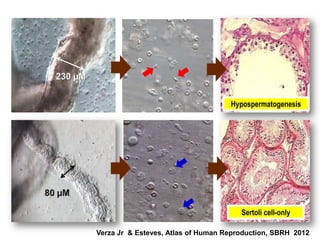
Hypospermatogenesis


                                       Sertoli cell-only

Verza Jr & Esteves, Atlas of Human Reproduction, SBRH 2012
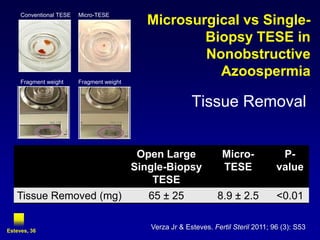
Conventional TESE   Micro-TESE
                                             Microsurgical vs Single-
                                                     Biopsy TESE in
                                                     Nonobstructive
                                                       Azoospermia
     Fragment weight     Fragment weight


                                                           Tissue Removal


                                            Open Large               Micro-             P-
                                           Single-Biopsy             TESE              value
                                               TESE
   Tissue Removed (mg)                        65 ± 25              8.9 ± 2.5           <0.01


Esteves, 36
                                              Verza Jr & Esteves. Fertil Steril 2011; 96 (3): S53
Success of Sperm Retrieval
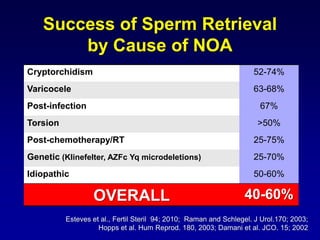
        by Cause of NOA
Cryptorchidism                                                       52-74%
Varicocele                                                           63-68%
Post-infection                                                         67%
Torsion                                                               >50%
Post-chemotherapy/RT                                                 25-75%
Genetic (Klinefelter, AZFc Yq microdeletions)                        25-70%
Idiopathic                                                           50-60%

                  OVERALL                                         40-60%
          Esteves et al., Fertil Steril 94; 2010; Raman and Schlegel. J Urol.170; 2003;
                    Hopps et al. Hum Reprod. 180, 2003; Damani et al. JCO. 15; 2002
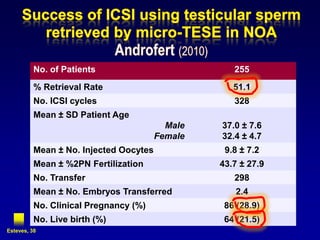
No. of Patients                           255
          % Retrieval Rate                          51.1
          No. ICSI cycles                           328
          Mean ± SD Patient Age
                                          Male   37.0 ± 7.6
                                        Female   32.4 ± 4.7
          Mean ± No. Injected Oocytes             9.8 ± 7.2
          Mean ± %2PN Fertilization              43.7 ± 27.9
          No. Transfer                              298
          Mean ± No. Embryos Transferred            2.4
          No. Clinical Pregnancy (%)              86 (28.9)
          No. Live birth (%)                      64 (21.5)
Esteves, 38
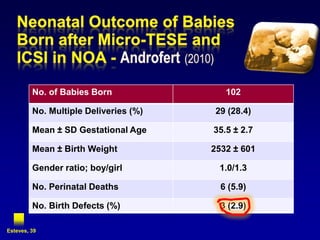
No. of Babies Born               102

         No. Multiple Deliveries (%)   29 (28.4)

         Mean ± SD Gestational Age     35.5 ± 2.7

         Mean ± Birth Weight           2532 ± 601

         Gender ratio; boy/girl         1.0/1.3

         No. Perinatal Deaths            6 (5.9)

         No. Birth Defects (%)           3 (2.9)

Esteves, 39
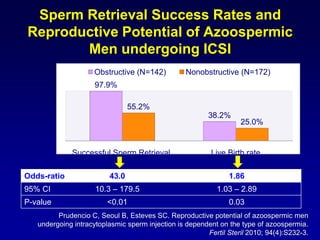
Sperm Retrieval Success Rates and
Reproductive Potential of Azoospermic
       Men undergoing ICSI
                     Obstructive (N=142)          Nonobstructive (N=172)
                     97.9%

                                55.2%
                                                         38.2%
                                                                   25.0%


             Successful Sperm Retrieval                   Live Birth rate

Odds-ratio               43.0                                  1.86
95% CI               10.3 – 179.5                          1.03 – 2.89
P-value                  <0.01                                 0.03
         Prudencio C, Seoul B, Esteves SC. Reproductive potential of azoospermic men
   undergoing intracytoplasmic sperm injection is dependent on the type of azoospermia.
                                                        Fertil Steril 2010; 94(4):S232-3.
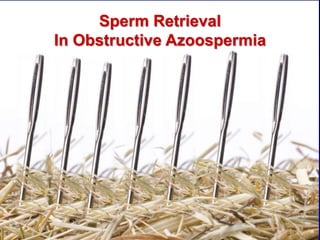
Sperm Retrieval
In Obstructive Azoospermia
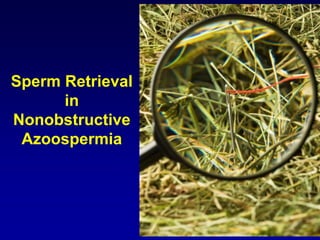
Sperm Retrieval
      in
Nonobstructive
 Azoospermia
1. Nowadays, the use of
   surgically-retrieved
   sperm and ICSI has
   become an established
   procedure for couples
   wishing to obtain a
   biological offspring in
   whom the male partner
   have azoospermia.

2. So far, the post-natal outcomes of babies born
   from such fathers are reassuring.
Learning Objectives
                    Understand azoospermia and the differences
                  between obstructive and nonobstructive subtypes

              Azoospermia is the lack of sperm in the ejaculate
                           Should be confirmed by semen analysis with
                                  centrifugation and pellet examination
                        Found in ~10% of the male infertility population

              Types are Obstructive and Nonobstructive
                         Congenital, acquired and unknown etiologies
                                      AO: sperm production is normal
                   NOA: sperm production severely abnormal or absent

Esteves, 44
Learning Objectives
                 Learn the available methods for sperm acquisition
                        in azoospermia and their indications


              Percutaneous (PESA, TESA) and open
              (MESA, TESE, micro-TESE) techniques are
              available


              Epididymides and testicles are the target organs
                       Epididymal retrievals: Obstructive azoospermia
                                    Testicular retrievals: AO and NOA
              Microdissection TESE for the most difficult cases of NOA

Esteves, 45
Learning Objectives
                    Learn the success rates of sperm retrieval in
                          different azoospermia scenarios


              Sperm retrieved in virtually all cases of OA
                Not related to collection method or cause of obstruction

              Sperm retrieved in 40-60% of NOA cases
                      Current testing not reliable to predict SR success
                              Success not related to the cause of NOA
                     Men with AZF a or b microdeletions not candidates
                                          Higher SRR with micro-TESE

Esteves, 46
Learning Objectives
                     Understand the reproductive potential of
                 azoospermic men undergoing assisted conception

       Success of ICSI
                                     Not related to collection method
                                  Related to the type of azoospermia
              Follow-up of children born similar outcomes (few data)

        Obstructive Azoospermia
                    Similar (or better) results than ejaculated sperm
                                                  ~40% live birth rates
         Nonobstructive Azoospermia
                           Lower results than other infertility causes
                                               ~25% live birth rates
Esteves, 47
Sperm Retrieval Techniques - Looking for a Needle in the Haystack

Sperm Retrieval Techniques - Looking for a Needle in the Haystack

  • 1.
    2012 Summer InternshipProgram Cleveland Clinic Reproductive Research Center Sandro Esteves, MD, PhD Director, ANDROFERT Center for Male Reproduction and Infertility Campinas, BRAZIL
  • 2.
    Learning Objectives Understand azoospermia and the differences between obstructive and nonobstructive subtypes Learn the available methods for sperm acquisition in azoospermia and their indications Learn the success rates of sperm retrieval in different azoospermia scenarios Understand the reproductive potential of azoospermic men undergoing assisted conception Esteves, 2
  • 3.
    Review this lectureat: http://bit.ly/ccfsummerinterns2012 Pdf slides Videos Reference papers
  • 4.
    Spermatogenesis Where do westand compared to our relatives? Chimpanzee Human Gorilla 100 lbs 180 lbs 600 lbs 64 cc 20 cc 14 cc >1 64 5 billion/mL million/mL million/mL
  • 5.
    Sperm Count inHumans General Population of Unscreened Men Centiles 2.5% 50% 97.5% Sperm count per mL (x106) 4 64 237 Azoospermia • Complete absence of sperm in the ejaculate • 1-3% male population • ~10% male infertility population Cooper et l. Hum Reprod Update 2009; Esteves et al, CLINICS 2011
  • 6.
    Semen Analysis and Azoospermia Centrifugation at 3,000g for 15 minutes The supernatant is discharged and the pellet is examined Esteves, 6
  • 7.
    Types of Azoospermia Non- Obstructive obstructive • Normal sperm production • Absent or minimal sperm • Mechanical blockage anywhere production within the along the reproductive tract testicles • Epididymis • Testicular failure • Vas Deferens • Ejaculatory Duct
  • 8.
    Etiology of Azoospermia Obstructive Nonobstructive Congenital Congenital bilateral absence of vas Testicular dysgenesis/cryptorchidism deferens (CBAVD) Genetic abnormalities (Klinefelter’s Ejaculatory duct and prostatic cysts syndrome, Yq microdeletions) Germ cell aplasia (SCO syndrome) Spermatogenic (maturation) arrest Acquired Post-infection (epididymitis, prostatitis, Testicular torsion; Trauma seminal vesiculitis) Post-inflammatory (eg. mump’s orchitis) Post-surgical (vasectomy, epididymal cysts, Exogenous factors (steroid medications, hernia, scrotal surgery, bladder neck surgery, cytotoxic drugs, irradiation, heat) prostatectomy) Testicular Cancer; Systemic diseases Iatrogenic (urological endoscopic (liver cirrhosis, renal failure) instrumentation) Varicocele Idiopathic (Unknown etiology)
  • 9.
    Management of Azoospermia OA NOA non- treatable treatable ductal sperm reconstruc- retrieval tion and ICSI Esteves et al. An update on the initial assessment of the infertile male. CLINICS 2011;66:1-10.
  • 10.
    1. Azoospermia isa descriptive term of ejaculates that lack spermatozoa without implying a specific underlying cause. 2. Azoospermia is not synonymous of sterility. Treatment options are microsurgical ductal reconstruction (selected cases of OA) and sperm retrieval coupled with in vitro fertilization (ICSI).
  • 11.
    Sperm Retrieval Goals Immediate use for Obtain ICSI sperm for ICSI Cryopreservation Future retrievals Minimize damage Testicular function
  • 12.
    Sperm Retrieval Techniques Technique Acronym Indications Percutaneous Epididymal PESA OA cases only Sperm Aspiration Microsurgical Epididymal MESA OA cases only Sperm Aspiration Testicular Sperm Aspiration TESA; Failed PESA in OA TEFNA1 Epididymal agenesis in CAVD Favorable histopathology in NOA Previous SR success in NOA Testicular Sperm Extraction TESE Failed PESA or TESA in OA (single or multiple biopsies) NOA cases Microsurgical Testicular Micro-TESE NOA cases only sperm Extraction Esteves et al. Sperm Retrieval Techniques for Assisted Reproduction. Esteves, 12 Int Braz J Urol 2011; 37(5):570-83
  • 13.
    Sperm Retrieval inObstructive Azoospermia • Epididymis • Testicle • Simple and Effective Esteves SC & Agarwal A. Sperm Retrieval Techniques; In: Gardner D et al (Eds.), Human Esteves, 13 Assisted Reproductive Technology. Cambridge University Press, pp. 41-53, 2011.
  • 14.
    Percutaneous Sperm Retrievalin Obstructive Azoospermia Please visit http://androfert.com.br/videos to watch this video
  • 15.
    PESA alone PESA + rescue TESA 97.3 % OBSTRUCTIVE AZOOSPERMIA 100% 96.6% 96.3% 78.1 % Successful Retrievals CBAVD Vasectomy Post-infection Esteves et al. Reproductive potential of men with OA undergoing percutaneous sperm retrieval and ICSI according to the cause of obstruction. J Urol Esteves, 15 2012, submitted.
  • 16.
    Epididymal/Testicular sperm Ejaculated sperm 70 73.6 P>0.05 48.5 46.3 51.3 43.2 20 12.1 %2PN %Top quality % Pregnancy % Miscarriage Fertilization embryos Verza Jr S & Esteves SC. Sperm defect severity rather than sperm source is associated with lower fertilization rates after intracytoplasmic sperm injection. Int Braz J Urol 2008; 34:49-56. Esteves, 16
  • 17.
    CBAVD Post-vasectomy Post-infection P>0.05 265 277 250 Maformation rate: 1.5% Perinatal mortality: 1.5% 34.4 32.2 36.4 35.8 37.0 35.5 % Live birth Gestational age (wks) Birth weight (gramsx10) Esteves et al. Reproductive potential of men with OA undergoing percutaneous sperm retrieval and ICSI according to the cause of obstruction. J Urol Esteves, 17 2012, submitted.
  • 18.
  • 19.
    Non-obstructive Untreatable Azoospermia condition  Small testes/elevated FSH/”sterile”  Absent or minimal production for sperm to appear in ejaculate  Heterogeneity of sperm production: 600-800 seminiferous tubules/testis; Single focus of production adequate to retrieve spermatozoa for ICSI  Goal: To identify and retrieve sperm for ICSI, but… Geographic location unpredictable Esteves, 19
  • 20.
    Can We PredictSperm Retrieval Success in NOA? Important because: 1. Can minimize emotional and financial cost of IVF cycles. 2. Can minimize trauma/damage to testis during sperm harvesting. Esteves, 20
  • 21.
    Predictive Value ofNoninvasive Tests for Sperm Retrieval in NOA FSH Testosterone Testicular Volume Verza Jr. & Esteves. Fertil Steril 2011; 96: S53 Esteves, 21
  • 22.
    Predictive Value ofNoninvasive Tests for Sperm Retrieval in NOA Y Chromosome Microdeletion Screening Prevalence of Yq microdeletions: 1:2.000-3.000 newborns Azoospermic men: 5-12% Esteves, 22 Esteves, Miyaoka & Agarwal. An update on the initial assessment of the infertile male. CLINICS 2011; 66:1-10.
  • 23.
    Predictive Value ofNoninvasive Tests for Sperm Retrieval in NOA Y Chromosome Microdeletion Screening AZFb deletion Absence of retrievable sperm Esteves SC & Agarwal A. Novel concepts in male infertility. Esteves, 23 Int Braz J Urol 2011; 37:5-15.
  • 24.
    Predictive Value ofInvasive Tests for Sperm Retrieval in NOA  Testicular Histopathology Sensitivity Specificity (95% Accuracy (95% CI) CI) (%) HYPO 93 (66-100) 70 (54-82) MA 64 (31-89) 59 (44-73) 81.9 SCO 20 (08-37) 20 (07-41) Esteves, Miyaoka & Agarwal. Surgical Treatment of Male Infertility in the ICSI Era. Esteves, 24 CLINICS 2011; 66:1463-77.
  • 25.
    Predictive Value ofTesting for Sperm Retrieval in NOA
  • 26.
    Sperm Retrieval in NonobstructiveAzoospermia OPEN BIOPSY
  • 27.
    Nonobstructive Azoospermia TESA vs. TESE Controlled studies Needle Open Biopsy for NOA men Aspiration Friedler et al., 4/37 (11%) 16/37 (43%) Human Reprod 12:1488, 1997 Ezeh et al. 5/35 (14%) 22/35 (63%) Human Reprod 13:3075, 1998
  • 28.
    Conventional TESE (openbiopsy) in NOA Number of patients 25 20 15 10 5 0 1 2 3 4 7 8 9 10 14 Number of testicular fragments excised Ostad et al., Urology 52:692, 1998. Esteves, 28
  • 29.
    Nonobstructive Azoospermia Testicular microdissection- micro-TESE • Method to identify site(s) of production – Based on the diameter of seminiferous tubules • Microsurgical approach – Identify site of production – Preserve vasculature of testis – Small quantity of tissue excised Schlegel PN. Testicular sperm extraction: microdissection improves sperm yield with minimal tissue excision. Hum Reprod. 1999;14:131-135.
  • 30.
  • 31.
    Schlegel 1999 Amer etal. 2000 Micro- Okada et al. 2002 TESE 43%-53% Okubu et al. 2002 Tsujimura et al. 2002 TESE 25%-41% Ramon et al. 2003 Esteves et al. 2011
  • 32.
    1. Sperm retrieval techniques are surgical methods to collect spermatozoa from the epididimys or the testis of azoospermic men seeking fertility. 2. The method of choice is based primarily upon the type of azoospermia being obstructive or nonobstructive. 3. Retrieved sperm should be used for ICSI or cryopreserved for a future ICSI attempt.
  • 33.
    Microsurgical vs Single-BiopsyTESE in Nonobstructive Azoospermia Controlled series of 60 patients Sperm Retrieval Success Rates Micro-TESE single-biopsy TESE 93% Method Histology categories P=0.0005 64% 64% pairwise 45% comparisons P<0.0001 25% 20% 9% 6% Overall Hypospermatogenesis Maturation Arrest Sertoli-cell Only Microsurgical versus conventional single-biopsy testicular sperm extraction in nonobstructive azoospermia: a prospective controlled study Esteves, 33 Verza Jr S, Esteves SC. Fertil Steril 2011; 96 (3): S53
  • 35.
    Hypospermatogenesis Sertoli cell-only Verza Jr & Esteves, Atlas of Human Reproduction, SBRH 2012
  • 36.
    Conventional TESE Micro-TESE Microsurgical vs Single- Biopsy TESE in Nonobstructive Azoospermia Fragment weight Fragment weight Tissue Removal Open Large Micro- P- Single-Biopsy TESE value TESE Tissue Removed (mg) 65 ± 25 8.9 ± 2.5 <0.01 Esteves, 36 Verza Jr & Esteves. Fertil Steril 2011; 96 (3): S53
  • 37.
    Success of SpermRetrieval by Cause of NOA Cryptorchidism 52-74% Varicocele 63-68% Post-infection 67% Torsion >50% Post-chemotherapy/RT 25-75% Genetic (Klinefelter, AZFc Yq microdeletions) 25-70% Idiopathic 50-60% OVERALL 40-60% Esteves et al., Fertil Steril 94; 2010; Raman and Schlegel. J Urol.170; 2003; Hopps et al. Hum Reprod. 180, 2003; Damani et al. JCO. 15; 2002
  • 38.
    No. of Patients 255 % Retrieval Rate 51.1 No. ICSI cycles 328 Mean ± SD Patient Age Male 37.0 ± 7.6 Female 32.4 ± 4.7 Mean ± No. Injected Oocytes 9.8 ± 7.2 Mean ± %2PN Fertilization 43.7 ± 27.9 No. Transfer 298 Mean ± No. Embryos Transferred 2.4 No. Clinical Pregnancy (%) 86 (28.9) No. Live birth (%) 64 (21.5) Esteves, 38
  • 39.
    No. of BabiesBorn 102 No. Multiple Deliveries (%) 29 (28.4) Mean ± SD Gestational Age 35.5 ± 2.7 Mean ± Birth Weight 2532 ± 601 Gender ratio; boy/girl 1.0/1.3 No. Perinatal Deaths 6 (5.9) No. Birth Defects (%) 3 (2.9) Esteves, 39
  • 40.
    Sperm Retrieval SuccessRates and Reproductive Potential of Azoospermic Men undergoing ICSI Obstructive (N=142) Nonobstructive (N=172) 97.9% 55.2% 38.2% 25.0% Successful Sperm Retrieval Live Birth rate Odds-ratio 43.0 1.86 95% CI 10.3 – 179.5 1.03 – 2.89 P-value <0.01 0.03 Prudencio C, Seoul B, Esteves SC. Reproductive potential of azoospermic men undergoing intracytoplasmic sperm injection is dependent on the type of azoospermia. Fertil Steril 2010; 94(4):S232-3.
  • 41.
  • 42.
    Sperm Retrieval in Nonobstructive Azoospermia
  • 43.
    1. Nowadays, theuse of surgically-retrieved sperm and ICSI has become an established procedure for couples wishing to obtain a biological offspring in whom the male partner have azoospermia. 2. So far, the post-natal outcomes of babies born from such fathers are reassuring.
  • 44.
    Learning Objectives Understand azoospermia and the differences between obstructive and nonobstructive subtypes Azoospermia is the lack of sperm in the ejaculate Should be confirmed by semen analysis with centrifugation and pellet examination Found in ~10% of the male infertility population Types are Obstructive and Nonobstructive Congenital, acquired and unknown etiologies AO: sperm production is normal NOA: sperm production severely abnormal or absent Esteves, 44
  • 45.
    Learning Objectives Learn the available methods for sperm acquisition in azoospermia and their indications Percutaneous (PESA, TESA) and open (MESA, TESE, micro-TESE) techniques are available Epididymides and testicles are the target organs Epididymal retrievals: Obstructive azoospermia Testicular retrievals: AO and NOA Microdissection TESE for the most difficult cases of NOA Esteves, 45
  • 46.
    Learning Objectives Learn the success rates of sperm retrieval in different azoospermia scenarios Sperm retrieved in virtually all cases of OA Not related to collection method or cause of obstruction Sperm retrieved in 40-60% of NOA cases Current testing not reliable to predict SR success Success not related to the cause of NOA Men with AZF a or b microdeletions not candidates Higher SRR with micro-TESE Esteves, 46
  • 47.
    Learning Objectives Understand the reproductive potential of azoospermic men undergoing assisted conception Success of ICSI Not related to collection method Related to the type of azoospermia Follow-up of children born similar outcomes (few data) Obstructive Azoospermia Similar (or better) results than ejaculated sperm ~40% live birth rates Nonobstructive Azoospermia Lower results than other infertility causes ~25% live birth rates Esteves, 47