EXPORT 
IMPORT 
AND EXIM 
POLICY 
submitted by: 
Ashutosh kumar 
(c)ashutosh kumar 1
CONTENTS: 
Definition 
Types of export 
Role of govt in export 
Export/import process 
Export/import financing 
Exim policy 
Comparison of trade policy 
India’s Exim policy 2009-14 
Objective of india’s Exim policy 
Balance of trade 
Bibliography 
2 
(c)ashutosh kumar
DEFINITION 
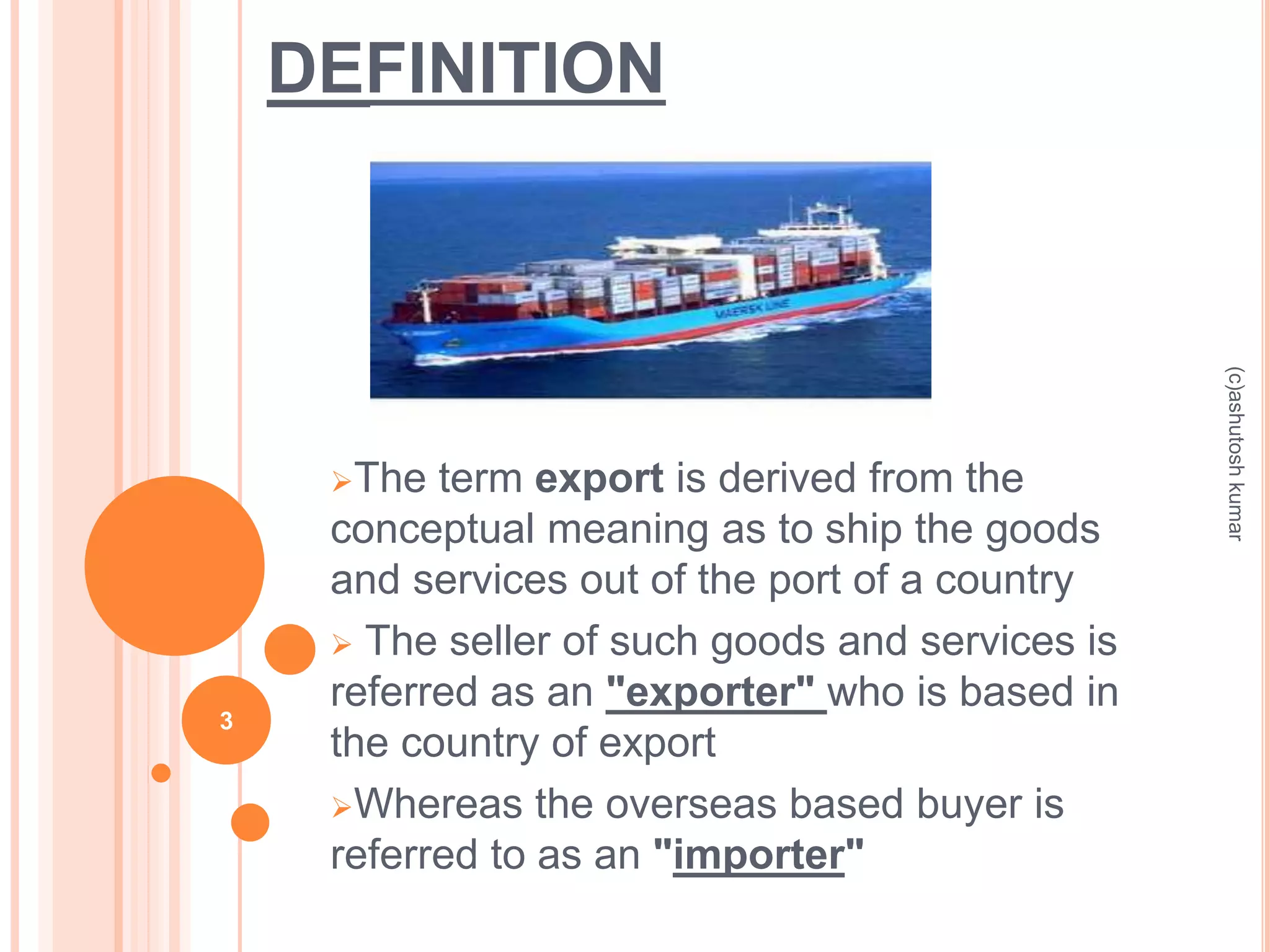
The term export is derived from the 
conceptual meaning as to ship the goods 
and services out of the port of a country 
 The seller of such goods and services is 
referred as an "exporter" who is based in 
the country of export 
Whereas the overseas based buyer is 
referred to as an "importer" 
3 
(c)ashutosh kumar
CONTD. 
 In International Trade, "exports" refers to 
selling goods and services produced in the 
home country to other markets 
 Exporting is the most popular way for 
companies to become international 
 Exporting is usually the first mode of foreign 
entry used by companies 4 
(c)ashutosh kumar
CONTD. 
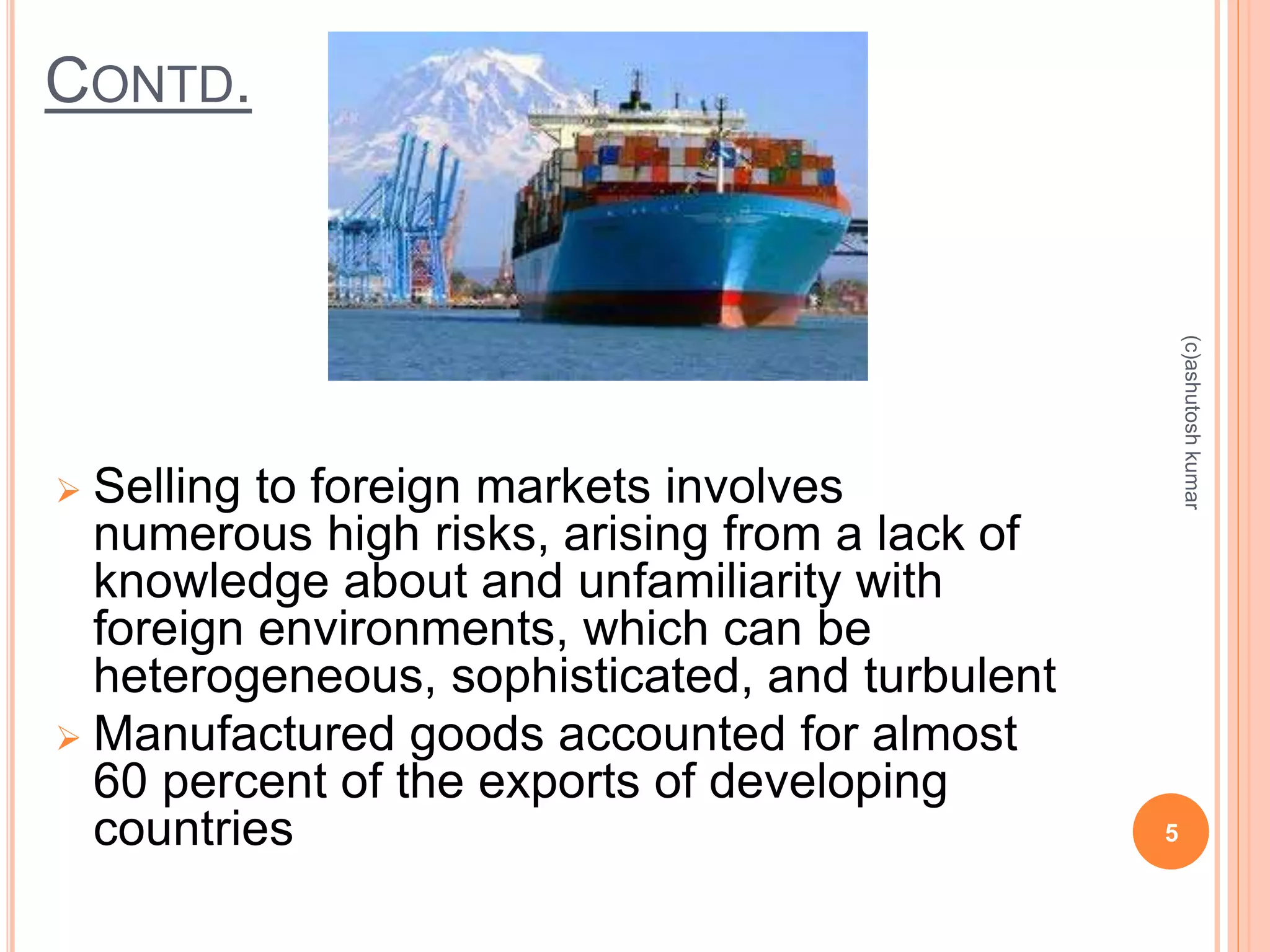
 Selling to foreign markets involves 
numerous high risks, arising from a lack of 
knowledge about and unfamiliarity with 
foreign environments, which can be 
heterogeneous, sophisticated, and turbulent 
 Manufactured goods accounted for almost 
60 percent of the exports of developing 
countries 5 
(c)ashutosh kumar
TYPES OF EXPORT 
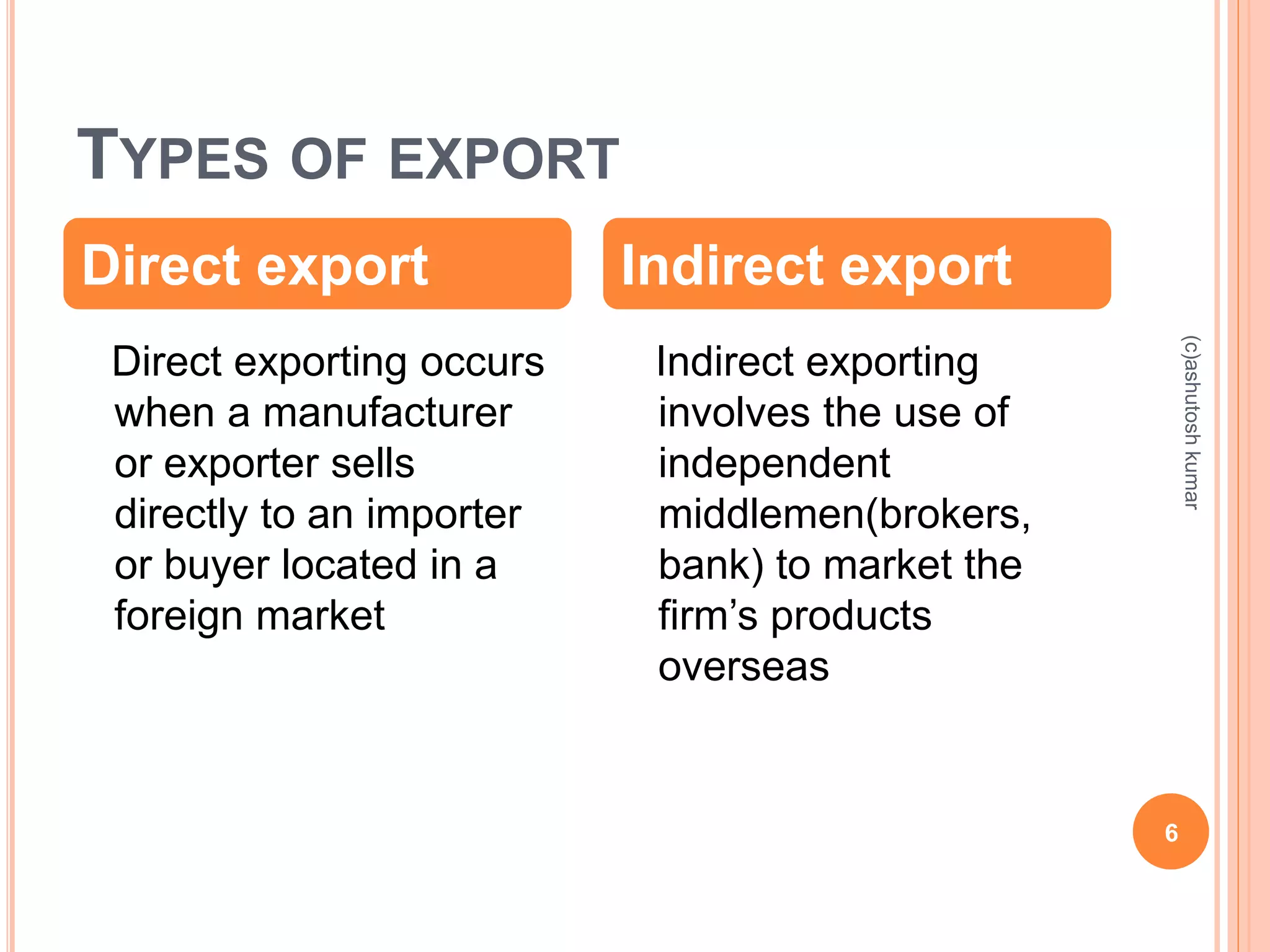
Direct export Indirect export 
Direct exporting occurs 
when a manufacturer 
or exporter sells 
directly to an importer 
or buyer located in a 
foreign market 
Indirect exporting 
involves the use of 
independent 
middlemen(brokers, 
bank) to market the 
firm’s products 
overseas 
6 
(c)ashutosh kumar
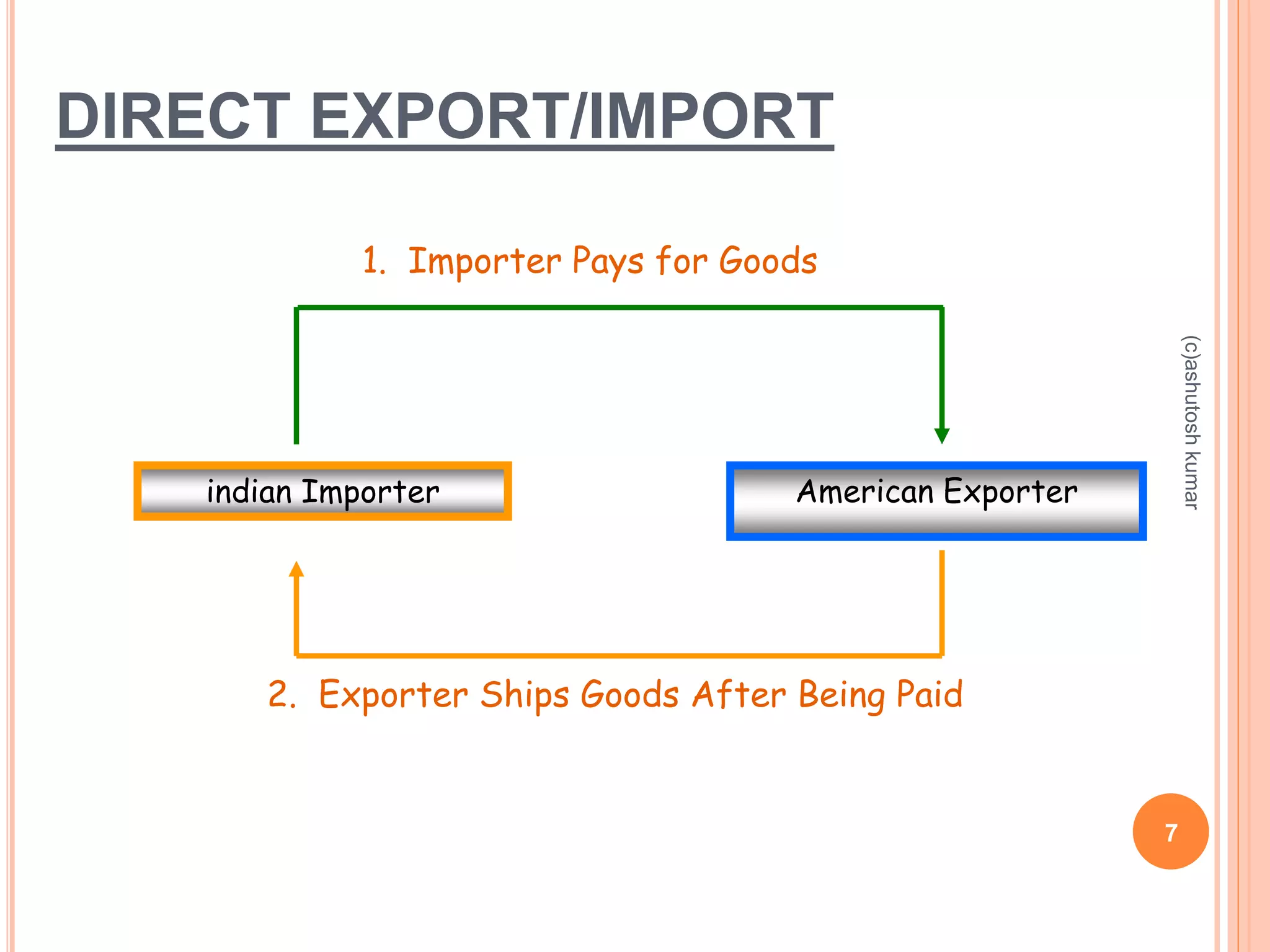
DIRECT EXPORT/IMPORT 
1. Importer Pays for Goods 
indian Importer American Exporter 
2. Exporter Ships Goods After Being Paid 
7 
(c)ashutosh kumar
A TYPICAL INTERNATIONAL 
TRANSACTION 
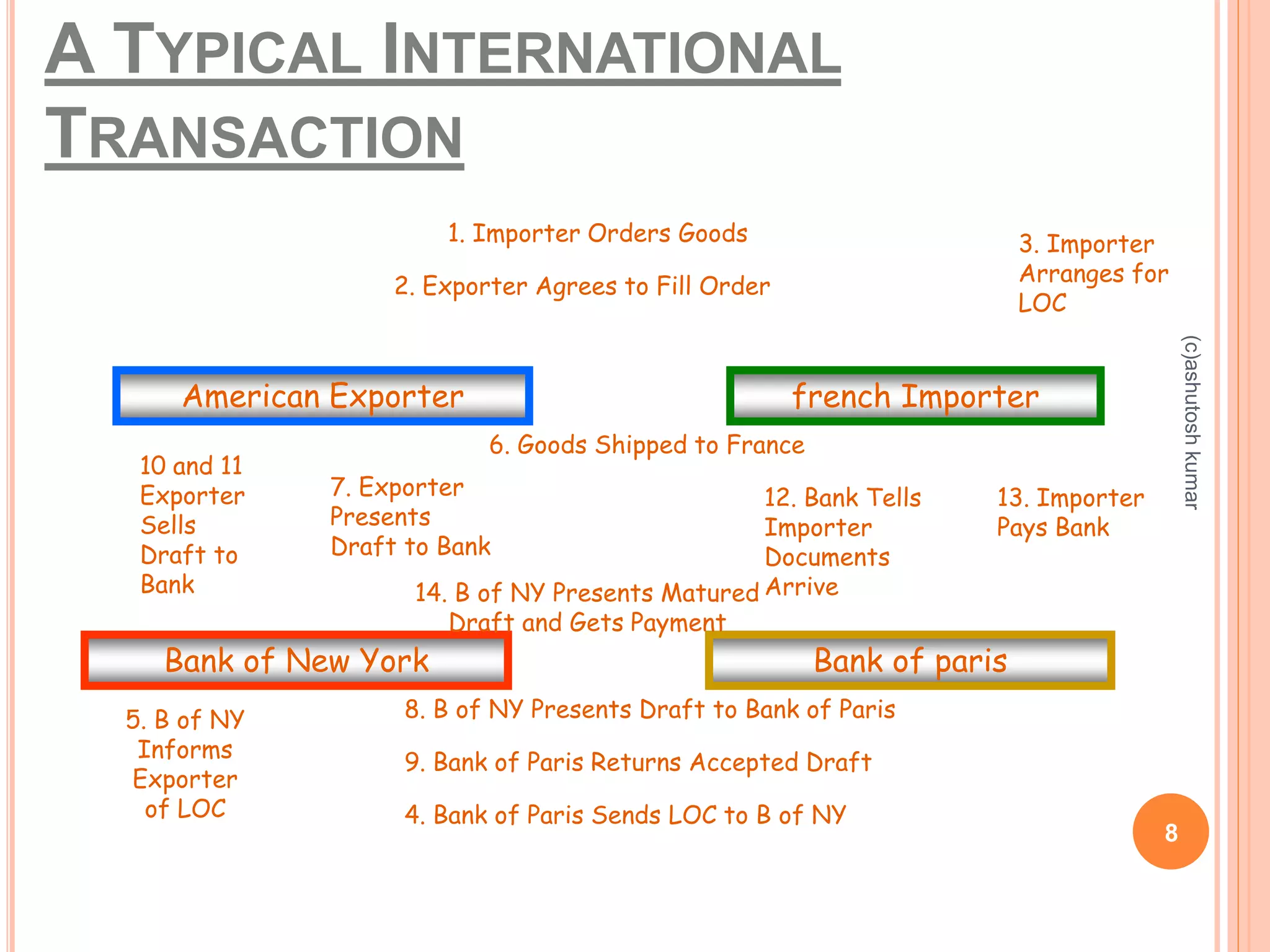
1. Importer Orders Goods 3. Importer 
2. Exporter Agrees to Fill Order 
American Exporter french Importer 
6. Goods Shipped to France 
10 and 11 
Exporter 
7. Exporter 
Sells 
Presents 
Draft to 
Draft to Bank 
Bank 14. B of NY Presents Matured 
Draft and Gets Payment 
12. Bank Tells 
Importer 
Documents 
Arrive 
13. Importer 
Pays Bank 
Bank of New York Bank of paris 
Arranges for 
LOC 
8. B of NY Presents Draft to Bank of Paris 
9. Bank of Paris Returns Accepted Draft 
4. Bank of Paris Sends LOC to B of NY 
5. B of NY 
Informs 
Exporter 
of LOC 
8 
(c)ashutosh kumar
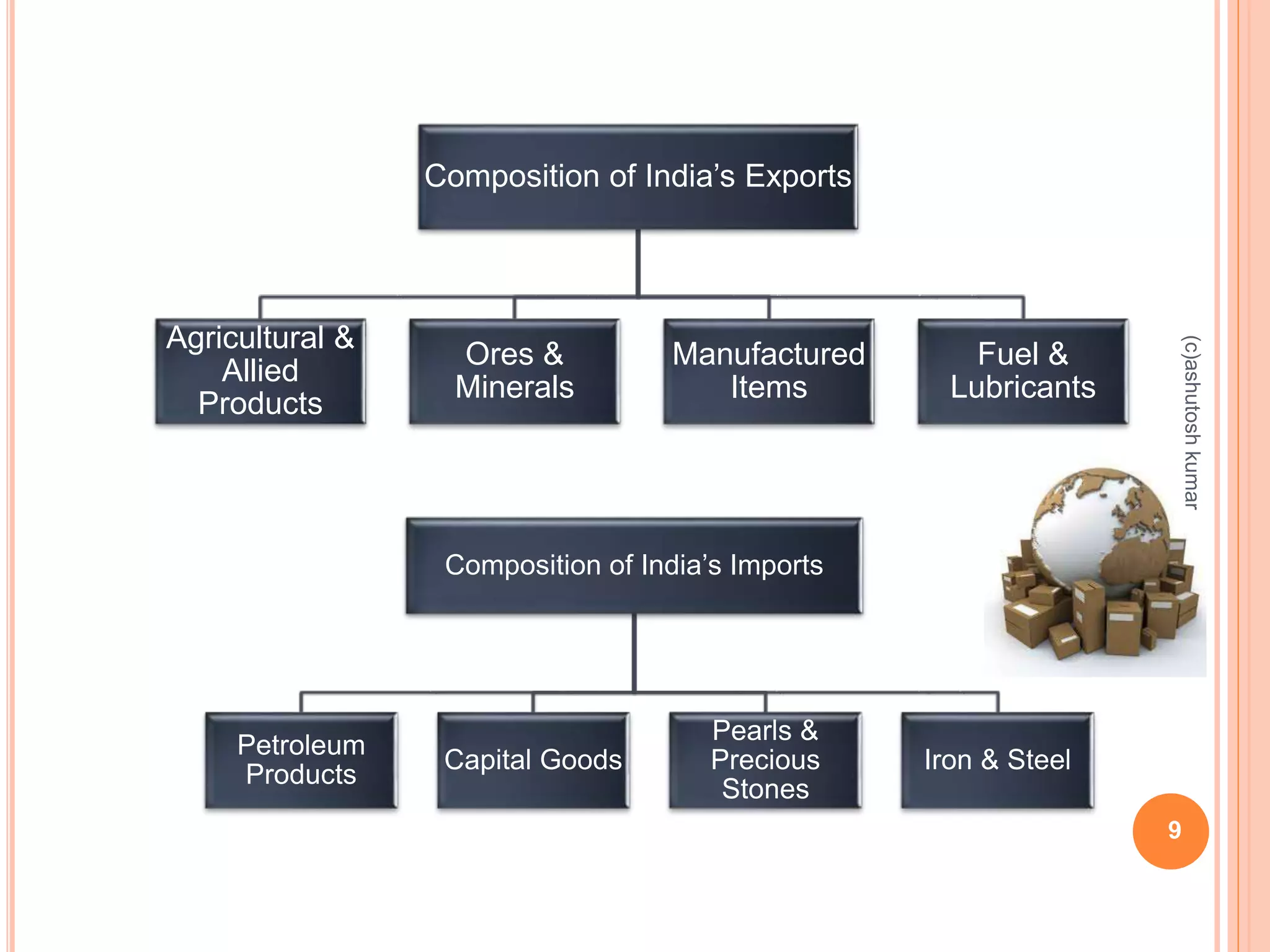
Composition of India’s Exports 
Agricultural & 
Allied 
Products 
Ores & 
Minerals 
Manufactured 
Items 
Fuel & 
Lubricants 
9 
Composition of India’s Imports 
Petroleum 
Products 
Capital Goods 
Pearls & 
Precious 
Stones 
Iron & Steel 
(c)ashutosh kumar
ROLE OF THE GOVERNMENT IN 
PROMOTING EXPORTS 
 Export promotion activities generally comprise: 
1.export services programs 
2.market development program 
 Export-import bank tariff concessions 
1.foreign trade zones 
2.foreign sales corporation(FSC) 
(c)ashutosh kumar 
10
EXPORT PROCESSES 
Evaluate export potential 
 financial resources 
 management capability/experience 
 competitive advantages abroad 
Do country analysis (more later) 
 country receptiveness to imports and investment 
 trade barriers/requirements 
 infrastructure 
(c)ashutosh kumar 
11
CONTD. 
Do market analysis 
 market size/product potential 
 distribution channels 
Determine entry method 
 goal of entry 
 select distribution “partner” 
 determine channel length 
 assess risks 
(c)ashutosh kumar 
 determine costs 12
SOURCES OF EXPORTER 
FINANCING 
Financing exporter credit to the importer: 
- Bankers’ acceptance (of the draft) 
- Factoring 
- Forfeiting 
- EXIM bank 
(c)ashutosh kumar 
13
PROCEDURES OF EXPORT AND IMPORT 
TRANSACTION 
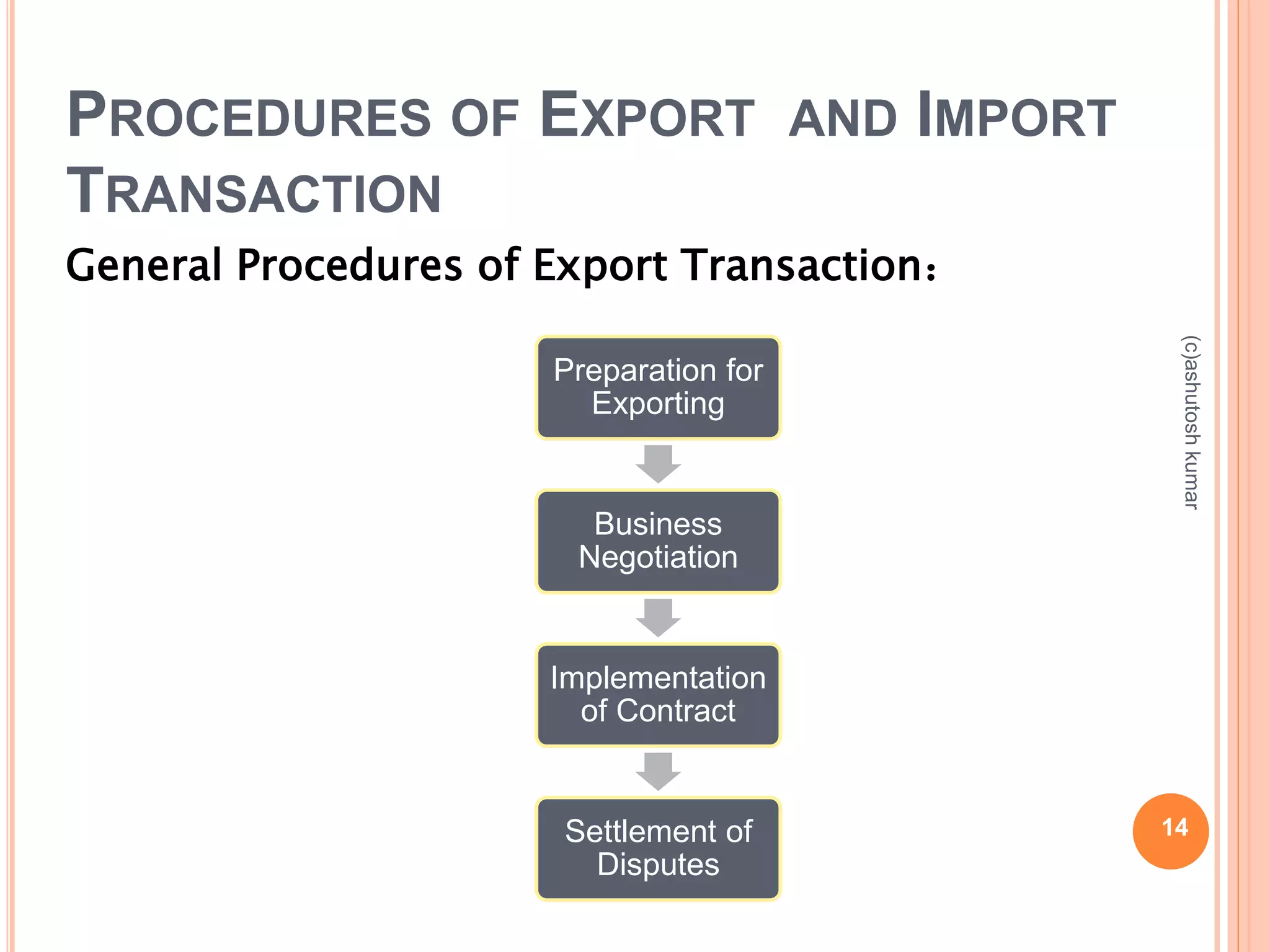
General Procedures of Export Transaction: 
Preparation for 
Exporting 
Business 
Negotiation 
Implementation 
of Contract 
Settlement of 
Disputes 
(c)ashutosh kumar 
14
EXPORT/IMPORT FINANCING 
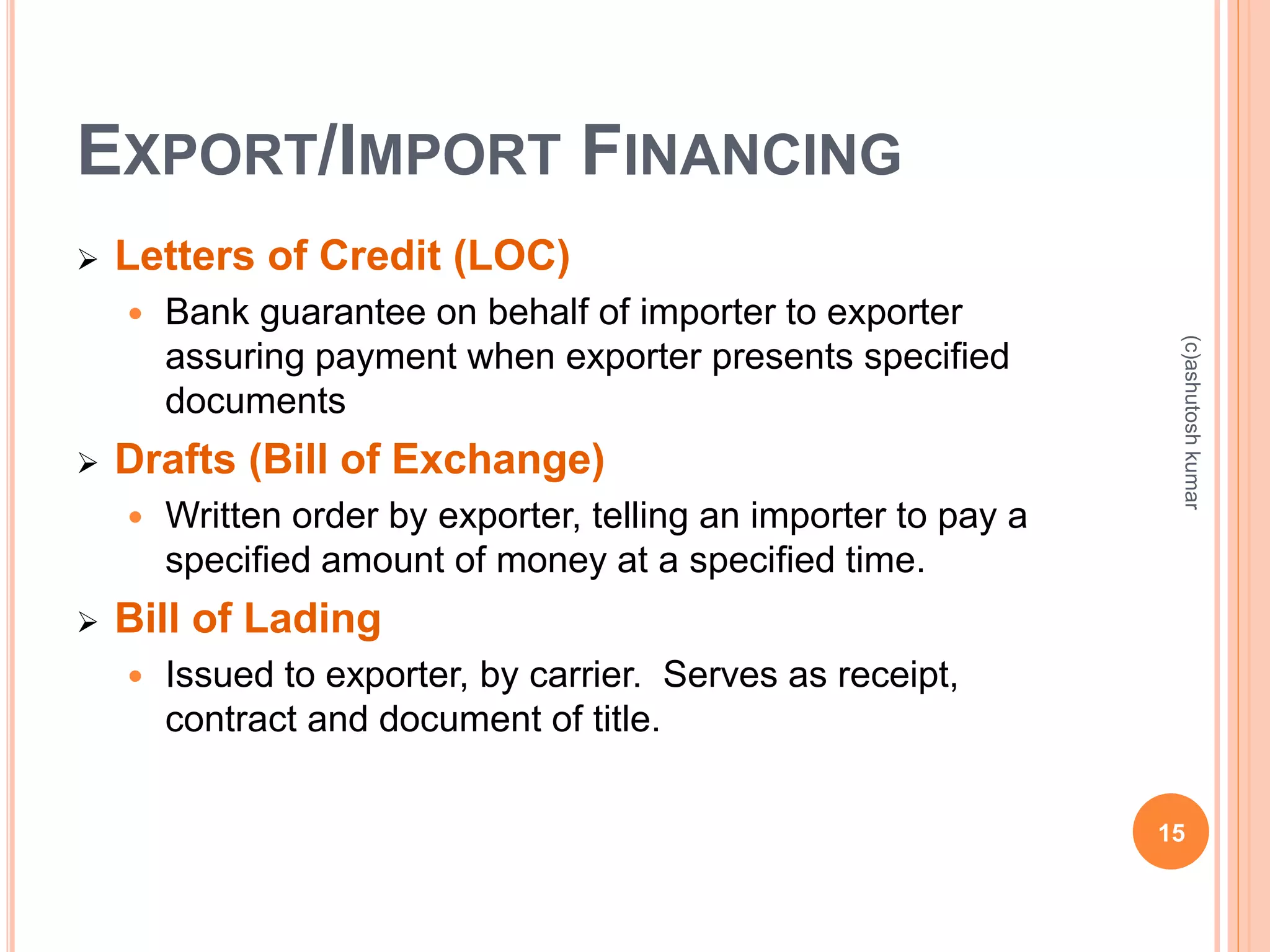
 Letters of Credit (LOC) 
 Bank guarantee on behalf of importer to exporter 
assuring payment when exporter presents specified 
documents 
 Drafts (Bill of Exchange) 
 Written order by exporter, telling an importer to pay a 
specified amount of money at a specified time. 
 Bill of Lading 
 Issued to exporter, by carrier. Serves as receipt, 
contract and document of title. 
(c)ashutosh kumar 
15
WHAT IS EXPORT IMPORT POLICY 
(EXIM POLICY)? 
 Export Import (Exim) Policy or Foreign Trade Policy (FTP) is a set of 
guidelines and instructions in matters related to the import and export of 
goods in India. 
 Established by the Directorate General of Foreign Trade (DGFT) 
 Regulated by The Foreign Trade Development and Regulation Act 1992 
(c)ashutosh kumar 
 Exim policy contains various policy decisions with respect to import and 
exports of the country. 
 Prepared and announced by the central government. 
 Aim 
 Developing export potential 
 Improving export performance 
 Encouraging foreign trade 
 Creating favorable balance of payment position. 
16
CONTD. 
 Trade Policy will strongly influence the 
direction, trend and growth of foreign trade of 
a country 
 Industrialisation and self-sufficiency in 
essential commodities were the important 
objectives of India's trade policy 
 trade policy is an important economic 
instrument which can be used by a country, 
with suitable modifications from time to time, 
to achieve its long-term objectives 
 Trade Policy can be free trade policy or 
protective trade policy 
(c)ashutosh kumar 
17
COMPARISON OF TRADE 
POLICY 
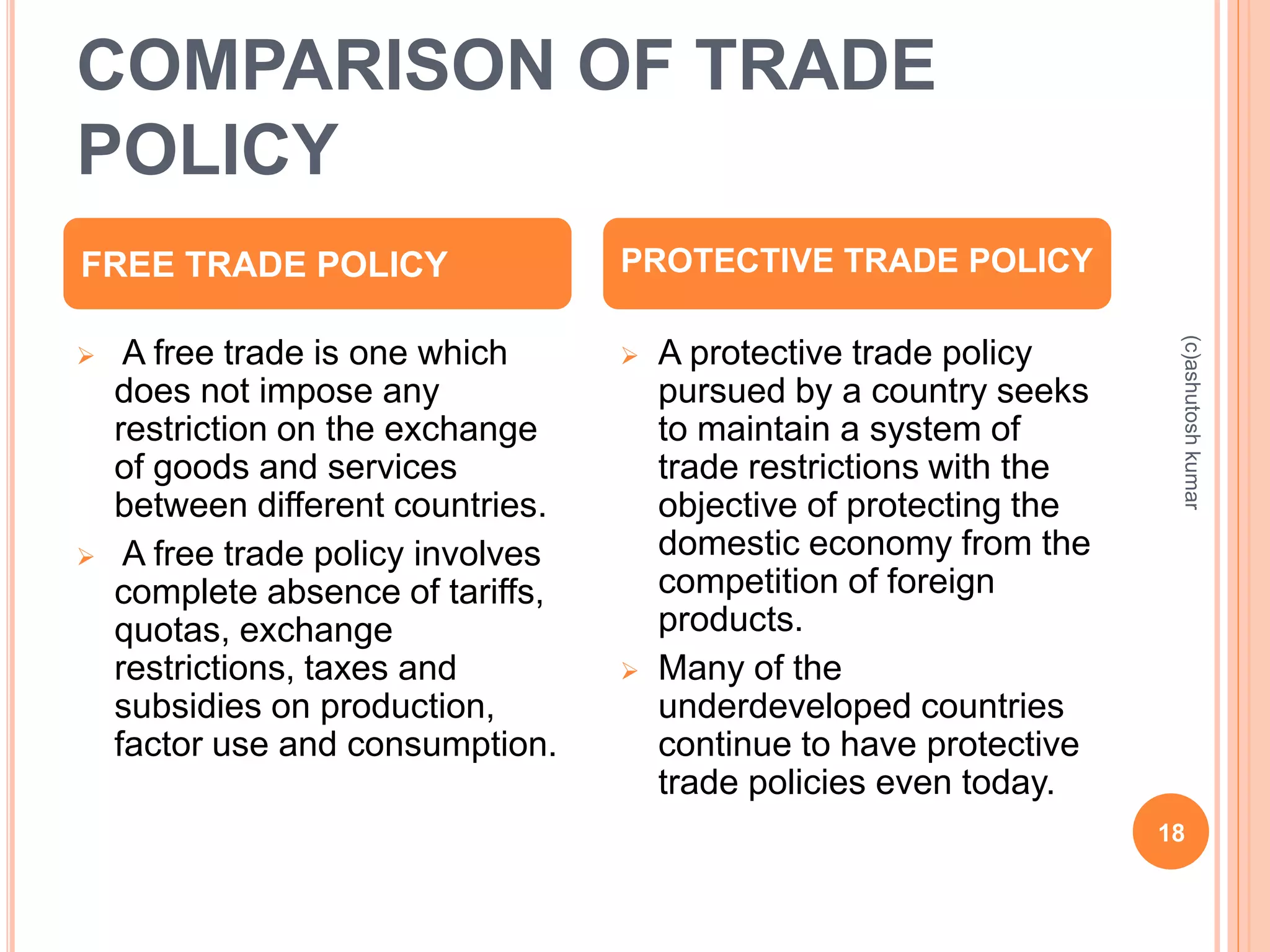
FREE TRADE POLICY PROTECTIVE TRADE POLICY 
 A free trade is one which 
does not impose any 
restriction on the exchange 
of goods and services 
between different countries. 
 A free trade policy involves 
complete absence of tariffs, 
quotas, exchange 
restrictions, taxes and 
subsidies on production, 
factor use and consumption. 
 A protective trade policy 
pursued by a country seeks 
to maintain a system of 
trade restrictions with the 
objective of protecting the 
domestic economy from the 
competition of foreign 
products. 
 Many of the 
underdeveloped countries 
continue to have protective 
trade policies even today. 
(c)ashutosh kumar 
18
INDIA'S EXIM POLICY 2009-2014 
The Union Commerce Ministry, Government of 
India announces the Export Import policy in every 
five year. This is also called EXIM policy. This policy 
is updated every year with some modifications and 
new schemes. New schemes come into effect on 
the first day of financial year i.e. April 1, every 
year. The Foreign trade Policy which was 
announced on August 28, 2009 is an integrated 
policy for the period 2009-14. This policy is 
updated on every financial year. 19 
(c)ashutosh kumar
OBJECTIVES OF EXIM POLICY 2009- 
2014 
 To arrest and reverse declining trend of exports which will be 
reviewed after every two years. 
 To Double India's exports of goods and services by 2014. 
 To double India's share in global merchandise trade by 2020 
(long term aim). India's share in Global merchandise exports 
was 1.45% in 2008. 
 Simplification of the application procedure for availing various 
benefits. 
 To set in motion the strategies and policy measures which 
catalyze the growth of exports. 
(c)ashutosh kumar 
20
INDIA'S FOREIGN TRADE IN JUNE 
2012 
 Exports: 
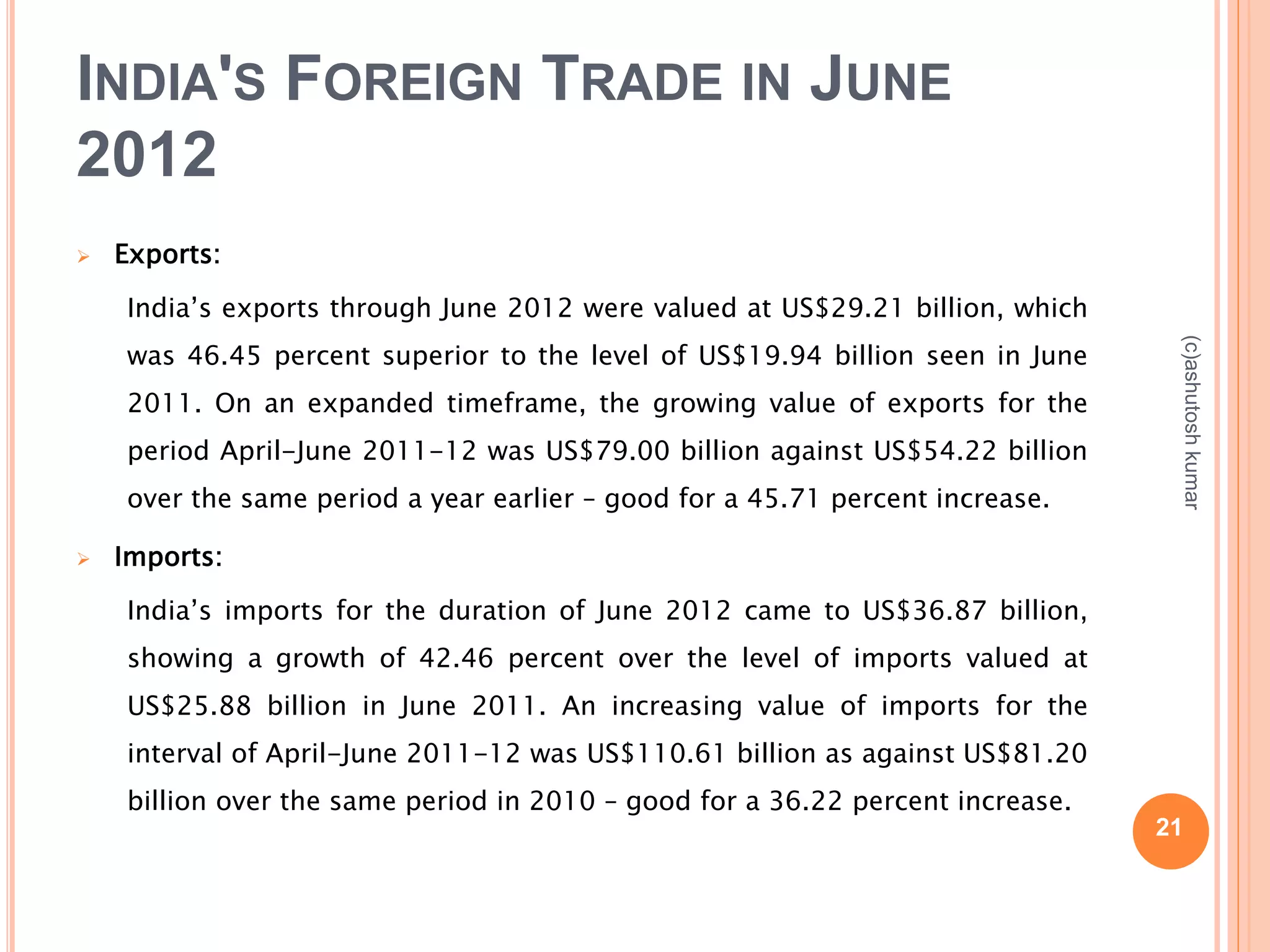
India’s exports through June 2012 were valued at US$29.21 billion, which 
was 46.45 percent superior to the level of US$19.94 billion seen in June 
2011. On an expanded timeframe, the growing value of exports for the 
period April-June 2011-12 was US$79.00 billion against US$54.22 billion 
over the same period a year earlier – good for a 45.71 percent increase. 
 Imports: 
India’s imports for the duration of June 2012 came to US$36.87 billion, 
showing a growth of 42.46 percent over the level of imports valued at 
US$25.88 billion in June 2011. An increasing value of imports for the 
interval of April-June 2011-12 was US$110.61 billion as against US$81.20 
billion over the same period in 2010 – good for a 36.22 percent increase. 
(c)ashutosh kumar 
21
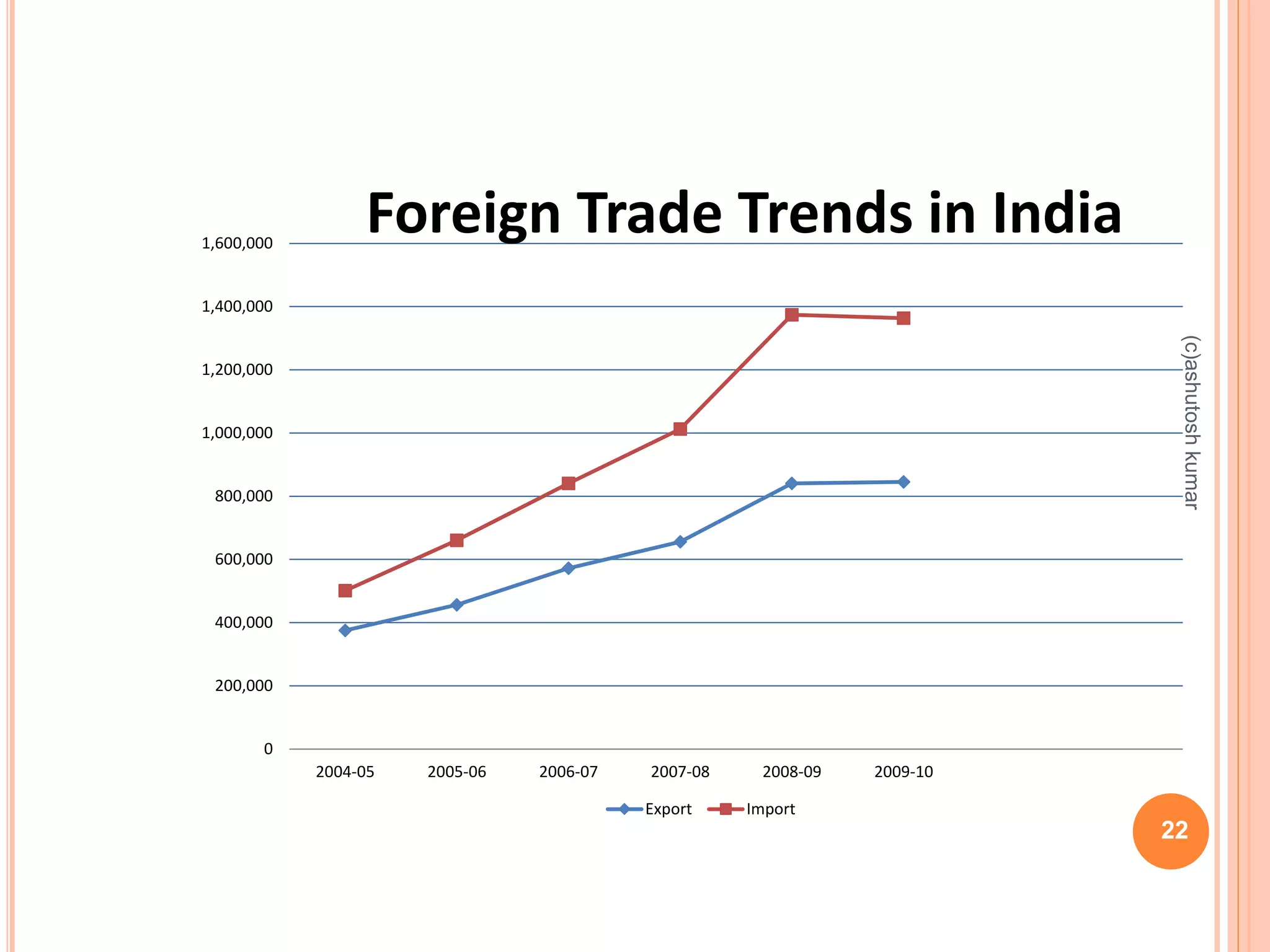
1,600,000 
1,400,000 
1,200,000 
1,000,000 
800,000 
600,000 
400,000 
200,000 
0 
Foreign Trade Trends in India 
2004-05 2005-06 2006-07 2007-08 2008-09 2009-10 
Export Import 
(c)ashutosh kumar 
22
BALANCE OF TRADE 
 Balance of trade = Exports - Imports 
 A positive balance of trade is known as a trade surplus 
 A negative balance of trade is known as a trade deficit or, 
informally, a trade gap. 
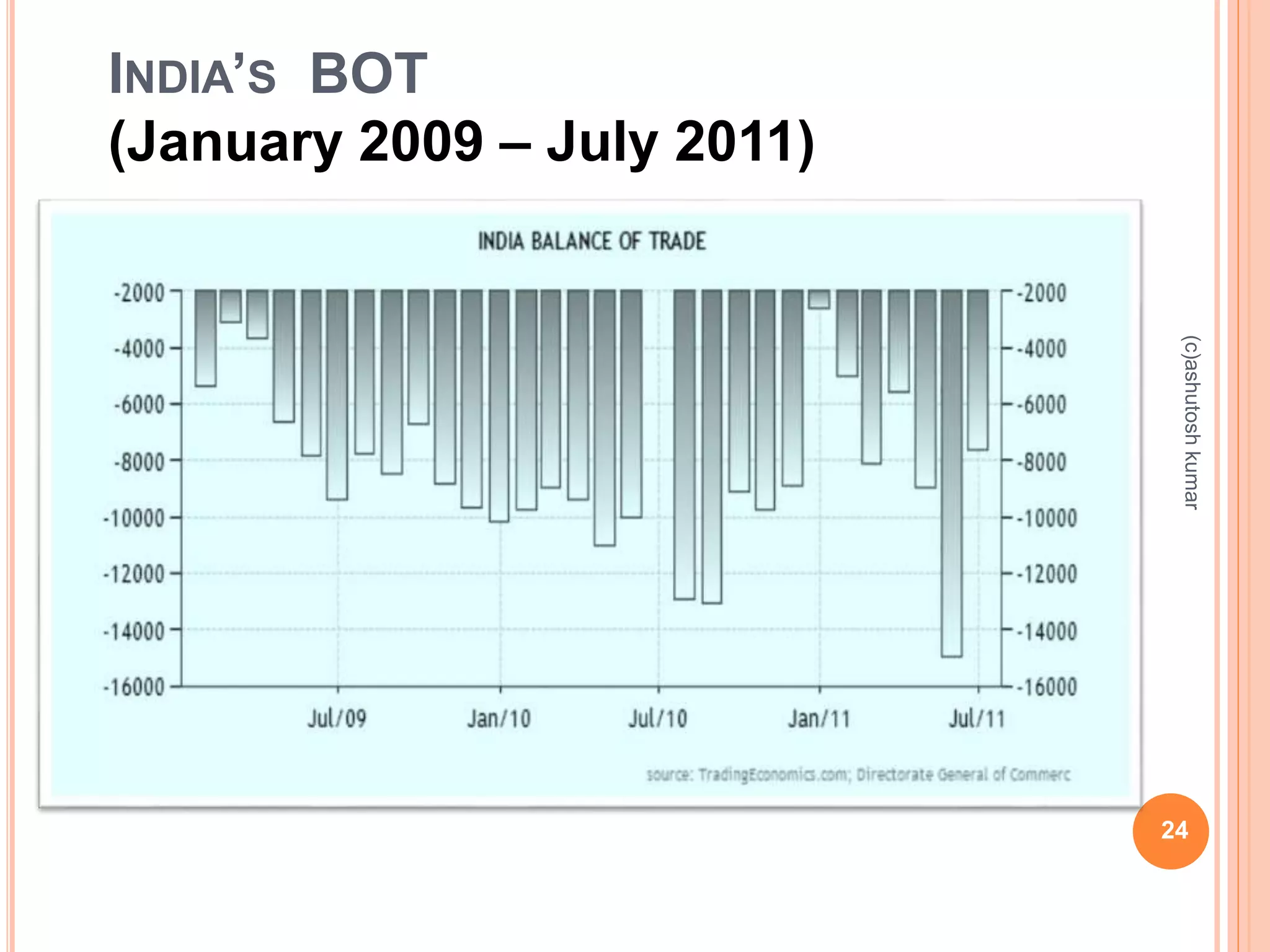
 India reported a trade deficit equivalent to 7659 Millions USD in 
June of 2011. 
 India is poor in oil resources and is currently heavily dependent 
on coal and foreign oil imports for its energy needs. 
 Other imported products are: machinery, gems, fertilizers and 
chemicals. 
(c)ashutosh kumar 
23
24 
INDIA’S BOT 
(January 2009 – July 2011) 
(c)ashutosh kumar
ANY QUERY? 
25 
(c)ashutosh kumar
BIBLIOGRAPHY 
Wikipedia 
Official website of Indian export-import 
portal 
 Internet 
 Oxford dictionary 
(c)ashutosh kumar 
26
THANKING 
YOU 
THANKING 
YOU 
(c)ashutosh kumar 
27

Ppt 03 import &export

  • 1.
    EXPORT IMPORT ANDEXIM POLICY submitted by: Ashutosh kumar (c)ashutosh kumar 1
  • 2.
    CONTENTS: Definition Typesof export Role of govt in export Export/import process Export/import financing Exim policy Comparison of trade policy India’s Exim policy 2009-14 Objective of india’s Exim policy Balance of trade Bibliography 2 (c)ashutosh kumar
  • 3.
    DEFINITION The termexport is derived from the conceptual meaning as to ship the goods and services out of the port of a country  The seller of such goods and services is referred as an "exporter" who is based in the country of export Whereas the overseas based buyer is referred to as an "importer" 3 (c)ashutosh kumar
  • 4.
    CONTD.  InInternational Trade, "exports" refers to selling goods and services produced in the home country to other markets  Exporting is the most popular way for companies to become international  Exporting is usually the first mode of foreign entry used by companies 4 (c)ashutosh kumar
  • 5.
    CONTD.  Sellingto foreign markets involves numerous high risks, arising from a lack of knowledge about and unfamiliarity with foreign environments, which can be heterogeneous, sophisticated, and turbulent  Manufactured goods accounted for almost 60 percent of the exports of developing countries 5 (c)ashutosh kumar
  • 6.
    TYPES OF EXPORT Direct export Indirect export Direct exporting occurs when a manufacturer or exporter sells directly to an importer or buyer located in a foreign market Indirect exporting involves the use of independent middlemen(brokers, bank) to market the firm’s products overseas 6 (c)ashutosh kumar
  • 7.
    DIRECT EXPORT/IMPORT 1.Importer Pays for Goods indian Importer American Exporter 2. Exporter Ships Goods After Being Paid 7 (c)ashutosh kumar
  • 8.
    A TYPICAL INTERNATIONAL TRANSACTION 1. Importer Orders Goods 3. Importer 2. Exporter Agrees to Fill Order American Exporter french Importer 6. Goods Shipped to France 10 and 11 Exporter 7. Exporter Sells Presents Draft to Draft to Bank Bank 14. B of NY Presents Matured Draft and Gets Payment 12. Bank Tells Importer Documents Arrive 13. Importer Pays Bank Bank of New York Bank of paris Arranges for LOC 8. B of NY Presents Draft to Bank of Paris 9. Bank of Paris Returns Accepted Draft 4. Bank of Paris Sends LOC to B of NY 5. B of NY Informs Exporter of LOC 8 (c)ashutosh kumar
  • 9.
    Composition of India’sExports Agricultural & Allied Products Ores & Minerals Manufactured Items Fuel & Lubricants 9 Composition of India’s Imports Petroleum Products Capital Goods Pearls & Precious Stones Iron & Steel (c)ashutosh kumar
  • 10.
    ROLE OF THEGOVERNMENT IN PROMOTING EXPORTS  Export promotion activities generally comprise: 1.export services programs 2.market development program  Export-import bank tariff concessions 1.foreign trade zones 2.foreign sales corporation(FSC) (c)ashutosh kumar 10
  • 11.
    EXPORT PROCESSES Evaluateexport potential  financial resources  management capability/experience  competitive advantages abroad Do country analysis (more later)  country receptiveness to imports and investment  trade barriers/requirements  infrastructure (c)ashutosh kumar 11
  • 12.
    CONTD. Do marketanalysis  market size/product potential  distribution channels Determine entry method  goal of entry  select distribution “partner”  determine channel length  assess risks (c)ashutosh kumar  determine costs 12
  • 13.
    SOURCES OF EXPORTER FINANCING Financing exporter credit to the importer: - Bankers’ acceptance (of the draft) - Factoring - Forfeiting - EXIM bank (c)ashutosh kumar 13
  • 14.
    PROCEDURES OF EXPORTAND IMPORT TRANSACTION General Procedures of Export Transaction: Preparation for Exporting Business Negotiation Implementation of Contract Settlement of Disputes (c)ashutosh kumar 14
  • 15.
    EXPORT/IMPORT FINANCING Letters of Credit (LOC)  Bank guarantee on behalf of importer to exporter assuring payment when exporter presents specified documents  Drafts (Bill of Exchange)  Written order by exporter, telling an importer to pay a specified amount of money at a specified time.  Bill of Lading  Issued to exporter, by carrier. Serves as receipt, contract and document of title. (c)ashutosh kumar 15
  • 16.
    WHAT IS EXPORTIMPORT POLICY (EXIM POLICY)?  Export Import (Exim) Policy or Foreign Trade Policy (FTP) is a set of guidelines and instructions in matters related to the import and export of goods in India.  Established by the Directorate General of Foreign Trade (DGFT)  Regulated by The Foreign Trade Development and Regulation Act 1992 (c)ashutosh kumar  Exim policy contains various policy decisions with respect to import and exports of the country.  Prepared and announced by the central government.  Aim  Developing export potential  Improving export performance  Encouraging foreign trade  Creating favorable balance of payment position. 16
  • 17.
    CONTD.  TradePolicy will strongly influence the direction, trend and growth of foreign trade of a country  Industrialisation and self-sufficiency in essential commodities were the important objectives of India's trade policy  trade policy is an important economic instrument which can be used by a country, with suitable modifications from time to time, to achieve its long-term objectives  Trade Policy can be free trade policy or protective trade policy (c)ashutosh kumar 17
  • 18.
    COMPARISON OF TRADE POLICY FREE TRADE POLICY PROTECTIVE TRADE POLICY  A free trade is one which does not impose any restriction on the exchange of goods and services between different countries.  A free trade policy involves complete absence of tariffs, quotas, exchange restrictions, taxes and subsidies on production, factor use and consumption.  A protective trade policy pursued by a country seeks to maintain a system of trade restrictions with the objective of protecting the domestic economy from the competition of foreign products.  Many of the underdeveloped countries continue to have protective trade policies even today. (c)ashutosh kumar 18
  • 19.
    INDIA'S EXIM POLICY2009-2014 The Union Commerce Ministry, Government of India announces the Export Import policy in every five year. This is also called EXIM policy. This policy is updated every year with some modifications and new schemes. New schemes come into effect on the first day of financial year i.e. April 1, every year. The Foreign trade Policy which was announced on August 28, 2009 is an integrated policy for the period 2009-14. This policy is updated on every financial year. 19 (c)ashutosh kumar
  • 20.
    OBJECTIVES OF EXIMPOLICY 2009- 2014  To arrest and reverse declining trend of exports which will be reviewed after every two years.  To Double India's exports of goods and services by 2014.  To double India's share in global merchandise trade by 2020 (long term aim). India's share in Global merchandise exports was 1.45% in 2008.  Simplification of the application procedure for availing various benefits.  To set in motion the strategies and policy measures which catalyze the growth of exports. (c)ashutosh kumar 20
  • 21.
    INDIA'S FOREIGN TRADEIN JUNE 2012  Exports: India’s exports through June 2012 were valued at US$29.21 billion, which was 46.45 percent superior to the level of US$19.94 billion seen in June 2011. On an expanded timeframe, the growing value of exports for the period April-June 2011-12 was US$79.00 billion against US$54.22 billion over the same period a year earlier – good for a 45.71 percent increase.  Imports: India’s imports for the duration of June 2012 came to US$36.87 billion, showing a growth of 42.46 percent over the level of imports valued at US$25.88 billion in June 2011. An increasing value of imports for the interval of April-June 2011-12 was US$110.61 billion as against US$81.20 billion over the same period in 2010 – good for a 36.22 percent increase. (c)ashutosh kumar 21
  • 22.
    1,600,000 1,400,000 1,200,000 1,000,000 800,000 600,000 400,000 200,000 0 Foreign Trade Trends in India 2004-05 2005-06 2006-07 2007-08 2008-09 2009-10 Export Import (c)ashutosh kumar 22
  • 23.
    BALANCE OF TRADE  Balance of trade = Exports - Imports  A positive balance of trade is known as a trade surplus  A negative balance of trade is known as a trade deficit or, informally, a trade gap.  India reported a trade deficit equivalent to 7659 Millions USD in June of 2011.  India is poor in oil resources and is currently heavily dependent on coal and foreign oil imports for its energy needs.  Other imported products are: machinery, gems, fertilizers and chemicals. (c)ashutosh kumar 23
  • 24.
    24 INDIA’S BOT (January 2009 – July 2011) (c)ashutosh kumar
  • 25.
    ANY QUERY? 25 (c)ashutosh kumar
  • 26.
    BIBLIOGRAPHY Wikipedia Officialwebsite of Indian export-import portal  Internet  Oxford dictionary (c)ashutosh kumar 26
  • 27.
    THANKING YOU THANKING YOU (c)ashutosh kumar 27