OPERATION
RESEARCH
WORKLOAD BALANCING ASSIGNMENT
DIGITAL IMAGING
 Firm launches new products in market
DI-910
• TIME REQUIRED TO PRINT-37
SECONDS
• PROFIT PER UNIT - 37
DI-950
• TIME REQUIRED TO PRINT IS
COMPARATIVELT LESS
• PROFIT PER UNIT - 82
MANUFACTURING
LINE 1
• PERFORMS THE ASSEMBLY OPERTION
• FOR DI-910 3 MINUTES
• FOR DI-950 6 MINUTES
LINE 2
• PERFORMS BOTH TESTING AND PACKAGING OPERATION
• FOR DI-910 4 MINUTES
• FOR DI-950 2 MINUTES
AVAILABLE TIME PER DAY IS 480
HOURS
MANAGERIAL REPORT
 RECOMMENDATION: NUMBER OF UNIT OF EACH PRINTER TO BE
MAXIMIZED
 DECISION VARIABLES: X: NUMBER OF UNITS OF DI-910
 Y: NUMBER OF UNITS OF DI-950
 OBJECTIVE FUNCTION: MAX 42X + 87Y
 CONSTAINTS:
 3X + 6Y <= 480
 4X + 2Y <= 480
 X,Y >=0
SENSITIVITY
HERE IS THE SOLUTION OF
MANAGEMENT SCIENTIST
SOFTWARE FOR PROFIT
MAXIMIZATION
INTERPRETATION
 Objective function value is
6960.00.
 From 1st table we can see that or
variable 1 reduced cost is 1.5 that
means that DI-910 is not in the
optimum solution. Its coefficient
that is 42 has to increase by 1.5
so that it can be in optimal
solution
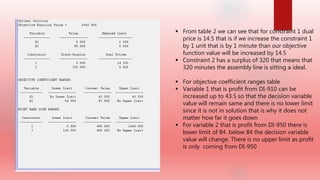
 From table 2 we can see that for constraint 1 dual
price is 14.5 that is if we increase the constraint 1
by 1 unit that is by 1 minute than our objective
function value will be increased by 14.5
 Constraint 2 has a surplus of 320 that means that
320 minutes the assembly line is sitting a ideal.
 For objective coefficient ranges table
 Variable 1 that is profit from DI-910 can be
increased up to 43.5 so that the decision variable
value will remain same and there is no lower limit
since it is not in solution that is why it does not
matter how far it goes down
 For variable 2 that is profit from DI-950 there is
lower limit of 84. below 84 the decision variable
value will change. There is no upper limit as profit
is only coming from DI-950
• For table 4 that is RIGHT HAND SIDE RANGES
• For constraint 1 that is assembly line 1 lower
limit is 0 and upper limit is 1440.
• What does it mean : that dual price will remain
14.5 for assembly line 1 as long as constraint 1
limit will be between 0 to 1440 beyond that dual
prices will change
• For constraint 2 that is assembly line 2 dual
prices is zero and lower limit is 160 and there is
no upper limit to this. What we can infer from
this is that whatever the constraint value is
whether 160 or more than this dual prices will
not change
RECOMMENDTIONS
Company according to our recommendation should produce 80 DI-950 products for
maximization of profits.
But there are some issues
1. There might be uncertain demand for DI-950 printer as producing all of then could
result in oversupply in the market
2. Untapped market will result in case if we are not producing DI-910 printer
3. DI-910 is also profitable
4. Line 2 is sitting ideal for 320 hours. This will be a machinery which is underutilized
for about 2/3rd of the time of total production time
Our recommendation: our recommendation will be to produce both
products according to the demand for each one and the market size
 Company can produce 53-53 of both the printers
 Profit will be 6880 which Is 80 units lesser than
previous one
 WHY
 Because as per the decision variables we can see
that profit from DI-950 is more than that of DI-
910. but because of constraint that we put in on
the production solution will be of equal
production
 As we can see that dual prices for constraint 3 is
minus 1 so by increasing one unit of constraint 1
we will be reducing the profit by 1 unit
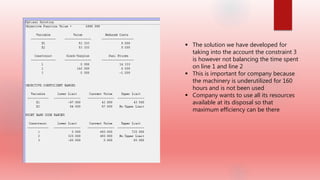
 The solution we have developed for
taking into the account the constraint 3
is however not balancing the time spent
on line 1 and line 2
 This is important for company because
the machinery is underutilized for 160
hours and is not been used
 Company wants to use all its resources
available at its disposal so that
maximum efficiency can be there
• Profit will be reduced by 65 units when
adding another constraint
• Also we can wee that in table 2 there is a
surplus in constraint 3 which means that
company will be producing 65 units more of
DI=910 and there is no reduced cost in it
that is no further improvement is there
• In case of constraint 4 there is dual price of
.5 which means that adding 1 more unit in
constraint one or relaxing the difference
value to 31 there will an improvement in
total profit by .5 units
• Total number of printers produced is
133
• DI-910 = 106
• DI-950 = 26
• PROFIT = 6054
• PROFIT WILL BE REDUCED
SUBSTANTIALLY
• BUT AS WE SEE THAT THERE IS NO
SLACK IS THERE AND BOTH THE
MACHINES ARE FULLY OCCUPIED BY
480 HOURS
• THIS WILL RESULT IN INCREASED
OVERALL EFFICIENCY
FINAL RECOMMENDATIONS
• OPERATIONAL EFFICIENCY : IF COMPANY WANTS TO FOCUS ON OPERATIONAL EFFICIENCY
THAN IT SHOULD PRODUCE BOTH PRINTERS THAT WILL OPTIMIZE THE AVAILABLE TIME
THAT IS WITH THE COMPANY
• PROFIT : IF FOCUS IS ON PROFIT THAT IT SHOULD PRODUCE ALL DI-950 PRINTERS BUT
DEMAND AND SUPPLY SHOULD BE TAKEN IN CONSIDERATION
• MARKET : LOOKING AT PROFIT FOCUSED SCENARIO WILL LEAVE THE MARKET OF DI-910
PRINTER AND IT WILL BE TAPPED BY ITS COMPETITIORS AND IN TH ELONGRUN IT WILL
HARMFUL FOT THE COMPANY
• SO TAKING INTO CONSIDERATION ALL THE ABOVE FACTORS COMPANY’S FOCUS
SHOULD BE OF LONG RUN CAPTURING MAXIMUM MARKET SHARE AND AS WELL AS
OPTIMIZATION OF MACINERY TIME

Workload balancing

  • 1.
  • 2.
    DIGITAL IMAGING  Firmlaunches new products in market DI-910 • TIME REQUIRED TO PRINT-37 SECONDS • PROFIT PER UNIT - 37 DI-950 • TIME REQUIRED TO PRINT IS COMPARATIVELT LESS • PROFIT PER UNIT - 82
  • 3.
    MANUFACTURING LINE 1 • PERFORMSTHE ASSEMBLY OPERTION • FOR DI-910 3 MINUTES • FOR DI-950 6 MINUTES LINE 2 • PERFORMS BOTH TESTING AND PACKAGING OPERATION • FOR DI-910 4 MINUTES • FOR DI-950 2 MINUTES AVAILABLE TIME PER DAY IS 480 HOURS
  • 4.
    MANAGERIAL REPORT  RECOMMENDATION:NUMBER OF UNIT OF EACH PRINTER TO BE MAXIMIZED  DECISION VARIABLES: X: NUMBER OF UNITS OF DI-910  Y: NUMBER OF UNITS OF DI-950  OBJECTIVE FUNCTION: MAX 42X + 87Y  CONSTAINTS:  3X + 6Y <= 480  4X + 2Y <= 480  X,Y >=0
  • 5.
    SENSITIVITY HERE IS THESOLUTION OF MANAGEMENT SCIENTIST SOFTWARE FOR PROFIT MAXIMIZATION INTERPRETATION  Objective function value is 6960.00.  From 1st table we can see that or variable 1 reduced cost is 1.5 that means that DI-910 is not in the optimum solution. Its coefficient that is 42 has to increase by 1.5 so that it can be in optimal solution
  • 6.
     From table2 we can see that for constraint 1 dual price is 14.5 that is if we increase the constraint 1 by 1 unit that is by 1 minute than our objective function value will be increased by 14.5  Constraint 2 has a surplus of 320 that means that 320 minutes the assembly line is sitting a ideal.  For objective coefficient ranges table  Variable 1 that is profit from DI-910 can be increased up to 43.5 so that the decision variable value will remain same and there is no lower limit since it is not in solution that is why it does not matter how far it goes down  For variable 2 that is profit from DI-950 there is lower limit of 84. below 84 the decision variable value will change. There is no upper limit as profit is only coming from DI-950
  • 7.
    • For table4 that is RIGHT HAND SIDE RANGES • For constraint 1 that is assembly line 1 lower limit is 0 and upper limit is 1440. • What does it mean : that dual price will remain 14.5 for assembly line 1 as long as constraint 1 limit will be between 0 to 1440 beyond that dual prices will change • For constraint 2 that is assembly line 2 dual prices is zero and lower limit is 160 and there is no upper limit to this. What we can infer from this is that whatever the constraint value is whether 160 or more than this dual prices will not change
  • 8.
    RECOMMENDTIONS Company according toour recommendation should produce 80 DI-950 products for maximization of profits. But there are some issues 1. There might be uncertain demand for DI-950 printer as producing all of then could result in oversupply in the market 2. Untapped market will result in case if we are not producing DI-910 printer 3. DI-910 is also profitable 4. Line 2 is sitting ideal for 320 hours. This will be a machinery which is underutilized for about 2/3rd of the time of total production time Our recommendation: our recommendation will be to produce both products according to the demand for each one and the market size
  • 9.
     Company canproduce 53-53 of both the printers  Profit will be 6880 which Is 80 units lesser than previous one  WHY  Because as per the decision variables we can see that profit from DI-950 is more than that of DI- 910. but because of constraint that we put in on the production solution will be of equal production  As we can see that dual prices for constraint 3 is minus 1 so by increasing one unit of constraint 1 we will be reducing the profit by 1 unit
  • 10.
     The solutionwe have developed for taking into the account the constraint 3 is however not balancing the time spent on line 1 and line 2  This is important for company because the machinery is underutilized for 160 hours and is not been used  Company wants to use all its resources available at its disposal so that maximum efficiency can be there
  • 11.
    • Profit willbe reduced by 65 units when adding another constraint • Also we can wee that in table 2 there is a surplus in constraint 3 which means that company will be producing 65 units more of DI=910 and there is no reduced cost in it that is no further improvement is there • In case of constraint 4 there is dual price of .5 which means that adding 1 more unit in constraint one or relaxing the difference value to 31 there will an improvement in total profit by .5 units
  • 12.
    • Total numberof printers produced is 133 • DI-910 = 106 • DI-950 = 26 • PROFIT = 6054 • PROFIT WILL BE REDUCED SUBSTANTIALLY • BUT AS WE SEE THAT THERE IS NO SLACK IS THERE AND BOTH THE MACHINES ARE FULLY OCCUPIED BY 480 HOURS • THIS WILL RESULT IN INCREASED OVERALL EFFICIENCY
  • 13.
    FINAL RECOMMENDATIONS • OPERATIONALEFFICIENCY : IF COMPANY WANTS TO FOCUS ON OPERATIONAL EFFICIENCY THAN IT SHOULD PRODUCE BOTH PRINTERS THAT WILL OPTIMIZE THE AVAILABLE TIME THAT IS WITH THE COMPANY • PROFIT : IF FOCUS IS ON PROFIT THAT IT SHOULD PRODUCE ALL DI-950 PRINTERS BUT DEMAND AND SUPPLY SHOULD BE TAKEN IN CONSIDERATION • MARKET : LOOKING AT PROFIT FOCUSED SCENARIO WILL LEAVE THE MARKET OF DI-910 PRINTER AND IT WILL BE TAPPED BY ITS COMPETITIORS AND IN TH ELONGRUN IT WILL HARMFUL FOT THE COMPANY • SO TAKING INTO CONSIDERATION ALL THE ABOVE FACTORS COMPANY’S FOCUS SHOULD BE OF LONG RUN CAPTURING MAXIMUM MARKET SHARE AND AS WELL AS OPTIMIZATION OF MACINERY TIME