Purpose
To find the undrained shear strength of
soils ( e.g soft clays)
Drained and Undrained Conditions
Drained Condition
 occurs when there is no change in pore water pressure due
to external loading.
 the pore water can drain out of the soil easily, causing
volumetric strains in the soil.
Undrained condition
 occurs when the pore water is unable to drain out of the
soil.
 the rate of loading is much quicker than the rate at which
the pore water is able to drain out of the soil.
 The tendency of soil to change volume is suppressed
Apparatus
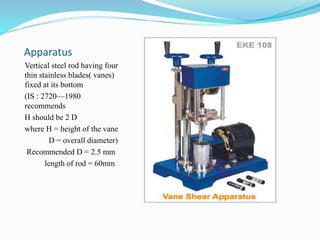
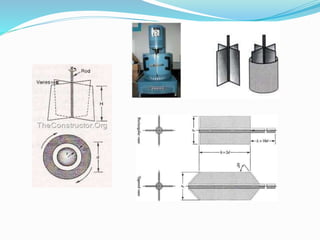
Vertical steel rod having four
thin stainless blades( vanes)
fixed at its bottom
(IS : 2720—1980
recommends
H should be 2 D
where H = height of the vane
D = overall diameter)
Recommended D = 2.5 mm
length of rod = 60mm
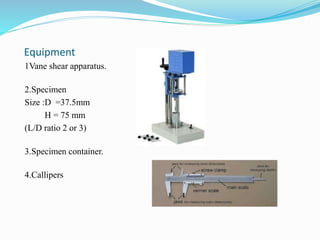
Equipment
1Vane shear apparatus.
2.Specimen
Size :D =37.5mm
H = 75 mm
(L/D ratio 2 or 3)
3.Specimen container.
4.Callipers
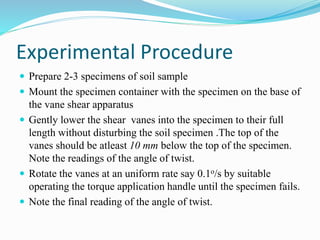
Experimental Procedure
 Prepare 2-3 specimens of soil sample
 Mount the specimen container with the specimen on the base of
the vane shear apparatus
 Gently lower the shear vanes into the specimen to their full
length without disturbing the soil specimen .The top of the
vanes should be atleast 10 mm below the top of the specimen.
Note the readings of the angle of twist.
 Rotate the vanes at an uniform rate say 0.1o/s by suitable
operating the torque application handle until the specimen fails.
 Note the final reading of the angle of twist.
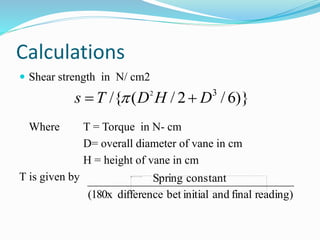
Calculations
 Shear strength in N/ cm2
Where T = Torque in N- cm
D= overall diameter of vane in cm
H = height of vane in cm
T is given by
)}6/2/(/{ 32
DHDTs  
reading)finalandinitialbetdifference(180x
constantSpring
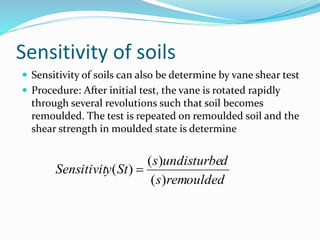
Sensitivity of soils
 Sensitivity of soils can also be determine by vane shear test
 Procedure: After initial test, the vane is rotated rapidly
through several revolutions such that soil becomes
remoulded. The test is repeated on remoulded soil and the
shear strength in moulded state is determine
remouldeds
dundisturbes
StySensitivit
)(
)(
)( 
General Remarks
 This test is useful when the soil is soft and its water
content is nearer to liquid limit.
 Ideally suited for determination of in-situ undrained
shear strength of non- fissured fully saturated clay
THANK YOU

Vane shear test

  • 2.
    Purpose To find theundrained shear strength of soils ( e.g soft clays)
  • 3.
    Drained and UndrainedConditions Drained Condition  occurs when there is no change in pore water pressure due to external loading.  the pore water can drain out of the soil easily, causing volumetric strains in the soil. Undrained condition  occurs when the pore water is unable to drain out of the soil.  the rate of loading is much quicker than the rate at which the pore water is able to drain out of the soil.  The tendency of soil to change volume is suppressed
  • 4.
    Apparatus Vertical steel rodhaving four thin stainless blades( vanes) fixed at its bottom (IS : 2720—1980 recommends H should be 2 D where H = height of the vane D = overall diameter) Recommended D = 2.5 mm length of rod = 60mm
  • 6.
    Equipment 1Vane shear apparatus. 2.Specimen Size:D =37.5mm H = 75 mm (L/D ratio 2 or 3) 3.Specimen container. 4.Callipers
  • 7.
    Experimental Procedure  Prepare2-3 specimens of soil sample  Mount the specimen container with the specimen on the base of the vane shear apparatus  Gently lower the shear vanes into the specimen to their full length without disturbing the soil specimen .The top of the vanes should be atleast 10 mm below the top of the specimen. Note the readings of the angle of twist.  Rotate the vanes at an uniform rate say 0.1o/s by suitable operating the torque application handle until the specimen fails.  Note the final reading of the angle of twist.
  • 8.
    Calculations  Shear strengthin N/ cm2 Where T = Torque in N- cm D= overall diameter of vane in cm H = height of vane in cm T is given by )}6/2/(/{ 32 DHDTs   reading)finalandinitialbetdifference(180x constantSpring
  • 9.
    Sensitivity of soils Sensitivity of soils can also be determine by vane shear test  Procedure: After initial test, the vane is rotated rapidly through several revolutions such that soil becomes remoulded. The test is repeated on remoulded soil and the shear strength in moulded state is determine remouldeds dundisturbes StySensitivit )( )( )( 
  • 10.
    General Remarks  Thistest is useful when the soil is soft and its water content is nearer to liquid limit.  Ideally suited for determination of in-situ undrained shear strength of non- fissured fully saturated clay
  • 11.