PRESENTATION OF DATA
This refers to the organization of data into tables, graphs
or charts, so that logical and statistical conclusions can
be derived from the collected measurements.
Data may be presented in(3 Methods):
- Textual
- Tabular or
- Graphical.
TEXTUAL PRESENTATION
- The data gathered are presented in paragraph form.
- Data are written and read.
- It is a combination of texts and figures.
Example:
Of the 150 sample interviewed, the following complaints
were noted: 27 for lack of books in the library, 25 for a
dirty playground, 20 for lack of laboratory equipment,
17 for a not well maintained university buildings
TABULAR PRESENTATION
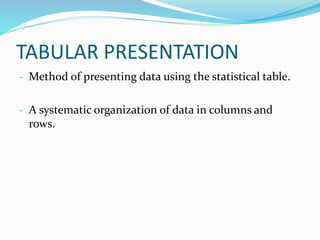
- Method of presenting data using the statistical table.
- A systematic organization of data in columns and
rows.
Parts of a statistical table
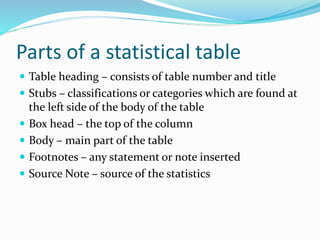
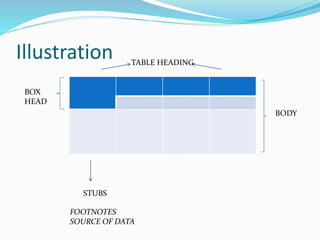
 Table heading – consists of table number and title
 Stubs – classifications or categories which are found at
the left side of the body of the table
 Box head – the top of the column
 Body – main part of the table
 Footnotes – any statement or note inserted
 Source Note – source of the statistics
Illustration TABLE HEADING
BOX
HEAD
BODY
STUBS
FOOTNOTES
SOURCE OF DATA
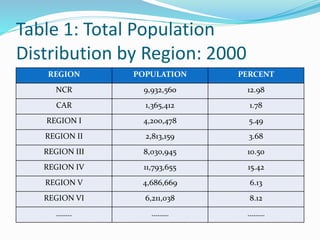
Table 1: Total Population
Distribution by Region: 2000
REGION POPULATION PERCENT
NCR 9,932,560 12.98
CAR 1,365,412 1.78
REGION I 4,200,478 5.49
REGION II 2,813,159 3.68
REGION III 8,030,945 10.50
REGION IV 11,793,655 15.42
REGION V 4,686,669 6.13
REGION VI 6,211,038 8.12
…….. ……… ………
GRAPHICAL PRESENTATION
KINDS OF GRAPHS OR DIAGRAMS
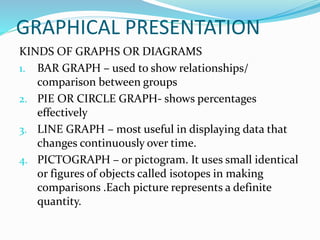
1. BAR GRAPH – used to show relationships/
comparison between groups
2. PIE OR CIRCLE GRAPH- shows percentages
effectively
3. LINE GRAPH – most useful in displaying data that
changes continuously over time.
4. PICTOGRAPH – or pictogram. It uses small identical
or figures of objects called isotopes in making
comparisons .Each picture represents a definite
quantity.
FIGURE 1: SELECTED CAUSES OF
DEATH IN THE PHILIPPINES
1594
3263
2170
6417
0
1000
2000
3000
4000
5000
6000
7000
CHRONIC
LOWER RESP.
DIS.
PNEUMONIA CEREBRO
VASCULAR
DISEASES
DISORDER OF
THE HEART
NUMBER OF DEATHS
62%
24%
14%
FIGURE 2.THREE LEADING CAUSE OF CHILD
MORTALITY AMONG FILIPINOS AGES 5-9(200)
ACCIDENTS PNEUMONIA DENGUE
0
20
40
60
80
100
120
1998 2000 2002 2004 2006
FIGURE 3. DISTRIBUTION OF ENROLLMENT AT A DAY CARE,
PERIOD 1999-2006
SYSTEMATIC RANDOM SAMPLING
FIGURE 4. NUMBER OF PERSONS WHO
HAVE EXCESSIVE DEPRESSION BY
CLUSTER
CLUSTER 1
CLUSTER 2
CLUSTER 3
CLUSTER 4
CLUSTER 5
CLUSTER 6
LEGEND: = 200
PEOPLE

Presentation of data

  • 1.
  • 2.
    PRESENTATION OF DATA Thisrefers to the organization of data into tables, graphs or charts, so that logical and statistical conclusions can be derived from the collected measurements. Data may be presented in(3 Methods): - Textual - Tabular or - Graphical.
  • 3.
    TEXTUAL PRESENTATION - Thedata gathered are presented in paragraph form. - Data are written and read. - It is a combination of texts and figures.
  • 4.
    Example: Of the 150sample interviewed, the following complaints were noted: 27 for lack of books in the library, 25 for a dirty playground, 20 for lack of laboratory equipment, 17 for a not well maintained university buildings
  • 5.
    TABULAR PRESENTATION - Methodof presenting data using the statistical table. - A systematic organization of data in columns and rows.
  • 6.
    Parts of astatistical table  Table heading – consists of table number and title  Stubs – classifications or categories which are found at the left side of the body of the table  Box head – the top of the column  Body – main part of the table  Footnotes – any statement or note inserted  Source Note – source of the statistics
  • 7.
  • 8.
    Table 1: TotalPopulation Distribution by Region: 2000 REGION POPULATION PERCENT NCR 9,932,560 12.98 CAR 1,365,412 1.78 REGION I 4,200,478 5.49 REGION II 2,813,159 3.68 REGION III 8,030,945 10.50 REGION IV 11,793,655 15.42 REGION V 4,686,669 6.13 REGION VI 6,211,038 8.12 …….. ……… ………
  • 9.
    GRAPHICAL PRESENTATION KINDS OFGRAPHS OR DIAGRAMS 1. BAR GRAPH – used to show relationships/ comparison between groups 2. PIE OR CIRCLE GRAPH- shows percentages effectively 3. LINE GRAPH – most useful in displaying data that changes continuously over time. 4. PICTOGRAPH – or pictogram. It uses small identical or figures of objects called isotopes in making comparisons .Each picture represents a definite quantity.
  • 11.
    FIGURE 1: SELECTEDCAUSES OF DEATH IN THE PHILIPPINES 1594 3263 2170 6417 0 1000 2000 3000 4000 5000 6000 7000 CHRONIC LOWER RESP. DIS. PNEUMONIA CEREBRO VASCULAR DISEASES DISORDER OF THE HEART NUMBER OF DEATHS
  • 12.
    62% 24% 14% FIGURE 2.THREE LEADINGCAUSE OF CHILD MORTALITY AMONG FILIPINOS AGES 5-9(200) ACCIDENTS PNEUMONIA DENGUE
  • 13.
    0 20 40 60 80 100 120 1998 2000 20022004 2006 FIGURE 3. DISTRIBUTION OF ENROLLMENT AT A DAY CARE, PERIOD 1999-2006
  • 14.
    SYSTEMATIC RANDOM SAMPLING FIGURE4. NUMBER OF PERSONS WHO HAVE EXCESSIVE DEPRESSION BY CLUSTER CLUSTER 1 CLUSTER 2 CLUSTER 3 CLUSTER 4 CLUSTER 5 CLUSTER 6 LEGEND: = 200 PEOPLE