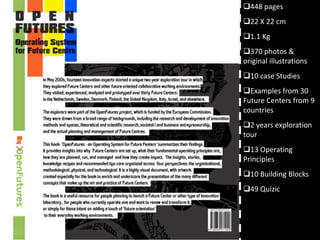


448 pages
22 X 22 cm
1.1 Kg
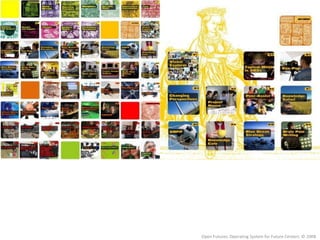
370 photos & original illustrations
10 case Studies
Examples from 30 Future Centers from 9 countries
2 years exploration tour
13 Operating Principles
10 Building Blocks
49 QuizicOpenFuturesAn Operating System for Future CentersBy OpenFutures experts:Paolo Mario Remo Martinez, Leif Edvinsson,  Hank Kune, Ron Dvir, Sune Knudsen, Terrence Fernando, JoaquinaBarullas, Edna Pasher, Rachel Pezzlo, Ofir Eyal, Yael Schwartzberg, Henrik Danckwardt, Caroline Dunne, MortenHejlesen, JurKosterbok, Herman Meines, Barth van Dijk, Tomasz Rudolf, Sergiusz Sawin, Lukasz GalachEdited by Ron DvirDesigned by Bar DvirIllustrations by Arye DvirLanguage editor: Diana Rubanenko2008
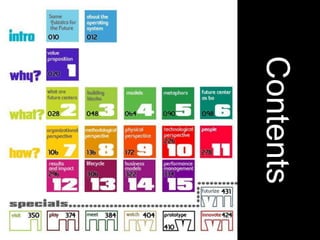
Contents
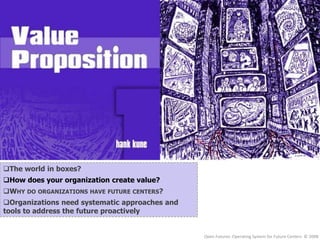
The world in boxes?
How does your organization create value?
Why do organizations have future centers?
Organizations need systematic approaches and tools to address the future proactively
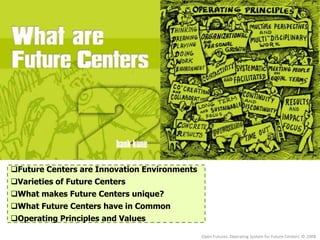
Future Centers are Innovation Environments
Varieties of Future Centers
What makes Future Centers unique?
What Future Centers have in Common
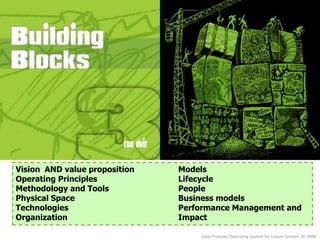
Operating Principles and ValuesVision  AND value propositionOperating PrinciplesMethodology and ToolsPhysical SpaceTechnologiesOrganizationModelsLifecyclePeopleBusiness modelsPerformance Management and Impact
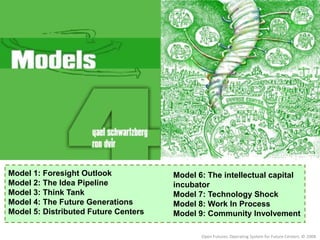
Model 1: Foresight OutlookModel 2: The Idea PipelineModel 3: Think TankModel 4: The Future Generations Model 5: Distributed Future CentersModel 6: The intellectual capital incubatorModel 7: Technology ShockModel 8: Work In ProcessModel 9: Community Involvement
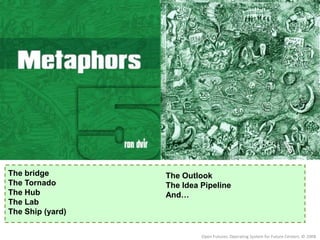
The bridgeThe TornadoThe HubThe LabThe Ship (yard)The OutlookThe Idea PipelineAnd…
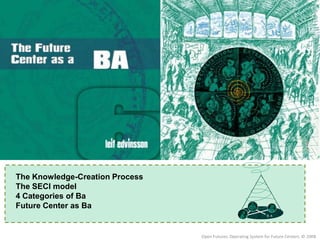
The Knowledge-Creation Process  The SECI model4 Categories of BaFuture Center as Ba
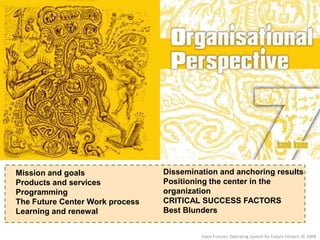
Dissemination and anchoring resultsPositioning the center in the organizationCRITICAL SUCCESS FACTORSBest BlundersMission and goalsProducts and servicesProgrammingThe Future Center Work process Learning and renewal
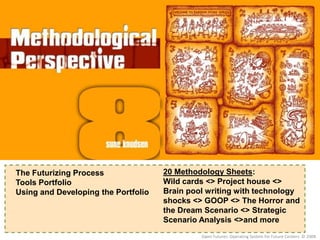
20 Methodology Sheets:Wild cards <> Project house <> Brain pool writing with technology shocks <> GOOP <> The Horror and the Dream Scenario <> Strategic Scenario Analysis <>and more The Futurizing ProcessTools PortfolioUsing and Developing the Portfolio
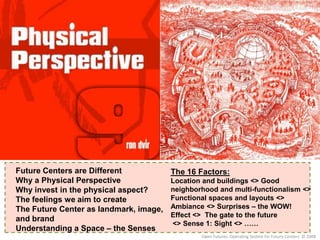
Future Centers are Different Why a Physical PerspectiveWhy invest in the physical aspect?The feelings we aim to createThe Future Center as landmark, image, and brand Understanding a Space – the SensesThe 16 Factors:Location and buildings <> Good neighborhood and multi-functionalism <> Functional spaces and layouts <> Ambiance <> Surprises – the WOW! Effect <>  The gate to the future <> Sense 1: Sight <> ……
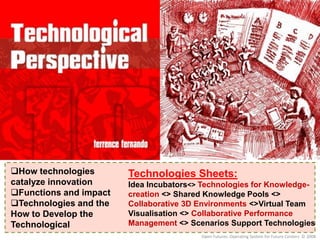
How technologies catalyze innovation
Functions and impact
Technologies and the How to Develop the Technological Technologies Sheets:Idea Incubators<> Technologies for Knowledge-creation <> Shared Knowledge Pools <> Collaborative 3D Environments<>Virtual Team Visualisation <> Collaborative Performance Management <> Scenarios Support Technologies
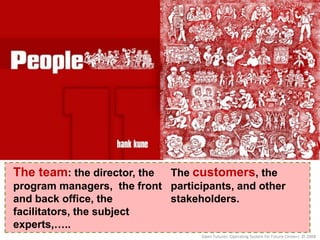
The team: the director, the program managers,  the front and back office, the facilitators, the subject experts,…..The customers, the participants, and other stakeholders.
How do Future Centers add value?
Why Future Centers are effective
Results

Open Futures Book

  • 2.
  • 3.
  • 4.
  • 5.
    370 photos &original illustrations
  • 6.
  • 7.
    Examples from 30Future Centers from 9 countries
  • 8.
  • 9.
  • 10.
  • 11.
    49 QuizicOpenFuturesAn OperatingSystem for Future CentersBy OpenFutures experts:Paolo Mario Remo Martinez, Leif Edvinsson, Hank Kune, Ron Dvir, Sune Knudsen, Terrence Fernando, JoaquinaBarullas, Edna Pasher, Rachel Pezzlo, Ofir Eyal, Yael Schwartzberg, Henrik Danckwardt, Caroline Dunne, MortenHejlesen, JurKosterbok, Herman Meines, Barth van Dijk, Tomasz Rudolf, Sergiusz Sawin, Lukasz GalachEdited by Ron DvirDesigned by Bar DvirIllustrations by Arye DvirLanguage editor: Diana Rubanenko2008
  • 13.
  • 15.
  • 16.
    How does yourorganization create value?
  • 17.
    Why do organizationshave future centers?
  • 18.
    Organizations need systematicapproaches and tools to address the future proactively
  • 19.
    Future Centers areInnovation Environments
  • 20.
  • 21.
    What makes FutureCenters unique?
  • 22.
    What Future Centershave in Common
  • 23.
    Operating Principles andValuesVision AND value propositionOperating PrinciplesMethodology and ToolsPhysical SpaceTechnologiesOrganizationModelsLifecyclePeopleBusiness modelsPerformance Management and Impact
  • 24.
    Model 1: ForesightOutlookModel 2: The Idea PipelineModel 3: Think TankModel 4: The Future Generations Model 5: Distributed Future CentersModel 6: The intellectual capital incubatorModel 7: Technology ShockModel 8: Work In ProcessModel 9: Community Involvement
  • 25.
    The bridgeThe TornadoTheHubThe LabThe Ship (yard)The OutlookThe Idea PipelineAnd…
  • 26.
    The Knowledge-Creation Process The SECI model4 Categories of BaFuture Center as Ba
  • 28.
    Dissemination and anchoringresultsPositioning the center in the organizationCRITICAL SUCCESS FACTORSBest BlundersMission and goalsProducts and servicesProgrammingThe Future Center Work process Learning and renewal
  • 29.
    20 Methodology Sheets:Wildcards <> Project house <> Brain pool writing with technology shocks <> GOOP <> The Horror and the Dream Scenario <> Strategic Scenario Analysis <>and more The Futurizing ProcessTools PortfolioUsing and Developing the Portfolio
  • 30.
    Future Centers areDifferent Why a Physical PerspectiveWhy invest in the physical aspect?The feelings we aim to createThe Future Center as landmark, image, and brand Understanding a Space – the SensesThe 16 Factors:Location and buildings <> Good neighborhood and multi-functionalism <> Functional spaces and layouts <> Ambiance <> Surprises – the WOW! Effect <> The gate to the future <> Sense 1: Sight <> ……
  • 31.
  • 32.
  • 33.
    Technologies and theHow to Develop the Technological Technologies Sheets:Idea Incubators<> Technologies for Knowledge-creation <> Shared Knowledge Pools <> Collaborative 3D Environments<>Virtual Team Visualisation <> Collaborative Performance Management <> Scenarios Support Technologies
  • 34.
    The team: thedirector, the program managers, the front and back office, the facilitators, the subject experts,…..The customers, the participants, and other stakeholders.
  • 35.
    How do FutureCenters add value?
  • 36.
    Why Future Centersare effective
  • 37.
  • 38.
    Broader impact: TheFuture Center and the worldPhase I: IdeationPhase II: PlanningPhase III: Launch and PilotingPhase IV: OperationPhase V: TransformationFrom Idea into Action
  • 39.
    How to managethe Future Center lifecycle?Return on Investment (ROI)
  • 40.
  • 41.
    Being a perfect“10” in formulating a Future Center Business model
  • 42.
    Futurizing as astrategic model
  • 43.
  • 44.
  • 45.
    Choosing a fundingmodelThe strategic dimension of Future Centers
  • 46.
    Open Futures PerformanceManagement Model
  • 47.
  • 48.
  • 49.
  • 50.
    Guidelines for effectiveimplementation of the PMM
  • 51.
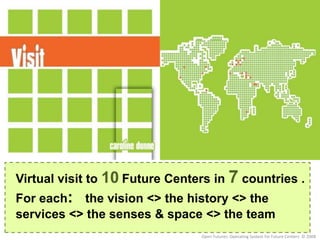
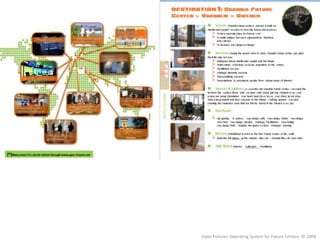
    Technological platform ofOpenVirtual visit to 10Future Centers in 7 countries .For each: the vision <> the history <> the services <> the senses & space <> the team
  • 53.
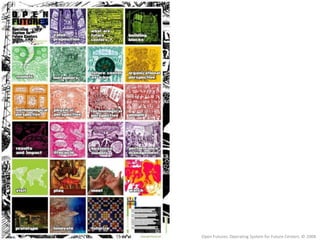
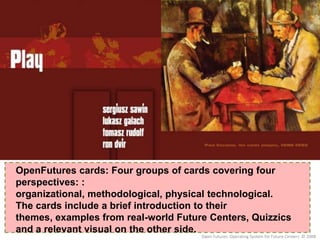
    OpenFutures cards: Fourgroups of cards covering four perspectives: : organizational, methodological, physical technological. The cards include a brief introduction to their themes, examples from real-world Future Centers, Quizzics and a relevant visual on the other side.
  • 55.
    Meet the peoplebehind this book: partners from 7 countries.
  • 56.
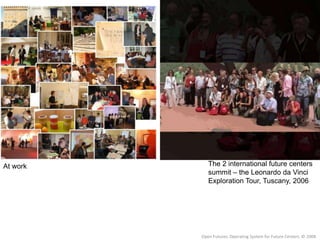
    The 2 internationalfuture centers summit – the Leonardo da Vinci Exploration Tour, Tuscany, 2006At work
  • 57.
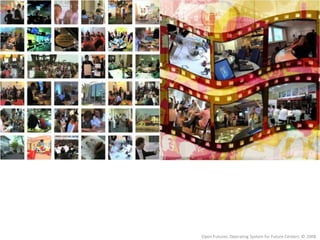
    The OpenFutures filmshows 15 Future Centers across Europe. It presents their history, explains why they are there, how they work, what they look like, how people work there, and when to use Future Centers.
  • 59.
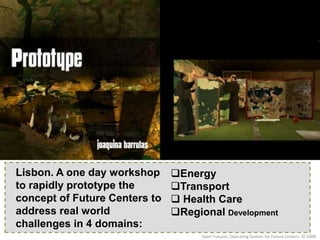
    Lisbon. A oneday workshop to rapidly prototype the concept of Future Centers to address real world challenges in 4 domains:Energy
  • 60.
  • 61.
  • 62.
  • 63.
    Breathing Life Intoa Future Center
  • 64.
    Future Centers asGroundbreaking Management Innovations
  • 65.
    In Search ofthe Business Model
  • 66.
    The Basic Elementsof the Business Model
  • 67.
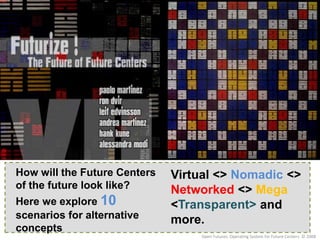
    Generic Future CenterBusiness ModelsHow will the Future Centers of the future look like?Here we explore 10 scenarios for alternative conceptsVirtual <> Nomadic <> Networked <> Mega <Transparent> and more.
  • 69.
    To order acopy:openfuturesbook@gmail.com