BY : RONALD N S
   Full turn                  : satu putaran penuh(360o)
   Straight angle             : sudut lurus ( 180o)
   Right angle                : sudut siku-siku ( 90o)
   Acute angle                : sudut lancip (0o < x < 90o)
   Obtuse angle               : sudut tumpul (90o< x <180o)
   Reflex angle               : sudut refleks (180o < x < 360o)
   Protractor                 : busur derajat
   Magnitude                  : besaran, ukuran
   Longest arm (minute arm)   : jarum panjang
   short arm ( hour arm )     : jarum pendek
   Complemantary angle        : sudut berpenyiku
   Supplementary angle        : sudut berpelurus
   Vertically opposite        : bertolak belakang
   Intersect                  : Berpotongan
   Compasses                  : Jangka
   Perpendicular              : tegak lurus
   Bisector                   : Membagi sudut sama besar
Types of Angles


Parts of Angle                           Hexadecimal system


                                       Supplementary Angles
Labelling Angles


    Complementary Angles                Clock Angle Problem
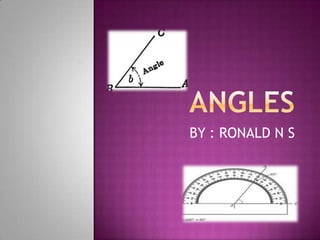
 The  corner point of an
          angle is called the
          VERTEX
         Two straight lines is
          called ARMS


       The angle is the amount
       of turn between each
Back
       arm.
   There are two main ways to label
           angles:

       1. by giving the angle a name,
         usually a lower-case letter like a
         or b, or sometimes a Greek letter
         like α (alpha) or θ (theta)

       2. or by the three letters on the
         shape that define the angle, with
         the middle letter being where the
         angle actually is (its vertex).

       Example angle "a" is "BAC", and
         angle "θ" is "BCD"

Back
Back


Look at the picture, and completely the table!
                B                                G
                2
                             D
                                                 4

                    C                        3
       1                                 F
                                                         5
  A                      E
                                                                H

      Numbers           One letter                   Three letters
           1                     A                       BAC
           2                     B                       ABC
           3                         F                    GFH
           4                         G                       FGH
           5                         H                       FHG
Back


Type of Angle                       Description

Acute angle     an angle that is less than 90°

Right angle     an angle that is 90° exactly

Obtuse angle    an angle that is greater than 90° but less than 180°

Straight angle an angle that is 180° exactly

Reflex angle    an angle that is greater than 180°
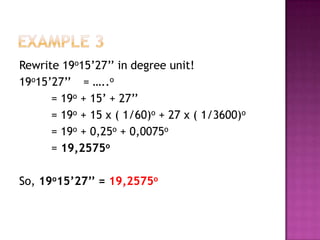
determine the type of the following angles!


  Acute         Acute   Right


              Acute
  Acute
                           Obtuse
Two Angles are Complementary if they add up
  to 90 degrees (a Right Angle).

                       These two angles (40° and 50°)
                       are Complementary Angles,
                       because they add up to 90°.


  If the two angles add to 90°, we say they "Complement" each other.


                                                          Back
Two Angles are Supplementary if they add up
  to 180 degrees.

                               These two angles (140° and 40°)
                               are Supplementary Angles, because
                               they add up to 180°.


       If the two angles add to 180°, we say they "Supplement" each other.


Back
How can you remember which is which? Easy!
 Think:

 "C" of Complementary stands for "Corner"
  (a Right Angle), and

 "S"of Supplementary stands for "Straight"
  (180 degrees is a straight line)
Remember :
1o = 60 ‘       1‘ = ( 1/ 60 )o
1‘ = 60 “       1“ = ( 1 / 60)‘
1o = 3600’’     1’’ = ( 1/ 3600 )o

O read degree
‘ read minute
“ read second
Rewrite 3,15 o into the hexadecimal system!
Solution
3,15o = 3o + 0,15o
      = 3o + 0,15 x 1o
      = 3o + 0,15 x 60’
      = 3o + 9’
      = 3o9’
So, 3,15o = 3o9’
Rewrite 3,125o into hexadecimal system!
Solution
3,125o      = 3o + 0,125o
            = 3o + 0,125 x 1o
            = 3o + 0,125 x 60’
            = 3o + 7,5’
            = 3o + 7’ + 0,5’
            = 3o+ 7’ + 0,5 x 60’’
            = 3o + 7’ + 30’’
            = 3o7’30’’
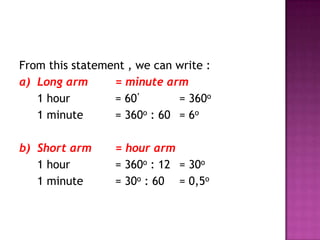
Rewrite 19o15’27’’ in degree unit!
19o15’27’’ = …..o
      = 19o + 15’ + 27’’
      = 19o + 15 x ( 1/60)o + 27 x ( 1/3600)o
      = 19o + 0,25o + 0,0075o
      = 19,2575o

So, 19o15’27’’ = 19,2575o
Find the result :
a. 15o43’25’’ + 42o52’17’’
b. 42o17’52’’ – 25o34’44’’
a.     15o43’25’’
       42o52’17’’ +
       57o95’42’’ = 58o35’42’’

b.     42o17’52’’          41o77’52’’
       25o34’44’’ -        25o34’44’’ -
                           16o43’8’’


Back
 The hour hand of a normal 12-hour analogue
 clock turns 360° in 12 hours (720 minutes)
 or 0.5° per minute

 Theminute hand rotates through 360° in 60
 minutes or 6° per minute.
                                        Back
From this statement , we can write :
a) Long arm      = minute arm
   1 hour        = 60’       = 360o
   1 minute      = 360o : 60 = 6o

b) Short arm      = hour arm
   1 hour         = 360o : 12 = 30o
   1 minute       = 30o : 60 = 0,5o
What degree is the angle formed by long and
 short arm of analogue clock at 07.15 am?

Solution:
Position long arm in number 3
Position short arm in number 7
So,
  (7 – 3)x 30o           = 4 x 30o   = 120o
Then Short arm is move = 15 x 0,5o = 7,5o
So, angle formed = 120o + 7,5o = 127,5o
Rewrite these questions into hexadecimal
  system:

Angles

  • 1.
  • 2.
    Full turn : satu putaran penuh(360o)  Straight angle : sudut lurus ( 180o)  Right angle : sudut siku-siku ( 90o)  Acute angle : sudut lancip (0o < x < 90o)  Obtuse angle : sudut tumpul (90o< x <180o)  Reflex angle : sudut refleks (180o < x < 360o)  Protractor : busur derajat  Magnitude : besaran, ukuran  Longest arm (minute arm) : jarum panjang  short arm ( hour arm ) : jarum pendek  Complemantary angle : sudut berpenyiku  Supplementary angle : sudut berpelurus  Vertically opposite : bertolak belakang  Intersect : Berpotongan  Compasses : Jangka  Perpendicular : tegak lurus  Bisector : Membagi sudut sama besar
  • 3.
    Types of Angles Partsof Angle Hexadecimal system Supplementary Angles Labelling Angles Complementary Angles Clock Angle Problem
  • 4.
     The corner point of an angle is called the VERTEX  Two straight lines is called ARMS The angle is the amount of turn between each Back arm.
  • 5.
    There are two main ways to label angles: 1. by giving the angle a name, usually a lower-case letter like a or b, or sometimes a Greek letter like α (alpha) or θ (theta) 2. or by the three letters on the shape that define the angle, with the middle letter being where the angle actually is (its vertex). Example angle "a" is "BAC", and angle "θ" is "BCD" Back
  • 6.
    Back Look at thepicture, and completely the table! B G 2 D 4 C 3 1 F 5 A E H Numbers One letter Three letters 1 A BAC 2 B ABC 3 F GFH 4 G FGH 5 H FHG
  • 7.
    Back Type of Angle Description Acute angle an angle that is less than 90° Right angle an angle that is 90° exactly Obtuse angle an angle that is greater than 90° but less than 180° Straight angle an angle that is 180° exactly Reflex angle an angle that is greater than 180°
  • 8.
    determine the typeof the following angles! Acute Acute Right Acute Acute Obtuse
  • 9.
    Two Angles areComplementary if they add up to 90 degrees (a Right Angle). These two angles (40° and 50°) are Complementary Angles, because they add up to 90°. If the two angles add to 90°, we say they "Complement" each other. Back
  • 10.
    Two Angles areSupplementary if they add up to 180 degrees. These two angles (140° and 40°) are Supplementary Angles, because they add up to 180°. If the two angles add to 180°, we say they "Supplement" each other. Back
  • 11.
    How can youremember which is which? Easy! Think:  "C" of Complementary stands for "Corner" (a Right Angle), and  "S"of Supplementary stands for "Straight" (180 degrees is a straight line)
  • 12.
    Remember : 1o =60 ‘ 1‘ = ( 1/ 60 )o 1‘ = 60 “ 1“ = ( 1 / 60)‘ 1o = 3600’’ 1’’ = ( 1/ 3600 )o O read degree ‘ read minute “ read second
  • 13.
    Rewrite 3,15 ointo the hexadecimal system! Solution 3,15o = 3o + 0,15o = 3o + 0,15 x 1o = 3o + 0,15 x 60’ = 3o + 9’ = 3o9’ So, 3,15o = 3o9’
  • 14.
    Rewrite 3,125o intohexadecimal system! Solution 3,125o = 3o + 0,125o = 3o + 0,125 x 1o = 3o + 0,125 x 60’ = 3o + 7,5’ = 3o + 7’ + 0,5’ = 3o+ 7’ + 0,5 x 60’’ = 3o + 7’ + 30’’ = 3o7’30’’
  • 15.
    Rewrite 19o15’27’’ indegree unit! 19o15’27’’ = …..o = 19o + 15’ + 27’’ = 19o + 15 x ( 1/60)o + 27 x ( 1/3600)o = 19o + 0,25o + 0,0075o = 19,2575o So, 19o15’27’’ = 19,2575o
  • 16.
    Find the result: a. 15o43’25’’ + 42o52’17’’ b. 42o17’52’’ – 25o34’44’’
  • 17.
    a. 15o43’25’’ 42o52’17’’ + 57o95’42’’ = 58o35’42’’ b. 42o17’52’’ 41o77’52’’ 25o34’44’’ - 25o34’44’’ - 16o43’8’’ Back
  • 18.
     The hourhand of a normal 12-hour analogue clock turns 360° in 12 hours (720 minutes) or 0.5° per minute  Theminute hand rotates through 360° in 60 minutes or 6° per minute. Back
  • 19.
    From this statement, we can write : a) Long arm = minute arm 1 hour = 60’ = 360o 1 minute = 360o : 60 = 6o b) Short arm = hour arm 1 hour = 360o : 12 = 30o 1 minute = 30o : 60 = 0,5o
  • 20.
    What degree isthe angle formed by long and short arm of analogue clock at 07.15 am? Solution: Position long arm in number 3 Position short arm in number 7 So, (7 – 3)x 30o = 4 x 30o = 120o Then Short arm is move = 15 x 0,5o = 7,5o So, angle formed = 120o + 7,5o = 127,5o
  • 22.
    Rewrite these questionsinto hexadecimal system: