“They Say”: Starting with What Others
Are Saying
 1. The chapter begins with a brief story
about Dr. X, a researcher who is
presenting his thesis to a conference.
According to the editors, what is so
unusual about his speech, and what is
the important lesson to be learned?
 Dr. X never states why he needs to be stating
his thesis. He isn’t clear about what he is
responding to!
 The lesson learned: A writer needs to indicate
clearly not only his thesis, but also what larger
conversation the thesis is responding to.
 2. Another lesson is to be learned: If
a writer wants to keep her audience
engaged, what must she do?
 She must consider and pay attention to order!
 First, she should start with “what others are saying”
by summarizing as soon as she can what she is
responding to. Then she can introduce her own
ideas.
 The editors suggest that writers avoid delaying this
explanation—wait no longer than the first couple of
paragraphs of an essay!
3. What is the best way to introduce what others
are saying?
 The best way to introduce what others are
saying is by summarizing the author’s
argument.
 Then continue to remind readers of that
argument as your own argument unfolds.
4. What are some conventional ways of
introducing what others are saying?
 A number of researchers have recently
suggested that…
 It has become common today to dismiss…
 In their recent work, Y and Z have offered
harsh critiques of _______ for _________.
Note: Of course these can be fine-tuned to fit
exactly how you want to use them. If Y and Z
aren’t offering critiques, then don’t say they are
and use a different verb instead!
5. What are some ways of introducing something
implied or assumed?
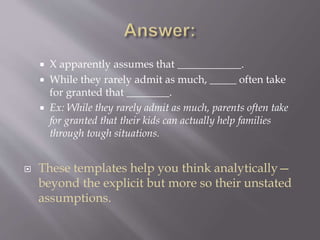
 X apparently assumes that ____________.
 While they rarely admit as much, _____ often take
for granted that ________.
 Ex: While they rarely admit as much, parents often take
for granted that their kids can actually help families
through tough situations.
 These templates help you think analytically—
beyond the explicit but more so their unstated
assumptions.
6. What is a way of introducing an ongoing debate?
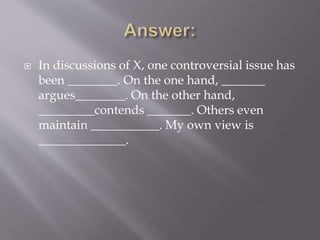
 In discussions of X, one controversial issue has
been ________. On the one hand, _______
argues________. On the other hand,
_________contends _______. Others even
maintain ___________. My own view is
______________.
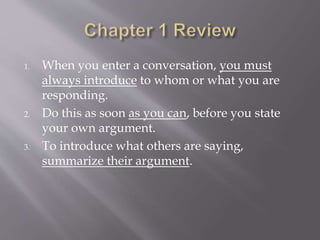
1. When you enter a conversation, you must
always introduce to whom or what you are
responding.
2. Do this as soon as you can, before you state
your own argument.
3. To introduce what others are saying,
summarize their argument.

They Say, I Say: Chapter 1

  • 1.
    “They Say”: Startingwith What Others Are Saying
  • 2.
     1. Thechapter begins with a brief story about Dr. X, a researcher who is presenting his thesis to a conference. According to the editors, what is so unusual about his speech, and what is the important lesson to be learned?
  • 3.
     Dr. Xnever states why he needs to be stating his thesis. He isn’t clear about what he is responding to!  The lesson learned: A writer needs to indicate clearly not only his thesis, but also what larger conversation the thesis is responding to.
  • 4.
     2. Anotherlesson is to be learned: If a writer wants to keep her audience engaged, what must she do?
  • 5.
     She mustconsider and pay attention to order!  First, she should start with “what others are saying” by summarizing as soon as she can what she is responding to. Then she can introduce her own ideas.  The editors suggest that writers avoid delaying this explanation—wait no longer than the first couple of paragraphs of an essay!
  • 6.
    3. What isthe best way to introduce what others are saying?
  • 7.
     The bestway to introduce what others are saying is by summarizing the author’s argument.  Then continue to remind readers of that argument as your own argument unfolds.
  • 8.
    4. What aresome conventional ways of introducing what others are saying?
  • 9.
     A numberof researchers have recently suggested that…  It has become common today to dismiss…  In their recent work, Y and Z have offered harsh critiques of _______ for _________. Note: Of course these can be fine-tuned to fit exactly how you want to use them. If Y and Z aren’t offering critiques, then don’t say they are and use a different verb instead!
  • 10.
    5. What aresome ways of introducing something implied or assumed?
  • 11.
     X apparentlyassumes that ____________.  While they rarely admit as much, _____ often take for granted that ________.  Ex: While they rarely admit as much, parents often take for granted that their kids can actually help families through tough situations.  These templates help you think analytically— beyond the explicit but more so their unstated assumptions.
  • 12.
    6. What isa way of introducing an ongoing debate?
  • 13.
     In discussionsof X, one controversial issue has been ________. On the one hand, _______ argues________. On the other hand, _________contends _______. Others even maintain ___________. My own view is ______________.
  • 14.
    1. When youenter a conversation, you must always introduce to whom or what you are responding. 2. Do this as soon as you can, before you state your own argument. 3. To introduce what others are saying, summarize their argument.