Di Presentasikan Oleh:
          Damel
Retno Kusuma Bayuningrum
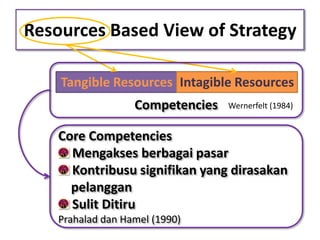
Resources Based View of Strategy

    Tangible Resources Intagible Resources
                   Competencies   Wernerfelt (1984)


    Core Competencies
      Mengakses berbagai pasar
      Kontribusu signifikan yang dirasakan
      pelanggan
      Sulit Ditiru
    Prahalad dan Hamel (1990)
A resource-based view of strategy
analysis             R.M. Grant (1991)


        4       Strategy

               Competitive
        3
                Advantage
                                5

        2      Capabilities

        1       Resources
Distinctive Capabilities
               Sustainable & Appropriate

     A                    R                    I
Architecture          Reputation           Innovation
A resource-based view of strategy
analysis             R.M. Grant (1991)


        4       Strategy

               Competitive
        3
                Advantage
                                5

        2      Capabilities

        1       Resources
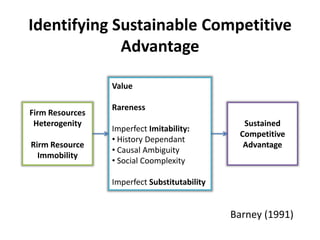
Identifying Sustainable Competitive
             Advantage

                 Value

                 Rareness
Firm Resources
 Heterogenity                                   Sustained
                 Imperfect Imitability:
                                               Competitive
                 • History Dependant
Rirm Resource                                   Advantage
                 • Causal Ambiguity
  Immobility
                 • Social Coomplexity

                 Imperfect Substitutability


                                              Barney (1991)
Resource Orchestration to Create
Competitive Advantage: Breadth,
Depth, and Life Cycle Effects


David G. Sirmon
Michael A. Hitt
R. Duane Ireland
Brett Anitra Gilbert

Texas A&M University
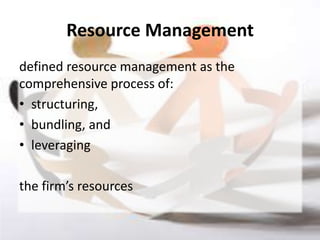
Resource Management
defined resource management as the
comprehensive process of:
• structuring,
• bundling, and
• leveraging

the firm’s resources
Possessing resources alone does not guarantee
  the development of competitive advantage;
  instead, resources must be accumulated,
  bundled, and leveraged, meaning that the full
  value of resources for creating competitive
  advantages is realized only when resources
  are managed effectively .

(Sirmon & Hitt, 2003; Sirmon, Hitt, & Ireland, 2007).
• Structuring the portfolio of resources :
  - acquiring,
  - accumulating, and
  - divesting
• Bundling resources to build capabilities :
  - stabilizing,
  - enriching, and
  - pioneering
• Leveraging capabilities in the marketplace :
  - mobilizing,
  - coordinating, and
  - deploying

to create value (Sirmon, Gove, & Hitt, 2008)
Resource Management
(1) managers differ in their resource management
    abilities, and these differences matter to firm
    outcomes;
(2) the resource management effect is contingent
    upon the quality of the focal resources; and
(3) synchronization across processes is vital for
    competitive advantage

Holcomb, Holmes, and Connelly’s (2009)
Asset Orchestration
Asset orchestration consists of two primary
processes:
• search/selection and
• configuration/deployment


Helfat et al. (2007)
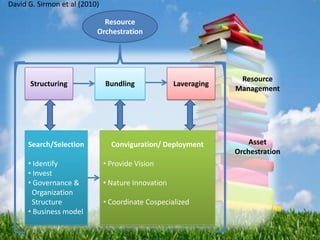
David G. Sirmon et al (2010)

                             Resource
                           Orchestration


                                                                   Resource
      Structuring              Bundling              Laveraging
                                                                  Management


      Search/Selection           Conviguration/ Deployment            Asset
                                                                  Orchestration
      • Identify               • Provide Vision
      • Invest
      • Governance &           • Nature Innovation
       Organization
       Structure               • Coordinate Cospecialized
      • Business model
David G. Sirmon et al (2010)


                Resource Management             Asset Orchestration


                               Resource Orchestration


              the firm’s             the firm’s
               breadth              depth (levels          the firm’s life
            (scope of the            within the                cycle
                firm)                  firm)
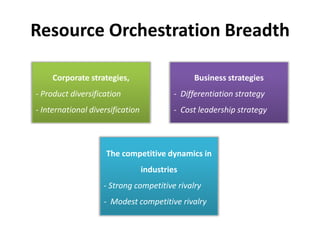
Resource Orchestration Breadth

     Corporate strategies,                      Business strategies
- Product diversification                  - Differentiation strategy
- International diversification            - Cost leadership strategy


                     The competitive dynamics in
                                  industries
                    - Strong competitive rivalry
                    - Modest competitive rivalry
Resource Orchestration & Firm Life
               Cycle
• Resource Orchestration in Start-Up Stage
• Resource Orchestration in Mature Stage
• Resource Orchestration in Decline-Stage Firms
Resource Orchestration Depth


          Helfat et al (2007) nor Sirmon et al (2007)
The development of
the resource-based view
of the firm: A critical
appraisal


Andy Lockett,1 Steve Thompson and
Uta Morgenstern
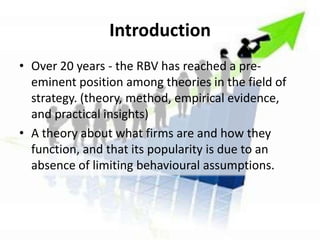
Introduction
• Over 20 years - the RBV has reached a pre-
  eminent position among theories in the field of
  strategy. (theory, method, empirical evidence,
  and practical insights)
• A theory about what firms are and how they
  function, and that its popularity is due to an
  absence of limiting behavioural assumptions.
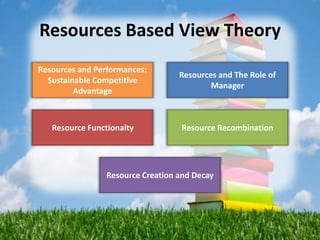
Resources Based View Theory
Resources and Performances:
                                   Resources and The Role of
  Sustainable Competitive
                                           Manager
         Advantage


   Resource Functionalty           Resource Recombination


                 Resource Creation and Decay
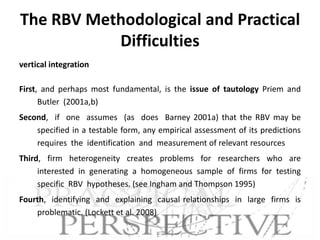
The RBV Methodological and Practical
           Difficulties
vertical integration

First, and perhaps most fundamental, is the issue of tautology Priem and
      Butler (2001a,b)
Second, if one assumes (as does Barney 2001a) that the RBV may be
    specified in a testable form, any empirical assessment of its predictions
    requires the identification and measurement of relevant resources
Third, firm heterogeneity creates problems for researchers who are
     interested in generating a homogeneous sample of firms for testing
     specific RBV hypotheses. (see Ingham and Thompson 1995)
Fourth, identifying and explaining causal relationships in large firms is
    problematic. (Lockett et al. 2008)
The RBV Methodological and Practical
           Difficulties
vertical integration

Fifth, not merely is agreement on a working definition of ‘competitive
      advantage’ itself controversial (Foss and Knudsen 2003; Powell 2001)
Sixth, the logic of the RBV does not predict a universal relationship between
     firm performance and any particular resource.
Finally, best practice firm-level empirical work now generally uses first-
     differenced panel data sets, usually unbalanced to minimize
     selection/survivor biases. Swann (2006)
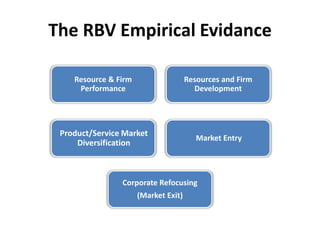
The RBV Empirical Evidance

    Resource & Firm                   Resources and Firm
     Performance                        Development


 Product/Service Market
                                         Market Entry
     Diversification


                Corporate Refocusing
                      (Market Exit)
Practical Insights From The RBV
The suitably selected case can illustrate neatly the successful or
  unsuccessful past attempt of some managers to achieve a
  winning fit between resources and strategy.

As Donald Rumsfeld opined about the problems facing US
  military operations in Afghanistan :
“Reports that say that something hasn’t happened are always
  interesting to me, because as we know, there are known
  knowns; there are things we know we know. We also know
  there are known unknowns; that is to say we know there are
  some things we do not know. But there are also unknown
  unknowns the ones we don’t know we don’t know”.
Practical Insights From The RBV
Finally, there are the unknown unknowns, the products of
   unfolding market, technological or other events, whose
   manifestation cannot be anticipated and incorporated
   in even the most careful scenario planning.

Known knowns are unlikely to enable a firm to
  outperform its rivals in the medium to long run unless
  there are market impediments that prevent competition
  for the underlying resources (this is the genesis of
  Barney’s 1991 paper)
Practical Insights From The RBV
The approach adopted in this paper is to treat the RBV not
  as a theory of firm behaviour but, primarily as a theory
  that offers insights about the decision-making
  behaviour of managers.
First  : managers need to understand what are the strengths and
         weaknesses of a firm.
Second : the resource base of the firm is path dependent, i.e. history
         matters.
Third : managers need to be able to understand the functionality of their
         resources.
Fourth : the resource base of the firm is continuously subject to the
         processes of resource creation and decay.
Fifth : acquiring competitive advantage in a resource market is not
         possible in the absence of asymmetric information and/or co-
         specialized resources with which you are going to augment the new
         resources (Denrell et al. 2003)
The RBV Looking Forward
First, rather than focusing on the consequences of firm heterogeneity
    Dierickx and Cool’s (1989)
Second, more scholarly attention needs to be focused on the neglected
   theoretical issue of resource functionality (seeAmbrosini and Bowman
   2009)
Third, as the RBV is a theory about what firms are, and does not require a
   host of limiting assumptions, it can be deployed with other theories to
   explain strategic behaviour. (Gray and Wood 1991)
Finally, scholars need to reflect on their methodological approaches to
   empirical research on the RBV.
Resources based view

Resources based view

  • 1.
    Di Presentasikan Oleh: Damel Retno Kusuma Bayuningrum
  • 2.
    Resources Based Viewof Strategy Tangible Resources Intagible Resources Competencies Wernerfelt (1984) Core Competencies Mengakses berbagai pasar Kontribusu signifikan yang dirasakan pelanggan Sulit Ditiru Prahalad dan Hamel (1990)
  • 3.
    A resource-based viewof strategy analysis R.M. Grant (1991) 4 Strategy Competitive 3 Advantage 5 2 Capabilities 1 Resources
  • 4.
    Distinctive Capabilities Sustainable & Appropriate A R I Architecture Reputation Innovation
  • 5.
    A resource-based viewof strategy analysis R.M. Grant (1991) 4 Strategy Competitive 3 Advantage 5 2 Capabilities 1 Resources
  • 6.
    Identifying Sustainable Competitive Advantage Value Rareness Firm Resources Heterogenity Sustained Imperfect Imitability: Competitive • History Dependant Rirm Resource Advantage • Causal Ambiguity Immobility • Social Coomplexity Imperfect Substitutability Barney (1991)
  • 7.
    Resource Orchestration toCreate Competitive Advantage: Breadth, Depth, and Life Cycle Effects David G. Sirmon Michael A. Hitt R. Duane Ireland Brett Anitra Gilbert Texas A&M University
  • 8.
    Resource Management defined resourcemanagement as the comprehensive process of: • structuring, • bundling, and • leveraging the firm’s resources
  • 9.
    Possessing resources alonedoes not guarantee the development of competitive advantage; instead, resources must be accumulated, bundled, and leveraged, meaning that the full value of resources for creating competitive advantages is realized only when resources are managed effectively . (Sirmon & Hitt, 2003; Sirmon, Hitt, & Ireland, 2007).
  • 10.
    • Structuring theportfolio of resources : - acquiring, - accumulating, and - divesting • Bundling resources to build capabilities : - stabilizing, - enriching, and - pioneering • Leveraging capabilities in the marketplace : - mobilizing, - coordinating, and - deploying to create value (Sirmon, Gove, & Hitt, 2008)
  • 11.
    Resource Management (1) managersdiffer in their resource management abilities, and these differences matter to firm outcomes; (2) the resource management effect is contingent upon the quality of the focal resources; and (3) synchronization across processes is vital for competitive advantage Holcomb, Holmes, and Connelly’s (2009)
  • 12.
    Asset Orchestration Asset orchestrationconsists of two primary processes: • search/selection and • configuration/deployment Helfat et al. (2007)
  • 13.
    David G. Sirmonet al (2010) Resource Orchestration Resource Structuring Bundling Laveraging Management Search/Selection Conviguration/ Deployment Asset Orchestration • Identify • Provide Vision • Invest • Governance & • Nature Innovation Organization Structure • Coordinate Cospecialized • Business model
  • 14.
    David G. Sirmonet al (2010) Resource Management Asset Orchestration Resource Orchestration the firm’s the firm’s breadth depth (levels the firm’s life (scope of the within the cycle firm) firm)
  • 15.
    Resource Orchestration Breadth Corporate strategies, Business strategies - Product diversification - Differentiation strategy - International diversification - Cost leadership strategy The competitive dynamics in industries - Strong competitive rivalry - Modest competitive rivalry
  • 16.
    Resource Orchestration &Firm Life Cycle • Resource Orchestration in Start-Up Stage • Resource Orchestration in Mature Stage • Resource Orchestration in Decline-Stage Firms
  • 17.
    Resource Orchestration Depth Helfat et al (2007) nor Sirmon et al (2007)
  • 18.
    The development of theresource-based view of the firm: A critical appraisal Andy Lockett,1 Steve Thompson and Uta Morgenstern
  • 19.
    Introduction • Over 20years - the RBV has reached a pre- eminent position among theories in the field of strategy. (theory, method, empirical evidence, and practical insights) • A theory about what firms are and how they function, and that its popularity is due to an absence of limiting behavioural assumptions.
  • 20.
    Resources Based ViewTheory Resources and Performances: Resources and The Role of Sustainable Competitive Manager Advantage Resource Functionalty Resource Recombination Resource Creation and Decay
  • 21.
    The RBV Methodologicaland Practical Difficulties vertical integration First, and perhaps most fundamental, is the issue of tautology Priem and Butler (2001a,b) Second, if one assumes (as does Barney 2001a) that the RBV may be specified in a testable form, any empirical assessment of its predictions requires the identification and measurement of relevant resources Third, firm heterogeneity creates problems for researchers who are interested in generating a homogeneous sample of firms for testing specific RBV hypotheses. (see Ingham and Thompson 1995) Fourth, identifying and explaining causal relationships in large firms is problematic. (Lockett et al. 2008)
  • 22.
    The RBV Methodologicaland Practical Difficulties vertical integration Fifth, not merely is agreement on a working definition of ‘competitive advantage’ itself controversial (Foss and Knudsen 2003; Powell 2001) Sixth, the logic of the RBV does not predict a universal relationship between firm performance and any particular resource. Finally, best practice firm-level empirical work now generally uses first- differenced panel data sets, usually unbalanced to minimize selection/survivor biases. Swann (2006)
  • 23.
    The RBV EmpiricalEvidance Resource & Firm Resources and Firm Performance Development Product/Service Market Market Entry Diversification Corporate Refocusing (Market Exit)
  • 24.
    Practical Insights FromThe RBV The suitably selected case can illustrate neatly the successful or unsuccessful past attempt of some managers to achieve a winning fit between resources and strategy. As Donald Rumsfeld opined about the problems facing US military operations in Afghanistan : “Reports that say that something hasn’t happened are always interesting to me, because as we know, there are known knowns; there are things we know we know. We also know there are known unknowns; that is to say we know there are some things we do not know. But there are also unknown unknowns the ones we don’t know we don’t know”.
  • 25.
    Practical Insights FromThe RBV Finally, there are the unknown unknowns, the products of unfolding market, technological or other events, whose manifestation cannot be anticipated and incorporated in even the most careful scenario planning. Known knowns are unlikely to enable a firm to outperform its rivals in the medium to long run unless there are market impediments that prevent competition for the underlying resources (this is the genesis of Barney’s 1991 paper)
  • 26.
    Practical Insights FromThe RBV The approach adopted in this paper is to treat the RBV not as a theory of firm behaviour but, primarily as a theory that offers insights about the decision-making behaviour of managers. First : managers need to understand what are the strengths and weaknesses of a firm. Second : the resource base of the firm is path dependent, i.e. history matters. Third : managers need to be able to understand the functionality of their resources. Fourth : the resource base of the firm is continuously subject to the processes of resource creation and decay. Fifth : acquiring competitive advantage in a resource market is not possible in the absence of asymmetric information and/or co- specialized resources with which you are going to augment the new resources (Denrell et al. 2003)
  • 27.
    The RBV LookingForward First, rather than focusing on the consequences of firm heterogeneity Dierickx and Cool’s (1989) Second, more scholarly attention needs to be focused on the neglected theoretical issue of resource functionality (seeAmbrosini and Bowman 2009) Third, as the RBV is a theory about what firms are, and does not require a host of limiting assumptions, it can be deployed with other theories to explain strategic behaviour. (Gray and Wood 1991) Finally, scholars need to reflect on their methodological approaches to empirical research on the RBV.