Recap:
Session 2
EnvironmentalUncertainty
Modes of Environmental Scanning
Scanning External Business Environment
General Environment Analysis - PESTEL/STEEP
Industry Analysis – Porter’s 5 Force Model
Industry Structure and Environmental Opportunities
3.
MCQ 1
PESTLE/STEEPis an analytical tool which helps to undertake:
A. An internal analysis.
B. An external analysis.
C. A competitor analysis.
D. A strategic analysis.
4.
MCQ 2
Ananalysis of the external environment enables a firm to
identify:
A. Strengths and opportunities.
B. Strengths and weaknesses.
C. Weaknesses and threats.
D. Opportunities and threats.
5.
MCQ 3
Porter's5 Force of Competition model is used for analysis of
industry environment can be used by _
A. An organization planning to enter in industry.
B. An organization present in the industry.
C. An organization planning to exit the industry.
D. All of the above.
What Does InternalAnalysis Tell Us?
Internal analysis provides a comparative look at
a firm’s resources and capabilities.
• What are the firm’s strengths?
• What are the firm’s weaknesses?
• How do these strengths and weaknesses compare
to competitors?
8.
Why Does InternalAnalysis Matter?
• establish strategies that will exploit any sources
of competitive advantage
• determine if its resources and capabilities are
likely sources of competitive advantage
Internal analysis helps a firm:
9.
The Theory BehindInternal Analysis
The Resource-Based View (RBV)
• developed to answer the question: Why do some
firms achieve better economic performance
than others?
• assumes that a firm’s resources and capabilities
are the primary drivers of competitive advantage
and economic performance
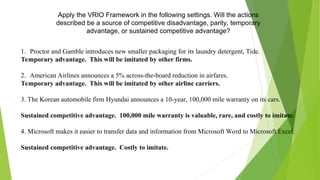
• used to help firms achieve competitive advantage
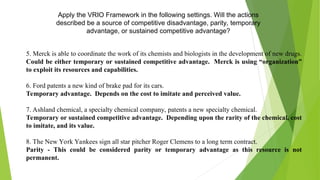
and superior economic performance
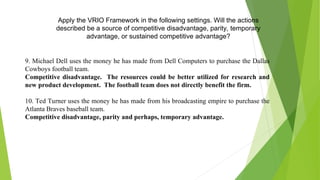
Jay Barney
Resource Based View
10.
The Resource-Based View(RBV)
3 Key RBV Questions:
1. What resources does a firm have?
2. What resources can a firm build?
3. What resources can a firm maintain?
The focus is on the firm as opposed to the industry.
11.
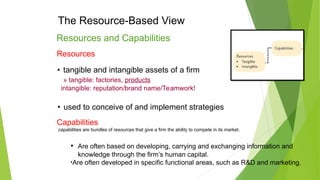
The Resource-Based View
Resourcesand Capabilities
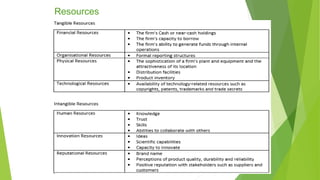
Resources
• tangible and intangible assets of a firm
» tangible: factories, products
intangible: reputation/brand name/Teamwork!
• used to conceive of and implement strategies
Capabilities
capabilities are bundles of resources that give a firm the ability to compete in its market.
• Are often based on developing, carrying and exchanging information and
knowledge through the firm’s human capital.
•Are often developed in specific functional areas, such as R&D and marketing.
12.
The Resource-Based View
FourCategories of Resources and capabilities
• Financial (cash, retained earnings)
• Physical (plant and equipment, geographic location)
• Human (skills and abilities of individuals)
• Organizational (reporting structures, relationships)
Capabilities
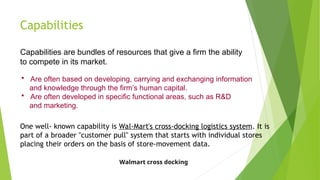
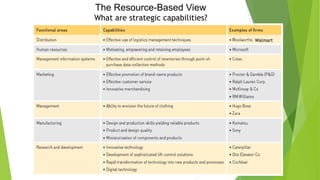
Capabilities are bundlesof resources that give a firm the ability
to compete in its market.
Are often based on developing, carrying and exchanging information
and knowledge through the firm’s human capital.
Are often developed in specific functional areas, such as R&D
and marketing.
One well- known capability is Wal-Mart's cross-docking logistics system. It is
part of a broader "customer pull" system that starts with individual stores
placing their orders on the basis of store-movement data.
Walmart cross docking
The Resource-Based View
TwoCritical Assumptions of the RBV
• Resource Heterogeneity
» Different firms may have different resources.
• Resource Immobility
» It may be costly for firms without certain
resources to acquire or develop them.
» Some resources may not spread from firm to
firm easily.
18.
The Resource-Based View
•Heterogeneity of resources typically occurs as the
result of “bundling” the resources, skills and capabilities
of a firm.
Resource Heterogeneity
• Managers of a firm could take resources that seem
homogeneous and “bundle” them to create
heterogeneous combinations.
• Competitive advantage typically stems from several
resources and capabilities “bundled” together.
19.
The Resource-Based View
Quoteof the Day
When activities mutually reinforce
each other, competitors can’t easily
imitate them
20.
The Resource-Based View
ResourceHeterogeneity
The best example of heterogeneous factors is that of Netflix and Apple TV. Netflix has a
very high subscriber base, while Apple TV is just starting. The pricing of Netflix is very high
compared to Apple TV because they have a lot of original content compared to Apple TV.
Apart from the original content, Netflix also features licensed content from other sources.
At the same time, Apple TV subscribers get to see only Apple content, which is why it is
priced at a lesser subscription rate.
Both of the video apps face the same external challenge from external competition. For
example, in May 2020, when HBO Max was launched, it was a threat to both apps because
the originality of the content was highest compared to both of these apps, but the pricing
of HBO max was very high.
21.
The Resource-Based View
ResourceImmobility
This assumption states that the resources cannot move from one organization to
another for the short term.
Because of this, companies are unable to copy similar strategies like their
competitors and implement them in the market.
Resource immobility (stickiness) is like a barrier (an isolating mechanism) that
prevents imitation of specific assets by rivals.
22.
The Resource-Based View
Whatdo these assumptions really mean?
• if one firm has resources that are valuable
and other firms don’t, and…
• if other firms can’t imitate these resources
without incurring high costs, then…
• the firm possessing the valuable resources
will likely gain a sustained competitive advantage
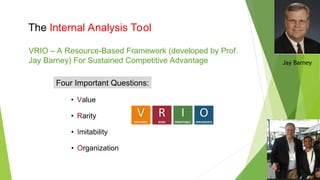
The Internal AnalysisTool
VRIO – A Resource-Based Framework (developed by Prof.
Jay Barney) For Sustained Competitive Advantage
Four Important Questions:
• Value
• Rarity
• Imitability
• Organization
Jay Barney
25.
The Internal AnalysisTool
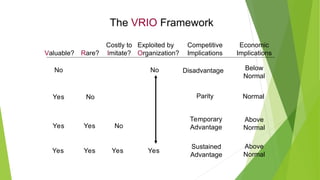
The VRIO Framework
Four Questions
1.Value – Does the resource enable the firm to exploit an opportunity or
neutralize a threat? The evidence of a positive response to this question is
usually that the resource somehow increases revenue or decreases cost.
2.Rarity – Is the resource rare? Is the resource rare enough that there is
still scarcity in the marketplace for this resource?
3.Imitability – Is the resource costly to imitate? Specifically, is the resource
so costly to imitate that no one would try to imitate it?
4.Organization – Is the firm organized in such a way that the resource can
be exploited?
If the answer to these four questions is AFFIRMATIVE, then the firm can
reasonably expect to achieve a competitive advantage.
26.
The VRIO Framework
•A resource or bundle of resources is subjected to
each question to determine the competitive
implication of the resource.
Applying the Tool
• Each question is considered in a comparative
sense (competitive environment).
27.
Applying the VRIOFramework
The Question of Value
• In theory: Does the resource enable the firm
to exploit an external opportunity or neutralize
an external threat?
• The practical: Does the resource result in an
increase in revenues, a decrease in costs, or
some combination of the two? Sony / Apple
• One way to identify potential valuable resources and
One way to identify potential valuable resources and
capabilities controlled by a company is to study its
capabilities controlled by a company is to study its
value chain
value chain
28.
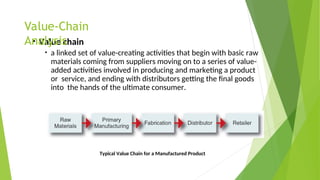
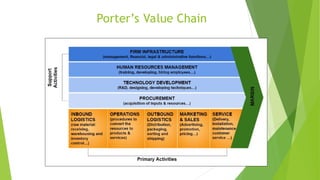
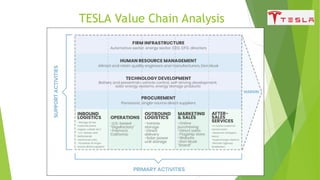
• Value chain
•a linked set of value-creating activities that begin with basic raw
materials coming from suppliers moving on to a series of value-
added activities involved in producing and marketing a product
or service, and ending with distributors getting the final goods
into the hands of the ultimate consumer.
Value-Chain
Analysis
Typical Value Chain for a Manufactured Product
Corporate Value Chain
1.Examine each product line’s value chain in terms of
the various activities involved in producing the
product or service
2. Examine the linkages within each product line’s
value chain
3. Examine the potential synergies among the value
chains of different product lines or business units
Porter's Value Chain: How to Create Value in Your
Organization
McDonald's Value Chain
32.
Applying the VRIOFramework
The Question of Rarity: How many competing firms
already possess Particular valuable resources & capabilities?
• A resource must be rare enough that perfect
competition has not set in.
Some resources might be very common (not rare) but are essential and this
may lead to competitive disadvantage !!
• If a resource is not rare, then perfect competition
dynamics are likely to be observed (i.e., no
competitive advantage, no above normal profits).
• Thus, there may be other firms that possess the resource, but still few
enough that there is scarcity (several pharmaceuticals sell cholesterol-
lowering drugs, but the drugs are still scarce—look at prices).
33.
Applying the VRIOFramework
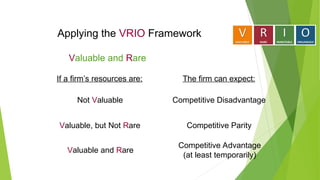
Valuable and Rare
If a firm’s resources are: The firm can expect:
Not Valuable Competitive Disadvantage
Valuable, but Not Rare Competitive Parity
Valuable and Rare
Competitive Advantage
(at least temporarily)
34.
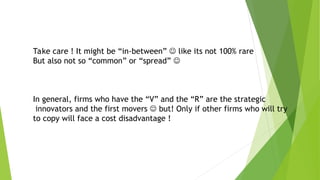
Take care !It might be “in-between” like its not 100% rare
But also not so “common” or “spread”
In general, firms who have the “V” and the “R” are the strategic
innovators and the first movers but! Only if other firms who will try
to copy will face a cost disadvantage !
35.
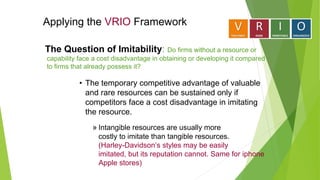
Applying the VRIOFramework
• The temporary competitive advantage of valuable
and rare resources can be sustained only if
competitors face a cost disadvantage in imitating
the resource.
» Intangible resources are usually more
costly to imitate than tangible resources.
(Harley-Davidson’s styles may be easily
imitated, but its reputation cannot. Same for iphone
Apple stores)
The Question of Imitability: Do firms without a resource or
capability face a cost disadvantage in obtaining or developing it compared
to firms that already possess it?
36.
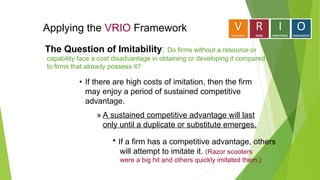
Applying the VRIOFramework
• If there are high costs of imitation, then the firm
may enjoy a period of sustained competitive
advantage.
» A sustained competitive advantage will last
only until a duplicate or substitute emerges.
If a firm has a competitive advantage, others
will attempt to imitate it. (Razor scooters
were a big hit and others quickly imitated them.)
The Question of Imitability: Do firms without a resource or
capability face a cost disadvantage in obtaining or developing it compared
to firms that already possess it?
37.
Applying the VRIOFramework
The Question of Imitability: Why might it be costly to imitate
another firm’s resources or capabilities?
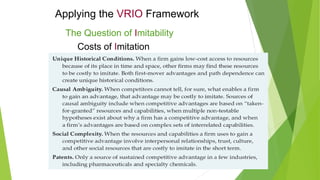
Costs of Imitation
1. Unique Historical Conditions
Unique Historical Conditions (McDonald)
• first mover advantages
ADNOC: One Vision .. One Brand
38.
Applying the VRIOFramework
The Question of Imitability
Costs of Imitation
2. Causal Ambiguity
Causal Ambiguity
• Causal links between resources and
competitive advantage may not be
understood.
• Bundles of resources fog these causal
links.
39.
Applying the VRIOFramework
The Question of Imitability
Costs of Imitation
3. Social Complexity
Social Complexity
• The social relationships entailed in
resources may be so complex that
managers cannot really manage them
or replicate them.
40.
Applying the VRIOFramework
The Question of Imitability
Costs of Imitation
4. Patents
Patents
• Patents may be a two-edged sword.
• Offer a period of protection if the firm is
able to defend its patent rights.
• Required disclosure may actually decrease
the cost of imitation, and the timing.
41.
Applying the VRIOFramework
The Question of Imitability
Costs of Imitation
42.
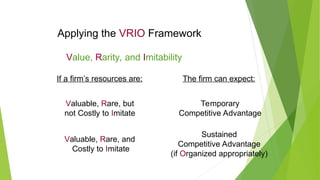
Applying the VRIOFramework
Value, Rarity, and Imitability
If a firm’s resources are: The firm can expect:
Valuable, Rare, but
not Costly to Imitate
Temporary
Competitive Advantage
Valuable, Rare, and
Costly to Imitate
Sustained
Competitive Advantage
(if Organized appropriately)
43.
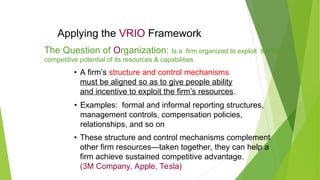
Applying the VRIOFramework
• A firm’s structure and control mechanisms
must be aligned so as to give people ability
and incentive to exploit the firm’s resources.
• Examples: formal and informal reporting structures,
management controls, compensation policies,
relationships, and so on
• These structure and control mechanisms complement
other firm resources—taken together, they can help a
firm achieve sustained competitive advantage.
(3M Company, Apple, Tesla)
The Question of Organization: Is a firm organized to exploit the full
competitive potential of its resources & capabilities
The VRIO Framework
Valuable?Rare?
Costly to
Imitate?
Exploited by
Organization?
Competitive
Implications
No
Yes
Yes
Yes
Yes
Yes Yes Yes
No
No
No Disadvantage
Parity
Temporary
Advantage
Sustained
Advantage
Economic
Implications
Below
Normal
Normal
Above
Normal
Above
Normal
46.
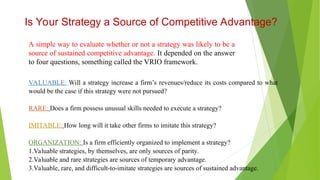
A simple wayto evaluate whether or not a strategy was likely to be a
source of sustained competitive advantage. It depended on the answer
to four questions, something called the VRIO framework.
Is Your Strategy a Source of Competitive Advantage?
VALUABLE: Will a strategy increase a firm’s revenues/reduce its costs compared to what
would be the case if this strategy were not pursued?
RARE: Does a firm possess unusual skills needed to execute a strategy?
IMITABLE: How long will it take other firms to imitate this strategy?
ORGANIZATION: Is a firm efficiently organized to implement a strategy?
1.Valuable strategies, by themselves, are only sources of parity.
2.Valuable and rare strategies are sources of temporary advantage.
3.Valuable, rare, and difficult-to-imitate strategies are sources of sustained advantage.
47.
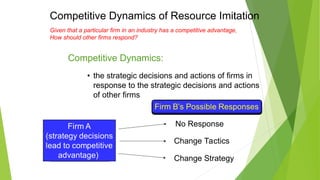
Competitive Dynamics ofResource Imitation
Given that a particular firm in an industry has a competitive advantage,
How should other firms respond?
Competitive Dynamics:
• the strategic decisions and actions of firms in
response to the strategic decisions and actions
of other firms
No Response
Change Tactics
Change Strategy
48.
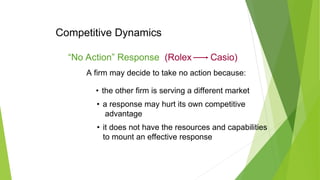
Competitive Dynamics
• theother firm is serving a different market
A firm may decide to take no action because:
• a response may hurt its own competitive
advantage
• it does not have the resources and capabilities
to mount an effective response
“No Action” Response (Rolex Casio)
49.
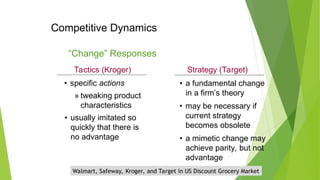
Competitive Dynamics
“Change” Responses
Tactics(Kroger) Strategy (Target)
• specific actions
» tweaking product
characteristics
• usually imitated so
quickly that there is
no advantage
• a fundamental change
in a firm’s theory
• may be necessary if
current strategy
becomes obsolete
• a mimetic change may
achieve parity, but not
advantage
Walmart, Safeway, Kroger, and Target in US Discount Grocery Market
50.
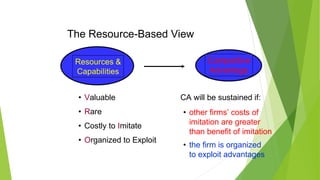
The Resource-Based View
•Valuable
• Rare
• Costly to Imitate
• Organized to Exploit
CA will be sustained if:
• other firms’ costs of
imitation are greater
than benefit of imitation
• the firm is organized
to exploit advantages
51.
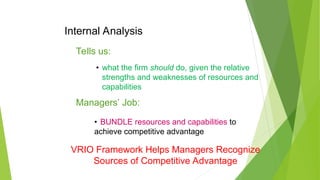
Managers’ Job:
• BUNDLEresources and capabilities to
achieve competitive advantage
Internal Analysis
Tells us:
• what the firm should do, given the relative
strengths and weaknesses of resources and
capabilities
VRIO Framework Helps Managers Recognize
Sources of Competitive Advantage
52.
Apply the VRIOFramework in the following settings.
Will the actions described be a source of competitive
disadvantage, parity, temporary advantage, or
sustained competitive advantage?
53.
Apply the VRIOFramework in the following settings. Will the actions described
be a source of competitive disadvantage, parity, temporary advantage, or
sustained competitive advantage?
1. Proctor and Gamble introduces new smaller packaging for its laundry detergent, Tide.
2. American Airlines announces a 5% across-the-board reduction in airfares.
3. The Korean automobile firm Hyundai announces a 10-year, 100,000 mile warranty on its cars.
4. Microsoft makes it easier to transfer data and information from Microsoft Word to Excel.
5. Merck is able to coordinate the work of its chemists and biologists in the development of new
drugs.
6. Ford patents a new kind of brake pad for its cars.
7. Ashland chemical, a specialty chemical company, patents a new specialty chemical.
8. The New York Yankees sign all star pitcher Roger Clemens to a long term contract.
9. Michael Dell uses the money he has made from Dell Computers to purchase the Dallas
Cowboys football team.
10.Ted Turner uses the money he has made from his broadcasting empire to purchase the Atlanta
Braves baseball team.
54.
Apply the VRIOFramework in the following settings. Will the actions
described be a source of competitive disadvantage, parity, temporary
advantage, or sustained competitive advantage?
1. Proctor and Gamble introduces new smaller packaging for its laundry detergent, Tide.
Temporary advantage. This will be imitated by other firms.
2. American Airlines announces a 5% across-the-board reduction in airfares.
Temporary advantage. This will be imitated by other airline carriers.
3. The Korean automobile firm Hyundai announces a 10-year, 100,000 mile warranty on its cars.
Sustained competitive advantage. 100,000 mile warranty is valuable, rare, and costly to imitate.
4. Microsoft makes it easier to transfer data and information from Microsoft Word to Microsoft Excel.
Sustained competitive advantage. Costly to imitate.
55.
Apply the VRIOFramework in the following settings. Will the actions
described be a source of competitive disadvantage, parity, temporary
advantage, or sustained competitive advantage?
5. Merck is able to coordinate the work of its chemists and biologists in the development of new drugs.
Could be either temporary or sustained competitive advantage. Merck is using “organization”
to exploit its resources and capabilities.
6. Ford patents a new kind of brake pad for its cars.
Temporary advantage. Depends on the cost to imitate and perceived value.
7. Ashland chemical, a specialty chemical company, patents a new specialty chemical.
Temporary or sustained competitive advantage. Depending upon the rarity of the chemical, cost
to imitate, and its value.
8. The New York Yankees sign all star pitcher Roger Clemens to a long term contract.
Parity - This could be considered parity or temporary advantage as this resource is not
permanent.
56.
Apply the VRIOFramework in the following settings. Will the actions
described be a source of competitive disadvantage, parity, temporary
advantage, or sustained competitive advantage?
9. Michael Dell uses the money he has made from Dell Computers to purchase the Dallas
Cowboys football team.
Competitive disadvantage. The resources could be better utilized for research and
new product development. The football team does not directly benefit the firm.
10. Ted Turner uses the money he has made from his broadcasting empire to purchase the
Atlanta Braves baseball team.
Competitive disadvantage, parity and perhaps, temporary advantage.
57.
In class
exercise
• Whatare the sources of SCA of the company you have
chosen for a group project work.
• You can work in groups.
#17 Second, some of these resource and capability differences among firms may
be long lasting because it may be very costly for firms without certain resources
and capabilities to develop or acquire them. This is the assumption of resource
immobility. For example, Toyota has had its advantage in manufacturing for at
least 30 years. Apple has had product design advantages over IBM since Apple
was founded in the 1980s. And eBay has been able to retain its brand reputation
since the beginning of the online auction industry. It is not that GM, IBM, and
eBay’s competitors are unaware of their disadvantages. Indeed, some of these
firms—notably GM and IBM—have made progress in addressing their disadvantages.
However, despite these efforts, Toyota, Apple, and, to a lesser extent, eBay
continue to enjoy advantages over their competition.
#19 https://www.youtube.com/watch?v=gFK4bYsGI2g
https://www.youtube.com/watch?v=61SAU1C3-h4
What Makes Tesla's Business Model Different?
Investopedia
https://www.investopedia.com › ... › Tech Companies
Tesla's business model is based on a three-pronged approach to selling, servicing, and charging its electric vehicles. Tesla applied the idea of open innovation by establishing research and development collaborations with large companies\
Amazon's high-performance culture, with its focus on customers, data, and outcomes, is supported by a unique annual planning process. Leaders .
Apple unique eco-system of offerings…The Apple ecosystem is the connection and integration between different Apple devices—such as the iPhone, iPad, MacBook, Apple Watch, AirPods, ... The secret to Apple's ecosystem is that instead of selling products or services, Apple ends up selling experiences made possible by controlling ..
#20 Variation is essential to have a competitive advantage.
#21 Whenever an employee gets selected in an organization, he won’t leave it for the first 3 to 6 months. If he performs better in the organization, then he will continue working in the same organization.
It will be very long before he decides to change and switch to the competition. In this case, it will be very long before the competition can learn about the organization from its old employee.
#22 Let’s consider Southwest and Amazon! It has been difficult/impossible (?) for any airline organization to duplicate Southwest’s unique culture of esprit de corps, one of the sources of its competitive advantage under Herb Kelleher’s era. It is equally difficult to replicate Amazon’s relentless culture of getting things done!
#24 Other tools like Gap analysis.. For fine tuning a single process, implementation tool to check internal consistency
#27 Intangible resources include those non-physical assets that the company uses to produce goods or provide services, or expects to generate future productive benefits” (Hill et al, 2007). The Sony brand is considered “one of the world’s most recognisable and trusted brands” and was “ranked 21st in the Business Week/Interbrand list of the World’s 100 Most Valuable Brands with an estimated value of US$14 billion” (Singh et al, 2005). The Sony brand is associated with “superior quality, innovation and style” (Sony United, 2007), in the minds of its customers.
#31 https://www.youtube.com/watch?v=aeshYi6lj2Y 3 mins
#35 Imitability: Do the competitors have the financial ability to imitate?
#36 The Razor Scooter is a compact folding scooter developed by Micro Mobility Systems and manufactured by JD Corporation.
#37 Unique historical circumstances can give a firm a sustained competitive advantage
in at least two ways. First, it may be that a particular firm was the first in an
industry to recognize and exploit an opportunity, and being first gave the firm one
or more of the first-mover advantages discussed in Chapter 2. Thus, although in
principle other firms in an industry could have exploited an opportunity, that only
one firm did so makes it more costly for other firms to imitate the original firm.
A second way that history can have an impact on a firm builds on the concept
of path dependence.15 A process is said to be path dependent when events
early in the evolution of a process have significant effects on subsequent events.
In the evolution of competitive advantage, path dependence suggests that a firm
may gain a competitive advantage in the current period based on the acquisition
and development of resources in earlier periods. // Consider, for example, a firm that purchased land for ranching some time
ago and discovered a rich supply of oil on this land in the current period. The
difference between the value of this land as a supplier of oil (high) and the value
of this land for ranching (low) is a source of competitive advantage for this firm.
Moreover, other firms attempting to acquire this or adjacent land will now have to
pay for the full value of the land in its use as a supply of oil (high) and thus will
be at a cost disadvantage compared to the firm that acquired it some time ago for
ranching.
#38 Fog…confusion // Finally, it may be that not just a few resources and capabilities enable
a firm to gain a competitive advantage, but that literally thousands of these
Organizational attributes, bundled together, generate these advantages. When
the resources and capabilities that generate competitive advantage are complex
networks of relationships between individuals, groups, and technology, imitation
can be costly.
Whenever the sources of competitive advantage are widely diffused across
people, locations, and processes in a firm, those sources will be costly to imitate.
Perhaps the best example of such a resource is knowledge itself. To the extent
that valuable knowledge about a firm’s products, processes, customers, and so
on is widely diffused throughout an organization, competitors will have difficulty
imitating that knowledge, and it can be a source of sustained competitive
advantage
#39 A wide variety of firm resources and capabilities may be socially complex.
Examples include the interpersonal relations among managers in a firm, a firm’s
culture, and a firm’s reputation among suppliers and customers.
#44 Accordingly add more as intangible resources…culture, role of leadership etc // https://www.youtube.com/watch?v=5hENFA3CJUY
#47 Tactics is very specific activity like price reduction, withdrawal etc, strategy is for long term implications
#48 For example, digital timekeeping
has made accurate watches available to most consumers at reasonable
prices. A firm such as Casio has a competitive advantage in this market because
of its miniaturization and electronic capabilities. Indeed, Casio’s market share
and performance in the watch business continue to climb although demand for
watches, overall, has gone down. How should Rolex—a manufacturer of very
expensive, non-electronic watches—respond to Casio? Rolex’s decision has been:
Not at all. Rolex appeals to a very different market segment than Casio. Should
Rolex change its strategies—even if it replaced its mechanical self-winding design
with the technologically superior digital design—it could easily compromise its
competitive advantage in its own niche market.28 In general, when a firm already
possesses its own sources of competitive advantage, it will not respond to different
sources of competitive advantage controlled by another firm. //but no response might be costlier in long run…it its signal towards a major trend or megatrend. Like Kodak took no response to digital film…Or when Tesla introduced EV…others were with no action at the beginning.
#49 Tactics are the specific actions a firm takes to implement its strategies. Examples
of tactics include decisions firms make about various attributes of their products—including
size, shape, color, and price—specific advertising approaches adopted
by a firm, and specific sales and marketing efforts. Generally, firms change their
tactics much more frequently than they change their strategies // Given that a particular firm in an industry has a competitive advantage,
how should other firms respond? Decisions made by other firms given the strategic
choices of a particular firm define the nature of the competitive dynamics
that exist in an industry. In general, other firms in an industry can respond to the
advantages of a competitor in one of three ways. First, they can choose to limit
their response. For example, when Wal-Mart entered the discount grocery market
with the creation of Super Walmarts, some competitors (e.g., Safeway) ignored
Wal-
Mart’s moves and continued on as before. Other competitors (e.g., Kroger)
modified some of their tactics, including, for example, selling more prepared foods
and more specialty foods than before. Finally, other firms fundamentally altered
their strategies (e.g., Target began building stores that also sold discount groceries).
#57 Take your chosen company from your group case study. Apply the VRIO framework to at least two value chain activities and decide if these are indeed resources/capabilities that lead to a sustained competitive advantage. Identify at least fine such R/C.