Presented by
Esakki Muthu Lakshmi V
M. Tech 1st yr (IBT)
Introduction
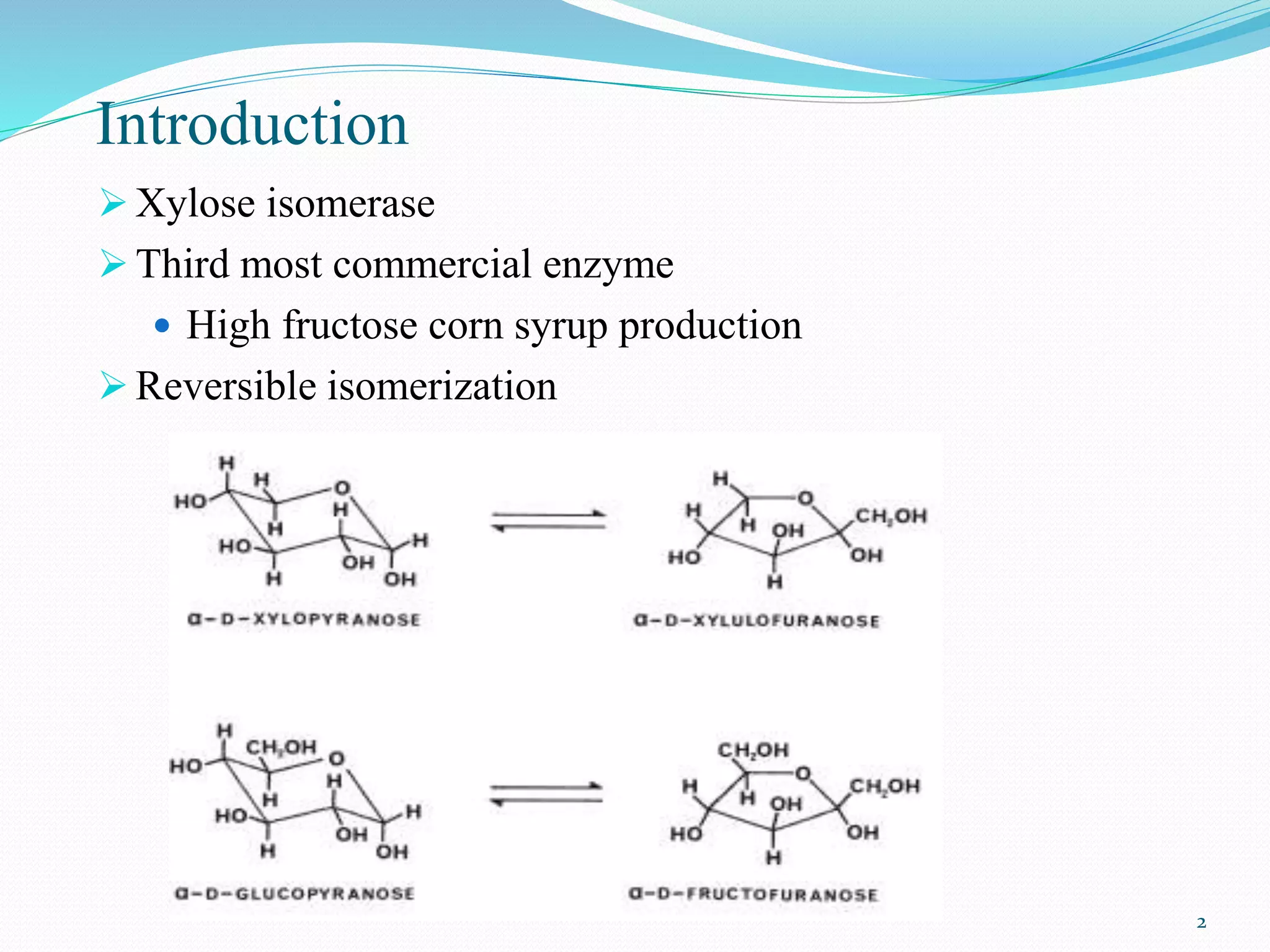
 Xylose isomerase
 Third most commercial enzyme
 High fructose corn syrup production
 Reversible isomerization
2
Enzyme Nomenclature
IUBMB
Entry
• EC 5.3.1.5
Name
• Accepted Name : D-xylose isomerase; D-xylose
ketoisomerase; D-xylose ketol-isomerase; glucose
isomerase (GI)
• Systematic Name : D-xylose aldose-ketose-isomerase
Class
• Isomerases;
Intramolecular oxidoreductases;
Interconverting aldoses and ketoses, and related compounds
3
Physicochemical properties
 Intracellular enzyme
 Substrate specificity- broad
 Ribose, rhamnose, arabinose
 Metal ions- Mg2+, Co2+ or Mn2+
 Inhibitors
 Ag2+,Hg2+, Cu2+,Zn2+, Ni2+, Ca2+
 Xylitol, arabitol, sorbitol, mannitol,
lyxose, and Tris
 pH- 7 to 9
 Temperature- 60 to 80 ºC
4
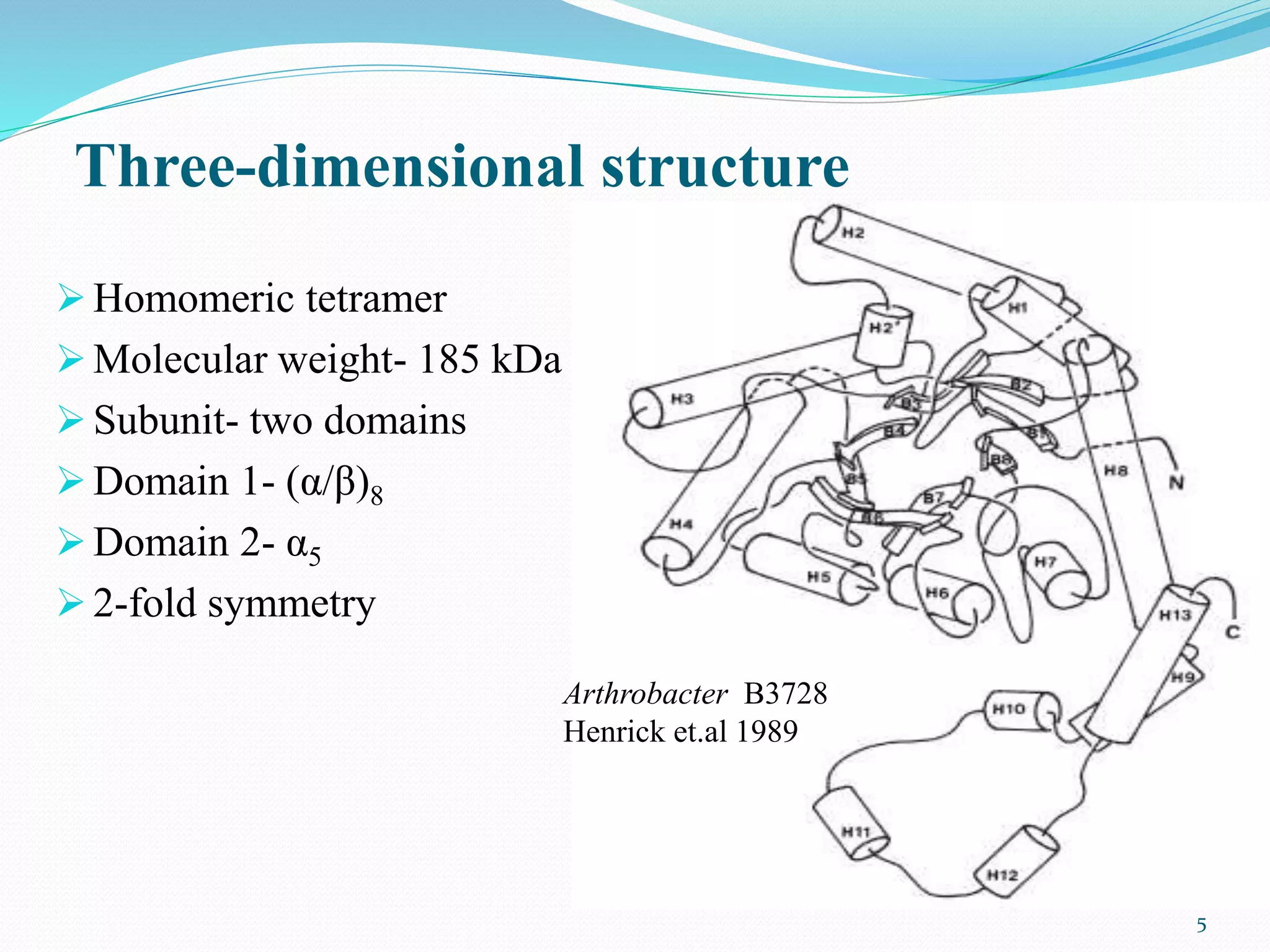
 Homomeric tetramer
 Molecular weight- 185 kDa
 Subunit- two domains
 Domain 1- (α/β)8
 Domain 2- α5
 2-fold symmetry
5
Arthrobacter B3728
Henrick et.al 1989
Three-dimensional structure
TIM barrel structure
6
Streptomyces rubiginosus
Ref: RCSB PDB
Metal ion requirement
 Monomer- 2 metal binding sites
7
Bacillus coagulans (Van
Bastelaere et al., 1991)
Incubation condition T=35ºC
pH= 7
Co2+
Kd1= 4*10-8
Kd2= 4*10-7
Mn2+
Kd1= 2*10-8
Kd2= 2*10-7
Increase of affinity
Mg2+
Kd1= <10-6
Kd2= 6*10-5
Kdl = dissociation constant for the high-affinity (structural) metal site; Kd2 = dissociation
constant for the low-affinity (catalytic) metal site.
Active site
 His -101 and -271- E.coli isomerase
 His-54 and His-217- s.rubiginosus
 Stabilise open chain substrate (Lee et al. 1990)
 Involved in ring opening
8
Catalytic mechanism
 proton transfer involving a cis-enediol intermediate
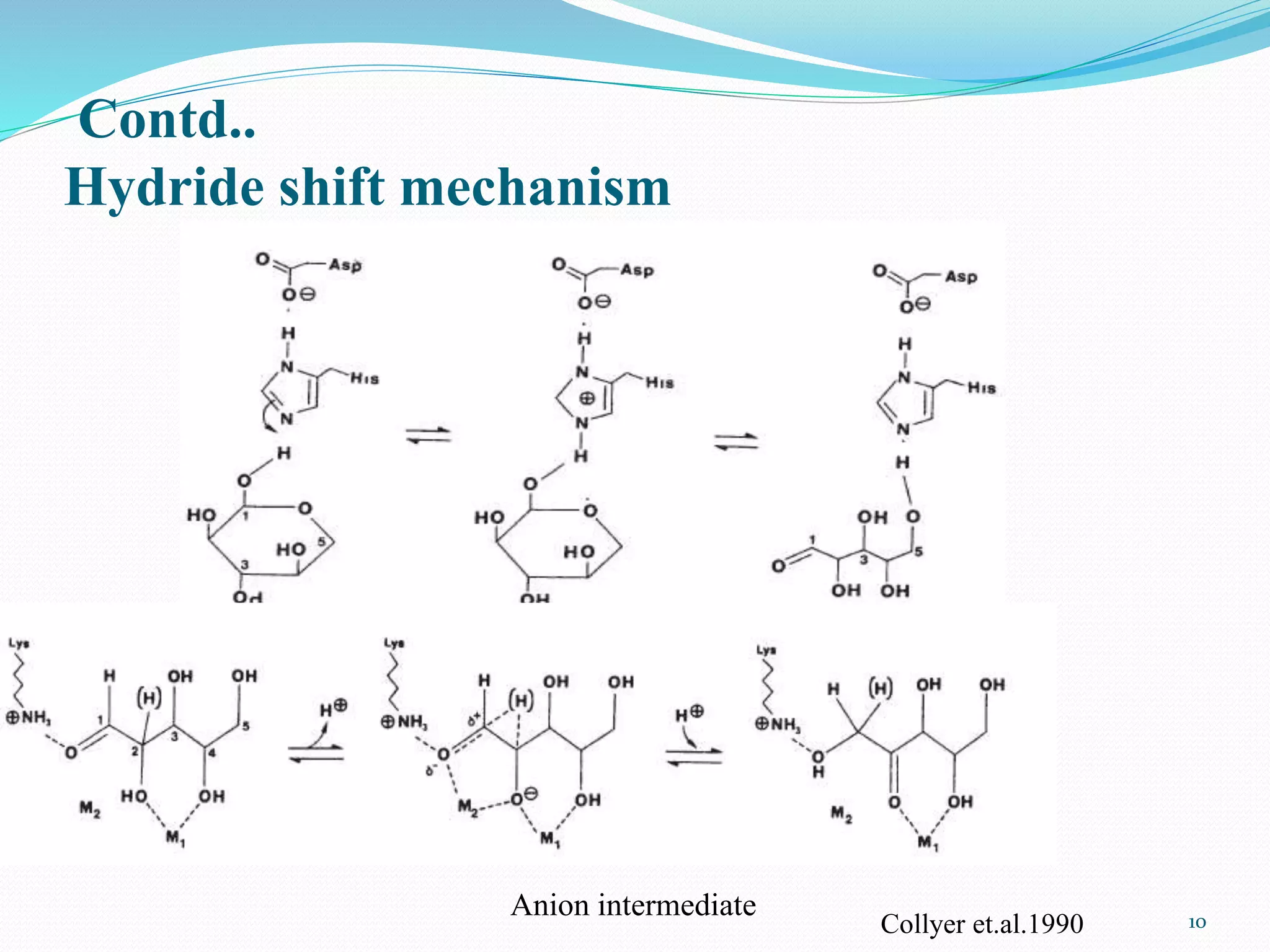
 hydride shift mechanism
 Proton transfer involving a cis-enediol intermediate
Contd..
Hydride shift mechanism
10
Anion intermediate
Collyer et.al.1990
Enzyme Kinetics
D-Xylose;
Mg2+
Km (mM)
0.903
Kcat/Km
(M-1 S-1)
1429
Kcat (S-1)
1.29
D-Glucose;
Mg2+
Km (mM)
145
Kcat (S-1)
0.462
Kcat/Km
(M-1 S-1)
3.2
Bacillus coagulans (Van Bastelaere et al., 1991)
11
Importance of glucose isomerase
 High fructose corn syrup (HFCS)
 Ethanol production
 Xylitol production
12
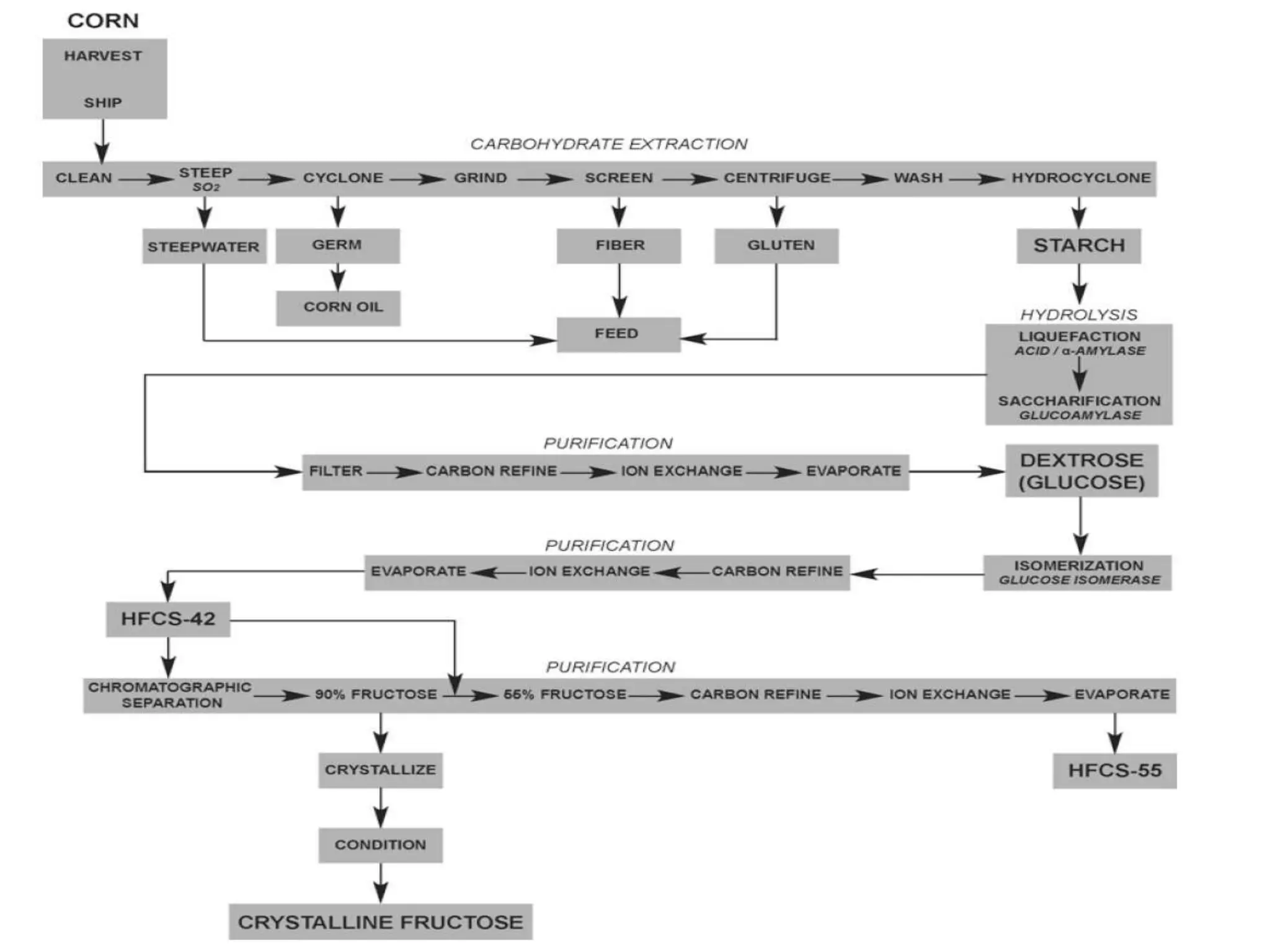
What is HFCS?
 Glucose-fructose syrup (1:1)
 Two formulations- HFCS- 42% & HFCS-55%
HFCS production
 liquefaction of starch by α-amylase
 corn, wheat, tapioca, and rice
 saccharification of starch
 amyloglucosidase and a debranching enzyme
 isomerization of glucose by GI.
13
14
Advantages of HFCS as sweetener
 1.3 times sweeter than sucrose and 1.7 times sweeter than
glucose (Bhosale et al. 1996)
 Flavor enhancement
 Cost effective
 High stability
 Low water activity
 Resist crystallisation
 fermentable
 Diabetic sweetener
 Beverage, soft drinks, dairy products, baked food
15
Production of GI
Sources
16
wheat
germ
Actinoplanes
Streptomyces
Bacillus
More than
100 species
Aspergillus
-oryzae
Candida
-utilis
&
Candida
-boidinii
Production of GI
 Inducer
 Xylose- expensive
 Mutant strain of b.coagulans- glucose
 Nitrogen sources
 Peptone, yeast extract, ammonium salts (b.coagulans)
 corn steep liquor, soy fluor
 pH- 7 to 8
 Temperature
 Arthrobacter, Streptomyces sp- 30ºC
 Thermophilic Bacillus sp- 50 to 60ºC
 Metal ions- Co2+, Mg2+, Mn2+
17
Mutant development
 Mutants with following properties
 increased thermostability
 lower pH optimum
 altered metal cation preference
 shift in substrate specificity from xylose to glucose.
 Mutation of Trp139 in Clostridium thermosulfurogenes
18
Immobilization of GI
Cell free immobilisation
 DEAE- cellulose
 Porous alumina
Whole cell immobilisation
 Physical entrapment in polymeric materials
 Chemical entrapment in membrane and cross linking
with glutaraldehyde
19
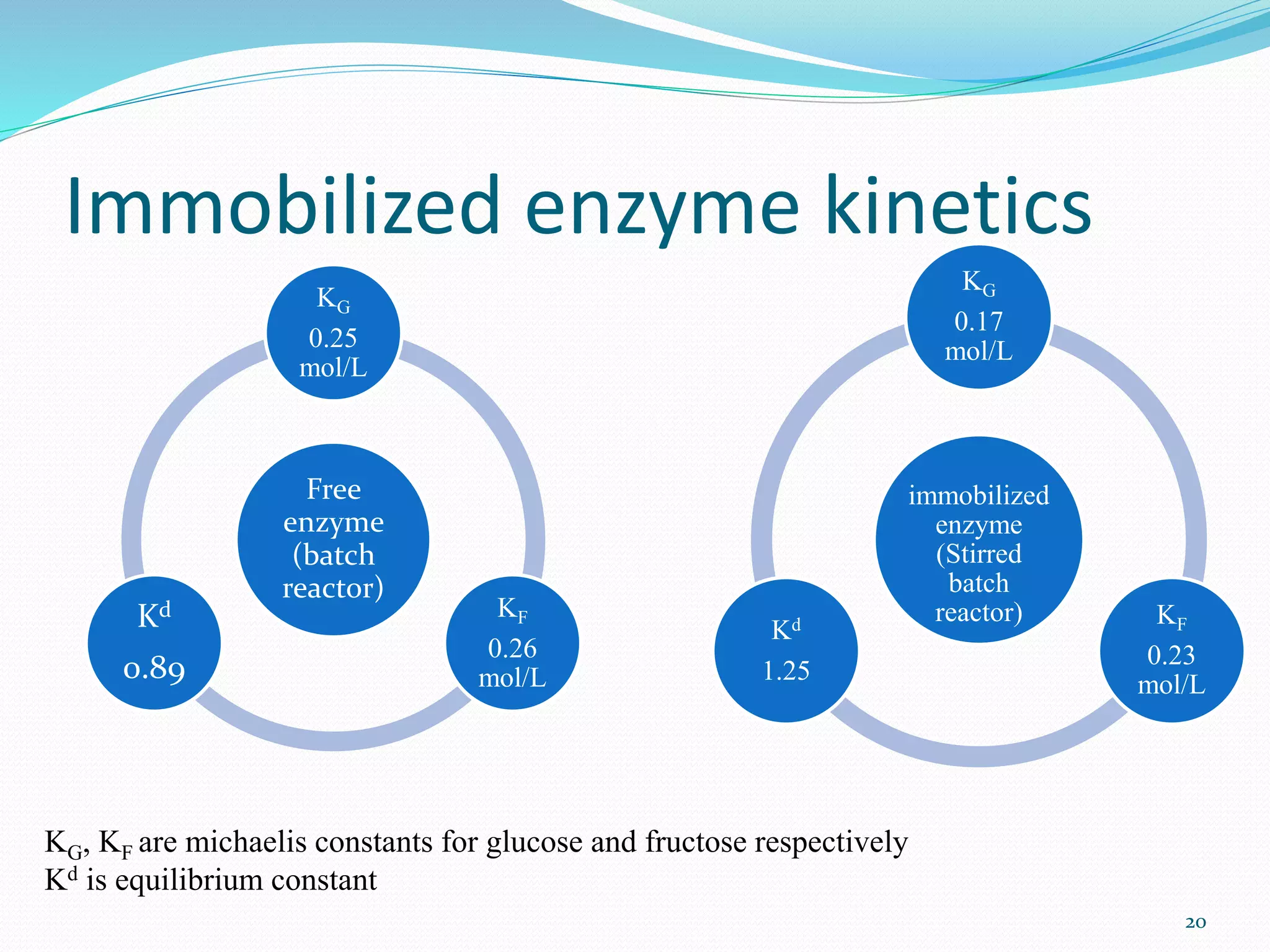
Immobilized enzyme kinetics
Free
enzyme
(batch
reactor)
KG
0.25
mol/L
KF
0.26
mol/L
Kd
0.89
20
immobilized
enzyme
(Stirred
batch
reactor)
KG
0.17
mol/L
KF
0.23
mol/L
Kd
1.25
KG, KF are michaelis constants for glucose and fructose respectively
Kd is equilibrium constant
Commercial producers
21
Bhosale et.al.1996
Reference
 Bhosale, S. H., Rao, M. B., & Deshpande, V. V. (1996). Molecular and
industrial aspects of glucose isomerase. Microbiological Reviews, 60(2),
280–300.
 Collyer, C. a, & Blow, D. M. (1990). Observations of reaction intermediates
and the mechanism of aldose-ketose interconversion by D-xylose isomerase.
Proceedings of the National Academy of Sciences of the United States of
America, 87(4), 1362–1366.
 Kuyper, M., Harhangi, H., Stave, a, Winkler, a, Jetten, M., Delaat, W.,
Pronk, J. (2003). High-level functional expression of a fungal xylose
isomerase: the key to efficient ethanolic fermentation of xylose by
Saccharomyces cerevisiae FEMS Yeast Research, 4(1), 69–78.
 Seyhan Tükel, S., & Alagöz, D. (2008). Catalytic efficiency of immobilized
glucose isomerase in isomerization of glucose to fructose. Food Chemistry,
111(3), 658–662.
22
 Sukumar, M., Jeyaseelan, A., Sivasankaran, T., Mohanraj, P., Mani, P.,
Sudhakar, G., … Susee, M. (2013). Production and partial characterization
of extracellular glucose isomerase using thermophilic Bacillus sp. isolated
from agricultural land. Biocatalysis and Agricultural Biotechnology, 2(1),
45–49.
 Hartley, B. S., Hanlon, N., Jackson, R. J., & Rangarajan, M. (2000).
Glucose isomerase : insights into protein engineering for increased
thermostability, 1543.
 Sayyed, R. Z., Shimpi, G. B., & Chincholkar, S. B. (2010). Constitutive
production of extracellular glucose isomerase by an osmophillic Aspergillus
sp. under submerged conditions. Journal of Food Science and Technology,
47(5), 496–500. http://doi.org/10.1007/s13197-010-0084-3
 Seyhan Tükel, S., & Alagöz, D. (2008). Catalytic efficiency of immobilized
glucose isomerase in isomerization of glucose to fructose. Food Chemistry,
111(3), 658–662. http://doi.org/10.1016/j.foodchem.2008.04.035
23
24
25

Glucose isomerase

  • 1.
    Presented by Esakki MuthuLakshmi V M. Tech 1st yr (IBT)
  • 2.
    Introduction  Xylose isomerase Third most commercial enzyme  High fructose corn syrup production  Reversible isomerization 2
  • 3.
    Enzyme Nomenclature IUBMB Entry • EC5.3.1.5 Name • Accepted Name : D-xylose isomerase; D-xylose ketoisomerase; D-xylose ketol-isomerase; glucose isomerase (GI) • Systematic Name : D-xylose aldose-ketose-isomerase Class • Isomerases; Intramolecular oxidoreductases; Interconverting aldoses and ketoses, and related compounds 3
  • 4.
    Physicochemical properties  Intracellularenzyme  Substrate specificity- broad  Ribose, rhamnose, arabinose  Metal ions- Mg2+, Co2+ or Mn2+  Inhibitors  Ag2+,Hg2+, Cu2+,Zn2+, Ni2+, Ca2+  Xylitol, arabitol, sorbitol, mannitol, lyxose, and Tris  pH- 7 to 9  Temperature- 60 to 80 ºC 4
  • 5.
     Homomeric tetramer Molecular weight- 185 kDa  Subunit- two domains  Domain 1- (α/β)8  Domain 2- α5  2-fold symmetry 5 Arthrobacter B3728 Henrick et.al 1989 Three-dimensional structure
  • 6.
    TIM barrel structure 6 Streptomycesrubiginosus Ref: RCSB PDB
  • 7.
    Metal ion requirement Monomer- 2 metal binding sites 7 Bacillus coagulans (Van Bastelaere et al., 1991) Incubation condition T=35ºC pH= 7 Co2+ Kd1= 4*10-8 Kd2= 4*10-7 Mn2+ Kd1= 2*10-8 Kd2= 2*10-7 Increase of affinity Mg2+ Kd1= <10-6 Kd2= 6*10-5 Kdl = dissociation constant for the high-affinity (structural) metal site; Kd2 = dissociation constant for the low-affinity (catalytic) metal site.
  • 8.
    Active site  His-101 and -271- E.coli isomerase  His-54 and His-217- s.rubiginosus  Stabilise open chain substrate (Lee et al. 1990)  Involved in ring opening 8
  • 9.
    Catalytic mechanism  protontransfer involving a cis-enediol intermediate  hydride shift mechanism  Proton transfer involving a cis-enediol intermediate
  • 10.
    Contd.. Hydride shift mechanism 10 Anionintermediate Collyer et.al.1990
  • 11.
    Enzyme Kinetics D-Xylose; Mg2+ Km (mM) 0.903 Kcat/Km (M-1S-1) 1429 Kcat (S-1) 1.29 D-Glucose; Mg2+ Km (mM) 145 Kcat (S-1) 0.462 Kcat/Km (M-1 S-1) 3.2 Bacillus coagulans (Van Bastelaere et al., 1991) 11
  • 12.
    Importance of glucoseisomerase  High fructose corn syrup (HFCS)  Ethanol production  Xylitol production 12
  • 13.
    What is HFCS? Glucose-fructose syrup (1:1)  Two formulations- HFCS- 42% & HFCS-55% HFCS production  liquefaction of starch by α-amylase  corn, wheat, tapioca, and rice  saccharification of starch  amyloglucosidase and a debranching enzyme  isomerization of glucose by GI. 13
  • 14.
  • 15.
    Advantages of HFCSas sweetener  1.3 times sweeter than sucrose and 1.7 times sweeter than glucose (Bhosale et al. 1996)  Flavor enhancement  Cost effective  High stability  Low water activity  Resist crystallisation  fermentable  Diabetic sweetener  Beverage, soft drinks, dairy products, baked food 15
  • 16.
    Production of GI Sources 16 wheat germ Actinoplanes Streptomyces Bacillus Morethan 100 species Aspergillus -oryzae Candida -utilis & Candida -boidinii
  • 17.
    Production of GI Inducer  Xylose- expensive  Mutant strain of b.coagulans- glucose  Nitrogen sources  Peptone, yeast extract, ammonium salts (b.coagulans)  corn steep liquor, soy fluor  pH- 7 to 8  Temperature  Arthrobacter, Streptomyces sp- 30ºC  Thermophilic Bacillus sp- 50 to 60ºC  Metal ions- Co2+, Mg2+, Mn2+ 17
  • 18.
    Mutant development  Mutantswith following properties  increased thermostability  lower pH optimum  altered metal cation preference  shift in substrate specificity from xylose to glucose.  Mutation of Trp139 in Clostridium thermosulfurogenes 18
  • 19.
    Immobilization of GI Cellfree immobilisation  DEAE- cellulose  Porous alumina Whole cell immobilisation  Physical entrapment in polymeric materials  Chemical entrapment in membrane and cross linking with glutaraldehyde 19
  • 20.
  • 21.
  • 22.
    Reference  Bhosale, S.H., Rao, M. B., & Deshpande, V. V. (1996). Molecular and industrial aspects of glucose isomerase. Microbiological Reviews, 60(2), 280–300.  Collyer, C. a, & Blow, D. M. (1990). Observations of reaction intermediates and the mechanism of aldose-ketose interconversion by D-xylose isomerase. Proceedings of the National Academy of Sciences of the United States of America, 87(4), 1362–1366.  Kuyper, M., Harhangi, H., Stave, a, Winkler, a, Jetten, M., Delaat, W., Pronk, J. (2003). High-level functional expression of a fungal xylose isomerase: the key to efficient ethanolic fermentation of xylose by Saccharomyces cerevisiae FEMS Yeast Research, 4(1), 69–78.  Seyhan Tükel, S., & Alagöz, D. (2008). Catalytic efficiency of immobilized glucose isomerase in isomerization of glucose to fructose. Food Chemistry, 111(3), 658–662. 22
  • 23.
     Sukumar, M.,Jeyaseelan, A., Sivasankaran, T., Mohanraj, P., Mani, P., Sudhakar, G., … Susee, M. (2013). Production and partial characterization of extracellular glucose isomerase using thermophilic Bacillus sp. isolated from agricultural land. Biocatalysis and Agricultural Biotechnology, 2(1), 45–49.  Hartley, B. S., Hanlon, N., Jackson, R. J., & Rangarajan, M. (2000). Glucose isomerase : insights into protein engineering for increased thermostability, 1543.  Sayyed, R. Z., Shimpi, G. B., & Chincholkar, S. B. (2010). Constitutive production of extracellular glucose isomerase by an osmophillic Aspergillus sp. under submerged conditions. Journal of Food Science and Technology, 47(5), 496–500. http://doi.org/10.1007/s13197-010-0084-3  Seyhan Tükel, S., & Alagöz, D. (2008). Catalytic efficiency of immobilized glucose isomerase in isomerization of glucose to fructose. Food Chemistry, 111(3), 658–662. http://doi.org/10.1016/j.foodchem.2008.04.035 23
  • 24.
  • 25.