Intellectual Development
• Piagetian Approach
• Behaviorist Approach
• Psychometric Approach
Classic Approaches
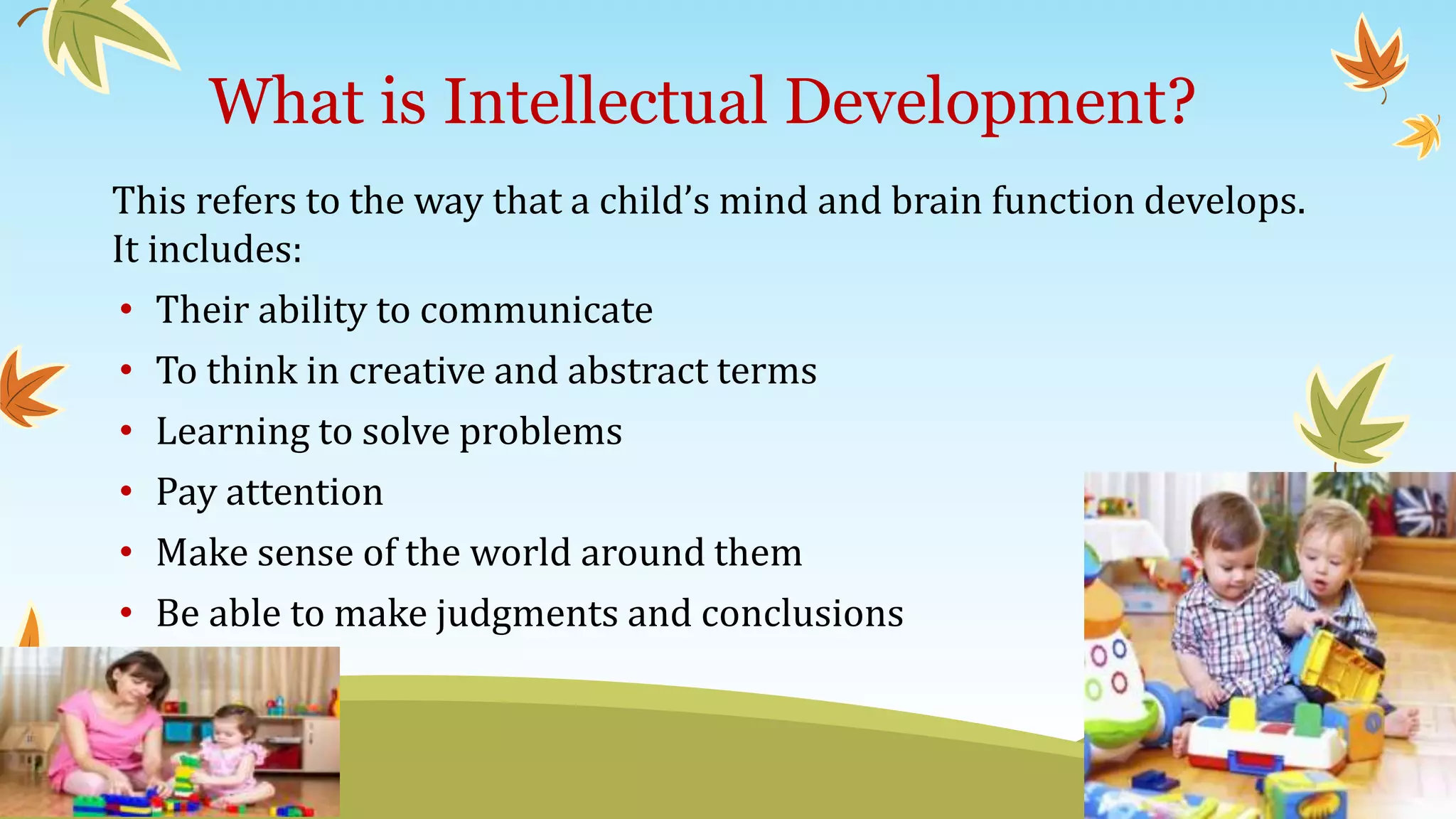
What is Intellectual Development?
This refers to the way that a child’s mind and brain function develops.
It includes:
• Their ability to communicate
• To think in creative and abstract terms
• Learning to solve problems
• Pay attention
• Make sense of the world around them
• Be able to make judgments and conclusions
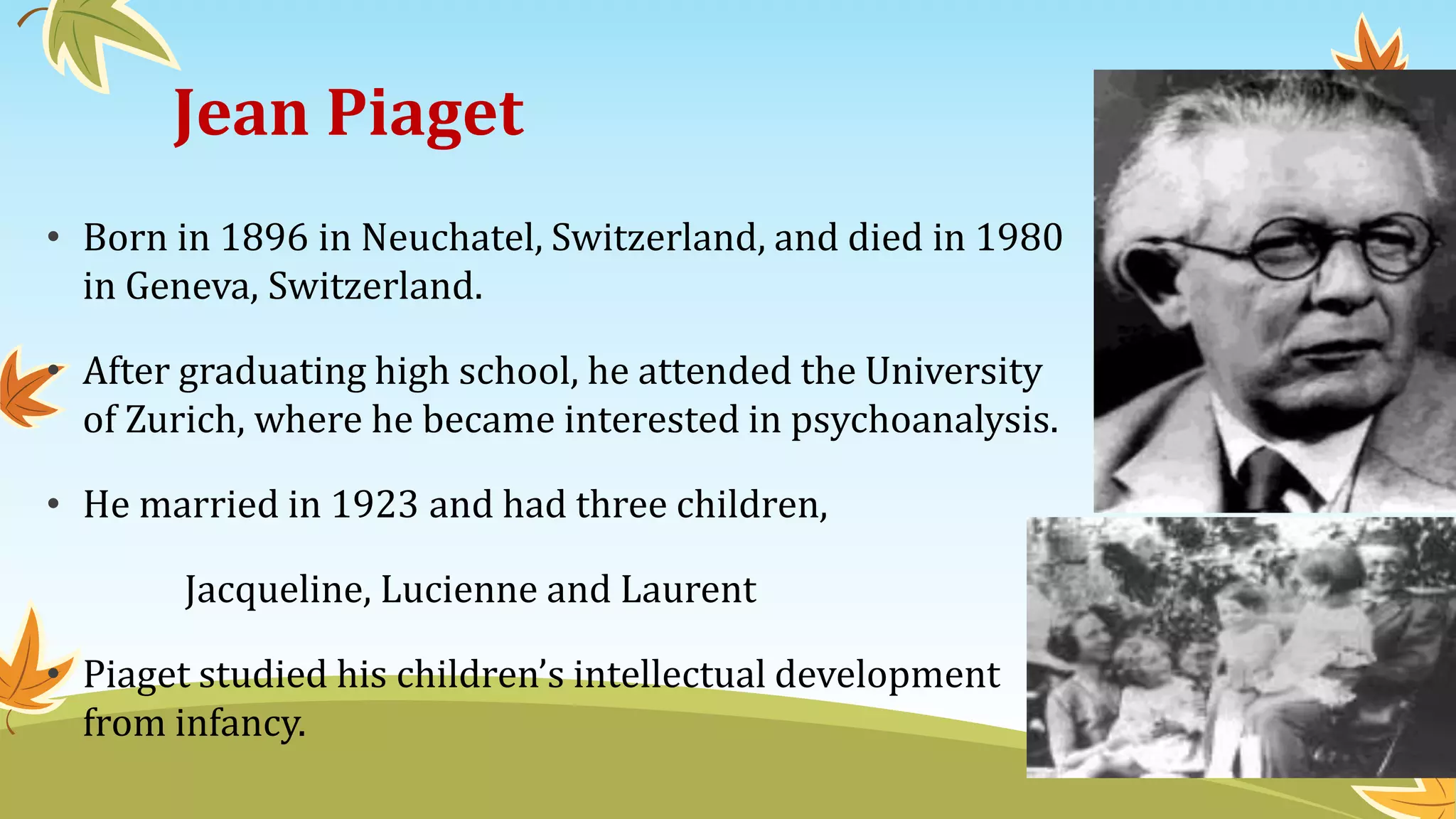
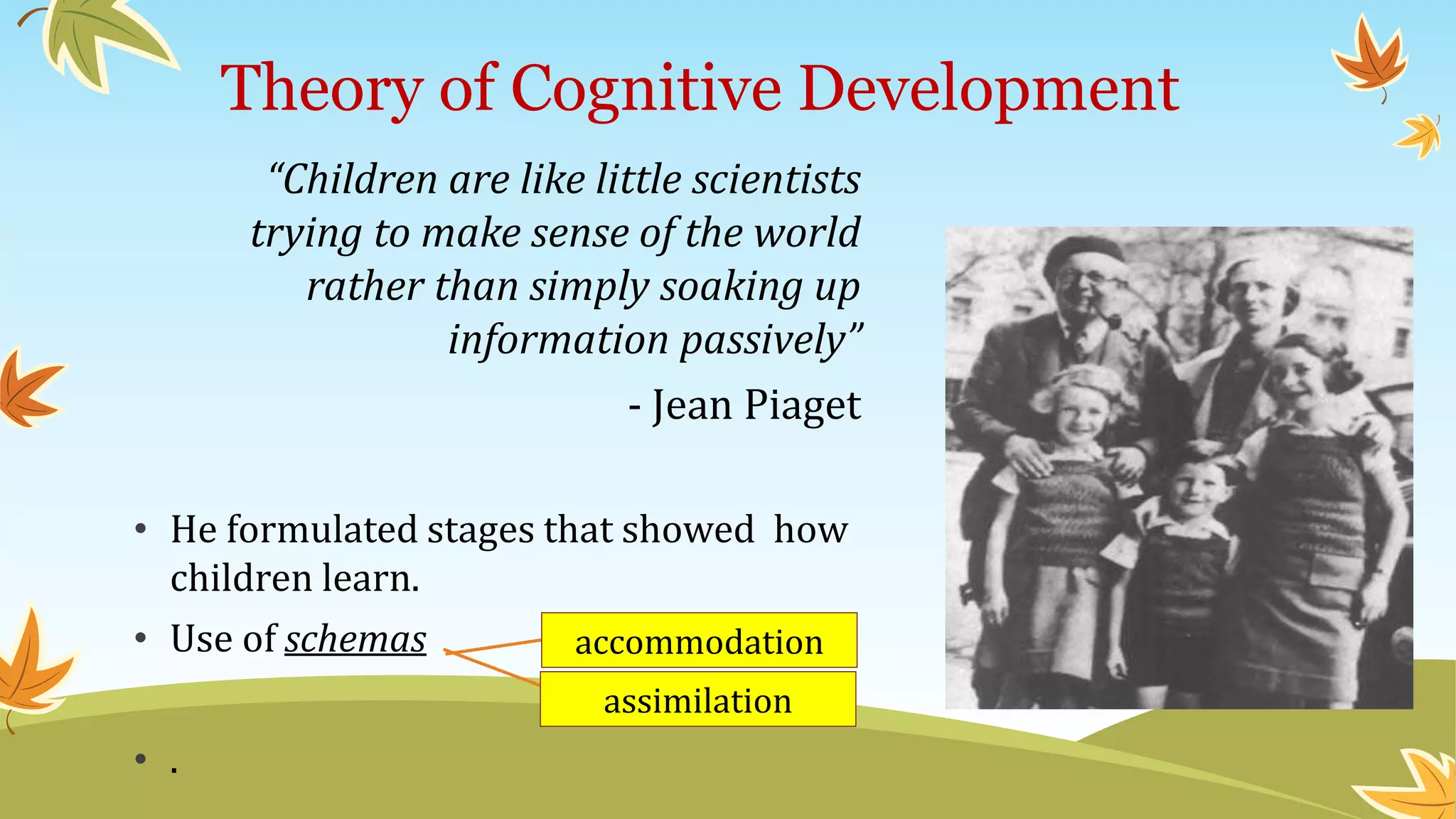
Jean Piaget
• Born in 1896 in Neuchatel, Switzerland, and died in 1980
in Geneva, Switzerland.
• After graduating high school, he attended the University
of Zurich, where he became interested in psychoanalysis.
• He married in 1923 and had three children,
Jacqueline, Lucienne and Laurent
• Piaget studied his children’s intellectual development
from infancy.
Theory of Cognitive Development
• He formulated stages that showed how
children learn.
• Use of schemas
• .
accommodation
assimilation
“Children are like little scientists
trying to make sense of the world
rather than simply soaking up
information passively”
- Jean Piaget
Stages of Cognitive Development
• Sensorimotor Stage
A period of time between birth and age two during which an infant’s
knowledge of the world is limited to his or her perceptions and motor activities.
• Preoperational Stage
A period between ages two and six during which a child learns to use
language. During this stage, mental representations and logic begin but they don’t
fully understand logical processes.
• Concrete Operational Stage – a period between ages seven and eleven
during which children gain a better understanding of mental representations.
• Formal Operational Stage – a period between twelve to adulthood when
people develop the ability to think about abstract concepts. Skills such as logical
thought, deductive reasoning and systematic planning also emerge during this
stage.
Infants begin to learn using their sensory system and reflexes.
• Birth to 1 month (Reflexive Action)
 Innate reflexive action –
 Spends a lot of time watching and playing with their own hands
Can focus and reach for objects, identify their parent’s face and
voice
Begins to modify reflections to accommodate the environment
SENSORIMOTOR STAGE
sucking, grasping, crying
1 – 4 months
(Primary Circular Reactions)
 Behaviors that are not previously present in stage 1 appears
(habitual thumb sucking)
Behaviors focus on own body
Acquired adaptations
Reflexive actions gradually being replaced by voluntary actions
(repeatedly putting hand in mouth)
Circular reactions resulting in modifications of existing schemes
4 – 8 months
(Secondary Circular Reactions)
Infants who hit an object by chance making it move about will
often repeat this action to keep the movement going
Increased awareness of and responses to people and objects in
the environment
Ability to initiate activities
Fascination with the effects of actions
Beginning of object permanence
8 – 12 months
(Coordination of Secondary Schemes)
Knowledge of cause and effect relationship
Increased deliberation and purposefulness in responding to people
and objects
Continued development of object permanence
Actively searching for hidden objects
Comprehends meaning of simple words
Combines new behavior to achieve goals
Behaves in particular ways to achieve results; likes push-pull toys
12 – 18 months
(Experimentation; Tertiary Circular Reactions)
Do some trial and error, leading to new outcomes
Much time spent experimenting with objects to see what happens;
insatiable curiosity
Realizes that “out of sight” is not “out of reach” or “out of existence”
Initial understanding of space, time, and causality
18 – 24 months
(Representational Intelligence)
Beginning of representational intelligence; child
mentally represents objects
Engages in symbolic, imitative behavior
Explore picture books and can name and label objects
within pictures
Beginning of sense of time
PREOPERATIONAL STAGE
Features the flourishing use of mental representations and
the beginnings of logic (intuitive thought).
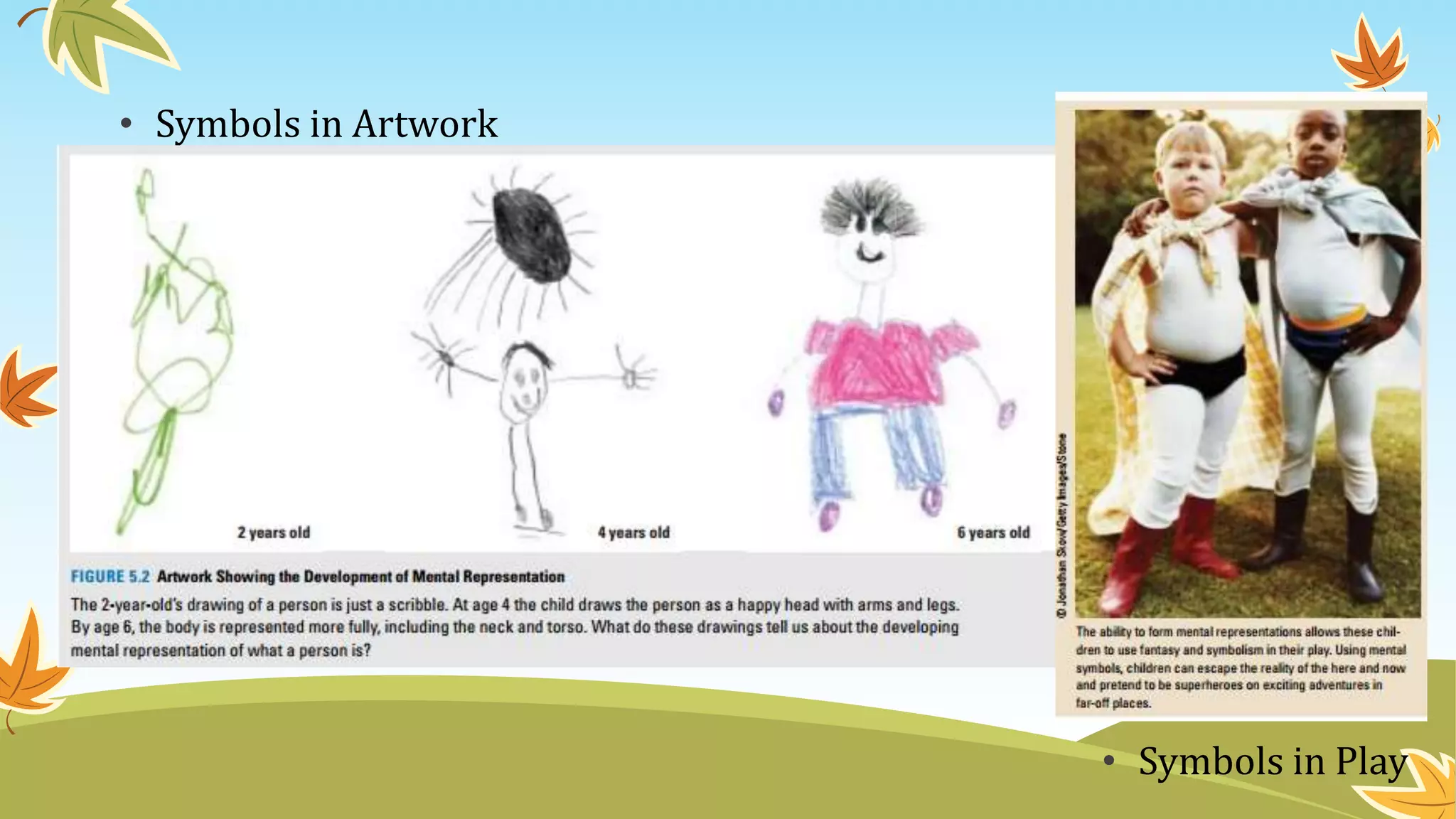
 Flourishing Mental Representations
Use of symbols in:
Language
Artwork
Play
• Symbols in Artwork
• Symbols in Play
 Emergence of Intuitive Thought
Children reason according to what
things “seem like”, according to their
personal experience with the objects and events
involved.
Thought and logic
based on the child’s
personal experience
rather than on a formal
system of rules
On the way to school one foggy morning, our son, who was about
3½ years old, said, “Better turn your lights on – it’s really froggy
out.” When asked what he meant, he explained that he had noticed
a lot of this cloudy stuff in the air whenever we drove by ponds.
“Mom, I know that frogs live in water, so when all the frogs
breathe out, they make the air froggy.”
Evidence of Intuitive thought that can be seen in several characteristics
of thinking that are common during preoperational period:
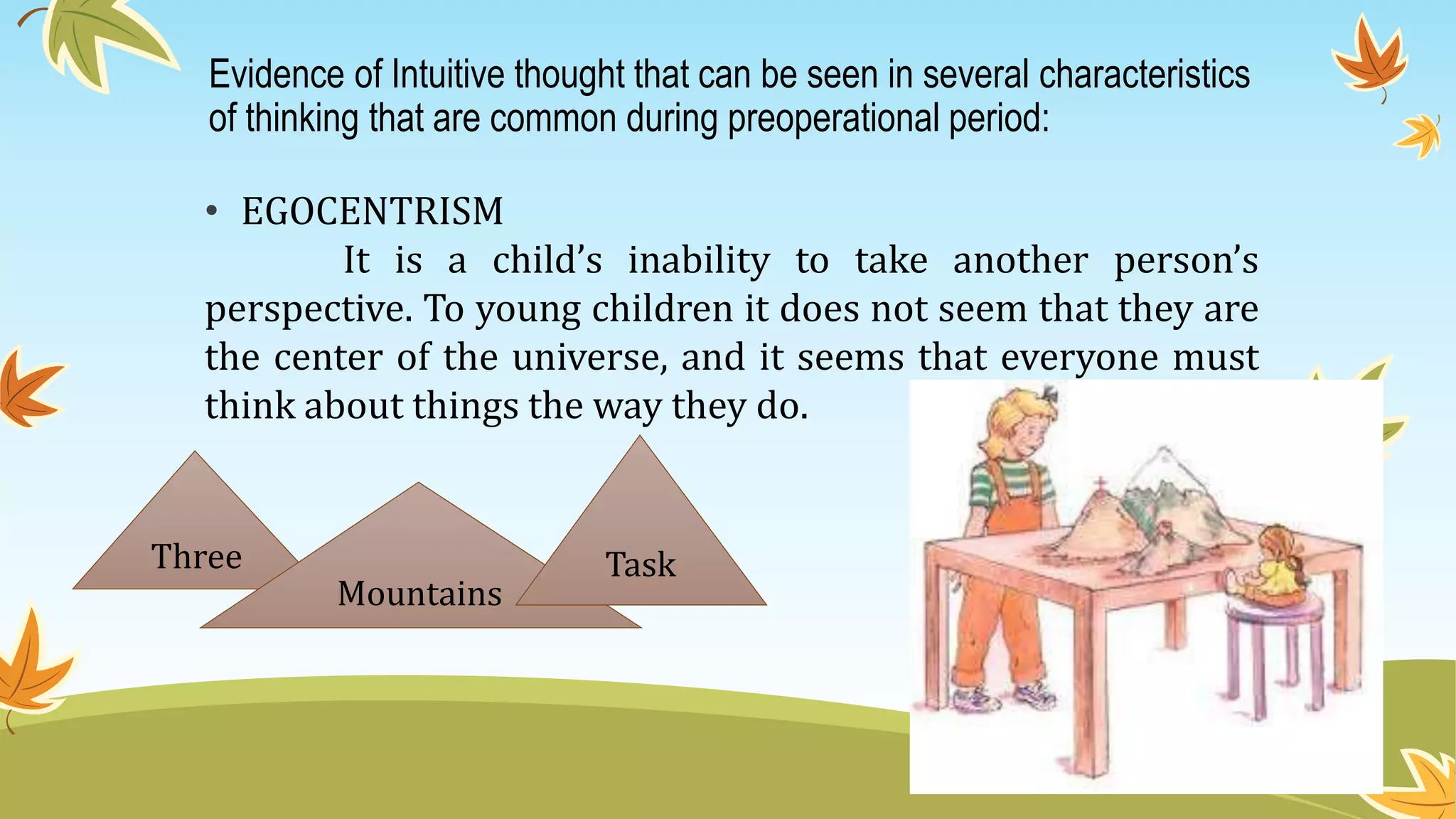
• EGOCENTRISM
It is a child’s inability to take another person’s
perspective. To young children it does not seem that they are
the center of the universe, and it seems that everyone must
think about things the way they do.
Three
Mountains
Task
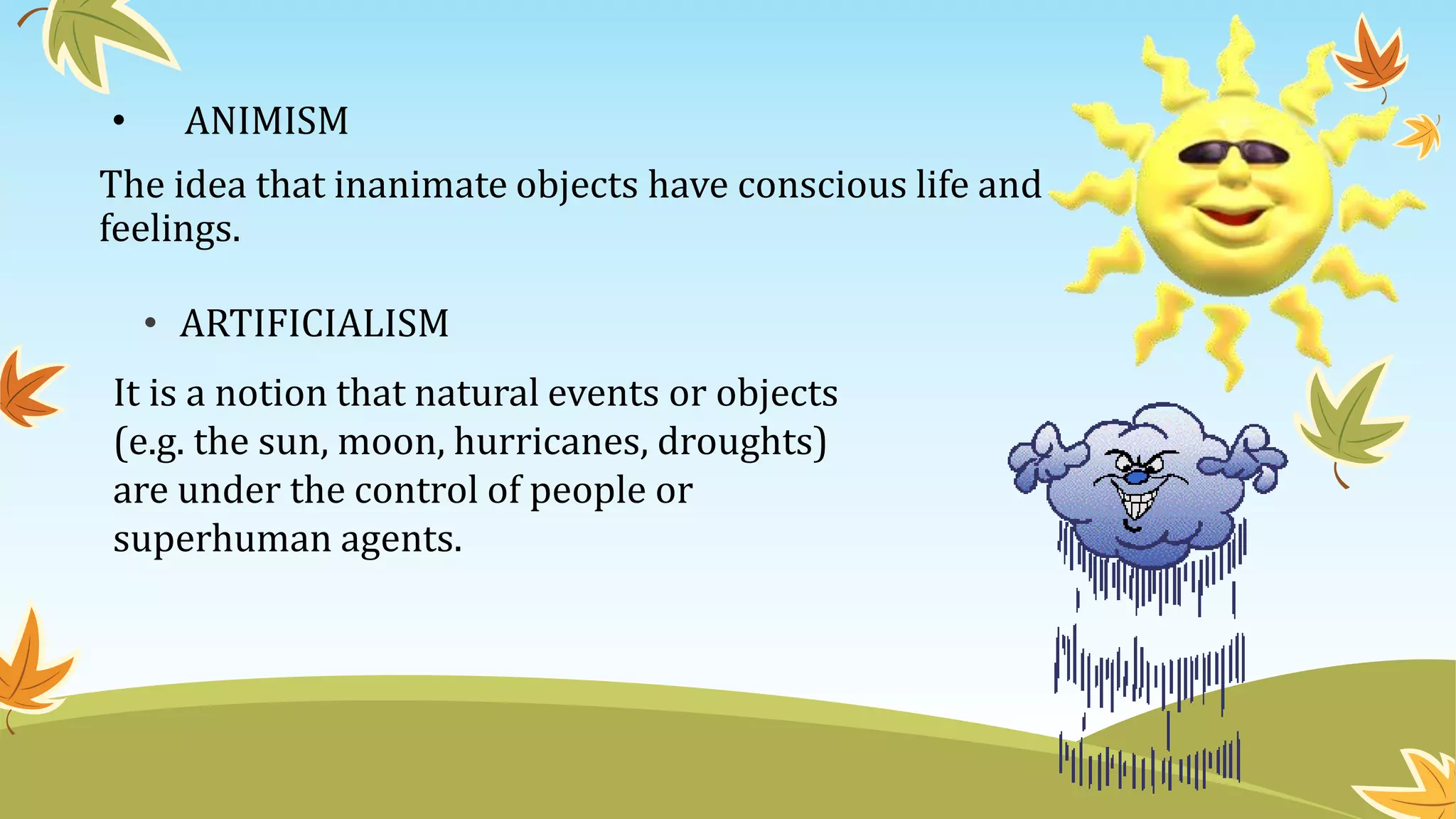
• ANIMISM
The idea that inanimate objects have conscious life and
feelings.
It is a notion that natural events or objects
(e.g. the sun, moon, hurricanes, droughts)
are under the control of people or
superhuman agents.
• ARTIFICIALISM
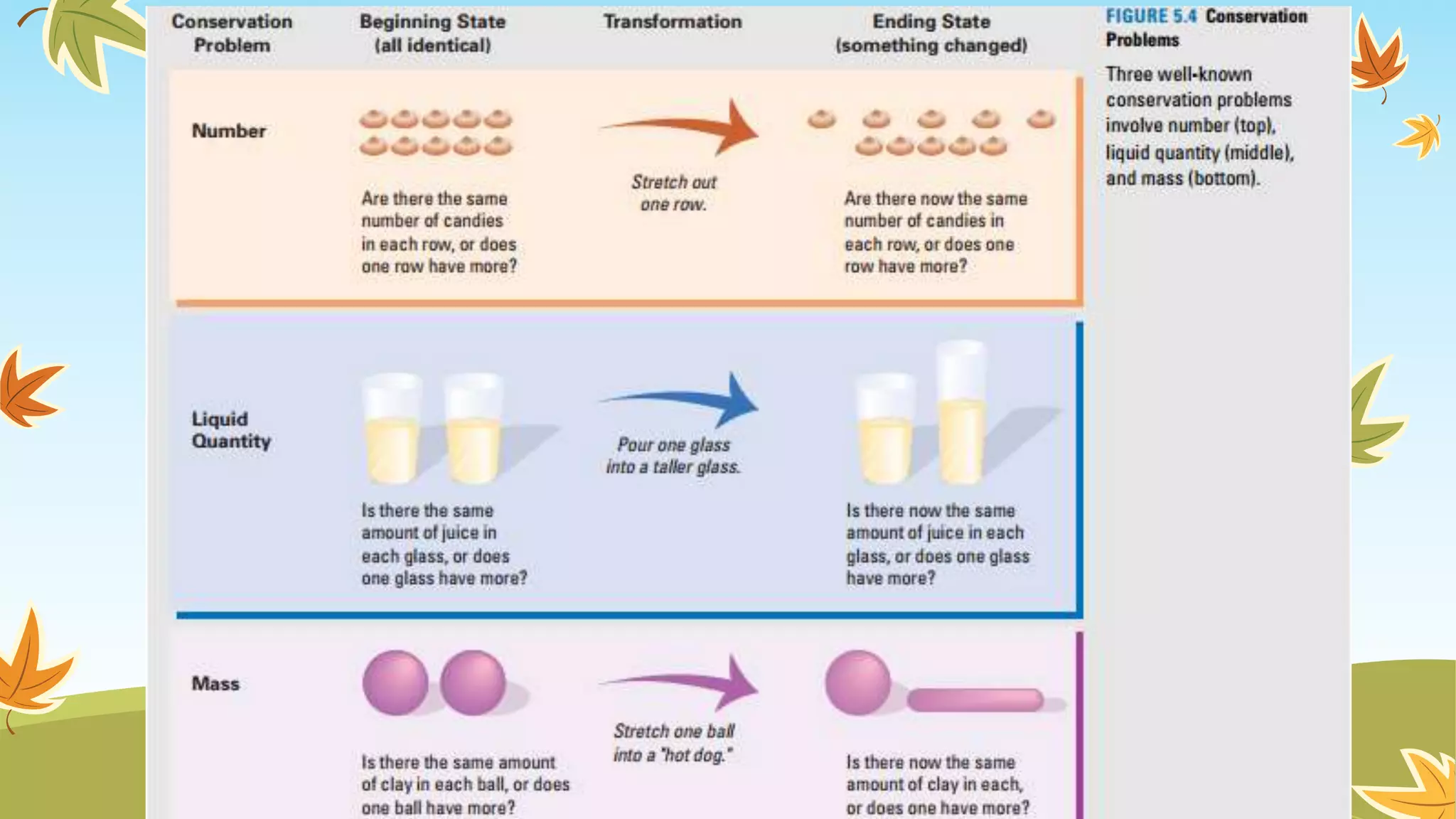
 Conservation Problems
Piaget used the term conservation to refer to the concept that
certain basic properties of an object (e.g. volume, mass, and
weight) remain the same even if its physical appearance
changes.
Concrete Operational Stage
• Children are decentered
• They focus on the dynamic transformation of the problem
• They show reversibility of true mental operations
• In this stage, children think about the world using
objective rules of logic, freeing them from misconceptions
of intuitive thought.
• Children master the conservation problems
Formal Operations Stage
According to Piaget, it is during adolescence that cognitive
development reaches its fullest potential – formal operational thought.
Adolescents gradually develop the ability to use hypothetico-deductive
reasoning, and they extend their logical thinking to concepts that are
abstract.
 Hypothetico – Deductive Reasoning
Hypothetico-deductive reasoning is the use of deductive
reasoning (reasoning from general principles to particular
conclusions) to systematically manipulate several variables,
test their effects in a systematic way, and reach concrete
conclusions.
It is the thought about things that are not real or tangible, or
things that are only possibilities
This leads adolescents to spend extraordinary amounts of
time speculating on all possible outcomes of seemingly
simple actions.
The adolescent also learns to think logically about such
abstract concepts as truth, justice, fairness, and morality
 Abstract Thought
Behaviorist Approach
Behaviorists study basic mechanics of learning.
Classical Conditioning
A teacher uses a bell to signal quiet time. When the bell
rings, the children folds their arms on their desk and rest
their heads.
Operant Conditioning
Learning occurs when behavior is either rewarded or
punished. Through operant conditioning, an association is
made between a behavior and its consequences.
POSITIVE REINFORCEMENT
Psychometric Approach
• The psychometric approach attempts to measure various
aspects of individuals to understand how development
takes place, and also to compare with those comparable
group of people
• This is a measurement of individual differences
Bayley Scales of Infant Development
• The most frequently used test of infant development
• Published by Nancy Bayley
• Measures the mental and motor development and test the
behavior of infants from one to 42 months of age.

Intellectual development (Piagetian, Psychometric, and Classical Approach)

  • 1.
  • 2.
    • Piagetian Approach •Behaviorist Approach • Psychometric Approach Classic Approaches
  • 3.
    What is IntellectualDevelopment? This refers to the way that a child’s mind and brain function develops. It includes: • Their ability to communicate • To think in creative and abstract terms • Learning to solve problems • Pay attention • Make sense of the world around them • Be able to make judgments and conclusions
  • 4.
    Jean Piaget • Bornin 1896 in Neuchatel, Switzerland, and died in 1980 in Geneva, Switzerland. • After graduating high school, he attended the University of Zurich, where he became interested in psychoanalysis. • He married in 1923 and had three children, Jacqueline, Lucienne and Laurent • Piaget studied his children’s intellectual development from infancy.
  • 5.
    Theory of CognitiveDevelopment • He formulated stages that showed how children learn. • Use of schemas • . accommodation assimilation “Children are like little scientists trying to make sense of the world rather than simply soaking up information passively” - Jean Piaget
  • 6.
  • 7.
    • Sensorimotor Stage Aperiod of time between birth and age two during which an infant’s knowledge of the world is limited to his or her perceptions and motor activities. • Preoperational Stage A period between ages two and six during which a child learns to use language. During this stage, mental representations and logic begin but they don’t fully understand logical processes. • Concrete Operational Stage – a period between ages seven and eleven during which children gain a better understanding of mental representations. • Formal Operational Stage – a period between twelve to adulthood when people develop the ability to think about abstract concepts. Skills such as logical thought, deductive reasoning and systematic planning also emerge during this stage.
  • 8.
    Infants begin tolearn using their sensory system and reflexes. • Birth to 1 month (Reflexive Action)  Innate reflexive action –  Spends a lot of time watching and playing with their own hands Can focus and reach for objects, identify their parent’s face and voice Begins to modify reflections to accommodate the environment SENSORIMOTOR STAGE sucking, grasping, crying
  • 9.
    1 – 4months (Primary Circular Reactions)  Behaviors that are not previously present in stage 1 appears (habitual thumb sucking) Behaviors focus on own body Acquired adaptations Reflexive actions gradually being replaced by voluntary actions (repeatedly putting hand in mouth) Circular reactions resulting in modifications of existing schemes
  • 10.
    4 – 8months (Secondary Circular Reactions) Infants who hit an object by chance making it move about will often repeat this action to keep the movement going Increased awareness of and responses to people and objects in the environment Ability to initiate activities Fascination with the effects of actions Beginning of object permanence
  • 11.
    8 – 12months (Coordination of Secondary Schemes) Knowledge of cause and effect relationship Increased deliberation and purposefulness in responding to people and objects Continued development of object permanence Actively searching for hidden objects Comprehends meaning of simple words Combines new behavior to achieve goals Behaves in particular ways to achieve results; likes push-pull toys
  • 12.
    12 – 18months (Experimentation; Tertiary Circular Reactions) Do some trial and error, leading to new outcomes Much time spent experimenting with objects to see what happens; insatiable curiosity Realizes that “out of sight” is not “out of reach” or “out of existence” Initial understanding of space, time, and causality
  • 13.
    18 – 24months (Representational Intelligence) Beginning of representational intelligence; child mentally represents objects Engages in symbolic, imitative behavior Explore picture books and can name and label objects within pictures Beginning of sense of time
  • 14.
    PREOPERATIONAL STAGE Features theflourishing use of mental representations and the beginnings of logic (intuitive thought).  Flourishing Mental Representations Use of symbols in: Language Artwork Play
  • 15.
    • Symbols inArtwork • Symbols in Play
  • 16.
     Emergence ofIntuitive Thought Children reason according to what things “seem like”, according to their personal experience with the objects and events involved. Thought and logic based on the child’s personal experience rather than on a formal system of rules On the way to school one foggy morning, our son, who was about 3½ years old, said, “Better turn your lights on – it’s really froggy out.” When asked what he meant, he explained that he had noticed a lot of this cloudy stuff in the air whenever we drove by ponds. “Mom, I know that frogs live in water, so when all the frogs breathe out, they make the air froggy.”
  • 17.
    Evidence of Intuitivethought that can be seen in several characteristics of thinking that are common during preoperational period: • EGOCENTRISM It is a child’s inability to take another person’s perspective. To young children it does not seem that they are the center of the universe, and it seems that everyone must think about things the way they do. Three Mountains Task
  • 18.
    • ANIMISM The ideathat inanimate objects have conscious life and feelings. It is a notion that natural events or objects (e.g. the sun, moon, hurricanes, droughts) are under the control of people or superhuman agents. • ARTIFICIALISM
  • 19.
     Conservation Problems Piagetused the term conservation to refer to the concept that certain basic properties of an object (e.g. volume, mass, and weight) remain the same even if its physical appearance changes.
  • 20.
    Concrete Operational Stage •Children are decentered • They focus on the dynamic transformation of the problem • They show reversibility of true mental operations • In this stage, children think about the world using objective rules of logic, freeing them from misconceptions of intuitive thought. • Children master the conservation problems
  • 21.
    Formal Operations Stage Accordingto Piaget, it is during adolescence that cognitive development reaches its fullest potential – formal operational thought. Adolescents gradually develop the ability to use hypothetico-deductive reasoning, and they extend their logical thinking to concepts that are abstract.
  • 22.
     Hypothetico –Deductive Reasoning Hypothetico-deductive reasoning is the use of deductive reasoning (reasoning from general principles to particular conclusions) to systematically manipulate several variables, test their effects in a systematic way, and reach concrete conclusions.
  • 23.
    It is thethought about things that are not real or tangible, or things that are only possibilities This leads adolescents to spend extraordinary amounts of time speculating on all possible outcomes of seemingly simple actions. The adolescent also learns to think logically about such abstract concepts as truth, justice, fairness, and morality  Abstract Thought
  • 24.
    Behaviorist Approach Behaviorists studybasic mechanics of learning. Classical Conditioning A teacher uses a bell to signal quiet time. When the bell rings, the children folds their arms on their desk and rest their heads.
  • 25.
    Operant Conditioning Learning occurswhen behavior is either rewarded or punished. Through operant conditioning, an association is made between a behavior and its consequences. POSITIVE REINFORCEMENT
  • 26.
    Psychometric Approach • Thepsychometric approach attempts to measure various aspects of individuals to understand how development takes place, and also to compare with those comparable group of people • This is a measurement of individual differences
  • 27.
    Bayley Scales ofInfant Development • The most frequently used test of infant development • Published by Nancy Bayley • Measures the mental and motor development and test the behavior of infants from one to 42 months of age.

Editor's Notes

  • #5 Piaget is the most influential theorist when we talk about cognitive development. He had a constructivist view in this development and he also showed interest in natural setting which led to his scientific publications about animals. He studied about the intellectual development of his own children and from didto naka create siya og theory of cognitive development.
  • #6 Piaget has a constructivist view in cognitive development
  • #9 So in the 1st month of life, ang behavior sa infant kay nag reflect sa innate reflexes
  • #10 A child puts his hands in his mouth by chance. But after a few weeks, he finds this as a pleasurable experience eventually sucking his thumb/hand purposefully.
  • #11 Infants who hit an object by chance making it move about will often repeat this action to keep the movement going
  • #17 Children have their own point of view on the event that happened.
  • #19 Maong nag dugdug og kilat kay nasuko ang clouds kay gi away siya
  • #25 We have already discussed about behaviorism. And if we talk about behaviorism, there will always be classical conditioning. If you remember Ivan Pavlov, he was the person who conducted a research about the salivation of dogs. One of the observations of Pavlov was that when he rings the bell, dogs salivate. He termed this as “associated learning”. Meaning the dogs had built associated between the bell and food.
  • #28 It is the most commonly used measure of development in this age range in both clinical and research settings. It is administered by examiners who are experienced clinicians specifically trained in Bayley test procedures. The examiner presents a series of test materials to the child and observes the child's responses and behaviors. The test contains items designed to identify young children at risk for developmental delay.