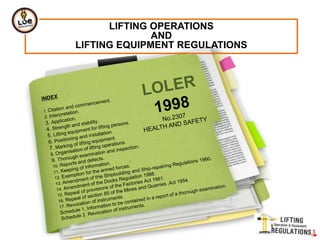
LIFTING OPERATIONS
              AND
LIFTING EQUIPMENT REGULATIONS
LOLER
     REGULATION 1: CITATION AND COMMENCEMENT


LOLER came into effect on 5th December 1998

All lifting equipment:

                   New
                   Existing second-hand
                   Leased equipment

These Regulations apply to all of Great Britain
LOLER

What is LOLER:

   In the main, LOLER replaced existing legal requirements
   relating to the use of lifting equipment, for example the
   Construction (Lifting Operations) Regulations 1961, the Docks
   Regulations 1988 and the Lifting Plant and Equipment
   (Records of Test and Examination etc) Regulations 1992.

   The Regulations aim to reduce the risks to people’s health
   and safety from lifting equipment provided for use at work. In
   addition to the requirements of LOLER, lifting equipment is
   also subject to requirements of PUWER 1998.
LOLER

What does LOLER do:

Generally, require that lifting equipment provided for use at work is:

    Equipment strong and stable (and suitable) enough for the
    particular use and marked to indicate safe working loads.

    Positioned and installed to minimise any risks; used
    safely, ie the work is planned, organised and performed by
    competent people; and subject to ongoing thorough examination
    and, where appropriate, inspection by competent people.

    Visibly marked
LOLER

Aims and Objectives:

    Provision of a simple set of regulations dealing with lifting
   across ‘ALL’ industry sectors, maintaining existing levels of
   health and safety and address deficiencies in current laws.

    Goal setting replacing minimum requirements implemented
   through ACOP’s.

    In effect ACOP’s must be treated as legislative requirements.


   ACOP: Approved Code of Practice
   It is practical guidance on how to comply with the law
LOLER
                 REGULATION 2: INTERPRETATION

NEW TERM AND DEFINITION:

Lifting operations is any operation concerned with the lifting, lowering or
suspending of a load (including attachments used for anchoring, fixing or
supporting it).

Lifting equipment: Work equipment for lifting or lowering loads (includes any
material, people or animals). Includes lifting accessories. Equipment including:
cranes, fork-lift trucks, lifts, hoists, mobile elevating work platforms, vehicle
inspection platform hoists.

Accesory for lifting: work equipment for attaching loads to machinery for lifting
(chains, slings, eyebolts…- in the use of a mobile crane- the weight of the lifting
accessories including the hook block will need to be considered as part of the
load being lifted).

Load: includes any material, people or animals (or any combination of these),
that are lifted by the lifting equipment.
LOLER
                 REGULATION 2: INTERPRETATION
Equipment & Operations covered by LOLER

Cranes
Lifts for person or goods
Scissor Lift
Front End Loader/Lift Trucks
Crane Fitted to a Lorry
Vacuum Lifting Crane
Vehicle Inspection Hoist
LOLER
REGULATION 2: INTERPRETATION

      Equipment & Operations covered by LOLER

      Hoists
      Chains
      Hooks
      Shackles
      Eyebolts
      Ropes Used for Climbing
      Rope & Pulley-Ropes for climbing or positioning (dumb
      waiter, bucket of cement, telecommunication, bath hoist in
      nursing home.)
      Articles suspended from overhead conveyor. Overhead
      gantry crane, pedestal crane….
      A refuse vehicle loading arm used for tipping
      Vehicle recovery equipment
      Vehicle tail lifts
      Air cargo transfer vehicle
LOLER
                 REGULATION 2: INTERPRETATION

Equipment and operations NOT covered by the Regulations:

             Winching loads on level ground ( as the load does not leave the ground)
              PUWER does cover this activity.

             Unassisted manual handling, covered by the Manual
              Handling Operations Regulations 1992.

             Horizontal conveyor belts. Conveyor belts moving articles horizontally.

             Escalators.

             Static equipment suspended from a ceiling.

             Gravity discharge through pipes.


Excluded because it is covered by more specific legislation or any.
LOLER
                    REGULATION 3: APPLICATION

The requirements imposed by these regulations on an employer in respect of
lifting equipment shall apply to all lifting equipment provided for use.

The requirements imposed by these Regulations also applies

•Self employed persons in respect of lifting equipment used at work

•To a person who has control to any extent of:

      Lifting Equipment
      A person at work who uses or supervises or manages the use of lifting
     equipment
      The way in which lifting equipment is used

Employers have a duty to ensure that lifting equipment provided for their
employees & the self employed comply with these regulations.

For instance , those hiring out cranes may, in practice have some control over the
way the crane is used or maintained.
LOLER
                 REGULATION 4: STRENGTH & STABILITY


Every Employer shall ensure that

 Lifting equipment is of adequate strength & stability for each load.

 Every part of the load and anything attached to it that are used in lifting
is of adequate strength.

It should be assessed:

      The lifting equipment
      The combination of forces
      Fixing point of any lifting equipment
      Additional precautions -wind-
      Any modifications to the lifting equipment Such as: Christmas decorations, Advertising Hoardings
      Overload :rated capacity indicators and rated capacity limiters (audible and or visual warning) RCI
LOLER
               REGULATION 4: STRENGTH & STABILITY

The factors can affect strength:

     Fracture, wear or fatigue
     Factor of safety
     Fixing point or the mounting, wrapping
     Additional force (wind-hoardings, weight)

A number of factors can effect stability, these can include:

       Ground conditions- slope, strength..
       The size & nature of the load
       How the load is to be lifted
       Wind & adverse conditions
       Shock loading
       Type of base of the equipment- tires, rails

Various methods can be used to improve stability, such as:

      A designed base
      Using a anchorage system
      Counterbalancing weights
      Outriggers or stabilisers
LOLER
   REGULATION 5: LIFTING EQUIPMENT FOR LIFTING PERSONS

Every Employer Shall Ensure that lifting equipment for lifting persons

     Is such as to prevent a person using it being crushed, trapped or struck or
     falling from the carrier.

     Has suitable devices to prevent the risk of a carrier falling.

     Fork-lift truck: use a properly maintained purpose-built working platform with suitable
     edge protection and toe boards.
     Telescopic handler: use a suitable working platform
     Crane: use with appropriate devices(a hoisting limiter, lowering limiter, rated capacity
     indicator and rated capacity limite, hook with a latch)

     Is such that a person trapped in any carrier is not exposed to danger and can
     be freed.

The term “Carrier” can be used to describe any device which supports persons,
while being raised or lowered. (Person 2m-edge protection)
LOLER
    REGULATION 5: LIFTING EQUIPMENT FOR LIFTING PERSONS

Carrier includes the device:
    The car of a passenger lift
    The cage of a construction site hoist
    A platform on a mobile elevating work platform
    A cradle suspended from the hookblock
    A bosun’s chair
    A harness used by a arborist

Lift Trucks

    People should never be lifted on a pallet
    Only purpose built platforms should be used
    The platform must be correctly secured to the machine
    Persons within the platform must be prevented from reaching dangerous parts of
    the machine.
Cranes
    The crane should be adequate & suitable for the task
    Have a freefall lock out
    The carrier should be adequately attached to the crane
    The carrier should be inspected every day by a competent person
LOLER
           REGULATION 6: POSITIONING & INSTALLATION

Every employer shall ensure that lifting equipment is positioned or installed in such a way as to
reduce the risk as low as is reasonably practicable of the risk:

Equipment striking a person

The load from

           Drifting
           Falling freely
           Being released unintentionally

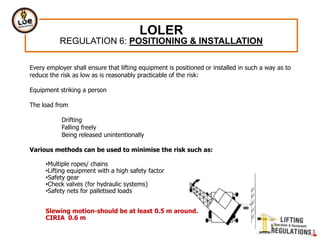
Various methods can be used to minimise the risk such as:

     •Multiple ropes/ chains
     •Lifting equipment with a high safety factor
     •Safety gear
     •Check valves (for hydraulic systems)
     •Safety nets for palletised loads


     Slewing motion-should be at least 0.5 m around.
     CIRIA 0.6 m
LOLER
      REGULATION 7: MARKING OF LIFTING EQUIPMENT


The employer shall ensure:

Machinery & accessories for lifting loads are clearly marked to indicate
their safe working load (SWL).

SWL depends on its configuration and this information is kept with the
machinery or accessories.

Accessories for lifting are also marked in such a way that it is possible to
identify the characteristics necessary for their safe use.

Lifting equipment which is designed for lifting persons is appropriately
marked to this effect (max. number of persons and SWL)

SWL = Rated-capacity = Working Load Limit
LOLER
      REGULATION 7: MARKING OF LIFTING EQUIPMENT


Examples of types of lifting machinery where the SWL can vary within the
operating radius include:

A Mobile Crane
Tower Crane
A Mobile Elevating Work Platform on a cantilever arm
A Telescopic Reach Truck
An Excavator used as a Crane
Forklift trucks fitted with attachments
Fitting a fly jib to a crane
Using a mobile crane free on wheels
A Telescopic Reach Truck
An Excavator used as a Crane
The jib of a Tower Crane
A lifting beam with multiple lifting points
LOLER
    REGULATION 8: ORGANISATION OF LIFTING OPERATIONS


Organisation of lifting operations:

     All lifts are properly planned by a competent person
     Appropriately supervised
     Carried out in a safe manner

The person planning the lifting operation (competent person) should
have adequate practical & theoretical knowledge & experience of
planning lifting operations.

The plan will have to identify all risks

The plan must make sure that the lifting equipment remains safe at all
times.
LOLER
    REGULATION 8: ORGANISATION OF LIFTING OPERATIONS

Planning will vary considerably depending on the complexity of the lift.
Proper planning of the operation is a combination of two parts
(equipments and operations)
           Initial planning to ensure that lifting equipment is provided which is
            suitable for the range of tasks that it will carry out.

           Planning of individual lifting operations so they can be carried out safely.
Initial Planning

      The load to be lifted: weight, shape, centre of gravity, availability of lifting
       points, place.
      Where the load is to be moved from & to where it going to be positioned.
      How often will the lifting equipment be used
      How can the environment effect the lifting operation? What effect will this have
       on the lifting operation
      The personnel available -- who should be made available & what roles do they
       hold.
LOLER
 REGULATION 9: THOROUGH EXAMINATION AND INSPECTION

Alternatively employers may provide their lifting equipment to others working on their
premises & they clearly have some control over the equipment provided


Examination is carried out at prescribed intervals:

1.    Every 6 Month for Lifting Accessories & Lifting Equipment used for lifting
      personnel.


2.    Every 12 months for lifting equipment, not used for lifting personnel.

3.    An examination scheme or each time that exceptional circumstances
      (accdident, change in conditions of use, long periods out of use).


The examination should be carried out by a competent person

EC- 12 months
LOLER
REGULATION 9: THOROUGH EXAMINATION AND INSPECTION

Cranes on Hire

The crane hire company has a duty under LOLER to ensure that the crane has physical
evidence of examinations etc.
The user has a duty to manage lifting operations in a safe manner. The user also has the duty
to ensure periodic examinations are undertaken at the prescribed intervals.
Also the user should ensure this evidence is available.

Cranes for hire for contract lift

This refers to a situation where an organisation enters into a contract with a third party who will
undertake the lifting operation on their behalf.

Inspection

Inspections are carried out at suitable intervals between examinations by a competent person.

        In this case the competent person would normally be the operator etc.
LOLER
REGULATION 9: THOROUGH EXAMINATION AND INSPECTION
LOLER

REGULATION 10: REPORTS AND DEFECTS

Notify any defect in the lifting equipment, make a report.

Person making thorough examination notifies employer of potential dangers
makes report to employer and owner, if hired if ‘existing or imminent risk of
serious injury’ (HSE)
Employers that are not notified as above ensure equipment is not used unless;
rectified, or rectified within given time frame.

REGULATION 11: KEEPING OF INFORMATION

Every record made is keep available until the next report is made.
And 2 years afters the report is made.
LOLER
The Regulations make provision with respect to:

   The strength and stability of lifting equipment (regulation 4));
   The safety of lifting equipment for lifting persons (regulation 5);
   The way lifting equipment is positioned and installed (regulation 6);
   The marking of machinery and accessories for lifting, and lifting equipment which is
    designed for lifting persons or which might so be used in error (regulation 7);
   The organisation of lifting operations (regulation 8);
   The thorough examination (defined in (regulation 2(1)) and inspection of lifting
     equipment in specified circumstances, (regulation 9(1) to (3));
   The evidence of examination to accompany it outside the undertaking
    (regulation 9(4));
   The exception for winding apparatus at mines from regulation 9 (regulation 9(5));
   Transitional arrangements relating to regulation 9 (regulation 9(6) and (7));
   The making of reports of thorough examinations and records of inspections
     (regulation 10 and Schedule 1);
   The keeping of information in the reports and records (regulation 11).

Loler

  • 1.
    LIFTING OPERATIONS AND LIFTING EQUIPMENT REGULATIONS
  • 2.
    LOLER REGULATION 1: CITATION AND COMMENCEMENT LOLER came into effect on 5th December 1998 All lifting equipment:  New  Existing second-hand  Leased equipment These Regulations apply to all of Great Britain
  • 3.
    LOLER What is LOLER: In the main, LOLER replaced existing legal requirements relating to the use of lifting equipment, for example the Construction (Lifting Operations) Regulations 1961, the Docks Regulations 1988 and the Lifting Plant and Equipment (Records of Test and Examination etc) Regulations 1992. The Regulations aim to reduce the risks to people’s health and safety from lifting equipment provided for use at work. In addition to the requirements of LOLER, lifting equipment is also subject to requirements of PUWER 1998.
  • 4.
    LOLER What does LOLERdo: Generally, require that lifting equipment provided for use at work is: Equipment strong and stable (and suitable) enough for the particular use and marked to indicate safe working loads. Positioned and installed to minimise any risks; used safely, ie the work is planned, organised and performed by competent people; and subject to ongoing thorough examination and, where appropriate, inspection by competent people. Visibly marked
  • 5.
    LOLER Aims and Objectives:  Provision of a simple set of regulations dealing with lifting across ‘ALL’ industry sectors, maintaining existing levels of health and safety and address deficiencies in current laws.  Goal setting replacing minimum requirements implemented through ACOP’s.  In effect ACOP’s must be treated as legislative requirements. ACOP: Approved Code of Practice It is practical guidance on how to comply with the law
  • 6.
    LOLER REGULATION 2: INTERPRETATION NEW TERM AND DEFINITION: Lifting operations is any operation concerned with the lifting, lowering or suspending of a load (including attachments used for anchoring, fixing or supporting it). Lifting equipment: Work equipment for lifting or lowering loads (includes any material, people or animals). Includes lifting accessories. Equipment including: cranes, fork-lift trucks, lifts, hoists, mobile elevating work platforms, vehicle inspection platform hoists. Accesory for lifting: work equipment for attaching loads to machinery for lifting (chains, slings, eyebolts…- in the use of a mobile crane- the weight of the lifting accessories including the hook block will need to be considered as part of the load being lifted). Load: includes any material, people or animals (or any combination of these), that are lifted by the lifting equipment.
  • 7.
    LOLER REGULATION 2: INTERPRETATION Equipment & Operations covered by LOLER Cranes Lifts for person or goods Scissor Lift Front End Loader/Lift Trucks Crane Fitted to a Lorry Vacuum Lifting Crane Vehicle Inspection Hoist
  • 8.
    LOLER REGULATION 2: INTERPRETATION Equipment & Operations covered by LOLER Hoists Chains Hooks Shackles Eyebolts Ropes Used for Climbing Rope & Pulley-Ropes for climbing or positioning (dumb waiter, bucket of cement, telecommunication, bath hoist in nursing home.) Articles suspended from overhead conveyor. Overhead gantry crane, pedestal crane…. A refuse vehicle loading arm used for tipping Vehicle recovery equipment Vehicle tail lifts Air cargo transfer vehicle
  • 9.
    LOLER REGULATION 2: INTERPRETATION Equipment and operations NOT covered by the Regulations:  Winching loads on level ground ( as the load does not leave the ground) PUWER does cover this activity.  Unassisted manual handling, covered by the Manual Handling Operations Regulations 1992.  Horizontal conveyor belts. Conveyor belts moving articles horizontally.  Escalators.  Static equipment suspended from a ceiling.  Gravity discharge through pipes. Excluded because it is covered by more specific legislation or any.
  • 10.
    LOLER REGULATION 3: APPLICATION The requirements imposed by these regulations on an employer in respect of lifting equipment shall apply to all lifting equipment provided for use. The requirements imposed by these Regulations also applies •Self employed persons in respect of lifting equipment used at work •To a person who has control to any extent of:  Lifting Equipment  A person at work who uses or supervises or manages the use of lifting equipment  The way in which lifting equipment is used Employers have a duty to ensure that lifting equipment provided for their employees & the self employed comply with these regulations. For instance , those hiring out cranes may, in practice have some control over the way the crane is used or maintained.
  • 11.
    LOLER REGULATION 4: STRENGTH & STABILITY Every Employer shall ensure that  Lifting equipment is of adequate strength & stability for each load.  Every part of the load and anything attached to it that are used in lifting is of adequate strength. It should be assessed:  The lifting equipment  The combination of forces  Fixing point of any lifting equipment  Additional precautions -wind-  Any modifications to the lifting equipment Such as: Christmas decorations, Advertising Hoardings  Overload :rated capacity indicators and rated capacity limiters (audible and or visual warning) RCI
  • 12.
    LOLER REGULATION 4: STRENGTH & STABILITY The factors can affect strength: Fracture, wear or fatigue Factor of safety Fixing point or the mounting, wrapping Additional force (wind-hoardings, weight) A number of factors can effect stability, these can include:  Ground conditions- slope, strength..  The size & nature of the load  How the load is to be lifted  Wind & adverse conditions  Shock loading  Type of base of the equipment- tires, rails Various methods can be used to improve stability, such as:  A designed base  Using a anchorage system  Counterbalancing weights  Outriggers or stabilisers
  • 13.
    LOLER REGULATION 5: LIFTING EQUIPMENT FOR LIFTING PERSONS Every Employer Shall Ensure that lifting equipment for lifting persons Is such as to prevent a person using it being crushed, trapped or struck or falling from the carrier. Has suitable devices to prevent the risk of a carrier falling. Fork-lift truck: use a properly maintained purpose-built working platform with suitable edge protection and toe boards. Telescopic handler: use a suitable working platform Crane: use with appropriate devices(a hoisting limiter, lowering limiter, rated capacity indicator and rated capacity limite, hook with a latch) Is such that a person trapped in any carrier is not exposed to danger and can be freed. The term “Carrier” can be used to describe any device which supports persons, while being raised or lowered. (Person 2m-edge protection)
  • 14.
    LOLER REGULATION 5: LIFTING EQUIPMENT FOR LIFTING PERSONS Carrier includes the device: The car of a passenger lift The cage of a construction site hoist A platform on a mobile elevating work platform A cradle suspended from the hookblock A bosun’s chair A harness used by a arborist Lift Trucks People should never be lifted on a pallet Only purpose built platforms should be used The platform must be correctly secured to the machine Persons within the platform must be prevented from reaching dangerous parts of the machine. Cranes The crane should be adequate & suitable for the task Have a freefall lock out The carrier should be adequately attached to the crane The carrier should be inspected every day by a competent person
  • 15.
    LOLER REGULATION 6: POSITIONING & INSTALLATION Every employer shall ensure that lifting equipment is positioned or installed in such a way as to reduce the risk as low as is reasonably practicable of the risk: Equipment striking a person The load from Drifting Falling freely Being released unintentionally Various methods can be used to minimise the risk such as: •Multiple ropes/ chains •Lifting equipment with a high safety factor •Safety gear •Check valves (for hydraulic systems) •Safety nets for palletised loads Slewing motion-should be at least 0.5 m around. CIRIA 0.6 m
  • 16.
    LOLER REGULATION 7: MARKING OF LIFTING EQUIPMENT The employer shall ensure: Machinery & accessories for lifting loads are clearly marked to indicate their safe working load (SWL). SWL depends on its configuration and this information is kept with the machinery or accessories. Accessories for lifting are also marked in such a way that it is possible to identify the characteristics necessary for their safe use. Lifting equipment which is designed for lifting persons is appropriately marked to this effect (max. number of persons and SWL) SWL = Rated-capacity = Working Load Limit
  • 17.
    LOLER REGULATION 7: MARKING OF LIFTING EQUIPMENT Examples of types of lifting machinery where the SWL can vary within the operating radius include: A Mobile Crane Tower Crane A Mobile Elevating Work Platform on a cantilever arm A Telescopic Reach Truck An Excavator used as a Crane Forklift trucks fitted with attachments Fitting a fly jib to a crane Using a mobile crane free on wheels A Telescopic Reach Truck An Excavator used as a Crane The jib of a Tower Crane A lifting beam with multiple lifting points
  • 18.
    LOLER REGULATION 8: ORGANISATION OF LIFTING OPERATIONS Organisation of lifting operations:  All lifts are properly planned by a competent person  Appropriately supervised  Carried out in a safe manner The person planning the lifting operation (competent person) should have adequate practical & theoretical knowledge & experience of planning lifting operations. The plan will have to identify all risks The plan must make sure that the lifting equipment remains safe at all times.
  • 19.
    LOLER REGULATION 8: ORGANISATION OF LIFTING OPERATIONS Planning will vary considerably depending on the complexity of the lift. Proper planning of the operation is a combination of two parts (equipments and operations)  Initial planning to ensure that lifting equipment is provided which is suitable for the range of tasks that it will carry out.  Planning of individual lifting operations so they can be carried out safely. Initial Planning  The load to be lifted: weight, shape, centre of gravity, availability of lifting points, place.  Where the load is to be moved from & to where it going to be positioned.  How often will the lifting equipment be used  How can the environment effect the lifting operation? What effect will this have on the lifting operation  The personnel available -- who should be made available & what roles do they hold.
  • 20.
    LOLER REGULATION 9:THOROUGH EXAMINATION AND INSPECTION Alternatively employers may provide their lifting equipment to others working on their premises & they clearly have some control over the equipment provided Examination is carried out at prescribed intervals: 1. Every 6 Month for Lifting Accessories & Lifting Equipment used for lifting personnel. 2. Every 12 months for lifting equipment, not used for lifting personnel. 3. An examination scheme or each time that exceptional circumstances (accdident, change in conditions of use, long periods out of use). The examination should be carried out by a competent person EC- 12 months
  • 21.
    LOLER REGULATION 9: THOROUGHEXAMINATION AND INSPECTION Cranes on Hire The crane hire company has a duty under LOLER to ensure that the crane has physical evidence of examinations etc. The user has a duty to manage lifting operations in a safe manner. The user also has the duty to ensure periodic examinations are undertaken at the prescribed intervals. Also the user should ensure this evidence is available. Cranes for hire for contract lift This refers to a situation where an organisation enters into a contract with a third party who will undertake the lifting operation on their behalf. Inspection Inspections are carried out at suitable intervals between examinations by a competent person. In this case the competent person would normally be the operator etc.
  • 22.
    LOLER REGULATION 9: THOROUGHEXAMINATION AND INSPECTION
  • 23.
    LOLER REGULATION 10: REPORTSAND DEFECTS Notify any defect in the lifting equipment, make a report. Person making thorough examination notifies employer of potential dangers makes report to employer and owner, if hired if ‘existing or imminent risk of serious injury’ (HSE) Employers that are not notified as above ensure equipment is not used unless; rectified, or rectified within given time frame. REGULATION 11: KEEPING OF INFORMATION Every record made is keep available until the next report is made. And 2 years afters the report is made.
  • 24.
    LOLER The Regulations makeprovision with respect to:  The strength and stability of lifting equipment (regulation 4));  The safety of lifting equipment for lifting persons (regulation 5);  The way lifting equipment is positioned and installed (regulation 6);  The marking of machinery and accessories for lifting, and lifting equipment which is designed for lifting persons or which might so be used in error (regulation 7);  The organisation of lifting operations (regulation 8);  The thorough examination (defined in (regulation 2(1)) and inspection of lifting equipment in specified circumstances, (regulation 9(1) to (3));  The evidence of examination to accompany it outside the undertaking (regulation 9(4));  The exception for winding apparatus at mines from regulation 9 (regulation 9(5));  Transitional arrangements relating to regulation 9 (regulation 9(6) and (7));  The making of reports of thorough examinations and records of inspections (regulation 10 and Schedule 1);  The keeping of information in the reports and records (regulation 11).