Oracle API Gateway
Rakesh Gujjarlapudi
rakesh_gujJ@yahoo.com
Oracle API Gateway - Basic Architecture
CLIENTS
Application Servers
Partner Applications
Mobile Applications

XML / JSON

Oracle API
Gateway

Web Applications
Cloud-Based Services
Oracle API Gateway integrates, accelerates, governs, and secures Web API and SOA-based systems.
Serves REST APIs and SOAP Web Services to clients
 Converts REST to SOAP
 Converts XML to JSON
Supports other protocols also
 FTP, SFTP, FTPS, TIBCO Rendezvous and EMS, JMS (to IBM WebSphere MQ, ActiveMQ, JBOSS Messaging)
Applies security rules
 Authentication: OAuth, HTTP Auth, Certificate Auth, WS-Security
Content Filtering: Detection of SQL Injection, XSS, Viruses
Monitoring of API and Service usage
Caching and Traffic Management (routing, throttling)

Legacy Applications
Data
Oracle API Gateway - Deployment Architecture
GREEN ZONE
Shared Services
Layer

RED ZONE
First Line Of
Defense

CLIENTS

End point security
HTTP, SOAP, REST, XML, JMS

Cloud-Based Services

Webservice Clients
REST-WS Clients

OES
PDP

WS-Security, Basic Auth, Digest, X509,
UNT,SAML, Kerberos Sign & Encrypt

EXTRANET

Oracle Service Bus

Oracle API
Gateway

(Service Virtualization)

Firewall

Web Applications

Internal Firewall

Mobile Applications

Oracle Webservices Manager

Partner Applications

WS-Security, Basic
Auth, Digest,
X509, UNT, SAML,
Kerberos Sign &
Encrypt

O
W
S
M

BPEL/Web
Service

End point security
HTTP, SOAP, REST, XML, JMS

O
W
S
M

BPM Process

End point security
HTTP, SOAP, REST, XML, JMS

O
W
S
M

Application

INTRANET
DMZ

In Green Zone security use
OWSM in conjunction with
Oracle FMW products(SOA
Suite, OSB, etc. both on
the Client Side and Service
Side Policy
In Red Zone security OEG
on the Service Side Policy.
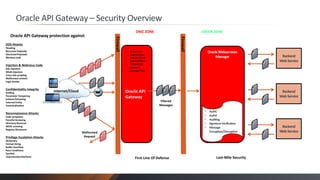
Oracle API Gateway – Security Overview

Flooding
Recursive Payloads
Oversized Payloads
Memory Leak

•
•

Injection & Malicious Code
SQL Injection
XPath Injection
Cross-site scripting
Malformed content
Logic bombs

Confidentiality Integrity
Sniffing
Parameter Tampering
Schema Poisoning
External Entity
Canonicalization

•

Firewall

DOS Attacks

GREEN ZONE

DMZ ZONE

Firewall

Oracle API Gateway protection against

Virtualize a
web services
Inbuilt Out-ofthe-Box filters
Throttle the
inbound
message flow

Privilege Escalation Attacks
Dictionary
Format String
Buffer Overflow
Race Conditions
Symlink
Unprotected interfaces

Oracle Webservices
Manager

O
W
S
M

Backend
Web Service

End point security
O
W
S
M

Oracle API
Gateway

Internet/Cloud

Filtered
Messages
•
•
•
•
•

Reconnaissance Attacks
Code templates
Forceful browsing
Directory Reversal
WSDL scanning
Registry Disclosure

End point security

Malformed
Request

First Line Of Defense

AuthC
AuthZ
Auditing
Signature Verification
Message
Encryption/Decryption

Last-Mile Security

Backend
Web Service

End point security
O
W
S
M

Backend
Web Service
Oracle API Gateway – Virtualization, Data/Protocol Bridging
GREEN ZONE

DMZ ZONE

Firewall

Firewall

HTTP GET/POST - REST

SSOToken

REST/JSON

< weatherreport city=“San Francisco"
weather=“42" >< /weatherreport>

SAML Token

Oracle
Webservices
Manager

Required transport
& format protocol

RESTful Web
Service

REST/XML

SOAP

Oracle API
Gateway
{ "weatherreport" : {"city":“San Francisco",
"weather":“42"} }

JMS
SAML Token

SOAP Web
Service
Required transport
& format protocol
Data Format Transformations
XML to JSON and vice versa
Protocol bridging
REST to SOAP and vice versa

First Line Of Defense

Last-Mile Security
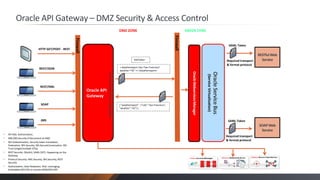
Oracle API Gateway – DMZ Security & Access Control
GREEN ZONE

DMZ ZONE

Firewall

Firewall

HTTP GET/POST - REST

SAML Token

SSOToken

JMS

SOAP/REST Virtual Web Services

{ "weatherreport" : {"city":“San Francisco",
"weather":“42"} }

Oracle Service Bus

SOAP

Oracle API
Gateway

(Service Virtualization)

REST/XML

Oracle Webservices Manager

< weatherreport city=“San Francisco"
weather=“42" >< /weatherreport>

REST/JSON

Required transport
& format protocol

RESTful Web
Service

SAML Token

SOAP Web
Service
•
•
•

•
•
•

API SSO, Authorization,
XML/WS Security Enforcement at DMZ
WS Authentication, Security token translation,
Federation: WS-Security, WS-SecureConversation, WSTrust (single/multiple STSs).
REST Security: OAuth2, SAML (OIT). Happening on the
Gateway.
Protocol Security: XML Security, WS-Security, REST
Security
Authorization, Data Redaction, Risk: Leveraging
Embedded OES PDP or remote OAM/OES PDP

Required transport
& format protocol
Oracle API Gateway – Social Connectivity
DMZ ZONE
3rd Party IDPs

GREEN ZONE
OAuth
OpenID Connect
SAML

Firewall

Firewall

f

SAML Token

Token

Required transport
& format protocol

SOAP/REST Virtual Web Services

{ "weatherreport" : {"city":“San Francisco",
"weather":“42"} }

Oracle Service Bus

Oracle API
Gateway

API/Web Request with Required Token
(SAML, OAM, Kerberos, OAuth etc.)

(Service Virtualization)

API Request
App/Device/User Credential
Web SSO

Oracle Webservices Manager

< weatherreport city=“San Francisco"
weather=“42" >< /weatherreport>

RESTful Web
Service

SAML Token

SOAP Web
Service
HTTP/REST/SOAP/OAuth Clients

Required transport
& format protocol
Oracle API Gateway – Fine Grained AuthZ and Data Redaction
GREEN ZONE

DMZ ZONE

Firewall

{<Response>
<Response Data 1>, <Response Data 2>,
<Response Data 3> <Response Data 4>,
<Response Data 5>, }

Firewall

HTTP GET/POST – REST
{<Request>}

Response Data1
Response Data2

SSOToken

Response Data3

{<Response>
<Response Data 3>
<Response Data 4>}

Oracle API
Gateway
{ <Response>}

SOAP {<Request>}
{<Response>
<Response Data 1>
<Response Data 2>}

Response Data5

SAML Token/ Request

End point security
O
W
S
M

RESTful/SOAP
Web Service

Response

PEP

JMS {<Request>}

(Service Virtualization)

{<Response>
<Response Data 5>}

Response Data4

Oracle Service Bus

{< Request>}

Oracle Webservices Manager

REST/JSON
{<Request>}

REST/XML {<Request>}

Existing API/WS Returns

PDP

{<Response>
<Response Data 1>}

Entitlements Server

Data Format Transformations
XML to JSON and vice versa
Protocol bridging
REST to SOAP and vice versa

First Line Of Defense

Last-Mile Security
Oracle API Gateway – API Key Management(Cloud Consumer)
GREEN ZONE

DMZ ZONE

Firewall

Google

Firewall

APIKey_Google

Oracle API
Gateway
SSOToken

Oracle Service Bus

{ <Response>}

(Service Virtualization)

APIKey_Y

API Key +
Web Service Request

X

{< Request>}
APIKey_Google

Oracle Webservices Manager

APIKey_X

Y
APIKey_X

APIKey_Y

First Line Of Defense

Last-Mile Security

SAML Token/ Request

End point security
O
W
S
M

Response

RESTful/SOAP
Web Service
Oracle API Gateway – Configuration & Management Tools
Policy
Studio

Oracle API
Gateway

Policy Studio is a policy development and configuration tool
• Enables policy developers to easily configure API Gateway policies and settings to control
and protect deployed API services and Web services.
• Policy Studio is typically installed on a separate machine from the API Gateway to enable
remote administration.

Manager

API Gateway Manager is a centralized web-based dashboard
• Enables administrators to control and manage API Gateways and groups in a domain.
• Connects to the Node Manager on each host, and displays aggregated monitoring data from
multiple API Gateway instances.

Oracle API Gateway Instance (Core Engine)

Policy Development
A Oracle API Gateway policy developer typically performs the following tasks:
•
•
•
•

Develops API Gateway policies and solution packs.
Customizes and extends the API Gateway using scripting.
Creates Java classes and/or custom filters using the API Gateway filter SDK.
Uses the Policy Studio, API Gateway Explorer, and API Gateway Manager tools.

Connector

Usage
Metrics

Connector

Connector

Connector

Analytics

API Gateway Analytics is a separately installed tool used by administrators
• Generates reports and charts based on usage metrics for all services and API Gateways in a
domain.
• API Gateway Analytics provides integration with databases such as MySQL Server, MS SQL
Server, and Oracle.
• Includes both real-time and historical metrics.
Oracle API Gateway – Managed Domain Architecture
POLICY
STUDIO

Browser-based
Manager UI

DOMAIN
ADMIN NODE MANAGER

Domain is the set of all hosts(Physical machine) running API Gateway instances, which are
managed centrally by the API Gateway Manager tool.

NODE MANAGER

Server Instance 1

Services Group 1

Server Instance 2

Server Instance 1

Services Group 2

Server Instance 2

Server Instance 1

TEST
GROUP

Node 1(Master)

Node 2

API Gateway's group-based domain architecture, which
enables to break down projects into logical groups and
manage configuration across your organization. This provides
manageability and scalability, and enables you to perform
load balancing and failover across distributed deployments

Group
• Number of API Gateway instances that all run the same configuration.
• Can runs across more than one physical host machine.
• Can include more than one API Gateway instance on the same host
• Each API Gateway in the group runs the same configuration
• Each API Gateway has its own deployment descriptor file (envSettings.properties)
• A group also has a deployment descriptor, which specifies settings values that are the same
across the group but may differ in different environments.
• A standalone API Gateway runs in a group of one member (TEST GROUP in the diagram).
• Deploy, manage, and monitor a group of API Gateways using the Policy Studio and the
browser-based API Gateway Manager.
Node Manager(Server side process)
• Manages & Monitors API Gateway instances on the host
• Only one Node Manager runs per host.
• Communication between the Node Manager and the API Gateway is secured using SSL.
• Policy Studio and the browser-based API Gateway Manager are clients of the Node Manager.
• The first Node Manager added in a domain is known as the Admin Node Manager.
• The Admin Node Manager acts as the master Node Manager. It performs Role-Based Access
Control (RBAC), and forwards requests to other Node Managers when required.
• The Admin Node Manager also manages and deploys configuration to the API Gateway
instance(s) in a domain.
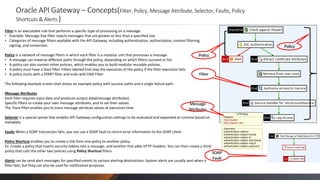
Oracle API Gateway – Concepts(Filter, Policy, Message Attribute, Selector, Faults, Policy
Shortcuts & Alerts )
Filter is an executable rule that performs a specific type of processing on a message.
• Example: Message Size filter rejects messages that are greater or less than a specified size.
• Categories of message filters available with the API Gateway, including authentication, authorization, content filtering,
signing, and conversion.
Policy is a network of message filters in which each filter is a modular unit that processes a message.
• A message can traverse different paths through the policy, depending on which filters succeed or fail.
• A policy can also contain other policies, which enables you to build modular reusable policies.
• A policy must have a Start filter. Filters labeled End stop the execution of the policy if the filter execution fails.
• A policy starts with a START filter and ends with END Filter

Policy

Policy

Filter

The following example screen shot shows an example policy with success paths and a single failure path:
Message Attributes
Each filter requires input data and produces output data(message attributes) .
Specific filters to create your own message attributes, and to set their values.
The Trace filter enables you to trace message attribute values at execution time.

Message
Attributes

Selector is a special syntax that enables API Gateway configuration settings to be evaluated and expanded at runtime based on
metadata
Faults When a SOAP transaction fails, you can use a SOAP fault to return error information to the SOAP client.
Policy Shortcut enables you to create a link from one policy to another policy.
Ex: Create a policy that inserts security tokens into a message, and another that adds HTTP headers. You can then create a third
policy that calls the other two policies using Policy Shortcut filters.
SOAP
Alerts can be send alert messages for specified events to various alerting destinations. System alerts are usually sent when a
filter fails, but they can also be used for notification purposes.

Fault
Oracle API Gateway – Concepts(Policy Container, Policy Context, Process, Listeners, Protocol
Mediation, Remote Hosts, Servlet Application, Configuration Profile, Service Virtualization)
Policy Container used to group similar policies together (for example, all authentication or logging policies), or policies that relate to a particular service.
Policy Context : Policies can execute in a specified context(set a context by associating a relative execution path or listener with a policy).
Process is an instance of the API Gateway capable of running on a host.
Listeners : Define different types of listeners and associate them with specific policies.
Protocol Mediation: The API Gateway can be used to provide protocol mediation (for example, receiving a SOAP request over JMS, and transforming it into a SOAP/HTTP request to a backend service).
Remote Hosts: Define a remote host when you need more control of the connection settings to a particular server.
HTTP version, IP addresses, Timeouts, Buffers, Caches
Servlet Applications : Provides a Web server and servlet application server that can be used to host static content (for example, documentation for your project), or servlets providing internal
services.
Configuration Profile contains the configuration information required to run the API Gateway.
For example, a specific Configuration Profile instance can store certificates, users, core policies and services, external connections, or listeners.
Service Virtualization
When you register an API service or Web Service, and deploy it to the API Gateway, the API Gateway virtualizes the service. Instead of connecting to the service directly, clients connect
through the API Gateway. The API Gateway can then apply policies to messages sent to the destination service
Question & Answers
Thanks

Oracle API Gateway

  • 1.
    Oracle API Gateway RakeshGujjarlapudi rakesh_gujJ@yahoo.com
  • 2.
    Oracle API Gateway- Basic Architecture CLIENTS Application Servers Partner Applications Mobile Applications XML / JSON Oracle API Gateway Web Applications Cloud-Based Services Oracle API Gateway integrates, accelerates, governs, and secures Web API and SOA-based systems. Serves REST APIs and SOAP Web Services to clients  Converts REST to SOAP  Converts XML to JSON Supports other protocols also  FTP, SFTP, FTPS, TIBCO Rendezvous and EMS, JMS (to IBM WebSphere MQ, ActiveMQ, JBOSS Messaging) Applies security rules  Authentication: OAuth, HTTP Auth, Certificate Auth, WS-Security Content Filtering: Detection of SQL Injection, XSS, Viruses Monitoring of API and Service usage Caching and Traffic Management (routing, throttling) Legacy Applications Data
  • 3.
    Oracle API Gateway- Deployment Architecture GREEN ZONE Shared Services Layer RED ZONE First Line Of Defense CLIENTS End point security HTTP, SOAP, REST, XML, JMS Cloud-Based Services Webservice Clients REST-WS Clients OES PDP WS-Security, Basic Auth, Digest, X509, UNT,SAML, Kerberos Sign & Encrypt EXTRANET Oracle Service Bus Oracle API Gateway (Service Virtualization) Firewall Web Applications Internal Firewall Mobile Applications Oracle Webservices Manager Partner Applications WS-Security, Basic Auth, Digest, X509, UNT, SAML, Kerberos Sign & Encrypt O W S M BPEL/Web Service End point security HTTP, SOAP, REST, XML, JMS O W S M BPM Process End point security HTTP, SOAP, REST, XML, JMS O W S M Application INTRANET DMZ In Green Zone security use OWSM in conjunction with Oracle FMW products(SOA Suite, OSB, etc. both on the Client Side and Service Side Policy In Red Zone security OEG on the Service Side Policy.
  • 4.
    Oracle API Gateway– Security Overview Flooding Recursive Payloads Oversized Payloads Memory Leak • • Injection & Malicious Code SQL Injection XPath Injection Cross-site scripting Malformed content Logic bombs Confidentiality Integrity Sniffing Parameter Tampering Schema Poisoning External Entity Canonicalization • Firewall DOS Attacks GREEN ZONE DMZ ZONE Firewall Oracle API Gateway protection against Virtualize a web services Inbuilt Out-ofthe-Box filters Throttle the inbound message flow Privilege Escalation Attacks Dictionary Format String Buffer Overflow Race Conditions Symlink Unprotected interfaces Oracle Webservices Manager O W S M Backend Web Service End point security O W S M Oracle API Gateway Internet/Cloud Filtered Messages • • • • • Reconnaissance Attacks Code templates Forceful browsing Directory Reversal WSDL scanning Registry Disclosure End point security Malformed Request First Line Of Defense AuthC AuthZ Auditing Signature Verification Message Encryption/Decryption Last-Mile Security Backend Web Service End point security O W S M Backend Web Service
  • 5.
    Oracle API Gateway– Virtualization, Data/Protocol Bridging GREEN ZONE DMZ ZONE Firewall Firewall HTTP GET/POST - REST SSOToken REST/JSON < weatherreport city=“San Francisco" weather=“42" >< /weatherreport> SAML Token Oracle Webservices Manager Required transport & format protocol RESTful Web Service REST/XML SOAP Oracle API Gateway { "weatherreport" : {"city":“San Francisco", "weather":“42"} } JMS SAML Token SOAP Web Service Required transport & format protocol Data Format Transformations XML to JSON and vice versa Protocol bridging REST to SOAP and vice versa First Line Of Defense Last-Mile Security
  • 6.
    Oracle API Gateway– DMZ Security & Access Control GREEN ZONE DMZ ZONE Firewall Firewall HTTP GET/POST - REST SAML Token SSOToken JMS SOAP/REST Virtual Web Services { "weatherreport" : {"city":“San Francisco", "weather":“42"} } Oracle Service Bus SOAP Oracle API Gateway (Service Virtualization) REST/XML Oracle Webservices Manager < weatherreport city=“San Francisco" weather=“42" >< /weatherreport> REST/JSON Required transport & format protocol RESTful Web Service SAML Token SOAP Web Service • • • • • • API SSO, Authorization, XML/WS Security Enforcement at DMZ WS Authentication, Security token translation, Federation: WS-Security, WS-SecureConversation, WSTrust (single/multiple STSs). REST Security: OAuth2, SAML (OIT). Happening on the Gateway. Protocol Security: XML Security, WS-Security, REST Security Authorization, Data Redaction, Risk: Leveraging Embedded OES PDP or remote OAM/OES PDP Required transport & format protocol
  • 7.
    Oracle API Gateway– Social Connectivity DMZ ZONE 3rd Party IDPs GREEN ZONE OAuth OpenID Connect SAML Firewall Firewall f SAML Token Token Required transport & format protocol SOAP/REST Virtual Web Services { "weatherreport" : {"city":“San Francisco", "weather":“42"} } Oracle Service Bus Oracle API Gateway API/Web Request with Required Token (SAML, OAM, Kerberos, OAuth etc.) (Service Virtualization) API Request App/Device/User Credential Web SSO Oracle Webservices Manager < weatherreport city=“San Francisco" weather=“42" >< /weatherreport> RESTful Web Service SAML Token SOAP Web Service HTTP/REST/SOAP/OAuth Clients Required transport & format protocol
  • 8.
    Oracle API Gateway– Fine Grained AuthZ and Data Redaction GREEN ZONE DMZ ZONE Firewall {<Response> <Response Data 1>, <Response Data 2>, <Response Data 3> <Response Data 4>, <Response Data 5>, } Firewall HTTP GET/POST – REST {<Request>} Response Data1 Response Data2 SSOToken Response Data3 {<Response> <Response Data 3> <Response Data 4>} Oracle API Gateway { <Response>} SOAP {<Request>} {<Response> <Response Data 1> <Response Data 2>} Response Data5 SAML Token/ Request End point security O W S M RESTful/SOAP Web Service Response PEP JMS {<Request>} (Service Virtualization) {<Response> <Response Data 5>} Response Data4 Oracle Service Bus {< Request>} Oracle Webservices Manager REST/JSON {<Request>} REST/XML {<Request>} Existing API/WS Returns PDP {<Response> <Response Data 1>} Entitlements Server Data Format Transformations XML to JSON and vice versa Protocol bridging REST to SOAP and vice versa First Line Of Defense Last-Mile Security
  • 9.
    Oracle API Gateway– API Key Management(Cloud Consumer) GREEN ZONE DMZ ZONE Firewall Google Firewall APIKey_Google Oracle API Gateway SSOToken Oracle Service Bus { <Response>} (Service Virtualization) APIKey_Y API Key + Web Service Request X {< Request>} APIKey_Google Oracle Webservices Manager APIKey_X Y APIKey_X APIKey_Y First Line Of Defense Last-Mile Security SAML Token/ Request End point security O W S M Response RESTful/SOAP Web Service
  • 10.
    Oracle API Gateway– Configuration & Management Tools Policy Studio Oracle API Gateway Policy Studio is a policy development and configuration tool • Enables policy developers to easily configure API Gateway policies and settings to control and protect deployed API services and Web services. • Policy Studio is typically installed on a separate machine from the API Gateway to enable remote administration. Manager API Gateway Manager is a centralized web-based dashboard • Enables administrators to control and manage API Gateways and groups in a domain. • Connects to the Node Manager on each host, and displays aggregated monitoring data from multiple API Gateway instances. Oracle API Gateway Instance (Core Engine) Policy Development A Oracle API Gateway policy developer typically performs the following tasks: • • • • Develops API Gateway policies and solution packs. Customizes and extends the API Gateway using scripting. Creates Java classes and/or custom filters using the API Gateway filter SDK. Uses the Policy Studio, API Gateway Explorer, and API Gateway Manager tools. Connector Usage Metrics Connector Connector Connector Analytics API Gateway Analytics is a separately installed tool used by administrators • Generates reports and charts based on usage metrics for all services and API Gateways in a domain. • API Gateway Analytics provides integration with databases such as MySQL Server, MS SQL Server, and Oracle. • Includes both real-time and historical metrics.
  • 11.
    Oracle API Gateway– Managed Domain Architecture POLICY STUDIO Browser-based Manager UI DOMAIN ADMIN NODE MANAGER Domain is the set of all hosts(Physical machine) running API Gateway instances, which are managed centrally by the API Gateway Manager tool. NODE MANAGER Server Instance 1 Services Group 1 Server Instance 2 Server Instance 1 Services Group 2 Server Instance 2 Server Instance 1 TEST GROUP Node 1(Master) Node 2 API Gateway's group-based domain architecture, which enables to break down projects into logical groups and manage configuration across your organization. This provides manageability and scalability, and enables you to perform load balancing and failover across distributed deployments Group • Number of API Gateway instances that all run the same configuration. • Can runs across more than one physical host machine. • Can include more than one API Gateway instance on the same host • Each API Gateway in the group runs the same configuration • Each API Gateway has its own deployment descriptor file (envSettings.properties) • A group also has a deployment descriptor, which specifies settings values that are the same across the group but may differ in different environments. • A standalone API Gateway runs in a group of one member (TEST GROUP in the diagram). • Deploy, manage, and monitor a group of API Gateways using the Policy Studio and the browser-based API Gateway Manager. Node Manager(Server side process) • Manages & Monitors API Gateway instances on the host • Only one Node Manager runs per host. • Communication between the Node Manager and the API Gateway is secured using SSL. • Policy Studio and the browser-based API Gateway Manager are clients of the Node Manager. • The first Node Manager added in a domain is known as the Admin Node Manager. • The Admin Node Manager acts as the master Node Manager. It performs Role-Based Access Control (RBAC), and forwards requests to other Node Managers when required. • The Admin Node Manager also manages and deploys configuration to the API Gateway instance(s) in a domain.
  • 12.
    Oracle API Gateway– Concepts(Filter, Policy, Message Attribute, Selector, Faults, Policy Shortcuts & Alerts ) Filter is an executable rule that performs a specific type of processing on a message. • Example: Message Size filter rejects messages that are greater or less than a specified size. • Categories of message filters available with the API Gateway, including authentication, authorization, content filtering, signing, and conversion. Policy is a network of message filters in which each filter is a modular unit that processes a message. • A message can traverse different paths through the policy, depending on which filters succeed or fail. • A policy can also contain other policies, which enables you to build modular reusable policies. • A policy must have a Start filter. Filters labeled End stop the execution of the policy if the filter execution fails. • A policy starts with a START filter and ends with END Filter Policy Policy Filter The following example screen shot shows an example policy with success paths and a single failure path: Message Attributes Each filter requires input data and produces output data(message attributes) . Specific filters to create your own message attributes, and to set their values. The Trace filter enables you to trace message attribute values at execution time. Message Attributes Selector is a special syntax that enables API Gateway configuration settings to be evaluated and expanded at runtime based on metadata Faults When a SOAP transaction fails, you can use a SOAP fault to return error information to the SOAP client. Policy Shortcut enables you to create a link from one policy to another policy. Ex: Create a policy that inserts security tokens into a message, and another that adds HTTP headers. You can then create a third policy that calls the other two policies using Policy Shortcut filters. SOAP Alerts can be send alert messages for specified events to various alerting destinations. System alerts are usually sent when a filter fails, but they can also be used for notification purposes. Fault
  • 13.
    Oracle API Gateway– Concepts(Policy Container, Policy Context, Process, Listeners, Protocol Mediation, Remote Hosts, Servlet Application, Configuration Profile, Service Virtualization) Policy Container used to group similar policies together (for example, all authentication or logging policies), or policies that relate to a particular service. Policy Context : Policies can execute in a specified context(set a context by associating a relative execution path or listener with a policy). Process is an instance of the API Gateway capable of running on a host. Listeners : Define different types of listeners and associate them with specific policies. Protocol Mediation: The API Gateway can be used to provide protocol mediation (for example, receiving a SOAP request over JMS, and transforming it into a SOAP/HTTP request to a backend service). Remote Hosts: Define a remote host when you need more control of the connection settings to a particular server. HTTP version, IP addresses, Timeouts, Buffers, Caches Servlet Applications : Provides a Web server and servlet application server that can be used to host static content (for example, documentation for your project), or servlets providing internal services. Configuration Profile contains the configuration information required to run the API Gateway. For example, a specific Configuration Profile instance can store certificates, users, core policies and services, external connections, or listeners. Service Virtualization When you register an API service or Web Service, and deploy it to the API Gateway, the API Gateway virtualizes the service. Instead of connecting to the service directly, clients connect through the API Gateway. The API Gateway can then apply policies to messages sent to the destination service
  • 14.