How incentive based pay effects teacher motivation  By Quincy Bryant
Introduction  How incentive based pay effects teacher motivation  Corporate incentive based  programs and the effect on  employee motivation  Moral and financial programs
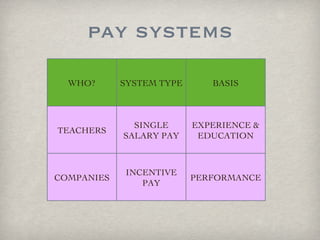
pay systems WHO? SYSTEM TYPE BASIS TEACHERS SINGLE SALARY PAY EXPERIENCE & EDUCATION COMPANIES INCENTIVE PAY PERFORMANCE
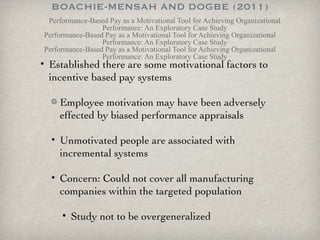
BOACHIE-MENSAH AND DOGBE (2011) Performance-Based Pay as a Motivational Tool for Achieving Organizational Performance: An Exploratory Case Study Performance-Based Pay as a Motivational Tool for Achieving Organizational Performance: An Exploratory Case Study Performance-Based Pay as a Motivational Tool for Achieving Organizational Performance: An Exploratory Case Study Established there are some motivational factors to incentive based pay systems Employee motivation may have been adversely effected by biased performance appraisals Unmotivated people are associated with incremental systems Concern: Could not cover all manufacturing companies within the targeted population Study not to be overgeneralized
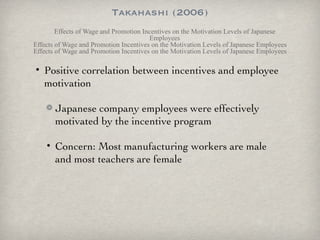
Takahashi (2006) Effects of Wage and Promotion Incentives on the Motivation Levels of Japanese Employees Effects of Wage and Promotion Incentives on the Motivation Levels of Japanese Employees Effects of Wage and Promotion Incentives on the Motivation Levels of Japanese Employees Positive correlation between incentives and employee motivation Japanese company employees were effectively motivated by the incentive program Concern: Most manufacturing workers are male and most teachers are female
Anderson, Dekker, and sedatole (2010) An Empirical Examination of Goals and Performance-to-Goal Following the Introduction of an Incentive Bonus Plan with Participative Goal Setting. Increased motivation of mangers was directly tied to the introduction of monetary incentives Managers were involved in setting goals, and meant but did not exceed goals  Demonstrated positive motivations in other industries
Al-Nsour (2012) Relationship Between Incentives and Organizational Performance for Employees in the Jordanian Universities Relationship Between Incentives and Organizational Performance for Employees in the Jordanian Universities Relationship Between Incentives and Organizational Performance for Employees in the Jordanian Universities Direct effect of financial and moral incentives on organizational performance Financial incentives ranked 1st place, Moral incentives ranked 2nd place Concerns: Only 5 universities selected Strengths: Statistical analysis software & Five-Point Likert Scale Parallel indicated between business sector and the educational system
podgursky & Springer (2011) Teacher Compensation Systems in the United States K-12 Public School System Teacher Compensation Systems in the United States K-12 Public School System Teacher Compensation Systems in the United States K-12 Public School System Student test results and achievements in relation to current pay system Top-performing teachers produced 3 x the achievement growth of low-performing teachers Paid based on education level and experience instead of performance Incentive based programs only in areas where availability of teachers was low
leigh (2010) Estimating Teacher Effectiveness From Two-Year Changes in Students Test Scores Estimating Teacher Effectiveness From Two-Year Changes in Students Test Scores Estimating Teacher Effectiveness From Two-Year Changes in Students Test Scores Correlation when teachers are offered incentives to work in less desirable schools their motivation will increase Increased willingness of teachers to work in less desirable schools Large sample of over 10,000 Australian schools Incentives are useful in increasing teacher effectiveness
kobakhidze (2010) Teacher Incentives and the Future of Merit-Based Pay in Georgia Teacher Incentives and the Future of Merit-Based Pay in Georgia Teacher Incentives and the Future of Merit-Based Pay in Georgia Teachers were more motivated through non-monetary rewards over student performance based incentives Teachers identified low pay as biggest problem in teaching profession Examined teacher motivation to remain in the profession due to low wages and poor working conditions Global look at incentive based pay in developing countries
lavy (2009) Performance Pay and Teachers Effort, Productivity, and Grading Ethics Performance Pay and Teachers Effort, Productivity, and Grading Ethics Performance Pay and Teachers Effort, Productivity, and Grading Ethics Where incentive based pay program was in place, the program had a motivation effect on teachers Effects of the program on teachers’ pedagogy and effort Incentives were based on students’ test scores which increased
muralidharan & sundararaman (2011) Teacher Opinions on Performance Pay: Evidence from India Teacher Opinions on Performance Pay: Evidence from India Teacher Opinions on Performance Pay: Evidence from India Positive attitude of teachers towards individual incentive based pay Correlation continues to be positive and significant after controlling for several characteristics Teachers aware of their own effectiveness
west & mykerezi (2011) Teachers Unions and Compensation: The Impact of Collective Bargaining on Salary Schedules and Performance Pay Schemes Teachers Unions and Compensation: The Impact of Collective Bargaining on Salary Schedules and Performance Pay Schemes Teachers Unions and Compensation: The Impact of Collective Bargaining on Salary Schedules and Performance Pay Schemes Education and experience are poor proxies for quality teaching skills Teachers and unions not excited to implement an input based pay reward system If pay was based on student achievement, it would create an undesirable competition amongst teachers
conclusions The links between incentive based pay and teacher motivation are largely connected to corporate incentive based pay programs and employee motivation Unintended complications of incentive based pay in schools: teachers may begin to lobby and compete for more successful students, motivations may fail, teachers may not buy in to the program Corporate and university incentive based pay programs have proven successful Connection between HR policies and programs for teachers
limitations and recommendations Limitation of current research is the lack of research that reviews the effect of an incentive based program on teachers’ motivation Focus on teachers who are working in an incentive based pay system Do incentive pay systems motivate teachers? How are teachers motivated through incentive based pay systems?
relevance Current research does not address teacher motivation Primary focus area should be how teachers are effected by incentive based pay Correlation between incentives and teachers motivation is inline with those of other industries

Lit Review Power Point

  • 1.
    How incentive basedpay effects teacher motivation By Quincy Bryant
  • 2.
    Introduction Howincentive based pay effects teacher motivation Corporate incentive based programs and the effect on employee motivation Moral and financial programs
  • 3.
    pay systems WHO?SYSTEM TYPE BASIS TEACHERS SINGLE SALARY PAY EXPERIENCE & EDUCATION COMPANIES INCENTIVE PAY PERFORMANCE
  • 4.
    BOACHIE-MENSAH AND DOGBE(2011) Performance-Based Pay as a Motivational Tool for Achieving Organizational Performance: An Exploratory Case Study Performance-Based Pay as a Motivational Tool for Achieving Organizational Performance: An Exploratory Case Study Performance-Based Pay as a Motivational Tool for Achieving Organizational Performance: An Exploratory Case Study Established there are some motivational factors to incentive based pay systems Employee motivation may have been adversely effected by biased performance appraisals Unmotivated people are associated with incremental systems Concern: Could not cover all manufacturing companies within the targeted population Study not to be overgeneralized
  • 5.
    Takahashi (2006) Effectsof Wage and Promotion Incentives on the Motivation Levels of Japanese Employees Effects of Wage and Promotion Incentives on the Motivation Levels of Japanese Employees Effects of Wage and Promotion Incentives on the Motivation Levels of Japanese Employees Positive correlation between incentives and employee motivation Japanese company employees were effectively motivated by the incentive program Concern: Most manufacturing workers are male and most teachers are female
  • 6.
    Anderson, Dekker, andsedatole (2010) An Empirical Examination of Goals and Performance-to-Goal Following the Introduction of an Incentive Bonus Plan with Participative Goal Setting. Increased motivation of mangers was directly tied to the introduction of monetary incentives Managers were involved in setting goals, and meant but did not exceed goals Demonstrated positive motivations in other industries
  • 7.
    Al-Nsour (2012) RelationshipBetween Incentives and Organizational Performance for Employees in the Jordanian Universities Relationship Between Incentives and Organizational Performance for Employees in the Jordanian Universities Relationship Between Incentives and Organizational Performance for Employees in the Jordanian Universities Direct effect of financial and moral incentives on organizational performance Financial incentives ranked 1st place, Moral incentives ranked 2nd place Concerns: Only 5 universities selected Strengths: Statistical analysis software & Five-Point Likert Scale Parallel indicated between business sector and the educational system
  • 8.
    podgursky & Springer(2011) Teacher Compensation Systems in the United States K-12 Public School System Teacher Compensation Systems in the United States K-12 Public School System Teacher Compensation Systems in the United States K-12 Public School System Student test results and achievements in relation to current pay system Top-performing teachers produced 3 x the achievement growth of low-performing teachers Paid based on education level and experience instead of performance Incentive based programs only in areas where availability of teachers was low
  • 9.
    leigh (2010) EstimatingTeacher Effectiveness From Two-Year Changes in Students Test Scores Estimating Teacher Effectiveness From Two-Year Changes in Students Test Scores Estimating Teacher Effectiveness From Two-Year Changes in Students Test Scores Correlation when teachers are offered incentives to work in less desirable schools their motivation will increase Increased willingness of teachers to work in less desirable schools Large sample of over 10,000 Australian schools Incentives are useful in increasing teacher effectiveness
  • 10.
    kobakhidze (2010) TeacherIncentives and the Future of Merit-Based Pay in Georgia Teacher Incentives and the Future of Merit-Based Pay in Georgia Teacher Incentives and the Future of Merit-Based Pay in Georgia Teachers were more motivated through non-monetary rewards over student performance based incentives Teachers identified low pay as biggest problem in teaching profession Examined teacher motivation to remain in the profession due to low wages and poor working conditions Global look at incentive based pay in developing countries
  • 11.
    lavy (2009) PerformancePay and Teachers Effort, Productivity, and Grading Ethics Performance Pay and Teachers Effort, Productivity, and Grading Ethics Performance Pay and Teachers Effort, Productivity, and Grading Ethics Where incentive based pay program was in place, the program had a motivation effect on teachers Effects of the program on teachers’ pedagogy and effort Incentives were based on students’ test scores which increased
  • 12.
    muralidharan & sundararaman(2011) Teacher Opinions on Performance Pay: Evidence from India Teacher Opinions on Performance Pay: Evidence from India Teacher Opinions on Performance Pay: Evidence from India Positive attitude of teachers towards individual incentive based pay Correlation continues to be positive and significant after controlling for several characteristics Teachers aware of their own effectiveness
  • 13.
    west & mykerezi(2011) Teachers Unions and Compensation: The Impact of Collective Bargaining on Salary Schedules and Performance Pay Schemes Teachers Unions and Compensation: The Impact of Collective Bargaining on Salary Schedules and Performance Pay Schemes Teachers Unions and Compensation: The Impact of Collective Bargaining on Salary Schedules and Performance Pay Schemes Education and experience are poor proxies for quality teaching skills Teachers and unions not excited to implement an input based pay reward system If pay was based on student achievement, it would create an undesirable competition amongst teachers
  • 14.
    conclusions The linksbetween incentive based pay and teacher motivation are largely connected to corporate incentive based pay programs and employee motivation Unintended complications of incentive based pay in schools: teachers may begin to lobby and compete for more successful students, motivations may fail, teachers may not buy in to the program Corporate and university incentive based pay programs have proven successful Connection between HR policies and programs for teachers
  • 15.
    limitations and recommendationsLimitation of current research is the lack of research that reviews the effect of an incentive based program on teachers’ motivation Focus on teachers who are working in an incentive based pay system Do incentive pay systems motivate teachers? How are teachers motivated through incentive based pay systems?
  • 16.
    relevance Current researchdoes not address teacher motivation Primary focus area should be how teachers are effected by incentive based pay Correlation between incentives and teachers motivation is inline with those of other industries

Editor's Notes

  • #3 These are the three areas I studied to measure the effectiveness of incentive programs on motivating teachers as well as workers in other fields. I draw a positive correlation between incentive based pay and motivation within these three parallels.
  • #4 The majority of teacher’s salaries are based on a single salary pay schedule that rewards experience and education. while many companies incorporate an incentive based system that rewards performance.
  • #5 Many different companies use an incentive based pay system to improve the motivation and production of their workers. Boachie-Mensah and Dogbe (2011) conducted a study which included 20 managerial staff and 60 non-managerial staff using a questionnaire with a two-way anova in analysis. The study suggested that there are some motivational factors to incentive-based pay systems. However, the study also found that employee motivation may have been adversely effected by biased performance appraisals. This indicates there may have been a positive relationship between incentive-based pay and motivation, however, it also may have been damaged by the evaluation of the managers. The study also stated that unmotivated people are associated with incremental systems, which is the type of system teachers currently have. A major concern of this study was that it could not cover all manufacturing companies within the targeted population, due to time and financial constraints and thus, should not be overgeneralized.
  • #6 Takahashi (2006), like the pervious study, found a positive correlation between incentives and employee motivation. The study was conducted using a Japanese company which found that the employees in this company were effectively motivated by the incentive program that was introduced by the employer. This study was completed using 2,000 questionnaires sent to 75 companies. 1,823 questionnaires were returned with 1,729 of them being from male respondents. One concern of this study in comparison to teachers is that the manufacturing industry is made up primarily of male employees while the teaching profession is primarily female. The strengths of this study include the large sample size and the high participation rate. This study directly supports the hypothesis as it finds a positive correlation between incentive based pay and employee motivation.
  • #7 Anderson, Dekker, Sedatole (2010) found the increased motivation of managers was directly tied to the introduction of monetary incentives set by managers and supervisors. This study reviewed quarterly sales and sales-goal data in relation to an introduced incentive plan across 61 stores of mid-sized U.S. retailers. In the early stages of implementation, managers were surveyed and this data was utilized within the study as well. When the managers were more involved in setting the goals for the incentive based pay program, managers met the goals but did not exceed the goals. This demonstrated that in other industries there are positive motivations to incentive based pay.
  • #8 AL-Nsour (2012), moral incentives and financial incentives were examined. Using 421 returned questionnaires out of 500 persons, the study reviewed the opinions of employees at five Jordanian universities towards incentive based pay programs including moral and financial incentives. This study showed that financial incentives ranked in 1st place in a survey of Jordanian university employees while moral incentives ranked 2nd place. Concerns within this study included that only five universities were selected for this study and that variations in the results could occur as a result of differences in the incentive approach used. The study was conducted using statistical analysis software was used to analyze the results of the questionnaire. The questionnaire was constructed using the five-point likert scale and results were reviewed by university professors. This study drew a conclusion that there was a direct effect of financial and moral incentives on organizational performance and customer satisfaction. This indicated a parallel between the business sector and the educational system when combined with other evidence that showed incentive based pay increased motivation. The study states that incentive based pay programs “play an active role in pushing forward individual's capacity and moving abilities, motivating them to develop their skills, and balance between organization requirements and the individuals' needs which enhance the organization performance efficiently and effectively” (AL-Nsour, 2012, p. 85).
  • #9 Though a incentive based pay system is common in companies, it is not common within the public school system. Podgursky & Springer (2011) completed a review of how teachers are currently paid in the K-12 school system in the United States. This review included results from four studies ranging in size from 27 to 300 schools each. Many of these studies were based on student test results and achievements and all examined the current pay system. Salary schedules across the public school system have been standardized and treat all teachers equally regardless of performance or field of expertise. Within Podgursky & Springer (2011), one study found top-performing teachers (the 95th percentile or above) produced three times the achievement growth in students when compared to low-performing teachers (Hanushek, 2003). However, due to the salary schedule in place in the public school system, teachers were paid based on education level and experience instead of performance. Incentive programs were only identified in areas where the availability of teachers was low, such as urban settings or less popular fields of study.
  • #10 Leigh (2010) examined the correlation between teacher effectiveness and student acheivement. In this study the ability of teachers to be motivated by incentives to their effectiveness in the classroom was illustrated. Thus, in order for teachers to be more effective, incentives are useful. Using a sample of over 10,000 Australian schools and over 90,000 students, this study gave information about the willingness of teachers to work in undesirable schools. For example, tenured teachers sometimes choose to leave a school located in a low income or low performing school to teach in one located in an area more favorable, such as suburban schools. A correlation is found that if teachers are offered incentives to work in less desirable schools their motivation will increase.
  • #11 Expanding on the study from Australia, Kobakhidze (2010) examined incentive based pay in Georgia. In this study, 98.14 percent of the study sample was female and 1.86 percent was male. Questionnaires were completed by 215 teachers from thirteen different schools and four different districts of Georgia. Additional focus group discussions were held with up to twelve teachers per group during data collection. In the focus group 30.08 percent of teachers identified low pay as the biggest problem in the teaching profession. This study contributes to a global look incentive based pay in developing countries. The study discussed teacher motivation to remain in the profession due to low wages and poor working conditions. This study found that teachers were more motivated through non-monetary rewards over student performance based incentives.
  • #12 Lavy (2009) found that in areas where an incentive based pay program was in place, the program had a motivation effect on teachers. The study included 629 teachers competing across various subjects including English, Mathematics, Hebrew or Arabic, and other subjects across 48 schools. The primary interest of the study was to examine the effect of the program on the teachers’ pedagogy and effort. Teachers during the study worked with students sometimes before and after school and put forth more effort in individualizing learning for students. In this study the incentives were based on students’ test scores which increased.
  • #13 Expanding on this, Muralidharan, Sundararaman (2011) showed that teachers had a positive attitude towards individual incentive based pay. 300 schools were randomly allocated two incentive programs with 100 serving as the control. Teacher feedback was gathered through face to face interviews throughout the study period. 80% of the teachers participating in this study had a favorable view of incentive pay and 45% had a very favorable view of this proposal. “This correlation continues to be positive and significant even after controlling for several observable teacher characteristics, suggesting that teachers are aware of their own effectiveness (based on traits unobservable to the econometrician or policy maker) and that their support for PLP is positively correlated with these unobservables” (Muralidharan, Sundararaman, 2011, p. 401).
  • #14 West & Mykerezi (2011) expanded on the topic of teacher pay structure and the difficulty to attract and retain good teachers. The study provides an example of the current teacher structure, which is an education and experience based pay schedule and how these two criteria are poor proxies for quality teaching skills across 4,000 school districts. The study also discussed how teachers and unions are not excited to implement an input based pay reward system rather than an incentive based system that rewards output of students. This means that teachers and the unions would be motivated to use an input based reward system where they are rewarded for their efforts as opposed to an output based system where teacher are rewarded for their students’ achievement including such things as test scores. Based on this study, teachers also believed if pay was based on student achievement, then it would create an undesirable competition amongst teachers.
  • #15 The links between incentive based pay and teacher motivation are largely connected to corporate incentive based pay programs and employee motivation. The research found that incentive based pay does motivate workers, including teachers (Boachie-Mensah, et al., 2011; Takahashi, 2006; Anderson, et al., 2010; AL-Nsour, 2011; Leigh, 2010; Kobakhidze, 2010; Lavy, 2009; Muralidharan, et al., 2011). However, some of the studies found that with the introduction of incentive based pay comes unintended complications. For example, teachers may begin to lobby and compete for the more successful students, and those who don’t find themselves in classrooms where student are high achievers motivations may fail (Leigh, 2010; Kobakhidze, 2010; Lavy, 2009). If incentives are tied to what teachers may see as results based rather then performance based, then teacher may not buy into the program (West et al., 2011). Corporate and university incentive based pay programs have proven to be successful for employee motivation (Boachie-Mensah, et al., 2011; Takahashi, 2006; Anderson, et al., 2010; AL-Nsour, 2012). There was a connection observed between the incentive based pay in human resource policies of companies and incentive based pay programs for teachers (Podgursky, et al., 2011).
  • #16 A limitation of the current research is the lack of research that reviews the effect of an incentive based program on the teacher’s motivation. In order to better understand this area of study, researchers may want to focus on teachers who are working in an incentive based pay system. This would give a better understanding if incentives directly effect teachers’ motivations and why. The research question may be: Do incentive pay systems motivate teachers? Another question to further develop this area of study may be: How are teachers motivated through incentive based pay systems?
  • #17 The research question is important and relevant to incentive based pay systems for teachers because the current research does not address teacher motivation. Some studies focus on student achievement and test effectiveness while other studies focus on how the pay structure would work for teachers, such as how teachers would be evaluated or measured to receive the incentives. A primary area of focus for this research should be how the teachers are effected by incentive based pay. In summary, incentive based pay is used in many areas of business and all around the country, however, for the purpose of this paper, the correlation between incentives and teachers motivation is inline with those of other industries.