Offshore best practices
QA or the Highway 2019
Breakout Session
Our Goal Today?
Our goal today is not to debate if you
should offshore but to help you be
successful when you do offshore.
2
Why offshore?
It is VERY important to understand why management wants to
offshore. Reasons can be many:
•Cost – do more with less / same budget
•Follow the sun development – get 24 hour development and
testing
•Staff augmentation – fill existing roles with offshore
consultants
•Skill-set augmentation – do not have anyone on staff or
locally which a specific skillset
•Try new technology – current staff doesn’t have the capacity
to try new tech
•Fill delivery needs – need more teams to get the job done
3
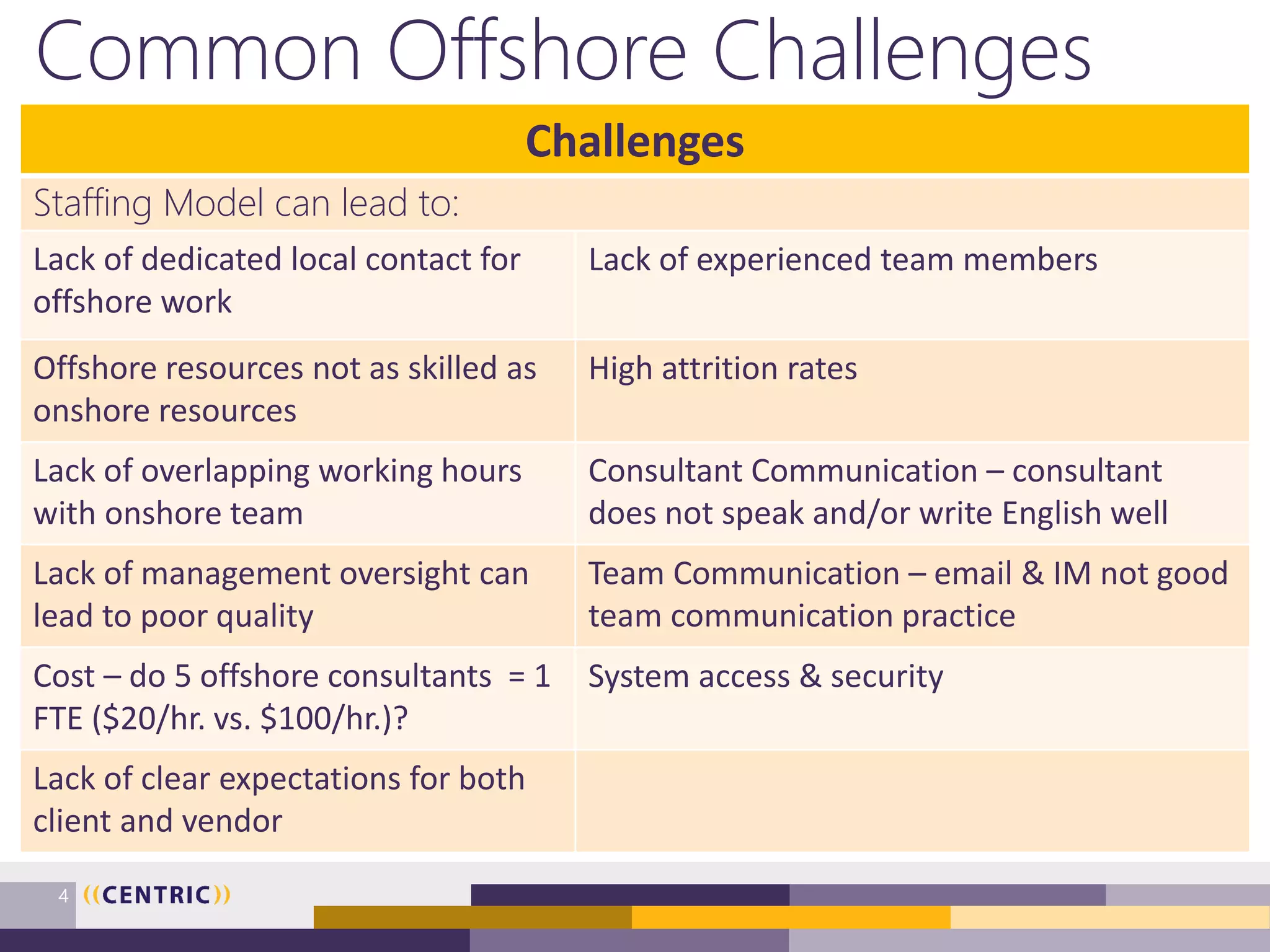
Common Offshore Challenges
4
Challenges
Staffing Model can lead to:
Lack of dedicated local contact for
offshore work
Lack of experienced team members
Offshore resources not as skilled as
onshore resources
High attrition rates
Lack of overlapping working hours
with onshore team
Consultant Communication – consultant
does not speak and/or write English well
Lack of management oversight can
lead to poor quality
Team Communication – email & IM not good
team communication practice
Cost – do 5 offshore consultants = 1
FTE ($20/hr. vs. $100/hr.)?
System access & security
Lack of clear expectations for both
client and vendor
Why do these challenges exist…
•Staffing model
•Many firms staff projects where 70% of team members
have less than 3 years of experience
•Vendor doesn’t match resource with needed skill sets
•Absence of defined governance
•Defined roles and expectations between client and vendor
team
•How do you measure success
•Lack of a true partner
•Partner has the flexibility to find a solution that works best
for the client
• Partner invest in the partnership (i.e. staff, training, onsite
time, move the client forward)
5
What is offshore success?
Success criteria regardless of reason for offshoring:
•Same skillset as onshore resources
•No drop-off in quality of work
•Similar velocity to onshore, individual and team
•Effective communication between on-shore and off-shore
•Quick & efficient equipment & system set-up
•Quick & efficient on-boarding
6
What is offshore success?
Answer depends on original reason for offshoring:
•If reason was cost driven: were you able to get more done
with the same budget?
•If reason was follow-the-sun development: were you able to
achieve 24-7 development with no drop-off in quality?
•If reason was staff augmentation: were you able to augment
your staff with no drop-off in quality?
•If reason was to fill your delivery needs: were you able to fill
your delivery needs?
7
What to offshore?
•Individual roles
•Find qualified resources
•Dip your toe into offshore (need more than 1 resource to
see full benefits of offshoring)
•Entire teams
•Follow-the-sun development
•Fill delivery needs (specific work with clearly defined
deliverables)
•Legacy work
•Allow current team members to upskill themselves
•Supplement an aging workforce
8
How do you measure success?
You need to have measures
Work with Vendor to establish "offshore success
measures" which are in line with internal success
measures
i.e. a team velocity measure of 12 points/sprint
should apply to both internal and offshore teams
9
Some Measures
•If fixed-scope SOW: did they get done what was promised in
time frame expected.
•Were SLA's met (if applicable)?
•Was $$ saved?
Objective measures
10
Some Measures
•Individual (consultant) or team
•Up-to-speed on domain knowledge similar to FTE?
•Are their skills & knowledge improving?
•Are they asking same questions over and over?
•Are they contributing improvement ideas?
•Are they communicating effectively inside and outside the
team?
•Order takes vs. Independent thinkers/workers
Subjective measures
11
Things to consider
"US" mentality
•Were all the same team
•All working towards the same goal
•Were successful together
12
Things to consider
•On-boarding
•Consultant should be trained on client system prior to day
1 (if possible)
•Same equipment and access as peers
•Access to same servers, db’s, api’s, etc..
•Same laptops & tools (may require VPN or CITRIX)
•Schedule team stand-up and meetings in AM
•India is 9-1/2 hours ahead (9:30am stand-up is at 8:00pm
in India)
•Team overlap time
•Require offshore team to work during US hours
(recommended: 8:00am – noon -> 6:30pm – 10:30pm)
Individual Roles
13
Things to consider
•Agile mindset
•Team: short achievable goals
•Better goal: build this screen
•Best goal: on the Orders screen, add OrderID filter
•Digital tracking system (i.e. JIRA)
•Shared by all
•Daily meetings with Lead(s) to track progress
•Require offshore team to work during US hours
(recommended: 8:00am – noon -> 6:30pm – 10:30pm)
Entire Team
14
How are you going to offshore?
•Managed services
•SOW
•Staff Augmentation
•Big Bang approach
•Stepped approach
•Partner or Resume Pusher
15
Things to consider
•Partners
•Work with you to fine-tune position needs
•Interview candidates before sending over
•Make investments in the team
•Cross train resources
•Up skill (i.e boot camps, brown bags)
•Hire in anticipation of demand
•Regular touchpoints to ensure they are delivering as
promised
•Vendors
•Send resumes
•Minimal screening of candidates
•Don’t follow up unless there is an issue
•Little to no investment in the partnership
16
Who to offshore with?
•You know WHY you are offshoring
•You know WHAT you are going to offshore
•You know HOW you are going to offshore
•Only question left is WHO are you going to offshore with?
17
Things to consider
18
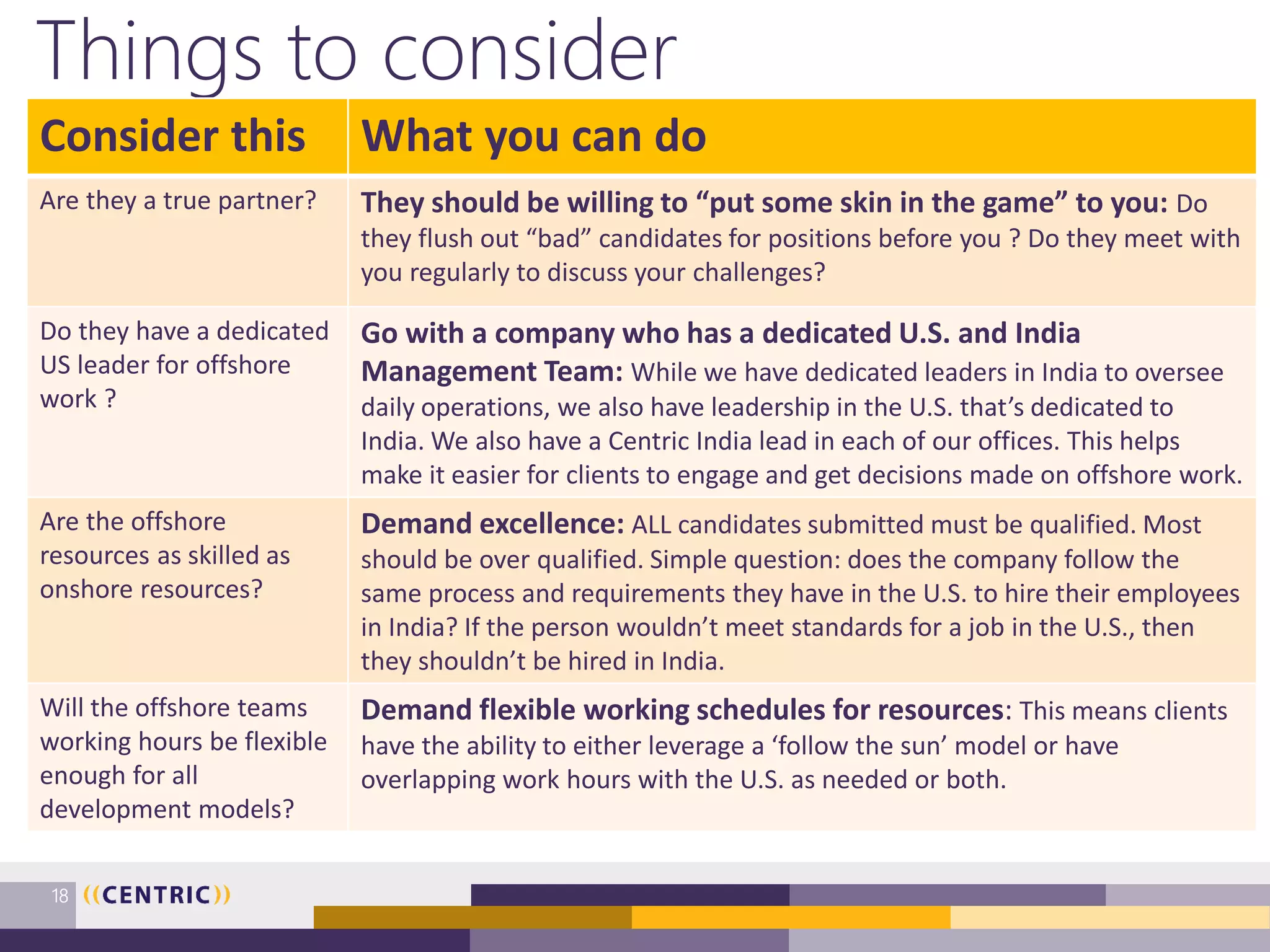
Consider this What you can do
Are they a true partner? They should be willing to “put some skin in the game” to you: Do
they flush out “bad” candidates for positions before you ? Do they meet with
you regularly to discuss your challenges?
Do they have a dedicated
US leader for offshore
work ?
Go with a company who has a dedicated U.S. and India
Management Team: While we have dedicated leaders in India to oversee
daily operations, we also have leadership in the U.S. that’s dedicated to
India. We also have a Centric India lead in each of our offices. This helps
make it easier for clients to engage and get decisions made on offshore work.
Are the offshore
resources as skilled as
onshore resources?
Demand excellence: ALL candidates submitted must be qualified. Most
should be over qualified. Simple question: does the company follow the
same process and requirements they have in the U.S. to hire their employees
in India? If the person wouldn’t meet standards for a job in the U.S., then
they shouldn’t be hired in India.
Will the offshore teams
working hours be flexible
enough for all
development models?
Demand flexible working schedules for resources: This means clients
have the ability to either leverage a ‘follow the sun’ model or have
overlapping work hours with the U.S. as needed or both.
More things to consider…
19
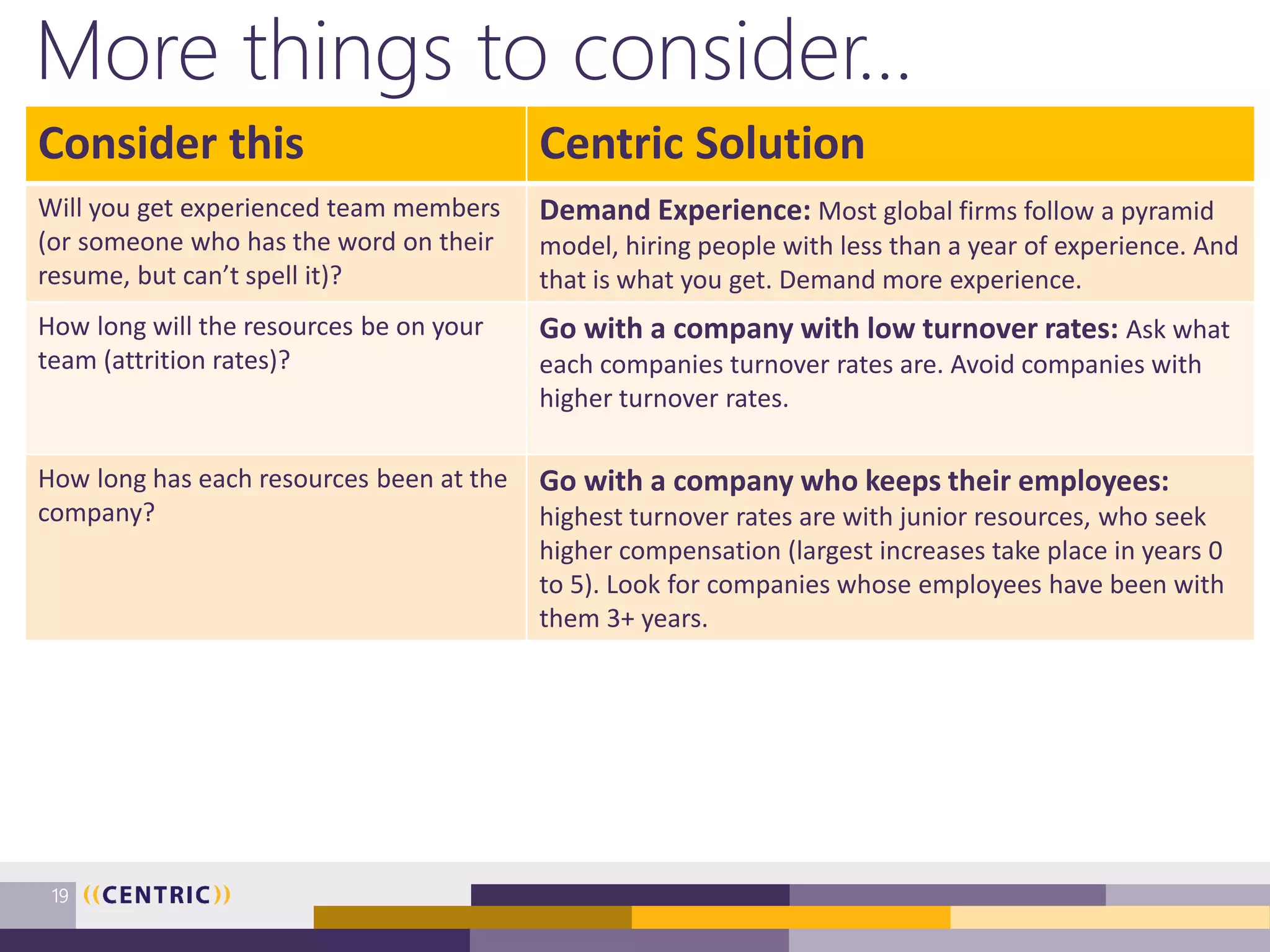
Consider this Centric Solution
Will you get experienced team members
(or someone who has the word on their
resume, but can’t spell it)?
Demand Experience: Most global firms follow a pyramid
model, hiring people with less than a year of experience. And
that is what you get. Demand more experience.
How long will the resources be on your
team (attrition rates)?
Go with a company with low turnover rates: Ask what
each companies turnover rates are. Avoid companies with
higher turnover rates.
How long has each resources been at the
company?
Go with a company who keeps their employees:
highest turnover rates are with junior resources, who seek
higher compensation (largest increases take place in years 0
to 5). Look for companies whose employees have been with
them 3+ years.
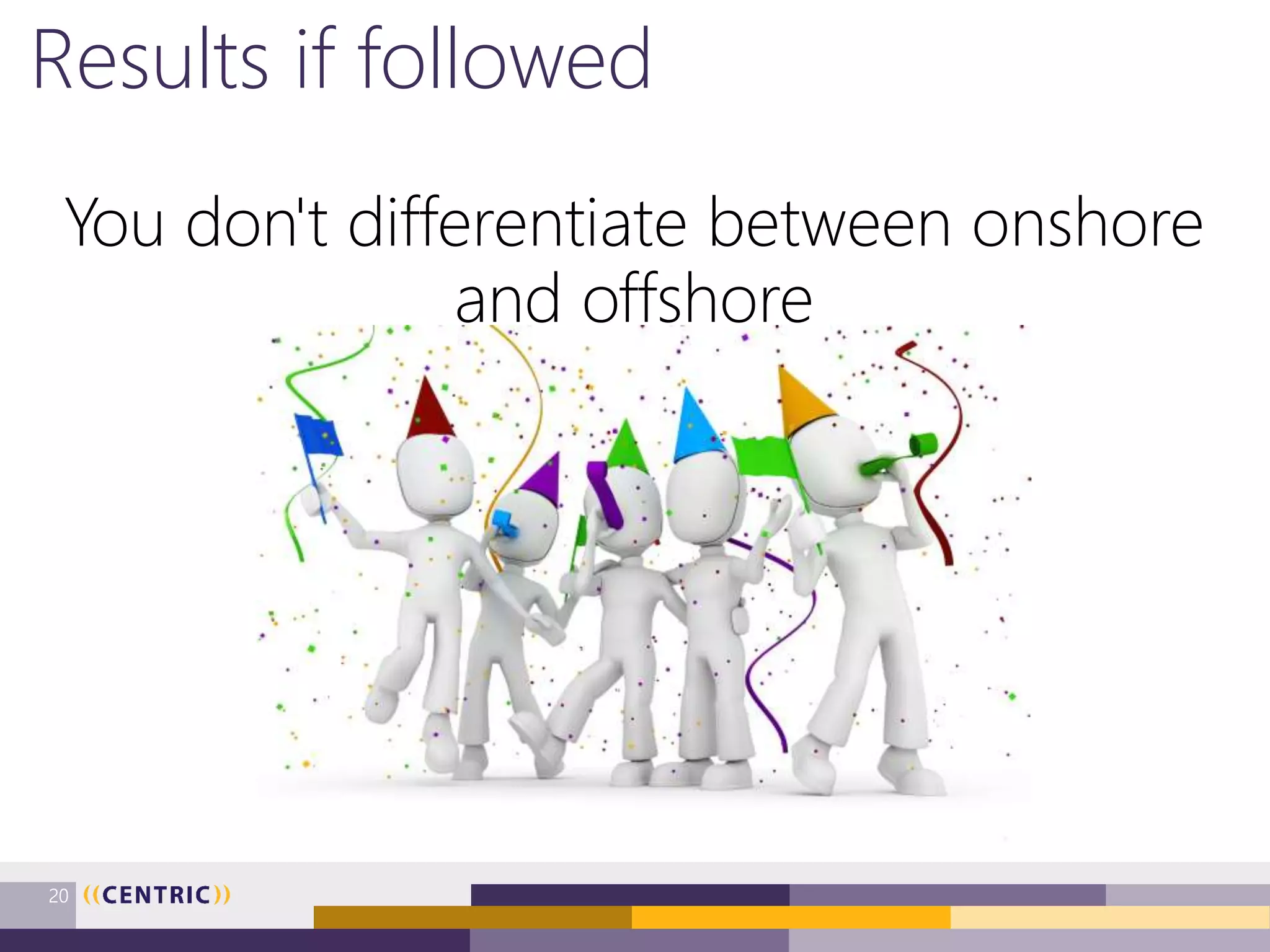
Results if followed
You don't differentiate between onshore
and offshore
20

Best Offshore Practices by Matt Eakin and Brian Offenbacher

  • 1.
    Offshore best practices QAor the Highway 2019 Breakout Session
  • 2.
    Our Goal Today? Ourgoal today is not to debate if you should offshore but to help you be successful when you do offshore. 2
  • 3.
    Why offshore? It isVERY important to understand why management wants to offshore. Reasons can be many: •Cost – do more with less / same budget •Follow the sun development – get 24 hour development and testing •Staff augmentation – fill existing roles with offshore consultants •Skill-set augmentation – do not have anyone on staff or locally which a specific skillset •Try new technology – current staff doesn’t have the capacity to try new tech •Fill delivery needs – need more teams to get the job done 3
  • 4.
    Common Offshore Challenges 4 Challenges StaffingModel can lead to: Lack of dedicated local contact for offshore work Lack of experienced team members Offshore resources not as skilled as onshore resources High attrition rates Lack of overlapping working hours with onshore team Consultant Communication – consultant does not speak and/or write English well Lack of management oversight can lead to poor quality Team Communication – email & IM not good team communication practice Cost – do 5 offshore consultants = 1 FTE ($20/hr. vs. $100/hr.)? System access & security Lack of clear expectations for both client and vendor
  • 5.
    Why do thesechallenges exist… •Staffing model •Many firms staff projects where 70% of team members have less than 3 years of experience •Vendor doesn’t match resource with needed skill sets •Absence of defined governance •Defined roles and expectations between client and vendor team •How do you measure success •Lack of a true partner •Partner has the flexibility to find a solution that works best for the client • Partner invest in the partnership (i.e. staff, training, onsite time, move the client forward) 5
  • 6.
    What is offshoresuccess? Success criteria regardless of reason for offshoring: •Same skillset as onshore resources •No drop-off in quality of work •Similar velocity to onshore, individual and team •Effective communication between on-shore and off-shore •Quick & efficient equipment & system set-up •Quick & efficient on-boarding 6
  • 7.
    What is offshoresuccess? Answer depends on original reason for offshoring: •If reason was cost driven: were you able to get more done with the same budget? •If reason was follow-the-sun development: were you able to achieve 24-7 development with no drop-off in quality? •If reason was staff augmentation: were you able to augment your staff with no drop-off in quality? •If reason was to fill your delivery needs: were you able to fill your delivery needs? 7
  • 8.
    What to offshore? •Individualroles •Find qualified resources •Dip your toe into offshore (need more than 1 resource to see full benefits of offshoring) •Entire teams •Follow-the-sun development •Fill delivery needs (specific work with clearly defined deliverables) •Legacy work •Allow current team members to upskill themselves •Supplement an aging workforce 8
  • 9.
    How do youmeasure success? You need to have measures Work with Vendor to establish "offshore success measures" which are in line with internal success measures i.e. a team velocity measure of 12 points/sprint should apply to both internal and offshore teams 9
  • 10.
    Some Measures •If fixed-scopeSOW: did they get done what was promised in time frame expected. •Were SLA's met (if applicable)? •Was $$ saved? Objective measures 10
  • 11.
    Some Measures •Individual (consultant)or team •Up-to-speed on domain knowledge similar to FTE? •Are their skills & knowledge improving? •Are they asking same questions over and over? •Are they contributing improvement ideas? •Are they communicating effectively inside and outside the team? •Order takes vs. Independent thinkers/workers Subjective measures 11
  • 12.
    Things to consider "US"mentality •Were all the same team •All working towards the same goal •Were successful together 12
  • 13.
    Things to consider •On-boarding •Consultantshould be trained on client system prior to day 1 (if possible) •Same equipment and access as peers •Access to same servers, db’s, api’s, etc.. •Same laptops & tools (may require VPN or CITRIX) •Schedule team stand-up and meetings in AM •India is 9-1/2 hours ahead (9:30am stand-up is at 8:00pm in India) •Team overlap time •Require offshore team to work during US hours (recommended: 8:00am – noon -> 6:30pm – 10:30pm) Individual Roles 13
  • 14.
    Things to consider •Agilemindset •Team: short achievable goals •Better goal: build this screen •Best goal: on the Orders screen, add OrderID filter •Digital tracking system (i.e. JIRA) •Shared by all •Daily meetings with Lead(s) to track progress •Require offshore team to work during US hours (recommended: 8:00am – noon -> 6:30pm – 10:30pm) Entire Team 14
  • 15.
    How are yougoing to offshore? •Managed services •SOW •Staff Augmentation •Big Bang approach •Stepped approach •Partner or Resume Pusher 15
  • 16.
    Things to consider •Partners •Workwith you to fine-tune position needs •Interview candidates before sending over •Make investments in the team •Cross train resources •Up skill (i.e boot camps, brown bags) •Hire in anticipation of demand •Regular touchpoints to ensure they are delivering as promised •Vendors •Send resumes •Minimal screening of candidates •Don’t follow up unless there is an issue •Little to no investment in the partnership 16
  • 17.
    Who to offshorewith? •You know WHY you are offshoring •You know WHAT you are going to offshore •You know HOW you are going to offshore •Only question left is WHO are you going to offshore with? 17
  • 18.
    Things to consider 18 Considerthis What you can do Are they a true partner? They should be willing to “put some skin in the game” to you: Do they flush out “bad” candidates for positions before you ? Do they meet with you regularly to discuss your challenges? Do they have a dedicated US leader for offshore work ? Go with a company who has a dedicated U.S. and India Management Team: While we have dedicated leaders in India to oversee daily operations, we also have leadership in the U.S. that’s dedicated to India. We also have a Centric India lead in each of our offices. This helps make it easier for clients to engage and get decisions made on offshore work. Are the offshore resources as skilled as onshore resources? Demand excellence: ALL candidates submitted must be qualified. Most should be over qualified. Simple question: does the company follow the same process and requirements they have in the U.S. to hire their employees in India? If the person wouldn’t meet standards for a job in the U.S., then they shouldn’t be hired in India. Will the offshore teams working hours be flexible enough for all development models? Demand flexible working schedules for resources: This means clients have the ability to either leverage a ‘follow the sun’ model or have overlapping work hours with the U.S. as needed or both.
  • 19.
    More things toconsider… 19 Consider this Centric Solution Will you get experienced team members (or someone who has the word on their resume, but can’t spell it)? Demand Experience: Most global firms follow a pyramid model, hiring people with less than a year of experience. And that is what you get. Demand more experience. How long will the resources be on your team (attrition rates)? Go with a company with low turnover rates: Ask what each companies turnover rates are. Avoid companies with higher turnover rates. How long has each resources been at the company? Go with a company who keeps their employees: highest turnover rates are with junior resources, who seek higher compensation (largest increases take place in years 0 to 5). Look for companies whose employees have been with them 3+ years.
  • 20.
    Results if followed Youdon't differentiate between onshore and offshore 20

Editor's Notes

  • #3 Start by asking the audience how many of them have worked with offshore?
  • #4 Start by asking the audience why companies offshore