Correction Factors LEL & PID Paul Tarter Regional Sales Manager RAE Systems
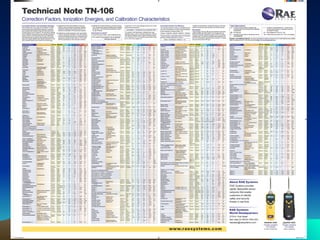
What is a Correction Factor? Correction Factor (CF) is a measure of the sensitivity of the LEL/PID sensor to a specific gas CFs are scaling factors, they do not make a LEL/PID sensor specific to a chemical, they only correct the scale to that chemical. Correction Factors allow PID calibration on cheap, non-toxic “surrogate” gas . Ref: RAE handout TN-106/TN-156
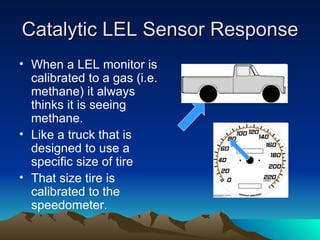
Catalytic LEL Sensor Response When a LEL monitor is calibrated to a gas (i.e. methane) it always thinks it is seeing methane. Like a truck that is designed to use a specific size of tire That size tire is calibrated to the speedometer.
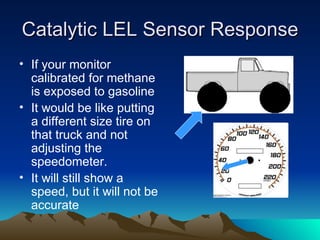
Catalytic LEL Sensor Response If your monitor calibrated for methane is exposed to gasoline It would be like putting a different size tire on that truck and not adjusting the speedometer. It will still show a speed, but it will not be accurate
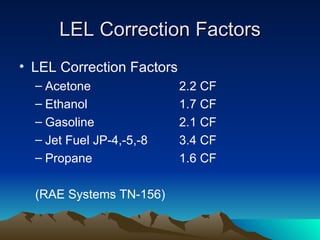
LEL Correction Factors LEL Correction Factors Acetone 2.2 CF Ethanol 1.7 CF Gasoline 2.1 CF Jet Fuel JP-4,-5,-8 3.4 CF Propane 1.6 CF (RAE Systems TN-156)
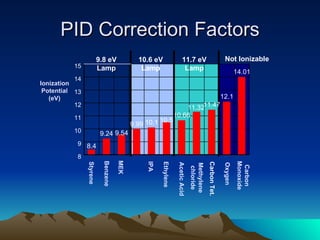
PID Correction Factors 8 9 10 11 12 13 14 15 8.4 9.24 9.54 9.99 10.1 10.5 10.66 11.32 11.47 12.1 14.01 Benzene MEK IPA Ethylene Acetic   Acid Methylene   chloride Carbon Tet. Carbon Monoxide Styrene Oxygen Ionization Potential (eV) 11.7 eV Lamp 10.6 eV Lamp Not Ionizable 9.8 eV Lamp
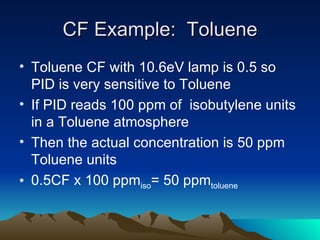
CF Example:  Toluene Toluene CF with 10.6eV lamp is 0.5 so PID is very sensitive to Toluene If PID reads 100 ppm of  isobutylene units in a Toluene atmosphere Then the actual concentration is 50 ppm Toluene units 0.5CF x 100 ppm iso = 50 ppm toluene
 
Question?

Correction factors basics

  • 1.
    Correction Factors LEL& PID Paul Tarter Regional Sales Manager RAE Systems
  • 2.
    What is aCorrection Factor? Correction Factor (CF) is a measure of the sensitivity of the LEL/PID sensor to a specific gas CFs are scaling factors, they do not make a LEL/PID sensor specific to a chemical, they only correct the scale to that chemical. Correction Factors allow PID calibration on cheap, non-toxic “surrogate” gas . Ref: RAE handout TN-106/TN-156
  • 3.
    Catalytic LEL SensorResponse When a LEL monitor is calibrated to a gas (i.e. methane) it always thinks it is seeing methane. Like a truck that is designed to use a specific size of tire That size tire is calibrated to the speedometer.
  • 4.
    Catalytic LEL SensorResponse If your monitor calibrated for methane is exposed to gasoline It would be like putting a different size tire on that truck and not adjusting the speedometer. It will still show a speed, but it will not be accurate
  • 5.
    LEL Correction FactorsLEL Correction Factors Acetone 2.2 CF Ethanol 1.7 CF Gasoline 2.1 CF Jet Fuel JP-4,-5,-8 3.4 CF Propane 1.6 CF (RAE Systems TN-156)
  • 6.
    PID Correction Factors8 9 10 11 12 13 14 15 8.4 9.24 9.54 9.99 10.1 10.5 10.66 11.32 11.47 12.1 14.01 Benzene MEK IPA Ethylene Acetic Acid Methylene chloride Carbon Tet. Carbon Monoxide Styrene Oxygen Ionization Potential (eV) 11.7 eV Lamp 10.6 eV Lamp Not Ionizable 9.8 eV Lamp
  • 7.
    CF Example: Toluene Toluene CF with 10.6eV lamp is 0.5 so PID is very sensitive to Toluene If PID reads 100 ppm of isobutylene units in a Toluene atmosphere Then the actual concentration is 50 ppm Toluene units 0.5CF x 100 ppm iso = 50 ppm toluene
  • 8.
  • 9.