ECOVILLAGES
Models for Sustainability
Presented by Pham Thuy Duong
Hue, 17.05.2016
Outline
2
 Introduction
 The Holistic Approach to Sustainability
 Ecovillages - Sustainability in Practice
 Challenges to Ecovillages
 Conclusions
Introduction
4
• Ecovillages are communities of people drawn together by
the common goal of living more sustainably.
• Ecovillages are exploring sustainable life styles not only
in environmental but also in social, economic and spiritual
terms.
• “An ecovillage is an intentional or traditional community
using local participatory processes to holistically integrate
ecological, economic, social, and cultural dimensions of
sustainability in order to regenerate social and natural
environments” (GEN).
What is Ecovillage?
Background
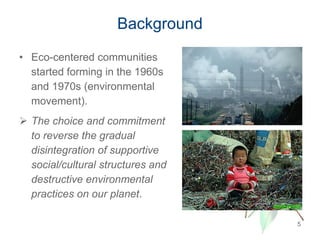
• Eco-centered communities
started forming in the 1960s
and 1970s (environmental
movement).
 The choice and commitment
to reverse the gradual
disintegration of supportive
social/cultural structures and
destructive environmental
practices on our planet.
5
Background
• 1991: Robert Gilman and Diane
Gilman wrote "Ecovillages and
Sustainable Communities" for Gaia
Trust.
• 1995: the first ecovillage conference
took place in Findhorn, Scotland.
 After that conference, many
intentional communities began
calling themselves “ecovillages”,
giving birth to a new movement: the
Global Ecovillage Network.
6
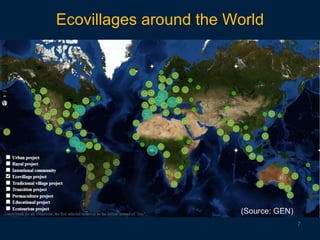
Ecovillages around the World
7
(Source: GEN)
The Holistic Approach
to
Sustainability
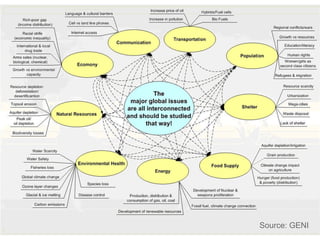
9Source: GENI
10
11
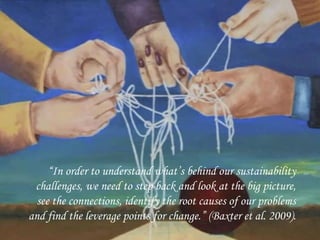
“In order to understand what’s behind our sustainability
challenges, we need to step back and look at the big picture,
see the connections, identify the root causes of our problems
and find the leverage points for change.” (Baxter et al. 2009).
12
Systems View of Life
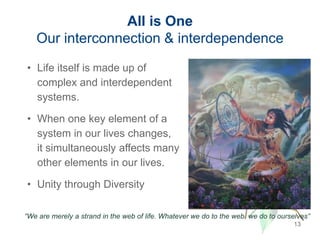
All is One
Our interconnection & interdependence
13
• Life itself is made up of
complex and interdependent
systems.
• When one key element of a
system in our lives changes,
it simultaneously affects many
other elements in our lives.
• Unity through Diversity
“We are merely a strand in the web of life. Whatever we do to the web, we do to ourselves”
Whole Systems Vision
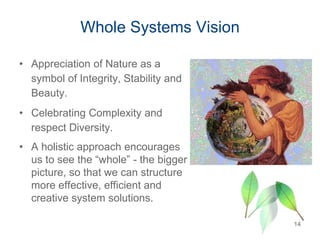
• Appreciation of Nature as a
symbol of Integrity, Stability and
Beauty.
• Celebrating Complexity and
respect Diversity.
• A holistic approach encourages
us to see the “whole” - the bigger
picture, so that we can structure
more effective, efficient and
creative system solutions.
14
Whole Systems Vision
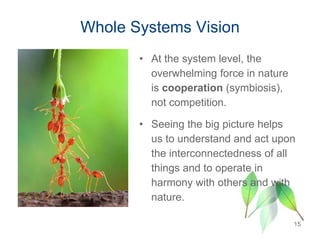
• At the system level, the
overwhelming force in nature
is cooperation (symbiosis),
not competition.
• Seeing the big picture helps
us to understand and act upon
the interconnectedness of all
things and to operate in
harmony with others and with
nature.
15
The Earth Charter
Values and Principles for a Sustainable Future
 Respect and Care for the Community of Life
 Ecological Integrity
 Social and Economic Justice
 Democracy, Nonviolence and Peace
Earth Charter Initiative: http://earthcharter.org
16
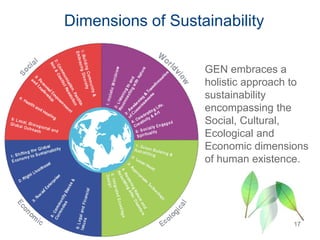
Dimensions of Sustainability
17
GEN embraces a
holistic approach to
sustainability
encompassing the
Social, Cultural,
Ecological and
Economic dimensions
of human existence.
Spiritual Values
18
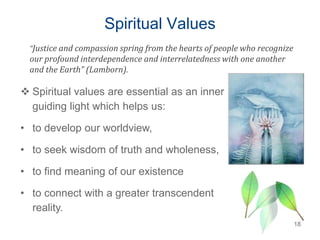
 Spiritual values are essential as an inner
guiding light which helps us:
• to develop our worldview,
• to seek wisdom of truth and wholeness,
• to find meaning of our existence
• to connect with a greater transcendent
reality.
“Justice and compassion spring from the hearts of people who recognize
our profound interdependence and interrelatedness with one another
and the Earth” (Lamborn).
Spiritual Values
19
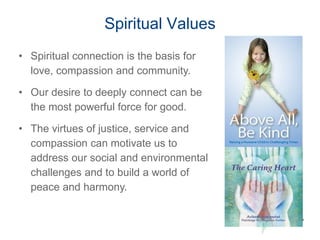
• Spiritual connection is the basis for
love, compassion and community.
• Our desire to deeply connect can be
the most powerful force for good.
• The virtues of justice, service and
compassion can motivate us to
address our social and environmental
challenges and to build a world of
peace and harmony.
Ecovillages
Sustainability in Practice
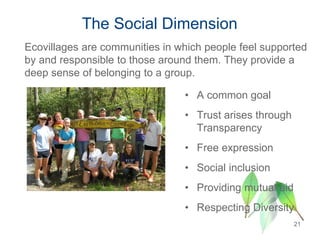
The Social Dimension
Ecovillages are communities in which people feel supported
by and responsible to those around them. They provide a
deep sense of belonging to a group.
21
• A common goal
• Trust arises through
Transparency
• Free expression
• Social inclusion
• Providing mutual aid
• Respecting Diversity
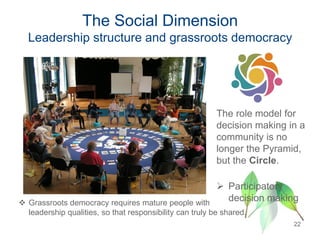
The Social Dimension
Leadership structure and grassroots democracy
The role model for
decision making in a
community is no
longer the Pyramid,
but the Circle.
 Participatory
decision making
22
 Grassroots democracy requires mature people with
leadership qualities, so that responsibility can truly be shared.
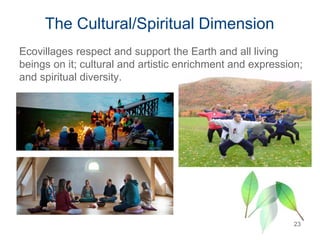
The Cultural/Spiritual Dimension
Ecovillages respect and support the Earth and all living
beings on it; cultural and artistic enrichment and expression;
and spiritual diversity.
23
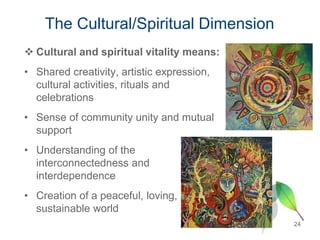
The Cultural/Spiritual Dimension
 Cultural and spiritual vitality means:
• Shared creativity, artistic expression,
cultural activities, rituals and
celebrations
• Sense of community unity and mutual
support
• Understanding of the
interconnectedness and
interdependence
• Creation of a peaceful, loving,
sustainable world
24
The Ecological Dimension
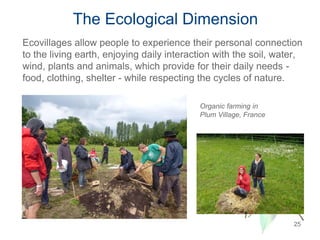
Ecovillages allow people to experience their personal connection
to the living earth, enjoying daily interaction with the soil, water,
wind, plants and animals, which provide for their daily needs -
food, clothing, shelter - while respecting the cycles of nature.
25
Organic farming in
Plum Village, France
The Ecological Dimension
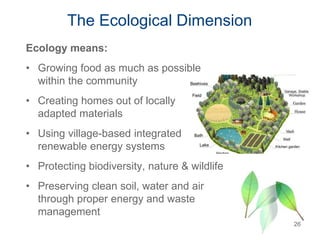
Ecology means:
• Growing food as much as possible
within the community
• Creating homes out of locally

adapted materials
• Using village-based integrated
renewable energy systems
• Protecting biodiversity, nature & wildlife
• Preserving clean soil, water and air
through proper energy and waste
management
26
27
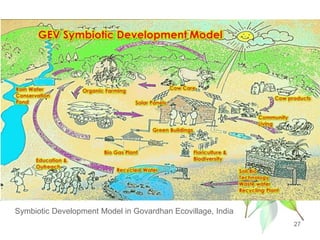
Symbiotic Development Model in Govardhan Ecovillage, India
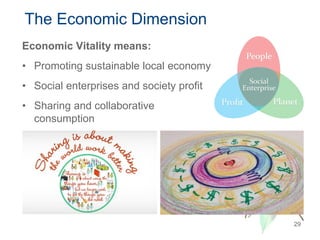
The Economic Dimension
28
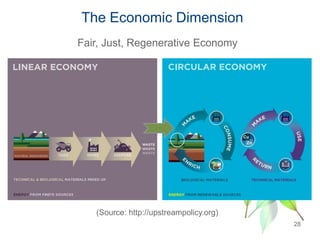
(Source: http://upstreampolicy.org)
Fair, Just, Regenerative Economy
The Economic Dimension
Economic Vitality means:
• Promoting sustainable local economy
• Social enterprises and society profit
• Sharing and collaborative
consumption
29
Challenges
to
Ecovillages
Challenges to Ecovillages
• Lack of land and high land price
• Lack of finance
• The trend towards greater globalization
 Limiting community access to and control over
land, water and food
• The trend towards greater individualism
• The commonality of interest may not be
sufficiently strong to make it effective as a
collective body
31
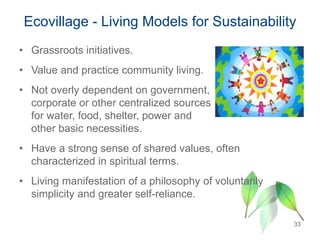
Conclusions
• Grassroots initiatives.
• Value and practice community living.
• Not overly dependent on government,
corporate or other centralized sources
for water, food, shelter, power and
other basic necessities.
• Have a strong sense of shared values, often
characterized in spiritual terms.
• Living manifestation of a philosophy of voluntarily
simplicity and greater self-reliance.
Ecovillage - Living Models for Sustainability
33
34
Creating a culture of sustainability which cherishes values of tolerance,
love, care, respect… is essential in empowering and transforming
community towards a sustainable future.
Ecovillages – a Vision, an Ideal, a Goal
References
• Collaborative Consumption http://www.collaborativeconsumption.com
• Ecovillage – 1001 Ways to Heal the Planet - GEN
• Ecovillage Newsletter http://www.ecovillagenewsletter.org
• Earth Charter – Values and Principles for a Sustainable Future
http://earthcharter.org
• Fellowship of Intentional Communities http://www.ic.org
• Findhorn Ecovillage http://www.ecovillagefindhorn.com
• Gaia University http://www.gaiauniversity.org
• Global Ecovillage Network (GEN) http://gen.ecovillage.org
• Govardhan Ecovillage http://www.ecovillage.org.in
• Jonathan Dawson, 2006, Ecovillages: New frontiers of sustainability,
Schumacher Briefings
• On the Commons http://www.onthecommons.org
• Shareable http://www.shareable.net
35
Thank you for your attention!
Questions & Discussion

Ecovillages - Models for Sustainability

  • 1.
    ECOVILLAGES Models for Sustainability Presentedby Pham Thuy Duong Hue, 17.05.2016
  • 2.
    Outline 2  Introduction  TheHolistic Approach to Sustainability  Ecovillages - Sustainability in Practice  Challenges to Ecovillages  Conclusions
  • 3.
  • 4.
    4 • Ecovillages arecommunities of people drawn together by the common goal of living more sustainably. • Ecovillages are exploring sustainable life styles not only in environmental but also in social, economic and spiritual terms. • “An ecovillage is an intentional or traditional community using local participatory processes to holistically integrate ecological, economic, social, and cultural dimensions of sustainability in order to regenerate social and natural environments” (GEN). What is Ecovillage?
  • 5.
    Background • Eco-centered communities startedforming in the 1960s and 1970s (environmental movement).  The choice and commitment to reverse the gradual disintegration of supportive social/cultural structures and destructive environmental practices on our planet. 5
  • 6.
    Background • 1991: RobertGilman and Diane Gilman wrote "Ecovillages and Sustainable Communities" for Gaia Trust. • 1995: the first ecovillage conference took place in Findhorn, Scotland.  After that conference, many intentional communities began calling themselves “ecovillages”, giving birth to a new movement: the Global Ecovillage Network. 6
  • 7.
    Ecovillages around theWorld 7 (Source: GEN)
  • 8.
  • 9.
  • 10.
  • 11.
    11 “In order tounderstand what’s behind our sustainability challenges, we need to step back and look at the big picture, see the connections, identify the root causes of our problems and find the leverage points for change.” (Baxter et al. 2009).
  • 12.
  • 13.
    All is One Ourinterconnection & interdependence 13 • Life itself is made up of complex and interdependent systems. • When one key element of a system in our lives changes, it simultaneously affects many other elements in our lives. • Unity through Diversity “We are merely a strand in the web of life. Whatever we do to the web, we do to ourselves”
  • 14.
    Whole Systems Vision •Appreciation of Nature as a symbol of Integrity, Stability and Beauty. • Celebrating Complexity and respect Diversity. • A holistic approach encourages us to see the “whole” - the bigger picture, so that we can structure more effective, efficient and creative system solutions. 14
  • 15.
    Whole Systems Vision •At the system level, the overwhelming force in nature is cooperation (symbiosis), not competition. • Seeing the big picture helps us to understand and act upon the interconnectedness of all things and to operate in harmony with others and with nature. 15
  • 16.
    The Earth Charter Valuesand Principles for a Sustainable Future  Respect and Care for the Community of Life  Ecological Integrity  Social and Economic Justice  Democracy, Nonviolence and Peace Earth Charter Initiative: http://earthcharter.org 16
  • 17.
    Dimensions of Sustainability 17 GENembraces a holistic approach to sustainability encompassing the Social, Cultural, Ecological and Economic dimensions of human existence.
  • 18.
    Spiritual Values 18  Spiritualvalues are essential as an inner guiding light which helps us: • to develop our worldview, • to seek wisdom of truth and wholeness, • to find meaning of our existence • to connect with a greater transcendent reality. “Justice and compassion spring from the hearts of people who recognize our profound interdependence and interrelatedness with one another and the Earth” (Lamborn).
  • 19.
    Spiritual Values 19 • Spiritualconnection is the basis for love, compassion and community. • Our desire to deeply connect can be the most powerful force for good. • The virtues of justice, service and compassion can motivate us to address our social and environmental challenges and to build a world of peace and harmony.
  • 20.
  • 21.
    The Social Dimension Ecovillagesare communities in which people feel supported by and responsible to those around them. They provide a deep sense of belonging to a group. 21 • A common goal • Trust arises through Transparency • Free expression • Social inclusion • Providing mutual aid • Respecting Diversity
  • 22.
    The Social Dimension Leadershipstructure and grassroots democracy The role model for decision making in a community is no longer the Pyramid, but the Circle.  Participatory decision making 22  Grassroots democracy requires mature people with leadership qualities, so that responsibility can truly be shared.
  • 23.
    The Cultural/Spiritual Dimension Ecovillagesrespect and support the Earth and all living beings on it; cultural and artistic enrichment and expression; and spiritual diversity. 23
  • 24.
    The Cultural/Spiritual Dimension Cultural and spiritual vitality means: • Shared creativity, artistic expression, cultural activities, rituals and celebrations • Sense of community unity and mutual support • Understanding of the interconnectedness and interdependence • Creation of a peaceful, loving, sustainable world 24
  • 25.
    The Ecological Dimension Ecovillagesallow people to experience their personal connection to the living earth, enjoying daily interaction with the soil, water, wind, plants and animals, which provide for their daily needs - food, clothing, shelter - while respecting the cycles of nature. 25 Organic farming in Plum Village, France
  • 26.
    The Ecological Dimension Ecologymeans: • Growing food as much as possible within the community • Creating homes out of locally adapted materials • Using village-based integrated renewable energy systems • Protecting biodiversity, nature & wildlife • Preserving clean soil, water and air through proper energy and waste management 26
  • 27.
    27 Symbiotic Development Modelin Govardhan Ecovillage, India
  • 28.
    The Economic Dimension 28 (Source:http://upstreampolicy.org) Fair, Just, Regenerative Economy
  • 29.
    The Economic Dimension EconomicVitality means: • Promoting sustainable local economy • Social enterprises and society profit • Sharing and collaborative consumption 29
  • 30.
  • 31.
    Challenges to Ecovillages •Lack of land and high land price • Lack of finance • The trend towards greater globalization  Limiting community access to and control over land, water and food • The trend towards greater individualism • The commonality of interest may not be sufficiently strong to make it effective as a collective body 31
  • 32.
  • 33.
    • Grassroots initiatives. •Value and practice community living. • Not overly dependent on government, corporate or other centralized sources for water, food, shelter, power and other basic necessities. • Have a strong sense of shared values, often characterized in spiritual terms. • Living manifestation of a philosophy of voluntarily simplicity and greater self-reliance. Ecovillage - Living Models for Sustainability 33
  • 34.
    34 Creating a cultureof sustainability which cherishes values of tolerance, love, care, respect… is essential in empowering and transforming community towards a sustainable future. Ecovillages – a Vision, an Ideal, a Goal
  • 35.
    References • Collaborative Consumptionhttp://www.collaborativeconsumption.com • Ecovillage – 1001 Ways to Heal the Planet - GEN • Ecovillage Newsletter http://www.ecovillagenewsletter.org • Earth Charter – Values and Principles for a Sustainable Future http://earthcharter.org • Fellowship of Intentional Communities http://www.ic.org • Findhorn Ecovillage http://www.ecovillagefindhorn.com • Gaia University http://www.gaiauniversity.org • Global Ecovillage Network (GEN) http://gen.ecovillage.org • Govardhan Ecovillage http://www.ecovillage.org.in • Jonathan Dawson, 2006, Ecovillages: New frontiers of sustainability, Schumacher Briefings • On the Commons http://www.onthecommons.org • Shareable http://www.shareable.net 35
  • 36.
    Thank you foryour attention! Questions & Discussion