Linked lists
Exercises
Eleonora Ciceri, Politecnico di Milano
Email: eleonora.ciceri@polimi.it
Simple exercises
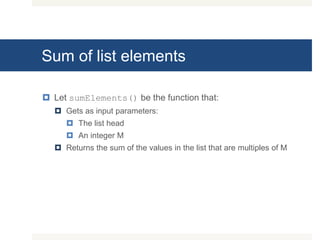
Sum of list elements
 Let sumElements() be the function that:
 Gets as input parameters:
 The list head
 An integer M
 Returns the sum of the values in the list that are multiples of M
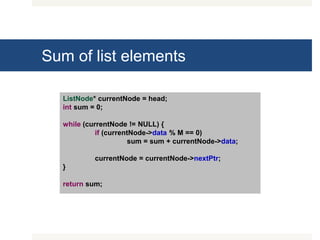
Sum of list elements
ListNode* currentNode = head;
int sum = 0;
while (currentNode != NULL) {
if (currentNode->data % M == 0)
sum = sum + currentNode->data;
currentNode = currentNode->nextPtr;
}
return sum;
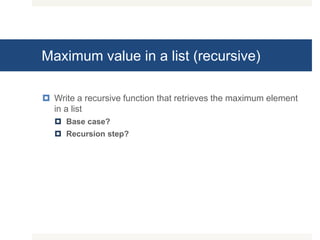
Maximum value in a list (recursive)
 Write a recursive function that retrieves the maximum element
in a list
 Base case?
 Recursion step?
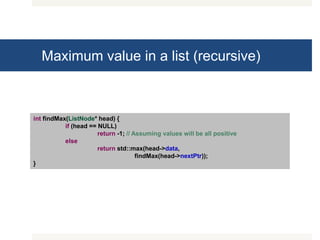
Maximum value in a list (recursive)
int findMax(ListNode* head) {
if (head == NULL)
return -1; // Assuming values will be all positive
else
return std::max(head->data,
findMax(head->nextPtr));
}
Even minimum number
 Define a function that, given a list of integer numbers, returns
the position (pointer) of the even minimum element in the list
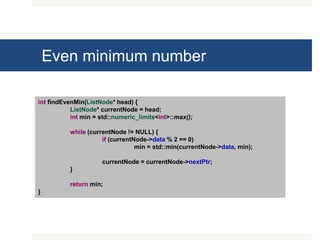
Even minimum number
int findEvenMin(ListNode* head) {
ListNode* currentNode = head;
int min = std::numeric_limits<int>::max();
while (currentNode != NULL) {
if (currentNode->data % 2 == 0)
min = std::min(currentNode->data, min);
currentNode = currentNode->nextPtr;
}
return min;
}
Reverse print of the list
 Write a function that prints the values in the list in reverse
order with respect to the order in which they are stored in the
list
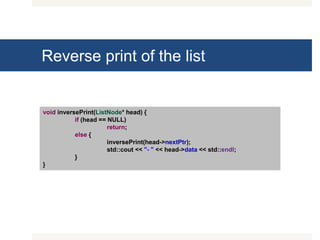
Reverse print of the list
void inversePrint(ListNode* head) {
if (head == NULL)
return;
else {
inversePrint(head->nextPtr);
std::cout << "- " << head->data << std::endl;
}
}
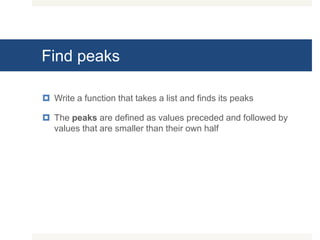
Find peaks
 Write a function that takes a list and finds its peaks
 The peaks are defined as values preceded and followed by
values that are smaller than their own half
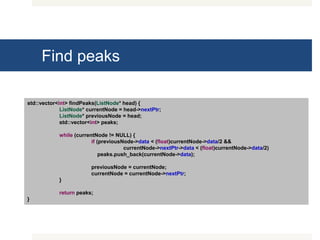
Find peaks
std::vector<int> findPeaks(ListNode* head) {
ListNode* currentNode = head->nextPtr;
ListNode* previousNode = head;
std::vector<int> peaks;
while (currentNode != NULL) {
if (previousNode->data < (float)currentNode->data/2 &&
currentNode->nextPtr->data < (float)currentNode->data/2)
peaks.push_back(currentNode->data);
previousNode = currentNode;
currentNode = currentNode->nextPtr;
}
return peaks;
}
Complex exercises
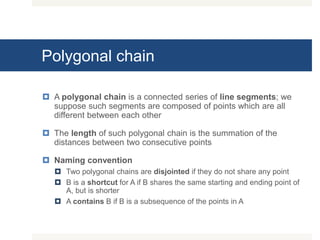
Polygonal chain
 A polygonal chain is a connected series of line segments; we
suppose such segments are composed of points which are all
different between each other
 The length of such polygonal chain is the summation of the
distances between two consecutive points
 Naming convention
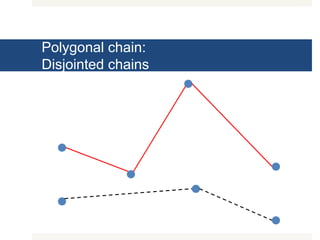
 Two polygonal chains are disjointed if they do not share any point
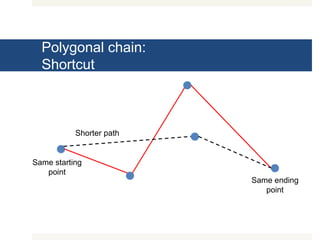
 B is a shortcut for A if B shares the same starting and ending point of
A, but is shorter
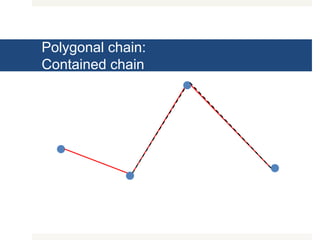
 A contains B if B is a subsequence of the points in A
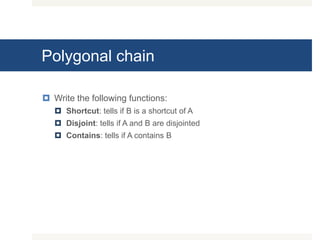
Polygonal chain
 Write the following functions:
 Shortcut: tells if B is a shortcut of A
 Disjoint: tells if A and B are disjointed
 Contains: tells if A contains B
Polygonal chain:
Shortcut
Same starting
point
Same ending
point
Shorter path
Polygonal chain:
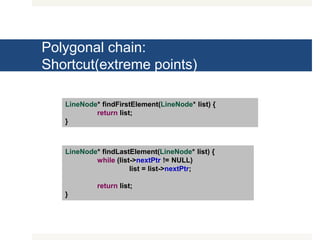
Shortcut(extreme points)
LineNode* findFirstElement(LineNode* list) {
return list;
}
LineNode* findLastElement(LineNode* list) {
while (list->nextPtr != NULL)
list = list->nextPtr;
return list;
}
Polygonal chain:
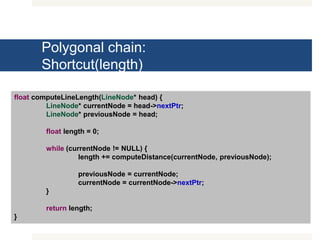
Shortcut(length)
float computeLineLength(LineNode* head) {
LineNode* currentNode = head->nextPtr;
LineNode* previousNode = head;
float length = 0;
while (currentNode != NULL) {
length += computeDistance(currentNode, previousNode);
previousNode = currentNode;
currentNode = currentNode->nextPtr;
}
return length;
}
Polygonal chain:
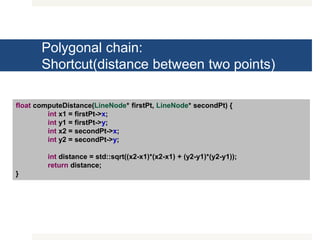
Shortcut(distance between two points)
float computeDistance(LineNode* firstPt, LineNode* secondPt) {
int x1 = firstPt->x;
int y1 = firstPt->y;
int x2 = secondPt->x;
int y2 = secondPt->y;
int distance = std::sqrt((x2-x1)*(x2-x1) + (y2-y1)*(y2-y1));
return distance;
}
Polygonalchain:
Shortcut
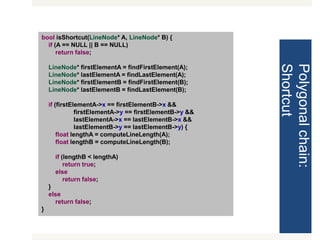
bool isShortcut(LineNode* A, LineNode* B) {
if (A == NULL || B == NULL)
return false;
LineNode* firstElementA = findFirstElement(A);
LineNode* lastElementA = findLastElement(A);
LineNode* firstElementB = findFirstElement(B);
LineNode* lastElementB = findLastElement(B);
if (firstElementA->x == firstElementB->x &&
firstElementA->y == firstElementB->y &&
lastElementA->x == lastElementB->x &&
lastElementB->y == lastElementB->y) {
float lengthA = computeLineLength(A);
float lengthB = computeLineLength(B);
if (lengthB < lengthA)
return true;
else
return false;
}
else
return false;
}
Polygonal chain:
Disjointed chains
Polygonalchain:
Disjointedchains
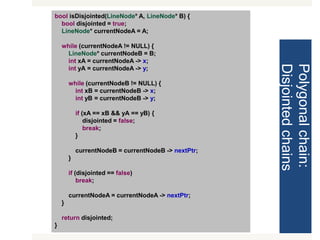
bool isDisjointed(LineNode* A, LineNode* B) {
bool disjointed = true;
LineNode* currentNodeA = A;
while (currentNodeA != NULL) {
LineNode* currentNodeB = B;
int xA = currentNodeA -> x;
int yA = currentNodeA -> y;
while (currentNodeB != NULL) {
int xB = currentNodeB -> x;
int yB = currentNodeB -> y;
if (xA == xB && yA == yB) {
disjointed = false;
break;
}
currentNodeB = currentNodeB -> nextPtr;
}
if (disjointed == false)
break;
currentNodeA = currentNodeA -> nextPtr;
}
return disjointed;
}
Polygonal chain:
Contained chain
Polygonalchain:
Containedchain
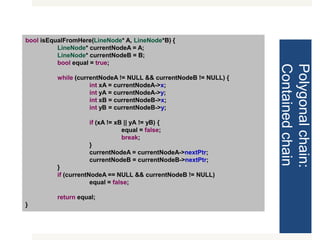
bool isEqualFromHere(LineNode* A, LineNode*B) {
LineNode* currentNodeA = A;
LineNode* currentNodeB = B;
bool equal = true;
while (currentNodeA != NULL && currentNodeB != NULL) {
int xA = currentNodeA->x;
int yA = currentNodeA->y;
int xB = currentNodeB->x;
int yB = currentNodeB->y;
if (xA != xB || yA != yB) {
equal = false;
break;
}
currentNodeA = currentNodeA->nextPtr;
currentNodeB = currentNodeB->nextPtr;
}
if (currentNodeA == NULL && currentNodeB != NULL)
equal = false;
return equal;
}
Polygonalchain:
Containedchain
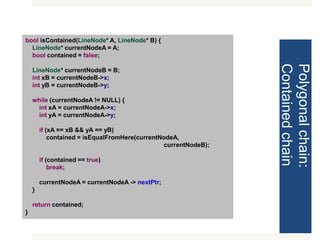
bool isContained(LineNode* A, LineNode* B) {
LineNode* currentNodeA = A;
bool contained = false;
LineNode* currentNodeB = B;
int xB = currentNodeB->x;
int yB = currentNodeB->y;
while (currentNodeA != NULL) {
int xA = currentNodeA->x;
int yA = currentNodeA->y;
if (xA == xB && yA == yB)
contained = isEqualFromHere(currentNodeA,
currentNodeB);
if (contained == true)
break;
currentNodeA = currentNodeA -> nextPtr;
}
return contained;
}
Polygonal chain
 Additional exercises:
 Define the extension function, which tells if A extends B; A
extends B if A contains B and (A,B) share the ending point
 Define the concatenate function, which returns the concatenation
of B after A
 Define the tortuosity function, which returns the ratio between the
length of A and the distance between its extreme points

Linked lists - Exercises

  • 1.
    Linked lists Exercises Eleonora Ciceri,Politecnico di Milano Email: eleonora.ciceri@polimi.it
  • 2.
  • 3.
    Sum of listelements  Let sumElements() be the function that:  Gets as input parameters:  The list head  An integer M  Returns the sum of the values in the list that are multiples of M
  • 4.
    Sum of listelements ListNode* currentNode = head; int sum = 0; while (currentNode != NULL) { if (currentNode->data % M == 0) sum = sum + currentNode->data; currentNode = currentNode->nextPtr; } return sum;
  • 5.
    Maximum value ina list (recursive)  Write a recursive function that retrieves the maximum element in a list  Base case?  Recursion step?
  • 6.
    Maximum value ina list (recursive) int findMax(ListNode* head) { if (head == NULL) return -1; // Assuming values will be all positive else return std::max(head->data, findMax(head->nextPtr)); }
  • 7.
    Even minimum number Define a function that, given a list of integer numbers, returns the position (pointer) of the even minimum element in the list
  • 8.
    Even minimum number intfindEvenMin(ListNode* head) { ListNode* currentNode = head; int min = std::numeric_limits<int>::max(); while (currentNode != NULL) { if (currentNode->data % 2 == 0) min = std::min(currentNode->data, min); currentNode = currentNode->nextPtr; } return min; }
  • 9.
    Reverse print ofthe list  Write a function that prints the values in the list in reverse order with respect to the order in which they are stored in the list
  • 10.
    Reverse print ofthe list void inversePrint(ListNode* head) { if (head == NULL) return; else { inversePrint(head->nextPtr); std::cout << "- " << head->data << std::endl; } }
  • 11.
    Find peaks  Writea function that takes a list and finds its peaks  The peaks are defined as values preceded and followed by values that are smaller than their own half
  • 12.
    Find peaks std::vector<int> findPeaks(ListNode*head) { ListNode* currentNode = head->nextPtr; ListNode* previousNode = head; std::vector<int> peaks; while (currentNode != NULL) { if (previousNode->data < (float)currentNode->data/2 && currentNode->nextPtr->data < (float)currentNode->data/2) peaks.push_back(currentNode->data); previousNode = currentNode; currentNode = currentNode->nextPtr; } return peaks; }
  • 13.
  • 14.
    Polygonal chain  Apolygonal chain is a connected series of line segments; we suppose such segments are composed of points which are all different between each other  The length of such polygonal chain is the summation of the distances between two consecutive points  Naming convention  Two polygonal chains are disjointed if they do not share any point  B is a shortcut for A if B shares the same starting and ending point of A, but is shorter  A contains B if B is a subsequence of the points in A
  • 15.
    Polygonal chain  Writethe following functions:  Shortcut: tells if B is a shortcut of A  Disjoint: tells if A and B are disjointed  Contains: tells if A contains B
  • 16.
  • 17.
    Polygonal chain: Shortcut(extreme points) LineNode*findFirstElement(LineNode* list) { return list; } LineNode* findLastElement(LineNode* list) { while (list->nextPtr != NULL) list = list->nextPtr; return list; }
  • 18.
    Polygonal chain: Shortcut(length) float computeLineLength(LineNode*head) { LineNode* currentNode = head->nextPtr; LineNode* previousNode = head; float length = 0; while (currentNode != NULL) { length += computeDistance(currentNode, previousNode); previousNode = currentNode; currentNode = currentNode->nextPtr; } return length; }
  • 19.
    Polygonal chain: Shortcut(distance betweentwo points) float computeDistance(LineNode* firstPt, LineNode* secondPt) { int x1 = firstPt->x; int y1 = firstPt->y; int x2 = secondPt->x; int y2 = secondPt->y; int distance = std::sqrt((x2-x1)*(x2-x1) + (y2-y1)*(y2-y1)); return distance; }
  • 20.
    Polygonalchain: Shortcut bool isShortcut(LineNode* A,LineNode* B) { if (A == NULL || B == NULL) return false; LineNode* firstElementA = findFirstElement(A); LineNode* lastElementA = findLastElement(A); LineNode* firstElementB = findFirstElement(B); LineNode* lastElementB = findLastElement(B); if (firstElementA->x == firstElementB->x && firstElementA->y == firstElementB->y && lastElementA->x == lastElementB->x && lastElementB->y == lastElementB->y) { float lengthA = computeLineLength(A); float lengthB = computeLineLength(B); if (lengthB < lengthA) return true; else return false; } else return false; }
  • 21.
  • 22.
    Polygonalchain: Disjointedchains bool isDisjointed(LineNode* A,LineNode* B) { bool disjointed = true; LineNode* currentNodeA = A; while (currentNodeA != NULL) { LineNode* currentNodeB = B; int xA = currentNodeA -> x; int yA = currentNodeA -> y; while (currentNodeB != NULL) { int xB = currentNodeB -> x; int yB = currentNodeB -> y; if (xA == xB && yA == yB) { disjointed = false; break; } currentNodeB = currentNodeB -> nextPtr; } if (disjointed == false) break; currentNodeA = currentNodeA -> nextPtr; } return disjointed; }
  • 23.
  • 24.
    Polygonalchain: Containedchain bool isEqualFromHere(LineNode* A,LineNode*B) { LineNode* currentNodeA = A; LineNode* currentNodeB = B; bool equal = true; while (currentNodeA != NULL && currentNodeB != NULL) { int xA = currentNodeA->x; int yA = currentNodeA->y; int xB = currentNodeB->x; int yB = currentNodeB->y; if (xA != xB || yA != yB) { equal = false; break; } currentNodeA = currentNodeA->nextPtr; currentNodeB = currentNodeB->nextPtr; } if (currentNodeA == NULL && currentNodeB != NULL) equal = false; return equal; }
  • 25.
    Polygonalchain: Containedchain bool isContained(LineNode* A,LineNode* B) { LineNode* currentNodeA = A; bool contained = false; LineNode* currentNodeB = B; int xB = currentNodeB->x; int yB = currentNodeB->y; while (currentNodeA != NULL) { int xA = currentNodeA->x; int yA = currentNodeA->y; if (xA == xB && yA == yB) contained = isEqualFromHere(currentNodeA, currentNodeB); if (contained == true) break; currentNodeA = currentNodeA -> nextPtr; } return contained; }
  • 26.
    Polygonal chain  Additionalexercises:  Define the extension function, which tells if A extends B; A extends B if A contains B and (A,B) share the ending point  Define the concatenate function, which returns the concatenation of B after A  Define the tortuosity function, which returns the ratio between the length of A and the distance between its extreme points