FERMENTATION IN MICROORGANISMS
-PRIYANKA PADHI
16MSLSBC11
CENTRE FOR BIOCHEMISTRY & MICROBIAL SCIENCES
Fermentation may have been a better invention than fire.
-David Wallace
CONTENT
Introduction-fermentation
History of fermentation
Types of fermentation:
Lactic acid fermentation
Alcoholic fermentation
Microorganism are the best choice –Why?
Applications
Controlling factors in industrial fermentation
Microorganisms as direct food
Products and its uses
Probiotics and its effects
Genetic engineering in fermentation
Conclusion
Reference
Greeting
FERMENTATION
Fermentation is a natural
process, occurs when
microorganisms consume
susceptible organic substrate
as part of their own metabolic
processes.
Also referred to the bulk
growth of microorganisms in a
growth medium with the goal
of producing a specific
chemical product.
The science of fermentation is
called zymology.
It mainly takes place when the
electron transport chain
unusable.
Extract energy but do not
consume O₂ or change the
concentration of NAD⁺ or
NADH.
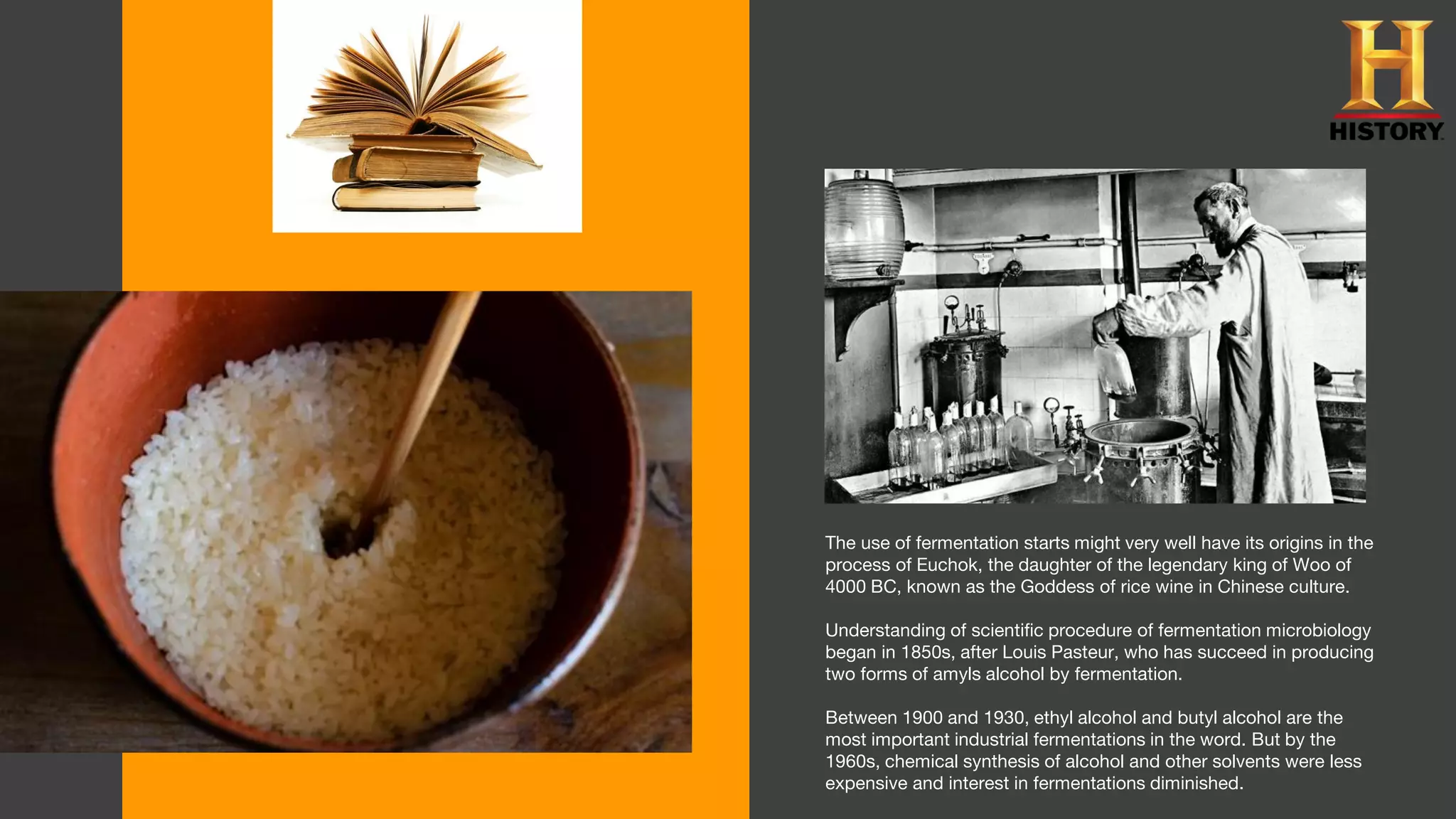
The use of fermentation starts might very well have its origins in the
process of Euchok, the daughter of the legendary king of Woo of
4000 BC, known as the Goddess of rice wine in Chinese culture.
Understanding of scientific procedure of fermentation microbiology
began in 1850s, after Louis Pasteur, who has succeed in producing
two forms of amyls alcohol by fermentation.
Between 1900 and 1930, ethyl alcohol and butyl alcohol are the
most important industrial fermentations in the word. But by the
1960s, chemical synthesis of alcohol and other solvents were less
expensive and interest in fermentations diminished.
TYPES
OF FERMENTATION
LACTIC ACID FERMENTATION
2
NAD⁺ NADH + H⁺
O⁻ S CoA
C=O C=O
C=O CH₃
CH₃
CO₂
Coenzyme APyruvate
Acetyl CoA
Transport Protein
1
2
3
When aerobic conditions occurs pyruvate is oxidized to acetate which enters the citric acid cycle to produce
CO₂, H₂O and NADH ultimately reoxidised to NAD⁺ by passage of its e⁻ to O₂ in mitochondrial respiration.
CYTOSOL MITOCHONDRION
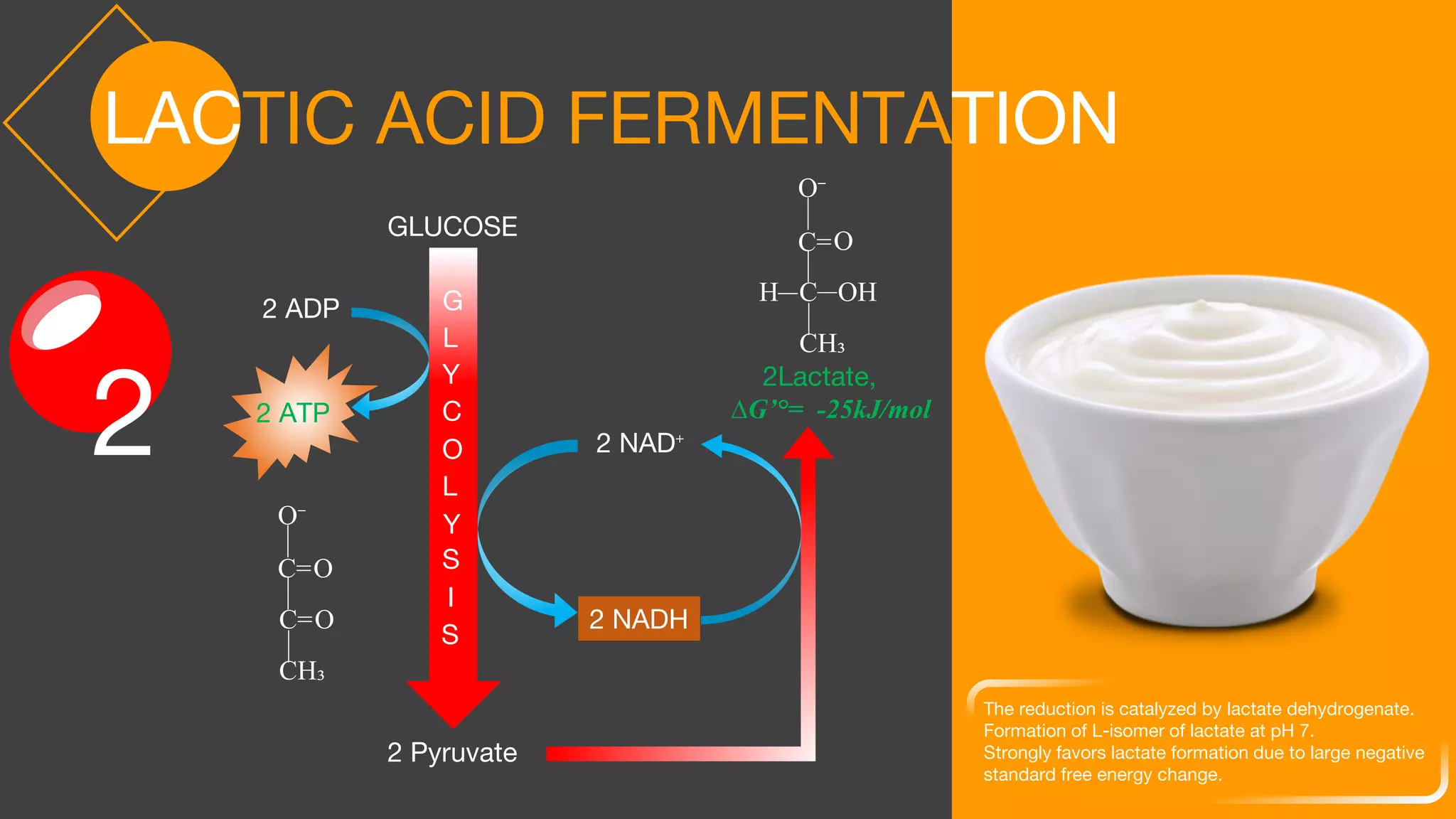
LACTIC ACID FERMENTATION
2
GLUCOSE
2 ADP G
L
Y
C
O
L
Y
S
I
S
O⁻
C=O
C=O
CH₃
2 Pyruvate
2 NAD⁺
2 NADH
O⁻
C=O
H C OH
CH₃
2 ATP
2Lactate,
∆G’°= -25kJ/mol
The reduction is catalyzed by lactate dehydrogenate.
Formation of L-isomer of lactate at pH 7.
Strongly favors lactate formation due to large negative
standard free energy change.
cORI CYCLE
Glucose
Glucose 6-phosphate
Pyruvate
Glycogen
Lactate
Urea
-NH₂
Alanine
Glucose 6-phosphateGlycogen
Lactate Pyruvate
Alanine
-NH₂
Lactate
BLOOD
Pyruvate
Alanine
ALCOHOL FERMENTATION
2 ADP + 2 P¡ 2 ATP
Glucose GLYCOLYSIS
O⁻
C=O
C=O
CH₃
2 Pyruvate
2 NAD⁺ 2 NADH
H H
C OH C=O
CH₃ CH₃
H
ETHANOL 2 Acetaldehyde
+ 2H₊
In all fermentation reaction, the H:C ratio of the
reactants and products are same
Glucose C₆H₁₂O₆ : 12/6=2
Lactic acid C₃H₆O₃ : 6/3=2
Glucose : 2
Ethanol: 12/6=2
2 CO₂
TPP, Mg ²⁺
Pyruvate decarboxylase
Alcohol dehydrogenase
PYROPHOSPHATE
VITAMIN B1
P O ¯
O ¯O ˉ
OO P
O O
CH₂CH₂
CH₂

C
H
H₃C
S
N
N
NH₂
H₃C
N
Thiamine pyrophosphate have “Active Acetaldehyde
group”.
Coenzyme derived from Vitamin B1
Plays an important role in the cleavage of bonds
adjacent to a carbonyl group.
Functional part of TPP, the thiazolium ring, has a
relatively acidic portion at C-2.
THIAMINE
THIAMINE PYROPHOSPHATE
M E C H A N I S M
H
C
N⁺R S
R’
CH₃
TPP
CCH₃
O
H
C
C
N⁺R
S
R’
CH₃
CH₃ O H
H
H⁺
C¯
C
N⁺R
S
R’
CH₃ OH
CH₃
Acetaldehyde
4
3
Hydroxyethyl
TPP
Resonance
stabilization
C
N⁺R
R’
CH₃
S
ˉ
TPP carbanion
C
O
O¯
C
CH₃
O
Pyruvate
1
H⁺
C
N⁺R
R’
CH₃
C
O
Oˉ
CCH₃
OH
CO₂
2
C
C
SN:R
R’
CH₃
CH₃ OH
H⁺
H⁺
5
Loss of proton produces a carbanion that is active
species in TPP-dependent reactions.
The carbanion readily adds to carbonyl groups , and
the thiazolium ring is thereby positioned to act as an
“electron sink” that greatly facilitates reactions such
as the decarboxylation catalyzed by pyruvate
decarboxylase.
MICROORGANISMS
ARE THE BEST CHOICE FOR FERMENTATION
Microscopic and
metabolic
characteristics
High surface
area to volume
ratio
Mode of
nutrients
transport
Genetic
adaptability
Metabolic
diversity
APPLICATIONS
LACTIC ACID BACTERIA
Sauerkraut Lettuce kraut
Coffee beans Vanilla beans
Unripen cheese- Cottage, Pot, Cream cheese
Mysost Ricotta
LACTIC ACID BACTERIA &
other microorganism bacteria
LACTOCOCCUS LACTIS
Swiss cheese
From Milk and
propinicacid bacteria
Sourdough Bread
From Yeast & cereal products like wheat
Ginger beer
From yeast and ginger
ACETIC ACID BACTERIA
Cider Honey
Wine Malt
YEASTS
Beer, Stout,
and Ale from
Malted grains
Wine &
Vermouth
from Fruits
Rum from
Molasses
Cacao bean citron
from Yeast and
Acetic acid bacteria
FUNGI & MOLD
Fungi may be the food, or may make the food edible following processing.
Processing may make it possible to consume the foodstuff by adding, modifying or
removing components, including flavors, nutritional elements such as vitamins or
colors to enhance the appeal of the food.
Fungi are a common contributor to the processing of foods. Their use dates back to
the start of the civilization, when breads and wines were first made deliberately.
These days, the selection and use of fungi is a highly organized field of research
and development in industry.
Molds have both positive and negative effects on the food
industry the same way that yeasts do. Some molds are
perfectly safe to eat and, in some cases, even desirable (the
classic example would be cheese made with mold, such as
blue, Brie, Camembert, and Gorgonzola).
Candida in Colliculus
fungus kefir
Soya sauce from
soya bean by koji
pores
Penicillium
CONTROLLINGFACTORS IN INDUSTRIAL FERMENTATION
Acid Levels
Amount of
Alcohol
Use of
Starters
Temperature
2OXYGEN
Salt
AS DIRECT FOODS
MICROORGANISMS
Single cell Protein(SCP)
designate high-protein
food compared to yeasts
and other
microorganisms
Saccharomyces cerevisiae or
saccharomyces uvarum has
leavening property, source of
nutrients, hydrolyzed plant
tissues, cheese , whey,
ethanol etc.
Yeast cells delivers proteins,
nucleic acid
Kefir
Improves immune
response
Indonesian tempeh (soya bean)
Reduce cholesterol
Gundruk (Nepal)
Prevent cancer, contain lactic
acids, Vitamin C, carotene, fibers
Kimchi (Korean)
Constipation& colon canes,
anti-stress, lowers cholesterol,
obesity, liver disease
Bhaati jaanr fermented (Rice)
Himalaya
Increase strength of women after
child birth
Koumiss
(dairy product)
Pulmonary tuberculosis
Natto (soya bean) reduce
brain hemorrhage (Vit K2),
osteroposis
Products & Uses
PROBIOTICS & its effects
Bifidobacteria
species
Incidence of
neonatal
necrotizing
enterocolitis
Enterococcus
faecium
Duration of acute
diarrhea
Lactobacillus strains
Lactose digestion Diarrhea in
lactose
intolerants
Mucosal
immune
function,
mucin
secretion
PROBIOTICS & its effects
Bacteroides
species
Chronic colitis,
gastritis and arthritis
Saccharomyces boulardii
Recurrence of clostridium, difficile
diarrhea, antibiotic associated
diarrhea, functional diarrhea in
irritable bowel syndrome
PROBIOTICS & its effects
Lactobacillus plantarum
Diarrhea Inflammation,
pain,
Constipation in
inflammatory bowel
diseases, bloating,
flatulence
Lactobacillus
Reuteri
Duration of acute
gastroenteritis
Lactobacillus
Rhamnosus
Cellular immunity
Lactobacillus
salivarius
Suppress & eradicate
helicobacter pylon in
tissue culture and
animal models by
lactic acid secretion
Genetic engineering
Human have been breeding food animal, plants and microorganisms in order to improve characteristic
such as yield, diseases resistance, appearance, processing attributes and fermentation characteristics.
Conventional breeding & mutation Selection of desirable traits Non predictable nor successful
time consuming
Genetic engineering, recombinant DNA
techniques, cell hybridization,
spheroplast or protoplast fusion &
other methods
Cells of one
organism
Cells of other
organism
Specific functions
Animals, plants&
microorganisms
Genes from human cells
[tells the pancreases to
make insulin]
bacteria
transfer
genes
Able to
make
insulin
Insulin
collected
purified
Treats
diabetes
Unfortunately, consumption of fermented food is repressed by modern life style and growing
popularity of fast food.
It is shame! fermented food is not just tasty but extremely healthy, nutritious and important
for well being of our body.
http://medicallabtechno.weebly.com/uploads/7/5/1/5/7515789/yogurt_productio
n.pdf
http://ijariie.com/AdminUploadPdf/Production_of_acetic_acid_from_molasses_by
_fermentation_process_IJARIIE1133_volume_1_11_page_58_60.pdf
https://www.elcamino.edu/faculty/pdoucette/21B-Metabolism-TCA-figures-
new.pdf
http://onlinelibrary.wiley.com/doi/10.1016/0307-4412(85)90068-8/pdf
http://www1.esb.ucp.pt/twt/olimpiadasbio07/MyFiles/MyAutoSiteFiles/FontesInfo
rmacao253906202/samorais/Fermentation.pdf
https://www.eolss.net/Sample-Chapters/C10/E5-08-06-01.pdf
http://www.biotechnologyforums.com/thread-1769.html
https://www.ncbi.nlm.nih.gov/pubmed/11157344
http://citeseerx.ist.psu.edu/viewdoc/download?doi=10.1.1.608.4453&rep=rep1&ty
pe=pdf
https://www.princeton.edu/~ota/disk3/1981/8115/811505.PDF
REFERENCE
Fermentation in microorganism

Fermentation in microorganism

  • 1.
    FERMENTATION IN MICROORGANISMS -PRIYANKAPADHI 16MSLSBC11 CENTRE FOR BIOCHEMISTRY & MICROBIAL SCIENCES
  • 2.
    Fermentation may havebeen a better invention than fire. -David Wallace
  • 3.
    CONTENT Introduction-fermentation History of fermentation Typesof fermentation: Lactic acid fermentation Alcoholic fermentation Microorganism are the best choice –Why? Applications Controlling factors in industrial fermentation Microorganisms as direct food Products and its uses Probiotics and its effects Genetic engineering in fermentation Conclusion Reference Greeting
  • 4.
    FERMENTATION Fermentation is anatural process, occurs when microorganisms consume susceptible organic substrate as part of their own metabolic processes. Also referred to the bulk growth of microorganisms in a growth medium with the goal of producing a specific chemical product. The science of fermentation is called zymology. It mainly takes place when the electron transport chain unusable. Extract energy but do not consume O₂ or change the concentration of NAD⁺ or NADH.
  • 5.
    The use offermentation starts might very well have its origins in the process of Euchok, the daughter of the legendary king of Woo of 4000 BC, known as the Goddess of rice wine in Chinese culture. Understanding of scientific procedure of fermentation microbiology began in 1850s, after Louis Pasteur, who has succeed in producing two forms of amyls alcohol by fermentation. Between 1900 and 1930, ethyl alcohol and butyl alcohol are the most important industrial fermentations in the word. But by the 1960s, chemical synthesis of alcohol and other solvents were less expensive and interest in fermentations diminished.
  • 6.
  • 7.
    LACTIC ACID FERMENTATION 2 NAD⁺NADH + H⁺ O⁻ S CoA C=O C=O C=O CH₃ CH₃ CO₂ Coenzyme APyruvate Acetyl CoA Transport Protein 1 2 3 When aerobic conditions occurs pyruvate is oxidized to acetate which enters the citric acid cycle to produce CO₂, H₂O and NADH ultimately reoxidised to NAD⁺ by passage of its e⁻ to O₂ in mitochondrial respiration. CYTOSOL MITOCHONDRION
  • 8.
    LACTIC ACID FERMENTATION 2 GLUCOSE 2ADP G L Y C O L Y S I S O⁻ C=O C=O CH₃ 2 Pyruvate 2 NAD⁺ 2 NADH O⁻ C=O H C OH CH₃ 2 ATP 2Lactate, ∆G’°= -25kJ/mol The reduction is catalyzed by lactate dehydrogenate. Formation of L-isomer of lactate at pH 7. Strongly favors lactate formation due to large negative standard free energy change.
  • 9.
    cORI CYCLE Glucose Glucose 6-phosphate Pyruvate Glycogen Lactate Urea -NH₂ Alanine Glucose6-phosphateGlycogen Lactate Pyruvate Alanine -NH₂ Lactate BLOOD Pyruvate Alanine
  • 10.
    ALCOHOL FERMENTATION 2 ADP+ 2 P¡ 2 ATP Glucose GLYCOLYSIS O⁻ C=O C=O CH₃ 2 Pyruvate 2 NAD⁺ 2 NADH H H C OH C=O CH₃ CH₃ H ETHANOL 2 Acetaldehyde + 2H₊ In all fermentation reaction, the H:C ratio of the reactants and products are same Glucose C₆H₁₂O₆ : 12/6=2 Lactic acid C₃H₆O₃ : 6/3=2 Glucose : 2 Ethanol: 12/6=2 2 CO₂ TPP, Mg ²⁺ Pyruvate decarboxylase Alcohol dehydrogenase
  • 11.
    PYROPHOSPHATE VITAMIN B1 P O¯ O ¯O ˉ OO P O O CH₂CH₂ CH₂  C H H₃C S N N NH₂ H₃C N Thiamine pyrophosphate have “Active Acetaldehyde group”. Coenzyme derived from Vitamin B1 Plays an important role in the cleavage of bonds adjacent to a carbonyl group. Functional part of TPP, the thiazolium ring, has a relatively acidic portion at C-2. THIAMINE
  • 12.
    THIAMINE PYROPHOSPHATE M EC H A N I S M H C N⁺R S R’ CH₃ TPP CCH₃ O H C C N⁺R S R’ CH₃ CH₃ O H H H⁺ C¯ C N⁺R S R’ CH₃ OH CH₃ Acetaldehyde 4 3 Hydroxyethyl TPP Resonance stabilization C N⁺R R’ CH₃ S ˉ TPP carbanion C O O¯ C CH₃ O Pyruvate 1 H⁺ C N⁺R R’ CH₃ C O Oˉ CCH₃ OH CO₂ 2 C C SN:R R’ CH₃ CH₃ OH H⁺ H⁺ 5 Loss of proton produces a carbanion that is active species in TPP-dependent reactions. The carbanion readily adds to carbonyl groups , and the thiazolium ring is thereby positioned to act as an “electron sink” that greatly facilitates reactions such as the decarboxylation catalyzed by pyruvate decarboxylase.
  • 13.
    MICROORGANISMS ARE THE BESTCHOICE FOR FERMENTATION Microscopic and metabolic characteristics High surface area to volume ratio Mode of nutrients transport Genetic adaptability Metabolic diversity
  • 14.
  • 15.
    LACTIC ACID BACTERIA SauerkrautLettuce kraut Coffee beans Vanilla beans Unripen cheese- Cottage, Pot, Cream cheese Mysost Ricotta
  • 16.
    LACTIC ACID BACTERIA& other microorganism bacteria LACTOCOCCUS LACTIS Swiss cheese From Milk and propinicacid bacteria Sourdough Bread From Yeast & cereal products like wheat Ginger beer From yeast and ginger
  • 17.
  • 18.
    YEASTS Beer, Stout, and Alefrom Malted grains Wine & Vermouth from Fruits Rum from Molasses Cacao bean citron from Yeast and Acetic acid bacteria
  • 19.
    FUNGI & MOLD Fungimay be the food, or may make the food edible following processing. Processing may make it possible to consume the foodstuff by adding, modifying or removing components, including flavors, nutritional elements such as vitamins or colors to enhance the appeal of the food. Fungi are a common contributor to the processing of foods. Their use dates back to the start of the civilization, when breads and wines were first made deliberately. These days, the selection and use of fungi is a highly organized field of research and development in industry. Molds have both positive and negative effects on the food industry the same way that yeasts do. Some molds are perfectly safe to eat and, in some cases, even desirable (the classic example would be cheese made with mold, such as blue, Brie, Camembert, and Gorgonzola). Candida in Colliculus fungus kefir Soya sauce from soya bean by koji pores Penicillium
  • 20.
    CONTROLLINGFACTORS IN INDUSTRIALFERMENTATION Acid Levels Amount of Alcohol Use of Starters Temperature 2OXYGEN Salt
  • 21.
    AS DIRECT FOODS MICROORGANISMS Singlecell Protein(SCP) designate high-protein food compared to yeasts and other microorganisms Saccharomyces cerevisiae or saccharomyces uvarum has leavening property, source of nutrients, hydrolyzed plant tissues, cheese , whey, ethanol etc. Yeast cells delivers proteins, nucleic acid
  • 22.
    Kefir Improves immune response Indonesian tempeh(soya bean) Reduce cholesterol Gundruk (Nepal) Prevent cancer, contain lactic acids, Vitamin C, carotene, fibers Kimchi (Korean) Constipation& colon canes, anti-stress, lowers cholesterol, obesity, liver disease Bhaati jaanr fermented (Rice) Himalaya Increase strength of women after child birth Koumiss (dairy product) Pulmonary tuberculosis Natto (soya bean) reduce brain hemorrhage (Vit K2), osteroposis Products & Uses
  • 23.
    PROBIOTICS & itseffects Bifidobacteria species Incidence of neonatal necrotizing enterocolitis Enterococcus faecium Duration of acute diarrhea Lactobacillus strains Lactose digestion Diarrhea in lactose intolerants Mucosal immune function, mucin secretion
  • 24.
    PROBIOTICS & itseffects Bacteroides species Chronic colitis, gastritis and arthritis Saccharomyces boulardii Recurrence of clostridium, difficile diarrhea, antibiotic associated diarrhea, functional diarrhea in irritable bowel syndrome
  • 25.
    PROBIOTICS & itseffects Lactobacillus plantarum Diarrhea Inflammation, pain, Constipation in inflammatory bowel diseases, bloating, flatulence Lactobacillus Reuteri Duration of acute gastroenteritis Lactobacillus Rhamnosus Cellular immunity Lactobacillus salivarius Suppress & eradicate helicobacter pylon in tissue culture and animal models by lactic acid secretion
  • 26.
    Genetic engineering Human havebeen breeding food animal, plants and microorganisms in order to improve characteristic such as yield, diseases resistance, appearance, processing attributes and fermentation characteristics. Conventional breeding & mutation Selection of desirable traits Non predictable nor successful time consuming Genetic engineering, recombinant DNA techniques, cell hybridization, spheroplast or protoplast fusion & other methods Cells of one organism Cells of other organism Specific functions Animals, plants& microorganisms Genes from human cells [tells the pancreases to make insulin] bacteria transfer genes Able to make insulin Insulin collected purified Treats diabetes
  • 27.
    Unfortunately, consumption offermented food is repressed by modern life style and growing popularity of fast food. It is shame! fermented food is not just tasty but extremely healthy, nutritious and important for well being of our body.
  • 28.