HOW TO CHOOSE A
PROJECT DELIVERY
METHOD
By PMA Consultants
2
AGENDA
01
Overview of Delivery Methods
Definitions of DBB, DB, and CMaR.
04
Best Practices in Using Each Method
Tips on how to manage under each method on
a day-to-day basis.
02
Evaluation of Each Method
Comparative analysis of the pros/cons of each.
03
When to Use Each Method
Discussion of the types of projects best suited to
each method.
05
Introductions
About us, PMA, and you.
1. OVERVIEW OF
DELIVERY METHODS
Definitions of DBB, DB, and CMaR.
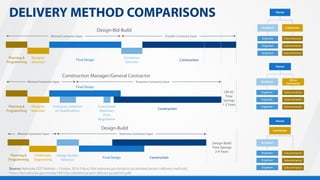
DELIVERY METHOD COMPARISONS
Construction Manager/General Contractor
Minimal Contractor Input Extensive Contractor Input
Contractor Selection
on Qualifications
Construction
Final Design
Designer
Selection
Planning &
Programming
Guaranteed
Maximum
Price
Negotiation
CM-GC
Time
Savings
1-2 Years
Design-Build
Minimal Contractor Input Extensive Contractor Input
Design-Builder
Selection
ConstructionFinal Design
Preliminary
Engineering
Planning &
Programming
Design-Build
Time Savings
3-4 Years
Design-Bid-Build
Minimal Contractor Input Possible Contractor Input
Contractor
Selection
ConstructionFinal Design
Designer
Selection
Planning &
Programming
Owner
ContractorArchitect
Subcontractor
Subcontractor
Subcontractor
Engineer
Engineer
Engineer
Owner
CM as
Contractor
Architect
Subcontractor
Subcontractor
Subcontractor
Engineer
Engineer
Engineer
Owner
Contractor
Architect
Engineer
Engineer
Engineer
Subcontractor
Subcontractor
SubcontractorSource: Nebraska DOT Website – October 2016 (https://dot.nebraska.gov/projects/accelerated-project-delivery-methods/;
https://dot.nebraska.gov/media/10010/accelerated-project-delivery-guidelines.pdf)
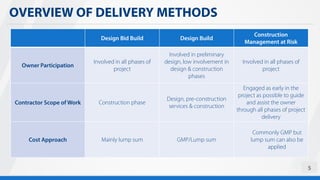
OVERVIEW OF DELIVERY METHODS
5
Design Bid Build Design Build
Construction
Management at Risk
Owner Participation
Involved in all phases of
project
Involved in preliminary
design, low involvement in
design & construction
phases
Involved in all phases of
project
Contractor Scope of Work Construction phase
Design, pre-construction
services & construction
Engaged as early in the
project as possible to guide
and assist the owner
through all phases of project
delivery
Cost Approach Mainly lump sum GMP/Lump sum
Commonly GMP but
lump sum can also be
applied
6
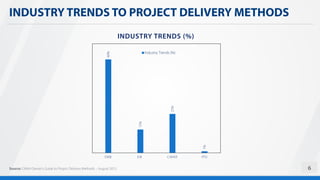
INDUSTRY TRENDS TO PROJECT DELIVERY METHODS
60%
15%
25%
1%
DBB DB CMAR IPD
INDUSTRY TRENDS (%)
Industry Trends (%)
Source: CMAA Owner’s Guide to Project Delivery Methods – August 2012
2. EVALUATION OF
EACH METHOD
Comparative analysis of the pros/cons of each.
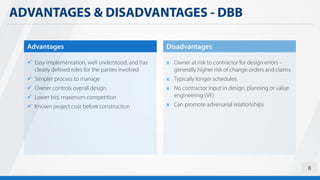
ADVANTAGES & DISADVANTAGES - DBB
8
Advantages
 Easy implementation, well understood, and has
clearly defined roles for the parties involved
 Simpler process to manage
 Owner controls overall design
 Lower bid, maximum competition
 Known project cost before construction
Disadvantages
x Owner at risk to contractor for design errors –
generally higher risk of change orders and claims
x Typically longer schedules
x No contractor input in design, planning or value
engineering (VE)
x Can promote adversarial relationships
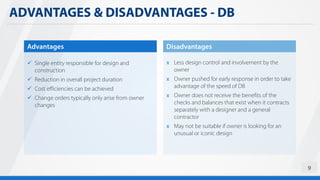
ADVANTAGES & DISADVANTAGES - DB
9
Advantages
 Single entity responsible for design and
construction
 Reduction in overall project duration
 Cost efficiencies can be achieved
 Change orders typically only arise from owner
changes
Disadvantages
x Less design control and involvement by the
owner
x Owner pushed for early response in order to take
advantage of the speed of DB
x Owner does not receive the benefits of the
checks and balances that exist when it contracts
separately with a designer and a general
contractor
x May not be suitable if owner is looking for an
unusual or iconic design
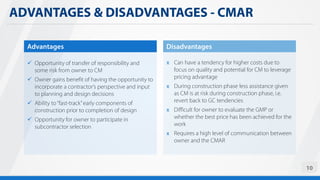
ADVANTAGES & DISADVANTAGES - CMAR
10
Advantages
 Opportunity of transfer of responsibility and
some risk from owner to CM
 Owner gains benefit of having the opportunity to
incorporate a contractor’s perspective and input
to planning and design decisions
 Ability to“fast-track”early components of
construction prior to completion of design
 Opportunity for owner to participate in
subcontractor selection
Disadvantages
x Can have a tendency for higher costs due to
focus on quality and potential for CM to leverage
pricing advantage
x During construction phase less assistance given
as CM is at risk during construction phase, i.e.
revert back to GC tendencies
x Difficult for owner to evaluate the GMP or
whether the best price has been achieved for the
work
x Requires a high level of communication between
owner and the CMAR
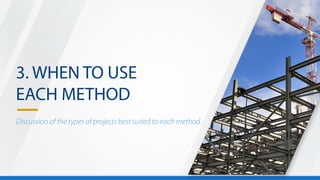
3. WHEN TO USE
EACH METHOD
Discussion of the types of projects best suited to each method.
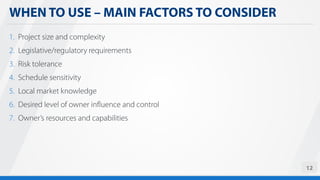
WHEN TO USE – MAIN FACTORS TO CONSIDER
12
1. Project size and complexity
2. Legislative/regulatory requirements
3. Risk tolerance
4. Schedule sensitivity
5. Local market knowledge
6. Desired level of owner influence and control
7. Owner’s resources and capabilities
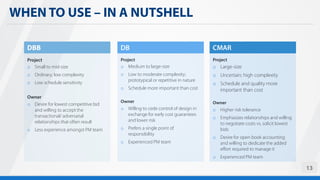
WHEN TO USE – IN A NUTSHELL
13
DBB
Project
o Small to mid-size
o Ordinary; low complexity
o Low schedule sensitivity
Owner
o Desire for lowest competitive bid
and willing to accept the
transactional/ adversarial
relationships that often result
o Less experience amongst PM team
DB
Project
o Medium to large-size
o Low to moderate complexity;
prototypical or repetitive in nature
o Schedule more important than cost
Owner
o Willing to cede control of design in
exchange for early cost guarantees
and lower risk
o Prefers a single point of
responsibility
o Experienced PM team
CMAR
Project
o Large-size
o Uncertain; high complexity
o Schedule and quality more
important than cost
Owner
o Higher risk tolerance
o Emphasizes relationships and willing
to negotiate costs vs. solicit lowest
bids
o Desire for open book accounting
and willing to dedicate the added
effort required to manage it
o Experienced PM team
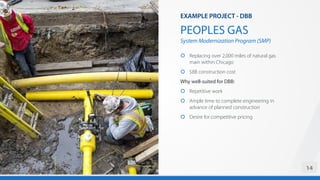
PEOPLES GAS
System Modernization Program (SMP)
14
EXAMPLE PROJECT - DBB
 Replacing over 2,000 miles of natural gas
main within Chicago
 $8B construction cost
Why well-suited for DBB:
 Repetitive work
 Ample time to complete engineering in
advance of planned construction
 Desire for competitive pricing
MONADNOCK HALL
Southern New Hampshire University
15
EXAMPLE PROJECT - DB
 300-bed dormitory
 100,000 square feet
 $34M total cost
 19 month duration
Why well-suited for DB:
 Tight timeline
 Viewed as a typical project
 Owner was able to retain some involvement
in design through design progress meetings
and submittals
UNIVERSITY OF CHICAGO
Center for Care and Discovery
16
EXAMPLE PROJECT - CMAR
 State-of-the-art facilities for advanced surgery,
cancer, interventional radiology and
gastroenterology, neuroscience, and high-tech
imaging
 1.1M square feet
 $700M construction cost
Why well-suited for CMAR:
 Very large project
 High complexity
 Commitment to quality
 Schedule-driven
 Organization with sustained capital portfolio that
is able to develop repeat vendor relationships
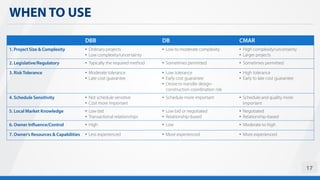
WHEN TO USE
17
DBB DB CMAR
1. Project Size & Complexity • Ordinary projects
• Low complexity/uncertainty
• Low to moderate complexity • High complexity/uncertainty
• Larger projects
2. Legislative/Regulatory • Typically the required method • Sometimes permitted • Sometimes permitted
3. Risk Tolerance • Moderate tolerance
• Late cost guarantee
• Low tolerance
• Early cost guarantee
• Desire to transfer design-
construction coordination risk
• High tolerance
• Early to late cost guarantee
4. Schedule Sensitivity • Not schedule sensitive
• Cost more important
• Schedule more important • Schedule and quality more
important
5. Local Market Knowledge • Low bid
• Transactional relationships
• Low bid or negotiated
• Relationship-based
• Negotiated
• Relationship-based
6. Owner Influence/Control • High • Low • Moderate to high
7. Owner’s Resources & Capabilities • Less experienced • More experienced • More experienced
4. BEST PRACTICES IN
USING EACH METHOD
Tips on how to manage under each method on a day-to-day
basis
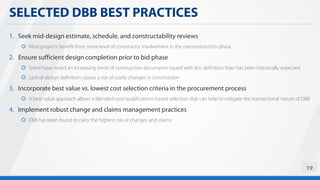
SELECTED DBB BEST PRACTICES
19
1. Seek mid-design estimate, schedule, and constructability reviews
 Most projects benefit from some level of constructor involvement in the preconstruction phase
2. Ensure sufficient design completion prior to bid phase
 Some have noted an increasing trend of construction documents issued with less definition than has been historically expected
 Lack of design definition causes a risk of costly changes in construction
3. Incorporate best value vs. lowest cost selection criteria in the procurement process
 A best value approach allows a blended cost/qualifications-based selection that can help to mitigate the transactional nature of DBB
4. Implement robust change and claims management practices
 DBB has been found to carry the highest risk of changes and claims
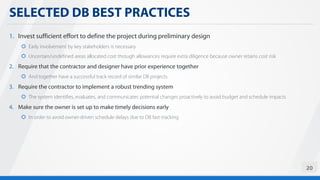
SELECTED DB BEST PRACTICES
20
1. Invest sufficient effort to define the project during preliminary design
 Early involvement by key stakeholders is necessary
 Uncertain/undefined areas allocated cost through allowances require extra diligence because owner retains cost risk
2. Require that the contractor and designer have prior experience together
 And together have a successful track record of similar DB projects
3. Require the contractor to implement a robust trending system
 The system identifies, evaluates, and communicates potential changes proactively to avoid budget and schedule impacts
4. Make sure the owner is set up to make timely decisions early
 In order to avoid owner-driven schedule delays due to DB fast-tracking
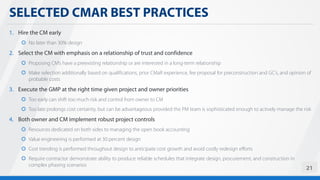
SELECTED CMAR BEST PRACTICES
21
1. Hire the CM early
 No later than 30% design
2. Select the CM with emphasis on a relationship of trust and confidence
 Proposing CM’s have a preexisting relationship or are interested in a long-term relationship
 Make selection additionally based on qualifications, prior CMaR experience, fee proposal for preconstruction and GC’s, and opinion of
probable costs
3. Execute the GMP at the right time given project and owner priorities
 Too early can shift too much risk and control from owner to CM
 Too late prolongs cost certainty, but can be advantageous provided the PM team is sophisticated enough to actively manage the risk
4. Both owner and CM implement robust project controls
 Resources dedicated on both sides to managing the open book accounting
 Value engineering is performed at 30 percent design
 Cost trending is performed throughout design to anticipate cost growth and avoid costly redesign efforts
 Require contractor demonstrate ability to produce reliable schedules that integrate design, procurement, and construction in
complex phasing scenarios
5. INTRODUCTIONS
About us, PMA, and you.
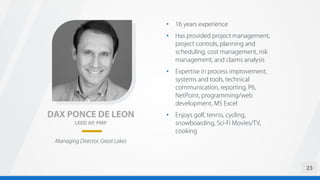
DAX PONCE DE LEON
LEED AP, PMP
• 16 years experience
• Has provided project management,
project controls, planning and
scheduling, cost management, risk
management, and claims analysis
• Expertise in process improvement,
systems and tools, technical
communication, reporting, P6,
NetPoint, programming/web
development, MS Excel
• Enjoys golf, tennis, cycling,
snowboarding, Sci-Fi Movies/TV,
cooking
23
Managing Director, Great Lakes
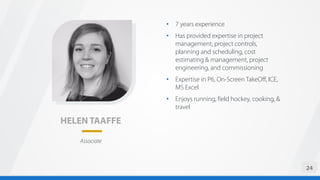
HELEN TAAFFE
• 7 years experience
• Has provided expertise in project
management, project controls,
planning and scheduling, cost
estimating & management, project
engineering, and commissioning
• Expertise in P6, On-Screen TakeOff, ICE,
MS Excel
• Enjoys running, field hockey, cooking, &
travel
24
Associate
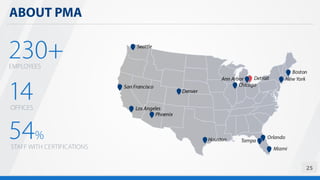
ABOUT PMA
25
230+EMPLOYEES
14OFFICES
54%
STAFF WITH CERTIFICATIONS
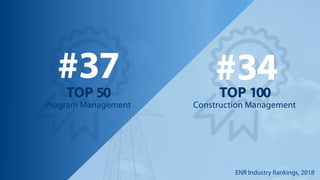
ENR Industry Rankings, 2018
TOP 100
Construction Management
#34TOP 50
Program Management
#37
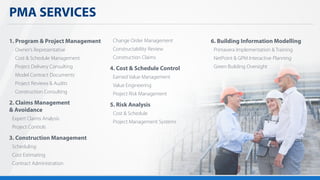
1. Program & Project Management
Owner’s Representative
Cost & Schedule Management
Project Delivery Consulting
Model Contract Documents
Project Reviews & Audits
Construction Consulting
2. Claims Management
& Avoidance
Expert Claims Analysis
Project Controls
3. Construction Management
Scheduling
Cost Estimating
Contract Administration
Change Order Management
Constructability Review
Construction Claims
4. Cost & Schedule Control
Earned Value Management
Value Engineering
Project Risk Management
5. Risk Analysis
Cost & Schedule
Project Management Systems
6. Building Information Modelling
Primavera Implementation & Training
NetPoint & GPM Interactive Planning
Green Building Oversight
PMA SERVICES
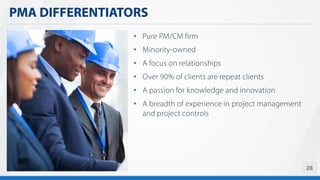
• Pure PM/CM firm
• Minority-owned
• A focus on relationships
• Over 90% of clients are repeat clients
• A passion for knowledge and innovation
• A breadth of experience in project management
and project controls
PMA DIFFERENTIATORS
28
CONTACT US TO LEARN MORE
Dax Ponce de Leon, LEED AP, PMP
Managing Director – Great Lakes
dax@pmaconsultants.com
Helen Taaffe
Associate
htaaffe@pmaconsultants.com

How to Choose a Project Delivery Method

  • 1.
    HOW TO CHOOSEA PROJECT DELIVERY METHOD By PMA Consultants
  • 2.
    2 AGENDA 01 Overview of DeliveryMethods Definitions of DBB, DB, and CMaR. 04 Best Practices in Using Each Method Tips on how to manage under each method on a day-to-day basis. 02 Evaluation of Each Method Comparative analysis of the pros/cons of each. 03 When to Use Each Method Discussion of the types of projects best suited to each method. 05 Introductions About us, PMA, and you.
  • 3.
    1. OVERVIEW OF DELIVERYMETHODS Definitions of DBB, DB, and CMaR.
  • 4.
    DELIVERY METHOD COMPARISONS ConstructionManager/General Contractor Minimal Contractor Input Extensive Contractor Input Contractor Selection on Qualifications Construction Final Design Designer Selection Planning & Programming Guaranteed Maximum Price Negotiation CM-GC Time Savings 1-2 Years Design-Build Minimal Contractor Input Extensive Contractor Input Design-Builder Selection ConstructionFinal Design Preliminary Engineering Planning & Programming Design-Build Time Savings 3-4 Years Design-Bid-Build Minimal Contractor Input Possible Contractor Input Contractor Selection ConstructionFinal Design Designer Selection Planning & Programming Owner ContractorArchitect Subcontractor Subcontractor Subcontractor Engineer Engineer Engineer Owner CM as Contractor Architect Subcontractor Subcontractor Subcontractor Engineer Engineer Engineer Owner Contractor Architect Engineer Engineer Engineer Subcontractor Subcontractor SubcontractorSource: Nebraska DOT Website – October 2016 (https://dot.nebraska.gov/projects/accelerated-project-delivery-methods/; https://dot.nebraska.gov/media/10010/accelerated-project-delivery-guidelines.pdf)
  • 5.
    OVERVIEW OF DELIVERYMETHODS 5 Design Bid Build Design Build Construction Management at Risk Owner Participation Involved in all phases of project Involved in preliminary design, low involvement in design & construction phases Involved in all phases of project Contractor Scope of Work Construction phase Design, pre-construction services & construction Engaged as early in the project as possible to guide and assist the owner through all phases of project delivery Cost Approach Mainly lump sum GMP/Lump sum Commonly GMP but lump sum can also be applied
  • 6.
    6 INDUSTRY TRENDS TOPROJECT DELIVERY METHODS 60% 15% 25% 1% DBB DB CMAR IPD INDUSTRY TRENDS (%) Industry Trends (%) Source: CMAA Owner’s Guide to Project Delivery Methods – August 2012
  • 7.
    2. EVALUATION OF EACHMETHOD Comparative analysis of the pros/cons of each.
  • 8.
    ADVANTAGES & DISADVANTAGES- DBB 8 Advantages  Easy implementation, well understood, and has clearly defined roles for the parties involved  Simpler process to manage  Owner controls overall design  Lower bid, maximum competition  Known project cost before construction Disadvantages x Owner at risk to contractor for design errors – generally higher risk of change orders and claims x Typically longer schedules x No contractor input in design, planning or value engineering (VE) x Can promote adversarial relationships
  • 9.
    ADVANTAGES & DISADVANTAGES- DB 9 Advantages  Single entity responsible for design and construction  Reduction in overall project duration  Cost efficiencies can be achieved  Change orders typically only arise from owner changes Disadvantages x Less design control and involvement by the owner x Owner pushed for early response in order to take advantage of the speed of DB x Owner does not receive the benefits of the checks and balances that exist when it contracts separately with a designer and a general contractor x May not be suitable if owner is looking for an unusual or iconic design
  • 10.
    ADVANTAGES & DISADVANTAGES- CMAR 10 Advantages  Opportunity of transfer of responsibility and some risk from owner to CM  Owner gains benefit of having the opportunity to incorporate a contractor’s perspective and input to planning and design decisions  Ability to“fast-track”early components of construction prior to completion of design  Opportunity for owner to participate in subcontractor selection Disadvantages x Can have a tendency for higher costs due to focus on quality and potential for CM to leverage pricing advantage x During construction phase less assistance given as CM is at risk during construction phase, i.e. revert back to GC tendencies x Difficult for owner to evaluate the GMP or whether the best price has been achieved for the work x Requires a high level of communication between owner and the CMAR
  • 11.
    3. WHEN TOUSE EACH METHOD Discussion of the types of projects best suited to each method.
  • 12.
    WHEN TO USE– MAIN FACTORS TO CONSIDER 12 1. Project size and complexity 2. Legislative/regulatory requirements 3. Risk tolerance 4. Schedule sensitivity 5. Local market knowledge 6. Desired level of owner influence and control 7. Owner’s resources and capabilities
  • 13.
    WHEN TO USE– IN A NUTSHELL 13 DBB Project o Small to mid-size o Ordinary; low complexity o Low schedule sensitivity Owner o Desire for lowest competitive bid and willing to accept the transactional/ adversarial relationships that often result o Less experience amongst PM team DB Project o Medium to large-size o Low to moderate complexity; prototypical or repetitive in nature o Schedule more important than cost Owner o Willing to cede control of design in exchange for early cost guarantees and lower risk o Prefers a single point of responsibility o Experienced PM team CMAR Project o Large-size o Uncertain; high complexity o Schedule and quality more important than cost Owner o Higher risk tolerance o Emphasizes relationships and willing to negotiate costs vs. solicit lowest bids o Desire for open book accounting and willing to dedicate the added effort required to manage it o Experienced PM team
  • 14.
    PEOPLES GAS System ModernizationProgram (SMP) 14 EXAMPLE PROJECT - DBB  Replacing over 2,000 miles of natural gas main within Chicago  $8B construction cost Why well-suited for DBB:  Repetitive work  Ample time to complete engineering in advance of planned construction  Desire for competitive pricing
  • 15.
    MONADNOCK HALL Southern NewHampshire University 15 EXAMPLE PROJECT - DB  300-bed dormitory  100,000 square feet  $34M total cost  19 month duration Why well-suited for DB:  Tight timeline  Viewed as a typical project  Owner was able to retain some involvement in design through design progress meetings and submittals
  • 16.
    UNIVERSITY OF CHICAGO Centerfor Care and Discovery 16 EXAMPLE PROJECT - CMAR  State-of-the-art facilities for advanced surgery, cancer, interventional radiology and gastroenterology, neuroscience, and high-tech imaging  1.1M square feet  $700M construction cost Why well-suited for CMAR:  Very large project  High complexity  Commitment to quality  Schedule-driven  Organization with sustained capital portfolio that is able to develop repeat vendor relationships
  • 17.
    WHEN TO USE 17 DBBDB CMAR 1. Project Size & Complexity • Ordinary projects • Low complexity/uncertainty • Low to moderate complexity • High complexity/uncertainty • Larger projects 2. Legislative/Regulatory • Typically the required method • Sometimes permitted • Sometimes permitted 3. Risk Tolerance • Moderate tolerance • Late cost guarantee • Low tolerance • Early cost guarantee • Desire to transfer design- construction coordination risk • High tolerance • Early to late cost guarantee 4. Schedule Sensitivity • Not schedule sensitive • Cost more important • Schedule more important • Schedule and quality more important 5. Local Market Knowledge • Low bid • Transactional relationships • Low bid or negotiated • Relationship-based • Negotiated • Relationship-based 6. Owner Influence/Control • High • Low • Moderate to high 7. Owner’s Resources & Capabilities • Less experienced • More experienced • More experienced
  • 18.
    4. BEST PRACTICESIN USING EACH METHOD Tips on how to manage under each method on a day-to-day basis
  • 19.
    SELECTED DBB BESTPRACTICES 19 1. Seek mid-design estimate, schedule, and constructability reviews  Most projects benefit from some level of constructor involvement in the preconstruction phase 2. Ensure sufficient design completion prior to bid phase  Some have noted an increasing trend of construction documents issued with less definition than has been historically expected  Lack of design definition causes a risk of costly changes in construction 3. Incorporate best value vs. lowest cost selection criteria in the procurement process  A best value approach allows a blended cost/qualifications-based selection that can help to mitigate the transactional nature of DBB 4. Implement robust change and claims management practices  DBB has been found to carry the highest risk of changes and claims
  • 20.
    SELECTED DB BESTPRACTICES 20 1. Invest sufficient effort to define the project during preliminary design  Early involvement by key stakeholders is necessary  Uncertain/undefined areas allocated cost through allowances require extra diligence because owner retains cost risk 2. Require that the contractor and designer have prior experience together  And together have a successful track record of similar DB projects 3. Require the contractor to implement a robust trending system  The system identifies, evaluates, and communicates potential changes proactively to avoid budget and schedule impacts 4. Make sure the owner is set up to make timely decisions early  In order to avoid owner-driven schedule delays due to DB fast-tracking
  • 21.
    SELECTED CMAR BESTPRACTICES 21 1. Hire the CM early  No later than 30% design 2. Select the CM with emphasis on a relationship of trust and confidence  Proposing CM’s have a preexisting relationship or are interested in a long-term relationship  Make selection additionally based on qualifications, prior CMaR experience, fee proposal for preconstruction and GC’s, and opinion of probable costs 3. Execute the GMP at the right time given project and owner priorities  Too early can shift too much risk and control from owner to CM  Too late prolongs cost certainty, but can be advantageous provided the PM team is sophisticated enough to actively manage the risk 4. Both owner and CM implement robust project controls  Resources dedicated on both sides to managing the open book accounting  Value engineering is performed at 30 percent design  Cost trending is performed throughout design to anticipate cost growth and avoid costly redesign efforts  Require contractor demonstrate ability to produce reliable schedules that integrate design, procurement, and construction in complex phasing scenarios
  • 22.
  • 23.
    DAX PONCE DELEON LEED AP, PMP • 16 years experience • Has provided project management, project controls, planning and scheduling, cost management, risk management, and claims analysis • Expertise in process improvement, systems and tools, technical communication, reporting, P6, NetPoint, programming/web development, MS Excel • Enjoys golf, tennis, cycling, snowboarding, Sci-Fi Movies/TV, cooking 23 Managing Director, Great Lakes
  • 24.
    HELEN TAAFFE • 7years experience • Has provided expertise in project management, project controls, planning and scheduling, cost estimating & management, project engineering, and commissioning • Expertise in P6, On-Screen TakeOff, ICE, MS Excel • Enjoys running, field hockey, cooking, & travel 24 Associate
  • 25.
  • 26.
    ENR Industry Rankings,2018 TOP 100 Construction Management #34TOP 50 Program Management #37
  • 27.
    1. Program &Project Management Owner’s Representative Cost & Schedule Management Project Delivery Consulting Model Contract Documents Project Reviews & Audits Construction Consulting 2. Claims Management & Avoidance Expert Claims Analysis Project Controls 3. Construction Management Scheduling Cost Estimating Contract Administration Change Order Management Constructability Review Construction Claims 4. Cost & Schedule Control Earned Value Management Value Engineering Project Risk Management 5. Risk Analysis Cost & Schedule Project Management Systems 6. Building Information Modelling Primavera Implementation & Training NetPoint & GPM Interactive Planning Green Building Oversight PMA SERVICES
  • 28.
    • Pure PM/CMfirm • Minority-owned • A focus on relationships • Over 90% of clients are repeat clients • A passion for knowledge and innovation • A breadth of experience in project management and project controls PMA DIFFERENTIATORS 28
  • 29.
    CONTACT US TOLEARN MORE Dax Ponce de Leon, LEED AP, PMP Managing Director – Great Lakes dax@pmaconsultants.com Helen Taaffe Associate htaaffe@pmaconsultants.com